
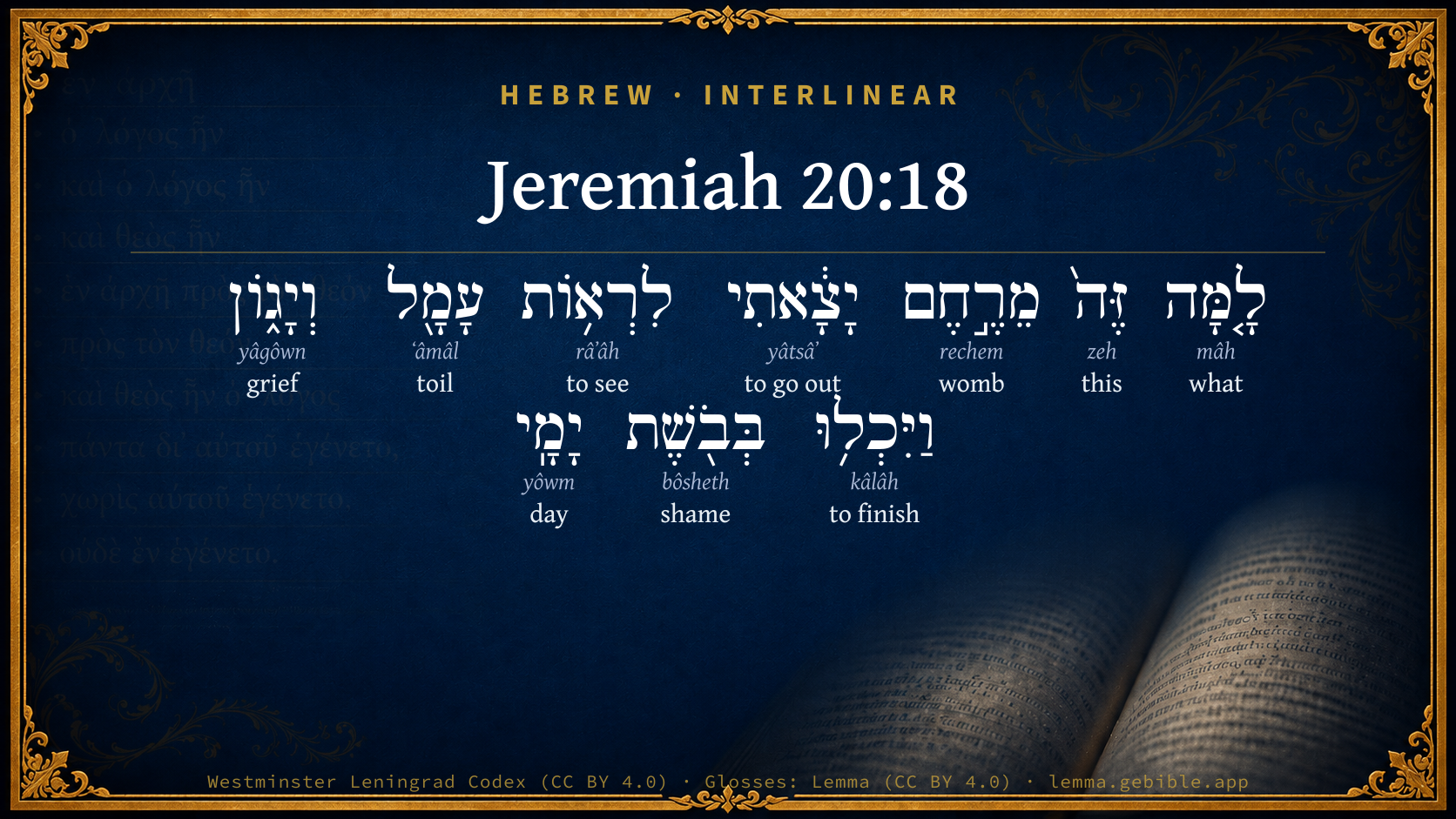
Jeremiah 20:18

Hebrew (Westminster Leningrad Codex) Jeremiah 20:18 appears in the Hebrew Old Testament. The text above is from the Westminster Leningrad Codex. Each word links to its Strong’s number, a concise gloss, and parsing drawn from the Open Scriptures Hebrew Bible morphology. Click any word for its full Brown-Driver-Briggs (BDB) entry.
Download image
Cite this verse

Jeremiah 20:18 (World English Bible). Public Domain. Lemma interlinear Bible study tool, https://lemma.gebible.app/v/jeremiah/20/18.

Show BibTeX & RIS
BibTeX
RIS
English Translation
Why came I forth out of the womb to see labor and sorrow, that my days should be consumed with shame?
World English Bible · Public Domain
Download a study sheet

One document with this verse’s original text, its word-by-word gloss line, the meaning frame, cross-references with their text, attributed commentary, and full source and license credits — printable, and it pastes into notes with its structure intact.

This verse Autodidact and up

Study sheet (.html) Plain text (.txt)

A passage Seminary Student

Up to 50 verses in one chapter. A passage sheet keeps up to 6 commentary sources and 12 cross-references per verse, in the order this page ranks them, and says so on the sheet whenever that leaves anything out. Ask for a single verse and you get the Autodidact verse sheet above.

Everything on this page stays free to read, with no account — the sheet is a download of what is already on screen, not access to it.

Want to remove ads? Support Godless Engineer
Compare translations 3

The same verse in 3 English versions, stacked beneath the original-language interlinear above. Click any original word for its lexicon entry.

Each is an independent rendering of the whole verse — the interlinear is not word-aligned to these translations.

Highlighted words mark where these versions differ — a whole-verse word diff, not a word-by-word alignment.

  • World English Bible Public Domain
    Why came I forth out of the womb to see labor and sorrow, that my days should be consumed with shame?
  • King James Version Public Domain
    Wherefore came I forth out of the womb to see labour and sorrow, that my days should be consumed with shame?
  • unfoldingWord Literal Text CC BY-SA 4.0
    Why this, from the womb I came out to see trouble and sorrow, and my days come to an end in shame.

unfoldingWord Literal Text — © unfoldingWord, licensed CC BY-SA 4.0. Word-aligned USFM3 via Door43 (git.door43.org/unfoldingWord/en_ult).

Versions to compare (up to 4)

3 of 4 selected

Show all 18 translations

Every available English version of this verse, each an independent rendering of the whole verse.

  • World English Bible Public Domain
    Why came I forth out of the womb to see labor and sorrow, that my days should be consumed with shame?
  • Berean Standard Bible Public Domain
    Why did I come out of the womb to see only trouble and sorrow, and to end my days in shame?
  • Majority Standard Bible Public Domain
    Why did I come out of the womb to see only trouble and sorrow, and to end my days in shame?
  • King James Version Public Domain
    Wherefore came I forth out of the womb to see labour and sorrow, that my days should be consumed with shame?
  • American Standard Version (1901) Public Domain
    Wherefore came I forth out of the womb to see labor and sorrow, that my days should be consumed with shame?
  • Revised Version (1885) Public Domain
    Wherefore came I forth out of the womb to see labour and sorrow, that my days should be consumed with shame?
  • Geneva Bible (1599) Public Domain
    How is it, that I came forth of the wombe, to see labour and sorowe, that my dayes shoulde be consumed with shame?
  • Douay-Rheims (1899) Public Domain
    Why came I out of the womb, to see labour and sorrow, and that my days should be spent in confusion?
  • Young's Literal Translation Public Domain
    Why `is' this? from the womb I have come out, To see labour and sorrow, Yea, consumed in shame are my days!
  • Literal Standard Version CC BY-SA 4.0
    Why [is] this? I have come out from the womb || To see labor and sorrow, || Indeed, my days are consumed in shame!
  • Unlocked Literal Bible CC BY-SA 4.0
    Why is it that I came out from the womb to see troubles and agony, so that my days are filled with shame?”
  • unfoldingWord Literal Text CC BY-SA 4.0
    Why this, from the womb I came out to see trouble and sorrow, and my days come to an end in shame.
  • Darby Bible Public Domain
    Wherefore came I forth from the womb to see labour and sorrow, that my days should be consumed in shame?
  • World Messianic Bible Public Domain
    Why did I come out of the womb to see labor and sorrow, that my days should be consumed with shame?
  • Webster's Bible Public Domain
    Why was I brought into the world to see labor and sorrow, that my days should be consumed with shame?
  • Free Bible Version CC BY-SA 4.0
    Why was I born only to see trouble and sadness, and to end my life in shame?
  • Bible in Basic English Public Domain
    Why did I come from my mother's body to see pain and sorrow, so that my days might be wasted with shame?
  • JPS Tanakh (1917) Public Domain
    Wherefore came I forth out of the womb to see labour and sorrow, that my days should be consumed in shame?

Literal Standard Version (2020), Covenant Press — licensed CC BY-SA 4.0. Text via the HelloAO Bible API (eBible.org). Unlocked Literal Bible (unfoldingWord) — licensed CC BY-SA 4.0. Text via the HelloAO Bible API (eBible.org). unfoldingWord Literal Text — © unfoldingWord, licensed CC BY-SA 4.0. Word-aligned USFM3 via Door43 (git.door43.org/unfoldingWord/en_ult). Free Bible Version, Dr. Jonathan Gallagher — licensed CC BY-SA 4.0. Text via the HelloAO Bible API (eBible.org).

Word by word

More ways to search: Search by grammar → Find every occurrence → Compare this word →

Practice this passage: Drill this verse → Learn its vocabulary →

וְיָג֑וֹן
yâgôwn
H3015
“and · grief”
Conjunction + Noun, Common, Masculine, Singular, Absolute
Part of Speech
Conjunction + Noun
Type
Common
Gender
Masculine
Number
Singular
State
Absolute
Full BDB Definition

Origin: from H3013

TWOT: 839a

grief, sorrow, anguish
  1. לָ֤מָּה mâh H4100 “to/for · what” Preposition + Particle, Interrogative
  2. זֶּה֙ zeh H2088 “this” Pronoun, Demonstrative, Masculine, Singular
  3. מֵרֶ֣חֶם rechem H7358 “from · womb” Preposition + Noun, Common, Masculine, Singular, Absolute
  4. יָצָ֔אתִי yâtsâʼ H3318 “to go out” Verb, Qal, Perfect, 1st Person, Common, Singular
  5. לִרְא֥וֹת râʼâh H7200 “to see” Preposition + Verb, Qal, Infinitive Construct
  6. עָמָ֖ל ʻâmâl H5999 “toil” Noun, Common, Both, Singular, Absolute
  7. וַיִּכְל֥וּ kâlâh H3615 “and · to finish” Conjunction + Verb, Qal, Sequential Imperfect, 3rd Person, Masculine, Plural
  8. בְּבֹ֖שֶׁת bôsheth H1322 “in/at · shame” Preposition + Noun, Common, Feminine, Singular, Absolute
  9. יָמָֽי yôwm H3117 “days · my” Noun, Common, Masculine, Plural, Construct + Suffix, Personal, 1st Person, Common, Singular

About this verse

These counts appear in no published source. They are computed here, from the morphology-tagged text and Lemma’s own curated glosses. What Lemma adds →

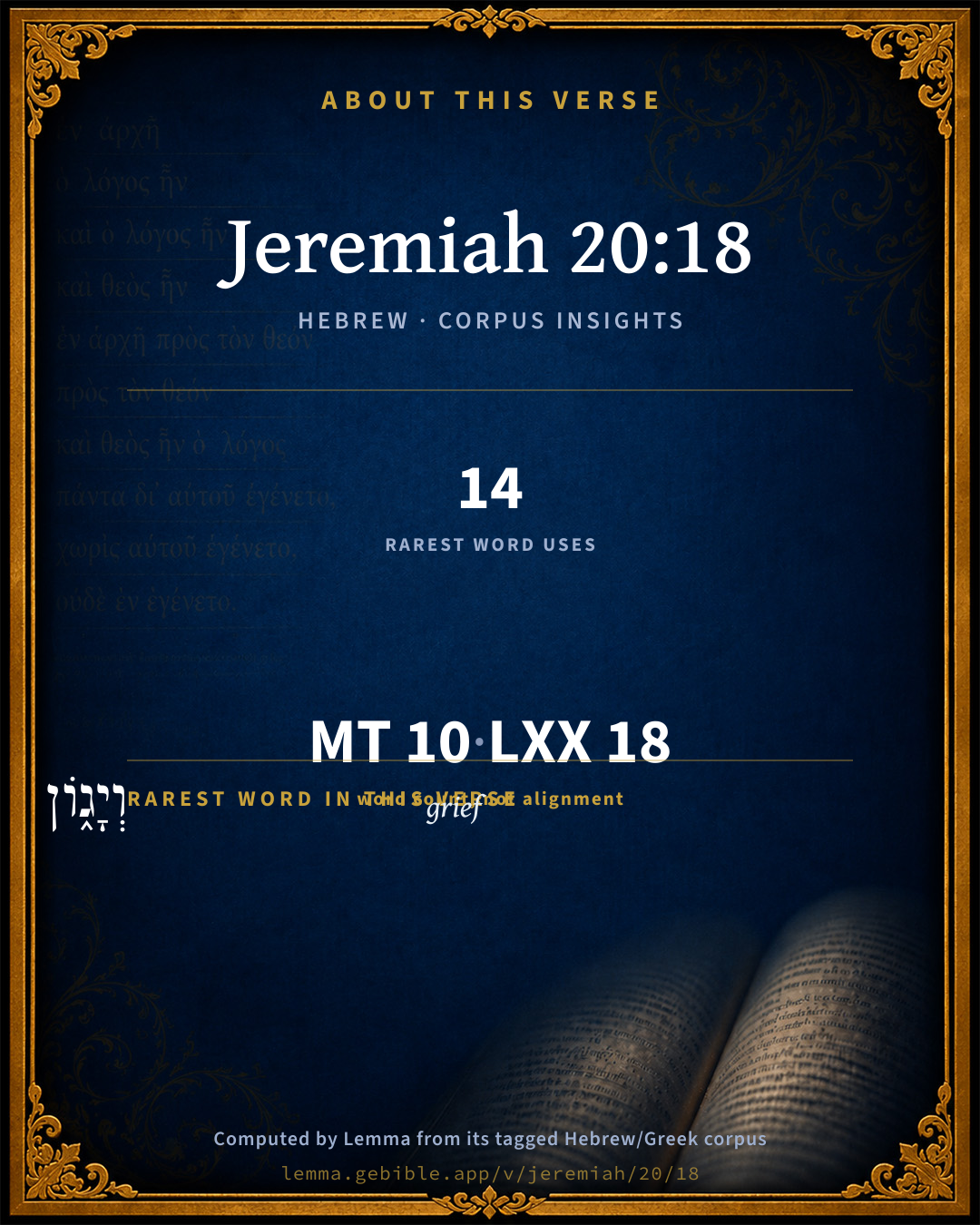
10
words
10
distinct lemmas
Prophets
section

Notable vocabulary

The rarest word here is וְיָג֑וֹן grief H3015 — appearing just 14 times in the whole Hebrew Bible.

Shared distinctive vocabulary

וְיָג֑וֹן grief H3015 occurs in 14 verses of the Hebrew Bible. Also found in:

Grammatical profile

  • 3 verbs
  • 5 nouns
  • 1 pronoun
  • 1 particle

Verb forms

  • יָצָ֔אתִי Qal · Perfect
  • לִרְא֥וֹת Qal · Infinitive Construct
  • וַיִּכְל֥וּ Qal · Sequential Imperfect

Hebrew & Septuagint length

In the original languages it is 10 Hebrew tokens and 18 Greek tokens — but the two are counted differently (Hebrew bundles its prefixes and suffixes into one token; the Greek is in lemma form), so that isn’t a like-for-like length.

Cross-references

20

Topical passages linked to Jeremiah 20:18 in the Treasury of Scripture Knowledge — connected by theme and wording, ordered by reader-vote popularity; previews shown in the World English Bible.

  • Job 3:20 "Why is light given to him who is in misery, Life to the bitter in soul,
  • Job 14:1 "Man, who is born of a woman, Is of few days, and full of trouble.
  • Lamentations 3:1 I am the man that has seen affliction by the rod of his wrath.
  • 1 Peter 4:14–16 If you are insulted for the name of Christ, blessed are you; because the Spirit of glory and of God rests on you. On their part he is blasphemed, but on your part he is glorified.
  • Psalms 69:19 You know my reproach, my shame, and my dishonor. My adversaries are all before you.
  • Psalms 90:9–10 For all our days have passed away in your wrath. We bring our years to an end as a sigh.
  • 1 Corinthians 4:9–13 For, I think that God has displayed us, the apostles, last of all, like men sentenced to death. For we are made a spectacle to the world, both to angels and men.
  • Genesis 3:16–19 To the woman he said, "I will greatly multiply your pain in childbirth. In pain you will bring forth children. Your desire will be for your husband, and he will rule over you."
  • Job 14:13 "Oh that you would hide me in Sheol, That you would keep me secret, until your wrath is past, That you would appoint me a set time, and remember me!
  • Isaiah 1:6 From the sole of the foot even to the head there is no soundness in it: Wounds, welts, and open sores. They haven't been closed, neither bandaged, neither soothed with oil.
  • Isaiah 51:7 Listen to me, you who know righteousness, the people in whose heart is my law; don't you fear the reproach of men, neither be you dismayed at their insults.
  • Jeremiah 8:18 Oh that I could comfort myself against sorrow! my heart is faint within me.
  • Lamentations 1:12 Is it nothing to you, all you who pass by? Look, and see if there be any sorrow like my sorrow, which is brought on me, With which Yahweh has afflicted [me] in the day of his fierce anger.
  • John 16:20 Most assuredly I tell you, that you will weep and lament, but the world will rejoice. You will be sorrowful, but your sorrow will be turned into joy.
  • Acts 5:41 They therefore departed from the presence of the council, rejoicing that they were counted worthy to suffer dishonor for Jesus' name.
  • 2 Timothy 1:12 For this cause I suffer also these things. Yet I am not ashamed, for I know him whom I have believed, and I am persuaded that he is able to guard that which I have committed to him against that day.
  • Hebrews 10:36 For you need endurance so that, having done the will of God, you may receive the promise.
  • Hebrews 11:36 Others were tried by mocking and scourging, yes, moreover by bonds and imprisonment.
  • Hebrews 12:2 looking to Jesus, the author and perfecter of faith, who for the joy that was set before him endured the cross, despising shame, and has sat down at the right hand of the throne of God.
  • Hebrews 13:13 Let us therefore go forth to him outside of the camp, bearing his reproach.

Cross-references courtesy of OpenBible.info (CC BY 4.0).

Hebrew and Greek witnesses Masoretic Hebrew ↔ Greek Septuagint

The same verse in the two great witnesses to the Old Testament, shown verse-for-verse.

These are two independent witnesses, not word-aligned to each other, and the Septuagint is shown in lemma (dictionary) form.

Hebrew Jeremiah 20:18 Masoretic · Westminster Leningrad Codex

לָ֤מָּה זֶּה֙ מֵרֶ֣חֶם יָצָ֔אתִי לִרְא֥וֹת עָמָ֖ל וְיָג֑וֹן וַיִּכְל֥וּ בְּבֹ֖שֶׁת יָמָֽי

Why came I forth out of the womb to see labor and sorrow, that my days should be consumed with shame?

World English Bible · Public Domain

Greek LXX Structure differs

In the Septuagint, Jeremiah is about an eighth shorter than the Hebrew and arranges its material differently — the Oracles Against the Nations (Hebrew chapters 46–51) appear in the middle of the Greek book, after 25:13. Because the chapter and verse boundaries do not line up, a verse-for-verse comparison with the Hebrew is not shown.

A verse-for-verse comparison isn’t shown here because the chapters and verses don’t line up. Switch to the LXX edition with the MT / LXX toggle above to read the Greek directly.

Hebrew: Westminster Leningrad Codex (CC BY 4.0). Greek: Septuagint (public domain); English from a public-domain English Septuagint. How the Septuagint differs from the Hebrew →

Targum (Aramaic paraphrase)

1

The Targum is the ancient Jewish Aramaic paraphrase of the Hebrew Scriptures — an interpretive translation, not the Hebrew text itself. Onkelos (literal) and Pseudo-Jonathan (expansive) render the Torah, and Jonathan the Prophets. Coverage is partial: where no permissively-licensed English translation exists for a verse, only the Aramaic is shown. This is verse-level text, not a word-by-word alignment to the Hebrew.

  1. Targum Jonathan Prophets (Joshua–Malachi)
    לְמָה דְנָן מִבִּטְנָא נְפָקֵית לְמֶחְזֵי עָמָל וּדְוָן וְסָפוּ בְּבַהֲתָא יוֹמָי:

    (no public-domain English translation for this verse)

    Targum Jonathan — Aramaic: “Mikraot Gedolot” (public domain). English: “Sefaria Community Translation” (CC0 1.0 (public-domain dedication)); “London "Chaldee Paraphrase," 1871” (public domain). Text via Sefaria.

Commentary

Notes on Jeremiah 20:18 from classic Christian and Jewish commentators (each source and its license shown beneath its notes). The classic Christian expositions comment on the surrounding passage and are grouped to its opening verse, so a note may address several verses; the Jewish commentaries on the Tanakh (Rashi and others) are per-verse, so they appear only where the commentator wrote on this verse.

Lemma curates 59 commentaries, every one of them public domain or Creative Commons licensed, each selected and text-cleaned for this edition rather than reprinted as found. About our sources →

Trapp's Complete Commentary

John Trapp

Jer 20:18 Wherefore came I forth out of the womb to see labour and sorrow, that my days should be consumed with shame?

Ver. 18. Wherefore came I forth, &c.] Passions are a most dangerous and heady water when once they are out.

That my days should be consumed with shame?] Why, but a Christian soldier may have a very great arrear. {2Ti 4:7-8} Vincet aliquando pertinax bonitas He will conquer sometimes obstinate goodness. {Rev 2:10}

John Trapp, A Commentary or Exposition upon All the Books of the Old and New Testament (1647–1656) — public domain. Text from a community e-Sword module.

Adam Clarke's Commentary

Verse 18. Wherefore came I forth] It would have been well had I never been born, as I have neither comfort in my life, nor comfort in my work.

Adam Clarke's Commentary on the Bible (1810–1826) — public domain. Text from a community e-Sword/MySword module.

John Calvin's Commentaries

He then adds, My mother might have been my grave; that is, “This light and life I value not; why then did I not die in my mother’s womb? and why did she conceive me?” Then he says, Why came I forth from the womb that I might see trouble and sorrow, and that my days. might be consumed in, reproach? Here he gives a reason why he was wearied of life; but he could not have been cleared on this account, nor ought he to be so at this day; for what just cause can we have to contend with God? Jeremiah was created to sorrow and trouble: this is the condition of all; why, then, should God be blamed? his days were spent in reproach: there was nothing new in his case; for many who have received an honorable testimony from God had suffered many wrongs and reproaches. Why, then, did he not look to them as examples, that he might bear with patience and resignation what had happened to other holy men? but he seemed as though he wished to appear as it were in public, that he might proclaim his disgrace, not only to his own age, but to every age to the end of the world.

At the same time we must remember the object he had in view; for the Prophet, as we have said, was not seized with this intemperate spirit after he had given thanks to God, and exulted as a conqueror, but before; and in order to amplify the grace of God in delivering him as it were from hell itself, into which he had plunged himself, he mentioned what had passed through his mind. The drift of the whole description seems to be this, — “I was lost, and my mind could conceive nothing but what was bitter, and with a full mouth I vomited forth poison and blasphemies against God.” What the Prophet then had here in view, was to render more conspicuous the kindness of God in bringing him to light from so deep an abyss.

A similar mode of speaking is found in the third chapter of Job. But Job had not the reason which, as we have said, Jeremiah had; for Jeremiah was not influenced by any private grief when carried away by all insane impulse to speak against God. Whence, then, was his great grief? even because he saw he was despised by the people, and that the whole of religion was esteemed by them as nothing: in short, he saw that the state of things was quite hopeless. He was, then, inflamed with zeal for God’s glory; and he also was extremely grieved at the irreclaimable wickedness of the people; but Job had only a respect to his own sufferings. There was, therefore, a great difference between Job and Jeremiah; and yet we know that both were endowed, as it were, with angelic virtue, for Job is named as one of three just men, who seemed to have been elevated above all mankind; and Jeremiah, if a comparison be made, was in this instance more excusable than Job; and yet we see that they were both inflamed with so unreasonable a grief, that they spared neither God nor man.

Let us then learn to check our feelings, that they may not break out thus unreasonably. Let us at the same time know that God’s servants, though they may excel in firmness, are yet not wholly divested of their corruptions. And should it happen at any time to us to feel such emotions within us, let not such a temptation discourage us; but as far as we can and as God gives us grace, let us strive to resist it, until the firmness of our faith at length gains the ascendency, as we see was the case with Jeremiah. For when overwhelmed with such a confusion of mind as to lie down as it were dead in hell itself, he was yet restored, as we have seen, to such a soundness of mind, that he afterwards courageously executed his own office, and also gloried, according to what we observed yesterday, in the help of God. Let us proceed, —

John Calvin's Commentaries (1540-1563) — public domain. Text from the Calvin Translation Society English edition (1840s-50s) via the Christian Classics Ethereal Library (ccel.org). Calvin's coverage is partial (roughly two-thirds of the Bible); uncommented books and verses are honest gaps, never fabricated. The 19th-century editor's footnotes and remarks are omitted so the notes are faithfully Calvin's own voice.

Ellicott's Commentary for English Readers

(18) Wherefore came I forth . . .?—Like the preceding verse, this is in its tone, almost in its words, an echo of Job_3:11-12; Job_3:20.

A Bible Commentary for English Readers, edited by Charles John Ellicott (1878–1897) — public domain. Text from a community e-Sword module.

John Gill's Exposition

Wherefore came I forth out of the womb to see labour and sorrow,.... "Labour" in performing his work and office as a prophet; and "sorrow" in suffering reproach, contempt, and persecution for it; which to avoid, he wishes he had never been born: a sign of a very fretful and impatient spirit, and of a carnal frame. Jarchi thinks this refers to the destruction of the temple;

that my days should be consumed with shame? through the bad usage of him, the reproach that was cast upon him, and the contempt he was had in for prophesying in the name of the Lord. All this shows that there is sin in the best of men, and what they are when left to themselves; how weak, foolish, and sinful they appear. And Jeremiah recording these his sins and failings, is an argument of the uprightness and sincerity of the man, and of the truth of Scripture.

Next: Jeremiah Chapter 21

John Gill's Exposition of the Whole Bible (1746–1763) — public domain (CC PDM 1.0). Text via the HelloAO Bible API.

Matthew Poole's English Annotations

These words let us know the prophet’s temptation to these extravagant eruptions of passion; it was the reproach, and shame, and affliction which he endured for the faithful discharge of his ministry; which both lets us see the goodness of God towards those whom he spareth as to these trials, and what need we have under them to keep a watch upon our own hearts. These records also of holy writ are useful to us, if at any time we be overtaken with such errors, to comfort us, in that they are not such spots but have been found in the faces of God’s fairest ones; and to make us charitable towards such as we may see sometimes overborne with the like temptations.

Matthew Poole's English Annotations on the Holy Bible (1683–1685) — public domain. Text from a community e-Sword/MySword module.

Rashi

Rabbi Shlomo Yitzchaki (Rashi)

toil and grief The destruction of the Temple.

Rashi on the Tanakh — English translations: “The Judaica Press complete Tanach with Rashi, translated by A. J. Rosenberg” (CC BY 4.0); “Pentateuch with Rashi's commentary by M. Rosenbaum and A.M. Silbermann, 1929-1934” (public domain); “The Metsudah Tanach series, Lakewood, N.J” (CC BY 4.0); and “The Book of Joshua, Metsudah Publications, 1997” (CC BY 4.0). Text via Sefaria.

Lesson kit

Teaching starters — assembled from the data on this page, not authored interpretation. Every prompt links to the verse data it draws on. Edit before teaching.

Jeremiah, in the Prophets, opens this verse with 10 words (10 distinct Hebrew lemmas). Its most distinctive word is yâgôwn (“grief”). A historical commentator’s framing appears above. Read the whole chapter for the surrounding context.

Discussion questions

  1. The word yâgôwn carries the sense “grief.” How does it shape the verse?
  2. Genesis 42:38 shares the word «grief» with this verse. How do the two illuminate each other?
  3. These translations render this verse differently. What is at stake in choosing one wording over another?
  4. The verb «יָצָ֔אתִי» is Qal Perfect. How does its form color the action?
  5. Reading how Trapp's Complete Commentary and Adam Clarke's Commentary read this verse, where do the two commentators agree and where do they part?

Things to notice

Reading settings

Reading text

Shown beneath each verse's original-language words.

Old Testament
Old Testament edition

Read the OT as the Masoretic Hebrew (MT) or the Greek Septuagint (LXX).

English shown for the Greek Septuagint (in the Hebrew ↔ Greek comparison).

Comparing translations? Open the Compare panel on any verse page to stack up to four side by side.