
Isaiah 45:9

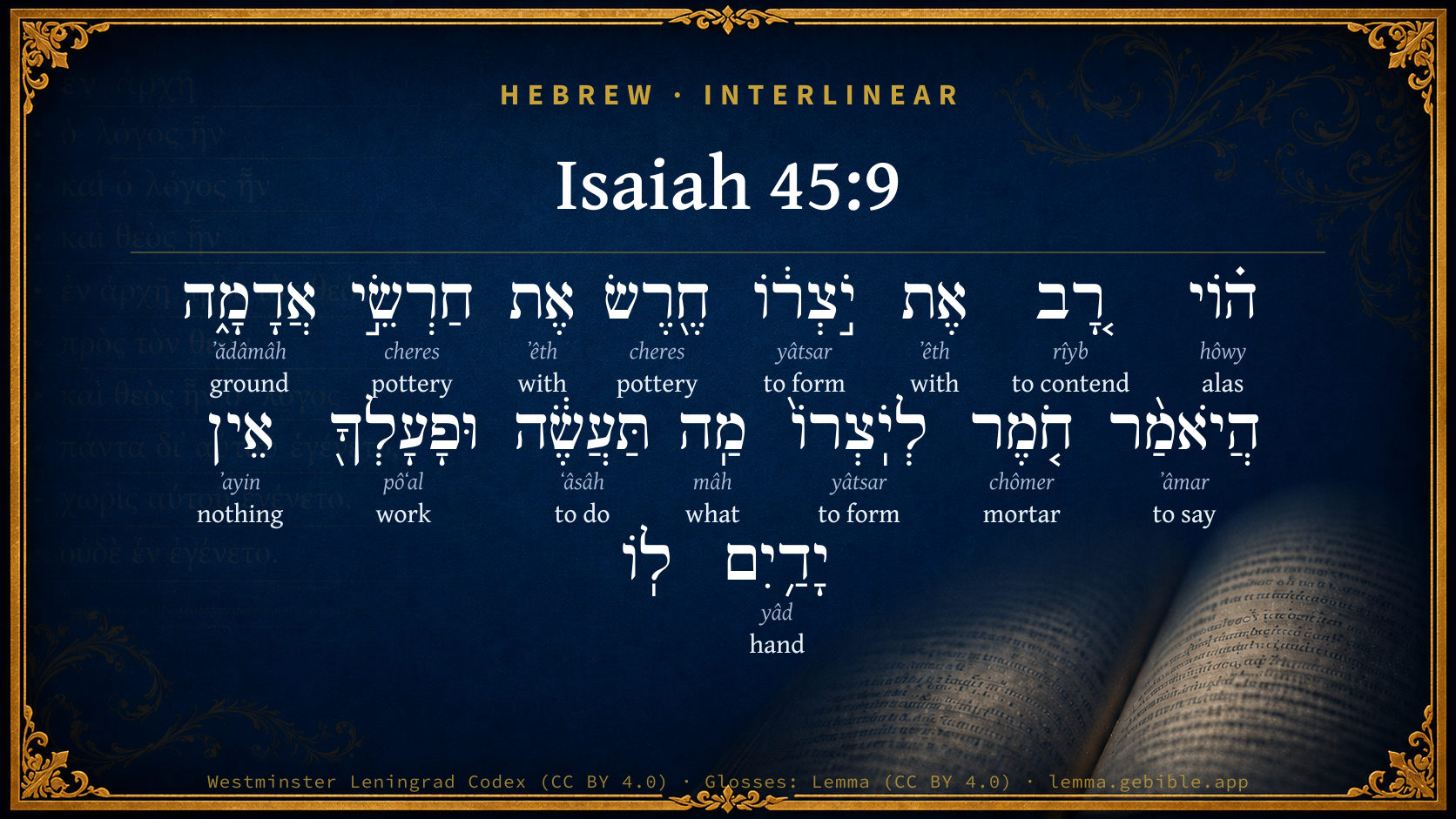
Hebrew (Westminster Leningrad Codex) Isaiah 45:9 appears in the Hebrew Old Testament. The text above is from the Westminster Leningrad Codex. Each word links to its Strong’s number, a concise gloss, and parsing drawn from the Open Scriptures Hebrew Bible morphology. Click any word for its full Brown-Driver-Briggs (BDB) entry.
Download image
Cite this verse

Isaiah 45:9 (World English Bible). Public Domain. Lemma interlinear Bible study tool, https://lemma.gebible.app/v/isaiah/45/9.

Show BibTeX & RIS
BibTeX
RIS
English Translation
Woe to him who strives with his Maker--a potsherd among the potsherds of the earth! Shall the clay ask him who fashions it, "What are you making?" or your work, "He has no hands?"
World English Bible · Public Domain
Download a study sheet

One document with this verse’s original text, its word-by-word gloss line, the meaning frame, cross-references with their text, attributed commentary, and full source and license credits — printable, and it pastes into notes with its structure intact.

This verse Autodidact and up

Study sheet (.html) Plain text (.txt)

A passage Seminary Student

Up to 50 verses in one chapter. A passage sheet keeps up to 6 commentary sources and 12 cross-references per verse, in the order this page ranks them, and says so on the sheet whenever that leaves anything out. Ask for a single verse and you get the Autodidact verse sheet above.

Everything on this page stays free to read, with no account — the sheet is a download of what is already on screen, not access to it.

Want to remove ads? Support Godless Engineer
Compare translations 3

The same verse in 3 English versions, stacked beneath the original-language interlinear above. Click any original word for its lexicon entry.

Each is an independent rendering of the whole verse — the interlinear is not word-aligned to these translations.

Highlighted words mark where these versions differ — a whole-verse word diff, not a word-by-word alignment.

  • World English Bible Public Domain
    Woe to him who strives with his Maker--a potsherd among the potsherds of the earth! Shall the clay ask him who fashions it, "What are you making?" or your work, "He has no hands?"
  • King James Version Public Domain
    Woe unto him that striveth with his Maker! Let the potsherd strive with the potsherds of the earth. Shall the clay say to him that fashioneth it, What makest thou? or thy work, He hath no hands?
  • unfoldingWord Literal Text CC BY-SA 4.0
    Woe to the one contending with his fashioner, a shard among the shards of the ground! Shall the clay say to its fashioner, “What are you making?” or “Your work, there are no hands to it”?

unfoldingWord Literal Text — © unfoldingWord, licensed CC BY-SA 4.0. Word-aligned USFM3 via Door43 (git.door43.org/unfoldingWord/en_ult).

Versions to compare (up to 4)

3 of 4 selected

Show all 18 translations

Every available English version of this verse, each an independent rendering of the whole verse.

  • World English Bible Public Domain
    Woe to him who strives with his Maker--a potsherd among the potsherds of the earth! Shall the clay ask him who fashions it, "What are you making?" or your work, "He has no hands?"
  • Berean Standard Bible Public Domain
    Woe to him who quarrels with his Maker—one clay pot among many. Does the clay ask the potter, ‘What are you making?’ Does your work say, ‘He has no hands’?
  • Majority Standard Bible Public Domain
    Woe to him who quarrels with his Maker—one clay pot among many. Does the clay ask the potter, ‘What are you making?’ Does your work say, ‘He has no hands’?
  • King James Version Public Domain
    Woe unto him that striveth with his Maker! Let the potsherd strive with the potsherds of the earth. Shall the clay say to him that fashioneth it, What makest thou? or thy work, He hath no hands?
  • American Standard Version (1901) Public Domain
    Woe unto him that striveth with his Maker! a potsherd among the potsherds of the earth! Shall the clay say to him that fashioneth it, What makest thou? or thy work, He hath no hands?
  • Revised Version (1885) Public Domain
    Woe unto him that striveth with his Maker! a potsherd among the potsherds of the earth! shall the clay say to him that fashioneth it, What makest thou? or thy work, He hath no hands?
  • Geneva Bible (1599) Public Domain
    Woe be vnto him that striueth with his maker, the potsherd with the potsherds of the earth: shall the clay say to him that facioneth it, What makest thou? or thy worke, It hath none hands?
  • Douay-Rheims (1899) Public Domain
    Woe to him that gainsayeth his maker, a sherd of the earthen pots: shall the clay say to him that fashioneth it: What art thou making, and thy work is without hands?
  • Young's Literal Translation Public Domain
    Wo `to' him who is striving with his Former, (A potsherd with potsherds of the ground!) Doth clay say to its Framer, `What dost thou?' And thy work, `He hath no hands?'
  • Literal Standard Version CC BY-SA 4.0
    Woe [to] him who is striving with his Former || (A potsherd with potsherds of the ground!) Does clay say to its Framer, What [are] you doing? And your work, He has no hands?
  • Unlocked Literal Bible CC BY-SA 4.0
    Woe to anyone who argues with the one who formed him, to him who is like any other earthen pot among all the earthen pots in the ground! Does the clay say to the potter, 'What are you making?' or 'Your work has no handles on it'?
  • unfoldingWord Literal Text CC BY-SA 4.0
    Woe to the one contending with his fashioner, a shard among the shards of the ground! Shall the clay say to its fashioner, “What are you making?” or “Your work, there are no hands to it”?
  • Darby Bible Public Domain
    Woe unto him that striveth with his Maker! Let a potsherd [strive] with the potsherds of the earth. Shall the clay say to him that formeth it, What makest thou? Or thy work, He hath no hands?
  • World Messianic Bible Public Domain
    Woe to him who strives with his Maker— a clay pot among the clay pots of the earth! Shall the clay ask him who fashions it, ‘What are you making?’ or your work, ‘He has no hands’?
  • Webster's Bible Public Domain
    Woe to him that contendeth with his Maker! Let the potsherd contend with the potsherds of the earth. Shall the clay say to him that fashioneth it, What makest thou? or thy work, He hath no hands?
  • Free Bible Version CC BY-SA 4.0
    What trouble people face when they fight with their Creator—they're just pots among all the other pots on earth! Does the clay tell the potter who is shaping it, “What are you doing?” or “What you're making is so bad it's like you have no hands!”
  • Bible in Basic English Public Domain
    Cursed is he who has an argument with his Maker, the pot which has an argument with the Potter! Will the wet earth say to him who is working with it, What are you doing, that your work has nothing by which it may be gripped?
  • JPS Tanakh (1917) Public Domain
    Woe unto him that striveth with his Maker, as a potsherd with the potsherds of the earth! Shall the clay say to him that fashioned it: 'What makest thou?' Or: 'Thy work, it hath no hands'?

Literal Standard Version (2020), Covenant Press — licensed CC BY-SA 4.0. Text via the HelloAO Bible API (eBible.org). Unlocked Literal Bible (unfoldingWord) — licensed CC BY-SA 4.0. Text via the HelloAO Bible API (eBible.org). unfoldingWord Literal Text — © unfoldingWord, licensed CC BY-SA 4.0. Word-aligned USFM3 via Door43 (git.door43.org/unfoldingWord/en_ult). Free Bible Version, Dr. Jonathan Gallagher — licensed CC BY-SA 4.0. Text via the HelloAO Bible API (eBible.org).

Word by word

More ways to search: Search by grammar → Find every occurrence → Compare this word →

Practice this passage: Drill this verse → Learn its vocabulary →

חֶ֖רֶשׂ
cheres
H2789
“pottery”
Noun, Common, Masculine, Singular, Absolute
Part of Speech
Noun
Type
Common
Gender
Masculine
Number
Singular
State
Absolute
Full BDB Definition

Origin: a collateral form mediating between H2775 and H2791

TWOT: 759a

earthenware, clay pottery, shard, potsherd, earthen vessel
  1. ה֗וֹי hôwy H1945 “alas” Particle, Interjection
  2. רָ֚ב rîyb H7378 “contending” Verb, Qal, Participle Active, Masculine, Singular, Absolute
  3. אֶת ʼêth H854 “with” Preposition
  4. יֹ֣צְר֔וֹ yâtsar H3335 “forming · him” Verb, Qal, Participle Active, Masculine, Singular, Construct + Suffix, Personal, 3rd Person, Masculine, Singular
  5. אֶת ʼêth H854 “with” Preposition
  6. חַרְשֵׂ֣י cheres H2789 “potsherds of” Noun, Common, Masculine, Plural, Construct
  7. אֲדָמָ֑ה ʼădâmâh H127 “ground” Noun, Common, Feminine, Singular, Absolute
  8. הֲיֹאמַ֨ר ʼâmar H559 “to say” Particle, Interrogative + Verb, Qal, Imperfect, 3rd Person, Masculine, Singular
  9. חֹ֤מֶר chômer H2563 “mortar” Noun, Common, Masculine, Singular, Absolute
  10. לְיֹֽצְרוֹ֙ yâtsar H3335 “to/for · forming · him” Preposition + Verb, Qal, Participle Active, Masculine, Singular, Construct + Suffix, Personal, 3rd Person, Masculine, Singular
  11. מַֽה mâh H4100 “what” Particle, Interrogative
  12. תַּעֲשֶׂ֔ה ʻâsâh H6213 “to do” Verb, Qal, Imperfect, 2nd Person, Masculine, Singular
  13. וּפָעָלְךָ֖ pôʻal H6467 “and · work · your” Conjunction + Noun, Common, Masculine, Singular, Construct + Suffix, Personal, 2nd Person, Masculine, Singular
  14. אֵין ʼayin H369 “nothing” Particle, Negative
  15. יָדַ֥יִם yâd H3027 “hands” Noun, Common, Both, Dual, Absolute

About this verse

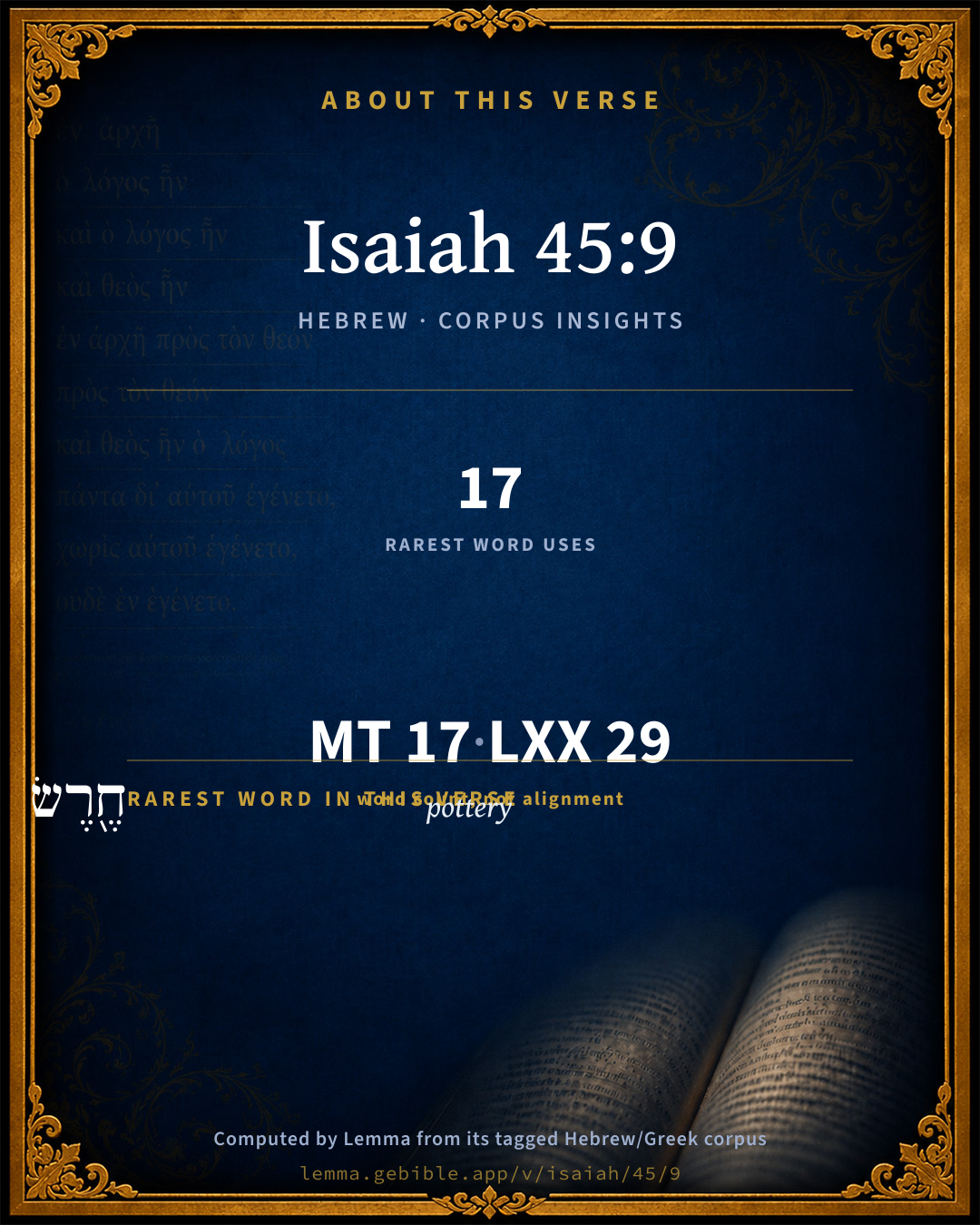
These counts appear in no published source. They are computed here, from the morphology-tagged text and Lemma’s own curated glosses. What Lemma adds →

17
words
13
distinct lemmas
Prophets
section

Notable vocabulary

The rarest word here is חֶ֖רֶשׂ pottery H2789 — appearing just 17 times in the whole Hebrew Bible.

Shared distinctive vocabulary

חֶ֖רֶשׂ pottery H2789 occurs in 16 verses of the Hebrew Bible. Also found in:

Grammatical profile

  • 5 verbs
  • 6 nouns
  • 3 prepositions
  • 3 particles

Verb forms

  • רָ֚ב Qal · Participle Active
  • יֹ֣צְר֔וֹ Qal · Participle Active
  • הֲיֹאמַ֨ר Qal · Imperfect
  • לְיֹֽצְרוֹ֙ Qal · Participle Active
  • תַּעֲשֶׂ֔ה Qal · Imperfect

Repetition

Words recur within this verse — often emphatic in Hebrew:

  • יֹ֣צְר֔וֹ to form H3335 ×2
  • חֶ֖רֶשׂ pottery H2789 ×2
  • אֶת with H854 ×2

Hebrew & Septuagint length

In English translation the verse runs 34 words from the Hebrew and 47 from the Septuagint (LXX English) — closely comparable.

A rough comparison of the two English renderings, which tokenize alike — not a word-level alignment.

Word counts can differ between the Hebrew and the Greek without any difference in meaning — e.g. the Hebrew direct-object marker אֵת has no separate Greek word, and Greek often adds the article ὁ.

In the original languages it is 17 Hebrew tokens and 29 Greek tokens — but the two are counted differently (Hebrew bundles its prefixes and suffixes into one token; the Greek is in lemma form), so that isn’t a like-for-like length.

Cross-references

12

Topical passages linked to Isaiah 45:9 in the Treasury of Scripture Knowledge — connected by theme and wording, ordered by reader-vote popularity; previews shown in the World English Bible.

  • Isaiah 64:8 But now, Yahweh, you are our Father; we are the clay, and you our potter; and we all are the work of your hand.
  • Romans 9:20–21 But indeed, O man, who are you to reply against God? Will the thing formed ask him who formed it, "Why did you make me like this?"
  • Isaiah 10:15 Shall the axe boast itself against him who hews therewith? Shall the saw magnify itself against him who wields it? as if a rod should wield those who lift it up, [or] as if a staff should lift up [him who is] not wood.
  • Isaiah 29:16 You turn things upside down! Shall the potter be esteemed as clay; that the thing made should say of him who made it, He didn't make me; or the thing formed say of him who formed it, He has no understanding?
  • Jeremiah 18:6 House of Israel, can't I do with you as this potter? says Yahweh. Behold, as the clay in the potter's hand, so are you in my hand, house of Israel.
  • Proverbs 21:30 There is no wisdom nor understanding Nor counsel against Yahweh.
  • Job 40:8–9 Will you even annul my judgment? Will you condemn me, that you may be justified?
  • Psalms 2:2–9 The kings of the earth take a stand, And the rulers take counsel together, Against Yahweh, and against his anointed, saying,
  • Exodus 9:16–17 but indeed for this cause I have made you stand: to show you my power, and that my name may be declared throughout all the earth;
  • Job 15:24–26 Distress and anguish make him afraid; They prevail against him, as a king ready to the battle.
  • Jeremiah 50:24 I have laid a snare for you, and you are also taken, Babylon, and you weren't aware: you are found, and also caught, because you have striven against Yahweh.
  • 1 Corinthians 10:22 Or do we provoke the Lord to jealousy? Are we stronger than he?

Cross-references courtesy of OpenBible.info (CC BY 4.0).

Hebrew and Greek witnesses Masoretic Hebrew ↔ Greek Septuagint

The same verse in the two great witnesses to the Old Testament, shown verse-for-verse.

These are two independent witnesses, not word-aligned to each other, and the Septuagint is shown in lemma (dictionary) form.

Hebrew Isaiah 45:9 Masoretic · Westminster Leningrad Codex

ה֗וֹי רָ֚ב אֶת יֹ֣צְר֔וֹ חֶ֖רֶשׂ אֶת חַרְשֵׂ֣י אֲדָמָ֑ה הֲיֹאמַ֨ר חֹ֤מֶר לְיֹֽצְרוֹ֙ מַֽה תַּעֲשֶׂ֔ה וּפָעָלְךָ֖ אֵין יָדַ֥יִם לֽוֹ

Woe to him who strives with his Maker--a potsherd among the potsherds of the earth! Shall the clay ask him who fashions it, "What are you making?" or your work, "He has no hands?"

World English Bible · Public Domain

Greek LXX Isaiah 45:9 Septuagint · lemma form

ποῖος βελτίων κατασκευάζω ὡς πηλός κεραμεύς μή ὁ ἀροτριάω ἀροτριάω ὁ γῆ ὅλος ὁ ἡμέρα μή εἶπον ὁ πηλός ὁ κεραμεύς τίς ποιέω ὅτι οὐ ἐργάζομαι οὐδέ ἔχω χείρ

What excellent thing have I prepared as clay of the potter? Will the plowman plow the earth all day? shall the clay say to the potter, What are you doing that you do not work, nor have hands? shall the thing formed answer him that formed it?

LXX2012 (modern English Septuagint) · Public Domain

On this verse, Keil & Delitzsch discusses the Septuagint’s reading. Read the note in Commentary ↓

Hebrew: Westminster Leningrad Codex (CC BY 4.0). Greek: Septuagint (public domain); English from LXX2012 (modern English Septuagint) (Public Domain). How the Septuagint differs from the Hebrew →

Targum (Aramaic paraphrase)

1

The Targum is the ancient Jewish Aramaic paraphrase of the Hebrew Scriptures — an interpretive translation, not the Hebrew text itself. Onkelos (literal) and Pseudo-Jonathan (expansive) render the Torah, and Jonathan the Prophets. Coverage is partial: where no permissively-licensed English translation exists for a verse, only the Aramaic is shown. This is verse-level text, not a word-by-word alignment to the Hebrew.

  1. Targum Jonathan Prophets (Joshua–Malachi)
    וַי דִי מִדַמֵי לְמֵידָן לִקֳבֵל פִּתְגָמֵי בָרְיֵהּ וְרָחַץ דְיוֹטְבִין לֵיהּ צַלְמֵי פַחֲרָא דְעָבְדִין מֵעֲפַר אַדְמָתָא הֲאֶפְשַׁר דְיֵימַר טִינָא לְעָבְדֵהּ לָא עֲבַדְתַּנִי וְעוֹבָדָךְ לֵית יְדִין לֵיהּ:

    Woe to him who thinks of striving against the words of his Creator, and trusts that the images of a potter shall do him good, which are made out of the dust of the earth. Is it possible, that the clay could say to him that worketh it, Thou hast not made me? or thy work, He hath no hands?

    Targum Jonathan — Aramaic: “Mikraot Gedolot” (public domain). English: “Sefaria Community Translation” (CC0 1.0 (public-domain dedication)); “London "Chaldee Paraphrase," 1871” (public domain). Text via Sefaria.

Commentary

Notes on Isaiah 45:9 from classic Christian and Jewish commentators (each source and its license shown beneath its notes). The classic Christian expositions comment on the surrounding passage and are grouped to its opening verse, so a note may address several verses; the Jewish commentaries on the Tanakh (Rashi and others) are per-verse, so they appear only where the commentator wrote on this verse.

Lemma curates 59 commentaries, every one of them public domain or Creative Commons licensed, each selected and text-cleaned for this edition rather than reprinted as found. About our sources →

Trapp's Complete Commentary

John Trapp

Isa 45:9 Woe unto him that striveth with his Maker! [Let] the potsherd [strive] with the potsherds of the earth. Shall the clay say to him that fashioneth it, What makest thou? or thy work, He hath no hands?

Ver. 9. Woe unto him that striveth with his Maker.] That contends with him, {Rom 9:20} or presumes to prescribe to him, as some impatient spirits among the captives may seem to have done. We may not measure God’s dealings by our models, nor murmur against his counsels; since his holy will is the most perfect rule of right.

Let the potsherd strive with the potsherds of the earth.] And not dash against the rock of ages; let him meddle with his match, and not "contend with a mightier than he," {Ecc 6:10} What though God create him darkness and evil, {as Isa 45:7} let him wait upon God for better times, and not think to mend himself by murmuring against his Maker as too severe.

Shall the clay say, &c., ] q.d., This were an intolerable petulance.

Or thy work, it hath no hands?] Or, He hath no hands, sc., to fashion me aright. Thus the work seemeth to make answer to the clay; for as the clay said to the potter, Quid fecisti, What hast thou made? so the work saith, by way of jeer, he hath no hands, sc., to make me as he should have done.

John Trapp, A Commentary or Exposition upon All the Books of the Old and New Testament (1647–1656) — public domain. Text from a community e-Sword module.

The Biblical Illustrator

Joseph S. Exell

Isa_45:9

Woe unto him that striveth with Ms Maker!--

Striving with God

The strong word strive, and the emphatic reassertion of the mission of Cyrus (Isa_45:13), as well as the connection with Isa_45:1-8, show that deliberate opposition to the Divine purpose, and not mere faint-hearted unbelief (as in Isa_40:27; Isa_51:13), is here referredto.

(Prof. J. Skinner, D. D.)

Opposing the Divine purpose

Those who were primarily addressed were at variance with God their Creator on two accounts--

1. Because He permitted His people to be led captive by their enemies into a distant country, where they were oppressed.

2. Because, notwithstanding the servants of the Lord spoke much concerning their liberation, the event seemed altogether improbable, and beyond even the power of God to effect. (R. Macculloch.)

Contending with God

I. BY MURMURING AT HIS DISPENSATIONS.

II. BY RESISTING HIS AUTHORITY.

III. BY CONTEMNING HIS INSTRUCTIONS. (R. Macculloch.)

Striving with our Maker

If we duly consider the life of man since the fall, we shall find it to be one continued struggle. In the great and most momentous affair of religion, upon which our whole happiness depends, what a domestic war do we find within our own breasts! Happy are they who are successful in this spiritual conflict; and are so wise as vigorously to join forces with the Lord of hosts! But woe be to him who is of a party with the enemy, and striveth with his Maker.

I. We will consider WHAT IT IS TO STRIVE WITH OUR MAKER. In general it is to resist His will, and oppose ourselves to His government, to struggle against the dispensations of His providence.

II. THE EXTREME VILENESS AND FOLLY OF SO DOING.

I. In general, if the height of ingratitude be a vile thing, and if to oppose and contend with our best Friend, who is infinitely wiser than we are, and loves us better than we do ourselves, and whose power too is so irresistible, that after all our strugglings His pleasure shall be accomplished one way or other, if not to our happiness, as He at first intended, then to our ruin, since we are resolved to have it so,--if this be a foolish thing, then to strive with our Maker does imply all the folly and baseness that a man can possibly be guilty of.

2. But more particularly, to strive with our Maker is a most vile and foolish thing, as it signifies--

(1) Our denying obedience to His commands; for what can be more base than to refuse even our utmost services to that infinitely glorious and good Being who made us what we are!

(2) Our murmuring at His disposal of us, and restless discontent at the circumstances He thinks fit to place us in.

(3) Our being stubborn and refractory to the conduct of His Divine Spirit, and the guidance of His ministers, in things relating to His service and our own eternal salvation.

III. THE MISERABLE CONSEQUENCE of thus striving with our Maker. Woe unto him.

1. As it signifies disobedience to His commands. For who can imagine but that a Governor so wise, and so powerful, and so just as God is, will in due time assert His authority, and secure His laws and government from contempt, by the condign punishment of those who have been so hardy as to resist and rebel against Him, and made no account of the plainest and most express declarations of His will? And when the Almighty shall proceed to do justice, who can withstand Him, or hope to avoid the stroke, but must sink under the weight of it for ever!

2. Nor will our discontents and murmurings at the Divine disposals escape without due punishment. For suppose that God should be so far provoked by our repinings as to throw us off from His care and protection, and leave us to ourselves, and in His anger comply with our foolish desires, and give us what we are so fond of, and which He sees will be our ruin, how sadly sensible shall we then soon be of the vast difference between Gods government and our own!

3. And so for impatience under troubles and afflictions, suppose our outcries and strugglings and resistance should make God withhold His paternal chastisements, and suffer sin upon us without correction, and disregard us as desperate and incorrigible; what woe on earth could befall us greater than this?

4. What but the extremest of all woes can be expected from our rejecting those proposals of reconciliation to God, which are not only offered but pressed upon us daily by the ministers of Christ, and to which we are constantly moved by the workings of the Spirit of God within, upon our souls! (W. Bragge.)

The misery of contending with God

I. SPECIFY SOME INSTANCES IN WHICH THE SINNER MAY BE CONSIDERED AS STRIVING WITH GOD. I hardly think it worth while to mention atheism, which opposes His very being, and tries to banish Him from the world which He has made. Some, indeed, have supposed that a speculative atheist is an impossibility. How far God may give up a man to strong delusion to believe a lie, who has despised and rejected the advantages of revelation, it is not for us to determine,--but if the light that is in thee be darkness, how great is that darkness! It is undeniable, however, that we have a multitude of practical atheists. That is, we have thousands who live precisely as they would do if they believed there was no God. They strive with Him--

1. By transgressing His holy and righteous law.

2. By opposing the Gospel.

3. By violating the dictates of conscience.

4. By refusing to resign themselves to the dispensations of His providence.

5. By the persecution of His people.

6. By trying to hinder the spread of His cause.

II. CONSIDER THE WOE WHICH HIS OPPOSITION NECESSARILY ENTAILS UPON HIM. This striving with God is--

1. A practice the most shameful and ungrateful. What would you think of a child who should strive with his father, reproach his character, counteract all his designs, and endeavour to injure his concerns? But such is your conduct towards God.

2. A practice the most unreasonable and absurd. For observe--in all the instances in which you oppose Him He is aiming to promote your good: His design is to make you wise, to make you holy, to make you happy; and the advantages of compliance will be all your own. Besides, can you do without Him? In life? In death?

3. Therefore nothing can be more injurious and ruinous. In striving with Him, you only resemble the wave that dashes against the rock, and is driven back in foam; or the ox that kicks against the goad, and only wounds himself; or the thorns and briers that should set themselves in battle array against the fire. To improve this awful subject let me ask--Whether you are for God or against Him? There is no neutrality here. We have been speaking of a striving with God which is unlawful and destructive--but there is a striving with Him which is allowable and necessary. It is by prayer and supplication. (W. Jay.)

The indelicacy of criticising God

(verse l 0):--That a child should so speak of father or mother is unthinkably unnatural and impious. And such are they who criticise Gods method of saving His people through Cyrus. (A. B.Davidson, D. D.)

The Biblical Illustrator, edited by Joseph S. Exell (c. 1880s–1900s) — public domain. Text from a community e-Sword module.

Joseph Benson's Commentary

Isa 45:9-10. Wo unto him that striveth, &c. — Bishop Lowth renders this verse, “Wo unto him that contendeth with the power that formed him, the potsherd with the moulder of the clay! Shall the clay say to the potter, What makest thou? And to the workman, Thou hast no hands.” “The prophet,” he thinks, “answers or prevents the objections and cavils of the unbelieving Jews disposed to murmur against God, and to arraign the wisdom and justice of his dispensations in regard to them; in permitting them to be oppressed by their enemies, and in promising them deliverance, instead of preventing their captivity. St. Paul has borrowed the image, and has applied it to the like purpose with equal force and elegance, Rom 9:20-21.”

Joseph Benson's Commentary on the Old and New Testaments (1811–1818) — public domain. Text from a community e-Sword module.

The Preacher's Complete Homiletical Commentary

Joseph S. Exell (gen. ed.)

STRIVING WITH GOD

Isa_45:9. Woe unto him, &c.

The idea of rebellion is one of frequent recurrence in this book. A sinner rebels against God’s authority and dominion. Is frequently styled an enemy, and this is evident both from his heart, tongue, and life. Is frequently described as fighting against God, or contending with Him, and this is the idea of the text.

I. MANIFESTATION OF THIS STRIFE. To strive is to oppose, and in a variety of ways sinners exhibit opposition to God.

1. The unblushing opposition of infidelity. Nothing can exhibit more daring wickedness. Rejects the Scriptures, and boasts of the sufficiency of nature to teach us virtue and religion. How devoted they are in prosecuting their work! How eager to dissuade others from their adherence to the Christian religion!

2. The fearless transgressions of the bold and daring in iniquity. Who lay aside all the restrictions of conscience, and the respect of the virtuous around them. Who give themselves up to every evil way and work. Who have no fear, &c. (Luk_18:4).

3. Those who resist the providential dealings and interpositions of God for their salvation. Providence subserves the designs of grace. Adversity, &c., are often employed to lead to thought and consideration, &c. The resistance of these is striving against God. If these do not soften, they harden (H. E. I. 56–59, 145, 229).

4. Those who will not yield to the overtures of the Gospel. The Gospel proclaims men enemies, and seeks their return to friendship. The Gospel proclaims an amnesty; but of course it is on the principle of their throwing down their weapons and ceasing to strive and rebel. Whoso persists in unbelief strives against God—yea, against the riches of His grace.

II. THE EVILS OF THIS STRIFE.

1. It is full of infatuation. It cannot be vindicated upon the principle of reason or propriety. A sign of the mind being blinded by the wicked one. There cannot be greater madness or more complete folly than to strive against God.

2. It is fraught with evils to our own souls. It excludes the greatest blessings God has to bestow (Jer_5:25)—the divine favour, peace, hope, all the rich communications of heaven. It degrades the mind, hardens the heart, &c.; converts conscience into a gnawing worm. Often makes life insupportable.

3. It is full of ingratitude. The child—the befriended. But all figures must fail in the illustration.

III. ITS FINAL RESULTS.

1. We cannot injure Deity. We might a potsherd like ourselves. Neither,

2. can we benefit ourselves. Who hath hardened himself against the Lord and prospered? Nor can we,

3. Escape the triumphs of the Divine judgments over us. One must prevail. We cannot! Then God will; and His prevailing will be our “woe.” The woe of His righteous sentence, &c. To each and all such (Rom_2:9).

CONCLUSION.—

1. Let the careless think and stop in their career.

2. Let the hesitating allow good emotions to prevail (H. E. I. 1489).

3. Let the seeking now exclaim, “I yield, I yield, I can hold out no more,” &c.

4. Let the children of God rejoice, and labour for the weal of others.—The Pulpit Cyclopœdia, vol. iii. pp. 150–152.

CAVILLING AGAINST GOD

Isa_45:9-10. Woe unto him that striveth, &c.

I. That man is formed by God, and that all his affairs are ordered by Him as really as the work of the potter is moulded by the hands of the workman.

II. That God has a design in making man, and in ordering and arranging his circumstances in life.

III. That man is little qualified to judge of that design, and not at all qualified to pronounce it unwise, any more than the clay could charge him that worked it into a vessel with want of wisdom.

IV. That God is a Sovereign, and does as He pleases. He has formed man as He chose, as really as the potter moulds the clay into any shape that he pleases. He has given him his rank in creation; given him such a body and intellect as He pleased; He has determined his circumstances in life just as He saw fit. And He is a Sovereign also in the dispensation of His grace—having a right to pardon whom He will—nor has any man any right to complain. Not that God, in all respects, moulds the character and destiny of men, as the potter does the clay. God is just, &c., as well as Sovereign; and man is a moral agent, and subject to the laws of moral agency which God has appointed. God does nothing wrong. He does not compel man to sin and then condemn him for it (H. E. I. 1779, 1780). He does His pleasure according to the eternal laws of equity; and man has no right to call in question the rectitude of His sovereign dispensations.—Albert Barnes, D.D.

The Preacher's Complete Homiletical Commentary (gen. ed. Joseph S. Exell; Funk & Wagnalls, c. 1892) — public domain (pre-1929). A full-Bible homiletical/sermon-outline anthology covering 65 of 66 books (2 John is absent from the source module). Text from a community e-Sword module.

Keil & Delitzsch

C. F. Keil & F. Delitzsch

The promise is now continued in the third strophe (Isa 45:9-13), and increases more and more in the distinctness of its terms; but just as in Isa 29:15-21, it opens with a reproof of that pusillanimity (Isa 40:27; cf., Isa 51:13; Isa 49:24; Isa 58:3), which goes so far to complain of the ways of Jehovah. "Woe to him that quarreleth with his Maker - a pot among the pots of earthenware? Can the clay indeed say to him that shapeth it, What makest thou? and thy work, He hath no hands? Woe to him that saith to his father, What begettest thou? and to the woman, What bringest thou forth?" The comparison drawn between a man as the work of God and the clay-work of a potter suggested itself all the more naturally, inasmuch as the same word yootseer was applied to God as Creator, and also to a potter (figulus). The word cheres signifies either a sherd, or fragment of earthenware (Isa 30:14), or an earthenware vessel (Jer 19:1; Pro 26:23). In the passage before us, where the point of comparison is not the fragmentary condition, but the earthen character of the material ()'adâmâh), the latter is intended: the man, who complains of God, is nothing but a vessel of clay, and, more than that, a perishable vessel among many others of the very same kind.

(Note: The Septuagint reads shin for sin in both instances, and introduces here the very unsuitable thought already contained in Isa 28:24, "Shall the ploughman plough the land the whole day?")

The questions which follow are meant to show the folly of this complaining. Can it possibly occur to the clay to raise a complaint against him who has it in hand, that he has formed it in such and such a manner, or for such and such a purpose (compare Rom 9:20, "Why hast thou made me thus")? To the words "or thy work" we must supply num dicet (shall it say); pō‛al is a manufacture, as in Isa 1:31. The question is addressed to the maker, as those in Isa 7:25 are to the husbandman: Can the thing made by thee, O man, possibly say in a contemptuous tone, "He has no hands?" - a supposition the ridiculous absurdity of which condemns it at once; and yet it is a very suitable analogy to the conduct of the man who complains of God. In Isa 45:10 a woe is denounced upon those who resemble a man who should say to his own father, What children dost thou beget? or to a wife, What dost thou bring forth? (techı̄lı̄n an emphatic, and for the most part pausal, fut. parag., as in Rut 2:8; Rut 3:18). This would be the rudest and most revolting attack upon an inviolably tender and private relation; and yet Israel does this when it makes the hidden providential government of its God the object of expostulation.

Keil & Delitzsch — Biblical Commentary on the Old Testament (1861–1891) — public domain (CC PDM 1.0). Text via the HelloAO Bible API. (Old Testament only.)

Tyndale Open Study Notes

Tyndale Open Resources

45:9-13 The Lord confronts those who question his right to use a pagan king to achieve his purposes. He, the Creator, is free and sovereign in his activities. He promised to bring his people back to their land, and he would use anyone he chose to accomplish that purpose.

45:9-11 pot . . . its maker . . . baby . . . its father: It is ridiculous for a creature to question the wisdom of its creator.

Tyndale Open Study Notes — © Tyndale Open Resources, licensed CC BY-SA 4.0. Text via the HelloAO Bible API.

Geneva Bible (1599)

Geneva Bible translators

That is, it is not perfectly made.

Hereby he bridleth their impatience, which in adversity and trouble murmur against God, and will not tarry his pleasure: willing that man should match with his like, and not contend against God.

Geneva Bible (1599) marginal notes — public domain. Text via Bolls.life.

Jamieson, Fausset & Brown

Robert Jamieson, A. R. Fausset & David Brown

Anticipating the objections which the Jews might raise as to why God permitted their captivity, and when He did restore them, why He did so by a foreign prince, Cyrus, not a Jew (Isa 40:27, &c.), but mainly and ultimately, the objections about to be raised by the Jews against God's sovereign act in adopting the whole Gentile world as His spiritual Israel (Isa 45:8, referring to this catholic diffusion of the Gospel), as if it were an infringement of their nation's privileges; so Paul expressly quotes it (Rom 9:4-8, Rom 9:11-21).

Let . . . strive--Not in the Hebrew; rather, in apposition with "him," "A potsherd among the potsherds of the earth!" A creature fragile and worthless as the fragment of an earthen vessel, among others equally so, and yet presuming to strive with his Maker! English Version implies, it is appropriate for man to strive with man, in opposition to Ti2 2:24 [GESENIUS].

thy . . . He--shall thy work say of thee, He . . . ?

Jamieson, Fausset & Brown — Commentary Critical and Explanatory on the Whole Bible (1871) — public domain (CC PDM 1.0). Text via the HelloAO Bible API.

Adam Clarke's Commentary

Verse 9. Wo unto him that striveth with his Maker - "To unto him that contendeth with the power that formed him"] The prophet answers or prevents the objections and cavils of the unbelieving Jews, disposed to murmur against God, and to arraign the wisdom and justice of his dispensations in regard to them; in permitting them to be oppressed by their enemies, and in promising them deliverance instead of preventing their captivity. St. Paul has borrowed the image, and has applied it to the like purpose with equal force and elegance: "Nay, but, O man! who art thou that repliest against God? Shall the thing formed say to him that formed it, Why hast thou made me thus? Hath not the potter power over the clay, out of the same lump to make one vessel to honour, and another to dishonour?" Isa 9:20; Isa 9:21. This is spoken says Kimchi, against the king of Babylon, who insulted the Most High, bringing forth the sacred vessels, drinking out of them, and magnifying himself against God.

Or thy work, He hath no hands - "And to the workman, Thou hast no hands"] The Syriac renders, as if he had read, ולא היתי פעל ידיך velo hayithi pheal yadeycha, "neither am I the work of thy hands;" the Septuagint, as if they had read, ולא פעלת ואין ודים לך velo phaalta veeyn yaadim lecha, "neither hast thou made me; and thou hast no hands." But the fault seems to be in the transposition of the two pronouns; for ופעלך uphoolcha, read ופעלו uphoolo: and for לו lo, read לך lecha. So Houbigant corrects it; reading also ופעלו uphoolo; which last correction seems not altogether necessary. The Septuagint, in MSS. Pachom. and I. D. II. have it thus, και το εργον ουκ εχεις χειρας, which favours the reading here proposed.

Adam Clarke's Commentary on the Bible (1810–1826) — public domain. Text from a community e-Sword/MySword module.

Ellicott's Commentary for English Readers

(9) Woe unto him that striveth . . .—The sequence of thought is not at first apparent. Were those who strove, the heathen nations who resisted Cyrus, or Israelites who desired some other deliverer, say a prince of the house of David? The latter seems more probable. In either case men were guilty of the folly of criticising the Almighty.

Let the potsherd strive . . .—The sentence, as the italics show, is abrupt, but is better taken without inserting the verbs, and in apposition with the pronoun—Woe unto him . . . a potsherd among the potsherds; a frail mortal like all his fellows.

Shall the clay say . . .—The potsherd suggests the potter, not without an allusive reference to the history of man’s creation in Gen_2:7. As in Jer_18:1-10; Rom_9:20-21, the thought pressed is that of absolute sovereignty, the belief in the wisdom and equity of that sovereignty being kept in the background, as a reserve force. The two clauses represent different aspects of presumption—the first questions, the other arrogantly condemns. The potter’s vessel says that the potter “has no hands,” is without creative power or skill.

A Bible Commentary for English Readers, edited by Charles John Ellicott (1878–1897) — public domain. Text from a community e-Sword module.

The Cambridge Bible for Schools and Colleges

gen. ed. J. J. S. Perowne

9–13. These verses are addressed to a section of the exiles who resented the idea of deliverance through a foreign conqueror. The strong word “strive” and the emphatic reassertion of the mission of Cyrus (Isa_45:13), as well as the connexion with Isa_45:1-8, shew that deliberate opposition to the Divine purpose, and not mere faint-hearted unbelief (as in chs. Isa_40:27, Isa_51:13), is here referred to. We know too little of the circumstances to understand the precise state of mind from which the objection proceeded. It may have arisen from reluctance to entertain the idea of deliverance through a foreign conqueror, instead of through an Israelite king, as ancient prophecies seemed to promise (e.g., Jer_30:21). The same tendency of thought is probably alluded to in ch. Isa_46:12 (the “stout-hearted, that are far from righteousness”).

his maker] the same word as “him that fashioned it” in the second half of the verse. It is the ordinary word for “potter.”

Let the potsherd strive &c.] Render as in R.V. a potsherd among the potsherds of the earth! or, “a potsherd like (no better than) an earthen potsherd.” “With” may mean “among” (as a synonymous word does in Psa_69:28), or “like” (Job_9:26), but the use of the same preposition in two different senses in one sentence is no doubt harsh.

or thy work, He hath no hands] i.e. no power. Delitzsch instances an identical Arabic phrase (lâ yadai lahu = “it is not in his power”). The LXX. reads “Thou” instead of “He,” and several commentators have suggested a transposition of the suffixes in the original: “or his work, Thou hast no hands.” The emendation is plausible, though perhaps hardly necessary.

The Cambridge Bible for Schools and Colleges (gen. ed. J. J. S. Perowne; Cambridge University Press, 1878–1918) — public domain. Text from a community e-Sword module.

John Gill's Exposition

Woe unto him that striveth with his Maker,.... That contends with him, enters into a controversy, and disputes with him, or litigates a point with him; quarrels with his purposes and decrees; murmurs and repines at his providences, and finds fault with his dispensations: this seems to have respect to the murmurs, quarrels, and contests of the Jews about Christ, the author of righteousness and salvation, when he should appear:

let the potsherd strive with the potsherds of the earth; let men strive with men, who are as earthen vessels made of the same mass and lump, and so are upon an equal foot, and a match for each other; but let them not have the insolence and vanity to strive with their Maker, who, as he has made them, can dash them in pieces as a potter's vessel:

shall the clay say to him that fashioneth it, what makest thou? yet this might be said with as much propriety and justice as that the Jews should quarrel with God for not sending the Messiah as a temporal prince to rescue them from the Roman yoke; but in a mean and humble manner, in the form of a servant, as a man of sorrows, and acquainted with griefs; and, at last, became obedient to the death of the cross, the way in which he was to be the Saviour of men: or

thy work, he hath no hands? or thus, or "thy work say unto thee, he, the potter, hath no hands"; no power nor skill to make me; I can make myself: as weakly, as wickedly, and as foolishly did the Jews, seeing no need of the Saviour sent them, nor of his righteousness and salvation, argue for justification by their own works, and in favour of their self-sufficiency to work out their own salvation. The Targum takes the words to be spoken to idolaters, and paraphrases the former part thus;

"woe to him who thinks to contend in judgment against the words of his Creator, and trusts that earthen images shall profit him, which are made out of the dust of the earth, &c.''

and there are many interpreters who think they are spoken against the idolatrous Babylonians, particularly against Belshazzar, as Kimchi; and others, against Astyages, a king of Persia, who was angry with the father and mother of Cyrus, and sought to have slain him as soon as born (q).

(q) Vid. Abendana in Miclol Yophi in loc.

John Gill's Exposition of the Whole Bible (1746–1763) — public domain (CC PDM 1.0). Text via the HelloAO Bible API.

Albert Barnes' Notes on the Bible

Wo unto him that striveth with his Maker! - This verse commences a new subject. Its connection with the preceeding is not very obvious. It may be designed to prevent the objections and cavils of the unbelieving Jews who were disposed to complain against God, and to arraign the wisdom of his dispensations in regard to them, in permitting them to be oppressed by their enemies, and in promising them deliver ance instead of preventing their captivity. So Lowth understands it. Rosenmuller regards it as designed to meet a cavil, because God chose to deliver them by Cyrus, a foreign prince, and a stranger to the true religion, rather than by one of their own nation. Kimchi, and some others, suppose that it is designed to repress the pride of the Babylonians, who designed to keep the Jews in bondage, and who would thus contend with God. But perhaps the idea is of a more general nature.

It may be designed to refer to the fact that any interposition of God, any mode of manifesting himself to people, meets with enemies, and with those who are disposed to contend with him, and especially any display of his mercy and grace in a great revival of religion. In the previous verse the prophet had spoken of the revival of religion. Perhaps he here adverts to the fact that such a manifestation of his mercy would meet with opposition. So it was when the Saviour came, and when Christianity spread around the world; so it is in every revival now; and so it will be, perhaps, in the spreading of the gospel throughout the world in the time that shall usher in the millennium. Men thus contend with their Maker; resist the influences of his Spirit; strive against the appeals made to them; oppose his sovereignty; are enraged at the preaching of the gospel, and often combine to oppose him. That this is the meaning of this passage, seems to be the sentiment of the apostle Paul, who has borrowed this image, and has applied it in a similar manner: ‘Nay but, O man, who art thou that repliest against God? Shall the thing formed say to him that formed it, Why hast thou made me thus?

Hath not the potter power over the clay, of the same lump to make one vessel auto honor, and another unto dishonor?’ Rom 9:20-21 It is implied that people are opposed to the ways which God takes to govern the world; it is affirmed that calamity shall follow all the resistance which people shall make. This we shall follow, because, first, God has all power, and all who contend with him must be defeated and overthrown; and, secondly, because God is right, and the sinner who opposes him is wrong, and must and will be punished for his resistance.

Let the potsherd strive with the potsherds ... of the earth - Lowth renders this,

Woe unto him that contendeth with the power that formed him;

The potsherd with the moulder of the clay.

The word rendered ‘potsherd’ (חרשׁ cheresh) means properly “a shard,” or “sherd,” that is, a fragment of an earthen vessel Lev 6:28; Lev 11:33; Job 2:8; Job 41:22; Psa 22:16. It is then put proverbially for anything frail and mean. Here it is undoubtedly put for man, regarded as weak and contemptible in his efforts against God. Our translation would seem to denote that it was appropriate for man to contend with equals, but not with one so much his superior as God; or that he might have some hope of success in contending with his fellowmen, but none in contending with his Maker. But this sense does not well suit the connection. The idea in the mind of the prophet is not that such contentions are either proper or appropriate among people, but it is the supreme folly and sin of contending with God; and the thought in illustration of this is not that people may appropriately contend with each other, but it is the superlative weakness and fragility of man. The translation proposed, therefore, by Jerome, ‘Wo to him who contends with his Maker - testa de samiis terrae - a potsherd among the earthen pots (made of the earth of Samos) of the earth’ - and which is found in the Syriac, and adopted by Rosenmuller, Gesenius, and Noyes, is doubtless the true rendering. According to Gesenius, the particle את 'êth here means “by” or “among”; and the idea is, that man is a potsherd among the potsherds of the earth; a weak fragile creature among others equally so - and yet presuming impiously to contend with the God that made him. The Septuagint renders this, ‘Is anything endowed with excellence? I fashioned it like the clay of a potter. Will the plowman plow the ground all the day long? Will the clay say to the potter,’ etc.

Shall the clay ... - It would be absurd for the clay to complain to him that moulds it, of the form which he chooses to give it. Not less absurd is it for man, made of clay, and moulded by the hand of God, to complain of the fashion in which he has made him; of the rank which he has assigned him in the scale of being; and of the purposes which he designs to accomplish by him.

He hath no hands - He has no skill, no wisdom, no power. It is by the hand chiefly that pottery is moulded; and the hands here stand for the skill or wisdom which is evinced in making it. The Syriac renders it, ‘Neither am I the work of thy hands.’

Albert Barnes' Notes on the Bible (1834–1885) — public domain. Text from a community e-Sword/MySword module.

Haydock's Catholic Bible Commentary

Earthen. Literally, "Samian." (Haydock) --- Samos was famous for its pottery. (Pliny, [Natural History?] xxxv. 12.) Hebrew, "Clay, disputest thou against the potters of the earth?" He shews the folly of idols, after having proved his own divinity. (Calmet) --- Protestants, "Let the potsherds strive with the potsherds of the earth." (Haydock)

George Leo Haydock (1774–1849), Haydock's Catholic Family Bible and Commentary, 1859 edition — public domain. Excludes Psalms (Douay-Rheims chapter numbering differs from Protestant) and Deuterocanonical books (Catholic canon only).

Matthew Poole's English Annotations

Woe unto him that striveth with his Maker! This woe is denounced, either,

1. Against those Jews who, hearing this and many other prophecies and promises of their deliverance out of captivity, and vet continuing in captivity, were ever prone to distrust God, and to murmur at him for punishing them so grievously, and for not making more speed to deliver them. Or,

2. Against the Babylonians, the great opposers of Cyrus, and of the deliverance of God’s people, whom they were resolved to keep in bondage, in spite of God and men. And therefore as God here makes many glorious promises to Cyrus, in order to this work; so he pronounceth a curse upon them who should endeavour to hinder it, and admonisheth the Babylonians, that they did not only fight against Cyrus, a man like themselves, but against God, the Maker and Governor of the world. For what Nebuchadnezzar spoke with respect to those three Jews, Dan 3:15, the Babylonians spoke in their hearts, in reference to the people of the Jews, Who is that God that shall deliver you out of my hands? Let the potsherd strive with the potsherds of the earth; contend, if you please, with your fellow creatures, but not with your Creator.

Thy work: he turneth his speech to the potter, of whom he spake in the third person in the foregoing clause; such sudden changes of persons being usual in prophetical writings.

He hath no hands; the potter that made me had no hands, i.e. no ability or skill to make good work.

Matthew Poole's English Annotations on the Holy Bible (1683–1685) — public domain. Text from a community e-Sword/MySword module.

Whedon's Commentary on the Bible

Daniel D. Whedon

9, 10. The Lord chooses Cyrus — an outsider to the covenant — to be his servant and medium for forwarding mankind’s redemption, and he is both right and wise in so doing. Yet he knows the temper of his own people to criticise the proceeding, and he thus protests.

Woe unto him — God’s yearning to console is often, in this way, at a break through these chapters. He frequently takes occasion thus to show how absurd for man to strive with his Maker — a strong way of putting human preposterousness. See chap. Isa_41:11.

Potsherd strive with (or among)… potsherds — Let man be compared with nothing higher than his own kind, certainly not with the infinite God. The tenth verse varies the illustration, but with the same import. A “potsherd” is a dried fragment of a skin bottle, or else a broken piece of pottery, a worthless thing, with which helpless man is compared when he shows discontent with God’s doings. See Jer_18:1-5.

Daniel D. Whedon (gen. ed.), Commentary on the Old and New Testaments (1874–1909) — public domain. Text from a community e-Sword module.

The Pulpit Commentary

Vers. 9-13. ISRAEL WARNED NOT TO CALL IN QUESTION GOD"S MODES OF ACTION. Apparently, Isaiah anticipates that the Israelites will be discontented and murmur at their deliverer being a heathen king, and not one of their own body. He therefore warns them against presuming to criticize the arrangements of the All-Wise, reminding them of his unapproachable greatness (ver. 12), and once more assuring them that the appointment of Cyrus is from him (ver. 13).

Woe unto him that striveth with his Maker! Let the potsherd strive, etc.; rather, woe unto him that striveth with his Maker, a potsherd among potsherds of the ground: All men are equally made of "the dust of the ground". (Gen_2:7) Israel has no prerogative in this respect. He, too, is "a potsherd among potsherds day moulded by the potter; no more entitled to lift up his voice against his Maker than the vessel to rebel against the man who shapes it. (comp. Isa_29:16; and see the comment furnished by St. Paul in the Epistle to the Romans Rom_9:20-24) What would a man think if the clay that he was fashioning objected to being moulded in a particular form, or if a work that he had made exclaimed, "He is a poor bungler he hath no hands"? Yet this is what a man does who finds fault with the arrangements of the Almighty.

Vers. 9-11. Murmuring against God"s arrangements at once foolish and wicked

Man is very apt to consider himself wiser than God, if not altogether, at any rate in this or that particular matter. There are few who do not at times imagine that, had the arrangement of the universe been committed to them, they could have improved it in many respects. Some would have had no sin; almost all would have had no suffering. Every one would have made some change or other. Bishop Butler suggests that such speculations are not altogether innocent ("Analogy," part 1. ch. 2.); but they are, perhaps, not greatly to be blamed, unless where they lead on to positive dissatisfaction, to complaints, and to murmurings.

I MURMURING IS FOOLISH. Since:

1. It is vain, idle; it can produce no change. God will not alter his arrangements because we are dissatisfied with them. "With him is no variableness, neither shadow of turning". (Jam_1:17) The laws which he gives are laws "which shall not be broken". (Psa_148:6, Prayer-book Version) "Since the fathers fell asleep, all things continue as they were from the beginning of the creation". (2Pe_3:4) If we could affect the operation of God"s laws, change them, modify them, the case would be different; there would then be some result of our querulousness. But, as it is, there is no result we effect nothing.

2. It is founded on ignorance. We know so little of God"s entire scheme of things that we cannot possibly tell whether any part of the scheme to which we object may not be a necessary condition to, or inseparably bound up with, some other part or parts on which we set the highest value. That to which we object may conceivably be the very thing which, if we knew all, we should most prize.

3. It is the preference of a lesser good over a greater. Whatever we may say in moments of suffering, ennui, or dissatisfaction, we do not really believe in our inmost hearts that any portion of God"s arrangement of the universe is actually wrong and could be set right by our wisdom. We know that "whatever is, is best." Were we actually empowered to make a change, we should hesitate. We should be afraid of doing harm. How foolish, then, to grumble at arrangements which we should fear to disturb!

II MURMURING IS WICKED. Since:

1. It is a form of rebellion against God, and so of the basest ingratitude, inasmuch as God is our great Benefactor, to whom we owe everything.

2. It is always selfish. We are never tempted to murmur except when the operation of some law of God"s universe interferes with our own immediate comfort, or our profit, or our imagined advantage. But in such cases we know that our disadvantage must be compensated by some overplus of advantage to others, or the law would not exist; so that our murmuring implies a desire that others should suffer instead of ourselves, which is pure selfishness.

3. It argues pride. If we had a right sense of our own demerit and ill deserving, we should accept any and every chastening at God"s hands as far less than our due. We should "humble ourselves under the mighty hand of God," and take thankfully whatever suffering he sent us. It is only when we are so proud as to imagine we do not need chastening that we can murmur.

Vers. 9-13. The sovereignty of God.

I THE MURMURER AGAINST PROVIDENCE. He is compared to a "potsherd among potsherds on the ground." "Woe unto him who, though made of earth, and with no intrinsic authority over others of his race, presumes to find fault with the Maker!". (cf. Isa_29:16 Isa_64:8 Jer_18:1-6 Jer_19:1, Jer_19:10, 11 Rom_9:20-24) In the account of the Creation, the Almighty is conceived as making man out of the dust of the earth. (Gen_2:7) Shall the clay, then, quarrel with the plastic hand of the Potter? How can the distance between man and God be better expressed than by the tautology, "God is God, and man is man"? or that he is Maker, man the made? "Since matters stand thus between God and us, let us consider what bands we are in, and what an irresistible grip has hold of us; and let that teach us, even for our sakes, to be quiet under it. There is, indeed, but one way of encountering an infinite power; and that is by an extraordinary (if it were possible), an infinite patience" (South). Is it natural, again, for the child to complain of its parents that it has been brought deformed or weakly into the world? Nor is it becoming of men to catechize and call to account Jehovah. "Are ye children of God? Then is it well with you; and to murmur against me is as if ye should renounce your sonship.

II THE ABSURDITY OF MURMURING. To criticize the Creator is to assume a knowledge we have not got. We should be creators ourselves before we could say whether this or that part of the great world-work could have been otherwise executed. It is also to assume a knowledge of the clues of history, the springs of sudden events, which is not ours. And Jehovah reminds man again of his providential relation to Cyrus. His absolute unquestionable dominion and sovereignty over all things is the great argument for our submission to him. His dominion is founded on an inalienable title Creation and Providence. It is reasonable that the first cause should be the Supreme Governor; and whatever has been made by God should also be commanded by him. He might have chosen whether he would have made the world or no; for he had no need of it to complete or add to his happiness, which was infinitely perfect within the compass of his own glorious being. Yet he was pleased, by the free motion of his will, to communicate and diffuse some little shadow of those perfections upon the creatures, and more especially upon his nearer resemblances, men and angels. A being essentially wise cannot do anything but wisely. Our ignorance of God"s actions cannot make them or argue them to be unreasonable. He is more honored by our admiration than by our inquiries. Hence the necessity, the prudence, and the becomingness of submission, without murmuring to his allotments. J.

Vers. 9-12. The argument for acquiescence.

No doubt there are circumstances in which men find

I A TEMPTATION TO REBEL.

1. Men are bitterly disappointed, or they are greatly distressed; their high hopes are dashed to the ground, or their chief treasures are taken from their grasp.

2. Then they think themselves aggrieved; they imagine that the Almighty is dealing with them as he does not with their fellows that he is acting ungraciously and even unjustly toward them.

3. The issue is often a settled rebelliousness of spirit, an" inward thought" that God is partial and unfair; a tone of querulousness, if not actual terms of reproach, or even blasphemous arraignment.

II THE ARGUMENT FOR ACQUIESCENCE. This is manifold.

1. The impotence and the peril of human resistance to the Divine Will. "Woe unto him that striveth," etc. (ver. 9). How vain is the contrast between finite, perishable man and the Infinite and Eternal; between one who is formed of clay and him who "made the earth and stretched out the heavens"!

2. The deference due from the creature to the Creator. "That striveth with his Maker" (vers. 9, 11). For us to enter into a controversy with the Being who called us into existence, who endowed us with all the faculties we possess, who gave us the very power which is being exercised in criticism and questioning, without whose creative and sustaining hand we could not think one thought or speak one word, is unseemly and unbecoming in the last degree.

3. The fact of God"s fatherhood, and all the reasons that reside therein. If it be unfitting for a son to reproach his father (ver. 10), how much more for us to rebel against God, who stands to us in a relation far more intimate, far more sacred, far more worthy of reverent submission, than that in which the human parent stands to his child! And it is also short-sighted; for the Divine Father has thoughts in his mired, reasons for his action, which we, his children, are quite unable to comprehend or even to conceive. For us to complain of him is for ignorance to complain of wisdom.

4. Consideration of the future which is coming. We must not leave the "things to come" (ver. 11) out of our reckoning; they have much to do with the whole question of God"s dealings with mankind. What God purposes to do for us, both as individual men and as a race, forms an essential element in the whole matter. The future will be found to adjust the past and the present. The grievous things which have been and the painful things which are now will be balanced by, will be completely lost in, the blessed and glorious things which "wait to be revealed. C.

The sin and folly of resisting God.

The truth of the Divine sovereignty must be clearly and faithfully presented. But we must carefully guard God from all charges of caprice or favouritism. We must liken him to man, in order to apprehend him at all; but we must eliminate from our figure of man all that is weak and self-seeking. The infinite holiness and infinite wisdom of God glorifies his sovereignty. He does what he wills with his own; but what he wills to do is always the absolute best, the eternally right. It must, then, be mistaken, unworthy, and wrong for us to resist God. "Woe unto him that striveth with his Maker!" The immediate reference of the text is to those who murmured at the delay of the deliverance from exile. "Woe unto him who, though made of earth, and with no intrinsic superiority over others of his race, presumes to find fault with his Maker, and to criticize providential arrangements!" Matthew Henry says, "Men are but earthen pots, nay, they are broken potsherds, and are made so very much by their mutual contentions. They are dashed in pieces one against another; and, if they are disposed to strive, let them strive with one another, let them meddle with their match; but let them not dare to contend with him that is infinitely above them, which is as senseless and absurd as for the clay to find fault with the potter, as unnatural as for a child to find fault with his parents." Criticizers of God may be classed under two heads

(1) those who only question and raise doubts;

(2) those who arrogantly condemn.

Some of the people of Israel were looking for a deliverer to arise from among themselves, and criticized God"s delay, and then criticized his delivering by the agency of a heathen prince. The plea urged is this: "Will Israel be more wise than God?" We have here suggested three stages of unworthy treatment of God.

I CRITICIZING. There are two ways of judging the actions of others, and they differ by the difference in their tone and spirit rather than in the acts themselves.

1. We may judge with the prevailing disposition to find out all that is good.

2. We may judge with the prevailing disposition to find fault. This is always unworthy, but never so unworthy as where applied to the ways and works of God.

II CONDEMNING. Always a doubtful thing for man to do, seeing he is invested with neither authority nor ability for such work. Always wrong and unworthy, if man"s condemnation of God, seeing that he cannot compass the whole of God"s reasons, motives, and aims. Man never knows enough to allow him to venture on a condemnation.

III WORKING AGAINST. Translating bad opinions into bad conduct. Allowing criticism to encourage enmity. Illustrate from Saul of Tarsus, who ventured to criticize and condemn God"s Messiah, and then thought himself justified in working against him. R.T.

The Pulpit Commentary (1880–1919), ed. H.D.M. Spence-Jones & Joseph S. Exell — public domain. Text from a community e-Sword module.

John Wesley's Explanatory Notes

Woe - As God here makes many glorious promises to Cyrus, so he pronounces a curse upon them, who should endeavour to hinder him. Contend - Contend, if you please, with your fellow creatures, but not with your creator. Or - He turns his speech to the potter.

John Wesley, Explanatory Notes Upon the Whole Bible (1754–1765) — public domain. Text via the GEBible commentary corpus.

J. A. Alexander on Isaiah

Joseph Addison Alexander

“Woe to (or alas for) him striving with his maker, a potsherd with potsherds of earth. Shall clay say to its former, What art thou doing? and thy work, He has no hands?” Striving with God is not merely active resistance, but opposition of judgment and affection. The second member of the first clause has been very variously construed. The analogy of what precedes would seem to make it mean, ‘woe to the potsherd (striving) with the potsherds of the earth’. But this is universally agreed to be inadmissible, a proof that the principle of parallelism has its limitations. The Peshito renders it, a potsherd of (or from) the potsherds of the earth, thus making the whole phrase a description of the weakness and insignificance of man. This construction is adopted by the modern writers, almost without exception; most of whom, however, give to the preposition its proper sense of with, which they suppose to imply likeness and relationship. It seems to be a just observation that earth is not mentioned as the dwelling of the potsherd, but as its material. ‘What art thou doing’ is the common Hebrew formula for calling to account, or questioning the propriety of what one does. (See Job 9:12; Ecc 8:4; Dan 4:35). The last words of the verse have also been the subject of many discordant explanations. Some of the older writers make them a continuation of the same speech: what art thou doing? and (as for) thy work, it has no hands, (i.e., it is unfinished). But most interpreters agree that ‘thy work’ introduces a new speaker. ‘And (shall) thy work (say of thee), he has no hands? There are no hands to him,’ (i.e., he has no power). The absurdity consists in the thing made denying the existence of the hands by which it was itself produced. The essential idea is the same as in Isa 10:15, but the expression here much stronger, since the instrument is not merely charged with exalting itself above the efficient agent, but the creature with denying the power or skill of its creator. The restriction of this verse, and of those which follow, to the Babylonians, or the Jews in exile, is entirely arbitrary and at variance with the context, which refers to the conquests of Cyrus and their consequences, not as the main subject of the prophecy, but as illustrations of a general truth. The form of speech used by Paul in Rom 9:20 (why hast thou made me thus?) is not a version but a paraphrase of the one here, in which however it is really included.

Joseph Addison Alexander, The Prophecies of Isaiah (1846–1847; New York: Scribner, 1870–1878) — public domain. Text from a community e-Sword module.

unfoldingWord translationNotes

Door43 World Missions Community

General Information:

Yahweh continues speaking.

any other earthen pot among all the earthen pots in the ground

Yahweh speaks of himself as if he were a potter, and of the one who would argue with him as if that person and the rest of humanity were all clay pots. AT: "like one piece of pottery among many other pieces of pottery scattered on the ground" (See: Metaphor)

earthen pot

Possible meanings are 1) "clay pot" or 2) "piece of broken clay pottery."

Does the clay say to the potter ... on it'?

Yahweh asks this question to rebuke those who argue with him about what he does. AT: "The clay should not say to the potter ... on it!'" (See: Rhetorical Question)

translationWords

woe

hand

unfoldingWord translationNotes — © Distant Shores Media and the Door43 World Missions Community, licensed CC BY-SA 4.0. Source: git.door43.org/Door43/en_tn.

Rashi

Rabbi Shlomo Yitzchaki (Rashi)

Woe to him who contends with his Creator Isaiah prophesied concerning Habakkuk, who was destined to stand and complain about the length of Nebuchadnezzar’s success (1:2): “How long, O Lord, have I entreated [You]?...” (v. 14) “And [why] have You made man like the fish of the sea?” And the Holy One, blessed be He, said to Isaiah, Why does this one come to contend with Me? Does he think that I do not give thought to save My people? When the time lapses, “that the land will appease its sabbaths” (Lev. 26:34).

has no place [lit. has no hands,] has no place.

Rashi on the Tanakh — English translations: “The Judaica Press complete Tanach with Rashi, translated by A. J. Rosenberg” (CC BY 4.0); “Pentateuch with Rashi's commentary by M. Rosenbaum and A.M. Silbermann, 1929-1934” (public domain); “The Metsudah Tanach series, Lakewood, N.J” (CC BY 4.0); and “The Book of Joshua, Metsudah Publications, 1997” (CC BY 4.0). Text via Sefaria.

Ibn Ezra

Rabbi Abraham ibn Ezra

הוי Hi! Interjectio vocandi. The prophet calls unto him, that does not believe in the words of God, who foretells these future events.

רב את יוצר That striveth with his maker. יוצר has here the same meaning as in Ps. 2:9; namely potter.

The potsherd. The man who is like a potsherd of earthenware.

Shall the clay say to him that fashioneth it, What makest thou? This cannot be; but he who fashions the clay does what he wishes.

ופעלך אין ידים לו Or thy work, etc. Or shall the clay say to him who fashions it, What thou doest is not done by thy hands. I think that this phrase contains the same idea as the preceding, namely: Thy work is made without hands; thou hast no power to do it as thou likest.

Ibn Ezra on the Tanakh — English translations: “Sefaria Community Translation” (CC0 1.0 (public-domain dedication)); “Yalkut, Sifsei Chachomim Chumash, Metsudah Publications, 2009” (CC BY 4.0); and “Commentary of Ibn Ezra on Isaiah - trans. by M. Friedlander, 1873” (public domain). Text via Sefaria.

Lesson kit

Teaching starters — assembled from the data on this page, not authored interpretation. Every prompt links to the verse data it draws on. Edit before teaching.

Isaiah, in the Prophets, opens this verse with 17 words (13 distinct Hebrew lemmas). Its most distinctive word is cheres (“pottery”). A historical commentator’s framing appears above. Read the whole chapter for the surrounding context.

Discussion questions

  1. The word cheres carries the sense “pottery.” How does it shape the verse?
  2. How does Leviticus 6:28, which shares the word «pottery», read alongside this verse?
  3. What does the repetition of “to form” (2× in this one verse) do in this verse?
  4. These translations render this verse differently. What is at stake in choosing one wording over another?
  5. «רָ֚ב» is a Qal Participle Active verb. How does that grammatical form shape the action described?
  6. Compare how Trapp's Complete Commentary and The Biblical Illustrator read this verse. Where do they agree or differ?

Things to notice

Reading settings

Reading text

Shown beneath each verse's original-language words.

Old Testament
Old Testament edition

Read the OT as the Masoretic Hebrew (MT) or the Greek Septuagint (LXX).

English shown for the Greek Septuagint (in the Hebrew ↔ Greek comparison).

Comparing translations? Open the Compare panel on any verse page to stack up to four side by side.