
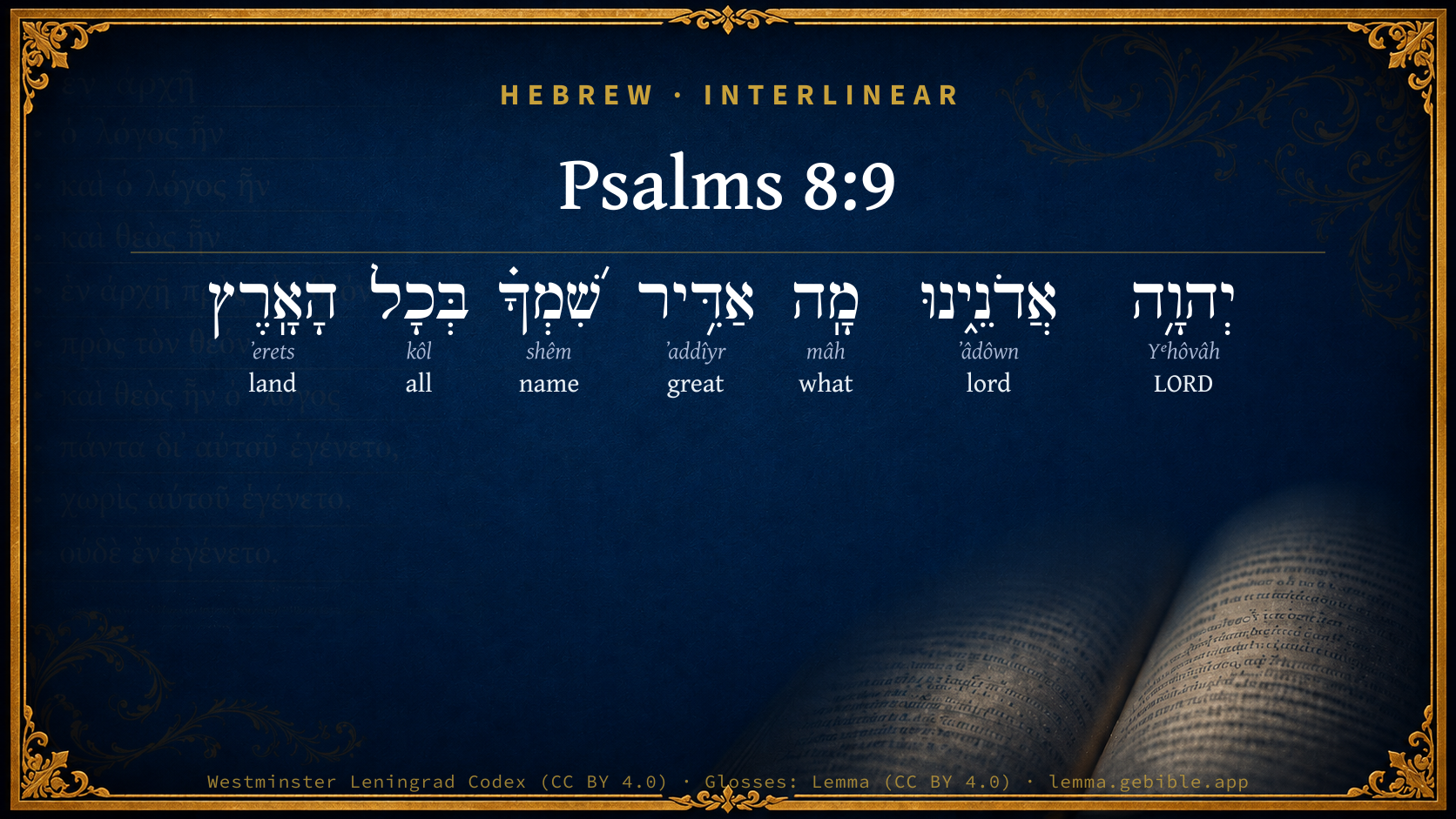
Psalms 8:9

Hebrew (Westminster Leningrad Codex) Psalms 8:9 appears in the Hebrew Old Testament. The text above is from the Westminster Leningrad Codex. Each word links to its Strong’s number, a concise gloss, and parsing drawn from the Open Scriptures Hebrew Bible morphology. Click any word for its full Brown-Driver-Briggs (BDB) entry.
Download image
Cite this verse

Psalms 8:9 (World English Bible). Public Domain. Lemma interlinear Bible study tool, https://lemma.gebible.app/v/psalms/8/9.

Show BibTeX & RIS
BibTeX
RIS
English Translation
Yahweh, our Lord, How majestic is your name in all the earth!
World English Bible · Public Domain
Download a study sheet

One document with this verse’s original text, its word-by-word gloss line, the meaning frame, cross-references with their text, attributed commentary, and full source and license credits — printable, and it pastes into notes with its structure intact.

This verse Autodidact and up

Study sheet (.html) Plain text (.txt)

A passage Seminary Student

Up to 50 verses in one chapter. A passage sheet keeps up to 6 commentary sources and 12 cross-references per verse, in the order this page ranks them, and says so on the sheet whenever that leaves anything out. Ask for a single verse and you get the Autodidact verse sheet above.

Everything on this page stays free to read, with no account — the sheet is a download of what is already on screen, not access to it.

Want to remove ads? Support Godless Engineer
Compare translations 3

The same verse in 3 English versions, stacked beneath the original-language interlinear above. Click any original word for its lexicon entry.

Each is an independent rendering of the whole verse — the interlinear is not word-aligned to these translations.

Highlighted words mark where these versions differ — a whole-verse word diff, not a word-by-word alignment.

  • World English Bible Public Domain
    Yahweh, our Lord, How majestic is your name in all the earth!
  • King James Version Public Domain
    O LORD our Lord, how excellent is thy name in all the earth!
  • unfoldingWord Literal Text CC BY-SA 4.0
    Yahweh, our Lord, how magnificent is your name in all the earth!

unfoldingWord Literal Text — © unfoldingWord, licensed CC BY-SA 4.0. Word-aligned USFM3 via Door43 (git.door43.org/unfoldingWord/en_ult).

Versions to compare (up to 4)

3 of 4 selected

Show all 18 translations

Every available English version of this verse, each an independent rendering of the whole verse.

  • World English Bible Public Domain
    Yahweh, our Lord, How majestic is your name in all the earth!
  • Berean Standard Bible Public Domain
    O LORD, our Lord, how majestic is Your name in all the earth!
  • Majority Standard Bible Public Domain
    O LORD, our Lord, how majestic is Your name in all the earth!
  • King James Version Public Domain
    O LORD our Lord, how excellent is thy name in all the earth!
  • American Standard Version (1901) Public Domain
    O Jehovah, our Lord, How excellent is thy name in all the earth! Psalm 9 For the Chief Musician; set to Muthlabben. A Psalm of David.
  • Revised Version (1885) Public Domain
    O LORD, our Lord, how excellent is thy name in all the earth!
  • Geneva Bible (1599) Public Domain
    O Lord our Lord, howe excellent is thy Name in all the world!
  • Douay-Rheims (1899) Public Domain
    The birds of the air, and the fishes of the sea, that pass through the paths of the sea.
  • Young's Literal Translation Public Domain
    Jehovah, our Lord, How honourable Thy name in all the earth!
  • Literal Standard Version CC BY-SA 4.0
    YHWH, our Lord, || How majestic [is] Your Name in all the earth!
  • Unlocked Literal Bible CC BY-SA 4.0
    Yahweh our Lord, how magnificent is your name in all the earth!
  • unfoldingWord Literal Text CC BY-SA 4.0
    Yahweh, our Lord, how magnificent is your name in all the earth!
  • Darby Bible Public Domain
    Jehovah our Lord, how excellent is thy name in all the earth!
  • World Messianic Bible Public Domain
    LORD, our Lord, how majestic is your name in all the earth!
  • Webster's Bible Public Domain
    \\8:8\\The fowl of the air, and the fish of the sea, and whatever passeth through the paths of the seas.
  • Free Bible Version CC BY-SA 4.0
    Lord, our Lord, your magnificent reputation fills the earth!
  • Bible in Basic English Public Domain
    O Lord, our Lord, how noble is your name in all the earth!
  • JPS Tanakh (1917) Public Domain
    (8-10) O LORD, our Lord, how glorious is Thy name in all the earth!

Literal Standard Version (2020), Covenant Press — licensed CC BY-SA 4.0. Text via the HelloAO Bible API (eBible.org). Unlocked Literal Bible (unfoldingWord) — licensed CC BY-SA 4.0. Text via the HelloAO Bible API (eBible.org). unfoldingWord Literal Text — © unfoldingWord, licensed CC BY-SA 4.0. Word-aligned USFM3 via Door43 (git.door43.org/unfoldingWord/en_ult). Free Bible Version, Dr. Jonathan Gallagher — licensed CC BY-SA 4.0. Text via the HelloAO Bible API (eBible.org).

Word by word

More ways to search: Search by grammar → Find every occurrence → Compare this word →

Practice this passage: Drill this verse → Learn its vocabulary →

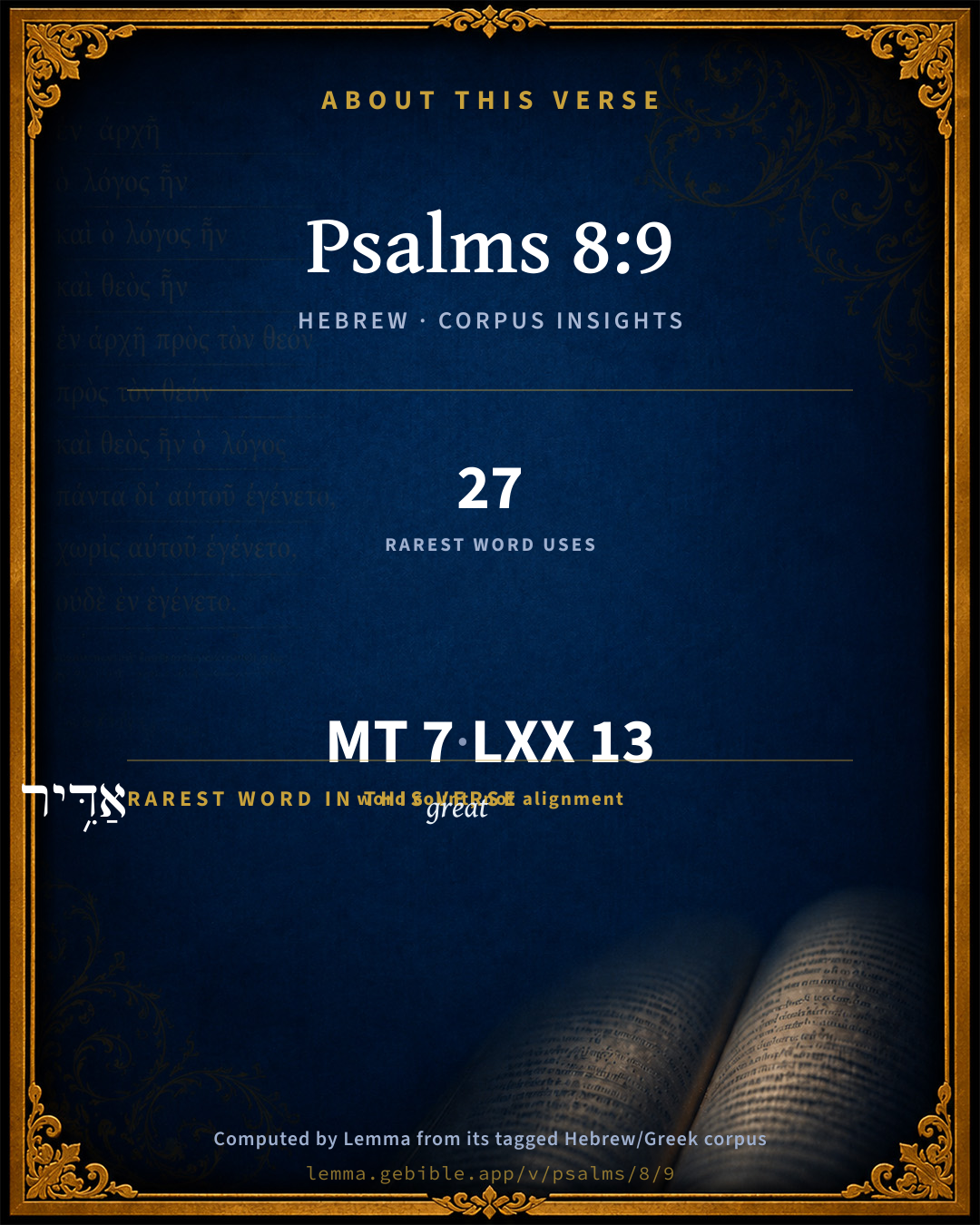
About this verse

These counts appear in no published source. They are computed here, from the morphology-tagged text and Lemma’s own curated glosses. What Lemma adds →

7
words
7
distinct lemmas
Wisdom
section

Shared distinctive vocabulary

אַדִּ֥יר great H117 occurs in 25 verses of the Hebrew Bible. Also found in:

Grammatical profile

  • 5 nouns
  • 1 adjective
  • 1 particle

Hebrew & Septuagint length

In English translation the verse runs 12 words from the Hebrew and 13 from the Septuagint (LXX English) — closely comparable.

A rough comparison of the two English renderings, which tokenize alike — not a word-level alignment.

Word counts can differ between the Hebrew and the Greek without any difference in meaning — e.g. the Hebrew direct-object marker אֵת has no separate Greek word, and Greek often adds the article ὁ.

In the original languages it is 7 Hebrew tokens and 13 Greek tokens — but the two are counted differently (Hebrew bundles its prefixes and suffixes into one token; the Greek is in lemma form), so that isn’t a like-for-like length.

Cross-references

4

Topical passages linked to Psalms 8:9 in the Treasury of Scripture Knowledge — connected by theme and wording, ordered by reader-vote popularity; previews shown in the World English Bible.

  • Psalms 8:1 Yahweh, our Lord, how majestic is your name in all the earth, Who has set your glory above the heavens!
  • Job 11:7 "Can you fathom the mystery of God? Or can you probe the limits of the Almighty?
  • Psalms 104:24 Yahweh, how many are your works! In wisdom have you made them all. The earth is full of your riches.
  • Deuteronomy 33:26 There is none like God, Jeshurun, Who rides on the heavens for your help, In his excellency on the skies.

Cross-references courtesy of OpenBible.info (CC BY 4.0).

Hebrew and Greek witnesses Masoretic Hebrew ↔ Greek Septuagint

The same verse in the two great witnesses to the Old Testament, shown verse-for-verse.

You’re reading Greek Psalm 8 (Hebrew Psalm 8). The Septuagint counts the superscription, so verse numbers can differ from the Hebrew — chapter-level alignment, not verse-by-verse. Numbering follows Rahlfs.

These are two independent witnesses, not word-aligned to each other, and the Septuagint is shown in lemma (dictionary) form.

Hebrew Psalms 8:9 Masoretic · Westminster Leningrad Codex

יְהוָ֥ה אֲדֹנֵ֑ינוּ מָֽה אַדִּ֥יר שִׁ֝מְךָ֗ בְּכָל הָאָֽרֶץ

Yahweh, our Lord, How majestic is your name in all the earth!

World English Bible · Public Domain

Greek LXX Greek Psalm 8:9 Septuagint · lemma form

ὁ πετεινόν ὁ οὐρανός καί ὁ ἰχθῦς ὁ θάλασσα ὁ διαπορεύομαι τρίβος θάλασσα

O Lord our Lord, how wonderful is your name in all the earth!

LXX2012 (modern English Septuagint) · Public Domain

Hebrew: Westminster Leningrad Codex (CC BY 4.0). Greek: Septuagint (public domain); English from LXX2012 (modern English Septuagint) (Public Domain). How the Septuagint differs from the Hebrew →

Commentary

Notes on Psalms 8:9 from classic Christian and Jewish commentators (each source and its license shown beneath its notes). The classic Christian expositions comment on the surrounding passage and are grouped to its opening verse, so a note may address several verses; the Jewish commentaries on the Tanakh (Rashi and others) are per-verse, so they appear only where the commentator wrote on this verse.

Lemma curates 59 commentaries, every one of them public domain or Creative Commons licensed, each selected and text-cleaned for this edition rather than reprinted as found. About our sources →

Trapp's Complete Commentary

John Trapp

Psa 8:9 O LORD our Lord, how excellent [is] thy name in all the earth!

Ver. 9. O Lord our Lord, &c.] Prius incipit Propheta mirari quam loqui, et desinit loqui non mirari. The psalmist endeth as he began, transported with an ecstasy of admiration. So he begins and ends many of his psalms with Hallelujah. Between God and us the distance is infinite; and, if it were possible, our love and thankfulness should fill up that distance, and extend itself to infiniteness, saith a grave divine.

John Trapp, A Commentary or Exposition upon All the Books of the Old and New Testament (1647–1656) — public domain. Text from a community e-Sword module.

J. A. Alexander on Psalms

Joseph Addison Alexander

10. (Psa 8:9). Jehovah, our Lord, how glorious is thy name in all the earth, not only made so by the splendour of the skies, but by God's condescending goodness to mankind. With this new evidence and clearer view of the divine perfection, the Psalmist here comes back to the point from which he started, and closes with a solemn repetition of the theme propounded in the opening sentence.

Joseph Addison Alexander, The Psalms Translated and Explained (1850) — public domain. Text from a community e-Sword module.

Jamieson, Fausset & Brown

Robert Jamieson, A. R. Fausset & David Brown

Appropriately, the writer closes this brief but pregnant and sublime song of praise with the terms of admiration with which it was opened.

Next: Psalms Chapter 9

Jamieson, Fausset & Brown — Commentary Critical and Explanatory on the Whole Bible (1871) — public domain (CC PDM 1.0). Text via the HelloAO Bible API.

Adam Clarke's Commentary

Verse 9. O Lord our Lord] The psalmist concludes as he began. Jehovah, our prop and support! his name is excellent in all the earth. The name of JESUS is celebrated in almost every part of the habitable globe; for his Gospel has been preached, or is in the progress of being preached, through the whole world. Bibles and missionaries are now carrying his name, and proclaiming his fame, to the utmost nations of the earth.

The whole of this Psalm, and the seventh and eighth verses in particular, have been the subject of much spiritualization in ancient and modern times. I shall give two examples: one from the pious Bishop Horne; the other from the ancient Latino-Scotico-English Psalter, mentioned before.

That of Bishop Horne, on the 7th and 8th verses, is as follows: "Adam, upon his creation, was invested with sovereign dominion over the creatures, in words of the same import with these, Ge 1:28, which are therefore here used, and the creatures particularized, to inform us that what the first Adam lost by transgression, the second Adam gained by obedience. That glory which was set above the heavens could not but be over all things on the earth; and accordingly we hear our Lord saying, after his resurrection, 'All power is given unto me in heaven and earth,' Mt 28:18. Nor is it a speculation unpleasing or unprofitable to consider that he who rules over the material world is Lord also of the intellectual or spiritual creation represented thereby.

"The souls of the faithful, lowly, and harmless, are the sheep of his pasture; those who like oxen, are strong to labour in the Church, and who by expounding the word of life tread out the corn for the nourishment of the people, own him for their kind and beneficent Master. Nay, tempers fierce and untractable as the wild beasts of the desert, are yet subject to his will. Spirits of the angelic kind, that, like the birds of the air, traverse freely the superior region, move at his command; and these evil ones, whose habitation is in the deep abyss, even to the great leviathan himself, all, all are put under the feet of the King Messiah; who, because he humbled himself, and became obedient to death, was therefore highly exalted, and had a name given him above every name; that at the name of Jesus every knee should bow, whether of things in heaven, or things on earth, or things under the earth; and that every tongue should confess that Jesus is Lord, to the glory of God the Father; Php 2:8, c." Thus far the pious bishop.

I shall now give, as a singular curiosity, the whole Psalm, with its translation and paraphrase, from the ancient MS. already mentioned inserting first the Latin text; next, the translation; and, thirdly, the paraphrase. The Latin text seems to be the old Itala, or Antehieronymian; at least it has readings which have been thought peculiar to that version.

PSALM VIII

Ver. 1. Domine Deus noster, quoniam admirabile est nomen tuum in universa terra.

Trans. Lord our Lord, qwat thi name es wonderfull in al the Erde.

Par. The prophete in louing, bygynnes and says: Lord of al, thow ert specialy our Lord that dredes the, loves the. Thi name that es the ioy and the fame of thi name Ihesu: for the creaturs that thu hes made and bought qwat it es wonderful. Als so say withouten end: for nane suffis for to knaw al creaturs: in qwilk wonder of the, and that in al the Erd, nought in a party anely.

Quoniam elevata est magnificencia tua super Celos.

Trans. For lyfted es thi worchyp aboven hevens.

Par. That es at say, thu ert mare worthy to be loued and wirchepyd than any Aungel or haly Saule may thynk.

Ver. 2. Ex ore infancium et lactencium perfecisti laudem, propter inimicos tuos, ut destruas inimicum et ultorem.

Trans. Of the mouth of nought spekand, and sowkand, thou has made louying, for thin enmys, that thou destroye the enmy and the venger.

Par. Nought anely thow ert loued of perfite men, bot of the mouthe of barnes that spekes nought: Zit there er tha that kan nought speke the wisdom of this werld: and of soukand, the qwilk gladdely resayves the lare of haly Kyrk theare moder. Thow has made thi luf thug perfyte for thin enmys: fals cristen men, to schame and to schende for thai er wer than er haythen men. That thu destruy the enmy; that es, he that es wyse in his awen eghen; and wil nought be underloute til thi wil: and the venger: that es he that defends his Syn; and sais that he synnes nought; or that his syn es les than other mennes.

Ver. 3. Quoniam videbo celos tuos, et opera digitorum tuorum, lunam et stellas quas tu fundasti.

Trans. For I sal se thi hevens werkes of thi fyngers the mone and the Sternys the quilk thow groundid.

Par. Thow destrues al that es contrariand til the; bot i in al thying confourom me to do thi wil; for thi i sal se in lyf withouten end. Thi hevens, that es Aungels and Apostels the qwilk er werkes of thi fingers: that es, that er mode perfyte thurgh the Haly Gost, of qwam es seven gyftes. Of he be bot a Spirit, als mani fyngers er in a hand. And i sal see the Mone, that es haly Kyrk: and the sternes that es ilk a ryghtwise man by hym selfe, the qwilk thu groundid in charite.

Ver. 4. Quid est homo quod memor es ejus; aut filius hominis, quoniam visitas eum?

Trans. Qhat es man that thu ert menand of hym: or son of man for thou visites hym?

Par. Als it war with despyte, he sais man, erdely and synful, qwat es he, that thu has mynd of hym. Als fer sett fra the; at the lest gyfand hym hele and ese of body. Or son of man: that es, he that es gastely, and beres the ymage of heven. Qwat es he, for thou visits hym. Als present the qwilk es nere the for clennes of lyf. Or son of man he calles Crist, thrugh qwam he visits mannes kynd.

Ver. 5. Minuisti eum paullo minus ab angelis: gloria et honore coronasti eum; et constituisti eum super opera manuum tuarum.

Trans. Thow lessed hym a littil fra aungels; with ioy and honour thu coround hym: and thu sett him aboven the werkes of thi hend.

Par. Crist was lessed fra aungels, for he was dedely, and mught suffer pyne; but a littel; for in other thyng, es he abouen aungels, thair Kyng and Sychthu thou coround hym with ioy, that es with brighthede of body, na mare sufferand pyne; and honour, for he es honourable til al: and thou sett hym abouen aungels and al creatures.

Ver. 6, 7. Omnia subjecisti sub pedibus ejus: oves et boves insuper et pecora campi.

Trans. Al thynges thu underkest undyr his fete: schepe and oxen al over that, and the bestes of the feld.

Par. That undyr hys Lordschyp and hys myght, in has cestyn al thyng: tha er schepe that er innocentes, als well aungels als men. And oxen, tha er, traveland men gastely, in haly Kyrk, over that; and the bestes of the feld; thai er lufers of this werld, wonnand, in the feld of fleschly lusts; noght in hillis of vertus; and so be the brode way thai ga til hell.

Ver. 8. Volucres celi et pisces maris qui perambulant semitas maris.

Trans. Fowls of heven and fysche of the see, that gas the wayes of the see.

Par. Fowls of heven, er prowde men that wald hee thair setil abouen al other. Fysches of the see, er covaytus men, the qwilk in the ground of the werld, sekes erthdly gudes, that all stretes in the see, sone wither oway. Al thir sal be underlout til Crist onther herts in grace, or thare in pine.

Ver. 9. Domine Deus noster, quam admirabile est nomen tuum in universa terra.

Trans. Lard our Lard qwat thi name is wonderful in al the erth.

Par. Als he bigan swa he endes, schewand that bygyning and endyng of al gode, is of Gode; and til his louing agh i for to be done.

The reader will no doubt be struck with the remarkable agreement between the pious bishop of Norwich and this ancient translator and paraphrast, particularly on the 7th and 8th verses. The language also is in several respects singular. The participle of the present tense, which we terminate with ing, is here almost always terminated with and. So Spekand, sowkand, gyfand, sufferand, traveland, for speaking, sucking, giving, suffering, travelling, c.

As the participle signifies the continuance of the action, the termination and seems much more proper than ing speak - and, i.e., continuing to speak; give - and, continuing to give; suffer - and, suffer more; travel - and, travel on, c. There are some words in this ancient MS. which I have met nowhere else.

ANALYSIS OF THE EIGHTH PSALM

This Psalm begins and ends with a general proposition, figured by an exclamation, which contains an admiration for he admires what he cannot perfectly comprehend. "O Lord our Lord, how excellent is thy name in all the earth! who hast set thy glory above the heavens." Such is the glory of thy divinity, power, and goodness, that it fills not only the earth, but transcends the very heavens, in which angels and blessed spirits, though they know much more than we on earth, yet cannot comprehend thy Majesty, which fills all and exceeds all.

This general proposition being premised, the prophet descends to some particular instances, in which the excellence of God's name particularly appears; and he mentions three: I. Infants. II. The heavens, with the moon and stars. III. Man himself.

I. The excellence of God's power, divinity, and goodness, appears in infants: "Out of the mouth of babes and sucklings thou hast ordained strength." 1. The sucking of babes, and speaking of young children, are evident demonstrations of God's excellent name; for who taught the babe to suck, or the dumb infant to speak, but the Lord our Governor? 2. The children that cried "Hosanna!" in the temple, struck with the miracles of our Lord; while the priests, through envy, were dumb. 3. Or by babes may be meant such as the worldly-wise repute no better than children and fools. By simple prophets, ignorant fishermen, humble confessors, and faithful martyrs, hath he stilled the enemy and the avenger; confounded the wisest philosophers, and stopped the mouths of devils.

II. The next instance in which the glory and excellence of God's name appears is the heavens, the moon and the stars: these are the works of his fingers, and therefore called Thy heavens; whose amplitude is great, order and orbs wonderful, beauty admirable, matter durable, and motions various yet stable; together with the stars, whose multitude is innumerable, magnitude vast and various, order admirable, and influences secret and wonderful. The varying, yet regular and constant course of the moon, her changes, phases, and influences on the earth and the waters, on men and other animals. All these have been ordained by the all-wise God; and the earth and its inhabitants are receiving continual benefits from them.

When I consider these things, then I say to myself:

III. "What is man, that thou art mindful of him? or the son of man, that thou visitest him?" This is the psalmist's third instance to manifest the excellence of God's providence and government of the world, in which he reflects upon man in his baseness and in his dignity.

1. In his baseness, vileness, and misery, signified by the question, What is man? As if he should say, What a poor creature? how miserable! What except dust and ashes, as to his body, when he was at the best; for he was taken from the dust of the ground, even when his soul was formed in the image of God. But now miserable dust while he lives, and to dust he shall return when he dies. What then is this miserable creature, of what worth, that thou, so great, and so glorious a Being, who art higher than the heavens, shouldst visit and take care of him!

2. This is his dignity; he can know, love, serve, and enjoy thee for ever; and thou settest thy love upon him above all other creatures. This thou hast showed in the following ways:-

1. In visiting him, and in being mindful of him: 1. Thou visitest him by conferring on him many temporal blessings. 2. In illuminating his mind by thy Holy Spirit. 3. In sending him thy law and thy Gospel, by prophets and apostles. 4. In giving thy Son to take upon himself human nature, and to die, the just for the unjust, that thou mightest bring him to thyself, through whom he is to receive remission of sins, and an eternal inheritance among the saints in light. 5. In making him, fallen and wretched as he is, lord of thy creatures; giving him all sheep and oxen, the beasts of the field, the fowls of heaven, and the fish of the sea. 6. But this universal dominion belongs principally to the Lord Jesus, through whom and by whom all good comes to man, and to whom all glory should be given, world without end. Let God's excellent name be exalted throughout all the earth!

Adam Clarke's Commentary on the Bible (1810–1826) — public domain. Text from a community e-Sword/MySword module.

The Cambridge Bible for Schools and Colleges

gen. ed. J. J. S. Perowne

9. How can the Psalmist better close than with the same exclamation of reverent wonder with which he began; repeated now with fuller significance, after meditation on the way in which the truth it asserts is most signally declared!

The Cambridge Bible for Schools and Colleges (gen. ed. J. J. S. Perowne; Cambridge University Press, 1878–1918) — public domain. Text from a community e-Sword module.

John Gill's Exposition

O Lord our Lord, how excellent is thy name in all the earth! The psalm ends with the same words with which it begins; which shows that the sense of this, with which the psalmist was affected, continued with him, and doubtless increased, after such a confirmation of it, by the instances he was led to take notice of. See Gill on Psa 8:1.

Next: Psalms Chapter 9

John Gill's Exposition of the Whole Bible (1746–1763) — public domain (CC PDM 1.0). Text via the HelloAO Bible API.

Albert Barnes' Notes on the Bible

O Lord our Lord, how excellent ... - Repeating the sentiment with which the psalm opens, as now fully illustrated, or as its propriety is now seen. The intermediate thoughts are simply an illustration of this; and now we see what occupied the attention of the psalmist when, in Psa 8:1, he gave utterance to what seems there to be a somewhat abrupt sentiment. We now, at the close of the psalm, see clearly its beauty and truthfulness.

Albert Barnes' Notes on the Bible (1834–1885) — public domain. Text from a community e-Sword/MySword module.

The Treasury of David

Charles H. Spurgeon

Ver. 9. Here, like a good composer, the poet returns to his key-note, falling back, as it were, into his first state of wondering adoration. What he started with as a proposition in the first verse, he closes with as a well proven conclusion, with a sort of quod erat demonstrandum. O for grace to walk worthy of that excellent name which has been named upon us, and which we are pledged to magnify!

None.

Ver. 9. The wanderer in many climes enjoying the sweetness of his Lord's name in every condition.

Charles H. Spurgeon's The Treasury of David (1869–1885) — public domain. Psalms only. Text from a community e-Sword/MySword module.

Whedon's Commentary on the Bible

Daniel D. Whedon

9. How excellent is thy name—A suitable refrain, in echo of Psa_8:1, after so lofty a tribute of honour to man and praise to God.

Daniel D. Whedon (gen. ed.), Commentary on the Old and New Testaments (1874–1909) — public domain. Text from a community e-Sword module.

The Pulpit Commentary

O Lord our Lord, how excellent is thy Name in all the earth! The psalmist ends as he began, with excellent poetic effect, and in a spirit of intense piety. Some think that he saw in vision the com plete subjugation of the whole earth to man in such sort as will only be accomplished in the "new heavens and new earth," in which Christ shall reign visibly over his people. But his words are not beyond those which are natural to one of warm poetic temperament and deep natural piety, looking out upon the world and upon man as they existed in his day. Inspiration, of which we know so little, may perhaps have guided him to the choice of words and phrases peculiarly applicable to "the Ideal of man"s nature and true Representative, Christ;" and hence the many references to this psalm in the New Testament, (Mat_21:16 1Co_15:25-28 Heb_2:6-8) and in this sense the psalm may be Messianic; but it is certainly not one of those, like Ps 2 and Ps 22, where the author consciously spoke of another time than his own, and of a Personage whom he knew only by faith. (For other examples of the recurrence at the end of a psalm of the idea wherewith it commenced, see Psa_20:1-9 Psa_46:1-11 Psa_70:1-5 Psa_103:1-22 Psa_118:1-29; and the "Hallelujah psalms:" Psa_106:1-48 Psa_113:1-9 Psa_117:1, 2 146-150)

The greatness of God in redemption.

"O Lord our Lord, how excellent is thy Name in all the earth!" This may be applied to redemption

I IN CHOOSING EARTH AS THE SCENE OF REDEMPTION. There are millions of other worlds, which we may reasonably believe have their intelligent inhabitants. Out of these the earth was chosen for the highest honours.

II IN MAKING MAN THE SUBJECT OF REDEMPTION. We cannot tell if sin extends to other worlds, but we know that other beings besides man have fallen from their first estate. The angels sinned, but God was pleased to pass them by, and to show his exceeding kindness and love to man in Christ Jesus. (Heb_2:16)

III IN EMPLOYING CHRIST AS THE AUTHOR OF REDEMPTION. It was not an angel, but his eternal Son, whom God sent to be our Saviour. (Gal_4:4, Gal_4:5) And when he came, it was not in the fulness of his glory, but in fashion as a man, born of a woman, made under the Law, obedient unto death, even the death of the cross. (Php_2:6-10)

IV IN PROCLAIMING BY THE GOSPEL THE COMPLETENESS OF REDEMPTION. All men as sinners needed salvation, and the salvation of Christ is suitable and sufficient for all. He is the Propitiation for the sins of the whole world, and if the whole world should bow in penitence before God, their sins would that moment be all put away.

V IN REVEALING THE ETERNAL GLORIES OF REDEMPTION THROUGH HIS SPIRIT Already great things have been done. But we look for greater. W.F. (Rev_21:1-7)

The Pulpit Commentary (1880–1919), ed. H.D.M. Spence-Jones & Joseph S. Exell — public domain. Text from a community e-Sword module.

Keil & Delitzsch

C. F. Keil & F. Delitzsch

(Heb.: 8:10) 8:10. He has now demonstrated what he expressed in Psa 8:2, that the name of Jahve whose glory is reflected by the heavens, is also glorious on earth. Thus, then, he can as a conclusion repeat the thought with which he began, in a wider and more comprehensive meaning, and weave his Psalm together, as it were, into a wreath.

It is just this Psalm, of which one would have least expected it, that is frequently quoted in the New Testament and applied to the Messiah. Indeed Jesus' designation of Himself by ὁ υἱὸς τοῦ ἀνθρώπου, however far it may refer back to the Old Testament Scriptures, leans no less upon this Psalm than upon Dan 7:13. The use the writer of the Epistle to the Hebrews (Heb 2:6-8) makes of Psa 8:5 of this Psalm shows us how the New Testament application to the Messiah is effected. The psalmist regards man as one who glorifies God and as a prince created of God. The deformation of this position by sin he leaves unheeded. But both sides of the mode of regarding it are warranted. On the one hand, we see that which man has become by creation still in operation even in his present state; on the other hand, we see it distorted and stunted. If we compare what the Psalm says with this shady side of the reality, from which side it is incongruous with the end of man's creation, then the song which treats of the man of the present becomes a prophecy of the man of the future. The Psalm undergoes this metamorphosis in the New Testament consciousness, which looks more to the loss than to that which remains of the original. In fact, the centre of the New Testament consciousness is Jesus the Restorer of that which is lost. The dominion of the world lost to fallen man, and only retained by him in a ruined condition, is allotted to mankind, when redeemed by Him, in fuller and more perfect reality. This dominion is not yet in the actual possession of mankind, but in the person of Jesus it now sits enthroned at the right hand of God. In Him the idea of humanity is transcendently realised, i.e., according to a very much higher standard than that laid down when the world was founded. He has entered into the state-only a little (βραχύ τι) beneath the angels - of created humanity for a little while (βραχύ τι), in order to raise redeemed humanity above the angels. Everything (כּל) is really put under Him with just as little limitation as is expressed in this Psalm: not merely the animal kingdom, not merely the world itself, but the universe with all the ruling powers in it, whether they be in subjection or in hostility to God, yea even the power of death (Co1 15:27, cf. Eph 1:22). Moreover, by redemption, more than heretofore, the confession which comes from the mouth of little children is become a bulwark founded of God, in order that against it the resistance of the opponents of revelation may be broken. We have an example of this in Mat 21:16, where our Lord points the pharisees and scribes, who are enraged at the Hosanna of the children, to Psa 8:3. Redemption demands of man, before everything else, that he should become as a little child, and reveals its mysteries to infants, which are hidden from the wise and intelligent. Thus, therefore, it is μικροὶ καὶ νήπιοι, whose tongue is loosed by the Spirit of God, who are to put to shame the unbelieving; and all that this Psalm says of the man of the present becomes in the light of the New Testament in its relation to the history of redemption, a prophecy of the Son of man κατ ̓ ἐξοχήν, and of the new humanity.

Keil & Delitzsch — Biblical Commentary on the Old Testament (1861–1891) — public domain (CC PDM 1.0). Text via the HelloAO Bible API. (Old Testament only.)

unfoldingWord translationNotes

Door43 World Missions Community

how magnificent is your name in all the earth

With this exclamation, David shows his joy and awe about how great God is. AT: "your name is wonderfully magnificent in all the earth" or "people in all the earth know how magnificent you are" (See: Exclamations)

your name

God's "name" represents him or his reputation. AT: "your reputation" (See: Metonymy)

magnificent

excellent, great

translationWords

name

unfoldingWord translationNotes — © Distant Shores Media and the Door43 World Missions Community, licensed CC BY-SA 4.0. Source: git.door43.org/Door43/en_tn.

Radak

Rabbi David Kimhi (Radak)

Fowl of heaven and fish of the sea: – He says: Even over those which are not in the earth with him, as the fowl which flies in the air, and the fishes which swim in the waters, he rules over all and snares them by his cunning devices. And further, by his understanding and his cunning devices

He passes over the paths of the sea: – in that he makes ships and passes in them over the paths of the sea.

Radak on the Tanakh — English translations: “Sefaria Community Translation” (CC0 1.0 (public-domain dedication)); “Eliyahu Munk, HaChut Hameshulash” (CC BY 4.0); “Rabbi Mike Feuer, Jerusalem Anthology” (CC BY 4.0); and “R. David Kimhi on the first book of Psalms, Translated by R.G. Finch, London, 1919” (public domain). Text via Sefaria.

Lesson kit

Teaching starters — assembled from the data on this page, not authored interpretation. Every prompt links to the verse data it draws on. Edit before teaching.

Psalms, in the Wisdom, opens this verse with 7 words (7 distinct Hebrew lemmas). Its most distinctive word is ʼaddîyr (“great”). A historical commentator’s framing appears above. Read the whole chapter for the surrounding context.

Discussion questions

  1. How does “great” (ʼaddîyr) shape what this verse is saying?
  2. How does Exodus 15:10, which shares the word «great», read alongside this verse?
  3. These translations render this verse differently; the difference is in the English rendering, not the original. What questions does that raise?
  4. Compare how Trapp's Complete Commentary and J. A. Alexander on Psalms read this verse. Where do they agree or differ?

Things to notice

Reading settings

Reading text

Shown beneath each verse's original-language words.

Old Testament
Old Testament edition

Read the OT as the Masoretic Hebrew (MT) or the Greek Septuagint (LXX).

English shown for the Greek Septuagint (in the Hebrew ↔ Greek comparison).

Comparing translations? Open the Compare panel on any verse page to stack up to four side by side.