

Isaiah 52:7

Hebrew (Westminster Leningrad Codex) Isaiah 52:7 appears in the Hebrew Old Testament. The text above is from the Westminster Leningrad Codex. Each word links to its Strong’s number, a concise gloss, and parsing drawn from the Open Scriptures Hebrew Bible morphology. Click any word for its full Brown-Driver-Briggs (BDB) entry.
Download image
Cite this verse

Isaiah 52:7 (World English Bible). Public Domain. Lemma interlinear Bible study tool, https://lemma.gebible.app/v/isaiah/52/7.

Show BibTeX & RIS
BibTeX
RIS
English Translation
How beautiful on the mountains are the feet of him who brings good news, who publishes peace, who brings good news of good, who publishes salvation, who says to Zion, Your God reigns!
World English Bible · Public Domain
Download a study sheet

One document with this verse’s original text, its word-by-word gloss line, the meaning frame, cross-references with their text, attributed commentary, and full source and license credits — printable, and it pastes into notes with its structure intact.

This verse Autodidact and up

Study sheet (.html) Plain text (.txt)

A passage Seminary Student

Up to 50 verses in one chapter. A passage sheet keeps up to 6 commentary sources and 12 cross-references per verse, in the order this page ranks them, and says so on the sheet whenever that leaves anything out. Ask for a single verse and you get the Autodidact verse sheet above.

Everything on this page stays free to read, with no account — the sheet is a download of what is already on screen, not access to it.

Want to remove ads? Support Godless Engineer
Compare translations 3

The same verse in 3 English versions, stacked beneath the original-language interlinear above. Click any original word for its lexicon entry.

Each is an independent rendering of the whole verse — the interlinear is not word-aligned to these translations.

Highlighted words mark where these versions differ — a whole-verse word diff, not a word-by-word alignment.

  • World English Bible Public Domain
    How beautiful on the mountains are the feet of him who brings good news, who publishes peace, who brings good news of good, who publishes salvation, who says to Zion, Your God reigns!
  • King James Version Public Domain
    How beautiful upon the mountains are the feet of him that bringeth good tidings, that publisheth peace; that bringeth good tidings of good, that publisheth salvation; that saith unto Zion, Thy God reigneth!
  • unfoldingWord Literal Text CC BY-SA 4.0
    How they are beautiful on the mountains, the feet of the one heralding, the one making hear peace, the one heralding good, the one making hear salvation, the one saying to Zion, “Your God reigns”!

unfoldingWord Literal Text — © unfoldingWord, licensed CC BY-SA 4.0. Word-aligned USFM3 via Door43 (git.door43.org/unfoldingWord/en_ult).

Versions to compare (up to 4)

3 of 4 selected

Show all 18 translations

Every available English version of this verse, each an independent rendering of the whole verse.

  • World English Bible Public Domain
    How beautiful on the mountains are the feet of him who brings good news, who publishes peace, who brings good news of good, who publishes salvation, who says to Zion, Your God reigns!
  • Berean Standard Bible Public Domain
    How beautiful on the mountains are the feet of those who bring good news, who proclaim peace, who bring good tidings, who proclaim salvation, who say to Zion, “Your God reigns!”
  • Majority Standard Bible Public Domain
    How beautiful on the mountains are the feet of those who bring good news, who proclaim peace, who bring good tidings, who proclaim salvation, who say to Zion, “Your God reigns!”
  • King James Version Public Domain
    How beautiful upon the mountains are the feet of him that bringeth good tidings, that publisheth peace; that bringeth good tidings of good, that publisheth salvation; that saith unto Zion, Thy God reigneth!
  • American Standard Version (1901) Public Domain
    How beautiful upon the mountains are the feet of him that bringeth good tidings, that publisheth peace, that bringeth good tidings of good, that publisheth salvation, that saith unto Zion, Thy God reigneth!
  • Revised Version (1885) Public Domain
    How beautiful upon the mountains are the feet of him that bringeth good tidings, that publisheth peace, that bringeth good tidings of good, that publisheth salvation; that saith unto Zion, Thy God reigneth!
  • Geneva Bible (1599) Public Domain
    How beautifull vpon the mountaines are the feete of him, that declareth and publisheth peace? that declareth good tidings, and publisheth saluation, saying vnto Zion, Thy God reigneth?
  • Douay-Rheims (1899) Public Domain
    How beautiful upon the mountains are the feet of him that bringeth good tidings, and that preacheth peace: of him that sheweth forth good, that preacheth salvation, that saith to Sion: Thy God shall reign!
  • Young's Literal Translation Public Domain
    How comely on the mountains, Have been the feet of one proclaiming tidings, Sounding peace, proclaiming good tidings, Sounding salvation, Saying to Zion, `Reigned hath thy God.'
  • Literal Standard Version CC BY-SA 4.0
    How lovely on the mountains, || Have been the feet of one proclaiming tidings, || Sounding peace, proclaiming good tidings, || Sounding salvation, || Saying to Zion, “Your God has reigned.”
  • Unlocked Literal Bible CC BY-SA 4.0
    How beautiful on the mountains are the feet of the messenger who brings good news, who announces peace, who bears good tidings, who announces salvation, who says to Zion, “Your God reigns!”
  • unfoldingWord Literal Text CC BY-SA 4.0
    How they are beautiful on the mountains, the feet of the one heralding, the one making hear peace, the one heralding good, the one making hear salvation, the one saying to Zion, “Your God reigns”!
  • Darby Bible Public Domain
    How beautiful upon the mountains are the feet of him that announceth glad tidings, that publisheth peace; that announceth glad tidings of good, that publisheth salvation, that saith unto Zion, Thy God reigneth!
  • World Messianic Bible Public Domain
    How beautiful on the mountains are the feet of him who brings good news, who publishes peace, who brings good news, who proclaims salvation, who says to Zion, “Your God reigns!”
  • Webster's Bible Public Domain
    How beautiful upon the mountains are the feet of him that bringeth good tidings, that publisheth peace; that bringeth good tidings of good, that publisheth salvation; that saith to Zion, Thy God reigneth!
  • Free Bible Version CC BY-SA 4.0
    What a wonderful sight in the mountains is the one running to bring good news, announcing peace and good news, announcing salvation, telling Zion, “Your God reigns!”
  • Bible in Basic English Public Domain
    How beautiful on the mountains are the feet of him who comes with good news, who gives word of peace, saying that salvation is near; who says to Zion, Your God is ruling!
  • JPS Tanakh (1917) Public Domain
    How beautiful upon the mountains are the feet of the messenger of good tidings, that announceth peace, the harbinger of good tidings, that announceth salvation; that saith unto Zion: 'Thy God reigneth!'

Literal Standard Version (2020), Covenant Press — licensed CC BY-SA 4.0. Text via the HelloAO Bible API (eBible.org). Unlocked Literal Bible (unfoldingWord) — licensed CC BY-SA 4.0. Text via the HelloAO Bible API (eBible.org). unfoldingWord Literal Text — © unfoldingWord, licensed CC BY-SA 4.0. Word-aligned USFM3 via Door43 (git.door43.org/unfoldingWord/en_ult). Free Bible Version, Dr. Jonathan Gallagher — licensed CC BY-SA 4.0. Text via the HelloAO Bible API (eBible.org).

Word by word

More ways to search: Search by grammar → Find every occurrence → Compare this word →

Practice this passage: Drill this verse → Learn its vocabulary →

נָּאו֨וּ
nâʼâh
H4998
“to be comely”
Verb, Qal, Perfect, 3rd Person, Common, Plural
Part of Speech
Verb
Stem
Qal
Form
Perfect
Person
3rd Person
Gender
Common
Number
Plural
Full BDB Definition

Origin: a primitive root

TWOT: 1271

to be comely, be beautiful, be befitting - (Pilpel) - to be comely - to be befitting
  1. מַה mâh H4100 “what” Particle, Interrogative
  2. עַל ʻal H5921 “upon” Preposition
  3. הֶהָרִ֜ים har H2022 “the · mountains” Particle, Definite Article + Noun, Common, Masculine, Plural, Absolute
  4. רַגְלֵ֣י regel H7272 “feet of” Noun, Common, Feminine, Dual, Construct
  5. מְבַשֵּׂ֗ר bâsar H1319 “preaching” Verb, Piel, Participle Active, Masculine, Singular, Absolute
  6. מַשְׁמִ֧יעַ shâmaʻ H8085 “hearing” Verb, Hiphil, Participle Active, Masculine, Singular, Absolute
  7. שָׁל֛וֹם shâlôwm H7965 “peace” Noun, Common, Masculine, Singular, Absolute
  8. מְבַשֵּׂ֥ר bâsar H1319 “preaching” Verb, Piel, Participle Active, Masculine, Singular, Absolute
  9. ט֖וֹב ṭôwb H2896 “good” Adjective, Adjective, Masculine, Singular, Absolute
  10. מַשְׁמִ֣יעַ shâmaʻ H8085 “hearing” Verb, Hiphil, Participle Active, Masculine, Singular, Absolute
  11. יְשׁוּעָ֑ה yᵉshûwʻâh H3444 “salvation” Noun, Common, Feminine, Singular, Absolute
  12. אֹמֵ֥ר ʼâmar H559 “saying” Verb, Qal, Participle Active, Masculine, Singular, Absolute
  13. לְצִיּ֖וֹן Tsîyôwn H6726 “to/for · Zion” Preposition + Noun, Proper
  14. מָלַ֥ךְ mâlak H4427 “to reign” Verb, Qal, Perfect, 3rd Person, Masculine, Singular
  15. אֱלֹהָֽיִךְ ʼĕlôhîym H430 “God(s) · your” Noun, Common, Masculine, Plural, Construct + Suffix, Personal, 2nd Person, Feminine, Singular

About this verse

These counts appear in no published source. They are computed here, from the morphology-tagged text and Lemma’s own curated glosses. What Lemma adds →

16
words
14
distinct lemmas
Prophets
section

Notable vocabulary

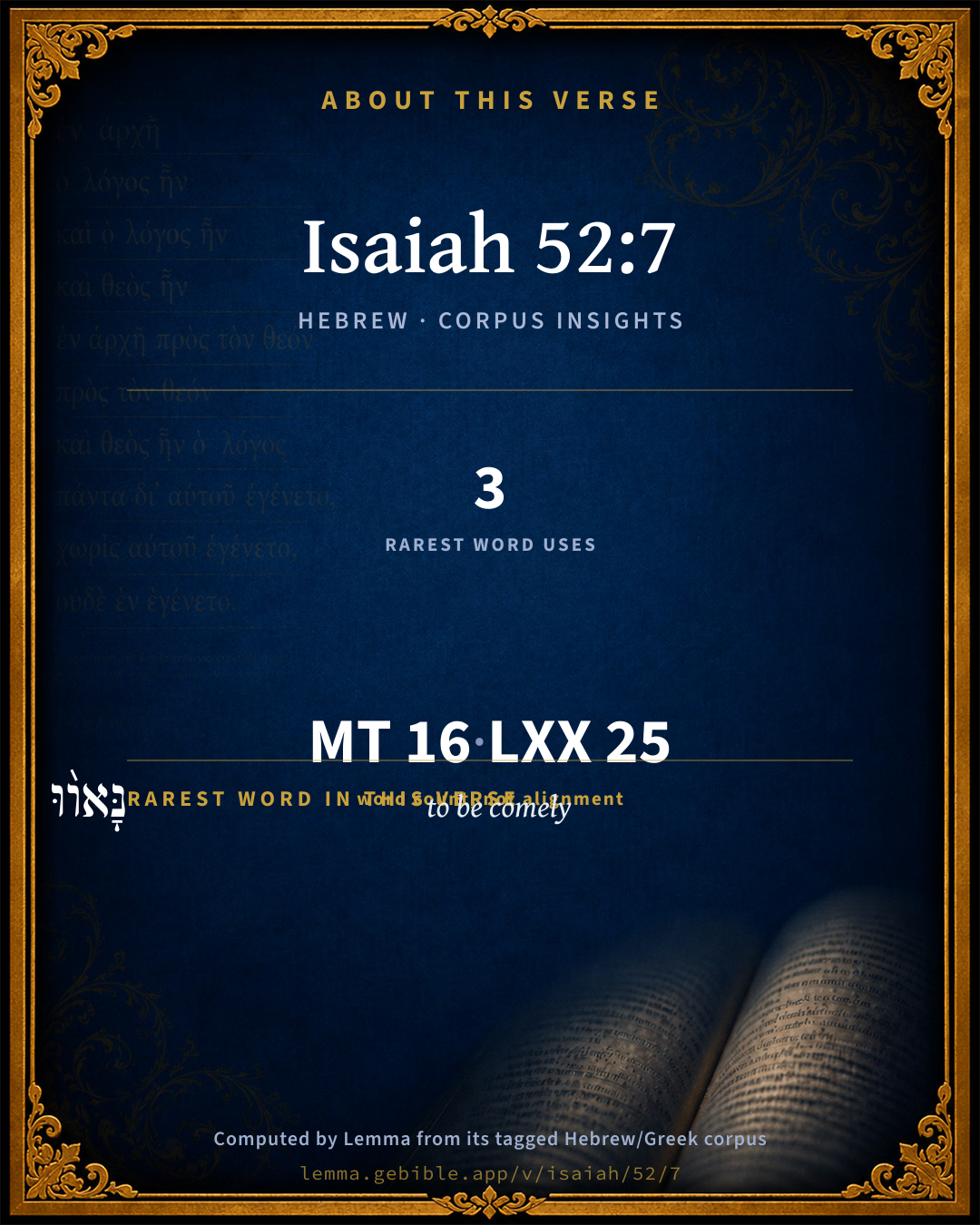
The rarest word here is נָּאו֨וּ to be comely H4998 — appearing just 3 times in the whole Hebrew Bible.

Shared distinctive vocabulary

נָּאו֨וּ to be comely H4998 occurs in 3 verses of the Hebrew Bible. Also found in:

Grammatical profile

  • 7 verbs
  • 6 nouns
  • 1 adjective
  • 1 preposition
  • 1 particle

Verb forms

  • נָּאו֨וּ Qal · Perfect
  • מְבַשֵּׂ֗ר Piel · Participle Active
  • מַשְׁמִ֧יעַ Hiphil · Participle Active
  • מְבַשֵּׂ֥ר Piel · Participle Active
  • מַשְׁמִ֣יעַ Hiphil · Participle Active
  • אֹמֵ֥ר Qal · Participle Active
  • מָלַ֥ךְ Qal · Perfect

Repetition

Words recur within this verse — often emphatic in Hebrew:

  • מְבַשֵּׂ֗ר to preach H1319 ×2
  • מַשְׁמִ֧יעַ to hear H8085 ×2

Hebrew & Septuagint length

In English translation the verse runs 33 words from the Hebrew and 36 from the Septuagint (LXX English) — closely comparable.

A rough comparison of the two English renderings, which tokenize alike — not a word-level alignment.

Word counts can differ between the Hebrew and the Greek without any difference in meaning — e.g. the Hebrew direct-object marker אֵת has no separate Greek word, and Greek often adds the article ὁ.

In the original languages it is 16 Hebrew tokens and 25 Greek tokens — but the two are counted differently (Hebrew bundles its prefixes and suffixes into one token; the Greek is in lemma form), so that isn’t a like-for-like length.

Cross-references

25

Topical passages linked to Isaiah 52:7 in the Treasury of Scripture Knowledge — connected by theme and wording, ordered by reader-vote popularity; previews shown in the World English Bible.

  • Romans 10:12–15 For there is no distinction between Jew and Greek; for the same Lord is Lord of all, and is rich to all who call on him.
  • Nahum 1:15 Behold, on the mountains the feet of him who brings good news, who publishes peace! Keep your feasts, Judah! Perform your vows, for the wicked one will no more pass through you. He is utterly cut off.
  • Isaiah 61:1–3 The Spirit of the Lord Yahweh is on me; because Yahweh has anointed me to preach good news to the humble; he has sent me to bind up the broken-hearted, to proclaim liberty to the captives, and the opening [of the prison] to those who are bound;
  • Mark 16:15 He said to them, "Go into all the world, and preach the Gospel to the whole creation.
  • Psalms 93:1 Yahweh reigns! He is clothed with majesty! Yahweh is armed with strength. The world also is established. It can't be moved.
  • Isaiah 40:9 You who tell good news to Zion, go up on a high mountain; you who tell good news to Jerusalem, lift up your voice with strength; lift it up, don't be afraid; say to the cities of Judah, Behold, your God!
  • Ephesians 6:15 and having fitted your feet with the preparation of the Gospel of peace;
  • Matthew 28:18 Jesus came to them and spoke to them, saying, "All authority has been given to me in heaven and on earth.
  • Isaiah 24:23 Then the moon shall be confounded, and the sun ashamed; for Yahweh of Hosts will reign on Mount Zion, and in Jerusalem; and before his elders shall be glory.
  • Psalms 68:11 The Lord announced the word. The ones who proclaim it are a great company.
  • Mark 13:10 The Gospel must first be preached to all the nations.
  • Luke 2:10 The angel said to them, "Don't be afraid, for behold, I bring you good news of great joy which will be to all the people.
  • Zechariah 9:9 Rejoice greatly, daughter of Zion! Shout, daughter of Jerusalem! Behold, your king comes to you! He is righteous, and having salvation; Lowly, and riding on a donkey, Even on a colt, the foal of a donkey.
  • Luke 24:47 and that repentance and remission of sins should be preached in his name to all the nations, beginning at Jerusalem.
  • Revelation 14:6 I saw an angel flying in mid heaven, having an eternal Gospel to proclaim to those who dwell on the earth, and to every nation, tribe, language, and people.
  • Psalms 99:1 Yahweh reigns! Let the peoples tremble. He sits enthroned among the cherubim. Let the earth be moved.
  • Revelation 11:15 The seventh angel sounded, and great voices in heaven followed, saying, "The kingdom of the world has become the Kingdom of our Lord, and of his Christ. He will reign forever and ever!"
  • Psalms 96:10 Say among the nations, "Yahweh reigns." The world is also established. It can't be moved. He will judge the peoples with equity.
  • Song of Solomon 2:8 The voice of my beloved! Behold, he comes, Leaping on the mountains, Skipping on the hills.
  • Isaiah 33:22 For Yahweh is our judge, Yahweh is our lawgiver, Yahweh is our king; he will save us.
  • Micah 4:7 And I will make that which was lame a remnant, And that which was cast far off a strong nation: And Yahweh will reign over them on Mount Zion from then on, even forever.
  • Acts 10:36–38 The word which he sent to the children of Israel, preaching good news of peace by Jesus Christ--he is Lord of all--
  • Matthew 25:34 Then the King will tell those on his right hand, 'Come, blessed of my Father, inherit the Kingdom prepared for you from the foundation of the world;
  • Psalms 59:13 Consume them in wrath. Consume them, and they will be no more. Let them know that God rules in Jacob, To the ends of the earth. Selah.
  • Psalms 97:1 Yahweh reigns! Let the earth rejoice! Let the multitude of islands be glad!

Cross-references courtesy of OpenBible.info (CC BY 4.0).

Hebrew and Greek witnesses Masoretic Hebrew ↔ Greek Septuagint

The same verse in the two great witnesses to the Old Testament, shown verse-for-verse.

These are two independent witnesses, not word-aligned to each other, and the Septuagint is shown in lemma (dictionary) form.

Hebrew Isaiah 52:7 Masoretic · Westminster Leningrad Codex

מַה נָּאו֨וּ עַל הֶהָרִ֜ים רַגְלֵ֣י מְבַשֵּׂ֗ר מַשְׁמִ֧יעַ שָׁל֛וֹם מְבַשֵּׂ֥ר ט֖וֹב מַשְׁמִ֣יעַ יְשׁוּעָ֑ה אֹמֵ֥ר לְצִיּ֖וֹן מָלַ֥ךְ אֱלֹהָֽיִךְ

How beautiful on the mountains are the feet of him who brings good news, who publishes peace, who brings good news of good, who publishes salvation, who says to Zion, Your God reigns!

World English Bible · Public Domain

Greek LXX Isaiah 52:7 Septuagint · lemma form

ὡς ὥρα ἐπί ὁ ὄρος ὡς πούς εὐαγγελίζω ἀκοή εἰρήνη ὡς εὐαγγελίζω ἀγαθός ὅτι ἀκουστός ποιέω ὁ σωτηρία σύ λέγω σιων βασιλεύω σύ ὁ θεός

as a season of beauty upon the mountains, as the feet of one preaching glad tidings of peace, as one preaching good news: for I will publish your salvation, saying, O Sion, your God shall reign.

LXX2012 (modern English Septuagint) · Public Domain

On this verse, J. A. Alexander on Isaiah discusses the Septuagint’s reading. Read the note in Commentary ↓

Hebrew: Westminster Leningrad Codex (CC BY 4.0). Greek: Septuagint (public domain); English from LXX2012 (modern English Septuagint) (Public Domain). How the Septuagint differs from the Hebrew →

Targum (Aramaic paraphrase)

1

The Targum is the ancient Jewish Aramaic paraphrase of the Hebrew Scriptures — an interpretive translation, not the Hebrew text itself. Onkelos (literal) and Pseudo-Jonathan (expansive) render the Torah, and Jonathan the Prophets. Coverage is partial: where no permissively-licensed English translation exists for a verse, only the Aramaic is shown. This is verse-level text, not a word-by-word alignment to the Hebrew.

  1. Targum Jonathan Prophets (Joshua–Malachi)
    מַה יָאֲוָן עַל טוּרֵי אַרְעָא דְיִשְׂרָאֵל רִגְלֵי מְבַסֵר מַשְׁמַע שְׁלָם מְבַסֵר טַב מַשְׁמַע פּוּרְקָן אֲמַר לִכְנִשְׁתָּא דְצִיוֹן אִיתְגְלִיאַת מַלְכוּתָא דֶאֱלָהָיִךְ:

    How beautiful upon the mountains of the land of Israel are the feet of him that bringeth good tidings, that publisheth peace, that publisheth salvation, saying to the congregation of Zion, The kingdom of thy God is revealed.

    Targum Jonathan — Aramaic: “Mikraot Gedolot” (public domain). English: “Sefaria Community Translation” (CC0 1.0 (public-domain dedication)); “London "Chaldee Paraphrase," 1871” (public domain). Text via Sefaria.

Commentary

Notes on Isaiah 52:7 from classic Christian and Jewish commentators (each source and its license shown beneath its notes). The classic Christian expositions comment on the surrounding passage and are grouped to its opening verse, so a note may address several verses; the Jewish commentaries on the Tanakh (Rashi and others) are per-verse, so they appear only where the commentator wrote on this verse.

Lemma curates 59 commentaries, every one of them public domain or Creative Commons licensed, each selected and text-cleaned for this edition rather than reprinted as found. About our sources →

Matthew Henry's Commentary

The removal of the Jews from Babylon to their own land again is here spoken of both as a mercy and as a duty; and the application of Isa 52:7 to the preaching of the gospel (by the apostle, Rom 10:15) plainly intimates that that deliverance was a type and figure of the redemption of mankind by Jesus Christ, to which what is here said of their redemption out of Babylon ought to be accommodated.

I. It is here spoken of as a great blessing, which ought to be welcomed with abundance of joy and thankfulness. 1. Those that bring the tidings of their release shall be very acceptable (Isa 52:7): "How beautiful upon the mountains, the mountains round about Jerusalem, over which these messengers are seen coming at a distance, how beautiful are their feet, when it is known what tidings they bring!" It is not meant so much of the common posts, or the messengers sent express by the government to disperse the proclamation, but rather of some of the Jews themselves, who, being at the fountain-head of intelligence, had early notice of it, and immediately went themselves, or sent their own messengers, to all parts, to disperse the news, and even to Jerusalem itself, to tell the few who remained there that their brethren would be with them shortly; for it is published not merely as matter of news, but as a proof that Zion's God reigns, for in that language it is published: they say unto Zion, Thy God reigns. Those who bring the tidings of peace and salvation, that Cyrus has given orders for the release of the Jews, tidings which were so long expected by those that waited for the consolation of Israel, those good tidings (so the original reads it, without the tautology of our translation, good tidings of good), put this construction upon it, O Zion! thy God reigns. Note, When bad news is abroad this is good news, and when good news is abroad this is the best news, that Zion's God reigns, that God is Zion's God, in covenant with her, and as such he reigns, Psa 146:10; Zac 9:9. The Lord has founded Zion, Isa 14:32. All events have their rise in the disposals of the kingdom of his providence and their tendency to the advancement of the kingdom of his grace. This must be applied to the preaching of the gospel, which is a proclamation of peace and salvation; it is gospel indeed, good news, glad tidings, tidings of victory over our spiritual enemies and liberty from our spiritual bondage. The good news is that the Lord Jesus reigns and all power is given to him. Christ himself brought these tidings first (Luk 4:18, Heb 2:3), and of him the text speaks: How beautiful are his feet! his feet that were nailed to the cross, how beautiful upon Mount Calvary! his feet when he came leaping upon the mountains (Sol 2:8), how beautiful were they to those who knew his voice and knew it to be the voice of their beloved! His ministers proclaim these good tidings; they ought to keep their feet clean from the pollutions of the world, and then they ought to be beautiful in the eyes of those to whom they are sent, who sit at their feet, or rather at Christ's in them, to hear his word. They must be esteemed in love for their work's sake (Th1 5:13), for their message sake, which is well worthy of all acceptation. 2. Those to whom the tidings are brought shall be put thereby into a transport of joy. (1.) Zion's watchmen shall then rejoice because they are surprisingly illuminated, Isa 52:8. The watchmen on Jerusalem's walls shall lead the chorus in this triumph. Who they were we are told, Isa 62:6. They were such as God set on the walls of Jerusalem, to make mention of his name, and to continue instant in prayer to him, till he again made Jerusalem a praise in the earth. These watchmen stand upon their watch-tower, waiting for an answer to their prayers (Hab 2:1); and therefore when the good news comes they have it first, and the longer they have continued and the more importunate they have been in praying for it the more will they be elevated when it comes: They shall lift up the voice, with the voice together shall they sing in concert, to invite others to join with them in their praises. And that which above all things will transport them with pleasure is that they shall see eye to eye, that is, face to face. Whereas God had been a God hiding himself, and they could scarcely discern any thing of his favour through the dark cloud of their afflictions, now that the cloud is scattered they shall plainly see it. They shall see Zion's king eye to eye; so it was fulfilled when the Word was made flesh and dwelt among us, and there were those that saw his glory (Joh 1:14) and looked upon it, Jo1 1:1. They shall see an exact agreement and correspondence between the prophecy and the event, the promise and the performance; they shall see how they look one upon another eye to eye, and be satisfied that the same God spoke the one and did the other. When the Lord shall bring again Zion out of her captivity the prophets shall thence receive and give fuller discoveries than ever of God's good-will to his people. Applying this also, as the foregoing verse, to gospel times, it is a promise of the pouring out of the Spirit upon gospel ministers, as a spirit of wisdom and revelation, to lead them into all truth, so that they shall see eye to eye, shall see God's grace more clearly than the Old Testament saints could see it: and they shall herein be unanimous; in these great things concerning the common salvation they shall concur in their sentiments as well as their songs. Nay, St. Paul seems to allude to this when he makes it the privilege of our future state that we shall see face to face. (2.) Zion's waste places shall then rejoice because they shall be surprisingly comforted (Isa 52:9): Break forth into joy, sing together, you waste places of Jerusalem; that is, all parts of Jerusalem, for it was all in ruins, and even those parts that seemed to lie most desolate shall share in the joy; and they, having little expected it, shall break forth into joy, as men that dream, Psa 126:1, Psa 126:2. Let them sing together. Note, Those that share in mercies ought to join in praises. Here is matter for joy and praise. [1.] God's people will have the comfort of this salvation; and what is the matter of our rejoicing ought to be the matter of our thanksgiving. He has redeemed Jerusalem (the inhabitants of Jerusalem that were sold into the hands of their enemies) and thereby he has comforted his people that were in sorrow. The redemption of Jerusalem is the joy of all God's people, whose character it is that they look for that redemption, Luk 2:38. [2.] God will have the glory of it, Isa 52:10. He has made bare his holy arm (manifested and displayed his power) in the eyes of all the nations. God's arm is a holy arm, stretched out in purity and justice, in defence of holiness and in pursuance of his promise. [3.] All the world will have the benefit of it. In the great salvation wrought out by our Lord Jesus the arm of the Lord was revealed and all the ends of the earth were made to see the great salvation, not as spectators of it only, as they saw the deliverance of the Jews out of Babylon, but as sharers in it; some of all nations, the most remote, shall partake of the benefits of the redemption. This is applied to our salvation by Christ. Luk 3:6, All flesh shall see the salvation of God, that great salvation.

II. It is here spoken of as a great business, which ought to be managed with abundance of care and circumcision. When the liberty is proclaimed, 1. Let the people of God hasten out of Babylon with all convenient speed; though they are ever so well settled there, let them not think of taking root in Babylon, but Depart, depart (Isa 52:11), go out from the midst of her; not only those that are in the borders, but those that are in the midst, in the heart of the country, let them be gone. Babylon is no place for Israelites. As soon as they have leave to let go, let them lose no time. With this word God stirred up the spirits of those that were moved to go up, Ezr 1:5. And it is a call to all those who are yet in the bondage of sin and Satan to make use of the liberty which Christ has proclaimed to them. And, if the Son make them free, they shall be free indeed. 2. Let them take heed of carrying away with them any of the pollutions of Babylon: Touch no unclean thing. Now that God makes bare his holy arm for you, be you holy as he is, and keep yourselves from every wicked thing. When they came out of Egypt they brought with them the idolatrous customs of Egypt (Eze 23:3), which were their ruin; let them take heed of doing so now that they come out of Babylon. Note, When we are receiving any special mercy from God we ought more carefully than ever to watch against all impurity. But especially let those be clean who bear the vessels of the Lord, that is, the priests, who had the charge of the vessels of the sanctuary (when they were restored by a particular grant) to carry them to Jerusalem, Ezr 1:7; Ezr 8:24, etc. Let them not only avoid touching any unclean thing, but be very careful to cleanse themselves according to the purification of the sanctuary. Christians are made to our God spiritual priests, Rev 1:6. They are to bear the vessels of the Lord, are entrusted to keep the ordinances of God pure and entire; it is a good thing that is committed to them, and they ought to be clean, to wash their hands in innocency and so to compass God's altars and carry his vessels, and keep themselves pure. 3. Let them depend upon the presence of God with them and his protection in their removal (Isa 52:12): You shall not go out with haste. They were to go with a diligent haste, not to lose time nor linger as Lot in Sodom, but they were not to go with a diffident distrustful haste, as if they were afraid of being pursued (as when they came out of Egypt) or of having the orders for their release recalled and countermanded: no, they shall find that, as for God, his work is perfect, and therefore they need not make more haste than good speed. Cyrus shall give them an honourable discharge, and they shall have an honourable return, and not steal away; for the Lord will go before them as their general and commander-in-chief, and the God of Israel will be their rearward, or he that will gather up those that are left behind. God will both lead their van and bring up their rear; he will secure them from enemies that either meet them or follow them, for with his favour will he compass them. The pillar of cloud and fire, when they came out of Egypt, sometimes went behind them, to secure their rear (Exo 14:19), and God's presence with them would now be that to them which that pillar was a visible token of. Those that are in the way of their duty are under God's special protection; and he that believes this will not make haste.

Matthew Henry's Commentary on the Whole Bible (1708–1710) — public domain (CC PDM 1.0). Text via the HelloAO Bible API.

Trapp's Complete Commentary

John Trapp

Isa 52:7 How beautiful upon the mountains are the feet of him that bringeth good tidings, that publisheth peace; that bringeth good tidings of good, that publisheth salvation; that saith unto Zion, Thy God reigneth!

Ver. 7. How beautiful!] Quam amaeni, i.e., amabiles! How amiable or desirable. Interrogatio admirantis et exultantis.

Upon the mountains.] Whence they may best be heard, {as in Jdg 9:7} saying, as there, "Hearken unto me, that God may hearken unto you." Our Saviour, that arch-evangelist, who, as some, is here first and chiefly meant by Mebassher, him that bringeth good tidings, "seeing the multitudes, went up into a mountain," {Mat 5:1} which is said to be in the tribe of Naphtali, and called Christ’s Mount to this day. His apostles afterwards travelled and trudged on foot over hills and dales - what a compass fetched Paul! {Rom 15:19} Intervallum illud est milliariorum Germanicorum, 350, so that he might better be called, than afterwards George Eagles the martyr was, Trudge-over-the-world - to preach the gospel and to plant churches, to whom their feet, though fouled and worn - how much more their faces? - were deemed delectable and debonnaire. {Gal 4:14 Act 10:21} The Pope, Peter’s pretended successor, holdeth forth his feet to be kissed, but preacheth not; or not peace, but war, which he stirreth up by his roaring bulls.

Of him that bringeth good tidings.] Whosoever he be that preacheth the gospel, that chief work of a minister. {Rom 10:15} Of Mr John Dod it is written, and I know it to be true, that he was very evangelical, striving first to make men see their lost condition clearly - for, said he, sense of misery must go before sense of mercy - and then largely and excellently opening the promises, and the grace of God in Christ according to the gospel, looking at that as the most effectual preaching. Some, said he, labour still to keep men under terrors, loading them with threatenings, &c., lest they should not be humbled enough: but the gospel worketh true humiliation, not the law; it ariseth from sense of sin and misery joined with hope of mercy. The damned have terror and sense of misery enough, but that doth not humble them.

That publisheth peace.] The gospel is a doctrine of peace, {Eph 2:17} whose author is the "God of peace," {1Co 14:33} whose ministers are "messengers of peace," {Rom 10:15} whose followers are the "children of peace." {Luk 10:6-11} If any know not how they came by their peace, but are like the Israelitish women, quick of delivery, before ever the midwife (the minister) can come at them, they have cause to suspect their peace.

That bringeth good tidings.] As before, but never enough, mentioned and memorised. Some critics {a} tell us that the Hebrew word here used, signifying also flesh, showed that the incarnation or taking flesh should be generally good news to the whole world, even the best tidings. The old church had επαγγαλιαν, the "promise"; we have ευαγγελιαν, the "joyful tidings."

That publisheth salvation.] Publicantis Iesum, so some {b} have rendered it: the concrete for the abstract.

That saith to Zion, Thy God reigneth.] Maugre the malice of earth and of hell. This is the sum of all the good news in the world. It is happy that Christ liveth and reigneth, said a godly man, for else I had utterly despaired.

{a} Bishop Andrews.

{b} Leo Castrius ex Procop., et Euseb.

John Trapp, A Commentary or Exposition upon All the Books of the Old and New Testament (1647–1656) — public domain. Text from a community e-Sword module.

The Biblical Illustrator

Joseph S. Exell

Isa_52:7

How beautiful upon the mountains

Messengers of redemption

Messengers coming over the mountains announce to Jerusalem the peoples redemption from Babylon, and the advent of Jehovahs eternal kingdom.

(A. B. Davidson, D.D.)

Beautiful feet

The exclamation does not refer to the pretty sound of their footsteps, but their feet are as if they were winged, because it is a joyful message which they bring. (F. Delitzsch, D.D.)

The Gospel of the swift-footed messengers

The Gospel of the swift-footed messengers is the Gospel of the kingdom of God which is at hand. (F. Delitzsch, D. D.)

Good tidings of good

I. THE PRIMARY MEANING. The passage is supposed to refer to the sending forth the heralds of the conquering Persian to proclaim liberty to the Jews that groaned under captivity in Babylon (Ezr_1:2-3.) In order fully to understand the joy and gladness which such a proclamation as this must necessarily bring to the poor Jew mourning in captivity, we must have some conception of their condition, and the feelings that swelled in their hearts during that period of degradation and suffering. Of this, some idea may be formed from the lamentations of Jeremiah, which speak the language of the believing Israelite, mourning over the fall of Zion; and again, in Psa_137:1-9, we find the captive Jews describing their bitter sorrows. Even as the prophet Isaiah foretold, this deliverance came to the people of God, great and sudden; but God had promised, and He surely brought it to pass. In vain the might and power of Babylon interposed; the dominion and empire of Babylon fell for ever, even in one hour, because the day for the redemption of Israel was fully come.

II. This passage has A SECONDARY FULFILMENT far more glorious and extensive, in the sending forth those who shall preach good tidings of salvation to all the ends of the earth; and the message thus conveyed has an analogy with that proclaimed by the heralds of Cyrus; for it bears to man--fallen and degraded, the captive of sin, fast bound in slavish chains--the tidings of deliverance. The blowing of the trumpet of the Gospel tells of restoration to the forfeited inheritance. It proclaims a full and yet the only mode of deliverance to enslaved man; the only mode of reconciliation with an offended God. The state, then, of the multitude of the heathen should excite our earnest attention, and rouse our warmest sympathies.

III. THE MODE WHICH GOD HAS BEEN PLEASED TO APPOINT FOR MAKING THE JOYFUL SOUND KNOWN TO MAN. The preaching of the Word of God by his fellow man. The message must be received by faith.

IV. THE CHARACTER OF THE PREACHER SHOULD CORRESPOND WITH HIS MESSAGE, that he should show forth in his life and conversation, that the glorious tidings he was commissioned to convey to others had been received by himself. Pray that the feet of the missionaries in foreign lands may be beautiful in holiness and love.

V. THE AUTHORITY ON WHICH THIS PROCLAMATION IS MADE. It was the conqueror of Babylon, the victorious Persian, that gave liberty to the captive Jew; it is the Conqueror of death and hell, the risen and triumphant Saviour, who gave commandment that the Gospel should be proclaimed to all people. (C. Caulfield, M.A.)

The annunciation of peace

1. The tidings of the deliverance from Babylon were joyful. But the prophet sees more joyful tidings than these, and a mightier deliverance from a more terrible bondage than even that of Babylon.

2. It is not said, How lovely are the messengers! but How beautiful are their feet! Not what they are in themselves, but what they bring, as sent from God, and running in obedience to Him, is here presented to the view.

3. Observe how the message is dwelt upon! as if it was so full of everything joyful and good that words fail to express it. It is good tidings, peace, good tidings-of good, salvation. What a mine is there here for him who has eyes to see, a mind to understand, a soul to love, and a heart to overflow with gratitude!

4. Observe how the message ends. It is a glorious note of jubilee. It is a veritable shout of joy. It is a summing up in very deed of the glorious news. It is a pledge of peace and of salvation with which the good news is concluded: Thy God reigneth. (R. W. Close, M.A.)

The peace of the Gospel

1. The rich blessing, to which the text refers in such emphatic language, is conveyed in that single, but comprehensive word, Peace.

2. To whom, then, is the word of this salvation sent? To whom is the minister of the Gospel commissioned to preach the message of peace? The very mission implies the existence of previous enmity. With whom has God this controversy? Who stand in need of so free an amnesty? Where are the objects of His unmerited grace?

3. Whose heart should not burn within him at the thoughts of his privilege in being employed on such a ministration of love?

4. Let me add one word on the responsibility of those to whom the message of reconciliation is sent. (C. R. Sumner, D.D.)

Advent

I. THE STATE IMPLIED in the words before us is to be collected from the view of their primary meaning. They originally refer to the Jews captive in Babylon, banished from their country, and deprived of the ordinances of Divine worship, under the displeasure of the Almighty, and oppressed by a haughty and idolatrous enemy. But this is only a faint emblem of that spiritual captivity in which mankind are naturally involved, and from which the Son of God came to deliver us.

II. IN WHAT MANNER IS THIS GRACIOUS DISPENSATION DESCRIBED? As the proclamation of good tidings, as the message of reconciliation and peace, as the publication of deliverance and salvation.

III. We are now, in some measure, prepared to enter into the spirit of THE EXCLAMATION and to participate in the joyful reception of the message which it announces. Practical remarks:

1. The true nature of the Gospel. It is not, as some would represent it, a mere system of morality. It comprises this, but infinitely more. It contains, first and principally, the offer of parson to the guilty, of deliverance to the oppressed, of salvation to the lost.

2. If such, however, be the nature of the Gospel, how highly should we value it, and how anxious should we be to profit by it!

3. While we rejoice in the good tidings which have been proclaimed to ourselves, let us pray that the multitudes of our fellow-creatures, to whom they have not yet been announced, may speedily hear the same delightful sound; and may exult in the joyful message of the Gospel, until all flesh shall at length see the salvation of God, and the whole earth be filled with His glory! (Hugh Pearson, D.D.)

The best news

When bad news is abroad, this is good news; and when good news is abroad, this is the best news: that Zions God reigns. (M. Henry.)

The joy of the Christian ministry

I. THE MINISTER OF CHRIST IS HELD IN COMMUNION WITH THE GREATEST REALITIES IN THE UNIVERSE. The Hebrew prophets were strenuous men, living in the coils of battle, wrestling with great serpents, struggling up bare cliffs, and giving their lives for the ransom of the people; but we cannot doubt that they were happy men as well, because of the intellectual and spiritual glories in which their lives were set, and, their cheering and inspiring comradeship with the wonderful words of God. The Hymn to the Sun and the Sermon to the Birds of St. Francis of Assisi bear witness to a soul that was enriched, ennobled, purified, simplified, magnified, and made to ripple with gladness and to sing the songs of victory and peace because of perpetual communion with the high and holy thoughts of its heavenly Father. The artist whose soul is seeing visions of the great creations of Raphael and Angelo, the general on the eve of a campaign for the emancipation of a people, the philanthropist pouring out his tears upon the miseries and sins of the world, will sleep on planks and find them soft as down, will eat coarse food and get good blood out of it, and so far forget themselves in their sublime consecrations and so populate with their holiest passions the thought-world and spirit-world within them as to realize Hawthornes parable of the Great Stone Face, and grow into the image of the mountain on which their gaze is fixed. So it is with the preacher, and more so. He is surrounded by an imperial guard of holiest inspirations.

II. THE CHRISTIAN MINISTRY IS BOUND TO WIN.

III. THE CHRISTIAN MINISTRY HAS THE BULK OF GOOD MEN IN THE WORLD BEHIND IT, CHEERING IT ON. (W. J. McKittrick, D.D.)

The missionary theme

Dr. Judson when at home on a visit, addressed a large meeting, his theme being The Preciousness of Christ, and sat down, deeply affected. On his way home a friend said to him, The people are much disappointed; they wonder you did not talk of something else. Why, what did they want? said the missionary. I presented to the best of my ability the most interesting subject in the world. But, said the man, they have heard that before; they wanted something new from a man who has just come from the antipodes. Then, said the great man, kindling, I am glad to have it to say that a man from the antipodes had nothing better to tell them than the wondrous story of the dying love of Christ. (The Wellspring.)

The Biblical Illustrator, edited by Joseph S. Exell (c. 1880s–1900s) — public domain. Text from a community e-Sword module.

Joseph Benson's Commentary

Isa 52:7. How beautiful — How exceeding precious and acceptable; upon the mountains — Of Judea, to which these glad tidings were brought; are the feet of him that bringeth good tidings — Tidings, first, Of the release of the Jews from captivity in Babylon; and, secondly, Of the redemption and salvation of mankind by the Messiah. Thus most commentators interpret the prophet’s words. They are “a poetical description,” says Lowth, “of the messenger who first brought the good news of Cyrus’s decree for the people to return home, whom the watchmen, mentioned Isa 52:8, are supposed to descry afar off from the tops of the mountains, making all possible haste to publish this happy news: a signal instance of God’s overruling providence, of the peculiar care he hath for his church. But this text is very fitly applied by St. Paul to the first preachers of the gospel, (Rom 10:15,) the very words importing good tidings of that peace and salvation whereby the kingdom of God was erected among men.” Indeed, true peace and salvation were procured for mankind, and are conferred upon them, only by Christ. And in his days, or from the time of his manifestation in the flesh, and entering upon his public ministry, God discovered and exercised his dominion over the world far more eminently than he ever had done from the beginning of the world until that time. Accordingly, we may observe, those Psalms wherein we find that expression, The Lord reigneth, are by the generality of interpreters, both Jewish and Christian, expounded of the times of the Messiah; the declaration being, in effect, the same that John the Baptist, the messenger of Christ, and that Christ himself published, when they testified, The kingdom of heaven is at hand.

Joseph Benson's Commentary on the Old and New Testaments (1811–1818) — public domain. Text from a community e-Sword module.

The Preacher's Complete Homiletical Commentary

Joseph S. Exell (gen. ed.)

THE GOSPEL AND ITS PUBLISHERS

Isa_52:7. How beautiful upon the mountains, &c.

Whatever reference this passage might have to the deliverance of the people of God from the Chaldean bondage, it refers also and chiefly to the great and glorious Gospel of Christ (Rom_10:13). It is in this application of it that it is now interesting and important.

I. A DELIGHTFUL REPRESENTATION OF THE GOSPEL OF CHRIST.

1. The Gospel is represented as “good tidings.” This is literally the meaning of the word gospel. These good tidings centre in one glorious fact—the provision of a Saviour for a guilty world. Everything else is based on this fact. Everything connected with the gift of the Saviour forms matter for joy: the supreme dignity of His person, the completeness of His work, the glory of His doctrine, the efficacy of His death, and the exhaustless fulness of His blessings.

2. It publishes peace. Man united with the fallen apostate spirits in rebellion against God, &c.

3. It brings tidings of good. Not only is God at peace with the sinner, but He waits to bless him with all good. There is

(1.) acceptance into God’s favour.

(2.) Divine adoption.

(3.) The influences of the Spirit to illume, convince, guide, solace, meeten for heaven.

(4.) The precious promises of the new covenant.

4. The Gospel publishes salvation. A salvation meeting the needs of the sinner.

5. The Gospel declares the reign of Jesus (Psa_2:6-7, &c.)

II. AN INTERESTING DESCRIPTION OF THE MODE OF ITS PUBLICATION.

1. The messengers appointed to declare it. Jesus Himself went forth preaching the good tidings of His kingdom. Now the messengers are men, not angels. Men who have been called and qualified—sent of God. Men who have known and felt the power of the truths themselves.

2. The publication of this Gospel is to be free and extensive. They are to go forth prominently; to ascend the mountain tops, and there, before God, and angels, and men, they are to preach the unsearchable riches of Christ. The message of grace is to be published throughout the world, and to every creature.

3. The publication of the Gospel is to be a source of joy and delight to perishing souls. By some it will be ridiculed. By others spurned. By others coolly and indifferently heard. But to thousands it shall be spirit and life, solace and bliss.

APPLICATION:

1. The subject should excite admiration and praise. The earth is full of the goodness of the Lord. But here is matchless love—unparalleled grace.

2. Have we experienced the saving power of the Gospel? Is it our boast, and joy, and ?Song of Solomon 3. The infatuation of the rejectors of the good news (Heb_2:3; 1Pe_4:17).

4. The duty of the Church to diffuse the Gospel to the ends of the earth. Its prayers, energies, and means, should all bear to this one great end, &c.—The New Pulpit Assistant, pp. 318–322.

I. The varied characteristics of the “good tidings” of Christianity—they are peace, salvation, the reign of God.

II. The great function of the minister of the Gospel—is to bring these good tidings. III. The character in which he appears—“How beautiful,” &c.; i.e., how welcome they should be to us!—John Cumming, D.D.: Occasional Discourses, vol. i. p. 336.

THE MINISTRY OF THE GOSPEL

(Ordination Sermon.)

Isa_52:7. How beautiful upon the mountains, &c.

This exclamation would strike those who first read it more impressively than it strikes us. They would see the runner coming over the distant hills, bearing welcome news. They would hear the loud cry from the watchmen on the walls. They would see the people crowd to the gate to hear. The primary reference of the text is to the news of the restoration of the Jews to Jerusalem, and of the restoration of the ruined city. But there is a secondary reference to gospel times. It is thus applied by the apostle (Rom_10:15). We may thus apply it.

I. The ministry of the Gospel exists for the announcement of valuable intelligence. It brings good tidings. It is not a ministration of condemnation, but of salvation (2 Corinthians 3) It tells such things as these,

1. That satisfaction has been made for human sin. Man is sinful, guilty. The Lord Jesus Christ, by His death on the cross, has atoned for sin. Thus, in announcing this, the ministry of the gospel is “the ministry of reconciliation.”

2. That on the ground of that atonement salvation may be obtained by all that desire it. The dark angel of sin and sorrow has not left the world. But there is pardon for the sinner, holiness for the depraved, comfort for the distressed, which will develop into heaven at last. It may be obtained by faith in Christ. The time when the gospel is preached is the tide of opportunity.

3. That thus the Divine dominion over man is re-asserted and re-established. “Thy God reigneth.” He reigns through the bestowment of salvation. Jesus has been exalted to reign in His people’s hearts, in the Church, in the world.

II. The ministry of the Gospel is a great and important office. The bearer of this intelligence, primarily referred to in our text, acquired importance both from his mission and his qualifications. He would require speed, interest in the message, fidelity. Thus the ministry is important. Remember,

1. The end at which it aims. The message, the sermon, is not the end but the means. It aims at the salvation of souls. Nothing less will content the true preacher than conversion, spiritual growth.

2. The means which it employs. The message itself. Attract attention to it by legitimate, not fantastic means. While the message cannot be changed, let it be presented in varied forms, to the young, to the aged, in public, in private.

3. The qualifications which it demands. Intelligent acquaintance with the message; a living personal interest in it; thoughtful carefulness as to the methods by which it may be made most interesting and acceptable; diligent and sedulous use of opportunities; earnest sympathy with Christ and immortal souls.

III. The ministry of the Gospel should be regarded with suitable respect and honour. The office, because of its nature; the man, on the supposition that he deserves it. The office cannot entitle the man to respect if he is not worthy of it. Qualification is the only title to office, and the only claim to respect in it. This being supposed, the prominent idea of the text is the man. This honour will comprise,

1. Welcome. The Galatians welcomed Paul. Jesus said, “Blessed are your eyes for they see, and your ears for they hear.” Welcome the ministry of the word by regular and constant attendance; by candid and respectful hearing, as distinguished from indifference, and from unkindly criticism; and by a kindly reception at the home.

2. Love. Cherish affection to the minister for his work’s sake. Let him see it in the manner which reveals and perpetuates kindness. Sometimes commend his work.

3. Maintenance (1 Corinthians 9; Gal_6:6-8). Now what is maintenance? It is determined largely by position in society. If there is narrow-mindedness in relation to the minister’s means of obtaining books, and unholding his influence in the locality where his lot is cast, the church suffers.

4. Co-operation. The primitive churches were active in many ministries. Every member of the church should do something for Christ. The work of extending the gospel is not the minister’s business exclusively. The church should be a centre from which every one is working.

5. Prayer. This was the apostle’s request (Eph_6:19; 2Th_3:1).The work of the ministry is spiritual, and it requires spiritual influences. It needs the power of the Holy Ghost. Do you pray for it by praying for Him?

What is the practical effect of the preacher’s work in those that receive the truth? Is it not that you bring forth fruits of holiness? See that such fruit is borne. Then you will in your turn proclaim the gospel to others, if not in words, by the influence of your lives (H. E. I. 2622, 2623).

But have you received the truth which has been heralded to you? Some of you are, perhaps, not yet saved. The preacher seeks your salvation. Oh, let this be his joy; not for his sake but for your own. Life is passing on. And the gospel alone can save.—J. Rawlinson.

I. A representation of a true minister of Christ. A messenger.

1. He receives his commission from God.

2. He is intrusted by Him.

3. He is qualified for his particular work.

II. The subject of his message. “Good tidings.”

1. Peace.

2. Salvation from spiritual evil, and an introduction to spiritual good.

3. Dominion of Christ. He reigns in His providential and mediatorial kingdom.

III. The dispositions with which he is received.

1. With joy.

2. With admiration.

Improvement.

1. Gratitude for the gospel.

2. Attention to its tidings.

3. Obedience to its precepts.—J. Hordle.

The Preacher's Complete Homiletical Commentary (gen. ed. Joseph S. Exell; Funk & Wagnalls, c. 1892) — public domain (pre-1929). A full-Bible homiletical/sermon-outline anthology covering 65 of 66 books (2 John is absent from the source module). Text from a community e-Sword module.

Keil & Delitzsch

C. F. Keil & F. Delitzsch

The first two turns in the prophecy (Isa 52:1-2, Isa 52:3-6) close here. The third turn (Isa 52:7-10) exults at the salvation which is being carried into effect. The prophet sees in spirit, how the tidings of the redemption, to which the fall of Babylon, which is equivalent to the dismission of the prisoners, gives the finishing stroke, are carried over the mountains of Judah to Jerusalem. "How lovely upon the mountains are the feet of them that bring good tidings, that publish peace, that bring tidings of good, that publish salvation, that say unto Zion, Thy God reigneth royally!" The words are addressed to Jerusalem, consequently the mountains are those of the Holy Land, and especially those to the north of Jerusalem: mebhassēr is collective (as in the primary passage, Nah 2:1; cf., Isa 41:27; Psa 68:12), "whoever brings the glad tidings to Jerusalem." The exclamation "how lovely" does not refer to the lovely sound of their footsteps, but to the lovely appearance presented by their feet, which spring over the mountains with all the swiftness of gazelles (Sol 2:17; Sol 8:14). Their feet look as if they had wings, because they are the messengers of good tidings of joy. The joyful tidings that are left indefinite in mebhassēr, are afterwards more particularly described as a proclamation of peace, good, salvation, and also as containing the announcement "thy God reigneth," i.e., has risen to a right royal sway, or seized upon the government (מלך in an inchoative historical sense, as in the theocratic psalms which commence with the same watchword, or like ἐβασίλευσε in Rev 19:6, cf., Rev 11:17). Up to this time, when His people were in bondage, He appeared to have lost His dominion (Isa 63:19); but now He has ascended the throne as a Redeemer with greater glory than ever before (Isa 24:23). The gospel of the swift-footed messengers, therefore, is the gospel of the kingdom of God that is at hand; and the application which the apostle makes of this passage of Isaiah in Rom 10:15, is justified by the fact that the prophet saw the final and universal redemption as though in combination with the close of the captivity.

Keil & Delitzsch — Biblical Commentary on the Old Testament (1861–1891) — public domain (CC PDM 1.0). Text via the HelloAO Bible API. (Old Testament only.)

Tyndale Open Study Notes

Tyndale Open Resources

52:7-12 This is a poetic description of God’s promise to rescue his people from the alienation their sin created. The imagery is of a besieged city waiting for word that its hero has defeated the enemy armies. Paul applies these words to the proclamation of the Good News of the Lord Jesus (Rom 10:15).

52:7 How beautiful on the mountains: See Nah 1:15; Rom 10:15. • The good news goes beyond proclaiming an end to the Exile; it also points to the peace and salvation of the age to come (Isa 54:13-14; see 40:9-10; 41:27).

Tyndale Open Study Notes — © Tyndale Open Resources, licensed CC BY-SA 4.0. Text via the HelloAO Bible API.

Geneva Bible (1599)

Geneva Bible translators

Signifying, that the joy and good tidings of their deliverance should make their affliction in the mean time more easy: but this is chiefly meant of the spiritual joy, as Nah. 1:15; Rom. 10:15.

Geneva Bible (1599) marginal notes — public domain. Text via Bolls.life.

Jamieson, Fausset & Brown

Robert Jamieson, A. R. Fausset & David Brown

beautiful . . . feet--that is, The advent of such a herald seen on the distant "mountains" (see on Isa 40:9; Isa 41:27; Isa 25:6-7; Sol 2:17) running in haste with the long-expected good tidings, is most grateful to the desolated city (Nah 1:15).

good tidings--only partially applying to the return from Babylon. Fully, and antitypically, the Gospel (Luk 2:10-11), "beginning at Jerusalem" (Luk 24:17), "the city of the great King" (Mat 5:35), where Messiah shall, at the final restoration of Israel, "reign" as peculiarly Zion's God ("Thy God reigneth"; compare Psa 2:6).

Jamieson, Fausset & Brown — Commentary Critical and Explanatory on the Whole Bible (1871) — public domain (CC PDM 1.0). Text via the HelloAO Bible API.

Adam Clarke's Commentary

Verse 7. How beautiful] The watchmen discover afar off, on the mountains, the messenger bringing the expected and much-wished-for news of the deliverance from the Babylonish captivity. They immediately spread the joyful tidings, Isa 52:8, and with a loud voice proclaim that JEHOVAH is returning to Zion, to resume his residence on his holy mountain, which for some time he seemed to have deserted. This is the literal sense of the place.

"How beautiful on the mountains are the feet of the joyful messenger," is an expression highly poetical: for, how welcome is his arrival! how agreeable are the tidings which he brings!

Nahum, Na 1:15, who is generally supposed to have lived after Isaiah, has manifestly taken from him this very pleasing image; but the imitation does not equal the beauty of the original: -

"Behold upon the mountain the feet of the joyful messenger,

Of him that announceth peace!

Celebrate, O Judah, thy festivals; perform thy vows:

For no more shall pass through thee the wicked one;

He is utterly cut off."

But it must at the same time be observed that Isaiah's subject is infinitely more interesting and more sublime than that of Nahum; the latter denounces the destruction of the capital of the Assyrian empire, the most formidable enemy of Judah; the ideas of the former are in their full extent evangelical; and accordingly St. Paul has, with the utmost propriety, applied this passage to the preaching of the Gospel, Ro 10:15. The joyful tidings here to be proclaimed, "Thy God, O Zion, reigneth," are the same that John the Baptist, the messenger of Christ, and Christ himself, published: "The kingdom of heaven is at hand."

From the use made of this by our Lord and the apostles, we may rest assured that the preachers of the Gospel are particularly intended. Mountains are put for the whole land of Judea, where the Gospel was first preached. There seems to be an allusion to a battle fought, and the messengers coming to announce the victory, which was so decisive that a peace was the consequence, and the king's throne established in the land.

There appear to have been two sorts of messengers among the Jews: one sort always employed to bring evil tidings; the other to bring good. The names also and persons of these different messengers appear to have been well known; so that at a distance they could tell, from seeing the messenger, what sort of tidings he was bringing. See a case in point, 2Sa 18:19-27. Ahimaaz and Cushi running to bring tidings of the defeat of Absalom and his rebel army. Ahimaaz is a GOOD man, and bringeth GOOD tidings.

Adam Clarke's Commentary on the Bible (1810–1826) — public domain. Text from a community e-Sword/MySword module.

Ellicott's Commentary for English Readers

(7) How beautiful . . .—The image is reproduced, with variations, from Isa_40:9. There Zion herself was the herald proclaiming the glad tidings; here the heralds are seen coming to Zion, to tell her that her God is verily reigning, and their feet are beautiful on the mountains like those of an antelope (Son_2:8-9; Nah_1:15).

A Bible Commentary for English Readers, edited by Charles John Ellicott (1878–1897) — public domain. Text from a community e-Sword module.

The Cambridge Bible for Schools and Colleges

gen. ed. J. J. S. Perowne

7. Describes, in vivid pictorial imagery taken from ch. Isa_40:9, the arrival in Jerusalem of the first tidings of the deliverance from Babylon and the establishment of the kingdom of God. Part of the verse occurs in Nah_1:15.

of him that bringeth good tidings] The mìbassçr (see on Isa_40:9 and cf. Isa_41:27) is one of the prophet’s dramatis personœ, occupying a position somewhat analogous to that of “the fugitive” in the Book of Ezekiel (Eze_24:26 f., Eze_33:21 f.). He is the “evangelist,” the herald of salvation whose single function is to announce to Zion the speedy advent of her God. He is an ideal creation of the writer’s mind, and the conception fluctuates between that of an individual (as here and Isa_41:27) and of a company (in Isa_40:9). In St Paul’s application of the figure (Rom_10:15) it becomes a type of the gospel ministry.

Thy God reigneth] Rather, thy God hath become king, has established His everlasting kingdom (cf. ch. Isa_24:23; Psa_93:1; Psa_97:1).

7–12. The return of Jehovah to Zion.

The Cambridge Bible for Schools and Colleges (gen. ed. J. J. S. Perowne; Cambridge University Press, 1878–1918) — public domain. Text from a community e-Sword module.

John Gill's Exposition

How beautiful upon the mountains are the feet of him that bringeth good tidings,.... Not of the messenger that brought the news of Cyrus's proclamation of liberty to the Jews; rather of John the Baptist, the forerunner of our Lord; best of Christ himself, the messenger of the covenant, who was anointed to preach glad tidings to the meek, and by whom grace, peace, life, and salvation came; and also of the apostles of Christ, for to Gospel times are these words applied, and to more persons than one, Rom 10:15, who were not only seen "upon the mountains" of the land of Israel, as the Targum paraphrases it, where both Christ and his apostles preached, but upon the mountains of the Gentile world; and may denote the pains they took, the circuit they made, and the difficulties they had to encounter with; and the publicness of their ministrations, which lay in bringing "good tidings" of the incarnate Saviour, of God manifest in the flesh, for the word (k) here used has the signification of flesh in it; of good things in the heart of God for his people, in the covenant of grace, in the hands of Christ, and as come by him, and to be had from him; as pardon by his blood; justification by his righteousness; eternal life and happiness through him; and of all good things to be enjoyed now and hereafter. It may be applied to all other ministers of the Gospel in later ages, who are bringers of the same good tidings to the children of men, to whom their very feet are beautiful, and even at a distance, upon the high mountains; not to carnal men, but sensible sinners, to whom the good news of salvation by Christ is welcome. Feet are mentioned instead of their whole persons, because the instruments of motion, and so of bringing the tidings, and of running to and fro with them from place to place, and even though they are dirty and defiled with sin; for Gospel ministers are not free from it, and are men of like passions with others; yet are beautiful when their walk and ministry, conversation and doctrine, agree together; and their feet are particularly so, being shod with the preparation of the Gospel of peace. The words may with the greatest propriety, and in agreement with the context, be understood of that angel, or set of Gospel ministers in the latter day, represented as flying in the midst of the heavens, having the everlasting Gospel to preach to all nations, which will precede the fall of Babylon, Rev 14:6,

that publisheth peace; peace by the blood of Jesus Christ, a principal article of the Gospel, and of its good news; hence it is called the Gospel of peace, and the word of reconciliation; peace of conscience, which flows from the same blood applied, and of which the Gospel is the means; and peace among the saints one with another, and among men, which shall at this time be enjoyed; there, will be no discord nor animosities among themselves, nor persecution from their enemies: happy times! halcyon days! welcome the publishers of such tidings!

that bringeth good tidings of good; or, "that bringeth good tidings" (l); for the original does not require such a tautology; it means the same good tidings as before, and which follow after:

that publisheth salvation; by Jesus Christ, as wrought out by him for sinners, which is full, complete, and suitable for them, and to be had of him freely; and what better tidings than this? see Rev 19:1,

that sitteth unto Zion, thy God reigneth; that saith to Zion, the church of Christ, that Christ, who is truly God, and their God, has taken to himself, in a more open and visible manner, his great power and reigns as the Lord God omnipotent; and this is good news and glad tidings; see Psa 97:1. The Targum is,

"the kingdom of thy God is revealed;''

see Mat 3:2. This passage is interpreted of the Messiah and his times, by many Jewish (m) writers, ancient and modern; See Gill on Rom 10:15.

(k) a "caro". (l) "evangelizantis bonum", Pagninus, Montanus, Junius & Tremellius; "qui nuntiat bonum", Cocceius. (m) Vajikra Rabba, sect. 9. fol. 153. 2. Shirhashirim Rabba, fol. 11. 4. Yalkut Simeoni in Psal. xxix. 11. Menasseh Ben Israel, Nishmat Chayim, fol. 41. 2.

John Gill's Exposition of the Whole Bible (1746–1763) — public domain (CC PDM 1.0). Text via the HelloAO Bible API.

Albert Barnes' Notes on the Bible

How beautiful upon the mountains - This passage is applied by Paul to the ministers of the gospel (see Rom 10:15). The meaning here seems to be this: Isaiah was describing the certain return of the Jews to their own land. He sees in vision the heralds announcing their return to Jerusalem running on the distant hills. A herald bearing good news is a beautiful object; and he says that his feet are beautiful; that is, his running is beautiful. He came to declare that the long and painful captivity was closed, and that the holy city and its temple were again to rise with splendor, and that peace and plenty and joy were to be spread over the land. Such a messenger coming with haste, the prophet says, would be a beautiful object. Some have supposed (see Campbell on the Gospels, Diss. v. p. 11, Section 3, 4), that the idea here is, that the feet of messengers when they traveled in the dust were naturally offensive and disgusting, but that the messenger of peace and prosperity to those who had been oppressed and afflicted by the ravages of war, was so charming as to transform a most disagreeable into a pleasing object.

But I cannot see any such allusion here. It is true that the feet of those who had traveled far in dry and dusty roads would present a spectacle offensive to the beholder; and it is true also, as Dr. Campbell suggests, that the consideration that they who were coming were messengers of peace and safety would convert deformity into beauty, and make us behold with delight this indication of their embassy. But it seems to me that this passage has much higher beauty. The idea in the mind of the prophet is not, that the messenger is so near that the sordid appearance of his feet could be seen. The beholder is supposed to be standing amidst the ruins of the desolated city, and the messenger is seen running on the distant hills. The long anticipated herald announcing that these ruins are to rise, at length appears. Seen on the distant hills, running rapidly, he is a beautiful object. It is his feet, his running, his haste, that attracts attention; an indication that he bears a message of joy, and that the nation is about to be restored. Nahum, who is supposed to have lived after Isaiah, has evidently copied from him this beautiful image:

Behold upon the mountains the feet of the joyful messenger,

Of him that announceth peace;

Celebrate, O Judah, thy festivals; perform thy vows;

For no more shall pass through thee the wicked one;

He is utterly cut off.

Nah 1:15

That publisheth peace - This declaration is general, that the coming of such a messenger would be attended with joy. The particular and special idea here is, that it would be a joyful announcement that this captivity was ended, and that Zion was about to be restored.

That bringeth good tidings of good - He announces that which is good or which is a joyful message.

That saith unto Zion, thy God reigneth - That is, thy God has delivered the people from their captivity, and is about to reign again in Zion. This was applied at first to the return from the captivity. Paul, as has been already observed, applies it to the ministers of the gospel. That is, it is language which will well express the nature of the message which the ministers of the gospel bear to their fellow-men. The sense is here, that the coming of a messenger bringing good news is universally agreeable to people. And it the coming of a messenger announcing that peace is made, is pleasant; or if the coming of such a messenger declaring that the captivity at Babylon was ended, was delightful, how much more so should be the coming of the herald announcing that man may be at peace with his Maker?

Albert Barnes' Notes on the Bible (1834–1885) — public domain. Text from a community e-Sword/MySword module.

Haydock's Catholic Bible Commentary

Peace. He come like a conqueror to save his people. It may also be applied to the prophets and apostles, (Calmet) as St. Paul explains it, Romans x. 15. (Menochius)

George Leo Haydock (1774–1849), Haydock's Catholic Family Bible and Commentary, 1859 edition — public domain. Excludes Psalms (Douay-Rheims chapter numbering differs from Protestant) and Deuterocanonical books (Catholic canon only).

Matthew Poole's English Annotations

How beautiful! these are words of rejoicing and admiration. They are exceeding precious and acceptable.

Upon the mountains of Zion and Moriah, which are sometimes mentioned as one mountain, and sometimes as two. Or in the mountainous country of Judea, to which these glad tidings were brought, and from which they were spread abroad into other countries.

Are the feet, which carry this welcome messenger; or the messenger himself. Of him; or, of them; for the singular number is oft put for the plural: although it may be here emphatically used, to signify, that although there were many messengers, yet one was the chief and Lord of the embassy, whose coming was more acceptable than the rest; which suits excellently to the Messiah, who is called the Messenger of the covenant, Mal 3:1, and is oft said to be sent by God, as Joh 6:38; 8:16,18, &c., to publish the glad tidings of salvation.

That bringeth good tidings, that publisheth peace; that bringeth good tidings of good, that publisheth salvation: these emphatical and repeated expressions are a sufficient evidence that something further and better is here intended than their deliverance out of Babylon, which in itself was but a very imperfect work, and reached at first but to a few of that numerous people, and was attended with many fears, and sorrows, and remainders of their bondage, Ezr 9:8,9; Ne 1:3; and that although that was the beginning of these glad tidings, yet they extended much further, even to the coming of Christ, by whom alone true peace and salvation were procured.

That saith unto Zion, Thy God reigneth: it is true, this might in some sort be said when God so overruled the affairs of the world, and the heart of Cyrus, that his people were freed from the Babylonish captivity, and restored into and settled in their own land. Although he that considers the state of God’s people in their own land after their return, will find that the reign of God in and over the world was not then either very conspicuous or glorious. And therefore it seems far more reasonable to understand it of the days of the Messiah, when God did discover and exercise his dominion over the world far more eminently than ever he had done from the beginning of the world until that time.

Matthew Poole's English Annotations on the Holy Bible (1683–1685) — public domain. Text from a community e-Sword/MySword module.

Whedon's Commentary on the Bible

Daniel D. Whedon

7. The scene changes here in Jerusalem, and the prophet represents the watchmen on the lookout toward Babylon, as if expecting what, in an instant they see, namely, the swiftly coming messenger on the distant Judean hills. Then the exclamation: How beautiful upon the mountains are the feet, etc. — The joyful expectation, now sure to be soon realized, is what gives the word “beautiful” its meaning. Glad tidings borne by any one, however ugly, makes the bearer an agreeable object. In this scene the message brought was the oncoming of the returning exiles to their spiritual Jerusalem. Figuratively, this verse applies to a glorious religious prospect in any period.

Daniel D. Whedon (gen. ed.), Commentary on the Old and New Testaments (1874–1909) — public domain. Text from a community e-Sword module.

The Pulpit Commentary

Vers. 7-12. A VISION OF THE DAY OF DELIVERANCE. The prophet sees the messenger come bounding over the mountains of Judaea, to bring the news to Jerusalem that her deliverance is come (ver. 7). The angelic watchers sing with joy (ver. 8). The prophet calls upon the waste places of Jerusalem to do the same, and dwells on the greatness of the mercy wrought (vers. 9, 10). Finally, he exhorts the exiles to avail themselves of the permission to quit Babylon, and prophesies that they will go forth in peace, without hurry, under the guidance and protection of God (vers. 11, 12).

How beautiful upon the mountains are the feet of him that bringeth good tidings, that publisheth peace!. (comp. Nah_1:15, which is almost a repetition of the passage) The primary meaning is undoubtedly that assigned to the words in the introductory paragraph; but this does not hinder there being also a secondary meaning, viz. the Messianic one of Rom_10:15. Jerusalem"s deliverance is a type of the redemption of the world by Christ. That saith unto Zion, Thy God reigneth! So long as Israel was in captivity, and Jerusalem in ruins, God"s earthly sovereignty (1Sa_12:12) was in abeyance. The moment that the Jews were set free and allowed to return and to rebuild their city, his. sovereignty was re-established.

HOMILIES BY W.M. STATHAM Ver. 7. Beautiful messengers.

"How beautiful upon the mountains," etc.! Not so with the warrior. His garments are dyed in blood; his track is over desolated cornfields and ruined vineyards. Look at the footsteps of the servants of God.

I THE MESSENGERS. They are not self-inspired or self-commissioned. They are sent of God. From Jerusalem the apostles are to go forth; over her all-surrounding mountains they go to tell the story of the angels" song, the Messiah"s ministry, and the redeeming cross. How beautiful! to publish peace!

1. Peace between man and man.

2. Peace between God and man.

3. Peace between nation and nation.

4. Peace in a man"s own soul.

II THE MESSAGE. "Good tidings of good, that publisheth salvation." Blessed word! But how often narrowed and marred through human interpretation!

1. We are saved from ourselves. And this salvation is going on within us day by day, as we grow in grace.

2. We are saved from guilt. As we can only be by an atonement where the offering is without spot.

3. We are saved from all that is inimical in the evil that is without us. For the Saviour knows our enemies, is stronger than our enemies, and will subdue them under his feet. "Thy God reigneth," and, mystery of mysteries, the cross is his sceptre. "I, if I be lifted up., will draw all men unto me. W.M.S.

The message glorifying the messengers.

Immediate reference is to the heralds who go on in advance of the returning exiles to proclaim to Jerusalem that "the time to favour her, yea, the set time has come." And to those who send the heralds, as well as to those who receive them, they seem beautiful for the sake of their message. And this is the only worthy reason for glorying in the ministers of Christ we love them "for their work"s sake" (see St. Paul"s use of this verse in relation to the first preachers of the gospel, in Rom_10:15). In the poetical style of the East, the watchmen are represented as standing upon their watch-tower, or post of observation, and stretching their vision to the utmost point of the horizon, as if in eager expectation of a news-bearing messenger. On a sudden the wished-for object appears in sight, on the summit of the distant mountain, speeding his rapid way to the city, while the watchmen, anticipating the tenor of his tidings, burst forth in a shout of gratulation and triumph. The imagery strikingly represents the expectant attitude and heedful vigilance of the believing part of the teachers and pastors of the nation of Israel on the eve of the Messiah"s manifestation. Illustrating the precise point indicated in the heading of this homily, we note

I THE SNARE OF A MINISTER IS SETTING HIMSELF BEFORE HIS MESSAGE. Even an apostle felt the power of this temptation, and, having overcome it, he says, "We preach not ourselves, but Christ Jesus the Lord." The snare is felt especially when there is pride of intellect; a notion of remarkable individuality; the conceit of genius; a rhetorical delivery; or a popular, attractive power. We are sometimes obliged, with grieved hearts, to acknowledge that, in those to whom we listen, there is "more of the man than the message." The messenger may stand in front of the King. All workers for Christ need to deal watchfully with themselves, lest they be overcome of this fault, and find the people forgetting themselves in the flattery of the herald. Popular preachers are in sore need of great grace. Self-conceit takes strangely subtle forms when it enters in and dwells with God"s ministers.

II THE JOY OF A MINISTER WHEN HE CAN LOSE HIMSELF IN THE GLORY OF HIS MESSAGE. Compare Samuel Rutherford"s exclamation, "God is my witness, that your salvation would be two salvations for me, and your heaven two heavens for me." Our Lord Jesus Christ ever stood back, and let his Father speak to men through him; and we shall never know the joy of our work until we also can stand back right back and let Christ speak to men through us. R.T.

The Pulpit Commentary (1880–1919), ed. H.D.M. Spence-Jones & Joseph S. Exell — public domain. Text from a community e-Sword module.

John Wesley's Explanatory Notes

The mountains - Of Judea, to which these glad tidings were brought, and from which they were spread abroad into other countries. Of him - Or, of them; the singular number being put for the plural. Returneth - In the days of the Messiah, God did discover and exercise his dominion over the world far more eminently than ever he had done from the beginning of the world until that time.

John Wesley, Explanatory Notes Upon the Whole Bible (1754–1765) — public domain. Text via the GEBible commentary corpus.

J. A. Alexander on Isaiah

Joseph Addison Alexander

“How timely on the mountains are the feet of one bringing glad tidings, publishing peace, bringing glad tidings of good, publishing salvation, saying to Zion, Thy God reigneth.” The verb na’wu means ‘to be suitable, becoming, opportune,’ and though not applied to time in either of the two cases where it occurs elsewhere, evidently admits of such an application, especially when there is no general usage to forbid it. It is here recommended by the context, which is much more coherent if we understand this verse as intimating that the help appears at the very juncture when it is most needed, than if we take it as a mere expression of delight. It is also favored by the analogy of Nah 1:15, where a similar connection is expressed by the word hinneh. It is favored lastly by the use of the Greek word howraioi in Paul’s translation of the verse (Rom 10:15) of which howra in our copies of the Septuagint is probably a corruption. This Greek word, both from etymology and usage, most explicitly means ‘timely’ or ‘seasonable’, although sometimes employed in the secondary sense of ‘beautiful’ (Mat 23:27; Act 3:2) like the Hebrew na’wu (Son 1:10), ‘decorus’ in Latin, and ‘becoming’ in English. The mountains meant may be the mountains round Jerusalem, or the word may be more indefinitely understood as adding a trait to the prophetic picture. The word mebasser has no equivalent in English, and must therefore be expressed by a periphrasis, in order to include the two ideas of , ‘annunciation’ and the joyful character of that which is announced. The sense is perfectly expressed by the Greek euaggelizomenos but our derivatives, ‘evangelizing’ and ‘evangelist’, would not convey the meaning to an English reader. The joyous nature of the tidings brought is still more definitely intimated in the next clause by the addition of the word ‘good’, which is not explanatory but intensive. The explanation of mebasser as a collective referring to the prophets, or the messengers from Babylonia to Jerusalem, is perfectly gratuitous. The primary application of the term is to the Messiah, but in itself it is indefinite; and Paul is therefore chargeable with no misapplication of the words when he applies them to the preachers of the gospel. The contents of the message are the manifestation of the reign of God, the very news which Christ and his forerunner published when they cried saying, ‘The kingdom of God is at hand.’

Joseph Addison Alexander, The Prophecies of Isaiah (1846–1847; New York: Scribner, 1870–1878) — public domain. Text from a community e-Sword module.

Kretzmann's Popular Commentary

Paul E. Kretzmann

The Messengers of Redemption

v. 7. How beautiful upon the mountains are the feet of him that bringeth good tidings, namely, those of the salvation of Israel, of Zion, that publisheth peace, announcing that all devastating warfare is now ended, that bringeth good tidings of good, preaching with glad acclaim, that publisheth salvation, making the fact of redemption known throughout the nation, that saith unto Zion, Thy God reigneth, He has entered upon His rule. During the exile, indeed, the Lord had given the heathen power over the kingdoms of the world and even over Israel, but now that His people is delivered from the bondage of Babylonia, He has once more established His Kingdom of Grace over Israel, just as He has once more assumed the reins of the world government, never to relinquish them again. The picture which is here drawn is one of perfect Messianic conditions, the beauty of the Messianic era with its wonderful Gospel proclamation.

v. 8. Thy watchmen shall lift up the voice, as they see the messengers approaching; with the voice together shall they sing, for they shall see eye to eye, very plainly and unmistakably, when the Lord shall bring again Zion, when He Himself shall return to his city. Such shouts of rejoicing are now inserted in order to emphasize the full extent of the deliverance gained.

v. 9. Break forth into joy, sing together, ye waste places of Jerusalem, the ruins of the city themselves being regarded as mourning on account of the downfall of the city; for the Lord hath comforted His people, placing them once more into their ancient heritage, He hath redeemed Jerusalem, tearing it out of the hands of the enemies.

v. 10. The Lord hath made bare His holy arm, in preparing for a mighty punishment, in the eyes of all the nations, before the eyes of the unbelieving, mocking enemies; and all the ends of the earth shall see the salvation of our God, being obliged to witness in what manner the Lord brings deliverance to His people. The description now goes back to the first moments of the deliverance from Babylon.

v. 11. Depart ye, depart ye, the Lord urges the returning Jews, go ye out from thence, from the midst of idolatrous Babylon, touch no unclean thing, anything connected with idolatry; go ye out of the midst of her; be ye clean, that bear the vessels of the Lord, namely, those belonging to the Temple, which the exiles took back with them to Jerusalem. Cf Ezr 1:7-11. The expression refers to the need of consecration in the Lord’s work in all times, under all circumstances.

v. 12. For ye shall not go out with haste, nor go by flight, in a precipitate hurry, as at the time of the exodus from Egypt; for the Lord will go before you, their Ruler Himself being their guide, and the God of Israel will be your rearward, bringing up the rear and thus sheltering them on both sides and giving them the full security needed in all their ways. Thus the believers are ever and everywhere secure against the evil plans of their enemies, the Lord Himself being their Guide and their Protector.

Paul E. Kretzmann, Popular Commentary of the Bible (1921–1924) — public domain. Text from a community e-Sword module.

unfoldingWord translationNotes

Door43 World Missions Community

General Information:

Isaiah is speaking to the people of Israel.

How beautiful on the mountains are the feet of the messenger who brings good news

Here "feet" represents a messenger who is walking. AT: "It is beautiful to see a messenger coming over the mountains to announce good news" (See: Synecdoche)

to Zion

Here "Zion" represents the people of Zion. AT: "to the people of Zion" (See: Metonymy)

raise their voices

This is an idiom. AT: "shout loudly" (See: Idiom)

every eye of theirs

Here "eye" represents the whole person. AT: "every one of them" (See: Synecdoche)

translationWords

messenger

good news

peace

save

Zion

God

reign

watch

voice

joy

Yahweh

unfoldingWord translationNotes — © Distant Shores Media and the Door43 World Missions Community, licensed CC BY-SA 4.0. Source: git.door43.org/Door43/en_tn.

Ibn Ezra

Rabbi Abraham ibn Ezra

How beautiful upon the mountains, etc. After I shall have helped thee, that is, after I have said, Behold, it is I, then how beautiful, etc. נאוו Are beautiful. It is Niphal of אוה to desire. Comp. תאוה desire. He who thinks that נ in נאוו is radical, is mistaken, although the root נאה to be beautiful is found in Rabbinical literature.

Thy God reigneth. This is the explanation of הנני behold, it is I.

Ibn Ezra on the Tanakh — English translations: “Sefaria Community Translation” (CC0 1.0 (public-domain dedication)); “Yalkut, Sifsei Chachomim Chumash, Metsudah Publications, 2009” (CC BY 4.0); and “Commentary of Ibn Ezra on Isaiah - trans. by M. Friedlander, 1873” (public domain). Text via Sefaria.

Lesson kit

Teaching starters — assembled from the data on this page, not authored interpretation. Every prompt links to the verse data it draws on. Edit before teaching.

Isaiah, in the Prophets, opens this verse with 16 words (14 distinct Hebrew lemmas). Its most distinctive word is nâʼâh (“to be comely”). A historical commentator’s framing appears above. Read the whole chapter for the surrounding context.

Discussion questions

  1. The word nâʼâh carries the sense “to be comely.” How does it shape the verse?
  2. How does Psalms 93:5, which shares the word «to be comely», read alongside this verse?
  3. What does the repetition of “to preach” (2× in this one verse) do in this verse?
  4. These translations render this verse differently; the difference is in the English rendering, not the original. What questions does that raise?
  5. «נָּאו֨וּ» is a Qal Perfect verb. How does that grammatical form shape the action described?
  6. Compare how Matthew Henry's Commentary and Trapp's Complete Commentary read this verse. Where do they agree or differ?

Things to notice

Reading settings

Reading text

Shown beneath each verse's original-language words.

Old Testament
Old Testament edition

Read the OT as the Masoretic Hebrew (MT) or the Greek Septuagint (LXX).

English shown for the Greek Septuagint (in the Hebrew ↔ Greek comparison).

Comparing translations? Open the Compare panel on any verse page to stack up to four side by side.