
Ezekiel 8:6

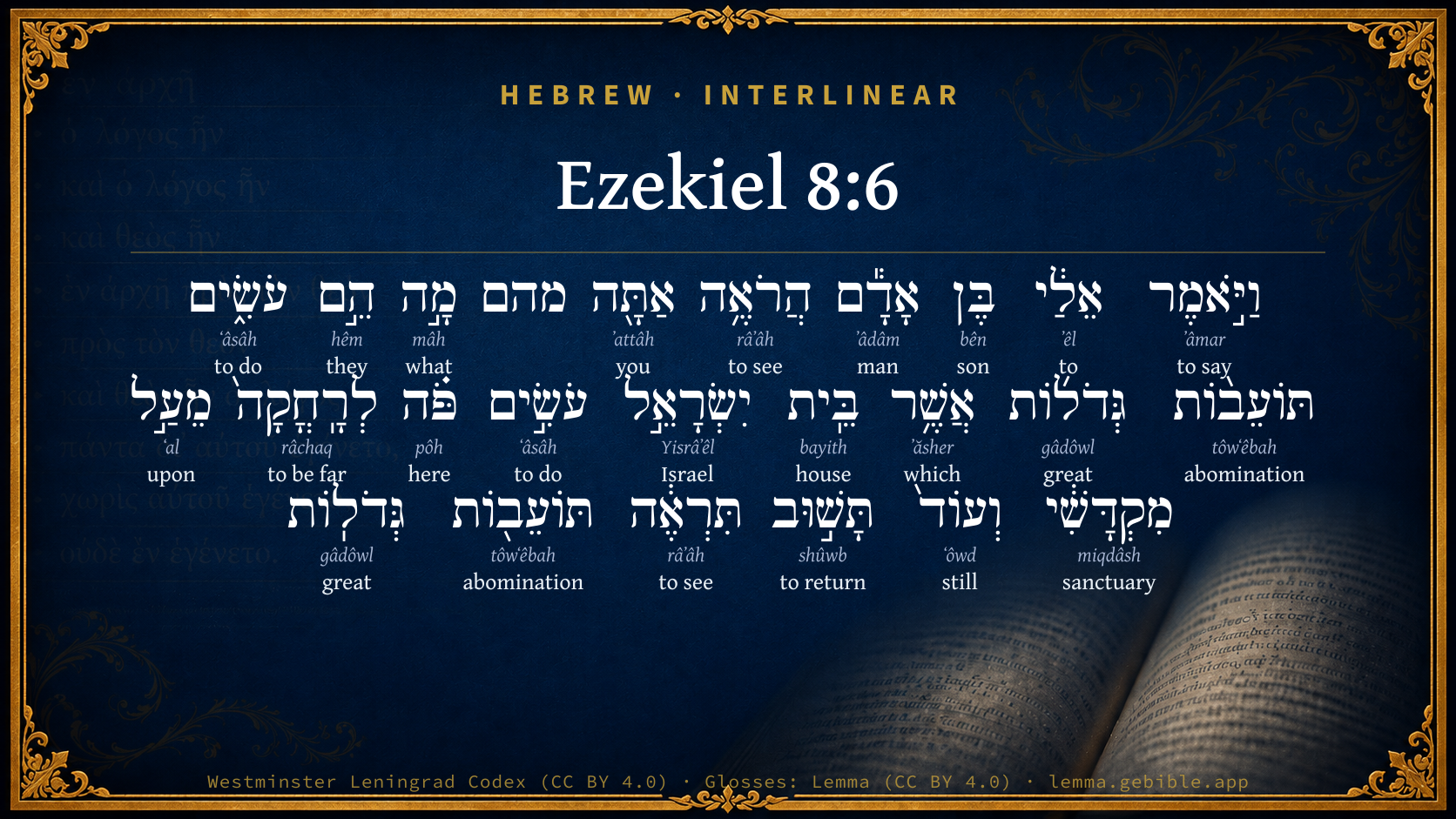
Hebrew (Westminster Leningrad Codex) Ezekiel 8:6 appears in the Hebrew Old Testament. The text above is from the Westminster Leningrad Codex. Each word links to its Strong’s number, a concise gloss, and parsing drawn from the Open Scriptures Hebrew Bible morphology. Click any word for its full Brown-Driver-Briggs (BDB) entry.
Download image
Cite this verse

Ezekiel 8:6 (World English Bible). Public Domain. Lemma interlinear Bible study tool, https://lemma.gebible.app/v/ezekiel/8/6.

Show BibTeX & RIS
BibTeX
RIS
English Translation
He said to me, Son of man, see you what they do? even the great abominations that the house of Israel do commit here, that I should go far off from my sanctuary? but you shall again see yet other great abominations.
World English Bible · Public Domain
Download a study sheet

One document with this verse’s original text, its word-by-word gloss line, the meaning frame, cross-references with their text, attributed commentary, and full source and license credits — printable, and it pastes into notes with its structure intact.

This verse Autodidact and up

Study sheet (.html) Plain text (.txt)

A passage Seminary Student

Up to 50 verses in one chapter. A passage sheet keeps up to 6 commentary sources and 12 cross-references per verse, in the order this page ranks them, and says so on the sheet whenever that leaves anything out. Ask for a single verse and you get the Autodidact verse sheet above.

Everything on this page stays free to read, with no account — the sheet is a download of what is already on screen, not access to it.

Want to remove ads? Support Godless Engineer
Compare translations 3

The same verse in 3 English versions, stacked beneath the original-language interlinear above. Click any original word for its lexicon entry.

Each is an independent rendering of the whole verse — the interlinear is not word-aligned to these translations.

Highlighted words mark where these versions differ — a whole-verse word diff, not a word-by-word alignment.

  • World English Bible Public Domain
    He said to me, Son of man, see you what they do? even the great abominations that the house of Israel do commit here, that I should go far off from my sanctuary? but you shall again see yet other great abominations.
  • King James Version Public Domain
    He said furthermore unto me, Son of man, seest thou what they do? even the great abominations that the house of Israel committeth here, that I should go far off from my sanctuary? but turn thee yet again, and thou shalt see greater abominations.
  • unfoldingWord Literal Text CC BY-SA 4.0
    So he said to me, “Son of man, do you see what they are doing? These are great abominations that the house of Israel is doing here to make me go far from my own sanctuary. But you will turn and see even greater abominations.”

unfoldingWord Literal Text — © unfoldingWord, licensed CC BY-SA 4.0. Word-aligned USFM3 via Door43 (git.door43.org/unfoldingWord/en_ult).

Versions to compare (up to 4)

3 of 4 selected

Show all 18 translations

Every available English version of this verse, each an independent rendering of the whole verse.

  • World English Bible Public Domain
    He said to me, Son of man, see you what they do? even the great abominations that the house of Israel do commit here, that I should go far off from my sanctuary? but you shall again see yet other great abominations.
  • Berean Standard Bible Public Domain
    “Son of man,” He said to me, “do you see what they are doing—the great abominations that the house of Israel is committing—to drive Me far from My sanctuary? Yet you will see even greater abominations.”
  • Majority Standard Bible Public Domain
    “Son of man,” He said to me, “do you see what they are doing—the great abominations that the house of Israel is committing—to drive Me far from My sanctuary? Yet you will see even greater abominations.”
  • King James Version Public Domain
    He said furthermore unto me, Son of man, seest thou what they do? even the great abominations that the house of Israel committeth here, that I should go far off from my sanctuary? but turn thee yet again, and thou shalt see greater abominations.
  • American Standard Version (1901) Public Domain
    And he said unto me, Son of man, seest thou what they do? even the great abominations that the house of Israel do commit here, that I should go far off from my sanctuary? but thou shalt again see yet other great abominations.
  • Revised Version (1885) Public Domain
    And he said unto me, Son of man, seest thou what they do? even the great abominations that the house of Israel do commit here, that I should go far off from my sanctuary? but thou shalt again see yet other great abominations.
  • Geneva Bible (1599) Public Domain
    He said furthermore vnto me, Sonne of man, seest thou not what they doe? euen the great abominations that the house of Israel committeth here to cause me to depart from my Sanctuarie? but yet turne thee and thou shalt see greater abominations.
  • Douay-Rheims (1899) Public Domain
    And he said to me: Son of man, dost thou see, thinkest thou, what these are doing, the great abominations that the house of Israel committeth here, that I should depart far off from my sanctuary? and turn thee yet again and thou shalt see greater abominations.
  • Young's Literal Translation Public Domain
    And He saith unto me, `Son of man, art thou seeing what they are doing? the great abominations that the house of Israel are doing here, to keep far off from My sanctuary; and again thou dost turn, thou dost see great abominations.'
  • Literal Standard Version CC BY-SA 4.0
    And He says to me, “Son of man, are you seeing what they are doing? The great abominations that the house of Israel is doing here, to keep far off from My sanctuary; and turn again, [and] see great abominations.”
  • Unlocked Literal Bible CC BY-SA 4.0
    So he said to me, “Son of man, do you see what they are doing? These are great abominations that the house of Israel is doing here to make me go far from my own sanctuary. But you will turn and see even greater abominations.”
  • unfoldingWord Literal Text CC BY-SA 4.0
    So he said to me, “Son of man, do you see what they are doing? These are great abominations that the house of Israel is doing here to make me go far from my own sanctuary. But you will turn and see even greater abominations.”
  • Darby Bible Public Domain
    And he said unto me, Son of man, seest thou what they do? the great abominations that the house of Israel commit here, to cause [me] to go far off from my sanctuary? And yet again thou shalt see great abominations.
  • World Messianic Bible Public Domain
    He said to me, “Son of man, do you see what they do? Even the great abominations that the house of Israel commit here, that I should go far off from my sanctuary? But you will again see yet other great abominations.”
  • Webster's Bible Public Domain
    He said furthermore to me, Son of man, seest thou what they do? even the great abominations that the house of Israel committeth here, that I should withdraw from my sanctuary? but turn thee yet again, and thou shalt see greater abominations.
  • Free Bible Version CC BY-SA 4.0
    “Son of man,” he said to me, “can you see what they are doing? Look at the disgusting sins the people of Israel are committing that are driving me far away from my sanctuary? But you're going to see even more disgusting sins than these!”
  • Bible in Basic English Public Domain
    And he said to me, Son of man, do you see what they are doing? even the very disgusting things which the children of Israel are doing here, causing me to go far away from my holy place? but you will see other most disgusting things.
  • JPS Tanakh (1917) Public Domain
    And He said unto me: 'Son of man, seest thou what they do? even the great abominations that the house of Israel do commit here, that I should go far off from My sanctuary? but thou shalt again see yet greater abominations.'

Literal Standard Version (2020), Covenant Press — licensed CC BY-SA 4.0. Text via the HelloAO Bible API (eBible.org). Unlocked Literal Bible (unfoldingWord) — licensed CC BY-SA 4.0. Text via the HelloAO Bible API (eBible.org). unfoldingWord Literal Text — © unfoldingWord, licensed CC BY-SA 4.0. Word-aligned USFM3 via Door43 (git.door43.org/unfoldingWord/en_ult). Free Bible Version, Dr. Jonathan Gallagher — licensed CC BY-SA 4.0. Text via the HelloAO Bible API (eBible.org).

Word by word

More ways to search: Search by grammar → Find every occurrence → Compare this word →

Practice this passage: Drill this verse → Learn its vocabulary →

לְרָֽחֳקָה֙
râchaq
H7368
“to be far”
Preposition + Verb, Qal, Infinitive Construct
Part of Speech
Preposition + Verb
Stem
Qal
Form
Infinitive Construct
Full BDB Definition

Origin: a primitive root

TWOT: 2151

to be or become far, be or become distant, be removed, go far away (verb) - (Qal) to be far, be distant - (Piel) to send far away, extend - (Hiphil) - to make or exhibit distance, be gone far - to remove, put far away - (Niphal) loose (verb) - at a distance (verbal infinitive [as adverb])
  1. וַיֹּ֣אמֶר ʼâmar H559 “and · to say” Conjunction + Verb, Qal, Sequential Imperfect, 3rd Person, Masculine, Singular
  2. אֵלַ֔י ʼêl H413 “to · me” Preposition + Suffix, Personal, 1st Person, Common, Singular
  3. בֶּן bên H1121 “son of” Noun, Common, Masculine, Singular, Construct
  4. אָדָ֕ם ʼâdâm H120 “man” Noun, Common, Masculine, Singular, Absolute
  5. הֲרֹאֶ֥ה râʼâh H7200 “seeing” Particle, Interrogative + Verb, Qal, Participle Active, Masculine, Singular, Absolute
  6. אַתָּ֖ה ʼattâh H859 “you” Pronoun, Personal, 2nd Person, Masculine, Singular
  7. מָ֣ה mâh H4100 “what” Particle, Interrogative
  8. הֵ֣ם hêm H1992 “they” Pronoun, Personal, 3rd Person, Masculine, Plural
  9. עֹשִׂ֑ים ʻâsâh H6213 “doing” Verb, Qal, Participle Active, Masculine, Plural, Absolute
  10. תּוֹעֵב֨וֹת tôwʻêbah H8441 “abominations” Noun, Common, Feminine, Plural, Absolute
  11. גְּדֹל֜וֹת gâdôwl H1419 “great” Adjective, Adjective, Feminine, Plural, Absolute
  12. אֲשֶׁ֥ר ʼăsher H834 “which” Particle, Relative
  13. בֵּֽית bayith H1004 “house of” Noun, Common, Masculine, Singular, Construct
  14. יִשְׂרָאֵ֣ל Yisrâʼêl H3478 “Israel” Noun, Proper
  15. עֹשִׂ֣ים ʻâsâh H6213 “doing” Verb, Qal, Participle Active, Masculine, Plural, Absolute
  16. פֹּ֗ה pôh H6311 “here” Adverb
  17. מֵעַ֣ל ʻal H5921 “from · upon” Preposition + Preposition
  18. מִקְדָּשִׁ֔י miqdâsh H4720 “sanctuary · my” Noun, Common, Masculine, Singular, Construct + Suffix, Personal, 1st Person, Common, Singular
  19. וְעוֹד֙ ʻôwd H5750 “and · still” Conjunction + Adverb
  20. תָּשׁ֣וּב shûwb H7725 “to return” Verb, Qal, Imperfect, 2nd Person, Masculine, Singular
  21. תִּרְאֶ֔ה râʼâh H7200 “to see” Verb, Qal, Imperfect, 2nd Person, Masculine, Singular
  22. תּוֹעֵב֖וֹת tôwʻêbah H8441 “abominations” Noun, Common, Feminine, Plural, Absolute
  23. גְּדֹלֽוֹת gâdôwl H1419 “great” Adjective, Adjective, Feminine, Plural, Absolute

About this verse

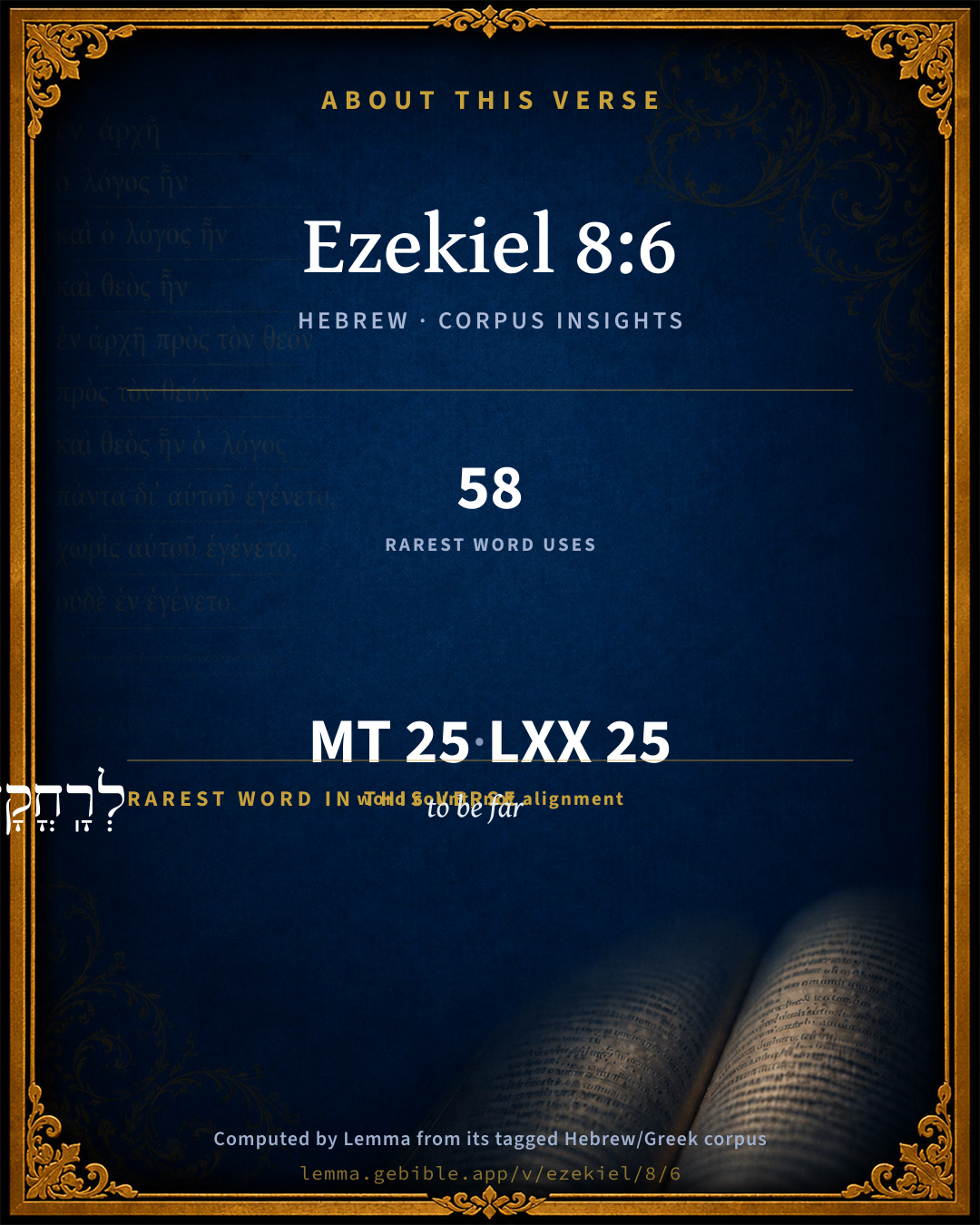
These counts appear in no published source. They are computed here, from the morphology-tagged text and Lemma’s own curated glosses. What Lemma adds →

25
words
20
distinct lemmas
Prophets
section

Shared distinctive vocabulary

לְרָֽחֳקָה֙ to be far H7368 occurs in 56 verses of the Hebrew Bible. Also found in:

Grammatical profile

  • 7 verbs
  • 7 nouns
  • 2 adjectives
  • 2 pronouns
  • 3 prepositions
  • 2 adverbs
  • 2 particles

Verb forms

  • וַיֹּ֣אמֶר Qal · Sequential Imperfect
  • הֲרֹאֶ֥ה Qal · Participle Active
  • עֹשִׂ֑ים Qal · Participle Active
  • עֹשִׂ֣ים Qal · Participle Active
  • לְרָֽחֳקָה֙ Qal · Infinitive Construct
  • תָּשׁ֣וּב Qal · Imperfect
  • תִּרְאֶ֔ה Qal · Imperfect

Repetition

Words recur within this verse — often emphatic in Hebrew:

  • הֲרֹאֶ֥ה to see H7200 ×2
  • עֹשִׂ֑ים to do H6213 ×2
  • תּוֹעֵב֨וֹת abomination H8441 ×2
  • גְּדֹל֜וֹת great H1419 ×2

Hebrew & Septuagint length

In English translation the verse runs 42 words from the Hebrew and 35 from the Septuagint (LXX English) — closely comparable.

A rough comparison of the two English renderings, which tokenize alike — not a word-level alignment.

Word counts can differ between the Hebrew and the Greek without any difference in meaning — e.g. the Hebrew direct-object marker אֵת has no separate Greek word, and Greek often adds the article ὁ.

In the original languages it is 25 Hebrew tokens and 25 Greek tokens — but the two are counted differently (Hebrew bundles its prefixes and suffixes into one token; the Greek is in lemma form), so that isn’t a like-for-like length.

Cross-references

21

Topical passages linked to Ezekiel 8:6 in the Treasury of Scripture Knowledge — connected by theme and wording, ordered by reader-vote popularity; previews shown in the World English Bible.

  • Ezekiel 5:11 Therefore, as I live, says the Lord Yahweh, surely, because you have defiled my sanctuary with all your detestable things, and with all your abominations, therefore will I also diminish [you]; neither shall my eye spare, and I also will have no pity.
  • Ezekiel 10:19 The cherubim lifted up their wings, and mounted up from the earth in my sight when they went forth, and the wheels beside them: and they stood at the door of the east gate of Yahweh's house; and the glory of the God of Israel was over them above.
  • Ezekiel 8:9 He said to me, Go in, and see the wicked abominations that they do here.
  • Deuteronomy 31:16–18 Yahweh said to Moses, Behold, you shall sleep with your fathers; and this people will rise up, and play the prostitute after the strange gods of the land, where they go to be among them, and will forsake me, and break my covenant which I have made with them.
  • 2 Kings 23:4–6 The king commanded Hilkiah the high priest, and the priests of the second order, and the keepers of the threshold, to bring forth out of the temple of Yahweh all the vessels that were made for Baal, and for the Asherah, and for all the host of the sky, and he burned them outside of Jerusalem in the fields of the Kidron, and carried the ashes of them to Bethel.
  • 2 Chronicles 36:14–17 Moreover all the chiefs of the priests, and the people, trespassed very greatly after all the abominations of the nations; and they polluted the house of Yahweh which he had made holy in Jerusalem.
  • Psalms 78:60 So that he forsook the tent of Shiloh, The tent which he placed among men;
  • Proverbs 5:14 I have come to the brink of utter ruin, In the midst of the gathered assembly."
  • Jeremiah 3:6 Moreover Yahweh said to me in the days of Josiah the king, Have you seen that which backsliding Israel has done? she is gone up on every high mountain and under every green tree, and there has played the prostitute.
  • Jeremiah 7:17 Don't you see what they do in the cities of Judah and in the streets of Jerusalem?
  • Jeremiah 7:30 For the children of Judah have done that which is evil in my sight, says Yahweh: they have set their abominations in the house which is called by my name, to defile it.
  • Jeremiah 23:11 for both prophet and priest are profane; yes, in my house have I found their wickedness, says Yahweh.
  • Jeremiah 26:6 then will I make this house like Shiloh, and will make this city a curse to all the nations of the earth.
  • Jeremiah 32:34 But they set their abominations in the house which is called by my name, to defile it.
  • Lamentations 2:6–7 He has violently taken away his tent, as if it were of a garden; he has destroyed his place of assembly: Yahweh has caused solemn assembly and Sabbath to be forgotten in Zion, Has despised in the indignation of his anger the king and the priest.
  • Ezekiel 7:20–22 As for the beauty of his ornament, he set it in majesty; but they made the images of their abominations [and] their detestable things therein: therefore have I made it to them as an unclean thing.
  • Ezekiel 8:11–12 There stood before them seventy men of the elders of the house of Israel; and in the midst of them stood Jaazaniah the son of Shaphan, every man with his censer in his hand; and the odor of the cloud of incense went up.
  • Ezekiel 8:14 Then he brought me to the door of the gate of Yahweh's house which was toward the north; and see, there sat the women weeping for Tammuz.
  • Ezekiel 8:16–17 He brought me into the inner court of Yahweh's house; and see, at the door of the temple of Yahweh, between the porch and the altar, were about twenty-five men, with their backs toward the temple of Yahweh, and their faces toward the east; and they were worshipping the sun toward the east.
  • Ezekiel 11:22 Then did the cherubim lift up their wings, and the wheels were beside them; and the glory of the God of Israel was over them above.
  • Ezekiel 23:38–39 Moreover this they have done to me: they have defiled my sanctuary in the same day, and have profaned my Sabbaths.

Cross-references courtesy of OpenBible.info (CC BY 4.0).

Hebrew and Greek witnesses Masoretic Hebrew ↔ Greek Septuagint

The same verse in the two great witnesses to the Old Testament, shown verse-for-verse.

These are two independent witnesses, not word-aligned to each other, and the Septuagint is shown in lemma (dictionary) form.

Hebrew Ezekiel 8:6 Masoretic · Westminster Leningrad Codex

וַיֹּ֣אמֶר אֵלַ֔י בֶּן אָדָ֕ם הֲרֹאֶ֥ה אַתָּ֖ה מהם מָ֣ה הֵ֣ם עֹשִׂ֑ים תּוֹעֵב֨וֹת גְּדֹל֜וֹת אֲשֶׁ֥ר בֵּֽית יִשְׂרָאֵ֣ל עֹשִׂ֣ים פֹּ֗ה לְרָֽחֳקָה֙ מֵעַ֣ל מִקְדָּשִׁ֔י וְעוֹד֙ תָּשׁ֣וּב תִּרְאֶ֔ה תּוֹעֵב֖וֹת גְּדֹלֽוֹת

He said to me, Son of man, see you what they do? even the great abominations that the house of Israel do commit here, that I should go far off from my sanctuary? but you shall again see yet other great abominations.

World English Bible · Public Domain

Greek LXX Ezekiel 8:6 Septuagint · lemma form

καί εἶπον πρός ἐγώ υἱός ἄνθρωπος ὁράω τίς οὗτος ποιέω ἀνομία μέγας ποιέω ὧδε ὁ ἀποἔχω ἀπό ὁ ἅγιος ἐγώ καί ἔτι ὁράω ἀνομία μέγας

And he said to me, Son of man, have you seen what these do? They commit great abominations here so that I should keep away from my sanctuary: and you shall see yet greater iniquities.

LXX2012 (modern English Septuagint) · Public Domain

On this verse, John Gill's Exposition discusses the Septuagint’s reading. Read the note in Commentary ↓

Hebrew: Westminster Leningrad Codex (CC BY 4.0). Greek: Septuagint (public domain); English from LXX2012 (modern English Septuagint) (Public Domain). How the Septuagint differs from the Hebrew →

Targum (Aramaic paraphrase)

1

The Targum is the ancient Jewish Aramaic paraphrase of the Hebrew Scriptures — an interpretive translation, not the Hebrew text itself. Onkelos (literal) and Pseudo-Jonathan (expansive) render the Torah, and Jonathan the Prophets. Coverage is partial: where no permissively-licensed English translation exists for a verse, only the Aramaic is shown. This is verse-level text, not a word-by-word alignment to the Hebrew.

  1. Targum Jonathan Prophets (Joshua–Malachi)
    וַאֲמַר לִי בַּר אָדָם חֲזֵי אַתְּ מַה דְאִינוּן עָבְדִין תּוֹעֵיבָן רַבְרְבָן דְבֵית יִשְׂרָאֵל עָבְדִין בָּא לְאִתְרַחֲקָא מֵעַל מַקְדְשִׁי וְעוֹד תְּתוּב תֶּחֱזֵי תוֹעֵיבָן רַבְרְבָן:

    (no public-domain English translation for this verse)

    Targum Jonathan — Aramaic: “Mikraot Gedolot” (public domain). English: “Sefaria Community Translation” (CC0 1.0 (public-domain dedication)); “London "Chaldee Paraphrase," 1871” (public domain). Text via Sefaria.

Commentary

Notes on Ezekiel 8:6 from classic Christian and Jewish commentators (each source and its license shown beneath its notes). The classic Christian expositions comment on the surrounding passage and are grouped to its opening verse, so a note may address several verses; the Jewish commentaries on the Tanakh (Rashi and others) are per-verse, so they appear only where the commentator wrote on this verse.

Lemma curates 59 commentaries, every one of them public domain or Creative Commons licensed, each selected and text-cleaned for this edition rather than reprinted as found. About our sources →

Trapp's Complete Commentary

John Trapp

Eze 8:6 He said furthermore unto me, Son of man, seest thou what they do? [even] the great abominations that the house of Israel committeth here, that I should go far off from my sanctuary? but turn thee yet again, [and] thou shalt see greater abominations.

Ver. 6. That I should go far from my sanctuary.] Which is now become omnium turpitudinum arx (as was once said of Pompey’s great theatre at Rome), a receptacle of all roguery, et impiae gentis arcanum, as afterward Florus unworthily called it.

And thou shalt see greater abominations.] All sins are not equally sinful then, as the Stoics affirmed, but there are degrees of abominations. See Deu 32:5. {See Trapp on "Deu 32:5"}

John Trapp, A Commentary or Exposition upon All the Books of the Old and New Testament (1647–1656) — public domain. Text from a community e-Sword module.

Geneva Bible (1599)

Geneva Bible translators

For God will not be where idols are.

Geneva Bible (1599) marginal notes — public domain. Text via Bolls.life.

Jamieson, Fausset & Brown

Robert Jamieson, A. R. Fausset & David Brown

that I should go far off from my sanctuary--"that I should (be compelled by their sin to) go far off from my sanctuary"-- (Eze 10:18); the sure precursor of its destruction.

Jamieson, Fausset & Brown — Commentary Critical and Explanatory on the Whole Bible (1871) — public domain (CC PDM 1.0). Text via the HelloAO Bible API.

John Calvin's Commentaries

Now God complains with his Prophet; and we must always mark the object and consider God’s design, because at the end of the chapter we shall see how severe a vengeance God was about to take on the people. Hence the Prophet prevents those obstreperous reproaches with which the people loaded him through envy, when he chastised them according to their deserts. Hence he doubtless wished the exiles to be persuaded of what they could scarcely conceive, namely, that the destruction of Jerusalem was near. For we have said that those who had been drawn into captivity had displeased him, and wished to return to their country. Since therefore their condition was too grievous and severe, for this reason God wished to testify to them that the last overthrow of Jerusalem was at hand. He does this while he shows the great abominations which reigned in the very temple, whence the Almighty must of necessity appear as the avenger of his glory and worship. The rest to-morrow.

John Calvin's Commentaries (1540-1563) — public domain. Text from the Calvin Translation Society English edition (1840s-50s) via the Christian Classics Ethereal Library (ccel.org). Calvin's coverage is partial (roughly two-thirds of the Bible); uncommented books and verses are honest gaps, never fabricated. The 19th-century editor's footnotes and remarks are omitted so the notes are faithfully Calvin's own voice.

Ellicott's Commentary for English Readers

(6) That I should go far off from my sanctuary.—In the original this is simply an infinitive, without any subject expressed, “for the removing far off,” and may therefore be understood either of the removing of the people or of the Divine abandonment of the sanctuary. The latter sense, however, which is that given in the Authorised Version, is more probable and more in accordance with the whole teaching of the vision. There was a strong feeling among the people that they were safe at Jerusalem; God, Whom they still regarded, notwithstanding their idolatries, as a powerful national God, would certainly protect His temple. It is the office of the prophet to show that, the transgressions of the people led, as their natural consequence, to his giving over the city to desolation. The “great abominations” spoken of are the constant refrain of this chapter (Eze_8:9; Eze_8:13; Eze_8:15; Eze_8:17). The people’s own acts make necessary the judgments impending over them. Still worse is in store.

A Bible Commentary for English Readers, edited by Charles John Ellicott (1878–1897) — public domain. Text from a community e-Sword module.

The Cambridge Bible for Schools and Colleges

gen. ed. J. J. S. Perowne

6. I should go far off] i.e. withdraw. These abominations defiled Jehovah’s sanctuary, the place of his abode, causing him to abandon it. His withdrawal is symbolized ch. Eze_11:1; Eze_11:22-23.

turn thee … again … see] Rather: thou shalt again see greater abominations; so Eze_8:13; Eze_8:15.

The Cambridge Bible for Schools and Colleges (gen. ed. J. J. S. Perowne; Cambridge University Press, 1878–1918) — public domain. Text from a community e-Sword module.

John Gill's Exposition

He said furthermore unto me, son of man,.... He continued his speech to the prophet, saying

seest thou what they do? the idolatrous Jews, who had set up a graven image at the northern gate of the court, where the altar was, and were sacrificing to it:

even the great abominations that the house of Israel committeth here; for to set up an idol where he was, and an altar by his altar, and to sacrifice to Baal, and not to him, or to Baal along with him, or besides him, or to any other idol, were very abominable to the Lord: even to such a degree,

that I should go far from my sanctuary? be obliged to leave it, not being able to bear such abominable idolatries: or, "that they should go far from my sanctuary" (u); depart from the true worship and service of it, and fall into idolatry:

but turn thee yet again; from the north to the south it may be; however, to some other part of the temple:

and thou shalt see greater abominations; or, "great abominations" (w); for there is no necessity of rendering it "greater": but the meaning is, that he should see other great abominations besides what he had seen, than which there could not be anything well greater.

(u) "ut longius recedant, vel abeant, sub. Israelitae a sauctuario meo", Vatablus; and to this sense are the Septuagint, Syriac, and Arabic versions; "ad longe recedendum", Cocceius. (w) "abominationes magnas", Pagninus, Montanus, Calvin, Piscator, Cocceius. Starckius.

John Gill's Exposition of the Whole Bible (1746–1763) — public domain (CC PDM 1.0). Text via the HelloAO Bible API.

Matthew Poole's English Annotations

Seest thou? dost thou observe?

What they do; the inhabitants, the generality of the Jews.

The great abominations; the notorious idolatries.

Here; in this court, in view of my temple, and where all that come, as most did, this way to worship me see it, so shameless is it!

That I should go; not that they designed this, but eventually it was so, and in all reason could be no otherwise expected.

From my sanctuary; that I chose, but am not confined to. That I shall leave not by local distance, but by rejecting and casting it off, and laying it desolate.

Matthew Poole's English Annotations on the Holy Bible (1683–1685) — public domain. Text from a community e-Sword/MySword module.

Whedon's Commentary on the Bible

Daniel D. Whedon

6. Turn thee yet again, and thou shall see greater abominations — Or, thou shalt see again greater abominations. The gradation of crime indicated here is a help in determining the location and nature of the worship now to be described. The increased desecration is seen, if our exegesis is correct, first, in the place where the worship is offered; second, in the character of the worshipers; and, third, in the nature of the worship. The image was set up “at the gate” (of the outer court, Eze_8:5); the “chambers of imagery” were in the gate, or in an adjoining chamber at the very entrance to the inner court; the women “weeping for Tammuz” were at “the door of the gate of the Lord’s house,” which we suppose to be a special title designating the door of the holy place, just as the priests’ court seems to be called “the court of the Lord’s house” (Jer_19:14; Jer_26:2). The sun worshipers were “at the door of the temple of the Lord,” which evidently locates them on the steps of the court leading to the holy of holies; for it is distinctly stated, as if to increase the enormity of the offense, that they were “between the porch and the altar” (Eze_8:16), and the Mishna also declares that this particular space was especially holy (Chelim, 1-9). The priests would naturally speak of the priests’ court as the court, and of the gate of the inner court as the gate (2Ch_20:5; Jer_19:14; Jer_26:2, and Ezekiel passim). The character of the worshipers and the kind of worship, if our explanation is correct, show a growth in shamelessness: elders (Eze_8:11), women prostitutes (Eze_8:14, compare Deu_23:17); men prostitutes (Eze_8:16); the Egyptian Mysteries (Eze_8:10); the Tammuz Festival (Eze_8:14); the worship of the sun with special reference to its fructifying influence (Eze_8:16-17).

That I should go far off from my sanctuary — These abominations drive Jehovah from his temple. Jerusalem and the temple have always been called sacred to Jehovah, and the comrades of Ezekiel in exile thought it blasphemy for anyone to suggest that the temple could be captured and profaned by the heathen; but in the vision it is made plain that the temple is already profaned. The elders, the common people, and even the priests — the chief ministers of the temple — have already brought into it the worst forms of heathen worship. It is already polluted. The Chaldean army can do no worse. Let the siege begin! It is Jehovah’s temple no longer, and he will no longer protect it. This is a syncretism which even the heathen have not been guilty of (Jer_2:10).

Daniel D. Whedon (gen. ed.), Commentary on the Old and New Testaments (1874–1909) — public domain. Text from a community e-Sword module.

The Pulpit Commentary

That I should go far off, etc. The lesson taught was that already implied in the fact that the glorious vision and come to him from the north. (Eze_1:4) The temple was already as a God-deserted shrine. His return to it now was but the coming of the Judge and the Destroyer. We are reminded of the Metabainwmen enteuqen, ("Let us depart hence"), which was heard in the darkness of the night before the later destruction of Jerusalem (Josephus, "Bell. Jud:" 6:5:3) Bad begins, but worse remains behind. The prophet is led onward as through the successive stages of an inferno of idolatries.

The Pulpit Commentary (1880–1919), ed. H.D.M. Spence-Jones & Joseph S. Exell — public domain. Text from a community e-Sword module.

John Wesley's Explanatory Notes

They - The generality of the Jews. Great abominations - The notorious idolatries. Here - In this court, in view of my temple. Far off - Not that they designed this, but no other could be expected.

John Wesley, Explanatory Notes Upon the Whole Bible (1754–1765) — public domain. Text via the GEBible commentary corpus.

Rashi

Rabbi Shlomo Yitzchaki (Rashi)

to cause Me to distance Myself from My sanctuary In order that I distance Myself from My sanctuary.

Rashi on the Tanakh — English translations: “The Judaica Press complete Tanach with Rashi, translated by A. J. Rosenberg” (CC BY 4.0); “Pentateuch with Rashi's commentary by M. Rosenbaum and A.M. Silbermann, 1929-1934” (public domain); “The Metsudah Tanach series, Lakewood, N.J” (CC BY 4.0); and “The Book of Joshua, Metsudah Publications, 1997” (CC BY 4.0). Text via Sefaria.

Lesson kit

Teaching starters — assembled from the data on this page, not authored interpretation. Every prompt links to the verse data it draws on. Edit before teaching.

Ezekiel, in the Prophets, opens this verse with 25 words (20 distinct Hebrew lemmas). Its most distinctive word is râchaq (“to be far”). A historical commentator’s framing appears above. Read the whole chapter for the surrounding context.

Discussion questions

  1. How does “to be far” (râchaq) shape what this verse is saying?
  2. How does Genesis 21:16, which shares the word «to be far», read alongside this verse?
  3. What does the repetition of “to see” (2× in this one verse) do in this verse?
  4. These translations render this verse differently. What is at stake in choosing one wording over another?
  5. «וַיֹּ֣אמֶר» is a Qal Sequential Imperfect verb. How does that grammatical form shape the action described?
  6. Compare how Trapp's Complete Commentary and Geneva Bible (1599) read this verse. Where do they agree or differ?

Things to notice

Reading settings

Reading text

Shown beneath each verse's original-language words.

Old Testament
Old Testament edition

Read the OT as the Masoretic Hebrew (MT) or the Greek Septuagint (LXX).

English shown for the Greek Septuagint (in the Hebrew ↔ Greek comparison).

Comparing translations? Open the Compare panel on any verse page to stack up to four side by side.