1 Kings 22:16

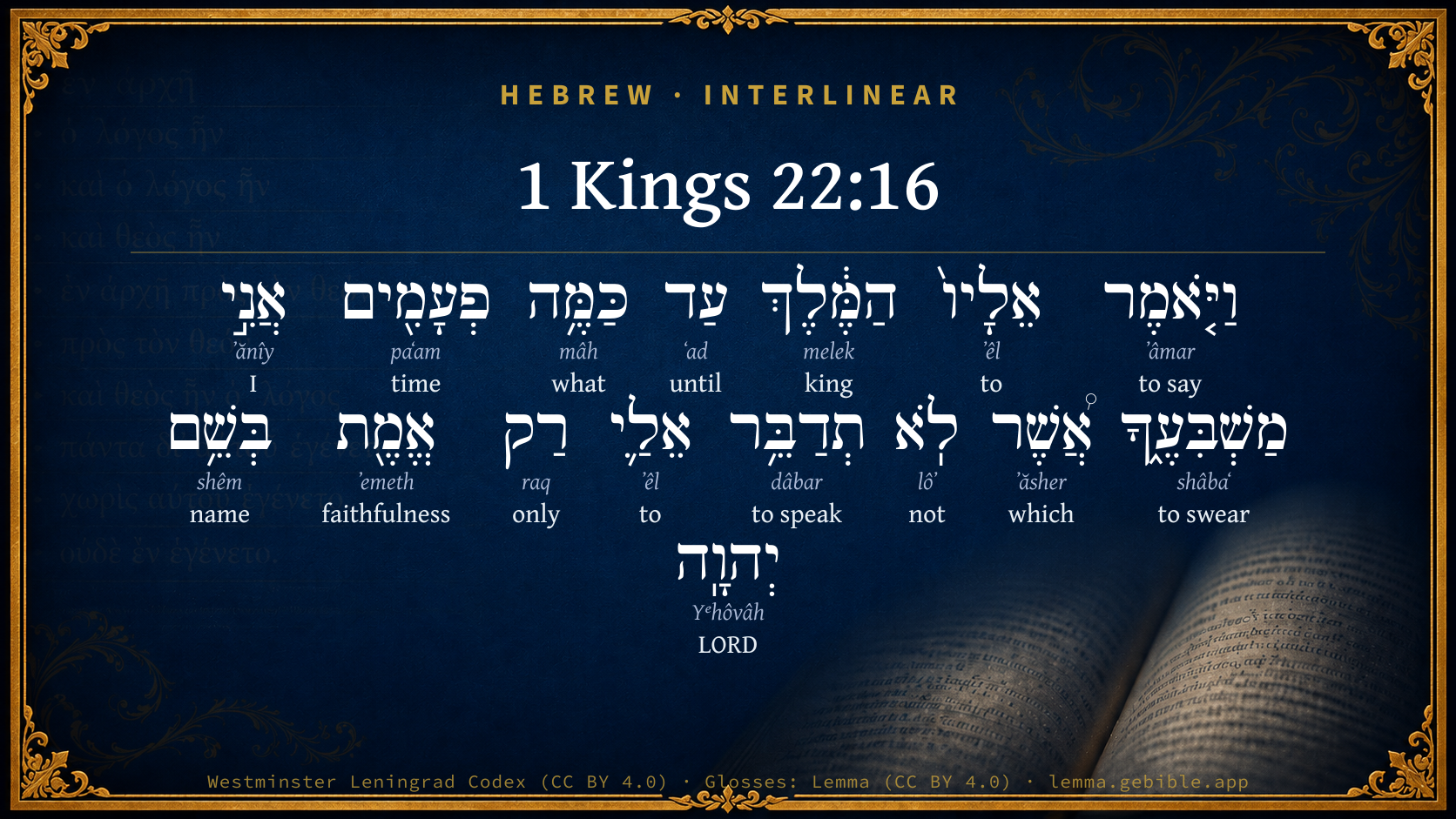
Hebrew (Westminster Leningrad Codex) 1 Kings 22:16 appears in the Hebrew Old Testament. The text above is from the Westminster Leningrad Codex. Each word links to its Strong’s number, a concise gloss, and parsing drawn from the Open Scriptures Hebrew Bible morphology. Click any word for its full Brown-Driver-Briggs (BDB) entry.
Download image
Cite this verse

1 Kings 22:16 (World English Bible). Public Domain. Lemma interlinear Bible study tool, https://lemma.gebible.app/v/1-kings/22/16.

Show BibTeX & RIS
BibTeX
RIS
English Translation
The king said to him, How many times shall I adjure you that you speak to me nothing but the truth in the name of Yahweh?
World English Bible · Public Domain
Download a study sheet

One document with this verse’s original text, its word-by-word gloss line, the meaning frame, cross-references with their text, attributed commentary, and full source and license credits — printable, and it pastes into notes with its structure intact.

This verse Autodidact and up

Study sheet (.html) Plain text (.txt)

A passage Seminary Student

Up to 50 verses in one chapter. A passage sheet keeps up to 6 commentary sources and 12 cross-references per verse, in the order this page ranks them, and says so on the sheet whenever that leaves anything out. Ask for a single verse and you get the Autodidact verse sheet above.

Everything on this page stays free to read, with no account — the sheet is a download of what is already on screen, not access to it.

Want to remove ads? Support Godless Engineer
Compare translations 3

The same verse in 3 English versions, stacked beneath the original-language interlinear above. Click any original word for its lexicon entry.

Each is an independent rendering of the whole verse — the interlinear is not word-aligned to these translations.

Highlighted words mark where these versions differ — a whole-verse word diff, not a word-by-word alignment.

  • World English Bible Public Domain
    The king said to him, How many times shall I adjure you that you speak to me nothing but the truth in the name of Yahweh?
  • King James Version Public Domain
    And the king said unto him, How many times shall I adjure thee that thou tell me nothing but that which is true in the name of the LORD?
  • unfoldingWord Literal Text CC BY-SA 4.0
    And the king said to him, “Up to how many times have I been making you swear that you would not speak about me except truth in the name of Yahweh?”

unfoldingWord Literal Text — © unfoldingWord, licensed CC BY-SA 4.0. Word-aligned USFM3 via Door43 (git.door43.org/unfoldingWord/en_ult).

Versions to compare (up to 4)

3 of 4 selected

Show all 18 translations

Every available English version of this verse, each an independent rendering of the whole verse.

  • World English Bible Public Domain
    The king said to him, How many times shall I adjure you that you speak to me nothing but the truth in the name of Yahweh?
  • Berean Standard Bible Public Domain
    But the king said to him, “How many times must I make you swear not to tell me anything but the truth in the name of the LORD?”
  • Majority Standard Bible Public Domain
    But the king said to him, “How many times must I make you swear not to tell me anything but the truth in the name of the LORD?”
  • King James Version Public Domain
    And the king said unto him, How many times shall I adjure thee that thou tell me nothing but that which is true in the name of the LORD?
  • American Standard Version (1901) Public Domain
    And the king said unto him, How many times shall I adjure thee that thou speak unto me nothing but the truth in the name of Jehovah?
  • Revised Version (1885) Public Domain
    And the king said unto him, How many times shall I adjure thee that thou speak unto me nothing but the truth in the name of the LORD?
  • Geneva Bible (1599) Public Domain
    And the King said vnto him, How oft shall I charge thee, that thou tell me nothing but that which is true in the Name of the Lord?
  • Douay-Rheims (1899) Public Domain
    But the king said to him: I adjure thee again and again, that thou tell me nothing but that which is true in the name of the Lord.
  • Young's Literal Translation Public Domain
    And the king saith unto him, `How many times am I adjuring thee that thou speak nothing unto me but truth in the name of Jehovah?'
  • Literal Standard Version CC BY-SA 4.0
    And the king says to him, “How many times am I adjuring you that you speak nothing to me but truth in the Name of YHWH?”
  • Unlocked Literal Bible CC BY-SA 4.0
    Then the king said to him, “How many times must I require you to swear to tell me nothing but the truth in the name of Yahweh?”
  • unfoldingWord Literal Text CC BY-SA 4.0
    And the king said to him, “Up to how many times have I been making you swear that you would not speak about me except truth in the name of Yahweh?”
  • Darby Bible Public Domain
    And the king said to him, How many times shall I adjure thee that thou tell me nothing but truth in the name of Jehovah?
  • World Messianic Bible Public Domain
    The king said to him, “How many times do I have to adjure you that you speak to me nothing but the truth in the LORD’s name?”
  • Webster's Bible Public Domain
    And the king said to him, How many times shall I adjure thee that thou tell me nothing but that which is true in the name of the LORD?
  • Free Bible Version CC BY-SA 4.0
    But the king said to him, “How many times must I make you swear to tell me only the truth in the name of the Lord?”
  • Bible in Basic English Public Domain
    Then the king said to him, Have I not, again and again, put you on your oath to say nothing to me but what is true in the name of the Lord?
  • JPS Tanakh (1917) Public Domain
    And the king said unto him: 'How many times shall I adjure thee that thou speak unto me nothing but the truth in the name of the LORD?'

Literal Standard Version (2020), Covenant Press — licensed CC BY-SA 4.0. Text via the HelloAO Bible API (eBible.org). Unlocked Literal Bible (unfoldingWord) — licensed CC BY-SA 4.0. Text via the HelloAO Bible API (eBible.org). unfoldingWord Literal Text — © unfoldingWord, licensed CC BY-SA 4.0. Word-aligned USFM3 via Door43 (git.door43.org/unfoldingWord/en_ult). Free Bible Version, Dr. Jonathan Gallagher — licensed CC BY-SA 4.0. Text via the HelloAO Bible API (eBible.org).

Word by word

More ways to search: Search by grammar → Find every occurrence → Compare this word →

Practice this passage: Drill this verse → Learn its vocabulary →

רַק
raq
H7535
“only”
Particle, Accusative
Part of Speech
Particle
Type
Accusative
Full BDB Definition

Origin: the same as H7534 as a noun

TWOT: 2218a

only, altogether, surely - only - only, nought but, altogether (in limitation) - save, except (after a negative) - only, altogether, surely (with an affirmative) - if only, provided only (prefixed for emphasis) - only, exclusively (for emphasis)
  1. וַיֹּ֤אמֶר ʼâmar H559 “and · to say” Conjunction + Verb, Qal, Sequential Imperfect, 3rd Person, Masculine, Singular
  2. אֵלָיו֙ ʼêl H413 “to · him” Preposition + Suffix, Personal, 3rd Person, Masculine, Singular
  3. הַמֶּ֔לֶךְ melek H4428 “the · king” Particle, Definite Article + Noun, Common, Masculine, Singular, Absolute
  4. עַד ʻad H5704 “until” Preposition
  5. כַּמֶּ֥ה mâh H4100 “like/as · what” Preposition + Particle, Interrogative
  6. פְעָמִ֖ים paʻam H6471 “times” Noun, Common, Feminine, Plural, Absolute
  7. אֲנִ֣י ʼănîy H589 “I” Pronoun, Personal, 1st Person, Common, Singular
  8. מַשְׁבִּעֶ֑ךָ shâbaʻ H7650 “swearing · you” Verb, Hiphil, Participle Active, Masculine, Singular, Construct + Suffix, Personal, 2nd Person, Masculine, Singular
  9. אֲ֠שֶׁר ʼăsher H834 “which” Particle, Relative
  10. לֹֽא lôʼ H3808 “not” Particle, Negative
  11. תְדַבֵּ֥ר dâbar H1696 “to speak” Verb, Piel, Imperfect, 2nd Person, Masculine, Singular
  12. אֵלַ֛י ʼêl H413 “to · me” Preposition + Suffix, Personal, 1st Person, Common, Singular
  13. אֱמֶ֖ת ʼemeth H571 “faithfulness” Noun, Common, Feminine, Singular, Absolute
  14. בְּשֵׁ֥ם shêm H8034 “in/at · name of” Preposition + Noun, Common, Masculine, Singular, Construct
  15. יְהוָֽה Yᵉhôvâh H3068 “LORD” Noun, Proper

About this verse

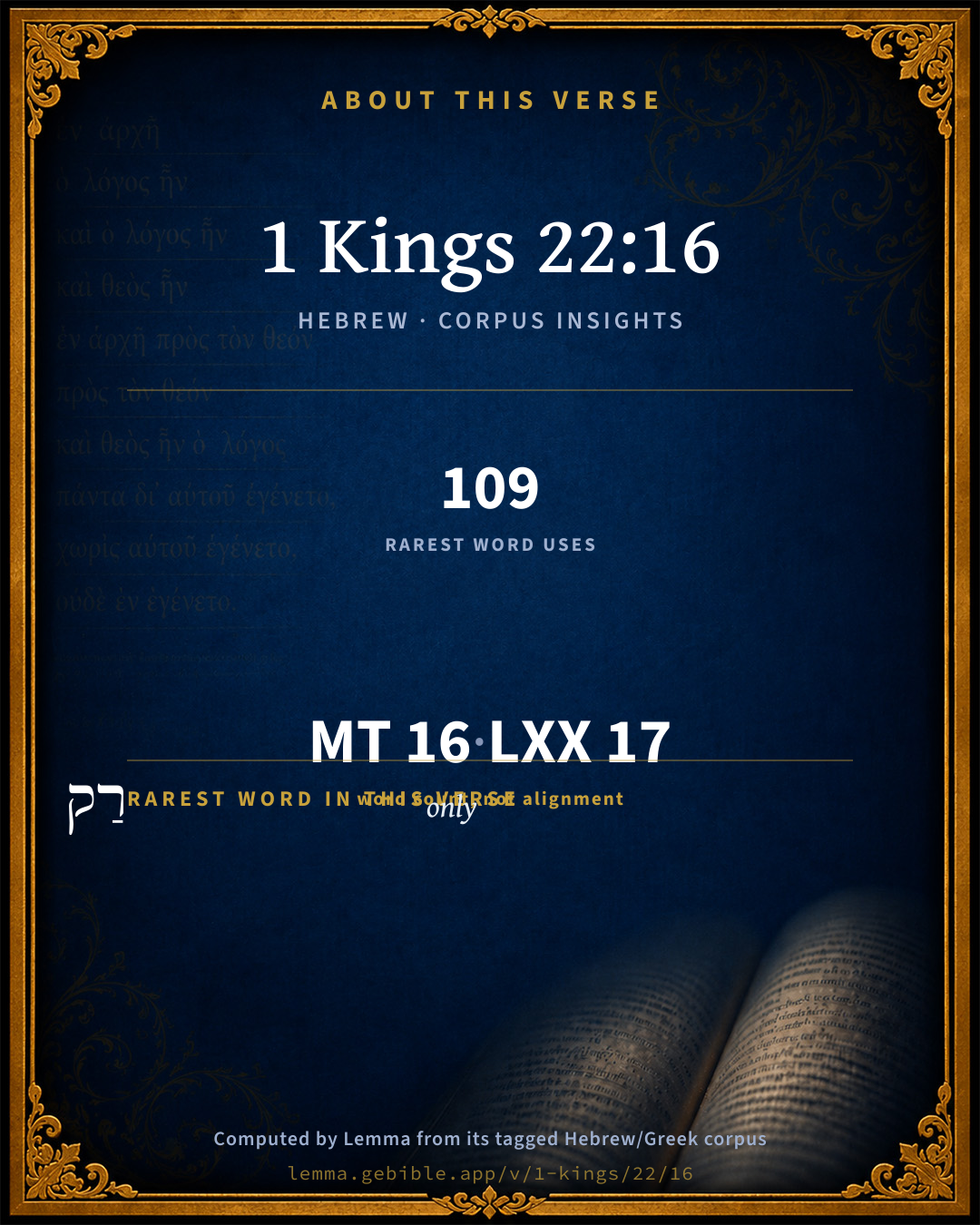
These counts appear in no published source. They are computed here, from the morphology-tagged text and Lemma’s own curated glosses. What Lemma adds →

16
words
15
distinct lemmas
Historical
section

Grammatical profile

  • 3 verbs
  • 5 nouns
  • 1 pronoun
  • 3 prepositions
  • 4 particles

Verb forms

  • וַיֹּ֤אמֶר Qal · Sequential Imperfect
  • מַשְׁבִּעֶ֑ךָ Hiphil · Participle Active
  • תְדַבֵּ֥ר Piel · Imperfect

Repetition

A word recurs within this verse — often emphatic in Hebrew:

  • אֵלָיו֙ to H413 ×2

Hebrew & Septuagint length

In English translation the verse runs 26 words from the Hebrew and 24 from the Septuagint (LXX English) — closely comparable.

A rough comparison of the two English renderings, which tokenize alike — not a word-level alignment.

Word counts can differ between the Hebrew and the Greek without any difference in meaning — e.g. the Hebrew direct-object marker אֵת has no separate Greek word, and Greek often adds the article ὁ.

In the original languages it is 16 Hebrew tokens and 17 Greek tokens — but the two are counted differently (Hebrew bundles its prefixes and suffixes into one token; the Greek is in lemma form), so that isn’t a like-for-like length.

Cross-references

8

Topical passages linked to 1 Kings 22:16 in the Treasury of Scripture Knowledge — connected by theme and wording, ordered by reader-vote popularity; previews shown in the World English Bible.

  • Joshua 6:26 Joshua charged them with an oath at that time, saying, Cursed be the man before Yahweh, that rises up and builds this city Jericho: with the loss of his firstborn shall he lay the foundation of it, and with the loss of his youngest son shall he set up the gates of it.
  • 1 Samuel 14:24 The men of Israel were distressed that day; for Saul had adjured the people, saying, Cursed be the man who eats any food until it be evening, and I be avenged on my enemies. So none of the people tasted food.
  • 2 Chronicles 18:15 The king said to him, How many times shall I adjure you that you speak to me nothing but the truth in the name of Yahweh?
  • Jeremiah 42:3–6 that Yahweh your God may show us the way in which we should walk, and the thing that we should do.
  • Matthew 22:16–17 They sent their disciples to him, along with the Herodians, saying, "Teacher, we know that you are honest, and teach the way of God in truth, no matter who you teach, for you aren't partial to anyone.
  • Matthew 26:63 But Jesus held his peace. The high priest answered him, "I adjure you by the living God, that you tell us whether you are the Christ, the Son of God."
  • Mark 5:7 and crying out with a loud voice, he said, "What have I to do with you, Jesus, you Son of the Most High God? I adjure you by God, don't torment me."
  • Acts 19:13 But some of the itinerant Jews, exorcists, took on themselves to name over those who had the evil spirits the name of the Lord Jesus, saying, "We adjure you by Jesus whom Paul preaches."

Cross-references courtesy of OpenBible.info (CC BY 4.0).

Hebrew and Greek witnesses Masoretic Hebrew ↔ Greek Septuagint

The same verse in the two great witnesses to the Old Testament, shown verse-for-verse.

These are two independent witnesses, not word-aligned to each other, and the Septuagint is shown in lemma (dictionary) form.

Hebrew 1 Kings 22:16 Masoretic · Westminster Leningrad Codex

וַיֹּ֤אמֶר אֵלָיו֙ הַמֶּ֔לֶךְ עַד כַּמֶּ֥ה פְעָמִ֖ים אֲנִ֣י מַשְׁבִּעֶ֑ךָ אֲ֠שֶׁר לֹֽא תְדַבֵּ֥ר אֵלַ֛י רַק אֱמֶ֖ת בְּשֵׁ֥ם יְהוָֽה

The king said to him, How many times shall I adjure you that you speak to me nothing but the truth in the name of Yahweh?

World English Bible · Public Domain

Greek LXX 1 Kings 22:16 Septuagint · lemma form

καί εἶπον αὐτός ὁ βασιλεύς ποσάκις ἐγώ ὁρκίζω σύ ὅπως λαλέω πρός ἐγώ ἀλήθεια ἐν ὄνομα κύριος

And the king said to him, How often shall I adjure you, that you speak to me truth in the name of the Lord?

LXX2012 (modern English Septuagint) · Public Domain

Hebrew: Westminster Leningrad Codex (CC BY 4.0). Greek: Septuagint (public domain); English from LXX2012 (modern English Septuagint) (Public Domain). How the Septuagint differs from the Hebrew →

Targum (Aramaic paraphrase)

1

The Targum is the ancient Jewish Aramaic paraphrase of the Hebrew Scriptures — an interpretive translation, not the Hebrew text itself. Onkelos (literal) and Pseudo-Jonathan (expansive) render the Torah, and Jonathan the Prophets. Coverage is partial: where no permissively-licensed English translation exists for a verse, only the Aramaic is shown. This is verse-level text, not a word-by-word alignment to the Hebrew.

  1. Targum Jonathan Prophets (Joshua–Malachi)
    וַאֲמַר לֵיהּ מַלְכָּא עַד כַמָא זִמְנִין אֲנָא מְקַיֵם עֲלָךְ דְלָא תְמַלֵיל לִי לְחוֹד קְשׁוֹט בִּשְׁמָא דַיָי:

    (no public-domain English translation for this verse)

    Targum Jonathan — Aramaic: “Mikraot Gedolot” (public domain). English: “Sefaria Community Translation” (CC0 1.0 (public-domain dedication)); “London "Chaldee Paraphrase," 1871” (public domain). Text via Sefaria.

Commentary

Notes on 1 Kings 22:16 from classic Christian and Jewish commentators (each source and its license shown beneath its notes). The classic Christian expositions comment on the surrounding passage and are grouped to its opening verse, so a note may address several verses; the Jewish commentaries on the Tanakh (Rashi and others) are per-verse, so they appear only where the commentator wrote on this verse.

Lemma curates 59 commentaries, every one of them public domain or Creative Commons licensed, each selected and text-cleaned for this edition rather than reprinted as found. About our sources →

Trapp's Complete Commentary

John Trapp

1Ki 22:16 And the king said unto him, How many times shall I adjure thee that thou tell me nothing but [that which is] true in the name of the LORD?

Ver. 16. How many times shall I adjure thee?] I charge thee again and again, as by solemn oath. Here he makes a great flaunt of love to the truth, which, when it was told him, he could by no means bear or brook. But how impudent was the devil, in adjuring our Saviour by God not to torment him! {Mar 5:7}

John Trapp, A Commentary or Exposition upon All the Books of the Old and New Testament (1647–1656) — public domain. Text from a community e-Sword module.

The Cambridge Bible for Schools and Colleges

gen. ed. J. J. S. Perowne

16. How many times shall I adjure thee] It would seem from this that Ahab on former occasions had consulted Micaiah, and been dissatisfied with his answers.

that thou tell me nothing but that which is true] R.V. that thou speak unto me nothing but the truth. This is very nearly the form in 2 Chron. in A.V. The Hebrew is exactly the same. And both are in R.V. made to agree.

The Cambridge Bible for Schools and Colleges (gen. ed. J. J. S. Perowne; Cambridge University Press, 1878–1918) — public domain. Text from a community e-Sword module.

John Gill's Exposition

And he saith, hear thou therefore the word of the Lord,.... Since he had represented what he had said as proceeding from hatred to him, he would make it clear and plain that what he had said was the word of the Lord, and according to his mind; and that what the other prophets had said was owing to a lying spirit in them, which the Lord suffered for his ruin; all which are represented as in a vision, in which things are brought down to the capacities of men, and not as really transacted:

I saw the Lord sitting on his throne; so it was represented to his mind, as if he had seen with his bodily eyes the divine Being in a glorious form, as a king sitting on his throne, to do justice and judgment; as Ahab and Jehoshaphat were now sitting on their thrones, only as a far greater King, even the King of kings, and in a more splendid manner:

and all the host of heaven standing by him on his right hand and on his left the ministering angels ready to do his will.

John Gill's Exposition of the Whole Bible (1746–1763) — public domain (CC PDM 1.0). Text via the HelloAO Bible API.

Matthew Poole's English Annotations

How many times shall I adjure thee? I adjure thee again and again, that thou give over this mockery, and seriously tell me the mind of God in this matter.

Matthew Poole's English Annotations on the Holy Bible (1683–1685) — public domain. Text from a community e-Sword/MySword module.

Whedon's Commentary on the Bible

Daniel D. Whedon

16. How many times shall I adjure thee — Here observe how the same words, which in the mouth of the false prophets are by the king regarded as a prophecy of good, in the mouth of Micaiah are regarded as false and of evil omen.

Daniel D. Whedon (gen. ed.), Commentary on the Old and New Testaments (1874–1909) — public domain. Text from a community e-Sword module.

The Pulpit Commentary

And the king said unto him How many times shall I adjure thee that thou tell me nothing but that which is true in the name of the Lord? Rawlinson concludes from these words that "this mocking manner was familiar to Micaiah, who had used it in some former dealing with the Israelite monarch." But we must remember that Ahab"s words were really addressed to Jehoshaphat. He is so manifestly playing a part, that we need not assume that he is strictly truthful. His great desire evidently is to discredit Micah"s predictions, which he clearly perceives, from the bitter and ironical tone of the latter, will be adverse to him.

The Pulpit Commentary (1880–1919), ed. H.D.M. Spence-Jones & Joseph S. Exell — public domain. Text from a community e-Sword module.

unfoldingWord translationNotes

Door43 World Missions Community

How many times must I require ... in the name of Yahweh?

Ahab asks this question out of frustration to rebuke Micaiah. AT: "Many times I have required ... in the name of Yahweh." (See: Rhetorical Question)

in the name of Yahweh

Here the word "name" refers to authority. AT: "as the representative of Yahweh" (See: Metonymy)

I saw all Israel

Here "all Israel" refers to the army of Israel. AT: "I saw the entire army of Israel" (See: Synecdoche)

like sheep who have no shepherd

The people of the army are compared to sheep that have no one to lead them because their shepherd, the king, has died. (See: Simile)

These have no shepherd

Yahweh speaks of the king as if he were a shepherd. Just like a shepherd is responsible to care for and protect his sheep, the king is responsible to lead and protect his people. AT: "These people no longer have a leader" (See: Metaphor)

translationWords

king

oath

true

name

Yahweh

kingdom of Israel

ewe

shepherd

house

peace

unfoldingWord translationNotes — © Distant Shores Media and the Door43 World Missions Community, licensed CC BY-SA 4.0. Source: git.door43.org/Door43/en_tn.

Lesson kit

Teaching starters — assembled from the data on this page, not authored interpretation. Every prompt links to the verse data it draws on. Edit before teaching.

1 Kings, in the Historical, opens this verse with 16 words (15 distinct Hebrew lemmas). Its most distinctive word is raq (“only”). A historical commentator’s framing appears above. Read the whole chapter for the surrounding context.

Discussion questions

  1. How does “only” (raq) shape what this verse is saying?
  2. Joshua 6:26 shares this passage’s theme. How do the two illuminate each other?
  3. “to” occurs 2× in this one verse. What is the effect of the repetition?
  4. These translations render this verse differently; the difference is in the English rendering, not the original. What questions does that raise?
  5. The verb «וַיֹּ֤אמֶר» is Qal Sequential Imperfect. How does its form color the action?
  6. Reading how Trapp's Complete Commentary and The Cambridge Bible for Schools and Colleges read this verse, where do the two commentators agree and where do they part?

Things to notice

Reading settings

Reading text

Shown beneath each verse's original-language words.

Old Testament
Old Testament edition

Read the OT as the Masoretic Hebrew (MT) or the Greek Septuagint (LXX).

English shown for the Greek Septuagint (in the Hebrew ↔ Greek comparison).

Comparing translations? Open the Compare panel on any verse page to stack up to four side by side.