
Daniel 10:20

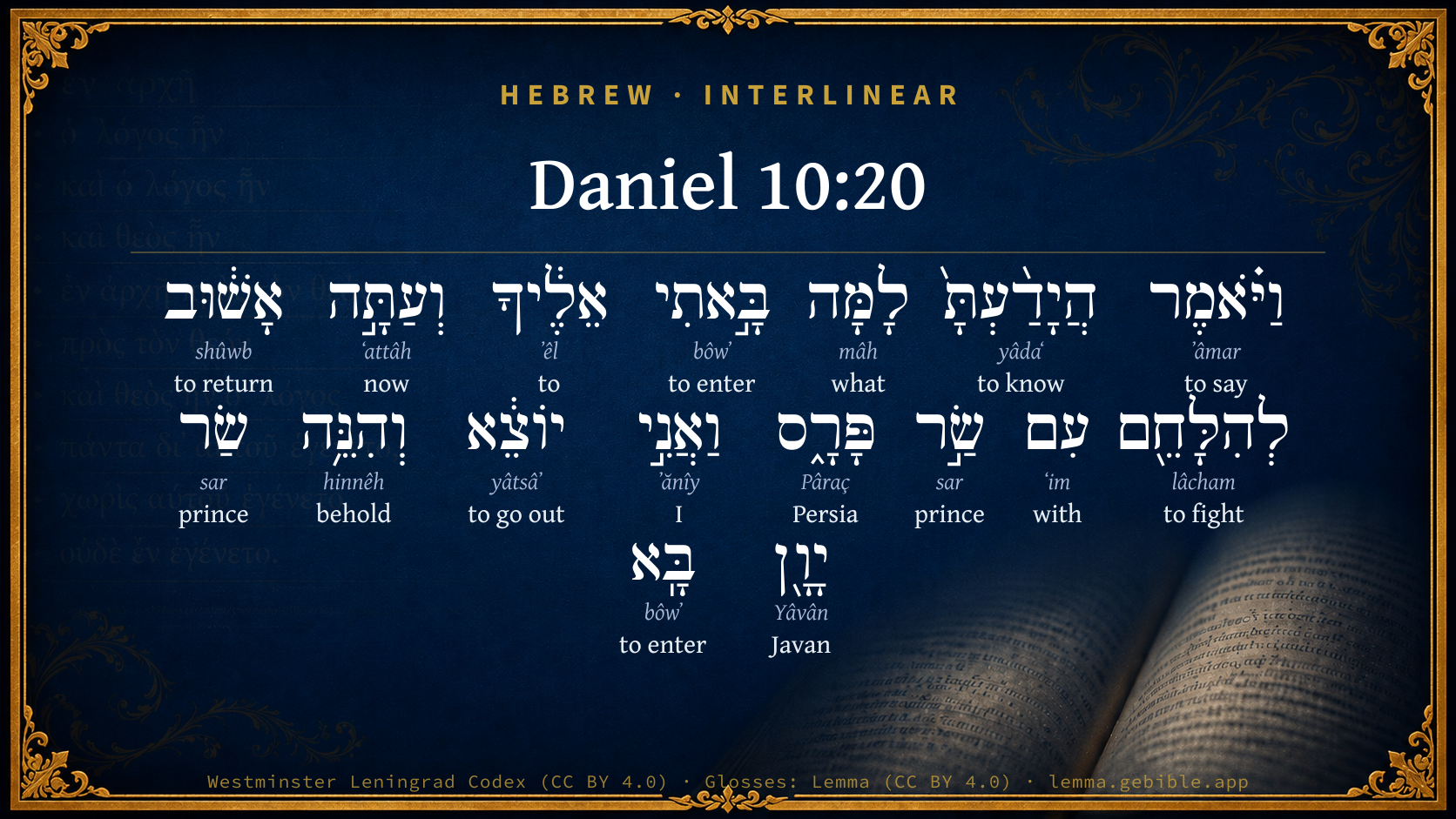
Hebrew (Westminster Leningrad Codex) Daniel 10:20 appears in the Hebrew Old Testament. The text above is from the Westminster Leningrad Codex. Each word links to its Strong’s number, a concise gloss, and parsing drawn from the Open Scriptures Hebrew Bible morphology. Click any word for its full Brown-Driver-Briggs (BDB) entry.
Download image
Cite this verse

Daniel 10:20 (World English Bible). Public Domain. Lemma interlinear Bible study tool, https://lemma.gebible.app/v/daniel/10/20.

Show BibTeX & RIS
BibTeX
RIS
English Translation
Then he said, "Do you know why I have come to you? Now I will return to fight with the prince of Persia. When I go forth, behold, the prince of Greece shall come.
World English Bible · Public Domain
Download a study sheet

One document with this verse’s original text, its word-by-word gloss line, the meaning frame, cross-references with their text, attributed commentary, and full source and license credits — printable, and it pastes into notes with its structure intact.

This verse Autodidact and up

Study sheet (.html) Plain text (.txt)

A passage Seminary Student

Up to 50 verses in one chapter. A passage sheet keeps up to 6 commentary sources and 12 cross-references per verse, in the order this page ranks them, and says so on the sheet whenever that leaves anything out. Ask for a single verse and you get the Autodidact verse sheet above.

Everything on this page stays free to read, with no account — the sheet is a download of what is already on screen, not access to it.

Want to remove ads? Support Godless Engineer
Compare translations 3

The same verse in 3 English versions, stacked beneath the original-language interlinear above. Click any original word for its lexicon entry.

Each is an independent rendering of the whole verse — the interlinear is not word-aligned to these translations.

Highlighted words mark where these versions differ — a whole-verse word diff, not a word-by-word alignment.

  • World English Bible Public Domain
    Then he said, "Do you know why I have come to you? Now I will return to fight with the prince of Persia. When I go forth, behold, the prince of Greece shall come.
  • King James Version Public Domain
    Then said he, Knowest thou wherefore I come unto thee? and now will I return to fight with the prince of Persia: and when I am gone forth, lo, the prince of Grecia shall come.
  • unfoldingWord Literal Text CC BY-SA 4.0
    Then he said, “Do you know why I have come to you? But now I will return to fight against the prince of Persia. When I go out, behold, the prince of Greece will come.

unfoldingWord Literal Text — © unfoldingWord, licensed CC BY-SA 4.0. Word-aligned USFM3 via Door43 (git.door43.org/unfoldingWord/en_ult).

Versions to compare (up to 4)

3 of 4 selected

Show all 18 translations

Every available English version of this verse, each an independent rendering of the whole verse.

  • World English Bible Public Domain
    Then he said, "Do you know why I have come to you? Now I will return to fight with the prince of Persia. When I go forth, behold, the prince of Greece shall come.
  • Berean Standard Bible Public Domain
    “Do you know why I have come to you?” he said. “I must return at once to fight against the prince of Persia, and when I have gone forth, behold, the prince of Greece will come.
  • Majority Standard Bible Public Domain
    “Do you know why I have come to you?” he said. “I must return at once to fight against the prince of Persia, and when I have gone forth, behold, the prince of Greece will come.
  • King James Version Public Domain
    Then said he, Knowest thou wherefore I come unto thee? and now will I return to fight with the prince of Persia: and when I am gone forth, lo, the prince of Grecia shall come.
  • American Standard Version (1901) Public Domain
    Then said he, Knowest thou wherefore I am come unto thee? and now will I return to fight with the prince of Persia: and when I go forth, lo, the prince of Greece shall come.
  • Revised Version (1885) Public Domain
    Then said he, Knowest thou wherefore I am come unto thee? and now will I return to fight with the prince of Persia: and when I go forth, lo, the prince of Greece shall come.
  • Geneva Bible (1599) Public Domain
    Then saide he, Knowest thou wherefore I am come vnto thee? but nowe will I returne to fight with the prince of Persia: and when I am gone forth, loe, the prince of Grecia shall come.
  • Douay-Rheims (1899) Public Domain
    And he said: Dost thou know wherefore I am come to thee? and now I will return, to fight against the prince of the Persians. When I went forth, there appeared the prince of the Greeks coming.
  • Young's Literal Translation Public Domain
    And he saith, Hast thou known why I have come unto thee? and now I turn back to fight with the head of Persia; yea, I am going forth, and lo, the head of Javan hath come;
  • Literal Standard Version CC BY-SA 4.0
    And he says, Have you known why I have come to you? And now I return to fight with the head of Persia; indeed, I am going forth, and behold, the head of Javan has come;
  • Unlocked Literal Bible CC BY-SA 4.0
    He said, “Do you know why I have come to you? I will soon return to fight against the prince of Persia. When I go, the prince of Greece will come.
  • unfoldingWord Literal Text CC BY-SA 4.0
    Then he said, “Do you know why I have come to you? But now I will return to fight against the prince of Persia. When I go out, behold, the prince of Greece will come.
  • Darby Bible Public Domain
    And he said, Knowest thou wherefore I am come unto thee? And now I return to fight with the prince of Persia; and when I go forth, behold, the prince of Greece shall come.
  • World Messianic Bible Public Domain
    Then he said, “Do you know why I have come to you? Now I will return to fight with the prince of Persia. When I go out, behold, the prince of Greece will come.
  • Webster's Bible Public Domain
    \\10:21\\But I will show thee that which is noted in the scripture of truth: and there is none that holdeth with me in these things, but Michael your prince.
  • Free Bible Version CC BY-SA 4.0
    “Do you know why I've come to you?” he asked. “Shortly I will have to go back and fight the prince of Persia, and after that the prince of Greece will come.
  • Bible in Basic English Public Domain
    But I am going back to make war with the angel of Persia, and when I am gone, the angel of Greece will come. And there is no one on my side against these, but Michael, your angel.
  • JPS Tanakh (1917) Public Domain
    Then said he: Knowest thou wherefore I come unto thee? and now will I return to fight with the prince of Persia; and when I go forth, lo, the prince of Greece shall come.

Literal Standard Version (2020), Covenant Press — licensed CC BY-SA 4.0. Text via the HelloAO Bible API (eBible.org). Unlocked Literal Bible (unfoldingWord) — licensed CC BY-SA 4.0. Text via the HelloAO Bible API (eBible.org). unfoldingWord Literal Text — © unfoldingWord, licensed CC BY-SA 4.0. Word-aligned USFM3 via Door43 (git.door43.org/unfoldingWord/en_ult). Free Bible Version, Dr. Jonathan Gallagher — licensed CC BY-SA 4.0. Text via the HelloAO Bible API (eBible.org).

Word by word

More ways to search: Search by grammar → Find every occurrence → Compare this word →

Practice this passage: Drill this verse → Learn its vocabulary →

יָוָ֖ן
Yâvân
H3120
“Javan”
Noun, Proper
Part of Speech
Noun
Type
Proper
Full BDB Definition

Origin: probably from the same as H3196

TWOT: 855

Javan = "Ionia" or " Greece" - a son of Japheth and grandson of Noah (noun proper masculine) - Greece, Ionia, Ionians (noun proper locative) - location of descendants of Javan
  1. וַיֹּ֗אמֶר ʼâmar H559 “and · to say” Conjunction + Verb, Qal, Sequential Imperfect, 3rd Person, Masculine, Singular
  2. הֲיָדַ֨עְתָּ֙ yâdaʻ H3045 “to know” Particle, Interrogative + Verb, Qal, Perfect, 2nd Person, Masculine, Singular
  3. לָמָּה mâh H4100 “to/for · what” Preposition + Particle, Interrogative
  4. בָּ֣אתִי bôwʼ H935 “to enter” Verb, Qal, Perfect, 1st Person, Common, Singular
  5. אֵלֶ֔יךָ ʼêl H413 “to · you” Preposition + Suffix, Personal, 2nd Person, Masculine, Singular
  6. וְעַתָּ֣ה ʻattâh H6258 “and · now” Conjunction + Adverb
  7. אָשׁ֔וּב shûwb H7725 “to return” Verb, Qal, Imperfect, 1st Person, Common, Singular
  8. לְהִלָּחֵ֖ם lâcham H3898 “to fight” Preposition + Verb, Niphal, Infinitive Construct
  9. עִם ʻim H5973 “with” Preposition
  10. שַׂ֣ר sar H8269 “prince of” Noun, Common, Masculine, Singular, Construct
  11. פָּרָ֑ס Pâraç H6539 “Persia” Noun, Proper
  12. וַאֲנִ֣י ʼănîy H589 “and · I” Conjunction + Pronoun, Personal, 1st Person, Common, Singular
  13. יוֹצֵ֔א yâtsâʼ H3318 “going out” Verb, Qal, Participle Active, Masculine, Singular, Absolute
  14. וְהִנֵּ֥ה hinnêh H2009 “and · behold” Conjunction + Particle, Demonstrative
  15. שַׂר sar H8269 “prince of” Noun, Common, Masculine, Singular, Construct
  16. בָּֽא bôwʼ H935 “entering” Verb, Qal, Participle Active, Masculine, Singular, Absolute

About this verse

These counts appear in no published source. They are computed here, from the morphology-tagged text and Lemma’s own curated glosses. What Lemma adds →

17
words
15
distinct lemmas
Prophets
section

Notable vocabulary

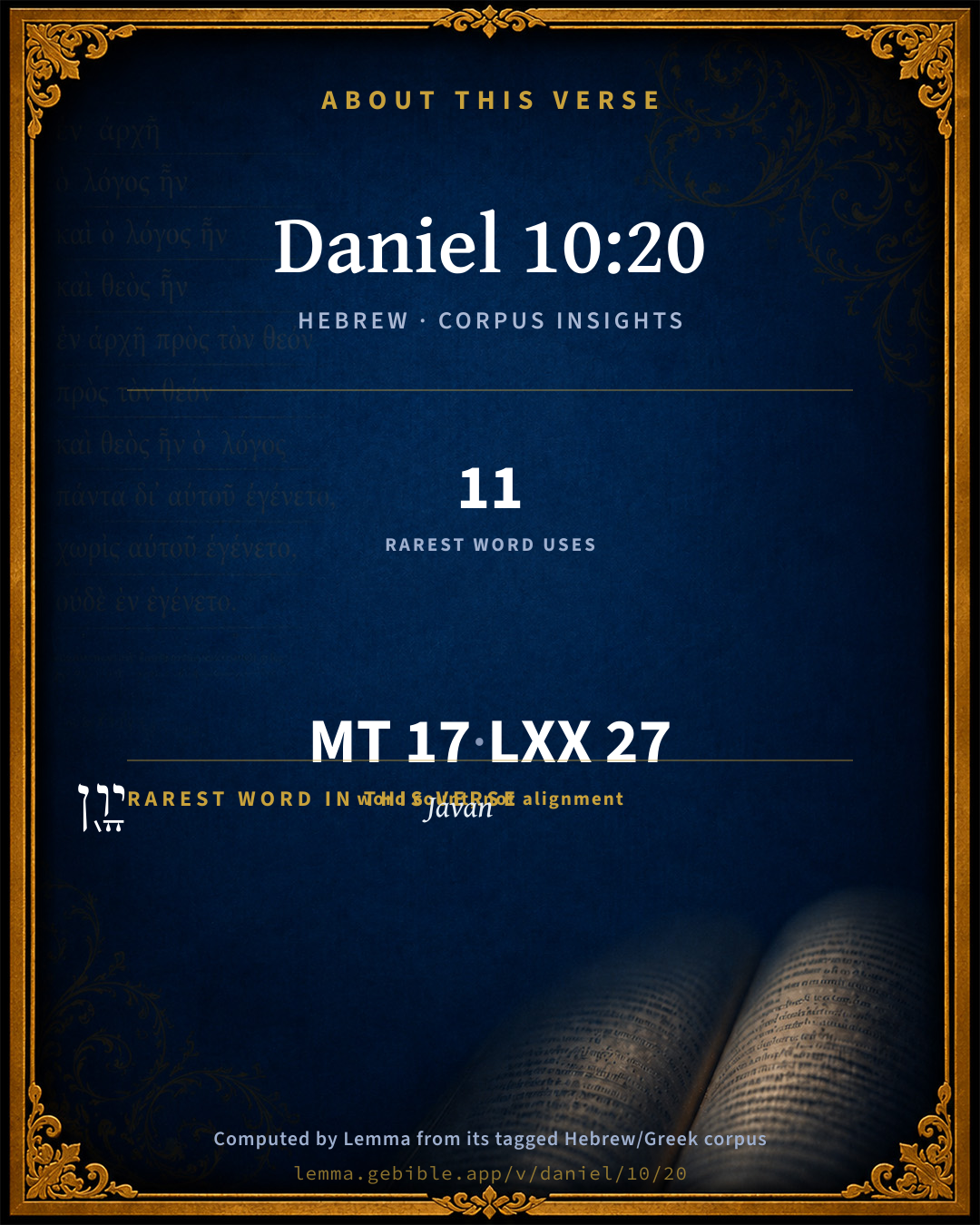
The rarest word here is יָוָ֖ן Javan H3120 — appearing just 11 times in the whole Hebrew Bible.

Shared distinctive vocabulary

יָוָ֖ן Javan H3120 occurs in 11 verses of the Hebrew Bible. Also found in:

Grammatical profile

  • 7 verbs
  • 4 nouns
  • 1 pronoun
  • 2 prepositions
  • 1 adverb
  • 2 particles

Verb forms

  • וַיֹּ֗אמֶר Qal · Sequential Imperfect
  • הֲיָדַ֨עְתָּ֙ Qal · Perfect
  • בָּ֣אתִי Qal · Perfect
  • אָשׁ֔וּב Qal · Imperfect
  • לְהִלָּחֵ֖ם Niphal · Infinitive Construct
  • יוֹצֵ֔א Qal · Participle Active
  • בָּֽא Qal · Participle Active

Repetition

Words recur within this verse — often emphatic in Hebrew:

  • בָּ֣אתִי to enter H935 ×2
  • שַׂ֣ר prince H8269 ×2

Hebrew & Septuagint length

In English translation the verse runs 34 words from the Hebrew and 36 from the Septuagint (LXX English) — closely comparable.

A rough comparison of the two English renderings, which tokenize alike — not a word-level alignment.

Word counts can differ between the Hebrew and the Greek without any difference in meaning — e.g. the Hebrew direct-object marker אֵת has no separate Greek word, and Greek often adds the article ὁ.

In the original languages it is 17 Hebrew tokens and 27 Greek tokens — but the two are counted differently (Hebrew bundles its prefixes and suffixes into one token; the Greek is in lemma form), so that isn’t a like-for-like length.

Cross-references

7

Topical passages linked to Daniel 10:20 in the Treasury of Scripture Knowledge — connected by theme and wording, ordered by reader-vote popularity; previews shown in the World English Bible.

  • Daniel 8:21 The rough male goat is the king of Greece: and the great horn that is between his eyes is the first king.
  • Daniel 8:5–8 As I was considering, behold, a male goat came from the west over the surface of the whole earth, and didn't touch the ground: and the goat had a notable horn between his eyes.
  • Daniel 11:2–4 Now will I show you the truth. Behold, there shall stand up yet three kings in Persia; and the fourth shall be far richer than they all: and when he has grown strong through his riches, he shall stir up all against the realm of Greece.
  • Isaiah 37:36 The angel of Yahweh went forth, and struck in the camp of the Assyrians one hundred and eighty-five thousand; and when men arose early in the morning, behold, these were all dead bodies.
  • Daniel 7:6 After this I saw, and, behold, another, like a leopard, which had on its back four wings of a bird; the animal had also four heads; and dominion was given to it.
  • Daniel 10:13 But the prince of the kingdom of Persia withstood me twenty-one days; but, behold, Michael, one of the chief princes, came to help me: and I remained there with the kings of Persia.
  • Acts 12:23 Immediately an angel of the Lord struck him, because he didn't give God the glory, and he was eaten by worms and died.

Cross-references courtesy of OpenBible.info (CC BY 4.0).

Hebrew and Greek witnesses Masoretic Hebrew ↔ Greek Septuagint

The same verse in the two great witnesses to the Old Testament, shown verse-for-verse.

These are two independent witnesses, not word-aligned to each other, and the Septuagint is shown in lemma (dictionary) form.

Hebrew Daniel 10:20 Masoretic · Westminster Leningrad Codex

וַיֹּ֗אמֶר הֲיָדַ֨עְתָּ֙ לָמָּה בָּ֣אתִי אֵלֶ֔יךָ וְעַתָּ֣ה אָשׁ֔וּב לְהִלָּחֵ֖ם עִם שַׂ֣ר פָּרָ֑ס וַאֲנִ֣י יוֹצֵ֔א וְהִנֵּ֥ה שַׂר יָוָ֖ן בָּֽא

Then he said, "Do you know why I have come to you? Now I will return to fight with the prince of Persia. When I go forth, behold, the prince of Greece shall come.

World English Bible · Public Domain

Greek LXX Daniel 10:20 Septuagint · lemma form

καί εἶπον πρός ἐγώ γιγνώσκω τίς ἔρχομαι πρός σύ καί νῦν ἐπιστρέφω διαμάχομαι μετά ὁ στρατηγός βασιλεύς ὁ πέρσης καί ἐγώ ἐκπορεύομαι καί ἰδού στρατηγός ἕλλην εἰςπορεύομαι

And he said, Know you, therefore I am come to you? and now I will return to fight with the prince of the Persians: and I was going in, and the prince of the Greeks came.

LXX2012 (modern English Septuagint) · Public Domain

Hebrew: Westminster Leningrad Codex (CC BY 4.0). Greek: Septuagint (public domain); English from LXX2012 (modern English Septuagint) (Public Domain). How the Septuagint differs from the Hebrew →

Commentary

Notes on Daniel 10:20 from classic Christian and Jewish commentators (each source and its license shown beneath its notes). The classic Christian expositions comment on the surrounding passage and are grouped to its opening verse, so a note may address several verses; the Jewish commentaries on the Tanakh (Rashi and others) are per-verse, so they appear only where the commentator wrote on this verse.

Lemma curates 59 commentaries, every one of them public domain or Creative Commons licensed, each selected and text-cleaned for this edition rather than reprinted as found. About our sources →

Trapp's Complete Commentary

John Trapp

Dan 10:20 Then said he, Knowest thou wherefore I come unto thee? and now will I return to fight with the prince of Persia: and when I am gone forth, lo, the prince of Grecia shall come.

Ver. 20. Knowest thou wherefore I come unto thee?] q.d., I told thee that before, {Dan 10:14} and I look thou shouldst remember it.

I will return to fight with the prince of Persia.] To defeat and prevent his tyranny and cruel intents against thy people, {see Dan 10:13} not without the devil’s hand and help.

And when I am gone forth,] sc., Out of Persia.

Lo, the prince of Grecia.] Great Alexander, whom I will fetch in, so that the Persians shall have henceforth little leisure or mind to meddle with the Jews. There were other Grecian captains also before Alexander, who found the Persians somewhat to do, as Leonidas, Miltiades, Themistocles; but he overturned their monarchy.

John Trapp, A Commentary or Exposition upon All the Books of the Old and New Testament (1647–1656) — public domain. Text from a community e-Sword module.

Joseph Benson's Commentary

Dan 10:20. Knowest thou wherefore I come unto thee? — Or, Thou knowest for what cause I am come, &c. “The angel, having strengthened the prophet, presumes that he also understood the general design of his errand. The Greek is, Ει οιδας, Surely thou knowest, according to a usual Hebrew idiom. And now will I return to fight with the prince of Persia — With the evil angel, who, under “the god of this world,” presides over Persia; or rather, with the present ruling prince of Persia, whether Cambyses or any other person then intrusted with the chief power, whose designs against the Jews this angel was employed in counteracting, and would continue to counteract, as also those of every future prince of that kingdom, till it should be overturned by the Greeks. And when I am gone forth — Hebrew, ואני יוצא, and I going forth, namely, to execute my commission; or, when I am gone forth, having executed it, and their monarchy is brought down for their unkindness to the Jews, lo, the prince of Grecia shall come — The Macedonian empire, under Alexander the Great and his successors, shall be established in Asia; and though favourable to the Jews at first, as the Persian was, yet will afterward become vexatious to them. “Such is the state of the church militant; when it has got clear of one enemy, it has another to encounter; and such a hydra’s head is that of the old serpent; when one storm is blown over, it is not long before another rises.” — Henry.

Joseph Benson's Commentary on the Old and New Testaments (1811–1818) — public domain. Text from a community e-Sword module.

Keil & Delitzsch

C. F. Keil & F. Delitzsch

But before he communicated to Daniel what would befall his people in the "latter days" (Dan 10:14), he gives to him yet further disclosures regarding the proceedings in the spirit-kingdom which determine the fate of nations, and contain for Israel, in the times of persecution awaiting them, the comforting certainty that they had in the Angel of the Lord and in the guardian angel Michael a strong protection against the enmities of the heathen world. Kliefoth supposes that the angel who speaks in v. 20 - Daniel 11:1 gives a brief resum of the contents of his previous statement (Dan 10:12-14). But it is not so. These verses, 10:20-11:1, contain new disclosures not yet made known in Dan 11:12-19, although resembling the contents of Dan 10:13. Of the coming of the prince of Javan (v. 20b), and the help which the angel-prince renders to Darius (Dan 11:1), nothing is said in Dan 10:13; also what the Angel of the Lord, Dan 10:20, says regarding the conflict with the prince of Persia is different from that which is said in Dan 10:13. In Dan 10:13 he speaks of that which he has done before his coming to Daniel; in Dan 10:20, of that which he will now do. To the question, "Knowest thou wherefore I come unto thee?" no answer follows; it has, however, an affirmative sense, and is only an animated mode of address to remind Daniel of that which is said in Dan 10:12-14, and to impress it upon him as weighty and worthy of consideration. Then follows the new communication: "and now will I return to fight with the prince of Persia," i.e., to carry forward and bring to an end the victory gained for thee before my arrival over the demon of Persia, the spirit of the Persian kingdom.

The words which follow, 'וגו והנּה יוצא ואני (v. 20b, and when I am gone forth, lo, etc.), present some difficulty. The ואני in comparison with אשׁוּב (will I return) points to a contrast, and והנּה plainly indicates that which shall begin with the יוצא אני. By this, the union of the יוצא ואני with that which goes before and the adversative interpretation of והנּה (v. Leng.) is excluded. But יוצא is interpreted differently. Hvernick, Maurer, and others understand it of going forth to war; only we must not then think (with Maurer) of the war against the prince of Persia. "For he will do that even now (in the third year of Cyrus), and at this time the coming of the prince of Grecia has no meaning" (Hitzig). Hofmann and Hitzig understand, therefore, יוצא, in contrast to בּא, of a going forth from the conflict, as in Kg2 11:7 "they shall go forth on the Sabbath" is placed over against "that enter in on the Sabbath" in Kg2 11:5; but in an entirely different sense. Hitzig thus renders the clause: "when I have done with the Persians, and am on the point of departing, then shall the king of Grecia rise up against me." יון must then be the Seleucidan kingdom, and the שׂר the guardian spirit of Egypt - suppositions which need no refutation, while the interpretation of the words themselves fails by the arbitrary interpolation "against me" after בּא. According to Hofmann, the angel says that "he had to return and contend further with the prince of the people of Persia; and that when he has retired from this conflict, then shall the prince of the Grecian people come, compelling him to enter on a new war." This last clause Hofmann thus more fully illustrates: "Into the conflict with the prince of the people of Persia, which the angel retires from, the prince of the Grecian people enters, and against him he resumes it after that the Persian kingdom has fallen, and is then also helped by Michael, the prince of the Jewish people, in this war against the prince of Grecia, as he had been in the war against the prince of Persia" (Schriftbew. i. pp. 333, 334f.). But Hitzig and Kliefoth have, in opposition to this, referred to the incongruity which lies in the thought that the prince of Javan shall enter into the war of the angel against the Persians, and assume and carry it forward. The angel fights against the demon of Persia, not to destroy the Persians, but to influence the Persian king in favour of the people of God; on the contrary, the prince of Javan comes to destroy the Persian king. According to this, we cannot say that the prince of Javan enters into the place of the angel in the war. "The Grecians and the Persians much rather stand," as Hitzig rightly remarks, "on one side, and are adversaries of Michael and our שׂר," i.e., of the angel who spake to Daniel. Add to this, that although יצא, to go out, means also to go away, to go off, yet the meaning to go away from the conflict, to abandon it, is not confirmed: much rather יצא, sensu militari, always denotes only "to go out, forth, into the conflict;" cf. Sa1 8:20; Sa1 23:15; Ch1 20:1; Job 39:21, etc. We have to take the word in this signification here (with C. B. Michaelis, Klief., and Kran.), only we must not, with Kranichfeld, supply the clause, "to another more extensive conflict," because this supplement is arbitrary, but rather, with Kliefoth, interpret the word generally as it stands of the going out of the angel to fight for the people of God, without excluding the war with the prince of Persia, or limiting it to this war. Thus the following will be the meaning of the passage: Now shall I return to resume and continue the war with the prince of Persia, to maintain the position gained (Dan 10:13) beside the kings of Persia; but when (while) I thus go forth to war, i.e., while I carry on this conflict, lo, the prince of Javan shall come (הנּה with the partic. בּא of the future) - then shall there be a new conflict. This last thought is not, it is true, expressly uttered, but it appears from Dan 10:21. The warring with the prince, i.e., the spirit of Persia hostile to Israel, refers to the oppositions which the Jews would encounter in the hindrances put in the way of their building the temple from the time of Cyrus to the time of Darius Hystaspes, and further under Xerxes and Artaxerxes till the rebuilding of the walls of Jerusalem by Nehemiah, as well as at a later time on the side of the Persian world-power, in the midst of all which difficulties the Angel of the Lord promises to guide the affairs of His people. יון שׂר is the spirit of the Macedonian world-kingdom, which would arise and show as great hostility as did the spirit of Persia against the people of God.

Keil & Delitzsch — Biblical Commentary on the Old Testament (1861–1891) — public domain (CC PDM 1.0). Text via the HelloAO Bible API. (Old Testament only.)

Tyndale Open Study Notes

Tyndale Open Resources

10:20 The messenger described empires in terms of the spirit prince representing each of them. The Persian Empire had just begun and would later be replaced by the Greek Empire (cp. 8:3-7, 19-21).

Tyndale Open Study Notes — © Tyndale Open Resources, licensed CC BY-SA 4.0. Text via the HelloAO Bible API.

Geneva Bible (1599)

Geneva Bible translators

Meaning, that he would not only himself bridle the rage of Cambyses, but also the other Kings of Persia by Alexander the King of Macedonia.

Geneva Bible (1599) marginal notes — public domain. Text via Bolls.life.

Jamieson, Fausset & Brown

Robert Jamieson, A. R. Fausset & David Brown

Knowest thou wherefore--The angel asks, after Daniel had recovered from his fright, whether he has understood what was revealed (Dan 10:13). On Daniel, by his silence, intimating that he did understand, the angel declares he will return to renew the fight with the evil angel, the prince of Persia. This points to new difficulties to the Jews' restoration which would arise in the Persian court, but which would be counteracted by God, through the ministry of angels.

prince of Grecia shall come--Alexander the Great, who conquered Persia, and favored the Jews [CALVIN]. Rather, as the prince of Persia is an angel, representing the hostile world power, so the prince of Grecia is a fresh angelic adversary, representing Greece. When I am gone forth from conquering the Persian foe, a fresh one starts up, namely, the world power that succeeds Persia, Greece; Antiochus Epiphanes, and his antitype Antichrist, but him, too, with the help of Michael, Israel's champion, I shall overcome [GEJER].

Jamieson, Fausset & Brown — Commentary Critical and Explanatory on the Whole Bible (1871) — public domain (CC PDM 1.0). Text via the HelloAO Bible API.

Adam Clarke's Commentary

Verse 20. Knowest thou wherefore I come] So high art thou in the favour of God, that he hath sent me unto thee to give thee farther satisfaction; though I was elsewhere employed upon a most important mission, and I must speedily return to accomplish it, viz.: -

To fight with the king of Persia] To remove all the scruples of Cyrus, and to excite him to do all that God designs him to do for the restoration of my people, and the rebuilding of the city and temple of Jerusalem. Nothing less than a supernatural agency in the mind of Cyrus can account for his decree in favour of the Jews. He had no natural, no political inclination to it; and his reluctance to obey the heavenly motions is here represented as a fight between him and the angel.

The prince of Grecia shall come.] I believe this refers to Alexander the Great, who was to destroy the Persian empire. See the second and third verses of the following chapter. See Clarke on Da 11:2; "Da 11:3".

Adam Clarke's Commentary on the Bible (1810–1826) — public domain. Text from a community e-Sword/MySword module.

John Calvin's Commentaries

The angel appears here to lead the Prophet in vain through a winding course; for he might directly and simply have told him why he had come. It was necessary to recall the Prophet to his senses, as he was at one time scarcely master of his actions. He was not indeed permanently injured in his mind, but the disturbance of feeling through which he had passed had temporarily disarranged the calmness of his thoughts. This event both occurred and is narrated for our advantage. This is the reason why the angel again uses this preface, Dost thee know? as if he wished to gather together the Prophet’s senses which were formerly wandering and dispersed. He urges him to pay great attention. And now, says he, I will return; that is, after I shall have explained to thee what thou wilt afterwards hear, I will return again to contend with the prince of the Persians. Here the angel indicates the reason for the delay of his mission, not because God neglected the groans and prayers of his Prophet, but the fit time had not yet arrived. The angel had formerly stated how the Persian prince had stood before him; meaning, he detained me, and I was obliged to enter into conflict with him, for his cruelty to the people had become far more formidable and insolent. This is the account which he gives of his occupation. But he now adds, I will return to fight with the prince of the Persians; implying, God sent me purposely to unfold to thee future occurrences, but you now know how far I was from being at leisure or shall be hereafter. I now come to be God’s witness and herald of his good will towards thyself and thy people. In reality, I am the defender of thy safety, since I have constantly to fight for thee with the prince of the Persians. He means Cambyses. I follow my former interpretation of an engagement between the angel and the king of Persia, whom wicked men had stimulated to cruelty; for he had revoked the edict of his father. The angel resisted the king’s fury, who was naturally very turbulent, and profane writers have described his character in a similar way.

He now adds, I will go to fight against the prince of the Persians; for עם, gnem, has the force of “against” here and in many other passages. He next adds, And when I shall depart, that is, when I am gone, the prince of Greece shall approach, says he; that is, God shall exercise him in another way. He does not mean this to refer to Cambyses, but to other Persian kings, as we shall state in the proper place. It is quite correct to suppose the king of Macedon to have arrived by God’s permission; but the angel simply means to state the existence of various methods by which God hinders the cruelty of kings whenever they attempt to injure his people. He shall send the prince of the Greeks, says he. God, therefore, thus restrained Cambyses by the angel’s assistance, and then he protected his people from the cruelty exercised by Alexander, king of Macedon. God is always providing for the safety of his people, and always has a variety of methods in operation. The angel desired to teach us this with all simplicity. At length he adds: —

John Calvin's Commentaries (1540-1563) — public domain. Text from the Calvin Translation Society English edition (1840s-50s) via the Christian Classics Ethereal Library (ccel.org). Calvin's coverage is partial (roughly two-thirds of the Bible); uncommented books and verses are honest gaps, never fabricated. The 19th-century editor's footnotes and remarks are omitted so the notes are faithfully Calvin's own voice.

Ellicott's Commentary for English Readers

(20) Then said he.—The meaning of this verse is obscure. Apparently the person who is speaking refers back to what he had said (Dan_10:12-14); and from the question “Knowest thou?” &c., we are to infer that Daniel was perfectly aware of the reasons which caused him to come, viz., “to make thee understand what shall befal thy people in the latter days.” But before he proceeds to make this revelation, he prepares Daniel’s mind for a portion of what is about to be revealed, by mentioning the spiritual powers which ruled over Greece. “I shall return to fight,” referring to the Providence which watched over Israel during the Persian sovereignty; “but while I am gone forth” (the word being used in a military sense, as in Jos_14:11) “the prince of Javan will come,” this word being also used in a hostile sense. The prophet is in this manner prepared for troublous times, which shall occur under the Macedonian supremacy.

A Bible Commentary for English Readers, edited by Charles John Ellicott (1878–1897) — public domain. Text from a community e-Sword module.

The Cambridge Bible for Schools and Colleges

gen. ed. J. J. S. Perowne

20. Knowest thou, &c.] A rhetorical question, designed to recall to Daniel what had been said in Dan_10:12; Dan_10:14, and to indicate to him its importance.

and now will I return, &c.] to carry on and complete the successes begun in Dan_10:13. ‘Now’ must mean, as soon as possible, as soon as I have given thee this revelation (Dan_11:2 ff.): I cannot tarry here longer than is necessary, as I have still to contend in heaven against the enemies of Israel.

and when I go forth (viz. from the contest with the ‘prince’ of Persia), lo, the prince of Greece (Heb. Javan, as Dan_8:21) will come in] As soon as the conflict with Persia is ended, one with Greece will begin: ‘go forth’ and ‘come in,’ as 2Ki_11:5; 2Ki_11:7. It would be more in accordance with the usual sense of go forth in such a connexion as the present, to understand it of going forth to the contest with the prince of Persia (cf. of going forth on a military expedition, with to battle expressed, Deu_20:1; Deu_21:10; without it, Jdg_9:29, 2Sa_11:1; 2Sa_18:2 (end), 3, 6, 2Ki_9:21, &c.); but unless the future is greatly foreshortened, or ‘go forth’ is understood not of proceeding to, but of continuing in, the conflict (so Keil), this interpretation agrees hardly with the history; for the empire of Alexander and his successors did not arise till two centuries after the time of Cyrus.

The Cambridge Bible for Schools and Colleges (gen. ed. J. J. S. Perowne; Cambridge University Press, 1878–1918) — public domain. Text from a community e-Sword module.

John Gill's Exposition

Then said he, knowest thou wherefore I come unto thee?.... He had told him before, Dan 10:12, that it was on account of his prayers, and to bring an answer to them; and particularly to inform him what would befall his people in the latter day; and now, lest, through the hurry of his spirits, he had not observed it, or had forgot it, he reminds him of it, to stir up his desire the more after the knowledge of particulars, which he was now about to relate unto him: and now will I return to fight with the prince of Persia; the evil spirit, in the court of Persia, he had been contesting with before, and had got the better of by the help of Michael; but since this good angel had been with Daniel, the evil one had been working upon the king and counsellors of Persia, and had wrought them up to an indifference unto, or carelessness about, the affairs of the people of the Jews, and to listen to their adversaries, whereby the building of the city and temple went on heavily and slowly; and so things were, through the evil influence of Satan, more or less, until the twentieth year of Artaxerxes Longimanus: and, indeed, Satan was continually soliciting mischief against the Jews, and stirring up enemies to them in the court of Persia, as long as that monarchy lasted, though he had not always the wished for success; the times of Esther and Mordecai are a proof of this:

and when I am gone forth, lo, the prince of Grecia shall come; meaning, when he was gone forth from the court of Persia, having done his business he was sent about; confounded the schemes and baffled the designs of the evil spirit, conquered him, and obliged him to give way, and cease from being troublesome any more, and obtained peace and rest for the Jews, and settled their affairs: the Persian monarchy being translated to the Grecians, the evil spirit began to work among them, to put them on doing mischief to the people of God; as in Alexander himself, who set out against them, but was pacified by the meeting of the high priest; and more especially in his successors; and above all in Antiochus, who was a violent persecutor of them; which this clause, as well as the following prophecy, has a respect unto.

John Gill's Exposition of the Whole Bible (1746–1763) — public domain (CC PDM 1.0). Text via the HelloAO Bible API.

Albert Barnes' Notes on the Bible

Then said he, Knowest thou wherefore I come unto thee? - This was known by what the angel had said in Dan 10:14. He seems to have called his attention to it, and to have proposed the question, because Daniel had been so overcome by his fright that it might be doubtful whether he had understood him distinctly when he had told him the object of his coming. He therefore proposes the question here; and as the silence of Daniel seems to have been construed as a declaration that he did understand the purpose of the visit, he proceeds to unfold frilly the purport of his message.

And now will I return - That is, evidently, after he had made known to him the message which he came to deliver. He cannot mean that he would then leave Daniel, and return immediately to Persia, for he proceeds at length Dan. 11–12 to deliver his message to him, and to state what would occur in the world in future times.

To fight with the prince of Persia - In Dan 10:13, he says that he had had a contest with that “prince,” and that in consequence of that he had been delayed on his journey to Daniel. By the interposition of Michael, the affairs of Persia had been so arranged that the opposition to what was desired by Daniel had been in part removed - so far, at least, as to make it certain that Iris prayers would be answered. See the note at that verse. But still it would seem that the difficulty was not entirely overcome, and that it would be desirable for him to return, and to complete the arrangements which had been commenced. There were still causes in existence in Persia which might tend to frustrate all these plans unless they were counteracted, and his presence might still be necessary there to secure the safe return of the exiles to their own land, and the means required to rebuild the city and temple. The simple meaning of this is, that it would be necessary to exert a farther influence at the Persian court in order to bring about the object desired; and this fact is expressed in language derived from the belief that angelic beings, good and bad, have much to do in controlling the minds of men.

And when I am gone forth - literally, “and I go forth.” The meaning seems to be, that he would return to Persia, and would so direct affairs there that the welfare of the Jews would be promoted, and that protection would be extended to them. This, he says, he would continue as long as it was necessary, for when he should have gone forth, the king of Greece would come, and the affairs of Persia would be put on a new footing, but on such a footing as not to require his presence - for the government would be of itself favorable to the Jews. The sense is, that up to the time when this “king of Grecia” should come, there would be a state of things in the Persian court that would demand the presence of some being from heaven - exerting some constant influence to prevent an outbreak against the Jews, and to secure their peace and prosperity; but that when the “king of Grecia” should come, he would himself favor their cause, and render the presence of the angel unnecessary. No one can prove that this is not a correct representation, or that the favor shown to the Jews at the Persian court during all the time of the rebuilding of the city and the temple, was not to be traced to some presiding influence from above, or that that was not put forth in connection with the ministration of an angelic being. Indeed, it is in accordance with all the teachings of the Bible that the disposition of kings and princes to show favor to the people of God, like all else that is good in this world, is to be traced to an influence from above; and it is not contrary to any of the laws of analogy, or anything with which we are acquainted pertaining to the spiritual world, to suppose that angelic interposition may be employed in any case in bringing about what is good.

Lo, the prince of Grecia shall come - Hebrew - יון yâvân. There can be no doubt that Greece is intended. The word properly denotes Ionia (derived from this word), “the name of which province,” says Gesenius, “as being adjacent to the East, and better known, was extended so as to comprehend the whole of Greece, as is expressly said by Greek writers themselves.” - Lexicon By the “prince of Greece” here, there can be no doubt that there is reference to Alexander the Great, who conquered Persia. See Dan 11:1-4. The meaning here is, that when he should come, and conquer Persia, the opposition which the Hebrews had encountered from that country would cease, and there would then be no need of the interposition of the angel at the Persian court. The matter of fact was, that the Hebrews were favored by Alexander the Great, and that whatever there was in the Persian or Chaldean power which they had had reason to dread was then brought to an end, for all those Eastern governments were absorbed in the empire of Alexander - the Macedonian monarchy.

Albert Barnes' Notes on the Bible (1834–1885) — public domain. Text from a community e-Sword/MySword module.

Haydock's Catholic Bible Commentary

To thee? He awakens his attention (verse 14.) (Calmet) and gratitude. (Haydock) --- Prince, angel guardian; or Alexander, who would one day rout the Persians. (Chap. xi. 2.) (Calmet)

George Leo Haydock (1774–1849), Haydock's Catholic Family Bible and Commentary, 1859 edition — public domain. Excludes Psalms (Douay-Rheims chapter numbering differs from Protestant) and Deuterocanonical books (Catholic canon only).

Matthew Poole's English Annotations

Knowest thou wherefore I come unto thee? i.e. by what I have said already, and what I have further to tell thee upon thy prayers, which God hath accepted, and hath given me in charge to reveal to thee as followeth to the end.

To fight with the prince of Persia; Cyrus, or Cambyses, who by his counsels and captains hinder the work of God; and to bring the prince of Greece upon him, viz. Alexander the Great, who utterly ruined the Persian monarchy, which is ushered with the word

to, because it was a wonder that the prince of Greece with thirty thousand men should do it. Thus the Lord sets and disposeth the fates of empires, and changeth them as he lists; especially in his church’s quarrel.

Matthew Poole's English Annotations on the Holy Bible (1683–1685) — public domain. Text from a community e-Sword/MySword module.

Whedon's Commentary on the Bible

Daniel D. Whedon

20. Gabriel, “the angel of prophecy” (Ewald), recalls to the mind of the strengthened prophet that he had come for the sake of unveiling the future of Israel in answer to his prayer (note Dan_10:2; Dan_10:14), and adds that after giving this revelation he must return to do his part in carrying it out by continuing the fight with the “spirit” of Persia. (See note Dan_10:13.) Daniel is distinctly said to have received this vision during the Persian supremacy (Dan_10:1), and he is now told that the empire which shall follow the Persian will be the Grecian.

Daniel D. Whedon (gen. ed.), Commentary on the Old and New Testaments (1874–1909) — public domain. Text from a community e-Sword module.

The Pulpit Commentary

Then said he, Knowest thou wherefore I come unto thee? and now will I return to fight with the Prince of Persia: and when I am gone forth, lo, the Prince of Grecia shall come. The versions here are in close agreement with the Massoretic text. Theodetion, since he begins the speech of the angel with eij, may have read he (hayn), "if," instead of h (ha), the sign of interrogation. The Peshitta has, "to make war," instead of "fight," indicating a beginning of hostilities, not a continuance of them. Then said he, Knowest thou wherefore I come unto thee? This question appears to be abruptly put, and to be put without awaiting an answer. Probably the meaning would be better brought out by rendering, somewhat colloquially, "You know, don"t you? After I have revealed the future to you, I must return." In considering this whole subject, we must beware of taking everything literally. We may not deduce, because of the statement here, that angels are under the limitations of time and space, or that there is actual warfare. We must regard the matter as, to a large extent, figurative. And now will I return to fight with the Prince of Persia. Every one who studies history in a philosophic spirit must see that the progress of the race, the evolution of that ultimate ideal state the kingdom of heaven among men is accomplished by successive steps, and over each step a nationality presides. This nationality represents the special moment of spiritual force necessary to secure the new step the race is required to take. While in the lower plane of history the nations themselves do these things; in the higher sphere it is their angels who are the actors. A nation has in it much of the characteristics of a living organism, and the angel of the nation is the life of that organism. As a finite being, the angel of any nation of necessity is imperfect; his knowledge of the Divine plan only limited. His instrument the nation committed to his charge is yet more imperfect. Let an imperfect being, however holy, have a piece of work to do, that work must assume, to him, an exaggerated importance; let him be associated as patron with sentient beings, and his affections must go forth to these beings in a special way. He will resist any attempt to limit in any way the function of that race which is specially his, and will be apt to interpret too widely this function, and be loth to recognize that its time is past, or this or that region is beyond its province. If we regard Gabriel as an angel not of Egypt, as Hitzig, but of the kingdom of heaven, and by this the angel of prophecy (Ewald) then he must exercise a watchful care over the actions of each nationality, and therefore of its angel, lest the ultimate purpose of God be in any way hindered. The angel of Persia might regard the national semi-independence allowed to the Jews as hindering the evolution of the idea exhibited by the Persian race. The Persian rule allowed races a good deal of licence if tribute were paid. It was required to specialize its treatment of the Jews; to convey them back from Babylon to Palestine; to protect them in Palestine; to assist them to set up a quasi-independence. All this was contrary to the negative character of the Persian rule, in contradiction to its spirit, and therefore opposed by its angel, who represented this spirit. Michael, the special angel of the Jews, naturally came to assist Gabriel. What a conflict between angelic spirits may mean, what may be the weapons of their warfare, we know not; we do know that, though not carnal, they are mighty. And when I am gone forth. To this phrase several meanings have been attached. Havernick, Maurer, and Ewald take it as meaning "going forth to war." Ewald renders, "I will return to contend against the Prince of Persia; so, while I am going forth, the Prince of Javan will come." In this connection it is very doubtful whether axy (yatza") can mean "going forth to battle." Motion to the field of battle is indicated by "return." Yatza"simply means to go from a given place; the purpose may be indicated by some other word. Another view is that of Hitzig, Hofmann, and Bertheau, "to go out," not to, but from "a conflict." This meaning is possible; it would certainly need some determinant to fix this meaning on it, but this may be supplied from the preceding clause. This view, though suiting admirably with the otherwise untenable supposition that the "prince" speaking with Daniel is the angel of Egypt, does not suit with the view that Gabriel, the "prince" talking with Daniel, is the angel of prophecy, and therefore of the ideal kingdom. Keil would take the first meaning of yatza", and would paraphrase thus, "Now shall I return to resume and continue the war with the Prince of Persia; but while I thus go forth to war while I continue the conflict, the prince of Javan shall come, and then there shall be a new conflict." Yatza"never does mean "to continue a conflict;" it means to begin either a war, a battle, or a campaign. A great deal of the difficulty is due to maintaining that angels are under the time-relation of human beings. The matter is clearer if we take it as meaning simply that when Gabriel went out from the presence of Daniel, the "Prince of Grecia" would come. Lo, the Prince of Grecia shall come. This does not refer to Alexander the Great, or the overthrow of the Persian Empire, still less to the Seleucids and their persecutions. Before his Babylonian reign, Cyrus encountered the Greeks, and roused their opposition. The angel, then, of the Greek nation began to stir up his people. Then came the Ionian revolt, and the successive invasions of Greece, which compelled the Persians to leave the "holy people" alone. The angelic Prince of Grecia appears first as an instrument of the angel of prophecy, to limit the power of Persia. When, after prolonged conflicts, the empire of Persia gives place to that of Greece, the conflict of the people of God must be renewed in a fiercer form.

The Pulpit Commentary (1880–1919), ed. H.D.M. Spence-Jones & Joseph S. Exell — public domain. Text from a community e-Sword module.

John Wesley's Explanatory Notes

To fight - To oppose his mischievous designs.

John Wesley, Explanatory Notes Upon the Whole Bible (1754–1765) — public domain. Text via the GEBible commentary corpus.

unfoldingWord translationNotes

Door43 World Missions Community

the prince of Persia

Here "prince" refers to a spirit who rules and guards a human nation. See how you translated a similar phrase in Daniel 10:13. AT: "the spirit prince of Persia"

But I will tell you

This implies that the angel will tell Daniel about this immediately, before he goes away. AT: "But first I will tell you" (See: Assumed Knowledge and Implicit Information)

what is written in the Book of Truth

This can be stated in active form. AT: "what the Book of Truth says" or "what someone wrote in the Book of Truth" (See: Active or Passive)

who shows himself to be strong

"who proves himself to be strong"

There is no one who shows himself to be strong with me against them, except Michael your prince

"Michael your prince is the only one to show himself strong with me against them" or "Michael your prince is the only one who helps me against them"

Michael your prince

The word "your" is plural. It refers to Daniel and the rest of the people of Israel. AT: "Michael, the prince of your people" (See: Forms of You)

Michael your prince

"Michael your guardian angel." Translate "prince" when it refers to Michael as you did Daniel 10:13.

translationWords

prince

Persia

Greece

Michael

unfoldingWord translationNotes — © Distant Shores Media and the Door43 World Missions Community, licensed CC BY-SA 4.0. Source: git.door43.org/Door43/en_tn.

Rashi

Rabbi Shlomo Yitzchaki (Rashi)

And now I shall return to battle with the prince of Persia and I know that I will be victorious, but when the time of the kingdom of the heathens [Greece Malbim ed., Antiochus Vilna ed.] arrives, I know that I will leave, and he will enter after thirty-four years of the existence of the Temple. Alexander of Macedon will rise, for although Israel was subjugated by the kings of Persia in those days, they exacted a light tribute from them, and they did not burden them heavily because the Holy One, blessed be He, caused them to have mercy on them. But the kings of the heathens [Greece, Antiochus] laid a heavy yoke upon them.

Rashi on the Tanakh — English translations: “The Judaica Press complete Tanach with Rashi, translated by A. J. Rosenberg” (CC BY 4.0); “Pentateuch with Rashi's commentary by M. Rosenbaum and A.M. Silbermann, 1929-1934” (public domain); “The Metsudah Tanach series, Lakewood, N.J” (CC BY 4.0); and “The Book of Joshua, Metsudah Publications, 1997” (CC BY 4.0). Text via Sefaria.

Lesson kit

Teaching starters — assembled from the data on this page, not authored interpretation. Every prompt links to the verse data it draws on. Edit before teaching.

Daniel, in the Prophets, opens this verse with 17 words (15 distinct Hebrew lemmas). Its most distinctive word is Yâvân (“Javan”). A historical commentator’s framing appears above. Read the whole chapter for the surrounding context.

Discussion questions

  1. How does “Javan” (Yâvân) shape what this verse is saying?
  2. Genesis 10:2 shares the word «Javan» with this verse. How do the two illuminate each other?
  3. “to enter” occurs 2× in this one verse. What is the effect of the repetition?
  4. These translations render this verse differently; the difference is in the English rendering, not the original. What questions does that raise?
  5. The verb «וַיֹּ֗אמֶר» is Qal Sequential Imperfect. How does its form color the action?
  6. Reading how Trapp's Complete Commentary and Joseph Benson's Commentary read this verse, where do the two commentators agree and where do they part?

Things to notice

Reading settings

Reading text

Shown beneath each verse's original-language words.

Old Testament
Old Testament edition

Read the OT as the Masoretic Hebrew (MT) or the Greek Septuagint (LXX).

English shown for the Greek Septuagint (in the Hebrew ↔ Greek comparison).

Comparing translations? Open the Compare panel on any verse page to stack up to four side by side.