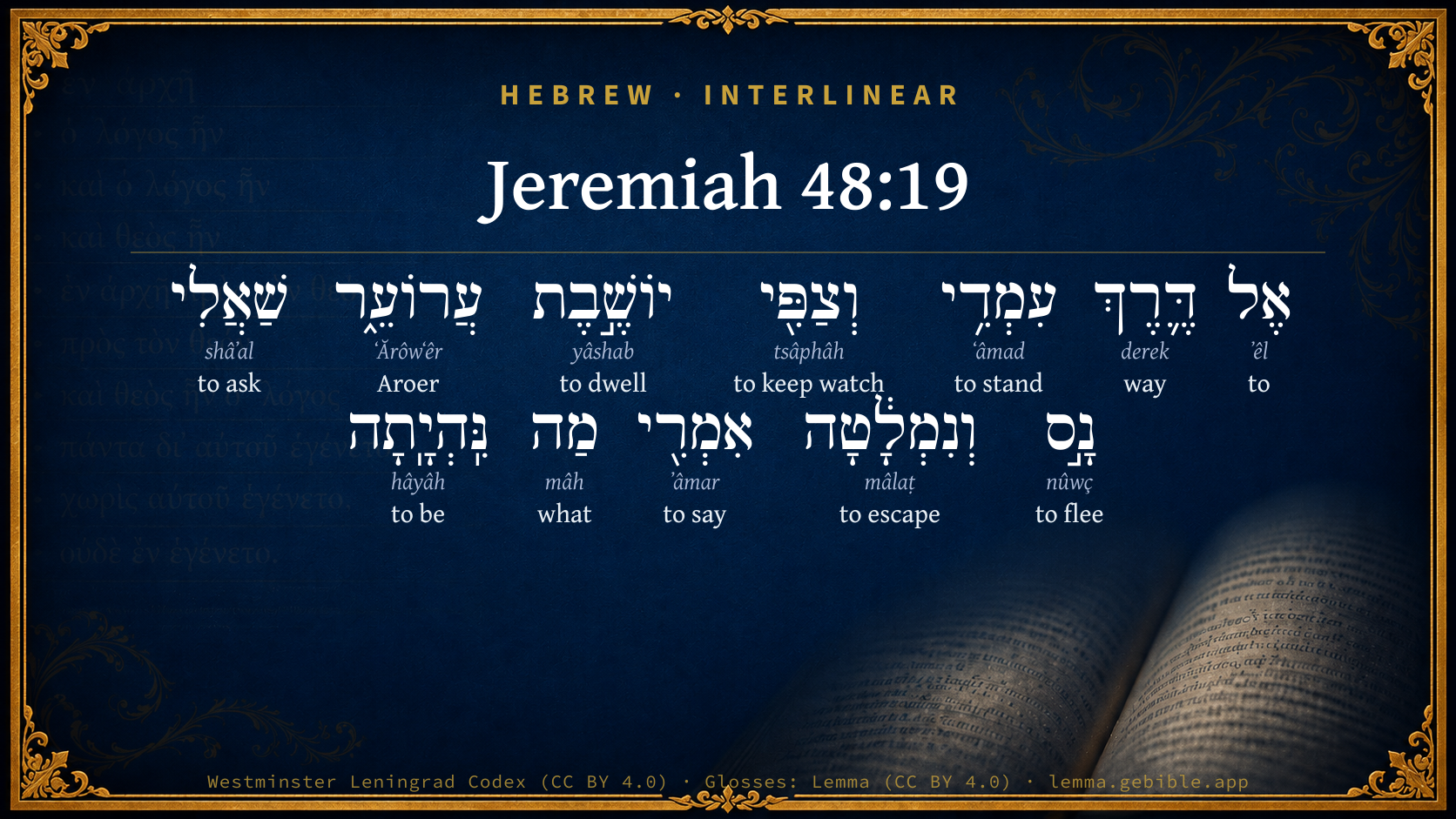
Jeremiah 48:19

Hebrew (Westminster Leningrad Codex) Jeremiah 48:19 appears in the Hebrew Old Testament. The text above is from the Westminster Leningrad Codex. Each word links to its Strong’s number, a concise gloss, and parsing drawn from the Open Scriptures Hebrew Bible morphology. Click any word for its full Brown-Driver-Briggs (BDB) entry.
Download image
Cite this verse

Jeremiah 48:19 (World English Bible). Public Domain. Lemma interlinear Bible study tool, https://lemma.gebible.app/v/jeremiah/48/19.

Show BibTeX & RIS
BibTeX
RIS
English Translation
Inhabitant of Aroer, stand by the way, and watch: ask him who flees, and her who escapes; say, What has been done?
World English Bible · Public Domain
Download a study sheet

One document with this verse’s original text, its word-by-word gloss line, the meaning frame, cross-references with their text, attributed commentary, and full source and license credits — printable, and it pastes into notes with its structure intact.

This verse Autodidact and up

Study sheet (.html) Plain text (.txt)

A passage Seminary Student

Up to 50 verses in one chapter. A passage sheet keeps up to 6 commentary sources and 12 cross-references per verse, in the order this page ranks them, and says so on the sheet whenever that leaves anything out. Ask for a single verse and you get the Autodidact verse sheet above.

Everything on this page stays free to read, with no account — the sheet is a download of what is already on screen, not access to it.

Want to remove ads? Support Godless Engineer
Compare translations 3

The same verse in 3 English versions, stacked beneath the original-language interlinear above. Click any original word for its lexicon entry.

Each is an independent rendering of the whole verse — the interlinear is not word-aligned to these translations.

Highlighted words mark where these versions differ — a whole-verse word diff, not a word-by-word alignment.

  • World English Bible Public Domain
    Inhabitant of Aroer, stand by the way, and watch: ask him who flees, and her who escapes; say, What has been done?
  • King James Version Public Domain
    O inhabitant of Aroer, stand by the way, and espy; ask him that fleeth, and her that escapeth, and say, What is done?
  • unfoldingWord Literal Text CC BY-SA 4.0
    Stand on the road and watch, you people who live in Aroer. Ask the ones who are fleeing and escaping. Say, ‘What has happened?’

unfoldingWord Literal Text — © unfoldingWord, licensed CC BY-SA 4.0. Word-aligned USFM3 via Door43 (git.door43.org/unfoldingWord/en_ult).

Versions to compare (up to 4)

3 of 4 selected

Show all 18 translations

Every available English version of this verse, each an independent rendering of the whole verse.

  • World English Bible Public Domain
    Inhabitant of Aroer, stand by the way, and watch: ask him who flees, and her who escapes; say, What has been done?
  • Berean Standard Bible Public Domain
    Stand by the road and watch, O dweller of Aroer! Ask the man fleeing or the woman escaping, ‘What has happened?’
  • Majority Standard Bible Public Domain
    Stand by the road and watch, O dweller of Aroer! Ask the man fleeing or the woman escaping, ‘What has happened?’
  • King James Version Public Domain
    O inhabitant of Aroer, stand by the way, and espy; ask him that fleeth, and her that escapeth, and say, What is done?
  • American Standard Version (1901) Public Domain
    O inhabitant of Aroer, stand by the way, and watch: ask him that fleeth, and her that escapeth; say, What hath been done?
  • Revised Version (1885) Public Domain
    O inhabitant of Aroer, stand by the way, and espy: ask him that fleeth, and her that escapeth; say, What hath been done?
  • Geneva Bible (1599) Public Domain
    Thou that dwellest in Aroer, stand by the way, and beholde: aske him that fleeth and that escapeth, and say, What is done?
  • Douay-Rheims (1899) Public Domain
    Stand in the way, and look out, O habitation of Aroer: inquire of him that fleeth: and say to him that hath escaped: What Is done?
  • Young's Literal Translation Public Domain
    On the way stand, and watch, O inhabitant of Aroer, Ask the fugitive and escaped, Say, What hath happened?
  • Literal Standard Version CC BY-SA 4.0
    Stand on the way, and watch, O inhabitant of Aroer, || Ask the fugitive and escaped, || Say, What has happened?
  • Unlocked Literal Bible CC BY-SA 4.0
    Stand on the road and watch, you people who live in Aroer. Ask the ones who are fleeing and escaping. Say, 'What has happened?'
  • unfoldingWord Literal Text CC BY-SA 4.0
    Stand on the road and watch, you people who live in Aroer. Ask the ones who are fleeing and escaping. Say, ‘What has happened?’
  • Darby Bible Public Domain
    Stand by the way, and watch, inhabitress of Aroer; ask him that fleeth, and her that escapeth; say, What is done?
  • World Messianic Bible Public Domain
    Inhabitant of Aroer, stand by the way and watch. Ask him who flees, and her who escapes; say, ‘What has been done?’
  • Webster's Bible Public Domain
    O inhabitant of Aroer, stand by the way, and espy; ask him that fleeth, and her that escapeth, and say, What is done?
  • Free Bible Version CC BY-SA 4.0
    Stand at the roadside and watch, you who live in Aroer. Ask the men and women who are running away to escape, “What's happened?”
  • Bible in Basic English Public Domain
    O daughter of Aroer, take your station by the way, on the watch: questioning him who is in flight, and her who has got away safe, say, What has been done?
  • JPS Tanakh (1917) Public Domain
    O inhabitant of Aroer, stand by the way, and watch; ask him that fleeth, and her that escapeth; say: 'What hath been done?'

Literal Standard Version (2020), Covenant Press — licensed CC BY-SA 4.0. Text via the HelloAO Bible API (eBible.org). Unlocked Literal Bible (unfoldingWord) — licensed CC BY-SA 4.0. Text via the HelloAO Bible API (eBible.org). unfoldingWord Literal Text — © unfoldingWord, licensed CC BY-SA 4.0. Word-aligned USFM3 via Door43 (git.door43.org/unfoldingWord/en_ult). Free Bible Version, Dr. Jonathan Gallagher — licensed CC BY-SA 4.0. Text via the HelloAO Bible API (eBible.org).

Word by word

More ways to search: Search by grammar → Find every occurrence → Compare this word →

Practice this passage: Drill this verse → Learn its vocabulary →

עֲרוֹעֵ֑ר
ʻĂrôwʻêr
H6177
“Aroer”
Noun, Proper
Part of Speech
Noun
Type
Proper
Full BDB Definition

Origin: the same as H6176

TWOT: None

Aroer = "ruins" - a city on the north bank of the river Arnon, the southern point of the territory of Sihon the king of the Amorites and later of Reuben; modern 'Arair' - a city in Ammon near the Jabbok belonging to Gad - a town in southern Judah
  1. אֶל ʼêl H413 “to” Preposition
  2. דֶּ֛רֶךְ derek H1870 “way” Noun, Common, Both, Singular, Absolute
  3. עִמְדִ֥י ʻâmad H5975 “stand” Verb, Qal, Imperative, 2nd Person, Feminine, Singular
  4. וְצַפִּ֖י tsâphâh H6822 “and · keep watch” Conjunction + Verb, Piel, Imperative, 2nd Person, Feminine, Singular
  5. יוֹשֶׁ֣בֶת yâshab H3427 “dwelling” Verb, Qal, Participle Active, Feminine, Singular, Construct
  6. שַׁאֲלִי shâʼal H7592 “ask” Verb, Qal, Imperative, 2nd Person, Feminine, Singular
  7. נָ֣ס nûwç H5127 “fleeing” Verb, Qal, Participle Active, Masculine, Singular, Absolute
  8. וְנִמְלָ֔טָה mâlaṭ H4422 “and · escaped” Conjunction + Verb, Niphal, Participle Passive, Feminine, Singular, Absolute
  9. אִמְרִ֖י ʼâmar H559 “say” Verb, Qal, Imperative, 2nd Person, Feminine, Singular
  10. מַה mâh H4100 “what” Particle, Interrogative
  11. נִּֽהְיָֽתָה hâyâh H1961 “to be” Verb, Niphal, Perfect, 3rd Person, Feminine, Singular

About this verse

These counts appear in no published source. They are computed here, from the morphology-tagged text and Lemma’s own curated glosses. What Lemma adds →

12
words
12
distinct lemmas
Prophets
section

Notable vocabulary

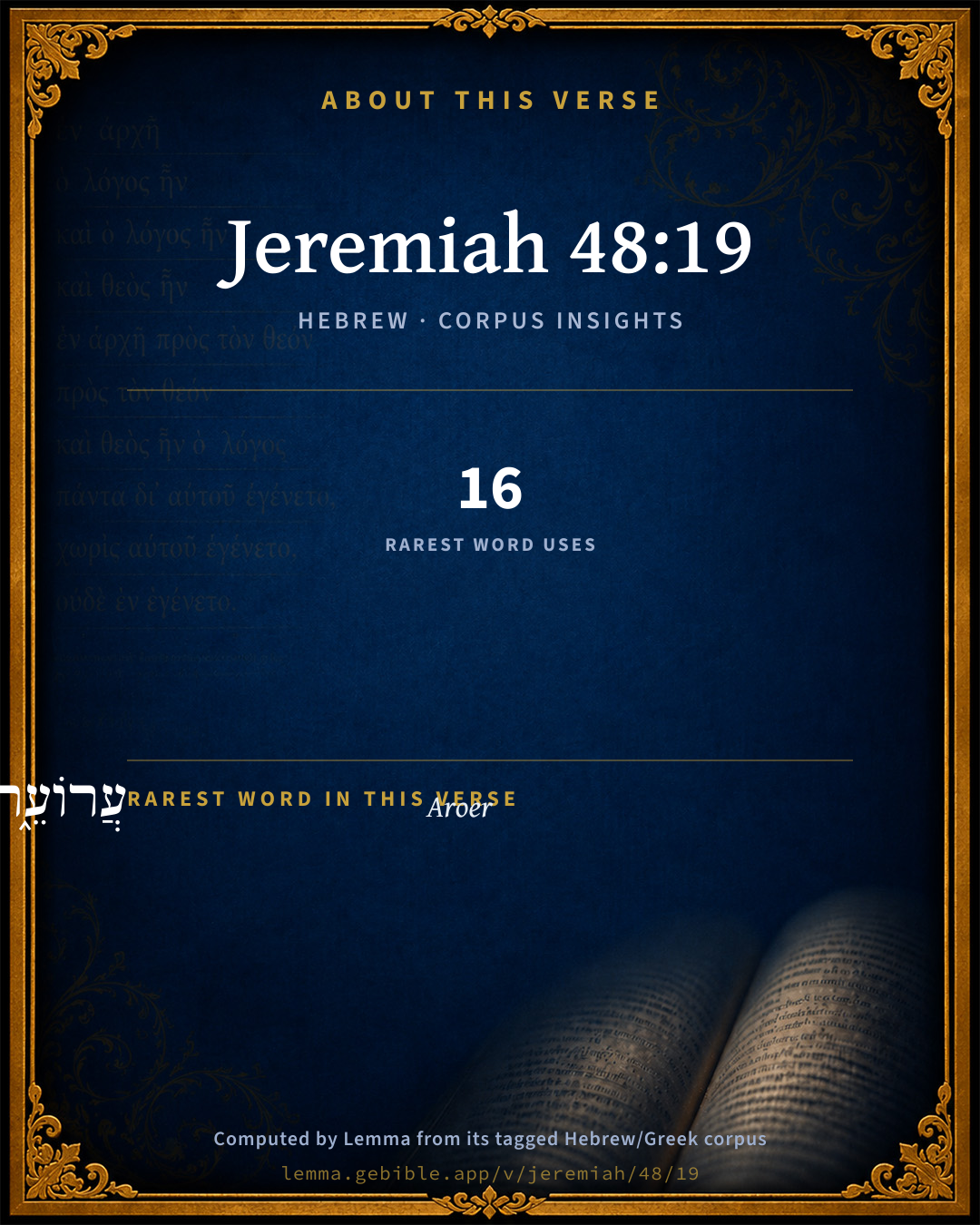
The rarest word here is עֲרוֹעֵ֑ר Aroer H6177 — appearing just 16 times in the whole Hebrew Bible.

Shared distinctive vocabulary

עֲרוֹעֵ֑ר Aroer H6177 occurs in 16 verses of the Hebrew Bible. Also found in:

Grammatical profile

  • 8 verbs
  • 2 nouns
  • 1 preposition
  • 1 particle

Verb forms

  • עִמְדִ֥י Qal · Imperative
  • וְצַפִּ֖י Piel · Imperative
  • יוֹשֶׁ֣בֶת Qal · Participle Active
  • שַׁאֲלִי Qal · Imperative
  • נָ֣ס Qal · Participle Active
  • וְנִמְלָ֔טָה Niphal · Participle Passive
  • אִמְרִ֖י Qal · Imperative
  • נִּֽהְיָֽתָה Niphal · Perfect

Cross-references

8

Topical passages linked to Jeremiah 48:19 in the Treasury of Scripture Knowledge — connected by theme and wording, ordered by reader-vote popularity; previews shown in the World English Bible.

  • Deuteronomy 2:36 From Aroer, which is on the edge of the valley of the Arnon, and [from] the city that is in the valley, even to Gilead, there was not a city too high for us; Yahweh our God delivered up all before us:
  • 1 Samuel 4:16 The man said to Eli, I am he who came out of the army, and I fled today out of the army. He said, How went the matter, my son?
  • 1 Samuel 4:13–14 When he came, behold, Eli was sitting on his seat by the road watching; for his heart trembled for the ark of God. When the man came into the city, and told it, all the city cried out.
  • Numbers 32:34 The children of Gad built Dibon, and Ataroth, and Aroer,
  • 2 Samuel 1:3–4 David said to him, From whence come you? He said to him, Out of the camp of Israel am I escaped.
  • 2 Samuel 18:24–32 Now David was sitting between the two gates: and the watchman went up to the roof of the gate to the wall, and lifted up his eyes, and looked, and, behold, a man running alone.
  • 2 Samuel 24:5 They passed over the Jordan, and encamped in Aroer, on the right side of the city that is in the middle of the valley of Gad, and to Jazer:
  • 1 Chronicles 5:8 and Bela the son of Azaz, the son of Shema, the son of Joel, who lived in Aroer, even to Nebo and Baal Meon:

Cross-references courtesy of OpenBible.info (CC BY 4.0).

Hebrew and Greek witnesses Masoretic Hebrew ↔ Greek Septuagint

The same verse in the two great witnesses to the Old Testament, shown verse-for-verse.

These are two independent witnesses, not word-aligned to each other, and the Septuagint is shown in lemma (dictionary) form.

Hebrew Jeremiah 48:19 Masoretic · Westminster Leningrad Codex

אֶל דֶּ֛רֶךְ עִמְדִ֥י וְצַפִּ֖י יוֹשֶׁ֣בֶת עֲרוֹעֵ֑ר שַׁאֲלִי נָ֣ס וְנִמְלָ֔טָה אִמְרִ֖י מַה נִּֽהְיָֽתָה

Inhabitant of Aroer, stand by the way, and watch: ask him who flees, and her who escapes; say, What has been done?

World English Bible · Public Domain

Greek LXX Structure differs

In the Septuagint, Jeremiah is about an eighth shorter than the Hebrew and arranges its material differently — the Oracles Against the Nations (Hebrew chapters 46–51) appear in the middle of the Greek book, after 25:13. Because the chapter and verse boundaries do not line up, a verse-for-verse comparison with the Hebrew is not shown.

A verse-for-verse comparison isn’t shown here because the chapters and verses don’t line up. Switch to the LXX edition with the MT / LXX toggle above to read the Greek directly.

Hebrew: Westminster Leningrad Codex (CC BY 4.0). Greek: Septuagint (public domain); English from a public-domain English Septuagint. How the Septuagint differs from the Hebrew →

Targum (Aramaic paraphrase)

1

The Targum is the ancient Jewish Aramaic paraphrase of the Hebrew Scriptures — an interpretive translation, not the Hebrew text itself. Onkelos (literal) and Pseudo-Jonathan (expansive) render the Torah, and Jonathan the Prophets. Coverage is partial: where no permissively-licensed English translation exists for a verse, only the Aramaic is shown. This is verse-level text, not a word-by-word alignment to the Hebrew.

  1. Targum Jonathan Prophets (Joshua–Malachi)
    עַל אוֹרְחָא קוּמוּ וּסְכוּ דְיַתְבִין בַּעֲרוֹעֵר שְׁאִילוּ שְׁאִילוּ לְמֶעְרְקַיָא וּלְמִשֵׁיזָבַיָא אֲמָרוּ מָה הֲוָה עַל תְּבָרָא דֵיכִי:

    (no public-domain English translation for this verse)

    Targum Jonathan — Aramaic: “Mikraot Gedolot” (public domain). English: “Sefaria Community Translation” (CC0 1.0 (public-domain dedication)); “London "Chaldee Paraphrase," 1871” (public domain). Text via Sefaria.

Commentary

Notes on Jeremiah 48:19 from classic Christian and Jewish commentators (each source and its license shown beneath its notes). The classic Christian expositions comment on the surrounding passage and are grouped to its opening verse, so a note may address several verses; the Jewish commentaries on the Tanakh (Rashi and others) are per-verse, so they appear only where the commentator wrote on this verse.

Lemma curates 59 commentaries, every one of them public domain or Creative Commons licensed, each selected and text-cleaned for this edition rather than reprinted as found. About our sources →

Trapp's Complete Commentary

John Trapp

Jer 48:19 O inhabitant of Aroer, stand by the way, and espy; ask him that fleeth, and her that escapeth, [and] say, What is done?

Ver. 19. Stand by the way and espy, &c.] What brave rhetoric is here? Tenendum quidem, prophetas et apostolos non affectasse artem dicendi: vide tamen quanta etoquentia peroret Spiritus, Sanctus. {a}

{a} Egregia est prosopopoeia.

John Trapp, A Commentary or Exposition upon All the Books of the Old and New Testament (1647–1656) — public domain. Text from a community e-Sword module.

Jamieson, Fausset & Brown

Robert Jamieson, A. R. Fausset & David Brown

Aroer--on the north bank of the Arnon, a city of Ammon (Deu 2:36; Deu 3:12). As it was on "the way" of the Moabites who fled into the desert, its inhabitants "ask" what is the occasion of Moab's flight, and so learn the lot that awaits themselves (compare Sa1 4:13, Sa1 4:16).

Jamieson, Fausset & Brown — Commentary Critical and Explanatory on the Whole Bible (1871) — public domain (CC PDM 1.0). Text via the HelloAO Bible API.

Adam Clarke's Commentary

Verse 19. O inhabitant of Aroer] See Clarke on Jer 48:6. This place, being at a greater distance, is counselled to watch for its own safety, and inquire of every passenger, What is done? that it may know when to pack up and be gone.

Adam Clarke's Commentary on the Bible (1810–1826) — public domain. Text from a community e-Sword/MySword module.

John Calvin's Commentaries

We have stated elsewhere why the prophets in describing calamities spoke in so elevated a style; for their object was not to seek fame or the praise of eloquence. They are not these rhetorical ornaments which the prophets used; but they necessarily spoke in a lofty style of the punishments which awaited the ungodly, because such was the hardness of their hearts that they hesitated not to despise God’s threatenings, or to regard them as fables. That God’s threatenings then might penetrate into the hearts of men, it was necessary to exaggerate them by means of various comparisons, as it is done here and in many places. We ought at the same time to bear in mind what I have said, that the Prophet had a regard to his own people. As the Moabites were like a hid treasure, the Jews could never have thought it possible, that the Chaldeans would at length make an inroad there; but the Prophet declares that the thing was so certain, as though it was seen by their own eyes. In order then to lead the Jews to the very scene itself, the judgments of God are here not only described, but as it were painted.

Stand, he says, on the way, and look, thou inhabitant of Aroer This was another city of the Moabites, of which mention is made in many places; and then he mentions others, as we shall see. Ask him, he says, who fleeth and her who escapes He, indeed, changes the gender of the nouns; but when he mentions many, and then one person, he did this for the sake of amplifying; because, on the one hand, he wished to show that so great would be the number of exiles, that the whole land would become empty; and then, on the other hand, when he says that this and that person would flee, he means that they would be so scattered that they would not go in troops; but as it is usual in a disordered state of things, one would flee on this side, and another on the other side. Ask him who fleeth, or as we may render the words, Ask all who flee; and then, ask her who escapes; because not only men, but also women would flee, so that no sex would be spared. In short, he intimates, that those who dwelt in cities well fortified, would be all anxiety on seeing enemies irresistibly advancing through every part of the country.

John Calvin's Commentaries (1540-1563) — public domain. Text from the Calvin Translation Society English edition (1840s-50s) via the Christian Classics Ethereal Library (ccel.org). Calvin's coverage is partial (roughly two-thirds of the Bible); uncommented books and verses are honest gaps, never fabricated. The 19th-century editor's footnotes and remarks are omitted so the notes are faithfully Calvin's own voice.

Ellicott's Commentary for English Readers

(19) O inhabitant of Aroer.—There seems to have been two cities of this name: one which had belonged first to the territory of Sihon, then to Reuben, then to Moab, on the north side of the Arnon (Deu_2:36; Deu_3:12; Deu_4:48; Jos_12:2); another in the Ammonite territory belonging to Gad, near Rabbath-Ammon, in the valley of the Jabbok (Num_32:34; Jos_13:25; Jdg_11:33). Both are probably comprised under the “cities of Aroer” in Isa_17:2. The name exists in the modern Arair. As lying on the frontier, the inhabitants of the Northern Aroer are represented as seeing the fugitives, male and female, from Dibon, and asking what had happened to drive them from their city. Milton’s lines (Par. Lost, L 407) may be quoted as illustrating the topography :

“From Aroer to Nebo, and the wild

Of Southmost Abarim; in Hesebon

And Horonaim, Seon’s realm . . .”

A Bible Commentary for English Readers, edited by Charles John Ellicott (1878–1897) — public domain. Text from a community e-Sword module.

The Cambridge Bible for Schools and Colleges

gen. ed. J. J. S. Perowne

19. Aroer] now ‘Ara‘ir, not to be confounded with the Aroer of Num_32:34, a Gadite city, or with an Aroer belonging to Judah (1Sa_30:28). The Aroer of the text was a few miles S.W. of Dibon. Mesha records on the “Moabite stone” that he “built (i.e. restored) the city and made the road over the Arnon.”

The Cambridge Bible for Schools and Colleges (gen. ed. J. J. S. Perowne; Cambridge University Press, 1878–1918) — public domain. Text from a community e-Sword module.

John Gill's Exposition

Moab is confounded, for it is broken down,.... This is the answer returned, by those that had escaped and were fleeing, to those who inquired of them; who report that the whole country of Moab was in the utmost confusion and consternation; not being able to stand before the enemy, who broke down and destroyed all that was in his way: and therefore calls upon them to

howl and cry; because of the general ruin at the nation, and who must expect themselves to share the same fate; and therefore should prepare themselves and their neighbours for it, as follows:

tell ye it in Arnon, that Moab is spoiled; the country of Arnon, so called from a river of that name, on the banks of which Aroer was situated; the inhabitants of which are desired to spread it all over that part of the country, that Moab was utterly ruined by the Chaldean army; the particulars of which follow:

John Gill's Exposition of the Whole Bible (1746–1763) — public domain (CC PDM 1.0). Text via the HelloAO Bible API.

Albert Barnes' Notes on the Bible

Aroer - On the Arnon, due south of Dibon. If Dibon falls, the turn of Aroer will come next, and therefore its inhabitants are to be on the look out, asking for news.

Albert Barnes' Notes on the Bible (1834–1885) — public domain. Text from a community e-Sword/MySword module.

Matthew Poole's English Annotations

Aroer was a city in the lot of Gad and Reuben, Num 32:34. In David’s time it was in the hand of the Jews, 1Sa 30:28, but in Isaiah’s time it belonged to Syria, Isa 17:2, and here it is reckoned to the Moabites. The inhabitants of it are called to

stand by the way, and seeing the Moabites fleeing, to ask what news. Others think that Aroer was at this time a city of the Ammonites, and here called unto to see their neighbours the Moabites fleeing before their enemies.

Matthew Poole's English Annotations on the Holy Bible (1683–1685) — public domain. Text from a community e-Sword/MySword module.

Whedon's Commentary on the Bible

Daniel D. Whedon

19. Aroer — A town on the northern bank of the Arnon, once belonging to Ammon, but now, apparently, to Moab.

Daniel D. Whedon (gen. ed.), Commentary on the Old and New Testaments (1874–1909) — public domain. Text from a community e-Sword module.

The Pulpit Commentary

The inhabitants of Aroer will come out in eager expectation to meet the fugitives, and ask, What hath happened? (so the question should be rendered). There were several Aroers, (one belonged to the Ammonites, Jos_13:25) but as the enemy is driving the Moabites southward, the Aroer here intended can only be the town by the Arnon, which separated Moab proper first of all from the kingdom of the Amorites, (Deu_4:48 Jos_12:2) and afterwards from the territory of the Israelites. (Deu_2:36 Deu_3:12) The picture drawn in this verse is singularly appropriate to the site of Arnon, "just by the edge of the arterial highway of Moab," and commanding a complete view of the pass of the Arnon (Tristram, "Land of Moab," p. 132). There is the same variety of statement as to the Israetitish tribe to which Aroer belonged as in the case of Dibon (see ver. 18). Jos_13:16 speaks in favour of Reuben; Num_32:34 in favour of Gad.

The Pulpit Commentary (1880–1919), ed. H.D.M. Spence-Jones & Joseph S. Exell — public domain. Text from a community e-Sword module.

Rashi

Rabbi Shlomo Yitzchaki (Rashi)

ask those who have fled and escaped Ask those who flee and escape from Moab, what transpired, if anyone escaped from being destroyed

Rashi on the Tanakh — English translations: “The Judaica Press complete Tanach with Rashi, translated by A. J. Rosenberg” (CC BY 4.0); “Pentateuch with Rashi's commentary by M. Rosenbaum and A.M. Silbermann, 1929-1934” (public domain); “The Metsudah Tanach series, Lakewood, N.J” (CC BY 4.0); and “The Book of Joshua, Metsudah Publications, 1997” (CC BY 4.0). Text via Sefaria.

Lesson kit

Teaching starters — assembled from the data on this page, not authored interpretation. Every prompt links to the verse data it draws on. Edit before teaching.

Jeremiah, in the Prophets, opens this verse with 12 words (12 distinct Hebrew lemmas). Its most distinctive word is ʻĂrôwʻêr (“Aroer”). A historical commentator’s framing appears above. Read the whole chapter for the surrounding context.

Discussion questions

  1. What does “Aroer” (ʻĂrôwʻêr) contribute to the verse as a whole?
  2. How does Numbers 32:34, which shares the word «Aroer», read alongside this verse?
  3. These translations render this verse differently. What is at stake in choosing one wording over another?
  4. «עִמְדִ֥י» is a Qal Imperative verb. How does that grammatical form shape the action described?
  5. Compare how Trapp's Complete Commentary and Jamieson, Fausset & Brown read this verse. Where do they agree or differ?

Things to notice

Reading settings

Reading text

Shown beneath each verse's original-language words.

Old Testament
Old Testament edition

Read the OT as the Masoretic Hebrew (MT) or the Greek Septuagint (LXX).

English shown for the Greek Septuagint (in the Hebrew ↔ Greek comparison).

Comparing translations? Open the Compare panel on any verse page to stack up to four side by side.