
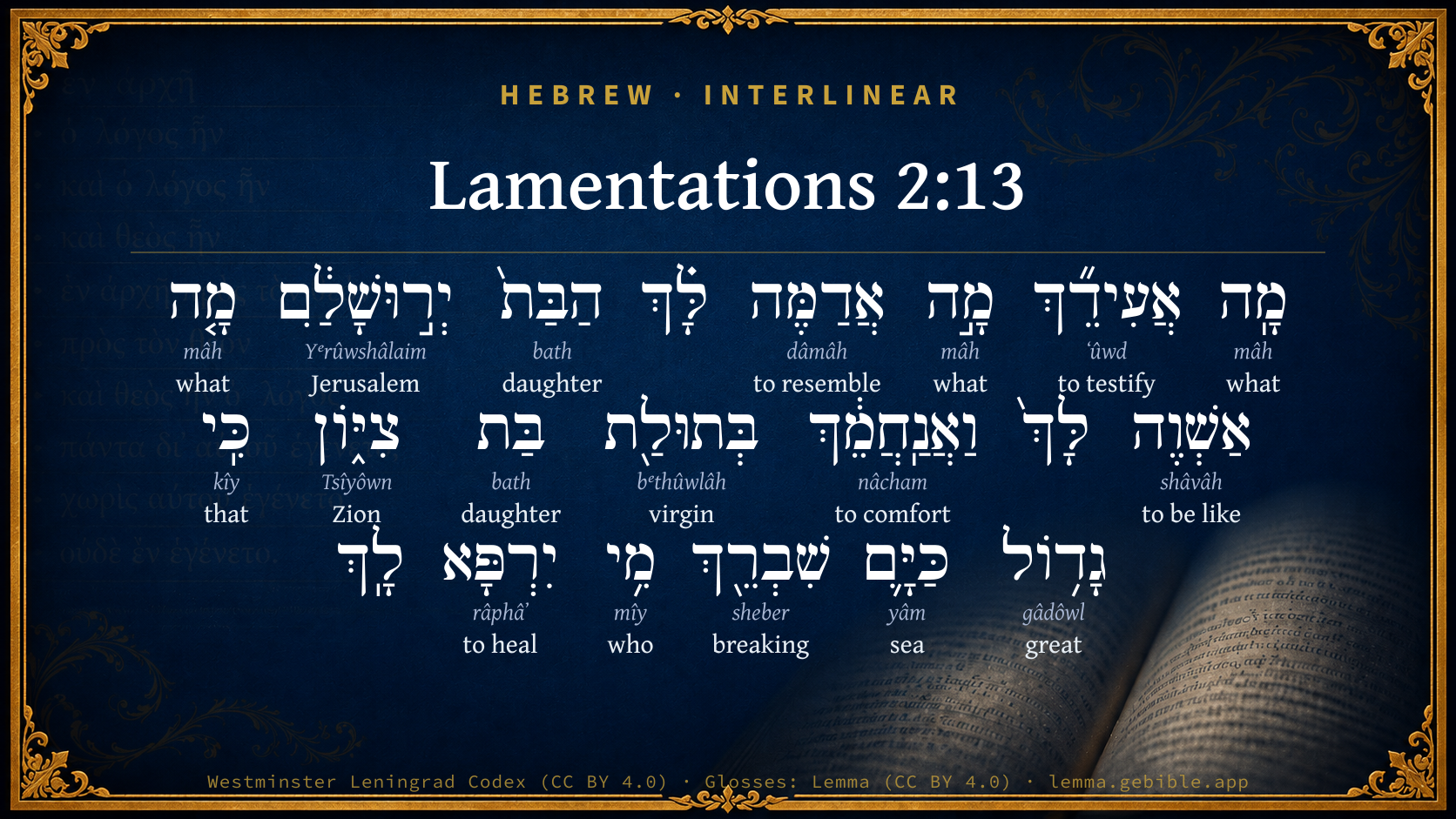
Lamentations 2:13

Hebrew (Westminster Leningrad Codex) Lamentations 2:13 appears in the Hebrew Old Testament. The text above is from the Westminster Leningrad Codex. Each word links to its Strong’s number, a concise gloss, and parsing drawn from the Open Scriptures Hebrew Bible morphology. Click any word for its full Brown-Driver-Briggs (BDB) entry.
Download image
Cite this verse

Lamentations 2:13 (World English Bible). Public Domain. Lemma interlinear Bible study tool, https://lemma.gebible.app/v/lamentations/2/13.

Show BibTeX & RIS
BibTeX
RIS
English Translation
What shall I testify to you? what shall I liken to you, daughter of Jerusalem? What shall I compare to you, that I may comfort you, virgin daughter of Zion? For your breach is great like the sea: who can heal you?
World English Bible · Public Domain
Download a study sheet

One document with this verse’s original text, its word-by-word gloss line, the meaning frame, cross-references with their text, attributed commentary, and full source and license credits — printable, and it pastes into notes with its structure intact.

This verse Autodidact and up

Study sheet (.html) Plain text (.txt)

A passage Seminary Student

Up to 50 verses in one chapter. A passage sheet keeps up to 6 commentary sources and 12 cross-references per verse, in the order this page ranks them, and says so on the sheet whenever that leaves anything out. Ask for a single verse and you get the Autodidact verse sheet above.

Everything on this page stays free to read, with no account — the sheet is a download of what is already on screen, not access to it.

Want to remove ads? Support Godless Engineer
Compare translations 3

The same verse in 3 English versions, stacked beneath the original-language interlinear above. Click any original word for its lexicon entry.

Each is an independent rendering of the whole verse — the interlinear is not word-aligned to these translations.

Highlighted words mark where these versions differ — a whole-verse word diff, not a word-by-word alignment.

  • World English Bible Public Domain
    What shall I testify to you? what shall I liken to you, daughter of Jerusalem? What shall I compare to you, that I may comfort you, virgin daughter of Zion? For your breach is great like the sea: who can heal you?
  • King James Version Public Domain
    What thing shall I take to witness for thee? what thing shall I liken to thee, O daughter of Jerusalem? what shall I equal to thee, that I may comfort thee, O virgin daughter of Zion? for thy breach is great like the sea: who can heal thee?
  • unfoldingWord Literal Text CC BY-SA 4.0
    What can I testify to you? To what can I compare you, O daughter of Jerusalem? To what can I liken you, that I may comfort you, O virgin daughter of Zion? For your brokenness is as great as the sea; who can heal you? NUN

unfoldingWord Literal Text — © unfoldingWord, licensed CC BY-SA 4.0. Word-aligned USFM3 via Door43 (git.door43.org/unfoldingWord/en_ult).

Versions to compare (up to 4)

3 of 4 selected

Show all 18 translations

Every available English version of this verse, each an independent rendering of the whole verse.

  • World English Bible Public Domain
    What shall I testify to you? what shall I liken to you, daughter of Jerusalem? What shall I compare to you, that I may comfort you, virgin daughter of Zion? For your breach is great like the sea: who can heal you?
  • Berean Standard Bible Public Domain
    What can I say for you? To what can I compare you, O Daughter of Jerusalem? To what can I liken you, that I may console you, O Virgin Daughter of Zion? For your wound is as deep as the sea. Who can ever heal you?
  • Majority Standard Bible Public Domain
    What can I say for you? To what can I compare you, O Daughter of Jerusalem? To what can I liken you, that I may console you, O Virgin Daughter of Zion? For your wound is as deep as the sea. Who can ever heal you?
  • King James Version Public Domain
    What thing shall I take to witness for thee? what thing shall I liken to thee, O daughter of Jerusalem? what shall I equal to thee, that I may comfort thee, O virgin daughter of Zion? for thy breach is great like the sea: who can heal thee?
  • American Standard Version (1901) Public Domain
    What shall I testify unto thee? what shall I liken to thee, O daughter of Jerusalem? What shall I compare to thee, that I may comfort thee, O virgin daughter of Zion? For thy breach is great like the sea: who can heal thee?
  • Revised Version (1885) Public Domain
    What shall I testify unto thee? what shall I liken to thee, O daughter of Jerusalem? what shall I equal to thee, that I may comfort thee, O virgin daughter of Zion? for thy breach is great like the sea: who can heal thee?
  • Geneva Bible (1599) Public Domain
    What thing shall I take to witnesse for thee? what thing shall I compare to thee, O daughter Ierusalem? what shall I liken to thee, that I may comfort thee, O virgine daughter Zion? for thy breach is great like ye sea: who can heale thee?
  • Douay-Rheims (1899) Public Domain
    Mem. To what shall I compare thee? or to what shall I liken thee, O daughter of Jerusalem? to what shall I equal thee, that I may comfort thee, O virgin daughter of Sion? for great as the sea is thy destruction: who shall heal thee?
  • Young's Literal Translation Public Domain
    What do I testify `to' thee, what do I liken to thee, O daughter of Jerusalem? What do I equal to thee, and I comfort thee, O virgin daughter of Zion? For great as a sea `is' thy breach, Who doth give healing to thee?
  • Literal Standard Version CC BY-SA 4.0
    What do I testify [to] you, what do I liken to you, || O daughter of Jerusalem? What do I equal to you, and I comfort you, || O virgin daughter of Zion? For great as a sea [is] your breach, || Who gives healing to you?
  • Unlocked Literal Bible CC BY-SA 4.0
    What can I say to you, daughter of Jerusalem? To what can I compare to you, that I may comfort you, virgin daughter of Zion? Your wound is as great as the sea. Who can heal you?
  • unfoldingWord Literal Text CC BY-SA 4.0
    What can I testify to you? To what can I compare you, O daughter of Jerusalem? To what can I liken you, that I may comfort you, O virgin daughter of Zion? For your brokenness is as great as the sea; who can heal you? NUN
  • Darby Bible Public Domain
    What shall I take to witness for thee? what shall I liken unto thee, daughter of Jerusalem? What shall I equal to thee, that I may comfort thee, virgin daughter of Zion? For thy ruin is great as the sea: who will heal thee?
  • World Messianic Bible Public Domain
    What shall I testify to you? What shall I liken to you, daughter of Jerusalem? What shall I compare to you, that I may comfort you, virgin daughter of Zion? For your breach is as big as the sea. Who can heal you?
  • Webster's Bible Public Domain
    What thing shall I take to witness for thee? what thing shall I liken to thee, O daughter of Jerusalem? What shall I equal to thee, that I may comfort thee, O virgin daughter of Zion? for thy breach is great like the sea: who can heal thee?
  • Free Bible Version CC BY-SA 4.0
    What can I tell you? What shall I compare you to, Daughter of Jerusalem? What can I say you're like in order to comfort you, virgin Daughter of Zion? For your wound gapes as wide as the sea—who could ever heal you?
  • Bible in Basic English Public Domain
    What example am I to give you? what comparison am I to make for you, O daughter of Jerusalem? what am I to make equal to you, so that I may give you comfort, O virgin daughter of Zion? for your destruction is great like the sea: who is able to make you well?
  • JPS Tanakh (1917) Public Domain
    What shall I take to witness for thee? What shall I liken to thee, O daughter of Jerusalem? What shall I equal to thee, that I may comfort thee, O virgin daughter of Zion? For thy breach is great like the sea; who can heal thee?

Literal Standard Version (2020), Covenant Press — licensed CC BY-SA 4.0. Text via the HelloAO Bible API (eBible.org). Unlocked Literal Bible (unfoldingWord) — licensed CC BY-SA 4.0. Text via the HelloAO Bible API (eBible.org). unfoldingWord Literal Text — © unfoldingWord, licensed CC BY-SA 4.0. Word-aligned USFM3 via Door43 (git.door43.org/unfoldingWord/en_ult). Free Bible Version, Dr. Jonathan Gallagher — licensed CC BY-SA 4.0. Text via the HelloAO Bible API (eBible.org).

Word by word

More ways to search: Search by grammar → Find every occurrence → Compare this word →

Practice this passage: Drill this verse → Learn its vocabulary →

אַשְׁוֶה
shâvâh
H7737
“to be like”
Verb, Hiphil, Imperfect, 1st Person, Common, Singular
Part of Speech
Verb
Stem
Hiphil
Form
Imperfect
Person
1st Person
Gender
Common
Number
Singular
Full BDB Definition

Origin: a primitive root

TWOT: 2342 , 2343

to agree with, be or become like, level, resemble - (Qal) - to be like - equivalent (participle) - to set, place - setting (participle) - (Piel) to level, smooth, still - (Hiphil) to make like - (Nithpael) to be alike - (Piel) to set, place
  1. מָֽה mâh H4100 “what” Particle, Interrogative
  2. אֲעִידֵ֞ךְ ʻûwd H5749 “to testify · you” Verb, Hiphil, Imperfect, 1st Person, Common, Singular + Suffix, Personal, 2nd Person, Feminine, Singular
  3. מָ֣ה mâh H4100 “what” Particle, Interrogative
  4. אֲדַמֶּה dâmâh H1819 “to resemble” Verb, Piel, Imperfect, 1st Person, Common, Singular
  5. הַבַּת֙ bath H1323 “the · daughter” Particle, Definite Article + Noun, Common, Feminine, Singular, Absolute
  6. יְר֣וּשָׁלִַ֔ם Yᵉrûwshâlaim H3389 “Jerusalem” Noun, Proper
  7. מָ֤ה mâh H4100 “what” Particle, Interrogative
  8. וַאֲנַֽחֲמֵ֔ךְ nâcham H5162 “and · to comfort · you” Conjunction + Verb, Piel, Imperfect, 1st Person, Common, Singular + Suffix, Personal, 2nd Person, Feminine, Singular
  9. בְּתוּלַ֖ת bᵉthûwlâh H1330 “virgin of” Noun, Common, Feminine, Singular, Construct
  10. בַּת bath H1323 “daughter of” Noun, Common, Feminine, Singular, Construct
  11. צִיּ֑וֹן Tsîyôwn H6726 “Zion” Noun, Proper
  12. כִּֽי kîy H3588 “that” Conjunction
  13. גָד֥וֹל gâdôwl H1419 “great” Adjective, Adjective, Masculine, Singular, Absolute
  14. כַּיָּ֛ם yâm H3220 “like/as the · sea” Preposition, Determined + Noun, Common, Masculine, Singular, Absolute
  15. שִׁבְרֵ֖ךְ sheber H7667 “breaking · your” Noun, Common, Masculine, Singular, Construct + Suffix, Personal, 2nd Person, Feminine, Singular
  16. מִ֥י mîy H4310 “who” Particle, Interrogative
  17. יִרְפָּא râphâʼ H7495 “to heal” Verb, Qal, Imperfect, 3rd Person, Masculine, Singular

About this verse

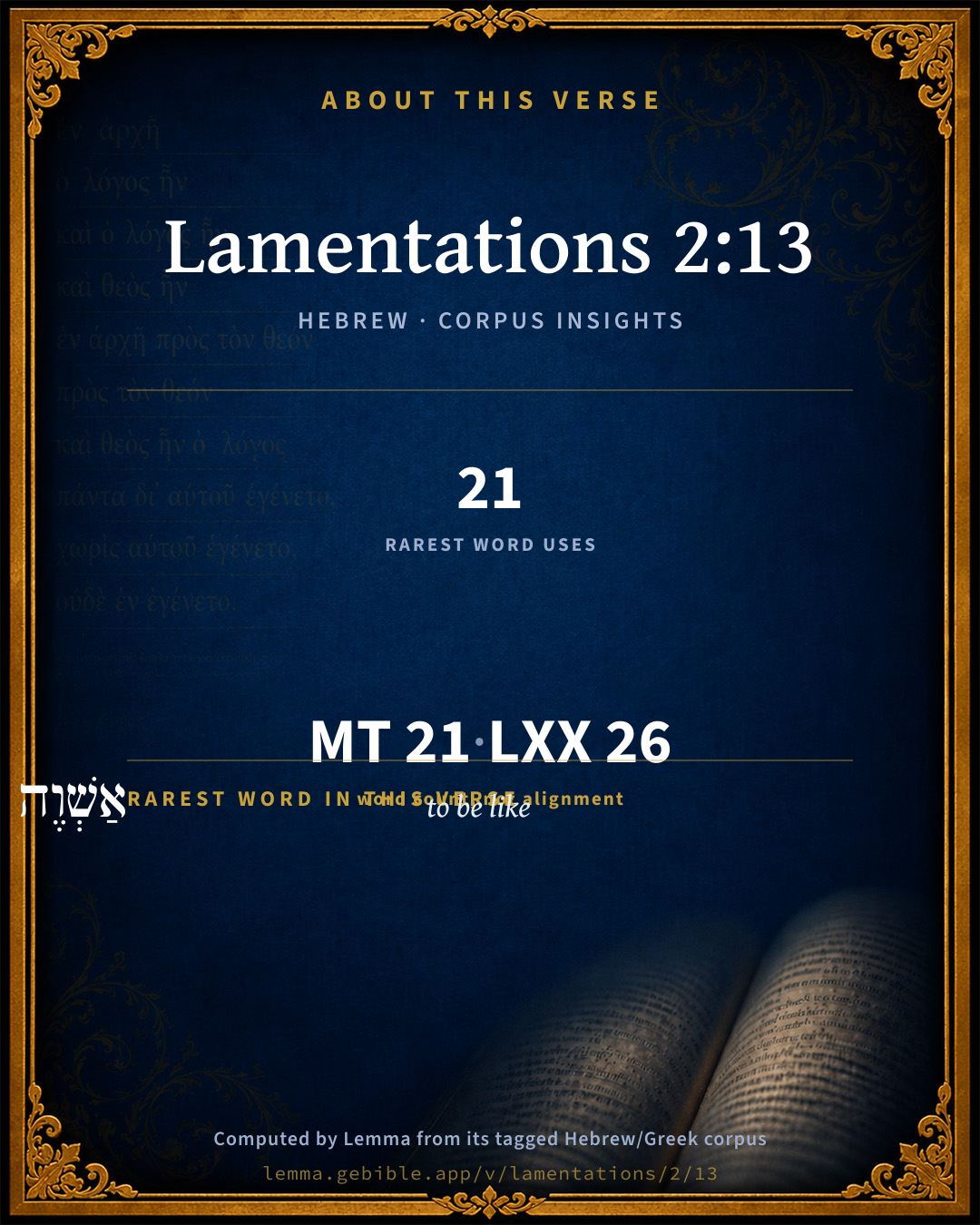
These counts appear in no published source. They are computed here, from the morphology-tagged text and Lemma’s own curated glosses. What Lemma adds →

21
words
15
distinct lemmas
Prophets
section

Notable vocabulary

The rarest word here is אַשְׁוֶה to be like H7737 — appearing just 21 times in the whole Hebrew Bible.

Shared distinctive vocabulary

אַשְׁוֶה to be like H7737 occurs in 21 verses of the Hebrew Bible. Also found in:

Grammatical profile

  • 5 verbs
  • 7 nouns
  • 1 adjective
  • 3 prepositions
  • 1 conjunction
  • 4 particles

Verb forms

  • אֲעִידֵ֞ךְ Hiphil · Imperfect
  • אֲדַמֶּה Piel · Imperfect
  • אַשְׁוֶה Hiphil · Imperfect
  • וַאֲנַֽחֲמֵ֔ךְ Piel · Imperfect
  • יִרְפָּא Qal · Imperfect

Repetition

Words recur within this verse — often emphatic in Hebrew:

  • הַבַּת֙ daughter H1323 ×2
  • מָֽה what H4100 ×3

Hebrew & Septuagint length

In English translation the verse runs 42 words from the Hebrew and 41 from the Septuagint (LXX English) — closely comparable.

A rough comparison of the two English renderings, which tokenize alike — not a word-level alignment.

Word counts can differ between the Hebrew and the Greek without any difference in meaning — e.g. the Hebrew direct-object marker אֵת has no separate Greek word, and Greek often adds the article ὁ.

In the original languages it is 21 Hebrew tokens and 26 Greek tokens — but the two are counted differently (Hebrew bundles its prefixes and suffixes into one token; the Greek is in lemma form), so that isn’t a like-for-like length.

Cross-references

10

Topical passages linked to Lamentations 2:13 in the Treasury of Scripture Knowledge — connected by theme and wording, ordered by reader-vote popularity; previews shown in the World English Bible.

  • Lamentations 1:12 Is it nothing to you, all you who pass by? Look, and see if there be any sorrow like my sorrow, which is brought on me, With which Yahweh has afflicted [me] in the day of his fierce anger.
  • 2 Samuel 5:20 David came to Baal Perazim, and David struck them there; and he said, Yahweh has broken my enemies before me, like the breach of waters. Therefore he called the name of that place Baal Perazim.
  • Jeremiah 8:22 Is there no balm in Gilead? is there no physician there? why then isn't the health of the daughter of my people recovered?
  • Jeremiah 14:17 You shall say this word to them, Let my eyes run down with tears night and day, and let them not cease; for the virgin daughter of my people is broken with a great breach, with a very grievous wound.
  • Jeremiah 30:12–15 For thus says Yahweh, Your hurt is incurable, and your wound grievous.
  • Psalms 60:2 You have made the land tremble. You have torn it. Mend its fractures, For it quakes.
  • Isaiah 37:22 this is the word which Yahweh has spoken concerning him: The virgin daughter of Zion has despised you and ridiculed you; the daughter of Jerusalem has shaken her head at you.
  • Jeremiah 51:8–9 Babylon is suddenly fallen and destroyed: wail for her; take balm for her pain, if so be she may be healed.
  • Ezekiel 26:3–4 therefore thus says the Lord Yahweh, Behold, I am against you, Tyre, and will cause many nations to come up against you, as the sea causes its waves to come up.
  • Daniel 9:12 He has confirmed his words, which he spoke against us, and against our judges who judged us, by bringing on us a great evil; for under the whole sky has not been done as has been done on Jerusalem.

Cross-references courtesy of OpenBible.info (CC BY 4.0).

Hebrew and Greek witnesses Masoretic Hebrew ↔ Greek Septuagint

The same verse in the two great witnesses to the Old Testament, shown verse-for-verse.

These are two independent witnesses, not word-aligned to each other, and the Septuagint is shown in lemma (dictionary) form.

Hebrew Lamentations 2:13 Masoretic · Westminster Leningrad Codex

מָֽה אֲעִידֵ֞ךְ מָ֣ה אֲדַמֶּה לָּ֗ךְ הַבַּת֙ יְר֣וּשָׁלִַ֔ם מָ֤ה אַשְׁוֶה לָּךְ֙ וַאֲנַֽחֲמֵ֔ךְ בְּתוּלַ֖ת בַּת צִיּ֑וֹן כִּֽי גָד֥וֹל כַּיָּ֛ם שִׁבְרֵ֖ךְ מִ֥י יִרְפָּא לָֽךְ

What shall I testify to you? what shall I liken to you, daughter of Jerusalem? What shall I compare to you, that I may comfort you, virgin daughter of Zion? For your breach is great like the sea: who can heal you?

World English Bible · Public Domain

Greek LXX Lamentations 2:13 Septuagint · lemma form

τίς μαρτυρέω σύ ἤ τίς ὁμοιόω σύ θυγάτηρ ἰερουσαλήμ τίς σώζω σύ καί παρακαλέω σύ παρθένος θυγάτηρ σιων ὅτι μεγαλύνω ποτήριον συντριβή σύ τίς ἰάομαι σύ

MEM. What shall I testify to you, or what shall I compare to you, O daughter of Jerusalem? who shall save and comfort you, O virgin daughter of Sion? for the cup of your destruction is enlarged: who shall heal you?

LXX2012 (modern English Septuagint) · Public Domain

Hebrew: Westminster Leningrad Codex (CC BY 4.0). Greek: Septuagint (public domain); English from LXX2012 (modern English Septuagint) (Public Domain). How the Septuagint differs from the Hebrew →

Commentary

Notes on Lamentations 2:13 from classic Christian and Jewish commentators (each source and its license shown beneath its notes). The classic Christian expositions comment on the surrounding passage and are grouped to its opening verse, so a note may address several verses; the Jewish commentaries on the Tanakh (Rashi and others) are per-verse, so they appear only where the commentator wrote on this verse.

Lemma curates 59 commentaries, every one of them public domain or Creative Commons licensed, each selected and text-cleaned for this edition rather than reprinted as found. About our sources →

Trapp's Complete Commentary

John Trapp

Lam 2:13 What thing shall I take to witness for thee? what thing shall I liken to thee, O daughter of Jerusalem? what shall I equal to thee, that I may comfort thee, O virgin daughter of Zion? for thy breach [is] great like the sea: who can heal thee?

Ver. 13. What thing shall I take to witness for thee?] q.d., Thou art such a mirror of God’s heavy judgments, that I know not whence to borrow arguments, nor where to find examples for thy comfort, so matchless is thy misery. It exceedeth that of the Egyptians under Moses, of the Canaanites under Joshua, of the Philistines under David, of the Hebrews under Eli, &c. It is even imparallel and inexpressible. I have but one simile to set it forth by, and it is this,

Thy breach is great, like the sea.] As far as the sea exceedeth the rivers, so doth thy calamity exceed that of other nations.

Who can heal thee?] None but an almighty Physician. Surely, in man’s judgment, thy bruise is incurable, and thy wound is grievous. {Jer 30:12}

John Trapp, A Commentary or Exposition upon All the Books of the Old and New Testament (1647–1656) — public domain. Text from a community e-Sword module.

The Preacher's Complete Homiletical Commentary

Joseph S. Exell (gen. ed.)

EXEGETICAL NOTES.—

(מ) Lam_2:13. He is ready, as a servant of the All-merciful and All-wise, to speak on His behalf, so as to alleviate the clamant wretchedness; but he feels unable. What shall I testify to thee? No message is given to him from the Most High, and no resemblance to her condition is perceptible on the broad surface of past or present human life. What liken to thee, O daughter of Jerusalem? The case is unparalleled, and there are no lessons applicable. What shall I compare to thee and comfort thee [with], O virgin daughter of Zion? For great is thy breach like the sea. Who will heal thee? Ruin had extended as far as to the horizon of the people’s existence, and to the deep springs of thought. True, there had not been wanting men who professed to be commissioned by Jehovah to declare that all would be well. They healed the hurt—the word here translated breach—of the daughter of my people lightly, saying, Peace, peace, when there is no peace.

HOMILETICS

INEXPRESSIBLE RUIN

(Lam_2:13)

I. Is incomparable with any ordinary calamity. “What thing shall I take to witness for thee? What thing shall I liken to thee? What shall I equal to thee?” Great as may be our distress, it is some comfort, slight though it be, to know there are others more or less unfortunate. But in this case, the prophet has no message from Jehovah to afflicted Judah, nor can he offer the ordinary human consolation of saying that others have had equal or worse sorrow to bear. The lamentable condition of Jerusalem was unparalleled; there had been nothing like it. No city had been so highly privileged with Divine honours: no city had been so signally punished. “Behold, and see if there be any sorrow like unto my sorrow” (chap. Lam_1:12). Jeremiah had exhausted all his powers of description. Desperate indeed must be the state of Judah when such a master of similes had to confess his inability to coin an adequate comparison.

II. Is measureless as the illimitable ocean. “For thy breach is great like the sea.” In his extremity to find some comparison, the prophet mentions the sea, which, on account of its vast dimensions, its illimitable depth and breadth, could alone furnish a fitting emblem of the magnitude of the devastation effected by the Chaldeans. The indefiniteness of the figure thus used reveals at once the straits to which the writer was reduced, and the utter ruin in which Judah was overwhelmed. Thou hast a flood of afflictions, a sea of troubles, an ocean of miseries.

III. Is beyond the power of human consolation and repair. “What shall I equal to thee, that I may comfort thee, O virgin daughter of Zion? who can heal thee?” Human words fail; human help is powerless. There is no comfort in man, or in any number of men. If there is to be any relief or restoration, it must come from God. He alone can change ruin into prosperity, misery into joy, darkness into light. A traveller in Madeira set off one morning to climb the summit of a lofty mountain to gaze upon the distant scene and enjoy the balmy air. He had a guide, and they had with difficulty ascended some two thousand feet, when a thick mist was seen descending upon them, obscuring the heavens. The traveller thought there was no hope left but to retrace their steps or be lost. But as the cloud came nearer and darkness enveloped them, the guide stepped on before, penetrating the mist, calling out every now and then, “Press on, master, press on; there’s light beyond!” They did press on, and in a few minutes, emerging from the thick mist, found themselves gazing upon a scene of transcendent beauty. Above, the sky was bright and cloudless; below, the almost level cloud through which they had passed was silvered with the rays of the sun, like a field of untrodden snow. In the darkest experiences, if we will but listen, we may hear the voice of our Divine Guide exclaiming, “Press on, press on; there is light beyond!”

LESSONS.—

1. Great indeed is the calamity that baffles human ingenuity to describe.

2. The nation is utterly undone when smitten by the hand of God.

3. God alone can repair the damage His righteous anger has inflicted.

ILLUSTRATIONS.—Drifting to ruin. Two or three miles above the falls of Niagara an Indian canoe was one day observed floating quietly along, with its paddle on its side. At first it was supposed to be empty. No one could imagine a man would expose himself to such well-known danger; but a turn of the current revealed an Indian lying asleep at the bottom. The spectators were shocked, and shouted to rouse him, but in vain. It seemed more like death than sleep which held him. All hope of rescue was gone, and they hurried along the shore in alarm to see the end. It soon came, for the torrent was now rolling so rapidly that they could scarcely keep pace with the object of their interest. At length the roar of the water, which had been hitherto almost buried within the high banks below, by a sudden change of the wind broke upon them with double violence. This dreadful noise, with which the Indian ear was so familiar, did at last arouse him. He was seen to start up and snatch his paddle. But it was too late. The same dinning sound which had roused him from insensibility told him at the same time that it was in vain to seek safety now by paddling, nor indeed had he time to try. Upright as he stood he was swept over the awful precipice, and the boat and its occupant were seen no more.

Ruin and responsibility. Julian the Apostate had for his coat of arms on his escutcheon an eagle struck through the heart with a shaft feathered from her own wing, with the motto, “Our death flies to us with our own feathers, and our wings pierce us to the very heart.” The moral is, that if a man receives injury, he alone has caused it, and is alone to blame.

Unutterable ruin. Every man feels, and not strangely, that there never were such experiences of life as his own. No joy was ever like our joy, no sorrow ever like our sorrow. Indeed, there is a kind of indignation excited in us when one likens our grief to his own. The soul is jealous of its experiences, and does not like pride to be humbled by the thought that they are common. For though we know that the world groans and travails in pain, and has done so for ages, yet a groan heard by our ear is a very different thing from a groan uttered by our mouth. The sorrows of other men seem to us like clouds of rain that empty themselves in the distance, and whose long-travelling thunder comes to us mellowed and subdued; but our own troubles are like a storm bursting right overhead and sending down its bolts upon us with direct plunge.—Beecher.

Ruin the punishment for sin. Fearful it is to consider that sin does not only drive us into calamity, but it makes us also impatient, and embitters our spirit in the sufferance: it cries aloud for vengeance, and so torments men before the time with such fearful outcries and horrid alarms, that their hell begins before the fire is kindled. It hinders our prayers, and consequently makes us hopeless and helpless. It perpetually affrights the conscience, unless by its frequent stripes it brings a callousness and an insensible damnation upon it. It makes us lose all that Christ purchased for us—all the blessings of His providence, the comforts of His Spirit, the aids of His grace, the light of His countenance, the hopes of His glory.—Jeremy Taylor.

—The pain, the disappointment, the dissatisfaction that wait on an evil course, show that the soul was not made to be the instrument of sin, but its lofty avenger. The desolated affections, the haggard countenance, the pallid and sunken cheek, the sighings of grief, proclaim that these are ruins indeed; but they proclaim that something noble has fallen into ruin, proclaim it by signs mournful yet venerable, like the desolation of an ancient temple, like its broken walls and fallen columns, and the hollow sounds of decay that sink down heavily among its deserted recesses.—Dewey.

Helpless ruin appeals to our sympathy. Helplessness appealing to our pity begets affection. In one of the cottages of my country parish dwelt a poor idiot child, horrible to all eyes but her parents, and so helpless that, though older than sisters just blooming into womanhood, she lay, unable either to walk or speak, a burden on her mother’s lap almost the whole day long—a heavy handful to one who had the cares of a family, and was the wife of a hard-working man, and a most painful contrast to the very roses that flung their bright clusters over the cottage window, as well as to the lark that, pleased with a grassy turf, carolled within its cage. Death, in most instances an unwelcome visitor, came at length—to her and to their relief. Relief! so I thought; and when the father came with an invitation to the funeral, so I said. Though not roughly, but inadvertently spoken, the word jarred on a tender chord; and I was more than ever taught how helplessness begets affection in the very measure and proportion of itself, when he burst into a fit of sorrow, and, speaking of his beautiful boys and blooming girls, said, “If it had been God’s will, I would have parted with any of them rather than her.”—Guthrie.

No hope but in God. The ninth capital in the Ducal Palace at Venice is decorated with figures of the eight virtues—Faith, Hope, Charity, Justice, Temperance, Prudence, Humility, and Fortitude. The virtues of the fourteenth century are somewhat hard-featured, with vivid and living expression, and plain everyday clothes of the time. Charity has her lap full of apples, and is giving one to a little child, who stretches his arm for it across a gap in the leafage of the capital. Fortitude tears open a lion’s jaws; Faith lays her hand on her breast as she beholds the cross; and Hope is praying, while above is a hand seen emerging from sunbeams—the hand of God, and the inscription above is Spes optima in Deo. This design is rudely imitated by the fifteenth century workmen: the virtues have lost their hard features and living expression; they have now all got Roman noses, and have had their hair curled. Their actions and emblems are, however, preserved until we come to Hope—she is still praising, but she is praising to the sun only: the hand of God is gone!—Ruskin.

The Preacher's Complete Homiletical Commentary (gen. ed. Joseph S. Exell; Funk & Wagnalls, c. 1892) — public domain (pre-1929). A full-Bible homiletical/sermon-outline anthology covering 65 of 66 books (2 John is absent from the source module). Text from a community e-Sword module.

Tyndale Open Study Notes

Tyndale Open Resources

2:13 Who can heal you? Reputed healers and prophets were all liars and frauds (Jer 6:13-14).

Tyndale Open Study Notes — © Tyndale Open Resources, licensed CC BY-SA 4.0. Text via the HelloAO Bible API.

Geneva Bible (1599)

Geneva Bible translators

Meaning, that her calamity was so evident, that it needed no witnesses.

Geneva Bible (1599) marginal notes — public domain. Text via Bolls.life.

Jamieson, Fausset & Brown

Robert Jamieson, A. R. Fausset & David Brown

What thing shall I take to witness--What can I bring forward as a witness, or instance, to prove that others have sustained as grievous ills as thou? I cannot console thee as mourners are often consoled by showing that thy lot is only what others, too, suffer. The "sea" affords the only suitable emblem of thy woes, by its boundless extent and depth (Lam 1:12; Dan 9:12).

Jamieson, Fausset & Brown — Commentary Critical and Explanatory on the Whole Bible (1871) — public domain (CC PDM 1.0). Text via the HelloAO Bible API.

Adam Clarke's Commentary

Verse 13. What thing shall I take] Or, rather, as Dr. Blayney, "What shall I urge to thee?" How shall I comfort thee?

Thy breach is great like the sea] Thou hast a flood of afflictions, a sea of troubles, an ocean of miseries.

Adam Clarke's Commentary on the Bible (1810–1826) — public domain. Text from a community e-Sword/MySword module.

John Calvin's Commentaries

When we wish to alleviate grief, we are wont to bring examples which have some likeness to the case before us. For when any one seeks to comfort one in illness, he will say, “Thou art not the first nor the last, thou hast many like thee; why shouldest thou so much torment thyself; for this is a condition almost common to mortals.” As, then, it is an ordinary way of alleviating grief to bring forward examples, the Prophet says, “What examples shall I set before thee? that is, why or to what purpose should I mention to thee this or that man who is like thee? or, What then shall I call thee to witness, or testify to thee?,” But I prefer this rendering, “To what purpose should I bring witnesses to thee, who may say that they have seen something of a like kind? for these things will avail thee nothing.”

The Prophet, then, means that comforts commonly administered to those in misery, would be of no benefit, because the calamity of Jerusalem exceeded all other examples, as though he had said, “No such thing had ever happened in the world; God had never before thundered so tremendously against any people; were I, then, to seek to bring examples to thee, I should be utterly at a loss; for when I compare thee with others in misery, I find that thou exceedest them all. “We now, then, perceive the meaning of the Prophet: he wished by this mode of speaking to exaggerate the grievousness of Jerusalem’s calamity, for she had been afflicted in a manner unusual and unheard of before; as though he had said that the Jews had become miserable beyond all other nations. Why then should I bring witnesses before thee? and why should I make any one like thee? why should I make other miserable people equal to thee? He adds the reason or the end (for the ו, vau, here ought to be so rendered) that I might comfort thee, that is, after the usual manner of men. He afterwards adds, because great as the sea is thy breach or breaking; that is, “Thy calamity is the deepest abyss: I cannot then find any in the whole world whom I can compare to thee, for thy calamity exceeds all calamities; nor is there anything like it that can be set before thee, so that thou art become a memorable example for all ages.”

But when we hear the Prophet speaking thus, we ought to remember that we have succeeded in the place of the ancient people. As, then, God had formerly punished with so much severity the sins of his chosen people, we ought to beware lest we in the present day provoke him to an extremity by our perverseness, for he remains ever like himself. But whenever it may happen that we are severely afflicted and broken down by his hand, let us still know that there is yet some comfort remaining for us, even when sunk down in the lowest depth. The Prophet, indeed, exaggerates in this place the evils of the people; but he had previously begun to encourage the faithful to entertain hope; and he will again repeat the same doctrine. But it was necessary for the Prophet to use such words until those who were as yet torpid in their sins, and did not sufficiently consider the design of God’s vengeance, were really humbled. He adds, —

John Calvin's Commentaries (1540-1563) — public domain. Text from the Calvin Translation Society English edition (1840s-50s) via the Christian Classics Ethereal Library (ccel.org). Calvin's coverage is partial (roughly two-thirds of the Bible); uncommented books and verses are honest gaps, never fabricated. The 19th-century editor's footnotes and remarks are omitted so the notes are faithfully Calvin's own voice.

Ellicott's Commentary for English Readers

(13) What thing shall I take to witness . . .—Practically the question is the same as that which follows, and implies that there was no parallel to the sufferings of Zion in the history of the past. Had there been, and had it been surmounted, it might have been cited in evidence, and some consolation might have been derived from it. As it was there was no such parallel, no such witness. Her “breach,” i.e., her ruin, was illimitable as the ocean, and therefore irremediable.

A Bible Commentary for English Readers, edited by Charles John Ellicott (1878–1897) — public domain. Text from a community e-Sword module.

The Cambridge Bible for Schools and Colleges

gen. ed. J. J. S. Perowne

13. shall I testify unto thee] or, as mg. take to witness for thee. If the MT. be right, we can only explain it as meaning, Of what shall I assure thee? But it is better, specially in view of the parallel clause, to read with an inconsiderable change in the original (’e‘ĕrôk for ’ã‘îdçk), for “testify” compare.

great like the sea] without measure.

who can heal thee?] Cp. Jer_30:12 f.

The Cambridge Bible for Schools and Colleges (gen. ed. J. J. S. Perowne; Cambridge University Press, 1878–1918) — public domain. Text from a community e-Sword module.

John Gill's Exposition

What thing shall I take to witness for thee?.... What argument can be made use of? what proof or evidence can be given? what witnesses can be called to convince thee, and make it a clear case to time, that ever any people or nation was in such distress and calamity, what with sword, famine, pestilence, and captivity, as thou art?

what thing shall I liken thee to, O daughter of Jerusalem? what kingdom or nation ever suffered the like? no example can be given, no instance that comes up to it; not the Egyptians, when the ten plagues were inflicted on them; not the Canaanites, when conquered and drove out by Joshua; not the Philistines, Moabites, Edomites, and Syrians, when subdued by David; or any other people:

what shall I equal to thee, that I may comfort thee, O virgin daughter of Zion? for this is one way that friends comfort the afflicted, by telling them that such an one's case was as bad, and worse, than theirs; and therefore bid them be of good heart; bear their affliction patiently; before long it will be over; but nothing of this kind could be said here; no, nor any hope given it would be otherwise; they could not say their case was like others, or that it was not desperate:

for thy breach is great like the sea; as large and as wide as that: Zion's troubles were a sea of trouble; her afflictions as numerous and as boisterous as the waves of the sea; and as salt, as disagreeable, and as intolerable, as the waters of it: or her breach was great, like the breach of the sea; when it overflows its banks, or breaks through its bounds, there is no stopping it, but it grows wider and wider:

who can heal thee? it was not in the power of man, in her own power, or of her allies, to recover her out of the hands of the enemy; to restore her civil or church state; her wound was incurable; none but God could be her physician. The Targum is,

"for thy breach is great as the greatness of the breach of the waves of the sea in the time of its tempest; and who is the physician that can heal thee of thy infirmity?''

John Gill's Exposition of the Whole Bible (1746–1763) — public domain (CC PDM 1.0). Text via the HelloAO Bible API.

Albert Barnes' Notes on the Bible

Equal - i. e. “compare.” Zion’s breach, i. e. her destruction, is measureless, like the ocean.

Albert Barnes' Notes on the Bible (1834–1885) — public domain. Text from a community e-Sword/MySword module.

Haydock's Catholic Bible Commentary

Sea. This is an hyperbole, to express the greatness of sorrow, as the sea surpasses all other waters. (Worthington)

George Leo Haydock (1774–1849), Haydock's Catholic Family Bible and Commentary, 1859 edition — public domain. Excludes Psalms (Douay-Rheims chapter numbering differs from Protestant) and Deuterocanonical books (Catholic canon only).

Matthew Poole's English Annotations

The sum of this verse is, that the miserable condition of the people was both incomparable and incurable. There was no people whose miserable condition was in any degree parallel to the misery of the Jews. It is some comfort to persons in misery to consider that others are and have been, as miserable as they, but the prophet had not this topic from whence to fetch an argument of comfort to the Jews; there were none to whom he could liken them, nor was there any present cure for them; their breach was like a sea-breach, where the waters come in with such a torrent, that while the tide abates there is no making any bank of defence against them.

Matthew Poole's English Annotations on the Holy Bible (1683–1685) — public domain. Text from a community e-Sword/MySword module.

Whedon's Commentary on the Bible

Daniel D. Whedon

13. What thing, etc. — All words fail. No comparison is adequate. No comfort meets the case. Your misery is great like the sea, illimitable, over-passing all measure.

Daniel D. Whedon (gen. ed.), Commentary on the Old and New Testaments (1874–1909) — public domain. Text from a community e-Sword module.

The Pulpit Commentary

What thing shall I take to witness for thee? rather, What shall I testify unto thee? The nature, of the testifying may be gathered from the following words. It would be a comfort to Zion to know that her misfortune was not unparalleled: solamen miseris socios habuisse malorum. The expression is odd, however, and, comparing Isa_40:18, A. Krochmal has suggested, What shall I compare? The correction is easy. Equal; i.e. compare (comp. Isa_46:5)

Commiseration.

The spirit of the prophet deserves our warm admiration. Jerusalem, its king and its citizens, had treated him with injustice and indignities. But in the day when his predictions were fulfilled and the city was overwhelmed by disaster and humiliation, so far from boasting over her, Jeremiah regarded her state with profoundest pity. Observe in this verse

I THE AFFECTIONATE AND ADMIRING LANGUAGE BY WHICH THE PROPHET DESIGNATES THE AFFLICTED CITY. Not a word of insult or of contempt, but, on the contrary, language evincing the deepest, the fondest interest. The population that had so despised his prophecy and had treated him so ill is here personified in language apparently more appropriate to times of prosperity. Jeremiah bewails the state of the daughter of Jerusalem, the virgin daughter of Zion.

II THE TENDER COMMISERATION OF THE PROPHET WITH THE CITY"S WOES.

1. He pronounces the sorrows of Jerusalem unequalled. It is a common mode of expressing sympathy to assure the afflicted that others have the same griefs and trials to endure. No such consolation is offered here; the prophet looks around in vain for a case so distressing. The breach is "great like the sea." This is either a figure drawn from the vastness of the ocean, with which the great woe of Judah is compared; or it depicts the enemy as rushing in upon Jerusalem, as the sea in its fury makes a breach in the wall of a low lying territory, and, sweeping the defences away by irresistible force, creates a desolation, so that a waste of waters is beheld where villages and fruitful fields once smiled in peace and plenty.

2. He pronounces the sorrows of Jerusalem irremediable. A mortal wound has been inflicted, which no leechcraft can heal. If Jerusalem is again to flourish it must be by a revival from the dead. For nothing now can save her.

APPLICATION.

1. The captive city is a picture of the desolation and misery to which (sooner or later) sin will surely bring all those who submit themselves to it.

2. The commiseration shown by the prophet is an example of the state of mind with which the pious should contemplate the ravages of sin and the wretchedness of sinful men.

3. The gospel forbids despondency over even the most utter debasement and humiliation of man. "There is balm in Gilead; there is a Physician there. T.

The Pulpit Commentary (1880–1919), ed. H.D.M. Spence-Jones & Joseph S. Exell — public domain. Text from a community e-Sword module.

John Wesley's Explanatory Notes

Who - There was no people whose condition was in any degree parallel to the misery of the Jews: nor was there any cure for them, their breach was like a sea breach where the waters come in with such a torrent, that there is no making any defense against them.

John Wesley, Explanatory Notes Upon the Whole Bible (1754–1765) — public domain. Text via the GEBible commentary corpus.

Keil & Delitzsch

C. F. Keil & F. Delitzsch

Against such terrible misery, human power can give neither comfort nor help. "What shall I testify to you?" the Kethib אעודך is a mistake in transcription for אעידך (Qeri), because עוּד is not commonly used in the Kal. העיד, to bear witness, is mostly construed with בּ, against or for any one, but also with acc., Kg1 21:10, Kg1 21:13, in malam, and Job 29:11, in bonam partem. Here it is used in the latter sense: "give testimony to thee" for the purpose of instruction and comfort, - not of a calamity that has happened elsewhere, as Calvin and Thenius explain, though against the construction of the verb with the accus.; still less "to make one swear" (Gesenius, Ewald). That the prophetic witness is meant here in the sense of encouragement by instruction, warning, and comfort, is evident from the mention of the testimony of the false prophets in Lam 2:14. "What shall I compare to thee?" i.e., what kind of misfortune shall I mention as similar to yours? This is required by the principle derived from experience: solamen miseris socios habuisse malorum. ואנחמך, "that I may comfort thee." The reason assigned, viz., "for thy destruction is great, like the sea" (i.e., immense), follows the answer, understood though not expressed, "I can compare nothing to thee." The answer to the last question, "Who can heal thee?" (רפא with ל) is, "no man;" cf. Jer 30:12. Reasons are assigned for this in Lam 2:14-16.

Keil & Delitzsch — Biblical Commentary on the Old Testament (1861–1891) — public domain (CC PDM 1.0). Text via the HelloAO Bible API. (Old Testament only.)

unfoldingWord translationNotes

Door43 World Missions Community

General Information:

The author begins to address Jerusalem.

What can I say ... Jerusalem?

The author uses this rhetorical question to express that he does not know what to say to help Jerusalem. This question can be written as a statement. AT: "There is nothing that I can say ... Jerusalem." (See: Rhetorical Question)

daughter of Jerusalem ... virgin daughter of Zion

These are poetic names for Jerusalem, which is spoken of here as if it were a woman. "Zion" is another name for Jerusalem. (See: Personification)

To what can I compare to you ... Zion?

The author uses this rhetorical question to express that he does not know how to give comfort to Jerusalem. This question can be written as a statement. AT: "There is nothing to which I can compare you ... Zion." (See: Rhetorical Question)

Your wound is as great as the sea

This speaks of Jerusalem's great suffering as if it were as terrible as the sea is great. AT: "Your suffering is as terrible as the sea is large" (See: Simile)

Who can heal you?

"Who can restore you?" The author uses this rhetorical question to express that there is no one who can restore Jerusalem to the way it was before. This question can be written as a statement. AT: "No one can heal you." or "No one can restore you." (See: Rhetorical Question)

They have not exposed your iniquity to restore your fortunes

"They did not tell you about your sins to restore your fortunes." The word "fortune" refers to a person's wealth and prosperity.

for you they gave utterances

The word "utterances" can be expressed with the verb "spoke." AT: "they spoke things to you" (See: Abstract Nouns)

translationWords

comfort

virgin

Zion

cure

prophet

deceive

fool

vision

reveal

iniquity

restore

unfoldingWord translationNotes — © Distant Shores Media and the Door43 World Missions Community, licensed CC BY-SA 4.0. Source: git.door43.org/Door43/en_tn.

Rashi

Rabbi Shlomo Yitzchaki (Rashi)

What shall I testify for you? What shall I compare to you to say to you, “Why do you wonder about your destruction? Didn’t that also happen to such and such a nation, just like you?”

What can I liken to you, that I may comfort you When trouble befalls a person, [others] say to him, “This also happened to so-and-so.” These are consolations for him.

Rashi on the Tanakh — English translations: “The Judaica Press complete Tanach with Rashi, translated by A. J. Rosenberg” (CC BY 4.0); “Pentateuch with Rashi's commentary by M. Rosenbaum and A.M. Silbermann, 1929-1934” (public domain); “The Metsudah Tanach series, Lakewood, N.J” (CC BY 4.0); and “The Book of Joshua, Metsudah Publications, 1997” (CC BY 4.0). Text via Sefaria.

Lesson kit

Teaching starters — assembled from the data on this page, not authored interpretation. Every prompt links to the verse data it draws on. Edit before teaching.

Lamentations, in the Prophets, opens this verse with 21 words (15 distinct Hebrew lemmas). Its most distinctive word is shâvâh (“to be like”). A historical commentator’s framing appears above. Read the whole chapter for the surrounding context.

Discussion questions

  1. The word shâvâh carries the sense “to be like.” How does it shape the verse?
  2. How does 2 Samuel 22:34, which shares the word «to be like», read alongside this verse?
  3. What does the repetition of “daughter” (2× in this one verse) do in this verse?
  4. These translations render this verse differently. What is at stake in choosing one wording over another?
  5. «אֲעִידֵ֞ךְ» is a Hiphil Imperfect verb. How does that grammatical form shape the action described?
  6. Compare how Trapp's Complete Commentary and The Preacher's Complete Homiletical Commentary read this verse. Where do they agree or differ?

Things to notice

Reading settings

Reading text

Shown beneath each verse's original-language words.

Old Testament
Old Testament edition

Read the OT as the Masoretic Hebrew (MT) or the Greek Septuagint (LXX).

English shown for the Greek Septuagint (in the Hebrew ↔ Greek comparison).

Comparing translations? Open the Compare panel on any verse page to stack up to four side by side.