Isaiah 3:15

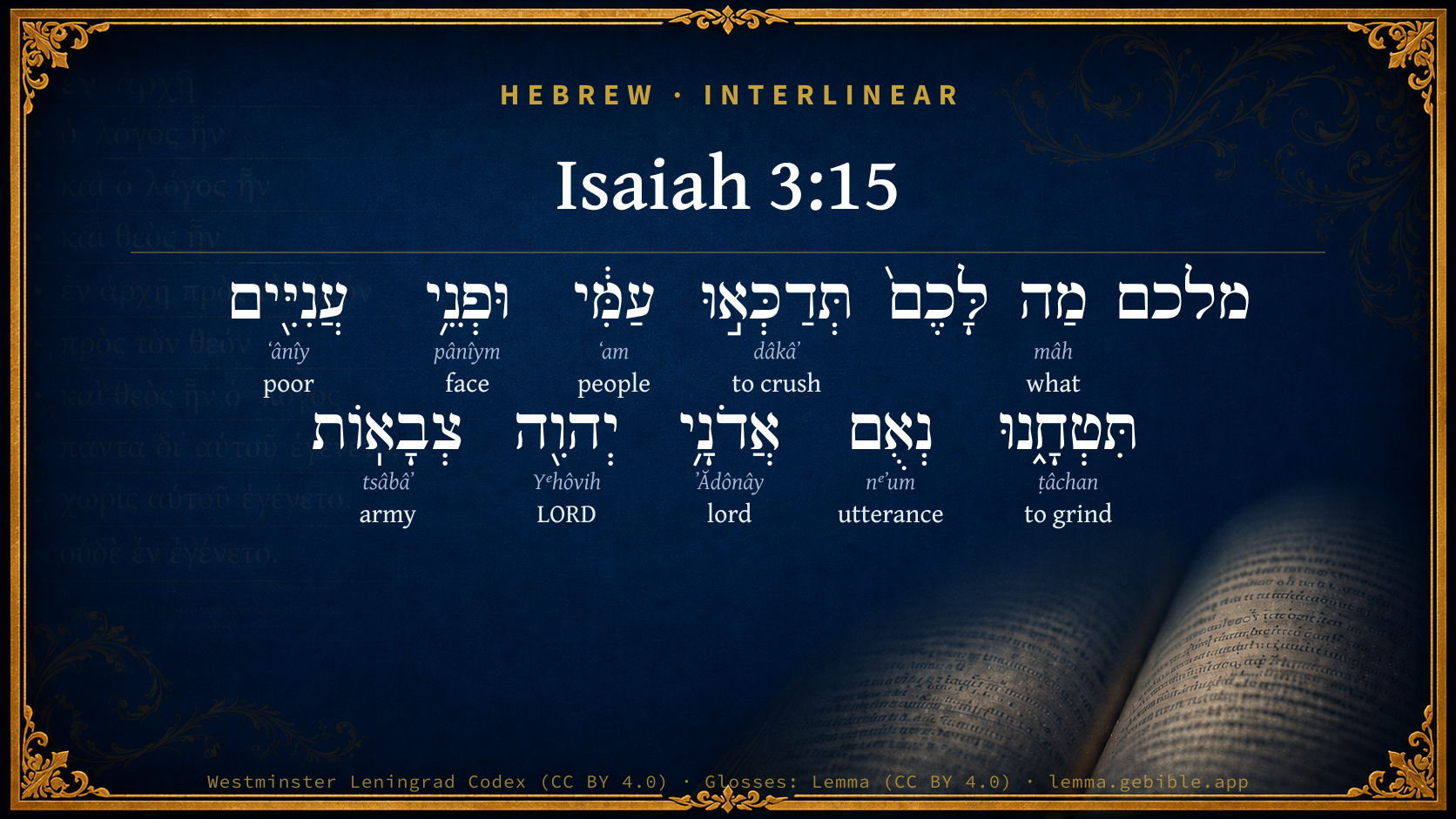
Hebrew (Westminster Leningrad Codex) Isaiah 3:15 appears in the Hebrew Old Testament. The text above is from the Westminster Leningrad Codex. Each word links to its Strong’s number, a concise gloss, and parsing drawn from the Open Scriptures Hebrew Bible morphology. Click any word for its full Brown-Driver-Briggs (BDB) entry.
Download image
Cite this verse

Isaiah 3:15 (World English Bible). Public Domain. Lemma interlinear Bible study tool, https://lemma.gebible.app/v/isaiah/3/15.

Show BibTeX & RIS
BibTeX
RIS
English Translation
What do you mean that you crush my people, And grind the face of the poor?" says the Lord, Yahweh of Hosts.
World English Bible · Public Domain
Download a study sheet

One document with this verse’s original text, its word-by-word gloss line, the meaning frame, cross-references with their text, attributed commentary, and full source and license credits — printable, and it pastes into notes with its structure intact.

This verse Autodidact and up

Study sheet (.html) Plain text (.txt)

A passage Seminary Student

Up to 50 verses in one chapter. A passage sheet keeps up to 6 commentary sources and 12 cross-references per verse, in the order this page ranks them, and says so on the sheet whenever that leaves anything out. Ask for a single verse and you get the Autodidact verse sheet above.

Everything on this page stays free to read, with no account — the sheet is a download of what is already on screen, not access to it.

Want to remove ads? Support Godless Engineer
Compare translations 3

The same verse in 3 English versions, stacked beneath the original-language interlinear above. Click any original word for its lexicon entry.

Each is an independent rendering of the whole verse — the interlinear is not word-aligned to these translations.

Highlighted words mark where these versions differ — a whole-verse word diff, not a word-by-word alignment.

  • World English Bible Public Domain
    What do you mean that you crush my people, And grind the face of the poor?" says the Lord, Yahweh of Hosts.
  • King James Version Public Domain
    What mean ye that ye beat my people to pieces, and grind the faces of the poor? saith the Lord GOD of hosts.
  • unfoldingWord Literal Text CC BY-SA 4.0
    What to you, you crush my people and you grind the faces of the poor?” —the declaration of the Lord, Yahweh of Armies. q1

unfoldingWord Literal Text — © unfoldingWord, licensed CC BY-SA 4.0. Word-aligned USFM3 via Door43 (git.door43.org/unfoldingWord/en_ult).

Versions to compare (up to 4)

3 of 4 selected

Show all 18 translations

Every available English version of this verse, each an independent rendering of the whole verse.

  • World English Bible Public Domain
    What do you mean that you crush my people, And grind the face of the poor?" says the Lord, Yahweh of Hosts.
  • Berean Standard Bible Public Domain
    Why do you crush My people and grind the faces of the poor?” declares the Lord GOD of Hosts.
  • Majority Standard Bible Public Domain
    Why do you crush My people and grind the faces of the poor?” declares the Lord GOD of Hosts.
  • King James Version Public Domain
    What mean ye that ye beat my people to pieces, and grind the faces of the poor? saith the Lord GOD of hosts.
  • American Standard Version (1901) Public Domain
    what mean ye that ye crush my people, and grind the face of the poor? saith the Lord, Jehovah of hosts.
  • Revised Version (1885) Public Domain
    what mean ye that ye crush my people, and grind the face of the poor? saith the Lord, the LORD of hosts.
  • Geneva Bible (1599) Public Domain
    What haue ye to do, that ye beate my people to pieces, and grinde the faces of the poore, saith the Lord, euen the Lord of hoasts?
  • Douay-Rheims (1899) Public Domain
    Why do you consume my people, and grind the faces of the poor? saith the Lord the God of hosts.
  • Young's Literal Translation Public Domain
    What -- to you? ye bruise My people, And the faces of the poor ye grind.' An affirmation of the Lord, Jehovah of Hosts, And Jehovah saith:
  • Literal Standard Version CC BY-SA 4.0
    Why? Why do you [do this]? You bruise My people, || And you grind the faces of the poor.” A declaration of the Lord, YHWH of Hosts, || And YHWH says:
  • Unlocked Literal Bible CC BY-SA 4.0
    Why do you crush my people and grind the faces of the poor?” This is the declaration of the Lord Yahweh of hosts.
  • unfoldingWord Literal Text CC BY-SA 4.0
    What to you, you crush my people and you grind the faces of the poor?” —the declaration of the Lord, Yahweh of Armies. q1
  • Darby Bible Public Domain
    What mean ye that ye crush my people, and grind the faces of the afflicted? saith the Lord, Jehovah of hosts.
  • World Messianic Bible Public Domain
    What do you mean that you crush my people, and grind the face of the poor?” says the Lord, GOD of Hosts.
  • Webster's Bible Public Domain
    What mean ye that ye beat my people to pieces, and grind the faces of the poor? saith the Lord GOD of hosts.
  • Free Bible Version CC BY-SA 4.0
    Why have you crushed my people? Why have you ground the faces of the poor into the dirt? the Lord Almighty demands to know.
  • Bible in Basic English Public Domain
    By what right are you crushing my people, and putting a bitter yoke on the necks of the poor? This is the word of the Lord, the Lord of armies.
  • JPS Tanakh (1917) Public Domain
    What mean ye that ye crush My people, and grind the face of the poor?' saith the Lord, the GOD of hosts.

Literal Standard Version (2020), Covenant Press — licensed CC BY-SA 4.0. Text via the HelloAO Bible API (eBible.org). Unlocked Literal Bible (unfoldingWord) — licensed CC BY-SA 4.0. Text via the HelloAO Bible API (eBible.org). unfoldingWord Literal Text — © unfoldingWord, licensed CC BY-SA 4.0. Word-aligned USFM3 via Door43 (git.door43.org/unfoldingWord/en_ult). Free Bible Version, Dr. Jonathan Gallagher — licensed CC BY-SA 4.0. Text via the HelloAO Bible API (eBible.org).

Word by word

More ways to search: Search by grammar → Find every occurrence → Compare this word →

Practice this passage: Drill this verse → Learn its vocabulary →

תִּטְחָ֑נוּ
ṭâchan
H2912
“to grind”
Verb, Qal, Imperfect, 2nd Person, Masculine, Plural
Part of Speech
Verb
Stem
Qal
Form
Imperfect
Person
2nd Person
Gender
Masculine
Number
Plural
Full BDB Definition

Origin: a primitive root

TWOT: 802

(Qal) to grind, crush
  1. מַה mâh H4100 “what” Particle, Interrogative
  2. תְּדַכְּא֣וּ dâkâʼ H1792 “to crush” Verb, Piel, Imperfect, 2nd Person, Masculine, Plural
  3. עַמִּ֔י ʻam H5971 “people · my” Noun, Common, Masculine, Singular, Construct + Suffix, Personal, 1st Person, Common, Singular
  4. וּפְנֵ֥י pânîym H6440 “and · face(s) of” Conjunction + Noun, Common, Both, Plural, Construct
  5. עֲנִיִּ֖ים ʻânîy H6041 “poor” Adjective, Adjective, Masculine, Plural, Absolute
  6. נְאֻם nᵉʼum H5002 “utterance of” Noun, Common, Masculine, Singular, Construct
  7. אֲדֹנָ֥י ʼĂdônây H136 “Lord · my” Noun, Common, Masculine, Plural, Construct + Suffix, Personal, 1st Person, Common, Singular
  8. יְהוִ֖ה Yᵉhôvih H3069 “LORD” Noun, Proper
  9. צְבָאֽוֹת tsâbâʼ H6635 “armies” Noun, Common, Both, Plural, Absolute

About this verse

These counts appear in no published source. They are computed here, from the morphology-tagged text and Lemma’s own curated glosses. What Lemma adds →

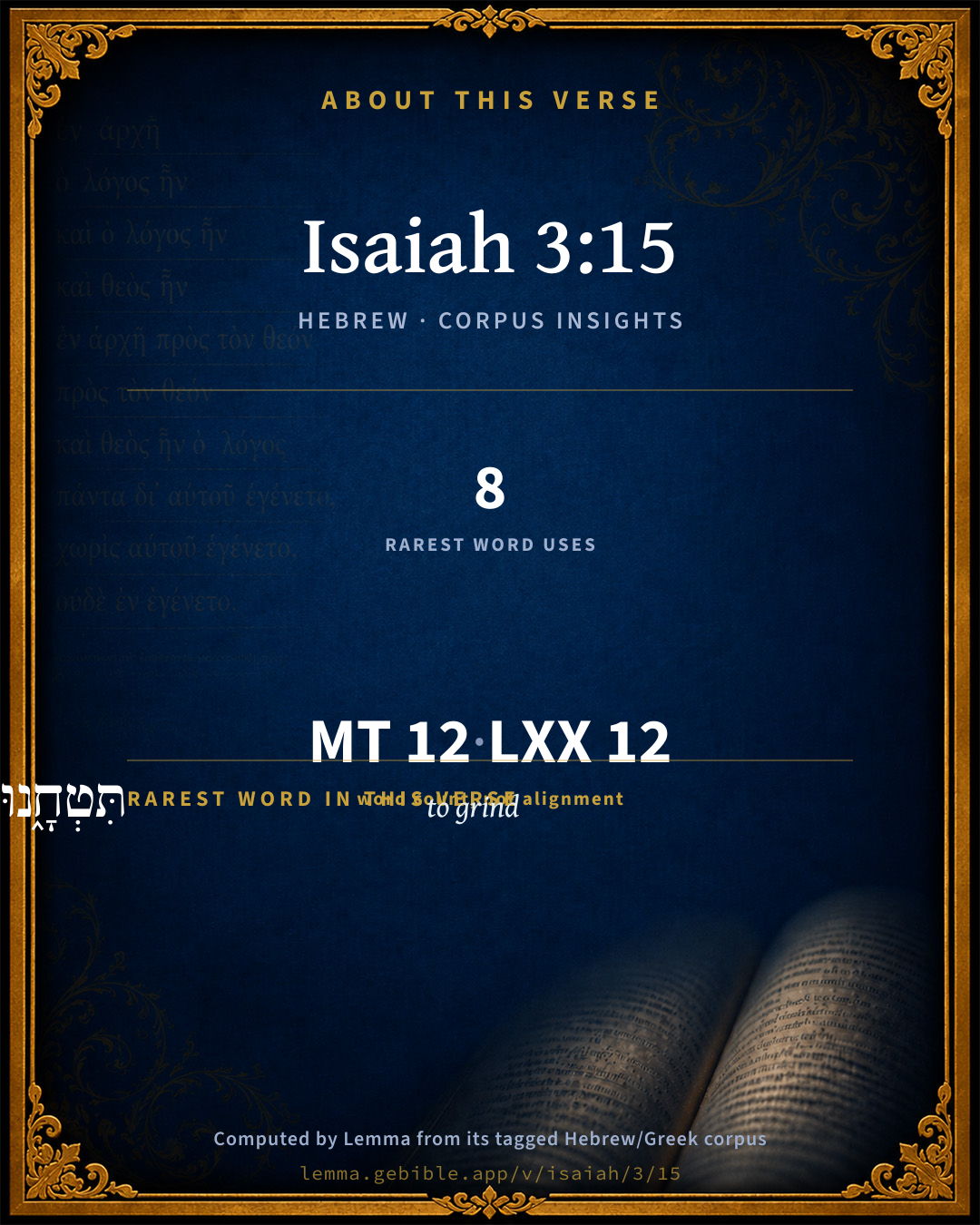
12
words
10
distinct lemmas
Prophets
section

Notable vocabulary

The rarest word here is תִּטְחָ֑נוּ to grind H2912 — appearing just 8 times in the whole Hebrew Bible.

Shared distinctive vocabulary

תִּטְחָ֑נוּ to grind H2912 occurs in 8 verses of the Hebrew Bible. Also found in:

Grammatical profile

  • 2 verbs
  • 6 nouns
  • 1 adjective
  • 2 prepositions
  • 1 particle

Verb forms

  • תְּדַכְּא֣וּ Piel · Imperfect
  • תִּטְחָ֑נוּ Qal · Imperfect

Hebrew & Septuagint length

In English translation the verse runs 22 words from the Hebrew and 13 from the Septuagint (LXX English) — the Septuagint runs noticeably shorter here. See the side-by-side →

A rough comparison of the two English renderings, which tokenize alike — not a word-level alignment.

Word counts can differ between the Hebrew and the Greek without any difference in meaning — e.g. the Hebrew direct-object marker אֵת has no separate Greek word, and Greek often adds the article ὁ.

In the original languages it is 12 Hebrew tokens and 12 Greek tokens — but the two are counted differently (Hebrew bundles its prefixes and suffixes into one token; the Greek is in lemma form), so that isn’t a like-for-like length.

Cross-references

7

Topical passages linked to Isaiah 3:15 in the Treasury of Scripture Knowledge — connected by theme and wording, ordered by reader-vote popularity; previews shown in the World English Bible.

  • Psalms 94:5 They break your people in pieces, Yahweh, And afflict your heritage.
  • Micah 3:2–3 You who hate the good, And love the evil; Who tear off their skin, And their flesh from off their bones;
  • Amos 2:6–7 Thus says Yahweh: "For three transgressions of Israel, yes, for four, I will not turn away its punishment; Because they have sold the righteous for silver, And the needy for a pair of shoes;
  • Amos 8:4–6 Hear this, you who desire to swallow up the needy, And cause the poor of the land to fail,
  • Exodus 5:14 The officers of the children of Israel, whom Pharaoh's taskmasters had set over them, were beaten, and demanded, "Why haven't you fulfilled your quota both yesterday and today, in making brick as before?"
  • Isaiah 58:4 Behold, you fast for strife and contention, and to strike with the fist of wickedness: you don't fast this day so as to make your voice to be heard on high.
  • Ezekiel 18:2 What do you mean, that you use this proverb concerning the land of Israel, saying, The fathers have eaten sour grapes, and the children's teeth are set on edge?

Cross-references courtesy of OpenBible.info (CC BY 4.0).

Hebrew and Greek witnesses Masoretic Hebrew ↔ Greek Septuagint

The same verse in the two great witnesses to the Old Testament, shown verse-for-verse.

Here the Septuagint runs noticeably shorter than the Hebrew — LXX2012 (modern English Septuagint) 13 words vs World English Bible 22. A rough length comparison of the two English translations, not a word-level alignment — read both below.

These are two independent witnesses, not word-aligned to each other, and the Septuagint is shown in lemma (dictionary) form.

Hebrew Isaiah 3:15 Masoretic · Westminster Leningrad Codex

מלכם מַה לָּכֶם֙ תְּדַכְּא֣וּ עַמִּ֔י וּפְנֵ֥י עֲנִיִּ֖ים תִּטְחָ֑נוּ נְאֻם אֲדֹנָ֥י יְהוִ֖ה צְבָאֽוֹת

What do you mean that you crush my people, And grind the face of the poor?" says the Lord, Yahweh of Hosts.

World English Bible · Public Domain

Greek LXX Isaiah 3:15 Septuagint · lemma form

τίς σύ ἀδικέω ὁ λαός ἐγώ καί ὁ πρόσωπον ὁ πτωχός κατααἰσχύνω

Why do you⌃ wrong my people, and shame the face of the poor?

LXX2012 (modern English Septuagint) · Public Domain

On this verse, Adam Clarke's Commentary discusses the Septuagint’s reading. Read the note in Commentary ↓

Hebrew: Westminster Leningrad Codex (CC BY 4.0). Greek: Septuagint (public domain); English from LXX2012 (modern English Septuagint) (Public Domain). How the Septuagint differs from the Hebrew →

Targum (Aramaic paraphrase)

1

The Targum is the ancient Jewish Aramaic paraphrase of the Hebrew Scriptures — an interpretive translation, not the Hebrew text itself. Onkelos (literal) and Pseudo-Jonathan (expansive) render the Torah, and Jonathan the Prophets. Coverage is partial: where no permissively-licensed English translation exists for a verse, only the Aramaic is shown. This is verse-level text, not a word-by-word alignment to the Hebrew.

  1. Targum Jonathan Prophets (Joshua–Malachi)
    מַה לְכוֹן דְאַתּוּן מְמַסְכְּנִין יַת עַמִי וְאַפֵּי חֲשִׁיכַיָא מְבַלִין אַתּוּן וּמַיְתִין בְּדִינֵיהוֹן אֲמַר יְיָ אֱלֹהִים צְבָאוֹת:

    What mean ye, that ye impoverish my people and grind the faces of the poor? They are perishing in their contentions, saith the Lord, the God of hosts.'

    Targum Jonathan — Aramaic: “Mikraot Gedolot” (public domain). English: “Sefaria Community Translation” (CC0 1.0 (public-domain dedication)); “London "Chaldee Paraphrase," 1871” (public domain). Text via Sefaria.

Commentary

Notes on Isaiah 3:15 from classic Christian and Jewish commentators (each source and its license shown beneath its notes). The classic Christian expositions comment on the surrounding passage and are grouped to its opening verse, so a note may address several verses; the Jewish commentaries on the Tanakh (Rashi and others) are per-verse, so they appear only where the commentator wrote on this verse.

Lemma curates 59 commentaries, every one of them public domain or Creative Commons licensed, each selected and text-cleaned for this edition rather than reprinted as found. About our sources →

Trapp's Complete Commentary

John Trapp

Isa 3:15 What mean ye [that] ye beat my people to pieces, and grind the faces of the poor? saith the Lord GOD of hosts.

Ver. 15. What mean you, that you beat my people to pieces?] Heb., What to you? all in a word, short and sharp - q.d., What reason had you, what authority to do thus? That was a witty answer that was given once here to the Pope’s exactor, who pleaded that all churches were his, and therefore he might call for what sums he pleased; a nimble disputant replied that all churches were the Pope’s in a sense, viz., Tuitione sed non fruitione; defensione, non dissipatione - i.e., to defend them, but not to destroy them. If God give any man power, it is for "edification, and not for destruction." {2Co 13:10}

And grind the faces.] Holding their noses to the grindstone, as we say - by hard usage. See on Mic 3:3.

Saith the Lord God.] Dixit Dominator Dominus; he who is higher than the highest, and being Lord of hosts, hath those at hand that are higher than they. {Ecc 5:8}

John Trapp, A Commentary or Exposition upon All the Books of the Old and New Testament (1647–1656) — public domain. Text from a community e-Sword module.

The Preacher's Complete Homiletical Commentary

Joseph S. Exell (gen. ed.)

OPPRESSION OF THE POOR

Isa_3:15. What mean ye that ye beat my people to pieces, and grind the faces of the poor? saith the Lord God of hosts.

That infidelity should progress among the labouring classes is one of the most surprising and unreasonable things imaginable. For there is no book so emphatically on the side of the poor as is the Bible. Were the Bible obeyed, the miseries of the poor would vanish. The truth, however, is, that the Bible has suffered from its professed friends. The upper classes who have patronised it have not put its precepts into practice, and the victims of their greed and oppression have foolishly accepted their conduct as an exposition of the teaching of the book which they have professed to venerate. Hence the wrongs which the poor have suffered have prepared them to listen to the blasphemies and to accept the sophisms of infidel lecturers. The employer of labour who oppresses his men during the six days of the week, and goes to church twice on the Sunday, is more dangerous to society than a score of Tom Paines or Bradlaughs. Hence also it is the duty of God’s “prophets” in all ages to confront such men with the question of our text.

I. Oppression of the poor is one of the most common of all sins. It has been practised in all ages, in all countries, by all classes, in most varied forms. “Poor” is a relative term. Masters have oppressed their servants, debtors their creditors, officers their soldiers, kings their subjects, people their pastors. The oppression has often been so terrible that the oppressed have sought refuge in suicide.

“Man’s cruelty to man

Makes countless thousands mourn.”

II. Oppression of the poor is one of the most hateful of all sins.

1. It is a misuse of strength. Strength is given to men that they may be helpful to each other; but the oppressor uses his strength as if he were a tiger or a wolf; as if he were a wrecker who drowns the shipwrecked mariner whom he ought to rescue.

2. It is a cowardly and shameful advantage that is taken of human weakness. To lead a blind man into a quagmire or over a precipice would be thought a shameful act, even by the most degraded villains. But in what respect would it differ in principle from oppression of the poor? The weak and needy, by reason of their feebleness and poverty, have a claim upon our pity and help; to oppress them is to outrage the primary laws of conscience. Yet how often it is done!

III. Oppression of the poor is among those sins which are certain to be most terribly punished. The oppressor proceeds on the idea, that the man whom he oppresses has no friends to succour and avenge him. What a mistake! All the oppressed have a friend and avenger in GOD. Shall oppression go unrequited? Nay, verily! For,

1. It is an offence against God’s laws. He has distinctly commanded us to love our neighbour as ourselves, and how manifold are the applications of this great commandment!

2. It is an offence against God’s feelings. In a peculiar manner His sensibilities are outraged when His children act cruelly towards each other. Oppression of the poor kindles within Him mingled disgust and indignation, [559]

[559] These things are done before God, who looks upon every part of the human family as His own. How should you feel if you were to enter the room where your child is sleeping, and find upon it a stealthy cat, stationed at the portal of life, and stopping its very breath? How should you feel were you to find upon your child a vampire that had fastened into its flesh his blood-sucking bill, and was fast consuming its vitality? How do you feel when one of your children tramples upon another? or when your neighbour’s children crush yours? or when ruffian violence strikes against those whose hearts for ever carry the core of your heart?

Judge from your own feelings how God, with His infinite sensibility, must feel when He sees men rising up against their fellow-men; performing gross deeds of cruelty on every hand, waging wars that cause blood to flow throughout the globe; when, in short, He sees them devastating society by every infernal mischief that their ingenuity can invent.—Beecher.

What shall become of the oppressor? No creature in heaven or earth shall testify his innocency. But the sighs, cries, and groans of undone parents, of beggared widows and orphans, shall witness the contrary. All his money, like hempseed, is sowed with curses; and every obligation is written on earth with ink and blood, and in hell with blood and fire.—Adams, 1653.

APPLICATION.

1. A due consideration of our text would deter men from the sin here denounced. The question which God now addresses to oppressors He will, with a slight difference, put to them again—when they shall he gathered at His bar! “What meant ye that ye did beat my people to pieces, and did grind the faces of the poor?” Bethink you, O ye oppressors, what will ye answer then? Will it be, “Lord, we thought Thou wert too great to take any notice of what men did on earth”? or, “Lord, we oppressed them because they were weak, and we saw we could make a good profit out of their defencelessness”? Do these excuses seem to you too flimsy to be seriously suggested? Consider, then, what more valid vindication will be at your command in that day. In that day you will stand “speechless!”

2. A remembrance of the prevalence of the crime denounced in our text will give soundness and vigour to our theology. The demand of our day is for “a God all mercy.” Men are endeavouring to cover up hell with the rose-leaves of a spurious benevolence. But a remembrance of the wrongs that are done upon earth, the frightful cruelties that are every day perpetrated, will convince us that hell is a moral necessity. “A God all mercy” would be not only “a God unkind,” but a God unjust, a God worthy only of the pity and contempt of his creatures.

3. A due consideration of the manner in which God intervenes on behalf of the wronged and defenceless, will inspire all noble minds with veneration and admiration for His character. Jehovah is no Brahma, throned in eternal calm, and indifferent to the sins and sufferings of mankind; He is a Father, prompt to feel and to avenge the wrongs of His children. Let us resolve to be like Him. Let us not only avoid oppression in all its forms; let us be swift to sympathise with and to succour the oppressed.

The Preacher's Complete Homiletical Commentary (gen. ed. Joseph S. Exell; Funk & Wagnalls, c. 1892) — public domain (pre-1929). A full-Bible homiletical/sermon-outline anthology covering 65 of 66 books (2 John is absent from the source module). Text from a community e-Sword module.

Tyndale Open Study Notes

Tyndale Open Resources

3:15 The Lord cares for the poor. These were the marginalized and oppressed (see 1:17), but God is their protector (see 25:4). God called for his people to share his concern for the poor, but the Israelites were exploiting them to gain wealth (see 3:14).

Tyndale Open Study Notes — © Tyndale Open Resources, licensed CC BY-SA 4.0. Text via the HelloAO Bible API.

Geneva Bible (1599)

Geneva Bible translators

That is, ye show all cruelty against them.

Geneva Bible (1599) marginal notes — public domain. Text via Bolls.life.

Jamieson, Fausset & Brown

Robert Jamieson, A. R. Fausset & David Brown

What right have ye to beat, &c. (Psa 94:5; Mic 3:2-3).

grind--by exactions, so as to leave them nothing.

faces--persons; with the additional idea of it being openly and palpably done. "Presence," equivalent to "face" (Hebrew).

Jamieson, Fausset & Brown — Commentary Critical and Explanatory on the Whole Bible (1871) — public domain (CC PDM 1.0). Text via the HelloAO Bible API.

Adam Clarke's Commentary

Verse 15. And grind the faces] The expression and the image is strong, to denote grievous oppression but is exceeded by the prophet Micah, Mic 3:1-3: -

"Hear, I pray you, ye chiefs of Jacob,

And ye princes of the house of Israel:

Is it not yours to know what is right?

Ye that hate good and love evil:

Who tear their skins from off them,

And their flesh from off their bones;

Who devour the flesh of my people;

And flay from off them their skin;

And their bones they dash in pieces;

And chop them asunder, as morsels for the pot:

And as flesh thrown into the midst of the caldron."

In the last line but one, for כאשר keasher, read, by the transposition of a letter, כשאר kisher, with the Septuagint and Chaldee.

Adam Clarke's Commentary on the Bible (1810–1826) — public domain. Text from a community e-Sword/MySword module.

The Cambridge Bible for Schools and Colleges

gen. ed. J. J. S. Perowne

15. The strongest metaphors are used to express the cruelty with which the poor are treated.

What mean ye that ye crush my people (Pro_22:22), and grind the face of the afflicted as between two millstones, determined to wring the uttermost farthing from them. The expression does not occur elsewhere, but in its fierce energy it may be compared with Mic_3:2 and Amo_2:7.

16–4:1. An oracle addressed to the women of Jerusalem. Like Amos (Isa_4:1-3) in Samaria, Isaiah sees in the luxury of these pampered ladies a measure of the extortions practised by their husbands (cf. also ch. Isa_32:9-12).

16, 17 are connected as protasis and apodosis.

The Cambridge Bible for Schools and Colleges (gen. ed. J. J. S. Perowne; Cambridge University Press, 1878–1918) — public domain. Text from a community e-Sword module.

John Gill's Exposition

What mean ye, that ye beat my people to pieces,.... Reduce them to the utmost poverty; so the Targum,

"wherefore do ye impoverish my people?''

as they did by exacting tithes of all that they possessed; by requiring large sums for their long prayers; and by various traditions they enjoined them to observe:

and grind the faces of the poor? either by smiting them on the cheek, as Christ, who became poor for our sakes, was smitten by them; or by bringing them into such low circumstances, by their exorbitant demands, that they had not sufficiency of food to eat; by which means their faces became pale, thin, and meagre:

saith the Lord God of Hosts: who saw all their actions, and was able to plead his people's cause, and take vengeance on their oppressors.

John Gill's Exposition of the Whole Bible (1746–1763) — public domain (CC PDM 1.0). Text via the HelloAO Bible API.

Albert Barnes' Notes on the Bible

What mean ye - What is your object? Or, What advantage is it to you? Or, By what right or pretence do you do this?

Beat my people to pieces - That is, that you trample on them; or cruelly oppress them; Psa 94:5.

And grind the faces of the poor - This is an expression also denoting great oppression. It is taken from the act of grinding a substance on a stone until it is worn away and nothing is left. So, by their cruel exactions, by their injustice to the poor, they exhausted their little property until nothing was left. The word “faces” here is synonymous with “persons” - or with the poor themselves. The word “face” is often used in the sense of “person;” Exo 33:14; 2Sa 18:11. A similar description, though in still stronger language, is found in Mic 3:2-3 :

Who pluck off their skin from off them,

And their flesh from off their bones;

Who also eat the flesh of my people,

And flay their skin from off them;

And they break their bones, and chop them in pieces,

As for the pot, and as flesh within the caldron.

Albert Barnes' Notes on the Bible (1834–1885) — public domain. Text from a community e-Sword/MySword module.

Matthew Poole's English Annotations

What mean ye? what warrant have ye for it? how durst you presume to do it?

Grind, or batter, as the word is used, Exo 32:20; smite them cruelly: see Isa 58:4.

Matthew Poole's English Annotations on the Holy Bible (1683–1685) — public domain. Text from a community e-Sword/MySword module.

Whedon's Commentary on the Bible

Daniel D. Whedon

15. What mean ye — What induces such foul injustice? What motive, what right, impels such action toward the poor? A blow aimed at the public conscience, though parried just for that lawless time, nevertheless comes home some day with its full death stroke.

Grind the faces of the poor — This signifies great oppression. To “grind” is to trample on. “Faces” is here equivalent to persons. The poor are claimed in the Scriptures (Amo_2:6-7; Mic_3:2, etc.) as well as in the universal conscience, as objects of care and protection. In times when justice is prostrate, such as the prophet foresaw in Judah and Jerusalem, crushing oppression of the poor is the greatest social crime.

89504e470d0a1a0a0000000d49484452000000aa000000d00803000000a0110a1700000300504c54450000000101010202020303030404040505050606060707070808080909090a0a0a0b0b0b0c0c0c0d0d0d0e0e0e0f0f0f1010101111111212121313131414141515151616161717171818181919191a1a1a1b1b1b1c1c1c1d1d1d1e1e1e1f1f1f2020202020202222222323232424242424242626262727272828282828282a2a2a2b2b2b2c2c2c2c2c2c2e2e2e2f2f2f3030303030303232323333333434343434343636363737373838383838383a3a3a3b3b3b3c3c3c3c3c3c3e3e3e3f3f3f4040404141414141414343434444444545454646464747474848484949494949494b4b4b4c4c4c4d4d4d4e4e4e4f4f4f5050505151515151515353535454545555555656565757575858585959595959595b5b5b5c5c5c5d5d5d5e5e5e5f5f5f6060606161616161616363636464646565656666666767676868686969696969696b6b6b6c6c6c6d6d6d6e6e6e6f6f6f7070707171717171717373737474747575757676767777777878787979797979797b7b7b7c7c7c7d7d7d7e7e7e7f7f7f8080808181818282828383838383838585858686868787878888888989898a8a8a8b8b8b8c8c8c8d8d8d8e8e8e8f8f8f9090909191919292929393939393939595959696969797979898989999999a9a9a9b9b9b9c9c9c9d9d9d9e9e9e9f9f9fa0a0a0a1a1a1a2a2a2a3a3a3a3a3a3a5a5a5a6a6a6a7a7a7a8a8a8a9a9a9aaaaaaabababacacacadadadaeaeaeafafafb0b0b0b1b1b1b2b2b2b3b3b3b3b3b3b5b5b5b6b6b6b7b7b7b8b8b8b9b9b9babababbbbbbbcbcbcbdbdbdbebebebfbfbfc0c0c0c1c1c1c2c2c2c3c3c3c3c3c3c5c5c5c6c6c6c7c7c7c8c8c8c9c9c9cacacacbcbcbcccccccdcdcdcecececfcfcfd0d0d0d1d1d1d2d2d2d3d3d3d3d3d3d5d5d5d6d6d6d7d7d7d8d8d8d9d9d9dadadadbdbdbdcdcdcdddddddedededfdfdfe0e0e0e1e1e1e2e2e2e3e3e3e3e3e3e5e5e5e6e6e6e7e7e7e8e8e8e9e9e9eaeaeaebebebecececedededeeeeeeefefeff0f0f0f1f1f1f2f2f2f3f3f3f3f3f3f5f5f5f6f6f6f7f7f7f8f8f8f9f9f9fafafafbfbfbfcfcfcfdfdfdfefefeffffff0e79e2e400000001624b47440088051d48000000097048597300000ec400000ec401952b0e1b0000200049444154789ced5d797c1455f27fb993994cee99241392908b2420f7258772ef0a08888ae20128badee27df253d465f144c45dbc6f573c57177615c50357654158154557101105c99d397bfaeeaedfabd79364e2f44c9261e4e31ffb0449a67bbabf5daf5e5dafaa9ac06f65b8e95f09e052500505400b3f811c75489187009ae6aa74abf447d5e4f06f06aaa4808bfed35cc1d19fe92fe1e337035545aaaafc57d3e8e4f3bac9fcff76a032707ee5ab1132fea40be167fc66a0ca3ca5ab0c3b06c8e69cfa1b828a4354f51b87d37f39ddece86f06aa42a9a98038b1965714baa8f8f0336287aa82aaeba68fdf315052ba15e0443ab35debe4a9365035f0fef2643c8982ed3f52a7dfe3e22a5765d83992deb03dd27111392ea0cdb8a699ae16b9ebf39fa79fe207bfd90aa7a78358b416bf1a303b1a3b553f2d9d2387132764f0786ff20daeebd08fef1e4cff278866e7cbe0a976838e74305959b143dd42aef442140650748e1e2ea38b8442963a3f6edf94abf94c1739927e6335884871550a3f7e04cbca39362aafca786f774d23fd519742a0f14e11641324b8f095d959c0cee54d2e7c04505306e99a270a521c874a2985fc026aa2e0d0e4b4bf822a877f41074a6c47297d084103b3478919aaff604115fe13f90ce4d02786bbfd94677da19fe64e8710e81d4355f10b259370fa35531d103b551bad134dc55fc710e84a16061d6fc82008595979b9e65fa020a58adf8124a20c3059763143d5a1688060ca72c1a148f441c8fab08fd5e1f9a69a53447445c6b5e34c5539d9a181ee8b74182752964a5bc28faca0f754c21807b9d70b7501b652e3ab5835d5d14f8b645904efa6ec2809fb9c53d5dca526761378e8537f5b49a9ced4433ce5aa0c832bcd754ec71015f88b258c99f50014549959cec82f273d2c6abac6046bf809b1338036d8ae512b38d26119241d96e4847d4ea9bd3605a430bab6402b787f57be14616af1f5ad749852286991e98abc275714981c6907c7e566dfd07418ed4ca72b55554cb9f50818e0a462ce8ce742468084f3aaa0c254cbffa961c2c8431f616cd1faec16c3b48e2b0388135202a09bc8bf0e9c94302923c2c9ae8d9f4f4e379b6080d4657352bff78361b0c411aafb78f2b112d95ee1a999b2be627e98e455c1717e895d41e5c1585293e882d210def765b77c9e98f65f0dcc593576a86df05ef99d9165150efdf4d270a65478c789d7d453551be0511fa8680f509326202b35f3034ed2dfabcb0a6ad9384205b8a470101f056a0b88e5c98f86ebb39fb24e4ac8e4991120b2788a86a24b5f3464b6d79af43c3083418d2b5545f787a4d2c4ec08199e4139e1a6b72a9391154e66e6731e052fe00341b9bf5ff9172d538aacb3b9004472596386aac0c17c0b65834843123d57926a0813f63aa40fb882506aea1e4a3a1f92cf234e29ab3e280cab1e4048f6dfe907821e5761456f3af012d17c251b90c041d684af6449fb34ef93e3a68a3eb6caf1eb8f9756cffc377c5ed3f8c9ce63efb35c2033bfc164c40c9553819028f34f4124e77ac3a90a6265e1d8b6fb46b7d109f1f9817f7f6ceef403d09435e44b683bbde46f89d325741fe21cb3f2e51778cd7d4b86083e4d2e34333b2b4bdd1b73ff038bcbae07f1e945b58ba82cd830b0e67a4aef479d175c943a833dbe195d63b7ac0072322553e74a57a8bc01ff00eb6013f6508b4fd3fa7f367d191c3eb1b0206f37bdce5b45c7adc438c1cbb67d2d85ce1ffc602eab8e84aa8a2ddbf47303bd0849e9ab810be3d517ab939f3e587efedf263d2ff3f08fdf8d9d5e5a77f62517deb078e485324ca820d5182250f5388782456bae995961105a830fb26c60729c2b49ccd9f633485fbde15cb20ea5aebc959e73604f03b4398f25535be9278ab91d7c045025ab4d0d87825a917a074aa0864c873613e2bc6d49cbcbb1fd218b8cce218549b9390b269f75f64d139dc5c929f58512f2be62b6a68e042a459999ea57c2a0621c9f45a872d31acc8cd98008df8d2b4bcb273332977ffccebd332b9c59169239b2ee98d337411e1a06a69aea08a1822dc91dae379139f166cf6638f0b66eb3efea18e819ba139ae9a901971a74d1db21f53b8fa1532529cedb1699a95cf8150db3586d2fccbdb2cd2c4ad0ccf43e0f7c65318588417fbd1d4434af64bfed26fa94384fb2145f6da55a2da641120c9db876db2e57e97dcd584015e90a076d420ed31f3215f93a4654282f25648261bdc4672f009f57c52902d951c142962abbbccc16838864f552840392fde0d2e18d830738837fc32e549ffa757bc8aa1439f00eb637213328a2e923c64455e3be9a95204c232429d01be89c886e0112cb9f7622b53954706d6d36347d98f011064e2b00be9b56d29f26751c0b149b8642fa0e353839f4b9ebd21410782419cf02140888a7fce705e9a4f4db5039ea46a8480713a5be20252ff45749f1435365fe76f4b1cded95be4345f9a4b2f8673e79173f08f8303ceda2a871c5887823777535129a7e20eacc150da7aa7a7c62915be96e42f06b4ae6028f1e4bb8108c096ad06e57a03033401d0d9c798dc56fa984e17025d313925ec4ad3dbaae0378b66ec6ab1bcf2a0e3511150f06e448fe418c7563dc320e508321e54a47ba7398e065ba855dd78d93adf0f4ee2dfbea49de509e121879405355535f717365ae2cfe32423f982c0566afc7092a2ef646fb8de32f3e9d5a823208ad9a1ea033dc2c009a199e96e7b38af28a1236f12a155b2d10215ca69524a784e2f1810b64f5c7226733a56e7cb62d0cbe737d38ebbe5b561f332967f8c027eef9ddf4b2faf56b770e299c9b99d5cf5230cb76735df9d7a91b2955f5a00ed04cac9af2e28910b241a31911d9ccaa97214278293615a08a7cea34b8e2b1173f9a3d968c4b77e4a51790c2ec934a368efee8e377f7acf8565f7c925d40a65323981e74e4cebfbbbb4ce2517d9425eee223049863a12a1a24e2043229004dde95b02bf0c1970716c3e19fb7361c542ea3b479c90d9fa765fc1dbd7bf398aef1b40eb20f9a4224289eaa796a0bdc4861291ed115632a3535a93ce9aab18767c3ec4040f8fa95bbd7f0cb038760369cecde323e6f7e5affc4fa56b6d22253d56a95855021a632ebdf69f180478f8fb6eae0ba94ff642c7c60cb8cdabc298b3e85fb2fdffcd51dc3474e1b78dc9da709cdf0b72b4f5c9eb4174551945d8d2a7a6b7d70c8a3b0dda394012d18ed32732f63365792a17c8374ea85dbf7ed5d3c61c4b41de79d3ffdc0ddef377b8189d63f0d7824ef1bb61d1839a65590c7c14be3bba82ae10c7c58f0284b0788abc75a5996ffe6922f65ca57783785c319c45d2c0d66cd769f973f89ae6e137e0b1916fb3942eaa95dbffb30cc326a946af0443c53170a879cf2c8aceadac7763c09d25e8aabe5e9d7be78e0850373e78cbbc6397546710e95e3ba3752f4818e80333b774ae6779dbf6b326a623208244e0b3e7f3ca0e286a525e120549e38e4f2e4dae6c7ce187adda8da09d76c3b75c6ab2faf7defc04dfaa3353695e7d4081b94c698976c1f1a727719c36a4a61b280731147b94a47ffabe176f806a6f3124c096cf3dab54b94af857df0eefdad9361fbc482aae178c328ab4a85fb0919dae5cf78d08d51ead250d506e2bb179037d1e5ddc1c1a84033fc70af6be2a41775e827bfb786a2dff7dff7d2536a6fe0a885ec8f122a561f26b60b4219445745e5c294271586329ebb810fa7913af8e30a806dff6d17610c6cf39ffff572787c056cb828a378a4c6522cc0dc9c3780417b72faae10b94b95af0cdbb3c76020413433ae63f7ad1eb4e6de700de9b73febda59efd84e760e5b42b2cf189299b7d89699fdad804e8b6cea21750c19b6122277ad1e43b12979f9c64193113b54c14ff25efaa7739567e3a0716fc2f0badfb72277eedb55c8bb192d055d50a3282b15ea489e2ff477ca9fa23230e72df433ccf82666a801f093f35cd4eed30c6b9fba52224671ae38cd636ced33c516315048471ac9ec065dc78c903bd3e6a1096c46d6d8a9eadf973819efc09c545cea124ac6f64ac0f8b0002e9efad0513840fea8841034773ba1b255df9460eb0811c70faa2e5986284cc60bf47fa2eac55429714b0e6eefb883feb46cee7bb27123b18d0895f498bda4f0904e0c63202e5075d0310f4a7d29fbedd04baa14b2048533712107a2e53404918d4b23379808a50ce242bb351e50850ec38e1b91e392c4ce6b2ac6f59d8f45155121a33633efb089aa1f483ed4e304956de0f9a83f2af41f03215e9cccc8fd434e2bc872c4b863c850abb233cc04c4f949379bf9e23141a5e6938cb2647ff27d8abf1bfd44106e2514a66eaa6c7e3992131ff79b48d0172de3214ecb4a63913c70b70d75d2dbb4761d40312097272078c5cceffbc5f0d6179c0a2621cdfd79661bf33141a5b2928a54baeef3b3bb6d85688c434916b2413469da31742b31ddf6550aacec701ca02ac80101f0d490b7a86bdcc553865c229d61c79eaef36a46bad062c69439f96c3dc4012a427281529d388749834eb9a95002fba55c4a2a9628db435203355749bda93dab67f6d335f5c84c6b9688aa83b17bdfbf78511b4ebe37e4301ddf25a6f474190cf76baa0c6554d69b8a7abb5d61fe4fec503b025e3aa6c94eb155d3c90f84face1a72c62acaab3d0e5e4433aa34d5660a55abac88c03c7d60004c80545910b528ab1f7386ba0f45d05f2791966fe760624c0c049c8975a656893a7a1072d511314030518dd77dcb324f008d47d739c4ca43ae6bd2498fd7c3740594100e325e340da3cea8c1e8e79179ac0ab32738a84cbad6d804c224eaae4b3275654becf132aa2cd16fbb73c80473a8f372c1dc60e98b041099bc4c48a9d6594c01edf610cde8b9cf035c6e5ea42f770ebfa1ccac64a0026ab850d2cf4b158f34cbc28b3738b43b3be75f38d3e061395f5dc246f28c7b0802a9693d5e476248b9549207a6fefe5dd9be23dd0c6aa38baaedd484e18d3ad212316a42c80eb30eb7ff0eb8821e8595c25865bd3d2981e05e4a38d497fabbc2976c2fa16ad459d32576d5932c6169b2782f640c497d6ebaaa965a6485da7092794c3d08d6075a49e6d559b65bbc262ca9ee226f9a7fb947a87c906e6e7a598b6575f80987195a01e4bd5701e4a683a126220e911e9385ac7aab429fb0dde4c476eb3a35561b405784002f5130e3b28f0d4f91a543c5308a07562ed3c149180346cb1616104756498991e0665258605f22c79811c4eadfe857958ca4bdaef0c34d6a70bb521fdf1290ce240dc03631233380a68ab0c7428218c334a80cb641ba695e788f5083d5279267a4e306d0fd2676fb41ea145301f951a10c2da352371a89fd1123eb58d0a09e81113ff048264495b4945cd372ab9ea122d1fcd4d2294d7fc2140095b0226c01b8b76e25fd6d49d275803bd111f30f8c4ba624ae312e1d08c7a467e69a7b113d4255d8f75ab7248c14c0cbcbe1105c122466e6253b6651fb405b4aa651c3c93c40de31a8e19391bb9f9ae2a0992695f72b6c8fcd61d1f14fcb2d96b1866609932ef4f8fcec9a6b3fd2f0911a9f26b5ccf58a1801461f45867e0548764e35111512d416eded9d0440b5acabaaa6b0fd468f51a5b3ad6878a45b2b1a5f9aade25e30a5aaeb43e2e05890282254b444545b8e88d3851965d4bd557d1d8cc5f22e1767f994de59569a5f668a4d644124ea276990dd6f7d6432b16b505d08545348cd3909a0eaa6db7f1dc347d1a596491d2ea0e1f28aaa0b045c639436ab4a0453df3c9caa38cd22c7731248bce187382ccb23fbf5d4082a9539aaaf449671602754c083d9cc0607235751e60a052618f782169139bef8745ecac0be9b09657a13791b0655025645c21e1f9fb1ad884c12cd77678c5b337a0b8c8be9a3a5e4b502aa8b28bb2bf452b790d2803656e3c1e609fa67220a70fa43b3e47b2a45567ab9ac44910a1b4e76639cec9b194efb54f3c4c78e41fd0f4c35c253349093ed6b70572f8a0dd0042ecf3f493dec18b81f5a4734822c1f5f2ba9e0968dec0a4d7bc36efec570a882ca6e0ff0538da3fe987594b03e014cd4547050880d80b9d28c32ba236138ce7e34cd4ac7aadc297023fe60c58df9494c1bbf35623575d778d01ec8010ce0f50c553742ddea8ef2e2795fd2452d4aacfc2bf2bd9be95f0fbab1cc722b21569cffc8dbc01e0868daa5a45ed8e2e7402d4409f8740dfafd4da4ccc7b659ef2c35ab1c3481cab33f8f970dfd0f34223179d4add1a36554a6d33521e928fcb352f3e5687b4028c914b5c172d1e1abd0e0adc76dd817acf4e13c9094c51687705a7aa00737b001da8d6814a5e490fecfa336e1a847eec5af2154af8042af6bb9887c27efab8a6eec52b9212fd9124d0100f22395c1e4e6f1055f82571980427cf81c8c52aa2909180373c1bc24f3b4e84ea8419abbe9243c9ff590829a71e71e8c3eea6dc6162f04abb74287da55204f1fc92f40b38d24a16bac458fae78124a9ebf7539c09715fba9eac8fb596da63720d90f6388eea27a07f4b06fa50714cc6f51da06da9723e70dcf3f7dab51afc5f23302928293d219a4a4c6be22ab1a2e755d1105de48a97ac092e6a0dc1b2dbec61ce7fabc7f9cb2d627dc304e1e3fe4ed415e8c30bce7c8ff3f78e7e6aa3b0a88ee8d0a35c0a66d4a3ab9c4b34b52fcd376edc74fa56fe7a180653495ba556cea3a4bf6087472848f1e1d9c4c924930c32ac24072378034b37f053cb14e9eaeb80477195c3976fca87ca8ddc2ce9896b70fccec982eaab6d0e99c5170dddb0055fe6bafe1bce0f2c27727ae52c18bcca7636e17f05de40ab2136510ce2f31f342dc963ecc622d73a958ba1ab960c02da2b2106e9cabbebb70dd4714f91b8ff2200a7b2a61ace6e3a5efb427c81253f6e9842a4393afbee819cddde400f176fa546d0767326de7812bec2fe21918f70f846cdf510ea0cab4e9e0c1d6a68f56cc3c3b3f87d808b90b272010b962cc3080bc209c53eb818317afff636dc31b5fc00f325c4ad5ad36d2f9b7d74b37d8ec9f9a9135445809309c6c63845a7c117deeb76fa516355d336f1efb17b480e9cd5ddd64962c6a871e9f55644f2324c39648483a49b69f4d9f4d6a0fa6b7990f4a3017b2c0e32579b3aa86c0ad4db57f3d3070e11098d32a5401f923f0f7feb5a67c7254aa223584b282e247de799db2d25cf9ba0d533d5404ce1b6dd88ea74d7813a3802110d6d590a4f424929042b192445b49dd198f073ab45a34c1dac60c5a15ecc7e950c6bd074f7e7ecd7cf8f7eecb54f5a20d0535f3eb1327959332b375d9c500b8e676cea0f7bd7acb4c49beaf9fee9ba1c1a83d98e4fdce55277dae61ca9c6c9443733a2c2f22c996e4e1abffb3f38d17ef5f78faa35f4601673aa4b5646456fedb63071ef3e9ca93f77cfede741126bd76881e38fc7a7ac6193d6404a1e1e5817b5696b955b8fa8eaf2f5cf846ebe4cfe752eb75d0a646590c86545cf8bcdb072566e59089df0673cec0d716b5eeca7c789b560e25f95e38f8de539b5fbff32baaaae6e717ddf2f2f9fd925366bb7bca0750994f14d86cb317e45195a59d48c6bc50071baa1ede4095c08b0f6ff28014101eb8ad984c2b2c3b87b2afe6c22d4b375bae114b6fa30d6dcf9d638bac5959e7ffb124d501d4d09a929a433248560f1b973e81e78c3d47e5ede18b879f75cec675c9e95f79c1577df0624d6b9a53382085e41726a6137bd1b0e70e533e500ce7065316cd4ae47b1aaaec157d68d7781b6f2a74f49f792e9b9ff9a38f1bb2cad50aba49897c085559f9a86038606abf4c52319a94ae9ce8b0fcf5d083d3332cbb1f1c6629ceea7ff107bb45deebc1260e74ed0886580af05172ff2241459e917f469300e0a0c88c0b0e574c2b0ab3a8210bbfca0439954f019d4a68a9715553e0c2c482cc84b7aead4cb4666d0263e5712c994a661287c7851ec4180bb3626da99bc71d2f64fa6623031a73a0290e1311109a3ea405bcccfc64257b3ee6a4b7505dc5d1c7a03fb649d83d01651ab530d0ee47e345f6b364f6188691ffe142af80ca3681de855a6a5eb67625af698f8c10b92a18890832da03d414a1881a0c10b86e30f5b1c30294806d2ce98c18d416d0b1c0beef58a560163e4b1ac73438e0d93e3d2e81b826841cfdf13fa8bfc6f81fd45f63fc0feaaf31fe07d574f082112140f91e83223e6a50b516669fb0bd939e9370ccc6d1a3aa8c11a3e07646b4cdc288e3a8410d042d31236a14cb386a5025acfec37d7a8d0fc4c0a870549715d611b21cd2a85b7091c75183ca89326e6c78fffc4da466253d8da3475505b3465d2727ddd874d4240006db7c66f7f26028a2d3c6a6ae02f843b7ca140c7d714bd233d87e75f44e48f1811a60dc16de75540996b3760d86a66ba2551e65d40f09694657bebe8f58188013cd594df52b5dfb1ba202baa074518fed0f711a58331a5167458dc1c7092a5dbac3262866db189a8c7b319d430ef6500a0ecec829931fce1889fa35066e8d25d536f302932d10b66174deb84e72b7e096527791e443b77975b6458266e568082b11dac37bbf0547a12d84aa028f9e6f17a480d1ac74574a72bb78748495a81eaadd89e57bbf187efa9f2304aa36b89f14ba7c304f4f95dd92d82f1fc01503abc6521eaea6fec1ec733f3417dfdd05c1979a0add024f2c6c4289f9145921985654f63462c8b5fe22fd319345a5683ec878b72b795a4f4d7b17f8f0e0a3d84ee6c8bdc81a0e1f3108abc6bc5de619eaffca0a4d90db9c97db68b67bc1658da61ff798351c3e62280e95c8fd267baeaaac2fa861095fc1214d264926756c9a9096ad45ab6f8d38fa9e6b2d6b59d5a6b7926bef50bb567640038b638719f5abec267cd18bd17706f0c3b86a735673fe18bab9aac11c6bae89026d9b9fc6bac8f479f41daa0a15e320bc8d912ec81696e5181c8a08eec2ec49615f778390bbd7dbab2a975f8c18ea0294f25a337b437ea55b7723c4bc9ca485378600d5fa644c11d9182480f7e26a131b4ed76614687c683eab5f80dcdc9fc24e14e078523eee68982bd4283dad3fe349a358a5eb806d29085d4ccc5c938f32ff42cf092841eb50d79951fdc9598f17a681e0eba37d1543bd15e71c82016c4c6a51ba522265397d6b68ea2c560d80a7dcdaca72719bf09b2cd701f39cb247dd9b7d2c6ee6f4c96eed3b55f9ef6d971865e7105a2ec3831dba99d601f0a8b0834c10f054153cacab089edf0623d692c49a55ac9cbc0fcbabef505fc9268ee676ec0622744b3f7daadad57db5504dd53884d8b044d88f9bf101060bdb9e8825f987efb2ae122947f44115f45d02645f3d88208e36903da19ac0f9e76e969d0b3dfffea9c765b958899eae189db5058a75ff0975a02f481d0fe1fd42e30a554e7b5e2eb8936d2ce9a1b90c6ad2b25ff64dd6e1f424f7794f81ca72db7495d9d36a7b51e9f77469250d961acdabd5e20615aac96d0db78dc7cc0a2594d17665935a2ed4646e02e11c522f7f522b888a8c1fe3ab0b76bd3addf919658c01a48e3dd7afbbacceb22d1afce12180c5be9767fef74027599e1ffbd7727fc8ad31ffbab2e9d68bdf27a0b976be31a5b4bede9e75dc93ed003ffe5f7142e27205b3897bc8733a52a84b9e00fdc0a5d69aebeffef1ed2ba6d68c3c6bd3ba15ca09a7169ff6d9b09f43d619052d9543dbe1572654398b4a2ca34f5ebb8d6df1f9f72713624d615b94ae3ef92d7d873ab68ede4f848685e5555523977fbb6567db17df7ef705afb55d95f465b72cfb56f8574e1b0a5e09f1630ee407e3f2adc9099694e3a0df5c9dc16c8d7093b8409572476cbf2a580704dfaf19ee186f274915a3065717911238dcb54ed070f1d7642cb9f42994b687f7c297bf2fb7911c5237c10da2fff802dc47d723e70dc503ea07564be2813a8f1468d780f7067b90604e179463214317b3721c3ecfe83a2b99ef1c60c921e5096993ffec0e883a0b6b946ee458b0a80f1cd067a82f6593550a9ce23ce5f7980caab702953c466a65b6a074d73d02089ca637a4a1b60a6cc7ce458ad1334c92e05a1bb4f73133a3cf501f2119b93c3c48977cebd6b16ef858f32e780de0f6cd774c3b931ef576ea041f607e90461f62e8f54c2ef9b036d1076a23602ab55c891bde81beacab3e43cdcf7e88d4a40cfc1c8466e74c106bf9c9b07a4dadfd7b2ef1336f37d66ba6fa14cb599496415e8dd38c823019d5442bf6baab2fe3b036bf0f51963e434dc9863db735b40fbd740ebc676d74df8ecd402b8eb1835ea4aad018a26945e449a6bec82dec0389fdf100661a78e1daa4ad2c5af46b40e581a356c70252ce36483cba0c3f5b2d672b6a76daa0ef9656a7cdb528a6ade824aa8aab70dd6107be50979a6443b07f2f465b7bc108bd872aa2937fb273cdf99ff2cc54f6077b55ac18b70994adcd3f6561430bf39752e4e2029425410af5749d09b2aad007a1764cefa46b5f1840869fead3efd69b871c4291a431334f622a4805e5d9d4ede671081e0859a6e3d2c702984ebb5f7492ccc7d0de6229dabdd920ea35d480c2b255d249b60fd60dd9451991978cdce876859acd2f10720e064dccfab116db8a83310ebd6b1969bb9f4bcea97a83892f9eef8dd9d2978a4baab2ddf0c4b173a7beb81b56ae183cf394c71edb74ee396fac1ebdf0ecfbfc8d76bc547826179df1c2ac41983f1450bb95b7f9bdfcc9242de71fb28e6d2ce3caab142b66fcb7e404aeaf754c7c785323b80ffde35ffffcba8d4eb167e3d22ab20abc260501d4c7b2931528abb0b6aacba0456ab6de539b63addf8106632f2cac5e43f5b3447605c84d28c8370f7716106786d341d20ac8429293569977669b16c1fd5862f927882e6637885db634b65cf1c1bc6c42ea2198581827a86090e446fb9fa8243880e16897c7bbf6b2654befbae7c7773e62798fbf78df8a3178105eb33f0d3f3fc5fa718458fd2a18bb1a8f24245b3eedcded7b03d5c3660bd3bee46129237ceca54ed82151f41a5560fadecd913d0f4986cb1d3f41ce45d895c39cea6767a5e51ca6ea8063c68fce2a9262e9bce435cab4440954fed0aa82dc164c7394b13b31a560336ea435c15457e47707d1b57e3ad90e23fd126eb007c21ea98d3abe9f3892332fa6f4707b828f1cfe968ede400555e56423cbfa9602b288feee6185021260ed1987ed36f5e428ee3c658beb4bbe11d339a368cd44e7a376fd228b14ee663b5b92e2f399875f7bae0d34827baae61996671949954b00baea545bd8eea46c8f1a2f774f493f0ce5bbd8ce95c9421730c350764d25a98f698dec493488bda39d28ab62614eca2341074352e9d5790f358cb2d196f26aa95142bbd4c01e931bf01492c96da8d8c2c825b3d956da61af23f3347caf1136bb90ccc8da235481aa181d1e2624e544bc0caff27e2f23051e1cc0534670ab59d1b7219c44106e4acbca3b164c923d59ce0d6b1ffd6d416a26bd5c80c3e45393d13355299f3e5e44710c0200000861494441544fec3380b5ce3606cfba7ac223d728b8a8f5da28b127cacc69c9c8b2eb6781597a0526a377bce6e0dff545437d86b5184bdf158ae1ed52527c329d7bec09cc7a3768d8c88d17219bea7624545134b528eb49e9cc4a05a328327ce8aaa618525974d826edc74a94a875016143a0763c2b7cfc374939570b9b9265f3164f1db89739cdbee24f2363d534dd92a4f43e38557fcc43f4c12423319c45904470eb51a18a46336ae5f0dc82843f98b46c199a39f4bd3650345dd7e59a67a2b1ea6769637aaa150c1de73afa3fbd01eb3079ae0d3a5ec910880695d2c38dbef2924cf22ab4872f1b542f9aa0b3eaa99917464b9bb93569795fa0c293ce7a6b5982e5a45720f8962ccea86c8f085530e6b498387f42133a6ce906f023d464f4bcbb27469600aa3c32e9b53e4065dde21bbf7ffdac89b95515d31e52b00fb5cc58373255315bbbcd6a9dabfaa9a16a9651fe337b188c3d7d5e1f9957453dd3faf7be6ca95146f5fe792db68ed0f72d2a4bb37fd0615946868ae50103a80787ada0e4705e455ef68040fd5559532a2243d121397fa52ef761fb975e795b7df95e379d78bffce195e9a553d6834f8a0695dac4f56967e0bb5238d30aba769688884dc815288926ad926cc72bbd8ff98a2af6e596e0ab6b879fbf1dda4bfcf0ead0d43c7cd288501570e517f3468c4131ef4da061753ed5b12a1444269aa2119221f57e535d81b503f61bc12cfeb26760fb84b686f170669edaad840123b38aca197d6ba8715991f1a52fb4ff8511200f186d2015b66ba5ea4ce0ea0591978d001943c916f6236bb6c92afa75d66bcc487842c5a46bc110b6f835e87ceb99232e6045ff30f7398067cb0fc26b29b343a9aa7698333fb19f5f21f94639457074b91aac2e43c346df46fd3afd293f4ab94d839632a6da2fb06c21d6b5038b4982af8cc2a5abea868268677d1067f6bb62173ed125a5275083f0f879cf52f1ef5736db7343a0620b7d10db584308fad525f935200a21af996133a8abec650bc6a69f7218274039487fb447a62a9d97fec5494d3827b8c9d2464dece01307a88656309315832e180d1065aa1d9f39af72392ec29669ab0096370ffa11fdc761644928554586969a4ab2a8cd75943d27a0e40c09dd6886a455745991552357526354f2cb4a51e4fd07941df348c15ef68b6af46ee4a9bba3048d02065c5714e5d142b2d200e2aef77895bb4e99f9aa5a77b6964bd20b49c6097a0854d699c88573b0794101198510dbc366159ba6b139f77bb0d50f6ba4463d9adf3f1491a8ac4887cf20150ff0d06cf050c01fa4ab07f702148953581d93ebdcbabce287a8f1ba41d9527e48af795bafd8e88366e73dcb2f3ab3019fb8132a479f90defcab072dd50fcad04057cc8f42685b14afd1d306db7a88ed2fdf78f1d3d4bca726909b1a45f973a220055c4edab0b4aceaa2810b260eb92cd169adba61f5f2075ebefda566e34dc8749921b5597337b1606f2b2863f7593f860be63d94995169cb47082c68dcc500d3ab575fb8ac36ad6a1520c32ac8f9de6e290a9475f19a9fdf3d7dac35b5b8a27cc119b7edf960f918674e710344ee75d0886620751a77bdbcb0a2bf23c3915290925e574e12496649f2a90da035e13ad559bf31596b86736a0e00dc7bfab2c193afbcc2317bc59aab00afcdaa9a3aa1e65948e1555bd34bd1a994580b050efda64e1ee03eb8eddc45270d4a2b4cc83dab01c5e5a38f2d3d61c162f15b16728c16d16d41960cb0170da0a9d6ecfae91faf6f79f3fd6b7e9f9b566cab7be207aec16fd45c892f5d0e35d5b6e19fb51e589735b824f3d91dac020bcd15e4ce4ea8571464ec4bb5d4ef51d8a2345a8d698cf6b2fec99d03acd9594924c59a5776e1d38720f8d21563a8a69d637a1e2a049e1f9560494ec9484dcaccb7add8baf24f99e450cb2bcb32adf6d4714bc3bfd025ac60fd866a9c764d10354df0ec3be0460c9abe69a0a368dd534f5c70fd5dcf6dfdc1d800d6ba75f0c0e2bcbe6778499ccab231db575ffdcc9f2a89f34c52644fa94a21c4b1b9a90dfb2944860a078113371f869b171d5bee282c7458732a478c193f612449185883922124721e08cd3e630d196222ab166c61aed3ebf9fefdc9077ba89e10bf7a94f3c9e68658b7ae0b6dac328fb507d1044ec2973fa92c3f52c750b8865be5c1604e5731a08131caeb16228ca0ada677787c417bc8cf2b4c1e9a2cd32eb9eac236e85496327a19ba4ea2128ff3b05d344f87bfcadaf987564ba8723b55817d45ca6ec2075803468575c7f3782526955af131a2bb8122ebac8a60445e8110ed2fb1eea00a135cd8302ed0ed7d2eac4770df2b6e595ca2e30274691aaf20658e36d56542782e77f7ea60a6af446382454908bebdacd9c3c4bf31c31d0abcebe5a628a17f88da18ce7c049bebc89ab10a34af86d135cc79d290ff4dfadd76426569fbac75aad899774c7915f71bfc4124ec630eab62bbbd29cb05f7f07d4a9730ae8d112c991abc4af065f2f8f4468b5851370daf1c710903aac4028dd9883c7b1a5df6ebacc19607f922e81829acaad6bceab7b7e3c8ab2d3cfe16db09804ac907fe802004d8ebba3cb8c25d4633762c25a08462666a0c4c1d3fa8a23e63773175885e2bbce8fd9a2f0e5697ddd16f4cc3b8f2c53c777dd97913477f54d9bfaef2b6dbcecab91d3881ef339fc4152a08d77fc11217171edb700bc08867bfa12a0866d10f9aea7db35ed80dfe2b617f8ef7cf5e16f28a49aac5092a07776d6d29c75616afef38ee7c4e5cb8ba0483ae7512b541cbaf3e838af2efef87b62faac6ec00b157adb97f3da8b0cd09706c1585fc0cac5f04dc9b6b775689b2bb026032f483874f103ccf5e0830d1ff40956826818e2654e1c4e3975e71cacce361eef8eb6181fef388112f38ab3cd7395e3e71f27ffbf99f9b04af0d3d668d7ba874ed256ffd2d164b218e50b1338dcab2ea75e6a053e9e437de4e826ca9625e85c8ce923cd89027866ce08ef1ff3c37efb74e576bf40000000049454e44ae426082

Daniel D. Whedon (gen. ed.), Commentary on the Old and New Testaments (1874–1909) — public domain. Text from a community e-Sword module.

The Pulpit Commentary

What mean ye? i.e. "What has come over you?" or "What strange perversity has possessed yon?" (Kay). That ye beat my people to pieces, etc. The strongest possible expressions are used to mark God"s abhorrence of the oppression to which the poor were subjected. Under the Law, he constituted himself the champion of such persons. (see Exo_22:22-24)

The sins of the women. (Vers. 16-26.) These may be summed up under the three heads of pride, wanton manners (ver. 16), and love of dress and ornament (vers. 18-23). It was natural that, with increased commerce (2Ki_14:22 Isa_2:16) and more frequent communication with foreign nations, such as Assyria (2Ki_16:7-10) and Babylon, (2Ki_20:12, 2Ki_20:13) there should be an increase of luxury, and quite in accordance with Eastern ideas that the luxury should particularly show itself in the dress and adornment of the women. The Egyptian remains show an advanced state of luxury among the women at a time anterior to Moses; and in Assyria, though the evidence is less abundant, we find also indications of a similar kind. The Jews, whose regard for their women was high, are not likely to have been behindhand in the gallantry which shows itself in heaping ornament and the newest appliances of civilization on the weaker sex.

Grinding the faces of the poor.

Two figures are here employed: "Beat my people to pieces;" "Grind the faces of the poor." One of these may help to the understanding of the other. Both deal with the tyrannies of masters, and may be illustrated by the cruel treatment of slaves in the old slave-holding times. J.A. Alexander explains the figures thus: "Crush my people is a common figure for severe oppression. (Job_5:4 Pro_22:22) Grind the faces upon the ground, by trampling on their prostrate bodies, is also another strong figure for contemptuous and oppressive violence." Ewald thinks blows or wounds in the face may be referred to. The figure may be taken from the threshing-sled, a cart without wheels, having pieces of flint and iron on the under side, which was drawn by oxen over the heap of wheat, grinding the grains. So the exactions and forced labors to which the poor were subject was making lines and furrows in their faces by their grinding influence. The figure may be illustrated by the condition of the wretched fellahin in Egypt, who are ground with taxation until life has, become a burden. Matthew Henry gives two suggestions by way of explanation. "You put them to as much pain and terror as if they were ground in a mill, and as certainly reduce them to dust by one act of oppression after another." "Their faces are bruised and crushed with the blows you have given them; you have not only ruined their estates, but have given them personal abuses." Roberts gives specimens of similar proverbial expressions current in India. "Ah! my lord, do not thus crush my face. Alas I alas! my nose and other features will soon be rubbed away. Is my face to be made quite fiat with grinding?" "That head man has been grinding the faces of all his people." The opposite figure to this is to "smooth the face," meaning to "court or flatter.

I MAN"S CRUELTY TO THE POOR. Illustrate the condition of poor people in Eastern lands. They are the first to suffer in times of national calamity, pestilence, famine, or war. The selfishness induced by national distress is seen in the neglect and ill treatment of the poor. Weak governments make cruel exactions from the poor. Lordly and rich men too often crush the poor. Slave countries have awful records of cruelty to the slave poor. Forced labor has, in many lands, embittered the lot of the poor. Now the evil is rather selfish neglect than open cruelty. Rich and poor are separated by wide class distinctions, and the poor are too often left in their misery to perish.

II GOD"S CARE FOR, THE POOR. Seen in his counsels respecting the treatment of them, in his own wondrous ways of providing for them, and in the relation of his manifested Son to them. Of him this was the characteristic, "Blessed are the poor;" "To the poor the gospel is preached.

III MAN"S CONCERN FOR THE POOR WHEN HE BECOMES GOD-LIKE. Then he strives to feel as Christ felt, and to act as Christ acts. See the spirit of pious Job, (Job 29) and compare Barnabas and Dorcas. The regenerate man cannot fail to interest himself in those who are needy, or in trouble. The good man deals justly and kindly and thoughtfully with the lowly folk who serve him. Grinding the face of the poor is an absolute impossibility to any man who has "the mind of Christ. R.T.

The Pulpit Commentary (1880–1919), ed. H.D.M. Spence-Jones & Joseph S. Exell — public domain. Text from a community e-Sword module.

J. A. Alexander on Isaiah

Joseph Addison Alexander

The Lord’s address to the elders of Israel is continued in a tone of indignant expostulation. “What mean ye (literally what is to you, equivalent in English to what have you, (i.e., what right, what reason, what motive, what advantage) that ye crush my people (a common figure for severe oppression, (Job 5:4; Pro 22:22) and grind the faces of the poor (upon the ground, by trampling on their bodies, another strong figure for contemptuous and oppressive violence), saith the Lord Jehovah of hosts” (which is added to remind the accused of the sovereign authority, omniscience, and omnipotence of Him by whom the charge is brought against them). The first verb does not mean merely to weaken, bruise, or break, but to break in pieces, to break utterly, to crush. By the faces of the poor some understand their persons or the poor themselves, and by grinding them, reducing, attenuating, by exaction and oppression. Others refer the phrase to literal injuries of the face by blows or wounds. But the simplest and most natural interpretation is that which applies it to the act of grinding the face upon the ground by trampling on the body, thus giving both the noun and verb their proper meaning, and making the parallelism more exact. The phrase at the beginning of the verse, what mean ye? merely serves to introduce the question.

Joseph Addison Alexander, The Prophecies of Isaiah (1846–1847; New York: Scribner, 1870–1878) — public domain. Text from a community e-Sword module.

Rashi

Rabbi Shlomo Yitzchaki (Rashi)

What to you mean Heb. מַלָּכֶם, like מַה לָכֶם, what do you mean? [lit. What is to you?]

you grind Crush and degrade to disgrace them in their lawsuit.

Rashi on the Tanakh — English translations: “The Judaica Press complete Tanach with Rashi, translated by A. J. Rosenberg” (CC BY 4.0); “Pentateuch with Rashi's commentary by M. Rosenbaum and A.M. Silbermann, 1929-1934” (public domain); “The Metsudah Tanach series, Lakewood, N.J” (CC BY 4.0); and “The Book of Joshua, Metsudah Publications, 1997” (CC BY 4.0). Text via Sefaria.

Ibn Ezra

Rabbi Abraham ibn Ezra

מלכם What mean you? Dagesh in ל compensates for the omitted מה לכם ═ מלכם.ה is compounded, of two words, like (מה זה ═)מזה What is that (Exod. 4:3).

Ye grind. Metaphorically said, for you put to shame and contempt.

Ibn Ezra on the Tanakh — English translations: “Sefaria Community Translation” (CC0 1.0 (public-domain dedication)); “Yalkut, Sifsei Chachomim Chumash, Metsudah Publications, 2009” (CC BY 4.0); and “Commentary of Ibn Ezra on Isaiah - trans. by M. Friedlander, 1873” (public domain). Text via Sefaria.

Lesson kit

Teaching starters — assembled from the data on this page, not authored interpretation. Every prompt links to the verse data it draws on. Edit before teaching.

Isaiah, in the Prophets, opens this verse with 12 words (10 distinct Hebrew lemmas). Its most distinctive word is ṭâchan (“to grind”). The Greek Septuagint runs shorter here. A historical commentator’s framing appears above. Read the whole chapter for the surrounding context.

Discussion questions

  1. What does “to grind” (ṭâchan) contribute to the verse as a whole?
  2. Exodus 32:20 shares the word «to grind» with this verse. How do the two illuminate each other?
  3. Compared with the Hebrew, the Septuagint runs shorter here. What questions does that raise?
  4. These translations render this verse differently. What is at stake in choosing one wording over another?
  5. The verb «תְּדַכְּא֣וּ» is Piel Imperfect. How does its form color the action?
  6. Reading how Trapp's Complete Commentary and The Preacher's Complete Homiletical Commentary read this verse, where do the two commentators agree and where do they part?

Things to notice

Reading settings

Reading text

Shown beneath each verse's original-language words.

Old Testament
Old Testament edition

Read the OT as the Masoretic Hebrew (MT) or the Greek Septuagint (LXX).

English shown for the Greek Septuagint (in the Hebrew ↔ Greek comparison).

Comparing translations? Open the Compare panel on any verse page to stack up to four side by side.