
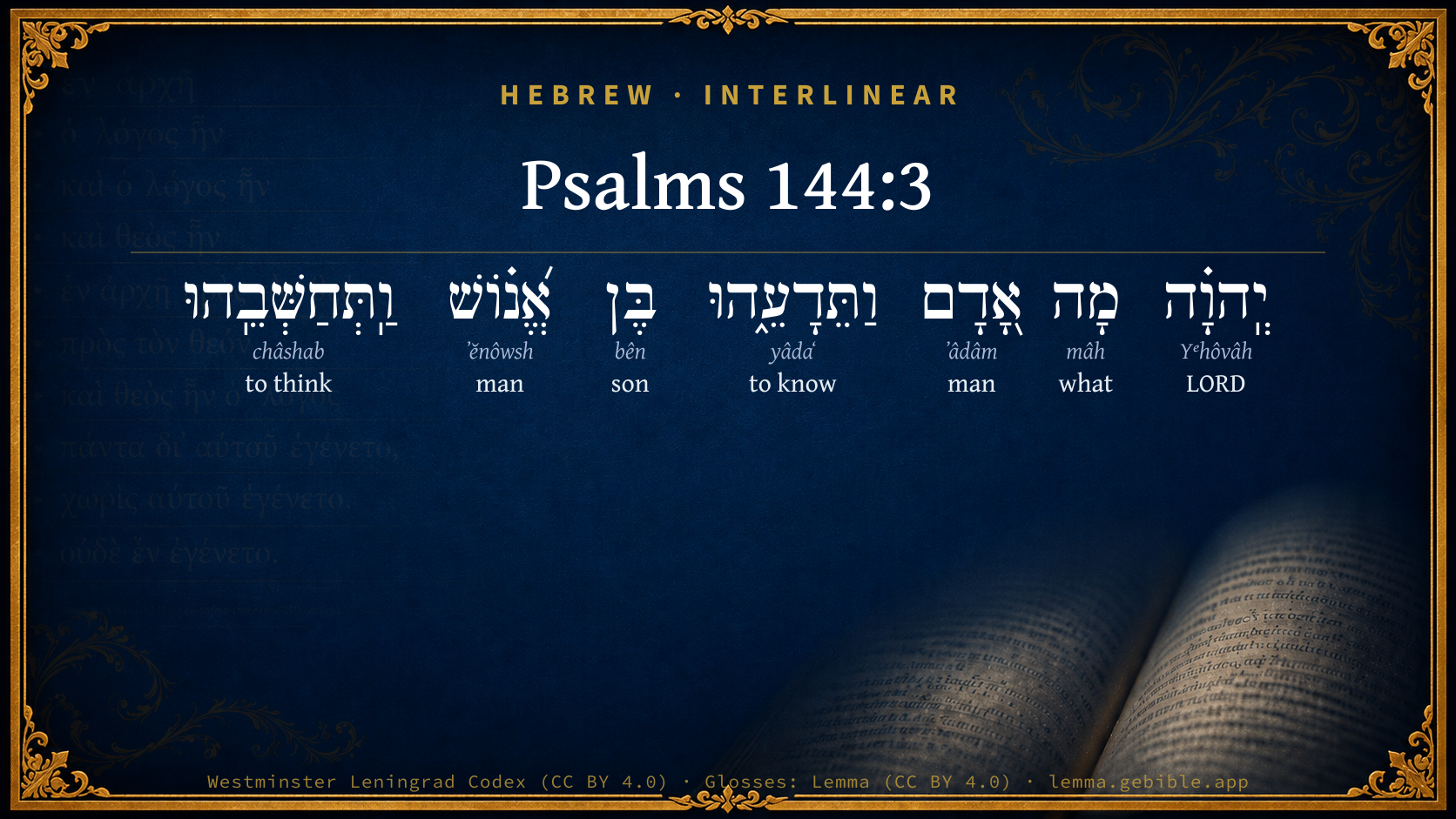
Psalms 144:3

Hebrew (Westminster Leningrad Codex) Psalms 144:3 appears in the Hebrew Old Testament. The text above is from the Westminster Leningrad Codex. Each word links to its Strong’s number, a concise gloss, and parsing drawn from the Open Scriptures Hebrew Bible morphology. Click any word for its full Brown-Driver-Briggs (BDB) entry.
Download image
Cite this verse

Psalms 144:3 (World English Bible). Public Domain. Lemma interlinear Bible study tool, https://lemma.gebible.app/v/psalms/144/3.

Show BibTeX & RIS
BibTeX
RIS
English Translation
Yahweh, what is man, that you care for him? Or the son of man, that you think of him?
World English Bible · Public Domain
Download a study sheet

One document with this verse’s original text, its word-by-word gloss line, the meaning frame, cross-references with their text, attributed commentary, and full source and license credits — printable, and it pastes into notes with its structure intact.

This verse Autodidact and up

Study sheet (.html) Plain text (.txt)

A passage Seminary Student

Up to 50 verses in one chapter. A passage sheet keeps up to 6 commentary sources and 12 cross-references per verse, in the order this page ranks them, and says so on the sheet whenever that leaves anything out. Ask for a single verse and you get the Autodidact verse sheet above.

Everything on this page stays free to read, with no account — the sheet is a download of what is already on screen, not access to it.

Want to remove ads? Support Godless Engineer
Compare translations 3

The same verse in 3 English versions, stacked beneath the original-language interlinear above. Click any original word for its lexicon entry.

Each is an independent rendering of the whole verse — the interlinear is not word-aligned to these translations.

Highlighted words mark where these versions differ — a whole-verse word diff, not a word-by-word alignment.

  • World English Bible Public Domain
    Yahweh, what is man, that you care for him? Or the son of man, that you think of him?
  • King James Version Public Domain
    LORD, what is man, that thou takest knowledge of him! or the son of man, that thou makest account of him!
  • unfoldingWord Literal Text CC BY-SA 4.0
    Yahweh, what man, that you know him, the son of man, that you consider him?

unfoldingWord Literal Text — © unfoldingWord, licensed CC BY-SA 4.0. Word-aligned USFM3 via Door43 (git.door43.org/unfoldingWord/en_ult).

Versions to compare (up to 4)

3 of 4 selected

Show all 18 translations

Every available English version of this verse, each an independent rendering of the whole verse.

  • World English Bible Public Domain
    Yahweh, what is man, that you care for him? Or the son of man, that you think of him?
  • Berean Standard Bible Public Domain
    O LORD, what is man, that You regard him, the son of man that You think of him?
  • Majority Standard Bible Public Domain
    O LORD, what is man, that You regard him, the son of man that You think of him?
  • King James Version Public Domain
    LORD, what is man, that thou takest knowledge of him! or the son of man, that thou makest account of him!
  • American Standard Version (1901) Public Domain
    Jehovah, what is man, that thou takest knowledge of him? Or the son of man, that thou makest account of him?
  • Revised Version (1885) Public Domain
    LORD, what is man, that thou takest knowledge of him? or the son of man, that thou makest account of him?
  • Geneva Bible (1599) Public Domain
    Lord, what is man that thou regardest him! or the sonne of man that thou thinkest vpon him!
  • Douay-Rheims (1899) Public Domain
    For the enemy hath persecuted my soul: he hath brought down my life to the earth. He hath made me to dwell in darkness as those that have been dead of old:
  • Young's Literal Translation Public Domain
    Jehovah, what `is' man that Thou knowest him? Son of man, that Thou esteemest him?
  • Literal Standard Version CC BY-SA 4.0
    YHWH, what [is] man that You know him? The son of man, that You esteem him?
  • Unlocked Literal Bible CC BY-SA 4.0
    Yahweh, what is man that you take notice of him or the son of man that you think about him?
  • unfoldingWord Literal Text CC BY-SA 4.0
    Yahweh, what man, that you know him, the son of man, that you consider him?
  • Darby Bible Public Domain
    Jehovah, what is man, that thou takest knowledge of him, the son of man, that thou takest thought of him?
  • World Messianic Bible Public Domain
    LORD, what is man, that you care for him? Or the son of man, that you think of him?
  • Webster's Bible Public Domain
    LORD, what is man, that thou takest knowledge of him! or the son of man, that thou makest account of him!
  • Free Bible Version CC BY-SA 4.0
    Lord, what are human beings that you should care about them? What are people that you should concern yourself with them?
  • Bible in Basic English Public Domain
    Lord, what is man, that you keep him in mind? or the son of man that you take him into account?
  • JPS Tanakh (1917) Public Domain
    LORD, what is man, that Thou takest knowledge of him? or the son of man, that Thou makest account of him?

Literal Standard Version (2020), Covenant Press — licensed CC BY-SA 4.0. Text via the HelloAO Bible API (eBible.org). Unlocked Literal Bible (unfoldingWord) — licensed CC BY-SA 4.0. Text via the HelloAO Bible API (eBible.org). unfoldingWord Literal Text — © unfoldingWord, licensed CC BY-SA 4.0. Word-aligned USFM3 via Door43 (git.door43.org/unfoldingWord/en_ult). Free Bible Version, Dr. Jonathan Gallagher — licensed CC BY-SA 4.0. Text via the HelloAO Bible API (eBible.org).

Word by word

More ways to search: Search by grammar → Find every occurrence → Compare this word →

Practice this passage: Drill this verse → Learn its vocabulary →

About this verse

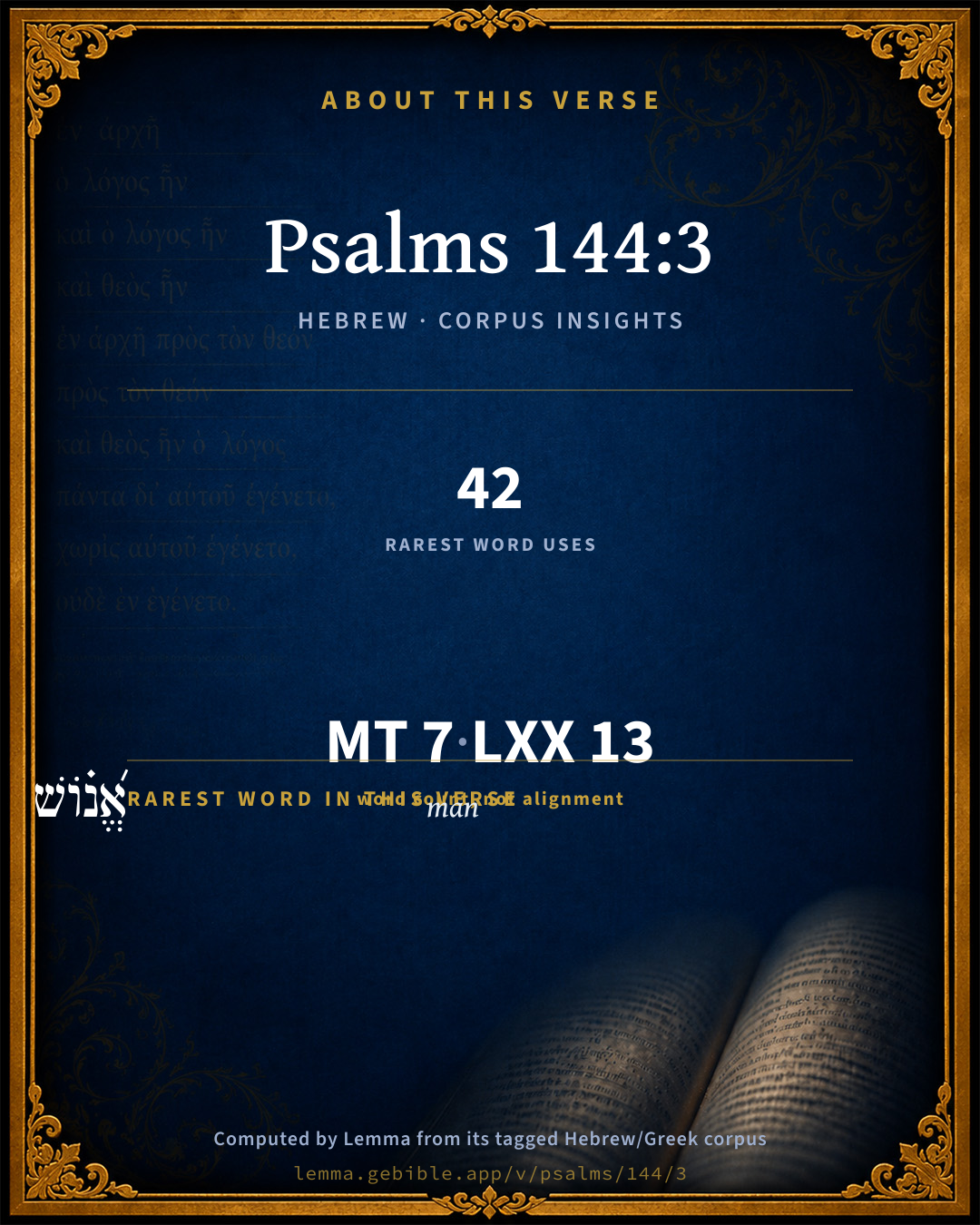
These counts appear in no published source. They are computed here, from the morphology-tagged text and Lemma’s own curated glosses. What Lemma adds →

7
words
7
distinct lemmas
Wisdom
section

Shared distinctive vocabulary

אֱ֝נ֗וֹשׁ man H582 occurs in 41 verses of the Hebrew Bible. Also found in:

Grammatical profile

  • 2 verbs
  • 4 nouns
  • 1 particle

Verb forms

  • וַתֵּדָעֵ֑הוּ Qal · Sequential Imperfect
  • וַֽתְּחַשְּׁבֵֽהוּ Piel · Sequential Imperfect

Hebrew & Septuagint length

In English translation the verse runs 19 words from the Hebrew and 22 from the Septuagint (LXX English) — closely comparable.

A rough comparison of the two English renderings, which tokenize alike — not a word-level alignment.

Word counts can differ between the Hebrew and the Greek without any difference in meaning — e.g. the Hebrew direct-object marker אֵת has no separate Greek word, and Greek often adds the article ὁ.

In the original languages it is 7 Hebrew tokens and 13 Greek tokens — but the two are counted differently (Hebrew bundles its prefixes and suffixes into one token; the Greek is in lemma form), so that isn’t a like-for-like length.

Cross-references

5

Topical passages linked to Psalms 144:3 in the Treasury of Scripture Knowledge — connected by theme and wording, ordered by reader-vote popularity; previews shown in the World English Bible.

  • Psalms 8:4 What is man, that you think of him? The son of man, that you care for him?
  • Job 7:17 What is man, that you should magnify him, That you should set your mind on him,
  • Hebrews 2:6 But one has somewhere testified, saying, "What is man, that you think of him? Or the son of man, that you care for him?
  • Job 15:14 What is man, that he should be clean? He who is born of a woman, that he should be righteous?
  • Psalms 146:3–4 Don't put your trust in princes, Each a son of man in whom there is no help.

Cross-references courtesy of OpenBible.info (CC BY 4.0).

Hebrew and Greek witnesses Masoretic Hebrew ↔ Greek Septuagint

The same verse in the two great witnesses to the Old Testament, shown verse-for-verse.

You’re reading Greek Psalm 143 (Hebrew Psalm 144). The Septuagint counts the superscription, so verse numbers can differ from the Hebrew — chapter-level alignment, not verse-by-verse. Numbering follows Rahlfs.

These are two independent witnesses, not word-aligned to each other, and the Septuagint is shown in lemma (dictionary) form.

Hebrew Psalms 144:3 Masoretic · Westminster Leningrad Codex

יְֽהוָ֗ה מָה אָ֭דָם וַתֵּדָעֵ֑הוּ בֶּן אֱ֝נ֗וֹשׁ וַֽתְּחַשְּׁבֵֽהוּ

Yahweh, what is man, that you care for him? Or the son of man, that you think of him?

World English Bible · Public Domain

Greek LXX Greek Psalm 143:3 Septuagint · lemma form

κύριος τίς εἰμί ἄνθρωπος ὅτι γιγνώσκω αὐτός ἤ υἱός ἄνθρωπος ὅτι λογίζομαι αὐτός

Lord, what is man, that you are made known to him? or the son of man, that you take account of him?

LXX2012 (modern English Septuagint) · Public Domain

On this verse, John Gill's Exposition discusses the Septuagint’s reading. Read the note in Commentary ↓

Hebrew: Westminster Leningrad Codex (CC BY 4.0). Greek: Septuagint (public domain); English from LXX2012 (modern English Septuagint) (Public Domain). How the Septuagint differs from the Hebrew →

Commentary

Notes on Psalms 144:3 from classic Christian and Jewish commentators (each source and its license shown beneath its notes). The classic Christian expositions comment on the surrounding passage and are grouped to its opening verse, so a note may address several verses; the Jewish commentaries on the Tanakh (Rashi and others) are per-verse, so they appear only where the commentator wrote on this verse.

Lemma curates 59 commentaries, every one of them public domain or Creative Commons licensed, each selected and text-cleaned for this edition rather than reprinted as found. About our sources →

Trapp's Complete Commentary

John Trapp

Psa 144:3 LORD, what [is] man, that thou takest knowledge of him! [or] the son of man, that thou makest account of him!

Ver. 3. Lord, what is man?] What am I, that thou shouldest do all this for me? or, what is the strongest man alive, when such a giant as Goliath so suddenly and easily is slain by me?

That thou makest account of him?] Tantus tantillos et tales, saith a Father.

John Trapp, A Commentary or Exposition upon All the Books of the Old and New Testament (1647–1656) — public domain. Text from a community e-Sword module.

The Biblical Illustrator

Joseph S. Exell

Psa_144:3-4

Lord, what is man, that Thou takest knowledge of him!

The vanity of man; and Christianity its antidote

We must take care, in denouncing human depravity, and declaiming on human misery, not to decry human nature; for that would be a procedure of a plainly immoral and irreligious tendency, instead of being praiseworthy; and it would involve untruth.

The temple is in ruins, and the Great Inhabitant is gone. But still we meet, here with a broken shaft, and there with a mutilated wreath; although all only sufficient to awaken melancholy remembrances, and make us say, Here God once dwelt. And yet man is like to vanity; and the moment we have read the text it finds an echo in our bosoms.

I. The vanity of man. There are two words in our Bibles with which we are familiar, Death and Vanity. They are both employed to express the desolate estate into which mans fall has plunged him. Death sometimes includes the sin of that estate as well as its penal consequences. So sometimes does vanity. It is sometimes used as but another name for sin (Psa_12:2; Job_15:35; Rom_1:21; Eph_4:17). But it appears to be the more appropriate function of the Bible-word to express the penal consequences of sin (Job_15:31; Psa_78:33; Rom_8:20). Sin has driven all the originally solid and desirable out of man. It has left him the lifeless, bloodless, unsubstantial ghost of what once he was.

1. The life of man is perishable and ephemeral.

2. It is very far from yielding him satisfaction while it lasts. Man cannot find what he was made to find. He is like a long-lost child, with faint and melancholy recollections lingering in him of a sunny land and a pleasant home. And, closely connected with this, man cannot make of life what he has shrewd suspicions it was given to him that he might make of it. It is soon to end; and yet he knows that he has not been turning it to the right account; and, what is worse, he feels that even yet he cannot do so. Go then it must, and he can make nothing to his satisfaction out of it.

II. Christianity the antidote of human vanity.

1. It brings redemption by the Son of God.

2. It brings regeneration by the Spirit of God.

3. It gives faith in God.

4. It opens up the glorious spiritual world to view, and intercourse, and hope. (H. Angus.)

Man

I. An intellectual problem.

1. What is man in his constitution?

(1) What is he corporeally? Medical science, from the beginning, has concerned itself with this question, and, as yet, has reached no satisfactory solution.

(2) What is he mentally? Psychology has pondered on this question for ages, and has not, up to the present hour, reached a satisfactory explanation.

(3) What is he morally? Ethical science has employed its most earnest efforts in order to find out whether man is a moral being or not, and, if he is, what are his distinguishing faculties, and what his ultimate destiny.

2. What is man in his relations? His relations to the material and the spiritual, the human and the Divine.

3. What is man in his character? Has he fallen from a higher type of character, or is he gradually rising out of a lower? Is his moral character a progressive evolution? Here is the problem, What is man? Truly, says Sir Thomas Browne, the whole creation is a mystery, and particularly that of man. Man, says Carlyle, stands in the centre of nature, his fraction of time encircled by eternity, his hand-breadth of space encircled by infinitude.

II. A religious sentiment.

1. The exclamation assumes that the Almighty does take special notice of man. The shepherd is interested in his one lost sheep. The housewife in her one lost piece of silver. The father in his one lost son.

2. The exclamation breathes the spirit of amazement at this. It is so contrary to what might antecedently have been expected, so contrary to what a guilty conscience would have foreboded. (David Thomas, D. D.)

Worthless man much regarded by the mighty God

I. Scriptural solution of the question.

1. As a creature of God, man is--

(1) A piece of modified dust, enlivened with the breath of God (Gen_2:7; 1Co_15:47).

(2) A potters vessel, that is easily dashed and broken (Psa_2:9; Rom_9:21).

(3) Grass (Isa_40:6-8).

(4) The drop of a bucket, etc. (Isa_40:15).

(5) Nothing, and less than nothing (Isa_40:17).

2. As a fallen creature, man is--

(1) Diseased, overrun with a loathsome leprosy from the crown of the head to the sole of the foot: the disease of sin has invaded the very vitals, insomuch that the very mind and conscience is defiled and wasted, etc.

(2) Ugly and loathsome (Job_15:16).

(3) Impotent and helpless.

(4) Rebellious.

(5) Condemned.

(6) Noxious and hurtful.

(7) Noisome.

(8) Dead (Eph_2:1)

II. What is imported in Gods regarding man, or making account of him.

1. That he is yet not beyond Gods notice and observation.

2. That the regard God shows unto man does not flow from anything in himself.

3. That it is the fruit of His own free grace and sovereign will and pleasure.

4. That God has no need of man.

5. That Gods mercy and love unto man, and the son of man, is of a preventing nature: man is not seeking after God when He takes knowledge of him in a way of mercy.

6. That whatever man be, however despicable, low, and inconsiderable, yet God treats him as if he were some great and considerable person. Hence He is said to magnify him (Job_7:17).

III. Wherein doth God discover His regard unto man?

1. Take a short view of the regard that God shows in common unto all men.

(1) Observe what regard God showed unto man, that petty, poor creature, at his creation.

(2) Consider the regard God shows unto man in the course of His common providence, and that notwithstanding his apostasy.

(a) Although we be all transgressors from the very womb, yet He continues a succession of men upon the earth.

(b) See the wonderful care that God has in and about the formation of man in the womb.

(c) Whenever man is brought into the world, although he is the most helpless creature in himself, yet He has provided the best of help to cherish and preserve him.

2. Take a view of the good of His chosen.

(1) Before time.

(2) In time.

(3) After time ends, in eternity (1Co_2:9).

IV. Show that this is truly wonderful and surprising.

1. It is surprising, if we consider Gods infinite and amazing greatness and glory.

2. It is surprising, if we consider what man is, what a poor, inconsiderable, contemptible creature he is, both as a creature and as a sinner.3. It is surprising and wonderful, because it cannot be conceived or expressed; it runs beyond all thought and all words.

V. Application.

1. See hence the folly of all such as are taken up in admiring any created excellency, either to be found in themselves, or others of the human raze, without running up to the fountain head, an infinite God, from whom all being, beauty, glory, and excellency doth flow.

2. See hence the horrid ingratitude of sinners in waging war against God, who is so good and so kind unto man.

3. See hence the way and method that God takes to lead sinners to repentance: why, He just pursues them with His kindness, and draws them with cords of a man, with bands of love; knowest thou not, O man, that the goodness of God leadeth thee to repentance?

4. Is God so good and so kind to worm man? then see hence, what a reasonable command the first command of the law is, Thou shalt have no other gods before Me.

5. See hence the criminal nature of the sin of unbelief, which is a saying upon the matter, God is not to be trusted, notwithstanding all His kindness, pity, and love to man.

6. Is God so kind to man? worm, worthless many Is the regard that He shows to us so surprising and wonderful? then let us discover a regard to Him, and to everything that belongs to Him.

(1) In His works of nature.

(2) In His works of providence.

(3) In His Christ.

(4) In His Scriptures.

(5) By attending His courts. (E. Erskine.)

The Divine condescension

I. The Great Being who regards--Jehovah.

1. Infinitely blessed in Himself.

(1) Independent.

(2) All-sufficient.

2. He has dominion over all.

3. He is well acquainted with all our conduct.

4. He hates sin with an infinite hatred.

II. The object regarded--man.

1. A most mean object.

2. A most frail being.

3. Singularly poor.

(1) Spiritually destitute.

(2) Spiritually deep in debt.

(3) Unable to escape his creditor.

4. Spiritually loath-some.

5. Full of malignity.

III. The nature of the regard shown by God to man. God hath shown his love to man--

1. By assuming wonderfully gracious characters. David exclaimed, Lord, what is man, etc., immediately after he had been surveying some of Gods principal titles. Blessed be the Lord my strength, etc.

2. By conceiving many kind thoughts about his welfare.

3. By uttering many gracious expressions to him and concerning him.

4. By acting a gracious part towards him.

5. By conferring favours upon him.

6. By what He has endured for him. (E. Brown.)

A fourfold wonder

Consider man--

I. In a state of nature. Of few days, and full of trouble. As soon as we are born, we go astray, speaking lies. Lord, what is man? An immortal creature, and yet his immortality uncared for! A corrupt creature, and yet no holiness sought! A blind creature, and yet no sight implored! A redeemed creature, and yet that redemption slighted and forgotten!

II. In a state of grace. Old things have passed away. Old habits, old associations, old acquaintances, no longer please. All things have become new. The man has new motives, new desires, new feelings, and he delights in the society and friendship of new companions.

III. In a state of torment. Man dieth; man wasteth away; he giveth up the ghost, and where is he? The wicked will rise to shame and everlasting contempt.

IV. In a state of glory. Whom He justifies, them He also glorifies. He gives grace, and He gives glory, and no good thing will He withhold from you, if you are only His children, washed in His blood, sanctified by His Spirit, and robed in His righteousness. (C. Clayton, M. A.)

The Biblical Illustrator, edited by Joseph S. Exell (c. 1880s–1900s) — public domain. Text from a community e-Sword module.

Joseph Benson's Commentary

Psa 144:3-4. Lord, what is man — He magnifies and illustrates God’s goodness to him, by the consideration of his own meanness. Though I am a king over my people, yet, alas, I am but a man, a base, sinful; and mortal creature; if compared with thee, less than nothing and vanity; that thou takest knowledge of him — That thou so much as takest notice, or makest any account of him, especially that thou hast any care over, or kindness for him; or the son of man, &c. — The same thing repeated in other words: see on Psa 8:4; Job 7:17-18. Man — In his nature and continuance in the world; is like to vanity — Or, to a vapour, or a breath, as Isa 57:13, which is gone in an instant. His days are as a shadow that passeth away — That declineth, as Psa 102:11; Psa 109:23, (where see the notes,) or “that glides over the earth, vanishes, and is seen no more. Such was human nature; but the Son of God hath taken it upon himself, rendered it immortal, and exalted it to heaven; whither all will follow him hereafter who follow him now in the paths of righteousness and holiness. It is justly observed here by Dr. Horne, (as had been suggested by Dr. Hammond,) that, “if David, upon the remembrance of what God had done for him, could break forth into this reflection, much more may we do so, for whom the Redeemer hath been manifested in the form of a servant, and in that form hath humbled himself to the death of the cross, to gain the victory over principalities and powers, to put all things under our feet, and to make us partakers of his everlasting kingdom. Lord, what, indeed, is man, or what is the son of such a miserable creature, that thou shouldst take this knowledge, and make this account of him!”

Joseph Benson's Commentary on the Old and New Testaments (1811–1818) — public domain. Text from a community e-Sword module.

Keil & Delitzsch

C. F. Keil & F. Delitzsch

It is evident that Psa 144:3 is a variation of Psa 8:5 with the use of other verbs. ידע in the sense of loving intimacy; חשּׁב, properly to count, compute, here rationem habere. Instead of כּי followed by the future there are consecutive futures here, and בּן־אדם is aramaizingly (בּר אנשׁ) metamorphosed into בּן־אנושׁ. Psa 144:4 is just such another imitation, like a miniature of Psa 39:6., Psa 39:11, cf. Psa 62:10. The figure of the shadow is the same as in Psa 102:12, cf. Psa 109:23. The connection of the third stanza with the second is still more disrupt than that of the second with the first.

Keil & Delitzsch — Biblical Commentary on the Old Testament (1861–1891) — public domain (CC PDM 1.0). Text via the HelloAO Bible API. (Old Testament only.)

J. A. Alexander on Psalms

Joseph Addison Alexander

3. (Psa 144:3) Jehovah, what (is) man, that thou shouldst know him, the son of man, that thou shouldst think of him? The greatness of God's goodness is enhanced by a view of man's insignificance and unworthiness. The original construction seems to be, what is man? (nothing), and (yet) thou knowest him, etc. To know is here to recognise as being in existence, to take notice of. The first man is the generic term, the second one denoting weakness. See above, on Psa 8:4, and compare 2Sa 7:18.

Joseph Addison Alexander, The Psalms Translated and Explained (1850) — public domain. Text from a community e-Sword module.

Tyndale Open Study Notes

Tyndale Open Resources

144:3-4 what are human beings? The same question in 8:4-6 elicits the answer that humans are mere mortals but are also glorious rulers. The psalmist depicts humans as having a transitory, empty existence (see 90:3, 7-10; 102:11; 109:23; 146:4).

Tyndale Open Study Notes — © Tyndale Open Resources, licensed CC BY-SA 4.0. Text via the HelloAO Bible API.

Geneva Bible (1599)

Geneva Bible translators

To give unto God just praise, is to confess ourselves to be unworthy of so excellent benefits, and that he bestoweth them upon us of his free mercy.

Geneva Bible (1599) marginal notes — public domain. Text via Bolls.life.

Adam Clarke's Commentary

Verse 3. Lord, what is man] See Clarke on Ps 8:4; "Ps 8:5". What is Adam, that thou approvest of him? Can he do any thing worthy of thy notice? Or the son of feeble perishing man, that thou shouldest hold him in repute? What care, love, and attention, dost thou lavish upon him!

Adam Clarke's Commentary on the Bible (1810–1826) — public domain. Text from a community e-Sword/MySword module.

John Calvin's Commentaries

3. O Jehovah! what is man, etc. He amplifies the goodness shown by God by instituting a comparison. Having declared how singularly he had been dealt with, he turns his eyes inward, and asks, “Who am I, that God should show me such condescension? “He speaks of man in general; only the circumstance is noticeable that he commends the mercy of God, by considering his lowly and abject condition. In other places he mentions grounds of humiliation of a more personal or private nature, — here he confines himself to what has reference to our common nature; and though even in discussing the nature of man there are other reasons he might have specified why he is unworthy of the regard and love of God, he briefly adverts to his being like the smoke, and as a shadow. “Et mesmes combion qu’en espluchant la nature des hommes il eust peu toucher d’autres choses, pour lesquelles ils sont indignes. — neantmoins,” etc. — Fr.

John Calvin's Commentaries (1540-1563) — public domain. Text from the Calvin Translation Society English edition (1840s-50s) via the Christian Classics Ethereal Library (ccel.org). Calvin's coverage is partial (roughly two-thirds of the Bible); uncommented books and verses are honest gaps, never fabricated. The 19th-century editor's footnotes and remarks are omitted so the notes are faithfully Calvin's own voice.

Ellicott's Commentary for English Readers

(3) See Psa_8:4.

A Bible Commentary for English Readers, edited by Charles John Ellicott (1878–1897) — public domain. Text from a community e-Sword module.

The Cambridge Bible for Schools and Colleges

gen. ed. J. J. S. Perowne

3. A variation of Psa_8:4. Cp. 2Sa_7:18.

3, 4. From the enthusiastic contemplation of Jehovah’s goodness the Psalmist turns to reflect upon the character of the object of it. Man’s insignificance and transitoriness enhance the marvel of God’s gracious care for him.

The Cambridge Bible for Schools and Colleges (gen. ed. J. J. S. Perowne; Cambridge University Press, 1878–1918) — public domain. Text from a community e-Sword module.

John Gill's Exposition

Lord, what is man, that thou takest knowledge of him?.... Man, that is at most and best but a creature, made of the dust of the earth, is but dust and ashes; yea, a sinful creature, that drinks up iniquity like water: and yet the Lord not only knows him, as he is the omniscient God, but takes notice of him in a way of providence, and in a way of grace. His chosen people are no other nor better than others, of the same original, and of the same character; and yet he owns and acknowledges them as his peculiar people, and makes himself known unto them: and so it is rendered by the Septuagint version, "that thou shouldest be known unto him?" or, "appear to him?" as the Arabic; reveal thyself to him, not only by the light of nature and works of creation, but in Christ, and by the spirit of wisdom and revelation in the knowledge of him;

or the son of man, that thou makest account of him? as the Lord does, especially of some of the sons of men; whom he reckons as his portion and inheritance, his jewels and peculiar treasure, and who are as dear to him as the apple of his eye; whom he "magnifies", as in Job 7:17; makes them kings and priests; raises them from the dunghill, and sets them among princes, to inherit the throne of glory; on whom he sets his heart, and loves them with an everlasting love: or, "that thou shouldest think of him?" (g) thoughts of peace, and not of evil; so as to provide a Saviour for men, and send down the Spirit of his Son into their hearts to quicken them; so as to bless them with all spiritual blessings, and at last to glorify them. David no doubt had a special respect to himself; and wondered at the goodness of God to him, in taking him from a family of little or no account, from a mean employ, from a shepherd's cottage, and raising him to the throne of Israel; and especially in making him a partaker of grace, and an heir of glory; see Psa 8:4; which is applied to Christ, Heb 2:6.

(g) "quod cogites de eo", Tigurine version, Vatablus.

John Gill's Exposition of the Whole Bible (1746–1763) — public domain (CC PDM 1.0). Text via the HelloAO Bible API.

Albert Barnes' Notes on the Bible

Lord, what is man, that thou takest knowledge of him? - The sentiment here is the same as in Psa 8:4, though the language is not precisely the same. See the notes at that passage. The word rendered “that thou takest knowledge of him,” means here to take notice of; to regard. The idea is, It is amazing that a being so insignificant as man should be an object of interest to God, or that One so great should pay any attention to him and to his affairs. In Psa 8:4, the language is “that thou art mindful of him,” that is, that thou dost remember him - that thou dost not altogether pass him over. In Psa 8:1-9 the remark is made in view of the heavens as being so exalted in comparison with man, and the wonder is, that in view of worlds so vast occupying the divine attention, and needing the divine care, “man,” so insignificant, does not pass out of his view altogether. Here the remark seems to be made in illustration of the idea that there is no strength in man; that he has no power to accomplish anything of himself; that he is entirely dependent on God.

Or the son of man - Man - any of the race. See the notes at Psa 8:4.

That thou makest account of him! - Psa 8:4, “that thou visitest him.” See the notes at that passage. The word here means “that thou shouldest “think” of him,” that he should ever come into thy thought at all.

Albert Barnes' Notes on the Bible (1834–1885) — public domain. Text from a community e-Sword/MySword module.

Matthew Poole's English Annotations

Lord, what is man he aggravates God’s goodness to him, expressed Psa 144:2, by the consideration of his own meanness. Though I am king over my people, yet, alas, I am but a man. a base, sinful, mortal, and miserable creature; if compared with thee, less than nothing and vanity.

Takest knowledge of him, i.e. hast any care and kindness for him, as words of knowledge commonly imply in Scripture.

Makest account of him; the same thing repeated in other words.

Matthew Poole's English Annotations on the Holy Bible (1683–1685) — public domain. Text from a community e-Sword/MySword module.

The Treasury of David

Charles H. Spurgeon

Ver. 3. LORD, what is man, that thou takest knowledge of him? What a contrast between Jehovah and man! The Psalmist turns from the glorious all sufficiency of God to the insignificance and nothingness of man. He sees Jehovah to be everything, and then cries, "Lord, what is man!" What is man in the presence of the Infinite God? What can he be compared to? He is too little to be described at all; only God, who knows the most minute object, can tell what man is. Certainly he is not fit to be the rock of our confidence: he is at once too feeble and too fickle to be relied upon. The Psalmist's wonder is that God should stoop to know him, and indeed it is more remarkable than if the greatest archangel should make a study of emmets, or become the friend of mites. God knows his people with a tender intimacy, a constant, careful observation: he foreknew them in love, he knows them by care, he will know them in acceptance at last. Why and wherefore is this? What has man done? What has he been? What is he now that God should know him, and make himself known to him as his goodness, fortress, and high tower? This is an unanswerable question. Infinite condescension can alone account for the Lord stooping to be the friend of man. That he should make man the subject of election, the object of redemption, the child of eternal love, the darling of infallible providence, the next of kin to Deity, is indeed a matter requiring more than the two notes of exclamation found in this verse.

Or the son of man, that thou makest account of him! The son of man is a weaker being still, so the original word implies. He is not so much man as God made him, but man as his mother bore him; and how can the Lord think of him, and write down such a cipher in his accounts? The Lord thinks much of man, and in connection with redeeming love makes a great figure of him: this can be believed, but it cannot be explained. Adoring wonder makes us each one cry out, Why dost thou take knowledge of me? We know by experience how little man is to be reckoned upon, and we know by observation how greatly he can vaunt himself, it is therefore meet for us to be humble and to distrust ourselves; but all this should make us the more grateful to the Lord, who knows man better than we do, and yet communes with him, and even dwells in him. Every trace of the misanthrope should be hateful to the believer; for if God makes account of man it is not for us to despise our own kind.

Ver. 3. LORD, what is man, etc.

Now what is man when grace reveals

The virtues of a Saviour's blood?

Again a life divine he feels,

Despises earth, and walks with God.

And what in yonder realms above,

Is ransomed man ordained to be?

With honour, holiness, and love,

No seraph more adorned than he.

Nearest the throne, and first in song.

Man shall his hallelujahs raise,

While wondering angels round him strong,

And swell the chorus of his praise. John Newton, in Olney Hymns.

Ver. 3. LORD, what is man? Take him in his four elements, of earth, air, fire, and water. In the earth, he is as fleeting dust; in the air, he is as a disappearing vapour; in the water, he is as a breaking bubble; and in the fire, he is as consuming smoke. William Seeker, in "The Nonsuch Professor."

Ver. 3-4. LORD, what is man, etc. There is no book so well worthy reading as this living one. Even now David spake as a king of men, of people subdued under him: now he speaks as a humble vassal to God: LORD, what is man that thou takest knowledge of him? In one breath is both sovereignty and subjugation: an absolute sovereignty over his people: My people are subdued under me; an humble subjection to the God of kings; "LORD, what is man?" Yea, in the very same word wherein, is the profession of that sovereignty, there is an acknowledgment of subjection: "Thou hast subdued my people." In that he had a people, he was a king: that they might be his people, a subjection was requisite; and that subjugation was God's, and not his own: "Thou hast subdued." Lo, David had not subdued his people, if God had not subdued them for him. He was a great king, but they were a stiff people: the God that made them swayed them to a due subjection. The great conquerors of worlds could not conquer hearts, if he, that moulded hearts, did not temper them. "By me kings reign", saith the Eternal Wisdom; and he that had courage enough to encounter a bear, a lion, Goliath, yet can say, "Thou hast subdued my people."

Contrarily, in the lowliest subjection of himself, there is an acknowledgment of greatness. Though he abused himself with, "What is man?" yet, withal he adds, "Thou takest knowledge of him, thou makest account of him": and this knowledge, this account of God, doth more exalt man than his own vanity can depress him. My text, then, ye see, is David's rapture, expressed in an ecstatical question of sudden wonder; a wonder at God, and at man: man's vileness; "What is man?" God's mercy and favour, in his knowledge, in his estimation of man. Lo, there are but two lessons that we need to take out here, in the world, God and man; man, in the notion of his wretchedness; God, in the notion of his bounty.

Let us, if you please, take a short view of both; and, in the one, see cause of our humiliation; of our joy and thankfulness in the other: and if, in the former, there be a sad Lent of mortification; there is, in the latter, a cheerful Easter of our raising and exaltation.

Many a one besides David wonders at himself: one wonders at his own honour; and, though he will not say so, yet thinks, "What a great man am I! Is not this great Babel, which I have built?" This is Nebuchadnezzar's wonder. Another wonders at his person, and finds, either a good face, or a fair eye, or an exquisite hand, or a well shaped leg, or some gay fleece, to admire in himself: this was Absalom's wonder. Another wonders at his wit and learning: "How came I by all this? Turba haec! This vulgar, that knows not the law, is accursed": this was the Pharisee's wonder. Another wonders at his wealth; "Soul, take thine ease"; as the epicure in the gospel. David's wonder is as much above, as against all these: he wonders at his vileness: like as the Chosen Vessel would boast of nothing but his infirmities: "LORD, what is man?"

How well this hangs together! No sooner had he said, "Thou hast subdued my people under me", than he adds, "LORD, what is man?" Some vain heart would have been lifted up with a conceit of his own eminence; "Who am I? I am not as other men. I have people under me; and people of my own, and people subdued to me"; this is to be more than a man. I know who hath said, "I said ye are gods." Joseph Hall.

Ver. 3. Dr. Hammond refers this psalm to the slaying of Goliath, and thus understands the appellation "son of man", "David was but a young stripling, the youngest and most inconsiderable of all the sons of Jesse, who also was himself an ordinary man."

Ver. 3. Thou takest knowledge of him. It is a great word. Alas! what knowledge do we take of the gnats that play in the sun; or the ants, or worms, that are crawling in our grounds? Yet the disproportion betwixt us and them is but finite; infinite betwixt God and us. Thou, the Great God of Heaven, to take knowledge of such a thing as man. If a mighty prince shall vouchsafe to spy and single out a plain homely swain in a throng, as the Great Sultan did lately a tankard bearer; and take special notice of him, and call him but to a kiss of his hand and nearness to his person; he boasts of it as a great favour: for thee, then, O God, who abasest thyself to behold the things in heaven itself, to cast thine eye upon so poor a worm as man, it must needs be a wonderful mercy. Exigua pauperibus magna; as Nazianzen to his Amphilochius. Joseph Hall.

Ver. 3. A note of interrogation, exclamation, and admiration.

Ver. 3. The question,

1. Denies any right in man to claim the regard of God.

2. Asserts the great honour God has nevertheless put upon him.

3. Suggests that the true reason of God's generous dealings is the graciousness of his own heart.

4. Implies the becomingness of gratitude and humility.

5. Encourages the most unworthy to put their confidence in God. J.F.

Ver. 3.

1. What was man as he came from the hands of his Creator?

a) Rational.

b) Responsible.

c) Immortal.

d) Holy and happy.

2. What is man in his present condition?

a) Fallen.

b) Guilty.

c) Sinful.

d) Miserable, and helpless in his misery.

3. What is man when he has believed in Christ?

a) Restored to a right relation to God.

b) Restored to a right disposition toward God.

c) He enjoys the influences of the Holy Spirit.

d) He is in process of preparation for the heavenly world.

4. What shall man be when he is admitted into heaven?

a) Free from sin and sorrow.

b) Advanced to the perfection of his nature.

c) Associated with angels.

d) Near to his Saviour and his God.

George Brooks, in "The Homiletic Commentary", 1879.

Ver. 3. Worthless man much regarded by the mighty God. Sermon by Ebenezer Erskine. Works 3, pp. 141-162.

Ver. 3. It is a wonder above all wonders, that ever the great God should make such account of such a thing as man.

1. It will appear if you consider what a great God the Lord is.

2. What a poor thing man is.

3. What a great account the great God hath of this poor thing, man.

Joseph Alleine.

Psalms 144:4*

Charles H. Spurgeon's The Treasury of David (1869–1885) — public domain. Psalms only. Text from a community e-Sword/MySword module.

Whedon's Commentary on the Bible

Daniel D. Whedon

3, 4. Man is like to vanity—The wickedness and weakness of man are in several psalms set forth in this beautiful and impressive language.

Daniel D. Whedon (gen. ed.), Commentary on the Old and New Testaments (1874–1909) — public domain. Text from a community e-Sword module.

The Pulpit Commentary

Lord, what is man, that thou takest knowledge of him! (comp. Job_7:17, 18 Psa_8:4) Or the sea of man, that thou makest account of him! It enhances our estimate of God"s goodness to consider the insignificance and unworthiness of the creatures on whom he bestows it.

Vers. 3, 4. The transitoriness of man.

"The occasion of the introduction of these sentiments here is not quite clear. It may be the humility of the warrior who ascribes all success to God instead of to human prowess; or it may be a reflection uttered over the corpses of comrades; or, perhaps, a blending of the two.

I THE VANITY OF MAN CREATES SURPRISE AT GOD"S CARE. "Lord, what is man, that thou takest knowledge of him?" This is an exclamation of surprise, which is repeated by every devout soul when the frailty of man is brought impressively before him. It is not merely the brevity of life that is in view, nor its uncertainty; it is the smallness of all human doings and aims. Relative to the size of the globe, the highest mountain is but a slight and scarcely perceptible ridge. Relative to the mountain, a single man is scarcely as big as a pin"s head. And what can man accomplish? His mightiest achievements are but as the triumphs of the ants whose work he despises; and he is seldom permitted folly to achieve anything, for he is usually cut off before the thing he intended can be completed. Man is a smaller being than some of the animals, and it is hard to conceive of his doing anything that is really worthy of Divine notice. And yet God does care for man as he cares for nothing else that he has made. We can only wonder over the fact, glory in it, and let it bring home to our hearts the mystery is love.

II THE VANITY OF MAN SHOULD LEAD HIM TO PUT HIMSELF INTO GOD"S CARE. For it is not enough that God should care for us. The joy of that care is not realized until we care that God should thus care. It may be a fact, but it is no helpful, comforting fact until we respond to the fact, accept the care, and voluntarily put ourselves entirely into it. The psalmist here speaks as one who had mastered the depressing influence of his own sense of frailty, by assuring his heart of God"s personal care. That brings to man a sense of dignity which more than matches the sense of frailty. Man may be "crushed before the moth;" but it is also true, he is only "a little lower than the angels," for God yes, the great, eternal God is mindful of him. R.T.

The Pulpit Commentary (1880–1919), ed. H.D.M. Spence-Jones & Joseph S. Exell — public domain. Text from a community e-Sword module.

unfoldingWord translationNotes

Door43 World Missions Community

Yahweh, what is man that you take notice of him or the son of man that you think about him?

These questions can be translated as statements. AT: "Man is so small compared to everything else you have made that I am surprised that you take notice of man and that you think about the son of man" (See: Rhetorical Question)

man ... son of man

two words for human beings. (See: Doublet)

like a breath ... like a passing shadow

The writer compares humans to these thing to emphasize how short their lives are. (See: Simile)

translationWords

Son of Man

breath

shadow

unfoldingWord translationNotes — © Distant Shores Media and the Door43 World Missions Community, licensed CC BY-SA 4.0. Source: git.door43.org/Door43/en_tn.

Rashi

Rabbi Shlomo Yitzchaki (Rashi)

what is man What are Persia [Esau, acc. to mss.] and Ishmael before You that You know them to lavish greatness upon them?

Rashi on the Tanakh — English translations: “The Judaica Press complete Tanach with Rashi, translated by A. J. Rosenberg” (CC BY 4.0); “Pentateuch with Rashi's commentary by M. Rosenbaum and A.M. Silbermann, 1929-1934” (public domain); “The Metsudah Tanach series, Lakewood, N.J” (CC BY 4.0); and “The Book of Joshua, Metsudah Publications, 1997” (CC BY 4.0). Text via Sefaria.

Lesson kit

Teaching starters — assembled from the data on this page, not authored interpretation. Every prompt links to the verse data it draws on. Edit before teaching.

Psalms, in the Wisdom, opens this verse with 7 words (7 distinct Hebrew lemmas). Its most distinctive word is ʼĕnôwsh (“man”). A historical commentator’s framing appears above. Read the whole chapter for the surrounding context.

Discussion questions

  1. The word ʼĕnôwsh carries the sense “man.” How does it shape the verse?
  2. Deuteronomy 32:26 shares the word «man» with this verse. How do the two illuminate each other?
  3. The translations on this page render this verse differently — a whole-verse word diff, not a word-by-word alignment. What might account for the different wordings?
  4. The verb «וַתֵּדָעֵ֑הוּ» is Qal Sequential Imperfect. How does its form color the action?
  5. Reading how Trapp's Complete Commentary and The Biblical Illustrator read this verse, where do the two commentators agree and where do they part?

Things to notice

Reading settings

Reading text

Shown beneath each verse's original-language words.

Old Testament
Old Testament edition

Read the OT as the Masoretic Hebrew (MT) or the Greek Septuagint (LXX).

English shown for the Greek Septuagint (in the Hebrew ↔ Greek comparison).

Comparing translations? Open the Compare panel on any verse page to stack up to four side by side.