
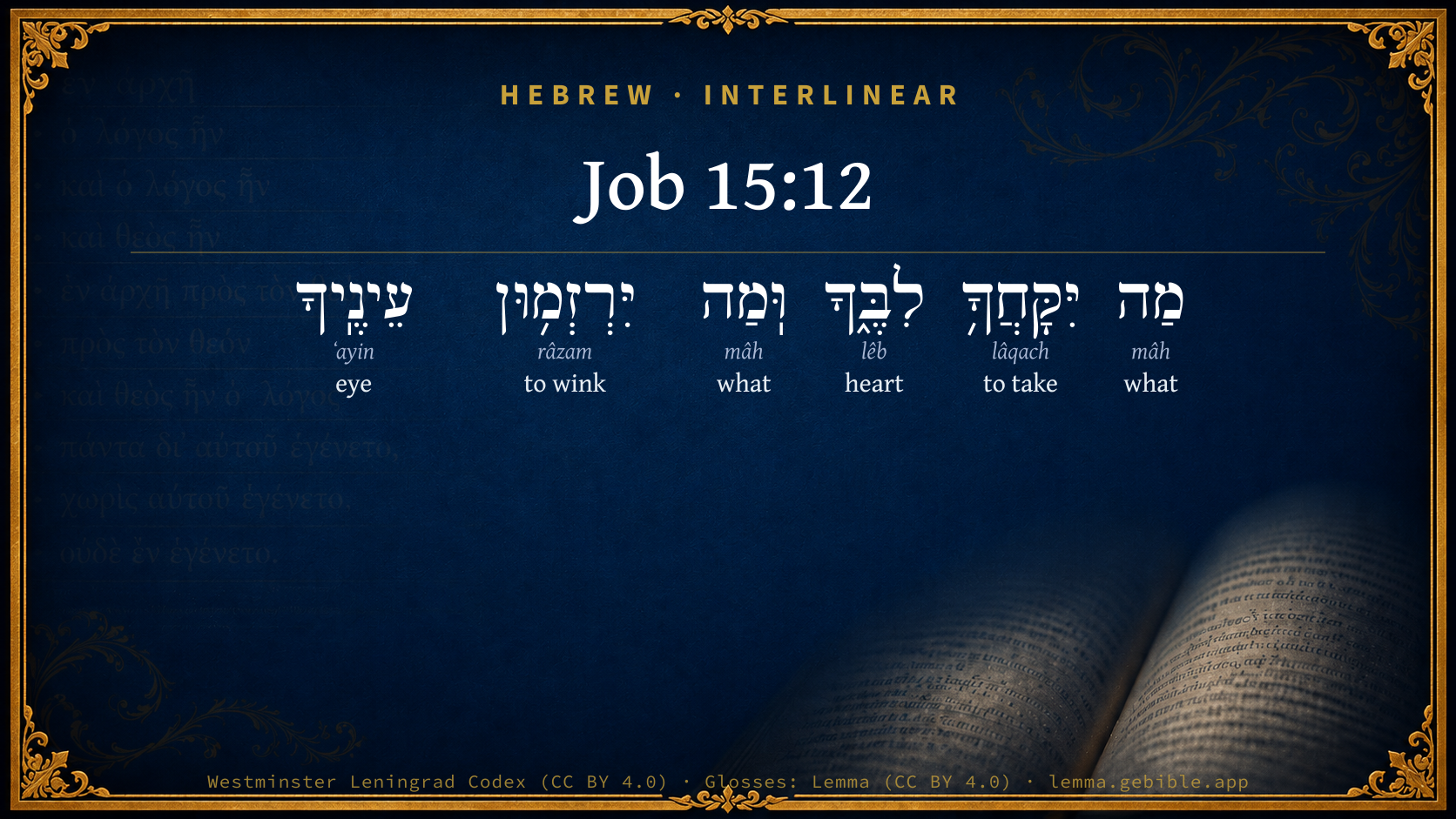
Job 15:12

Hebrew (Westminster Leningrad Codex) Job 15:12 appears in the Hebrew Old Testament. The text above is from the Westminster Leningrad Codex. Each word links to its Strong’s number, a concise gloss, and parsing drawn from the Open Scriptures Hebrew Bible morphology. Click any word for its full Brown-Driver-Briggs (BDB) entry.
Download image
Cite this verse

Job 15:12 (World English Bible). Public Domain. Lemma interlinear Bible study tool, https://lemma.gebible.app/v/job/15/12.

Show BibTeX & RIS
BibTeX
RIS
English Translation
Why does your heart carry you away? Why do your eyes flash,
World English Bible · Public Domain
Highlights
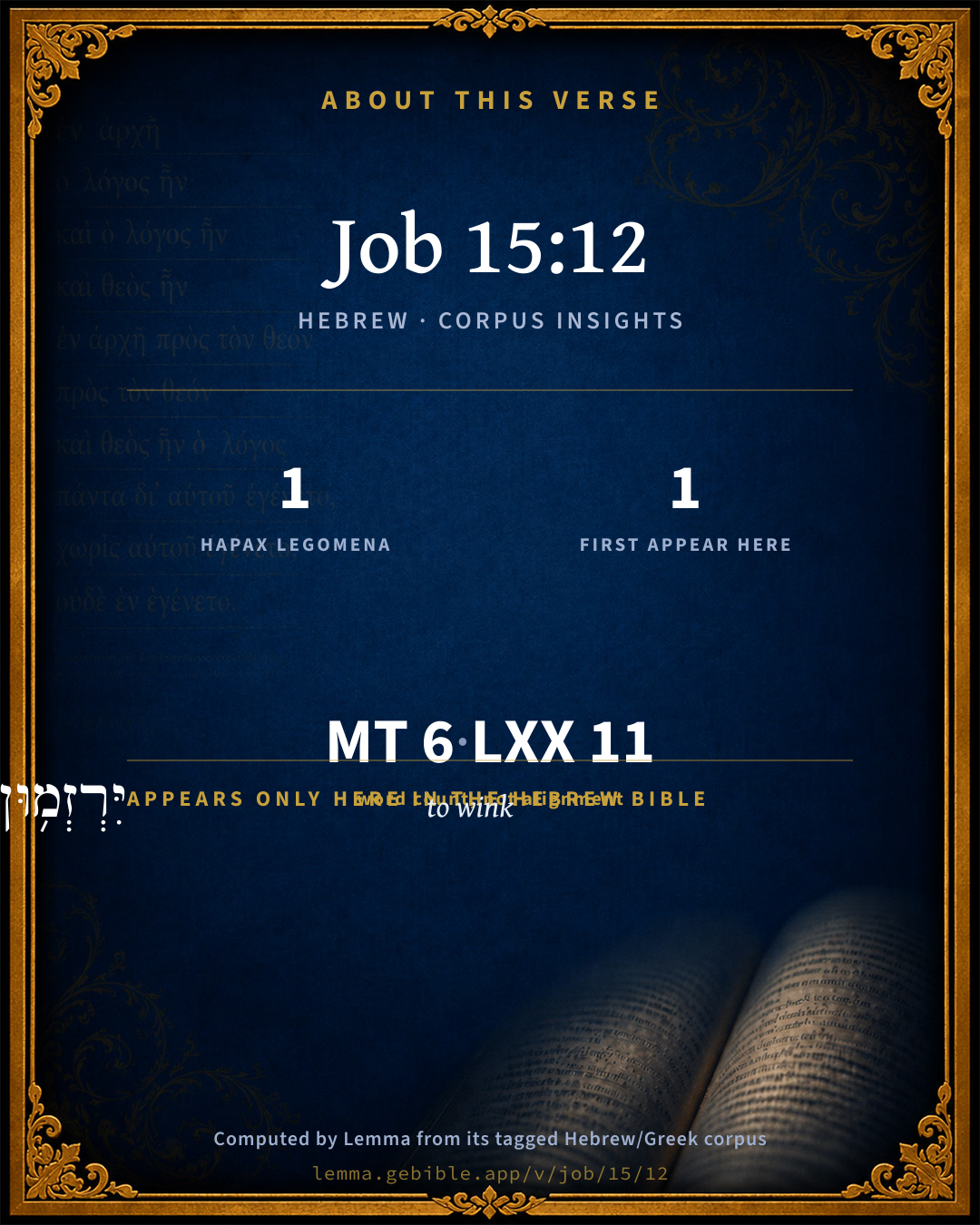
  • 1 hapax legomenon — only here in the Hebrew Bible
  • 1 first appearance in the Hebrew Bible
Full analysis ↓
Download a study sheet

One document with this verse’s original text, its word-by-word gloss line, the meaning frame, cross-references with their text, attributed commentary, and full source and license credits — printable, and it pastes into notes with its structure intact.

This verse Autodidact and up

Study sheet (.html) Plain text (.txt)

A passage Seminary Student

Up to 50 verses in one chapter. A passage sheet keeps up to 6 commentary sources and 12 cross-references per verse, in the order this page ranks them, and says so on the sheet whenever that leaves anything out. Ask for a single verse and you get the Autodidact verse sheet above.

Everything on this page stays free to read, with no account — the sheet is a download of what is already on screen, not access to it.

Want to remove ads? Support Godless Engineer
Compare translations 3

The same verse in 3 English versions, stacked beneath the original-language interlinear above. Click any original word for its lexicon entry.

Each is an independent rendering of the whole verse — the interlinear is not word-aligned to these translations.

Highlighted words mark where these versions differ — a whole-verse word diff, not a word-by-word alignment.

  • World English Bible Public Domain
    Why does your heart carry you away? Why do your eyes flash,
  • King James Version Public Domain
    Why doth thine heart carry thee away? and what do thy eyes wink at,
  • unfoldingWord Literal Text CC BY-SA 4.0
    Why does your heart carry you away and why do your eyes flash,

unfoldingWord Literal Text — © unfoldingWord, licensed CC BY-SA 4.0. Word-aligned USFM3 via Door43 (git.door43.org/unfoldingWord/en_ult).

Versions to compare (up to 4)

3 of 4 selected

Show all 18 translations

Every available English version of this verse, each an independent rendering of the whole verse.

  • World English Bible Public Domain
    Why does your heart carry you away? Why do your eyes flash,
  • Berean Standard Bible Public Domain
    Why has your heart carried you away, and why do your eyes flash,
  • Majority Standard Bible Public Domain
    Why has your heart carried you away, and why do your eyes flash,
  • King James Version Public Domain
    Why doth thine heart carry thee away? and what do thy eyes wink at,
  • American Standard Version (1901) Public Domain
    Why doth thy heart carry thee away? And why do thine eyes flash,
  • Revised Version (1885) Public Domain
    Why doth thine heart carry thee away? and why do thine eyes wink?
  • Geneva Bible (1599) Public Domain
    Why doeth thine heart take thee away, and what doe thine eyes meane,
  • Douay-Rheims (1899) Public Domain
    Why doth thy heart elevate thee, and why dost thou stare with thy eyes, as if they were thinking great things?
  • Young's Literal Translation Public Domain
    What -- doth thine heart take thee away? And what -- are thine eyes high?
  • Literal Standard Version CC BY-SA 4.0
    Why does your heart take you away? And why are your eyes high?
  • Unlocked Literal Bible CC BY-SA 4.0
    Why does your heart carry you away? Why do your eyes flash,
  • unfoldingWord Literal Text CC BY-SA 4.0
    Why does your heart carry you away and why do your eyes flash,
  • Darby Bible Public Domain
    Why doth thy heart carry thee away? and why do thine eyes wink?
  • World Messianic Bible Public Domain
    Why does your heart carry you away? Why do your eyes flash,
  • Webster's Bible Public Domain
    Why doth thy heart carry thee away? and what do thy eyes wink at,
  • Free Bible Version CC BY-SA 4.0
    Why do you let yourself be carried away by your emotions?
  • Bible in Basic English Public Domain
    Why is your heart uncontrolled, and why are your eyes lifted up;
  • JPS Tanakh (1917) Public Domain
    Why doth thy heart carry thee away? And why do thine eyes wink?

Literal Standard Version (2020), Covenant Press — licensed CC BY-SA 4.0. Text via the HelloAO Bible API (eBible.org). Unlocked Literal Bible (unfoldingWord) — licensed CC BY-SA 4.0. Text via the HelloAO Bible API (eBible.org). unfoldingWord Literal Text — © unfoldingWord, licensed CC BY-SA 4.0. Word-aligned USFM3 via Door43 (git.door43.org/unfoldingWord/en_ult). Free Bible Version, Dr. Jonathan Gallagher — licensed CC BY-SA 4.0. Text via the HelloAO Bible API (eBible.org).

Word by word

More ways to search: Search by grammar → Find every occurrence → Compare this word →

Practice this passage: Drill this verse → Learn its vocabulary →

About this verse

These counts appear in no published source. They are computed here, from the morphology-tagged text and Lemma’s own curated glosses. What Lemma adds →

6
words
5
distinct lemmas
Wisdom
section

Notable vocabulary

1 hapax legomenon — a word that appears only here in the entire Hebrew Bible:

  • יִּרְזְמ֥וּן to wink H7335

First appearance in Scripture

This word makes its first canonical appearance in the Hebrew Bible here:

  • יִּרְזְמ֥וּן to wink H7335

Grammatical profile

  • 2 verbs
  • 2 nouns
  • 2 particles

Verb forms

  • יִּקָּחֲךָ֥ Qal · Imperfect
  • יִּרְזְמ֥וּן Qal · Imperfect

Repetition

A word recurs within this verse — often emphatic in Hebrew:

Hebrew & Septuagint length

In English translation the verse runs 12 words from the Hebrew and 12 from the Septuagint (LXX English) — the same length.

A rough comparison of the two English renderings, which tokenize alike — not a word-level alignment.

Word counts can differ between the Hebrew and the Greek without any difference in meaning — e.g. the Hebrew direct-object marker אֵת has no separate Greek word, and Greek often adds the article ὁ.

In the original languages it is 6 Hebrew tokens and 11 Greek tokens — but the two are counted differently (Hebrew bundles its prefixes and suffixes into one token; the Greek is in lemma form), so that isn’t a like-for-like length.

Cross-references

9

Topical passages linked to Job 15:12 in the Treasury of Scripture Knowledge — connected by theme and wording, ordered by reader-vote popularity; previews shown in the World English Bible.

  • Psalms 35:19 Don't let those who are my enemies wrongfully rejoice over me; Neither let them wink with the eye who hate me without a cause.
  • Ecclesiastes 11:9 Rejoice, young man, in your youth, And let your heart cheer you in the days of your youth, And walk in the ways of your heart, And in the sight of your eyes; But know that for all these things God will bring you into judgment.
  • Mark 7:21–22 For from within, out of the hearts of men, proceed evil thoughts, adulteries, sexual sins, murders, thefts,
  • Job 11:13 "If you set your heart aright, Stretch out your hands toward him.
  • Job 17:2 Surely there are mockers with me, My eye dwells on their provocation.
  • Proverbs 6:13 Who winks with his eyes, who signals with his feet, Who motions with his fingers;
  • Acts 5:3–4 But Peter said, "Ananias, why has Satan filled your heart to lie to the Holy Spirit, and to keep back part of the price of the land?
  • Acts 8:22 Repent therefore of this, your wickedness, and ask God if perhaps the thought of your heart may be forgiven you.
  • James 1:14–15 But each one is tempted, when he is drawn away by his own lust, and enticed.

Cross-references courtesy of OpenBible.info (CC BY 4.0).

Hebrew and Greek witnesses Masoretic Hebrew ↔ Greek Septuagint

The same verse in the two great witnesses to the Old Testament, shown verse-for-verse.

These are two independent witnesses, not word-aligned to each other, and the Septuagint is shown in lemma (dictionary) form.

Hebrew Job 15:12 Masoretic · Westminster Leningrad Codex

מַה יִּקָּחֲךָ֥ לִבֶּ֑ךָ וּֽמַה יִּרְזְמ֥וּן עֵינֶֽיךָ

Why does your heart carry you away? Why do your eyes flash,

World English Bible · Public Domain

Greek LXX Job 15:12 Septuagint · lemma form

τίς τολμάω ὁ καρδία σύ ἤ τίς ἐπιφέρω ὁ ὀφθαλμός σύ

What has your heart dared? or what have your eyes aimed at,

LXX2012 (modern English Septuagint) · Public Domain

On this verse, Albert Barnes' Notes on the Bible discusses the Septuagint’s reading. Read the note in Commentary ↓

Hebrew: Westminster Leningrad Codex (CC BY 4.0). Greek: Septuagint (public domain); English from LXX2012 (modern English Septuagint) (Public Domain). How the Septuagint differs from the Hebrew →

Commentary

Notes on Job 15:12 from classic Christian and Jewish commentators (each source and its license shown beneath its notes). The classic Christian expositions comment on the surrounding passage and are grouped to its opening verse, so a note may address several verses; the Jewish commentaries on the Tanakh (Rashi and others) are per-verse, so they appear only where the commentator wrote on this verse.

Lemma curates 59 commentaries, every one of them public domain or Creative Commons licensed, each selected and text-cleaned for this edition rather than reprinted as found. About our sources →

Trapp's Complete Commentary

John Trapp

Job 15:12 Why doth thine heart carry thee away? and what do thy eyes wink at,

Ver. 12. Why doth thine heart carry thee away?] Violently transport thee; sc. beyond all bounds of reason and modesty, Quis te furor cordis exagitat? (Pineda.) There is another charge, and higher than the former, as if he had been emotae mentis, not well in his wits, but wild and wood, as they call it; or, at least, that his passions were so far too hard for his reason, as they did

Rectam de cardine tollere mentem,

We are in no small danger of our naughty hearts. It was no ill prayer of one, Lord, keep me from that naughty man myself, Domine, libera me a malo homine, meipso. Nor was it any ill counsel of another, who said, So take heed to thyself, that thou beware of thyself, Ita cave tibi ut caveas teipsum. Though there were no devil, yet our corrupt nature would act Satan’s part against itself; it would have a supply of wickedness (as a serpent hath of poison) from itself, it hath a spring to feed it. Keep thy heart therefore with all custody, Pro 4:24; it will get away else, and carry thee away with it.

And what do thy eyes wink at?] Nictant, celeriter scilicet, et subtiliter. Possibly Job, through pain and anguish, might be made to wink while he was speaking to them, or they to him; and this they miscontrue as done in contempt. See Psa 35:19. Or that he was plotting some mischief, Pro 10:10; Pro 16:30, or pretending to some extraordinary devotion, and therefore shutting his eyes, that he might be the more reserved to God. The Vulgate hath it, Why doth thine heart lift thee up? and as if thou wert thinking of some great things, why are thine eyes so set? it is for no goodness, sure.

John Trapp, A Commentary or Exposition upon All the Books of the Old and New Testament (1647–1656) — public domain. Text from a community e-Sword module.

The Biblical Illustrator

Joseph S. Exell

Job_15:12

Why doth thine heart carry thee away?

Impulsiveness

Elihu means to say, Why dost thou allow thy feelings to carry thee beyond the boundaries of reason? The vast masses of mankind are the victims of ungoverned impulses. See this--

1. In the formation of friendships. Such impulses often bring the sexes together in a fellowship which does but issue in mutual irritation and disappointment.

2. In the history of religion. The religion of the people is not unfrequently directed by ungoverned impulses, excited by the impassioned appeals of enthusiasts and fanatics.

3. In the current of politics. A few red-hot demagogues and effective stump orators will often turn the whole current of a nations politics. Why doth thine heart carry thee away? Why act from ungoverned impulse?

I. It is unnatural. Mans constitution shows that he was made, not to act from blind instinct, but intelligent motive. And that these motives should be formed by an understanding duly enlightened with a knowledge of the fundamental principles of moral obligation. In fact his constitution shows--

1. That all his passions should be governed by his intellect.

2. That his intellect should be governed by his conscience.

3. That his conscience should be governed by the revealed laws of heaven.

II. It is immoral Man is a responsible being, amenable to his Maker for all the operations of his existence, bound evermore to give an account of himself. When he acts from impulse, he acts as a brute, not as a man; and acting thus he sins against his Maker. That man is responsible is proved--

1. By his own consciousness. He condemns himself when he does not act from the enlightened conviction of duty.

2. By the Word of God. Everywhere, by distinct statements as well as by implications, the Bible holds forth the doctrine of mens responsibility.

III. It is ruinous. A man, or a community of men--whether the community be commercial, political, or religious--who act from ungoverned impulse, is like a vessel tossed on the ocean in a tempest without chart, compass, or pilot to direct it. (Homilist.)

The Biblical Illustrator, edited by Joseph S. Exell (c. 1880s–1900s) — public domain. Text from a community e-Sword module.

Joseph Benson's Commentary

Job 15:12-13. Why doth thy heart carry thee away? — Why dost thou suffer thyself to be transported by the pride of thy heart, to use such unworthy and unbecoming expressions, both concerning us and concerning God and his providence? And what do thine eyes wink at? — Why dost thou look with such an angry, supercilious, and disdainful look? But Buxtorf translates the words, Quid collimant oculi tui? What are thine eyes taking aim at? Or, Quid innuunt? Quorsum spectant? What do they intimate? Or, Whither, what way, or toward what, do they look? The Hebrew, ירזמון, jirzmun, properly signifies to wink with one eye, as those that aim at a mark. That thou turnest thy spirit against God? — Opposest thyself to him, and art become his enemy. He thought Job’s spirit was soured against God, and exasperated at his dealings with him, and so was turned from what it had been: and that this was evident from his letting such words go out of his mouth as reflected on God, and his justice and goodness. But Eliphaz wanted candour and charity, otherwise he would not have put such a harsh construction on the speeches of one that had such a settled reputation for piety, and was now sorely assaulted with temptation. This was, in effect, to give the cause on Satan’s side, and to own that Job had done as Satan said he would, curse God to his face.

Joseph Benson's Commentary on the Old and New Testaments (1811–1818) — public domain. Text from a community e-Sword module.

Whedon's Commentary on the Bible

Daniel D. Whedon

Third strophe — The fundamental error with Job is his ignorance of the true character of sin, Job_15:12-16.

12. Thy eyes — Why do thy eyes twinkle? Job’s impatience at the hypocritical assumption of his friends must have manifested itself through the flashing of his eyes.

Daniel D. Whedon (gen. ed.), Commentary on the Old and New Testaments (1874–1909) — public domain. Text from a community e-Sword module.

Tyndale Open Study Notes

Tyndale Open Resources

15:12 What has weakened your vision (literally Why do your eyes blink): This sentence might be a metaphor for unbelief, or it could indicate winking like a schemer or blinking in disbelief.

Tyndale Open Study Notes — © Tyndale Open Resources, licensed CC BY-SA 4.0. Text via the HelloAO Bible API.

Geneva Bible (1599)

Geneva Bible translators

Why dost thou stand in thine own conceit?

Geneva Bible (1599) marginal notes — public domain. Text via Bolls.life.

Jamieson, Fausset & Brown

Robert Jamieson, A. R. Fausset & David Brown

wink--that is, why do thy eyes evince pride? (Pro 6:13; Psa 35:19).

Jamieson, Fausset & Brown — Commentary Critical and Explanatory on the Whole Bible (1871) — public domain (CC PDM 1.0). Text via the HelloAO Bible API.

Adam Clarke's Commentary

Verse 12. Why doth thine heart carry thee away?] Why is it that thou dost conceive and entertain such high sentiments of thyself?

And what do thy eyes wink at] With what splendid opinion of thyself is thine eye dazzled? Perhaps there is an allusion here to that sparkling in the eye which is excited by sensations of joy and pleasing objects of sight, or to that furious rolling of the eyes observed in deranged persons. Rosenmuller translates thus: -

Quo te tuus animus rapit?

Quid occuli tui vibrantes?

"Whither does thy soul hurry thee?

What mean thy rolling eyes?"

Thou seemest transported beyond thyself; thou art actuated by a furious spirit. Thou art beside thyself; thy words and thy eyes show it.

None but a madman could speak and act as thou dost; for thou turnest thy spirit against God, and lettest such words go out of thy mouth, Job 15:13. This latter sense seems to agree best with the words of the text, and with the context.

Adam Clarke's Commentary on the Bible (1810–1826) — public domain. Text from a community e-Sword/MySword module.

Ellicott's Commentary for English Readers

(12) What do thy eyes wink at?—Or, Why do they wink? as though it was only thou who perceivedst it.

A Bible Commentary for English Readers, edited by Charles John Ellicott (1878–1897) — public domain. Text from a community e-Sword module.

The Cambridge Bible for Schools and Colleges

gen. ed. J. J. S. Perowne

12. what do thine eyes wink at] Rather, wherefore do thine eyes wink? i. e., flash or roll, sign of violent passion. In the first clause “heart” is the excited mind under strong feeling.

12–16. Turning from Job’s arrogant claims to superior wisdom Eliphaz must rebuke his violent and irreverent behaviour towards God: What is man that he should be clean?

The Cambridge Bible for Schools and Colleges (gen. ed. J. J. S. Perowne; Cambridge University Press, 1878–1918) — public domain. Text from a community e-Sword module.

John Gill's Exposition

Why doth thine heart carry thee away?.... To such conceit of thyself, and contempt of others, and even to slight the consolations of God; the heart, being deceitful and wicked, sometimes carries away good men to say and do those things which are unbecoming; and if, in any instance, this was Job's case, it was owing to his own heart, which carried him beyond due bounds; for whenever any man is "tempted" to do evil, "he is drawn away of his own lust", and enticed, Jam 1:14;

and what do thine eyes wink at; conniving at and shutting his eyes against his own sins and iniquities, unwilling to see them, and be convinced of them, and own them; or shutting them against the charges and reproofs of his friends, and all the light and evidence with which they came; or rather as carelessly attending to them, and scoffing and sneering at them: some render it, "what do thine eyes aim at" (c)? as men, when they take an aim at a mark, wink with or shut one eye; what are thy designs? what hast thou in view? what wouldest thou be at, talking and behaving in such a manner as thou dost?

(c) "collimant", Junius & Tremellius, Piscator, Cocceius; so Broughton.

John Gill's Exposition of the Whole Bible (1746–1763) — public domain (CC PDM 1.0). Text via the HelloAO Bible API.

Albert Barnes' Notes on the Bible

Why doth thine heart carry thee away? - Why do you allow your feelings to control you in spite of the decisions of the understanding? Eliphaz means to represent him as wholly under the influence of passion, instead of looking calmly and cooly at things as they were, and listening to the results of past experience and observation.

And what do thy eyes wink at - This expression has given considerable perplexity to commentators. Rosenmuller (and after him Noyes) remarks that the expression indicates pride, haughtiness, and arrogance. In Psa 35:19, it is an indication of joyfulness or triumph over a prostrate foe:

Let not them that are mine enemies wrongfully rejoice over me;

Neither let them wink with the eye that hate me without a cause.

In Pro 6:13, it is an indication of a haughty, froward, self-confident person:

A haughty person, a wicked man,

Walketh with a froward mouth;

He winketh with his eyes,

He speaketh with his feet,

He teacheth with his fingers.

The Hebrew word (רזם râzam) occurs nowhere else, and it is therefore difficult to determine its true signification. The most probable meaning is, to wink with the eyes as a gesture of pride and insolence; compare the notes at Isa 3:16. The Vulgate renders it, attonitos habes oculos? - “Why, as though meditating great things, hast thou eyes of astonishment?” Septuagint, “Why are thine eyes elevated?” Schultens renders it, “Why do thine eyes roll fury?” - Quid fremitum volvunt oculi tui? Luther, “Why art thou so proud? There can be no reasonable doubt that the word conveys the idea of pride and haughtiness manifested in some way by the eyes.

Albert Barnes' Notes on the Bible (1834–1885) — public domain. Text from a community e-Sword/MySword module.

Haydock's Catholic Bible Commentary

Why. Septuagint, "What has thy heart dared, or what have thine eyes brought thee?" Hebrew, "what do thy eyes wink at?" (Haydock) through pride and disdain, Psalm xxxiv. 19., and Proverbs vi. 13. (Calmet) --- We need not wonder that Eliphaz should misunderstand the looks of Job, (Haydock) since he gives such a false notion of his speeches. (Calmet)

George Leo Haydock (1774–1849), Haydock's Catholic Family Bible and Commentary, 1859 edition — public domain. Excludes Psalms (Douay-Rheims chapter numbering differs from Protestant) and Deuterocanonical books (Catholic canon only).

Matthew Poole's English Annotations

Why dost thou suffer thyself to be transported by the pride and lusts of thy heart to use such unworthy and unbecoming expressions, both concerning us, and concerning God and his providence.

What do thine eyes wink at, i.e. what dost thou aim at? What benefit dost thou expect from such words and carriages? So it is a metaphor from archers, who wink when they take their aim at a mark. Or, why do thine eyes wink, i.e. why dost thou look with such an angry, supercilious, and disdainful look, expressing both thy contempt of us, and thy rage against God? The eye is observed both by God and men, as the great discoverer of the heart; and winking with the eye is a note of a malicious mind, Psa 35:9; Pro 6:13; 10:10.

Matthew Poole's English Annotations on the Holy Bible (1683–1685) — public domain. Text from a community e-Sword/MySword module.

The Pulpit Commentary

Why doth thine heart carry thee away? or, Whither doth thine heart carry thee away? i.e. to what a pitch of presumption and audacity do thy proud thoughts carry thee? And what do thy eyes wink at? or, Wherefore do thy eyes roll? The verb used occurs only in this place. Its meaning is very doubtful.

Heart-wanderings.

Eliphaz cannot understand Job. He will assume that the sufferer is guilty, and that, when he protests his innocence and refuses the consolations offered on condition of repentance, the patriarch is betrayed by his own heart into turning his spirit against God. As usual, what Eliphaz says, though it is not applicable directly to Job, still in itself contains an important lesson.

I WE ARE LED BY OUR HEARTS.

1. The inner life. All life flows outward from hidden, deep-seated springs, as the Jordan at Banias bursts out of the cave of Pan beneath Mount Hermon, a full river, whose secret origin is too remote and deep for any man to discover it.

2. The thought. The heart in the Bible stands for the whole inner life, and therefore it includes the thinking faculty. Now, we are governed largely by our ideas of things; not by things as they are, but by things as they appear to us. Therefore we need to think truly.

3. The affections and desires. We are chiefly moved by what we love. The love of sin is the parent of sin. If the heart is betrayed into entertaining low desires, a degraded conduct follows.

II OUR HEARTS ARE PRONE TO ERR.

1. I n weakness. We have not fixed thoughts and affections. The life within is in continuous change and movement. At the same time, its weakness makes it peculiarly liable to be led astray.

2. I n sinful inclination. We inherit tendencies to evil. Our own self-chosen conduct creates habits of evil. Thus our heart tends downward. Left to itself, it will go astray and drag us down to ruin. The human heart is ever wandering and rebellious until it has been renewed.

III THE WANDERING HEART LEADS TO RUIN. We are tempted to neglect the evil on three accounts.

1. That it is internal. Thus it seems to be a secret thing, not concerned with conduct. But as it is the spring of all our conduct, the excuse is a delusion.

2. That it is under our control. The idea is that we can stop before we have gone too far. We are not the slaves of another, we are our own masters. This is also a delusion, for the heart gets out of control.

3. That it only concerns ourselves. It is only our heart that wanders, and our heart is our own possession. This is to assume that we are not accountable to God. But the supreme Judge takes account of the heart as well as of the outward act, and condemns for heart-sins. (Mat_15:19)

IV THE WANDERING HEART NEEDS TO BE RENEWED. Sin comes from the heart; then sin must be cured in the heart. Clean hands are of little use without a clean heart.

1. Cleansing. The guilt of sin needs to he washed away; the love and desire of sin also need to be pureed out of the heart. This is so difficult a work that only the Creator can do it. "Create in me a clean heart, O God". (Psa_51:10)

2. Recovery. The wandering heart must be brought back to God. It is not enough that sin is cast out. The love of God must be planted, and the heart must be restored to fellowship with God. These are blessings which come with the reception of Christ into the heart.

3. Preservation. We are bidden to keep our heart with all diligence. (Pro_4:23) But we find the treacherous heart eluding our utmost vigilance, and wandering in spite of all our care. Therefore we have to find safety in obeying a second command, "My son, give me thy heart". W.F.A. (Pro_23:26)

The Pulpit Commentary (1880–1919), ed. H.D.M. Spence-Jones & Joseph S. Exell — public domain. Text from a community e-Sword module.

John Wesley's Explanatory Notes

Why - Why dost thou suffer thyself to be transported by the pride of thine heart, to use such unworthy expressions? Wink - Why dost thou look with such an angry, supercilious, and disdainful look?

John Wesley, Explanatory Notes Upon the Whole Bible (1754–1765) — public domain. Text via the GEBible commentary corpus.

unfoldingWord translationNotes

Door43 World Missions Community

Why does your heart carry you away?

Here the "heart" represents a person's emotions. AT: "Why do your emotions take you away?" or "Why do you allow your emotions to guide your decisions?" (See: Metonymy and Idiom)

Why do your eyes flash

This probably refers to Job appearing angry, specifically the appearance of his eyes. AT: "Why do your eyes look angry" or "Why are you angry" (See: Assumed Knowledge and Implicit Information)

turn your spirit

Here the "spirit" refers to the whole person. AT: "turn yourself" (See: Synecdoche)

bring out such words from your mouth

This describes him speaking. AT: "so you say harsh things against him" (See: Assumed Knowledge and Implicit Information)

What is man ... What is he who is born

These two questions are basically the same and are used together to emphasize that a man cannot be perfect. (See: Parallelism)

What is man that he should be clean?

This rhetorical question is asked to emphasize that a man cannot be completely "clean." This can be written as a statement. AT: "A man, he cannot be completely clean." (See: Rhetorical Question)

clean

A person who God considers spiritually acceptable is spoken of as if the person were physically clean. (See: Metaphor)

What is he who is born of a woman that he should be righteous?

This rhetorical question is asked to emphasize that a man cannot be completely "righteous." This can be written as a statement. AT: "A man who is born from a woman cannot be completely righteous." (See: Rhetorical Question)

translationWords

heart

turn

spirit

clean

righteous

unfoldingWord translationNotes — © Distant Shores Media and the Door43 World Missions Community, licensed CC BY-SA 4.0. Source: git.door43.org/Door43/en_tn.

Rashi

Rabbi Shlomo Yitzchaki (Rashi)

teach you Heb. יקחך, teach you, as in (Deut. 32:2), “so that my teaching (לקחי) may drip like rain.”

hint Heb. ירזמון, like יִרְמְזוּן; like שַׂלְמָה שִׂמְלָה (Exod. 22:8, 26).

Rashi on the Tanakh — English translations: “The Judaica Press complete Tanach with Rashi, translated by A. J. Rosenberg” (CC BY 4.0); “Pentateuch with Rashi's commentary by M. Rosenbaum and A.M. Silbermann, 1929-1934” (public domain); “The Metsudah Tanach series, Lakewood, N.J” (CC BY 4.0); and “The Book of Joshua, Metsudah Publications, 1997” (CC BY 4.0). Text via Sefaria.

Lesson kit

Teaching starters — assembled from the data on this page, not authored interpretation. Every prompt links to the verse data it draws on. Edit before teaching.

Job, in the Wisdom, opens this verse with 6 words (5 distinct Hebrew lemmas). Its most distinctive word is râzam (“to wink”). A historical commentator’s framing appears above. Read the whole chapter for the surrounding context.

Discussion questions

  1. How does “to wink” (râzam) shape what this verse is saying?
  2. This verse holds 1 word here found nowhere else in the Hebrew Bible. What might the rare word draw attention to?
  3. The word “to wink” first appears here in Scripture. What is being introduced at this debut?
  4. Psalms 35:19 shares this passage’s theme. How do the two illuminate each other?
  5. “what” occurs 2× in this one verse. What is the effect of the repetition?
  6. These translations render this verse differently; the difference is in the English rendering, not the original. What questions does that raise?
  7. The verb «יִּקָּחֲךָ֥» is Qal Imperfect. How does its form color the action?
  8. Reading how Trapp's Complete Commentary and The Biblical Illustrator read this verse, where do the two commentators agree and where do they part?

Things to notice

  • 1 word in this verse appears nowhere else in the Hebrew Bible.
  • 1 word makes its first canonical appearance in Scripture here.
  • This verse counts 6 Hebrew ↔ 11 Greek words.
  • These translations choose different wording for 5 words in this verse.
  • “what” occurs 2× in this single verse.

Reading settings

Reading text

Shown beneath each verse's original-language words.

Old Testament
Old Testament edition

Read the OT as the Masoretic Hebrew (MT) or the Greek Septuagint (LXX).

English shown for the Greek Septuagint (in the Hebrew ↔ Greek comparison).

Comparing translations? Open the Compare panel on any verse page to stack up to four side by side.