
Ezekiel 18:2

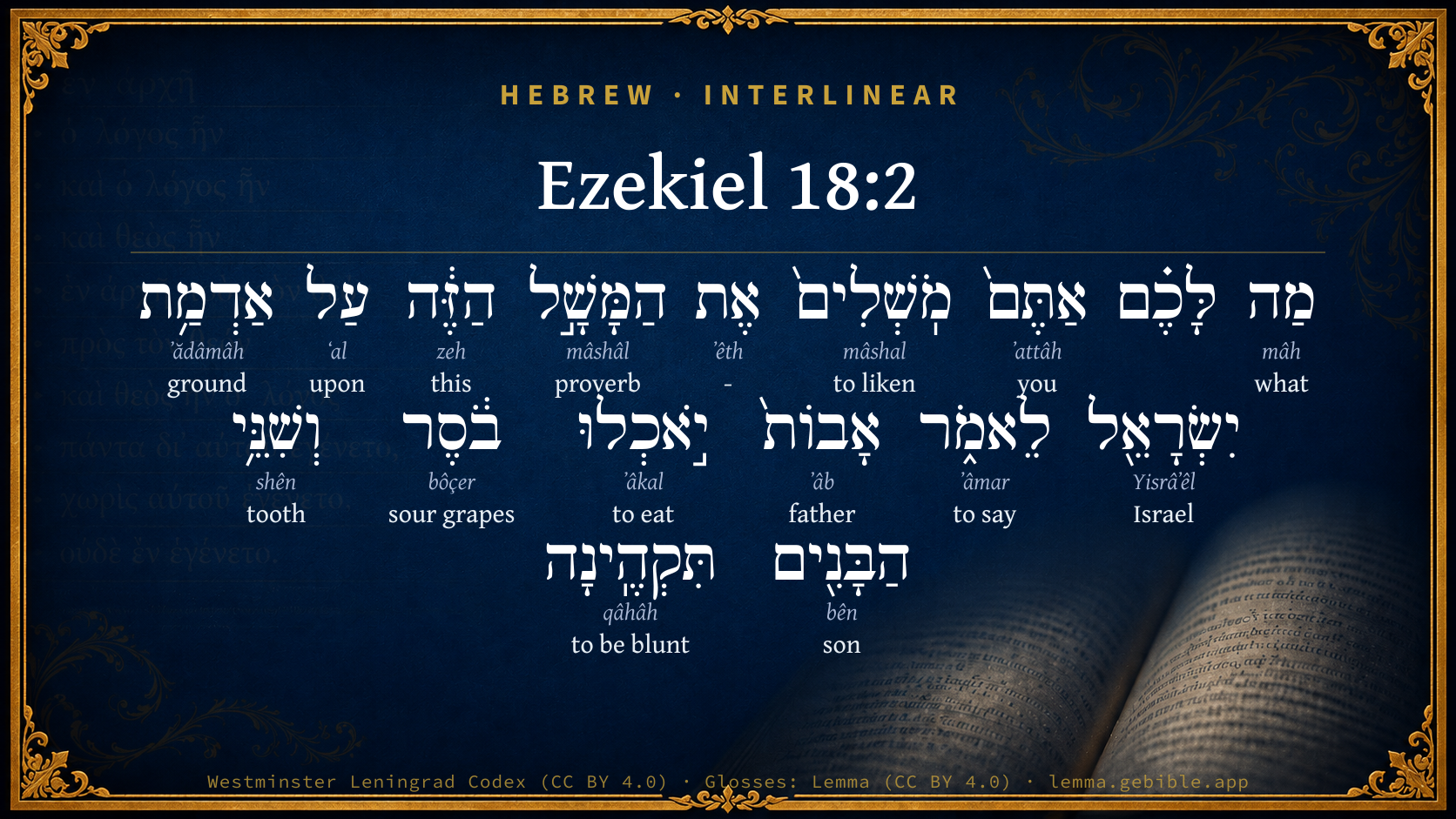
Hebrew (Westminster Leningrad Codex) Ezekiel 18:2 appears in the Hebrew Old Testament. The text above is from the Westminster Leningrad Codex. Each word links to its Strong’s number, a concise gloss, and parsing drawn from the Open Scriptures Hebrew Bible morphology. Click any word for its full Brown-Driver-Briggs (BDB) entry.
Download image
Cite this verse

Ezekiel 18:2 (World English Bible). Public Domain. Lemma interlinear Bible study tool, https://lemma.gebible.app/v/ezekiel/18/2.

Show BibTeX & RIS
BibTeX
RIS
English Translation
What do you mean, that you use this proverb concerning the land of Israel, saying, The fathers have eaten sour grapes, and the children's teeth are set on edge?
World English Bible · Public Domain
Download a study sheet

One document with this verse’s original text, its word-by-word gloss line, the meaning frame, cross-references with their text, attributed commentary, and full source and license credits — printable, and it pastes into notes with its structure intact.

This verse Autodidact and up

Study sheet (.html) Plain text (.txt)

A passage Seminary Student

Up to 50 verses in one chapter. A passage sheet keeps up to 6 commentary sources and 12 cross-references per verse, in the order this page ranks them, and says so on the sheet whenever that leaves anything out. Ask for a single verse and you get the Autodidact verse sheet above.

Everything on this page stays free to read, with no account — the sheet is a download of what is already on screen, not access to it.

Want to remove ads? Support Godless Engineer
Compare translations 3

The same verse in 3 English versions, stacked beneath the original-language interlinear above. Click any original word for its lexicon entry.

Each is an independent rendering of the whole verse — the interlinear is not word-aligned to these translations.

Highlighted words mark where these versions differ — a whole-verse word diff, not a word-by-word alignment.

  • World English Bible Public Domain
    What do you mean, that you use this proverb concerning the land of Israel, saying, The fathers have eaten sour grapes, and the children's teeth are set on edge?
  • King James Version Public Domain
    What mean ye, that ye use this proverb concerning the land of Israel, saying, The fathers have eaten sour grapes, and the children's teeth are set on edge?
  • unfoldingWord Literal Text CC BY-SA 4.0
    “What do you mean, you who use this proverb concerning the land of Israel and say, ‘Fathers eat sour grapes, and the children’s teeth are made blunt’?

unfoldingWord Literal Text — © unfoldingWord, licensed CC BY-SA 4.0. Word-aligned USFM3 via Door43 (git.door43.org/unfoldingWord/en_ult).

Versions to compare (up to 4)

3 of 4 selected

Show all 18 translations

Every available English version of this verse, each an independent rendering of the whole verse.

  • World English Bible Public Domain
    What do you mean, that you use this proverb concerning the land of Israel, saying, The fathers have eaten sour grapes, and the children's teeth are set on edge?
  • Berean Standard Bible Public Domain
    “What do you people mean by quoting this proverb about the land of Israel: ‘The fathers have eaten sour grapes, and the teeth of the children are set on edge’?
  • Majority Standard Bible Public Domain
    “What do you people mean by quoting this proverb about the land of Israel: ‘The fathers have eaten sour grapes, and the teeth of the children are set on edge’?
  • King James Version Public Domain
    What mean ye, that ye use this proverb concerning the land of Israel, saying, The fathers have eaten sour grapes, and the children's teeth are set on edge?
  • American Standard Version (1901) Public Domain
    What mean ye, that ye use this proverb concerning the land of Israel, saying, The fathers have eaten sour grapes, and the children's teeth are set on edge?
  • Revised Version (1885) Public Domain
    What mean ye, that ye use this proverb concerning the land of Israel, saying, The fathers have eaten sour grapes, and the children’s teeth are set on edge?
  • Geneva Bible (1599) Public Domain
    What meane ye that ye speake this prouerbe, concerning the land of Israel, saying, The fathers haue eaten sowre grapes, and the childrens teeth are set on edge?
  • Douay-Rheims (1899) Public Domain
    That you use among you this parable as a proverb in the land of Israel, saying: The fathers have eaten sour grapes, and the teeth of the children are set on edge.
  • Young's Literal Translation Public Domain
    `What -- to you, ye -- using this simile Concerning the ground of Israel, saying: Fathers do eat unripe fruit, And the sons' teeth are blunted?
  • Literal Standard Version CC BY-SA 4.0
    “What [is it] to you [that] you are using this allegory || Concerning the ground of Israel, saying, || Fathers eat unripe fruit, || And the sons’ teeth are blunted?
  • Unlocked Literal Bible CC BY-SA 4.0
    “What do you mean, you who use this proverb concerning the land of Israel and say, 'Fathers eat sour grapes, and the children's teeth are made blunt'?
  • unfoldingWord Literal Text CC BY-SA 4.0
    “What do you mean, you who use this proverb concerning the land of Israel and say, ‘Fathers eat sour grapes, and the children’s teeth are made blunt’?
  • Darby Bible Public Domain
    What mean ye, ye who use this proverb of the land of Israel, saying, [The] fathers eat sour grapes, and the children's teeth are set on edge?
  • World Messianic Bible Public Domain
    “What do you mean, that you use this proverb concerning Eretz-Israel, saying, ‘The fathers have eaten sour grapes, and the children’s teeth are set on edge’?
  • Webster's Bible Public Domain
    What mean ye, that ye use this proverb concerning the land of Israel, saying, The fathers have eaten sour grapes, and the children's teeth are set on edge?
  • Free Bible Version CC BY-SA 4.0
    “What's this proverb you people are quoting about the country of Israel: ‘The fathers ate the unripe grapes, but their children got the sour taste’?
  • Bible in Basic English Public Domain
    Why do you make use of this saying about the land of Israel, The fathers have been tasting bitter grapes and the children's teeth are on edge?
  • JPS Tanakh (1917) Public Domain
    'What mean ye, that ye use this proverb in the land of Israel, saying: The fathers have eaten sour grapes, and the children's teeth are set on edge?

Literal Standard Version (2020), Covenant Press — licensed CC BY-SA 4.0. Text via the HelloAO Bible API (eBible.org). Unlocked Literal Bible (unfoldingWord) — licensed CC BY-SA 4.0. Text via the HelloAO Bible API (eBible.org). unfoldingWord Literal Text — © unfoldingWord, licensed CC BY-SA 4.0. Word-aligned USFM3 via Door43 (git.door43.org/unfoldingWord/en_ult). Free Bible Version, Dr. Jonathan Gallagher — licensed CC BY-SA 4.0. Text via the HelloAO Bible API (eBible.org).

Word by word

More ways to search: Search by grammar → Find every occurrence → Compare this word →

Practice this passage: Drill this verse → Learn its vocabulary →

בֹ֔סֶר
bôçer
H1155
“sour grapes”
Noun, Common, Masculine, Singular, Absolute
Part of Speech
Noun
Type
Common
Gender
Masculine
Number
Singular
State
Absolute
Full BDB Definition

Origin: from the same as H1154

TWOT: 257a

unripe grapes, sour grapes
  1. מַה mâh H4100 “what” Particle, Interrogative
  2. אַתֶּם֙ ʼattâh H859 “you” Pronoun, Personal, 2nd Person, Masculine, Plural
  3. מֹֽשְׁלִים֙ mâshal H4911 “likening” Verb, Qal, Participle Active, Masculine, Plural, Absolute
  4. אֶת ʼêth H853 “-” Particle, Direct Object
  5. הַמָּשָׁ֣ל mâshâl H4912 “the · proverb” Particle, Definite Article + Noun, Common, Masculine, Singular, Absolute
  6. הַזֶּ֔ה zeh H2088 “the · this” Particle, Definite Article + Pronoun, Demonstrative, Masculine, Singular
  7. עַל ʻal H5921 “upon” Preposition
  8. אַדְמַ֥ת ʼădâmâh H127 “ground of” Noun, Common, Feminine, Singular, Construct
  9. יִשְׂרָאֵ֖ל Yisrâʼêl H3478 “Israel” Noun, Proper
  10. לֵאמֹ֑ר ʼâmar H559 “to say” Preposition + Verb, Qal, Infinitive Construct
  11. אָבוֹת֙ ʼâb H1 “fathers” Noun, Common, Masculine, Plural, Absolute
  12. יֹ֣אכְלוּ ʼâkal H398 “to eat” Verb, Qal, Imperfect, 3rd Person, Masculine, Plural
  13. וְשִׁנֵּ֥י shên H8127 “and · teeth of” Conjunction + Noun, Common, Both, Dual, Construct
  14. הַבָּנִ֖ים bên H1121 “the · sons” Particle, Definite Article + Noun, Common, Masculine, Plural, Absolute
  15. תִּקְהֶֽינָה qâhâh H6949 “to be blunt” Verb, Qal, Imperfect, 3rd Person, Feminine, Plural

About this verse

These counts appear in no published source. They are computed here, from the morphology-tagged text and Lemma’s own curated glosses. What Lemma adds →

17
words
16
distinct lemmas
Prophets
section

Notable vocabulary

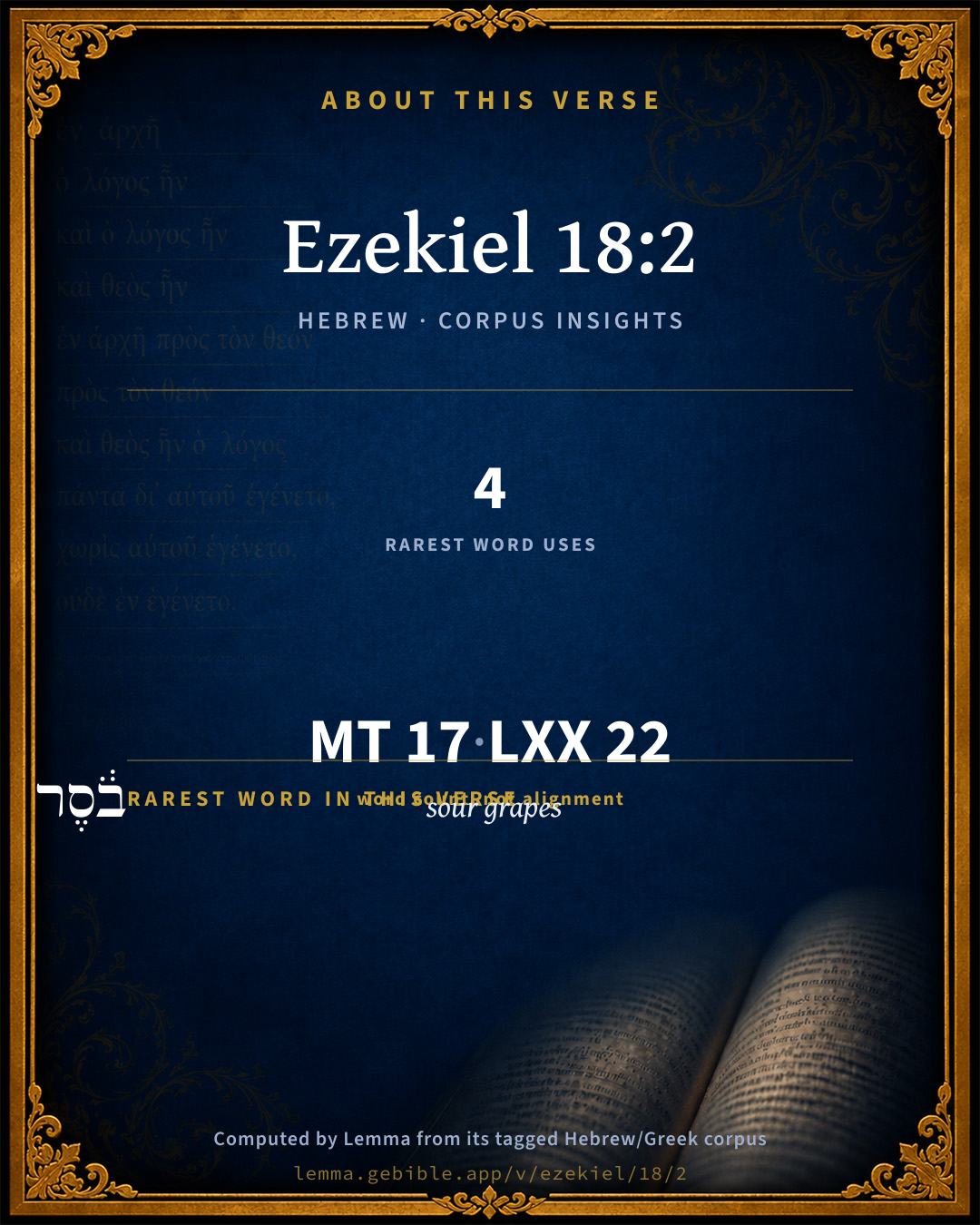
The rarest word here is בֹ֔סֶר sour grapes H1155 — appearing just 4 times in the whole Hebrew Bible.

Shared distinctive vocabulary

בֹ֔סֶר sour grapes H1155 occurs in 4 verses of the Hebrew Bible. Also found in:

Grammatical profile

  • 4 verbs
  • 7 nouns
  • 2 pronouns
  • 2 prepositions
  • 2 particles

Verb forms

  • מֹֽשְׁלִים֙ Qal · Participle Active
  • לֵאמֹ֑ר Qal · Infinitive Construct
  • יֹ֣אכְלוּ Qal · Imperfect
  • תִּקְהֶֽינָה Qal · Imperfect

Hebrew & Septuagint length

In English translation the verse runs 29 words from the Hebrew and 30 from the Septuagint (LXX English) — closely comparable.

A rough comparison of the two English renderings, which tokenize alike — not a word-level alignment.

Word counts can differ between the Hebrew and the Greek without any difference in meaning — e.g. the Hebrew direct-object marker אֵת has no separate Greek word, and Greek often adds the article ὁ.

In the original languages it is 17 Hebrew tokens and 22 Greek tokens — but the two are counted differently (Hebrew bundles its prefixes and suffixes into one token; the Greek is in lemma form), so that isn’t a like-for-like length.

Cross-references

14

Topical passages linked to Ezekiel 18:2 in the Treasury of Scripture Knowledge — connected by theme and wording, ordered by reader-vote popularity; previews shown in the World English Bible.

  • Jeremiah 31:29–30 In those days they shall say no more, The fathers have eaten sour grapes, and the children's teeth are set on edge.
  • Lamentations 5:7 Our fathers sinned, and are no more; We have borne their iniquities.
  • Ezekiel 37:11 Then he said to me, Son of man, these bones are the whole house of Israel: behold, they say, Our bones are dried up, and our hope is lost; we are clean cut off.
  • Ezekiel 37:19 tell them, Thus says the Lord Yahweh: Behold, I will take the stick of Joseph, which is in the hand of Ephraim, and the tribes of Israel his companions; and I will put them with it, [even] with the stick of Judah, and make them one stick, and they shall be one in my hand.
  • Ezekiel 17:12 Say now to the rebellious house, Don't you know what these things mean? tell them, Behold, the king of Babylon came to Jerusalem, and took the king of it, and the princes of it, and brought them to him to Babylon:
  • Ezekiel 37:25 They shall dwell in the land that I have given to Jacob my servant, in which your fathers lived; and they shall dwell therein, they, and their children, and their children's children, forever: and David my servant shall be their prince for ever.
  • Isaiah 3:15 What do you mean that you crush my people, And grind the face of the poor?" says the Lord, Yahweh of Hosts.
  • Jeremiah 15:4 I will cause them to be tossed back and forth among all the kingdoms of the earth, because of Manasseh, the son of Hezekiah, king of Judah, for that which he did in Jerusalem.
  • Ezekiel 6:2–3 Son of man, set your face toward the mountains of Israel, and prophesy to them,
  • Ezekiel 25:3 and tell the children of Ammon, Hear the word of the Lord Yahweh: Thus says the Lord Yahweh, Because you said, Aha, against my sanctuary, when it was profaned; and against the land of Israel, when it was made desolate; and against the house of Judah, when they went into captivity:
  • Matthew 23:36 Most assuredly I tell you, all these things will come upon this generation.
  • Romans 9:20 But indeed, O man, who are you to reply against God? Will the thing formed ask him who formed it, "Why did you make me like this?"
  • Ezekiel 7:2 You, son of man, thus says the Lord Yahweh to the land of Israel, An end: the end is come on the four corners of the land.
  • Ezekiel 36:1–6 You, son of man, prophesy to the mountains of Israel, and say, You mountains of Israel, hear the word of Yahweh.

Cross-references courtesy of OpenBible.info (CC BY 4.0).

Hebrew and Greek witnesses Masoretic Hebrew ↔ Greek Septuagint

The same verse in the two great witnesses to the Old Testament, shown verse-for-verse.

These are two independent witnesses, not word-aligned to each other, and the Septuagint is shown in lemma (dictionary) form.

Hebrew Ezekiel 18:2 Masoretic · Westminster Leningrad Codex

מַה לָּכֶ֗ם אַתֶּם֙ מֹֽשְׁלִים֙ אֶת הַמָּשָׁ֣ל הַזֶּ֔ה עַל אַדְמַ֥ת יִשְׂרָאֵ֖ל לֵאמֹ֑ר אָבוֹת֙ יֹ֣אכְלוּ בֹ֔סֶר וְשִׁנֵּ֥י הַבָּנִ֖ים תִּקְהֶֽינָה

What do you mean, that you use this proverb concerning the land of Israel, saying, The fathers have eaten sour grapes, and the children's teeth are set on edge?

World English Bible · Public Domain

Greek LXX Ezekiel 18:2 Septuagint · lemma form

υἱός ἄνθρωπος τίς σύ ὁ παραβολή οὗτος ἐν ὁ υἱός ἰσραήλ λέγω ὁ πατήρ ἐσθίω ὄμφαξ καί ὁ ὀδούς ὁ τέκνον γομφιάζω

Son of man, what mean you⌃ by this parable among the children of Israel, saying, The fathers have eaten unripe grapes, and the children's teeth have been set on edge?

LXX2012 (modern English Septuagint) · Public Domain

Hebrew: Westminster Leningrad Codex (CC BY 4.0). Greek: Septuagint (public domain); English from LXX2012 (modern English Septuagint) (Public Domain). How the Septuagint differs from the Hebrew →

Targum (Aramaic paraphrase)

1

The Targum is the ancient Jewish Aramaic paraphrase of the Hebrew Scriptures — an interpretive translation, not the Hebrew text itself. Onkelos (literal) and Pseudo-Jonathan (expansive) render the Torah, and Jonathan the Prophets. Coverage is partial: where no permissively-licensed English translation exists for a verse, only the Aramaic is shown. This is verse-level text, not a word-by-word alignment to the Hebrew.

  1. Targum Jonathan Prophets (Joshua–Malachi)
    מָה לְכוֹן דְאַתּוּן מַתְלִין יַת מַתְלָא הָדֵין עַל אַרְעָא דְיִשְׂרָאֵל לְמֵימָר אֲבָהָתָא חָטָן וּבְנַיָא לְקָן:

    (no public-domain English translation for this verse)

    Targum Jonathan — Aramaic: “Mikraot Gedolot” (public domain). English: “Sefaria Community Translation” (CC0 1.0 (public-domain dedication)); “London "Chaldee Paraphrase," 1871” (public domain). Text via Sefaria.

Commentary

Notes on Ezekiel 18:2 from classic Christian and Jewish commentators (each source and its license shown beneath its notes). The classic Christian expositions comment on the surrounding passage and are grouped to its opening verse, so a note may address several verses; the Jewish commentaries on the Tanakh (Rashi and others) are per-verse, so they appear only where the commentator wrote on this verse.

Lemma curates 59 commentaries, every one of them public domain or Creative Commons licensed, each selected and text-cleaned for this edition rather than reprinted as found. About our sources →

Trapp's Complete Commentary

John Trapp

Eze 18:2 What mean ye, that ye use this proverb concerning the land of Israel, saying, The fathers have eaten sour grapes, and the children’s teeth are set on edge?

Ver. 2. What mean you?] Or, What is come to you? - quoe vos dimentia cepit? - that you do so toss this sinful and senseless proverb among you, both at Jerusalem {Jer 31:29} and also here at Babylon.

“ Delicta parentum

Immeritus Iudaeae luis? ”

Must I be blasphemed rather than you faulted? Is it for your fathers’ sins only that ye suffer? And do ye thus think to put off the reproofs of the prophets, as if yourselves had not seconded and outsinned your fathers, and are therefore justly punished?

The fathers have eaten sour grapes.] Sin is no better. It is an "evil and a bitter thing to forsake the Lord." {Jer 2:19} What wild sour grapes your fathers both bred and fed upon, see Isa 5:2; Isa 5:8; Isa 5:11; Isa 5:20-22; and it was woe, woe unto them.

And the children’s teeth are set on edge.] Or, Stupefied. But is there not a cause? and are there not sins enough with you, even with you, to procure your ruth and your ruin? but that I must be injurious rather than you be found obnoxious?

John Trapp, A Commentary or Exposition upon All the Books of the Old and New Testament (1647–1656) — public domain. Text from a community e-Sword module.

Joseph Benson's Commentary

Eze 18:2. What mean ye, that ye use this proverb concerning the land of Israel — With respect to the desolations made in it by the sword, famine, and pestilence. The fathers have eaten sour grapes, and the children’s teeth are set on edge — The present generation is punished for the offences committed by their forefathers, particularly for the sins committed in the time of Manasseh, king of Judah: see 2Ki 23:26; Jer 15:4. The Jewish people were very prone to plead their innocence, however great their crimes were.

Joseph Benson's Commentary on the Old and New Testaments (1811–1818) — public domain. Text from a community e-Sword module.

Geneva Bible (1599)

Geneva Bible translators

The people murmured at the chastisings of the Lord, and therefore used this proverb, meaning, that their fathers had sinned, and their children were punished for their transgressions, read Jer. 31:29.

Geneva Bible (1599) marginal notes — public domain. Text via Bolls.life.

Adam Clarke's Commentary

Verse 2. The fathers have eaten sour grapes, and the children's teeth are set on edge?] We have seen this proverb already, Jer 31:29, &c., and have considered its general meaning. But the subject is here proposed in greater detail, with a variety of circumstances, to adapt it to all those cases to which it should apply. It refers simply to these questions: How far can the moral evil of the parent be extended to his offspring? And, Are the faults and evil propensities of the parents, not only transferred to the children, but punished in them? Do parents transfer their evil nature, and are their children punished for their offences?

Adam Clarke's Commentary on the Bible (1810–1826) — public domain. Text from a community e-Sword/MySword module.

Ellicott's Commentary for English Readers

(2) What mean ye?—Almost the same expression occurs in Eze_12:22. The literal translation would be, What is it to you who are using this proverb? and the sense is “Why do you, &c.?” Proverb shows that it was a common saying, a way in which the people habitually sought to shirk the responsibility for their guilt. The same proverb is quoted in Jer_31:29, and condemned in the same way. “Concerning the land” should rather be in the land, i.e., among the people, including both those at Jerusalem and in captivity. The teaching of this chapter concerning individual responsibility is, in one form or another, often repeated by Ezekiel. It is set forth in regard to the prophet and people, in Eze_3:18-21; in regard to those upon whom the mark was set, in Eze_9:4-6; in regard to those who enquire of the Lord, in Eze_14:3-9; and generally the teaching of this chapter is repeated in Eze_33:1-20.

A Bible Commentary for English Readers, edited by Charles John Ellicott (1878–1897) — public domain. Text from a community e-Sword module.

The Cambridge Bible for Schools and Colleges

gen. ed. J. J. S. Perowne

2. concerning the land] Rather, in the land, lit, upon: cf. Eze_18:3 “in Israel.”

fathers have eaten] Or, the fathers eat; the proverb being thrown into a general form. The proverb, already noticed by Jeremiah (ch. Jer_31:29-30) means that the children suffer the consequences of the sins of their fathers. Sour or unripe grapes are occasionally eaten, and naturally the effect upon the eater’s teeth is immediate—his teeth are set on edge, lit. blunted, the edge of them turned. Here, however, the effect is first felt by the children. Such feelings could not but arise in the troubled times of the fall of the state, when the righteous suffered with the wicked, and the most righteous were carried into exile, and just because they still slave to their own faith in the midst of heathenism endured severer sufferings than others who accommodated themselves to their circumstances. Soon after the fall of Jerusalem we hear the same complaint in literal terms: “The fathers sinned and are not, and we have borne their iniquities” (Lam_5:7).

The Cambridge Bible for Schools and Colleges (gen. ed. J. J. S. Perowne; Cambridge University Press, 1878–1918) — public domain. Text from a community e-Sword module.

John Gill's Exposition

Behold, all souls are mine,.... By creation; they being the immediate produce of his power; hence he is called "the Father of spirits", Heb 12:9, or the souls of men; these he has an apparent right unto; a property in; a dominion over; they are accountable to him, and will be judged impartially by him:

as the soul of the father, so also the soul of the son is mine; and therefore must be thought to have as great a respect and affection for the one as for the other; for the soul of a son as for the soul of a father; and not deal partially in favour of the one, and cruelly and unrighteously with the other:

the soul that sinneth, it shall die; the soul that continues in sin, without repentance towards God, and faith in Christ, shall die the second death; shall be separated from the presence of God, and endure his wrath to all eternity: or the meaning is, that a person that is guilty of gross sins, and continues in them, shall personally suffer; he shall endure one calamity or another, as the famine, sword, pestilence, or be carried into captivity, which is the death all along spoken of in this chapter; the Lord will exercise no patience towards him, or defer punishment to a future generation, his offspring; but shall immediately execute it upon himself.

John Gill's Exposition of the Whole Bible (1746–1763) — public domain (CC PDM 1.0). Text via the HelloAO Bible API.

Albert Barnes' Notes on the Bible

Concerning the land of Israel - Rather, “in the land of Israel,” i. e., upon Israel’s soil, the last place where such a paganish saying should be expected. The saying was general among the people both in Palestine and in exile; and expressed the excuse wherewith they ascribed their miserable condition to anyone’s fault but their own - to a blind fate such as the pagan recognized, instead of the discriminating judgment of an All-holy God.

Albert Barnes' Notes on the Bible (1834–1885) — public domain. Text from a community e-Sword/MySword module.

Haydock's Catholic Bible Commentary

Edge. Those in captivity would not allow that they were punished for their own sins: God convinces them of the contrary. (Worthington) --- They knew that he often visited the sins of the fathers upon the children, (Exodus xx. 5., and xxiv. 5.; Calmet) when they also hated him, (Haydock) and that many had suffered for their parents’ faults, like those of Saul, David, &c. (Calmet) --- But these were all guilty of original sin at least, and death is not always a real misfortune. (Haydock) --- God seems to allow that the complaints had hitherto had some grounds, (Jeremias xxxi.) but that they should be removed after the captivity, and still more effectually by the death of Christ, who came to redeem sinners, and rejected none. By baptism he cancels original sin, the sour grape, and those who cannot receive it are not innocent. (Calmet) --- God chastises the body, but not the soul of children, for their parents’ faults: (Menochius) and this conduct is a trial for them, which may increase their glory. (Haydock)

George Leo Haydock (1774–1849), Haydock's Catholic Family Bible and Commentary, 1859 edition — public domain. Excludes Psalms (Douay-Rheims chapter numbering differs from Protestant) and Deuterocanonical books (Catholic canon only).

Matthew Poole's English Annotations

What cause have you, or what would you have men think of your carriage to me, and of mine towards you, that ye who are now in Babylon openly, unjustly, and impudently justify yourselves, and condemn your God?

Israel; the two tribes, not the ten.

The fathers; our forefathers have sinned, and we their children, who were unborn, do suffer now for their sins: and this was grown common, both in Babylon, and also in Jerusalem, Jer 31:29; you would be thought innocent, and my proceedings against you unjust and cruel.

Matthew Poole's English Annotations on the Holy Bible (1683–1685) — public domain. Text from a community e-Sword/MySword module.

The Pulpit Commentary

HOMILETICS, Vers. 2, 3. An old proverb discarded.

The proverb of the sour grapes was but an expression of a prevalent belief of the Jews, viz. that guilt is hereditary. Whatever element of truth there may have been in this proverb was overlaid and lost in a monstrous notion, which destroyed both the sense of personal responsibility and the conception of Divine justice, substituting doctrines of unavoidable fate and unreasonable vengeance on the innocent.

I THE TRUTHS BEHIND THE PROVERB. This saying and the doctrine which it embodied were based upon dark, mysterious, but still true, facts of experience.

1. Children share in the sufferings produced by the sins of their parents. Sins of the fathers are visited on the children. This dread fact was recognized in the ten commandments. (Exo_20:5) We see it confirmed by our daily observation of the world. The vices of the father and mother bring poverty, disgrace, and disease on the children. When the thief is sent to prison his children are left without bread. Fearful diseases appear in the constitution of innocent children following their parents" profligacy.

2. Children inherit the appetites and habits of their parents. The child of the drunkard is predisposed to inebriety. This physical inheritance in brain and nerve is confirmed by the ceaseless, powerful, unanswerable lessons of example. Where the head of the family leads a loose life the children are brought up under evil influences.

II THE FALSITY OF THE PROVERB.

1. God does not inflict real punishment on innocent children. They suffer, but they are not punished; for there is no element of Divine anger towards them in what they endure. God permits the suffering, and he uses it, as he uses other troubles of his children, for discipline. But he cannot look upon the poor victims of the vices of others with any disfavour. It is a piece of hypocritical Pharisaism on the part of society to treat the children who come of sinful parentage as though they were disgraced by their birth. The effect of sour grapes is purely physical. When we transfer the physical fact to the moral world we fall into a mistake.

2. Actual sin is not hereditary. If it were, men would be doomed to sin apart from their own choice. But the essence of sin is a self-willed rebellion against God. When freedom of choice is taken out of it the evil thing ceases to be sin; it becomes a moral disease. So long as we have individuality and personal wills we can choose for ourselves. No one is utterly the slave of moral disease, or, if such a person exists, be is a moral lunatic, and not responsible for his action. Therefore he should be put under lock and key. Moreover, responsibility is measured by opportunity, and moral conduct is seen in the amount of resistance offered to the terrible slavery of an inherited tendency to evil habits. The proverb of the sour grapes was not only a discouragement to children; it was an excuse for impenitence among grownup men.

III THE EXPOSURE AND REJECTION OF THE PROVERB.

1. A familiar saying may be false. It may be a venerable lie, or, if true in its first utterance, it may have been exaggerated and so presented as to be false in its present application.

2. It is the duty of the teacher of religion to correct popular notions. This is the second occasion on which Ezekiel has exposed and repudiated a popular fallacy enshrined in the form of a proverb. (Eze_12:22) Christ fought prevalent delusions (e.g. ; Luk_13:1-5) so did St. Paul. (Rom_2:25)

3. There is an advance in revelation. The proverb of the sour grapes was never given with the authority of a Divine truth. But in the earlier stages of revelation there was not enough light to liberate men from the illusion on which it was founded. As revelation advances it dissolves moral difficulties and clarifies our vision of Divine righteousness.

HOMILIES BY J.R. THOMSON Vers. 2-4. Heredity and individuality.

The proverb here quoted embodied a popular sentiment. Those who suffered from the troubles and calamities of the time were not willing to admit that their sufferings were only their deserts; they endeavoured to thrust the blame upon others than themselves; and accordingly they complained that they had to endure the consequences of the evil deeds of their ancestors. One generation so they put it ate the sour grapes, and escaped the consequences; a succeeding generation endured these consequences, their teeth were set on edge. There was a half truth in such representations; for society is linked together by bonds of succession and inheritance which constitute solidarity and unity; yet at the same time, so far as responsibility is concerned, God deals with men as individuals.

I THE INFLUENCE OF HEREDITY UPON CHARACTER. Physically, the power of heredity is vast. Every individual, we are told by men of science, is the product of parents, with the addition of such peculiarity as they attribute to the other principle, viz. variation. A man"s birth, breeding, and training count for very much; they determine the locality of his early days, the climate, the political and social circumstances, the religions education, the associations, of childhood and of youth. The bodily constitution, including the nervous organization, the temperament and the inclinations springing from it, are to a very large extent hereditary. The environment is largely the effect of birth, and the early influences involved in it. Those who adopt the "naturalistic" system of morals, to whom man appears the effect of definite causes the "determinists," as they are cabled in philosophy consider that circumstances, and such character as is itself the product of circumstances, determine what the man will be and must be. Whilst even those who advocate spiritual ethics, and who believe in human liberty, are quite willing to admit that all men owe to hereditary causes and influences very much which makes them what they are.

II THE LIMITS TO THIS INFLUENCE.

1. Heredity does not interfere with man"s moral nature. The will, thefreedom, of man are as real as the motives upon which he acts, with which he identifies himself. There is a distinction absolute and ineffaceable between the material and animal on the one side, and the spiritual upon the other.

2. Nor with man"s responsibility. If man were not free, he would not beresponsible. We do not speak of the sun as responsible for shining, or a bird as responsible for flying. But we cannot avoid speaking and thinking of men as responsible for all their purposes, endeavours, and habits. The wicked are blamable because, when good and evil were before them, and they were free to choose the good, they chose the evil.

3. Nor with God"s justice and grace. Ezekiel makes a great point ofvindicating the ways of God with men, of showing that every individual will certainly be dealt with, not upon capricious or unjust principles, hut with omniscient wisdom, inflexible righteousness, and considerate mercy. Thus, in the sight of God, all circumstances are apparent, and in the judgment of God all circumstances are taken into account, which justly affect an individual"s guilt. Heredity may be among such circumstances, and allowance is doubtless made for tendencies inherited, for early neglect, for unfavourable influences of whatever kind. Where little is given, little is required. but all this does not affect the great fact that every individual is held responsible for his own moral position and conduct. None can escape judgment and censure by pleading the iniquities of his progenitors, as if those iniquities were an excuse for yielding to temptation. Every one shall bear his own burden. All souls are God"s, to rule, to weigh, to recompense. From whomsoever sprung, the just shall live, and the soul that sinneth, it shall die. T.

The Pulpit Commentary (1880–1919), ed. H.D.M. Spence-Jones & Joseph S. Exell — public domain. Text from a community e-Sword module.

John Wesley's Explanatory Notes

The land of Israel - The two tribes, not the ten. The fathers - Our fore-fathers. Have eaten - Have sinned. The childrens - We their children, who were unborn, suffer for their sins.

John Wesley, Explanatory Notes Upon the Whole Bible (1754–1765) — public domain. Text via the GEBible commentary corpus.

Rashi

Rabbi Shlomo Yitzchaki (Rashi)

And the word of the Lord came to me, saying: What do you mean that you use this parable Asanplanz in Old French, comparison, parable.

The fathers have eaten sour grapes Heb. בוֹסֶר, fruit before it has ripened. Verjus in—French, verjuice.

and the children’s teeth are set on edge Heb. תִּקְהֶינָה, agazeront in Old French, will be set on edge. So is the way of the Holy One, blessed be He: the fathers sin and the children are punished, for the kings of Israel sinned for many years before they were exiled, and we too need not be concerned that we shall be punished for our iniquities.

Rashi on the Tanakh — English translations: “The Judaica Press complete Tanach with Rashi, translated by A. J. Rosenberg” (CC BY 4.0); “Pentateuch with Rashi's commentary by M. Rosenbaum and A.M. Silbermann, 1929-1934” (public domain); “The Metsudah Tanach series, Lakewood, N.J” (CC BY 4.0); and “The Book of Joshua, Metsudah Publications, 1997” (CC BY 4.0). Text via Sefaria.

Lesson kit

Teaching starters — assembled from the data on this page, not authored interpretation. Every prompt links to the verse data it draws on. Edit before teaching.

Ezekiel, in the Prophets, opens this verse with 17 words (16 distinct Hebrew lemmas). Its most distinctive word is bôçer (“sour grapes”). A historical commentator’s framing appears above. Read the whole chapter for the surrounding context.

Discussion questions

  1. What does “sour grapes” (bôçer) contribute to the verse as a whole?
  2. Isaiah 18:5 shares the word «sour grapes» with this verse. How do the two illuminate each other?
  3. The translations on this page render this verse differently — a whole-verse word diff, not a word-by-word alignment. What might account for the different wordings?
  4. The verb «מֹֽשְׁלִים֙» is Qal Participle Active. How does its form color the action?
  5. Reading how Trapp's Complete Commentary and Joseph Benson's Commentary read this verse, where do the two commentators agree and where do they part?

Things to notice

Reading settings

Reading text

Shown beneath each verse's original-language words.

Old Testament
Old Testament edition

Read the OT as the Masoretic Hebrew (MT) or the Greek Septuagint (LXX).

English shown for the Greek Septuagint (in the Hebrew ↔ Greek comparison).

Comparing translations? Open the Compare panel on any verse page to stack up to four side by side.