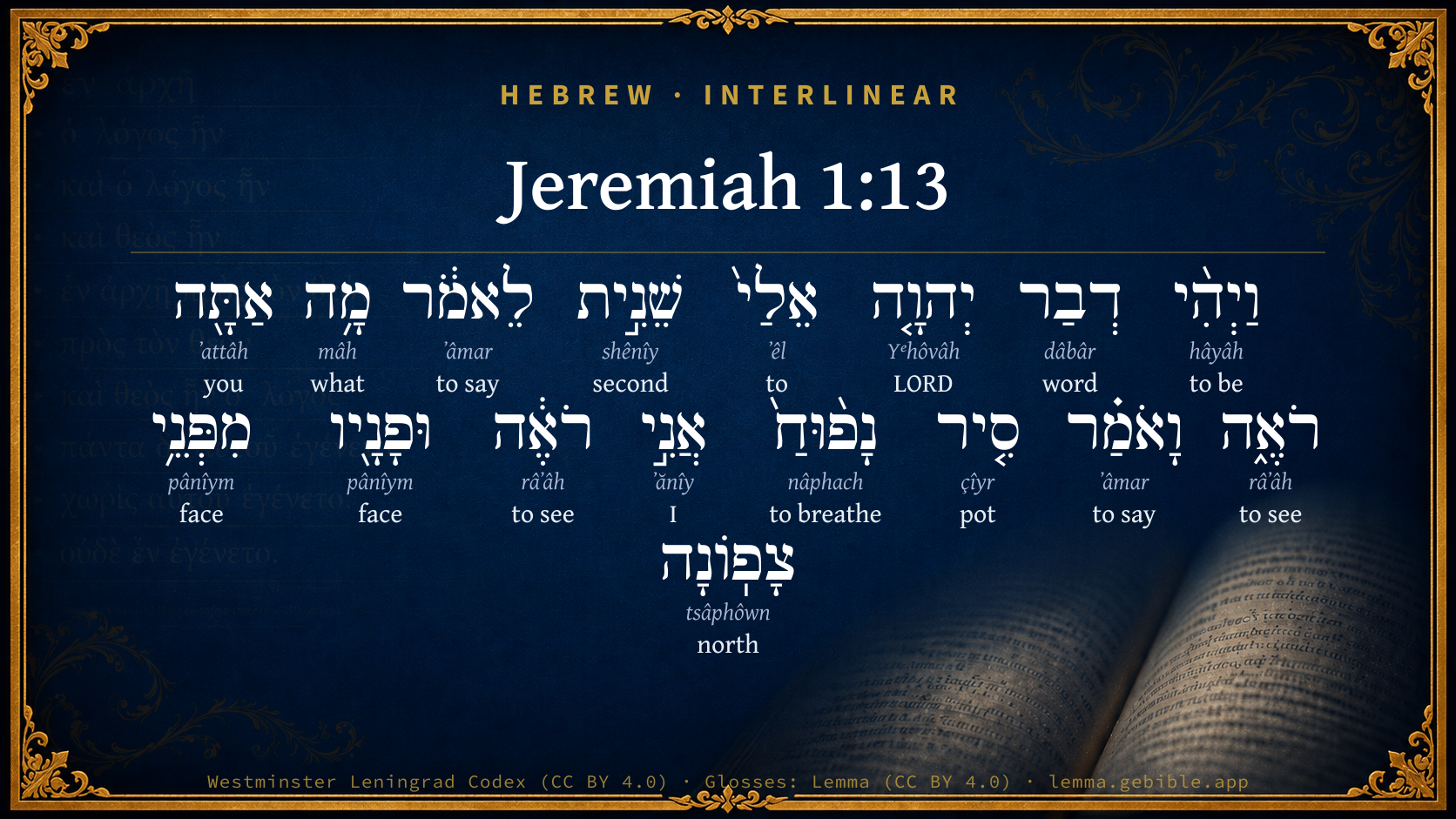
Jeremiah 1:13

Hebrew (Westminster Leningrad Codex) Jeremiah 1:13 appears in the Hebrew Old Testament. The text above is from the Westminster Leningrad Codex. Each word links to its Strong’s number, a concise gloss, and parsing drawn from the Open Scriptures Hebrew Bible morphology. Click any word for its full Brown-Driver-Briggs (BDB) entry.
Download image
Cite this verse

Jeremiah 1:13 (World English Bible). Public Domain. Lemma interlinear Bible study tool, https://lemma.gebible.app/v/jeremiah/1/13.

Show BibTeX & RIS
BibTeX
RIS
English Translation
The word of Yahweh came to me the second time, saying, What see you? I said, I see a boiling caldron; and the face of it is from the north.
World English Bible · Public Domain
Download a study sheet

One document with this verse’s original text, its word-by-word gloss line, the meaning frame, cross-references with their text, attributed commentary, and full source and license credits — printable, and it pastes into notes with its structure intact.

This verse Autodidact and up

Study sheet (.html) Plain text (.txt)

A passage Seminary Student

Up to 50 verses in one chapter. A passage sheet keeps up to 6 commentary sources and 12 cross-references per verse, in the order this page ranks them, and says so on the sheet whenever that leaves anything out. Ask for a single verse and you get the Autodidact verse sheet above.

Everything on this page stays free to read, with no account — the sheet is a download of what is already on screen, not access to it.

Want to remove ads? Support Godless Engineer
Compare translations 3

The same verse in 3 English versions, stacked beneath the original-language interlinear above. Click any original word for its lexicon entry.

Each is an independent rendering of the whole verse — the interlinear is not word-aligned to these translations.

Highlighted words mark where these versions differ — a whole-verse word diff, not a word-by-word alignment.

  • World English Bible Public Domain
    The word of Yahweh came to me the second time, saying, What see you? I said, I see a boiling caldron; and the face of it is from the north.
  • King James Version Public Domain
    And the word of the LORD came unto me the second time, saying, What seest thou? And I said, I see a seething pot; and the face thereof is toward the north.
  • unfoldingWord Literal Text CC BY-SA 4.0
    And the word of Yahweh was to me a second, saying, “What do you see?” And said, “I see a blown-on pot and its face from the face of the north.”

unfoldingWord Literal Text — © unfoldingWord, licensed CC BY-SA 4.0. Word-aligned USFM3 via Door43 (git.door43.org/unfoldingWord/en_ult).

Versions to compare (up to 4)

3 of 4 selected

Show all 18 translations

Every available English version of this verse, each an independent rendering of the whole verse.

  • World English Bible Public Domain
    The word of Yahweh came to me the second time, saying, What see you? I said, I see a boiling caldron; and the face of it is from the north.
  • Berean Standard Bible Public Domain
    Again the word of the LORD came to me, asking, “What do you see?” “I see a boiling pot,” I replied, “and it is tilting toward us from the north.”
  • Majority Standard Bible Public Domain
    Again the word of the LORD came to me, asking, “What do you see?” “I see a boiling pot,” I replied, “and it is tilting toward us from the north.”
  • King James Version Public Domain
    And the word of the LORD came unto me the second time, saying, What seest thou? And I said, I see a seething pot; and the face thereof is toward the north.
  • American Standard Version (1901) Public Domain
    And the word of Jehovah came unto me the second time, saying, What seest thou? And I said, I see a boiling caldron; and the face thereof is from the north.
  • Revised Version (1885) Public Domain
    And the word of the LORD came unto me the second time, saying, What seest thou? And I said, I see a seething caldron; and the face thereof is from the north.
  • Geneva Bible (1599) Public Domain
    Againe the worde of the Lord came vnto me the second time, saying, What seest thou? And I saide, I see a seething pot looking out of the North.
  • Douay-Rheims (1899) Public Domain
    And the word of the Lord came to me a second time, saying: What seest thou? I see a boiling caldron, and the face thereof from the face of the north.
  • Young's Literal Translation Public Domain
    And there is a word of Jehovah unto me a second time, saying, `What art thou seeing?' And I say, `A blown pot I am seeing, and its face `is' from the north.'
  • Literal Standard Version CC BY-SA 4.0
    And there is a word of YHWH to me a second time, saying, “What are you seeing?” And I say, “I am seeing a blown pot, and its face [is] from the north.”
  • Unlocked Literal Bible CC BY-SA 4.0
    The word of Yahweh came to me a second time, saying, “What do you see?” I said, “I see a heated pot, whose surface is churning, tipping away from the north.”
  • unfoldingWord Literal Text CC BY-SA 4.0
    And the word of Yahweh was to me a second, saying, “What do you see?” And said, “I see a blown-on pot and its face from the face of the north.”
  • Darby Bible Public Domain
    And the word of Jehovah came to me the second time, saying, What seest thou? And I said, I see a seething-pot, and its face is from the north.
  • World Messianic Bible Public Domain
    The LORD’s word came to me the second time, saying, “What do you see?” I said, “I see a boiling cauldron; and it is tipping away from the north.”
  • Webster's Bible Public Domain
    And the word of the LORD came to me the second time, saying, What seest thou? And I said, I see a seething pot; and its face is towards the north.
  • Free Bible Version CC BY-SA 4.0
    The Lord's message came to me again, asking, “What can you see?” “I see a pot that's boiling,” I answered, “and it's tipping in this direction from the north.”
  • Bible in Basic English Public Domain
    And the word of the Lord came to me a second time, saying, What do you see? And I said, I see a boiling pot, and its face is from the north.
  • JPS Tanakh (1917) Public Domain
    And the word of the LORD came unto me the second time, saying: 'What seest thou?' And I said: 'I see a seething pot; and the face thereof is from the north.'

Literal Standard Version (2020), Covenant Press — licensed CC BY-SA 4.0. Text via the HelloAO Bible API (eBible.org). Unlocked Literal Bible (unfoldingWord) — licensed CC BY-SA 4.0. Text via the HelloAO Bible API (eBible.org). unfoldingWord Literal Text — © unfoldingWord, licensed CC BY-SA 4.0. Word-aligned USFM3 via Door43 (git.door43.org/unfoldingWord/en_ult). Free Bible Version, Dr. Jonathan Gallagher — licensed CC BY-SA 4.0. Text via the HelloAO Bible API (eBible.org).

Word by word

More ways to search: Search by grammar → Find every occurrence → Compare this word →

Practice this passage: Drill this verse → Learn its vocabulary →

נָפ֨וּחַ֙
nâphach
H5301
“breathed”
Verb, Qal, Participle Passive, Masculine, Singular, Absolute
Part of Speech
Verb
Stem
Qal
Form
Participle Passive
Gender
Masculine
Number
Singular
State
Absolute
Full BDB Definition

Origin: a primitive root

TWOT: 1390

to breathe, blow, sniff at, seethe, give up or lose (life) - (Qal) to breathe, blow - (Pual) to be blown - (Hiphil) to cause to breathe out
  1. וַיְהִ֨י hâyâh H1961 “and · to be” Conjunction + Verb, Qal, Sequential Imperfect, 3rd Person, Masculine, Singular
  2. דְבַר dâbâr H1697 “word of” Noun, Common, Masculine, Singular, Construct
  3. יְהוָ֤ה Yᵉhôvâh H3068 “LORD” Noun, Proper
  4. אֵלַי֙ ʼêl H413 “to · me” Preposition + Suffix, Personal, 1st Person, Common, Singular
  5. שֵׁנִ֣ית shênîy H8145 “second” Adjective, Ordinal number, Feminine, Singular, Absolute
  6. לֵאמֹ֔ר ʼâmar H559 “to say” Preposition + Verb, Qal, Infinitive Construct
  7. מָ֥ה mâh H4100 “what” Particle, Interrogative
  8. אַתָּ֖ה ʼattâh H859 “you” Pronoun, Personal, 2nd Person, Masculine, Singular
  9. רֹאֶ֑ה râʼâh H7200 “seeing” Verb, Qal, Participle Active, Masculine, Singular, Absolute
  10. וָאֹמַ֗ר ʼâmar H559 “and · to say” Conjunction + Verb, Qal, Sequential Imperfect, 1st Person, Common, Singular
  11. סִ֤יר çîyr H5518 “pot” Noun, Common, Both, Singular, Absolute
  12. אֲנִ֣י ʼănîy H589 “I” Pronoun, Personal, 1st Person, Common, Singular
  13. רֹאֶ֔ה râʼâh H7200 “seeing” Verb, Qal, Participle Active, Masculine, Singular, Absolute
  14. וּפָנָ֖יו pânîym H6440 “and · face(s) · his” Conjunction + Noun, Common, Both, Plural, Construct + Suffix, Personal, 3rd Person, Masculine, Singular
  15. מִפְּנֵ֥י pânîym H6440 “from · face(s) of” Preposition + Noun, Common, Both, Plural, Construct
  16. צָפֽוֹנָה tsâphôwn H6828 “north · toward” Noun, Common, Feminine, Singular, Absolute + Suffix, Demonstrative

About this verse

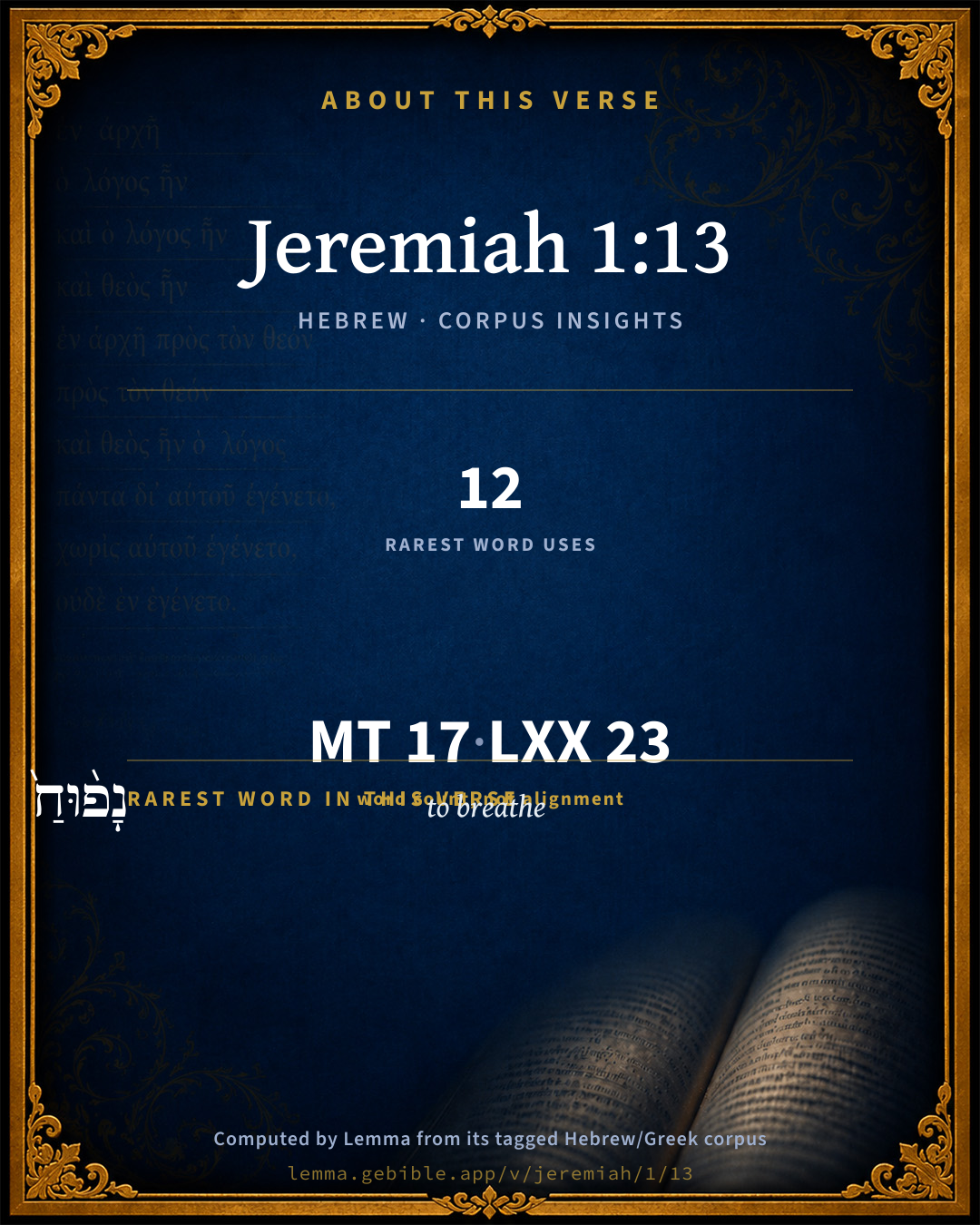
These counts appear in no published source. They are computed here, from the morphology-tagged text and Lemma’s own curated glosses. What Lemma adds →

17
words
14
distinct lemmas
Prophets
section

Notable vocabulary

The rarest word here is נָפ֨וּחַ֙ to breathe H5301 — appearing just 12 times in the whole Hebrew Bible.

Shared distinctive vocabulary

נָפ֨וּחַ֙ to breathe H5301 occurs in 12 verses of the Hebrew Bible. Also found in:

Grammatical profile

  • 6 verbs
  • 6 nouns
  • 1 adjective
  • 2 pronouns
  • 1 preposition
  • 1 particle

Verb forms

  • וַיְהִ֨י Qal · Sequential Imperfect
  • לֵאמֹ֔ר Qal · Infinitive Construct
  • רֹאֶ֑ה Qal · Participle Active
  • וָאֹמַ֗ר Qal · Sequential Imperfect
  • נָפ֨וּחַ֙ Qal · Participle Passive
  • רֹאֶ֔ה Qal · Participle Active

Repetition

Words recur within this verse — often emphatic in Hebrew:

  • לֵאמֹ֔ר to say H559 ×2
  • רֹאֶ֑ה to see H7200 ×2
  • וּפָנָ֖יו face H6440 ×2

Hebrew & Septuagint length

In the original languages it is 17 Hebrew tokens and 23 Greek tokens — but the two are counted differently (Hebrew bundles its prefixes and suffixes into one token; the Greek is in lemma form), so that isn’t a like-for-like length.

Cross-references

6

Topical passages linked to Jeremiah 1:13 in the Treasury of Scripture Knowledge — connected by theme and wording, ordered by reader-vote popularity; previews shown in the World English Bible.

  • Ezekiel 11:3 who say, [The time] is not near to build houses: this [city] is the caldron, and we are the flesh.
  • Ezekiel 11:7 Therefore thus says the Lord Yahweh: Your slain whom you have laid in the midst of it, they are the flesh, and this [city] is the caldron; but you shall be brought forth out of the midst of it.
  • Genesis 41:32 The dream was doubled to Pharaoh, because the thing is established by God, and God will shortly bring it to pass.
  • Ezekiel 24:3–14 Utter a parable to the rebellious house, and tell them, Thus says the Lord Yahweh, Set on the caldron, set it on, and also pour water into it:
  • Zechariah 4:2 He said to me, "What do you see?" I said, "I have seen, and, behold, a lampstand all of gold, with its bowl on the top of it, and its seven lamps thereon; there are seven pipes to each of the lamps, which are on the top of it;
  • 2 Corinthians 13:1–2 This is the third time I am coming to you. "At the mouth of two or three witnesses shall every word established."

Cross-references courtesy of OpenBible.info (CC BY 4.0).

Hebrew and Greek witnesses Masoretic Hebrew ↔ Greek Septuagint

The same verse in the two great witnesses to the Old Testament, shown verse-for-verse.

These are two independent witnesses, not word-aligned to each other, and the Septuagint is shown in lemma (dictionary) form.

Hebrew Jeremiah 1:13 Masoretic · Westminster Leningrad Codex

וַיְהִ֨י דְבַר יְהוָ֤ה אֵלַי֙ שֵׁנִ֣ית לֵאמֹ֔ר מָ֥ה אַתָּ֖ה רֹאֶ֑ה וָאֹמַ֗ר סִ֤יר נָפ֨וּחַ֙ אֲנִ֣י רֹאֶ֔ה וּפָנָ֖יו מִפְּנֵ֥י צָפֽוֹנָה

The word of Yahweh came to me the second time, saying, What see you? I said, I see a boiling caldron; and the face of it is from the north.

World English Bible · Public Domain

Greek LXX Structure differs

In the Septuagint, Jeremiah is about an eighth shorter than the Hebrew and arranges its material differently — the Oracles Against the Nations (Hebrew chapters 46–51) appear in the middle of the Greek book, after 25:13. Because the chapter and verse boundaries do not line up, a verse-for-verse comparison with the Hebrew is not shown.

A verse-for-verse comparison isn’t shown here because the chapters and verses don’t line up. Switch to the LXX edition with the MT / LXX toggle above to read the Greek directly.

On this verse, Keil & Delitzsch discusses the Septuagint’s reading. Read the note in Commentary ↓

Hebrew: Westminster Leningrad Codex (CC BY 4.0). Greek: Septuagint (public domain); English from a public-domain English Septuagint. How the Septuagint differs from the Hebrew →

Targum (Aramaic paraphrase)

1

The Targum is the ancient Jewish Aramaic paraphrase of the Hebrew Scriptures — an interpretive translation, not the Hebrew text itself. Onkelos (literal) and Pseudo-Jonathan (expansive) render the Torah, and Jonathan the Prophets. Coverage is partial: where no permissively-licensed English translation exists for a verse, only the Aramaic is shown. This is verse-level text, not a word-by-word alignment to the Hebrew.

  1. Targum Jonathan Prophets (Joshua–Malachi)
    וַהֲוָה פִּתְגָם נְבוּאָה מִן קֳדָם יְיָ עִמִי תִּנְיָנוּת לְמֵימָר מָה אַתְּ חָזֵי וַאֲמָרַת מְלַךְ דְרָתַח כְּדוּד אֲנָא חָזֵי וְטִקוּס מַשִׁירְיָתֵיהּ דִמְדַבְּרָן וַאֲתְיָן מֵאַפֵּי צִפּוּנָא:

    (no public-domain English translation for this verse)

    Targum Jonathan — Aramaic: “Mikraot Gedolot” (public domain). English: “Sefaria Community Translation” (CC0 1.0 (public-domain dedication)); “London "Chaldee Paraphrase," 1871” (public domain). Text via Sefaria.

Commentary

Notes on Jeremiah 1:13 from classic Christian and Jewish commentators (each source and its license shown beneath its notes). The classic Christian expositions comment on the surrounding passage and are grouped to its opening verse, so a note may address several verses; the Jewish commentaries on the Tanakh (Rashi and others) are per-verse, so they appear only where the commentator wrote on this verse.

Lemma curates 59 commentaries, every one of them public domain or Creative Commons licensed, each selected and text-cleaned for this edition rather than reprinted as found. About our sources →

Trapp's Complete Commentary

John Trapp

Jer 1:13 And the word of the LORD came unto me the second time, saying, What seest thou? And I said, I see a seething pot; and the face thereof [is] toward the north.

Ver. 13. What seest thou?] By these questions his attention is stirred up, that he may the better observe the matter of his preaching, which is here represented by a second vision.

I see a seething pot.] Heb., Ollam ebullitam, A pot blown up. This boiling pot is Jerusalem besieged by the Chaldeans, and we are the flesh, say those deriders of this prophecy of Jeremiah; {Eze 11:3} but they found it to be just so shortly after. And then their profane hearers might well have bespoke them, as the heart of Apollodorus the tyrant seemed to say to him, who dreamed one night that he was flayed by the Scythians and boiled in a caldron; and that his heart spake to him out of the kettle, Eγω σοι τουτων αιτια, It is I that have drawn thee to all this.

And the face thereof,] i.e., That part of the pot that is next the fire, and heated therewith.

John Trapp, A Commentary or Exposition upon All the Books of the Old and New Testament (1647–1656) — public domain. Text from a community e-Sword module.

Joseph Benson's Commentary

Jer 1:13. I see a seething-pot — Or, a pot boiling. The steam of this boiling pot represented God’s judgments, which are often compared to a fire, as the afflictions of Israel were to a smoking furnace. Gen 15:17. And the face thereof was toward the north — The steam was represented to the prophet as raised by a fire, or driven by a wind coming from the north. Thus interpreted, the pot or caldron denoted Judea or Jerusalem, expressed by the same figure, Eze 11:3; Eze 11:7; Eze 24:3. But the Hebrew פניו מפני צפונה, seems to be more exactly rendered by Blaney; The face thereof is turned from the north, or, as it is expressed in the margin, from the face of the north. For it appears from the next verse, that the evil was to come from the north; and therefore the steam, which was designed for an emblem of that evil, must have issued from that quarter. According to this interpretation, the pot denoted the empire of the Chaldeans, lying to the north of Judea, and pouring forth its multitudes like a thick vapour.

Joseph Benson's Commentary on the Old and New Testaments (1811–1818) — public domain. Text from a community e-Sword module.

Keil & Delitzsch

C. F. Keil & F. Delitzsch

The Seething Pot. - Jer 1:13. "And there came to me the word of Jahveh for the second time, saying, What seest thou? And I said: I see a seething-pot; and it looketh hither from the north. Jer 1:14. Then said Jahveh to me: From the north will trouble break forth upon all inhabitants of the land. Jer 1:15. For, behold, I call to all families of the kingdoms towards the north, saith Jahveh; that they come and set each his throne before the gates of Jerusalem, and against all her walls round about, and against all cities of Judah. Jer 1:16. And I will pronounce judgment against them for all their wickedness, in that they have forsaken me, and have offered odours to other gods, and worshipped the work of their hands." סיר is a large pot or caldron in which can be cooked vegetables or meat for many persons at once; cf. Kg2 4:38., Eze 24:3. נפוּח, fanned, blown upon, used of fire, Ezek. 21:36; Eze 22:20.; then by transference, seething, steaming, since the caldron under which fire is fanned steams, its contents boil; cf. Job 41:12. The פּנים of the pot is the side turned to the spectator (the prophet), the side towards the front. This is turned from the north this way, i.e., set so that its contents will run thence this way. צפונה, properly: towards the north; then, that which lies towards the north, or the northerly direction. In the interpretation of this symbol in Jer 1:14, תּפּתח, assonant to נפוּח, is introduced, just as in Amo 8:2 קיץ is explained by קץ; so that there was no occasion for the conjecture of Houbig. and Graf: תּפּח, it is fanned up; and against this we have Hitzig's objection that the Hophal of נפח never occurs. Equally uncalled for is Hitzig's own conjecture, xaw%pt@f, it will steam, fume, be kindled; while against this we have the fact, that as to xpanf no evidence can be given for the meaning be kindled, and that we have no cases of such a mode of speaking as: the trouble is fuming, steaming up. The Arabian poetical saying: their pot steams or boils, i.e., a war is being prepared by them, is not sufficient to justify such a figure. We hold then תּפּתח for the correct reading, and decline to be led astray by the paraphrastic ἐκκαυθήσεται of the lxx, since תּפּתח gives a suitable sense. It is true, indeed, that פּתח usually means open; but an opening of the caldron by the removal of the lid is not (with Graf) to be thought of. But, again, פּתח has the derived sig. let loose, let off (cf. ,פּתח בּי Isa 14:17), from which there can be no difficulty in inferring for the Niph. the sig. be let loose, and in the case of trouble, calamity: break forth. That which is in the pot runs over as the heat increases, and pours itself on the hearth or ground. If the seething contents of the pot represent disaster, their running over will point to its being let loose, its breaking out. are the inhabitants of the land of Judah, as the interpretation in Jer 1:15 shows. In Jer 1:15 reference to the figure is given up, and the further meaning is given in direct statement. The Lord will call to all families of the kingdoms of the north, and they will come (= that they are to come). The kingdoms of the north are not merely the kingdoms of Syria, but in general those of Upper Asia; since all armies marching from the Euphrates towards Palestine entered the land from the north. משׁפּחות, families, are the separate races of nations, hence often used in parallelism with גּוים; cf. Jer 10:25; Nah 3:4. We must not conclude from this explanation of the vision seen that the seething pot symbolizes the Chaldeans themselves or the kingdom of Nebuchadnezzar; such a figure would be too unnatural. The seething pot, whose contents boil over, symbolizes the disaster and ruin which the families of the kingdoms of the north will pour out on Judah.

Keil & Delitzsch — Biblical Commentary on the Old Testament (1861–1891) — public domain (CC PDM 1.0). Text via the HelloAO Bible API. (Old Testament only.)

Tyndale Open Study Notes

Tyndale Open Resources

1:13-14 Like a flood of boiling water, invading armies would bring terror to the people of Judah. Although Babylon was due east of Judah, the desert between them required that the Babylonian army attack Judah from the north.

Tyndale Open Study Notes — © Tyndale Open Resources, licensed CC BY-SA 4.0. Text via the HelloAO Bible API.

Geneva Bible (1599)

Geneva Bible translators

Signifying, that the Chaldeans and Assyrians should be as a pot to seethe the Jews which boiled in their pleasures and lust.

Geneva Bible (1599) marginal notes — public domain. Text via Bolls.life.

Jamieson, Fausset & Brown

Robert Jamieson, A. R. Fausset & David Brown

Another vision, signifying what is the "word" about to be "performed," and by what instrumentality.

seething--literally, "blown under"; so boiling by reason of the flame under it kept brisk by blowing. An Oriental symbol of a raging war.

toward--rather, "from the north." Literally, "from the face of the region situated towards the north" (compare Jer 1:14-15) [MAURER]. The pot in the north rested on one side, its mouth being about to pour forth its contents southwards, namely, on Judea. Babylon, though east of Judea, was regarded by the Hebrews as north, because they appropriated the term "east" to Arabia-Deserta, stretching from Palestine to the Euphrates; or rather [BOCHART], the reference here is not to the site, but to the route of the Babylonians; not being able to cross the desert, they must enter the Holy Land by the northern frontier, through Riblah in Hamath (Jer 39:5; Jer 52:9).

Jamieson, Fausset & Brown — Commentary Critical and Explanatory on the Whole Bible (1871) — public domain (CC PDM 1.0). Text via the HelloAO Bible API.

Adam Clarke's Commentary

Verse 13. A seething pot - toward the north.] We find, from Ezekiel, Eze 24:3, c., that a boiling pot was an emblem of war, and the desolations it produces. Some have thought that by the seething pot Judea is intended, agitated by the invasion of the Chaldeans, whose land lay north of Judea. But Dr. Blayney contends that מפני צפונה mippeney tsaphonah should be translated, From the face of the north, as it is in the margin for, from the next verse, it appears that the evil was to come from the north; and therefore the steam, which was designed as an emblem of that evil, must have arisen from that quarter also. The pot denotes the empire of the Babylonians and Chaldeans lying to the north of Judea, and pouring forth its multitudes like a thick vapour, to overspread the land. Either of these interpretations will suit the text.

Adam Clarke's Commentary on the Bible (1810–1826) — public domain. Text from a community e-Sword/MySword module.

John Calvin's Commentaries

Jeremiah begins now to address the people to whom he was sent as a Prophet. He has hitherto spoken of his calling, that the authority of his doctrine might be evident: and he spoke generally; but now he accommodates his teaching specially to the people. Hence he says, that he had a vision, and saw a boiling-pot, whose face was towards the north. By God asking, and the Prophet answering, the design was to confirm the prediction; for if it had been only said that he saw a boiling-pot, and if an explanation of the metaphor had been given, there would not have been so much force and weight in the narrative. But when God is set forth as being present, and explaining what the boiling-pot signified, the prediction becomes more certain: and the Prophet no doubt gave this narrative, in order to shew that God, being as it were present, thereby proved himself to he the Author of this prophecy.

Now the import of the whole is, that the Chaldeans would come to overthrow the city Jerusalem, to take away and abolish all the honor and dignity both of the kingdom and of the priesthood.

This indeed had been previously announced by Isaiah as well as by other prophets; but all their threatenings had been despised. While indeed Isaiah was living, the king of Babylon had secured the friendship of Hezekiah; and the Jews thought that his protection had been opportunely obtained against the Assyrians. But they did not consider that the hearts of men are ruled by the hand of God, and are turned as he pleases: nor did they consider that they had for many years provoked God, and that he was become their enemy. Since, then, all threatening had been despised and regarded with derision, Jeremiah came forth and declared, that the northern nations would come, the Assyrians as well as the Chaldeans. For we know that the one monarchy had been swallowed up by the other; and the Chaldeans ruled over the Assyrians; and thus it happened that the whole eastern empire, with the exception of the Medes and Persians, had passed over to them; and with respect to Judea, they were northward. Hence the Prophet says, that he saw a boiling-pot, having its face towards the north.

By the pot many understand the king of Babylon; but they seem not rightly to understand what the Prophet says: and I could easily disprove their interpretation, but I shall be satisfied with a simple statement of what is true; and the meaning will become evident as we proceed. The pot, then, as it will be presently seen more clearly, is the nation of the Jews: I say this now, as I do not wish to heap together too many things. They are said to be like a boiling-pot, because the Lord, as it were, boiled them, until they were reduced almost to nothing. It is said also, that the face of the pot was towards the north; because there, as Jeremiah immediately explains, was the fire kindled. And the comparison is very apposite; for when a pot is set on the fire, it boils on that side nearest the fire, and all the scum passes over to the other side. Hence he says that it boiled, but so that its mouth was on the north side; for there was the fire, and there was the blowing. In short, God intended to shew to his Prophet, that the people were like flesh which is cast into the pot, boiled, and afterwards burnt, or reduced after a long time almost to nothing. The Prophet saw the mouth or the face of the boiling-pot, and on the side on which it boiled it looked towards the north; hence God, the interpreter of the vision which he presented to his servant, answers and says, From the north shall break forth evil on all the inhabitants of the land, that is, of Judea. In these words God declares, that the fire was already kindled by the Chaldeans and the Assyrians, by which he would boil, as it were, his people like flesh, and at length wholly consume them, as it is commonly the case, when the flesh remains in the pot, and the fire is continually burning, and blowing is also added; the flesh must necessarily be reduced to nothing when thus boiled or seethed.

John Calvin's Commentaries (1540-1563) — public domain. Text from the Calvin Translation Society English edition (1840s-50s) via the Christian Classics Ethereal Library (ccel.org). Calvin's coverage is partial (roughly two-thirds of the Bible); uncommented books and verses are honest gaps, never fabricated. The 19th-century editor's footnotes and remarks are omitted so the notes are faithfully Calvin's own voice.

Ellicott's Commentary for English Readers

(13) A seething pot; and the face thereof is toward the north.—More correctly, from the north. The next symbol was one that set forth the darker side of the prophet’s work: a large cauldron (probably of metal) placed (as in Ezekiel’s vision, Eze_24:3-11) on a great pile of burning wood, boiling and steaming, with its face turned from the north, and so on the point of emptying out its scalding contents towards the south. This was as strong a contrast as possible to the vernal beauty of the almond-bough, and told too plainly the terrors which were to be expected from the regions that lay to the north of the land of Israel, Assyria and Chaldæa. The flood of water at the boiling point went beyond the “waters of the great river” of Israel’s symbolism (Isa_8:7).

A Bible Commentary for English Readers, edited by Charles John Ellicott (1878–1897) — public domain. Text from a community e-Sword module.

The Cambridge Bible for Schools and Colleges

gen. ed. J. J. S. Perowne

13–16. The symbol of the caldron

13. a seething caldron] An ordinary sight in daily life conveys a message to the prophet. In this second symbol the character of the future in store for the nation is more clearly brought out. The word sîr, here rendered caldron, denotes a large vessel, as it could be used in preparing pottage for a considerable number (2Ki_4:38). It was also used for washing (Psa_60:8). The word rendered “seething” (boiling) is lit. blown, i.e. well heated, and so boiling.

the face thereof is from the north] The expression is an awkward one, and the symbol has been explained in two ways. Either (a) the spectator in the south sees the contents of the caldron ready to boil over in his direction, or, perhaps better (with a slight change in the Hebrew), (b) the caldron is thought of as supported by stones on three of its sides, while the fourth, i.e. the north side, is open and is being fed with fuel from that side. If we accept (a), the people in Judaea will receive the boiling contents, if (b), the point will be that the fuel is supplied from the north and employed with hostile intent against the Jews, now themselves figuring as the contents of the vessel. Whichever view we take, an attack from the north is plainly indicated. For the application, as referring to a threatened invasion of Scythian hordes, see Intr. i. § 3. Later, the danger from the north came to be the Empire of Babylon and the symbol would be equally suggestive. In earlier days, Assyrians had come from the north and carried the ten tribes captive. It was thus a region whose associations inspired dread.

The Cambridge Bible for Schools and Colleges (gen. ed. J. J. S. Perowne; Cambridge University Press, 1878–1918) — public domain. Text from a community e-Sword module.

John Gill's Exposition

And the word of the Lord came unto me the second time,.... In the same vision:

saying, what seest thou? besides the almond tree rod; which perhaps was now removed out of sight, and another object appears:

and I said, I see a seething pot; a pot with fire under it, boiling and bubbling up:

and the face thereof was towards the north; either the mouth of the pot where it boiled up, which might be turned to the north in the vision; or that side of the pot, as Kimchi thinks, on which the liquor was poured out; it may be that side of it on which the fire was put to cause it to boil; and so denotes from what quarter the fire came, and was put under it, and the wind that blew it up. The Targum paraphrases the words thus,

"and I said, I see a king boiling as a pot, and the banner of his army, which was brought and came from the north.''

The explanation follows:

John Gill's Exposition of the Whole Bible (1746–1763) — public domain (CC PDM 1.0). Text via the HelloAO Bible API.

Albert Barnes' Notes on the Bible

The first vision was for the support of the prophet’s own faith during his long struggle with his countrymen: the second explains to him the general nature of his mission. He was to be the bearer of tidings of a great national calamity about to break forth item the north. He sees a caldron. It was a vessel of metal Eze 24:11, large enough to prepare the meal of a numerous community 2Ki 4:38, and broad at the top, as it was also used for washing purposes Psa 60:8. This caldron was boiling furiously.

The face ... - More correctly the margin, i. e toward the south. We must suppose this caldron set upon a pile of inflammable materials. As they consume it settles down unevenly, with the highest side toward the north, so that its face is turned the other way and looks southward. Should it still continue so to settle, the time must finally come when it will be overturned, and will pour the whole mass of its boiling contents upon the south.

Albert Barnes' Notes on the Bible (1834–1885) — public domain. Text from a community e-Sword/MySword module.

Haydock's Catholic Bible Commentary

North, whence the wind blows, to make the fire burn more intensely. Assyria lay to the north, and Babylon to the east of Judea; but the troops always penetrated the northern frontier, as they could not pass through the Desert Arabia. The caldron represented Jerusalem, Ezechiel xi. 3., and xxiv. 3.

George Leo Haydock (1774–1849), Haydock's Catholic Family Bible and Commentary, 1859 edition — public domain. Excludes Psalms (Douay-Rheims chapter numbering differs from Protestant) and Deuterocanonical books (Catholic canon only).

Matthew Poole's English Annotations

After the smaller punishment from the Lord follows this of the boiling pot, by which understand Judea and Jerusalem, as may appear by the application that they themselves make of it in a way of scorn and derision, Eze 11:3,7. Some put the

face of the pot for the pot itself; as the face of the cold, the face of his anger, for cold and anger itself: q.d. I see a pot coming, meaning the Babylonian army flowing in upon them, like boiling or scalding water, as some interpret it: but this seems not to be so congruous to the vision; but rather thus, the Babylonians should besiege; as a fire plays round the furnace when it is to be made boil, so should these Chaldeans begirt it, as Jer 1:15, and reduce the inhabitants to most miserable extremities, with unspeakable cruelty, as if they were like flesh roasting by the fire, or boiling in a pot, as their sufferings are described, Mic 3:3.

The face, or front of the pot, or furnace, the place where the fire was put in or blowed up to make it boil; as a pot, hanged in the form of a furnace, seems to be all but one and the same pot or vessel, the face of which may be easily conceived to stand toward the north, not the mouth of the pot, for that looks directly upward, unless we conceive it to be represented in the vision leaning, of which conceit there is no need.

Is toward the north; indicating from whence their misery should come, Jer 1:14, viz. from Chaldea, which lay north from Jerusalem.

Matthew Poole's English Annotations on the Holy Bible (1683–1685) — public domain. Text from a community e-Sword/MySword module.

Whedon's Commentary on the Bible

Daniel D. Whedon

13. A seething pot — Rather, a caldron. The attributive is participial in form, meaning literally “blown upon,” and hence is here well rendered by “seething.”

The face… is toward the north — Better, from “the north,” and so is seen as if pouring its burning contents over the land.

Daniel D. Whedon (gen. ed.), Commentary on the Old and New Testaments (1874–1909) — public domain. Text from a community e-Sword module.

The Pulpit Commentary

A seething pot. There is a variety of Hebrew words for "pot." The word hero used suggests a vessel of large size, since pottage for a whole company of prophets could be cooked in such. a pot or caldron. (2Ki_4:38) From Eze_24:11 we may infer that it was of metal. A "seething pot" in ancient Arabic poetry is a figure for war. The same symbol occurs in Eze_24:3-12, but with a different application. The face thereof is toward the north; rather, toward the south; literally, from the face of the north. The "face" of the pet is the side turned to the prophet. We may suppose the contents to be on the point of boiling over.

Vers. 13, 14. The seething pot.

I THE VISION OF THE SEETHING POT FORESHADOWS APPROACHING DOOM. God is about to hold his session" upon Jerusalem and the cities of Judah.

1. They who are most favored by God must expect the severest judgment if they prove unfaithful to him. The Jews were a favored people. Their privileges were great; if they abused these their guilt and consequent punishment must be proportionately great. Therefore, instead of considering the past mercies of God as a ground for expecting to escape the penalties of our offences, we should see in them the measure of his future severities upon us if we sin in face of the special inducements to devotion afforded by those mercies.

2. The revelation of impending judgment is a great motive for faithful preaching. This vision of the seething pot is given to Jeremiah to rouse him to undertake his prophetic duties. A large part of his work consisted in gloomy predictions of coming doom. This was peculiar to the age. There are ages when similar preaching is especially appropriate. But as sin always makes for death the preacher is always called to raise a voice of warning.

II THE VISION OF THE SEETHING POT ILLUSTRATES THE CHARACTER OF THE APPROACHING DOOM.

1. It is gradually prepared. The vessel is slowly heated to the boiling point. The guilt of sin accumulates and the evil consequences gather in force until they burst upon the victim with the energy of long pent-up wrath.

2. It breaks forth suddenly. Suddenly the vessel boils over. Judgment may be delayed and gradual in the preparation, and yet suddenly surprise us when at length it falls upon us.

3. It is violent and overwhelming, as the seething pot suggests fury, tumult, and, in its boiling over, a rushing forth of its scalding contents.

III THE VISION OF THE SEETHING POT SUGGESTS THE SOURCE OF THE APPROACHING DOOM. The pot was turned towards the south and heated by fires in the north.

1. Punishment may come from the most unlikely quarter. The Jews had turned to Babylon for friendship, and from Babylon came their ruin. Our most trusted friends may become the instruments of our keenest suffering.

2. Lawless violence may be overruled by providence to work the ends of God"s righteous laws. The doom is not to come from within the range of the theocracy and through the influence of those who consciously executed the Divine decree, but from far-off regions, wholly beyond the light of Israel"s religion. Thus God makes the wrath of man to praise him. So storms and earthquakes, revolutions and invasions, tumults in nature and tumults in the human world, work ultimate good results in clearing and purifying the air, sweeping away pestilent corruption, and preparing for a new and wholesome order.

3. The more luxurious Southern races have frequently been visited by terrible invasions of hardier races from the North. The Scythians in the East, the Goths in the West, were scourges of God, and wholesome scourges, helping to reform the corrupt and indolent peoples who lived in dread of their invasions. We should see wise and good purposes of providence in these terrible events of general history, as we see them in the special history of Israel.

The Pulpit Commentary (1880–1919), ed. H.D.M. Spence-Jones & Joseph S. Exell — public domain. Text from a community e-Sword module.

John Wesley's Explanatory Notes

Seething-Pot - I see a pot coming, meaning the Babylonian army, who would besiege Jerusalem as a fire plays round the pot, when it is to be made boil; and reduce the inhabitants to miserable extremities. Face - Or front of the pot, or furnace, the place where the fire was put in, or blowed up to make it boil. North - Indicating from whence their misery should come, namely, from Chaldea, which lay north from Jerusalem.

John Wesley, Explanatory Notes Upon the Whole Bible (1754–1765) — public domain. Text via the GEBible commentary corpus.

unfoldingWord translationNotes

Door43 World Missions Community

The word of Yahweh came to me a second time, saying

The idiom "The word of Yahweh came to" is used to introduce a special message from God. See how you translated a similar phrase in Jeremiah 1:4, and make any changes as needed. AT: "Yahweh gave me a message a second time. He said" or "Yahweh spoke this second message to me" (See: Idiom)

whose surface is churning

The surface refers to the surface of the water in the pot. Jeremiah could see the water boiling. AT: "whose water is boiling" (See: Metonymy)

tipping away from the north

This means that it was tipping toward the south, where Jeremiah was in Judah.

Disaster will be opened up out of the north

"Disaster will be let loose from the north." This represents God causing disaster to come from the north to the south. AT: "Disaster will come from the north" or "I will send disaster from the north" (See: Metaphor)

translationWords

life

unfoldingWord translationNotes — © Distant Shores Media and the Door43 World Missions Community, licensed CC BY-SA 4.0. Source: git.door43.org/Door43/en_tn.

Rashi

Rabbi Shlomo Yitzchaki (Rashi)

a bubbling pot [lit. blown up,] seething (boillant in French).

whose foam [lit. and its face,] its seething (et ses ondes in O.F.) [and its waves].

Rashi on the Tanakh — English translations: “The Judaica Press complete Tanach with Rashi, translated by A. J. Rosenberg” (CC BY 4.0); “Pentateuch with Rashi's commentary by M. Rosenbaum and A.M. Silbermann, 1929-1934” (public domain); “The Metsudah Tanach series, Lakewood, N.J” (CC BY 4.0); and “The Book of Joshua, Metsudah Publications, 1997” (CC BY 4.0). Text via Sefaria.

Lesson kit

Teaching starters — assembled from the data on this page, not authored interpretation. Every prompt links to the verse data it draws on. Edit before teaching.

Jeremiah, in the Prophets, opens this verse with 17 words (14 distinct Hebrew lemmas). Its most distinctive word is nâphach (“to breathe”). A historical commentator’s framing appears above. Read the whole chapter for the surrounding context.

Discussion questions

  1. How does “to breathe” (nâphach) shape what this verse is saying?
  2. Genesis 2:7 shares the word «to breathe» with this verse. How do the two illuminate each other?
  3. “to say” occurs 2× in this one verse. What is the effect of the repetition?
  4. These translations render this verse differently; the difference is in the English rendering, not the original. What questions does that raise?
  5. The verb «וַיְהִ֨י» is Qal Sequential Imperfect. How does its form color the action?
  6. Reading how Trapp's Complete Commentary and Joseph Benson's Commentary read this verse, where do the two commentators agree and where do they part?

Things to notice

Reading settings

Reading text

Shown beneath each verse's original-language words.

Old Testament
Old Testament edition

Read the OT as the Masoretic Hebrew (MT) or the Greek Septuagint (LXX).

English shown for the Greek Septuagint (in the Hebrew ↔ Greek comparison).

Comparing translations? Open the Compare panel on any verse page to stack up to four side by side.