
Jeremiah 11:15

Hebrew (Westminster Leningrad Codex) Jeremiah 11:15 appears in the Hebrew Old Testament. The text above is from the Westminster Leningrad Codex. Each word links to its Strong’s number, a concise gloss, and parsing drawn from the Open Scriptures Hebrew Bible morphology. Click any word for its full Brown-Driver-Briggs (BDB) entry.
Download image
Cite this verse

Jeremiah 11:15 (World English Bible). Public Domain. Lemma interlinear Bible study tool, https://lemma.gebible.app/v/jeremiah/11/15.

Show BibTeX & RIS
BibTeX
RIS
English Translation
What has my beloved to do in my house, seeing she has worked lewdness [with] many, and the holy flesh is passed from you? when you do evil, then you rejoice.
World English Bible · Public Domain
Download a study sheet

One document with this verse’s original text, its word-by-word gloss line, the meaning frame, cross-references with their text, attributed commentary, and full source and license credits — printable, and it pastes into notes with its structure intact.

This verse Autodidact and up

Study sheet (.html) Plain text (.txt)

A passage Seminary Student

Up to 50 verses in one chapter. A passage sheet keeps up to 6 commentary sources and 12 cross-references per verse, in the order this page ranks them, and says so on the sheet whenever that leaves anything out. Ask for a single verse and you get the Autodidact verse sheet above.

Everything on this page stays free to read, with no account — the sheet is a download of what is already on screen, not access to it.

Want to remove ads? Support Godless Engineer
Compare translations 3

The same verse in 3 English versions, stacked beneath the original-language interlinear above. Click any original word for its lexicon entry.

Each is an independent rendering of the whole verse — the interlinear is not word-aligned to these translations.

Highlighted words mark where these versions differ — a whole-verse word diff, not a word-by-word alignment.

  • World English Bible Public Domain
    What has my beloved to do in my house, seeing she has worked lewdness [with] many, and the holy flesh is passed from you? when you do evil, then you rejoice.
  • King James Version Public Domain
    What hath my beloved to do in mine house, seeing she hath wrought lewdness with many, and the holy flesh is passed from thee? when thou doest evil, then thou rejoicest.
  • unfoldingWord Literal Text CC BY-SA 4.0
    What to my beloved in my house, to do her wickedness, the many, and the flesh of the holy thing they pass over from you? When evil of you, then you rejoice.

unfoldingWord Literal Text — © unfoldingWord, licensed CC BY-SA 4.0. Word-aligned USFM3 via Door43 (git.door43.org/unfoldingWord/en_ult).

Versions to compare (up to 4)

3 of 4 selected

Show all 18 translations

Every available English version of this verse, each an independent rendering of the whole verse.

  • World English Bible Public Domain
    What has my beloved to do in my house, seeing she has worked lewdness [with] many, and the holy flesh is passed from you? when you do evil, then you rejoice.
  • Berean Standard Bible Public Domain
    What right has My beloved in My house, having carried out so many evil schemes? Can consecrated meat avert your doom, so that you can rejoice?
  • Majority Standard Bible Public Domain
    What right has My beloved in My house, having carried out so many evil schemes? Can consecrated meat avert your doom? When you are wicked, then you rejoice.
  • King James Version Public Domain
    What hath my beloved to do in mine house, seeing she hath wrought lewdness with many, and the holy flesh is passed from thee? when thou doest evil, then thou rejoicest.
  • American Standard Version (1901) Public Domain
    What hath my beloved to do in my house, seeing she hath wrought lewdness `with' many, and the holy flesh is passed from thee? when thou doest evil, then thou rejoicest.
  • Revised Version (1885) Public Domain
    What hath my beloved to do in mine house, seeing she hath wrought lewdness with many, and the holy flesh is passed from thee? when thou doest evil, then thou rejoicest.
  • Geneva Bible (1599) Public Domain
    What shoulde my beloued tarie in mine house, seeing they haue committed abomination with manie? and the holy flesh goeth away from thee: yet when thou doest euill, thou reioycest.
  • Douay-Rheims (1899) Public Domain
    What is the meaning that my beloved hath wrought muck wickedness in my house? shall the holy flesh take away from thee thy crimes, in which thou hast boasted?
  • Young's Literal Translation Public Domain
    What -- to My beloved in My house, Her doing wickedness with many, And the holy flesh do pass over from thee? When thou dost evil, then thou exultest.
  • Literal Standard Version CC BY-SA 4.0
    What has My beloved to do in My house, || Her doing wickedness with many, || And does the holy flesh pass over from you? When you do evil, then you exult.
  • Unlocked Literal Bible CC BY-SA 4.0
    Why is my beloved one, the one who has had so many wicked intentions, in my house? The meat of your sacrifices cannot help you. You rejoice because of your evil actions.
  • unfoldingWord Literal Text CC BY-SA 4.0
    What to my beloved in my house, to do her wickedness, the many, and the flesh of the holy thing they pass over from you? When evil of you, then you rejoice.
  • Darby Bible Public Domain
    What hath my beloved to do in my house, seeing that the more part practise their evil devices, and the holy flesh is passed from thee? When thou doest evil, then thou rejoicest.
  • World Messianic Bible Public Domain
    What has my beloved to do in my house, since she has behaved lewdly with many, and the holy flesh has passed from you? When you do evil, then you rejoice.”
  • Webster's Bible Public Domain
    What hath my beloved to do in my house, seeing she hath wrought lewdness with many; and the holy flesh is passed from thee? when thou doest evil, then thou rejoicest.
  • Free Bible Version CC BY-SA 4.0
    What right do the people I love have to be in my Temple when they've done so many evil things? Do you think the meat of sacrifices will save you? When disaster strikes will you be happy?
  • Bible in Basic English Public Domain
    About Judah. What have you to do in my house? is it your thought that oaths and holy flesh will get you out of your trouble? will you make yourself safe in this way?
  • JPS Tanakh (1917) Public Domain
    What hath My beloved to do in My house, seeing she hath wrought lewdness with many, and the hallowed flesh is passed from thee? When thou doest evil, then thou rejoicest.

Literal Standard Version (2020), Covenant Press — licensed CC BY-SA 4.0. Text via the HelloAO Bible API (eBible.org). Unlocked Literal Bible (unfoldingWord) — licensed CC BY-SA 4.0. Text via the HelloAO Bible API (eBible.org). unfoldingWord Literal Text — © unfoldingWord, licensed CC BY-SA 4.0. Word-aligned USFM3 via Door43 (git.door43.org/unfoldingWord/en_ult). Free Bible Version, Dr. Jonathan Gallagher — licensed CC BY-SA 4.0. Text via the HelloAO Bible API (eBible.org).

Word by word

More ways to search: Search by grammar → Find every occurrence → Compare this word →

Practice this passage: Drill this verse → Learn its vocabulary →

לִֽידִידִ֞י
yᵉdîyd
H3039
“to/for · beloved · my”
Preposition + Adjective, Adjective, Masculine, Singular, Construct + Suffix, Personal, 1st Person, Common, Singular
Part of Speech
Preposition + Adjective
Type
Adjective
Gender
Masculine
Number
Singular
State
Construct
Full BDB Definition

Origin: from the same as H1730

TWOT: 846a

one beloved, beloved (noun masculine) - lovely (adjective)
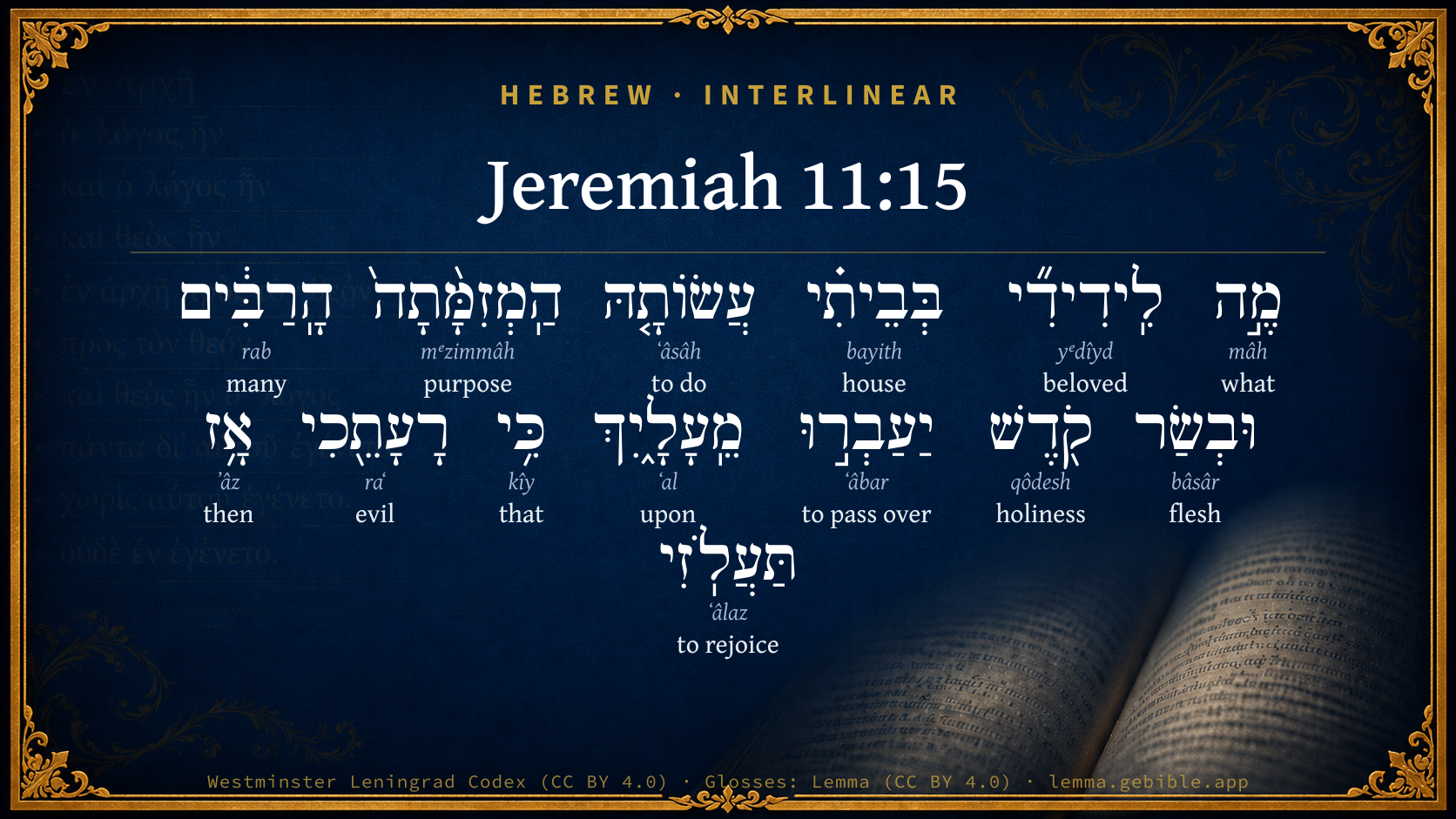
  1. מֶ֣ה mâh H4100 “what” Particle, Interrogative
  2. בְּבֵיתִ֗י bayith H1004 “in/at · house · my” Preposition + Noun, Common, Masculine, Singular, Construct + Suffix, Personal, 1st Person, Common, Singular
  3. עֲשׂוֹתָ֤הּ ʻâsâh H6213 “to do · her” Verb, Qal, Infinitive Construct + Suffix, Personal, 3rd Person, Feminine, Singular
  4. הַֽמְזִמָּ֨תָה֙ mᵉzimmâh H4209 “the · purpose” Particle, Definite Article + Noun, Common, Feminine, Singular, Absolute + Suffix, h
  5. הָֽרַבִּ֔ים rab H7227 “the · many” Particle, Definite Article + Adjective, Adjective, Masculine, Plural, Absolute
  6. וּבְשַׂר bâsâr H1320 “and · flesh of” Conjunction + Noun, Common, Masculine, Singular, Construct
  7. קֹ֖דֶשׁ qôdesh H6944 “holiness” Noun, Common, Masculine, Singular, Absolute
  8. יַעַבְר֣וּ ʻâbar H5674 “to pass over” Verb, Qal, Imperfect, 3rd Person, Masculine, Plural
  9. מֵֽעָלָ֑יִךְ ʻal H5921 “from · upon · you” Preposition + Preposition + Suffix, Personal, 2nd Person, Feminine, Singular
  10. כִּ֥י kîy H3588 “that” Conjunction
  11. רָעָתֵ֖כִי raʻ H7451 “evil · your” Adjective, Adjective, Feminine, Singular, Construct + Suffix, Personal, 2nd Person, Feminine, Singular
  12. אָ֥ז ʼâz H227 “then” Adverb
  13. תַּעֲלֹֽזִי ʻâlaz H5937 “to rejoice” Verb, Qal, Imperfect, 2nd Person, Feminine, Singular

About this verse

These counts appear in no published source. They are computed here, from the morphology-tagged text and Lemma’s own curated glosses. What Lemma adds →

14
words
14
distinct lemmas
Prophets
section

Notable vocabulary

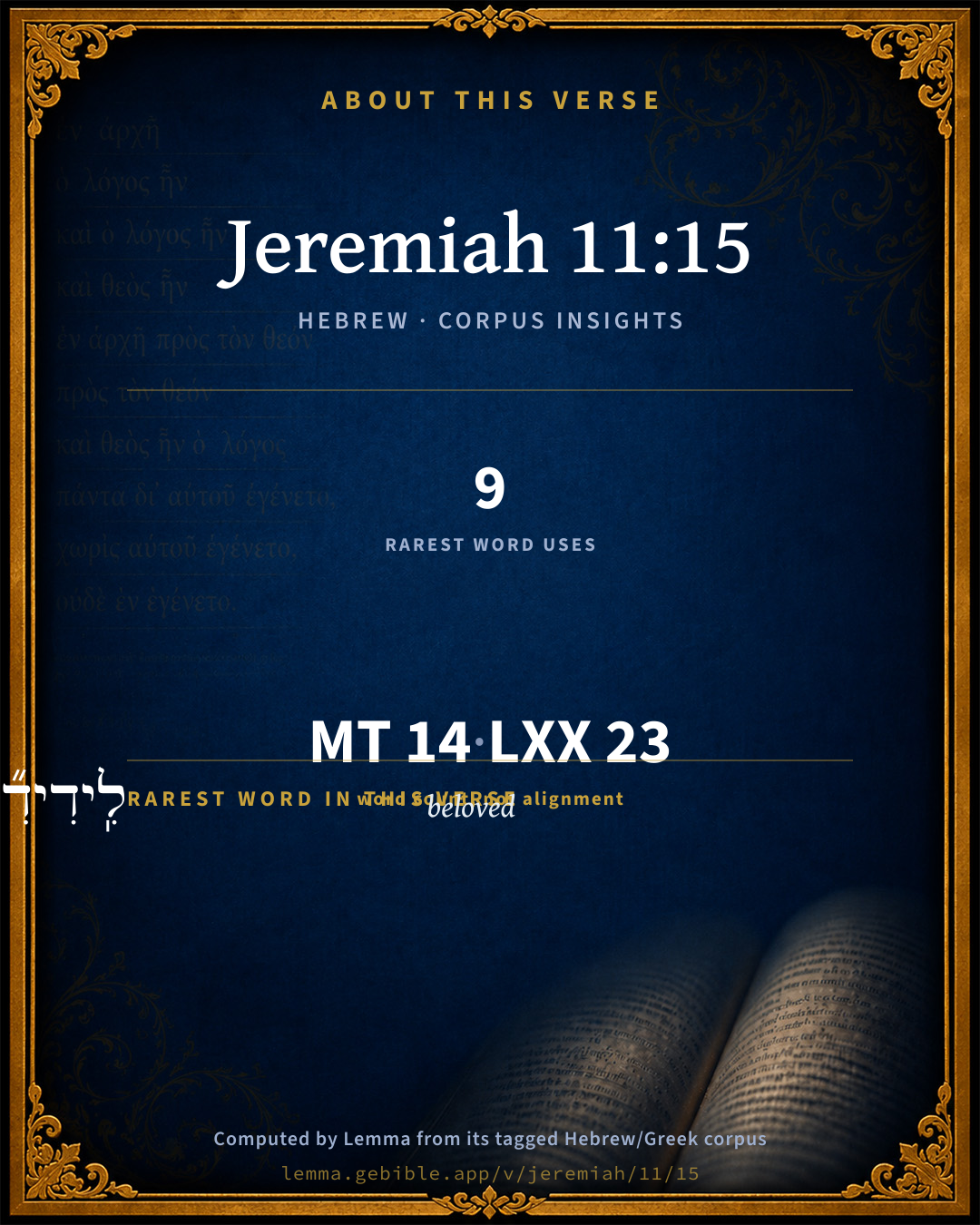
The rarest word here is לִֽידִידִ֞י beloved H3039 — appearing just 9 times in the whole Hebrew Bible.

Shared distinctive vocabulary

לִֽידִידִ֞י beloved H3039 occurs in 8 verses of the Hebrew Bible. Also found in:

Grammatical profile

  • 3 verbs
  • 4 nouns
  • 3 adjectives
  • 1 preposition
  • 1 conjunction
  • 1 adverb
  • 1 particle

Verb forms

  • עֲשׂוֹתָ֤הּ Qal · Infinitive Construct
  • יַעַבְר֣וּ Qal · Imperfect
  • תַּעֲלֹֽזִי Qal · Imperfect

Hebrew & Septuagint length

In the original languages it is 14 Hebrew tokens and 23 Greek tokens — but the two are counted differently (Hebrew bundles its prefixes and suffixes into one token; the Greek is in lemma form), so that isn’t a like-for-like length.

Cross-references

26

Topical passages linked to Jeremiah 11:15 in the Treasury of Scripture Knowledge — connected by theme and wording, ordered by reader-vote popularity; previews shown in the World English Bible.

  • Proverbs 2:14 Who rejoice to do evil, And delight in the perverseness of evil;
  • Titus 1:15 To the pure, all things are pure; but to those who are defiled and unbelieving, nothing is pure; but both their mind and their conscience are defiled.
  • Psalms 50:16 But to the wicked God says, "What right do you have to declare my statutes, That you have taken my covenant on your lips,
  • Proverbs 10:23 It is a fool's pleasure to do wickedness, But wisdom is a man of understanding's pleasure.
  • Proverbs 15:8 The sacrifice made by the wicked is an abomination to Yahweh, But the prayer of the upright is his delight.
  • Proverbs 21:27 The sacrifice of the wicked is an abomination: How much more, when he brings it with a wicked mind!
  • Proverbs 26:18 Like a madman who shoots firebrands, arrows, and death,
  • Proverbs 28:9 He who turns away his ear from hearing the law, Even his prayer is an abomination.
  • Isaiah 1:11–15 "What are the multitude of your sacrifices to me?," says Yahweh. "I have had enough of the burnt offerings of rams, And the fat of fed animals. I don't delight in the blood of bulls, Or of lambs, Or of male goats.
  • Isaiah 50:1 Thus says Yahweh, Where is the bill of your mother's divorce, with which I have put her away? or which of my creditors is it to whom I have sold you? Behold, for your iniquities were you sold, and for your transgressions was your mother put away.
  • Jeremiah 2:2 Go, and cry in the ears of Jerusalem, saying, Thus says Yahweh, I remember for you the kindness of your youth, the love of your weddings; how you went after me in the wilderness, in a land that was not sown.
  • Jeremiah 3:1–2 They say, If a man put away his wife, and she go from him, and become another man's, will he return to her again? Won't that land be greatly polluted? But you have played the prostitute with many lovers; yet return again to me, says Yahweh.
  • Jeremiah 3:8 I saw, when, for this very cause that backsliding Israel had committed adultery, I had put her away and given her a bill of divorce, yet treacherous Judah, her sister, didn't fear; but she also went and played the prostitute.
  • Jeremiah 3:14 Return, backsliding children, says Yahweh; for I am a husband to you: and I will take you one of a city, and two of a family, and I will bring you to Zion:
  • Jeremiah 7:8–11 Behold, you trust in lying words, that can't profit.
  • Jeremiah 12:7 I have forsaken my house, I have cast off my heritage; I have given the dearly beloved of my soul into the hand of her enemies.
  • Jeremiah 15:1 Then said Yahweh to me, Though Moses and Samuel stood before me, yet my mind would not be toward this people: cast them out of my sight, and let them go forth.
  • Ezekiel 16:25–34 You have built your lofty place at the head of every way, and have made your beauty an abomination, and have opened your feet to everyone who passed by, and multiplied your prostitution.
  • Ezekiel 23:2–21 Son of man, there were two women, the daughters of one mother:
  • Hosea 3:1 Yahweh said to me, "Go again, love a woman loved by another, and an adulteress, even as Yahweh loves the children of Israel, though they turn to other gods, and love cakes of raisins."
  • Haggai 2:12–14 'If someone carries holy meat in the fold of his garment, and with his fold touches bread, stew, wine, oil, or any food, will it become holy?'" The priests answered, "No."
  • Matthew 22:11 But when the king came in to see the guests, he saw there a man who didn't have on wedding clothing,
  • Luke 8:28 When he saw Jesus, he cried out, and fell down before him, and with a loud voice said, "What do I have to do with you, Jesus, you Son of the Most High God? I beg you, don't torment me!"
  • Romans 11:28 Concerning the Gospel, they are enemies for your sake. But concerning the election, they are beloved for the fathers' sake.
  • 1 Corinthians 13:6 doesn't rejoice in unrighteousness, but rejoices with the truth;
  • James 4:16 But now you glory in your boasting. All such boasting is evil.

Cross-references courtesy of OpenBible.info (CC BY 4.0).

Hebrew and Greek witnesses Masoretic Hebrew ↔ Greek Septuagint

The same verse in the two great witnesses to the Old Testament, shown verse-for-verse.

These are two independent witnesses, not word-aligned to each other, and the Septuagint is shown in lemma (dictionary) form.

Hebrew Jeremiah 11:15 Masoretic · Westminster Leningrad Codex

מֶ֣ה לִֽידִידִ֞י בְּבֵיתִ֗י עֲשׂוֹתָ֤הּ הַֽמְזִמָּ֨תָה֙ הָֽרַבִּ֔ים וּבְשַׂר קֹ֖דֶשׁ יַעַבְר֣וּ מֵֽעָלָ֑יִךְ כִּ֥י רָעָתֵ֖כִי אָ֥ז תַּעֲלֹֽזִי

What has my beloved to do in my house, seeing she has worked lewdness [with] many, and the holy flesh is passed from you? when you do evil, then you rejoice.

World English Bible · Public Domain

Greek LXX Structure differs

In the Septuagint, Jeremiah is about an eighth shorter than the Hebrew and arranges its material differently — the Oracles Against the Nations (Hebrew chapters 46–51) appear in the middle of the Greek book, after 25:13. Because the chapter and verse boundaries do not line up, a verse-for-verse comparison with the Hebrew is not shown.

A verse-for-verse comparison isn’t shown here because the chapters and verses don’t line up. Switch to the LXX edition with the MT / LXX toggle above to read the Greek directly.

On this verse, Ellicott's Commentary for English Readers discusses the Septuagint’s reading. Read the note in Commentary ↓

Hebrew: Westminster Leningrad Codex (CC BY 4.0). Greek: Septuagint (public domain); English from a public-domain English Septuagint. How the Septuagint differs from the Hebrew →

Targum (Aramaic paraphrase)

1

The Targum is the ancient Jewish Aramaic paraphrase of the Hebrew Scriptures — an interpretive translation, not the Hebrew text itself. Onkelos (literal) and Pseudo-Jonathan (expansive) render the Torah, and Jonathan the Prophets. Coverage is partial: where no permissively-licensed English translation exists for a verse, only the Aramaic is shown. This is verse-level text, not a word-by-word alignment to the Hebrew.

  1. Targum Jonathan Prophets (Joshua–Malachi)
    מַה לְעַמָא דַהֲוָה חָבִיב קֳדָמַי שְׁבָקוּ פוּלְחַן בֵּית מַקְדְשִׁי עֲבָדוּ עֵצָה לְחֶטְאִין סַגִיאִין מְעַרְבִין בְּשַׂר שִׁקוּצִין עִם בְּשַׂר קוּדְשָׁא יִגְלוֹן מִנִיךְ מִן קֳדָם בִּשְׁתִּיךְ בְּכֵן הֲוֵיתָא תַקִיפָא:

    (no public-domain English translation for this verse)

    Targum Jonathan — Aramaic: “Mikraot Gedolot” (public domain). English: “Sefaria Community Translation” (CC0 1.0 (public-domain dedication)); “London "Chaldee Paraphrase," 1871” (public domain). Text via Sefaria.

Commentary

Notes on Jeremiah 11:15 from classic Christian and Jewish commentators (each source and its license shown beneath its notes). The classic Christian expositions comment on the surrounding passage and are grouped to its opening verse, so a note may address several verses; the Jewish commentaries on the Tanakh (Rashi and others) are per-verse, so they appear only where the commentator wrote on this verse.

Lemma curates 59 commentaries, every one of them public domain or Creative Commons licensed, each selected and text-cleaned for this edition rather than reprinted as found. About our sources →

Trapp's Complete Commentary

John Trapp

Jer 11:15 What hath my beloved to do in mine house, [seeing] she hath wrought lewdness with many, and the holy flesh is passed from thee? when thou doest evil, then thou rejoicest.

Ver. 15. What hath my beloved to do in mine house?] i.e., Mine once beloved people, which had the liberty of mine house, and was welcome thither, but is now discarded and discovenanted, as if a husband should say to his adulterous wife, What maketh this strumpet in my bed, since she hath so many paramours? {a}

And the holy flesh.] The sacrifice sanctified by the altar.

Is passed from thee.] Shall be wholly taken away from you, together with the temple.

When thou doest evil, then thou rejoicest.] Thou revellest in thine impurities and sensualities, as dreading no danger, but slighting all admonition.

{a} Vatab.

John Trapp, A Commentary or Exposition upon All the Books of the Old and New Testament (1647–1656) — public domain. Text from a community e-Sword module.

Joseph Benson's Commentary

Jer 11:15. What hath my beloved to do in my house, &c. — “Why doth this, my chosen and peculiar people, as they love to call themselves, make their appearance before me in my house, since they have gone a whoring after several idols of the nations round about them, and thereby have disowned me, and broken the marriage contract that was between us? See note on Jer 2:2. God calls the Jews his beloved people, because they called themselves so, and because they were still beloved for their fathers’ sake, Rom 11:18; and he would not cast them off utterly, for the sake of the covenant he had made with their progenitors.” — Lowth. And the holy flesh is passed from thee — “The flesh of thy sacrifices, which thou offerest up to me as an atonement for thy sins, does not at all profit thee, being rendered unacceptable to me through thy many and great provocations, in the commission of which thou continuest without remorse.” — Lowth. But the words are rendered by some, The flesh of my sanctuary shall pass from thee, and may mean, that the parts of the victims, which by the Mosaic law were the portion of the priests, should not be given to them, since the temple would be destroyed. According to this interpretation the prophet must be considered as addressing the priests, of whom there were, without doubt, many in Jerusalem. When thou doest evil, thou rejoicest — Thou gloriest in thy wickedness. Or, at a time when thou offendest most against my laws, thou exultest, and behavest as if thou didst every thing that is right.

Joseph Benson's Commentary on the Old and New Testaments (1811–1818) — public domain. Text from a community e-Sword module.

Tyndale Open Study Notes

Tyndale Open Resources

11:15 The people’s worship included the words and ceremonies the Lord required, but their worship was insincere; they did not love God or their neighbors.

Tyndale Open Study Notes — © Tyndale Open Resources, licensed CC BY-SA 4.0. Text via the HelloAO Bible API.

Geneva Bible (1599)

Geneva Bible translators

My people of Israel, whom I have hitherto so greatly loved.

Meaning, that they offer not in the Temple to God, but on the altars of Baal and the idols, and so rejoiced in their wickedness.

Geneva Bible (1599) marginal notes — public domain. Text via Bolls.life.

Jamieson, Fausset & Brown

Robert Jamieson, A. R. Fausset & David Brown

my beloved--My elect people, Judea; this aggravates their ingratitude (Jer 12:7).

lewdness with many-- (Eze 16:25). Rather, "that great (or, manifold) enormity"; literally, "the enormity, the manifold"; namely, their idolatry, which made their worship of God in the temple a mockery (compare Jer 7:10; Eze 23:39) [HENDERSON].

holy flesh-- (Hag 2:12-14; Tit 1:15), namely, the sacrifices, which, through the guilt of the Jews, were no longer holy, that is, acceptable to God. The sacrifices on which they relied will, therefore, no longer protect them. Judah is represented as a priest's wife, who, by adultery, has forfeited her share in the flesh of the sacrifices, and yet boasts of her prerogative at the very same time [HORSLEY].

when thou doest evil--literally, "when thy evil" (is at hand). PISCATOR translates, "When thy calamity is at hand (according to God's threats), thou gloriest" (against God, instead of humbling thyself). English Version is best (compare Pro 2:14).

Jamieson, Fausset & Brown — Commentary Critical and Explanatory on the Whole Bible (1871) — public domain (CC PDM 1.0). Text via the HelloAO Bible API.

Adam Clarke's Commentary

Verse 15. What hath my beloved to do in mine house] This has been supposed to refer to Abraham, Moses, or such eminent servants of God, whose intercession was very powerful. Were even they to appear as intercessors, their prayer should not be regarded. Others think that this is an endearing expression, which properly belonged to the Israelites. When God took them into covenant with himself, they were espoused to him, and therefore his beloved; but now that they have forsaken him, and joined themselves to another, what have they to do with his house or its ordinances, which they wish now to frequent with vows and sacrifices, when they see the evil fast coming upon them? This is probably the sense of this very obscure passage. Dr. Blayney translates, "What hath my beloved to do in my house whilst she practiseth wickedness? Shall vows and holy flesh (sacrifices) be allowed to come from thee? When thou art malignant, shalt thou rejoice?"

Adam Clarke's Commentary on the Bible (1810–1826) — public domain. Text from a community e-Sword/MySword module.

John Calvin's Commentaries

As the words are concise, this passage is in various ways perverted by interpreters: brevity is commonly obscure. But the explanation almost universally received is this, — that the Prophet in this sense, think also that the Temple is called his house, on account of his concern for religion, for which he was very zealous. As then he had preferred God’s Temple to all earthly things, they think that he thus spoke, What has my beloved to do in mine house? But Jonathan much more correctly applies the words to God; and doubtless, whoever wisely considers the Prophet’s words will wonder that so many learned men have been mistaken on a point by no means doubtful. God then, no doubt, speaks here; and he calls his people beloved on account of their adoption.

But the expression is ironical: we cannot think otherwise when we consider how great was the impiety of the people, and how unworthy they were of such an honor on account of their ingratitude. It is yet not strange that they were called beloved, as in other places, for they had been chosen by God. They were in a similar way called “upright” in the song of Moses; and yet Moses, in that very song, declared how wickedly they had departed from their God. (Deuteronomy 32:15) But he called them “upright” in reference to God; for though men do not answer to their vocation, yet the counsel of God remains firm, and can never be changed by the wickedness of men. Though then all had then become apostates, yet God did not suffer his covenant to be abolished, Hence Paul, in speaking of the Jews, in Romans 11:28, when almost all had become the bitterest enemies to the gospel, and had, through their unfaithfulness, wholly forfeited their privileges, so as to become aliens, yet says that they were beloved on account of their fathers:

“For you,” he says, “they are indeed for a time enemies;”

which means, that God designed to give their place to the Gentiles, and to adopt them; and yet that, on account of his covenant, they remain, and will remain beloved, that is, with regard to the first adoption.

I shall quote no other similar passages, for it is enough to understand the real meaning of the term: What then has my beloved to do in my house? which means, “Why do the Jews now pretend to come to the Temple to sacrifice to me? Why do they profess themselves to be my people? What have they to do with my house?” that is, “What have they to do with anything like holiness?” Hence he indirectly touches the Jews in two ways, — that they bad precluded themselves from the advantage of offering sacrifices in the temple, — and that it was an increase of their crime, that while they were God’s friends, that is, when he bestowed on them his favor, and embraced them as a father his own children, they yet carried on war with him as his avowed enemies, according to what is elsewhere said,

“Ah! I will take vengeance on mine enemies.” (Isaiah 1:24)

We now see that this meaning is the most suitable. God shews that his temple was polluted by the Jews, when they thoughtlessly rushed there to offer their sacrifices; What have you, he says, to do with my house? Nearly the same thing is said in the first chapter of Isaiah; for God there contemptuously reproves the Jews because they trod the pavement of his temple: “I truly do not owe you anything; ye indeed come to my courts, but for what purpose? Ye only wear out the pavement of my temple: Stay then at home, and think not that I am bound to you because ye come to the temple.” So also in this place, What has my beloved to do with my house? He concedes to them the title Beloved, as though he had said, “Ye are, it is true, beloved, and ye think that God is bound to you; for, relying on the covenant which I made with your father Abraham, ye always continue to make this boasting — ‘We are the people of God and his heritage; we are a holy nation and a royal priesthood’ — Beloved ye are,” he says, “but what have you to do with my Temple?”

Then he adds, For she has done abomination with many The gender is here changed, for the relative is feminine: but this mode of speaking is everywhere common, as the people are represented to us under the character of a woman. Then he in effect says, “Behold the daughter of my people hath done abomination with many.” The Jews were not to enter the Temple except they remained as it were fixed in its pure worship; for as it was the only true Temple, and had in it the only true altar, so they ought to have worshipped none but the only true God, and also to have observed one rule only in worshipping him. But he says here that they had done abomination; and thus he charged them with those impious devices, those spurious forms of worship which they had adopted, and thus departed from what had been prescribed to them; for abomination is set here in opposition to the law. He says further, that they did this with many. We hence see that the gate of the Temple was closed against them, for the Temple could not be separated from the law, nor yet from God, to whom it was dedicated The Jews, having forsaken the law, and adopted innumerable idols, thrust themselves into the Temple; and hence we see the reason why God complains that they still came to the Temple: “As then they have done abomination, and done it with many, they have no more anything to do with my law.” The Temple was a visible image of the one true God, and also the holy receptacle of his law. They despised the law, and gloried in innumerable gods: they sought thus to blend the sanctity of the Temple with a multitude of gods, and with their own depravations and devices.

He says afterwards, that the flesh of the sanctuary had passed away from them: The flesh of the sanctuary have passed away Some apply this to all the faithful, according to that saying,

“Silent before God let all flesh be,” (Habakkuk 2:20)

but this is forced, and without meaning. He speaks no doubt of sacrifices, and says, that the flesh of the sanctuary, that is, sacrifices, had departed from the people. They no doubt still offered sacrifices very regularly; but God did not accept their sacrifices, because they had corrupted his true worship. This then is the reason why he says that the flesh of the sanctuary had departed from the people, as in other places he denies that it was offered to him. At the same time the Jews wished sacrifices to be regarded as offered to him, and doubtless they boldly referred to them in opposition to the prophets. But God did not accept them, though they sought thus to render him as it were a debtor. “It is not to me,” he says, “that ye offer your sacrifices, but to idols.” So also in this place he says, The flesh of the sanctuary is taken away from them; for their sacrifices had become polluted. They were then nothing but putrid carcases; for victims, ought to have been offered in the Temple; but they had polluted the Temple, so that it had become a den of robbers, and like a dunghin, in short, a brothel, as Scripture speaks elsewhere. There was then now, doubtless, no flesh of the sanctuary; that is, no lawful sacrifice, such as God approved.

Let us then know that hypocrites, as soon as they depart from the true worship of God, do nothing that can avail them, though they may busy themselves much, and even weary themselves in worshipping God, for all that they offer is abominable. If then we desire to render to God such services as he will accept and approve, let us regard this truth — that obedience is more valued by him than all sacrifices. (1 Samuel 15:22)

He adds another complaint, — that when they did evil, they gloried in it. And there is a causal particle introduced, Because, he says, thou gloriest when thou hast done evil The Prophet no doubt means, that they had by no means a right to contend, because they had not only corrupted true religion, but were also proud of their superstitions, and despised God, and set up their own devices against his law. But it was an intolerable thing for men to attempt to subject God to their own will, or rather to their own fancies. Indeed, the faithful do not so purely and so perfectly sacrifice to God, but that some vices are mixed with their offerings; but God nevertheless receives what they offer, though there be some mixture of defilement. How so? Because they acquiesce not in their own performances, but, on the contrary, aspire after purity, though they do not attain it; but when hypocrites exalt themselves against God, and proudly despise his teaching, and prefer their own inventions, and dare even to set up these against his authority, it is doubtless a diabolical presumption, such as contaminates what would otherwise be most holy. It follows —

John Calvin's Commentaries (1540-1563) — public domain. Text from the Calvin Translation Society English edition (1840s-50s) via the Christian Classics Ethereal Library (ccel.org). Calvin's coverage is partial (roughly two-thirds of the Bible); uncommented books and verses are honest gaps, never fabricated. The 19th-century editor's footnotes and remarks are omitted so the notes are faithfully Calvin's own voice.

Ellicott's Commentary for English Readers

(15) My beloved.—sc., Judah—or, perhaps, Israel collectively—as the betrothed of Jehovah. What has she to do, what part or lot has she in that house of Jehovah which she pollutes?

Seeing she hath wrought lewdness with many.—The Hebrew is difficult, and probably corrupt. The most probable rendering is What hath my beloved to do in my house, to work it even evil devices? Thy many, i.e. (probably, as in Jer_3:1), thy many lovers, and the holy flesh (i.e., her sacrifices), will they make it (the guilt of her devices) to pass away from thee? Keeping the present text of the Hebrew the latter clause would run, they shall pass away from thee, i.e., shall leave thee, as thou wert, unreconciled and unforgiven. A conjectural emendation, following the LXX., gives, will thy vows and the holy flesh remove thy evil from thee . . . The general sense is, however, clear. A religion of mere ritual-sacrifices and the like will not avail to save. The Hebrew for “lewdness” does not convey the idea which we now attach to the English word, but means primarily a plan of any kind, and then a “device” or “scheme” in a bad sense, as in Psa_10:2; Psa_21:11; Pro_14:17. Probably the translators, here, as in Act_17:5; Act_18:14, used the word in this more general sense. Primarily, indeed, “lewd” in Old English was simply the opposite of “learned.”

When thou doest evil, then thou rejoicest.—The clause is involved in the same difficulty as the rest of the verse. The English version is tenable, and gives an adequate meaning. By some commentators, however, the passage is rendered, referring evil to the previous sentence, Will they (vows, &c.) remove evil from thee? Then mightest thou rejoice.

A Bible Commentary for English Readers, edited by Charles John Ellicott (1878–1897) — public domain. Text from a community e-Sword module.

The Cambridge Bible for Schools and Colleges

gen. ed. J. J. S. Perowne

15. The MT. is not really intelligible. It can be approximately corrected from LXX (as in the mg.). Gi. (so Du. and Erbt), quotes Irenaeus (IV. 32), who has adipes, fat pieces, a rendering which can be obtained by a fairly easy change in the consonants of the word in MT. The Hebrew noun which he thus adopts is used several times (e.g. Lev_8:26) of the fat of sacrifices. The weak part of the LXX reading lies in the last clause, where, although the sense given by them is better, the rendering involves considerable change in the Hebrew.

my beloved] Judah; so ch. Jer_12:7.

15–17. See summary at commencement of section.

The Cambridge Bible for Schools and Colleges (gen. ed. J. J. S. Perowne; Cambridge University Press, 1878–1918) — public domain. Text from a community e-Sword module.

John Gill's Exposition

The Lord called thy name a green olive tree,.... That is, compared the Jewish church and people to one, and made them as one, very prosperous and flourishing in the enjoyment of privileges, civil and religious, being highly favoured with the word and ordinances: fair, and of goodly fruit; which, for a while, brought forth the fruit of good works; and, while such, was amiable and goodly to look upon; was, as the Syriac version is, "fair with fruit, and beautiful in sight"; and whereas it might have been expected she would have so continued, and been still as a green olive tree in the house of God, as David says, Psa 52:8, now it was otherwise, she was become barren, dry, and fruitless: and therefore it follows:

with the noise of a great tumult he hath kindled fire upon it: that is, by means of the Chaldean army, which came with a mighty rushing noise, as a numerous army does; the Lord hath destroyed it, and burnt it with fire; what the Chaldeans did is ascribed to God, because it was done according to his will, and by his direction and overruling providence:

and the branches of it are broken; the high and principal ones, the king, princes, and nobles, their palaces, and the house of God. The apostle seems to have respect to this passage in Rom 11:17. The Targum is,

"as an olive tree that is beautiful in form and comely of sight, whose branches overshadow the trees, so the Lord hath magnified thy name among the people; but now that thou hast transgressed the law, the armies of the people, who are strong as fire, shall come against thee, and helps shall be joined to them.''

John Gill's Exposition of the Whole Bible (1746–1763) — public domain (CC PDM 1.0). Text via the HelloAO Bible API.

Haydock's Catholic Bible Commentary

Beloved, dilectus. Hebrew and Septuagint have the feminine. Chaldean, "people." They presumptuously thought that they would be freed from all their abominations, by partaking of the sacrifices. (Calmet) --- But the offerings of such are not accepted. (Menochius) --- The flesh is holy, but is of no service to the obstinate sinner. (Worthington)

George Leo Haydock (1774–1849), Haydock's Catholic Family Bible and Commentary, 1859 edition — public domain. Excludes Psalms (Douay-Rheims chapter numbering differs from Protestant) and Deuterocanonical books (Catholic canon only).

Matthew Poole's English Annotations

Some make these words the words of the prophet, declaring that God (whom they suppose here called the beloved) was about to forsake the temple. Others make them the words of God, speaking of his prophet, whom he calleth his beloved; or rather, speaking of his people, whom he calleth his beloved, upon the account of his ancient union with them, and marriage to them; this seemeth most probable, and agreeth both with Jer 7:9,10, and also with the usual confidence of the Jews, because of the temple of the Lord, and their formal services of God in it. My people, saith God, though I was formerly their Husband, yet have wrought lewdness with many, that is, committed idolatry with many idols; and now what have they to do more in my house, than a base strumpet which hath turned a whore hath to do in the house of her husband?

And the holy flesh is passed from thee: some by this phrase understand that God would own them no more as a holy people. Others that their circumcision was become uncircumcision. Others more probably understand it of the flesh of the sacrifices they were wont to offer; either they had been remiss in offering the sacrifices God had commanded them; or (which is more probable) the flesh of their sacrifices, being set before idols, as well as before him who was the only true God, became polluted, and was abomination to the Lord. The learned author of our English Annotations notes, that the words may very fairly be translated, and the holy flesh they shall pass away from thee; so the words import a threatening, that because they had polluted and profaned the sacrifices, God would make their sacrifices to cease.

When thou doest evil, then thou rejoicest: and this the Lord would rather do against them, because they were not only evil, but gloried in their wickedness, or at least were full of mirth and jollity as if they had done no iniquity.

Matthew Poole's English Annotations on the Holy Bible (1683–1685) — public domain. Text from a community e-Sword/MySword module.

Whedon's Commentary on the Bible

Daniel D. Whedon

15. What hath my beloved, etc. — The language here is characterized by such difficulty as has led many conservative and evangelical commentators to conjecture a corruption of the text. This conjecture is supported by the fact that the ancient Versions do not agree with the Hebrew — though neither do they agree among themselves. The Septuagint renders the last part, shall vows and holy flesh turn away thine evil from thee? The Syriac and Vulgate agree in treating the words rendered lewdness and many as in opposition, so that the middle clause would read, to work the enormity, the manifold, alluding to the many-shaped sin of idolatry. But if we reject all suggestions of change in the text, perhaps the most probable rendering of the original as it now stands would be, What hath my beloved in my house? To do wickedness? The chiefs and the holy flesh shall pass away from thee. When thy iniquity is, then thou rejoicest. This term of endearment sounds strangely in the midst of these charges against the nation, and yet it is thoroughly in harmony with the spirit of this book and of the Old Testament. Unworthy and corrupt as this people had become, they were still the “beloved” of the Lord.

Daniel D. Whedon (gen. ed.), Commentary on the Old and New Testaments (1874–1909) — public domain. Text from a community e-Sword module.

The Pulpit Commentary

What hath my beloved to do in mine house? "My beloved" is evidently the Jewish people, who in Jer_12:7 is called "the dearly beloved of my soul." The Divine Speaker expresses surprise that one who has now so poor a claim to the title of "my beloved" should appear in his holy house. It is spoken in the spirit of that earlier revelation of Isaiah, "When ye come to appear before me, who hath required this at your hand, to trample my courts?". (Isa_1:12) The Jews, it would seem, came to the temple to pray, but their prayer is not accepted, because it is associated with unholy practices. They thought by formal prayers and sacrifices to pay off their debt to the Deity, and so be free to go on with their old devices. (as in Jer_7:15) This seems the best view of the difficult words which follow, but it implies a correction of the certainly ungrammatical rendering of the Authorized Versionseeing she hath wrought lewdness into to work the wicked device. But here begins the most obscure part of the verse. With many cannot be right; for "with" has nothing corresponding to it in the Hebrew; the word in the original simply means "the many," and as it is immediately followed by a noun in the singular with "and," and a verb in the plural, it is plain that it must (if correctly read) be part of the subject of the latter. The Septuagint, however, has a different reading, which may very well be correct, and out of which the received Hebrew reading may easily have grown vows and holy i.e. hallowed flesh remove from thee thy wickedness or perhaps, "thy calamity?" The connection thus becomes easy. "Vows and holy flesh", (i.e. the flesh of sacrifices, Hag_2:12) naturally go together; the only other possible way of taking the passage (assuming the correctness of the "received text) the great ones and the holy flesh shall pass away from thee is obviously inadmissible. "Vows and sacrifices," however, precisely express the true association of ideas. A man made a vow, and he generally paid it in the form of a sacrifice. But, inquires Jehovah, "Can such vows and such Victims please God, and expiate thy wickedness or, "avert thy calamity? Then thou mightest rejoice." The latter words are not, indeed, more exact than those of the Authorized Version, but are in accordance with grammar, and suit the preceding question. It is not certain, however, that the text is right here; the Septuagint has hh toutoiv diafeuxh . (Notice that Keil, conservative to a fault in matters affecting the received text, agrees with the above correction, which is also adopted by Ewald, Hitzig, and Graf.)

The Pulpit Commentary (1880–1919), ed. H.D.M. Spence-Jones & Joseph S. Exell — public domain. Text from a community e-Sword module.

John Wesley's Explanatory Notes

My beloved - My people, saith God, though I was formerly their husband, yet have wrought lewdness with many, that is, committed idolatry with many idols, and now what have they to do more in my house? The holy flesh - Flesh of their sacrifices, being set before idols, as well as before God, became polluted, and was abomination to the Lord. Thou rejoicest - They were not only evil but gloried in their wickedness.

John Wesley, Explanatory Notes Upon the Whole Bible (1754–1765) — public domain. Text via the GEBible commentary corpus.

Scofield Reference Notes

C. I. Scofield

holy flesh

See Hag 2:12 i.e. to what purpose the "holy flesh" of sacrifices? Its efficacy is "passed from thee" who rejoicest in evil. Cf. Isa 1:13-15.

The Scofield Reference Bible (1917 edition), notes by C. I. Scofield — public domain. Text from a community e-Sword module.

Rashi

Rabbi Shlomo Yitzchaki (Rashi)

What has my beloved to do in My house What reason has My treasured people to come anymore into My house?

[seeing that]...perform evil design That she does the evil design of her sinful plans.

the many of them.

and the holy flesh they remove from you Even the circumcision through which they were hallowed to Me, they have abolished from their flesh.

for [with] your evil, then you rejoice When you commit a transgression, you rejoice.

Rashi on the Tanakh — English translations: “The Judaica Press complete Tanach with Rashi, translated by A. J. Rosenberg” (CC BY 4.0); “Pentateuch with Rashi's commentary by M. Rosenbaum and A.M. Silbermann, 1929-1934” (public domain); “The Metsudah Tanach series, Lakewood, N.J” (CC BY 4.0); and “The Book of Joshua, Metsudah Publications, 1997” (CC BY 4.0). Text via Sefaria.

Lesson kit

Teaching starters — assembled from the data on this page, not authored interpretation. Every prompt links to the verse data it draws on. Edit before teaching.

Jeremiah, in the Prophets, opens this verse with 14 words (14 distinct Hebrew lemmas). Its most distinctive word is yᵉdîyd (“beloved”). A historical commentator’s framing appears above. Read the whole chapter for the surrounding context.

Discussion questions

  1. The word yᵉdîyd carries the sense “beloved.” How does it shape the verse?
  2. How does Deuteronomy 33:12, which shares the word «beloved», read alongside this verse?
  3. These translations render this verse differently; the difference is in the English rendering, not the original. What questions does that raise?
  4. «עֲשׂוֹתָ֤הּ» is a Qal Infinitive Construct verb. How does that grammatical form shape the action described?
  5. Compare how Trapp's Complete Commentary and Joseph Benson's Commentary read this verse. Where do they agree or differ?

Things to notice

Reading settings

Reading text

Shown beneath each verse's original-language words.

Old Testament
Old Testament edition

Read the OT as the Masoretic Hebrew (MT) or the Greek Septuagint (LXX).

English shown for the Greek Septuagint (in the Hebrew ↔ Greek comparison).

Comparing translations? Open the Compare panel on any verse page to stack up to four side by side.