
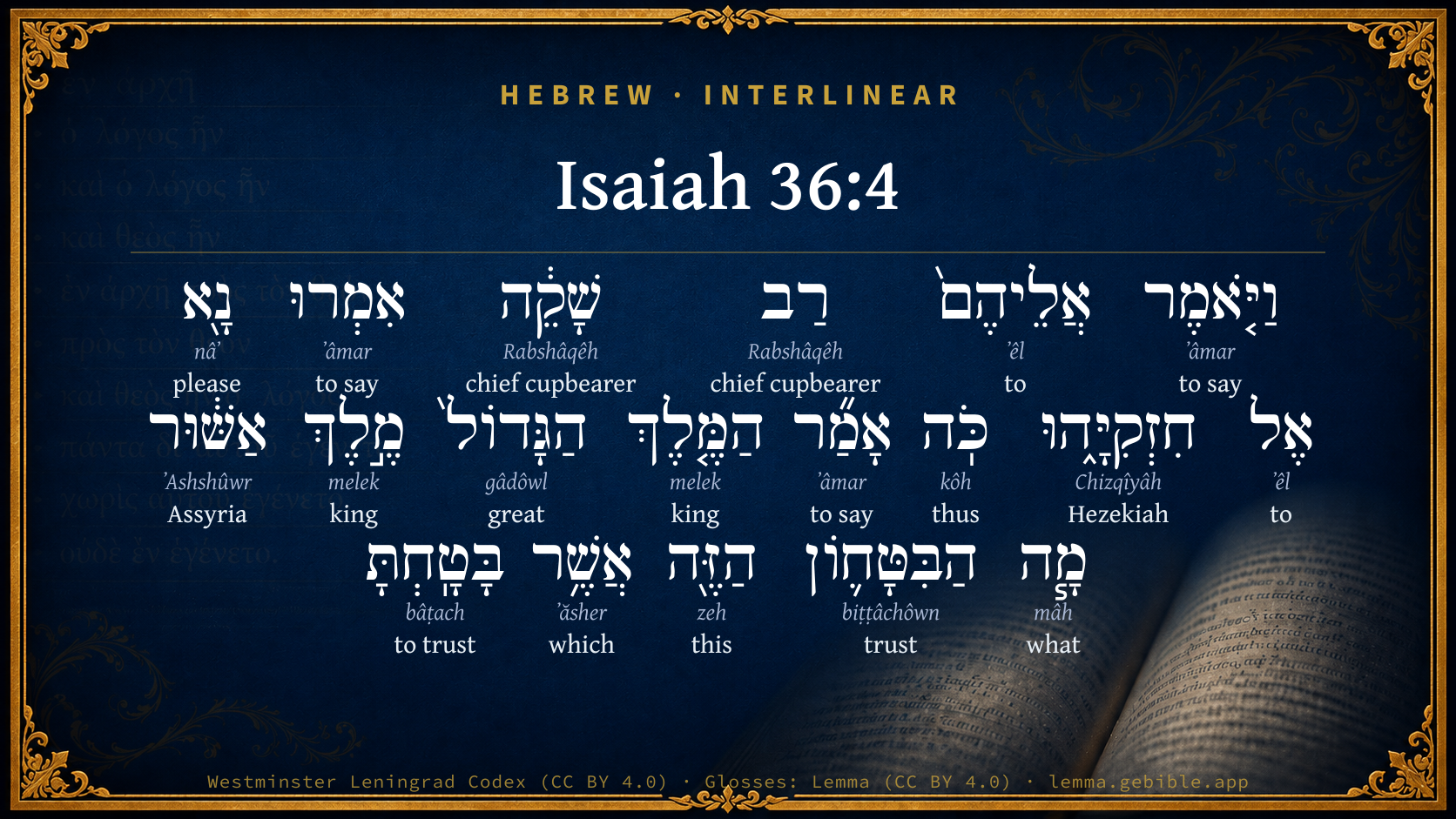
Isaiah 36:4

Hebrew (Westminster Leningrad Codex) Isaiah 36:4 appears in the Hebrew Old Testament. The text above is from the Westminster Leningrad Codex. Each word links to its Strong’s number, a concise gloss, and parsing drawn from the Open Scriptures Hebrew Bible morphology. Click any word for its full Brown-Driver-Briggs (BDB) entry.
Download image
Cite this verse

Isaiah 36:4 (World English Bible). Public Domain. Lemma interlinear Bible study tool, https://lemma.gebible.app/v/isaiah/36/4.

Show BibTeX & RIS
BibTeX
RIS
English Translation
Rabshakeh said to them, Say you now to Hezekiah, Thus says the great king, the king of Assyria, What confidence is this in which you trust?
World English Bible · Public Domain
Download a study sheet

One document with this verse’s original text, its word-by-word gloss line, the meaning frame, cross-references with their text, attributed commentary, and full source and license credits — printable, and it pastes into notes with its structure intact.

This verse Autodidact and up

Study sheet (.html) Plain text (.txt)

A passage Seminary Student

Up to 50 verses in one chapter. A passage sheet keeps up to 6 commentary sources and 12 cross-references per verse, in the order this page ranks them, and says so on the sheet whenever that leaves anything out. Ask for a single verse and you get the Autodidact verse sheet above.

Everything on this page stays free to read, with no account — the sheet is a download of what is already on screen, not access to it.

Want to remove ads? Support Godless Engineer
Compare translations 3

The same verse in 3 English versions, stacked beneath the original-language interlinear above. Click any original word for its lexicon entry.

Each is an independent rendering of the whole verse — the interlinear is not word-aligned to these translations.

Highlighted words mark where these versions differ — a whole-verse word diff, not a word-by-word alignment.

  • World English Bible Public Domain
    Rabshakeh said to them, Say you now to Hezekiah, Thus says the great king, the king of Assyria, What confidence is this in which you trust?
  • King James Version Public Domain
    And Rabshakeh said unto them, Say ye now to Hezekiah, Thus saith the great king, the king of Assyria, What confidence is this wherein thou trustest?
  • unfoldingWord Literal Text CC BY-SA 4.0
    And the Rabshakeh said to them, “Now say to Hezekiah, ‘Thus says the great king, the king of Assyria, “What this trust that you trust?

unfoldingWord Literal Text — © unfoldingWord, licensed CC BY-SA 4.0. Word-aligned USFM3 via Door43 (git.door43.org/unfoldingWord/en_ult).

Versions to compare (up to 4)

3 of 4 selected

Show all 18 translations

Every available English version of this verse, each an independent rendering of the whole verse.

  • World English Bible Public Domain
    Rabshakeh said to them, Say you now to Hezekiah, Thus says the great king, the king of Assyria, What confidence is this in which you trust?
  • Berean Standard Bible Public Domain
    The Rabshakeh said to them, “Tell Hezekiah that this is what the great king, the king of Assyria, says: What is the basis of this confidence of yours?
  • Majority Standard Bible Public Domain
    The Rabshakeh said to them, “Tell Hezekiah that this is what the great king, the king of Assyria, says: What is the basis of this confidence of yours?
  • King James Version Public Domain
    And Rabshakeh said unto them, Say ye now to Hezekiah, Thus saith the great king, the king of Assyria, What confidence is this wherein thou trustest?
  • American Standard Version (1901) Public Domain
    And Rabshakeh said unto them, Say ye now to Hezekiah, Thus saith the great king, the king of Assyria, What confidence is this wherein thou trustest?
  • Revised Version (1885) Public Domain
    And Rabshakeh said unto them, Say ye now to Hezekiah, Thus saith the great king, the king of Assyria, what confidence is this wherein thou trustest?
  • Geneva Bible (1599) Public Domain
    And Rabshakeh sayde vnto them, Tell you Hezekiah, I pray you, Thus sayth the great King, the King of Asshur, What confidence is this, wherein thou trustest?
  • Douay-Rheims (1899) Public Domain
    And Rabsaces said to them: Tell Ezechias: Thus saith the great king, the king of the Assyrians: What is this confidence wherein thou trustest?
  • Young's Literal Translation Public Domain
    And Rabshakeh saith unto them, `Say ye, I pray you, unto Hezekiah, `Thus said the great king, the king of Asshur, What `is' this confidence in which thou hast confided?
  • Literal Standard Version CC BY-SA 4.0
    And Rabshakeh says to them, “Now say to Hezekiah, Thus said the great king, the king of Asshur: What [is] this confidence in which you have confided?
  • Unlocked Literal Bible CC BY-SA 4.0
    The chief commander said to them, “Tell Hezekiah that the great king, the king of Assyria, says, 'What is the source of your confidence?
  • unfoldingWord Literal Text CC BY-SA 4.0
    And the Rabshakeh said to them, “Now say to Hezekiah, ‘Thus says the great king, the king of Assyria, “What this trust that you trust?
  • Darby Bible Public Domain
    And Rab-shakeh said to them, Say now to Hezekiah, Thus says the great king, the king of Assyria: What confidence is this in which thou trustest?
  • World Messianic Bible Public Domain
    Rabshakeh said to them, “Now tell Hezekiah, ‘The great king, the king of Assyria, says, “What confidence is this in which you trust?
  • Webster's Bible Public Domain
    And Rabshakeh said to them, Say ye now to Hezekiah, Thus saith the great king, the king of Assyria, What confidence is this in which thou trustest?
  • Free Bible Version CC BY-SA 4.0
    The Assyrian army general said to them, “Tell Hezekiah this is what the great king, the king of Assyria, says: What are you trusting in that gives you such confidence?
  • Bible in Basic English Public Domain
    And the Rab-shakeh said to them, Say now to Hezekiah, These are the words of the great king, the king of Assyria: In what are you placing your hope?
  • JPS Tanakh (1917) Public Domain
    And Rab-shakeh said unto them: 'Say ye now to Hezekiah: Thus saith the great king, the king of Assyria: What confidence is this wherein thou trustest?

Literal Standard Version (2020), Covenant Press — licensed CC BY-SA 4.0. Text via the HelloAO Bible API (eBible.org). Unlocked Literal Bible (unfoldingWord) — licensed CC BY-SA 4.0. Text via the HelloAO Bible API (eBible.org). unfoldingWord Literal Text — © unfoldingWord, licensed CC BY-SA 4.0. Word-aligned USFM3 via Door43 (git.door43.org/unfoldingWord/en_ult). Free Bible Version, Dr. Jonathan Gallagher — licensed CC BY-SA 4.0. Text via the HelloAO Bible API (eBible.org).

Word by word

More ways to search: Search by grammar → Find every occurrence → Compare this word →

Practice this passage: Drill this verse → Learn its vocabulary →

הַבִּטָּח֛וֹן
biṭṭâchôwn
H986
“the · trust”
Particle, Definite Article + Noun, Common, Masculine, Singular, Absolute
Part of Speech
Particle + Noun
Type
Common
Gender
Masculine
Number
Singular
State
Absolute
Full BDB Definition

Origin: from H982

TWOT: 233c

trust, confidence, hope
  1. וַיֹּ֤אמֶר ʼâmar H559 “and · to say” Conjunction + Verb, Qal, Sequential Imperfect, 3rd Person, Masculine, Singular
  2. אֲלֵיהֶם֙ ʼêl H413 “to · them” Preposition + Suffix, Personal, 3rd Person, Masculine, Plural
  3. רַב Rabshâqêh H7262 “chief cupbearer” Noun, Proper
  4. שָׁקֵ֔ה Rabshâqêh H7262 “chief cupbearer” Noun, Proper
  5. אִמְרוּ ʼâmar H559 “say” Verb, Qal, Imperative, 2nd Person, Masculine, Plural
  6. נָ֖א nâʼ H4994 “please” Particle, Exhortation
  7. אֶל ʼêl H413 “to” Preposition
  8. חִזְקִיָּ֑הוּ Chizqîyâh H2396 “Hezekiah” Noun, Proper
  9. כֹּֽה kôh H3541 “thus” Adverb
  10. אָמַ֞ר ʼâmar H559 “to say” Verb, Qal, Perfect, 3rd Person, Masculine, Singular
  11. הַמֶּ֤לֶךְ melek H4428 “the · king” Particle, Definite Article + Noun, Common, Masculine, Singular, Absolute
  12. הַגָּדוֹל֙ gâdôwl H1419 “the · great” Particle, Definite Article + Adjective, Adjective, Masculine, Singular, Absolute
  13. מֶ֣לֶךְ melek H4428 “king of” Noun, Common, Masculine, Singular, Construct
  14. אַשּׁ֔וּר ʼAshshûwr H804 “Assyria” Noun, Proper
  15. מָ֧ה mâh H4100 “what” Particle, Interrogative
  16. הַזֶּ֖ה zeh H2088 “the · this” Particle, Definite Article + Pronoun, Demonstrative, Masculine, Singular
  17. אֲשֶׁ֥ר ʼăsher H834 “which” Particle, Relative
  18. בָּטָֽחְתָּ bâṭach H982 “to trust” Verb, Qal, Perfect, 2nd Person, Masculine, Singular

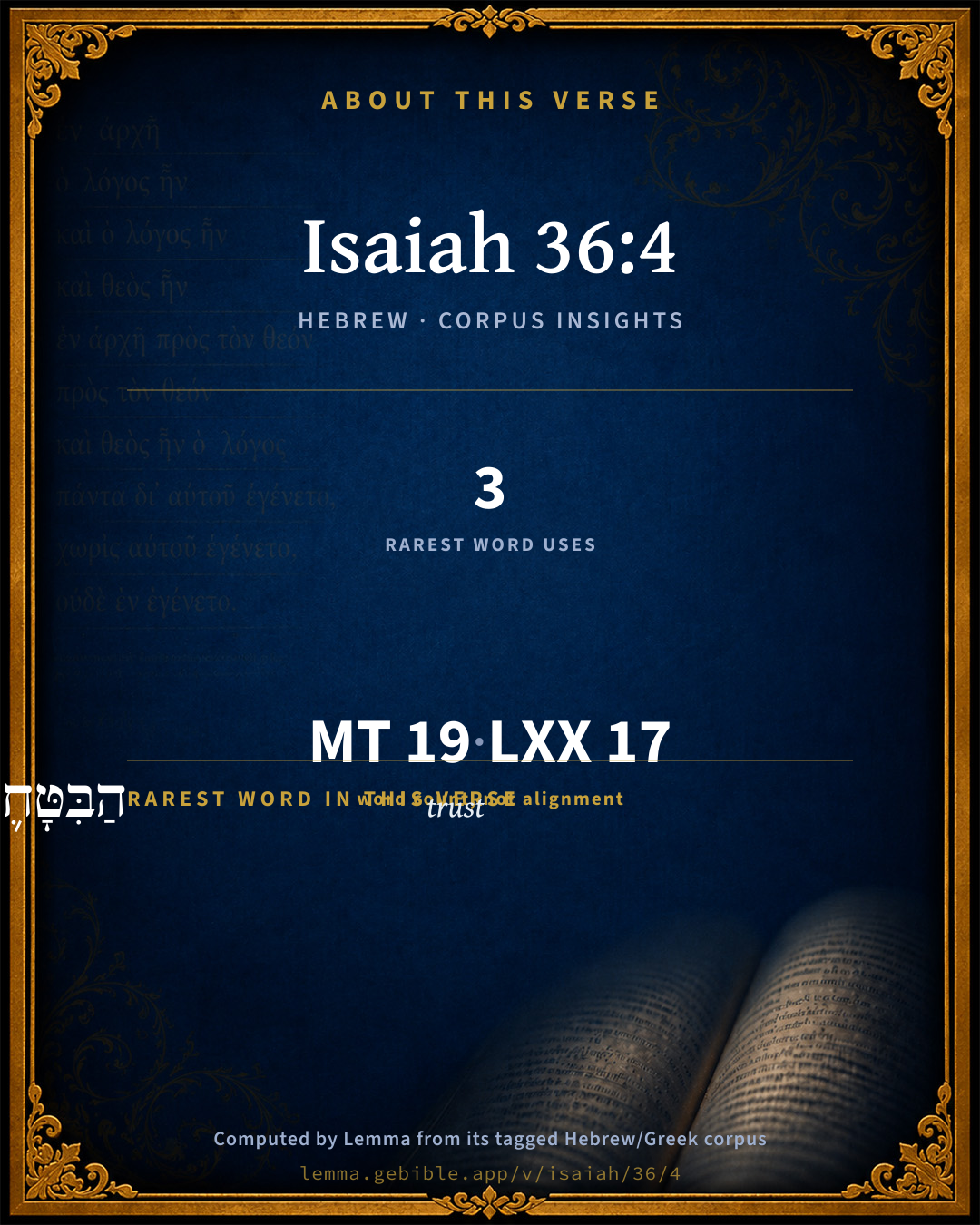
About this verse

These counts appear in no published source. They are computed here, from the morphology-tagged text and Lemma’s own curated glosses. What Lemma adds →

19
words
14
distinct lemmas
Prophets
section

Notable vocabulary

The rarest word here is הַבִּטָּח֛וֹן trust H986 — appearing just 3 times in the whole Hebrew Bible.

Shared distinctive vocabulary

הַבִּטָּח֛וֹן trust H986 occurs in 3 verses of the Hebrew Bible. Also found in:

Grammatical profile

  • 4 verbs
  • 7 nouns
  • 1 adjective
  • 1 pronoun
  • 2 prepositions
  • 1 adverb
  • 3 particles

Verb forms

  • וַיֹּ֤אמֶר Qal · Sequential Imperfect
  • אִמְרוּ Qal · Imperative
  • אָמַ֞ר Qal · Perfect
  • בָּטָֽחְתָּ Qal · Perfect

Repetition

Words recur within this verse — often emphatic in Hebrew:

  • וַיֹּ֤אמֶר to say H559 ×3
  • רַב chief cupbearer H7262 ×2
  • הַמֶּ֤לֶךְ king H4428 ×2
  • אֲלֵיהֶם֙ to H413 ×2

Hebrew & Septuagint length

In English translation the verse runs 26 words from the Hebrew and 22 from the Septuagint (LXX English) — closely comparable.

A rough comparison of the two English renderings, which tokenize alike — not a word-level alignment.

Word counts can differ between the Hebrew and the Greek without any difference in meaning — e.g. the Hebrew direct-object marker אֵת has no separate Greek word, and Greek often adds the article ὁ.

In the original languages it is 19 Hebrew tokens and 17 Greek tokens — but the two are counted differently (Hebrew bundles its prefixes and suffixes into one token; the Greek is in lemma form), so that isn’t a like-for-like length.

Cross-references

15

Topical passages linked to Isaiah 36:4 in the Treasury of Scripture Knowledge — connected by theme and wording, ordered by reader-vote popularity; previews shown in the World English Bible.

  • 2 Kings 18:19–37 Rabshakeh said to them, Say you now to Hezekiah, Thus says the great king, the king of Assyria, What confidence is this in which you trust?
  • 2 Kings 18:5 He trusted in Yahweh, the God of Israel; so that after him was none like him among all the kings of Judah, nor [among them] that were before him.
  • 2 Kings 19:10 Thus shall you speak to Hezekiah king of Judah, saying, Don't let your God in whom you trust deceive you, saying, Jerusalem shall not be given into the hand of the king of Assyria.
  • 2 Chronicles 32:7–10 Be strong and of good courage, don't be afraid nor dismayed for the king of Assyria, nor for all the multitude who is with him; for there is a greater with us than with him:
  • 2 Chronicles 32:14–16 Who was there among all the gods of those nations which my fathers utterly destroyed, that could deliver his people out of my hand, that your God should be able to deliver you out of my hand?
  • Psalms 42:3 My tears have been my food day and night, While they continually ask me, "Where is your God?"
  • Psalms 42:10 As with a sword in my bones, my adversaries reproach me, While they continually ask me, "Where is your God?"
  • Psalms 71:10–11 For my enemies talk about me. Those who watch for my soul conspire together,
  • Proverbs 16:18 Pride goes before destruction, And a haughty spirit before a fall.
  • Isaiah 10:8–14 For he says, Aren't my princes all of them kings?
  • Isaiah 37:11–15 Behold, you have heard what the kings of Assyria have done to all lands, by destroying them utterly: and shall you be delivered?
  • Ezekiel 31:3–18 Behold, the Assyrian was a cedar in Lebanon with beautiful branches, and with a forest-like shade, and of high stature; and its top was among the thick boughs.
  • Acts 12:22–23 The people shouted, "The voice of a god, and not of a man!"
  • Jude 1:16 These are murmurers and complainers, walking after their lusts (and their mouth speaks proud things), showing respect of persons to gain advantage.
  • Daniel 4:30 The king spoke and said, Is not this great Babylon, which I have built for the royal dwelling-place, by the might of my power and for the glory of my majesty?

Cross-references courtesy of OpenBible.info (CC BY 4.0).

Hebrew and Greek witnesses Masoretic Hebrew ↔ Greek Septuagint

The same verse in the two great witnesses to the Old Testament, shown verse-for-verse.

These are two independent witnesses, not word-aligned to each other, and the Septuagint is shown in lemma (dictionary) form.

Hebrew Isaiah 36:4 Masoretic · Westminster Leningrad Codex

וַיֹּ֤אמֶר אֲלֵיהֶם֙ רַב שָׁקֵ֔ה אִמְרוּ נָ֖א אֶל חִזְקִיָּ֑הוּ כֹּֽה אָמַ֞ר הַמֶּ֤לֶךְ הַגָּדוֹל֙ מֶ֣לֶךְ אַשּׁ֔וּר מָ֧ה הַבִּטָּח֛וֹן הַזֶּ֖ה אֲשֶׁ֥ר בָּטָֽחְתָּ

Rabshakeh said to them, Say you now to Hezekiah, Thus says the great king, the king of Assyria, What confidence is this in which you trust?

World English Bible · Public Domain

Greek LXX Isaiah 36:4 Septuagint · lemma form

καί εἶπον αὐτός ραψακης εἶπον εζεκιας ὅδε λέγω ὁ βασιλεύς ὁ μέγας βασιλεύς ἀσσύριος τίς πείθω εἰμί

And Rabsaces said to them, Say to Ezekias, Thus says the great king, the king of the Assyrians, Why are you secure?

LXX2012 (modern English Septuagint) · Public Domain

Hebrew: Westminster Leningrad Codex (CC BY 4.0). Greek: Septuagint (public domain); English from LXX2012 (modern English Septuagint) (Public Domain). How the Septuagint differs from the Hebrew →

Targum (Aramaic paraphrase)

1

The Targum is the ancient Jewish Aramaic paraphrase of the Hebrew Scriptures — an interpretive translation, not the Hebrew text itself. Onkelos (literal) and Pseudo-Jonathan (expansive) render the Torah, and Jonathan the Prophets. Coverage is partial: where no permissively-licensed English translation exists for a verse, only the Aramaic is shown. This is verse-level text, not a word-by-word alignment to the Hebrew.

  1. Targum Jonathan Prophets (Joshua–Malachi)
    וַאֲמַר לְהוֹן רַבְשָׁקֵה אֲמָרוּ כְעַן לְחִזְקִיָה כִּדְנַן אֲמַר מַלְכָּא דְרַבְּתָנָא מַלְכָּא דְאַתּוּר מָה רוּחֲצָנָא הָדֵין דְאִיתְרַחֵיצְתָּא:

    And Rabshakeh said unto them, say ye now to Hezekiah, Thus saith our great king, the king of Assyria, What confidence is this wherein thou trustest?

    Targum Jonathan — Aramaic: “Mikraot Gedolot” (public domain). English: “Sefaria Community Translation” (CC0 1.0 (public-domain dedication)); “London "Chaldee Paraphrase," 1871” (public domain). Text via Sefaria.

Commentary

Notes on Isaiah 36:4 from classic Christian and Jewish commentators (each source and its license shown beneath its notes). The classic Christian expositions comment on the surrounding passage and are grouped to its opening verse, so a note may address several verses; the Jewish commentaries on the Tanakh (Rashi and others) are per-verse, so they appear only where the commentator wrote on this verse.

Lemma curates 59 commentaries, every one of them public domain or Creative Commons licensed, each selected and text-cleaned for this edition rather than reprinted as found. About our sources →

The Biblical Illustrator

Joseph S. Exell

Isa_36:4-20

Rabshakeh said unto them

War orators

We have a class of speakers in this country who are silent on all great social and cosmopolitan topics, but make themselves heard and felt the moment any matter of warlike fascination comes to the surface.

All other questions float down the stream of public opinion without causing them even to indicate their existence. But let a question involving blood appear, and with marvellous celerity all these pugilistic men come from the obscurity of barracks and service clubs, and from no one knows where, often fuming about no one knows what. They remind one of those animals noted for their bloodthirstiness in the warm regions of Africa--the caribitos (Serrasalmo)

Their haunts are at the bottoms of rivers, but a few drops of blood suffice to bring them by thousands to the surface; and Humboldt himself mentions that in some part of the A pure, where the water was perfectly clear and no fish were visible, he could, in a few minutes, bring together a cloud of caribitos by casting in some bits of flesh. With equal ease we can collect our war orators if we only give them one sanguinary pretext. (Scientific Illustrations and Symbols.)

The Biblical Illustrator, edited by Joseph S. Exell (c. 1880s–1900s) — public domain. Text from a community e-Sword module.

The Preacher's Complete Homiletical Commentary

Joseph S. Exell (gen. ed.)

MODERN RABSHAKEHS, AND THEIR ATTEMPTS TO TERRIFY GOD’S PEOPLE INTO A HUMBLE SURRENDER

Isa_36:4. What confidence is this wherein thou trustest?

Sennacherib is surprised at the attitude of resistance taken by Hezekiah, and sends an embassy to dissuade him from his mad project. When they appear outside the walls, some officers of Hezekiah’s court come out to confer with them, and Rabshakeh opens upon them with the taunting question, “What confidence,” &c. The proud king of Assyria had another end beyond that of conquest. His aim was to show that Jehovah was on a level with the gods of the nations. This was, therefore, a religious war. Every country he subdued was another god overcome, and if only Jerusalem were taken, his triumph would be complete. The situation here described is an image of the Christian faith assailed by modern unbelief. The forces of infidelity have become bold and insolent. The Bible is subjected to the hostile criticism of men who would rejoice to see it overthrown. Unbelief is marshalling her forces against the citadel of revealed truth. She has on her side some prominent leaders of modern thought, and employs both press and lecture room for accomplishing her destructive designs. If she can only get the Christian faith out of the way, the world will be her own. Our modern Rabshakehs are hurling against us the taunting question, “What confidence,” &c.

I. What is this confidence of ours which is so assailed

The question implies that we have a confidence. Our opponents admit it, though to them it is inexplicable. They are forced to bear testimony to a strange but courageous faith by which we are supported in life and death. Jerusalem had nothing to rest on but God’s presence and promise. Their king had encouraged them with the noble words of 2Ch_32:7-8. Here is the secret of the confidence which so surprised the Assyrian king; and on the same ground do we take our stand against the opposing hosts of unbelief. God’s presence and faithfulness are the bulwarks behind which we may safely entrench ourselves. We have believed God’s Word and have taken shelter in Christ (Php_3:3). On His exalted throne He is directing the Church’s energies, restraining her enemies, and giving success to her enterprises.

II. What assaults are made upon our confidence?

They correspond to those by which Rabshakeh tried to subvert Hezekiah’s confidence. He puts the question in a contemptuous tone, and then proceeds to answer it, and to show that the confidence cherished had no solid basis.

1. He points to the slenderness of Hezekiah’s resources (Isa_36:5-6; Isa_36:8-9). “The Egyptians can no more be relied on than the frail reeds that grow on the banks of their Nile. No help can come from abroad; and see how weak you are in yourselves. If you can find riders, I will supply 2000 horses.” How could such a puny kingdom withstand the power of Assyria with its magnificent military equipment? So unbelief tries to undermine faith, not knowing that God’s strength is perfected in human weakness. Cardinal Cajetan tried to browbeat Luther,—“Do you think that your electors will take up arms for you? I tell you, no; and where then will you be?” The brave answer was, “Then, as now, in the hands of God.”

2. Rabshakeh tries to close the door of Divine help (Isa_36:7). “How can you expect support from a God whose worship you have suppressed?” But this was a needful reform, for these rural places of worship had degenerated into scenes of idolatry. So the enemies of the faith in our day try to make capital out of the changes and reforms that have taken place. They point to our ecclesiastical divisions and theological controversies as an argument against us. “How can that be true about which there is so much diversity of opinion? How can Divine help be expected to defend the Christian faith, when there are so many sects and parties, disestablishment agitations, and ecclesiastical rivalries?” We answer that there is a unity among all who love the Lord Jesus, and however much we may deplore the need of change and reform, we are not to be deterred from effecting them by any fear of God’s displeasure. It can never offend God to maintain His truth and worship in all their purity (H. E. I. 1372–1374).

3. Another reason for surrender is urged in Isa_36:10, where the Assyrian claims to be commissioned by God to destroy the land. This was only a piece of bluster intended to alarm Jerusalem. It has its counterpart in our day in those men of science, who come to us in the name of God with the truths they have discovered, and throw them in our face as inconsistent with faith in the Scriptures. But there can be no real disagreement between science and revelation. We are not going to open our gates to arrogant scientists who claim that their department embraces everything; to materialists who tell us that our heaven is six feet below the ground. Let science keep to its legitimate sphere. It was a good remark made by Professor Ball to a lady who put to him some questions about comets, to each of which he replied, “I do not know.” “Then,” she said, “may I ask what is the use of your science?” “To let me know, madam,” he replied, “that I cannot know some things” (H. E. I. 538, 539).

4. Rabshakeh presses a surrender in view of the hardships the people would have to endure. He threatens them with famine and thirst, and (Isa_36:16-17) promises them ease and plenty if they will but suppress the sentiment of patriotism, abandon their confidence, and give up their city into his hands. This is an old and well-used device to make the believer cower in the face of trials and privations. But the men of faith are proof against such selfish considerations. They will fight the Lord’s battles at whatever cost; for however hard their outward lot may be, they have inward joys which more than counterbalance the loss of all things.

5. The last argument which Rabshakeh employed is this (Isa_36:18-20): Other gods were unable to defend their worshippers against his victorious march, and why should the Lord be able to defend Jerusalem? This was his last thrust, and was intended to bring home to the people the utter baselessness of their confidence. This reasoning is not unlike the patronising tone in which infidels speak of the Christian religion, as one of the many superstitions, all well enough for their day, but now effete, or destined to perish before the advance of intelligence; as one of those venerable systems, all of which are now losing their hold on the intellect and heart.

III. Why should we still hold to our Christian confidence in spite of these attempts to overthrow it?

The agnosticism and infidelity which in our time are so loud and pretentious are only systems of negation; they have no substitute for that which they endeavour to destroy. If we allow them to rob us of our faith, we are spiritually bankrupt, for these destructive agencies have nothing to satisfy the heart and conscience. Never let us lower our flag for all their threats and boastful arrogance. Perhaps the best way to deal with them is that which was followed by Hezekiah’s officers (Isa_36:21; Mat_7:6).

IV. What will be the end of all the assaults made upon the Christian faith?

We know what came of the boastful insolence of Rabshakeh. Not only did he fail to unhinge the confidence of Hezekiah, but he brought upon himself confusion and defeat. God answered his blasphemies. God employs the hostile efforts of unbelief to confirm us in our confidence. What our enemies intend for the subversion of the truth only places it on a more solid basis. Christianity can never suffer from the most rigid investigation, for this only reveals its immovable strength. We throw back on our opponents their own question, “What confidence have you, what light in the dark lonesome hour of death?” Oh, the strange “credulity of unbelief,” which accepts the most glaring fallacies, whose reason is clouded by a proud and insolent defiance of God! We have nothing to fear, then, from the boastful Rabshakehs of our day. The assaults to which our faith is now subjected are nothing new. Old weapons are refurbished, old stratagems resorted to; but it has survived attacks as clever as those now made upon it (H. E. I. 1165).

CONCLUSION.—Let me put to you the question in a different tone with all affection and anxiety for your spiritual welfare. It is good to have our position assailed that we may see its strength (H. E. I. 1138–1139). Is yours a confidence that can resist the thrusts and subtle reasonings and plausible solicitations of the world? The best answer you can give to the insolence of unbelief is to hold your peace, and go quietly forward in resolute faith and persistent well-doing, giving not the answer of the lip, but of the life—a life nourished, strengthened, and beautified by faith in Christ.—William Guthrie, M.A.

The Preacher's Complete Homiletical Commentary (gen. ed. Joseph S. Exell; Funk & Wagnalls, c. 1892) — public domain (pre-1929). A full-Bible homiletical/sermon-outline anthology covering 65 of 66 books (2 John is absent from the source module). Text from a community e-Sword module.

Tyndale Open Study Notes

Tyndale Open Resources

36:4-22 The Assyrian chief of staff attempted to use intimidation to negotiate a settlement without bloodshed. In his first speech (36:4-10), he rightly argued against Egypt’s ability to rescue but wrongly charged Hezekiah with misplaced trust in the Lord. Strikingly, the Assyrian did not see the contest as being between the gods of Assyria and the Lord but rather between Sennacherib—the great king—and the Lord.

36:4 Great king is a title similar to emperor.

Tyndale Open Study Notes — © Tyndale Open Resources, licensed CC BY-SA 4.0. Text via the HelloAO Bible API.

Geneva Bible (1599)

Geneva Bible translators

Sennacherib’s chief captain.

Geneva Bible (1599) marginal notes — public domain. Text via Bolls.life.

Jamieson, Fausset & Brown

Robert Jamieson, A. R. Fausset & David Brown

great king--the usual title of the Persian and Assyrian kings, as they had many subordinate princes or kings under them over provinces (Isa 10:8).

Jamieson, Fausset & Brown — Commentary Critical and Explanatory on the Whole Bible (1871) — public domain (CC PDM 1.0). Text via the HelloAO Bible API.

The Cambridge Bible for Schools and Colleges

gen. ed. J. J. S. Perowne

4–10. The speech of the Rabshakeh, dealing with the two motives which might be supposed to have induced Hezekiah to rebel: (1) his reliance on the help of Egypt (Isa_36:6), and (2) his religious confidence in Jehovah (Isa_36:7); and urging him to submit to the king of Assyria (Isa_36:8-10).

The Cambridge Bible for Schools and Colleges (gen. ed. J. J. S. Perowne; Cambridge University Press, 1878–1918) — public domain. Text from a community e-Sword module.

John Gill's Exposition

And Rabshakeh said unto them,.... The three ministers above mentioned:

say ye now to Hezekiah; tell him what follows; he does not call him king, as he does his own master:

thus saith the great king, the king of Assyria; this he said boastingly of his master, and in order to terrify Hezekiah and his subjects; whom he would represent as little in comparison of him, who had subdued many kingdoms, and aimed at universal monarchy; so the eastern kings used to be called, as now the Grand Signior with the Turks, and the French call their king the great monarch; but the title of a great king suits best with God himself, Psa 95:3,

what confidence is this wherein thou trustest? meaning, what was the ground and foundation of his confidence? what was it that kept him in high spirits, that he did not at once submit to the king of Assyria, and surrender the city of Jerusalem to him?

John Gill's Exposition of the Whole Bible (1746–1763) — public domain (CC PDM 1.0). Text via the HelloAO Bible API.

Albert Barnes' Notes on the Bible

What confidence - What is the ground of your confidence? on what do you trust? The appellation ‘great king’ was the customary title of the kings of the Persians and Assyrians.

Albert Barnes' Notes on the Bible (1834–1885) — public domain. Text from a community e-Sword/MySword module.

Whedon's Commentary on the Bible

Daniel D. Whedon

4. The great king — Sennacherib was so called because he had under him subordinate kings or provinces. Notice Rabshakeh’s affected contempt of Hezekiah in withholding his title as king. What hast thou, a pretended king, to confide in? But he puts a royal swell upon thinking of Assyria.

Daniel D. Whedon (gen. ed.), Commentary on the Old and New Testaments (1874–1909) — public domain. Text from a community e-Sword module.

The Pulpit Commentary

And Rabshakeh said. Of the three Assyrian envoys Rabshakeh alone obtains mention in Isaiah, probably because he was the spokesman. (2Ki_18:19, 2Ki_18:26, 2Ki_18:27, 37 19:4) He was probably chosen for spokesman because he could speak Hebrew fluently (infra, vers. 11, 13). The great king. "The great king" (sarru rabbu) is the most common title assumed by the Assyrian monarchs in their inscriptions. It is found as early as B.C. 1120.

Vers. 4-9. Wise and foolish trust.

Rabshakeh laughed to scorn equally all the grounds of trust which he regarded Hezekiah as entertaining. His ridicule was just with respect to two of them, wholly unjust and misplaced, with respect to the third.

I IT IS A FOOLISH TRUST TO PUT CONFIDENCE IN WISE COUNSELLORS. Princes, no doubt, do well to seek advice from the wisest among their subjects, and, speaking generally, cannot do better than follow such advice when it has been deliberately given. But to place absolute confidence in the wisest of human counsellors is sheer folly. "The wisdom of the wise is foolishness with God"; (1Co_3:19) "God casteth out the counsel of princes." The wisest of men are liable to err, to misinterpret the past, to misconceive the future. The best of counsellors are "blind guides," and are liable to "fall into the pit" with those who are guided by them. It is the truest wisdom to mistrust all human advisers, and to look elsewhere for an infallible guidance.

II IT IS A FOOLISH TRUST TO PUT CONFIDENCE IN AN ARMED FORCE, however strong it may seem to be. "It is nothing to the Lord to help, whether with ninny, or with them that have no power". (2Ch_14:11) "It is no hard matter" with him "for many to be shut up in the hands of a few; and with Heaven it is all one, to deliver with a great multitude, or a small company: for the victory of battle standeth not in the multitude of a host; but strength cometh from heaven". (RAPC 1Ma 3:18, 19) Even a heathen could remark that "ofttimes a mighty host is discomfited by a few men, when God in his anger sends fear or storm from heaven, and they perish in a way unworthy of them" (Herod., 7:10, The children of this world put their trust in "big battalions;" but the entire course of history testifies to the frequent triumph of the weak over the strong, of small over large armies Plataea, Cunaxa, Issus, Arbela, Magnesia, in the ancient; Soissons, Mortgarten, Cressy, Poitiers, Waterloo, Inkerman, in the modern world, are cases in point. "The race is not to the swift, neither the battle to the strong." At any rate, it is foolish to trust implicitly in "strength for the war" (ver. 5), since such trust is often the forerunner of a dire calamity.

III BUT IT IS A WISE TRUST TO HAVE CONFIDENCE IN THE LORD GOD. Rabshakeh ridicules this trust no less than the others (vers. 7, 15-20); but wholly without reason. He imagines, indeed, that Jehovah is only a god one of many. He has no conception of one Supreme God, "Maker of heaven and earth, and of all things, visible and invisible." For want of this fundamental idea his whole reasoning is confused and mistaken. Theists know that, while all other trust is vain, absolute reliance may be placed on God

(1) to perform his promises;

(2) to succour all them that flee to him for aid with faith and penitence;

(3) to abase those that proudly lift themselves up against him, if not immediately, at any rate in his own good time. Hezekiah"s trust was based on all three grounds: God had promised to deliver Jerusalem from the Assyrians; (Isa_31:5-8) Hezekiah had given up his trust in Egypt, and turned to God (Isa_36:18) in sincerity; and Rabshakeh"s own boastings had placed both himself and his master in the category of God"s open enemies, on whom judgment was almost sure to fall.

HOMILIES BY W. CLARKSON Vers. 4-21. Contemptuousness.

An air of intolerable arrogance breathes in almost every sentence of this "railing Rabshakeh." It comes out in insolent characterization (vers. 5, 6), in disdainful challenge (ver. 8), in haughty self-confidence (ver. 9), in contemptuous disregard of the conventionalities of war (ver. 12), in a reprehensible vulgarity (ver. 12), etc. From this incident, or from other parts of Scripture, we conclude respecting it

I THAT IT IS APT TO DE VERY IGNORANT. Rabshakeh made a large and even ludicrous mistake respecting the action of Hezekiah in his iconoclastic policy. He thought the Jewish king was doing that which would excite the anger of Jehovah, when he was really securing his Divine favour (ver. 7). Contemptuous men are often found to be ignorant: and, naturally, if not necessarily, so; for they imagine themselves to be above the necessity to inquire and ascertain, and their assumptions are soon discovered to be false. Those who are too proud to learn must be content to be numbered with the foolish.

II THAT IT SINKS INTO IMPIETY. Rabshakeh held up to derision the idea that Jehovah could preserve Jerusalem (ver. 15), and classed the Lord of heaven with the helpless deities of Syria (vers. 18-20). The arrogant spirit is essentially an irreverent one. Men that look with scorn upon the human soon come to regard themselves as independent of the Divine. They are not deified in the daring and presumptuous form which was once known; but they assume to themselves a power, a control, a providence, which belongs only to the Lord of our hearts and lives. Hence we find

III THAT IT MAKES FATAL BLUNDERS. The king for whom Rabshakeh was speaking and whose haughty determination he was announcing never did "come and take away" to his own land these despised Jews who were on the walls of Jerusalem. He returned with haste and humiliation into his own land. The scornful will find that events do not fill up their bold outlines; on the contrary, they will entirely traverse them: their pretensions will be overthrown, and their promises and their threats left unfulfilled.

Expel the contemptuous spirit from the heart: it is an evil thing in itself, and it works evil to him that cherishes it.

1. It is exceedingly unlovely; it is utterly unbecoming in any child of manwho, be he what he may, stands on the same level of fallibility on which his fellows stand.

2. It meets with the deep displeasure, and will bring down the strongrebuke, of God. He resists the proud and humiliates them.

3. It is only worthy of the disregard of man; all wise people, when they aretreated with arrogance, return a rebuking silence, like these sensible sons of Jerusalem (ver. 21).

The Pulpit Commentary (1880–1919), ed. H.D.M. Spence-Jones & Joseph S. Exell — public domain. Text from a community e-Sword module.

J. A. Alexander on Isaiah

Joseph Addison Alexander

“And Rabshakeh said to them: Say now (or if you please) to Hezekiah, thus saith the great king, the king of Assyria, What is this confidence which thou confidest in?” He expresses his contempt by withholding the name of king from Hezekiah and calling his own master the great king, a common title of the Persian and other oriental monarchs, corresponding to Grand Seignior, Grand Monarque, and Emperor, as a distinctive royal title. The interrogation in the last clause implies surprise and scorn at a reliance so unfounded. ‘Confide’ and ‘confidence’ sustain the same etymological relation to each other as the Hebrew noun and verb.

Joseph Addison Alexander, The Prophecies of Isaiah (1846–1847; New York: Scribner, 1870–1878) — public domain. Text from a community e-Sword module.

unfoldingWord translationNotes

Door43 World Missions Community

said to them

"said to Eliakim, Shebna, and Joah"

What is the source of your confidence?

The king of Assyria uses this question to challenge Hezekiah and to say that he does not have a good source for confidence. This question may be written as a statement. AT: "You have no reliable source for your confidence." (See: Rhetorical Question)

there is counsel and strength for war

"you have the council and the strength to go to war." The phrase "strength for war" refers to having a large enough and strong enough army with weapons. AT: "you have enough military council, strong men, and weapons to go to war" (See: Metonymy)

Now in whom are you trusting? Who has given you courage to rebel against me?

The king of Assyria uses questions to ridicule Hezekiah for believing he has the strength to rebel. This question may be written as a statement. AT: "No matter in whom you trust, you will not have the courage to rebel against me." (See: Rhetorical Question)

translationWords

Hezekiah

king

Assyria

confidence

word

advice

trust

rebel

unfoldingWord translationNotes — © Distant Shores Media and the Door43 World Missions Community, licensed CC BY-SA 4.0. Source: git.door43.org/Door43/en_tn.

Lesson kit

Teaching starters — assembled from the data on this page, not authored interpretation. Every prompt links to the verse data it draws on. Edit before teaching.

Isaiah, in the Prophets, opens this verse with 19 words (14 distinct Hebrew lemmas). Its most distinctive word is biṭṭâchôwn (“trust”). A historical commentator’s framing appears above. Read the whole chapter for the surrounding context.

Discussion questions

  1. What does “trust” (biṭṭâchôwn) contribute to the verse as a whole?
  2. 2 Kings 18:19 shares the word «trust» with this verse. How do the two illuminate each other?
  3. “to say” occurs 3× in this one verse. What is the effect of the repetition?
  4. These translations render this verse differently; the difference is in the English rendering, not the original. What questions does that raise?
  5. The verb «וַיֹּ֤אמֶר» is Qal Sequential Imperfect. How does its form color the action?
  6. Reading how The Biblical Illustrator and The Preacher's Complete Homiletical Commentary read this verse, where do the two commentators agree and where do they part?

Things to notice

Reading settings

Reading text

Shown beneath each verse's original-language words.

Old Testament
Old Testament edition

Read the OT as the Masoretic Hebrew (MT) or the Greek Septuagint (LXX).

English shown for the Greek Septuagint (in the Hebrew ↔ Greek comparison).

Comparing translations? Open the Compare panel on any verse page to stack up to four side by side.