Jeremiah 30:15

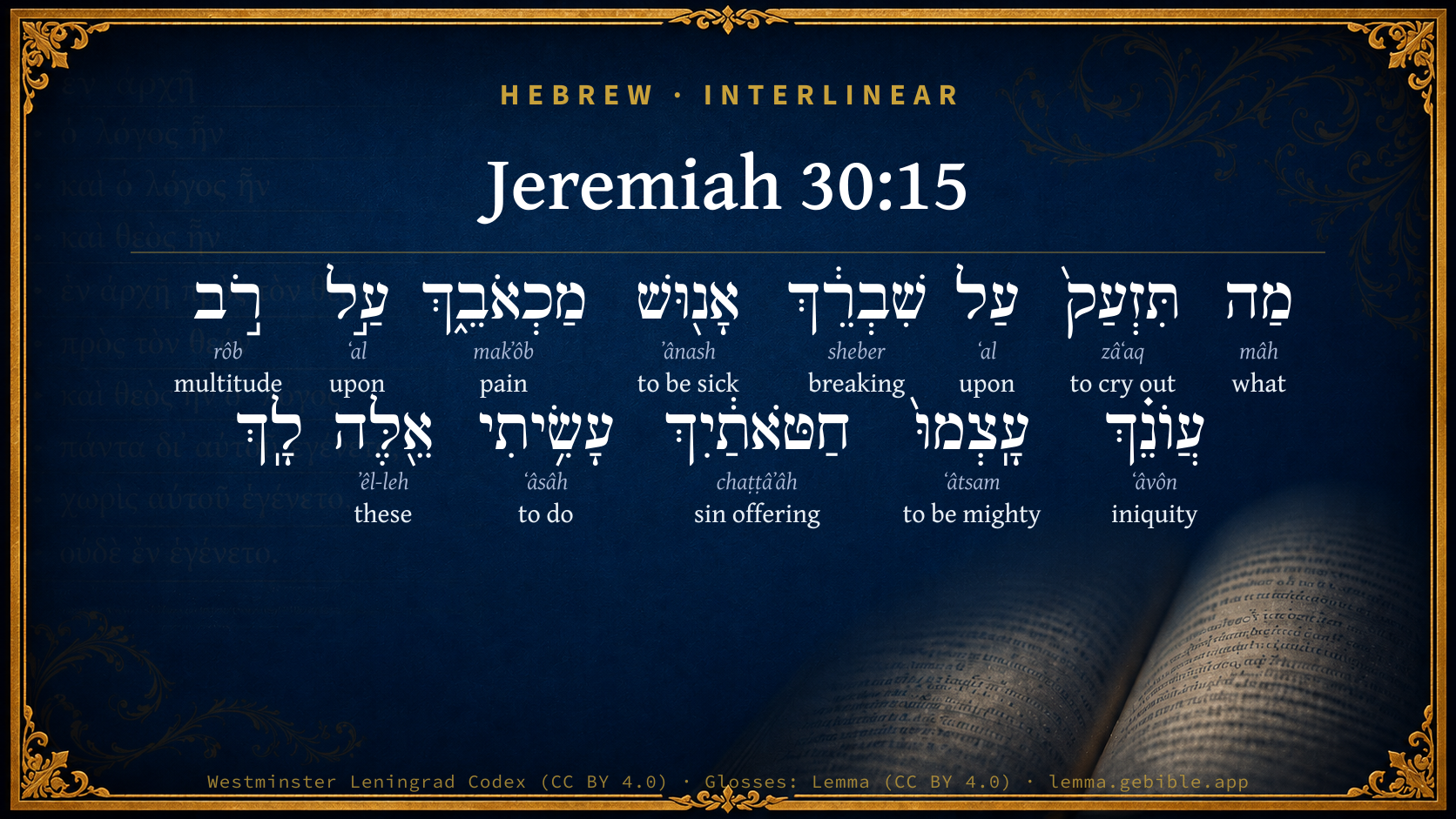
Hebrew (Westminster Leningrad Codex) Jeremiah 30:15 appears in the Hebrew Old Testament. The text above is from the Westminster Leningrad Codex. Each word links to its Strong’s number, a concise gloss, and parsing drawn from the Open Scriptures Hebrew Bible morphology. Click any word for its full Brown-Driver-Briggs (BDB) entry.
Download image
Cite this verse

Jeremiah 30:15 (World English Bible). Public Domain. Lemma interlinear Bible study tool, https://lemma.gebible.app/v/jeremiah/30/15.

Show BibTeX & RIS
BibTeX
RIS
English Translation
Why cry you for your hurt? your pain is incurable: for the greatness of your iniquity, because your sins were increased, I have done these things to you.
World English Bible · Public Domain
Download a study sheet

One document with this verse’s original text, its word-by-word gloss line, the meaning frame, cross-references with their text, attributed commentary, and full source and license credits — printable, and it pastes into notes with its structure intact.

This verse Autodidact and up

Study sheet (.html) Plain text (.txt)

A passage Seminary Student

Up to 50 verses in one chapter. A passage sheet keeps up to 6 commentary sources and 12 cross-references per verse, in the order this page ranks them, and says so on the sheet whenever that leaves anything out. Ask for a single verse and you get the Autodidact verse sheet above.

Everything on this page stays free to read, with no account — the sheet is a download of what is already on screen, not access to it.

Want to remove ads? Support Godless Engineer
Compare translations 3

The same verse in 3 English versions, stacked beneath the original-language interlinear above. Click any original word for its lexicon entry.

Each is an independent rendering of the whole verse — the interlinear is not word-aligned to these translations.

Highlighted words mark where these versions differ — a whole-verse word diff, not a word-by-word alignment.

  • World English Bible Public Domain
    Why cry you for your hurt? your pain is incurable: for the greatness of your iniquity, because your sins were increased, I have done these things to you.
  • King James Version Public Domain
    Why criest thou for thine affliction? thy sorrow is incurable for the multitude of thine iniquity: because thy sins were increased, I have done these things unto thee.
  • unfoldingWord Literal Text CC BY-SA 4.0
    Why do you call for help for your injury? Your pain is incurable. Because of your many iniquities, your innumerable sins, I have done these things to you.

unfoldingWord Literal Text — © unfoldingWord, licensed CC BY-SA 4.0. Word-aligned USFM3 via Door43 (git.door43.org/unfoldingWord/en_ult).

Versions to compare (up to 4)

3 of 4 selected

Show all 18 translations

Every available English version of this verse, each an independent rendering of the whole verse.

  • World English Bible Public Domain
    Why cry you for your hurt? your pain is incurable: for the greatness of your iniquity, because your sins were increased, I have done these things to you.
  • Berean Standard Bible Public Domain
    Why do you cry out over your wound? Your pain has no cure! Because of your great iniquity and your numerous sins I have done these things to you.
  • Majority Standard Bible Public Domain
    Why do you cry out over your wound? Your pain has no cure! Because of your great iniquity and your numerous sins I have done these things to you.
  • King James Version Public Domain
    Why criest thou for thine affliction? thy sorrow is incurable for the multitude of thine iniquity: because thy sins were increased, I have done these things unto thee.
  • American Standard Version (1901) Public Domain
    Why criest thou for thy hurt? thy pain is incurable: for the greatness of thine iniquity, because thy sins were increased, I have done these things unto thee.
  • Revised Version (1885) Public Domain
    Why criest thou for thy hurt? thy pain is incurable: for the greatness of thine iniquity, because thy sins were increased, I have done these things unto thee.
  • Geneva Bible (1599) Public Domain
    Why cryest thou for thine affliction? thy sorowe is incurable, for the multitude of thine iniquities: because thy sinnes were increased, I haue done these things vnto thee.
  • Douay-Rheims (1899) Public Domain
    Why criest thou for thy affliction? thy sorrow is incurable: for the multitude of thy iniquity, and for thy hardened sins I have done these things to thee.
  • Young's Literal Translation Public Domain
    What! -- thou criest concerning thy breach! Incurable `is' thy pain, Because of the abundance of thy iniquity, Mighty have been thy sins! I have done these to thee.
  • Literal Standard Version CC BY-SA 4.0
    Why do you cry concerning your breach? Your pain [is] incurable, || Because of the abundance of your iniquity, || Your sins have been mighty! I have done these to you.
  • Unlocked Literal Bible CC BY-SA 4.0
    Why do you call for help for your injury? Your pain is incurable. Because of your many iniquities, your innumerable sins, I have done these things to you.
  • unfoldingWord Literal Text CC BY-SA 4.0
    Why do you call for help for your injury? Your pain is incurable. Because of your many iniquities, your innumerable sins, I have done these things to you.
  • Darby Bible Public Domain
    Why criest thou because of thy bruise? thy sorrow is incurable; for the greatness of thine iniquity, [because] thy sins are manifold, I have done these things unto thee.
  • World Messianic Bible Public Domain
    Why do you cry over your injury? Your pain is incurable. For the greatness of your iniquity, because your sins have increased, I have done these things to you.
  • Webster's Bible Public Domain
    Why criest thou for thy affliction? thy sorrow is incurable for the multitude of thy iniquity: because thy sins were increased, I have done these things to thee.
  • Free Bible Version CC BY-SA 4.0
    Why are you crying over your wound? Your pain can't be cured. I did this to you because of how wicked you are, because of your many sins.
  • Bible in Basic English Public Domain
    Why are you crying for help because of your wound? for your pain may never be taken away: because your evil-doing was so great and because your sins were increased, I have done these things to you.
  • JPS Tanakh (1917) Public Domain
    Why criest thou for thy hurt, that thy pain is incurable? For the greatness of thine iniquity, because thy sins were increased, I have done these things unto thee.

Literal Standard Version (2020), Covenant Press — licensed CC BY-SA 4.0. Text via the HelloAO Bible API (eBible.org). Unlocked Literal Bible (unfoldingWord) — licensed CC BY-SA 4.0. Text via the HelloAO Bible API (eBible.org). unfoldingWord Literal Text — © unfoldingWord, licensed CC BY-SA 4.0. Word-aligned USFM3 via Door43 (git.door43.org/unfoldingWord/en_ult). Free Bible Version, Dr. Jonathan Gallagher — licensed CC BY-SA 4.0. Text via the HelloAO Bible API (eBible.org).

Word by word

More ways to search: Search by grammar → Find every occurrence → Compare this word →

Practice this passage: Drill this verse → Learn its vocabulary →

אָנ֖וּשׁ
ʼânash
H605
“incurable”
Adjective, Adjective, Masculine, Singular, Absolute
Part of Speech
Adjective
Type
Adjective
Gender
Masculine
Number
Singular
State
Absolute
Full BDB Definition

Origin: a primitive root

TWOT: 135

to be weak, sick, frail - (Qal) - to be incurable - to be sick - desperate, incurable, desperately wicked, woeful, very sick (passive participle) (metaphorically) - (Niphal) to be sick
  1. מַה mâh H4100 “what” Particle, Interrogative
  2. תִּזְעַק֙ zâʻaq H2199 “to cry out” Verb, Qal, Imperfect, 2nd Person, Masculine, Singular
  3. עַל ʻal H5921 “upon” Preposition
  4. שִׁבְרֵ֔ךְ sheber H7667 “breaking · your” Noun, Common, Masculine, Singular, Construct + Suffix, Personal, 2nd Person, Feminine, Singular
  5. מַכְאֹבֵ֑ךְ makʼôb H4341 “pain · your” Noun, Common, Masculine, Singular, Construct + Suffix, Personal, 2nd Person, Feminine, Singular
  6. עַ֣ל ʻal H5921 “upon” Preposition
  7. רֹ֣ב rôb H7230 “multitude of” Noun, Common, Both, Singular, Construct
  8. עֲוֺנֵ֗ךְ ʻâvôn H5771 “iniquity · your” Noun, Common, Both, Singular, Construct + Suffix, Personal, 2nd Person, Feminine, Singular
  9. עָֽצְמוּ֙ ʻâtsam H6105 “to be mighty” Verb, Qal, Perfect, 3rd Person, Common, Plural
  10. חַטֹּאתַ֔יִךְ chaṭṭâʼâh H2403 “sin offerings · your” Noun, Common, Feminine, Plural, Construct + Suffix, Personal, 2nd Person, Feminine, Singular
  11. עָשִׂ֥יתִי ʻâsâh H6213 “to do” Verb, Qal, Perfect, 1st Person, Common, Singular
  12. אֵ֖לֶּה ʼêl-leh H428 “these” Pronoun, Demonstrative, Common, Plural

About this verse

These counts appear in no published source. They are computed here, from the morphology-tagged text and Lemma’s own curated glosses. What Lemma adds →

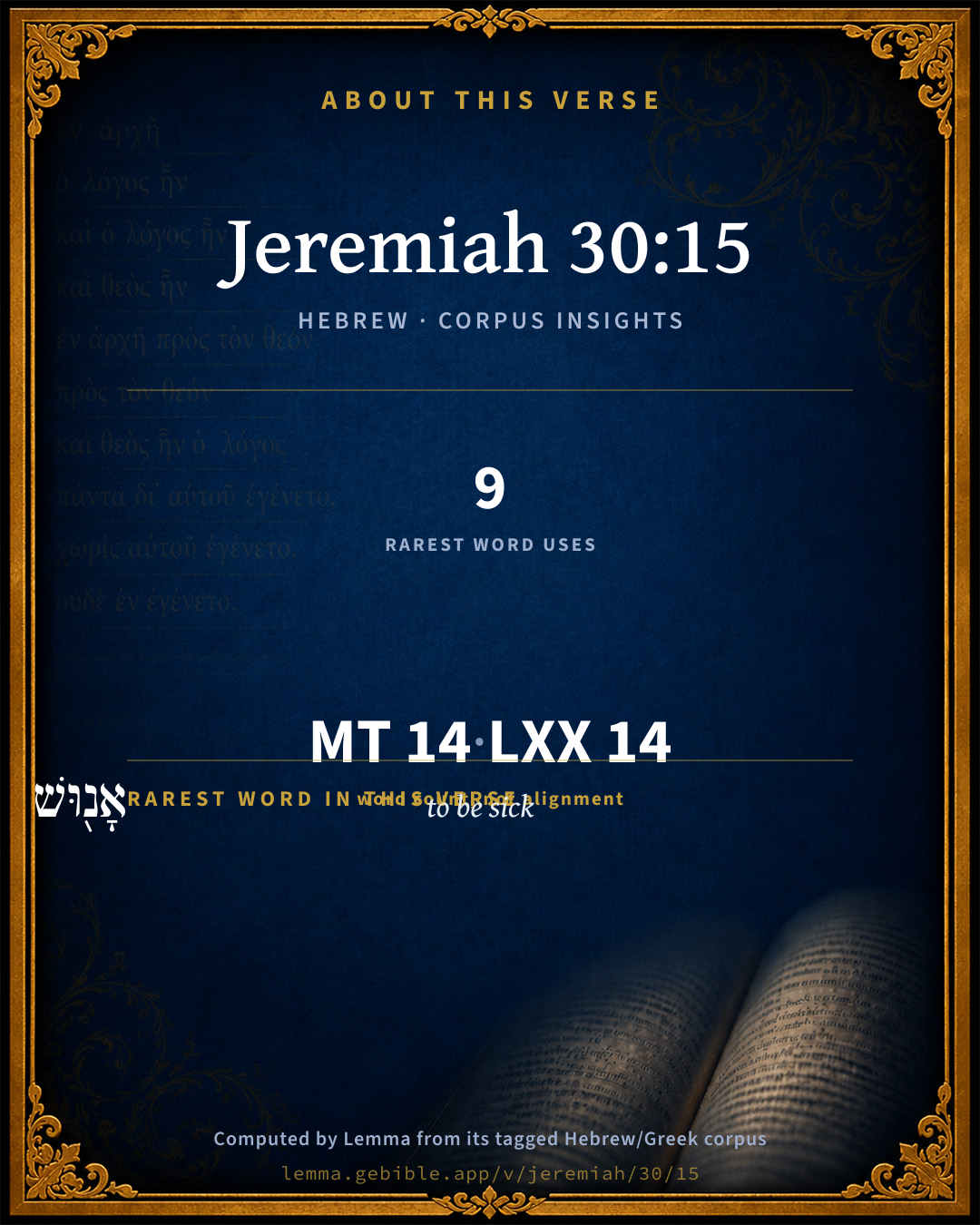
14
words
12
distinct lemmas
Prophets
section

Notable vocabulary

The rarest word here is אָנ֖וּשׁ to be sick H605 — appearing just 9 times in the whole Hebrew Bible.

Shared distinctive vocabulary

אָנ֖וּשׁ to be sick H605 occurs in 9 verses of the Hebrew Bible. Also found in:

Grammatical profile

  • 3 verbs
  • 5 nouns
  • 1 adjective
  • 1 pronoun
  • 3 prepositions
  • 1 particle

Verb forms

  • תִּזְעַק֙ Qal · Imperfect
  • עָֽצְמוּ֙ Qal · Perfect
  • עָשִׂ֥יתִי Qal · Perfect

Repetition

A word recurs within this verse — often emphatic in Hebrew:

Hebrew & Septuagint length

In the original languages it is 14 Hebrew tokens and 14 Greek tokens — but the two are counted differently (Hebrew bundles its prefixes and suffixes into one token; the Greek is in lemma form), so that isn’t a like-for-like length.

Cross-references

40

Topical passages linked to Jeremiah 30:15 in the Treasury of Scripture Knowledge — connected by theme and wording, ordered by reader-vote popularity; previews shown in the World English Bible.

  • Jeremiah 30:14 All your lovers have forgotten you; they don't seek you: for I have wounded you with the wound of an enemy, with the chastisement of a cruel one, for the greatness of your iniquity, because your sins were increased.
  • Jeremiah 30:12 For thus says Yahweh, Your hurt is incurable, and your wound grievous.
  • Joshua 9:10–11 and all that he did to the two kings of the Amorites, who were beyond the Jordan, to Sihon king of Heshbon, and to Og king of Bashan, who was at Ashtaroth.
  • 2 Chronicles 36:14–17 Moreover all the chiefs of the priests, and the people, trespassed very greatly after all the abominations of the nations; and they polluted the house of Yahweh which he had made holy in Jerusalem.
  • Ezra 9:6–7 and I said, my God, I am ashamed and blush to lift up my face to you, my God; for our iniquities are increased over our head, and our guiltiness is grown up to the heavens.
  • Ezra 9:13 After all that is come on us for our evil deeds, and for our great guilt, seeing that you our God have punished us less than our iniquities deserve, and have given us such a remnant,
  • Nehemiah 9:26–36 Nevertheless they were disobedient, and rebelled against you, and cast your law behind their back, and killed your prophets that testified against them to turn them again to you, and they committed awful blasphemies.
  • Job 34:6 Notwithstanding my right I am considered a liar; My wound is incurable, though I am without disobedience.'
  • Job 34:29 When he gives quietness, who then can condemn? When he hides his face, who then can see him? Alike whether to a nation, or to a man:
  • Isaiah 1:4–5 Ah sinful nation, A people loaded with iniquity, A seed of evil-doers, Children who deal corruptly! They have forsaken Yahweh. They have despised the Holy One of Israel. They are estranged and backward.
  • Isaiah 1:21–24 How the faithful city has become a prostitute! She was full of justice; righteousness lodged in her, But now murderers.
  • Isaiah 5:2 He dug it up, Gathered out its stones, Planted it with the choicest vine, Built a tower in its midst, And also cut out a winepress therein. He looked for it to yield grapes, But it yielded wild grapes.
  • Isaiah 30:13–14 therefore this iniquity shall be to you as a breach ready to fall, swelling out in a high wall, whose breaking comes suddenly in an instant.
  • Isaiah 59:1–4 Behold, Yahweh's hand is not shortened, that it can't save; neither his ear heavy, that it can't hear:
  • Isaiah 59:12–15 For our transgressions are multiplied before you, and our sins testify against us; for our transgressions are with us, and as for our iniquities, we know them:
  • Jeremiah 2:19 Your own wickedness shall correct you, and your backsliding shall reprove you: know therefore and see that it is an evil thing and a bitter, that you have forsaken Yahweh your God, and that my fear is not in you, says the Lord, Yahweh of Hosts.
  • Jeremiah 2:28–30 But where are your gods that you have made you? let them arise, if they can save you in the time of your trouble: for according to the number of your cities are your gods, Judah.
  • Jeremiah 5:6–9 Therefore a lion out of the forest shall kill them, a wolf of the evenings shall destroy them, a leopard shall watch against their cities; everyone who goes out there shall be torn in pieces; because their transgressions are many, [and] their backsliding is increased.
  • Jeremiah 5:25–31 Your iniquities have turned away these things, and your sins have withheld good from you.
  • Jeremiah 6:6–7 For thus has Yahweh of Hosts said, Hew you down trees, and cast up a mound against Jerusalem: this is the city to be visited; she is wholly oppression in the midst of her.
  • Jeremiah 6:13 For from the least of them even to the greatest of them everyone is given to covetousness; and from the prophet even to the priest everyone deals falsely.
  • Jeremiah 7:8–11 Behold, you trust in lying words, that can't profit.
  • Jeremiah 9:1–9 Oh that my head were waters, and my eyes a spring of tears, that I might weep day and night for the slain of the daughter of my people!
  • Jeremiah 11:13 For according to the number of your cities are your gods, Judah; and according to the number of the streets of Jerusalem have you set up altars to the shameful thing, even altars to burn incense to Baal.
  • Jeremiah 15:18 Why is my pain perpetual, and my wound incurable, which refuses to be healed? will you indeed be to me as a deceitful [brook], as waters that fail?
  • Jeremiah 30:17 For I will restore health to you, and I will heal you of your wounds, says Yahweh; because they have called you an outcast, [saying], It is Zion, whom no man seeks after.
  • Jeremiah 32:30–35 For the children of Israel and the children of Judah have done only that which was evil in my sight from their youth; for the children of Israel have only provoked me to anger with the work of their hands, says Yahweh.
  • Jeremiah 46:11 Go up into Gilead, and take balm, virgin daughter of Egypt: in vain do you use many medicines; there is no healing for you.
  • Lamentations 1:5 Her adversaries are become the head, her enemies prosper; For Yahweh has afflicted her for the multitude of her transgressions: Her young children are gone into captivity before the adversary.
  • Lamentations 3:39 Why does a living man complain, a man for the punishment of his sins?
  • Lamentations 4:13 [It is] because of the sins of her prophets, [and] the iniquities of her priests, That have shed the blood of the just in the midst of her.
  • Lamentations 5:16–17 The crown is fallen from our head: Woe to us! for we have sinned.
  • Ezekiel 16:1–63 Again the word of Yahweh came to me, saying,
  • Ezekiel 20:1–49 It happened in the seventh year, in the fifth [month], the tenth [day] of the month, that certain of the elders of Israel came to inquire of Yahweh, and sat before me.
  • Ezekiel 22:1–23 Moreover the word of Yahweh came to me, saying,
  • Hosea 5:12–13 Therefore I am to Ephraim like a moth, And to the house of Judah like rottenness.
  • Micah 1:9 For her wounds are incurable; For it has come even to Judah. It reaches to the gate of my people, Even to Jerusalem.
  • Micah 7:9 I will bear the indignation of Yahweh, Because I have sinned against him, Until he pleads my case, and executes judgment for me. He will bring me forth to the light. I will see his righteousness.
  • Zephaniah 3:1–5 Woe to her who is rebellious and polluted, the oppressing city!
  • Malachi 4:1–2 "For, behold, the day comes, it burns as a furnace; and all the proud, and all who work wickedness, will be stubble; and the day that comes will burn them up," says Yahweh of Hosts, "that it shall leave them neither root nor branch.

Cross-references courtesy of OpenBible.info (CC BY 4.0).

Hebrew and Greek witnesses Masoretic Hebrew ↔ Greek Septuagint

The same verse in the two great witnesses to the Old Testament, shown verse-for-verse.

These are two independent witnesses, not word-aligned to each other, and the Septuagint is shown in lemma (dictionary) form.

Hebrew Jeremiah 30:15 Masoretic · Westminster Leningrad Codex

מַה תִּזְעַק֙ עַל שִׁבְרֵ֔ךְ אָנ֖וּשׁ מַכְאֹבֵ֑ךְ עַ֣ל רֹ֣ב עֲוֺנֵ֗ךְ עָֽצְמוּ֙ חַטֹּאתַ֔יִךְ עָשִׂ֥יתִי אֵ֖לֶּה לָֽךְ

Why cry you for your hurt? your pain is incurable: for the greatness of your iniquity, because your sins were increased, I have done these things to you.

World English Bible · Public Domain

Greek LXX Structure differs

In the Septuagint, Jeremiah is about an eighth shorter than the Hebrew and arranges its material differently — the Oracles Against the Nations (Hebrew chapters 46–51) appear in the middle of the Greek book, after 25:13. Because the chapter and verse boundaries do not line up, a verse-for-verse comparison with the Hebrew is not shown.

A verse-for-verse comparison isn’t shown here because the chapters and verses don’t line up. Switch to the LXX edition with the MT / LXX toggle above to read the Greek directly.

Hebrew: Westminster Leningrad Codex (CC BY 4.0). Greek: Septuagint (public domain); English from a public-domain English Septuagint. How the Septuagint differs from the Hebrew →

Targum (Aramaic paraphrase)

1

The Targum is the ancient Jewish Aramaic paraphrase of the Hebrew Scriptures — an interpretive translation, not the Hebrew text itself. Onkelos (literal) and Pseudo-Jonathan (expansive) render the Torah, and Jonathan the Prophets. Coverage is partial: where no permissively-licensed English translation exists for a verse, only the Aramaic is shown. This is verse-level text, not a word-by-word alignment to the Hebrew.

  1. Targum Jonathan Prophets (Joshua–Malachi)
    מַה אַתְּ מְצַוְחָא עַל תַּבְרִיךְ מְמַרְעָא מַחֲתִיךְ עַל דִסְגִיאוּ חוֹבַיִךְ תַּקִיפִי חַטְאָיִךְ עֲבָדֵית אִלֵין לִיךְ:

    (no public-domain English translation for this verse)

    Targum Jonathan — Aramaic: “Mikraot Gedolot” (public domain). English: “Sefaria Community Translation” (CC0 1.0 (public-domain dedication)); “London "Chaldee Paraphrase," 1871” (public domain). Text via Sefaria.

Commentary

Notes on Jeremiah 30:15 from classic Christian and Jewish commentators (each source and its license shown beneath its notes). The classic Christian expositions comment on the surrounding passage and are grouped to its opening verse, so a note may address several verses; the Jewish commentaries on the Tanakh (Rashi and others) are per-verse, so they appear only where the commentator wrote on this verse.

Lemma curates 59 commentaries, every one of them public domain or Creative Commons licensed, each selected and text-cleaned for this edition rather than reprinted as found. About our sources →

Trapp's Complete Commentary

John Trapp

Jer 30:15 Why criest thou for thine affliction? thy sorrow [is] incurable for the multitude of thine iniquity: [because] thy sins were increased, I have done these things unto thee.

Ver. 15. Why criest thou for thine affliction?] And not rather for thy sins? cry not perii, I have died, but peccavi; I have sinned, not, I am undone; but, I have done very foolishly. See Lam 3:39-40.

John Trapp, A Commentary or Exposition upon All the Books of the Old and New Testament (1647–1656) — public domain. Text from a community e-Sword module.

Tyndale Open Study Notes

Tyndale Open Resources

30:15 The Israelites had no right to protest their punishment; they deserved their exile, and God’s justice demanded that they be punished.

Tyndale Open Study Notes — © Tyndale Open Resources, licensed CC BY-SA 4.0. Text via the HelloAO Bible API.

Jamieson, Fausset & Brown

Robert Jamieson, A. R. Fausset & David Brown

Why criest thou--as if God's severity was excessive. Thou hast no reason to complain, for thine affliction is just. Thy cry is too late, for the time of repentance and mercy is past [CALVIN].

Jamieson, Fausset & Brown — Commentary Critical and Explanatory on the Whole Bible (1871) — public domain (CC PDM 1.0). Text via the HelloAO Bible API.

Adam Clarke's Commentary

Verse 15. Thy sorrow is incurable] אנוש anush, desperate. See Jer 30:12.

Adam Clarke's Commentary on the Bible (1810–1826) — public domain. Text from a community e-Sword/MySword module.

John Calvin's Commentaries

The Prophet now anticipates an objection, lest the Jews should expostulate with God; for it sufficiently appears that they always complained of God’s extreme severity, when they indulged themselves in their vices. As soon then as God treated them as they deserved, they became exasperated and enraged against him. Hence the Prophet now meets their perverse and unjust complaints, and asks, why they cried out for their bruising, as though he had said, that these clamors were much too late, when they had passed by the season for repentance. For God had suspended his extreme threatenings until the people had betrayed so much obstinacy, that there was no room for mercy. When, therefore, the people’s wickedness had become unhealable, the Prophet, as we have seen, proclaimed their exile.

Now, indeed, he derides their late crying, for they had been too long torpid in their contempt of God: Why, then, dost thou cry for thy bruising? grievous is thy sorrow, or, grievousness is to thy sorrow; but for the multitude of thine iniquity, and because thy sins have grown strong, have I done these things to thee Here God frees himself from the calumnies of the people, and shews that those who murmured or made a clamor, acted unjustly, having not considered what they merited: for they were worthy of the heaviest punishment, because they not only in one way brought ruin on themselves, and more and more kindled God’s vengeance, but had also for many years hardened themselves in their sins; and they had, besides, given themselves up, in various ways, to every kind of wickedness, so that the Prophet justly upbraided them with a multitude of iniquity, and also with a mass of sins. God then says, that he had not exceeded the limits of moderation in the punishment he inflicted on the people, because their desperate wickedness and perverseness compelled him. But consolation is immediately subjoined, —

John Calvin's Commentaries (1540-1563) — public domain. Text from the Calvin Translation Society English edition (1840s-50s) via the Christian Classics Ethereal Library (ccel.org). Calvin's coverage is partial (roughly two-thirds of the Bible); uncommented books and verses are honest gaps, never fabricated. The 19th-century editor's footnotes and remarks are omitted so the notes are faithfully Calvin's own voice.

Ellicott's Commentary for English Readers

(15) Why criest thou . . .?—The personification of the previous verse is continued. The prophet looks on Judah—as in Lam_1:1-2—as on some forlorn and desperate castaway smitten with pestilence, crying in the agony of her hopelessness; and he reminds her that she is but bearing the righteous punishment of her iniquities. In accepting the law of retribution, as seen in her own sufferings, she might find hope for the future. Her oppressors also would come under that law. The wheel would come full circle, and the devourers would be themselves devoured.

A Bible Commentary for English Readers, edited by Charles John Ellicott (1878–1897) — public domain. Text from a community e-Sword module.

John Gill's Exposition

Why criest thou for thine affliction?.... Or complainest of the hardness, and heaviness, and continuance of it, when there was such a just cause for it? when men have sinned at a high rate, they have no reason to complain of the punishment of their sins, Lam 3:39;

thy sorrow is incurable, for the multitude of thine iniquity; such were the number of their iniquities, that they brought them into such a sorrowful and wretched estate and condition that there was no recovery of them, nor hope of recovery of them, by their own power, or by the help and assistance of others:

because thy sins were increased I have done these things unto thee; which shows the justice of God, and is a vindication of it under all the seeming severity of it. The Jews (x) acknowledge, that under the second temple there was a great increase of capital crimes, such as murders, adulteries, &c. for which, and other sins, wrath came upon them to the uttermost by the Romans; and they still continue under the visible marks of the divine displeasure.

(x) Misna Sota, c. 9. sect. 9.

John Gill's Exposition of the Whole Bible (1746–1763) — public domain (CC PDM 1.0). Text via the HelloAO Bible API.

Albert Barnes' Notes on the Bible

Translate it:

Why criest thou because of thy breaking?

Because thy pain is grievous?

Because of the multitude of thine iniquity,

Because thy sins are strong,

I have done these things unto thee.

Albert Barnes' Notes on the Bible (1834–1885) — public domain. Text from a community e-Sword/MySword module.

Matthew Poole's English Annotations

Why criest thou for thine affliction? thy sorrow is incurable:

Why complainest thou of my dealings with thee? or, as Jer 15:18, the cause of thy sorrow is incurable: or, as others, Why complainest thou that thy sorrow is incurable? Though it be so, yet thou hast no reason to complain of my dealings, for thy destruction is of thyself; I am just in what I have done, for I have but given thee that death which is the wages of thy work of sin; nor was I suddenly provoked, it is for the multitude of thine iniquities, and in that case the living man hath no just reason to complain, Lam 3:39.

Matthew Poole's English Annotations on the Holy Bible (1683–1685) — public domain. Text from a community e-Sword/MySword module.

Whedon's Commentary on the Bible

Daniel D. Whedon

15. Why criest thou, etc. — It is too late for prayers and lamentations to avail.

Daniel D. Whedon (gen. ed.), Commentary on the Old and New Testaments (1874–1909) — public domain. Text from a community e-Sword module.

Lesson kit

Teaching starters — assembled from the data on this page, not authored interpretation. Every prompt links to the verse data it draws on. Edit before teaching.

Jeremiah, in the Prophets, opens this verse with 14 words (12 distinct Hebrew lemmas). Its most distinctive word is ʼânash (“to be sick”). A historical commentator’s framing appears above. Read the whole chapter for the surrounding context.

Discussion questions

  1. What does “to be sick” (ʼânash) contribute to the verse as a whole?
  2. 2 Samuel 12:15 shares the word «to be sick» with this verse. How do the two illuminate each other?
  3. “upon” occurs 2× in this one verse. What is the effect of the repetition?
  4. The translations on this page render this verse differently — a whole-verse word diff, not a word-by-word alignment. What might account for the different wordings?
  5. The verb «תִּזְעַק֙» is Qal Imperfect. How does its form color the action?
  6. Reading how Trapp's Complete Commentary and Tyndale Open Study Notes read this verse, where do the two commentators agree and where do they part?

Things to notice

Reading settings

Reading text

Shown beneath each verse's original-language words.

Old Testament
Old Testament edition

Read the OT as the Masoretic Hebrew (MT) or the Greek Septuagint (LXX).

English shown for the Greek Septuagint (in the Hebrew ↔ Greek comparison).

Comparing translations? Open the Compare panel on any verse page to stack up to four side by side.