Ezekiel 16:30

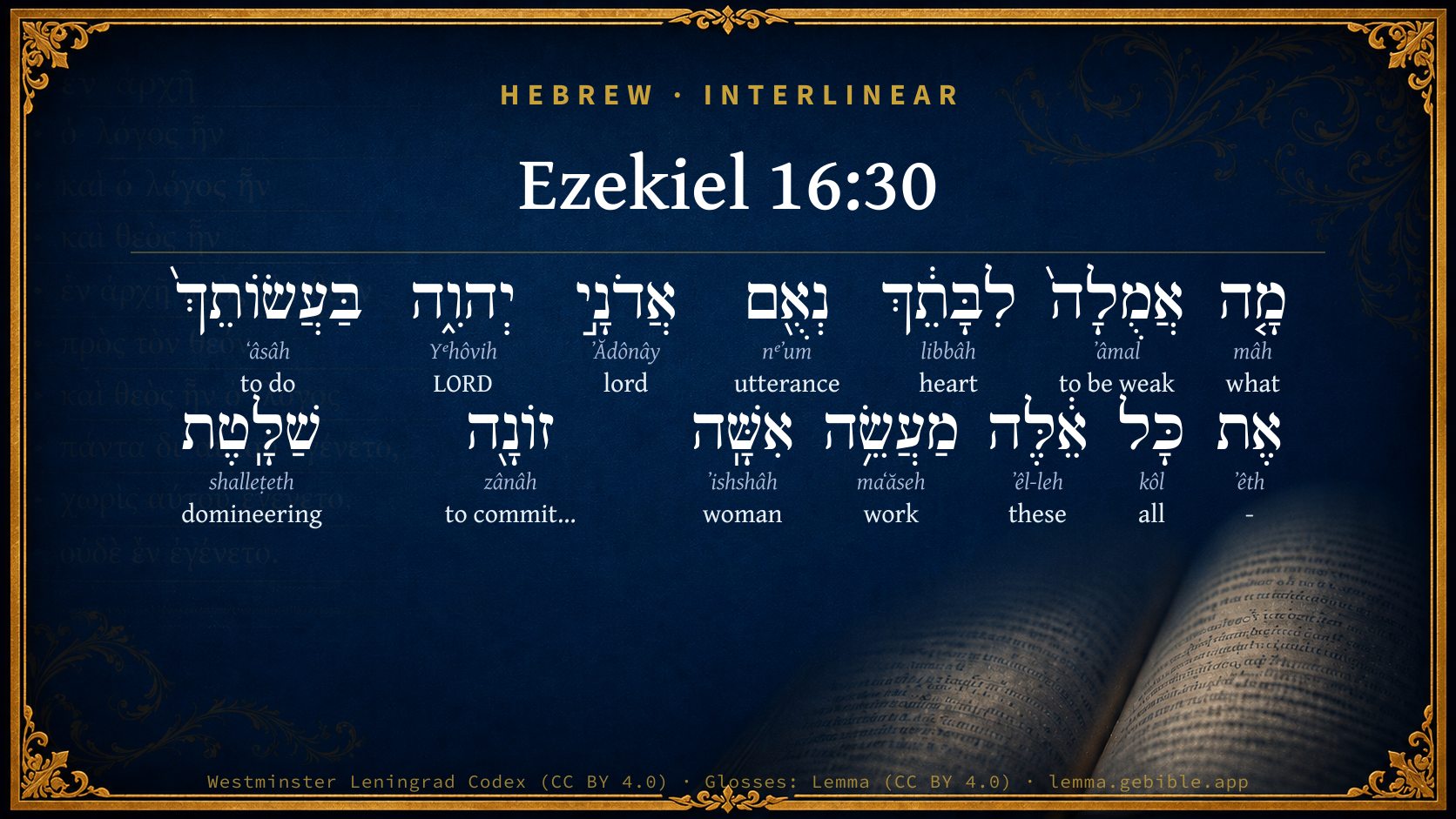
Hebrew (Westminster Leningrad Codex) Ezekiel 16:30 appears in the Hebrew Old Testament. The text above is from the Westminster Leningrad Codex. Each word links to its Strong’s number, a concise gloss, and parsing drawn from the Open Scriptures Hebrew Bible morphology. Click any word for its full Brown-Driver-Briggs (BDB) entry.
Download image
Cite this verse

Ezekiel 16:30 (World English Bible). Public Domain. Lemma interlinear Bible study tool, https://lemma.gebible.app/v/ezekiel/16/30.

Show BibTeX & RIS
BibTeX
RIS
English Translation
How weak is your heart, says the Lord Yahweh, seeing you do all these things, the work of an impudent prostitute;
World English Bible · Public Domain
Highlights Full analysis ↓
Download a study sheet

One document with this verse’s original text, its word-by-word gloss line, the meaning frame, cross-references with their text, attributed commentary, and full source and license credits — printable, and it pastes into notes with its structure intact.

This verse Autodidact and up

Study sheet (.html) Plain text (.txt)

A passage Seminary Student

Up to 50 verses in one chapter. A passage sheet keeps up to 6 commentary sources and 12 cross-references per verse, in the order this page ranks them, and says so on the sheet whenever that leaves anything out. Ask for a single verse and you get the Autodidact verse sheet above.

Everything on this page stays free to read, with no account — the sheet is a download of what is already on screen, not access to it.

Want to remove ads? Support Godless Engineer
Compare translations 3

The same verse in 3 English versions, stacked beneath the original-language interlinear above. Click any original word for its lexicon entry.

Each is an independent rendering of the whole verse — the interlinear is not word-aligned to these translations.

Highlighted words mark where these versions differ — a whole-verse word diff, not a word-by-word alignment.

  • World English Bible Public Domain
    How weak is your heart, says the Lord Yahweh, seeing you do all these things, the work of an impudent prostitute;
  • King James Version Public Domain
    How weak is thine heart, saith the LORD GOD, seeing thou doest all these things, the work of an imperious whorish woman;
  • unfoldingWord Literal Text CC BY-SA 4.0
    How sick is your heart—this is the Lord Yahweh’s declaration—that you would do all these things, deeds of a shameless prostitute?

unfoldingWord Literal Text — © unfoldingWord, licensed CC BY-SA 4.0. Word-aligned USFM3 via Door43 (git.door43.org/unfoldingWord/en_ult).

Versions to compare (up to 4)

3 of 4 selected

Show all 18 translations

Every available English version of this verse, each an independent rendering of the whole verse.

  • World English Bible Public Domain
    How weak is your heart, says the Lord Yahweh, seeing you do all these things, the work of an impudent prostitute;
  • Berean Standard Bible Public Domain
    How weak-willed is your heart, declares the Lord GOD, while you do all these things, the acts of a shameless prostitute!
  • Majority Standard Bible Public Domain
    How weak-willed is your heart, declares the Lord GOD, while you do all these things, the acts of a shameless prostitute!
  • King James Version Public Domain
    How weak is thine heart, saith the LORD GOD, seeing thou doest all these things, the work of an imperious whorish woman;
  • American Standard Version (1901) Public Domain
    How weak is thy heart, saith the Lord Jehovah, seeing thou doest all these things, the work of an impudent harlot;
  • Revised Version (1885) Public Domain
    How weak is thine heart, saith the Lord GOD, seeing thou doest all these things, the work of an imperious whorish woman;
  • Geneva Bible (1599) Public Domain
    Howe weake is thine heart, saith the Lord God, seeing thou doest all these thinges, euen the worke of a presumptuous whorish woman?
  • Douay-Rheims (1899) Public Domain
    Wherein shall I cleanse thy heart, saith the Lord God: seeing thou dost all these the works of a shameless prostitute?
  • Young's Literal Translation Public Domain
    How weak `is' thy heart, An affirmation of the Lord Jehovah, In thy doing all these, The work of a domineering whorish woman.
  • Literal Standard Version CC BY-SA 4.0
    How weak [is] your heart, || A declaration of Lord YHWH, || In your doing all these, || The work of a domineering, whorish woman.
  • Unlocked Literal Bible CC BY-SA 4.0
    How sick is your heart—this is the Lord Yahweh's declaration—that you would do all these things, deeds of a shameless prostitute?
  • unfoldingWord Literal Text CC BY-SA 4.0
    How sick is your heart—this is the Lord Yahweh’s declaration—that you would do all these things, deeds of a shameless prostitute?
  • Darby Bible Public Domain
    How weak is thy heart, saith the Lord Jehovah, seeing thou doest all these [things], the work of a whorish woman, under no restraint;
  • World Messianic Bible Public Domain
    “‘“How weak is your heart,” says the Lord GOD, “since you do all these things, the work of an impudent prostitute;
  • Webster's Bible Public Domain
    How weak is thy heart, saith the Lord GOD, seeing thou doest all these things, the work of an imperious lewd woman;
  • Free Bible Version CC BY-SA 4.0
    You're really sick-minded to do all this, acting like a prostitute with no shame, declares the Lord God.
  • Bible in Basic English Public Domain
    How feeble is your heart, says the Lord, seeing that you do all these things, the work of a loose and overruling woman;
  • JPS Tanakh (1917) Public Domain
    How weak is thy heart, saith the Lord GOD, seeing thou doest all these things, the work of a wanton harlot;

Literal Standard Version (2020), Covenant Press — licensed CC BY-SA 4.0. Text via the HelloAO Bible API (eBible.org). Unlocked Literal Bible (unfoldingWord) — licensed CC BY-SA 4.0. Text via the HelloAO Bible API (eBible.org). unfoldingWord Literal Text — © unfoldingWord, licensed CC BY-SA 4.0. Word-aligned USFM3 via Door43 (git.door43.org/unfoldingWord/en_ult). Free Bible Version, Dr. Jonathan Gallagher — licensed CC BY-SA 4.0. Text via the HelloAO Bible API (eBible.org).

Word by word

More ways to search: Search by grammar → Find every occurrence → Compare this word →

Practice this passage: Drill this verse → Learn its vocabulary →

שַׁלָּֽטֶת
shalleṭeth
H7986
“domineering”
Adjective, Adjective, Feminine, Singular, Absolute
Part of Speech
Adjective
Type
Adjective
Gender
Feminine
Number
Singular
State
Absolute
Full BDB Definition

Origin: fem. from H7980

TWOT: 2396c

imperious, domineering
  1. מָ֤ה mâh H4100 “what” Particle, Interrogative
  2. אֲמֻלָה֙ ʼâmal H535 “weak” Verb, Qal, Participle Passive, Feminine, Singular, Absolute
  3. לִבָּתֵ֔ךְ libbâh H3826 “heart · your” Noun, Common, Feminine, Singular, Construct + Suffix, Personal, 2nd Person, Feminine, Singular
  4. נְאֻ֖ם nᵉʼum H5002 “utterance of” Noun, Common, Masculine, Singular, Construct
  5. אֲדֹנָ֣י ʼĂdônây H136 “Lord · my” Noun, Common, Masculine, Plural, Construct + Suffix, Personal, 1st Person, Common, Singular
  6. יְהוִ֑ה Yᵉhôvih H3069 “LORD” Noun, Proper
  7. בַּעֲשׂוֹתֵךְ֙ ʻâsâh H6213 “in/at · to do · you” Preposition + Verb, Qal, Infinitive Construct + Suffix, Personal, 2nd Person, Feminine, Singular
  8. אֶת ʼêth H853 “-” Particle, Direct Object
  9. כָּל kôl H3605 “all of” Noun, Common, Masculine, Singular, Construct
  10. אֵ֔לֶּה ʼêl-leh H428 “these” Pronoun, Demonstrative, Common, Plural
  11. מַעֲשֵׂ֥ה maʻăseh H4639 “work of” Noun, Common, Masculine, Singular, Construct
  12. אִשָּֽׁה ʼishshâh H802 “woman” Noun, Common, Feminine, Singular, Absolute
  13. זוֹנָ֖ה zânâh H2181 “committing fornication” Verb, Qal, Participle Active, Feminine, Singular, Absolute

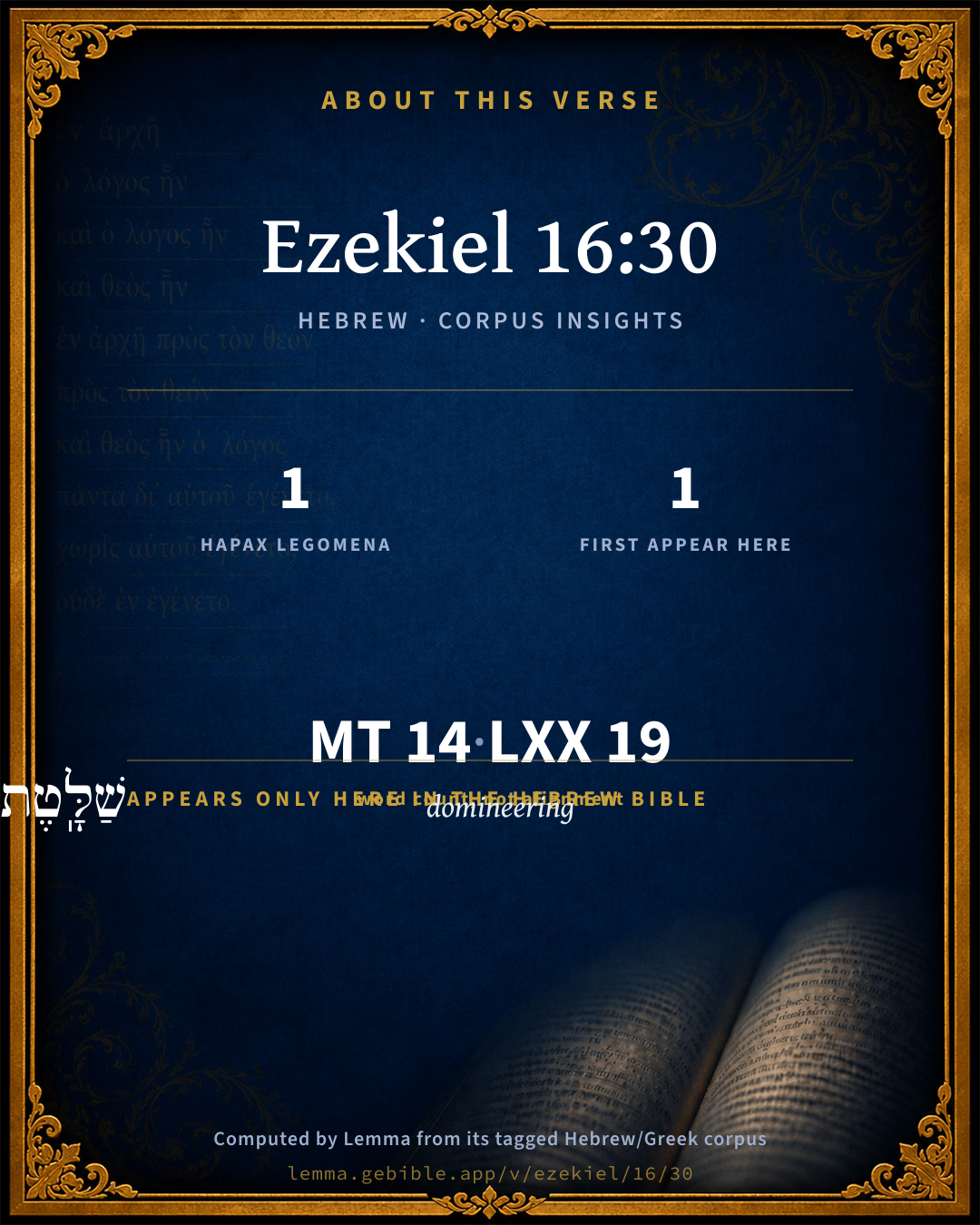
About this verse

These counts appear in no published source. They are computed here, from the morphology-tagged text and Lemma’s own curated glosses. What Lemma adds →

14
words
14
distinct lemmas
Prophets
section

Notable vocabulary

1 hapax legomenon — a word that appears only here in the entire Hebrew Bible:

  • שַׁלָּֽטֶת domineering H7986

First appearance in Scripture

This word makes its first canonical appearance in the Hebrew Bible here:

  • שַׁלָּֽטֶת domineering H7986

Shared distinctive vocabulary

לִבָּתֵ֔ךְ heart H3826 occurs in 7 verses of the Hebrew Bible. Also found in:

Grammatical profile

  • 3 verbs
  • 7 nouns
  • 1 adjective
  • 1 pronoun
  • 2 particles

Verb forms

  • אֲמֻלָה֙ Qal · Participle Passive
  • בַּעֲשׂוֹתֵךְ֙ Qal · Infinitive Construct
  • זוֹנָ֖ה Qal · Participle Active

Hebrew & Septuagint length

In English translation the verse runs 21 words from the Hebrew and 35 from the Septuagint (LXX English) — the Septuagint runs noticeably longer here. See the side-by-side →

A rough comparison of the two English renderings, which tokenize alike — not a word-level alignment.

Word counts can differ between the Hebrew and the Greek without any difference in meaning — e.g. the Hebrew direct-object marker אֵת has no separate Greek word, and Greek often adds the article ὁ.

In the original languages it is 14 Hebrew tokens and 19 Greek tokens — but the two are counted differently (Hebrew bundles its prefixes and suffixes into one token; the Greek is in lemma form), so that isn’t a like-for-like length.

Cross-references

10

Topical passages linked to Ezekiel 16:30 in the Treasury of Scripture Knowledge — connected by theme and wording, ordered by reader-vote popularity; previews shown in the World English Bible.

  • Isaiah 1:3 The ox knows his owner, And the donkey his master's crib; But Israel doesn't know, My people don't consider.
  • Jeremiah 3:3 Therefore the showers have been withheld, and there has been no latter rain; yet you have a prostitute's forehead, you refused to be ashamed.
  • Proverbs 9:13 The foolish woman is loud, Undisciplined, and knows nothing.
  • Isaiah 3:9 The look of their faces testify against them. They parade their sin like Sodom. They don't hide it. Woe to their soul! For they have brought disaster upon themselves.
  • Jeremiah 4:22 For my people are foolish, they don't know me; they are foolish children, and they have no understanding; they are wise to do evil, but to do good they have no knowledge.
  • Judges 16:15–16 She said to him, How can you say, I love you, when your heart is not with me? you have mocked me these three times, and have not told me in which your great strength lies.
  • Proverbs 7:11–13 She is loud and defiant. Her feet don't stay in her house.
  • Proverbs 7:21 With persuasive words, she led him astray. With the flattering of her lips, she seduced him.
  • Jeremiah 2:12–13 Be astonished, you heavens, at this, and be horribly afraid, be you very desolate, says Yahweh.
  • Revelation 17:1–6 One of the seven angels who had the seven bowls came and spoke with me, saying, "Come here. I will show you the judgment of the great prostitute who sits on many waters,

Cross-references courtesy of OpenBible.info (CC BY 4.0).

Hebrew and Greek witnesses Masoretic Hebrew ↔ Greek Septuagint

The same verse in the two great witnesses to the Old Testament, shown verse-for-verse.

Here the Septuagint runs noticeably longer than the Hebrew — LXX2012 (modern English Septuagint) 35 words vs World English Bible 21. A rough length comparison of the two English translations, not a word-level alignment — read both below.

These are two independent witnesses, not word-aligned to each other, and the Septuagint is shown in lemma (dictionary) form.

Hebrew Ezekiel 16:30 Masoretic · Westminster Leningrad Codex

מָ֤ה אֲמֻלָה֙ לִבָּתֵ֔ךְ נְאֻ֖ם אֲדֹנָ֣י יְהוִ֑ה בַּעֲשׂוֹתֵךְ֙ אֶת כָּל אֵ֔לֶּה מַעֲשֵׂ֥ה אִשָּֽׁה זוֹנָ֖ה שַׁלָּֽטֶת

How weak is your heart, says the Lord Yahweh, seeing you do all these things, the work of an impudent prostitute;

World English Bible · Public Domain

Greek LXX Ezekiel 16:30 Septuagint · lemma form

τίς διατίθημι ὁ θυγάτηρ σύ λέγω κύριος ἐν ὁ ποιέω σύ οὗτος πᾶς ἔργον γυνή πόρνη καί ἐκπορνεύω τρισσῶς

Why should I make a covenant with your daughter, says the Lord, while you do all these things, the works of a harlot? and you have gone a-whoring in a threefold degree with your daughters.

LXX2012 (modern English Septuagint) · Public Domain

On this verse, The Cambridge Bible for Schools and Colleges discusses the Septuagint’s reading. Read the note in Commentary ↓

Hebrew: Westminster Leningrad Codex (CC BY 4.0). Greek: Septuagint (public domain); English from LXX2012 (modern English Septuagint) (Public Domain). How the Septuagint differs from the Hebrew →

Targum (Aramaic paraphrase)

1

The Targum is the ancient Jewish Aramaic paraphrase of the Hebrew Scriptures — an interpretive translation, not the Hebrew text itself. Onkelos (literal) and Pseudo-Jonathan (expansive) render the Torah, and Jonathan the Prophets. Coverage is partial: where no permissively-licensed English translation exists for a verse, only the Aramaic is shown. This is verse-level text, not a word-by-word alignment to the Hebrew.

  1. Targum Jonathan Prophets (Joshua–Malachi)
    מָה תַקִיף הֲוָה רֶשַׁע לִבֵּךְ אֲמַר יְיָ אֱלֹהִים בְּמֶעְבְּדִיךְ יַת כָּל אִילֵן בְּעוֹבָדֵי אִיתְּתָא נַפְקַת בְּרָא דְשַׁלִיט לָהּ בְּנַפְשָׁהּ:

    (no public-domain English translation for this verse)

    Targum Jonathan — Aramaic: “Mikraot Gedolot” (public domain). English: “Sefaria Community Translation” (CC0 1.0 (public-domain dedication)); “London "Chaldee Paraphrase," 1871” (public domain). Text via Sefaria.

Commentary

Notes on Ezekiel 16:30 from classic Christian and Jewish commentators (each source and its license shown beneath its notes). The classic Christian expositions comment on the surrounding passage and are grouped to its opening verse, so a note may address several verses; the Jewish commentaries on the Tanakh (Rashi and others) are per-verse, so they appear only where the commentator wrote on this verse.

Lemma curates 59 commentaries, every one of them public domain or Creative Commons licensed, each selected and text-cleaned for this edition rather than reprinted as found. About our sources →

Trapp's Complete Commentary

John Trapp

Eze 16:30 How weak is thine heart, saith the Lord GOD, seeing thou doest all these [things], the work of an imperious whorish woman;

Ver. 30. How weak is thine heart.] Weak as water, melted in spiritual lust, putrefying alive, and perishing daily, as Tiberius said he perceived himself to do at Capreae. {a} This is here uttered by way of admiration; and the word rendered heart, being otherwhere of the masculine gender, is here made feminine, to show how idolaters are effeminated to a base and sensual esteem of God and his service. {Hebrew Text Note}

The work of an imperious whorish woman.] {b} Of a strong whore; {c} weak to do good, but strong to do evil; so are all idolaters with their hippomanes et cacoethes. The word rendered imperious signifieth a sultaness or queen; who, if with a queen, what will she not dare to do? See it in that whore of Babylon, who sitteth as a queen, &c. The unbridled boisterousness of idolaters, see Jer 44:16-17.

{a} Sueton.

{b} Pervicacissimae et procacissimae.

{c} Une paillarde robuste. - French.

John Trapp, A Commentary or Exposition upon All the Books of the Old and New Testament (1647–1656) — public domain. Text from a community e-Sword module.

The Biblical Illustrator

Joseph S. Exell

Eze_16:30

How weak is thine heart, saith the Lord God, seeing thou doest all these things.

The weak place

Three great errors of the day will stand corrected if due attention be paid to our text.

I. That a mans life may be irregular and yet the mans heart be good. Here is a man who has little or no sense of practical honesty. He thinks the very least of getting into debt without the slightest probability of ever being able to discharge his liabilities. He lives in a superior house, lives in luxury, his family dress well, give entertainments, etc. But they never trouble about paying anybody; they will fail and begin over again, that they may do the same trick. Now, people will say of such an one: Yes, he is sadly wanting in prudence, in discretion, in management; but really, he is as generous, good-hearted a fellow as ever lived. But, in fact, he is nothing of the sort. Content to feed on the fruits of others industry, he is essentially false and cruel. Another of these good-hearted fellows is the man who wont work. People say of him, What a pity! He has a fine disposition, he ought to have been born a gentleman. The fact is, he has made a blackguard of himself, whatever he was born; he has not a fine disposition, but, a base disposition; he lacks all that independence, self-reliance, courage which are the very essence of noble character. Another of these deceivers is the specious fellow, wanting in social purity and honour. People will speak regretfully of the escapades, the gallantries, the scandals, of what are termed the gay Lotharios; but these scoundrels are chided as if their infidelities and libertinism were simply on the surface, and, despite their licence, they are reckoned as honest, kind men of the world. Not so. Such men are profoundly selfish, cowardly, bloodguilty. Or take many intemperate men. People say: Fine fellow; only, his own enemy. But that will not do. Breaking the heart of his friends, killing his wife, reducing his family to shame and wretchedness, he is altogether destitute of the qualities of honourable men. Evil conduct may assume the aspect of innocence, gaiety, greatness, but analyse it and it shall be seen to be mean, base, low, cowardly, ignoble. How weak, corrupt, vile is thine heart, seeing thou doest all these things.

II. That a mans life may be irregular and yet the mans heart be strong. This is the second error to be corrected by our text. There is really weakness in all sin, most pitiful weakness no matter how cunningly it may simulate strength. Take a passionate man. He feels strong, he looks strong, his language is strong; but in truth he is weakness itself. No matter how in his wrath he affects the god, he is the mere sport of the wind. The very word passion signifies the passivity of the man--not that he is the actor, but that he is being acted upon. The calm, patient man is the strong man. Take the ambitious man. He seems strong-natured, strong-willed, but real strength is wanting. A man like Napoleon seems a very incarnation of strength, but the fretfulness displayed by him on the rock of exile betrayed his essential weakness. Take a discontented man. People are ready to think that the complainings of such are signs of a large, powerful genius which frets at narrow conditions; but it is not so. Emerson says: Discontent is the infirmity of the will. And this view is fully borne out by Paul: I have learned, in whatsoever state I am, therewith to be content . . . I can do all things through Christ which strengtheneth me. Contentment is a question of strength. Take a selfish man. He is restless, daring, aggressive, assertive, grasping, and may easily be accounted a man of superior force; but one of the greatest preachers of our age has just shown us that the mightiest of all energies is the energy of unselfishness. Take a man of great animal appetites and indulgences. He thinks himself a bold, strong man, and many are disposed to think this type manly; but that is not the view of the prophet: How effeminate is thine heart, seeing thou doest all these things. Carlyle says truly: Crabbedness, pride, obstinacy, affectation are at bottom want of strength. The revelation of divinest strength lies in overcoming wickedness, and he who is overcome by wickedness is in soul dyspeptic, paralysed, crippled, impotent.

III. That a mans life may be irregular and yet the mans heart be neutral. The third error corrected by the text. Without saying, perhaps, that a man who leads a bad life has a noble heart, or a strong one, many are prepared today to say that the mans heart has nothing to do with his conduct whatever. The fault is not in the thoughts, affections, will, at all. The source of mans conduct is boldly affirmed to be his organisation; the man has an inborn character from which he cannot escape, his general constitution determines his personal conduct. And the circumstances of the man complete the ring of necessity in which he moves. Now, in opposition to this, the text declares the heart to be originative, the prime source of mischief. The conduct of Israel in entering into alliances with Egypt and Babylon and Nineveh is not condoned on the ground of Israel occupying a peculiar geographical situation, which rendered such alliances politic and necessary in the view of worldly wisdom; nothing is said of the peculiar geographical position, but the conduct of Israel is referred at once to their lack of true faith, of noble will, of inward loyalty to their covenant-keeping God. So today God does not excuse our bad conduct on the grounds of the nature we inherit, or the events which influence us, but He attributes to the individual a full, solemn responsibility. It is false; we are not waifs and strays, the sport of winds and currents: we are ocean steamers throbbing with a mysterious independent energy; we can set winds and waves at defiance, we know in which direction lies our path, we can turn the helm whithersoever we list, and if we make shipwreck we are not blameless, as an empty bottle driven on this shore or that, but we are found guilty and condemned by God and man as men at the wheel are found disobedient, as captains are found asleep, as pilots are found drunk or presumptuous. The great need then is the renewal of the human heart. Society needs regeneration before it will permit any considerable reconstruction. Seek in the Church to strengthen the conscience, to purify the life--that is our first grand work. And as to the individual, the defects of our life must be cured in the defects of our spirit. (W. L. Watkinson.)

Half-hearted men

A half-and-half man, a half-and-half creed, will never meet with violent opposition or enmity from the world. Even what might be called a three-quarters man will escape without very much harm. It is the out-and-out Christian, and the out-and-out creed that the world hates. Making compromises is an old trade of Satans. It is one at which he shows consummate skill; he is wilting to be large and liberal; he will concede far more than at first sight anyone would suppose; in fact, he will go so far as to say, You may be nine-tenths Christs if only as regards the remaining tenth you will agree to be mine. The man of God must nail his colours to the mast, and not listen even for a moment to any terms upon which those colours are to be struck. (P. B. Power.)

The Biblical Illustrator, edited by Joseph S. Exell (c. 1880s–1900s) — public domain. Text from a community e-Sword module.

Joseph Benson's Commentary

Eze 16:30-34. How weak is thy heart — Not only unstable as to good resolutions, but even restless and unsettled in evil practices, still hankering after some new kind of idolatry, and resolved to indulge a wandering appetite, Eze 16:28-29. The work of an imperious, whorish woman — A woman that acknowledges no superior, and will neither be guided nor governed. In that thou buildest thine eminent place — See Eze 16:16; Eze 16:22. And hast not been as a harlot, in that thou scornest hire — Thou art the more inexcusable in that thou hast practised these idolatries without being compelled to it by want and necessity, and thou also hast never gained by them. The metaphor of a lewd woman is still carried on; and as one who is lewd for the sake of a maintenance, is more excusable than those who are lewd to gratify their passions, so God here tells the Jewish people, by the prophet, that they had not even the plea, which common harlots had, of practising their sin out of necessity; for that they had never made any advantage of their idolatries, but were subservient to those idolatrous nations, and lavished their riches on them, without reaping any benefit from them. They give gifts to all whores — That is, to the most of them: it is usual for loose men to do so. But thou givest thy gifts to all thy lovers — By this is signified the large presents they frequently sent to the Egyptians, Assyrians, and Chaldeans, to purchase their friendship. The Jews are often upbraided for making leagues with idolaters, and courting their favours by presents, and by complying with their idolatries. And the contrary is in thee — The intelligent reader, says Bishop Warburton, perceives that the meaning of the metaphor is, “You Jews are contrary to all other nations; you are fond of borrowing their rites; while none of them care to borrow yours, or to take any of them into their national worship.” See Div. Leg., vol. 3.

Joseph Benson's Commentary on the Old and New Testaments (1811–1818) — public domain. Text from a community e-Sword module.

Geneva Bible (1599)

Geneva Bible translators

Or, that will bear rule.

Geneva Bible (1599) marginal notes — public domain. Text via Bolls.life.

Jamieson, Fausset & Brown

Robert Jamieson, A. R. Fausset & David Brown

weak . . . heart--Sin weakens the intellect ("heart") as, on the contrary, "the way of the Lord is strength to the upright" (Pro 10:29).

Jamieson, Fausset & Brown — Commentary Critical and Explanatory on the Whole Bible (1871) — public domain (CC PDM 1.0). Text via the HelloAO Bible API.

John Calvin's Commentaries

The Prophet seems at variance with himself when he compares the Jews to a robust or very strong woman, and yet says that their heart was dissolute. For those who translate an obstinate heart are without a reason for it, for this seems to imply some kind of resistance, as they were strong and bold, and yet of a soft or weak or infirm heart. But in the despisers of God both evils are to be blamed when they flow away like water and yet are hard as rocks. They flow away, then, when there is no strength or constancy in them; for they are drawn aside this way and that, as some explain it, by a distracted heart, but we must always come to the idea of softness. All who revolt from God are borne along by their own levity, so that the minds of the impious are changeable and moveable: for the heart is here taken for the seat of the intellect, as in many other places. Hence the Prophet accuses the Jews of sloth, but under the name of a dissolute heart: as in French we say un coeur lasche, and the Prophet’s sense is best explained by that French word — faint-hearted. But it is sufficient to understand the Prophet’s meaning, that the Jews were unstable, and agitated and distracted hither and thither, since there was nothing in them either firm or solid. Meanwhile he compares them to a strong and abandoned woman, since we know the boldness of the despisers of God in sinning against him. Since then they are dissolute, because they have no power of attention, and nothing is stable in their minds: yet they are like rocks, and carry themselves audaciously, and do not hesitate to strive with God. Although therefore these two states of mind appear contrary in their nature, yet we may always see them in the reprobate, though in different ways. Thus he properly calls the Jews not only a robust or abandoned woman, but “a high and mighty dame,” as it may best be rendered in French, une maitresse putain ou painarde. It is forced to explain the word “lofty,” as taking license for her desires. I do not hesitate to interpret it of the people being like dissolute women, who throw aside all modesty, and seek lovers from all quarters, and entertain them all. This is the Prophet’s sense. It now follows —

John Calvin's Commentaries (1540-1563) — public domain. Text from the Calvin Translation Society English edition (1840s-50s) via the Christian Classics Ethereal Library (ccel.org). Calvin's coverage is partial (roughly two-thirds of the Bible); uncommented books and verses are honest gaps, never fabricated. The 19th-century editor's footnotes and remarks are omitted so the notes are faithfully Calvin's own voice.

Ellicott's Commentary for English Readers

(30) Weak.—The English word scarcely expresses the force of the original :—languishing with desire. The word heart occurs here only in the feminine.

A Bible Commentary for English Readers, edited by Charles John Ellicott (1878–1897) — public domain. Text from a community e-Sword module.

The Cambridge Bible for Schools and Colleges

gen. ed. J. J. S. Perowne

30. How weak is thine heart] i.e. how passion-sick, consumed by desire. The term “heart” (fem.) occurs nowhere else, and the plur. (Psa_7:10; Pro_15:11) is hardly evidence for it (Ges.). LXX. renders: how shall I deal with thy daughter (exactly as Hos_11:9 how shall I deal with thee, Ephraim). Our present text lay before the translator: “with thy daughter” is “thy heart” with different points; and “weak” was probably read as part of verb “to fill” (spelled as Job_8:21) and rendered freely. The text, however, may be faulty.

imperious … woman] Not positive: domineering; but negative: subject to no control, unbridled.

The Cambridge Bible for Schools and Colleges (gen. ed. J. J. S. Perowne; Cambridge University Press, 1878–1918) — public domain. Text from a community e-Sword module.

John Gill's Exposition

In that thou buildest thine eminent place in the head of every way,.... Or brothel house, as before; See Gill on Eze 16:24; which showed her to be a whore, and an imperious one:

and makest thine high place in every street; See Gill on Eze 16:24;

and hast not been as an harlot: a common one, or as a harlot usually is:

in that thou scornest hire; which they do not; for it is for hire they prostitute themselves; and have their names, both in our language, and in the Latin tongue, from, thence.

John Gill's Exposition of the Whole Bible (1746–1763) — public domain (CC PDM 1.0). Text via the HelloAO Bible API.

Matthew Poole's English Annotations

Weak; unstable, like water that melts away. Neither hast strength of judgment to discern the truth and purity of religion, nor hast strength of resolution to hold fast to it.

Doest all these things; changest thy God and religion, or detest on all the gaudy, pompous religions and idols thou hearest of.

Imperious whorish woman; a woman who thinks herself her own, that knows no superior, nor will be either guided and governed to do good, nor reproved and reclaimed from evil; a woman whose lust is her law, and her husband her contempt and burden. Such will be boundless in her disorders, and shameless too.

Matthew Poole's English Annotations on the Holy Bible (1683–1685) — public domain. Text from a community e-Sword/MySword module.

Whedon's Commentary on the Bible

Daniel D. Whedon

30. How weak is thine heart… imperious — The Polychrome Bible reads, “How consumed wert thou by passion.” Cornill, following the Coptic and Arabic versions, reads, “What have I to do with thy covenant?”

(See Eze_16:8.) Plumptre suggests “masterful” as a synonym for “imperious;” “one who is subject to no outward control.”

Daniel D. Whedon (gen. ed.), Commentary on the Old and New Testaments (1874–1909) — public domain. Text from a community e-Sword module.

The Pulpit Commentary

How weak, etc.! The weakness is that expressed in the Latin impotens libidinis, with no strength to resist the impulses of desire. The word imperious (perhaps masterful would be better) is that of one who is subject to no outward control. One is reminded of Dante on Semimlnis ("Inf.," 5:56). The strange renderings of the LXX (ti diaqw thra sou) and the Vulgate (in quo mundabo cor tuum) are difficult to account for, but probably indicate that the present text is corrupt.

Ver. 30 ("How weak is thine heart!"). A weak heart.

I THE NATURE OF A WEAK HEART. It has certain characteristics.

1. Coldness of affection. The first ardor of love is forgotten, and has given place to a Laodicean indifference. It cannot be said that the soul has lost all interest in God. But the old passion has faded and left only the dull embers of a listless devotion.

2. Lack of energy. The weak heart beats feebly, and the person who is afflicted with it does not feel equal to any great exertions. There are souls in this condition of torpor.

3. Readiness to give way. The weak heart may be overstrained; its action may be depressed; or it may be excited to unhealthy palpitation. The soul that is similarly affected lacks stability.

II THE SIGNS OF A WEAK HEART.

1. Yielding to evil influences. If the heart were true to God, temptation would be harmless. It is the feeble soul that first falls. When a little fear depresses us, and a little worldly joy distracts from the love of God, the heart cannot be strong in its affection. The stout heart will stand out bravely against the agonies of martyrdom. Thus with the Christian, sin is always a sign of weakness in the first instance.

2. Failure in service. Apparent failure may indicate no weakness in God"s true servant. The best seed sown by the best sower will fail of fruitfulness if it fall by the wayside or on stony ground. Real failure is in ourselves it is the giving up of earnest, faithful endeavour. This only comes from a weakness of love. When the heart beats strong and true to God, the service of the life does not flag.

3. Inability to repent. The true servant of God is sometimes found in sin. But he grieves over it, and seeks forgiveness with tears of anguish. When he despairs of recovery or will not exert himself to repent, he proves that his love is cold and his heart feeble.

III THE SINFULNESS OF A WEAK HEART. We have every reason to love God with all our heart, and with a warmth and decision of character that nothing can shake, for we are embraced by his infinite love. The strong heart of God has cared for us in trouble and redeemed us in sin, and we can only measure his love by the preciousness of the gift of his Son. In view of the great love of Christ, proved to us by his death and Passion, any love short of the warmest and strongest sinews ingratitude on our part. Note, further, that weakness of heart is sinful on certain definite grounds.

1. God expects love in the heart, not merely obedience in the life.

2. God is not satisfied with measured devotion; he seeks a whole-hearted love.

3. Sin in the heart leads to sin in the life; for "out of it are the issues of life.

IV THE DANGER OF A WEAK HEART.

1. It provokes the wrath of God. It is an insult to the wonderful love of God that we should receive it with a half-hearted response. Christ says to all Laodiceans, "I would thou wert either cold or hot." In some respects weak-hearted devotion is worse than ardent enmity; for it confesses an obligation it does not satisfy.

2. It leads to death. The weak heart will become the heart of stone. (Eze_11:19) This degeneracy cannot stay in its present stage. When love to Christ cools, it is on its way to extinction.

The Pulpit Commentary (1880–1919), ed. H.D.M. Spence-Jones & Joseph S. Exell — public domain. Text from a community e-Sword module.

John Wesley's Explanatory Notes

How weak - Unstable, like water. An imperious woman - A woman, that knows no superior, nor will be neither guided nor governed.

John Wesley, Explanatory Notes Upon the Whole Bible (1754–1765) — public domain. Text via the GEBible commentary corpus.

unfoldingWord translationNotes

Door43 World Missions Community

General Information:

Yahweh continues to speak about Jerusalem and the people of Israel as his unfaithful wife.

How sick is your heart ... that you would do all these things, deeds of a shameless prostitute?

Yahweh asks the rhetorical question in order to rebuke Jerusalem. It can be translated as a statement. AT: "Your heart must be very sick ... that you would do all these things, deeds of a shameless prostitute!" (See: Rhetorical Question)

How sick is your heart

Here the word "heart" represents the will and emotions. Yahweh speaks of her inability to control her desires as if her heart were sick. AT: "How weak-willed are you" (See: Metonymy and Metaphor)

at the head of every street

Yahweh speaks of the beginning of a street as if it were its head. See how you translated a similar phrase in Ezekiel 16:25. AT: "at the beginning of every street" (See: Metaphor)

made your vaulted chamber

Possible meanings are that she built a place where 1) she could worship her idols or 2) she could practice her prostitution. See how you translated this in Ezekiel 16:24.

translationWords

heart

Lord Yahweh

declare

works

high place

prostitute

unfoldingWord translationNotes — © Distant Shores Media and the Door43 World Missions Community, licensed CC BY-SA 4.0. Source: git.door43.org/Door43/en_tn.

Rashi

Rabbi Shlomo Yitzchaki (Rashi)

How degenerate Heb. אֲמֻלָה, spoiled. Similarly (Neh. 3:34): “the feeble (הָאֲמֵלָלִים) Jews,” and similarly (Ps. 6:3), “because I languish (אֻמְלַל).”

your heart Heb. לִבַָּתֵךְ, like לִבֵּךּ.

dominated Heb. שַּׁלָּטֶת, whose evil inclination dominates her.

Rashi on the Tanakh — English translations: “The Judaica Press complete Tanach with Rashi, translated by A. J. Rosenberg” (CC BY 4.0); “Pentateuch with Rashi's commentary by M. Rosenbaum and A.M. Silbermann, 1929-1934” (public domain); “The Metsudah Tanach series, Lakewood, N.J” (CC BY 4.0); and “The Book of Joshua, Metsudah Publications, 1997” (CC BY 4.0). Text via Sefaria.

Lesson kit

Teaching starters — assembled from the data on this page, not authored interpretation. Every prompt links to the verse data it draws on. Edit before teaching.

Ezekiel, in the Prophets, opens this verse with 14 words (14 distinct Hebrew lemmas). Its most distinctive word is shalleṭeth (“domineering”). The Greek Septuagint runs longer here. A historical commentator’s framing appears above. Read the whole chapter for the surrounding context.

Discussion questions

  1. How does “domineering” (shalleṭeth) shape what this verse is saying?
  2. 1 word here appears nowhere else in the Hebrew Bible. Why might the author reach for such rare wording?
  3. This is the first place “domineering” appears in Scripture (first appears here). What does its debut here establish?
  4. How does Psalms 7:9, which shares the word «heart», read alongside this verse?
  5. The Septuagint runs longer here than the Hebrew. What might account for the difference?
  6. The translations on this page render this verse differently — a whole-verse word diff, not a word-by-word alignment. What might account for the different wordings?
  7. «אֲמֻלָה֙» is a Qal Participle Passive verb. How does that grammatical form shape the action described?
  8. Compare how Trapp's Complete Commentary and The Biblical Illustrator read this verse. Where do they agree or differ?

Things to notice

Reading settings

Reading text

Shown beneath each verse's original-language words.

Old Testament
Old Testament edition

Read the OT as the Masoretic Hebrew (MT) or the Greek Septuagint (LXX).

English shown for the Greek Septuagint (in the Hebrew ↔ Greek comparison).

Comparing translations? Open the Compare panel on any verse page to stack up to four side by side.