Exodus 16:7

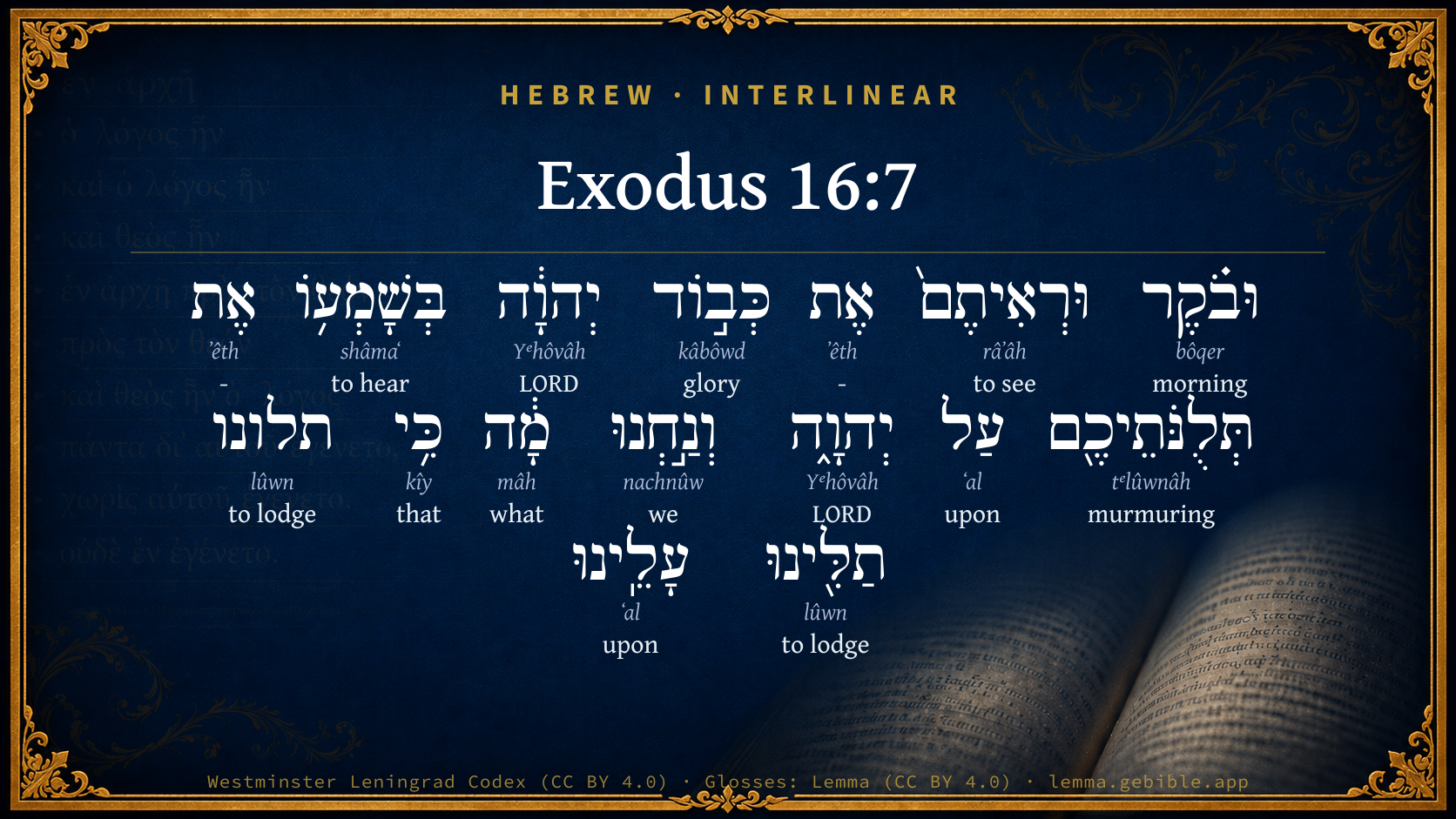
Hebrew (Westminster Leningrad Codex) Exodus 16:7 appears in the Hebrew Old Testament. The text above is from the Westminster Leningrad Codex. Each word links to its Strong’s number, a concise gloss, and parsing drawn from the Open Scriptures Hebrew Bible morphology. Click any word for its full Brown-Driver-Briggs (BDB) entry.
Download image
Cite this verse

Exodus 16:7 (World English Bible). Public Domain. Lemma interlinear Bible study tool, https://lemma.gebible.app/v/exodus/16/7.

Show BibTeX & RIS
BibTeX
RIS
English Translation
and in the morning, then you shall see the glory of Yahweh; because he hears your murmurings against Yahweh. Who are we, that you murmur against us?"
World English Bible · Public Domain
Highlights
  • 1 first appearance in the Hebrew Bible
Full analysis ↓
Download a study sheet

One document with this verse’s original text, its word-by-word gloss line, the meaning frame, cross-references with their text, attributed commentary, and full source and license credits — printable, and it pastes into notes with its structure intact.

This verse Autodidact and up

Study sheet (.html) Plain text (.txt)

A passage Seminary Student

Up to 50 verses in one chapter. A passage sheet keeps up to 6 commentary sources and 12 cross-references per verse, in the order this page ranks them, and says so on the sheet whenever that leaves anything out. Ask for a single verse and you get the Autodidact verse sheet above.

Everything on this page stays free to read, with no account — the sheet is a download of what is already on screen, not access to it.

Want to remove ads? Support Godless Engineer
Compare translations 3

The same verse in 3 English versions, stacked beneath the original-language interlinear above. Click any original word for its lexicon entry.

Each is an independent rendering of the whole verse — the interlinear is not word-aligned to these translations.

Highlighted words mark where these versions differ — a whole-verse word diff, not a word-by-word alignment.

  • World English Bible Public Domain
    and in the morning, then you shall see the glory of Yahweh; because he hears your murmurings against Yahweh. Who are we, that you murmur against us?"
  • King James Version Public Domain
    And in the morning, then ye shall see the glory of the LORD; for that he heareth your murmurings against the LORD: and what are we, that ye murmur against us?
  • unfoldingWord Literal Text CC BY-SA 4.0
    In the morning you will see the glory of Yahweh in his hearing your murmurings against Yahweh. And who are we that you murmur against us?”

unfoldingWord Literal Text — © unfoldingWord, licensed CC BY-SA 4.0. Word-aligned USFM3 via Door43 (git.door43.org/unfoldingWord/en_ult).

Versions to compare (up to 4)

3 of 4 selected

Show all 18 translations

Every available English version of this verse, each an independent rendering of the whole verse.

  • World English Bible Public Domain
    and in the morning, then you shall see the glory of Yahweh; because he hears your murmurings against Yahweh. Who are we, that you murmur against us?"
  • Berean Standard Bible Public Domain
    and in the morning you will see the LORD’s glory, because He has heard your grumbling against Him. For who are we that you should grumble against us?”
  • Majority Standard Bible Public Domain
    and in the morning you will see the LORD’s glory, because He has heard your grumbling against Him. For who are we, that you should grumble against us?”
  • King James Version Public Domain
    And in the morning, then ye shall see the glory of the LORD; for that he heareth your murmurings against the LORD: and what are we, that ye murmur against us?
  • American Standard Version (1901) Public Domain
    and in the morning, then ye shall see the glory of Jehovah; for that he heareth your murmurings against Jehovah: and what are we, that ye murmur against us?
  • Revised Version (1885) Public Domain
    and in the morning, then ye shall see the glory of the LORD; for that he heareth your murmurings against the LORD: and what are we, that ye murmur against us?
  • Geneva Bible (1599) Public Domain
    And in the morning ye shall see the glorie of the Lord: for he hath heard your grudgings against the Lord: and what are we that ye haue murmured against vs?
  • Douay-Rheims (1899) Public Domain
    And in the morning you shall see the glory of the Lord: for he hath heard your murmuring against the Lord: but as for us, what are we, that you mutter against us?
  • Young's Literal Translation Public Domain
    and morning -- and ye have seen the honour of Jehovah, in His hearing your murmurings against Jehovah, and what `are' we, that ye murmur against us?'
  • Literal Standard Version CC BY-SA 4.0
    and morning—and you have seen the glory of YHWH, in His hearing your murmurings against YHWH, and what [are] we, that you murmur against us?”
  • Unlocked Literal Bible CC BY-SA 4.0
    In the morning you will see Yahweh's glory, for he hears your complaining against him. Who are we for you to complain against us?”
  • unfoldingWord Literal Text CC BY-SA 4.0
    In the morning you will see the glory of Yahweh in his hearing your murmurings against Yahweh. And who are we that you murmur against us?”
  • Darby Bible Public Domain
    and in the morning, then shall ye see the glory of Jehovah; for he has heard your murmurings against Jehovah; -- and what are we, that ye murmur against us?
  • World Messianic Bible Public Domain
    In the morning, you shall see the LORD’s glory; because he hears your murmurings against the LORD. Who are we, that you murmur against us?”
  • Webster's Bible Public Domain
    And in the morning, then ye shall see the glory of the LORD; for that he heareth your murmurings against the LORD: And what are we, that ye murmur against us?
  • Free Bible Version CC BY-SA 4.0
    and in the morning you will see the glory of the Lord displayed as he responds to the complaints he's heard you making against him. For why should you be complaining to us? We're nobodies!”
  • Bible in Basic English Public Domain
    And in the morning you will see the glory of the Lord; for your angry words against the Lord have come to his ears: and what are we that you are crying out against us?
  • JPS Tanakh (1917) Public Domain
    and in the morning, then ye shall see the glory of the LORD; for that He hath heard your murmurings against the LORD; and what are we, that ye murmur against us?'

Literal Standard Version (2020), Covenant Press — licensed CC BY-SA 4.0. Text via the HelloAO Bible API (eBible.org). Unlocked Literal Bible (unfoldingWord) — licensed CC BY-SA 4.0. Text via the HelloAO Bible API (eBible.org). unfoldingWord Literal Text — © unfoldingWord, licensed CC BY-SA 4.0. Word-aligned USFM3 via Door43 (git.door43.org/unfoldingWord/en_ult). Free Bible Version, Dr. Jonathan Gallagher — licensed CC BY-SA 4.0. Text via the HelloAO Bible API (eBible.org).

Word by word

More ways to search: Search by grammar → Find every occurrence → Compare this word →

Practice this passage: Drill this verse → Learn its vocabulary →

וְנַ֣חְנוּ
nachnûw
H5168
“and · we”
Conjunction + Pronoun, Personal, 1st Person, Common, Plural
Part of Speech
Conjunction + Pronoun
Type
Personal
Person
1st Person
Gender
Common
Number
Plural
Full BDB Definition

Origin: for H587

TWOT: 128a

we
  1. וּבֹ֗קֶר bôqer H1242 “and · morning” Conjunction + Noun, Common, Masculine, Singular, Absolute
  2. וּרְאִיתֶם֙ râʼâh H7200 “and · to see” Conjunction + Verb, Qal, Sequential Perfect, 2nd Person, Masculine, Plural
  3. אֶת ʼêth H853 “-” Particle, Direct Object
  4. כְּב֣וֹד kâbôwd H3519 “glory of” Noun, Common, Both, Singular, Construct
  5. יְהוָ֔ה Yᵉhôvâh H3068 “LORD” Noun, Proper
  6. בְּשָׁמְע֥וֹ shâmaʻ H8085 “in/at · to hear · him” Preposition + Verb, Qal, Infinitive Construct + Suffix, Personal, 3rd Person, Masculine, Singular
  7. אֶת ʼêth H853 “-” Particle, Direct Object
  8. תְּלֻנֹּתֵיכֶ֖ם tᵉlûwnâh H8519 “murmurings · your” Noun, Common, Feminine, Plural, Construct + Suffix, Personal, 2nd Person, Masculine, Plural
  9. עַל ʻal H5921 “upon” Preposition
  10. יְהוָ֑ה Yᵉhôvâh H3068 “LORD” Noun, Proper
  11. מָ֔ה mâh H4100 “what” Particle, Interrogative
  12. כִּ֥י kîy H3588 “that” Conjunction
  13. תלונו lûwn H3885 “to lodge” Verb, Hiphil, Imperfect, 2nd Person, Masculine, Plural
  14. תַלִּ֖ינוּ lûwn H3885 “to lodge” Verb, Hiphil, Imperfect, 2nd Person, Masculine, Plural
  15. עָלֵֽינוּ ʻal H5921 “upon · us” Preposition + Suffix, Personal, 1st Person, Common, Plural

About this verse

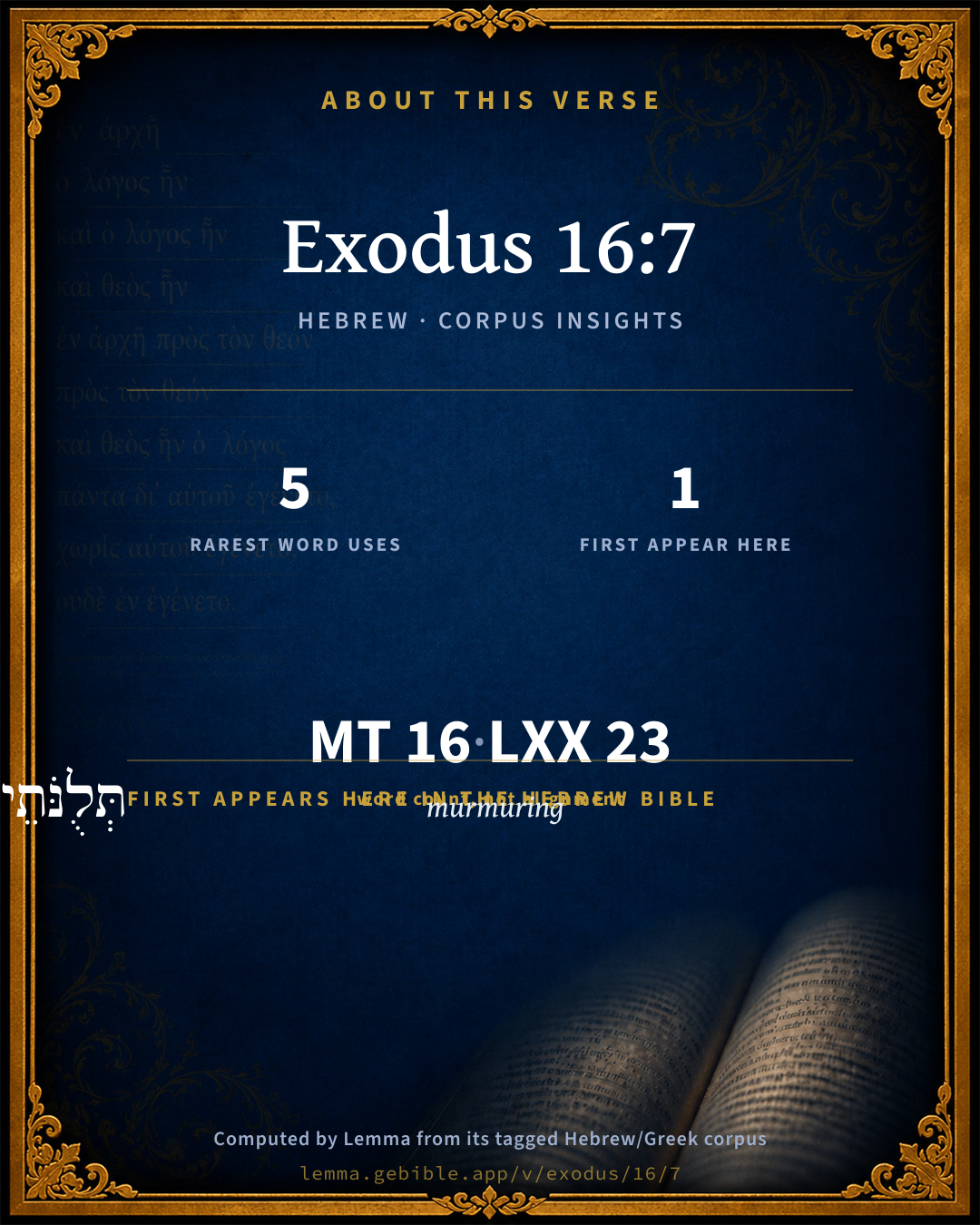
These counts appear in no published source. They are computed here, from the morphology-tagged text and Lemma’s own curated glosses. What Lemma adds →

16
words
12
distinct lemmas
Pentateuch
section

Notable vocabulary

The rarest word here is וְנַ֣חְנוּ we H5168 — appearing just 5 times in the whole Hebrew Bible.

First appearance in Scripture

This word makes its first canonical appearance in the Hebrew Bible here:

  • תְּלֻנֹּתֵיכֶ֖ם murmuring H8519

Shared distinctive vocabulary

וְנַ֣חְנוּ we H5168 occurs in 5 verses of the Hebrew Bible. Also found in:

Grammatical profile

  • 4 verbs
  • 5 nouns
  • 1 pronoun
  • 2 prepositions
  • 1 conjunction
  • 3 particles

Verb forms

  • וּרְאִיתֶם֙ Qal · Sequential Perfect
  • בְּשָׁמְע֥וֹ Qal · Infinitive Construct
  • תלונו Hiphil · Imperfect
  • תַלִּ֖ינוּ Hiphil · Imperfect

Repetition

Words recur within this verse — often emphatic in Hebrew:

  • יְהוָ֔ה LORD H3068 ×2
  • עַל upon H5921 ×2
  • תלונו to lodge H3885 ×2

Hebrew & Septuagint length

In English translation the verse runs 27 words from the Hebrew and 31 from the Septuagint (LXX English) — closely comparable.

A rough comparison of the two English renderings, which tokenize alike — not a word-level alignment.

Word counts can differ between the Hebrew and the Greek without any difference in meaning — e.g. the Hebrew direct-object marker אֵת has no separate Greek word, and Greek often adds the article ὁ.

In the original languages it is 16 Hebrew tokens and 23 Greek tokens — but the two are counted differently (Hebrew bundles its prefixes and suffixes into one token; the Greek is in lemma form), so that isn’t a like-for-like length.

Cross-references

16

Topical passages linked to Exodus 16:7 in the Treasury of Scripture Knowledge — connected by theme and wording, ordered by reader-vote popularity; previews shown in the World English Bible.

  • Isaiah 40:5 and the glory of Yahweh shall be revealed, and all flesh shall see it together; for the mouth of Yahweh has spoken it.
  • Numbers 16:11 Therefore you and all your company are gathered together against Yahweh: and Aaron, what is he who you murmur against him?
  • John 11:40 Jesus said to her, "Didn't I tell you that if you believed, you would see God's glory?"
  • Exodus 16:10 It happened, as Aaron spoke to the whole congregation of the children of Israel, that they looked toward the wilderness, and, behold, the glory of Yahweh appeared in the cloud.
  • Isaiah 35:2 It shall blossom abundantly, and rejoice even with joy and singing; the glory of Lebanon shall be given to it, the excellency of Carmel and Sharon: they shall see the glory of Yahweh, the excellency of our God.
  • John 11:4 But when Jesus heard it, he said, "This sickness is not to death, but for the glory of God, that God's Son may be glorified by it."
  • Exodus 40:34 Then the cloud covered the tent of meeting, and the glory of Yahweh filled the tent.
  • Numbers 14:10 But all the congregation bade stone them with stones. The glory of Yahweh appeared in the tent of meeting to all the children of Israel.
  • Numbers 16:42 It happened, when the congregation was assembled against Moses and against Aaron, that they looked toward the tent of meeting: and, behold, the cloud covered it, and the glory of Yahweh appeared.
  • Exodus 24:10 They saw the God of Israel. Under his feet was like a paved work of sapphire stone, like the skies for clearness.
  • Exodus 24:16 The glory of Yahweh settled on Mount Sinai, and the cloud covered it six days. The seventh day he called to Moses out of the midst of the cloud.
  • Numbers 14:27 How long [shall I bear] with this evil congregation, that murmur against me? I have heard the murmurings of the children of Israel, which they murmur against me.
  • Exodus 16:2–3 The whole congregation of the children of Israel murmured against Moses and against Aaron in the wilderness;
  • Exodus 16:8 Moses said, "Now Yahweh shall give you meat to eat in the evening, and in the morning bread to satisfy you; because Yahweh hears your murmurings which you murmur against him. And who are we? Your murmurings are not against us, but against Yahweh."
  • Exodus 16:12 "I have heard the murmurings of the children of Israel. Speak to them, saying, 'At evening you shall eat meat, and in the morning you shall be filled with bread: and you shall know that I am Yahweh your God.'"
  • Leviticus 9:6 Moses said, "This is the thing which Yahweh commanded that you should do: and the glory of Yahweh shall appear to you."

Cross-references courtesy of OpenBible.info (CC BY 4.0).

Hebrew and Greek witnesses Masoretic Hebrew ↔ Greek Septuagint

The same verse in the two great witnesses to the Old Testament, shown verse-for-verse.

These are two independent witnesses, not word-aligned to each other, and the Septuagint is shown in lemma (dictionary) form.

Hebrew Exodus 16:7 Masoretic · Westminster Leningrad Codex

וּבֹ֗קֶר וּרְאִיתֶם֙ אֶת כְּב֣וֹד יְהוָ֔ה בְּשָׁמְע֥וֹ אֶת תְּלֻנֹּתֵיכֶ֖ם עַל יְהוָ֑ה וְנַ֣חְנוּ מָ֔ה כִּ֥י תלונו תַלִּ֖ינוּ עָלֵֽינוּ

and in the morning, then you shall see the glory of Yahweh; because he hears your murmurings against Yahweh. Who are we, that you murmur against us?"

World English Bible · Public Domain

Greek LXX Exodus 16:7 Septuagint · lemma form

καί πρωΐ ὁράω ὁ δόξα κύριος ἐν ὁ εἰςἀκούω ὁ γογγυσμός σύ ἐπί ὁ θεός ἐγώ δέ τίς εἰμί ὅτι διαγογγύζω κατά ἐγώ

and in the morning you⌃ shall see the glory of the Lord, inasmuch as he hears your murmuring against God; and who are we, that you⌃ continue to murmur against us?

LXX2012 (modern English Septuagint) · Public Domain

Hebrew: Westminster Leningrad Codex (CC BY 4.0). Greek: Septuagint (public domain); English from LXX2012 (modern English Septuagint) (Public Domain). How the Septuagint differs from the Hebrew →

Targum (Aramaic paraphrase)

2

The Targum is the ancient Jewish Aramaic paraphrase of the Hebrew Scriptures — an interpretive translation, not the Hebrew text itself. Onkelos (literal) and Pseudo-Jonathan (expansive) render the Torah, and Jonathan the Prophets. Coverage is partial: where no permissively-licensed English translation exists for a verse, only the Aramaic is shown. This is verse-level text, not a word-by-word alignment to the Hebrew.

  1. Targum Onkelos Torah (Genesis–Deuteronomy)
    וּבְצַפְרָא וְתֶחֱזוּן יָת יְקָרָא דַיְיָ כַּד שְׁמִיעַ (קֳדָמוֹהִי) יָת תֻּרְעֲמוּתְכוֹן עַל מֵימְרָא דַיְיָ וְנַחְנָא מָא אֲרֵי אַתְרַעַמְתּוּן עֲלָנָא:

    (no public-domain English translation for this verse)

    Targum Onkelos — Aramaic: “Onkelos Genesis” (public domain); “Onkelos Exodus” (public domain); “Onkelos Leviticus” (public domain); “Onkelos Numbers” (public domain); “Onkelos Deuteronomy” (public domain). English: “Sefaria Community Translation” (CC0 1.0 (public-domain dedication)); “J.W. Etheridge. The Targums of Onkelos and Jonathan Ben Uzziel on the Pentateuch. London: Longmans, Green, 1862” (public domain). Text via Sefaria.

  2. Targum Pseudo-Jonathan Torah (Genesis–Deuteronomy)
    וּבְצַפְרָא יִתְגְּלֵי עֲלֵיכוֹן יְקַר שְׁכִינְתָּא דַיְיָ כַּד שְׁמִיעַן קֳדָמוֹי יַת תּוּרְעֲמַתְכוֹן קֳדָם יְיָ וַאֲנַחְנָא מָה אֲנַן חֲשִׁיבִין אֲרוּם אִתְרַעַמְתּוּן עֲלָנָא

    and in the morning will be revealed to you the glory of the Shekinah of the Lord; and we, what are we accounted, that you complain against us?

    Targum Pseudo-Jonathan — Aramaic: “Targum Jonathan on Genesis” (public domain); “Targum Jonathan on Exodus” (public domain); “Targum Jonathan on Leviticus” (public domain); “Targum Jonathan on Numbers” (public domain); “Targum Jonathan on Deuteronomy” (public domain). English: “The Targum of Jonathan ben Uzziel, trans. J. W. Etheridge, London, 1862” (public domain). Text via Sefaria.

Commentary

Notes on Exodus 16:7 from classic Christian and Jewish commentators (each source and its license shown beneath its notes). The classic Christian expositions comment on the surrounding passage and are grouped to its opening verse, so a note may address several verses; the Jewish commentaries on the Tanakh (Rashi and others) are per-verse, so they appear only where the commentator wrote on this verse.

Lemma curates 59 commentaries, every one of them public domain or Creative Commons licensed, each selected and text-cleaned for this edition rather than reprinted as found. About our sources →

John Gill's Exposition

And in the morning, then ye shall see the glory of the Lord,.... Either as displayed in this wonderful affair, raining bread about their tents, which was in the morning, or else as it appeared in the cloud, Exo 16:7 the latter sense seems to be confirmed by what follows: for that he; the glory of the Lord, the glorious Shechinah of Jehovah, the Angel that went before them in the cloud, the eternal Word and Son of God: heareth your murmurings against the Lord; against Jehovah his Father; see Gen 19:24.

and what are we, that ye murmur against us? either signifying that there was no reason for it, and no occasion of it, since not they, but the Lord, brought them out of Egypt, and into those circumstances; what they did was only by his command, and with a view for their good, and therefore it was both unreasonable and ungrateful in them to murmur against them; or as observing, that seeing they murmured against the Lord, it was no strange thing to them they should murmur against them, and therefore took it the more quietly and patiently.

John Gill's Exposition of the Whole Bible (1746–1763) — public domain (CC PDM 1.0). Text via the HelloAO Bible API.

Trapp's Complete Commentary

John Trapp

Exo 16:7 And in the morning, then ye shall see the glory of the LORD; for that he heareth your murmurings against the LORD: and what [are] we, that ye murmur against us?

Ver. 7. Ye shall see the glory of the Lord.] Shining in that wonderful work of his, the bread from heaven. Compare Num 14:21 Joh 11:40.

John Trapp, A Commentary or Exposition upon All the Books of the Old and New Testament (1647–1656) — public domain. Text from a community e-Sword module.

Joseph Benson's Commentary

Exo 16:7-9. Ye shall see the glory of the Lord — Either this glorious work of God in giving you bread from heaven, or rather the glorious appearance of God in the cloud, as is mentioned in Exo 16:10. Come near before the Lord — Before the cloudy pillar, where God was especially present.

Joseph Benson's Commentary on the Old and New Testaments (1811–1818) — public domain. Text from a community e-Sword module.

Tyndale Open Study Notes

Tyndale Open Resources

16:7 The Hebrew word translated glory connotes weightiness, substance, and reality. It is not the flimsy, ephemeral quality we often associate with the English term glory. It is more the idea of royal grandeur.

Tyndale Open Study Notes — © Tyndale Open Resources, licensed CC BY-SA 4.0. Text via the HelloAO Bible API.

Geneva Bible (1599)

Geneva Bible translators

He gave them not Manna because they murmured, but for his promise sake.

Geneva Bible (1599) marginal notes — public domain. Text via Bolls.life.

Adam Clarke's Commentary

Verse 7. Ye shall see the glory of the Lord] Does it not appear that the glory of the Lord is here spoken of as something distinct from the Lord? for it is said HE (the glory) heareth your murmurings against the Lord; though the Lord may be here put for himself, the antecedent instead of the relative. This passage may receive some light from Heb 1:3: Who being the brightness of his glory, and the express image of his person, c. And as St. Paul's words are spoken of the Lord Jesus, is it not likely that the words of Moses refer to him also? "No man hath seen God at any time" hence we may infer that Christ was the visible agent in all the extraordinary and miraculous interferences which took place both in the patriarchal times and under the law.

Adam Clarke's Commentary on the Bible (1810–1826) — public domain. Text from a community e-Sword/MySword module.

Ellicott's Commentary for English Readers

(7) And in the morning, then ye shall see the glory of the Lord.—The reference here is to the manna, which “in the morning lay round about the host” (Exo_16:13), not to the “appearance” of Exo_16:10, which preceded the coming of the quails, and was not—as far as we are told—“in the morning.” The “glory of God” was strikingly revealed in a gift which was not transient, but secured permanently the subsistence of the people so long as it might be necessary for them to continue in the wilderness. (Comp. the parallelism of Exo_16:8; Exo_16:12.)

A Bible Commentary for English Readers, edited by Charles John Ellicott (1878–1897) — public domain. Text from a community e-Sword module.

The Cambridge Bible for Schools and Colleges

gen. ed. J. J. S. Perowne

7. see the glory, &c.] His might and greatness will be declared by His gift of manna.

and what, &c.] i.e. since what &c.: we are merely His agents; your murmurings therefore are really against Him. Cf. Num_16:11 b (P).

The Cambridge Bible for Schools and Colleges (gen. ed. J. J. S. Perowne; Cambridge University Press, 1878–1918) — public domain. Text from a community e-Sword module.

Albert Barnes' Notes on the Bible

The glory of the Lord - the visible appearance described in Exo 16:10.

Albert Barnes' Notes on the Bible (1834–1885) — public domain. Text from a community e-Sword/MySword module.

Haydock's Catholic Bible Commentary

Morning, when manna fell, as quails were brought the former evening, ver. 12 and 13. These fresh instances of protection might, convince them that they had not been imposed upon by Moses in leaving Egypt. (Menochius)

George Leo Haydock (1774–1849), Haydock's Catholic Family Bible and Commentary, 1859 edition — public domain. Excludes Psalms (Douay-Rheims chapter numbering differs from Protestant) and Deuterocanonical books (Catholic canon only).

Matthew Poole's English Annotations

The glory of the Lord; either this glorious work of God in giving manna; or rather the glorious appearance of God in the cloud, as is evident from Exo 16:10.

Matthew Poole's English Annotations on the Holy Bible (1683–1685) — public domain. Text from a community e-Sword/MySword module.

The Pulpit Commentary

And in the morning then ye shall see the glory of the Lord. This has been supposed to refer to the manifestation of God"s presence recorded in verse 10; but the balance of the two clauses in verses 6 and 7 implies two similar manifestations, and their arrangement shows the priority of the evening one. Now the manifestation of verse 10 preceded the coming of the quails. The manifestation which followed it, which was similar, and in the morning, was the fall of the manna. For that he heareth your murmurings. The connection of this clause with the preceding furnishes an additional argument in favour of the exposition that "the glory of God," spoken of in this verse is the manna. Against the Lord . Professedly and directly against us, but indirectly and really against God, whose instruments we have been in the whole matter of the exodus. What are we?i.e. , "What power have we of our own? We have no hereditary rank, no fixed definite position. We are simply the leaders whom you have chosen to follow, because you believed us to have a commission from God. Apart from this, we are nobodies. But, if our commission is conceded, we are to you in the place of God; and to murmur against us is to murmur against Jehovah."

The Pulpit Commentary (1880–1919), ed. H.D.M. Spence-Jones & Joseph S. Exell — public domain. Text from a community e-Sword module.

Rashi

Rabbi Shlomo Yitzchaki (Rashi)

ובקר וראיתם AND IN THE MORNING YE SHALL SEE [THE GLORY OF THE LORD] — Not in reference to that glory of which it stated, (v. 10) “And behold the glory of the Lord appeared in the cloud” is this said, but thus, in effect, did he say to them: In the evening ye shall know that His hand has the power to give you your desire and He will give you flesh; but not with a radiant countenance will He give it to you, because you have asked Him something that is not proper (since one can exist without eating meat), and out of a full stomach (i. e. you really have meat for you have an abundance of cattle); but the bread for which you have asked out of necessity — when it falls in the morning you will behold the glory of the radiance of His countenance (His glory), because He will make it fall for you in a manner that is indicative of His love (Mekhilta) — in the morning, whilst there is yet time to prepare it, and there shall be dew above it and dew below it as though it were carefully packed in a chest (Yoma 75b).

את תלנתיכם על ה׳ this is the same as תלנתיכם] אשר על ה׳] YOUR MURMURINGS WHICH ARE AGAINST THE LORD.

ונחנו מה (lit., and we, what?) means AND WE, WHAT ARE WE accounted (of what importance are we?),

כי תלינו עלינו THAT YOU MAKE everyone MURMUR AGAINST US — your sons, and your wives, and your daughters and the mixed multitude. — And whether I like it or not I am forced to explain the word תַלִּינוּ in the sense of “you make (people) do something”, viz., murmur (i. e. what we call the Hiphil conjugation), because of its (the ל) be eshed and because of the קרי. For if it (the ל) were weak (i. e. without a Dagesh), I would explain it in the sense of “ye do something” (our Kal), just as, (Exodus 17:3) “And the people murmured (וַיָלֶן) against Moses”, or, if there was still a Dagesh but there was no י in it, so that it could be read תִלּוֹנוּ, I would explain it as meaning “ye put yourself in a state of murmuring” (our Niphal; cf. Rashi on Exodus 15:24). Now, however, it being as it is, it must imply “you make others murmur”, just as in the case of the spies it states, (Numbers 14:36) “And they made all the congregation to murmur (וַיַּלִּינוּ) against him” (where וַיַּלִּינוּ is the same grammatical form, so far as conjugation is concerned, as תַלִּינוּ, but as it has an object, כל העדה, it cannot mean “And they murmured”, and must necessarily mean “they made the congregation murmur).

Rashi on the Tanakh — English translations: “The Judaica Press complete Tanach with Rashi, translated by A. J. Rosenberg” (CC BY 4.0); “Pentateuch with Rashi's commentary by M. Rosenbaum and A.M. Silbermann, 1929-1934” (public domain); “The Metsudah Tanach series, Lakewood, N.J” (CC BY 4.0); and “The Book of Joshua, Metsudah Publications, 1997” (CC BY 4.0). Text via Sefaria.

Ramban (Nachmanides)

Rabbi Moshe ben Nachman (Ramban / Nachmanides)

AND WHAT ARE WE, THAT YE MURMUR AGAINST US. Rabbi Abraham ibn Ezra explained it as meaning: “And what power to act is there in our hands? We have only carried out what we have been commanded.” But this is not so. Rather, the sense of the verse here is similar to: What is man, that Thou art mindful of him? Eternal, what is man that Thou takest knowledge of him?, 144:3. For how little is he [man] to be accounted! And this [verse here] is an expression of humility. “For what are we that you should attribute us with bringing you out from the land of Egypt? Behold we are nothing, and our work is vanity., 41:24. And your murmurings are not against us, but against the Eternal. It is He Who has brought you out from the land of Egypt, not we.” And in the Mechilta we find. “[They said to them]: ‘Are we so distinguished that you arise and murmur against us?’” is one of humility, as explained.

Ramban (Nachmanides) on the Tanakh — English translation: “Commentary on the Torah by Ramban (Nachmanides). Translated and annotated by Charles B. Chavel. New York, Shilo Pub. House, 1971-1976” (CC BY 4.0). Text via Sefaria.

Lesson kit

Teaching starters — assembled from the data on this page, not authored interpretation. Every prompt links to the verse data it draws on. Edit before teaching.

Exodus, in the Pentateuch, opens this verse with 16 words (12 distinct Hebrew lemmas). Its most distinctive word is nachnûw (“we”). A historical commentator’s framing appears above. Read the whole chapter for the surrounding context.

Discussion questions

  1. The word nachnûw carries the sense “we.” How does it shape the verse?
  2. The word “murmuring” first appears here in Scripture. What is being introduced at this debut?
  3. Genesis 42:11 shares the word «we» with this verse. How do the two illuminate each other?
  4. “LORD” occurs 2× in this one verse. What is the effect of the repetition?
  5. These translations render this verse differently; the difference is in the English rendering, not the original. What questions does that raise?
  6. The verb «וּרְאִיתֶם֙» is Qal Sequential Perfect. How does its form color the action?
  7. Reading how John Gill's Exposition and Trapp's Complete Commentary read this verse, where do the two commentators agree and where do they part?

Things to notice

Reading settings

Reading text

Shown beneath each verse's original-language words.

Old Testament
Old Testament edition

Read the OT as the Masoretic Hebrew (MT) or the Greek Septuagint (LXX).

English shown for the Greek Septuagint (in the Hebrew ↔ Greek comparison).

Comparing translations? Open the Compare panel on any verse page to stack up to four side by side.