
Lamentations 5:20

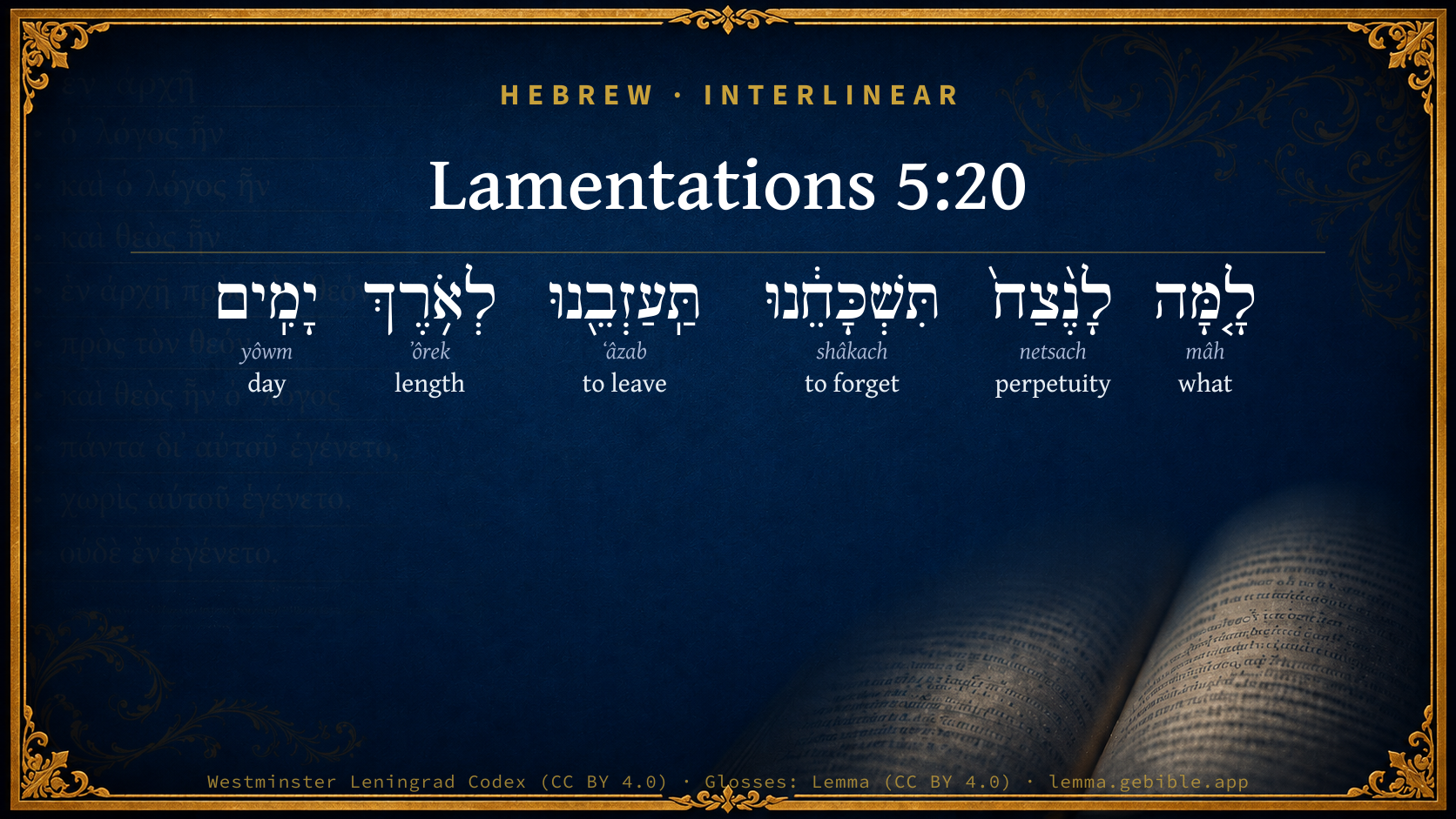
Hebrew (Westminster Leningrad Codex) Lamentations 5:20 appears in the Hebrew Old Testament. The text above is from the Westminster Leningrad Codex. Each word links to its Strong’s number, a concise gloss, and parsing drawn from the Open Scriptures Hebrew Bible morphology. Click any word for its full Brown-Driver-Briggs (BDB) entry.
Download image
Cite this verse

Lamentations 5:20 (World English Bible). Public Domain. Lemma interlinear Bible study tool, https://lemma.gebible.app/v/lamentations/5/20.

Show BibTeX & RIS
BibTeX
RIS
English Translation
Why do you forget us forever, [And] forsake us so long time?
World English Bible · Public Domain
Download a study sheet

One document with this verse’s original text, its word-by-word gloss line, the meaning frame, cross-references with their text, attributed commentary, and full source and license credits — printable, and it pastes into notes with its structure intact.

This verse Autodidact and up

Study sheet (.html) Plain text (.txt)

A passage Seminary Student

Up to 50 verses in one chapter. A passage sheet keeps up to 6 commentary sources and 12 cross-references per verse, in the order this page ranks them, and says so on the sheet whenever that leaves anything out. Ask for a single verse and you get the Autodidact verse sheet above.

Everything on this page stays free to read, with no account — the sheet is a download of what is already on screen, not access to it.

Want to remove ads? Support Godless Engineer
Compare translations 3

The same verse in 3 English versions, stacked beneath the original-language interlinear above. Click any original word for its lexicon entry.

Each is an independent rendering of the whole verse — the interlinear is not word-aligned to these translations.

Highlighted words mark where these versions differ — a whole-verse word diff, not a word-by-word alignment.

  • World English Bible Public Domain
    Why do you forget us forever, [And] forsake us so long time?
  • King James Version Public Domain
    Wherefore dost thou forget us for ever, and forsake us so long time?
  • unfoldingWord Literal Text CC BY-SA 4.0
    Why do you forget us forever, do you forsake us for the length of days?

unfoldingWord Literal Text — © unfoldingWord, licensed CC BY-SA 4.0. Word-aligned USFM3 via Door43 (git.door43.org/unfoldingWord/en_ult).

Versions to compare (up to 4)

3 of 4 selected

Show all 18 translations

Every available English version of this verse, each an independent rendering of the whole verse.

  • World English Bible Public Domain
    Why do you forget us forever, [And] forsake us so long time?
  • Berean Standard Bible Public Domain
    Why have You forgotten us forever? Why have You forsaken us for so long?
  • Majority Standard Bible Public Domain
    Why have You forgotten us forever? Why have You forsaken us for so long?
  • King James Version Public Domain
    Wherefore dost thou forget us for ever, and forsake us so long time?
  • American Standard Version (1901) Public Domain
    Wherefore dost thou forget us for ever, `And' forsake us so long time?
  • Revised Version (1885) Public Domain
    Wherefore dost thou forget us for ever, and forsake us so long time?
  • Geneva Bible (1599) Public Domain
    Wherefore doest thou forget vs for euer, and forsake vs so long time?
  • Douay-Rheims (1899) Public Domain
    Why wilt thou forget us for ever? why wilt thou forsake us for a long time?
  • Young's Literal Translation Public Domain
    Why for ever dost Thou forget us? Thou forsakest us for length of days!
  • Literal Standard Version CC BY-SA 4.0
    Why do You forget us forever? You forsake us for [the] length of [our] days!
  • Unlocked Literal Bible CC BY-SA 4.0
    Why do you forget us forever? Why do you forsake us for so many days?
  • unfoldingWord Literal Text CC BY-SA 4.0
    Why do you forget us forever, do you forsake us for the length of days?
  • Darby Bible Public Domain
    Wherefore dost thou forget us for ever, dost thou forsake us so long time?
  • World Messianic Bible Public Domain
    Why do you forget us forever, and forsake us for so long a time?
  • Webster's Bible Public Domain
    Why dost thou forget us for ever, and forsake us so long time?
  • Free Bible Version CC BY-SA 4.0
    So why have you forgotten us for such a long time? Why have you abandoned us for so many years?
  • Bible in Basic English Public Domain
    Why have we gone from your memory for ever? why have you been turned away from us for so long?
  • JPS Tanakh (1917) Public Domain
    Wherefore dost Thou forget us for ever, and forsake us so long time?

Literal Standard Version (2020), Covenant Press — licensed CC BY-SA 4.0. Text via the HelloAO Bible API (eBible.org). Unlocked Literal Bible (unfoldingWord) — licensed CC BY-SA 4.0. Text via the HelloAO Bible API (eBible.org). unfoldingWord Literal Text — © unfoldingWord, licensed CC BY-SA 4.0. Word-aligned USFM3 via Door43 (git.door43.org/unfoldingWord/en_ult). Free Bible Version, Dr. Jonathan Gallagher — licensed CC BY-SA 4.0. Text via the HelloAO Bible API (eBible.org).

Word by word

More ways to search: Search by grammar → Find every occurrence → Compare this word →

Practice this passage: Drill this verse → Learn its vocabulary →

About this verse

These counts appear in no published source. They are computed here, from the morphology-tagged text and Lemma’s own curated glosses. What Lemma adds →

6
words
6
distinct lemmas
Prophets
section

Shared distinctive vocabulary

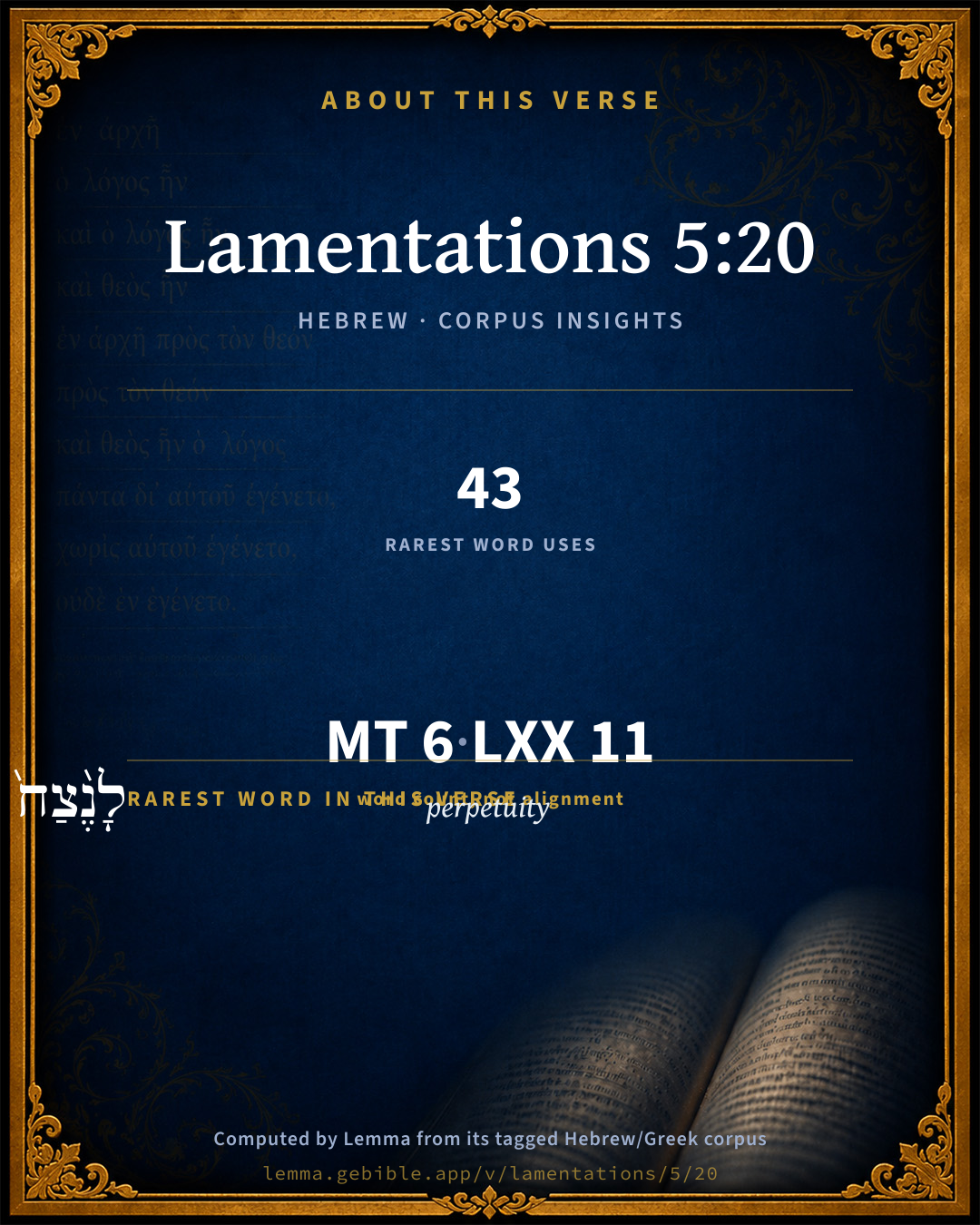
לָנֶ֨צַח֙ perpetuity H5331 occurs in 42 verses of the Hebrew Bible. Also found in:

Grammatical profile

  • 2 verbs
  • 3 nouns
  • 1 particle

Verb forms

  • תִּשְׁכָּחֵ֔נוּ Qal · Imperfect
  • תַּֽעַזְבֵ֖נוּ Qal · Imperfect

Hebrew & Septuagint length

In English translation the verse runs 12 words from the Hebrew and 12 from the Septuagint (LXX English) — the same length.

A rough comparison of the two English renderings, which tokenize alike — not a word-level alignment.

Word counts can differ between the Hebrew and the Greek without any difference in meaning — e.g. the Hebrew direct-object marker אֵת has no separate Greek word, and Greek often adds the article ὁ.

In the original languages it is 6 Hebrew tokens and 11 Greek tokens — but the two are counted differently (Hebrew bundles its prefixes and suffixes into one token; the Greek is in lemma form), so that isn’t a like-for-like length.

Cross-references

10

Topical passages linked to Lamentations 5:20 in the Treasury of Scripture Knowledge — connected by theme and wording, ordered by reader-vote popularity; previews shown in the World English Bible.

  • Psalms 13:1 How long, Yahweh? Will you forget me forever? How long will you hide your face from me?
  • Psalms 44:24 Why do you hide your face, And forget our affliction and our oppression?
  • Jeremiah 14:19–21 Have you utterly rejected Judah? has your soul loathed Zion? why have you struck us, and there is no healing for us? We looked for peace, but no good came; and for a time of healing, and, behold, dismay!
  • Psalms 74:1 God, why have you rejected us forever? Why does your anger smolder against the sheep of your pasture?
  • Psalms 77:7–10 "Will the Lord reject us forever? Will he be favorable no more?
  • Psalms 79:5 How long, Yahweh? Will you be angry forever? Will your jealousy burn like fire?
  • Psalms 85:5 Will you be angry with us forever? Will you draw out your anger to all generations?
  • Psalms 89:46 How long, Yahweh? Will you hide yourself forever? Will your wrath burn like fire?
  • Psalms 94:3–4 Yahweh, how long will the wicked, How long will the wicked triumph?
  • Isaiah 64:9–12 Don't be angry very sore, Yahweh, neither remember iniquity forever: see, look, we beg you, we are all your people.

Cross-references courtesy of OpenBible.info (CC BY 4.0).

Hebrew and Greek witnesses Masoretic Hebrew ↔ Greek Septuagint

The same verse in the two great witnesses to the Old Testament, shown verse-for-verse.

These are two independent witnesses, not word-aligned to each other, and the Septuagint is shown in lemma (dictionary) form.

Hebrew Lamentations 5:20 Masoretic · Westminster Leningrad Codex

לָ֤מָּה לָנֶ֨צַח֙ תִּשְׁכָּחֵ֔נוּ תַּֽעַזְבֵ֖נוּ לְאֹ֥רֶךְ יָמִֽים

Why do you forget us forever, [And] forsake us so long time?

World English Bible · Public Domain

Greek LXX Lamentations 5:20 Septuagint · lemma form

ἵνα τίς εἰς νεῖκος ἐπιλανθάνω ἐγώ καταλείπω ἐγώ εἰς μακρότης ἡμέρα

Therefore will you utterly forget us, and abandon us a long time?

LXX2012 (modern English Septuagint) · Public Domain

Hebrew: Westminster Leningrad Codex (CC BY 4.0). Greek: Septuagint (public domain); English from LXX2012 (modern English Septuagint) (Public Domain). How the Septuagint differs from the Hebrew →

Commentary

Notes on Lamentations 5:20 from classic Christian and Jewish commentators (each source and its license shown beneath its notes). The classic Christian expositions comment on the surrounding passage and are grouped to its opening verse, so a note may address several verses; the Jewish commentaries on the Tanakh (Rashi and others) are per-verse, so they appear only where the commentator wrote on this verse.

Lemma curates 59 commentaries, every one of them public domain or Creative Commons licensed, each selected and text-cleaned for this edition rather than reprinted as found. About our sources →

Trapp's Complete Commentary

John Trapp

Lam 5:20 Wherefore dost thou forget us for ever, [and] forsake us so long time?

Ver. 20. Wherefore dost thou forget us?] Since thy covenant runs otherwise. {2Sa 7:14 Lam 5:1}

And forsakest us so long time?] Heb., To length of days. {as Psa 23:6} Not for seventy years only, but to the end of the world; till "wrath is come upon us to the utmost." {as 1Th 2:16}

John Trapp, A Commentary or Exposition upon All the Books of the Old and New Testament (1647–1656) — public domain. Text from a community e-Sword module.

Jamieson, Fausset & Brown

Robert Jamieson, A. R. Fausset & David Brown

for ever--that is, for "so long a time."

Jamieson, Fausset & Brown — Commentary Critical and Explanatory on the Whole Bible (1871) — public domain (CC PDM 1.0). Text via the HelloAO Bible API.

John Calvin's Commentaries

He seems, indeed, here to expostulate with God; but the faithful, even when they patiently bear their evils, and submit to God’s scourges, do yet familiarly deposit their complaints in his bosom, and thus unburden themselves. We see that David prayed, and no doubt by the real impulse of the Spirit, and at the same time expostulated,

“Why dost thou forget me perpetually?” (Psalm 13:1.)

Nor is there a doubt but that the Prophet took this complaint from David. Let us, then, know, that though the faithful sometimes take this liberty of expostulating with God, they yet do not put off reverence, modesty, submission, or humility. For when the Prophet thus inquired why God should for ever forget his people and forsake them, he no doubt relied on his own prophecies, which he knew had proceeded from God, and thus he deferred his hope until the end of the seventy years, for that time had been prefixed by God. But it was according to human judgment that he complained in his own person, and in that of the faithful, that the affliction was long; nor is there a doubt but that he dictated this form of prayer to the faithful, that k might be retained after his death. He, then, formed this prayer, not only according to his own feeling, and for the direction to those of his own age; but his purpose was to supply the faithful with a prayer after his own death, so that they might flee to the mercy of God.

We now, then, perceive how complaints of this kind ought to be understood, when the prophets asked, “How long?” as though they stimulated God to hasten the time; for it cannot be, when we are pressed down by many evils, but that we wish help to be accelerated; for faith does not wholly strip us of all cares and anxieties. But when we thus pray, let us remember that our times are at the will and in the hand of God, and that we ought not to hasten too much. It is, then, lawful for us on the one hand to ask God to hasten; but, on the other hand, we ought to check our impatience and wait until the suitable time comes. Both these things the Prophet no doubt joined together when he said, Why shouldest thou, perpetually forget us and forsake us?

We yet see that he judged according to the evils then endured; and doubtless he believed that God had not forsaken his own people nor forgotten them, as no oblivion can happen to him. But, as I have already said, the Prophet mentioned these complaints through human infirmity, not that men might indulge themselves in their own thoughts, but that they might ascend by degrees to God and overcome all these temptations. It follows, —

John Calvin's Commentaries (1540-1563) — public domain. Text from the Calvin Translation Society English edition (1840s-50s) via the Christian Classics Ethereal Library (ccel.org). Calvin's coverage is partial (roughly two-thirds of the Bible); uncommented books and verses are honest gaps, never fabricated. The 19th-century editor's footnotes and remarks are omitted so the notes are faithfully Calvin's own voice.

Ellicott's Commentary for English Readers

(20) Wherefore dost thou forget . . .—This was the problem of the mystery of suffering then, as it has been at all times. Jehovah had seemed forgetful of His people, indifferent to their miseries.

A Bible Commentary for English Readers, edited by Charles John Ellicott (1878–1897) — public domain. Text from a community e-Sword module.

The Cambridge Bible for Schools and Colleges

gen. ed. J. J. S. Perowne

20. Since this is so, why is Israel left desolate?

The Cambridge Bible for Schools and Colleges (gen. ed. J. J. S. Perowne; Cambridge University Press, 1878–1918) — public domain. Text from a community e-Sword module.

John Gill's Exposition

Wherefore dost thou, forget us for ever,.... Since thou art firm, constant, and unchangeable, and thy love and covenant the same. God seems to forget his people when he afflicts them, or suffers them to be oppressed, and does not arise immediately for their help; which being deferred some time, looks like an eternity to them, or they fear it will ever be so; at least this they say to express their eager desire after his gracious presence, and to show how much they prize it:

and forsake us so long time? or, "to length of days" (d)? so long as the seventy years' captivity; which to be forsaken of God, or to seem to be forsaken of him, was with them a long time.

(d) "in longitudinem dierum", Pagninus, Montanus.

John Gill's Exposition of the Whole Bible (1746–1763) — public domain (CC PDM 1.0). Text via the HelloAO Bible API.

Matthew Poole's English Annotations

Wherefore dost thou, in the dispensations of thy providence, carry thyself as if thou hadst forgotten us, and forsaken us, and that for a long time.

Matthew Poole's English Annotations on the Holy Bible (1683–1685) — public domain. Text from a community e-Sword/MySword module.

The Pulpit Commentary

Wherefore dost thou forget us, etc.? The poet does not say," Wherefore hast thou forgotten us?" One of the psalmists, indeed, does go so far; (Psa_74:1) but the poet of this lamentation, with a more tender and trustful reserve, adopts the tense of feeling (the imperfect) in preference to that of fact (the perfect), and asks, "Wherefore dost thou to my feeling forget us? Wherefore, if Jehovah"s power is still unbroken, does he allow Israel to feel herself forsaken?" The fact is certain, viz. that the land of Israel is desolate, and (the poet seems to imply) desolate for some time already. The interpretation is hypothetical, and, as the last verse will show, the poet cannot bring himself to believe that it can be accurate.

Questioning God.

I IT IS NATURAL THAT WE SHOULD WISH TO KNOW THE PURPOSE OF GOD"S DEALINGS WITH US. There is no subject for inquiry that touches us more nearly or that affects us in such important matters. God"s treatment of us concerns our highest welfare for time and eternity. It is in all the experience of life our many blessings, our varied trials, our greatest prosperity, and our heaviest trouble. Surely it is natural that we should ask whither are all these waves driving us, and why do they sometimes beat so strangely and severely.

II THERE IS MUCH IN GOD"S DEALINGS WITH US THAT WE CANNOT UNDERSTAND. It seems that he has forgotten us when we are permitted to fall into great and lasting trouble. Short, sharp affliction may be faced. But long enduring distress wears out hope and faith, and makes it appear more and more as though the lonely sufferer had been deserted by God. The purpose of this is not easy to discover. The whole dispensation is just inexplicable.

III THE RIGHT WAY TO DISCOVER THE PURPOSE OF GOD"S DEALINGS WITH US IS TO ASK HIM. We often discuss vainly when we have no data to start with. But speculation is sure to fail if it goes beyond all evidence and clear reason. Prayer is the one safe resource. It would be well if we had enough faith in God to confide our doubts to him. For it is too often only unbelief that makes us silence doubt. If we truly trusted God we should more bravely confess to him all that troubled and perplexed our minds. In response to such confidence God may reveal to us a new way of looking at our experience that shall help us to understand something of its object; or he may simply reconcile our minds to the mystery perhaps an equally beneficial result.

IV WE MAY REST ASSURED THAT GOD HAS A PURPOSE IN HIS DEALINGS WITH US. It is there, though we cannot see it. We may say, "Wherefore dost thou forget us?" and we may not be able to receive an answer to our question. Yet we should not doubt that there is a "wherefore." God does nothing aimlessly. He certainly cannot be putting his children to pain without an object, nor without one that is adequate to the cost. The knowledge of this fact should quiet fear and restless doubt, even if the object itself remains hidden in mystery.

V WE MUST BEWARE OF QUESTIONING GOD QUERULOUSLY. We have no right to demand an explanation from God. To couch complaints in the form of inquiries is insulting to God. Let the questioning be humble and submissive, and the answers are sure to come in peace, if not always in light.

The Pulpit Commentary (1880–1919), ed. H.D.M. Spence-Jones & Joseph S. Exell — public domain. Text from a community e-Sword module.

Rashi

Rabbi Shlomo Yitzchaki (Rashi)

Why do You forget us forever Have You not sworn to us Yourself that just as You exist, so does Your oath exist?

Rashi on the Tanakh — English translations: “The Judaica Press complete Tanach with Rashi, translated by A. J. Rosenberg” (CC BY 4.0); “Pentateuch with Rashi's commentary by M. Rosenbaum and A.M. Silbermann, 1929-1934” (public domain); “The Metsudah Tanach series, Lakewood, N.J” (CC BY 4.0); and “The Book of Joshua, Metsudah Publications, 1997” (CC BY 4.0). Text via Sefaria.

Lesson kit

Teaching starters — assembled from the data on this page, not authored interpretation. Every prompt links to the verse data it draws on. Edit before teaching.

Lamentations, in the Prophets, opens this verse with 6 words (6 distinct Hebrew lemmas). Its most distinctive word is netsach (“perpetuity”). A historical commentator’s framing appears above. Read the whole chapter for the surrounding context.

Discussion questions

  1. The word netsach carries the sense “perpetuity.” How does it shape the verse?
  2. 1 Samuel 15:29 shares the word «perpetuity» with this verse. How do the two illuminate each other?
  3. These translations render this verse differently; the difference is in the English rendering, not the original. What questions does that raise?
  4. The verb «תִּשְׁכָּחֵ֔נוּ» is Qal Imperfect. How does its form color the action?
  5. Reading how Trapp's Complete Commentary and Jamieson, Fausset & Brown read this verse, where do the two commentators agree and where do they part?

Things to notice

Reading settings

Reading text

Shown beneath each verse's original-language words.

Old Testament
Old Testament edition

Read the OT as the Masoretic Hebrew (MT) or the Greek Septuagint (LXX).

English shown for the Greek Septuagint (in the Hebrew ↔ Greek comparison).

Comparing translations? Open the Compare panel on any verse page to stack up to four side by side.