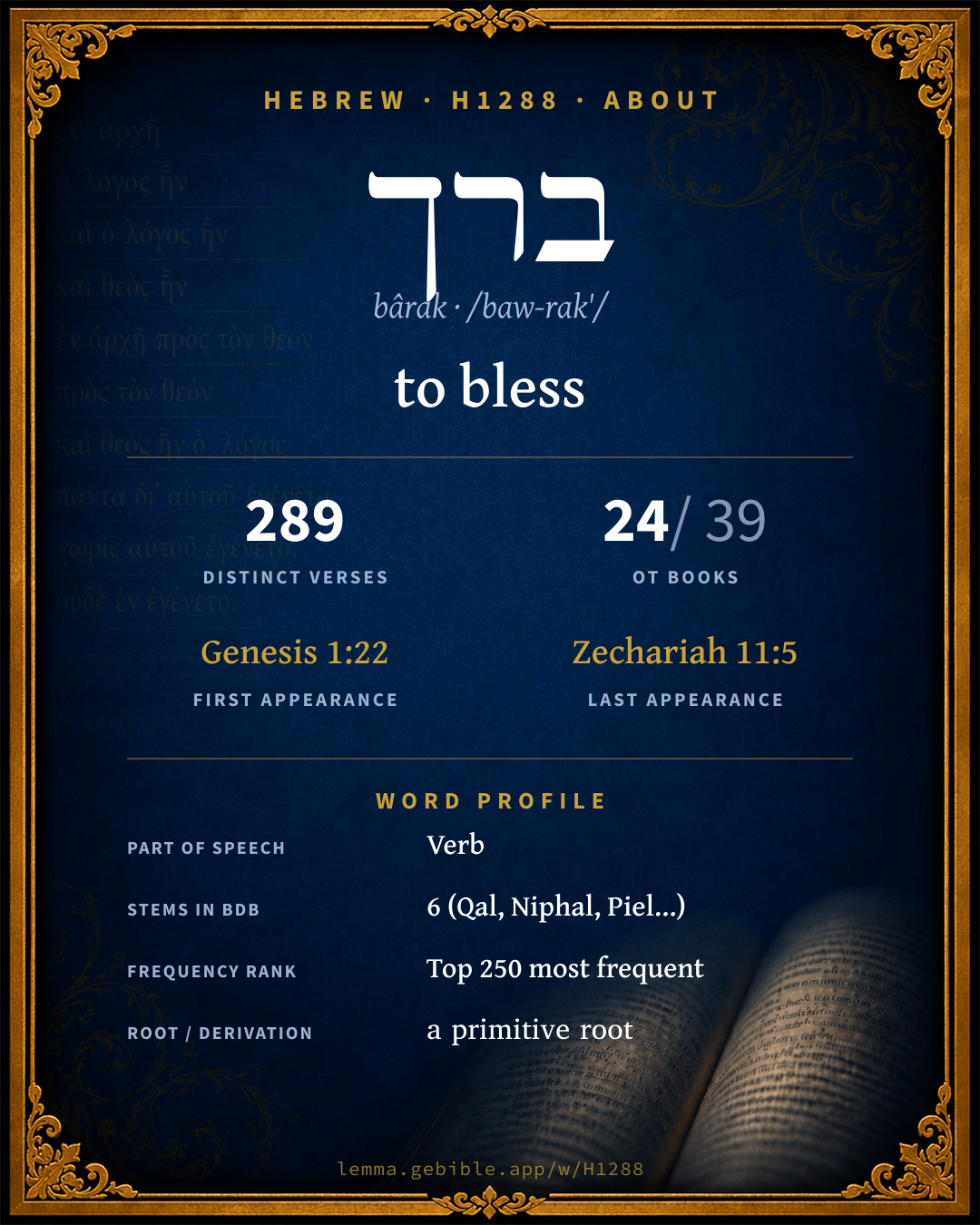
בָּרַךְ
to bless
‘to bless’ is one of 2 main senses fuller range ↓
Full lexicon entry — Brown-Driver-Briggs (BDB)
From Brown-Driver-Briggs (BDB)
Where this word appears
See every Piel verb in the Hebrew Bible →
Grammar key — what these labels mean
Part of speech
- Verb
- An action or state-of-being word.
Stem
- Qal
- The basic, simple active stem — the plain form of the verb (“he wrote”). Here: ‘kneel down’
- Piel
- An intensive or resultative active stem. Here: ‘bless God’
- Pual
- The passive counterpart of the Piel. Here: ‘to be blessed’
- Hithpael
- The reflexive or reciprocal stem (the subject acts on itself).
- Niphal
- Usually the simple passive or reflexive of the Qal (“he was written”).
- Hiphil
- The causative active stem (“he caused / brought about”).
Form
- Participle Passive
- A verbal adjective expressing action received (“written”).
- Sequential Imperfect
- An imperfect with prefixed waw — the standard past-narrative form (waw-consecutive imperfect).
- Imperfect
- An incomplete, ongoing, or future action (“he will / would write”).
- Imperative
- A direct command (“write!”).
- Perfect
- A completed action or state — Hebrew marks aspect (completeness) more than strict tense (“he wrote”).
- Infinitive Construct
- A bound verbal noun, frequently with prepositions (“to write / in writing”).
- Infinitive Absolute
- An unbound verbal noun, often intensifying or standing in for a finite verb.
- Sequential Perfect
- A perfect with prefixed waw continuing a preceding imperfect or command (waw-consecutive perfect).
- Participle Active
- A verbal adjective expressing ongoing or characteristic action (“writing / one who writes”).
- Cohortative
- A first-person volitional form expressing wish or resolve (“let me / let us write”).
- Jussive
- A third- or second-person volitional form expressing wish or command (“let him write”).
State
- Absolute
- The independent form of a noun, not bound to a following word.
- Construct
- A noun bound to a following noun in a possessive / “of” relationship (the construct chain).
Person
- 3rd Person
- The one spoken about (“he / she / it / they”).
- 2nd Person
- The one addressed (“you”).
- 1st Person
- The speaker (“I / we”).
Gender
- Masculine
- Grammatically masculine.
- Feminine
- Grammatically feminine.
- Common
- Either gender — not distinguished for this form.
Number
- Singular
- One.
- Plural
- More than one (in Hebrew, generally three or more).
Grammatical forms 49 distinct
- Verb, Qal, Participle Passive, Masculine, Singular, Absolute 63 times (19%)
- Verb, Piel, Sequential Imperfect, 3rd Person, Masculine, Singular 44 times (13%)
- Verb, Piel, Imperfect, 3rd Person, Masculine, Singular 33 times (10%)
- Verb, Piel, Perfect, 3rd Person, Masculine, Singular 24 times (7%)
- Verb, Piel, Imperative, 2nd Person, Masculine, Plural 18 times (5%)
- Verb, Piel, Infinitive Construct 17 times (5%)
- Verb, Piel, Imperfect, 1st Person, Common, Singular 12 times (4%)
- Verb, Piel, Infinitive Absolute 9 times (3%)
+41 more forms (110 occurrences)
Parsed forms decoded from the imported morphology (morphhb / Westminster Leningrad Codex — WLC text public domain, morphhb tagging CC BY 4.0), counted across 330 parsed occurrences — not distinct verses.
Page 1 of 2 — showing verses 1–200 of 289 distinct verses where H1288 appears, across 24 books. Click any verse to open its interlinear word-by-word view. Verse text shown in the World English Bible for context — . Each verse’s Hebrew form is shown with its reference; the English is not keyword-highlighted, since the data carries no word-level English alignment. Use “Compare translations” on any verse to read it across multiple English versions. This concordance covers the Hebrew Bible; Septuagint (Greek Old Testament) occurrences are not indexed here.
Genesis 62 verses
- Genesis 1:22 וַ/יְבָ֧רֶךְ conj + Piel wimpf 3ms God blessed them, saying, "Be fruitful, and multiply, and fill the waters in the seas, and let birds multiply on the earth."
- Genesis 1:28 וַ/יְבָ֣רֶךְ conj + Piel wimpf 3ms God blessed them. God said to them, "Be fruitful, multiply, fill the earth, and subdue it. Have dominion over the fish of the sea, over the birds of the sky, and over every living thing that moves on the earth."
- Genesis 2:3 וַ/יְבָ֤רֶךְ conj + Piel wimpf 3ms God blessed the seventh day, and made it holy, because he rested in it from all his work which he had created and made.
- Genesis 5:2 וַ/יְבָ֣רֶךְ conj + Piel wimpf 3ms He created them male and female, and blessed them, and called their name Adam, in the day when they were created.
- Genesis 9:1 וַ/יְבָ֣רֶךְ conj + Piel wimpf 3ms God blessed Noah and his sons, and said to them, "Be fruitful, and multiply, and replenish the earth.
- Genesis 9:26 בָּר֥וּךְ Qal ptcp.pass ms He said, "Blessed be Yahweh, the God of Shem; Let Canaan be his servant.
- Genesis 12:2 וַ/אֲבָ֣רֶכְ/ךָ֔ conj + Piel impf 1cs + sfx pers 2ms I will make of you a great nation. I will bless you, and make your name great. You will be a blessing.
- Genesis 12:3 וַ/אֲבָֽרֲכָה֙ מְבָ֣רְכֶ֔י/ךָ וְ/נִבְרְכ֣וּ conj + Piel impf 1cs Piel ptcp.act mp cs + sfx pers 2ms conj + Niphal pf 3cp I will bless those who bless you, and I will curse him who curses you. In you will all of the families of the earth be blessed."
- Genesis 14:19 וַֽ/יְבָרְכֵ֖/הוּ בָּר֤וּךְ conj + Piel wimpf 3ms + sfx pers 3ms Qal ptcp.pass ms He blessed him, and said, "Blessed be Abram of God Most High, possessor of heaven and earth:
- Genesis 14:20 וּ/בָרוּךְ֙ conj + Qal ptcp.pass ms and blessed be God Most High, who has delivered your enemies into your hand." Abram gave him a tenth of all.
- Genesis 17:16 וּ/בֵרַכְתִּ֣י וּ/בֵֽרַכְתִּ֨י/הָ֙ conj + Piel wpf 1cs conj + Piel wpf 1cs + sfx pers 3fs I will bless her, and moreover I will give you a son by her. Yes, I will bless her, and she will be a mother of nations. Kings of peoples will come from her."
- Genesis 17:20 בֵּרַ֣כְתִּי Piel pf 1cs As for Ishmael, I have heard you. Behold, I have blessed him, and will make him fruitful, and will multiply him exceedingly. He will become the father of twelve princes, and I will make him a great nation.
- Genesis 18:18 וְ/נִ֨בְרְכוּ conj + Niphal wpf 3cp seeing that Abraham has surely become a great and mighty nation, and all the nations of the earth will be blessed in him?
- Genesis 22:17 בָרֵ֣ךְ אֲבָרֶכְ/ךָ֗ Piel inf.abs Piel impf 1cs + sfx pers 2ms that in blessing I will bless you, and in multiplying I will multiply your seed as the stars of the heavens, and as the sand which is on the seashore. Your seed will possess the gate of his enemies.
- Genesis 22:18 וְ/הִתְבָּרֲכ֣וּ conj + Hithpael wpf 3cp In your seed will all the nations of the earth be blessed, because you have obeyed my voice."
- Genesis 24:1 בֵּרַ֥ךְ Piel pf 3ms Abraham was old, and well stricken in age. Yahweh had blessed Abraham in all things.
- Genesis 24:11 וַ/יַּבְרֵ֧ךְ conj + Hiphil wimpf 3ms He made the camels kneel down outside the city by the well of water at the time of evening, the time that women go out to draw water.
- Genesis 24:27 בָּר֤וּךְ Qal ptcp.pass ms He said, "Blessed be Yahweh, the God of my master Abraham, who has not forsaken his loving kindness and his truth toward my master. As for me, Yahweh has led me in the way to the house of my master's relatives."
- Genesis 24:31 בְּר֣וּךְ Qal ptcp.pass ms cs He said, "Come in, you blessed of Yahweh. Why do you stand outside? For I have prepared the house, and room for the camels."
- Genesis 24:35 בֵּרַ֧ךְ Piel pf 3ms Yahweh has blessed my master greatly. He has become great. He has given him flocks and herds, silver and gold, men-servants and maid-servants, and camels and donkeys.
- Genesis 24:48 וָ/אֲבָרֵ֗ךְ conj + Piel wimpf 1cs I bowed my head, and worshiped Yahweh, and blessed Yahweh, the God of my master Abraham, who had led me in the right way to take my master's brother's daughter for his son.
- Genesis 24:60 וַ/יְבָרֲכ֤וּ conj + Piel wimpf 3mp They blessed Rebekah, and said to her, "Our sister, may you be the mother of thousands of ten thousands, and let your seed possess the gate of those who hate them."
- Genesis 25:11 וַ/יְבָ֥רֶךְ conj + Piel wimpf 3ms It happened after the death of Abraham, that God blessed Isaac, his son. Isaac lived by Beer Lahai Roi.
- Genesis 26:3 וַ/אֲבָרְכֶ֑/ךָּ conj + Piel impf 1cs + sfx pers 2ms Sojourn in this land, and I will be with you, and will bless you. For to you, and to your seed, I will give all these lands, and I will establish the oath which I swore to Abraham your father.
- Genesis 26:4 וְ/הִתְבָּרֲכ֣וּ conj + Hithpael wpf 3cp I will multiply your seed as the stars of the sky, and will give to your seed all these lands. In your seed will all the nations of the earth be blessed,
- Genesis 26:12 וַֽ/יְבָרֲכֵ֖/הוּ conj + Piel wimpf 3ms + sfx pers 3ms Isaac sowed in that land, and reaped in the same year one hundred times what he planted. Yahweh blessed him.
- Genesis 26:24 וּ/בֵֽרַכְתִּ֨י/ךָ֙ conj + Piel wpf 1cs + sfx pers 2ms Yahweh appeared to him the same night, and said, "I am the God of Abraham your father. Don't be afraid, for I am with you, and will bless you, and multiply your seed for my servant Abraham's sake."
- Genesis 26:29 בְּר֥וּךְ Qal ptcp.pass ms cs that you will do us no harm, as we have not touched you, and as we have done to you nothing but good, and have sent you away in peace.' You are now the blessed of Yahweh."
- Genesis 27:4 תְּבָרֶכְ/ךָ֥ Piel impf 3fs + sfx pers 2ms Make me savory food, such as I love, and bring it to me, that I may eat, and that my soul may bless you before I die."
- Genesis 27:7 וַ/אֲבָרֶכְ/כָ֛ה conj + Piel coh 1cs + sfx pers 2ms 'Bring me venison, and make me savory food, that I may eat, and bless you before Yahweh before my death.'
- Genesis 27:10 יְבָרֶכְ/ךָ֖ Piel impf 3ms + sfx pers 2ms You shall bring it to your father, that he may eat, so that he may bless you before his death."
- Genesis 27:19 תְּבָרֲכַ֥/נִּי Piel impf 3fs + sfx pers 1cs Jacob said to his father, "I am Esau your firstborn. I have done what you asked me to do. Please arise, sit and eat of my venison, that your soul may bless me."
- Genesis 27:23 וַֽ/יְבָרְכֵֽ/הוּ conj + Piel wimpf 3ms + sfx pers 3ms He didn't recognize him, because his hands were hairy, like his brother, Esau's hands. So he blessed him.
- Genesis 27:25 תְּבָֽרֶכְ/ךָ֖ Piel impf 3fs + sfx pers 2ms He said, "Bring it near to me, and I will eat of my son's venison, that my soul may bless you." He brought it near to him, and he ate. He brought him wine, and he drank.
- Genesis 27:27 וַֽ/יְבָרֲכֵ֑/הוּ בֵּרֲכ֖/וֹ conj + Piel wimpf 3ms + sfx pers 3ms Piel pf 3ms + sfx pers 3ms He came near, and kissed him. He smelled the smell of his clothing, and blessed him, and said, "Behold, the smell of my son Is as the smell of a field which Yahweh has blessed.
- Genesis 27:29 וּֽ/מְבָרֲכֶ֖י/ךָ בָּרֽוּךְ conj + Piel ptcp.act mp cs + sfx pers 2ms Qal ptcp.pass ms Let peoples serve you, Nations bow down to you. Be lord over your brothers, Let your mother's sons bow down to you. Cursed be everyone who curses you, Blessed be everyone who blesses you."
- Genesis 27:30 לְ/בָרֵ֣ךְ prep + Piel inf.cs It happened, as soon as Isaac had made an end of blessing Jacob, and Jacob had just gone out from the presence of Isaac his father, that Esau his brother came in from his hunting.
- Genesis 27:31 תְּבָרֲכַ֥/נִּי Piel impf 3fs + sfx pers 1cs He also made savory food, and brought it to his father. He said to his father, "Let my father arise, and eat of his son's venison, that your soul may bless me."
- Genesis 27:33 וָ/אֲבָרֲכֵ֑/הוּ בָּר֖וּךְ conj + Piel wimpf 1cs + sfx pers 3ms Qal ptcp.pass ms Isaac trembled violently, and said, "Who, then, is he who has taken venison, and brought it me, and I have eaten of all before you came, and have blessed him? Yes, he will be blessed."
- Genesis 27:34 בָּרֲכֵ֥/נִי Piel impv 2ms + sfx pers 1cs When Esau heard the words of his father, he cried with an exceeding great and bitter cry, and said to his father, "Bless me, even me also, my father."
- Genesis 27:38 בָּרֲכֵ֥/נִי Piel impv 2ms + sfx pers 1cs Esau said to his father, "Have you but one blessing, my father? Bless me, even me also, my father." Esau lifted up his voice, and wept.
- Genesis 27:41 בֵּרֲכ֖/וֹ Piel pf 3ms + sfx pers 3ms Esau hated Jacob because of the blessing with which his father blessed him. Esau said in his heart, "The days of mourning for my father are at hand. Then I will kill my brother Jacob."
- Genesis 28:1 וַ/יְבָ֣רֶךְ conj + Piel wimpf 3ms Isaac called Jacob, blessed him, and commanded him, "You shall not take a wife of the daughters of Canaan.
- Genesis 28:3 יְבָרֵ֣ךְ Piel juss 3ms May God Almighty bless you, and make you fruitful, and multiply you, that you may be a company of peoples,
- Genesis 28:6 בֵרַ֣ךְ בְּ/בָרֲכ֣/וֹ Piel pf 3ms prep + Piel inf.cs + sfx pers 3ms Now Esau saw that Isaac had blessed Jacob and sent him away to Paddan Aram, to take him a wife from there, and that as he blessed him he gave him a charge, saying, "You shall not take a wife of the daughters of Canaan,"
- Genesis 28:14 וְ/נִבְרֲכ֥וּ conj + Niphal pf 3cp Your seed will be as the dust of the earth, and you will spread abroad to the west, and to the east, and to the north, and to the south. In you and in your seed will all the families of the earth be blessed.
- Genesis 30:27 וַ/יְבָרֲכֵ֥/נִי conj + Piel wimpf 3ms + sfx pers 1cs Laban said to him, "If now I have found favor in your eyes, stay here, for I have divined that Yahweh has blessed me for your sake."
- Genesis 30:30 וַ/יְבָ֧רֶךְ conj + Piel wimpf 3ms For it was little which you had before I came, and it has increased to a multitude. Yahweh has blessed you wherever I turned. Now when will I provide for my own house also?"
- Genesis 31:55 וַ/יְבָ֣רֶךְ conj + Piel wimpf 3ms Early in the morning, Laban rose up, and kissed his sons and his daughters, and blessed them. Laban departed and returned to his place.
- Genesis 32:26 בֵּרַכְתָּֽ/נִי Piel pf 2ms + sfx pers 1cs The man said, "Let me go, for the day breaks." Jacob said, "I won't let you go, unless you bless me."
- Genesis 32:29 וַ/יְבָ֥רֶךְ conj + Piel wimpf 3ms Jacob asked him, "Please tell me your name." He said, "Why is it that you ask what my name is?" He blessed him there.
- Genesis 35:9 וַ/יְבָ֖רֶךְ conj + Piel wimpf 3ms God appeared to Jacob again, when he came from Paddan Aram, and blessed him.
- Genesis 39:5 וַ/יְבָ֧רֶךְ conj + Piel wimpf 3ms It happened from the time that he made him overseer in his house, and over all that he had, that Yahweh blessed the Egyptian's house for Joseph's sake; and the blessing of Yahweh was on all that he had, in the house and in the field.
- Genesis 47:7 וַ/יְבָ֥רֶךְ conj + Piel wimpf 3ms Joseph brought in Jacob, his father, and set him before Pharaoh, and Jacob blessed Pharaoh.
- Genesis 47:10 וַ/יְבָ֥רֶךְ conj + Piel wimpf 3ms Jacob blessed Pharaoh, and went out from the presence of Pharaoh.
- Genesis 48:3 וַ/יְבָ֖רֶךְ conj + Piel wimpf 3ms Jacob said to Joseph, "God Almighty appeared to me at Luz in the land of Canaan, and blessed me,
- Genesis 48:9 וַ/אֲבָרֲכֵֽ/ם conj + Piel impf 1cs + sfx pers 3mp Joseph said to his father, "They are my sons, whom God has given me here." He said, "Please bring them to me, and I will bless them."
- Genesis 48:15 וַ/יְבָ֥רֶךְ conj + Piel wimpf 3ms He blessed Joseph, and said, "The God before whom my fathers Abraham and Isaac did walk, the God who has fed me all my life long to this day,
- Genesis 48:16 יְבָרֵךְ֮ Piel impf 3ms the angel who has redeemed me from all evil, bless the lads, and let my name be named on them, and the name of my fathers Abraham and Isaac. Let them grow into a multitude in the midst of the earth."
- Genesis 48:20 וַ/יְבָ֨רֲכֵ֜/ם יְבָרֵ֤ךְ conj + Piel wimpf 3ms + sfx pers 3mp Piel impf 3ms He blessed them that day, saying, "In you will Israel bless, saying, 'God make you as Ephraim and as Manasseh'" He set Ephraim before Manasseh.
- Genesis 49:25 וִ/יבָ֣רְכֶ֔/ךָּ conj + Piel impf 3ms + sfx pers 2ms Even by the God of your father, who will help you, By the Almighty, who will bless you, With blessings of heaven above, Blessings of the deep that lies below, Blessings of the breasts, and of the womb.
- Genesis 49:28 וַ/יְבָ֣רֶךְ בֵּרַ֥ךְ conj + Piel wimpf 3ms Piel pf 3ms All these are the twelve tribes of Israel, and this is what their father spoke to them and blessed them. He blessed everyone according to his blessing.
Exodus 6 verses
- Exodus 12:32 וּ/בֵֽרַכְתֶּ֖ם conj + Piel wpf 2mp Take both your flocks and your herds, as you have said, and be gone; and bless me also!"
- Exodus 18:10 בָּר֣וּךְ Qal ptcp.pass ms Jethro said, "Blessed be Yahweh, who has delivered you out of the hand of the Egyptians, and out of the hand of Pharaoh; who has delivered the people from under the hand of the Egyptians.
- Exodus 20:11 בֵּרַ֧ךְ Piel pf 3ms for in six days Yahweh made heaven and earth, the sea, and all that is in them, and rested the seventh day; therefore Yahweh blessed the Sabbath day, and made it holy.
- Exodus 20:24 וּ/בֵרַכְתִּֽי/ךָ conj + Piel wpf 1cs + sfx pers 2ms You shall make an altar of earth for me, and shall sacrifice on it your burnt offerings and your peace-offerings, your sheep and your oxen. In every place where I record my name I will come to you and I will bless you.
- Exodus 23:25 וּ/בֵרַ֥ךְ conj + Piel wpf 3ms You shall serve Yahweh your God, and he will bless your bread and your water, and I will take sickness away from your midst.
- Exodus 39:43 וַ/יְבָ֥רֶךְ conj + Piel wimpf 3ms Moses saw all the work, and, behold, they had done it as Yahweh had commanded, even so had they done it: and Moses blessed them.
Leviticus 2 verses
- Leviticus 9:22 וַֽ/יְבָרְכֵ֑/ם conj + Piel wimpf 3ms + sfx pers 3mp Aaron lifted up his hands toward the people, and blessed them; and he came down from offering the sin offering, and the burnt offering, and the peace offerings.
- Leviticus 9:23 וַֽ/יְבָרֲכ֖וּ conj + Piel wimpf 3mp Moses and Aaron went into the Tent of Meeting, and came out, and blessed the people: and the glory of Yahweh appeared to all the people.
Numbers 11 verses
- Numbers 6:23 תְבָרֲכ֖וּ Piel impf 2mp "Speak to Aaron and to his sons, saying, 'This is how you shall bless the children of Israel.' You shall tell them,
- Numbers 6:24 יְבָרֶכְ/ךָ֥ Piel juss 3ms + sfx pers 2ms 'Yahweh bless you, and keep you.
- Numbers 6:27 אֲבָרֲכֵֽ/ם Piel impf 1cs + sfx pers 3mp "So they shall put my name on the children of Israel; and I will bless them."
- Numbers 22:6 תְּבָרֵךְ֙ מְבֹרָ֔ךְ Piel impf 2ms Pual ptcp.pass ms Please come now therefore curse me this people; for they are too mighty for me: peradventure I shall prevail, that we may strike them, and that I may drive them out of the land; for I know that he whom you bless is blessed, and he whom you curse is cursed.
- Numbers 22:12 בָר֖וּךְ Qal ptcp.pass ms God said to Balaam, You shall not go with them; you shall not curse the people; for they are blessed.
- Numbers 23:11 בֵּרַ֥כְתָּ בָרֵֽךְ Piel pf 2ms Piel inf.abs Balak said to Balaam, What have you done to me? I took you to curse my enemies, and, behold, you have blessed them altogether.
- Numbers 23:20 בָרֵ֖ךְ וּ/בֵרֵ֖ךְ Piel inf.abs conj + Piel pf 3ms Behold, I have received [commandment] to bless: He has blessed, and I can't reverse it.
- Numbers 23:25 בָּרֵ֖ךְ תְבָרֲכֶֽ/נּוּ Piel inf.abs Piel impf 2ms + sfx pers 3ms Balak said to Balaam, Neither curse them at all, nor bless them at all.
- Numbers 24:1 לְ/בָרֵ֣ךְ prep + Piel inf.cs When Balaam saw that it pleased Yahweh to bless Israel, he didn't go, as at the other times, to meet with enchantments, but he set his face toward the wilderness.
- Numbers 24:9 מְבָרֲכֶ֣י/ךָ בָר֔וּךְ Piel ptcp.act mp cs + sfx pers 2ms Qal ptcp.pass ms He couched, he lay down as a lion, As a lioness; who shall rouse him up? Blessed be everyone who blesses you, Cursed be everyone who curses you.
- Numbers 24:10 בֵּרַ֣כְתָּ בָרֵ֔ךְ Piel pf 2ms Piel inf.abs Balak's anger was kindled against Balaam, and he struck his hands together; and Balak said to Balaam, I called you to curse my enemies, and, behold, you have altogether blessed them these three times.
Deuteronomy 35 verses
- Deuteronomy 1:11 וִ/יבָרֵ֣ךְ conj + Piel impf 3ms Yahweh, the God of your fathers, make you a thousand times as many as you are, and bless you, as he has promised you!
- Deuteronomy 2:7 בֵּֽרַכְ/ךָ֗ Piel pf 3ms + sfx pers 2ms For Yahweh your God has blessed you in all the work of your hand; he has known your walking through this great wilderness: these forty years Yahweh your God has been with you; you have lacked nothing.
- Deuteronomy 7:13 וּ/בֵרַכְ/ךָ֖ וּ/בֵרַ֣ךְ conj + Piel wpf 3ms + sfx pers 2ms conj + Piel wpf 3ms and he will love you, and bless you, and multiply you; he will also bless the fruit of your body and the fruit of your ground, your grain and your new wine and your oil, the increase of your cattle and the young of your flock, in the land which he swore to your fathers to give you.
- Deuteronomy 7:14 בָּר֥וּךְ Qal ptcp.pass ms You shall be blessed above all peoples: there shall not be male or female barren among you, or among your cattle.
- Deuteronomy 8:10 וּ/בֵֽרַכְתָּ֙ conj + Piel wpf 2ms You shall eat and be full, and you shall bless Yahweh your God for the good land which he has given you.
- Deuteronomy 10:8 וּ/לְ/בָרֵ֣ךְ conj + prep + Piel inf.cs At that time Yahweh set apart the tribe of Levi, to bear the ark of the covenant of Yahweh, to stand before Yahweh to minister to him, and to bless in his name, to this day.
- Deuteronomy 12:7 בֵּֽרַכְ/ךָ֖ Piel pf 3ms + sfx pers 2ms and there you shall eat before Yahweh your God, and you shall rejoice in all that you put your hand to, you and your households, in which Yahweh your God has blessed you.
- Deuteronomy 14:24 יְבָרֶכְ/ךָ֖ Piel impf 3ms + sfx pers 2ms If the way be too long for you, so that you are not able to carry it, because the place is too far from you, which Yahweh your God shall choose, to set his name there, when Yahweh your God shall bless you;
- Deuteronomy 14:29 יְבָרֶכְ/ךָ֙ Piel impf 3ms + sfx pers 2ms and the Levite, because he has no portion nor inheritance with you, and the foreigner living among you, and the fatherless, and the widow, who are within your gates, shall come, and shall eat and be satisfied; that Yahweh your God may bless you in all the work of your hand which you do.
- Deuteronomy 15:4 בָרֵ֤ךְ יְבָֽרֶכְ/ךָ֙ Piel inf.abs Piel impf 3ms + sfx pers 2ms However there shall be no poor with you; (for Yahweh will surely bless you in the land which Yahweh your God gives you for an inheritance to possess it;)
- Deuteronomy 15:6 בֵּֽרַכְ/ךָ֔ Piel pf 3ms + sfx pers 2ms For Yahweh your God will bless you, as he promised you: and you shall lend to many nations, but you shall not borrow; and you shall rule over many nations, but they shall not rule over you.
- Deuteronomy 15:10 יְבָרֶכְ/ךָ֙ Piel impf 3ms + sfx pers 2ms You shall surely give him, and your heart shall not be grieved when you give to him; because that for this thing Yahweh your God will bless you in all your work, and in all that you put your hand to.
- Deuteronomy 15:14 בֵּרַכְ/ךָ֛ Piel pf 3ms + sfx pers 2ms you shall furnish him liberally out of your flock, and out of your threshing floor, and out of your winepress; as Yahweh your God has blessed you, you shall give to him.
- Deuteronomy 15:18 וּ/בֵֽרַכְ/ךָ֙ conj + Piel wpf 3ms + sfx pers 2ms It shall not seem hard to you, when you let him go free from you; for to the double of the hire of a hireling has he served you six years: and Yahweh your God will bless you in all that you do.
- Deuteronomy 16:10 יְבָרֶכְ/ךָ֖ Piel impf 3ms + sfx pers 2ms You shall keep the feast of weeks to Yahweh your God with a tribute of a freewill-offering of your hand, which you shall give, according as Yahweh your God blesses you:
- Deuteronomy 16:15 יְבָרֶכְ/ךָ֞ Piel impf 3ms + sfx pers 2ms Seven days shall you keep a feast to Yahweh your God in the place which Yahweh shall choose; because Yahweh your God will bless you in all your increase, and in all the work of your hands, and you shall be altogether joyful.
- Deuteronomy 21:5 וּ/לְ/בָרֵ֖ךְ conj + prep + Piel inf.cs The priests the sons of Levi shall come near; for them Yahweh your God has chosen to minister to him, and to bless in the name of Yahweh; and according to their word shall every controversy and every stroke be.
- Deuteronomy 23:20 יְבָרֶכְ/ךָ֜ Piel impf 3ms + sfx pers 2ms to a foreigner you may lend on interest; but to your brother you shall not lend on interest, that Yahweh your God may bless you in all that you put your hand to, in the land where you go in to possess it.
- Deuteronomy 24:13 וּ/בֵֽרֲכֶ֑/ךָּ conj + Piel wpf 3ms + sfx pers 2ms you shall surely restore to him the pledge when the sun goes down, that he may sleep in his garment, and bless you: and it shall be righteousness to you before Yahweh your God.
- Deuteronomy 24:19 יְבָרֶכְ/ךָ֙ Piel impf 3ms + sfx pers 2ms When you reap your harvest in your field, and have forgot a sheaf in the field, you shall not go again to get it: it shall be for the foreigner, for the fatherless, and for the widow; that Yahweh your God may bless you in all the work of your hands.
- Deuteronomy 26:15 וּ/בָרֵ֤ךְ conj + Piel impv 2ms Look down from your holy habitation, from heaven, and bless your people Israel, and the ground which you have given us, as you swore to our fathers, a land flowing with milk and honey.
- Deuteronomy 27:12 לְ/בָרֵ֤ךְ prep + Piel inf.cs These shall stand on Mount Gerizim to bless the people, when you are passed over the Jordan: Simeon, and Levi, and Judah, and Issachar, and Joseph, and Benjamin.
- Deuteronomy 28:3 בָּר֥וּךְ וּ/בָר֥וּךְ Qal ptcp.pass ms conj + Qal ptcp.pass ms Blessed shall you be in the city, and blessed shall you be in the field.
- Deuteronomy 28:4 בָּר֧וּךְ Qal ptcp.pass ms Blessed shall be the fruit of your body, and the fruit of your ground, and the fruit of your animals, the increase of your cattle, and the young of your flock.
- Deuteronomy 28:5 בָּר֥וּךְ Qal ptcp.pass ms Blessed shall be your basket and your kneading-trough.
- Deuteronomy 28:6 בָּר֥וּךְ וּ/בָר֥וּךְ Qal ptcp.pass ms conj + Qal ptcp.pass ms Blessed shall you be when you come in, and blessed shall you be when you go out.
- Deuteronomy 28:8 וּ/בֵ֣רַכְ/ךָ֔ conj + Piel wpf 3ms + sfx pers 2ms Yahweh will command the blessing on you in your barns, and in all that you put your hand to; and he will bless you in the land which Yahweh your God gives you.
- Deuteronomy 28:12 וּ/לְ/בָרֵ֕ךְ conj + prep + Piel inf.cs Yahweh will open to you his good treasure in the sky, to give the rain of your land in its season, and to bless all the work of your hand: and you shall lend to many nations, and you shall not borrow.
- Deuteronomy 29:19 וְ/הִתְבָּרֵ֨ךְ conj + Hithpael wpf 3ms and it happen, when he hears the words of this curse, that he bless himself in his heart, saying, I shall have peace, though I walk in the stubbornness of my heart, to destroy the moist with the dry.
- Deuteronomy 30:16 וּ/בֵֽרַכְ/ךָ֙ conj + Piel wpf 3ms + sfx pers 2ms in that I command you this day to love Yahweh your God, to walk in his ways, and to keep his commandments and his statutes and his ordinances, that you may live and multiply, and that Yahweh your God may bless you in the land where you go in to possess it.
- Deuteronomy 33:1 בֵּרַ֥ךְ Piel pf 3ms This is the blessing, with which Moses the man of God blessed the children of Israel before his death.
- Deuteronomy 33:11 בָּרֵ֤ךְ Piel impv 2ms Bless, Yahweh, his substance, Accept the work of his hands: Smite through the loins of those who rise up against him, Of those who hate him, that they not rise again.
- Deuteronomy 33:13 מְבֹרֶ֥כֶת Pual ptcp.pass fs cs Of Joseph he said, Blessed of Yahweh be his land, For the precious things of the heavens, for the dew, For the deep that couches beneath,
- Deuteronomy 33:20 בָּר֖וּךְ Qal ptcp.pass ms Of Gad he said, Blessed be he who enlarges Gad: He dwells as a lioness, Tears the arm, yes, the crown of the head.
- Deuteronomy 33:24 בָּר֥וּךְ Qal ptcp.pass ms Of Asher he said, Blessed be Asher with children; Let him be acceptable to his brothers, Let him dip his foot in oil.
Joshua 7 verses
- Joshua 8:33 לְ/בָרֵ֛ךְ prep + Piel inf.cs All Israel, and their elders and officers, and their judges, stood on this side of the ark and on that side before the priests the Levites, who bore the ark of the covenant of Yahweh, as well the foreigner as the native; half of them in front of Mount Gerizim, and half of them in front of Mount Ebal; as Moses the servant of Yahweh had commanded at the first, that they should bless the people of Israel.
- Joshua 14:13 וַֽ/יְבָרְכֵ֖/הוּ conj + Piel wimpf 3ms + sfx pers 3ms Joshua blessed him; and he gave Hebron to Caleb the son of Jephunneh for an inheritance.
- Joshua 17:14 בֵּֽרְכַ֥/נִי Piel pf 3ms + sfx pers 1cs The children of Joseph spoke to Joshua, saying, Why have you given me but one lot and one part for an inheritance, seeing I am a great people, because hitherto Yahweh has blessed me?
- Joshua 22:6 וַֽ/יְבָרְכֵ֖/ם conj + Piel wimpf 3ms + sfx pers 3mp So Joshua blessed them, and sent them away; and they went to their tents.
- Joshua 22:7 וַ/יְבָרֲכֵֽ/ם conj + Piel wimpf 3ms + sfx pers 3mp Now to the one half-tribe of Manasseh Moses had given [inheritance] in Bashan; but to the other half gave Joshua among their brothers beyond the Jordan westward; moreover when Joshua sent them away to their tents, he blessed them,
- Joshua 22:33 וַ/יְבָרֲכ֥וּ conj + Piel wimpf 3mp The thing pleased the children of Israel; and the children of Israel blessed God, and spoke no more of going up against them to war, to destroy the land in which the children of Reuben and the children of Gad lived.
- Joshua 24:10 וַ/יְבָ֤רֶךְ בָּרוֹךְ֙ conj + Piel wimpf 3ms Piel inf.abs but I would not listen to Balaam; therefore he blessed you still: so I delivered you out of his hand.
Judges 5 verses
- Judges 5:2 בָּרֲכ֖וּ Piel impv 2mp For that the leaders took the lead in Israel, For that the people offered themselves willingly, Bless you Yahweh.
- Judges 5:9 בָּרֲכ֖וּ Piel impv 2mp My heart is toward the governors of Israel, Who offered themselves willingly among the people: Bless you Yahweh.
- Judges 5:24 תְּבֹרַךְ֙ תְּבֹרָֽךְ Pual impf 3fs Pual impf 3fs Blessed above women shall Jael be, The wife of Heber the Kenite; Blessed shall she be above women in the tent.
- Judges 13:24 וַֽ/יְבָרְכֵ֖/הוּ conj + Piel wimpf 3ms + sfx pers 3ms The woman bore a son, and named him Samson: and the child grew, and Yahweh blessed him.
- Judges 17:2 בָּר֥וּךְ Qal ptcp.pass ms He said to his mother, The eleven hundred [pieces] of silver that were taken from you, about which you did utter a curse, and did also speak it in my ears, behold, the silver is with me; I took it. His mother said, Blessed be my son of Yahweh.
Ruth 5 verses
- Ruth 2:4 יְבָרֶכְ/ךָ֥ Piel impf 3ms + sfx pers 2ms Behold, Boaz came from Bethlehem, and said to the reapers, Yahweh be with you. They answered him, Yahweh bless you.
- Ruth 2:19 בָּר֑וּךְ Qal ptcp.pass ms Her mother-in-law said to her, Where have you gleaned today? and where have you worked? blessed be he who did take knowledge of you. She shown her mother-in-law with whom she had worked, and said, The man's name with whom I worked today is Boaz.
- Ruth 2:20 בָּר֥וּךְ Qal ptcp.pass ms Naomi said to her daughter-in-law, Blessed be he of Yahweh, who has not left off his kindness to the living and to the dead. Naomi said to her, The man is a close relative to us, one of our near kinsmen.
- Ruth 3:10 בְּרוּכָ֨ה Qal ptcp.pass fs He said, Blessed are you by Yahweh, my daughter: you have shown more kindness in the latter end than at the beginning, inasmuch as you didn't follow young men, whether poor or rich.
- Ruth 4:14 בָּר֣וּךְ Qal ptcp.pass ms The women said to Naomi, Blessed be Yahweh, who has not left you this day without a near kinsman; and let his name be famous in Israel.
1 Samuel 10 verses
- 1 Samuel 2:20 וּ/בֵרַ֨ךְ conj + Piel wpf 3ms Eli blessed Elkanah and his wife, and said, Yahweh give you seed of this woman for the petition which was asked of Yahweh. They went to their own home.
- 1 Samuel 9:13 יְבָרֵ֣ךְ Piel impf 3ms as soon as you are come into the city, you shall immediately find him, before he goes up to the high place to eat; for the people will not eat until he come, because he does bless the sacrifice; [and] afterwards they eat who are invited. Now therefore get you up; for at this time you shall find him.
- 1 Samuel 13:10 לְ/בָרֲכֽ/וֹ prep + Piel inf.cs + sfx pers 3ms It came to pass that as soon as he had made an end of offering the burnt offering, behold, Samuel came; and Saul went out to meet him, that he might greet him.
- 1 Samuel 15:13 בָּר֤וּךְ Qal ptcp.pass ms Samuel came to Saul; and Saul said to him, Blessed are you by Yahweh: I have performed the commandment of Yahweh.
- 1 Samuel 23:21 בְּרוּכִ֥ים Qal ptcp.pass mp Saul said, Blessed be you of Yahweh; for you have had compassion on me.
- 1 Samuel 25:14 לְ/בָרֵ֥ךְ prep + Piel inf.cs But one of the young men told Abigail, Nabal's wife, saying, Behold, David sent messengers out of the wilderness to Greet our master; and he railed at them.
- 1 Samuel 25:32 בָּר֤וּךְ Qal ptcp.pass ms David said to Abigail, Blessed be Yahweh, the God of Israel, who sent you this day to meet me:
- 1 Samuel 25:33 וּ/בָר֥וּךְ וּ/בְרוּכָ֣ה conj + Qal ptcp.pass ms conj + Qal ptcp.pass fs and blessed be your discretion, and blessed be you, that have kept me this day from blood guiltiness, and from avenging myself with my own hand.
- 1 Samuel 25:39 בָּר֣וּךְ Qal ptcp.pass ms When David heard that Nabal was dead, he said, Blessed be Yahweh, who has pleaded the cause of my reproach from the hand of Nabal, and has kept back his servant from evil: and the evil-doing of Nabal has Yahweh returned on his own head. David sent and spoke concerning Abigail, to take her to him as wife.
- 1 Samuel 26:25 בָּר֤וּךְ Qal ptcp.pass ms Then Saul said to David, Blessed be you, my son David: you shall both do mightily, and shall surely prevail. So David went his way, and Saul returned to his place.
2 Samuel 13 verses
- 2 Samuel 2:5 בְּרֻכִ֤ים Qal ptcp.pass mp David sent messengers to the men of Jabesh Gilead, and said to them, Blessed be you of Yahweh, that you have shown this kindness to your lord, even to Saul, and have buried him.
- 2 Samuel 6:11 וַ/יְבָ֧רֶךְ conj + Piel wimpf 3ms The ark of Yahweh remained in the house of Obed-edom the Gittite three months: and Yahweh blessed Obed-edom, and all his house.
- 2 Samuel 6:12 בֵּרַ֣ךְ Piel pf 3ms It was told king David, saying, Yahweh has blessed the house of Obed-edom, and all that pertains to him, because of the ark of God. David went and brought up the ark of God from the house of Obed-edom into the city of David with joy.
- 2 Samuel 6:18 וַ/יְבָ֣רֶךְ conj + Piel wimpf 3ms When David had made an end of offering the burnt offering and the peace-offerings, he blessed the people in the name of Yahweh of Hosts.
- 2 Samuel 6:20 לְ/בָרֵ֣ךְ prep + Piel inf.cs Then David returned to bless his household. Michal the daughter of Saul came out to meet David, and said, How glorious was the king of Israel today, who uncovered himself today in the eyes of the handmaids of his servants, as one of the vain fellows shamelessly uncovers himself!
- 2 Samuel 7:29 וּ/בָרֵךְ֙ יְבֹרַ֥ךְ conj + Piel impv 2ms Pual impf 3ms now therefore let it please you to bless the house of your servant, that it may continue forever before you; for you, Lord Yahweh, have spoken it: and with your blessing let the house of your servant be blessed forever.
- 2 Samuel 8:10 וּֽ/לְ/בָרֲכ֗/וֹ conj + prep + Piel inf.cs + sfx pers 3ms then Toi sent Joram his son to king David, to Greet him, and to bless him, because he had fought against Hadadezer and struck him: for Hadadezer had wars with Toi. [Joram] brought with him vessels of silver, and vessels of gold, and vessels of brass:
- 2 Samuel 13:25 וַֽ/יְבָרֲכֵֽ/הוּ conj + Piel wimpf 3ms + sfx pers 3ms The king said to Absalom, No, my son, let us not all go, lest we be burdensome to you. He pressed him: however he would not go, but blessed him.
- 2 Samuel 14:22 וַ/יְבָ֣רֶךְ conj + Piel wimpf 3ms Joab fell to the ground on his face, and did obeisance, and blessed the king: and Joab said, Today your servant knows that I have found favor in your sight, my lord, king, in that the king has performed the request of his servant.
- 2 Samuel 18:28 בָּרוּךְ֙ Qal ptcp.pass ms Ahimaaz called, and said to the king, All is well. He bowed himself before the king with his face to the earth, and said, Blessed be Yahweh your God, who has delivered up the men who lifted up their hand against my lord the king.
- 2 Samuel 19:39 וַ/יְבָ֣רֲכֵ֔/הוּ conj + Piel wimpf 3ms + sfx pers 3ms All the people went over the Jordan, and the king went over: and the king kissed Barzillai, and blessed him; and he returned to his own place.
- 2 Samuel 21:3 וּ/בָרְכ֖וּ conj + Piel impv 2mp and David said to the Gibeonites, What shall I do for you? And with what shall I make atonement, that you may bless the inheritance of Yahweh?
- 2 Samuel 22:47 וּ/בָר֣וּךְ conj + Qal ptcp.pass ms Yahweh lives; Blessed be my rock; Exalted be God, the rock of my salvation,
1 Kings 12 verses
- 1 Kings 1:47 לְ֠/בָרֵךְ prep + Piel inf.cs Moreover the king's servants came to bless our lord king David, saying, Your God make the name of Solomon better than your name, and make his throne greater than your throne: and the king bowed himself on the bed.
- 1 Kings 1:48 בָּר֨וּךְ Qal ptcp.pass ms Also thus said the king, Blessed be Yahweh, the God of Israel, who has given one to sit on my throne this day, my eyes even seeing it.
- 1 Kings 2:45 בָּר֑וּךְ Qal ptcp.pass ms But king Solomon shall be blessed, and the throne of David shall be established before Yahweh forever.
- 1 Kings 5:7 בָּר֤וּךְ Qal ptcp.pass ms It happened, when Hiram heard the words of Solomon, that he rejoiced greatly, and said, Blessed be Yahweh this day, who has given to David a wise son over this great people.
- 1 Kings 8:14 וַ/יְבָ֕רֶךְ conj + Piel wimpf 3ms The king turned his face about, and blessed all the assembly of Israel: and all the assembly of Israel stood.
- 1 Kings 8:15 בָּר֤וּךְ Qal ptcp.pass ms He said, Blessed be Yahweh, the God of Israel, who spoke with his mouth to David your father, and has with his hand fulfilled it, saying,
- 1 Kings 8:55 וַ/יְבָ֕רֶךְ conj + Piel wimpf 3ms He stood, and blessed all the assembly of Israel with a loud voice, saying,
- 1 Kings 8:56 בָּר֣וּךְ Qal ptcp.pass ms Blessed be Yahweh, who has given rest to his people Israel, according to all that he promised: there has not failed one word of all his good promise, which he promised by Moses his servant.
- 1 Kings 8:66 וַֽ/יְבָרֲכ֖וּ conj + Piel wimpf 3mp On the eighth day he sent the people away; and they blessed the king, and went to their tents joyful and glad of heart for all the goodness that Yahweh had shown to David his servant, and to Israel his people.
- 1 Kings 10:9 בָּר֔וּךְ Qal ptcp.pass ms Blessed be Yahweh your God, who delighted in you, to set you on the throne of Israel: because Yahweh loved Israel forever, therefore made he you king, to do justice and righteousness.
- 1 Kings 21:10 בֵּרַ֥כְתָּ Piel pf 2ms and set two men, base fellows, before him, and let them testify against him, saying, You did curse God and the king. Then carry him out, and stone him to death.
- 1 Kings 21:13 בֵּרַ֥ךְ Piel pf 3ms The two men, the base fellows, came in and sat before him: and the base fellows bore witness against him, even against Naboth, in the presence of the people, saying, Naboth did curse God and the king. Then they carried him forth out of the city, and stoned him to death with stones.
2 Kings 2 verses
- 2 Kings 4:29 תְבָרְכֶ֔/נּוּ יְבָרֶכְ/ךָ֥ Piel impf 2ms + sfx pers 1cp Piel impf 3ms + sfx pers 2ms Then he said to Gehazi, Gird up your loins, and take my staff in your hand, and go your way: if you meet any man, Don't greet him; and if anyone greets you, don't answer him again: and lay my staff on the face of the child.
- 2 Kings 10:15 וַֽ/יְבָרְכֵ֗/הוּ conj + Piel wimpf 3ms + sfx pers 3ms When he was departed there, he lighted on Jehonadab the son of Rechab coming to meet him; and he greeted him, and said to him, Is your heart right, as my heart is with your heart? Jehonadab answered, It is. If it be, give me your hand. He gave him his hand; and he took him up to him into the chariot.
1 Chronicles 11 verses
- 1 Chronicles 4:10 בָּרֵ֨ךְ תְּבָרֲכֵ֜/נִי Piel inf.abs Piel impf 2ms + sfx pers 1cs Jabez called on the God of Israel, saying, Oh that you would bless me indeed, and enlarge my border, and that your hand might be with me, and that you would keep me from evil, that it not be to my sorrow! God granted him that which he requested.
- 1 Chronicles 13:14 וַ/יְבָ֧רֶךְ conj + Piel wimpf 3ms The ark of God remained with the family of Obed-edom in his house three months: and Yahweh blessed the house of Obed-edom, and all that he had.
- 1 Chronicles 16:2 וַ/יְבָ֥רֶךְ conj + Piel wimpf 3ms When David had made an end of offering the burnt offering and the peace-offerings, he blessed the people in the name of Yahweh.
- 1 Chronicles 16:36 בָּר֤וּךְ Qal ptcp.pass ms Blessed be Yahweh, the God of Israel, From everlasting even to everlasting. All the people said, Amen, and praised Yahweh.
- 1 Chronicles 16:43 לְ/בָרֵ֥ךְ prep + Piel inf.cs All the people departed every man to his house: and David returned to bless his house.
- 1 Chronicles 17:27 לְ/בָרֵךְ֙ בֵּרַ֔כְתָּ וּ/מְבֹרָ֖ךְ prep + Piel inf.cs Piel pf 2ms conj + Pual ptcp.pass ms and now it has pleased you to bless the house of your servant, that it may continue forever before you: for you, Yahweh, have blessed, and it is blessed forever.
- 1 Chronicles 18:10 וּֽ/לְ/בָרֲכ֗/וֹ conj + prep + Piel inf.cs + sfx pers 3ms he sent Hadoram his son to king David, to Greet him, and to bless him, because he had fought against Hadarezer and struck him; (for Hadarezer had wars with Tou;) and [he had with him] all manner of vessels of gold and silver and brass.
- 1 Chronicles 23:13 וּ/לְ/בָרֵ֥ךְ conj + prep + Piel inf.cs The sons of Amram: Aaron and Moses; and Aaron was separated, that he should sanctify the most holy things, he and his sons, forever, to burn incense before Yahweh, to minister to him, and to bless in his name, forever.
- 1 Chronicles 26:5 בֵרֲכ֖/וֹ Piel pf 3ms + sfx pers 3ms Ammiel the sixth, Issachar the seventh, Peullethai the eighth; for God blessed him.
- 1 Chronicles 29:10 וַ/יְבָ֤רֶךְ בָּר֨וּךְ conj + Piel wimpf 3ms Qal ptcp.pass ms Therefore David blessed Yahweh before all the assembly; and David said, You are blessed, Yahweh, the God of Israel our father, forever and ever.
- 1 Chronicles 29:20 בָּֽרְכוּ וַ/יְבָרֲכ֣וּ Piel impv 2mp conj + Piel wimpf 3mp David said to all the assembly, Now bless Yahweh your God. All the assembly blessed Yahweh, the God of their fathers, and bowed down their heads, and worshiped Yahweh, and the king.
2 Chronicles 9 verses
- 2 Chronicles 2:12 בָּר֤וּךְ Qal ptcp.pass ms Huram said moreover, Blessed be Yahweh, the God of Israel, that made heaven and earth, who has given to David the king a wise son, endowed with discretion and understanding, that should build a house for Yahweh, and a house for his kingdom.
- 2 Chronicles 6:3 וַ/יְבָ֕רֶךְ conj + Piel wimpf 3ms The king turned his face, and blessed all the assembly of Israel: and all the assembly of Israel stood.
- 2 Chronicles 6:4 בָּר֤וּךְ Qal ptcp.pass ms He said, Blessed be Yahweh, the God of Israel, who spoke with his mouth to David my father, and has with his hands fulfilled it, saying,
- 2 Chronicles 6:13 וַ/יִּבְרַ֤ךְ conj + Qal wimpf 3ms (for Solomon had made a brazen scaffold, five cubits long, and five cubits broad, and three cubits high, and had set it in the midst of the court; and on it he stood, and kneeled down on his knees before all the assembly of Israel, and spread forth his hands toward heaven;)
- 2 Chronicles 9:8 בָּר֔וּךְ Qal ptcp.pass ms Blessed be Yahweh your God, who delighted in you, to set you on his throne, to be king for Yahweh your God: because your God loved Israel, to establish them forever, therefore made he you king over them, to do justice and righteousness.
- 2 Chronicles 20:26 בֵּרֲכ֣וּ Piel pf 3cp On the fourth day they assembled themselves in the valley of Beracah; for there they blessed Yahweh: therefore the name of that place was called The valley of Beracah to this day.
- 2 Chronicles 30:27 וַ/יְבָרֲכ֣וּ conj + Piel wimpf 3mp Then the priests the Levites arose and blessed the people: and their voice was heard, and their prayer came up to his holy habitation, even to heaven.
- 2 Chronicles 31:8 וַֽ/יְבָרֲכוּ֙ conj + Piel wimpf 3mp When Hezekiah and the princes came and saw the heaps, they blessed Yahweh, and his people Israel.
- 2 Chronicles 31:10 בֵּרַ֣ךְ Piel pf 3ms Azariah the chief priest, of the house of Zadok, answered him and said, Since [the people] began to bring the offerings into the house of Yahweh, we have eaten and had enough, and have left plenty: for Yahweh has blessed his people; and that which is left is this great store.
Ezra 1 verse
Nehemiah 3 verses
- Nehemiah 8:6 וַ/יְבָ֣רֶךְ conj + Piel wimpf 3ms and Ezra blessed Yahweh, the great God. All the people answered, Amen, Amen, with the lifting up of their hands: and they bowed their heads, and worshiped Yahweh with their faces to the ground.
- Nehemiah 9:5 בָּרֲכוּ֙ וִ/יבָֽרְכוּ֙ Piel impv 2mp conj + Piel juss 3mp Then the Levites, Jeshua, and Kadmiel, Bani, Hashabneiah, Sherebiah, Hodiah, Shebaniah, [and] Pethahiah, said, Stand up and bless Yahweh your God from everlasting to everlasting; and blessed be your glorious name, which is exalted above all blessing and praise.
- Nehemiah 11:2 וַֽ/יְבָרֲכ֖וּ conj + Piel wimpf 3mp The people blessed all the men who willingly offered themselves to dwell in Jerusalem.
Job 8 verses
- Job 1:5 וּ/בֵרֲכ֥וּ conj + Piel pf 3cp It was so, when the days of their feasting had run their course, that Job sent and sanctified them, and rose up early in the morning, and offered burnt offerings according to the number of them all. For Job said, "It may be that my sons have sinned, and renounced God in their hearts." Thus did Job continually.
- Job 1:10 בֵּרַ֔כְתָּ Piel pf 2ms Haven't you made a hedge around him, and around his house, and around all that he has, on every side? You have blessed the work of his hands, and his substance is increased in the land.
- Job 1:11 יְבָרֲכֶֽ/ךָּ Piel impf 3ms + sfx pers 2ms But put forth your hand now, and touch all that he has, and he will renounce you to your face."
- Job 1:21 מְבֹרָֽךְ Pual ptcp.pass ms He said, "Naked I came out of my mother's womb, and naked shall I return there. Yahweh gave, and Yahweh has taken away. Blessed be the name of Yahweh."
- Job 2:5 יְבָרֲכֶֽ/ךָּ Piel impf 3ms + sfx pers 2ms But put forth your hand now, and touch his bone and his flesh, and he will renounce you to your face."
- Job 2:9 בָּרֵ֥ךְ Piel impv 2ms Then his wife said to him, "Do you still maintain your integrity? Renounce God, and die."
About this entry
At a glance — auto-summarized from this page’s data, not written by a person. Every figure links to its source below. This summary describes the numbers; it doesn’t interpret them.
ברך (bârak) is a Hebrew verb most often rendered “to bless.” Read the stem: it spans 6 stems, including Qal and Niphal. It turns up in 289 verses across 24 books, a common footprint. It first appears in Genesis 1:22. From the same root come ברך, ברך and ברכה. For the data behind this summary, explore the sense tree and the renderings breakdown below.
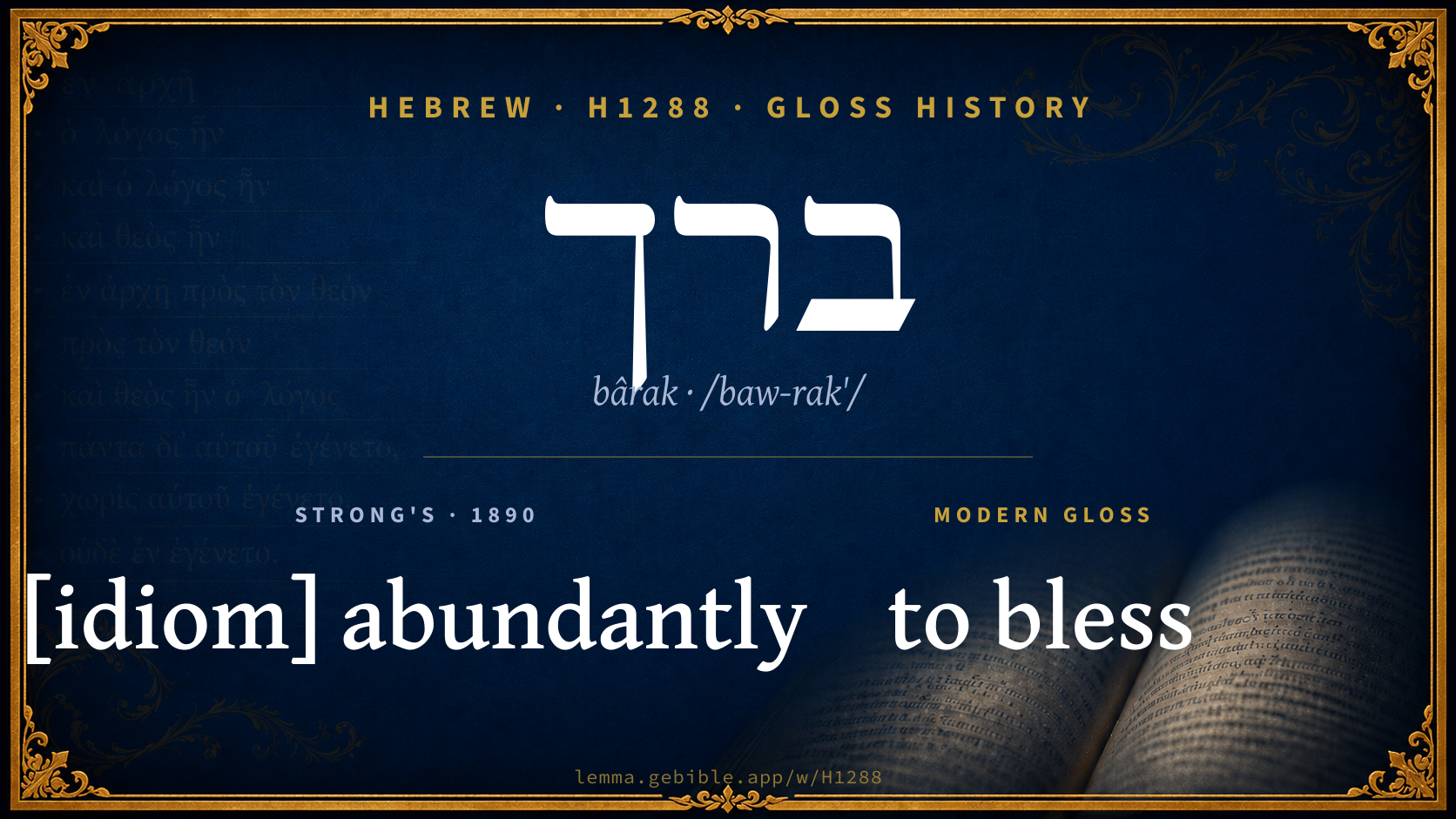
Gloss history
Strong's 1890 vs modern scholarship
About this word
Strong's H1288 catalogs a Hebrew word from the Hebrew Old Testament.
These counts are not copied from any lexicon or concordance. They are computed here, from the morphology-tagged Hebrew Old Testament. What Lemma adds →
- 289
- distinct verses
- The word appears in 289 distinct verses.
- 24 / 39
- OT books
- The word appears in 24 of 39 Old Testament books.
- #148
- by frequency
- Top 250 most frequent Hebrew words (rank 148 of 8,640 Hebrew words by occurrence).
View all 289 occurrences in the concordance →
Most concentrated in
- Psalms 68 verses 24%
- Genesis 62 verses 21%
- Deuteronomy 35 verses 12%
By section of the Old Testament
By traditional corpus
Conventional, traditional groupings — biblical authorship is debated, so this is a traditional corpus grouping, not an authorship claim. Each share is this word’s portion of its verses in that division of the Hebrew canon. Each figure is a share of the word’s 289 distinct verses.
- Torah (Pentateuch) 116 verses · 40%
- Writings (Ketuvim) 111 verses · 38%
- Prophets (Nevi'im) 62 verses · 21%
How translations render this word
Counts come from each version’s own published word-to-Strong’s tagging or interlinear alignment — an approximate guide to how each version renders this word, not a word-level alignment the data otherwise carries. Because each total is that version’s own tagged count, the per-version totals vary from one another and need not match the appearance or distinct-verse counts above. These counts may also differ from a printed concordance because Lemma counts each distinctly tagged rendering and does not collapse phrase taggings into a single head-word total. This is a fixed set of word-tagged versions (KJV, ASV, BSB, ULT) and does not change with the reading translation you choose elsewhere. Each version’s license is shown beside its name below (and on Sources).
- King James Version: Blessed 105×, Bless 50×, Hath blessed 14×
- American Standard Version: Blessed 96×, Bless 44×, Hath blessed 11×
- Berean Standard Bible: Blessed 70×, Bless 44×, Will be blessed 13×
- unfoldingWord Literal Text: Blessed 62×, Bless 46×, And 27×
King James Version Public Domain
Renders H1288 across 331 tagged occurrences — most commonly:
Plus other, less common renderings. Plus 75 renderings that appear only once — usually multi-word phrases or single function words the recovered tagging swept in, not distinct renderings.
American Standard Version Public Domain
Renders H1288 across 331 tagged occurrences — most commonly:
Plus other, less common renderings. Plus 89 renderings that appear only once — usually multi-word phrases or single function words the recovered tagging swept in, not distinct renderings.
Berean Standard Bible Public Domain
Renders H1288 across 323 tagged occurrences — most commonly:
Plus other, less common renderings. Plus 63 renderings that appear only once — usually multi-word phrases or single function words the recovered tagging swept in, not distinct renderings. Not rendered by a distinct English word in 6 further occurrences.
unfoldingWord Literal Text CC BY-SA 4.0
Renders H1288 across 416 tagged occurrences — most commonly:
Plus other, less common renderings. Plus 55 renderings that appear only once — usually multi-word phrases or single function words the recovered tagging swept in, not distinct renderings.
32 senses and sub-senses in the full BDB
Hebrew verbs can shift meaning by stem (binyan): Qal is the basic action, Niphal is often passive or reflexive, Piel often intensifies or makes it factitive, and Hiphil is typically causative. The senses below are grouped under the stem BDB assigns to each. This entry also uses Pual (the passive of Piel) and Hithpael (reflexive or reciprocal).
What do BDB’s symbols mean?
BDB uses these scholarly abbreviations:
| Symbol | Meaning |
|---|---|
| 𝔊 | the Septuagint (the ancient Greek translation, LXX) |
| 𝔙 | the Vulgate (the Latin translation) |
| 𝔖 | the Syriac version (the Peshitta) |
| 𝔗 | the Targum (the Aramaic translation) |
| ψ | the Psalms |
| √ | root (the underlying root or stem) |
| ‖ | parallel passage (a synonymous or contrasted parallel) |
| † | the dagger: every passage where the word occurs is cited |
The 32 senses and sub-senses the full Brown-Driver-Briggs lexicon distinguishes for this word, in lexicon order (not ranked by frequency), with BDB’s own verbatim wording and sub-sense lettering. Shown in Hebrew script with BDB’s own scholarly abbreviations. The condensed entry is in the Lexicon Entry tab. See also the Forms in the corpus table below.
Qal
- Impf. יִבְרַךְ 2 Ch 6:13; נִבְרְכָה ψ 95:6; בָּרוֹךְ (v. Pi.); Pt. pass. בָּרוּךְ Gn 9:26 + 70 times;— e.g. 2 Chronicles 6:13
- 1. kneel down (so Arabic Syriac Ethiopic): וַיִּבְרַךְ עַל־בִּרְכָּיו and he kneeled upon his knees 2 Ch 6:13; נִבְרְכָה לפני י׳ let us kneel before Yahweh ψ 95:6. e.g. 2 Chronicles 6:13
- 2. bless (only pt. pass.).
- a. of God: בָּרוּךְ י׳ blessed be (or is) י׳ Ex 18:10 (E) Gn 9:26; 24:27 (J) Ru 4:14; 1 S 25:32, 39; 2 S 18:28; 1 K 1:48; 5:21; 8:15, 56; 10:9; 1 Ch 16:36; 29:10; 2 Ch 2:11; 6:4; 9:8 Ezr 7:27; ψ 28:6; 31:22; 41:14; 72:18; 89:53; 106:48; 119:12; 124:6; 135:21; 144:1; Zc 11:5; ב׳ אלהים ψ 66:20; 68:36; ב׳ אדני ψ 68:20 (prob. for an original יהוה); ב׳ אל עליון Gn 14:20 (E); ב׳ צוּרִי 2 S 22:47 (= ψ 18:47); ב׳ כבוד י׳ Ez 3:12; ב׳ שׁם כבודו ψ 72:19. e.g. Exodus 18:10
- b. of men: Gn 27:33 (J) Nu 22:12 (E) Dt 7:14; 28:3, 6; 33:20, 24 1 S 25:33; 26:25; Ju 17:2; 1 K 2:45; ψ 118:26; Is 19:25; Je 17:7; 20:14; מברכיך ברוך blessed be the one blessing thee Gn 27:29; Nu 24:9 (E); ב׳ ליהוה Ru 2:19, 20; 3:10; 1 S 15:13; 23:21; 2 S 2:5; ψ 115:15; ב׳ לאל עליון Gn 14:19; בְּרוּךְ י׳ Gn 24:31; 26:29 (J); בְּרוּכֵי י׳ Is 65:23. e.g. Genesis 27:33
- c. things: בָּרוּךְ פרי בטנך blessed be the fruit of thy womb Dt 28:4 cf. Dt 28:5; 1 S 25:33; Pr 5:18. e.g. Deuteronomy 28:4
Niphal
- Pf. נִבְרְכוּ Gn 12:3; 18:18; 28:14 (J) bless oneself (cf. Hithp.). e.g. Genesis 12:3
Piel
- Pf. בֵּרַךְ Gn 24:1 + 29 times; בֵּרֵךְ ψ 10:3 Nu 23:20; בֵּרְכוּ 2 Ch 20:26; וּבֵרֲכוּ Jb 1:5; sf. בֵּרֲכוֹ, בֵּרֲכַנִי, etc., Gn 27:27 + 5 times; בֵּרַכְךָ Dt 2:7 + 9 times; Impf. יְבָרֵךְ, וַיְּבָ֫רֶךְ etc., Gn 28:3 + 52 times; אֲבָֽרֲכָה Gn 12:3 + 2 times; pl. יְבָֽרֲכוּ Gn 24:60 + 11 times; sf. יְבָרֶכְךָ Gn 27:10 + 21 times; יְבָֽרֲכֶךָּ Gn 49:25 + 2 times; יְבָֽרֲכֵהוּ Gn 14:19 + 16 times; יְבָֽרֲכֵם Gn 48:20 + 6 times; אֲבָרֶכְכָה Gn 27:7; תְּכָֽרֲכַנִּי Gn 27:19, 31; יְבָֽרֲכֶנְהוּ ψ 72:15; יְרָֽרֲכוּכָה ψ 145:10; Imv. בָּרֵךְ Dt 33:11; + 29 times; Inf. cstr. בָּרֵךְ Gn 22:17 + 24 times; Inf. abs. בָּרוֹךְ Jos 24:10 (Ki, cf. Köi. 191, Ew§ 240 b, 2 Ol Sta); Pt. מְבָרֵךְ Pr 27:14 + 4 times;— e.g. Genesis 24:1
- 1. bless God, adore with bended knees: acc. ברך י׳ Gn 24:48 (J) Dt 8:10; Ju 5:2, 9; 1 Ch 29:10, 20; 2 Ch 20:26; 31:8; Ne 9:5; ψ 16:7; 26:12; 34:2; 63:5; 103:20, 21, 22; 115:18; 134:1, 2; 135:19, 20; 145:2, 10; ברכי נפשׁי את י׳ ψ 103:1, 2, 22; 104:1, 35; ברך שׁם bless the name of Yahweh Ne 9:5; ψ 96:2; 100:4; 145:1, 21; ברך אלהים Jos 22:33; ψ 66:8; 68:27 (doubtless for an original יהוה), with לְ 1 Ch 29:20; מְבָרֵךְ אָוֶן Is 66:3 (of idolatrous worship). e.g. Genesis 24:48
- 2. God blesses
- a. men: abs. Nu 23:20 (E) ψ 109:28; with acc. Gn 32:27, 30; 48:16; Ex 20:24; Nu 24:1; Jos 24:10 (E) Gn 12:2, 3; 22:17; 24:1, 35; 26:12; 30:27, 30; 39:5; 49:25; Jos 17:14 (J) Gn 1:22, 28; 5:2; 9:1; 17:16, 20; 25:11; 26:3, 24; 28:3; 35:9; 48:3 Nu 6:24, 27 (P) Dt 1:11; 2:7; 7:13; 12:7; 14:24, 29; 15:4, 6, 10, 14, 18; 16:10, 15; 23:21; 24:13, 19; 26:15; 28:8; 30:16; Ju 13:24; 2 S 6:11, 12; 7:29; 1 Ch 4:10; 13:14; 17:27; 26:5; 2 Ch 31:10; Ne 8:6; Ru 2:4; Jb 42:12 ψ 5:13; 28:9; 29:11; 45:3; 67:2, 7, 8; 107:38; 115:12, 13; 128:5; 134:3; 147:13; Pr 3:33; Is 19:25; 51:2; 61:9; Je 31:23; Hg 2:19. e.g. Numbers 23:20
- b. things: sabbath Gn 2:3 Ex 20:11 (P); field Gn 27:27 (E); bread Ex 23:25 (E); work Dt 28:12 Jb 1:10 cf. Dt 33:11 ψ 65:11; 132:15. e.g. Genesis 2:3
- 3. men bless men: priests & kings בשׁם י׳ Dt 10:8; 21:5; 2 S 6:18; 1 Ch 16:2; 23:13; ψ 129:8; Melchizedek Abraham Gn 14:19; Moses Dt 33:1; Ex 12:32; 39:43; Joshua Jos 14:13; 22:6, 7; priests Lv 9:22, 23; Nu 6:23; Dt 27:12; Jos 8:33; 2 Ch 30:27; ψ 118:26; Solomon 1 K 8:14, 55 (= 2 Ch 6:3); David 2 S 6:20 (= 1 Ch 16:43) 19:40; Eli 1 S 2:20; Balaam Nu 22:6; 23:11, 20, 25; 24:10; fathers, especially on death-bed Gn 27:4 + 12 times Gn 27 (all JE) 28:1, 6 (P) 32:1 (E) 48:9 (P) 48:15, 20; 49:28 (J) 2 S 13:25; in consecrating a sacrifice 1 S 9:13. e.g. Deuteronomy 10:8
- 4. salute, greet, with an invocation of blessing (stronger than שׁלום): בך יברך ישׂראל with thee will Israel bless Gn 48:20 (E). e.g. Genesis 48:20
- a. in meeting Gn 47:7 (P) 2 K 4:29; 10:15 1 S 13:10. e.g. Genesis 47:7
- b. in departing Gn 24:60 (J) 47:10 (P) 1 K 8:66. e.g. Genesis 24:60
- c. by messengers 1 S 25:14 2 S 8:10 1 Ch 18:10. e.g. 1 Samuel 25:14
- d. in gratitude Jb 31:20 Pr 30:11 Ne 11:2. e.g. Job 31:20
- e. morning salutation Pr 27:14. e.g. Proverbs 27:14
- f. congratulations for prosperity Gn 12:3 (J) 27:29 Nu 24:9 (E) 1 K 1:47 ψ 49:19; 62:5. e.g. Genesis 12:3
- g. in homage 2 S 14:22 ψ 72:15. e.g. 2 Samuel 14:22
- h. in friendliness 2 S 21:3. e.g. 2 Samuel 21:3
- 5. bless, with the antithetical meaning curse (Thes) from the greeting in departing, saying adieu to, taking leave of; but rather a blessing overdone and so really a curse as in vulgar English as well as in the Shemitic cognates: 1 K 21:10, 13 Jb 1:5, 11; 2:5, 9 ψ 10:3. e.g. 1 Kings 21:10
Pual
- Impf. יְבֹרַךְ 2 S 7:29 + 3 times; תְּבֹרַךְ Ju 5:24 Pr 20:21; Pt. מְבֹרָךְ Nu 22:6 + 3 times; f. מְבֹרֶכֶת Dt 33:13; מְבֹרָכָיו ψ 37:22;— e.g. 2 Samuel 7:29
- 1. pass. to be blessed, adored: שׁם י׳ Jb 1:21 ψ 113:2. e.g. Job 1:21
- 2. prospered by God:
- a. persons 2 S 7:29 1 Ch 17:27 ψ 37:22; 112:2; 128:4 Pr 20:21. e.g. 2 Samuel 7:29
- b. things Dt 33:13. e.g. Deuteronomy 33:13
- 3. have prosperity invoked, by Balaam Nu 22:6. e.g. Numbers 22:6
- 4. in gratitude Pr 22:9 Ju 5:24. e.g. Proverbs 22:9
Hiphil
- וַיַּבְרֵךְ הַגְּמַלִּים and he made his camels kneel Gn 24:11 (J). e.g. Genesis 24:11
Hithpael
- הִתְבָּרֵךְ Dt 29:18 + 3 times; Impf. יִתְבָּרֵךְ Is 65:16 ψ 72:17; Pt. מִתְבָּרֵךְ Is 65:16;—bless oneself, congratulate oneself בלבבו in his heart Dt 29:18; בזרעך with or by (cf. בְּ iii. 2. d) thy seed (invoke for oneself the blessing of the seed of Abraham) Gn 22:18; 26:4 (J); by the Messianic king ψ 72:17; באלהי אמן Is 65:16; by י׳ Je 4:2. e.g. Deuteronomy 29:18
Senses from the full Brown-Driver-Briggs lexicon (Brown, Driver, Briggs; Oxford 1906 — public domain), digitized via Sefaria, supplemented by the OpenScriptures HebrewLexicon (CC BY 4.0). Full attribution on Sources.
Word origin
vb. kneel, bless (NH id.; Arabic بَرَكَ Ethiopic በረከ Aramaic בְּרֵךְ, ܒܪܶܟ (praise), Palm. especially in בריך שמו לעלמא VogPalm. 74 ff. cf. 94, 144)—
— Brown-Driver-Briggs (Oxford 1906, public domain), digitized via Sefaria, supplemented by the OpenScriptures HebrewLexicon (CC BY 4.0). See Sources.
Origin: a primitive root
Jastrow Dictionary
A second Hebrew/Aramaic lexicon for comparison, covering Aramaic and post-biblical (Talmudic, Targumic, Midrashic) usage that the biblical-Hebrew BDB does not. Matched by lemma rather than by Strong’s number, so a lemma may carry more than one Jastrow headword (shown separately below), and the entries cover usage well beyond the Bible.
בָּרַךְ
- 1. to cave out. Denom. בְּרֵכָה, בֶּרֶךְ; cmp. בּוּרְכָּא, בּוּרְכְּתָא.
- 2. (cmp. ברר) to select, point out (cmp. esp. Gen. II, 3) whence to bless (Pi.).—Part. pass. בָּרוּךְ chosen, blessed, praised. הקדוש ב׳ הוא (abbr. הקב"ה) the Holy One, blessed be He. Pes. 118ᵃ; a. v. fr. Ib. 104ᵇ, a. fr. פותח בב׳ וכ׳ he (who prays) opens the benediction with barukh and closes with barukh (i.e. ברוך אתה ה׳). Tosef. Sot. I, 10 ב׳ בכלל, v. כְּלָל; a. fr. e.g. Genesis 2:3
- (b. h.)
- 1. to praise, bless, esp. to recite the due benediction. Ber. VI, 1. Ib. 5 בי׳ על היין having recited the blessing over wine &c. Pes. X, 9 ב׳ ברכת הפסח having recited the blessing over the Paschal lamb. Ib. 5 אנחנו חייבים … לְבָרֵךְ we are bound to … praise &c.; a. v. fr.
- 2. (cmp. נקב) to blaspheme. Snh. 56ᵃ עד שֶיְבָרֵךְ שם בשם until he blasphemes the Lord by His name. Ib. שבי׳ את השם בכינוי who blasphemed the Lord by an attribute.—Part. Pu. מְבוֹרָךְ blessed, praiseworthy. Ber. VII, 3; a. fr.
- 3. *to cut through, to clear virgin ground or forest. Tosef. Shebi. III, 20 ed. Zuck. (Var. מגדר); Y. ib. IV, 35ᵇ bot. מבדין; Y. Sabb. VII, 10ᵃ top המברה, v. בהי h. [Tosef. Shebi. I, 6 מבורכות, v. infra.]
- , Nithpa. נִתְבָּרֵךְ to be blessed (praised); to be increased (v. בְּרָכָה). Y. Ber. IX, 14ᵃ top ויִתְבָּרַךְ and be blessed. Y. M. Kat. I, beg. 80ᵃ if the waters were scanty ונִתְבָּרְכוּ and grew plentiful. Yeb. 63ᵃ; a. fr.
- (denom. of בֶּרֶךְ or בְּרִיכָה) to form a knee, to engraft; esp. to bend a vine by drawing it into the ground and making it grow forth as an independent plant, to sink. Shebi. II, 6; R. Hash. 10ᵇ; a. fr.—Tosef. Shebi. I, 6 אם היו מוּבְרָכוֹת (incorr. מבורכ׳) if they have been sunk before New Year &c.—Yeb. 63ᵃ (allud. to Gen. XII, 3) שתי ברכית טובות יש לי להַבְרִיךְ בך two good shoots (proselytes) have I to engraft on thee, Ruth and &c. (B. Kam. 38ᵇ … פרידות וכ׳). e.g. Genesis 12:3
בְּרַךְ
- Part. Peil בְּרִיךְ blessed. Targ. Gen. IX, 26; a. fr.—Sabb. 67ᵃ, a. fr. קודשא ב׳ הוא the Holiness (Holy One), blessed be He. Cant. R. to. IV, 4; Gen. R. s. 32 הדין טורא בְּרִיכָא this blessed mount (Gerizim, revered by the Samaritans; Deut. R. s. 3 קדיש).
- as preced. Pi.
- 1. to bless &c. Targ. Deut. VIII, 10; a. fr.—Esp. to say grace after meal. Ber. 46ᵃ כי מטי לְבָרוּכֵי וכ׳ when it was time to say grace, he said, Will you please, say grace for us. Y. ib. VI, 10ᵇ מהו למיבָרְכָה בסופה what benediction must be said after it? Ib. bot. לא אנא חכים מברכא I do not know how to say grace after it.—Part. pass. מְבָרַךְ. Targ. Y. II, Gen. XLIX, 2.
- 2. to blaspheme. Targ. Job II, 9.—Snh. 56ᵃ לישנא דברוכי in the sense of blaspheming.
- as preced. Hithpa. Targ. Gen. XII, 3; a. fr.
בֶּרֶךְ
- preced.)
- 1. knee. Y. Ber. I, 3ᵈ top.
- 2. a knee-shaped pole. Taan. 25ᵇ כמלא ב׳ חמחרישה (Var. כוך, v. Rabb. D. S. a. l.) (until the rain penetrates) as far as the knee of the plough enters the soil; Ohol. XVII, 1 בו׳. Kel. XXI, 2 בו׳. [Tosef. Shebi. IV, 20 ברך, v. בְּרִיכָה.]—Du. בִּרְכַּיִם. Ber. 34ᵇ; Meg. 22ᵇ; Shebu. 16ᵇ כריעה על ב׳ the word כרע means falling on one’s knees. [בִּרְכּוֹת, v. בְּרִיכָה.]
בֶּרֶךְ ²
- 1. knee. Targ. Is. XLV, 23.—Pl. בִּרְכַּיָא, בִּרְכֵּי, בִּי׳. Targ. Jud. VII, 6; a. e.—Ber. 6ᵃ הנהו ב׳ וכ׳ those fatigued knees (of scholars) must be ascribed to them (the demons). Pes. 108ᵃ, v. זְגָא.
- 2. = h. בְּרִיכָה. Pl. בִּירְכֵּי shoots, branches. Tam. 30ᵃ top (Var. in Rashi בְּרִיכֵי, Ar. בורכי).
A Dictionary of the Targumim, the Talmud Babli and Yerushalmi, and the Midrashic Literature (Marcus Jastrow; London, Luzac, 1903) — Public Domain. Digitized via Sefaria. Digitized via Sefaria. Full attribution on Sources.
Forms in the corpus
The 219 distinct written forms H1288 takes in the Hebrew Bible, most frequent first — each parse links to that stem’s occurrences in the concordance. Hebrew forms include their vowel points and cantillation, so a single lemma takes many written forms.
The 60 most common forms are shown; 159 rarer forms follow in the full concordance.
Same root — word family
Other BDB entries built from the same root as H1288, grouped by Strong’s listed origin. These share a root / origin per the lexicon — not necessarily a shared meaning. Each links to that word’s own entry.
Derived from this word
Proper names from this root
People and places named from this root — a name, not an additional meaning of the word.
Compare all same-root words → Showing 4 of 8 — not the complete family. 3 of the same-root words are proper names (people or places). They share a root, not necessarily a meaning.
Septuagint verse parallels
This word appears in 264 verses that also exist in the Greek Old Testament (Septuagint), out of the 289 Hebrew verses it occurs in. You can read those verses in Greek by switching the Old Testament edition to the Septuagint.
Read these verses in the Septuagint
- Genesis 1:22
- Exodus 12:32
- Leviticus 9:22
- Numbers 6:23
- Deuteronomy 1:11
- Joshua 14:13
- Judges 5:2
- Ruth 2:4
- 1 Samuel 2:20
- 2 Samuel 2:5
- 1 Kings 1:47
- 2 Kings 4:29
This is a verse-level parallel only — the same verses exist in both the Hebrew and Greek Old Testaments. No word-level Hebrew↔Greek correspondence is claimed: the data carries no such alignment, so no Greek word is shown as this Hebrew word’s translation. Coverage is not total — the Septuagint omits the deuterocanon and renumbers the Psalms, so some Hebrew verses have no direct Greek parallel.