
1 Samuel 26:25

Hebrew (Westminster Leningrad Codex) 1 Samuel 26:25 appears in the Hebrew Old Testament. The text above is from the Westminster Leningrad Codex. Each word links to its Strong’s number, a concise gloss, and parsing drawn from the Open Scriptures Hebrew Bible morphology. Click any word for its full Brown-Driver-Briggs (BDB) entry.
Download image
Cite this verse

1 Samuel 26:25 (World English Bible). Public Domain. Lemma interlinear Bible study tool, https://lemma.gebible.app/v/1-samuel/26/25.

Show BibTeX & RIS
BibTeX
RIS
English Translation
Then Saul said to David, Blessed be you, my son David: you shall both do mightily, and shall surely prevail. So David went his way, and Saul returned to his place.
World English Bible · Public Domain
Download a study sheet

One document with this verse’s original text, its word-by-word gloss line, the meaning frame, cross-references with their text, attributed commentary, and full source and license credits — printable, and it pastes into notes with its structure intact.

This verse Autodidact and up

Study sheet (.html) Plain text (.txt)

A passage Seminary Student

Up to 50 verses in one chapter. A passage sheet keeps up to 6 commentary sources and 12 cross-references per verse, in the order this page ranks them, and says so on the sheet whenever that leaves anything out. Ask for a single verse and you get the Autodidact verse sheet above.

Everything on this page stays free to read, with no account — the sheet is a download of what is already on screen, not access to it.

Want to remove ads? Support Godless Engineer
Compare translations 3

The same verse in 3 English versions, stacked beneath the original-language interlinear above. Click any original word for its lexicon entry.

Each is an independent rendering of the whole verse — the interlinear is not word-aligned to these translations.

Highlighted words mark where these versions differ — a whole-verse word diff, not a word-by-word alignment.

  • World English Bible Public Domain
    Then Saul said to David, Blessed be you, my son David: you shall both do mightily, and shall surely prevail. So David went his way, and Saul returned to his place.
  • King James Version Public Domain
    Then Saul said to David, Blessed be thou, my son David: thou shalt both do great things, and also shalt still prevail. So David went on his way, and Saul returned to his place.
  • unfoldingWord Literal Text CC BY-SA 4.0
    And Saul said to David, “Blessed be you, my son David! Both doing, you will do, and also being able, you will be able.” And David went to his way, and Saul returned to his place.

unfoldingWord Literal Text — © unfoldingWord, licensed CC BY-SA 4.0. Word-aligned USFM3 via Door43 (git.door43.org/unfoldingWord/en_ult).

Versions to compare (up to 4)

3 of 4 selected

Show all 18 translations

Every available English version of this verse, each an independent rendering of the whole verse.

  • World English Bible Public Domain
    Then Saul said to David, Blessed be you, my son David: you shall both do mightily, and shall surely prevail. So David went his way, and Saul returned to his place.
  • Berean Standard Bible Public Domain
    Saul said to him, “May you be blessed, David my son. You will accomplish great things and will surely prevail.” So David went on his way, and Saul returned home.
  • Majority Standard Bible Public Domain
    Saul said to him, “May you be blessed, David my son. You will accomplish great things and will surely prevail.” So David went on his way, and Saul returned home.
  • King James Version Public Domain
    Then Saul said to David, Blessed be thou, my son David: thou shalt both do great things, and also shalt still prevail. So David went on his way, and Saul returned to his place.
  • American Standard Version (1901) Public Domain
    Then Saul said to David, Blessed be thou, my son David: thou shalt both do mightily, and shalt surely prevail. So David went his way, and Saul returned to his place.
  • Revised Version (1885) Public Domain
    Then Saul said to David, Blessed be thou, my son David: thou shalt both do mightily, and shalt surely prevail. So David went his way, and Saul returned to his place.
  • Geneva Bible (1599) Public Domain
    Then Saul said to Dauid, Blessed art thou, my sonne Dauid: for thou shalt doe great things, and also preuaile. So Dauid went his way, and Saul returned to his place.
  • Douay-Rheims (1899) Public Domain
    Then Saul said to David: Blessed art thou, my son David: and truly doing thou shalt do, and prevailing thou shalt prevail. And David went on his way, and Saul returned to his place.
  • Young's Literal Translation Public Domain
    And Saul saith unto David, `Blessed `art' thou, my son David, also working thou dost work, and also prevailing thou dost prevail.' And David goeth on his way, and Saul hath turned back to his place.
  • Literal Standard Version CC BY-SA 4.0
    And Saul says to David, “Blessed [are] you, my son David, also working you work, and also prevailing you prevail.” And David goes on his way, and Saul has turned back to his place.
  • Unlocked Literal Bible CC BY-SA 4.0
    Then Saul said to David, “May you be blessed, David my son! You will certainly do great things and you will succeed in them.” So David went his way, and Saul returned to his place.
  • unfoldingWord Literal Text CC BY-SA 4.0
    And Saul said to David, “Blessed be you, my son David! Both doing, you will do, and also being able, you will be able.” And David went to his way, and Saul returned to his place.
  • Darby Bible Public Domain
    And Saul said to David, Blessed be thou, my son David: thou shalt certainly do [great things], and shalt certainly prevail. And David went on his way, and Saul returned to his place.
  • World Messianic Bible Public Domain
    Then Saul said to David, “You are blessed, my son David. You will both do mightily, and will surely prevail.” So David went his way, and Saul returned to his place.
  • Webster's Bible Public Domain
    Then Saul said to David, Blessed be thou, my son David: thou shalt both do great things, and also shalt still prevail. So David went on his way, and Saul returned to his place.
  • Free Bible Version CC BY-SA 4.0
    Saul said to David, “May you be blessed, David my son. You will accomplish a great deal and always be successful.” David left, and Saul went back home.
  • Bible in Basic English Public Domain
    Then Saul said to David, May a blessing be on you, David, my son; you will do great things and without doubt you will overcome. Then David went on his way, and Saul went back to his place.
  • JPS Tanakh (1917) Public Domain
    Then Saul said to David: 'Blessed be thou, my son David; thou shalt both do mightily, and shalt surely prevail.' So David went his way, and Saul returned to his place.

Literal Standard Version (2020), Covenant Press — licensed CC BY-SA 4.0. Text via the HelloAO Bible API (eBible.org). Unlocked Literal Bible (unfoldingWord) — licensed CC BY-SA 4.0. Text via the HelloAO Bible API (eBible.org). unfoldingWord Literal Text — © unfoldingWord, licensed CC BY-SA 4.0. Word-aligned USFM3 via Door43 (git.door43.org/unfoldingWord/en_ult). Free Bible Version, Dr. Jonathan Gallagher — licensed CC BY-SA 4.0. Text via the HelloAO Bible API (eBible.org).

Word by word

More ways to search: Search by grammar → Find every occurrence → Compare this word →

Practice this passage: Drill this verse → Learn its vocabulary →

יָכֹ֣ל
yâkôl
H3201
“to prevail”
Verb, Qal, Infinitive Absolute
Part of Speech
Verb
Stem
Qal
Form
Infinitive Absolute
Full BDB Definition

Origin: a primitive root

TWOT: 866

to prevail, overcome, endure, have power, be able - (Qal) - to be able, be able to gain or accomplish, be able to endure, be able to reach - to prevail, prevail over or against, overcome, be victor - to have ability, have strength
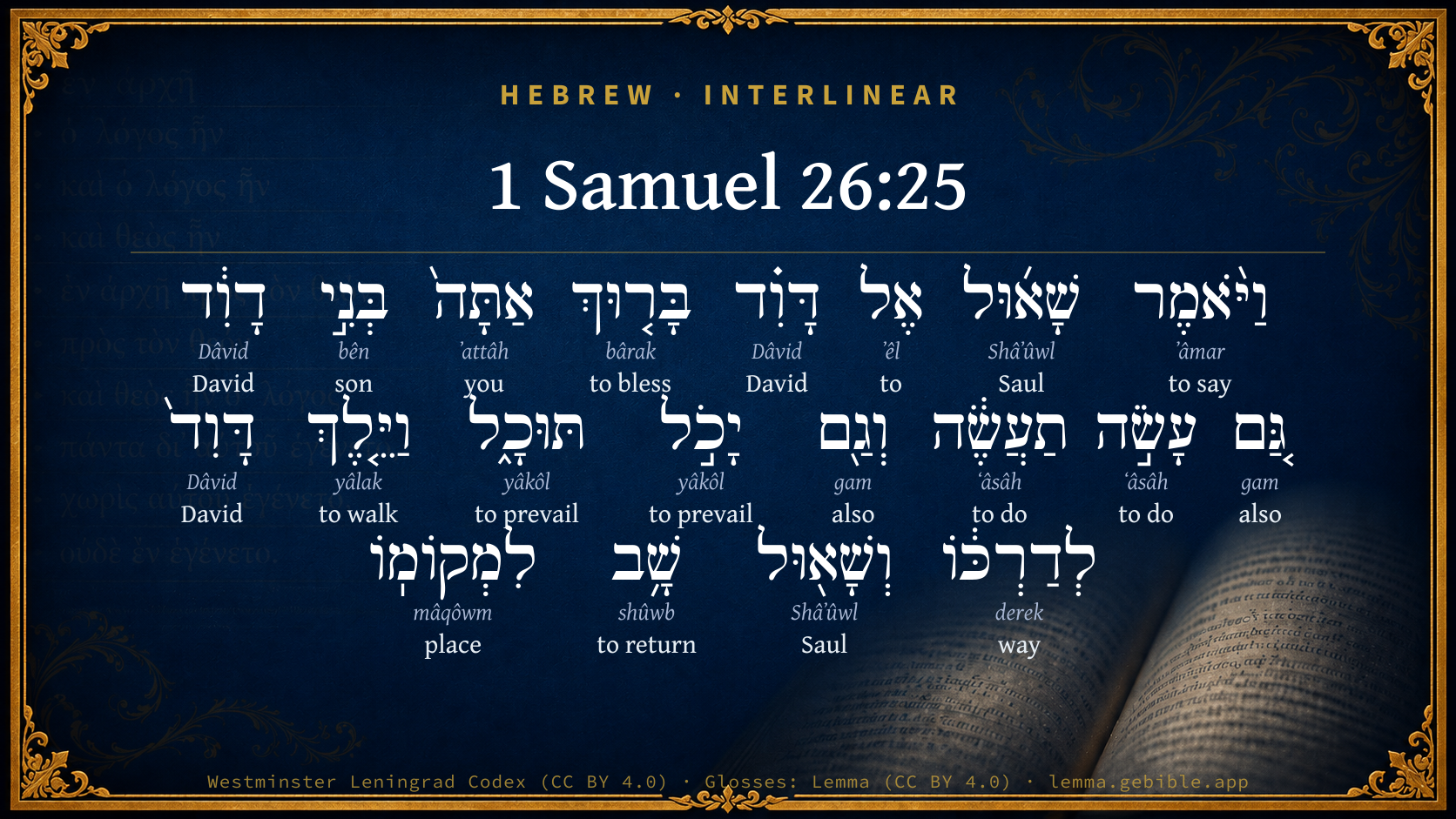
  1. וַיֹּ֨אמֶר ʼâmar H559 “and · to say” Conjunction + Verb, Qal, Sequential Imperfect, 3rd Person, Masculine, Singular
  2. שָׁא֜וּל Shâʼûwl H7586 “Saul” Noun, Proper
  3. אֶל ʼêl H413 “to” Preposition
  4. דָּוִ֗ד Dâvid H1732 “David” Noun, Proper
  5. בָּר֤וּךְ bârak H1288 “blessed” Verb, Qal, Participle Passive, Masculine, Singular, Absolute
  6. אַתָּה֙ ʼattâh H859 “you” Pronoun, Personal, 2nd Person, Masculine, Singular
  7. בְּנִ֣י bên H1121 “son · my” Noun, Common, Masculine, Singular, Construct + Suffix, Personal, 1st Person, Common, Singular
  8. דָוִ֔ד Dâvid H1732 “David” Noun, Proper
  9. גַּ֚ם gam H1571 “also” Particle, Accusative
  10. עָשֹׂ֣ה ʻâsâh H6213 “to do” Verb, Qal, Infinitive Absolute
  11. תַעֲשֶׂ֔ה ʻâsâh H6213 “to do” Verb, Qal, Imperfect, 2nd Person, Masculine, Singular
  12. וְגַ֖ם gam H1571 “and · also” Conjunction + Particle, Accusative
  13. תּוּכָ֑ל yâkôl H3201 “to prevail” Verb, Qal, Imperfect, 2nd Person, Masculine, Singular
  14. וַיֵּ֤לֶךְ yâlak H3212 “and · to walk” Conjunction + Verb, Qal, Sequential Imperfect, 3rd Person, Masculine, Singular
  15. דָּוִד֙ Dâvid H1732 “David” Noun, Proper
  16. לְדַרְכּ֔וֹ derek H1870 “to/for · way · his” Preposition + Noun, Common, Both, Singular, Construct + Suffix, Personal, 3rd Person, Masculine, Singular
  17. וְשָׁא֖וּל Shâʼûwl H7586 “and · Saul” Conjunction + Noun, Proper
  18. שָׁ֥ב shûwb H7725 “to return” Verb, Qal, Perfect, 3rd Person, Masculine, Singular
  19. לִמְקוֹמֽוֹ mâqôwm H4725 “to/for · place · his” Preposition + Noun, Common, Masculine, Singular, Construct + Suffix, Personal, 3rd Person, Masculine, Singular

About this verse

These counts appear in no published source. They are computed here, from the morphology-tagged text and Lemma’s own curated glosses. What Lemma adds →

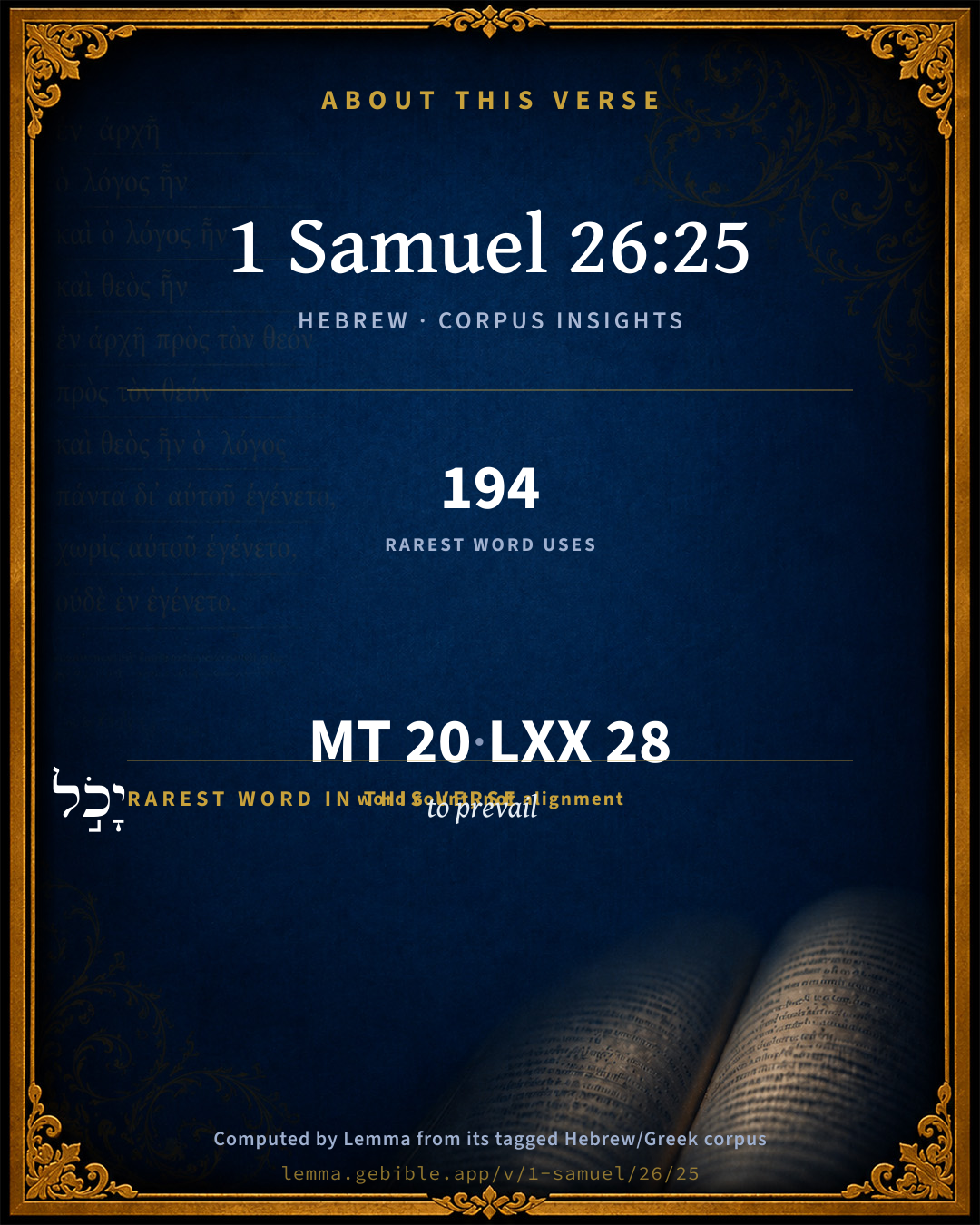
20
words
14
distinct lemmas
Historical
section

Grammatical profile

  • 8 verbs
  • 8 nouns
  • 1 pronoun
  • 1 preposition
  • 2 particles

Verb forms

  • וַיֹּ֨אמֶר Qal · Sequential Imperfect
  • בָּר֤וּךְ Qal · Participle Passive
  • עָשֹׂ֣ה Qal · Infinitive Absolute
  • תַעֲשֶׂ֔ה Qal · Imperfect
  • יָכֹ֣ל Qal · Infinitive Absolute
  • תּוּכָ֑ל Qal · Imperfect
  • וַיֵּ֤לֶךְ Qal · Sequential Imperfect
  • שָׁ֥ב Qal · Perfect

Repetition

Words recur within this verse — often emphatic in Hebrew:

  • דָּוִ֗ד David H1732 ×3
  • שָׁא֜וּל Saul H7586 ×2
  • גַּ֚ם also H1571 ×2
  • עָשֹׂ֣ה to do H6213 ×2
  • יָכֹ֣ל to prevail H3201 ×2

Hebrew & Septuagint length

In English translation the verse runs 31 words from the Hebrew and 31 from the Septuagint (LXX English) — the same length.

A rough comparison of the two English renderings, which tokenize alike — not a word-level alignment.

Word counts can differ between the Hebrew and the Greek without any difference in meaning — e.g. the Hebrew direct-object marker אֵת has no separate Greek word, and Greek often adds the article ὁ.

In the original languages it is 20 Hebrew tokens and 28 Greek tokens — but the two are counted differently (Hebrew bundles its prefixes and suffixes into one token; the Greek is in lemma form), so that isn’t a like-for-like length.

Cross-references

9

Topical passages linked to 1 Samuel 26:25 in the Treasury of Scripture Knowledge — connected by theme and wording, ordered by reader-vote popularity; previews shown in the World English Bible.

  • Numbers 24:9–10 He couched, he lay down as a lion, As a lioness; who shall rouse him up? Blessed be everyone who blesses you, Cursed be everyone who curses you.
  • 1 Samuel 24:19 For if a man finds his enemy, will he let him go away unharmed? Therefore may Yahweh reward you good for that which you have done to me this day.
  • Proverbs 26:25 When his speech is charming, don't believe him; For there are seven abominations in his heart:
  • Isaiah 54:17 No weapon that is formed against you shall prosper; and every tongue that shall rise against you in judgment you shall condemn. This is the heritage of the servants of Yahweh, and their righteousness which is of me, says Yahweh.
  • Romans 8:37 No, in all these things, we are more than conquerors through him who loved us.
  • Genesis 32:28 He said, "Your name will no longer be called 'Jacob,' but, 'Israel,' for you have fought with God and with men, and have prevailed."
  • 1 Samuel 24:22 David swore to Saul. Saul went home; but David and his men got them up to the stronghold.
  • Hosea 12:4 Indeed, he had power over the angel, and prevailed; He wept, and made supplication to him. He found him at Bethel, and there he spoke with us,
  • Romans 8:35 Who shall separate us from the love of Christ? Could oppression, or anguish, or persecution, or famine, or nakedness, or peril, or sword?

Cross-references courtesy of OpenBible.info (CC BY 4.0).

Hebrew and Greek witnesses Masoretic Hebrew ↔ Greek Septuagint

The same verse in the two great witnesses to the Old Testament, shown verse-for-verse.

These are two independent witnesses, not word-aligned to each other, and the Septuagint is shown in lemma (dictionary) form.

Hebrew 1 Samuel 26:25 Masoretic · Westminster Leningrad Codex

וַיֹּ֨אמֶר שָׁא֜וּל אֶל דָּוִ֗ד בָּר֤וּךְ אַתָּה֙ בְּנִ֣י דָוִ֔ד גַּ֚ם עָשֹׂ֣ה תַעֲשֶׂ֔ה וְגַ֖ם יָכֹ֣ל תּוּכָ֑ל וַיֵּ֤לֶךְ דָּוִד֙ לְדַרְכּ֔וֹ וְשָׁא֖וּל שָׁ֥ב לִמְקוֹמֽוֹ

Then Saul said to David, Blessed be you, my son David: you shall both do mightily, and shall surely prevail. So David went his way, and Saul returned to his place.

World English Bible · Public Domain

Greek LXX 1 Samuel 26:25 Septuagint · lemma form

καί εἶπον σαούλ πρός δαυίδ εὐλογημένος σύ τέκνον καί ποιέω ποιέω καί δύναμαι δύναμαι καί ἀποἔρχομαι δαυίδ εἰς ὁ ὁδός αὐτός καί σαούλ ἀναστρέφω εἰς ὁ τόπος αὐτός

And Saul said to David, Blessed be you, my son; and you shall surely do valiantly, and surely prevail. And David went on his way, and Saul returned to his place.

LXX2012 (modern English Septuagint) · Public Domain

Hebrew: Westminster Leningrad Codex (CC BY 4.0). Greek: Septuagint (public domain); English from LXX2012 (modern English Septuagint) (Public Domain). How the Septuagint differs from the Hebrew →

Targum (Aramaic paraphrase)

1

The Targum is the ancient Jewish Aramaic paraphrase of the Hebrew Scriptures — an interpretive translation, not the Hebrew text itself. Onkelos (literal) and Pseudo-Jonathan (expansive) render the Torah, and Jonathan the Prophets. Coverage is partial: where no permissively-licensed English translation exists for a verse, only the Aramaic is shown. This is verse-level text, not a word-by-word alignment to the Hebrew.

  1. Targum Jonathan Prophets (Joshua–Malachi)
    וַאֲמַר שָׁאוּל לְדָוִד בְּרִיךְ אַתְּ בְּרִי דָוִד אַף מִמְלַךְ תִּמְלוֹךְ וְאַף אַצְלַח תַּצְלַח וַאֲזַל דָוִד לְאוֹרְחֵיהּ וְשָׁאוּל תַּב לְאַתְרֵיהּ:

    (no public-domain English translation for this verse)

    Targum Jonathan — Aramaic: “Mikraot Gedolot” (public domain). English: “Sefaria Community Translation” (CC0 1.0 (public-domain dedication)); “London "Chaldee Paraphrase," 1871” (public domain). Text via Sefaria.

Commentary

Notes on 1 Samuel 26:25 from classic Christian and Jewish commentators (each source and its license shown beneath its notes). The classic Christian expositions comment on the surrounding passage and are grouped to its opening verse, so a note may address several verses; the Jewish commentaries on the Tanakh (Rashi and others) are per-verse, so they appear only where the commentator wrote on this verse.

Lemma curates 59 commentaries, every one of them public domain or Creative Commons licensed, each selected and text-cleaned for this edition rather than reprinted as found. About our sources →

Trapp's Complete Commentary

John Trapp

1Sa 26:25 Then Saul said to David, Blessed [be] thou, my son David: thou shalt both do great [things], and also shalt still prevail. So David went on his way, and Saul returned to his place.

Ver. 25. Thou shalt both do great things.] Faciendo facies. The Tigurines translate it, Et facies et omnino perficies, thou shalt do the deed, and go thorough stitch with it, as we use to say. And so David did indeed above all that went before him; so that in his days, and his son Solomon’s, that kingdom was at its highest ακμη but no thanks to Saul, who truly foretold it, but maliciously opposed it to his utmost.

John Trapp, A Commentary or Exposition upon All the Books of the Old and New Testament (1647–1656) — public domain. Text from a community e-Sword module.

Joseph Benson's Commentary

1Sa 26:25. Blessed be thou, my son David — Saul perceived that it was in vain to contend any longer against David, whom he saw God intended for great things. And so strong was his conviction now of this, as well as of his own sin and folly, that he could not forbear blessing him, foretelling his success, applauding him, and condemning himself, even in the hearing of his own soldiers. And this, it seems, was their last interview. After this they saw each other no more.

Joseph Benson's Commentary on the Old and New Testaments (1811–1818) — public domain. Text from a community e-Sword module.

Tyndale Open Study Notes

Tyndale Open Resources

26:25 Saul returned home, and this may have been David’s last personal encounter with him.

Tyndale Open Study Notes — © Tyndale Open Resources, licensed CC BY-SA 4.0. Text via the HelloAO Bible API.

Geneva Bible (1599)

Geneva Bible translators

To Gibeah of Benjamin.

Geneva Bible (1599) marginal notes — public domain. Text via Bolls.life.

Jamieson, Fausset & Brown

Robert Jamieson, A. R. Fausset & David Brown

So David went on his way--Notwithstanding this sudden relenting of Saul, David placed no confidence in his professions or promises, but wisely kept at a distance and awaited the course of Providence.

Next: 1 Samuel Chapter 27

Jamieson, Fausset & Brown — Commentary Critical and Explanatory on the Whole Bible (1871) — public domain (CC PDM 1.0). Text via the HelloAO Bible API.

Adam Clarke's Commentary

Verse 25. Thou shalt both do great things, and also shalt still prevail.] The Hebrew is גם עשה תעשה וגם יכל תוכל gam asoh thaaseh, vegam yachol tuchal; "Also in doing thou shalt do, and being able thou shalt be able; which the Targum translates, also in reigning thou shalt reign, and in prospering thou shalt prosper; which in all probability is the meaning.

There is a vast deal of dignity in this speech of David, arising from a consciousness of his own innocence. He neither begs his life from Saul, nor offers one argument to prevail upon him to desist from his felonious attempts, but refers the whole matter to God, as the judge and vindicator of oppressed innocence. Saul himself is speechless, except in the simple acknowledgment of his sin; and in the behalf of their king not one of his officers has one word to say! It is strange that none of them offered now to injure the person of David; but they saw that he was most evidently under the guardian care of God, and that their master was apparently abandoned by him. Saul invites David to return, but David knew the uncertainty of Saul's character too well to trust himself in the power of this infatuated king. How foolish are the counsels of men against God! When he undertakes to save, who can destroy? And who can deliver out of his hands?

Adam Clarke's Commentary on the Bible (1810–1826) — public domain. Text from a community e-Sword/MySword module.

Ellicott's Commentary for English Readers

(25) Thou shalt both do great things.—“Saul is here again ‘among the prophets,’ and foretells David’s exaltation and victory. ‘Vicisti Nazarene!’ was the exclamation of Julian.”—Bishop Wordsworth.

A Bible Commentary for English Readers, edited by Charles John Ellicott (1878–1897) — public domain. Text from a community e-Sword module.

The Cambridge Bible for Schools and Colleges

gen. ed. J. J. S. Perowne

25. to his place] i.e. to his home. Cp. 1Sa_2:20.

The Cambridge Bible for Schools and Colleges (gen. ed. J. J. S. Perowne; Cambridge University Press, 1878–1918) — public domain. Text from a community e-Sword module.

John Gill's Exposition

Then Saul said to David, blessed be thou, my son David,.... He desired God to bless him, and pronounced him blessed himself, believing he would be a happy and prosperous man:

thou shall both do great things; he had done great things already, in slaying Goliath, obtaining victories over the Philistines, and escaping the hands of Saul, and keeping out of them with so small a force; and he should do greater things yet:

and also shalt still prevail; against Saul and all his enemies; the Targum is,"even in reigning thou shalt reign, and even in prospering thou shalt prosper;''he believed he would be king, so he had said before, Sa1 24:20,

so David went on his way: to the wilderness again very probably, putting no trust and confidence in Saul, knowing how fickle and unstable he was:

and Saul returned to his place; to Gibeah, where his palace was.

Next: 1 Samuel Chapter 27

John Gill's Exposition of the Whole Bible (1746–1763) — public domain (CC PDM 1.0). Text via the HelloAO Bible API.

Haydock's Catholic Bible Commentary

Prevail, and mount the throne. --- Place, Gabaa. (Menochius)

George Leo Haydock (1774–1849), Haydock's Catholic Family Bible and Commentary, 1859 edition — public domain. Excludes Psalms (Douay-Rheims chapter numbering differs from Protestant) and Deuterocanonical books (Catholic canon only).

Matthew Poole's English Annotations

David went on his way; knowing Saul’s unstable and deceitful heart, he would not trust to any of his professions or promises, but kept out of his reach.

Matthew Poole's English Annotations on the Holy Bible (1683–1685) — public domain. Text from a community e-Sword/MySword module.

Whedon's Commentary on the Bible

Daniel D. Whedon

25. Saul returned to his place — To his home in Gibeah. These rivals never saw each other again.

Daniel D. Whedon (gen. ed.), Commentary on the Old and New Testaments (1874–1909) — public domain. Text from a community e-Sword module.

The Pulpit Commentary

Thou shalt both do, etc. Better, "Thou shalt both do mightily, and thou shalt surely prevail." The words are very general as compared with those in 1Sa_24:20, 1Sa_24:21, where Saul expressed his conviction that David Would be king, and intrusted his family to his care. The poverty of sentiment here, and the mere vexation expressed in ver. 21, justify Keil"s remark that Saul"s character had deteriorated in the interval, and that he was more hardened now than on the previous occasion. And so they parted David still leading the life of a fugitive, for Saul"s return in ver. 21 was the most evanescent of good purposes, while the king went back to his place, his home at Gibeah.

The Pulpit Commentary (1880–1919), ed. H.D.M. Spence-Jones & Joseph S. Exell — public domain. Text from a community e-Sword module.

Lesson kit

Teaching starters — assembled from the data on this page, not authored interpretation. Every prompt links to the verse data it draws on. Edit before teaching.

1 Samuel, in the Historical, opens this verse with 20 words (14 distinct Hebrew lemmas). Its most distinctive word is yâkôl (“to prevail”). A historical commentator’s framing appears above. Read the whole chapter for the surrounding context.

Discussion questions

  1. What does “to prevail” (yâkôl) contribute to the verse as a whole?
  2. How does Numbers 24:9–10, which shares this passage’s theme, read alongside this verse?
  3. What does the repetition of “David” (3× in this one verse) do in this verse?
  4. These translations render this verse differently; the difference is in the English rendering, not the original. What questions does that raise?
  5. «וַיֹּ֨אמֶר» is a Qal Sequential Imperfect verb. How does that grammatical form shape the action described?
  6. Compare how Trapp's Complete Commentary and Joseph Benson's Commentary read this verse. Where do they agree or differ?

Things to notice

Reading settings

Reading text

Shown beneath each verse's original-language words.

Old Testament
Old Testament edition

Read the OT as the Masoretic Hebrew (MT) or the Greek Septuagint (LXX).

English shown for the Greek Septuagint (in the Hebrew ↔ Greek comparison).

Comparing translations? Open the Compare panel on any verse page to stack up to four side by side.