
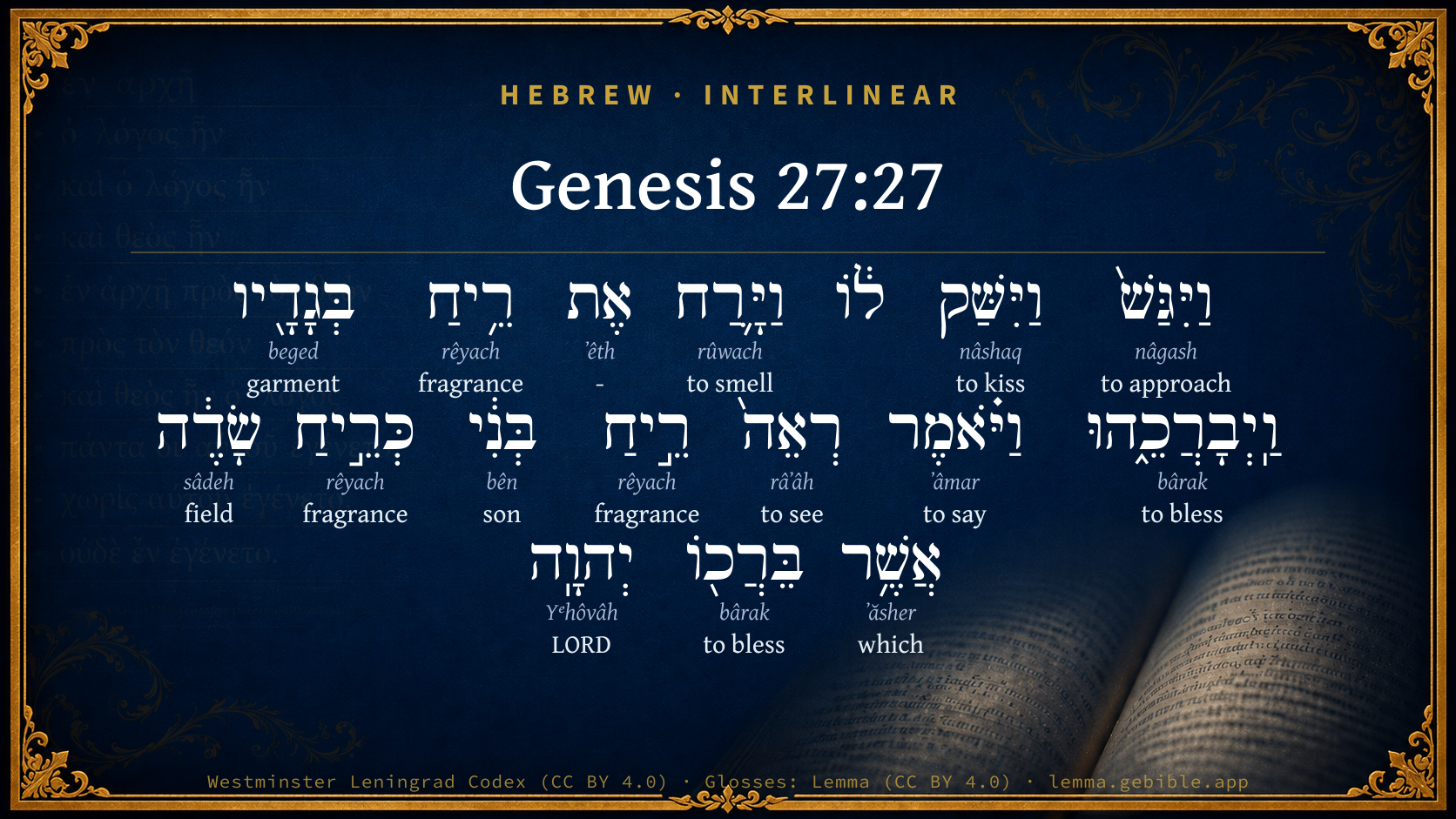
Genesis 27:27

Hebrew (Westminster Leningrad Codex) Genesis 27:27 appears in the Hebrew Old Testament. The text above is from the Westminster Leningrad Codex. Each word links to its Strong’s number, a concise gloss, and parsing drawn from the Open Scriptures Hebrew Bible morphology. Click any word for its full Brown-Driver-Briggs (BDB) entry.
Download image
Cite this verse

Genesis 27:27 (World English Bible). Public Domain. Lemma interlinear Bible study tool, https://lemma.gebible.app/v/genesis/27/27.

Show BibTeX & RIS
BibTeX
RIS
English Translation
He came near, and kissed him. He smelled the smell of his clothing, and blessed him, and said, "Behold, the smell of my son Is as the smell of a field which Yahweh has blessed.
World English Bible · Public Domain
Download a study sheet

One document with this verse’s original text, its word-by-word gloss line, the meaning frame, cross-references with their text, attributed commentary, and full source and license credits — printable, and it pastes into notes with its structure intact.

This verse Autodidact and up

Study sheet (.html) Plain text (.txt)

A passage Seminary Student

Up to 50 verses in one chapter. A passage sheet keeps up to 6 commentary sources and 12 cross-references per verse, in the order this page ranks them, and says so on the sheet whenever that leaves anything out. Ask for a single verse and you get the Autodidact verse sheet above.

Everything on this page stays free to read, with no account — the sheet is a download of what is already on screen, not access to it.

Want to remove ads? Support Godless Engineer
Compare translations 3

The same verse in 3 English versions, stacked beneath the original-language interlinear above. Click any original word for its lexicon entry.

Each is an independent rendering of the whole verse — the interlinear is not word-aligned to these translations.

Highlighted words mark where these versions differ — a whole-verse word diff, not a word-by-word alignment.

  • World English Bible Public Domain
    He came near, and kissed him. He smelled the smell of his clothing, and blessed him, and said, "Behold, the smell of my son Is as the smell of a field which Yahweh has blessed.
  • King James Version Public Domain
    And he came near, and kissed him: and he smelled the smell of his raiment, and blessed him, and said, See, the smell of my son is as the smell of a field which the LORD hath blessed:
  • unfoldingWord Literal Text CC BY-SA 4.0
    So he went close and kissed him. And he smelled the smell of his clothes, so he blessed him and said, “See, the smell of my son like the smell of a field that Yahweh has blessed!

unfoldingWord Literal Text — © unfoldingWord, licensed CC BY-SA 4.0. Word-aligned USFM3 via Door43 (git.door43.org/unfoldingWord/en_ult).

Versions to compare (up to 4)

3 of 4 selected

Show all 18 translations

Every available English version of this verse, each an independent rendering of the whole verse.

  • World English Bible Public Domain
    He came near, and kissed him. He smelled the smell of his clothing, and blessed him, and said, "Behold, the smell of my son Is as the smell of a field which Yahweh has blessed.
  • Berean Standard Bible Public Domain
    So he came near and kissed him. When Isaac smelled his clothing, he blessed him and said: “Ah, the smell of my son is like the smell of a field that the LORD has blessed.
  • Majority Standard Bible Public Domain
    So he came near and kissed him. When Isaac smelled his clothing, he blessed him and said: “Ah, the smell of my son is like the smell of a field that the LORD has blessed.
  • King James Version Public Domain
    And he came near, and kissed him: and he smelled the smell of his raiment, and blessed him, and said, See, the smell of my son is as the smell of a field which the LORD hath blessed:
  • American Standard Version (1901) Public Domain
    And he came near, and kissed him. And he smelled the smell of his raiment, and blessed him, and said, See, the smell of my son Is as the smell of a field which Jehovah hath blessed.
  • Revised Version (1885) Public Domain
    And he came near, and kissed him: and he smelled the smell of his raiment, and blessed him, and said, See, the smell of my son Is as the smell of a field which the LORD hath blessed:
  • Geneva Bible (1599) Public Domain
    And hee came neere and kissed him. Then he smellled the sauour of his garmentes, and blessed him, and sayde, Behold, the smelll of my sonne is as the smelll of a fielde, which the Lord hath blessed.
  • Douay-Rheims (1899) Public Domain
    He came near, and kissed him. And immediately as he smelled the fragrant smell of his garments, blessing him, he said: Behold the smell of my son is as the smell of a plentiful field, which Lord hath blessed.
  • Young's Literal Translation Public Domain
    and he cometh nigh, and kisseth him, and he smelleth the fragrance of his garments, and blesseth him, and saith, `See, the fragrance of my son `is' as the fragrance of a field which Jehovah hath blessed;
  • Literal Standard Version CC BY-SA 4.0
    and he comes near, and kisses him, and he smells the fragrance of his garments, and blesses him, and says, “See, the fragrance of my son [is] as the fragrance of a field which YHWH has blessed;
  • Unlocked Literal Bible CC BY-SA 4.0
    Jacob came near and kissed him, and he smelled the smell of his clothes and blessed him. He said, “See, the smell of my son is like the smell of a field that Yahweh has blessed.
  • unfoldingWord Literal Text CC BY-SA 4.0
    So he went close and kissed him. And he smelled the smell of his clothes, so he blessed him and said, “See, the smell of my son like the smell of a field that Yahweh has blessed!
  • Darby Bible Public Domain
    And he came near, and kissed him. And he smelt the smell of his clothes, and blessed him, and said, See, the smell of my son is as the smell of a field which Jehovah hath blessed.
  • World Messianic Bible Public Domain
    He came near, and kissed him. He smelled the smell of his clothing, and blessed him, and said, “Behold, the smell of my son is as the smell of a field which the LORD has blessed.
  • Webster's Bible Public Domain
    And he came near, and kissed him: and he smelled the smell of his raiment, and blessed him, and said, See, the smell of my son is as the smell of a field which the LORD hath blessed:
  • Free Bible Version CC BY-SA 4.0
    So Jacob went over and kissed him, and Isaac could smell the clothes Jacob was wearing. So he went ahead with the blessing, saying to himself, “See—the smell of my son is like the smell of a field that the Lord has blessed.”
  • Bible in Basic English Public Domain
    And he came near and gave him a kiss; and smelling the smell of his clothing, he gave him a blessing, and said, See, the smell of my son is like the smell of a field on which the blessing of the Lord has come:
  • JPS Tanakh (1917) Public Domain
    And he came near, and kissed him. And he smelled the smell of his raiment, and blessed him, and said: See, the smell of my son is as the smell of a field which the LORD hath blessed.

Literal Standard Version (2020), Covenant Press — licensed CC BY-SA 4.0. Text via the HelloAO Bible API (eBible.org). Unlocked Literal Bible (unfoldingWord) — licensed CC BY-SA 4.0. Text via the HelloAO Bible API (eBible.org). unfoldingWord Literal Text — © unfoldingWord, licensed CC BY-SA 4.0. Word-aligned USFM3 via Door43 (git.door43.org/unfoldingWord/en_ult). Free Bible Version, Dr. Jonathan Gallagher — licensed CC BY-SA 4.0. Text via the HelloAO Bible API (eBible.org).

Word by word

More ways to search: Search by grammar → Find every occurrence → Compare this word →

Practice this passage: Drill this verse → Learn its vocabulary →

וַיָּ֛רַח
rûwach
H7306
“and · to smell”
Conjunction + Verb, Hiphil, Sequential Imperfect, 3rd Person, Masculine, Singular
Part of Speech
Conjunction + Verb
Stem
Hiphil
Form
Sequential Imperfect
Person
3rd Person
Gender
Masculine
Number
Singular
Full BDB Definition

Origin: a primitive root

TWOT: 2131

(Hiphil) to smell, scent, perceive odour, accept - of horse - of delight (metaphorically)
  1. וַיִּגַּשׁ֙ nâgash H5066 “and · to approach” Conjunction + Verb, Qal, Sequential Imperfect, 3rd Person, Masculine, Singular
  2. וַיִּשַּׁק nâshaq H5401 “and · to kiss” Conjunction + Verb, Qal, Sequential Imperfect, 3rd Person, Masculine, Singular
  3. אֶת ʼêth H853 “-” Particle, Direct Object
  4. רֵ֥יחַ rêyach H7381 “fragrance of” Noun, Common, Masculine, Singular, Construct
  5. בְּגָדָ֖יו beged H899 “garments · his” Noun, Common, Masculine, Plural, Construct + Suffix, Personal, 3rd Person, Masculine, Singular
  6. וַֽיְבָרֲכֵ֑הוּ bârak H1288 “and · to bless · him” Conjunction + Verb, Piel, Sequential Imperfect, 3rd Person, Masculine, Singular + Suffix, Personal, 3rd Person, Masculine, Singular
  7. וַיֹּ֗אמֶר ʼâmar H559 “and · to say” Conjunction + Verb, Qal, Sequential Imperfect, 3rd Person, Masculine, Singular
  8. רְאֵה֙ râʼâh H7200 “see” Verb, Qal, Imperative, 2nd Person, Masculine, Singular
  9. רֵ֣יחַ rêyach H7381 “fragrance of” Noun, Common, Masculine, Singular, Construct
  10. בְּנִ֔י bên H1121 “son · my” Noun, Common, Masculine, Singular, Construct + Suffix, Personal, 1st Person, Common, Singular
  11. כְּרֵ֣יחַ rêyach H7381 “like/as · fragrance of” Preposition + Noun, Common, Masculine, Singular, Construct
  12. שָׂדֶ֔ה sâdeh H7704 “field” Noun, Common, Masculine, Singular, Absolute
  13. אֲשֶׁ֥ר ʼăsher H834 “which” Particle, Relative
  14. בֵּרֲכ֖וֹ bârak H1288 “to bless · him” Verb, Piel, Perfect, 3rd Person, Masculine, Singular + Suffix, Personal, 3rd Person, Masculine, Singular
  15. יְהוָֽה Yᵉhôvâh H3068 “LORD” Noun, Proper

About this verse

These counts appear in no published source. They are computed here, from the morphology-tagged text and Lemma’s own curated glosses. What Lemma adds →

17
words
13
distinct lemmas
Pentateuch
section

Notable vocabulary

The rarest word here is וַיָּ֛רַח to smell H7306 — appearing just 11 times in the whole Hebrew Bible.

Shared distinctive vocabulary

וַיָּ֛רַח to smell H7306 occurs in 11 verses of the Hebrew Bible. Also found in:

Grammatical profile

  • 7 verbs
  • 7 nouns
  • 1 preposition
  • 2 particles

Verb forms

  • וַיִּגַּשׁ֙ Qal · Sequential Imperfect
  • וַיִּשַּׁק Qal · Sequential Imperfect
  • וַיָּ֛רַח Hiphil · Sequential Imperfect
  • וַֽיְבָרֲכֵ֑הוּ Piel · Sequential Imperfect
  • וַיֹּ֗אמֶר Qal · Sequential Imperfect
  • רְאֵה֙ Qal · Imperative
  • בֵּרֲכ֖וֹ Piel · Perfect

Repetition

Words recur within this verse — often emphatic in Hebrew:

  • רֵ֥יחַ fragrance H7381 ×3
  • וַֽיְבָרֲכֵ֑הוּ to bless H1288 ×2

Hebrew & Septuagint length

In English translation the verse runs 35 words from the Hebrew and 38 from the Septuagint (LXX English) — closely comparable.

A rough comparison of the two English renderings, which tokenize alike — not a word-level alignment.

Word counts can differ between the Hebrew and the Greek without any difference in meaning — e.g. the Hebrew direct-object marker אֵת has no separate Greek word, and Greek often adds the article ὁ.

In the original languages it is 17 Hebrew tokens and 28 Greek tokens — but the two are counted differently (Hebrew bundles its prefixes and suffixes into one token; the Greek is in lemma form), so that isn’t a like-for-like length.

Cross-references

8

Topical passages linked to Genesis 27:27 in the Treasury of Scripture Knowledge — connected by theme and wording, ordered by reader-vote popularity; previews shown in the World English Bible.

  • Hebrews 6:7 For the land which has drunk the rain that comes often on it, and brings forth a crop suitable for them for whose sake it is also tilled, receives blessing from God;
  • Psalms 65:10 You drench its furrows. You level its ridges. You soften it with showers. You bless it with a crop.
  • Genesis 26:12 Isaac sowed in that land, and reaped in the same year one hundred times what he planted. Yahweh blessed him.
  • Hebrews 11:20 By faith, Isaac blessed Jacob and Esau, even concerning things to come.
  • Hosea 14:6–7 His branches will spread, And his beauty will be like the olive tree, And his fragrance like Lebanon.
  • Song of Solomon 4:11–14 Your lips, my bride, drip like the honeycomb. Honey and milk are under your tongue. The smell of your garments is like the smell of Lebanon.
  • Song of Solomon 7:12–13 Let's go early up to the vineyards. Let's see whether the vine has budded, Its blossom is open, And the pomegranates are in flower. There I will give you my love.
  • Song of Solomon 2:13 The fig tree ripens her green figs. The vines are in blossom; They give forth their fragrance. Arise, my love, my beautiful one, And come away. Lover

Cross-references courtesy of OpenBible.info (CC BY 4.0).

Hebrew and Greek witnesses Masoretic Hebrew ↔ Greek Septuagint

The same verse in the two great witnesses to the Old Testament, shown verse-for-verse.

These are two independent witnesses, not word-aligned to each other, and the Septuagint is shown in lemma (dictionary) form.

Hebrew Genesis 27:27 Masoretic · Westminster Leningrad Codex

וַיִּגַּשׁ֙ וַיִּשַּׁק ל֔וֹ וַיָּ֛רַח אֶת רֵ֥יחַ בְּגָדָ֖יו וַֽיְבָרֲכֵ֑הוּ וַיֹּ֗אמֶר רְאֵה֙ רֵ֣יחַ בְּנִ֔י כְּרֵ֣יחַ שָׂדֶ֔ה אֲשֶׁ֥ר בֵּרֲכ֖וֹ יְהוָֽה

He came near, and kissed him. He smelled the smell of his clothing, and blessed him, and said, "Behold, the smell of my son Is as the smell of a field which Yahweh has blessed.

World English Bible · Public Domain

Greek LXX Genesis 27:27 Septuagint · lemma form

καί ἐγγίζω φιλέω αὐτός καί ὀσφραίνομαι ὁ ὀσμή ὁ ἱμάτιον αὐτός καί εὐλογέω αὐτός καί εἶπον ἰδού ὀσμή ὁ υἱός ἐγώ ὡς ὀσμή ἀγρός πλήρης ὅς εὐλογέω κύριος

And he drew near and kissed him, and smelled the smell of his garments, and blessed him, and said, Behold, the smell of my son is as the smell of an abundant field, which the Lord has blessed.

LXX2012 (modern English Septuagint) · Public Domain

On this verse, The Cambridge Bible for Schools and Colleges discusses the Septuagint’s reading. Read the note in Commentary ↓

Hebrew: Westminster Leningrad Codex (CC BY 4.0). Greek: Septuagint (public domain); English from LXX2012 (modern English Septuagint) (Public Domain). How the Septuagint differs from the Hebrew →

Targum (Aramaic paraphrase)

2

The Targum is the ancient Jewish Aramaic paraphrase of the Hebrew Scriptures — an interpretive translation, not the Hebrew text itself. Onkelos (literal) and Pseudo-Jonathan (expansive) render the Torah, and Jonathan the Prophets. Coverage is partial: where no permissively-licensed English translation exists for a verse, only the Aramaic is shown. This is verse-level text, not a word-by-word alignment to the Hebrew.

  1. Targum Onkelos Torah (Genesis–Deuteronomy)
    וּקְרֵב וּנְשַׁק לֵהּ וַאֲרַח יָת רֵיחָא דִּלְבוּשׁוֹהִי וּבָרְכֵהּ וַאֲמַר חֲזֵי רֵיחָא דִּבְרִי כְּרֵיחָא דְחַקְלָא דִּי בָרֲכֵהּ יְיָ

    (no public-domain English translation for this verse)

    Targum Onkelos — Aramaic: “Onkelos Genesis” (public domain); “Onkelos Exodus” (public domain); “Onkelos Leviticus” (public domain); “Onkelos Numbers” (public domain); “Onkelos Deuteronomy” (public domain). English: “Sefaria Community Translation” (CC0 1.0 (public-domain dedication)); “J.W. Etheridge. The Targums of Onkelos and Jonathan Ben Uzziel on the Pentateuch. London: Longmans, Green, 1862” (public domain). Text via Sefaria.

  2. Targum Pseudo-Jonathan Torah (Genesis–Deuteronomy)
    וְקָרֵיב וּנְשֵׁיק לֵיהּ וְאָרַח יַת רֵיחָא דִלְבוּשׁוֹי וּבָרְכֵיהּ וְאָמַר חֲמוּן רֵיחָא דִבְרִי כְּרֵיחָא דִקְטוֹרֶת בּוּסְמַנְיָא דַעֲתִידָא מִתְקַרְבָא בְּטַוַור בֵּי מַקְדְשָׁא דְאִתְקְרֵי חֲקַל דִבְרִיךְ יָתֵיהּ יְיָ וְאִתְרְעֵי לְאַשְׁרָאָה שְׁכִינְתֵּיהּ תַּמָן

    and Jakob drew near and kissed him. And he smelled the smell of his vestments, and blessed him, and said, See, the smell of my son is as the smell of the fragrant incense which is to be offered on the mountain of the house of the sanctuary, which shall be called a field which the Lord hath blessed, and that He hath chosen, that therein His Shekinah might dwell.

    Targum Pseudo-Jonathan — Aramaic: “Targum Jonathan on Genesis” (public domain); “Targum Jonathan on Exodus” (public domain); “Targum Jonathan on Leviticus” (public domain); “Targum Jonathan on Numbers” (public domain); “Targum Jonathan on Deuteronomy” (public domain). English: “The Targum of Jonathan ben Uzziel, trans. J. W. Etheridge, London, 1862” (public domain). Text via Sefaria.

Commentary

Notes on Genesis 27:27 from classic Christian and Jewish commentators (each source and its license shown beneath its notes). The classic Christian expositions comment on the surrounding passage and are grouped to its opening verse, so a note may address several verses; the Jewish commentaries on the Tanakh (Rashi and others) are per-verse, so they appear only where the commentator wrote on this verse.

Lemma curates 59 commentaries, every one of them public domain or Creative Commons licensed, each selected and text-cleaned for this edition rather than reprinted as found. About our sources →

Trapp's Complete Commentary

John Trapp

Gen 27:27 And he came near, and kissed him: and he smelled the smell of his raiment, and blessed him, and said, See, the smell of my son [is] as the smell of a field which the LORD hath blessed:

Ver. 27. As the smell of a field.] Compare Son 2:13; Son 4:12-14. Aristotle {a} writes of a parcel of ground in Sicily that sendeth such a strong smell of fragrant flowers to all the fields and pasturages thereabouts, that no hound can hunt there, the scent is so confounded by the sweet smell of those flowers. Labour we so to resent heavenly sweetnesses, so to savour the things above, that we may have no mind to hunt after earthly vanities, &c. Alexander’s body is said to be of such an exact constitution, that it gave a sweet scent where it went. Christ, the true body, smells so sweet to all heavenly eagles, that, being now lifted up, he draws them after him. {Mat 24:28 Joh 12:32}

{a} Arist. Lib. de Mirab. Auscult.

John Trapp, A Commentary or Exposition upon All the Books of the Old and New Testament (1647–1656) — public domain. Text from a community e-Sword module.

Joseph Benson's Commentary

Gen 27:27. He smelled the smell of his raiment — Probably scented with odoriferous flowers and other perfumes, with which they could easily be supplied from Arabia, famed for aromatic herbs. The smell of my son is as the smell of a field — The grateful odour of my son’s apparel resembles that of a field which God hath adorned with a variety of fruits and flowers, and this I consider as a token and presage that he and his posterity shall be blessed with all sorts of blessings, and become blessings to others.

Three things Jacob is here blessed with, 1st, Plenty, (Gen 27:28,) heaven and earth concurring to make him rich. 2d, Power, (Gen 27:29,) particularly dominion over his brethren, namely, Esau and his posterity. 3d, Prevalency with God, and a great interest in heaven, Cursed be every one that curseth thee — Let God be a friend to all thy friends, and an enemy to all thine enemies. Now, certainly, more is comprised in this blessing than appears at first; it must amount to an entail of the promise of the Messiah: that was, in the patriarchal dialect, the blessing; something spiritual, doubtless, is included in it. First, That from him should come the Messiah, that should have a sovereign dominion on earth, See Num 24:19, Out of Jacob shall come he that shall have dominion, the star and sceptre, Gen 27:17.

Jacob’s dominion over Esau was to be only typical of this, Gen 49:10. Secondly, That from him should come the Church, that should be particularly owned and favoured by Heaven. It was part of the blessing of Abraham when he was first called to be the father of the faithful, Gen 12:3, I will bless them that bless thee; therefore, when Isaac afterward confirmed the blessing to Jacob, he called it, the blessing of Abraham, Gen 28:4.

Joseph Benson's Commentary on the Old and New Testaments (1811–1818) — public domain. Text from a community e-Sword module.

Jamieson, Fausset & Brown

Robert Jamieson, A. R. Fausset & David Brown

the smell of my son is as of a field--The aromatic odors of the Syrian fields and meadows, often impart a strong fragrance to the person and clothes, as has been noticed by many travellers.

Jamieson, Fausset & Brown — Commentary Critical and Explanatory on the Whole Bible (1871) — public domain (CC PDM 1.0). Text via the HelloAO Bible API.

Adam Clarke's Commentary

Verse 27. The smell of my son is as the smell of a field] The smell of these garments, the goodly raiment which had been laid up in the house, was probably occasioned by some aromatic herbs, which we may naturally suppose were laid up with the clothes; a custom which prevails in many countries to the present day. Thyme, lavender, &c., are often deposited in wardrobes, to communicate an agreeable scent, and under the supposition that the moths are thereby prevented from fretting the garments. I have often seen the leaves of aromatic plants, and sometimes whole sprigs, put in eastern MSS., to communicate a pleasant smell, and to prevent the worms from destroying them. Persons going from Europe to the East Indies put pieces of Russia leather among their clothes for the same purpose. Such a smell would lead Isaac's recollection to the fields where aromatic plants grew in abundance, and where he had often been regaled by the scent.

Adam Clarke's Commentary on the Bible (1810–1826) — public domain. Text from a community e-Sword/MySword module.

John Calvin's Commentaries

27. See, the smell of my son is as the smell of a field. The allegory of Ambrose on this passage is not displeasing to me. Jacob, the younger brother, is blessed under the person of the elder; the garments which were borrowed from his brother breathe an odour grateful and pleasant to his father. In the same manner we are blessed, as Ambrose teaches, when, in the name of Christ, we enter the presence of our Heavenly Father: we receive from him the robe of righteousness, which, by its odour, procures his favor; in short, we are thus blessed when we are put in his place. But Isaac seems here to desire and implore nothing for his son but what is earthly; for this is the substance of his words, that it might be well with his son in the world, that he might gather together the abundant produce of the earth, that he might enjoy great peace, and shine in honor above others. There is no mention of the heavenly kingdom; and hence it has arisen, that men without learning, and but little exercised in true piety, have imagined that these holy fathers were blessed by the Lord only in respect to this frail and transitory life. But it appears from many passages to have been far otherwise: and as to the fact that Isaac here confines himself to the earthly favors of God, the explanation is easy; for the Lord did not formerly set the hope of the future inheritance plainly before the eyes of the fathers, (as he now calls and raises us directly towards heaven,) but he led them as by a circuitous course. Thus he appointed the land of Canaan as a mirror and pledge to them of the celestial inheritance. In all his acts of kindness he gave them tokens of his paternal favor, not indeed for the purpose of making them content with present good, so that they should neglect heaven, or should follow a merely empty shadow, as some foolishly suppose; but that, being aided by such helps, according to the time in which they lived, they might by degrees rise towards heaven; for since Christ, the first-fruits of those who rise again, and the author of the eternal and incorruptible life, had not yet been manifested, his spiritual kingdom was, in this way, shadowed forth under figures only, until the fullness of the time should come; and as all the promises of God were involved, and in a sense clothed in these symbols, so the faith of the holy fathers observed the same measure, and made its advances heavenwards by means of these earthly rudiments. Therefore, although Isaac makes the temporal favors of God prominent, nothing is further from his mind than to confine the hope of his son to this world; he would raise him to the same elevation to which he himself aspired. Some proof of this may be drawn from his own words; for this is the principal point, that he assigns him the dominion over the nations. But whence the hope of such a dignity, unless he had been persuaded that his race had been elected by the Lord, and, indeed, with this stipulation, that the right of the kingdom should remain with one son only? Meanwhile, let it suffice to adhere to this principle, that the holy man, when he implores a prosperous course of life for his son, wishes that God, in whose paternal favor stands our solid and eternal happiness, may be propitious to him.

John Calvin's Commentaries (1540-1563) — public domain. Text from the Calvin Translation Society English edition (1840s-50s) via the Christian Classics Ethereal Library (ccel.org). Calvin's coverage is partial (roughly two-thirds of the Bible); uncommented books and verses are honest gaps, never fabricated. The 19th-century editor's footnotes and remarks are omitted so the notes are faithfully Calvin's own voice.

Ellicott's Commentary for English Readers

(27) As the smell of a field.—From the abundance of aromatic plants, the pastures of Palestine are peculiarly fragrant; but Isaac, deceived by the scent of Esau’s own garments, intended probably to contrast the pure sweetness of one whose life was spent in the open field with the less pleasant odour which Jacob would bring with him from the cattle-shed.

A Bible Commentary for English Readers, edited by Charles John Ellicott (1878–1897) — public domain. Text from a community e-Sword module.

The Cambridge Bible for Schools and Colleges

gen. ed. J. J. S. Perowne

27. he smelled] The scent of the “field” forms the starting-point of the Oracle, or Song, of Blessing. The blessing is concerned not with the personal destiny of Jacob, but with the national history of the Israelite people. Cf. the blessing of Jacob on Joseph (Gen_49:22 ff.). What “the smell of his raiment” had to do with “the goodly raiment” of Gen_27:15, is not explained.

as the smell of a field] Cf. Hos_14:6, “and his smell as Lebanon.” Isaac’s words refer to the “field” of Gen_25:27, Gen_27:5, the country of the huntsman. Before Isaac’s mind rises up the picture of a rich and fruitful land.

which the Lord hath blessed] i.e. by fertility. The versions prefix an adjective denoting “plenty” before the word “field.” LXX ἀγροῦ πλήρους; Lat. agri pleni.

Isaac’s utterance is in poetical form. The two clauses in this verse serve as a prelude to the blessing of Gen_27:28-29.

The Cambridge Bible for Schools and Colleges (gen. ed. J. J. S. Perowne; Cambridge University Press, 1878–1918) — public domain. Text from a community e-Sword module.

John Gill's Exposition

And he came near, and kissed him,.... Jacob came near and kissed Isaac his father:

and he smelled the smell of his raiment; which being not like the smell of a sheep coat, but of a field, might give him more full satisfaction that it was truly Esau:

and he blessed him; with his patriarchal and prophetic blessing, which here begins:

and said, see, the smell of my son is as the smell of a field which the Lord hath blessed; like a field fall of fragrant herbs, flowers, and spices, watered with the dews and rain of heaven, and so made fruitful, which emits a most, delightful odour; this may respect the scent of Esau's clothes, now on Jacob's back, which they received from the fields, which Esau continually frequented; or rather from the odoriferous herbs and fruits which were put among them in the chest, in which Rebekah had laid them up; and it may be, that whereas the goatskins on his hands and neck would be apt to send forth a rank and disagreeable smell, these might be so scented by Rebekah as to prevent that. Some render these words, "see the smell of my son, whom the Lord hath blessed (w), as the smell of a field"; and so Isaac pronounces him blessed of the Lord, as well as by himself; the sense is the same: as to the smell many interpreters consider this as a type and figure of the acceptance of believers with God, being clothed with the goodly, excellent, and desirable garment of the righteousness of Christ their elder brother, even of their persons, services, and sacrifices; which is indeed truly spiritual and evangelical; but is liable to this objection, that it makes profane Esau a type of Christ. I see not that anything can well be objected to the application of this son of Isaac's to the Messiah himself, whom he may have a special regard unto in this prophetic blessing, reading the words, "the smell of my son shall be as the smell of a field": or "my son, whom the Lord hath blessed", and came before with all the blessings of goodness, and in whom all nations shall be blessed, shall be "as the smell of a field"; all whose garments smell of myrrh, aloes, and cassia, Psa 45:8, even Isaac's principal son, that should be of his seed, of whom Jacob his present son was a type, and who was to spring from him.

(w) So Junius, Tremellius, Gesner. & Walther. apud Calov.

John Gill's Exposition of the Whole Bible (1746–1763) — public domain (CC PDM 1.0). Text via the HelloAO Bible API.

Haydock's Catholic Bible Commentary

Plentiful. A word retained by the Samaritan and Septuagint though lost in the Hebrew copies. (Grotius.) --- Hath blessed with abundance of fruit and odoriferous herbs; such as had probably been shut up in the drawers with Esau’s robes. (Menochius)

George Leo Haydock (1774–1849), Haydock's Catholic Family Bible and Commentary, 1859 edition — public domain. Excludes Psalms (Douay-Rheims chapter numbering differs from Protestant) and Deuterocanonical books (Catholic canon only).

Matthew Poole's English Annotations

Which is full of odoriferous herbs, and flowers, and fruits, and spices, with some of which Esau’s garments might be perfumed in the chest wherein they were laid, as the manner now is. These garments smell not of the sheepcots and stables, as Jacob’s do, but of the fields, in which Esau is conversant.

Matthew Poole's English Annotations on the Holy Bible (1683–1685) — public domain. Text from a community e-Sword/MySword module.

Whedon's Commentary on the Bible

Daniel D. Whedon

27. Kissed him — With something of the nature of a Judas kiss. “But it is altogether a mistake to suppose, with Tuch, that Isaac demanded a kiss, in order thereby to distinguish the shepherd, who would smell of the flock, from the huntsman, who would smell of the field. After Isaac had partaken of the meal he has given up all distrust. The kiss is only the expression of paternal love, excited by having partaken of the savoury dish; it is the acme of his now overflowing emotions and the transition to the blessing.” — Kurtz.

The smell of his raiment — “Many parts of Arabia and Palestine exhale a most delicious odour. Herod., 3:113. After a refreshing rain especially, the air is perfumed with a fragrance inexpressibly sweet, (Plin., 17:5;) and the soil, furrowed by the ploughshare, emits often the balmy treasures hidden in its depths. Thus the garments of Esau, the man of the field, who roamed through hill and valley, were redolent of the scent of aromatic herbs; they called up in Isaac’s mind the pictures of freshness, health, and abundance; his spirit, moved and struck, assumed a prophetic elevation; and he began the blessing.” — Kalisch. We render Isaac’s words as follows:

See, the odour of my son,

Like the odour of a field

Which Jehovah has blessed.

And the God shall give to thee

Of the dew of the heavens,

And of the fatness of the land,

And abundance of grain and sweet wine.

Nations shall serve thee,

And peoples bow down to thee.

Be lord to thy brethren,

And the sons of thy mother shall bow down to thee.

They that curse thee shall be cursed;

And they that bless thee shall be blessed.

Daniel D. Whedon (gen. ed.), Commentary on the Old and New Testaments (1874–1909) — public domain. Text from a community e-Sword module.

The Pulpit Commentary

And he came near, and kissed him. Originally the act of kissing had a symbolical character. Here it is a sign of affection between a parent and a child; in Gen_29:13 between relatives. It was also a token of friendship (RAPC Tob 7:6 10:12; 2Sa_20:9; Luk_7:45 Luk_15:20; Act_20:37) The kissing of princes was a symbol of homage. (1Sa_10:1; Psa_2:12; Xenoph., "Cyrop.," 7. 5, 32) With the Persians it was a mark of honor (Xenoph., "Agesil.," 5. 4). The Rabbins permitted only three kinds of kisses the kiss of reverence, of reception, and of dismissal. The kiss of charity was practiced among disciples in the early Christian Church (Rom_16:16; 1Co_16:20; 2Co_13:12; 1Th_5:26; 1Pe_5:14; vide Kitto"s" "Cyclopedia," art. Kissing) And he smelled the smell of his raiment, not deliberately, in order to detect whether they belonged to a shepherd or a huntsman (Tuch), but accidentally while, in the act of kissing. The odor of Esau s garments, impregnated with the fragrance of the aromatic herbs of Palestine, excited the dull sensibilities of the aged prophet, suggesting to his mind pictures of freshness and fertility, and inspiring him to pour forth his promised benedictionand blessed him (not a second time, the statement in ver. 23 being only inserted by anticipation), and said, the blessing, as is usual in elevated prophetic utterances, assumes a poetic and antistrophical form (cf. Esau"s blessing, vers. 39, 40)See, the smell of my son is as the smell of a field the first clause of the poetic stanza clearly connects with the odor of Esau"s raiment as that which had opened the fount of prophetic song in Isaac"s breast, so far at least as its peculiar form was concerned; its secret inspiration we know was the Holy Ghost operating through Isaac"s faith in the promise (vide Heb_11:20) which the Lord hath blessed. The introduction of the name Jehovah instead of Elohim in this second clause proves that Isaac did not mean to liken his son to an ordinary well-cultivated field, but to a field like that of Paradise, resplendent with traces of the Deity an ideal field, bearing the same relation to an ordinary one as Israel did to the heathen a kind of enchanted garden, such as would be realized at a later period in Canaan, as far as the fidelity of the people permitted it" (Hengstenberg).

The Pulpit Commentary (1880–1919), ed. H.D.M. Spence-Jones & Joseph S. Exell — public domain. Text from a community e-Sword module.

Rashi

Rabbi Shlomo Yitzchaki (Rashi)

’וירח וגו AND HE SMELLED etc.— Surely there is no more offensive smell than that of washed goat-skins! But Scripture implicitly tells us that the perfume of the Garden of Eden entered the room with him (Genesis Rabbah 65:22).

כריח שדה אשר ברכו AS THE ODOUR OF A FIELD WHICH THE ETERNAL HATH BLESSED — to which God has given a pleasant perfume: it refers to a field of apple-trees. So have our Rabbis, of blessed memory, explained it (Taanit 29b).

Rashi on the Tanakh — English translations: “The Judaica Press complete Tanach with Rashi, translated by A. J. Rosenberg” (CC BY 4.0); “Pentateuch with Rashi's commentary by M. Rosenbaum and A.M. Silbermann, 1929-1934” (public domain); “The Metsudah Tanach series, Lakewood, N.J” (CC BY 4.0); and “The Book of Joshua, Metsudah Publications, 1997” (CC BY 4.0). Text via Sefaria.

Radak

Rabbi David Kimhi (Radak)

ויגש...וירח את ריח בגדיו, while he was still engaged in kissing him the fragrance of Yaakov’s clothes inspired Yitzchok. We had described the fact that one kept good clothing in scented bags or wooden boxes until they would be worn again.

ויברכהו, after having inhaled the pleasant fragrance of his clothes and having said: 'ראה ריח בני כריח שדה אשר ברכו ה, that he enjoyed the odour of his clothes. Why, if he blessed him after inhaling the fragrance, does the Torah write the word ויברכהו before describing the odour of the clothing in detail? This was to tell us that Yitzchok’s heart was already gladdened by both the food and the wine so that the Holy Spirit came to rest upon him and to inspire the blessing.

ראה, an imperative mode; who was this addressed to? This was not addressed to a specific person, but it is a mode of speech addressed to anyone who considers what follows as pertinent to himself. We have a similar usage of the imperative not being addressed to someone specific in Jeremiah 13,18 אמר למלך ולגבירה, as well as in Isaiah 60,6 קול אומר קרא!, “a voice says: call out!” No specific person is addressed by this proclamation. Similarly, in Isaiah 35,3 חזקו ידים רפות. Also in verse 4 of that chapter we encounter a similar construction.

'אשר ברכו ה, He blessed the field, i.e. the grass growing there was of good quality. “The fragrance of my son is comparable to the growth of the vegetation on the field which G’d has blessed.” The meaning of the letter ו at the beginning of the next verse which commences with the actual blessing, is not that it adds to what preceded it, but that it introduces something new. It is similar to the letter ו in וישא אברהם את עיניו in 22,13 where it also is not a continuation of what preceded it but the beginning of a new paragraph, a new detail of the story being discussed. There are many examples of the letter ו performing such a function. It is, however, also possible to explain the letter ו at the end of the word ברכו, as referring to Yitzchok’s son, so that Yitzchok would be saying: “behold the fragrance of my son which is like a field which G’d has blessed, so that his blessing would be that Yaakov should continue to enjoy such fragrance also in the future. The blessing would then continue in the next verse with the words ויתן לך spelling out specific elements of that blessing. The letter ו in ויתן would then be the standard connective letter ו.

Radak on the Tanakh — English translations: “Sefaria Community Translation” (CC0 1.0 (public-domain dedication)); “Eliyahu Munk, HaChut Hameshulash” (CC BY 4.0); “Rabbi Mike Feuer, Jerusalem Anthology” (CC BY 4.0); and “R. David Kimhi on the first book of Psalms, Translated by R.G. Finch, London, 1919” (public domain). Text via Sefaria.

Lesson kit

Teaching starters — assembled from the data on this page, not authored interpretation. Every prompt links to the verse data it draws on. Edit before teaching.

Genesis, in the Pentateuch, opens this verse with 17 words (13 distinct Hebrew lemmas). Its most distinctive word is rûwach (“to smell”). A historical commentator’s framing appears above. Read the whole chapter for the surrounding context.

Discussion questions

  1. What does “to smell” (rûwach) contribute to the verse as a whole?
  2. Genesis 8:21 shares the word «to smell» with this verse. How do the two illuminate each other?
  3. “fragrance” occurs 3× in this one verse. What is the effect of the repetition?
  4. These translations render this verse differently; the difference is in the English rendering, not the original. What questions does that raise?
  5. The verb «וַיִּגַּשׁ֙» is Qal Sequential Imperfect. How does its form color the action?
  6. Reading how Trapp's Complete Commentary and Joseph Benson's Commentary read this verse, where do the two commentators agree and where do they part?

Things to notice

Reading settings

Reading text

Shown beneath each verse's original-language words.

Old Testament
Old Testament edition

Read the OT as the Masoretic Hebrew (MT) or the Greek Septuagint (LXX).

English shown for the Greek Septuagint (in the Hebrew ↔ Greek comparison).

Comparing translations? Open the Compare panel on any verse page to stack up to four side by side.