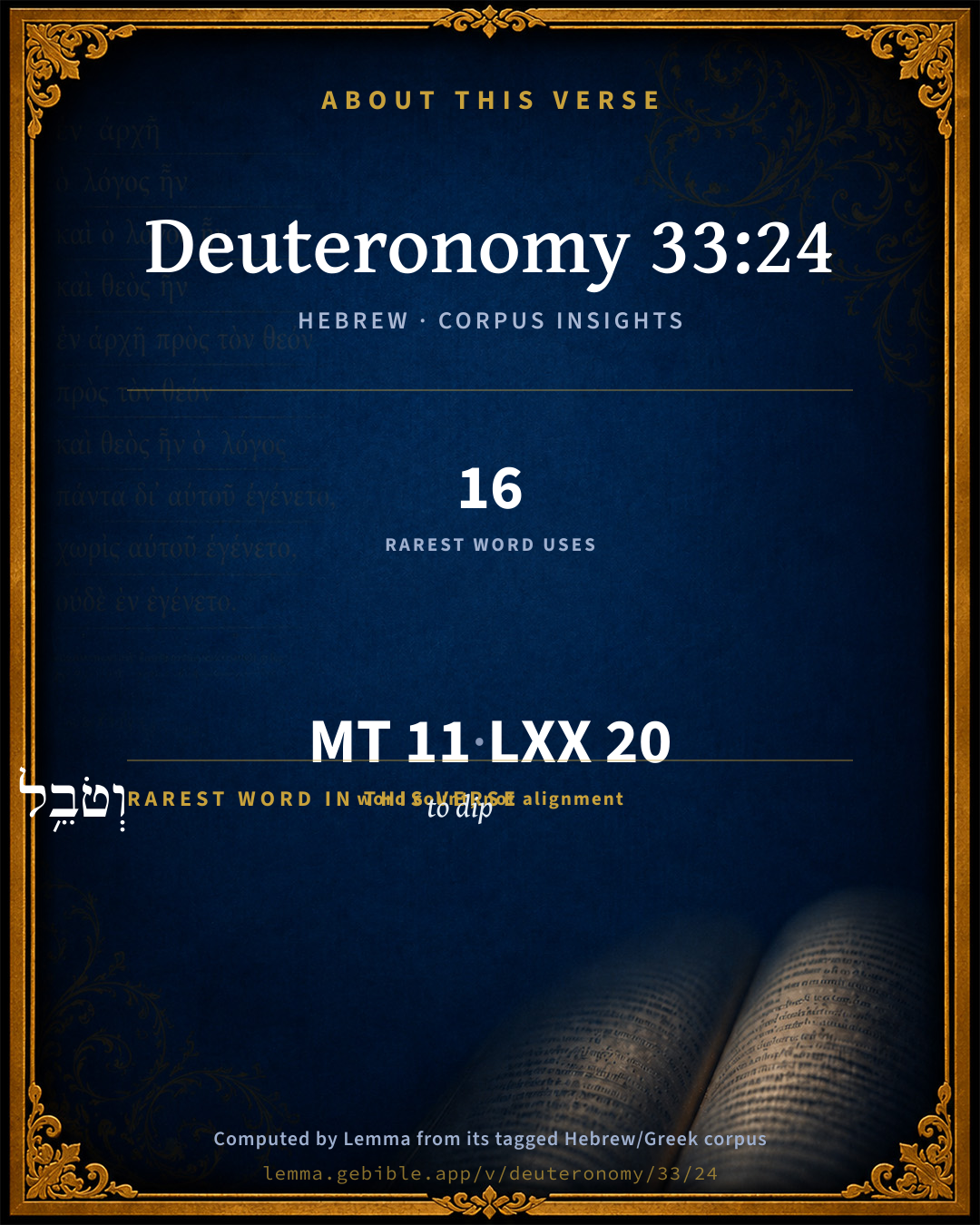
Deuteronomy 33:24

Hebrew (Westminster Leningrad Codex) Deuteronomy 33:24 appears in the Hebrew Old Testament. The text above is from the Westminster Leningrad Codex. Each word links to its Strong’s number, a concise gloss, and parsing drawn from the Open Scriptures Hebrew Bible morphology. Click any word for its full Brown-Driver-Briggs (BDB) entry.
Download image
Cite this verse

Deuteronomy 33:24 (World English Bible). Public Domain. Lemma interlinear Bible study tool, https://lemma.gebible.app/v/deuteronomy/33/24.

Show BibTeX & RIS
BibTeX
RIS
English Translation
Of Asher he said, Blessed be Asher with children; Let him be acceptable to his brothers, Let him dip his foot in oil.
World English Bible · Public Domain
Download a study sheet

One document with this verse’s original text, its word-by-word gloss line, the meaning frame, cross-references with their text, attributed commentary, and full source and license credits — printable, and it pastes into notes with its structure intact.

This verse Autodidact and up

Study sheet (.html) Plain text (.txt)

A passage Seminary Student

Up to 50 verses in one chapter. A passage sheet keeps up to 6 commentary sources and 12 cross-references per verse, in the order this page ranks them, and says so on the sheet whenever that leaves anything out. Ask for a single verse and you get the Autodidact verse sheet above.

Everything on this page stays free to read, with no account — the sheet is a download of what is already on screen, not access to it.

Want to remove ads? Support Godless Engineer
Compare translations 3

The same verse in 3 English versions, stacked beneath the original-language interlinear above. Click any original word for its lexicon entry.

Each is an independent rendering of the whole verse — the interlinear is not word-aligned to these translations.

Highlighted words mark where these versions differ — a whole-verse word diff, not a word-by-word alignment.

  • World English Bible Public Domain
    Of Asher he said, Blessed be Asher with children; Let him be acceptable to his brothers, Let him dip his foot in oil.
  • King James Version Public Domain
    And of Asher he said, Let Asher be blessed with children; let him be acceptable to his brethren, and let him dip his foot in oil.
  • unfoldingWord Literal Text CC BY-SA 4.0
    And to Asher, he said, “Blessed among sons Asher. Let him be favored his brothers, and bathe in oil his foot.

unfoldingWord Literal Text — © unfoldingWord, licensed CC BY-SA 4.0. Word-aligned USFM3 via Door43 (git.door43.org/unfoldingWord/en_ult).

Versions to compare (up to 4)

3 of 4 selected

Show all 18 translations

Every available English version of this verse, each an independent rendering of the whole verse.

  • World English Bible Public Domain
    Of Asher he said, Blessed be Asher with children; Let him be acceptable to his brothers, Let him dip his foot in oil.
  • Berean Standard Bible Public Domain
    And concerning Asher he said: “May Asher be the most blessed of sons; may he be the most favored among his brothers and dip his foot in oil.
  • Majority Standard Bible Public Domain
    And concerning Asher he said: “May Asher be the most blessed of sons; may he be the most favored among his brothers and dip his foot in oil.
  • King James Version Public Domain
    And of Asher he said, Let Asher be blessed with children; let him be acceptable to his brethren, and let him dip his foot in oil.
  • American Standard Version (1901) Public Domain
    And of Asher he said, Blessed be Asher with children; Let him be acceptable unto his brethren, And let him dip his foot in oil.
  • Revised Version (1885) Public Domain
    And of Asher he said, Blessed be Asher with children; Let him be acceptable unto his brethren, And let him dip his foot in oil.
  • Geneva Bible (1599) Public Domain
    And of Asher he saide, Asher shalbe blessed with children: he shalbe acceptable vnto his brethren, and shall dippe his foote in oyle.
  • Douay-Rheims (1899) Public Domain
    To Aser also he said: Let Aser be blessed with children, let him be acceptable to his brethren, and let him dip his foot in oil.
  • Young's Literal Translation Public Domain
    And of Asher he said: -- Blessed with sons `is' Asher, Let him be accepted by his brethren, And dipping in oil his foot.
  • Literal Standard Version CC BY-SA 4.0
    And of Asher he said: Asher [is] blessed with sons, || Let him be accepted by his brothers, || And dipping his foot in oil.
  • Unlocked Literal Bible CC BY-SA 4.0
    About Asher, Moses said: Blessed be Asher more than the other sons; let him be acceptable to his brothers, and let him dip his foot in olive oil.
  • unfoldingWord Literal Text CC BY-SA 4.0
    And to Asher, he said, “Blessed among sons Asher. Let him be favored his brothers, and bathe in oil his foot.
  • Darby Bible Public Domain
    And of Asher he said, Asher shall be blessed with sons; Let him be acceptable to his brethren, And let him dip his foot in oil.
  • World Messianic Bible Public Domain
    About Asher he said, “Asher is blessed with children. Let him be acceptable to his brothers. Let him dip his foot in oil.
  • Webster's Bible Public Domain
    And of Asher he said, Let Asher be blessed with children; let him be acceptable to his brethren, and let him dip his foot in oil.
  • Free Bible Version CC BY-SA 4.0
    To Asher he said: “May Asher be blessed more than all the other sons; may he be favored above his brothers and bathe his feet in olive oil.
  • Bible in Basic English Public Domain
    And of Asher he said, Let Asher have the blessing of children; may he be pleasing to his brothers, and let his foot be wet with oil.
  • JPS Tanakh (1917) Public Domain
    And of Asher he said: Blessed be Asher above sons; let him be the favoured of his brethren, and let him dip his foot in oil.

Literal Standard Version (2020), Covenant Press — licensed CC BY-SA 4.0. Text via the HelloAO Bible API (eBible.org). Unlocked Literal Bible (unfoldingWord) — licensed CC BY-SA 4.0. Text via the HelloAO Bible API (eBible.org). unfoldingWord Literal Text — © unfoldingWord, licensed CC BY-SA 4.0. Word-aligned USFM3 via Door43 (git.door43.org/unfoldingWord/en_ult). Free Bible Version, Dr. Jonathan Gallagher — licensed CC BY-SA 4.0. Text via the HelloAO Bible API (eBible.org).

Word by word

More ways to search: Search by grammar → Find every occurrence → Compare this word →

Practice this passage: Drill this verse → Learn its vocabulary →

וְטֹבֵ֥ל
ṭâbal
H2881
“and · dipping”
Conjunction + Verb, Qal, Participle Active, Masculine, Singular, Absolute
Part of Speech
Conjunction + Verb
Stem
Qal
Form
Participle Active
Gender
Masculine
Number
Singular
State
Absolute
Full BDB Definition

Origin: a primitive root

TWOT: 787 , 788

to dip, dip into, plunge - (Qal) - to dip in or into - to dip oneself - (Niphal) to be dipped
  1. וּלְאָשֵׁ֣ר ʼÂshêr H836 “and · to/for · Asher” Conjunction + Preposition + Noun, Proper
  2. אָמַ֔ר ʼâmar H559 “to say” Verb, Qal, Perfect, 3rd Person, Masculine, Singular
  3. בָּר֥וּךְ bârak H1288 “blessed” Verb, Qal, Participle Passive, Masculine, Singular, Absolute
  4. מִבָּנִ֖ים bên H1121 “from · sons” Preposition + Noun, Common, Masculine, Plural, Absolute
  5. אָשֵׁ֑ר ʼÂshêr H836 “Asher” Noun, Proper
  6. יְהִ֤י hâyâh H1961 “to be” Verb, Qal, Imperfect, 3rd Person, Masculine, Singular
  7. רְצוּי֙ râtsâh H7521 “pleased” Verb, Qal, Participle Passive, Masculine, Singular, Construct
  8. אֶחָ֔יו ʼâch H251 “brothers · his” Noun, Common, Masculine, Plural, Construct + Suffix, Personal, 3rd Person, Masculine, Singular
  9. בַּשֶּׁ֖מֶן shemen H8081 “in/at the · fat” Preposition, Determined + Noun, Common, Masculine, Singular, Absolute
  10. רַגְלֽוֹ regel H7272 “foot · his” Noun, Common, Feminine, Singular, Construct + Suffix, Personal, 3rd Person, Masculine, Singular

About this verse

These counts appear in no published source. They are computed here, from the morphology-tagged text and Lemma’s own curated glosses. What Lemma adds →

11
words
10
distinct lemmas
Pentateuch
section

Notable vocabulary

The rarest word here is וְטֹבֵ֥ל to dip H2881 — appearing just 16 times in the whole Hebrew Bible.

Shared distinctive vocabulary

וְטֹבֵ֥ל to dip H2881 occurs in 16 verses of the Hebrew Bible. Also found in:

Grammatical profile

  • 5 verbs
  • 6 nouns

Verb forms

  • אָמַ֔ר Qal · Perfect
  • בָּר֥וּךְ Qal · Participle Passive
  • יְהִ֤י Qal · Imperfect
  • רְצוּי֙ Qal · Participle Passive
  • וְטֹבֵ֥ל Qal · Participle Active

Repetition

A word recurs within this verse — often emphatic in Hebrew:

  • וּלְאָשֵׁ֣ר Asher H836 ×2

Hebrew & Septuagint length

In English translation the verse runs 23 words from the Hebrew and 25 from the Septuagint (LXX English) — closely comparable.

A rough comparison of the two English renderings, which tokenize alike — not a word-level alignment.

Word counts can differ between the Hebrew and the Greek without any difference in meaning — e.g. the Hebrew direct-object marker אֵת has no separate Greek word, and Greek often adds the article ὁ.

In the original languages it is 11 Hebrew tokens and 20 Greek tokens — but the two are counted differently (Hebrew bundles its prefixes and suffixes into one token; the Greek is in lemma form), so that isn’t a like-for-like length.

Cross-references

10

Topical passages linked to Deuteronomy 33:24 in the Treasury of Scripture Knowledge — connected by theme and wording, ordered by reader-vote popularity; previews shown in the World English Bible.

  • Genesis 49:20 Out of Asher his bread will be fat, He will yield royal dainties.
  • Job 29:6 When my steps were washed with butter, And the rock poured out streams of oil for me!
  • Proverbs 3:3–4 Don't let kindness and truth forsake you. Bind them around your neck. Write them on the tablet of your heart.
  • Romans 14:18 For he who serves Christ in these things is acceptable to God and approved by men.
  • Psalms 128:6 Yes, may you see your children's children. Peace be upon Israel.
  • Psalms 128:3 Your wife will be as a fruitful vine, In the innermost parts of your house; Your children like olive plants, Around your table.
  • Acts 7:10 and delivered him out of all his afflictions, and gave him favor and wisdom before Pharaoh, king of Egypt. He made him governor over Egypt and all his house.
  • Exodus 12:10 You shall let nothing of it remain until the morning; but that which remains of it until the morning you shall burn with fire.
  • Psalms 115:15 Blessed are you by Yahweh, Who made heaven and earth.
  • Romans 15:31 that I may be delivered from those who are disobedient in Judea, and that my service which I have for Jerusalem may be acceptable to the saints;

Cross-references courtesy of OpenBible.info (CC BY 4.0).

Hebrew and Greek witnesses Masoretic Hebrew ↔ Greek Septuagint

The same verse in the two great witnesses to the Old Testament, shown verse-for-verse.

These are two independent witnesses, not word-aligned to each other, and the Septuagint is shown in lemma (dictionary) form.

Hebrew Deuteronomy 33:24 Masoretic · Westminster Leningrad Codex

וּלְאָשֵׁ֣ר אָמַ֔ר בָּר֥וּךְ מִבָּנִ֖ים אָשֵׁ֑ר יְהִ֤י רְצוּי֙ אֶחָ֔יו וְטֹבֵ֥ל בַּשֶּׁ֖מֶן רַגְלֽוֹ

Of Asher he said, Blessed be Asher with children; Let him be acceptable to his brothers, Let him dip his foot in oil.

World English Bible · Public Domain

Greek LXX Deuteronomy 33:24 Septuagint · lemma form

καί ὁ ασηρ εἶπον εὐλογητός ἀπό τέκνον ασηρ καί εἰμί δεκτός ὁ ἀδελφός αὐτός βάπτω ἐν ἔλαιον ὁ πούς αὐτός

And to Aser he said, Aser is blessed with children; and he shall be acceptable to his brethren: he shall dip his foot in oil.

LXX2012 (modern English Septuagint) · Public Domain

On this verse, The Biblical Illustrator discusses the Septuagint’s reading. Read the note in Commentary ↓

Hebrew: Westminster Leningrad Codex (CC BY 4.0). Greek: Septuagint (public domain); English from LXX2012 (modern English Septuagint) (Public Domain). How the Septuagint differs from the Hebrew →

Targum (Aramaic paraphrase)

2

The Targum is the ancient Jewish Aramaic paraphrase of the Hebrew Scriptures — an interpretive translation, not the Hebrew text itself. Onkelos (literal) and Pseudo-Jonathan (expansive) render the Torah, and Jonathan the Prophets. Coverage is partial: where no permissively-licensed English translation exists for a verse, only the Aramaic is shown. This is verse-level text, not a word-by-word alignment to the Hebrew.

  1. Targum Onkelos Torah (Genesis–Deuteronomy)
    וּלְאָשֵׁר אֲמַר בְּרִיךְ מִבִּרְכַּת בְּנַיָא אָשֵׁר יְהֵי רַעֲוָא לְאַחוֹהִי וְיִתְרַבֵּי בְּתַפְנוּקֵי מַלְכִין

    (no public-domain English translation for this verse)

    Targum Onkelos — Aramaic: “Onkelos Genesis” (public domain); “Onkelos Exodus” (public domain); “Onkelos Leviticus” (public domain); “Onkelos Numbers” (public domain); “Onkelos Deuteronomy” (public domain). English: “Sefaria Community Translation” (CC0 1.0 (public-domain dedication)); “J.W. Etheridge. The Targums of Onkelos and Jonathan Ben Uzziel on the Pentateuch. London: Longmans, Green, 1862” (public domain). Text via Sefaria.

  2. Targum Pseudo-Jonathan Torah (Genesis–Deuteronomy)
    וּלְשִׁבְטָא דְאָשֵׁר בְּרִיךְ משֶׁה נְבִיָא דַיְיָ וַאֲמַר בְּרִיךְ הוּא מִבְּנַיָא דְיַעֲקב אָשֵׁר יְהֵי מַרְעֵי לְאָחוֹי וּמְסַפֵּק לְהוֹן מְזוֹנֵי בִּשְׁנֵי שְׁמִיטָתָא וּתְחוּמֵיהּ יְהֵי מַרְבֵּי זֵיתִין סַגִיעִין עָבְדִין מְשַׁח מְסַפְּקִין לְמִטְבוֹל בֵּיהּ רִיגְלוֹי

    {And Mosheh the prophet of the Lord blessed the tribe of Asher, and said:} Blessed is Asher of the sons of Jakob. He will be acceptable to his brethren, and will supply them with provender in the years of release: his border will produce many olives yielding oil, enough for him to bathe in it even his feet.

    Targum Pseudo-Jonathan — Aramaic: “Targum Jonathan on Genesis” (public domain); “Targum Jonathan on Exodus” (public domain); “Targum Jonathan on Leviticus” (public domain); “Targum Jonathan on Numbers” (public domain); “Targum Jonathan on Deuteronomy” (public domain). English: “The Targum of Jonathan ben Uzziel, trans. J. W. Etheridge, London, 1862” (public domain). Text via Sefaria.

Commentary

Notes on Deuteronomy 33:24 from classic Christian and Jewish commentators (each source and its license shown beneath its notes). The classic Christian expositions comment on the surrounding passage and are grouped to its opening verse, so a note may address several verses; the Jewish commentaries on the Tanakh (Rashi and others) are per-verse, so they appear only where the commentator wrote on this verse.

Lemma curates 59 commentaries, every one of them public domain or Creative Commons licensed, each selected and text-cleaned for this edition rather than reprinted as found. About our sources →

Trapp's Complete Commentary

John Trapp

Deu 33:24 And of Asher he said, [Let] Asher [be] blessed with children; let him be acceptable to his brethren, and let him dip his foot in oil.

Ver. 24. Let Asher be blessed with children.] Let his wife be as the vine, and his children as olive plants, two of the best fruits; {Psa 128:3} the one for cheering the heart, the other for clearing the face; {Psa 104:15} the one for sweetness, the other for fatness. {Jdg 9:9; Jdg 9:13}

Let him dip his foot in oil.] Like that of Job. {Job 29:6} Compare Gen 49:20. {See Trapp on "Gen 49:20"}

John Trapp, A Commentary or Exposition upon All the Books of the Old and New Testament (1647–1656) — public domain. Text from a community e-Sword module.

The Biblical Illustrator

Joseph S. Exell

Deu_33:24-25

Let Asher be blessed.

Asher

Asher signifies happiness, or prosperity, and was given by Leah to the son of her handmaid Zilpah, in token of the joy which this new gift of God had brought to her wounded heart (Gen_30:13). In this blessing of Moses there is manifestly a play upon the name thus given. It is treated as a good and true omen concerning Ashers temporal lot. The next line, Let him dip his feet in oil, is a prediction of the exceeding richness and fertility of Ashers territory in the promised land. Jacob had already foretold the same thing in his dying prophecy (Gen_49:20). Fatness is to an Oriental the quality which chiefly recommends any viand. Olive oil, butter of kine, and the animal fat which is lodged in the curiously overgrown tail of a Syrian sheep, are to this day the peculiar dainties of Eastern cookery, and all of these were produced in abundance on the land which fell by lot to this favoured tribe (Deu_8:7-9). The figure by which Asher is here said to dip his foot in oil is a familiar Eastern idiom to describe the overflowing abundance of all these natural productions of the soil. Job uses it in precisely the same way (Job_29:6). The fourth line of the blessing is certainly meant to be parallel with the third line in its reference to some natural feature of the territory reserved for Asher in Canaan; but the exact force of the reference is still a matter of dispute amongst the learned. Some would read the line as it stands in the margin: Under thy shoes shall be iron and brass (i.e. copper)

; and this would be a perfectly the description of the mineral wealth of a part of the mountain range which Asher ought to have occupied, but which he abandoned to the Zidonians, who very diligently dug out the metals above named from their subterranean veins. Moses had noted this feature of the soil of Canaan (Deu_8:9). But in all likelihood the notion of shoes is quite foreign to the true interpretation of this part of the blessing; and the Hebrew word which suggested it alike to the Septuagint and English translators should properly be rendered thy bars, or, thy bolts. Here, again, we find a very graphic poetical description of Ashers lot in the promised land. His boundary is traced on its landward side by strongly-marked mountain ridges; and on the west these barriers run out into the sea in successive capes, that resemble the traverses of some titanic fortification, and which are as rugged and ironbound in aspect as the inland region which they protect is smiling and soft. If this allusion be recognised in Moses blessing, the intention will plainly be to suggest the security of Asher in the portion which God was about to bestow upon him. There he should be fenced in, as it were, by bolts of iron and bars of brass, which no envious foe should be able to break through with hostile or thievish intent. This interpretation of the fourth line in the blessing would almost lead us to prefer the following amongst the many renderings that have been given of the fifth line: According to thy life shall be thy rest; that is, Ashers repose from warlike labours and alarms should continue as long as his tribal existence. But the associations which long attached to the rendering as given in the English Bible will probably make most readers reluctant to give up the thought which many a sermon and hymn will have endeared and familiarised: As thy days shall be thy strength--that is, the strength of him whom God favours shall always be in proportion to his need (1Co_10:13; 2Co_12:9). One could wish that the actual history of Asher furnished a happy comment upon, and illustration of, his blessing as thus interpreted; but in truth the comparison of prophetic poetry and prosaic fact in this particular instance is full of suggestive disappointment. Asher did dwell securely for a certain period within his mountain barriers, and his sons seem to have enjoyed a long season of material prosperity; but this was not through their trust in Divine protection, but through their own subtle worldly policy, which involved, alas, the faithless surrender of their highest duty to God. The men of Asher deemed it too hard a task to drive out the Phoenicians and Canaanites whom they found in possession of the strong cities and fat valleys of their portion. God would indeed have helped them utterly to exterminate their heathen rivals; but they preferred to make a cowardly truce and compromise, by virtue of which they dwelt peaceably among the Canaanites, the inhabitants of the land (Jdg_1:31-32). Nor did Asher from that time forward ever redeem the shame of his dishonourable compact with foes whom he ought to have destroyed. The very name of the tribe almost vanishes from the page of Hebrew history, and it had better have been absent altogether than conspicuous as it is in the bitterly scornful allusion of Deborah (Jdg_5:17-18). Yet the name of Asher is not, like that of Dan, blotted with hopeless ignominy from the list of Gods redeemed. A woman of this tribe, Anna, the centenarian prophetess of Jerusalem, was among the first to hail the infant Saviour, and to give thanks for His salvation unto the Lord (Luk_2:36-38). Though the majority of the tribe perished through worldly conformity and ease-loving apostasy from the covenant of God, yet the blessing of Moses upon Asher was not wholly forfeited nor unfulfilled. Let the lesson of this story be for our instruction in the dangers of temporal prosperity, even for the Lords elect, and no less in the meaning of those reverses of earthly fortune by which the backslidings of the chosen people are continually chastised. When Asher forgets the covenant of his Redeemer, the Lord, the Lord of hosts, will send among his fat ones leanness, and under his glory He will kindle a burning like the burning of a fire; but even in those experiences of well-deserved, correction and adversity, the soul that God has favoured and pronounced blessed shall not be abandoned to utter ruin. As his days, so his strength shall be (Isa_10:16-21). (T. G. Rooke, B. A.)

The Biblical Illustrator, edited by Joseph S. Exell (c. 1880s–1900s) — public domain. Text from a community e-Sword module.

Joseph Benson's Commentary

Deu 33:24. Let Asher — Who carries blessedness in his very name; be blessed with children — He shall have numerous, strong, and healthful children. Acceptable to his brethren — By his sweet disposition and winning carriage. In oil — He shall have such plenty of oil that he may not only wash his face, but his feet also in it. This prophetic blessing was remarkably fulfilled; for Asher’s portion abounded with the best and most remarkable oil, which was the most famed of all Canaan’s productions. Compare Job 29:6, and Gen 49:20.

Joseph Benson's Commentary on the Old and New Testaments (1811–1818) — public domain. Text from a community e-Sword module.

Tyndale Open Study Notes

Tyndale Open Resources

33:24 Asher was the younger of two sons of Jacob by Leah’s servant Zilpah (Gen 30:12-13). The name means “happy” or “blessed,” evident in the abundance of olive oil from the orchards that cover the lower Galilean hills and Mount Carmel, as well as the security from danger that these hills and other natural formations provided (Deut 33:25).

Tyndale Open Study Notes — © Tyndale Open Resources, licensed CC BY-SA 4.0. Text via the HelloAO Bible API.

Jamieson, Fausset & Brown

Robert Jamieson, A. R. Fausset & David Brown

of Asher he said--The condition of this tribe is described as combining all the elements of earthly felicity.

dip his foot in oil--These words allude either to the process of extracting the oil by foot presses, or to his district as particularly fertile and adapted to the culture of the olive.

Jamieson, Fausset & Brown — Commentary Critical and Explanatory on the Whole Bible (1871) — public domain (CC PDM 1.0). Text via the HelloAO Bible API.

Adam Clarke's Commentary

Verse 24. Let Asher be blessed with children] Let him have a numerous posterity, continually increasing.

Let him be acceptable to his brethren] May he be in perfect union and harmony with the other tribes.

Let him dip his foot in oil.] Let him have a fertile soil, and an abundance of all the conveniences and comforts of life.

Adam Clarke's Commentary on the Bible (1810–1826) — public domain. Text from a community e-Sword/MySword module.

Ellicott's Commentary for English Readers

(24) Let Asher be blessed with children.—It can be translated “more blessed than all sons.” Rashi quotes an old saying, “You will not find among all the tribes one so blest with children as Asher, and I cannot say why.”

Let him be acceptable to his brethren, and . . . dip his foot in oil.—The fertility of Asher’s inheritance is probably alluded to. There is no tribe of which so little is recorded in history. The happiest lives are sometimes the least eventful.

A Bible Commentary for English Readers, edited by Charles John Ellicott (1878–1897) — public domain. Text from a community e-Sword module.

The Cambridge Bible for Schools and Colleges

gen. ed. J. J. S. Perowne

24. at thine own pleasure] or appetite, Deu_12:20, Deu_14:26. Thy fill, which in Heb. follows this clause, may be a gloss on it.

vessel] Heb. keli (Deu_22:5 garment), a sack (Gen_43:11, 1Sa_17:40) or pot.

24 And of Asher he said:

Blessed above sons be Ashér,

Be the favoured of his brethren,

And be dipping his foot in oil.

25 Iron and brass be thy bars,

And thy strength as thy days.

Asher lay W. of Naphtali on the same range and enjoyed similar fertility, cp. Gen_49:20 : ‘I know not if there be in all antiquity a more finished picture’ (Geddes).

24. Blessed above sons be Asher] As in R.V. marg., cp. Jdg_5:24.

in oil] All the Galilean highlands were famous for their olives. ‘It is easier to raise a legion of olives in Galilee than to bring up a child in Palestine’ (Bereshith Rabba, 20).

The Cambridge Bible for Schools and Colleges (gen. ed. J. J. S. Perowne; Cambridge University Press, 1878–1918) — public domain. Text from a community e-Sword module.

John Gill's Exposition

Thy shoes shall be iron and brass,.... Either they should have such an abundance of these metals, that they could if they would have made their shoes of them; but that is not usual; though it is said of Empedocles (g) the philosopher, that he wore shoes of brass, which was very singular; and some think that this tribe, because of the abundance of these metals, used to stick their shoes with iron and brass nails at the bottom of them, as country people, soldiers, and travellers in various nations do; but the true sense seems to be, that the land that fell to this tribe, and on which they trod, should yield much iron and brass; as in Carmel, a mountain on the borders of it, brass was taken, as says Hesychius; and Zidon is by Homer (i) said to abound with brass, which belonged to this tribe; and Sarepta, another city in it, had its name from which signifies to melt, from the melting of these metals in it; see Deu 8:9; though some Jewish writers take the sense to be, that the land of Asher was so strongly fortified as if it had been enclosed with walls of brass and iron, or the gates of its cities were shut up with bolts and bars of iron and brass, as Jarchi, Kimchi, and Ben Melech observe; so the Arabic:

and as thy days, so shall thy strength be; the same in old age as in youth; which is the sense of the Latin Vulgate version, and all the Targums: such were the vigour and strength of. Moses himself, Deu 34:7; and so may denote a renewal of youth, like that of eagles; and, in a spiritual sense, a revival of the graces of the Spirit of God, as to the exercise of them, and an increase of spiritual strength, so that the inward man is renewed day by day; and may also denote such a measure of strength given, as is proportioned to the events that daily befall, or to the services and sufferings men are called unto; see Co1 10:13.

(g) Laert. in Vit. Empedocl. l. 8. p. 613. Aelian. Var. Hist. l. 12. c. 32. (i) Odyss. 15. l. 424.

John Gill's Exposition of the Whole Bible (1746–1763) — public domain (CC PDM 1.0). Text via the HelloAO Bible API.

Albert Barnes' Notes on the Bible

Rather, “Blessed above the sons” (i. e. of Jacob-most blessed among the sons of Jacob) “be Asher; let him he the favored one of his brethren,” i. e., the one favored of God. The plenty with which this tribe should be blessed is described under the figure of dipping the foot in oil (compare the marginal reference).

Albert Barnes' Notes on the Bible (1834–1885) — public domain. Text from a community e-Sword/MySword module.

Haydock's Catholic Bible Commentary

Blessed. He alludes to the name of Aser, which has this signification. (Haydock) --- This tribe had been upon the increase in the desert, (Calmet) and now comprised 53,000 warriors. (Haydock) --- The province of Galilee, where Aser dwelt, was one of the most fertile of all Chanaan, and noted for abundance of oil, Genesis xlix. 20. (Josephus, Jewish Wars iii. 2., and ii. 22.) (Calmet) --- Oil. So Job (xxix. 6,) says, When I washed my feet with butter. (Menochius)

George Leo Haydock (1774–1849), Haydock's Catholic Family Bible and Commentary, 1859 edition — public domain. Excludes Psalms (Douay-Rheims chapter numbering differs from Protestant) and Deuterocanonical books (Catholic canon only).

Matthew Poole's English Annotations

He shall have numerous, and those strong, and healthful, and comely, children. Or, shall be blessed or praised of or above the sons, i.e. the other sons of Israel, or his brethren, as it here follows, i.e. his portion shall fall in an excellent part, where he may have the benefits both of his own fat soil, and of the sea, by his neighbours Tyrus and Sidon.

Acceptable to his brethren; by his sweet disposition and winning carriage, and communication of his excellent commodities to his brethren, he shall gain their affections.

Let him dip his foot in oil; he shall have such plenty of oil, that he may not only wash his face, but his feet also, in it. Or, the fatness and fertility of his country may be expressed by oil, as Job 29:6. And so it agrees with Jacob’s blessing of him, Gen 49:20.

Matthew Poole's English Annotations on the Holy Bible (1683–1685) — public domain. Text from a community e-Sword/MySword module.

Whedon's Commentary on the Bible

Daniel D. Whedon

24. Let Asher be blessed with children — Better, Let Asher be most blessed among the sons. Let him have the prominence in blessing above all the other sons of Jacob.

Let him dip his foot in oil — The rabbins used to say that in Asher oil flows like a river. Both the Syrians and Phoenicians obtained their supply of oil from Galilee. Comp. 1Ki_5:11.

Daniel D. Whedon (gen. ed.), Commentary on the Old and New Testaments (1874–1909) — public domain. Text from a community e-Sword module.

The Pulpit Commentary

Vers. 24, 25. Asher, the prosperous one, as his name implies, was to be rich, and honored, and strong, and peaceful. Blessed with children; rather, blessed among the sons; i.e. either blessed more than the rest of the sons, or blessed by the sons who were to reap benefit from him. From what follows, the latter explanation seems the one to be preferred. The preposition mi is constantly used as indicating the source whence anything proceeds, or the agent by whom anything is done. Let him be acceptable to his brethren; "iis e tetras suae proventibus res optimas suppeditaturus;" (Gen_49:20) (Rosenm This tribe should find itself in so advantageous and luxurious a condition that the ether tribes should have delight and pleasure in it" (Knobel). Others render, "favored among his brethren;" favored, that is, by the Lord more than his brethren (Keil). But the former seems preferable. And let him dip his foot in oil. This points to a land abounding in olives, and generally richly fertile, a fat land and yielding rich dainties, such as Jacob promised to Asher. (Gen_49:20) Thy shoes shall be iron and brass. The word rendered "shoes" (lnmi) occurs only here. It is a derivative from ln; to bolt or shut fast, and is to be taken in the sense of a fastness or fortress, a place securely closed: iron and brass shall be thy fortress; i.e. his dwelling should be strong and impregnable. The rendering" shoes" is from a supposed derivation of the word from ln, a shoe. As thy days, so shall thy strength be; literally, as thy days, thy rest; i.e. as long as thou livest, so long shalt thou have rest and quiet. The noun rendered "strength" (abedo) in the Authorized Version. occurs only here, unless it be found in the proper name ab; dym, (Me-deba), and has no Cognate in Hebrew; but the Arabic supplies a root for it in (deba), to rest. Furst connects it with bz; and the Targum with aw; D, to flow, and translates by "riches.

Vers. 24, 25. Asher"s blessing; strength as the day.

There are several features in this blessing to Asher. He is to have a numerous seed: to enjoy above his brethren the favor of the Lord; to be surrounded with plenty; to be guarded with bars of iron and brass; and to have strength according to the days. (The Hebrew word translated "days" is so rendered or explained by the Targum, Boothroyd, and Parkhurst. The LXX render it ijscuv: the French version has it to force; Gesenius renders it "rest." In this Homily we follow the LXX, and accept our translation, "strength.") However great the temporal blessings may be which are here promised to Asher, this last-named one is surely the greatest of all, yea, greater than any merely earthly blessings could possibly be. And perhaps there is no promise of God"s Word which has more deeply touched the hearts of his people, or more frequently proved itself a balm in care, than this one. For that it was made to Asher first, need not shut off any child of God from taking the comfort of it. There is a distinct promise made to Joshua, "I will not fail thee, nor forsake thee;" but yet the writer of the Epistle to the Hebrews bids the people whom he is addressing to make that promise their own. And so assuredly may the people of God in every age and land do with the promise before us. They have done so hitherto, and will do so till the end. Let us meditate on it now, presenting, as it does, this topicStrength promised for the day.

I WHAT DOES THE PROMISE INCLUDE? It suggests truths of which we are often reminded, viz.: That we have to live by the day. In one sense we can do no otherwise. We can never with certainty look over the rim of one day so as to see what will happen tomorrow. Then each day has its own peculiar alternations and variations of light and shade. One day all is smiling; the next, perchance, all is in gloom. Every hour, every place has "hues of its own fresh borrowed from the heart." Consequently, each day bring, s its own demands with it. And for each day we require new selfadaptedness. Moreover, the strength of each day will not serve for the next. Now, these are the facts which this promise is intended to meet. How does it meet them?

1. It assures us of strength as varied as the day. Whatever kind of strength is wanted, that kind of strength will be given whether for work or war, pain or sickness, poverty or temptation, bereavement or death. "They that wait on the Lord shall renew i.e. change their strength.

2. It is a promise of strength as sure as the day. No day shall come without its due measure of might to enable us to meet its demands. He who hath taught his children to cry, "Give us day by day our daily bread," in teaching them so to pray reveals his purpose to fulfill the prayer he has taught. We shall never find a day when the Savior"s grace is a-wanting.

3. It pledges strength as long as the days shall last. So long as any demands are made upon us, so long will God"s grace be sufficient to enable us to meet them. We need not look wistfully and anxiously ahead. Our Father cares. One whose words are more to us than thousands of gold and silver has said, "Take no thought for the morrow," etc. And an inspired writer has given us an impregnable argument, "He that spared not his own Son, but delivered him up for us all, how shall he not with him also freely give us all things?" But let us inquire

II WHAT IT IS WHICH GIVES THIS PROMISE A SPECIAL VALUE? "As thy days, so shall thy strength be." The words remind us of a picture drawn by Mrs. Stowe, in "Uncle Tom"s Cabin," of a slave weary and worn with toiling in the sultry sun. One quotes the words, "Come unto me all ye that labor and are heavy laden, and I will give you rest!" "Them"s good words," is the reply, but who says em?" Obviously all depends on that so it is here. The words are said by

1. One who knows what our days will be.

2. One who orders our days.

3. One who measures our days.

4. One who loved us from everlasting days.

5. One whose love changes not with the days.

6. One who has infinite resources on which we can draw throughout the days.

7. One whose love as revealed in Christ is a pledge that he will be with us to the end of the days.

Is anything wanting to heighten the value of a promise if it comes from such a Promiser?

III OUGHT NOT SUCH A PROMISE TO HAVE GREAT POWER OVER US? Yea, verily. A triple power.

1. It should stimulate to holy obedience.

2. It should prepare us to look onward with holy calmness. "I will trust, and not be afraid.

3. It should embolden us to meet emergencies with a valiant heart.

4. It should lead us to look upward with a waiting, expectant eye.

Vers. 24, 25. The comprehensive benediction of Asher.

No one can read this series of poetical benedictions without cherishing the conviction that Moses "spoke as moved by the Holy Ghost." The peculiar fitness of his aspirations for the future exigencies of the tribes, and his clear foresight of their distant fortunes, indicate unmistakably that a supernatural light suffused his understanding. This benediction of the dying prophet foretokens

I NUMERICAL INCREASE. By a natural law of God"s providence, rapid increase of the people is a fruit of material prosperity. When scarcity of food is a permanent condition, infanticide prevails, or children perish for lack of nutritious food. This increase of children was, in former times, a distinct token of God"s favor, and a frequent subject of promise. As the numbers of Israel increased, so would their strength to resist aggression. It was when Israel"s numbers were diminished by intestine wars, that the Eastern potentates gained decisive triumphs. Occupying, as Asher did, the extreme north-west of Canaan, numerical increase was a source of defensive strength. To the Christian parent to the Church, children are a blessing. "Happy they who have their quiver full" of these Divine arrows.

II THERE IS SET FORTH SOCIAL REPUTATION AND GOOD WILL. "Let him be acceptable to his brethren." So long as the tribal relationship was maintained in strength, there was a constant danger of mutual jealousies and animosities. Occasionally this evil passion took fire and broke into open flame. From tribal suspicion and dislike Asher would be free. It is an honor and a joy to live in the esteem and good will of brethren. The outward reach of influence is enlarged. Life is felt to have nobler interests. The better part of human nature finds development.

III THERE IS FORESHADOWED AGRICULTURAL PROSPERITY. Upon the northern hills of Palestine the olive tree flourishes, and authorities affirm that no agricultural produce is so abundant and so remunerative as that of the olive. It is hardy, will flourish in rocky soil, and attains venerable age. Its fruit is valuable, is utilized for domestic purposes, and has always been a staple commodity of commerce. So prolific were the olives of Asher to become, that the people should have, not only the head, but the feet also, in the abundant oil; or the language may be designed as a bold figure, to indicate that so full should be the oil-vats at the base of every olive-clothed hill, that the very land should seem to be foot-deep in golden oil.

IV THERE IS PREDICTED IMPREGNABLE DEFENSE. The poetical imagery here may be better translated, "Thy bars shall be iron and brass." It may be that these metals were found in veins among the hills, or rather iron and copper, it may that the gates of their cities were, in some cases, fashioned with these metals. Doors and gates of iron are still to be seen in the district of Bashan. But it is better to treat the language as elegant imagery, to indicate the matchless strength of Asher"s fortresses. Over all her internal wealth there shall be a sure defense. The Chaldee paraphase reads, "Thou shalt be strong and bright, like iron and brass.

V THERE IS PLEDGED INTERNAL STRENGTH PROPORTIONED TO NEED. "As thy days, thy strength." A precious promise this of universal application. Our days are under Divine inspection; our circumstances are under Divine control. It is better for the man every way that his strength should be increased than that the trial should be abated. The outcome is that the man emerges stronger, nobler, more highly developed. The supply is always adjusted to the particular need. God is the model of frugal economy. In his administration there is no waste. But there would be waste if the supply of strength daily given were in excess of the requirement. This would be a blot upon his wisdom. What should we say of the water company that sent daily into our houses ten times the quantity of water that is required? Or, what advantage would it be to us if the supply of light from the sun daily were a hundredfold in excess of this world"s need? Our God is perfect wisdom, as well as infinite love. Strength shall be supplied, not in superabundant waste, but in exact proportion to our need. "As our days, our strength." The infant would be crushed with the strength of the full-grown man. D.

The Pulpit Commentary (1880–1919), ed. H.D.M. Spence-Jones & Joseph S. Exell — public domain. Text from a community e-Sword module.

John Wesley's Explanatory Notes

Let Asher - Who carries blessedness in his very name, be blessed with children - He shall have numerous, strong and healthful children. Acceptable to his brethren -- by his sweet disposition and winning carriage. In oil - He shall have such plenty of oil that he may not only wash his face, but his feet also in it.

John Wesley, Explanatory Notes Upon the Whole Bible (1754–1765) — public domain. Text via the GEBible commentary corpus.

Keil & Delitzsch

C. F. Keil & F. Delitzsch

Asher. - "Blessed before the sons be Asher; let him be the favoured among his brethren, and dipping his foot in oil. Iron and brass be thy castle; and as the days of thy life let thy rest continue." Asher, the prosperous (see at Gen 30:15), was justly to bear the name. He was to be a child of prosperity; blessed with earthly good, he was to enjoy rest all his life long in strong fortresses. It is evident enough that this blessing is simply an exposition of the name Asher, and that Moses here promises the tribe a verification of the omen contained in its name. מבּנים בּרוּך does not mean "blessed with children," or "praised because of his children," in which case we should have בּניו; but "blessed before the sons" (cf. Jdg 5:24), i.e., blessed before the sons of Jacob, who were peculiarly blessed, equivalent to the most blessed of all the sons of Israel. אחיו רצוּי does not mean the beloved among his brethren, acceptable to his brethren, but the one who enjoyed the favour of the Lord, i.e., the one peculiarly favoured by the Lord. Dipping the foot in oil points to a land flowing with oil (Job 29:6), i.e., fat or fertile throughout, which Jacob had already promised to Asher (see Gen 49:20). To complete the prosperity, however, security and rest were required for the enjoyment of the blessings bestowed by God; and these are promised in Deu 33:25. מנעל (ἅπ. λεγ.) does not mean a shoe, but is derived from נעל, to bolt (Jdg 3:23), and signifies either a bolt, or that which is shut fast; a poetical expression for a castle or fortress. Asher's dwellings were to be castles, fortresses of iron and brass; i.e., as strong and impregnable as if they were built of iron and brass. The pursuit of mining is not to be thought of as referred to here, even though the territory of Asher, which reached to Lebanon, may have contained brass and iron (see at Deu 8:9). Luther follows the lxx and Vulgate, and renders this clause, "iron and brass be upon his shoes;" but this is undoubtedly wrong, as the custom of fastening the shoes or sandals with brass or iron was quite unknown to the Israelites; and even Goliath, who was clothed in brass from head to foot, and wore iron greaves, had no iron sandals, though the military shoes of the ancient Romans had nails in the soles. Moreover, the context contains no reference to war, so as to suggest the idea that the treading down and cursing of the foe are intended. "As thy days," i.e., as long as the days of thy life last, let thy rest be (continue). Luther's rendering, "let thine old age be as thy youth," which follows the Vulgate, cannot be sustained; for although דּבא, derived from דאב, to vanish away, certainly might signify old age, the expression "thy days" cannot possibly be understood as signifying youth.

Keil & Delitzsch — Biblical Commentary on the Old Testament (1861–1891) — public domain (CC PDM 1.0). Text via the HelloAO Bible API. (Old Testament only.)

unfoldingWord translationNotes

Door43 World Missions Community

General Information:

Moses continues to bless the tribes of Israel; the blessings are short poems. (See: Parallelism)

dip his foot in olive oil

Olive oil was used for food and for the skin of the face and arms. Feet were dirty, so to put the foot in olive oil was to ruin valuable oil. The full meaning of this statement can be made clear. AT: "have so much olive oil that he can afford to waste it" (See: Assumed Knowledge and Implicit Information)

your city bars ... your days ... your security

Moses speaks to the tribe of Asher as if they are one man, so all instances of "your" are singular. (See: Forms of You)

May your city bars be iron and bronze

Cities had large bars across their gates to keep enemies out. The meaning of this statement can be made clear. AT: "May you be safe from attacks by your enemies" (See: Assumed Knowledge and Implicit Information)

translationWords

bless

Asher

olive

oil

bronze

unfoldingWord translationNotes — © Distant Shores Media and the Door43 World Missions Community, licensed CC BY-SA 4.0. Source: git.door43.org/Door43/en_tn.

Rashi

Rabbi Shlomo Yitzchaki (Rashi)

ברוך מבנים אשר LET ASHER BE BLESSED AMONG SONS (or, “on account of sons”) — I have found in the Sifrei Devarim 355:19 the following: You will find none of the tribes who was so blessed with children as Asher, but I do not know how this was so.

יהי רצוי אחיו LET HIM BE ACCEPTED OF HIS BRETHREN — and this was so for he pleased (רצה) his brother-tribes with oil of unripe olives (used for anointing the body) and fine fruits, and they paid him (רצה) with grain. — Another explanation of יהי רצוי אחיו HE WILL BE ACCEPTABLE TO HIS BRETHREN — because his daughters were beautiful (and were much sought in marriage), and this is what is stated in Chronicles (1 Chronicles 7:31) [”The sons of Asher … Malchiel] who was the father of ברזית”, which is explained to mean: that his daughters were married to High Priests and Kings who were anointed with olive oil (זית) (Genesis Rabbah 71:10; cf. Rashi on this verse).

וטבל בשמן רגלו AND LET HIM DIP HIS FOOT IN OIL — it means that his land flowed with oil as a fountain: once it happened that the people of Laodicia were in need of oil; they appointed an agent (to purchase a large quantity and were able to do so only at a city of Asher; see Rashi on Genesis 49:20), as it is related in Menachot 85b.

Rashi on the Tanakh — English translations: “The Judaica Press complete Tanach with Rashi, translated by A. J. Rosenberg” (CC BY 4.0); “Pentateuch with Rashi's commentary by M. Rosenbaum and A.M. Silbermann, 1929-1934” (public domain); “The Metsudah Tanach series, Lakewood, N.J” (CC BY 4.0); and “The Book of Joshua, Metsudah Publications, 1997” (CC BY 4.0). Text via Sefaria.

Ramban (Nachmanides)

Rabbi Moshe ben Nachman (Ramban / Nachmanides)

BLESSED ‘MIBANIM’ BE ASHER. If the letter mem [in the word mibanim] serves to signify greater status [meaning that Asher is singled out from among the tribes for greater blessing] as indicated by the mem in these expressions: blessed ‘minashim’ (from among all other women) shall Jael be; they [the ordinances of the Eternal] are to be desired ‘mizahav’ (more than gold), yea ‘umipaz rav’ (even more than much fine gold), and other similar expressions — then one may wonder: how could Moses diminish the rest of the tribes by saying that Asher be blessed more than all the sons of Jacob? Moreover [if such was his intent], his blessing was not fulfilled, for it did not come to pass. And Rashi wrote: “I have seen in the Sifre: 355. ‘You will find none of the tribes as blessed with children as Asher.’ But I know not how this was so.” Now, our Rabbis meant to explain blessed ‘mibanim’ that Asher be blessed with the many children that he will beget, similar to the usage of the letter mem in the expression Blessed of the Eternal be his land, ‘mimeged’ (of the precious things) of heaven, ‘mital’ (of the dew). Therefore, the Rabbis said that Moses blessed all the rest of the tribes with strength or with their inheritance, and Asher alone was blessed with children. And our textual version of the Sifre 355. reads: “You will find no one who was as blessed with children as Asher.” But how this blessing was fulfilled has not been explained. Perhaps it relates to what is written in [the Book of] Chronicles, All these were the children of Asher, heads of the fathers’ houses, choice and mighty men of valor, chief of the princes. And the number of them reckoned by genealogy for service in war was twenty and six thousand men. Such praise is not mentioned there about the rest of the tribes.In line with the simple meaning of Scripture, Blessed ‘mibanim’ be Asher is similar to the blessing let him be the favored of his brethren, the verse stating that Asher be blessed by all the sons of Jacob their father and be favored by all his brothers. The reason is that his land is rich and from there will come all royal dainties for all the tribes, and they will all constantly say, “May G-d bless this land which brings forth such fruits.” The letter mem in the word mibanim will be like the mem in: ‘mei’Hashem’ (‘from’ the Eternal) proceedeth the thing;, 24:50. ‘mei’E-il’ (‘from’ the G-d of) thy father, 49:25. [so that our verse means: “Blessed will be Asher ‘from’ the sons” of Jacob].And Onkelos translated: “The blessing of Asher will be from the blessings of the sons” [of Jacob]. It appears that Onkelos meant to say that all of the tribes will come to Asher to buy oil, and Judah, and the Land of Israel, will be his merchants for wheat of Minnith, and balsam, and honey, and oil and all choice fruits of the land all of which they will bring to sell him, and they will buy oil. Thus Asher will be blessed with all the delicacies available to all the tribes, this being the sense of the expression favored of his brethren, for they will sell to him and buy from him what they desire. Then I found in Bereshith Rabbah: “And Leah said: ‘For my happiness! for daughters will call me happy,’ [and she called his name Asher]. Rabbi Levi said: In all his days Asher never lodged in an inn. as meaning “in my resting place,” i.e., in my home, from the Aramaic root sharah, meaning “resting.” Asher inherited palaces on the heights, [heights great in area] more than the land inherited by Judah. The sons of Asher: Imnah, and Ishvah and Beriah, and Serah their sister. [And the sons of Beriah: Heber, and Malchiel,] who was the father of Birzaith. Rabbi Levi and Rabbi Simon said [with reference to the name Birzaith which contains the word zayith — olive] that the daughters of Asher were beautiful, and they were married to priests contains the word melech — king. Rashi here quotes both: “his daughters were married to High Priests and kings who were anointed with olive oil.” See Exodus 30:33 (Vol. II, pp. 531-533). who were anointed with olive oil etc.”

Ramban (Nachmanides) on the Tanakh — English translation: “Commentary on the Torah by Ramban (Nachmanides). Translated and annotated by Charles B. Chavel. New York, Shilo Pub. House, 1971-1976” (CC BY 4.0). Text via Sefaria.

Lesson kit

Teaching starters — assembled from the data on this page, not authored interpretation. Every prompt links to the verse data it draws on. Edit before teaching.

Deuteronomy, in the Pentateuch, opens this verse with 11 words (10 distinct Hebrew lemmas). Its most distinctive word is ṭâbal (“to dip”). A historical commentator’s framing appears above. Read the whole chapter for the surrounding context.

Discussion questions

  1. How does “to dip” (ṭâbal) shape what this verse is saying?
  2. How does Genesis 37:31, which shares the word «to dip», read alongside this verse?
  3. What does the repetition of “Asher” (2× in this one verse) do in this verse?
  4. The translations on this page render this verse differently — a whole-verse word diff, not a word-by-word alignment. What might account for the different wordings?
  5. «אָמַ֔ר» is a Qal Perfect verb. How does that grammatical form shape the action described?
  6. Compare how Trapp's Complete Commentary and The Biblical Illustrator read this verse. Where do they agree or differ?

Things to notice

Reading settings

Reading text

Shown beneath each verse's original-language words.

Old Testament
Old Testament edition

Read the OT as the Masoretic Hebrew (MT) or the Greek Septuagint (LXX).

English shown for the Greek Septuagint (in the Hebrew ↔ Greek comparison).

Comparing translations? Open the Compare panel on any verse page to stack up to four side by side.