
Deuteronomy 30:16

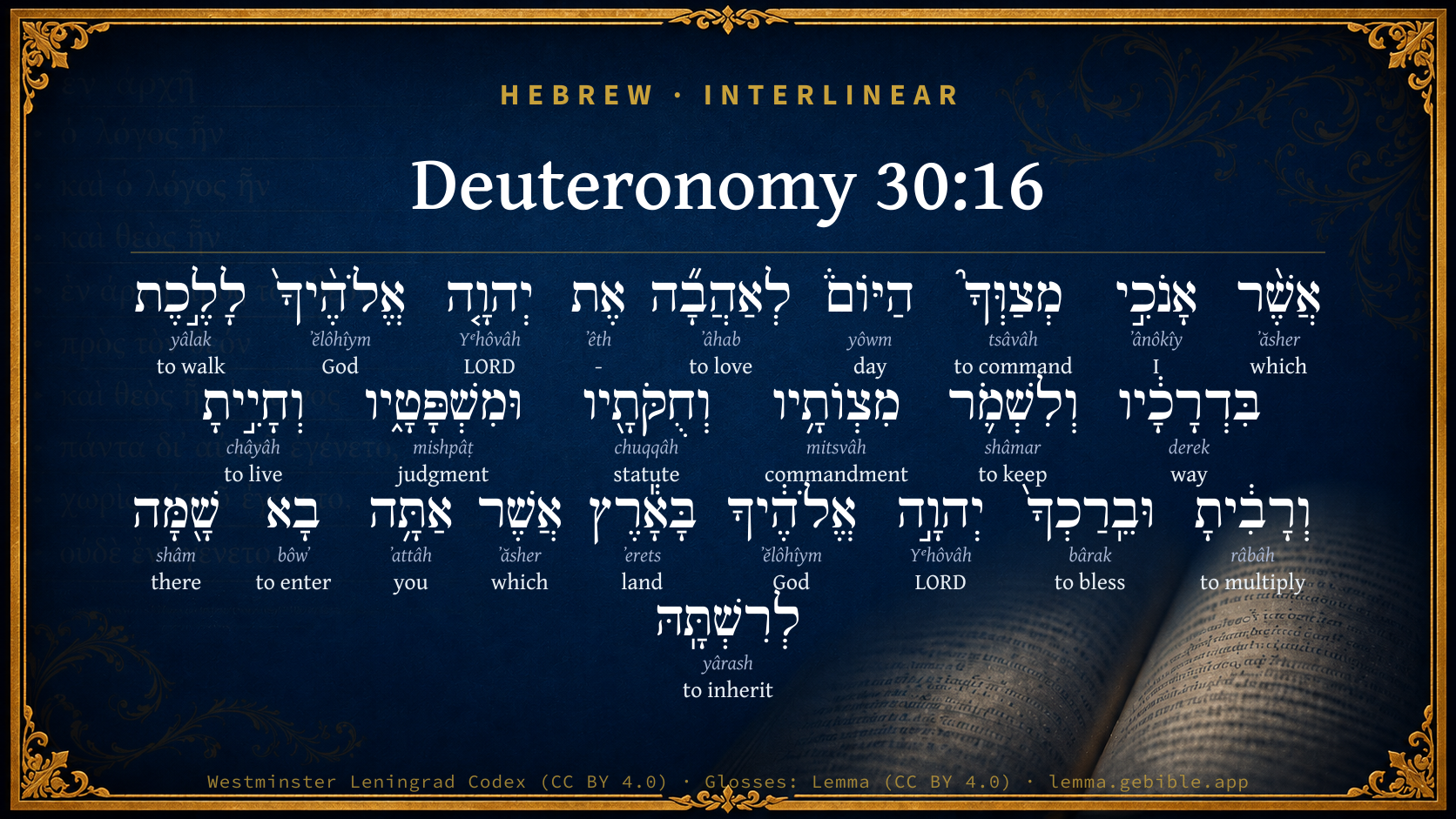
Hebrew (Westminster Leningrad Codex) Deuteronomy 30:16 appears in the Hebrew Old Testament. The text above is from the Westminster Leningrad Codex. Each word links to its Strong’s number, a concise gloss, and parsing drawn from the Open Scriptures Hebrew Bible morphology. Click any word for its full Brown-Driver-Briggs (BDB) entry.
Download image
Cite this verse

Deuteronomy 30:16 (World English Bible). Public Domain. Lemma interlinear Bible study tool, https://lemma.gebible.app/v/deuteronomy/30/16.

Show BibTeX & RIS
BibTeX
RIS
English Translation
in that I command you this day to love Yahweh your God, to walk in his ways, and to keep his commandments and his statutes and his ordinances, that you may live and multiply, and that Yahweh your God may bless you in the land where you go in to possess it.
World English Bible · Public Domain
Download a study sheet

One document with this verse’s original text, its word-by-word gloss line, the meaning frame, cross-references with their text, attributed commentary, and full source and license credits — printable, and it pastes into notes with its structure intact.

This verse Autodidact and up

Study sheet (.html) Plain text (.txt)

A passage Seminary Student

Up to 50 verses in one chapter. A passage sheet keeps up to 6 commentary sources and 12 cross-references per verse, in the order this page ranks them, and says so on the sheet whenever that leaves anything out. Ask for a single verse and you get the Autodidact verse sheet above.

Everything on this page stays free to read, with no account — the sheet is a download of what is already on screen, not access to it.

Want to remove ads? Support Godless Engineer
Compare translations 3

The same verse in 3 English versions, stacked beneath the original-language interlinear above. Click any original word for its lexicon entry.

Each is an independent rendering of the whole verse — the interlinear is not word-aligned to these translations.

Highlighted words mark where these versions differ — a whole-verse word diff, not a word-by-word alignment.

  • World English Bible Public Domain
    in that I command you this day to love Yahweh your God, to walk in his ways, and to keep his commandments and his statutes and his ordinances, that you may live and multiply, and that Yahweh your God may bless you in the land where you go in to possess it.
  • King James Version Public Domain
    In that I command thee this day to love the LORD thy God, to walk in his ways, and to keep his commandments and his statutes and his judgments, that thou mayest live and multiply: and the LORD thy God shall bless thee in the land whither thou goest to possess it.
  • unfoldingWord Literal Text CC BY-SA 4.0
    What I am commanding you today is to love Yahweh your God, to walk in his ways and to keep his commandments and his statutes and his ordinances, and you will live and multiply, and Yahweh your God will bless you in the land which you are going into to possess it.

unfoldingWord Literal Text — © unfoldingWord, licensed CC BY-SA 4.0. Word-aligned USFM3 via Door43 (git.door43.org/unfoldingWord/en_ult).

Versions to compare (up to 4)

3 of 4 selected

Show all 18 translations

Every available English version of this verse, each an independent rendering of the whole verse.

  • World English Bible Public Domain
    in that I command you this day to love Yahweh your God, to walk in his ways, and to keep his commandments and his statutes and his ordinances, that you may live and multiply, and that Yahweh your God may bless you in the land where you go in to possess it.
  • Berean Standard Bible Public Domain
    For I am commanding you today to love the LORD your God, to walk in His ways, and to keep His commandments, statutes, and ordinances, so that you may live and increase, and the LORD your God may bless you in the land that you are entering to possess.
  • Majority Standard Bible Public Domain
    For I am commanding you today to love the LORD your God, to walk in His ways, and to keep His commandments, statutes, and ordinances, so that you may live and increase, and the LORD your God may bless you in the land that you are entering to possess.
  • King James Version Public Domain
    In that I command thee this day to love the LORD thy God, to walk in his ways, and to keep his commandments and his statutes and his judgments, that thou mayest live and multiply: and the LORD thy God shall bless thee in the land whither thou goest to possess it.
  • American Standard Version (1901) Public Domain
    in that I command thee this day to love Jehovah thy God, to walk in his ways, and to keep his commandments and his statutes and his ordinances, that thou mayest live and multiply, and that Jehovah thy God may bless thee in the land whither thou goest in to possess it.
  • Revised Version (1885) Public Domain
    in that I command thee this day to love the LORD thy God, to walk in his ways, and to keep his commandments and his statutes and his judgments, that thou mayest live and multiply, and that the LORD thy God may bless thee in the land whither thou goest in to possess it.
  • Geneva Bible (1599) Public Domain
    In that I commaund thee this day, to loue the Lord thy God, to walke in his wayes, and to keepe his commandements, and his ordinances, and his lawes, that thou mayest liue, and be multiplied, and that the Lord thy God may blesse thee in the land, whither thou goest to possesse it.
  • Douay-Rheims (1899) Public Domain
    That thou mayst love the Lord thy God, and walk in his ways, and keep his commandments and ceremonies and judgments, and thou mayst live, and he may multiply thee, and bless thee in the land, which thou shalt go in to possess.
  • Young's Literal Translation Public Domain
    in that I am commanding thee to-day to love Jehovah thy God, to walk in His ways, and to keep His commands, and His statutes, and His judgments; and thou hast lived and multiplied, and Jehovah thy God hath blessed thee in the land whither thou art going in to possess it.
  • Literal Standard Version CC BY-SA 4.0
    in that today I am commanding you to love your God YHWH, to walk in His ways, and to keep His commands, and His statutes, and His judgments; and you have lived and multiplied, and your God YHWH has blessed you in the land to where you are going in to possess it.
  • Unlocked Literal Bible CC BY-SA 4.0
    If you obey the decrees of Yahweh your God, in which I am commanding you today to love Yahweh your God, to walk in his ways, and to keep his commandments, his regulations, and his statutes, you will live and multiply, and Yahweh your God will bless you in the land that you are entering to possess.
  • unfoldingWord Literal Text CC BY-SA 4.0
    What I am commanding you today is to love Yahweh your God, to walk in his ways and to keep his commandments and his statutes and his ordinances, and you will live and multiply, and Yahweh your God will bless you in the land which you are going into to possess it.
  • Darby Bible Public Domain
    in that I command thee this day to love Jehovah thy God, to walk in his ways, and to keep his commandments and his statutes and his ordinances, that thou mayest live and multiply, and that Jehovah thy God may bless thee in the land whither thou goest to possess it.
  • World Messianic Bible Public Domain
    For I command you today to love the LORD your God, to walk in his ways and to keep his commandments, his statutes, and his ordinances, that you may live and multiply, and that the LORD your God may bless you in the land where you go in to possess it.
  • Webster's Bible Public Domain
    In that I command thee this day to love the LORD thy God, to walk in his ways, and to keep his commandments, and his statutes, and his judgments, that thou mayest live and multiply: and the LORD thy God shall bless thee in the land whither thou goest to possess it.
  • Free Bible Version CC BY-SA 4.0
    I'm telling you today to love the Lord your God, to follow his ways, and to keep his commandments, rules, and regulations, so you can live and grow in number, and so the Lord your God may bless you in the country that you are entering and will own.
  • Bible in Basic English Public Domain
    In giving you orders today to have love for the Lord your God, to go in his ways and keep his laws and his orders and his decisions, so that you may have life and be increased, and that the blessing of the Lord your God may be with you in the land where you are going, the land of your heritage.
  • JPS Tanakh (1917) Public Domain
    in that I command thee this day to love the LORD thy God, to walk in His ways, and to keep His commandments and His statutes and His ordinances; then thou shalt live and multiply, and the LORD thy God shall bless thee in the land whither thou goest in to possess it.

Literal Standard Version (2020), Covenant Press — licensed CC BY-SA 4.0. Text via the HelloAO Bible API (eBible.org). Unlocked Literal Bible (unfoldingWord) — licensed CC BY-SA 4.0. Text via the HelloAO Bible API (eBible.org). unfoldingWord Literal Text — © unfoldingWord, licensed CC BY-SA 4.0. Word-aligned USFM3 via Door43 (git.door43.org/unfoldingWord/en_ult). Free Bible Version, Dr. Jonathan Gallagher — licensed CC BY-SA 4.0. Text via the HelloAO Bible API (eBible.org).

Word by word

More ways to search: Search by grammar → Find every occurrence → Compare this word →

Practice this passage: Drill this verse → Learn its vocabulary →

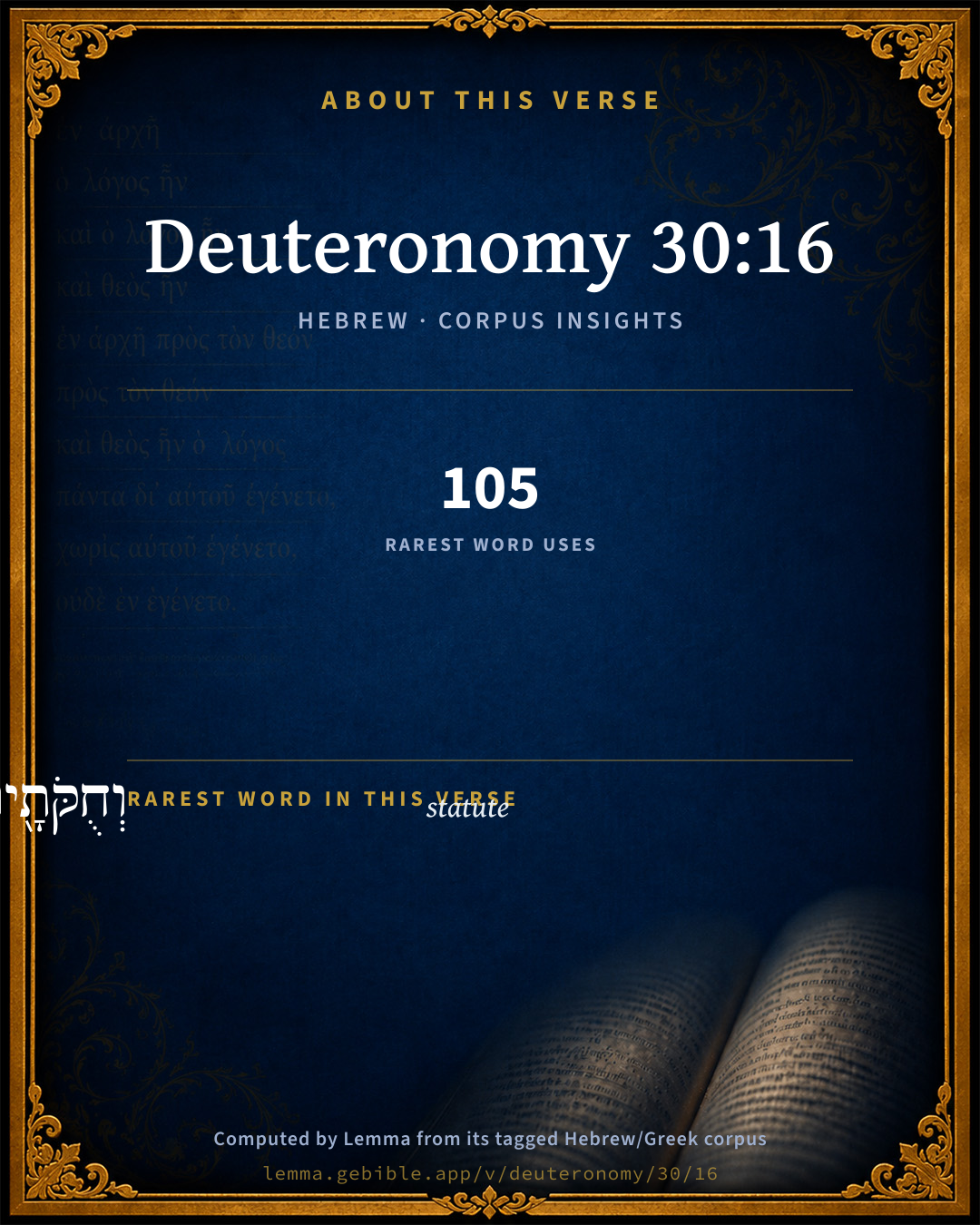
וְחֻקֹּתָ֖יו
chuqqâh
H2708
“and · statutes · his”
Conjunction + Noun, Common, Both, Plural, Construct + Suffix, Personal, 3rd Person, Masculine, Singular
Part of Speech
Conjunction + Noun
Type
Common
Gender
Both
Number
Plural
State
Construct
Full BDB Definition

Origin: from H2706

TWOT: 728b

statute, ordinance, limit, enactment, something prescribed - statute
  1. אֲשֶׁ֨ר ʼăsher H834 “which” Particle, Relative
  2. אָנֹכִ֣י ʼânôkîy H595 “I” Pronoun, Personal, 1st Person, Common, Singular
  3. מְצַוְּךָ֮ tsâvâh H6680 “commanding · you” Verb, Piel, Participle Active, Masculine, Singular, Construct + Suffix, Personal, 2nd Person, Masculine, Singular
  4. הַיּוֹם֒ yôwm H3117 “the · day” Particle, Definite Article + Noun, Common, Masculine, Singular, Absolute
  5. לְאַהֲבָ֞ה ʼâhab H157 “to love” Preposition + Verb, Qal, Infinitive Construct
  6. אֶת ʼêth H853 “-” Particle, Direct Object
  7. יְהוָ֤ה Yᵉhôvâh H3068 “LORD” Noun, Proper
  8. אֱלֹהֶ֨יךָ֙ ʼĕlôhîym H430 “God(s) · your” Noun, Common, Masculine, Plural, Construct + Suffix, Personal, 2nd Person, Masculine, Singular
  9. לָלֶ֣כֶת yâlak H3212 “to walk” Preposition + Verb, Qal, Infinitive Construct
  10. בִּדְרָכָ֔יו derek H1870 “in/at · ways · his” Preposition + Noun, Common, Both, Plural, Construct + Suffix, Personal, 3rd Person, Masculine, Singular
  11. וְלִשְׁמֹ֛ר shâmar H8104 “and · to keep” Conjunction + Preposition + Verb, Qal, Infinitive Construct
  12. מִצְוֺתָ֥יו mitsvâh H4687 “commandments · his” Noun, Common, Feminine, Plural, Construct + Suffix, Personal, 3rd Person, Masculine, Singular
  13. וּמִשְׁפָּטָ֑יו mishpâṭ H4941 “and · judgments · his” Conjunction + Noun, Common, Masculine, Plural, Construct + Suffix, Personal, 3rd Person, Masculine, Singular
  14. וְחָיִ֣יתָ châyâh H2421 “and · to live” Conjunction + Verb, Qal, Sequential Perfect, 2nd Person, Masculine, Singular
  15. וְרָבִ֔יתָ râbâh H7235 “and · to multiply” Conjunction + Verb, Qal, Sequential Perfect, 2nd Person, Masculine, Singular
  16. וּבֵֽרַכְךָ֙ bârak H1288 “and · to bless · you” Conjunction + Verb, Piel, Sequential Perfect, 3rd Person, Masculine, Singular + Suffix, Personal, 2nd Person, Masculine, Singular
  17. יְהוָ֣ה Yᵉhôvâh H3068 “LORD” Noun, Proper
  18. אֱלֹהֶ֔יךָ ʼĕlôhîym H430 “God(s) · your” Noun, Common, Masculine, Plural, Construct + Suffix, Personal, 2nd Person, Masculine, Singular
  19. בָּאָ֕רֶץ ʼerets H776 “in/at the · land” Preposition, Determined + Noun, Common, Both, Singular, Absolute
  20. אֲשֶׁר ʼăsher H834 “which” Particle, Relative
  21. אַתָּ֥ה ʼattâh H859 “you” Pronoun, Personal, 2nd Person, Masculine, Singular
  22. בָא bôwʼ H935 “entering” Verb, Qal, Participle Active, Masculine, Singular, Absolute
  23. שָׁ֖מָּה shâm H8033 “there · toward” Adverb + Suffix, Demonstrative
  24. לְרִשְׁתָּֽהּ yârash H3423 “to inherit · her” Preposition + Verb, Qal, Infinitive Construct + Suffix, Personal, 3rd Person, Feminine, Singular

About this verse

These counts appear in no published source. They are computed here, from the morphology-tagged text and Lemma’s own curated glosses. What Lemma adds →

25
words
22
distinct lemmas
Pentateuch
section

Grammatical profile

  • 9 verbs
  • 10 nouns
  • 2 pronouns
  • 1 adverb
  • 3 particles

Verb forms

  • מְצַוְּךָ֮ Piel · Participle Active
  • לְאַהֲבָ֞ה Qal · Infinitive Construct
  • לָלֶ֣כֶת Qal · Infinitive Construct
  • וְלִשְׁמֹ֛ר Qal · Infinitive Construct
  • וְחָיִ֣יתָ Qal · Sequential Perfect
  • וְרָבִ֔יתָ Qal · Sequential Perfect
  • וּבֵֽרַכְךָ֙ Piel · Sequential Perfect
  • בָא Qal · Participle Active
  • לְרִשְׁתָּֽהּ Qal · Infinitive Construct

Repetition

Words recur within this verse — often emphatic in Hebrew:

  • יְהוָ֤ה LORD H3068 ×2
  • אֱלֹהֶ֨יךָ֙ God H430 ×2
  • אֲשֶׁ֨ר which H834 ×2

Hebrew & Septuagint length

In English translation the verse runs 52 words from the Hebrew and 67 from the Septuagint (LXX English) — closely comparable.

A rough comparison of the two English renderings, which tokenize alike — not a word-level alignment.

Word counts can differ between the Hebrew and the Greek without any difference in meaning — e.g. the Hebrew direct-object marker אֵת has no separate Greek word, and Greek often adds the article ὁ.

Cross-references

6

Topical passages linked to Deuteronomy 30:16 in the Treasury of Scripture Knowledge — connected by theme and wording, ordered by reader-vote popularity; previews shown in the World English Bible.

  • Deuteronomy 30:6 Yahweh your God will circumcise your heart, and the heart of your seed, to love Yahweh your God with all your heart, and with all your soul, that you may live.
  • Matthew 22:37–38 Jesus said to him, "'You shall love the Lord your God with all your heart, and with all your soul, and with all your mind.'
  • 1 John 5:2–3 By this we know that we love the children of God, when we love God and keep his commandments.
  • Deuteronomy 6:5 and you shall love Yahweh your God with all your heart, and with all your soul, and with all your might.
  • John 14:21 One who has my commandments, and keeps them, that person is one who loves me. One who loves me will be loved by my Father, and I will love him, and will reveal myself to him."
  • 1 Corinthians 7:19 Circumcision is nothing, and uncircumcision is nothing, but the keeping of the commandments of God.

Cross-references courtesy of OpenBible.info (CC BY 4.0).

Hebrew and Greek witnesses Masoretic Hebrew ↔ Greek Septuagint

The same verse in the two great witnesses to the Old Testament, shown verse-for-verse.

These are two independent witnesses, not word-aligned to each other, and the Septuagint is shown in lemma (dictionary) form.

Hebrew Deuteronomy 30:16 Masoretic · Westminster Leningrad Codex

אֲשֶׁ֨ר אָנֹכִ֣י מְצַוְּךָ֮ הַיּוֹם֒ לְאַהֲבָ֞ה אֶת יְהוָ֤ה אֱלֹהֶ֨יךָ֙ לָלֶ֣כֶת בִּדְרָכָ֔יו וְלִשְׁמֹ֛ר מִצְוֺתָ֥יו וְחֻקֹּתָ֖יו וּמִשְׁפָּטָ֑יו וְחָיִ֣יתָ וְרָבִ֔יתָ וּבֵֽרַכְךָ֙ יְהוָ֣ה אֱלֹהֶ֔יךָ בָּאָ֕רֶץ אֲשֶׁר אַתָּ֥ה בָא שָׁ֖מָּה לְרִשְׁתָּֽהּ

in that I command you this day to love Yahweh your God, to walk in his ways, and to keep his commandments and his statutes and his ordinances, that you may live and multiply, and that Yahweh your God may bless you in the land where you go in to possess it.

World English Bible · Public Domain

Greek LXX Deuteronomy 30:16 Septuagint · lemma form

ἐάν εἰςἀκούω ὁ ἐντολή κύριος ὁ θεός σύ ὅς ἐγώ ἐντέλλομαι σύ σήμερον ἀγαπάω κύριος ὁ θεός σύ πορεύομαι ἐν πᾶς ὁ ὁδός αὐτός φυλάσσω ὁ δικαίωμα αὐτός καί ὁ κρίσις αὐτός καί ζάω καί πολύς εἰμί καί εὐλογέω σύ κύριος ὁ θεός σύ ἐν πᾶς ὁ γῆ εἰς ὅς εἰςπορεύομαι ἐκεῖ κληρονομέω αὐτός

If you will listen to the commands of the Lord your God, which I command you this day, to love the Lord your God, to walk in all his ways, and to keep his ordinances, and his judgments; then you⌃ shall live, and shall be many in number, and the Lord your God shall bless you in all the land into which you go to inherit it.

LXX2012 (modern English Septuagint) · Public Domain

On this verse, The Cambridge Bible for Schools and Colleges discusses the Septuagint’s reading. Read the note in Commentary ↓

Hebrew: Westminster Leningrad Codex (CC BY 4.0). Greek: Septuagint (public domain); English from LXX2012 (modern English Septuagint) (Public Domain). How the Septuagint differs from the Hebrew →

Targum (Aramaic paraphrase)

2

The Targum is the ancient Jewish Aramaic paraphrase of the Hebrew Scriptures — an interpretive translation, not the Hebrew text itself. Onkelos (literal) and Pseudo-Jonathan (expansive) render the Torah, and Jonathan the Prophets. Coverage is partial: where no permissively-licensed English translation exists for a verse, only the Aramaic is shown. This is verse-level text, not a word-by-word alignment to the Hebrew.

  1. Targum Onkelos Torah (Genesis–Deuteronomy)
    דִי אֲנָא מְפַקְדָךְ יוֹמָא דֵין לְמִרְחַם יָת יְיָ אֱלָהָךְ לִמְהַךְ בְּאָרְחָן דְתָקְנָן קֳדָמוֹהִי וּלְמִטַר פִּקוּדוֹהִי וּקְיָמוֹהִי וְדִינוֹהִי וְתֵיחֵי וְתִסְגֵי וִיבָרֵכִנָךְ יְיָ אֱלָהָךְ בְּאַרְעָא דִי אַתְּ עָלֵל לְתַמָן לְמֵירְתַהּ

    (no public-domain English translation for this verse)

    Targum Onkelos — Aramaic: “Onkelos Genesis” (public domain); “Onkelos Exodus” (public domain); “Onkelos Leviticus” (public domain); “Onkelos Numbers” (public domain); “Onkelos Deuteronomy” (public domain). English: “Sefaria Community Translation” (CC0 1.0 (public-domain dedication)); “J.W. Etheridge. The Targums of Onkelos and Jonathan Ben Uzziel on the Pentateuch. London: Longmans, Green, 1862” (public domain). Text via Sefaria.

  2. Targum Pseudo-Jonathan Torah (Genesis–Deuteronomy)
    דַאֲנָא מְפַקֵיד לְכוֹן יוֹמָנָא לְמִרְחַם יַת יְיָ אֱלָהָךְ וְלִמְהַךְ בְּאוֹרְחַן דְתַקְנָן קֳדָמוֹי וּלְמִנְטַר פִּקוּדוֹי וּקְיָימוֹי וְדִינוֹי וְתֵיחוּן וְתִסְגוּן וִיבָרֵכִינְכוֹן יְיָ אֱלָהָךְ בְּאַרְעָא דְאַתּוּן עָלְלִין לְתַמָן לְמֵירְתָהּ

    For I teach you today to love the Lord your God, and to walk in the ways that are right before Him, and to keep His commandments, statutes, and judgments, and live and multiply; that the Lord your God may bless you in the land into which you are entering to possess it.

    Targum Pseudo-Jonathan — Aramaic: “Targum Jonathan on Genesis” (public domain); “Targum Jonathan on Exodus” (public domain); “Targum Jonathan on Leviticus” (public domain); “Targum Jonathan on Numbers” (public domain); “Targum Jonathan on Deuteronomy” (public domain). English: “The Targum of Jonathan ben Uzziel, trans. J. W. Etheridge, London, 1862” (public domain). Text via Sefaria.

Commentary

Notes on Deuteronomy 30:16 from classic Christian and Jewish commentators (each source and its license shown beneath its notes). The classic Christian expositions comment on the surrounding passage and are grouped to its opening verse, so a note may address several verses; the Jewish commentaries on the Tanakh (Rashi and others) are per-verse, so they appear only where the commentator wrote on this verse.

Lemma curates 59 commentaries, every one of them public domain or Creative Commons licensed, each selected and text-cleaned for this edition rather than reprinted as found. About our sources →

The Cambridge Bible for Schools and Colleges

gen. ed. J. J. S. Perowne

16. The constr. of the Heb. is faulty but may be restored from the LXX thus: If thou hearken to the commandment of the Lord thy God which I command thee (Dillm.). For Deu_30:16 a see on Deu_13:4 (5): his commandments (wanting in LXX), Deu_4:2; statutes and judgements, Deu_4:1. On 16b, that thou mayest live, cp. Deu_4:1, Deu_30:6; on whither thou goest in to possess it (characteristic of the Sg. passages) see Deu_7:1, for the Pl. synonym see Deu_6:1.

The Cambridge Bible for Schools and Colleges (gen. ed. J. J. S. Perowne; Cambridge University Press, 1878–1918) — public domain. Text from a community e-Sword module.

Trapp's Complete Commentary

John Trapp

Deu 30:16 In that I command thee this day to love the LORD thy God, to walk in his ways, and to keep his commandments and his statutes and his judgments, that thou mayest live and multiply: and the LORD thy God shall bless thee in the land whither thou goest to possess it.

Ver. 16. To love the Lord.] God must be obeyed out of love, or all is lost.

John Trapp, A Commentary or Exposition upon All the Books of the Old and New Testament (1647–1656) — public domain. Text from a community e-Sword module.

Tyndale Open Study Notes

Tyndale Open Resources

30:16 love the Lord your God: This paraphrases the Shema, Israel’s central covenant affirmation (see 6:5). To love God means to obey him in every respect, which results in divine blessing.

Tyndale Open Study Notes — © Tyndale Open Resources, licensed CC BY-SA 4.0. Text via the HelloAO Bible API.

Geneva Bible (1599)

Geneva Bible translators

So that to love and obey God, is only life and felicity.

He addeth these promises to signify that it is for our profit that we love him, and not for his.

Geneva Bible (1599) marginal notes — public domain. Text via Bolls.life.

John Gill's Exposition

In that I command thee this day to love the Lord thy God,.... Which is the sum and substance of the first table of the law, and includes the whole worship of God, the contrary to which are idolatry, superstition, and will worship, from which Moses had been dissuading and deterring them:

to walk in his ways; which he has prescribed, as his will to walk in, and his law directs to:

and to keep his commandments, and his statutes, and his judgments; his laws, moral, ceremonial, and judicial, Moses had been repeating and reciting:

that thou mayest live and multiply; live in the land of Canaan, and have a numerous offspring and posterity to succeed and continue in it, which is confirmed by what follows:

and the Lord thy God shall bless thee in the land whither thou goest to possess it; with health and happiness, with an affluence of all good things, in the land of Canaan they were just entering into to take possession of.

John Gill's Exposition of the Whole Bible (1746–1763) — public domain (CC PDM 1.0). Text via the HelloAO Bible API.

Rashi

Rabbi Shlomo Yitzchaki (Rashi)

אשר אנכי מצוך היום לאהבה IN THAT I COMMAND THEE THIS DAY TO LOVE [THE LORD THY GOD] — You have here a description of the “good”, and upon this depends וחיית ורבית THAT YOU MAY LIVE AND INCREASE — here you have life.

Rashi on the Tanakh — English translations: “The Judaica Press complete Tanach with Rashi, translated by A. J. Rosenberg” (CC BY 4.0); “Pentateuch with Rashi's commentary by M. Rosenbaum and A.M. Silbermann, 1929-1934” (public domain); “The Metsudah Tanach series, Lakewood, N.J” (CC BY 4.0); and “The Book of Joshua, Metsudah Publications, 1997” (CC BY 4.0). Text via Sefaria.

Lesson kit

Teaching starters — assembled from the data on this page, not authored interpretation. Every prompt links to the verse data it draws on. Edit before teaching.

Deuteronomy, in the Pentateuch, opens this verse with 25 words (22 distinct Hebrew lemmas). Its most distinctive word is chuqqâh (“statute”). A historical commentator’s framing appears above. Read the whole chapter for the surrounding context.

Discussion questions

  1. How does “statute” (chuqqâh) shape what this verse is saying?
  2. How does Deuteronomy 30:6, which shares this passage’s theme, read alongside this verse?
  3. What does the repetition of “LORD” (2× in this one verse) do in this verse?
  4. These translations render this verse differently; the difference is in the English rendering, not the original. What questions does that raise?
  5. «מְצַוְּךָ֮» is a Piel Participle Active verb. How does that grammatical form shape the action described?
  6. Compare how The Cambridge Bible for Schools and Colleges and Trapp's Complete Commentary read this verse. Where do they agree or differ?

Things to notice

Reading settings

Reading text

Shown beneath each verse's original-language words.

Old Testament
Old Testament edition

Read the OT as the Masoretic Hebrew (MT) or the Greek Septuagint (LXX).

English shown for the Greek Septuagint (in the Hebrew ↔ Greek comparison).

Comparing translations? Open the Compare panel on any verse page to stack up to four side by side.