
Numbers 6:24

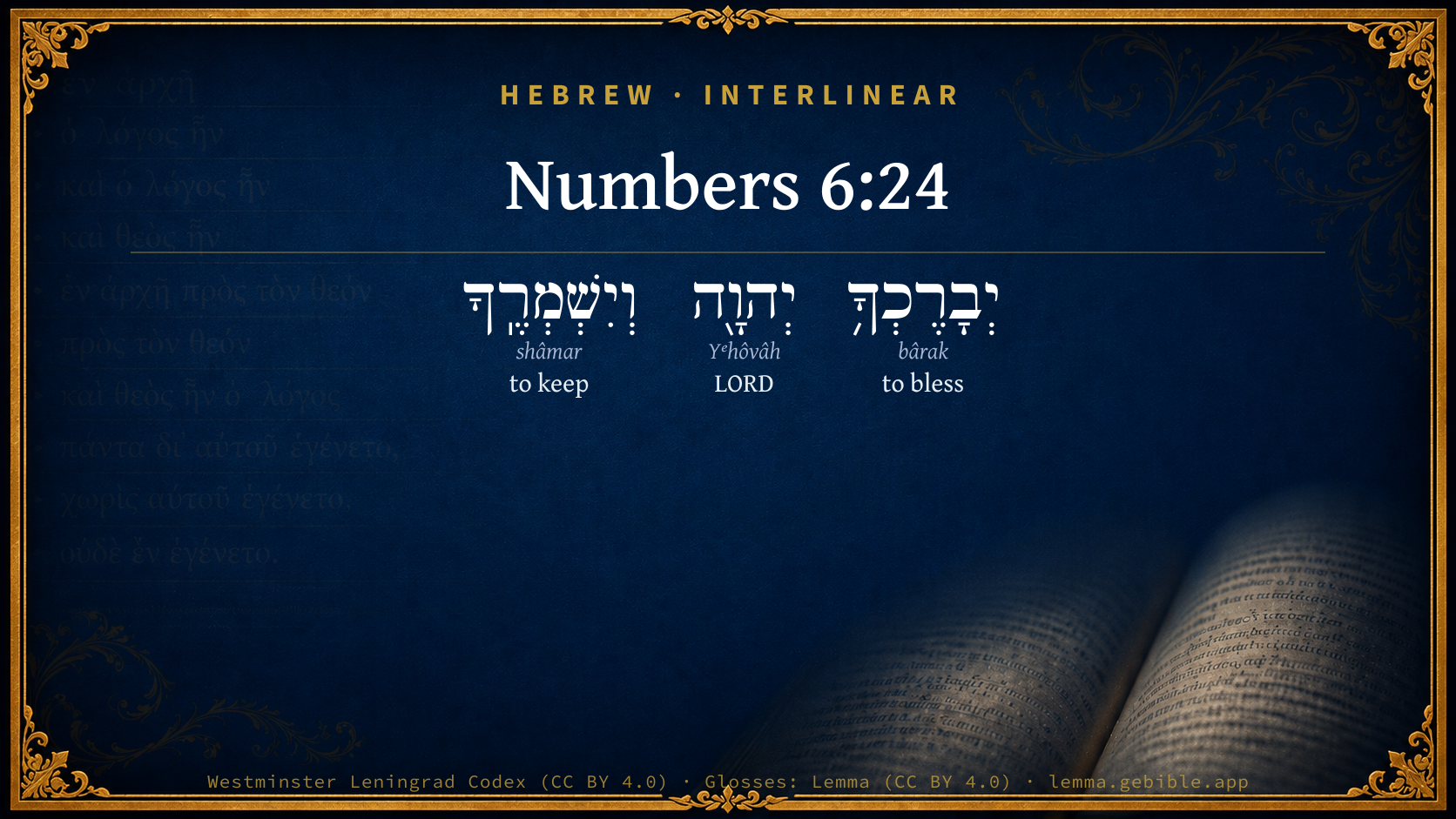
Hebrew (Westminster Leningrad Codex) Numbers 6:24 appears in the Hebrew Old Testament. The text above is from the Westminster Leningrad Codex. Each word links to its Strong’s number, a concise gloss, and parsing drawn from the Open Scriptures Hebrew Bible morphology. Click any word for its full Brown-Driver-Briggs (BDB) entry.
Download image
Cite this verse

Numbers 6:24 (World English Bible). Public Domain. Lemma interlinear Bible study tool, https://lemma.gebible.app/v/numbers/6/24.

Show BibTeX & RIS
BibTeX
RIS
English Translation
'Yahweh bless you, and keep you.
World English Bible · Public Domain
Download a study sheet

One document with this verse’s original text, its word-by-word gloss line, the meaning frame, cross-references with their text, attributed commentary, and full source and license credits — printable, and it pastes into notes with its structure intact.

This verse Autodidact and up

Study sheet (.html) Plain text (.txt)

A passage Seminary Student

Up to 50 verses in one chapter. A passage sheet keeps up to 6 commentary sources and 12 cross-references per verse, in the order this page ranks them, and says so on the sheet whenever that leaves anything out. Ask for a single verse and you get the Autodidact verse sheet above.

Everything on this page stays free to read, with no account — the sheet is a download of what is already on screen, not access to it.

Want to remove ads? Support Godless Engineer
Compare translations 3

The same verse in 3 English versions, stacked beneath the original-language interlinear above. Click any original word for its lexicon entry.

Each is an independent rendering of the whole verse — the interlinear is not word-aligned to these translations.

Highlighted words mark where these versions differ — a whole-verse word diff, not a word-by-word alignment.

  • World English Bible Public Domain
    'Yahweh bless you, and keep you.
  • King James Version Public Domain
    The LORD bless thee, and keep thee:
  • unfoldingWord Literal Text CC BY-SA 4.0
    “May Yahweh bless you, and may he keep you.

unfoldingWord Literal Text — © unfoldingWord, licensed CC BY-SA 4.0. Word-aligned USFM3 via Door43 (git.door43.org/unfoldingWord/en_ult).

Versions to compare (up to 4)

3 of 4 selected

Show all 18 translations

Every available English version of this verse, each an independent rendering of the whole verse.

  • World English Bible Public Domain
    'Yahweh bless you, and keep you.
  • Berean Standard Bible Public Domain
    ‘May the LORD bless you and keep you;
  • Majority Standard Bible Public Domain
    ‘May the LORD bless you and keep you;
  • King James Version Public Domain
    The LORD bless thee, and keep thee:
  • American Standard Version (1901) Public Domain
    Jehovah bless thee, and keep thee:
  • Revised Version (1885) Public Domain
    The LORD bless thee, and keep thee:
  • Geneva Bible (1599) Public Domain
    The Lord blesse thee, and keepe thee,
  • Douay-Rheims (1899) Public Domain
    The Lord bless thee, and keep thee.
  • Young's Literal Translation Public Domain
    `Jehovah bless thee and keep thee;
  • Literal Standard Version CC BY-SA 4.0
    YHWH bless you and keep you;
  • Unlocked Literal Bible CC BY-SA 4.0
    “May Yahweh bless you and keep you.
  • unfoldingWord Literal Text CC BY-SA 4.0
    “May Yahweh bless you, and may he keep you.
  • Darby Bible Public Domain
    Jehovah bless thee, and keep thee;
  • World Messianic Bible Public Domain
    ‘The LORD bless you, and keep you.
  • Webster's Bible Public Domain
    The LORD bless thee, and keep thee:
  • Free Bible Version CC BY-SA 4.0
    ‘May the Lord bless you and take care of you.
  • Bible in Basic English Public Domain
    May the Lord send his blessing on you and keep you:
  • JPS Tanakh (1917) Public Domain
    The LORD bless thee, and keep thee;

Literal Standard Version (2020), Covenant Press — licensed CC BY-SA 4.0. Text via the HelloAO Bible API (eBible.org). Unlocked Literal Bible (unfoldingWord) — licensed CC BY-SA 4.0. Text via the HelloAO Bible API (eBible.org). unfoldingWord Literal Text — © unfoldingWord, licensed CC BY-SA 4.0. Word-aligned USFM3 via Door43 (git.door43.org/unfoldingWord/en_ult). Free Bible Version, Dr. Jonathan Gallagher — licensed CC BY-SA 4.0. Text via the HelloAO Bible API (eBible.org).

Word by word

More ways to search: Search by grammar → Find every occurrence → Compare this word →

Practice this passage: Drill this verse → Learn its vocabulary →

יְבָרֶכְךָ֥
bârak
H1288
“to bless · you”
Verb, Piel, Jussive, 3rd Person, Masculine, Singular + Suffix, Personal, 2nd Person, Masculine, Singular
Part of Speech
Verb
Stem
Piel
Form
Jussive
Person
3rd Person
Gender
Masculine
Number
Singular
Full BDB Definition

Origin: a primitive root

TWOT: 285

to bless, kneel - (Qal) - to kneel - to bless - (Niphal) to be blessed, bless oneself - (Piel) to bless - (Pual) to be blessed, be adored - (Hiphil) to cause to kneel - (Hithpael) to bless oneself - (TWOT) to praise, salute, curse
  1. יְהוָ֖ה Yᵉhôvâh H3068 “LORD” Noun, Proper
  2. וְיִשְׁמְרֶֽךָ shâmar H8104 “and · to keep · you” Conjunction + Verb, Qal, Jussive, 3rd Person, Masculine, Singular + Suffix, Personal, 2nd Person, Masculine, Singular

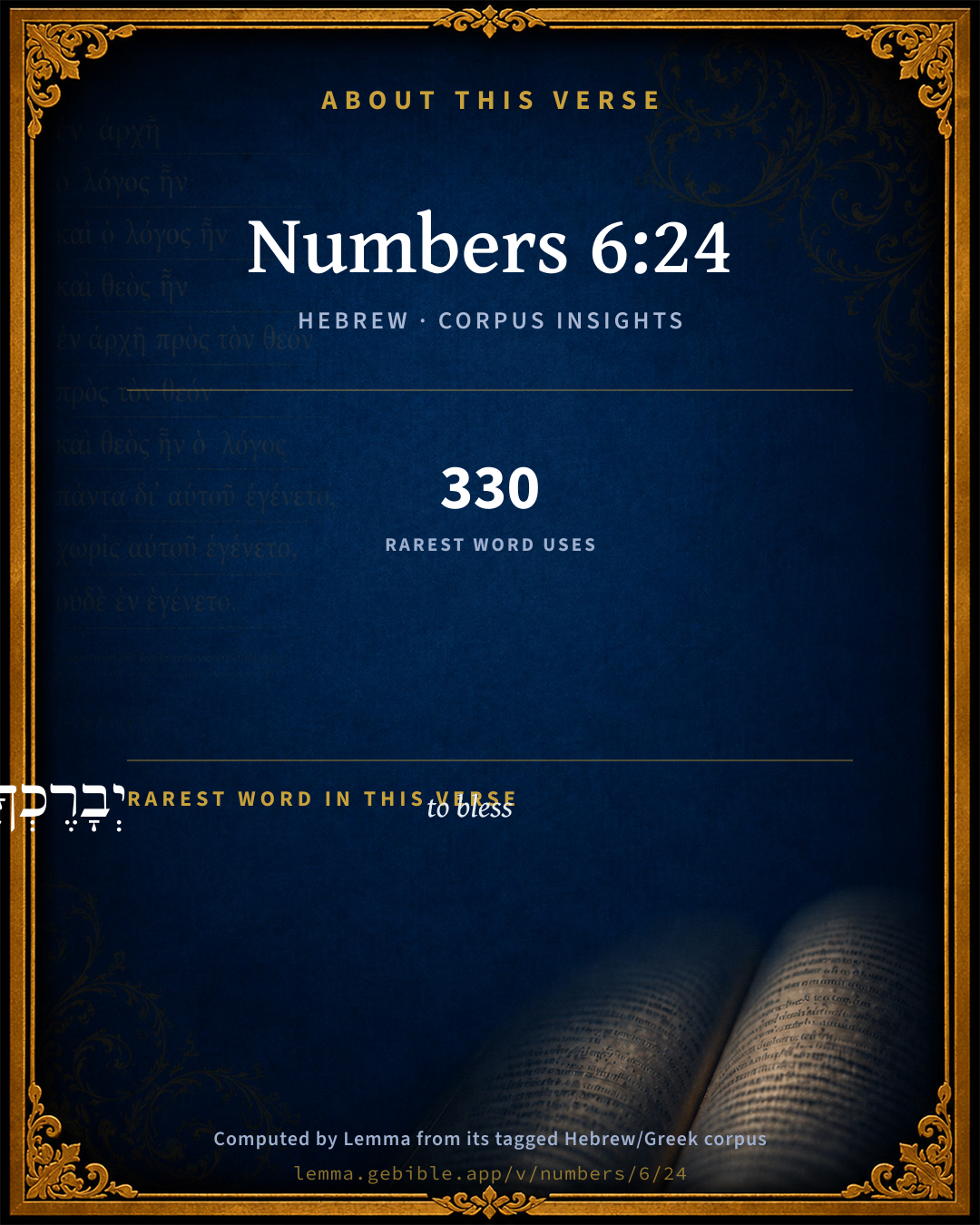
About this verse

These counts appear in no published source. They are computed here, from the morphology-tagged text and Lemma’s own curated glosses. What Lemma adds →

3
words
3
distinct lemmas
Pentateuch
section

Grammatical profile

  • 2 verbs
  • 1 noun

Verb forms

  • יְבָרֶכְךָ֥ Piel · Jussive
  • וְיִשְׁמְרֶֽךָ Qal · Jussive

Hebrew & Septuagint length

In English translation the verse runs 6 words from the Hebrew and 7 from the Septuagint (LXX English) — closely comparable.

A rough comparison of the two English renderings, which tokenize alike — not a word-level alignment.

Word counts can differ between the Hebrew and the Greek without any difference in meaning — e.g. the Hebrew direct-object marker אֵת has no separate Greek word, and Greek often adds the article ὁ.

Cross-references

19

Topical passages linked to Numbers 6:24 in the Treasury of Scripture Knowledge — connected by theme and wording, ordered by reader-vote popularity; previews shown in the World English Bible.

  • 1 Thessalonians 5:23 May the God of peace himself sanctify you completely. May your whole spirit, soul, and body be preserved blameless at the coming of our Lord Jesus Christ.
  • Psalms 121:4–7 Behold, he who keeps Israel Will neither slumber nor sleep.
  • Philippians 4:7 And the peace of God, which surpasses all understanding, will guard your hearts and your thoughts in Christ Jesus.
  • Jude 1:24 Now to him who is able to keep them from stumbling, and to present you faultless before the presence of his glory in great joy,
  • Isaiah 42:6 I, Yahweh, have called you in righteousness, and will hold your hand, and will keep you, and give you for a covenant of the people, for a light of the Gentiles;
  • Psalms 91:11 For he will give his angels charge over you, To guard you in all your ways.
  • Deuteronomy 28:3–6 Blessed shall you be in the city, and blessed shall you be in the field.
  • John 17:11 I am no more in the world, but these are in the world, and I am coming to you. Holy Father, keep them through your name which you have given me, that they may be one, even as we are.
  • Psalms 134:3 May Yahweh bless you from Zion; Even he who made heaven and earth.
  • 1 Samuel 2:9 He will keep the feet of his holy ones; But the wicked shall be put to silence in darkness; For by strength shall no man prevail.
  • Ruth 2:4 Behold, Boaz came from Bethlehem, and said to the reapers, Yahweh be with you. They answered him, Yahweh bless you.
  • Philippians 4:23 The grace of the Lord Jesus Christ be with you all. Amen.
  • Psalms 17:8 Keep me as the apple of your eye; Hide me under the shadow of your wings,
  • Ephesians 6:24 Grace be with all those who love our Lord Jesus Christ with incorruptible love. Amen.
  • 1 Peter 1:5 who by the power of God are guarded through faith for a salvation ready to be revealed in the last time.
  • Psalms 28:9 Save your people, And bless your inheritance. Be their shepherd also, And bear them up forever.
  • Isaiah 27:3 I Yahweh am its keeper; I will water it every moment: lest any hurt it, I will keep it night and day.
  • 1 Corinthians 14:16 Otherwise if you bless with the spirit, how will he who fills the place of the unlearned say the "Amen" at your giving of thanks, seeing he doesn't know what you say?
  • Revelation 1:4–5 John, to the seven assemblies that are in Asia: Grace to you and peace, from God, who is and who was and who is to come; and from the seven Spirits who are before his throne;

Cross-references courtesy of OpenBible.info (CC BY 4.0).

Hebrew and Greek witnesses Masoretic Hebrew ↔ Greek Septuagint

The same verse in the two great witnesses to the Old Testament, shown verse-for-verse.

These are two independent witnesses, not word-aligned to each other, and the Septuagint is shown in lemma (dictionary) form.

Hebrew Numbers 6:24 Masoretic · Westminster Leningrad Codex

יְבָרֶכְךָ֥ יְהוָ֖ה וְיִשְׁמְרֶֽךָ

'Yahweh bless you, and keep you.

World English Bible · Public Domain

Greek LXX Numbers 6:24 Septuagint · lemma form

εὐλογέω σύ κύριος καί φυλάσσω σύ

The Lord bless you and keep you;

LXX2012 (modern English Septuagint) · Public Domain

Hebrew: Westminster Leningrad Codex (CC BY 4.0). Greek: Septuagint (public domain); English from LXX2012 (modern English Septuagint) (Public Domain). How the Septuagint differs from the Hebrew →

Targum (Aramaic paraphrase)

2

The Targum is the ancient Jewish Aramaic paraphrase of the Hebrew Scriptures — an interpretive translation, not the Hebrew text itself. Onkelos (literal) and Pseudo-Jonathan (expansive) render the Torah, and Jonathan the Prophets. Coverage is partial: where no permissively-licensed English translation exists for a verse, only the Aramaic is shown. This is verse-level text, not a word-by-word alignment to the Hebrew.

  1. Targum Onkelos Torah (Genesis–Deuteronomy)
    יְבָרְכִינָךְ יְיָ וְיִטְרִינָךְ

    May Hashem bless you and guard you.

    Targum Onkelos — Aramaic: “Onkelos Genesis” (public domain); “Onkelos Exodus” (public domain); “Onkelos Leviticus” (public domain); “Onkelos Numbers” (public domain); “Onkelos Deuteronomy” (public domain). English: “Sefaria Community Translation” (CC0 1.0 (public-domain dedication)); “J.W. Etheridge. The Targums of Onkelos and Jonathan Ben Uzziel on the Pentateuch. London: Longmans, Green, 1862” (public domain). Text via Sefaria.

  2. Targum Pseudo-Jonathan Torah (Genesis–Deuteronomy)
    יְבָרְכִינָךָ יְיָ בְּכָל עִסְקָךְ וְיִטְרִינָךְ מִן לִילֵי וּמְזַיְיעֵי וּבְנֵי טִיהַרְרֵי וּבְנֵי צַפְרִירֵי וּמַזִיקֵי וּטְלוֹי

    The Lord bless thee and keep thee. The Lord make His face to shine upon thee, and gracious unto thee. The Lord lift up His countenance upon thee, and grant thee peace. The Lord bless thee in all thy business, and keep) thee from demonsof the night, and things that cause terror, and from demons of the noon and of the morning, and from malignant spirits and phantoms.

    Targum Pseudo-Jonathan — Aramaic: “Targum Jonathan on Genesis” (public domain); “Targum Jonathan on Exodus” (public domain); “Targum Jonathan on Leviticus” (public domain); “Targum Jonathan on Numbers” (public domain); “Targum Jonathan on Deuteronomy” (public domain). English: “The Targum of Jonathan ben Uzziel, trans. J. W. Etheridge, London, 1862” (public domain). Text via Sefaria.

Commentary

Notes on Numbers 6:24 from classic Christian and Jewish commentators (each source and its license shown beneath its notes). The classic Christian expositions comment on the surrounding passage and are grouped to its opening verse, so a note may address several verses; the Jewish commentaries on the Tanakh (Rashi and others) are per-verse, so they appear only where the commentator wrote on this verse.

Lemma curates 59 commentaries, every one of them public domain or Creative Commons licensed, each selected and text-cleaned for this edition rather than reprinted as found. About our sources →

Trapp's Complete Commentary

John Trapp

Num 6:24 The LORD bless thee, and keep thee:

Ver. 24. The Lord bless thee.] Here some observe the mystery of the holy Trinity. See it explained in 2Co 13:14.

John Trapp, A Commentary or Exposition upon All the Books of the Old and New Testament (1647–1656) — public domain. Text from a community e-Sword module.

Joseph Benson's Commentary

Num 6:24-26. The Lord bless thee — Bestow upon you all manner of blessings, temporal and spiritual. Keep thee — That is, continue his blessings to thee, and preserve thee in and to the use of them; keep thee from sin, and its bitter effects. Shine upon thee — Alluding to the shining of the sun upon the earth, to enlighten, and warm, and renew the face of it. The Lord love thee, and make thee know that he loves thee. We cannot but be happy, if we have God’s love; and we cannot but be easy, if we know that we have it. Lift up his countenance — That is, look upon thee with a cheerful and pleasant countenance, as one that is well pleased with thee and thy services. Peace — Peace with God, with thy own conscience, and with all men; all prosperity is comprehended under this word.

Joseph Benson's Commentary on the Old and New Testaments (1811–1818) — public domain. Text from a community e-Sword module.

Tyndale Open Study Notes

Tyndale Open Resources

6:24-26 Psalm 67:1 contains an abbreviated version of this benediction, much like one inscribed on a silver amulet excavated at Ketef Hinnom, southwest of Jerusalem’s Old City. On a second, larger silver amulet from the same tomb, the complete benediction was inscribed in words almost identical to those here. In the days of the Second Temple (from Ezra to the time of Jesus), priests pronounced a blessing at each day’s sacrifice or at the end of services. This blessing is still used in Jewish and Christian liturgy as a way of seeking divine blessing (as in 6:27).

6:24 The blessings sought in the first half of this verse include health, wealth, and fertility, while the protection mentioned in the second half was needed for all manner of dangers. This supplication is echoed in the language of Pss 121:3-8; 140:4; and 141:9. These heartfelt appeals are still good models for prayer and for the blessings that God’s people can seek for all humanity. The entire poem draws attention to the Lord as the source of all good things.

Tyndale Open Study Notes — © Tyndale Open Resources, licensed CC BY-SA 4.0. Text via the HelloAO Bible API.

Adam Clarke's Commentary

Verse 24. The Lord bless thee] There are three forms of blessing here, any or all of which the priests might use on any occasion. The following is a verbal translation: -

1. May Jehovah bless thee and preserve thee!

2. May Jehovah cause his faces to shine upon thee, and be gracious unto thee!

3. May Jehovah lift up his faces upon thee, and may be put prosperity unto thee!

This is a very comprehensive and excellent prayer, and may be paraphrased thus: -

1. May God speak good unto thee, by giving thee his excellent promises! (See Clarke on Ge 2:3.) May he preserve thee in the possession of all the good thou hast, and from all the evil with which thou art threatened!

2. May the Holy Trinity illuminate thy heart, giving thee the true knowledge of thyself and of thy Maker; and may he show thee his graciousness in pardoning thy sins, and supporting thy soul!

3. May God give thee communion with the Father, Son, and Spirit, with a constant sense of his approbation; and grant thee prosperity in thy soul, and in all thy secular affairs!

This I suppose to be the spirit and design of this form of benediction. Others will doubtless interpret it after their manner. Several wise and learned men believe that the mystery of the Holy Trinity is not obscurely hinted at in it. God the FATHER blesses and keeps his followers. God the SON is gracious unto sinners in remitting their offences, which he died to blot out. God the HOLY SPIRIT takes of the things which are Christ's, and shows them unto genuine Christians, and diffuses the peace of God in their hearts. In a word, Christ, the gift of the Father by the energy of the Holy Spirit, came to bless every one of us by turning us away from our iniquities.

1. EVERY genuine Christian is a true Nazarite. He is separated from the world, and dedicated solely to the service of God.

2. His life is a life of self-denial; he mortifies and keeps the flesh in obedience to the Spirit.

3. All this enters into the spirit of his baptismal vow; for in that he promises to renounce the devil and all his works, the pomps and vanities of this wicked world, and all the sinful lusts of the flesh-to keep God's holy word and commandments, and to walk in the same all the days of his life.

4. The person who is faithful has the blessing of God entailed upon him. Thus shall ye bless the children of Israel, &c., &c. See Clarke on Nu 6:5 and "Nu 6:7".

Adam Clarke's Commentary on the Bible (1810–1826) — public domain. Text from a community e-Sword/MySword module.

John Gill's Exposition

The Lord make his face to shine upon thee,.... Cause himself, the sun of righteousness, to arise and shine upon them, and give both spiritual light and heat unto them; grant his gracious presence, the manifestations of himself, communion with him, clearer discoveries of his love, of interest in him, and an increase of spiritual light and knowledge of his Gospel, and the truths of it, and of his mind and will:

and be gracious unto thee; by granting larger measures of grace out of his fulness, by leading more abundantly into it, and making fresh and frequent applications of it; grace is often wished for from Christ as well as from the Father.

John Gill's Exposition of the Whole Bible (1746–1763) — public domain (CC PDM 1.0). Text via the HelloAO Bible API.

Matthew Poole's English Annotations

Bless thee, i.e. bestow upon you all manner of blessings, temporal and spiritual. Compare Gen 12:2.

Keep thee, i.e. continue his blessings to thee, and preserve thee in and to the use of them; keep thee from sin and its bitter effects.

Matthew Poole's English Annotations on the Holy Bible (1683–1685) — public domain. Text from a community e-Sword/MySword module.

Whedon's Commentary on the Bible

Daniel D. Whedon

24. Bless thee — This priestly benediction touchingly individualizes the whole congregation by the use of the singular pronoun. “He calleth his own sheep by name.”

And keep thee — The Targum adds, “from demons of the night, and things that cause terror, and from demons of the noon and of the morning, and from malignant spirits and phantoms.” The addition is quite human. The keeping power of God, exercised toward his children amid peril, is a source of wonderful comfort and confidence. The blended agency of God and the believer in this keeping is beautifully expressed by St. Peter — “Kept by the power of God through faith” (1Pe_1:5) — while the inheritance is also “reserved” or kept “in heaven for you.” In this keeping free agency is not violated. See Joh_17:12, note.

Daniel D. Whedon (gen. ed.), Commentary on the Old and New Testaments (1874–1909) — public domain. Text from a community e-Sword module.

The Pulpit Commentary

Vers. 24-26. The Lord,... the Lord,... the Lord. Are we to see in this threefold use of the Divine name a shadowing forth of the Holy Trinity? It is obvious that it cannot be proved, and that it would not even have suggested any such idea to the priest who gave, or to the people who received, the benediction. To them the threefold form merely added beauty and fullness to the blessing. (cf. Ecc_4:12) But that is not the question. The real question is whether the Old Testament was written for our sakes, (1Co_9:10 1Co_10:11 2Ti_3:15, 2Ti_3:16) and whether the God of the Jews was indeed the Father of our Lord Jesus Christ. (Joh_5:17 Joh_8:54) If so, it is not possible for us to avoid seeing in this benediction a declaration of the threefold Being of God, and it is not possible to avoid believing that he meant us to see such a declaration, veiled indeed from the eyes of the Jew, but clear enough to the Christian. For a somewhat similar case compare Isa_6:3 Rev_4:8.

The Pulpit Commentary (1880–1919), ed. H.D.M. Spence-Jones & Joseph S. Exell — public domain. Text from a community e-Sword module.

John Wesley's Explanatory Notes

Bless thee - Bestow upon you all manner of blessings, temporal and spiritual. Keep thee - That is, continue his blessings to thee, and preserve thee in and to the use of them; keep thee from sin and its bitter effects.

John Wesley, Explanatory Notes Upon the Whole Bible (1754–1765) — public domain. Text via the GEBible commentary corpus.

Rashi

Rabbi Shlomo Yitzchaki (Rashi)

יברכך [THE LORD] BLESS THEE — that thy property may increase (Sifrei Bamidbar 40).

וישמרך AND MAY HE GUARD THEE — that no robbers come upon thee to take away thy property. For a human being who gives a present to his servant cannot guard him against everybody, and if a band of robbers attack him and take it away, what pleasure can he, then, derive from this present?! The Holy One, blessed be He, however, both gives and guards — against everybody (Midrash Tanchuma, Nasso 10). Many Midrashic interpretations are given of this verse in the Sifrei (Sifrei Bamidbar 40).

Rashi on the Tanakh — English translations: “The Judaica Press complete Tanach with Rashi, translated by A. J. Rosenberg” (CC BY 4.0); “Pentateuch with Rashi's commentary by M. Rosenbaum and A.M. Silbermann, 1929-1934” (public domain); “The Metsudah Tanach series, Lakewood, N.J” (CC BY 4.0); and “The Book of Joshua, Metsudah Publications, 1997” (CC BY 4.0). Text via Sefaria.

Ramban (Nachmanides)

Rabbi Moshe ben Nachman (Ramban / Nachmanides)

THE ETERNAL BLESS THEE, AND KEEP THEE. By way of the Truth, [the mystic teachings of the Cabala], the meaning thereof is because “the blessing” comes from on High [downward], and the meaning of shmirah [“keeping” — and He ‘keep’ thee] is that you should “keep” it, like Remember [the Sabbath-day], and ‘Shamor’ (Keep) the Sabbath-day. Furthermore, the Great Name will make His countenance that watches over you shine [upon you]. And so did the Rabbis say in the Sifre: 41. “Rabbi Nathan says: [The Eternal make His countenance shine upon thee.] This is a reference to the light of the Divine Presence.” And He be gracious unto thee, that you may find favor in His sight, similar to that which the Rabbis have said [that when G-d completed the creation of the world He said]: “My world! My world! Would that you will find favor in My sight all the time [as at this moment]!” Furthermore, the Eternal lift up His countenance to the heavens above and give thee peace — all in your house. And so the Rabbis said in the Sifre: 42. “[And He give thee peace.] Rabbi Nathan said: This is a reference to the peace of the kingdom of David.” So shall they put My Great Name upon the children of Israel, and I will bless them, for it is I that speaketh, behold, here I am, and peace.

Ramban (Nachmanides) on the Tanakh — English translation: “Commentary on the Torah by Ramban (Nachmanides). Translated and annotated by Charles B. Chavel. New York, Shilo Pub. House, 1971-1976” (CC BY 4.0). Text via Sefaria.

Ibn Ezra

Rabbi Abraham ibn Ezra

May Hashem bless you. This refers to an increase in life and wealth.

And protect you. This means that Hashem should protect this increase that it not be stolen.

Ibn Ezra on the Tanakh — English translations: “Sefaria Community Translation” (CC0 1.0 (public-domain dedication)); “Yalkut, Sifsei Chachomim Chumash, Metsudah Publications, 2009” (CC BY 4.0); and “Commentary of Ibn Ezra on Isaiah - trans. by M. Friedlander, 1873” (public domain). Text via Sefaria.

Lesson kit

Teaching starters — assembled from the data on this page, not authored interpretation. Every prompt links to the verse data it draws on. Edit before teaching.

Numbers, in the Pentateuch, opens this verse with 3 words (3 distinct Hebrew lemmas). Its most distinctive word is bârak (“to bless”). A historical commentator’s framing appears above. Read the whole chapter for the surrounding context.

Discussion questions

  1. How does “to bless” (bârak) shape what this verse is saying?
  2. 1 Thessalonians 5:23 shares this passage’s theme. How do the two illuminate each other?
  3. These translations render this verse differently. What is at stake in choosing one wording over another?
  4. The verb «יְבָרֶכְךָ֥» is Piel Jussive. How does its form color the action?
  5. Reading how Trapp's Complete Commentary and Joseph Benson's Commentary read this verse, where do the two commentators agree and where do they part?

Things to notice

Reading settings

Reading text

Shown beneath each verse's original-language words.

Old Testament
Old Testament edition

Read the OT as the Masoretic Hebrew (MT) or the Greek Septuagint (LXX).

English shown for the Greek Septuagint (in the Hebrew ↔ Greek comparison).

Comparing translations? Open the Compare panel on any verse page to stack up to four side by side.