
Deuteronomy 1:11

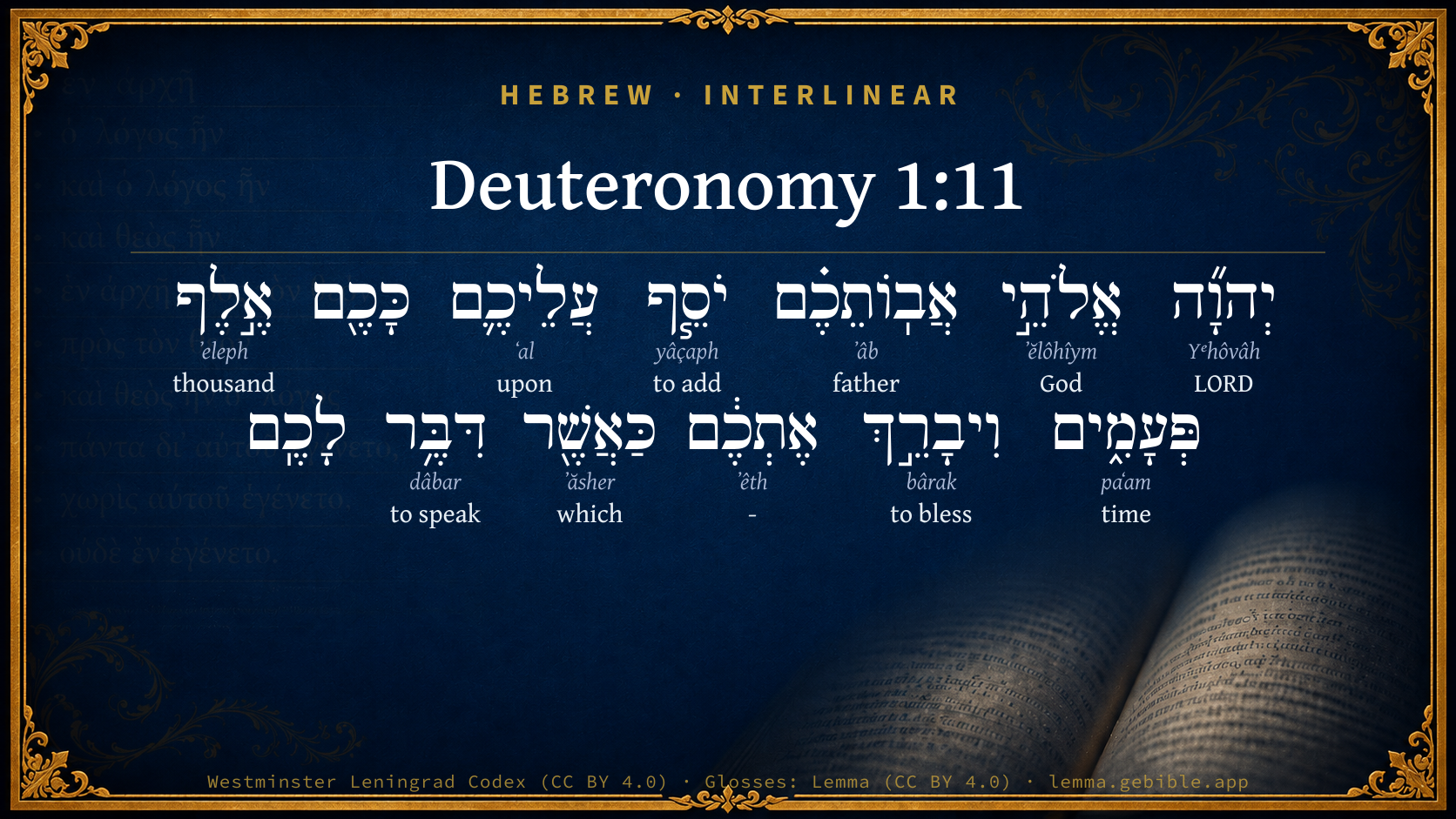
Hebrew (Westminster Leningrad Codex) Deuteronomy 1:11 appears in the Hebrew Old Testament. The text above is from the Westminster Leningrad Codex. Each word links to its Strong’s number, a concise gloss, and parsing drawn from the Open Scriptures Hebrew Bible morphology. Click any word for its full Brown-Driver-Briggs (BDB) entry.
Download image
Cite this verse

Deuteronomy 1:11 (World English Bible). Public Domain. Lemma interlinear Bible study tool, https://lemma.gebible.app/v/deuteronomy/1/11.

Show BibTeX & RIS
BibTeX
RIS
English Translation
Yahweh, the God of your fathers, make you a thousand times as many as you are, and bless you, as he has promised you!
World English Bible · Public Domain
Download a study sheet

One document with this verse’s original text, its word-by-word gloss line, the meaning frame, cross-references with their text, attributed commentary, and full source and license credits — printable, and it pastes into notes with its structure intact.

This verse Autodidact and up

Study sheet (.html) Plain text (.txt)

A passage Seminary Student

Up to 50 verses in one chapter. A passage sheet keeps up to 6 commentary sources and 12 cross-references per verse, in the order this page ranks them, and says so on the sheet whenever that leaves anything out. Ask for a single verse and you get the Autodidact verse sheet above.

Everything on this page stays free to read, with no account — the sheet is a download of what is already on screen, not access to it.

Want to remove ads? Support Godless Engineer
Compare translations 3

The same verse in 3 English versions, stacked beneath the original-language interlinear above. Click any original word for its lexicon entry.

Each is an independent rendering of the whole verse — the interlinear is not word-aligned to these translations.

Highlighted words mark where these versions differ — a whole-verse word diff, not a word-by-word alignment.

  • World English Bible Public Domain
    Yahweh, the God of your fathers, make you a thousand times as many as you are, and bless you, as he has promised you!
  • King James Version Public Domain
    (The LORD God of your fathers make you a thousand times so many more as ye are, and bless you, as he hath promised you!)
  • unfoldingWord Literal Text CC BY-SA 4.0
    Yahweh, the God of your fathers, may he add to you, as you, a thousand times, and may he bless you, just as he spoke to you!

unfoldingWord Literal Text — © unfoldingWord, licensed CC BY-SA 4.0. Word-aligned USFM3 via Door43 (git.door43.org/unfoldingWord/en_ult).

Versions to compare (up to 4)

3 of 4 selected

Show all 18 translations

Every available English version of this verse, each an independent rendering of the whole verse.

  • World English Bible Public Domain
    Yahweh, the God of your fathers, make you a thousand times as many as you are, and bless you, as he has promised you!
  • Berean Standard Bible Public Domain
    May the LORD, the God of your fathers, increase you a thousand times over and bless you as He has promised.
  • Majority Standard Bible Public Domain
    May the LORD, the God of your fathers, increase you a thousand times over and bless you as He has promised.
  • King James Version Public Domain
    (The LORD God of your fathers make you a thousand times so many more as ye are, and bless you, as he hath promised you!)
  • American Standard Version (1901) Public Domain
    Jehovah, the God of your fathers, make you a thousand times as many as ye are, and bless you, as he hath promised you!
  • Revised Version (1885) Public Domain
    The LORD, the God of your fathers, make you a thousand times so many more as ye are, and bless you, as he hath promised you!
  • Geneva Bible (1599) Public Domain
    (The Lord God of your fathers make you a thousand times so many moe as ye are, and blesse you, as he hath promised you)
  • Douay-Rheims (1899) Public Domain
    And I said to you at that time:
  • Young's Literal Translation Public Domain
    Jehovah, God of your fathers, is adding to you, as ye `are', a thousand times, and doth bless you as He hath spoken to you.
  • Literal Standard Version CC BY-SA 4.0
    YHWH, God of your fathers, is adding to you, as you [are], one thousand times, and blesses you as He has spoken to you.
  • Unlocked Literal Bible CC BY-SA 4.0
    May Yahweh, the God of your fathers, make you a thousand times as many as you are, and bless you, as he has promised you!
  • unfoldingWord Literal Text CC BY-SA 4.0
    Yahweh, the God of your fathers, may he add to you, as you, a thousand times, and may he bless you, just as he spoke to you!
  • Darby Bible Public Domain
    Jehovah, the God of your fathers, make you a thousand times so many more as ye are, and bless you as he hath said unto you!
  • World Messianic Bible Public Domain
    May the LORD, the God of your fathers, make you a thousand times as many as you are and bless you, as he has promised you!
  • Webster's Bible Public Domain
    (The LORD God of your fathers make you a thousand times so many more as ye are, and bless you, as he hath promised you!)
  • Free Bible Version CC BY-SA 4.0
    May the Lord, the God of your forefathers, multiply you a thousand times and bless you as he has promised.
  • Bible in Basic English Public Domain
    May the Lord, the God of your fathers, make you a thousand times greater in number than you are, and give you his blessing as he has said!
  • JPS Tanakh (1917) Public Domain
    The LORD, the God of your fathers, make you a thousand times so many more as ye are, and bless you, as He hath promised you! —

Literal Standard Version (2020), Covenant Press — licensed CC BY-SA 4.0. Text via the HelloAO Bible API (eBible.org). Unlocked Literal Bible (unfoldingWord) — licensed CC BY-SA 4.0. Text via the HelloAO Bible API (eBible.org). unfoldingWord Literal Text — © unfoldingWord, licensed CC BY-SA 4.0. Word-aligned USFM3 via Door43 (git.door43.org/unfoldingWord/en_ult). Free Bible Version, Dr. Jonathan Gallagher — licensed CC BY-SA 4.0. Text via the HelloAO Bible API (eBible.org).

Word by word

More ways to search: Search by grammar → Find every occurrence → Compare this word →

Practice this passage: Drill this verse → Learn its vocabulary →

פְּעָמִ֑ים
paʻam
H6471
“times”
Noun, Common, Feminine, Plural, Absolute
Part of Speech
Noun
Type
Common
Gender
Feminine
Number
Plural
State
Absolute
Full BDB Definition

Origin: from H6470

TWOT: 1793a

stroke, beat, foot, step, anvil, occurrence - foot, hoof-beat, footfall, footstep - anvil - occurrence, time, stroke, beat - one time, once, twice, thrice, as time on time, at this repetition, this once, now at length, now...now, at one time...at another
  1. יְהוָ֞ה Yᵉhôvâh H3068 “LORD” Noun, Proper
  2. אֱלֹהֵ֣י ʼĕlôhîym H430 “God(s) of” Noun, Common, Masculine, Plural, Construct
  3. אֲבֽוֹתֵכֶ֗ם ʼâb H1 “fathers · your” Noun, Common, Masculine, Plural, Construct + Suffix, Personal, 2nd Person, Masculine, Plural
  4. יֹסֵ֧ף yâçaph H3254 “to add” Verb, Hiphil, Jussive, 3rd Person, Masculine, Singular
  5. עֲלֵיכֶ֛ם ʻal H5921 “upon · you” Preposition + Suffix, Personal, 2nd Person, Masculine, Plural
  6. אֶ֣לֶף ʼeleph H505 “thousand” Adjective, Cardinal number, Both, Singular, Absolute
  7. וִיבָרֵ֣ךְ bârak H1288 “and · to bless” Conjunction + Verb, Piel, Imperfect, 3rd Person, Masculine, Singular
  8. אֶתְכֶ֔ם ʼêth H853 “- · you” Particle, Direct Object + Suffix, Personal, 2nd Person, Masculine, Plural
  9. כַּאֲשֶׁ֖ר ʼăsher H834 “like/as · which” Preposition + Particle, Relative
  10. דִּבֶּ֥ר dâbar H1696 “to speak” Verb, Piel, Perfect, 3rd Person, Masculine, Singular

About this verse

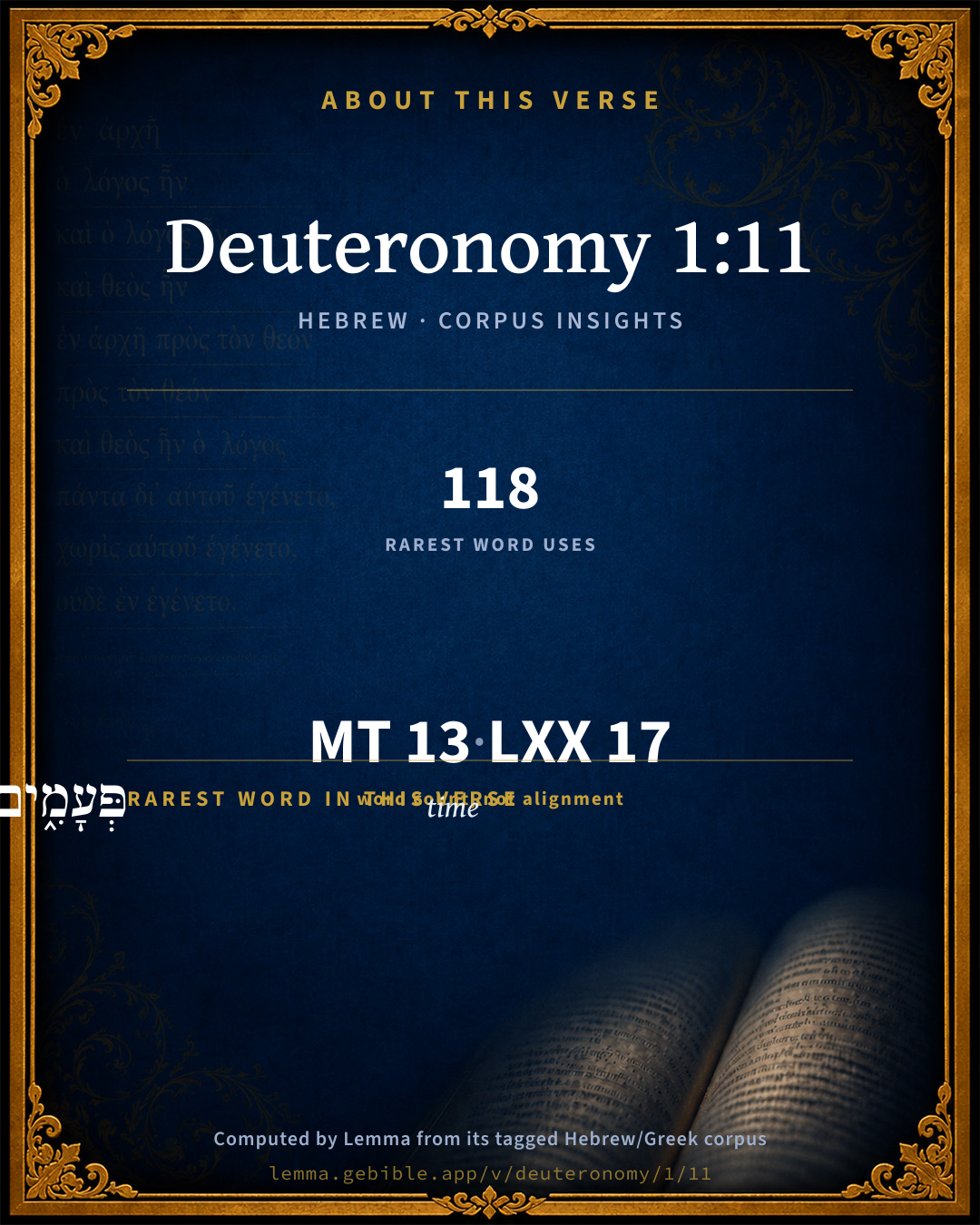
These counts appear in no published source. They are computed here, from the morphology-tagged text and Lemma’s own curated glosses. What Lemma adds →

13
words
11
distinct lemmas
Pentateuch
section

Grammatical profile

  • 3 verbs
  • 4 nouns
  • 1 adjective
  • 3 prepositions
  • 2 particles

Verb forms

  • יֹסֵ֧ף Hiphil · Jussive
  • וִיבָרֵ֣ךְ Piel · Imperfect
  • דִּבֶּ֥ר Piel · Perfect

Hebrew & Septuagint length

In English translation the verse runs 24 words from the Hebrew and 24 from the Septuagint (LXX English) — the same length.

A rough comparison of the two English renderings, which tokenize alike — not a word-level alignment.

Word counts can differ between the Hebrew and the Greek without any difference in meaning — e.g. the Hebrew direct-object marker אֵת has no separate Greek word, and Greek often adds the article ὁ.

In the original languages it is 13 Hebrew tokens and 17 Greek tokens — but the two are counted differently (Hebrew bundles its prefixes and suffixes into one token; the Greek is in lemma form), so that isn’t a like-for-like length.

Cross-references

10

Topical passages linked to Deuteronomy 1:11 in the Treasury of Scripture Knowledge — connected by theme and wording, ordered by reader-vote popularity; previews shown in the World English Bible.

  • Psalms 115:14 May Yahweh increase you more and more, You and your children.
  • Genesis 22:17 that in blessing I will bless you, and in multiplying I will multiply your seed as the stars of the heavens, and as the sand which is on the seashore. Your seed will possess the gate of his enemies.
  • Numbers 6:27 "So they shall put my name on the children of Israel; and I will bless them."
  • Genesis 26:4 I will multiply your seed as the stars of the sky, and will give to your seed all these lands. In your seed will all the nations of the earth be blessed,
  • Genesis 15:5 Yahweh brought him outside, and said, "Look now toward the sky, and count the stars, if you are able to count them." He said to Abram, "So shall your seed be."
  • Genesis 49:25 Even by the God of your father, who will help you, By the Almighty, who will bless you, With blessings of heaven above, Blessings of the deep that lies below, Blessings of the breasts, and of the womb.
  • 2 Samuel 24:3 Joab said to the king, Now Yahweh your God add to the people, however many they may be, one hundred times; and may the eyes of my lord the king see it: but why does my lord the king delight in this thing?
  • Exodus 32:13 Remember Abraham, Isaac, and Israel, your servants, to whom you swore by your own self, and said to them, 'I will multiply your seed as the stars of the sky, and all this land that I have spoken of I will give to your seed, and they shall inherit it forever.'"
  • Numbers 22:12 God said to Balaam, You shall not go with them; you shall not curse the people; for they are blessed.
  • 1 Chronicles 21:3 Joab said, Yahweh make his people a hundred times as many as they are: but, my lord the king, aren't they all my lord's servants? why does my lord require this thing? why will he be a cause of guilt to Israel?

Cross-references courtesy of OpenBible.info (CC BY 4.0).

Hebrew and Greek witnesses Masoretic Hebrew ↔ Greek Septuagint

The same verse in the two great witnesses to the Old Testament, shown verse-for-verse.

These are two independent witnesses, not word-aligned to each other, and the Septuagint is shown in lemma (dictionary) form.

Hebrew Deuteronomy 1:11 Masoretic · Westminster Leningrad Codex

יְהוָ֞ה אֱלֹהֵ֣י אֲבֽוֹתֵכֶ֗ם יֹסֵ֧ף עֲלֵיכֶ֛ם כָּכֶ֖ם אֶ֣לֶף פְּעָמִ֑ים וִיבָרֵ֣ךְ אֶתְכֶ֔ם כַּאֲשֶׁ֖ר דִּבֶּ֥ר לָכֶֽם

Yahweh, the God of your fathers, make you a thousand times as many as you are, and bless you, as he has promised you!

World English Bible · Public Domain

Greek LXX Deuteronomy 1:11 Septuagint · lemma form

κύριος ὁ θεός ὁ πατήρ σύ προςτίθημι σύ ὡς εἰμί χιλιοπλασίως καί εὐλογέω σύ καθότι λαλέω σύ

The Lord God of your fathers add to you a thousand-fold more than you are, and bless you as he has spoken to you.

LXX2012 (modern English Septuagint) · Public Domain

Hebrew: Westminster Leningrad Codex (CC BY 4.0). Greek: Septuagint (public domain); English from LXX2012 (modern English Septuagint) (Public Domain). How the Septuagint differs from the Hebrew →

Targum (Aramaic paraphrase)

2

The Targum is the ancient Jewish Aramaic paraphrase of the Hebrew Scriptures — an interpretive translation, not the Hebrew text itself. Onkelos (literal) and Pseudo-Jonathan (expansive) render the Torah, and Jonathan the Prophets. Coverage is partial: where no permissively-licensed English translation exists for a verse, only the Aramaic is shown. This is verse-level text, not a word-by-word alignment to the Hebrew.

  1. Targum Onkelos Torah (Genesis–Deuteronomy)
    יְיָ אֱלָהָא דַאֲבָהָתְכוֹן יוֹסֵף עֲלֵיכוֹן כְּוָתְכוֹן אֲלַף זִמְנִין וִיבָרֵךְ יָתְכוֹן כְּמָא דִי מַלִיל לְכוֹן

    (no public-domain English translation for this verse)

    Targum Onkelos — Aramaic: “Onkelos Genesis” (public domain); “Onkelos Exodus” (public domain); “Onkelos Leviticus” (public domain); “Onkelos Numbers” (public domain); “Onkelos Deuteronomy” (public domain). English: “Sefaria Community Translation” (CC0 1.0 (public-domain dedication)); “J.W. Etheridge. The Targums of Onkelos and Jonathan Ben Uzziel on the Pentateuch. London: Longmans, Green, 1862” (public domain). Text via Sefaria.

  2. Targum Pseudo-Jonathan Torah (Genesis–Deuteronomy)
    יְיָ אֱלָהָא דְאַבְהַתְכוֹן יוֹסֵף עֲלֵיכוֹן כְּוַותְכוֹן אֶלֶף זִמְנִין מְטוּל בִּרְכָתִי דָא וִיבָרֵךְ יַתְכוֹן בְּלָא סְכוּמָא הֵיכְמָא דְמַלֵּיל לְכוֹן

    The Lord God of your fathers increase you a thousand fold on account of this my benediction, and bless you beyond numbering as He hath said unto you.

    Targum Pseudo-Jonathan — Aramaic: “Targum Jonathan on Genesis” (public domain); “Targum Jonathan on Exodus” (public domain); “Targum Jonathan on Leviticus” (public domain); “Targum Jonathan on Numbers” (public domain); “Targum Jonathan on Deuteronomy” (public domain). English: “The Targum of Jonathan ben Uzziel, trans. J. W. Etheridge, London, 1862” (public domain). Text via Sefaria.

Commentary

Notes on Deuteronomy 1:11 from classic Christian and Jewish commentators (each source and its license shown beneath its notes). The classic Christian expositions comment on the surrounding passage and are grouped to its opening verse, so a note may address several verses; the Jewish commentaries on the Tanakh (Rashi and others) are per-verse, so they appear only where the commentator wrote on this verse.

Lemma curates 59 commentaries, every one of them public domain or Creative Commons licensed, each selected and text-cleaned for this edition rather than reprinted as found. About our sources →

Trapp's Complete Commentary

John Trapp

Deu 1:11 (The LORD God of your fathers make you a thousand times so many more as ye [are], and bless you, as he hath promised you!)

Ver. 11. The Lord God of your fathers.] Such holy ejaculations, such sallies of soul, and egression of affection to God and his people, are frequently found in heavenly minded men.

John Trapp, A Commentary or Exposition upon All the Books of the Old and New Testament (1647–1656) — public domain. Text from a community e-Sword module.

Ellicott's Commentary for English Readers

(11) The Lord God of your fathers . . . bless you.—This appears to belong distinctly to the Book of Deuteronomy. It can hardly be a record of what was spoken long before. It brings the living speaker before us in a way that precludes imitation.

A Bible Commentary for English Readers, edited by Charles John Ellicott (1878–1897) — public domain. Text from a community e-Sword module.

The Cambridge Bible for Schools and Colleges

gen. ed. J. J. S. Perowne

11. This verse is even more characteristic of the deuteronomic style. The Lord, the God of your fathers occurs indeed twice in JE; but either thus or with variants seven times in D. As he promised, Heb. spake, to you occurs in D 14 or 15 times.

The Cambridge Bible for Schools and Colleges (gen. ed. J. J. S. Perowne; Cambridge University Press, 1878–1918) — public domain. Text from a community e-Sword module.

John Gill's Exposition

The Lord God of your fathers make you a thousand times so many more as ye are,.... This prayer he made, or this blessing he pronounced on them, to show that he did not envy their increase, nor was any ways uneasy at it, but rejoiced in it, though he gave it as a reason of his not being able to govern them alone:

and bless you, as he hath promised you: with all kind of blessings, as he had often promised their fathers.

John Gill's Exposition of the Whole Bible (1746–1763) — public domain (CC PDM 1.0). Text via the HelloAO Bible API.

Haydock's Catholic Bible Commentary

CHAPTER I.

George Leo Haydock (1774–1849), Haydock's Catholic Family Bible and Commentary, 1859 edition — public domain. Excludes Psalms (Douay-Rheims chapter numbering differs from Protestant) and Deuterocanonical books (Catholic canon only).

The Pulpit Commentary

It was not the vast increase of the people in numbers that distressed Moses, rather was this to him a matter of rejoicing, and his desire was that their increase might become still greater, even a thousandfold. But he felt his own inability, as leader, ruler, and judge, alone to cope with so vast a multitude.

The Pulpit Commentary (1880–1919), ed. H.D.M. Spence-Jones & Joseph S. Exell — public domain. Text from a community e-Sword module.

Rashi

Rabbi Shlomo Yitzchaki (Rashi)

יסף עליכם ככם אלף פעמים MAY HE ADD TO YOU A THOUSAND TIMES AS MANY MORE AS YE ARE — What is the force of saying further: ויברך אתכם כאשר דבר לכם AND MAY HE BLESS YOU EVEN AS HE HATH SPOKEN CONCERNING YOU? But the explanation is: They said to him, “Moses, you are setting a limit to our blessings (only a thousand times)! The Holy One, blessed be He, has already made a boundless promise to Abraham (Genesis 13:16) “… if one can count [the dust of the earth, then can thy seed also be counted]"! Moses replied to them: This (a thousand times) is from me (it is my blessing); but may He bless you even as He hath spoken concerning you!" (Sifrei Devarim 11).

Rashi on the Tanakh — English translations: “The Judaica Press complete Tanach with Rashi, translated by A. J. Rosenberg” (CC BY 4.0); “Pentateuch with Rashi's commentary by M. Rosenbaum and A.M. Silbermann, 1929-1934” (public domain); “The Metsudah Tanach series, Lakewood, N.J” (CC BY 4.0); and “The Book of Joshua, Metsudah Publications, 1997” (CC BY 4.0). Text via Sefaria.

Lesson kit

Teaching starters — assembled from the data on this page, not authored interpretation. Every prompt links to the verse data it draws on. Edit before teaching.

Deuteronomy, in the Pentateuch, opens this verse with 13 words (11 distinct Hebrew lemmas). Its most distinctive word is paʻam (“time”). A historical commentator’s framing appears above. Read the whole chapter for the surrounding context.

Discussion questions

  1. The word paʻam carries the sense “time.” How does it shape the verse?
  2. Psalms 115:14 shares this passage’s theme. How do the two illuminate each other?
  3. These translations render this verse differently; the difference is in the English rendering, not the original. What questions does that raise?
  4. The verb «יֹסֵ֧ף» is Hiphil Jussive. How does its form color the action?
  5. Reading how Trapp's Complete Commentary and Ellicott's Commentary for English Readers read this verse, where do the two commentators agree and where do they part?

Things to notice

Reading settings

Reading text

Shown beneath each verse's original-language words.

Old Testament
Old Testament edition

Read the OT as the Masoretic Hebrew (MT) or the Greek Septuagint (LXX).

English shown for the Greek Septuagint (in the Hebrew ↔ Greek comparison).

Comparing translations? Open the Compare panel on any verse page to stack up to four side by side.