Leviticus 9:22

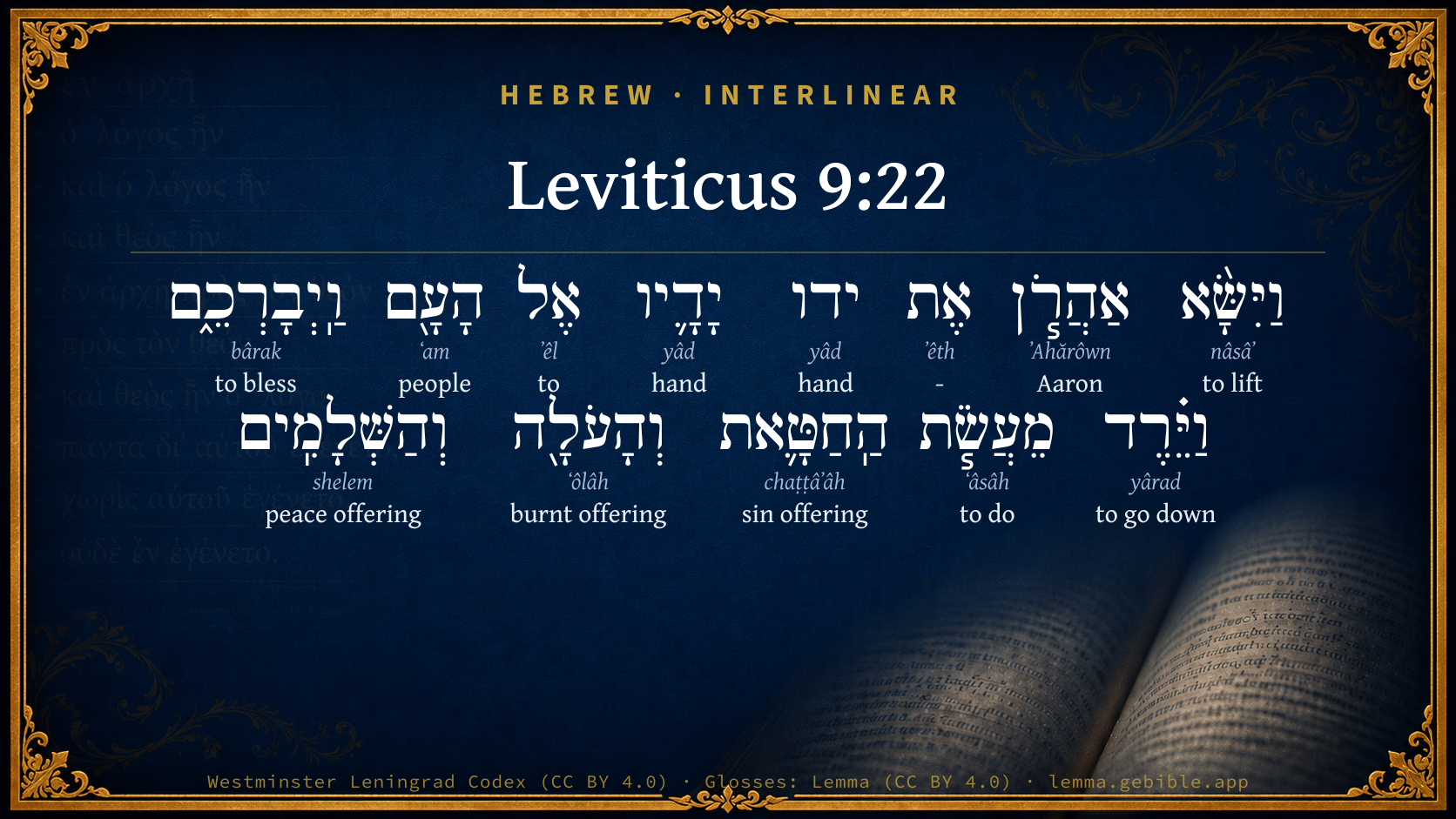
Hebrew (Westminster Leningrad Codex) Leviticus 9:22 appears in the Hebrew Old Testament. The text above is from the Westminster Leningrad Codex. Each word links to its Strong’s number, a concise gloss, and parsing drawn from the Open Scriptures Hebrew Bible morphology. Click any word for its full Brown-Driver-Briggs (BDB) entry.
Download image
Cite this verse

Leviticus 9:22 (World English Bible). Public Domain. Lemma interlinear Bible study tool, https://lemma.gebible.app/v/leviticus/9/22.

Show BibTeX & RIS
BibTeX
RIS
English Translation
Aaron lifted up his hands toward the people, and blessed them; and he came down from offering the sin offering, and the burnt offering, and the peace offerings.
World English Bible · Public Domain
Download a study sheet

One document with this verse’s original text, its word-by-word gloss line, the meaning frame, cross-references with their text, attributed commentary, and full source and license credits — printable, and it pastes into notes with its structure intact.

This verse Autodidact and up

Study sheet (.html) Plain text (.txt)

A passage Seminary Student

Up to 50 verses in one chapter. A passage sheet keeps up to 6 commentary sources and 12 cross-references per verse, in the order this page ranks them, and says so on the sheet whenever that leaves anything out. Ask for a single verse and you get the Autodidact verse sheet above.

Everything on this page stays free to read, with no account — the sheet is a download of what is already on screen, not access to it.

Want to remove ads? Support Godless Engineer
Compare translations 3

The same verse in 3 English versions, stacked beneath the original-language interlinear above. Click any original word for its lexicon entry.

Each is an independent rendering of the whole verse — the interlinear is not word-aligned to these translations.

Highlighted words mark where these versions differ — a whole-verse word diff, not a word-by-word alignment.

  • World English Bible Public Domain
    Aaron lifted up his hands toward the people, and blessed them; and he came down from offering the sin offering, and the burnt offering, and the peace offerings.
  • King James Version Public Domain
    And Aaron lifted up his hand toward the people, and blessed them, and came down from offering of the sin offering, and the burnt offering, and peace offerings.
  • unfoldingWord Literal Text CC BY-SA 4.0
    And Aaron lifted his hands toward the people, and he blessed them. And he came down from making the sin offering and the burnt offering and the peace offerings.

unfoldingWord Literal Text — © unfoldingWord, licensed CC BY-SA 4.0. Word-aligned USFM3 via Door43 (git.door43.org/unfoldingWord/en_ult).

Versions to compare (up to 4)

3 of 4 selected

Show all 18 translations

Every available English version of this verse, each an independent rendering of the whole verse.

  • World English Bible Public Domain
    Aaron lifted up his hands toward the people, and blessed them; and he came down from offering the sin offering, and the burnt offering, and the peace offerings.
  • Berean Standard Bible Public Domain
    Aaron lifted up his hands toward the people and blessed them. And having made the sin offering, the burnt offering, and the peace offering, he stepped down.
  • Majority Standard Bible Public Domain
    Aaron lifted up his hands toward the people and blessed them. And having made the sin offering, the burnt offering, and the peace offering, he stepped down.
  • King James Version Public Domain
    And Aaron lifted up his hand toward the people, and blessed them, and came down from offering of the sin offering, and the burnt offering, and peace offerings.
  • American Standard Version (1901) Public Domain
    And Aaron lifted up his hands toward the people, and blessed them; and he came down from offering the sin-offering, and the burnt-offering, and the peace-offerings.
  • Revised Version (1885) Public Domain
    And Aaron lifted up his hands toward the people, and blessed them; and he came down from offering the sin offering, and the burnt offering, and the peace offerings.
  • Geneva Bible (1599) Public Domain
    So Aaron lift vp his hand toward the people, and blessed them, and came downe from offring of the sinne offring, and the burnt offring, and the peace offrings.
  • Douay-Rheims (1899) Public Domain
    And stretching forth his hands to the people, he blessed them. And so the victims for sin, and the holocausts, and the peace offerings being finished, he came down.
  • Young's Literal Translation Public Domain
    And Aaron lifteth up his hand towards the people, and blesseth them, and cometh down from making the sin-offering, and the burnt-offering, and the peace-offerings.
  • Literal Standard Version CC BY-SA 4.0
    And Aaron lifts up his hand toward the people, and blesses them, and comes down from making the sin-offering, and the burnt-offering, and the peace-offerings.
  • Unlocked Literal Bible CC BY-SA 4.0
    Then Aaron lifted up his hands toward the people and blessed them; then he came down from offering the sin offering, the burnt offering, and the peace offering.
  • unfoldingWord Literal Text CC BY-SA 4.0
    And Aaron lifted his hands toward the people, and he blessed them. And he came down from making the sin offering and the burnt offering and the peace offerings.
  • Darby Bible Public Domain
    And Aaron lifted up his hands toward the people and blessed them, and came down after the offering of the sin-offering, and the burnt-offering, and the peace-offering.
  • World Messianic Bible Public Domain
    Aaron lifted up his hands toward the people, and blessed them; and he came down from offering the sin offering, and the burnt offering, and the peace offerings.
  • Webster's Bible Public Domain
    And Aaron lifted up his hand towards the people, and blessed them; and came down from offering the sin-offering, and the burnt-offering, and peace-offerings.
  • Free Bible Version CC BY-SA 4.0
    Then Aaron held up his hands towards the people and blessed them. After that he came down from the altar, having completed the sin offering, the burnt offering, and the peace offering.
  • Bible in Basic English Public Domain
    And Aaron, lifting up his hands to the people, gave them a blessing; and he came down from offering the sin-offering, and the burned offering, and the peace-offerings.
  • JPS Tanakh (1917) Public Domain
    And Aaron lifted up his hands toward the people, and blessed them; and he came down from offering the sin-offering, and the burnt-offering, and the peace-offerings.

Literal Standard Version (2020), Covenant Press — licensed CC BY-SA 4.0. Text via the HelloAO Bible API (eBible.org). Unlocked Literal Bible (unfoldingWord) — licensed CC BY-SA 4.0. Text via the HelloAO Bible API (eBible.org). unfoldingWord Literal Text — © unfoldingWord, licensed CC BY-SA 4.0. Word-aligned USFM3 via Door43 (git.door43.org/unfoldingWord/en_ult). Free Bible Version, Dr. Jonathan Gallagher — licensed CC BY-SA 4.0. Text via the HelloAO Bible API (eBible.org).

Word by word

More ways to search: Search by grammar → Find every occurrence → Compare this word →

Practice this passage: Drill this verse → Learn its vocabulary →

וְהַשְּׁלָמִֽים
shelem
H8002
“and · the · peace offerings”
Conjunction + Particle, Definite Article + Noun, Common, Masculine, Plural, Absolute
Part of Speech
Conjunction + Particle + Noun
Type
Common
Gender
Masculine
Number
Plural
State
Absolute
Full BDB Definition

Origin: from H7999

TWOT: 2401b

peace offering, requital, sacrifice for alliance or friendship - voluntary sacrifice of thanks
  1. וַיִּשָּׂ֨א nâsâʼ H5375 “and · to lift” Conjunction + Verb, Qal, Sequential Imperfect, 3rd Person, Masculine, Singular
  2. אַהֲרֹ֧ן ʼAhărôwn H175 “Aaron” Noun, Proper
  3. אֶת ʼêth H853 “-” Particle, Direct Object
  4. ידו yâd H3027 “hand · his” Noun, Common, Both, Singular, Construct + Suffix, Personal, 3rd Person, Masculine, Singular
  5. יָדָ֛יו yâd H3027 “hands · his” Noun, Common, Both, Dual, Construct + Suffix, Personal, 3rd Person, Masculine, Singular
  6. אֶל ʼêl H413 “to” Preposition
  7. הָעָ֖ם ʻam H5971 “the · people” Particle, Definite Article + Noun, Common, Masculine, Singular, Absolute
  8. וַֽיְבָרְכֵ֑ם bârak H1288 “and · to bless · them” Conjunction + Verb, Piel, Sequential Imperfect, 3rd Person, Masculine, Singular + Suffix, Personal, 3rd Person, Masculine, Plural
  9. וַיֵּ֗רֶד yârad H3381 “and · to go down” Conjunction + Verb, Qal, Sequential Imperfect, 3rd Person, Masculine, Singular
  10. מֵעֲשֹׂ֧ת ʻâsâh H6213 “from · to do” Preposition + Verb, Qal, Infinitive Construct
  11. הַֽחַטָּ֛את chaṭṭâʼâh H2403 “the · sin offering” Particle, Definite Article + Noun, Common, Feminine, Singular, Absolute
  12. וְהָעֹלָ֖ה ʻôlâh H5930 “and · the · burnt offering” Conjunction + Particle, Definite Article + Noun, Common, Feminine, Singular, Absolute

About this verse

These counts appear in no published source. They are computed here, from the morphology-tagged text and Lemma’s own curated glosses. What Lemma adds →

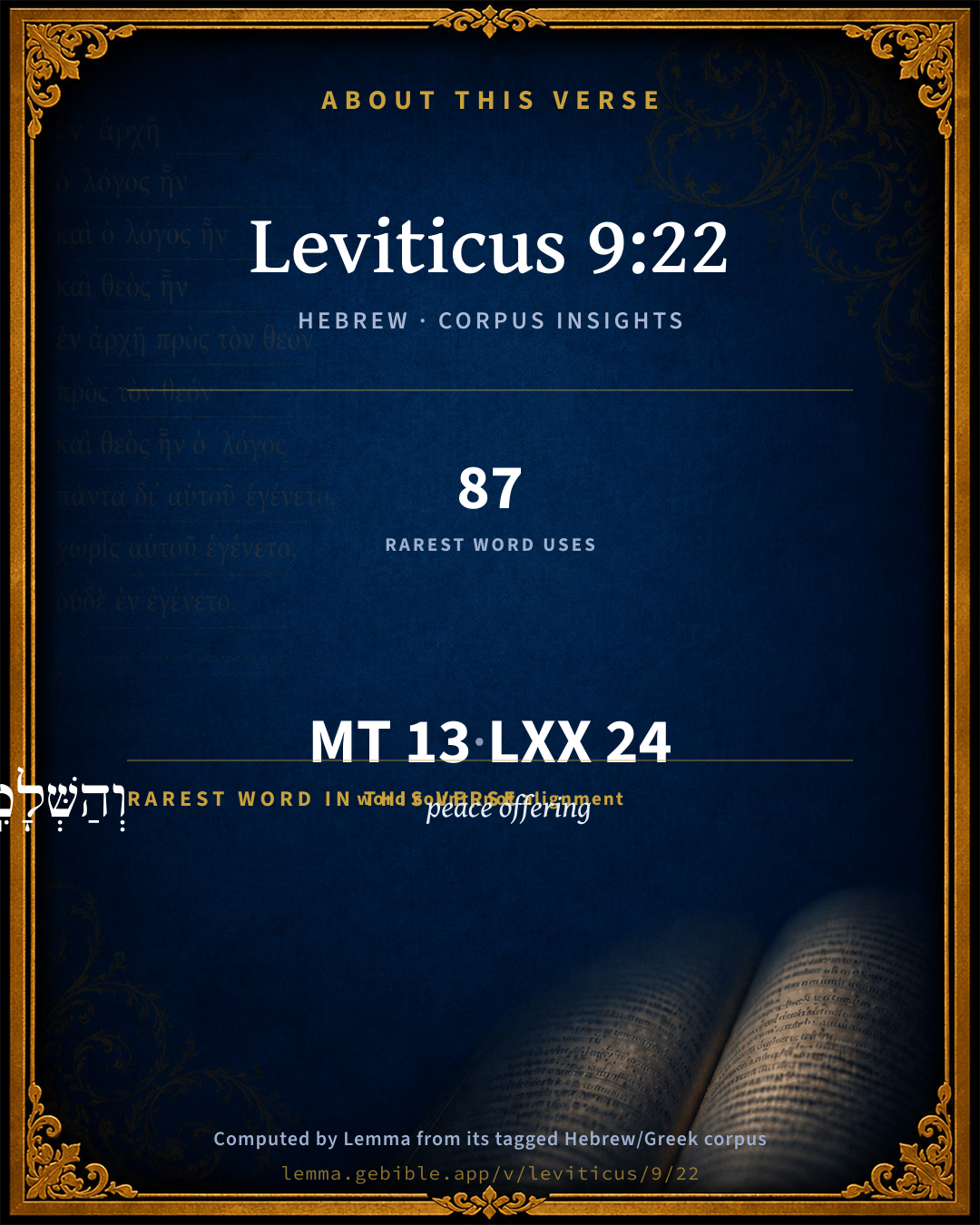
13
words
12
distinct lemmas
Pentateuch
section

Grammatical profile

  • 4 verbs
  • 7 nouns
  • 1 preposition
  • 1 particle

Verb forms

  • וַיִּשָּׂ֨א Qal · Sequential Imperfect
  • וַֽיְבָרְכֵ֑ם Piel · Sequential Imperfect
  • וַיֵּ֗רֶד Qal · Sequential Imperfect
  • מֵעֲשֹׂ֧ת Qal · Infinitive Construct

Repetition

A word recurs within this verse — often emphatic in Hebrew:

Hebrew & Septuagint length

In English translation the verse runs 28 words from the Hebrew and 30 from the Septuagint (LXX English) — closely comparable.

A rough comparison of the two English renderings, which tokenize alike — not a word-level alignment.

Word counts can differ between the Hebrew and the Greek without any difference in meaning — e.g. the Hebrew direct-object marker אֵת has no separate Greek word, and Greek often adds the article ὁ.

In the original languages it is 13 Hebrew tokens and 24 Greek tokens — but the two are counted differently (Hebrew bundles its prefixes and suffixes into one token; the Greek is in lemma form), so that isn’t a like-for-like length.

Cross-references

14

Topical passages linked to Leviticus 9:22 in the Treasury of Scripture Knowledge — connected by theme and wording, ordered by reader-vote popularity; previews shown in the World English Bible.

  • Deuteronomy 21:5 The priests the sons of Levi shall come near; for them Yahweh your God has chosen to minister to him, and to bless in the name of Yahweh; and according to their word shall every controversy and every stroke be.
  • Luke 24:50 He led them out as far as Bethany, and he lifted up his hands, and blessed them.
  • Numbers 6:23–27 "Speak to Aaron and to his sons, saying, 'This is how you shall bless the children of Israel.' You shall tell them,
  • Genesis 14:18–20 Melchizedek king of Salem brought forth bread and wine: and he was priest of God Most High.
  • Deuteronomy 10:8 At that time Yahweh set apart the tribe of Levi, to bear the ark of the covenant of Yahweh, to stand before Yahweh to minister to him, and to bless in his name, to this day.
  • 1 Kings 8:55 He stood, and blessed all the assembly of Israel with a loud voice, saying,
  • 1 Chronicles 23:13 The sons of Amram: Aaron and Moses; and Aaron was separated, that he should sanctify the most holy things, he and his sons, forever, to burn incense before Yahweh, to minister to him, and to bless in his name, forever.
  • 2 Chronicles 6:3 The king turned his face, and blessed all the assembly of Israel: and all the assembly of Israel stood.
  • Psalms 72:17 His name endures forever. His name continues as long as the sun. Men shall be blessed by him. All nations will call him blessed.
  • Mark 10:16 He took them in his arms, and blessed them, laying his hands on them.
  • Acts 3:26 God, having raised up his servant, Jesus, sent him to you first, to bless you, in turning away everyone of you from your wickedness."
  • 2 Corinthians 13:14 The grace of the Lord Jesus Christ, the love of God, and the communion of the Holy Spirit, be with you all. Amen.
  • Hebrews 7:6–7 but he whose genealogy is not counted from them has taken tithes of Abraham, and has blessed him who has the promises.
  • 1 Peter 3:9 not rendering evil for evil, or reviling for reviling; but instead blessing; knowing that to this were you called, that you may inherit a blessing.

Cross-references courtesy of OpenBible.info (CC BY 4.0).

Hebrew and Greek witnesses Masoretic Hebrew ↔ Greek Septuagint

The same verse in the two great witnesses to the Old Testament, shown verse-for-verse.

These are two independent witnesses, not word-aligned to each other, and the Septuagint is shown in lemma (dictionary) form.

Hebrew Leviticus 9:22 Masoretic · Westminster Leningrad Codex

וַיִּשָּׂ֨א אַהֲרֹ֧ן אֶת ידו יָדָ֛יו אֶל הָעָ֖ם וַֽיְבָרְכֵ֑ם וַיֵּ֗רֶד מֵעֲשֹׂ֧ת הַֽחַטָּ֛את וְהָעֹלָ֖ה וְהַשְּׁלָמִֽים

Aaron lifted up his hands toward the people, and blessed them; and he came down from offering the sin offering, and the burnt offering, and the peace offerings.

World English Bible · Public Domain

Greek LXX Leviticus 9:22 Septuagint · lemma form

καί ἐκαἴρω ἀαρών ὁ χείρ ἐπί ὁ λαός εὐλογέω αὐτός καί καταβαίνω ποιέω ὁ περί ὁ ἁμαρτία καί ὁ ὁλοκαύτωμα καί ὁ ὁ σωτήριον

And Aaron lifted up his hands on the people and blessed them; and after he had offered the sin-offering, and the whole burnt offerings, and the peace-offerings, he came down.

LXX2012 (modern English Septuagint) · Public Domain

Hebrew: Westminster Leningrad Codex (CC BY 4.0). Greek: Septuagint (public domain); English from LXX2012 (modern English Septuagint) (Public Domain). How the Septuagint differs from the Hebrew →

Targum (Aramaic paraphrase)

2

The Targum is the ancient Jewish Aramaic paraphrase of the Hebrew Scriptures — an interpretive translation, not the Hebrew text itself. Onkelos (literal) and Pseudo-Jonathan (expansive) render the Torah, and Jonathan the Prophets. Coverage is partial: where no permissively-licensed English translation exists for a verse, only the Aramaic is shown. This is verse-level text, not a word-by-word alignment to the Hebrew.

  1. Targum Onkelos Torah (Genesis–Deuteronomy)
    וַאֲרֵם אַהֲרֹן יָת יְדוֹהִי עַל עַמָא וּבָרֵכִנוּן וּנְחַת מִלְמֶעְבַּד חַטָאתָא וַעֲלָתָא וְנִכְסַת קוּדְשַׁיָא

    (no public-domain English translation for this verse)

    Targum Onkelos — Aramaic: “Onkelos Genesis” (public domain); “Onkelos Exodus” (public domain); “Onkelos Leviticus” (public domain); “Onkelos Numbers” (public domain); “Onkelos Deuteronomy” (public domain). English: “Sefaria Community Translation” (CC0 1.0 (public-domain dedication)); “J.W. Etheridge. The Targums of Onkelos and Jonathan Ben Uzziel on the Pentateuch. London: Longmans, Green, 1862” (public domain). Text via Sefaria.

  2. Targum Pseudo-Jonathan Torah (Genesis–Deuteronomy)
    וּפְרַס אַהֲרן יַת יְדוֹי לָקֳבֵיל עַמָא וּבָרֵיכִינוּן וּנְחַת מִן מַדְבְּחָא בְּחֶדְוָוא מִן דְפָסַק לְמֶעֱבַּד חַטָאתָא וְעָלָתָא וְנִכְסַת קוּדְשַׁיָא

    And Aharon stretched out his hands towards the people and blessed them, and came down from the altar with joy, after he had finished to perform the sin offering and the burnt offering and the hallowed oblation.

    Targum Pseudo-Jonathan — Aramaic: “Targum Jonathan on Genesis” (public domain); “Targum Jonathan on Exodus” (public domain); “Targum Jonathan on Leviticus” (public domain); “Targum Jonathan on Numbers” (public domain); “Targum Jonathan on Deuteronomy” (public domain). English: “The Targum of Jonathan ben Uzziel, trans. J. W. Etheridge, London, 1862” (public domain). Text via Sefaria.

Commentary

Notes on Leviticus 9:22 from classic Christian and Jewish commentators (each source and its license shown beneath its notes). The classic Christian expositions comment on the surrounding passage and are grouped to its opening verse, so a note may address several verses; the Jewish commentaries on the Tanakh (Rashi and others) are per-verse, so they appear only where the commentator wrote on this verse.

Lemma curates 59 commentaries, every one of them public domain or Creative Commons licensed, each selected and text-cleaned for this edition rather than reprinted as found. About our sources →

Trapp's Complete Commentary

John Trapp

Lev 9:22 And Aaron lifted up his hand toward the people, and blessed them, and came down from offering of the sin offering, and the burnt offering, and peace offerings.

Ver. 22. Lifted up his hand.] He put the blessing upon them. A type of Christ. {Luk 24:50 Act 3:26 Eph 1:3}

John Trapp, A Commentary or Exposition upon All the Books of the Old and New Testament (1647–1656) — public domain. Text from a community e-Sword module.

Joseph Benson's Commentary

Lev 9:22. Aaron lifted up his hand — Which was the usual rite of blessing. By this posture he signified both whence he expected the blessing, and his hearty desire of it for them. And blessed them — In some such manner as is related Num 6:24, &c., though not in the same form, for it is not probable that he used it before God delivered it. And this was an act of his priestly office, no less than sacrificing. And herein he was a type of Christ, who came into the world to bless us, and when he was parting from his disciples, lifted up his hands and blessed them; yea, and in them his whole church, of which they were the elders and representatives. And came down — From the altar; whence he is said to come down, either, 1st, Because the altar stood upon raised ground; or, 2d, Because it was nearer the holy place, which was the upper end.

Joseph Benson's Commentary on the Old and New Testaments (1811–1818) — public domain. Text from a community e-Sword module.

Whedon's Commentary on the Bible

Daniel D. Whedon

THE BENEDICTION, AND THE CONSUMING FIRE FROM JEHOVAH, Lev_9:22-24.

22. Aaron lifted up his hand — “Hands,” (R.V.) The custom of raising aloft the hands in prayer is found among most nations who pretend to any kind of worship. Virgil gives frequent instances among the Trojans and Greeks. Chrysostom explains it as an oblation to God of the instruments of our necessities. From its almost universal prevalence we would rather understand it as an instinctive propriety of prayer, and especially of blessing, pointing out the object of supplication and the recipients of the divine favours.

And blessed them — The form of the threefold priestly benediction is recorded in Num_6:23-27. Some writers discover in it intimations of the trinity of persons in the unity of the Divine Substance.

It was a special prerogative of the priests to bless in the name of Jehovah. See Deu_21:5. There has not been much of this thus far. We have been face to face with law and discipline. Now Aaron blesses Israel, and stern Moses joins him. Feeling begins to enter into the ministry of law.

Came down from offering — The standing place of the priest while ministering at the altar is spoken of as above the level of the court of the tabernacle. To reach this standing there must have been an inclined plane, since steps were forbidden, (Exo_20:26,) as a safeguard against an indecorous exposure of the priest’s person.

Daniel D. Whedon (gen. ed.), Commentary on the Old and New Testaments (1874–1909) — public domain. Text from a community e-Sword module.

The Expositor's Bible

THE DOUBLE BENEDICTION

Lev_9:22-24

"And Aaron lifted up his hands toward the people, and blessed them; and he came down from offering the sin offering, and the burnt offering, and the peace offerings. And Moses and Aaron went into the tent of meeting, and came out and blessed the people and the glory of the Lord appeared unto all the people. And there came forth fire from before the Lord, and consumed upon the altar the burnt offering and the fat; and when all the people saw it, they shouted, and fell on their faces."

The sacrifices having now been made, and the offerings presented in this divinely-appointed order, by the ordained and consecrated priesthood, two things followed: a double benediction was pronounced upon the people, and Jehovah manifested to them His glory. We read (Lev_9:22), "And Aaron lifted up his hands toward the people, and blessed them; and he came down from offering the sin offering, and the burnt offering, and the peace offerings."

Presumably, the form of benediction which Aaron used was that which, according to Num_6:24-27, the priests were commanded by the Lord to use: "The Lord bless thee, and keep thee: the Lord make His face to shine upon thee, and be gracious unto thee: the Lord lift up His countenance upon thee, and give thee peace." It was not an empty form; for the Lord at that time also promised Himself to make this blessing efficient, saying thereafter, "So shall they put My Name"-Jehovah, the name of God in covenant, -"upon the children of Israel; and I will bless them."

So also the Lord Jesus, just before withdrawing from the bodily sight of His disciples after the completion of His great sacrifice, "lifted up His hands, and blessed them"; and thereupon disappeared from their sight, ascending into heaven. Even so was it in the typical service of this day; for when Aaron had thus lifted up his hands and blessed the people (Lev_9:23), "Moses and Aaron went into the tent of meeting."

The work of Aaron in the outer court had been finished, and now he disappears from Israels sight; for he must, in like manner, be inducted into the priestly work within the Holy Place. He must there be shown all those things to which, in his priestly ministrations, the blood must be applied; and, especially, must also offer the sweet incense at the golden altar which was before the veil which enshrined the immediate presence of Jehovah. But this offering of incense, as all have agreed, typifies the precious and most effective intercession of the great Antitype; so that thus it was shown in a figure, how the Christ of God, having finished His sacrificial work in the sight of men, and having ascended into heaven, should there for a season abide, hidden from human sight, making intercession for His waiting people.

After an interval-we are not told how long-Moses and Aaron again (Lev_9:23-24), "came out, and blessed the people: and the glory of the Lord appeared unto all the people. And there came forth fire from before the Lord, and consumed upon the altar the burnt offering and the fat: and when all the people saw it, they shouted, and fell on their faces."

This second blessing, by Moses and Aaron conjointly, followed Aarons reappearance to Israel, and marked the completion of these inauguration services, the intercession within the veil, as well as the sacrifices. And the revelation in a visible way of the glory of the Lord added what now was alone required, the manifest attestation by the Lord of the tabernacle of His approval of all that had been done in these memorable eight days. This appearance of the Shekinah glory was followed by a flash of fire which, in token of the Divine appropriation of the sacrifices, consumed in an instant the burnt offering on the altar with the fat of the sin offering and the peace offering, which had been laid upon it. We cannot follow here the Jewish tradition, which has it that with this act the sacrificial fire which was never to go out upon the altar, was originated. On the contrary, as we have seen, the offerings had before this been made by Moses, and even on this day the fire had been kindled before (Lev_9:10, et seq.). Nor is there any necessary inconsistency here; for we have but to suppose that the burning of the sacrifices which had been kindled by Aaron was not yet complete, when the flash from the cloud of glory in an instant consummated the burning, teaching in a most august and impressive manner the symbolic meaning of the burning of the sacrifices on the altar, as signifying the acceptance and appropriation of that which was offered, by the Lord who had commanded all, and thereby endorsing all that had been done, as according to His mind and will.

And even so, according to the sure Word of prophecy, our heavenly High Priest has yet in reserve for His people a second benediction. His first blessing upon leaving the world was followed by Pentecost; the second, on His reappearing, shall bring in resurrection and full salvation. And in that day, when He "shall appear a second time, apart from sin, to them that wait for Him unto salvation," {Heb_9:28} therewith shall appear the glory which on that day, long ago, appeared to Israel; for He "shall come in the glory of His Father," and thus shall God, the Most High and the Most Holy, testify before the universe His gracious acceptance of the service of the true Aaron and His "many sons," the priestly people of God, through all the Christian ages. Thus, the services and events of that day of induction, in their order from beginning to end, were not only a parable of the order of grace, but also, as it were, a typical epitome of the whole work of redemption. They are thus a prophecy that the work which began when Christ made His soul an offering for sin, and to perfect which He is now withdrawn from our sight for a season, shall be consummated at last by His reappearing in glory for the final blessing of His waiting people.

And if we look at other and subordinate aspects of this inauguration service, we shall still find this sequel of all, no less richly suggestive. Expiation, righteousness, fellowship in peace with God, shall bring with it the blessing of the Lord, and finally issue in the revelation of His glory in the sight of all who accept this great redemption through sacrifice. And so also in the personal life. As the trustful acceptance and use of the appointed Sin offering leads to the consecration of the person and the life, and as by this consecration we come into conscious fellowship with God in joy and peace, as we feed on the flesh of the slain Lamb, so, as the blessed result, unto every true believer, according to the measure of his faith, this is followed by the double benediction of the Lord; one for this life, and a larger, for the life which is to come. The Lord blesses him, and keeps him: the Lord makes His face to shine upon" him, and is gracious unto him: the Lord lifts up His countenance upon him, and gives him peace, according to that word of the great High Priest: "Peace I leave with you: My peace I give unto you". {Joh_14:27} And then, after the present peace, is yet to follow, as the final issue of the expiated sin, and the consecrated life, and fellowship in peace with the God of life and love, the beholding of the glory of the Lord; according to, that high priestly prayer of our Redeemer, That which Thou hast given Me, I will that, where I am, they also may be with Me: that they may behold My glory". {Joh_17:24} Even here some know a little of this, and find that expiated sin and full consecration are followed here and now by bright glimpses of the Glory of the Lord. But what is now seen thus in part shall then be seen fully and face to face. Who would not make sure of that beatific vision of the glory of the Lord?

William Robertson Nicoll, ed., The Expositor's Bible (London: Hodder & Stoughton, 1887–1910) — public domain. 65 of 66 books (1 Corinthians is not separately keyed, as that volume carries no machine-parseable verse references); section-level commentary keyed to the opening verse. Introductory and overview sections not keyed to a specific passage are excluded.

Tyndale Open Study Notes

Tyndale Open Resources

9:22 blessed them: See Num 6:22-27.

Tyndale Open Study Notes — © Tyndale Open Resources, licensed CC BY-SA 4.0. Text via the HelloAO Bible API.

Geneva Bible (1599)

Geneva Bible translators

Because the altar was near the Sanctuary, which was the upper end, therefore he is said to come down.

Geneva Bible (1599) marginal notes — public domain. Text via Bolls.life.

Jamieson, Fausset & Brown

Robert Jamieson, A. R. Fausset & David Brown

Aaron lifted up his hand . . . and blessed them--The pronouncing of a benediction on the people assembled in the court was a necessary part of the high priest's duty, and the formula in which it was to be given is described (Num 6:23-27).

came down from offering--The altar was elevated above the level of the floor, and the ascent was by a gentle slope (Exo 20:26).

Jamieson, Fausset & Brown — Commentary Critical and Explanatory on the Whole Bible (1871) — public domain (CC PDM 1.0). Text via the HelloAO Bible API.

Adam Clarke's Commentary

Verse 22. And Aaron lifted up his hand toward the people, and blessed them] On lifting up the hands in prayer, see Ex 9:29. The form of the blessing we have in Nu 6:23, c.: "The LORD bless thee and keep thee! The LORD make his face shine upon thee, and be gracious unto thee! The LORD lift up his countenance upon thee, and give thee peace!" See the notes on these passages. See Clarke on Nu 6:23.

And came down from offering of the sin-offering, &c.] A sin-offering, a burnt-offering, a meat-offering, and peace-offerings, were made to God that his glory might appear to the whole congregation. This was the end of all sacrifice and religious service not to confer any obligation on God, but to make an atonement for sin, and to engage him to dwell among and influence his worshippers.

Adam Clarke's Commentary on the Bible (1810–1826) — public domain. Text from a community e-Sword/MySword module.

Ellicott's Commentary for English Readers

(22) And Aaron lifted up his hand.—Having now completed the rites of the various sacrifices, and whilst still standing on the elevation leading to the altar, Aaron with uplifted hands solemnly pronounces upon the assembled people the priestly benediction prescribed in Num_6:24-26. As the Lord separated the tribe of Levi to bless the people in His name (Deu_10:8; Deu_21:5), the descendants of Aaron to this day pronounce this benediction upon the congregation in the synagogue at certain periods of the year. In accordance with the remark in the passage before us, they are obliged to turn their faces to the people. In lifting up their hands above their shoulders, stretching them forward towards the worshippers, each priest joins his hands together by the thumbs and the two forefingers, separating the other two fingers so as to produce a triple division. (See Num_6:24, &c.)

And came down from offering.—That is, from the elevated standing-place by the side of the altar, which was ascended by a gently sloping dam of earth, since no steps were allowed (see Exo_20:3), and which during the second Temple was three cubits high.

A Bible Commentary for English Readers, edited by Charles John Ellicott (1878–1897) — public domain. Text from a community e-Sword module.

The Cambridge Bible for Schools and Colleges

gen. ed. J. J. S. Perowne

22. Aaron now lifts up his hands and blesses the people, exercising another of his priestly functions.

The Cambridge Bible for Schools and Colleges (gen. ed. J. J. S. Perowne; Cambridge University Press, 1878–1918) — public domain. Text from a community e-Sword module.

John Gill's Exposition

And Moses and Aaron went into the tabernacle of the congregation,.... They went out of the court where the altar of burnt offering stood, and where Aaron had been offering the sacrifices; and they went into the holy place, where stood the altar of incense, the shewbread table, and the candlestick; and it is probable Moses went in with Aaron thither, to show him how to offer the incense, to order the shewbread on the table, and to light and trim the lamps of the candlestick; and so Jarchi observes, that he went in to teach him concerning the business of the incense; but it may be, it was also to pray for the people, as the Targum, and for the Lord's appearance to them, as was promised and expected, and that fire might descend on the sacrifices as a token of acceptance of them, as Aben Ezra notes:

and came out, and blessed the people; Aaron had blessed them before, but now both Moses and Aaron blessed them, atonement being made by the sacrifice of Christ, and law and justice thereby fully satisfied; Christ and the law agree together in the blessing of the Lord's people; way was hereby made for the communication of blessings to them, consistent with the law of God, and his holiness and justice, Gal 3:10,

and the glory of the Lord appeared unto all the people: some visible signs of his glory, some very great splendour or lustre, or breaking forth of his glory; or Christ, the glory of the Father, appeared in an human form, as a pledge of his future incarnation, when all the above sacrifices, which were types of him, would have their accomplishment; and this being immediately upon the offering of them, may signify that the glory of God greatly appears in the sacrifice and satisfaction of Christ, and in the redemption and salvation of his people in that way, Psa 21:4 and the glorious and gracious presence of God is enjoyed by his people, in consequence of the propitiatory sacrifice of Christ, which was signified by the mercy seat, from whence the Lord communed; and it is through Christ, his blood and sacrifice, saints have access to God, and fellowship with him, Eph 2:18.

John Gill's Exposition of the Whole Bible (1746–1763) — public domain (CC PDM 1.0). Text via the HelloAO Bible API.

Albert Barnes' Notes on the Bible

Aaron having completed the offerings, before he came down from the stage surrounding the altar on which the priests used to stand to officiate (see Exo 27:8), turned toward the people, and blessed them; probably using the form which became the established one for the priests Num 6:24-26, and which is still maintained in the synagogues.

Albert Barnes' Notes on the Bible (1834–1885) — public domain. Text from a community e-Sword/MySword module.

Haydock's Catholic Bible Commentary

Hands. Thus representing the form of a cross, on which Christ redeemed us; in memory of which we still make the same sign. (Worthington) --- Them. The blessing is recorded, Numbers vi. 24. And the Lord bless thee, &c. (Menochius) --- In blessing an individual, the priest laid his hands upon him; but he stretched them out towards the multitude, as a mark of superiority.

George Leo Haydock (1774–1849), Haydock's Catholic Family Bible and Commentary, 1859 edition — public domain. Excludes Psalms (Douay-Rheims chapter numbering differs from Protestant) and Deuterocanonical books (Catholic canon only).

Matthew Poole's English Annotations

Aaron lifted up his right hand, which the Jews say was lifted up highest; or his hands, according to the other reading, which was the usual rite of blessing. See Luk 24:50. By this posture he signified both whence he expected the blessing, and his hearty desire of it for them.

Blessed them, in some such manner as is related Num 6:24, &c., though not in the same form, as some suppose, for it is not probable that he used it before God delivered it. And this blessing was an act of his priestly office no less than sacrificing. See Gen 14:18,19; Num 6:23; Deu 10:8; 21:5; Luk 24:50. Came down, to wit, from the altar; whence he is said to come down, either,

1. Because the altar stood upon raised ground, to which they went up by an insensible ascent. Compare Exo 20:26. Or,

2. Because it was nearer the holy place, and the holy of holies, which was the upper end.

Matthew Poole's English Annotations on the Holy Bible (1683–1685) — public domain. Text from a community e-Sword/MySword module.

The Pulpit Commentary

And Aaron lifted up his hand or (according to the more probable reading) hands. This was the first priestly benediction by Aaron, given from the elevated standing-place which he occupied by the side of the altar.

Holy invocation.

This was an imposing act of piety, one which our imagination easily presents to our minds, and which affects us as profoundly interesting. The high priest, after solemnly and with holy awe offering the sacrifices of himself and the people, comes forth from the Divine presence, and with hands lifted up to heaven, utters, amid intense silence, the sacred words, "The Lord bless thee and keep thee," etc. (Num_6:23-26) It was a scene fitted to subdue and sanctify the heart. It was also a beautiful act of piety. There is an admirable conformity to what is fitting and. excellent in the nature of things, that the man who had gone with the people"s burden of sin into the presence of God, and who had there sought and found for the people the Divine mercy, should, as he came from the holy place, bring to the people the blessing of the Most High. It was also an instinctive act of piety. It teaches us

I THAT HE WHO WOULD BLESS HIS RACE MUST FIRST BE RIGHT WITH GOD. Aaron could not have ventured on the holy invocation, if he himself had not been in the conscious enjoyment of the Divine favour. We must not expect to render any substantial religious service to our generation, if we have not ourselves returned unto our Father, and been reconciled unto him through Christ. Without all contradiction, the less is blessed of the better, and "he that is least in the kingdom of heaven is greater than" any one who stands without.

II THAT THE NEARER A MAN IS TO GOD THE MORE EFFECTUAL IS HIS HOLY INVOCATION. It was directly after offering sacrifice, and in close connection with that act, immediately after standing at the altar of Jehovah, that Aaron "lifted up his hand and blessed the people." It is not the official in the kingdom of Christ all we are brethren but it is the man who "walks with God," who "stands before God" continually, who "abides in Christ," who is "beloved of the Lord, it is he whose word of holy, earnest invocation will most avail to bless.

III THAT THERE ARE MANY UNKNOWN BENEFACTORS OF OUR RACE WHO BRING DOWN THE BLESSING OF GOD UPON US. "More things are wrought by prayer than this world dreams of by interceding prayer, by the earnest, believing invocation of the holy. Who shall say what essential service some have rendered who have quietly and secretly brought down the blessing from on high? Perhaps the uplifting of holy hands in the silent chamber may have done more to end the great campaign which is lasting through the centuries, than some notable and noisy lives men talk much of.

IV THAT THOSE WHO HAVE INTERCEDING KINDRED SHOULD REALIZE THEIR SPECIAL RESPONSIBILITY. They are the subjects not only of direct human influence, but of those Divine influences which are thus drawn down from above.

V THAT CHRIST ALONE CAN CONFER THE PEACE WE NEED. "The Lord... give thee peace," uttered the Hebrew priest. (Num_6:26) "Peace I leave with you, my peace I give unto you," said the Lord from heaven. (Joh_14:27) Aaron"s was a human invocation; Christ"s was a Divine bestowal. Aaron might hopefully invoke; Christ positively confers. "In him is life," and all that makes life precious in the sight of God; it is in his right hand to bestow fullness of life on us. Let us be attracted to him, be attached to his service, abide in him, walk with him, and he will "lay his hand upon us," and bless us with all those heavenly blessings which reside in him and are in his power to impart. C.

The Pulpit Commentary (1880–1919), ed. H.D.M. Spence-Jones & Joseph S. Exell — public domain. Text from a community e-Sword module.

John Wesley's Explanatory Notes

Aaron lifted up his hands - Which was the usual rite of blessing. By this posture he signified both whence he expected the blessing, and his hearty desire of it for them. And blessed them - In some such manner, as is related, Num. vi, 24, &c. though not in the same form, for it is not probable that he used it before God delivered it And this blessing was an act of his priestly office, no less than sacrificing. And herein be was a type of Christ, who came into the world to bless us, and when he was parting from his disciples, lifted up his hands and blessed them: yea, and in them his whole church, of which they were the elders and representatives. And came down - From the altar; whence he is said to come down, either

1. Because the altar stood upon raised ground, or

2. Because it was nearer the holy place, which was the upper end.

John Wesley, Explanatory Notes Upon the Whole Bible (1754–1765) — public domain. Text via the GEBible commentary corpus.

Keil & Delitzsch

C. F. Keil & F. Delitzsch

When the sacrificial ceremony was over, Aaron blessed the people from the altar with uplifted hands (cf. Num 6:22.), and then came down: sc., from the bank surrounding the altar, upon which he had stood while offering the sacrifice (see at Exo 27:4-5).

Lev 9:23-24

After this Moses went with him into the tabernacle, to introduce him into the sanctuary, in which he was henceforth to serve the Lord, and to present him to the Lord: not to offer incense, which would undoubtedly have been mentioned; nor yet for the special purpose of praying for the manifestation of the glory of Jehovah, although there can be no doubt that they offered prayer in the sanctuary, and prayed for the blessing of the Lord for the right discharge of the office entrusted to them in a manner well-pleasing to Him. On coming out again they united in bestowing that blessing upon the people which they had solicited for them in the sanctuary. "Then the glory of Jehovah appeared to all the people, and fire came out from before the face of Jehovah and consumed the burnt-offering and fat portions upon the altar" (i.e., the sin and peace-offerings, not the thank-offerings merely, as Knobel supposes, according to his mistaken theory). The appearance of the glory of Jehovah is probably to be regarded in this instance, and also in Num 16:19; Num 17:7, and Num 20:6, as the sudden flash of a miraculous light, which proceeded from the cloud that covered the tabernacle, probably also from the cloud in the most holy place, or as a sudden though very momentary change of the cloud, which enveloped the glory of the Lord, into a bright light, from which the fire proceeded in this instance in the form of lightning, and consumed the sacrifices upon the altar. The fire issued "from before the face of Jehovah," i.e., from the visible manifestation of Jehovah. It did not come down from heaven, like the fire of Jehovah, which consumed the sacrifices of David and Solomon (Ch1 21:26; Ch2 7:1).

The Rabbins believe that this divine fire was miraculously sustained upon the altar until the building of Solomon's temple, at the dedication of which it fell from heaven afresh, and then continued until the restoration of the temple-worship under Manasseh (Ch2 33:16; cf. Buxtorf exercitatt. ad histor. ignis sacri, c. 2); and the majority of them maintain still further, that it continued side by side with the ordinary altar-fire, which was kindled by the priests (Lev 1:7), and, according to Lev 6:6, kept constantly burning by them. The earlier Christian expositors are for the most part of opinion, that the heavenly fire, which proceeded miraculously from God and burned the first sacrifices of Aaron, was afterwards maintained by the priests by natural means (see J. Marckii sylloge diss. philol. theol. ex. vi. ad Lev 6:13). But there is no foundation in the Scriptures for either of these views. There is not a syllable about any miraculous preservation of the heavenly fire by the side of the fire which the priests kept burning by natural means. And even the modified opinion of the Christian theologians, that the heavenly fire was preserved by natural means, rests upon the assumption, which there is nothing to justify, that the sacrifices offered by Aaron were first burned by the fire which issued from Jehovah, and therefore that the statements in the text, with reference to the burning of the fat portions and burnt-offerings, or causing them to ascend in smoke (Lev 9:10, Lev 9:13, Lev 9:17, and Lev 9:20), are to be regarded as anticipations (per anticipationem accipienda, C. a Lap.), i.e., are to be understood as simply meaning, that when Aaron officiated at the different sacrifices, he merely laid upon the altar the pieces intended for it, but without setting them on fire. The fallacy of this is proved, not only by the verb הקטיר but by the fact implied in Lev 9:17, that the offering of these sacrifices, with which Aaron entered upon his office, was preceded by the daily morning burnt-offering, and consequently that at the time when Aaron began to carry out the special sacrifices of this day there was fire already burning upon the altar, and in fact a continual fire, that was never to be allowed to go out (Lev 6:6). Even, therefore, if we left out of view the fire of the daily morning and evening sacrifice, which had been offered from the first day on which the tabernacle was erected (Exo 40:29), there were sacrifices presented every day during the seven days of the consecration of the priests (ch. 8); and according to Lev 1:7, Moses must necessarily have prepared the fire for these. If it had been the intention of God, therefore, to originate the altar-fire by supernatural means, this would no doubt have taken place immediately after the erection of the tabernacle, or at least at the consecration of the altar, which was connected with that of the priests, and immediately after it had been anointed (Lev 8:11). But as God did not do this, the burning of the altar-sacrifices by a fire which proceeded from Jehovah, as related in this verse, cannot have been intended to give a sanction to the altar-fire as having proceeded from God Himself, which was to be kept constantly burning, either by miraculous preservation, or by being fed in a natural way. The legends of the heathen, therefore, about altar-fires which had been kindled by the gods themselves present no analogy to the fact before us (cf. Serv. ad Aen. xii. 200; Solin. v. 23; Pausan. v. 27, 3; Bochart, Hieroz. lib. ii. c. 35, pp. 378ff.; Dougtaei analect. ss. pp. 79ff.).

The miracle recorded in this verse did not consist in the fact that the sacrificial offerings placed upon the altar were burned by fire which proceeded from Jehovah, but in the fact that the sacrifices, which were already on fire, were suddenly consumed by it. For although the verb תּאכל admits of both meanings, setting on fire and burning up (see Jdg 6:21, and Kg1 18:38), the word literally denotes consuming or burning up, and must be taken in the stricter and more literal sense in the case before us, inasmuch as there was already fire upon the altar when the sacrifices were placed upon it. God caused this miracle, not to generate a supernatural altar-fire, but ut ordinem sacerdotalem legis veteris a se institutum et suas de sacrificio leges hoc miraculo confirmaret et quasi obsignaret (C. a Lap.), or to express it bore briefly, to give a divine consecration to the altar, or sacrificial service of Aaron and his sons, through which a way was to be opened for the people to His throne of grace, and whereby, moreover, the altar-fire was consecrated eo ipso into a divine, i.e., divinely appointed, means of reconciliation to the community. The whole nation rejoiced at this glorious manifestation of the satisfaction of God with this the first sacrifice of the consecrated priests, and fell down upon their faces to give thanks to the Lord for His mercy.

Keil & Delitzsch — Biblical Commentary on the Old Testament (1861–1891) — public domain (CC PDM 1.0). Text via the HelloAO Bible API. (Old Testament only.)

unfoldingWord translationNotes

Door43 World Missions Community

then he came down

The phrase "came down" is used because the place of the altar was higher than where the people were standing.

the glory of Yahweh appeared to all the people

Here "glory" represents Yahweh's presence. AT: "Yahweh showed all the people the glory of his presence" (See: Metonymy)

Fire came out from Yahweh and consumed

"Yahweh sent a fire that consumed"

consumed the burnt offering

The fire completely burning up the offering is spoken of as if the fire consumed or used up the burnt offering. (See: Metaphor)

lay facedown

"lay with their faces to the ground." This is a sign respect and honor. (See: Symbolic Action)

translationWords

Aaron

people group

bless

sin offering

burnt offering

peace offering

Moses

tent of meeting

glory

Yahweh

fire

consume

altar

unfoldingWord translationNotes — © Distant Shores Media and the Door43 World Missions Community, licensed CC BY-SA 4.0. Source: git.door43.org/Door43/en_tn.

Rashi

Rabbi Shlomo Yitzchaki (Rashi)

ויברכם AND HE BLESSED THEM with the priestly benediction (Numbers 6:24—26): “May the Lord bless thee … May the Lord cause his face to shine … May the Lord lift up …” (cf. Sifra, Shemini, Mechilta d'Miluim 2 17; Sotah 38a)

‎‏וירד AND HE CAME DOWN from off the altar.

Rashi on the Tanakh — English translations: “The Judaica Press complete Tanach with Rashi, translated by A. J. Rosenberg” (CC BY 4.0); “Pentateuch with Rashi's commentary by M. Rosenbaum and A.M. Silbermann, 1929-1934” (public domain); “The Metsudah Tanach series, Lakewood, N.J” (CC BY 4.0); and “The Book of Joshua, Metsudah Publications, 1997” (CC BY 4.0). Text via Sefaria.

Ramban (Nachmanides)

Rabbi Moshe ben Nachman (Ramban / Nachmanides)

AND AARON LIFTED UP HIS HANDS TOWARD THE PEOPLE, AND BLESSED THEM — “with the priestly benediction: The Eternal bless thee …. The Eternal make His face shine upon thee … The Eternal lift up His countenance upon thee …” Thus the language of Rashi. But if so, the section of Speak unto Aaron and unto his sons, saying: Thus ye shall bless the children of Israel, in the Book of Numbers, Verse 23. takes chronological precedence over this section! Perhaps it is [indeed] so since it is placed near to that which it says there, And it came to pass on the day that Moses had made an end of setting up the Tabernacle, 7:1. [which was on the first of Nisan — “the eighth day” herein discussed].It is possible to say that Aaron spread forth his hands towards heaven and blessed the people, just as Solomon did, as it is said, And Solomon stood before the altar of the Eternal in the presence of all the congregation of Israel, and spread forth his hands, toward heaven, and there it is said, And he stood, and blessed all the congregation of Israel with a loud voice, saying, etc., Verse 55. Therefore Scripture does not mention that Moses commanded him to do so [i.e., to say the priestly blessing, since it had in fact not yet been given].In the Beraitha Note 65. of the section of consecration in the Torath Kohanim I have seen it said: 30. “And he blessed them. This is an unspecified blessing [the nature of which] you do not know. Scripture [therefore] went back and explained it further on: The Eternal bless thee, and keep thee. The Eternal make His face to shine upon thee, and be gracious unto thee. The Eternal lift up His countenance upon thee, and give thee peace.” Nonetheless, I could still say that the Rabbis of this Beraitha were saying as follows: “This blessing with which Aaron blessed the people of his own accord, is unspecified, and Scripture did not explain to us what it was. But the blessing that the priests have been commanded to say in all future generations, has been expressly set forth, it applying to all priests alike forever. Or it may be that [the Rabbis of this Beraitha] are of the opinion that here He commanded him [to say] the priestly blessing for that day, and later on [as stated in the Book of Numbers] this blessing was given to Aaron and his sons for the succeeding generations.”

Ramban (Nachmanides) on the Tanakh — English translation: “Commentary on the Torah by Ramban (Nachmanides). Translated and annotated by Charles B. Chavel. New York, Shilo Pub. House, 1971-1976” (CC BY 4.0). Text via Sefaria.

Lesson kit

Teaching starters — assembled from the data on this page, not authored interpretation. Every prompt links to the verse data it draws on. Edit before teaching.

Leviticus, in the Pentateuch, opens this verse with 13 words (12 distinct Hebrew lemmas). Its most distinctive word is shelem (“peace offering”). A historical commentator’s framing appears above. Read the whole chapter for the surrounding context.

Discussion questions

  1. What does “peace offering” (shelem) contribute to the verse as a whole?
  2. How does Deuteronomy 21:5, which shares this passage’s theme, read alongside this verse?
  3. What does the repetition of “hand” (2× in this one verse) do in this verse?
  4. The translations on this page render this verse differently — a whole-verse word diff, not a word-by-word alignment. What might account for the different wordings?
  5. «וַיִּשָּׂ֨א» is a Qal Sequential Imperfect verb. How does that grammatical form shape the action described?
  6. Compare how Trapp's Complete Commentary and Joseph Benson's Commentary read this verse. Where do they agree or differ?

Things to notice

Reading settings

Reading text

Shown beneath each verse's original-language words.

Old Testament
Old Testament edition

Read the OT as the Masoretic Hebrew (MT) or the Greek Septuagint (LXX).

English shown for the Greek Septuagint (in the Hebrew ↔ Greek comparison).

Comparing translations? Open the Compare panel on any verse page to stack up to four side by side.