
Psalms 16:7

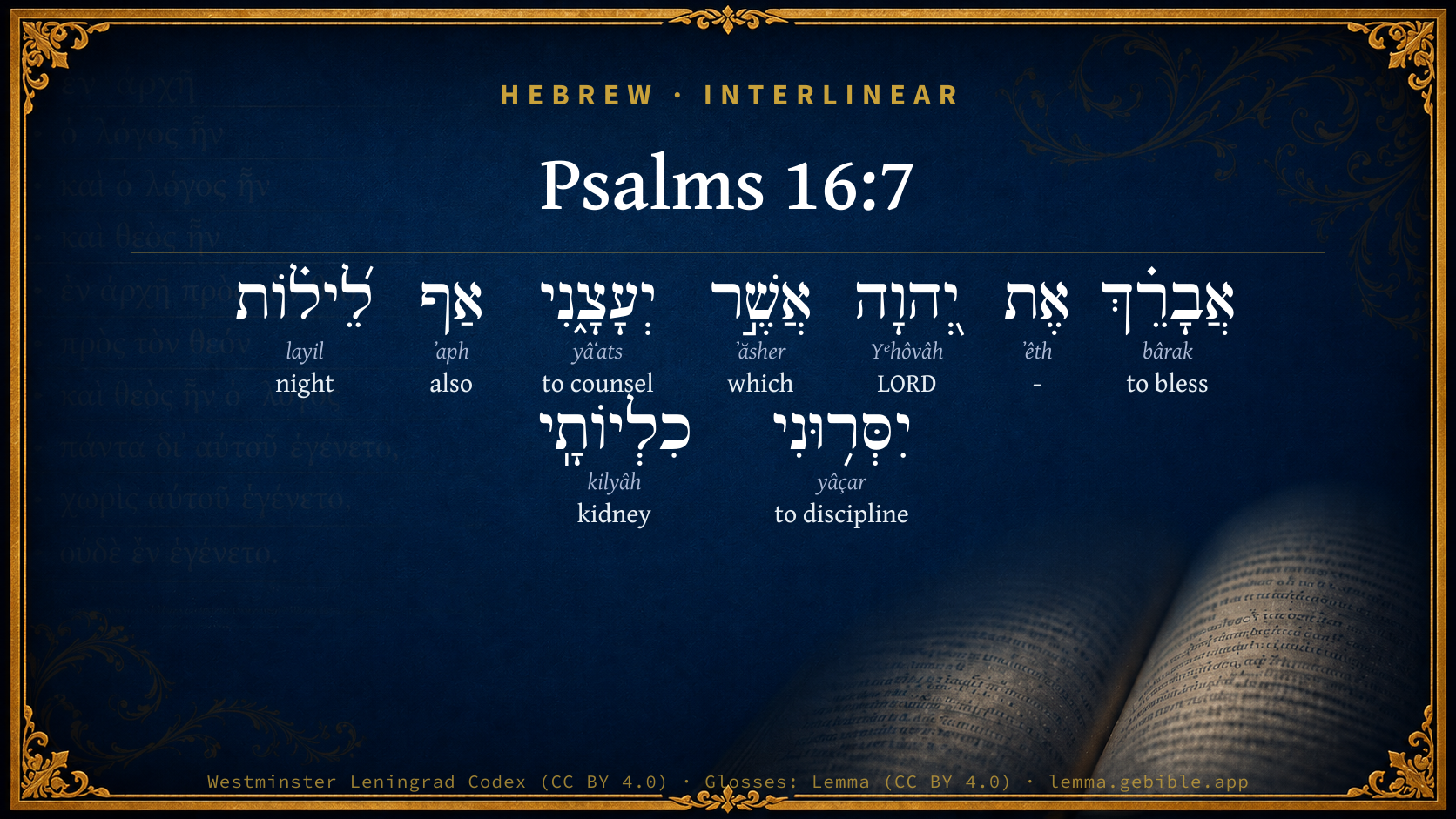
Hebrew (Westminster Leningrad Codex) Psalms 16:7 appears in the Hebrew Old Testament. The text above is from the Westminster Leningrad Codex. Each word links to its Strong’s number, a concise gloss, and parsing drawn from the Open Scriptures Hebrew Bible morphology. Click any word for its full Brown-Driver-Briggs (BDB) entry.
Download image
Cite this verse

Psalms 16:7 (World English Bible). Public Domain. Lemma interlinear Bible study tool, https://lemma.gebible.app/v/psalms/16/7.

Show BibTeX & RIS
BibTeX
RIS
English Translation
I will bless Yahweh, who has given me counsel. Yes, my heart instructs me in the night seasons.
World English Bible · Public Domain
Download a study sheet

One document with this verse’s original text, its word-by-word gloss line, the meaning frame, cross-references with their text, attributed commentary, and full source and license credits — printable, and it pastes into notes with its structure intact.

This verse Autodidact and up

Study sheet (.html) Plain text (.txt)

A passage Seminary Student

Up to 50 verses in one chapter. A passage sheet keeps up to 6 commentary sources and 12 cross-references per verse, in the order this page ranks them, and says so on the sheet whenever that leaves anything out. Ask for a single verse and you get the Autodidact verse sheet above.

Everything on this page stays free to read, with no account — the sheet is a download of what is already on screen, not access to it.

Want to remove ads? Support Godless Engineer
Compare translations 3

The same verse in 3 English versions, stacked beneath the original-language interlinear above. Click any original word for its lexicon entry.

Each is an independent rendering of the whole verse — the interlinear is not word-aligned to these translations.

Highlighted words mark where these versions differ — a whole-verse word diff, not a word-by-word alignment.

  • World English Bible Public Domain
    I will bless Yahweh, who has given me counsel. Yes, my heart instructs me in the night seasons.
  • King James Version Public Domain
    I will bless the LORD, who hath given me counsel: my reins also instruct me in the night seasons.
  • unfoldingWord Literal Text CC BY-SA 4.0
    I will bless Yahweh, who has given me counsel; even night my kidneys instruct me.

unfoldingWord Literal Text — © unfoldingWord, licensed CC BY-SA 4.0. Word-aligned USFM3 via Door43 (git.door43.org/unfoldingWord/en_ult).

Versions to compare (up to 4)

3 of 4 selected

Show all 18 translations

Every available English version of this verse, each an independent rendering of the whole verse.

  • World English Bible Public Domain
    I will bless Yahweh, who has given me counsel. Yes, my heart instructs me in the night seasons.
  • Berean Standard Bible Public Domain
    I will bless the LORD who counsels me; even at night my conscience instructs me.
  • Majority Standard Bible Public Domain
    I will bless the LORD who counsels me; even at night my conscience instructs me.
  • King James Version Public Domain
    I will bless the LORD, who hath given me counsel: my reins also instruct me in the night seasons.
  • American Standard Version (1901) Public Domain
    I will bless Jehovah, who hath given me counsel; Yea, my heart instructeth me in the night seasons.
  • Revised Version (1885) Public Domain
    I will bless the LORD, who hath given me counsel: yea, my reins instruct me in the night seasons.
  • Geneva Bible (1599) Public Domain
    I wil prayse the Lord, who hath giuen me counsell: my reines also teach me in the nightes.
  • Douay-Rheims (1899) Public Domain
    I will bless the Lord, who hath given me understanding: moreover my reins also have corrected me even till night.
  • Young's Literal Translation Public Domain
    I bless Jehovah who hath counselled me; Also `in' the nights my reins instruct me.
  • Literal Standard Version CC BY-SA 4.0
    I bless YHWH who has counseled me; Also [in] the nights my reins instruct me.
  • Unlocked Literal Bible CC BY-SA 4.0
    I will bless Yahweh, who counsels me; even at night my mind instructs me.
  • unfoldingWord Literal Text CC BY-SA 4.0
    I will bless Yahweh, who has given me counsel; even night my kidneys instruct me.
  • Darby Bible Public Domain
    I will bless Jehovah, who giveth me counsel; even in the nights my reins instruct me.
  • World Messianic Bible Public Domain
    I will bless the LORD, who has given me counsel. Yes, my heart instructs me in the night seasons.
  • Webster's Bible Public Domain
    I will bless the LORD, who hath given me counsel: my reins also instruct me in the night season.
  • Free Bible Version CC BY-SA 4.0
    I will bless the Lord who gives me good advice; even at night my conscience tells me what is right.
  • Bible in Basic English Public Domain
    I will give praise to the Lord who has been my guide; knowledge comes to me from my thoughts in the night.
  • JPS Tanakh (1917) Public Domain
    I will bless the LORD, who hath given me counsel; yea, in the night seasons my reins instruct me.

Literal Standard Version (2020), Covenant Press — licensed CC BY-SA 4.0. Text via the HelloAO Bible API (eBible.org). Unlocked Literal Bible (unfoldingWord) — licensed CC BY-SA 4.0. Text via the HelloAO Bible API (eBible.org). unfoldingWord Literal Text — © unfoldingWord, licensed CC BY-SA 4.0. Word-aligned USFM3 via Door43 (git.door43.org/unfoldingWord/en_ult). Free Bible Version, Dr. Jonathan Gallagher — licensed CC BY-SA 4.0. Text via the HelloAO Bible API (eBible.org).

Word by word

More ways to search: Search by grammar → Find every occurrence → Compare this word →

Practice this passage: Drill this verse → Learn its vocabulary →

כִלְיוֹתָֽי
kilyâh
H3629
“kidneys · my”
Noun, Common, Feminine, Plural, Construct + Suffix, Personal, 1st Person, Common, Singular
Part of Speech
Noun
Type
Common
Gender
Feminine
Number
Plural
State
Construct
Full BDB Definition

Origin: from H3627 (only pl.)

TWOT: 983a

kidneys - of physical organ (literally) - of seat of emotion and affection (figuratively) - of sacrificial animals - (TWOT) reins
  1. אֲבָרֵ֗ךְ bârak H1288 “to bless” Verb, Piel, Imperfect, 1st Person, Common, Singular
  2. אֶת ʼêth H853 “-” Particle, Direct Object
  3. יְ֭הוָה Yᵉhôvâh H3068 “LORD” Noun, Proper
  4. אֲשֶׁ֣ר ʼăsher H834 “which” Particle, Relative
  5. יְעָצָ֑נִי yâʻats H3289 “to counsel · me” Verb, Qal, Perfect, 3rd Person, Masculine, Singular + Suffix, Personal, 1st Person, Common, Singular
  6. אַף ʼaph H637 “also” Particle, Accusative
  7. לֵ֝יל֗וֹת layil H3915 “nights” Noun, Common, Masculine, Plural, Absolute
  8. יִסְּר֥וּנִי yâçar H3256 “to discipline · me” Verb, Piel, Perfect, 3rd Person, Common, Plural + Suffix, Personal, 1st Person, Common, Singular

About this verse

These counts appear in no published source. They are computed here, from the morphology-tagged text and Lemma’s own curated glosses. What Lemma adds →

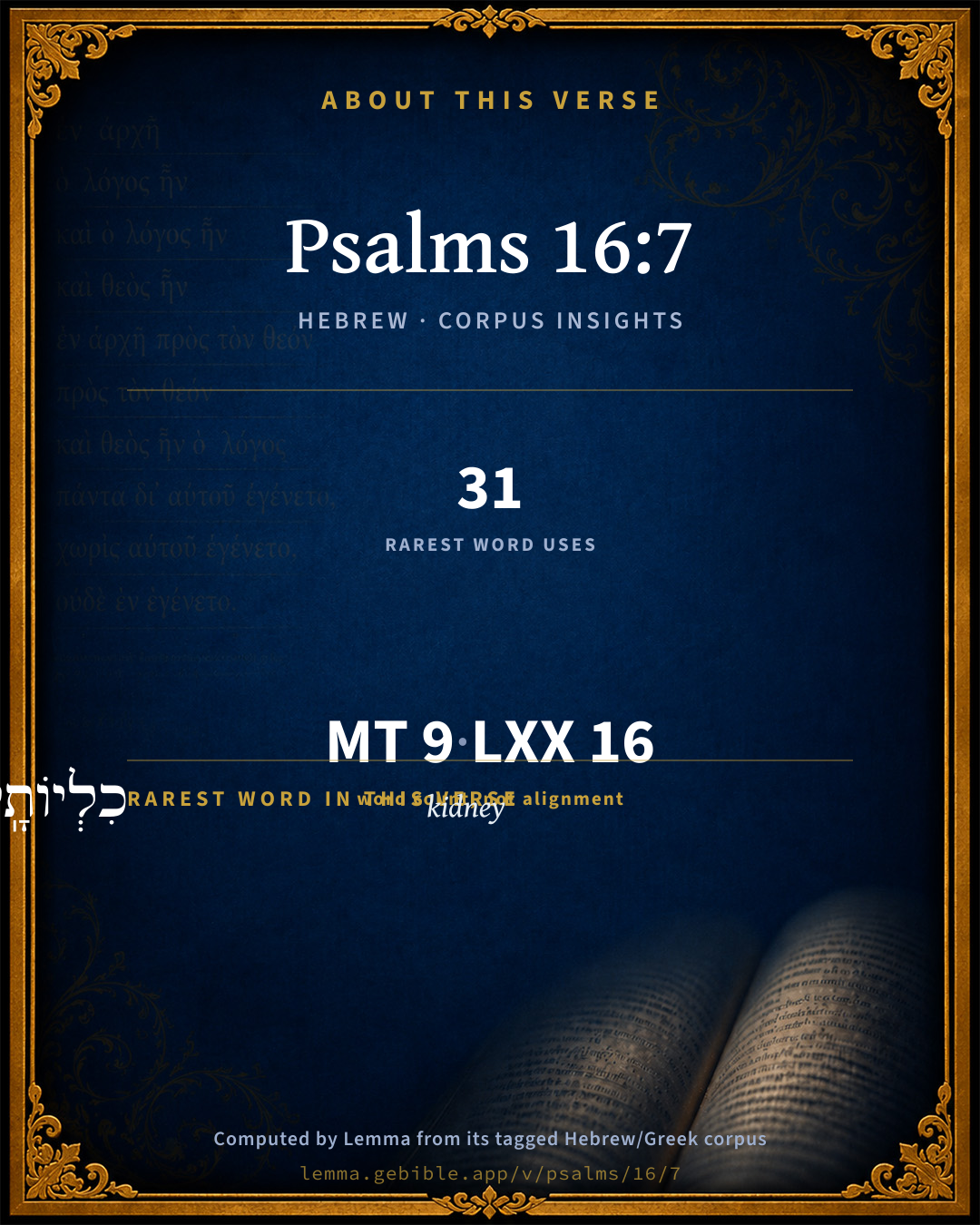
9
words
9
distinct lemmas
Wisdom
section

Shared distinctive vocabulary

כִלְיוֹתָֽי kidney H3629 occurs in 26 verses of the Hebrew Bible. Also found in:

Grammatical profile

  • 3 verbs
  • 3 nouns
  • 3 particles

Verb forms

  • אֲבָרֵ֗ךְ Piel · Imperfect
  • יְעָצָ֑נִי Qal · Perfect
  • יִסְּר֥וּנִי Piel · Perfect

Hebrew & Septuagint length

In English translation the verse runs 18 words from the Hebrew and 18 from the Septuagint (LXX English) — the same length.

A rough comparison of the two English renderings, which tokenize alike — not a word-level alignment.

Word counts can differ between the Hebrew and the Greek without any difference in meaning — e.g. the Hebrew direct-object marker אֵת has no separate Greek word, and Greek often adds the article ὁ.

In the original languages it is 9 Hebrew tokens and 16 Greek tokens — but the two are counted differently (Hebrew bundles its prefixes and suffixes into one token; the Greek is in lemma form), so that isn’t a like-for-like length.

Cross-references

20

Topical passages linked to Psalms 16:7 in the Treasury of Scripture Knowledge — connected by theme and wording, ordered by reader-vote popularity; previews shown in the World English Bible.

  • Psalms 17:3 You have proved my heart; you have visited me in the night; You have tried me, and found nothing; I have resolved that my mouth shall not disobey.
  • Psalms 63:6 When I remember you on my bed, And think about you in the night watches.
  • Isaiah 50:4 The Lord Yahweh has given me the tongue of those who are taught, that I may know how to sustain with words him who is weary: he wakens morning by morning, he wakens my ear to hear as those who are taught.
  • Psalms 73:24 You will guide me with your counsel, And afterward receive me to glory.
  • Psalms 77:6 I remember my song in the night. I consider in my own heart; My spirit diligently inquires:
  • Psalms 42:8 Yahweh will command his loving kindness in the daytime. In the night his song shall be with me: A prayer to the God of my life.
  • Psalms 119:55 I have remembered your name, Yahweh, in the night, And I obey your law.
  • Isaiah 26:9 With my soul have I desired you in the night; yes, with my spirit within me will I seek you earnestly: for when your judgments are in the earth, the inhabitants of the world learn righteousness.
  • Isaiah 48:17 Thus says Yahweh, your Redeemer, the Holy One of Israel: I am Yahweh your God, who teaches you to profit, who leads you by the way that you should go.
  • Jeremiah 17:10 I, Yahweh, search the mind, I try the heart, even to give every man according to his ways, according to the fruit of his doings.
  • Luke 6:12 It happened in these days, that he went out to the mountain to pray, and he continued all night in prayer to God.
  • Proverbs 8:14 Counsel and sound knowledge are mine. I have understanding and power.
  • Psalms 77:2 In the day of my trouble I sought the Lord. My hand was stretched out in the night, and didn't get tired. My soul refused to be comforted.
  • Psalms 119:7 I will give thanks to you with uprightness of heart, When I learn your righteous judgments.
  • Psalms 119:148 My eyes stay open through the night watches, That I might meditate on your word.
  • Revelation 2:23 I will kill her children with Death, and all the assemblies will know that I am he who searches the minds and hearts. I will give to each one of you according to your deeds.
  • Isaiah 11:2–4 The Spirit of Yahweh shall rest on him, the spirit of wisdom and understanding, the spirit of counsel and might, the spirit of knowledge and of the fear of Yahweh.
  • Psalms 22:2 My God, I cry in the daytime, but you don't answer; In the night season, and am not silent.
  • Psalms 73:21 For my soul was grieved. I was embittered in my heart.
  • Jeremiah 12:2 You have planted them, yes, they have taken root; they grow, yes, they bring forth fruit: you are near in their mouth, and far from their heart.

Cross-references courtesy of OpenBible.info (CC BY 4.0).

Hebrew and Greek witnesses Masoretic Hebrew ↔ Greek Septuagint

The same verse in the two great witnesses to the Old Testament, shown verse-for-verse.

You’re reading Greek Psalm 15 (Hebrew Psalm 16). The Septuagint counts the superscription, so verse numbers can differ from the Hebrew — chapter-level alignment, not verse-by-verse. Numbering follows Rahlfs.

These are two independent witnesses, not word-aligned to each other, and the Septuagint is shown in lemma (dictionary) form.

Hebrew Psalms 16:7 Masoretic · Westminster Leningrad Codex

אֲבָרֵ֗ךְ אֶת יְ֭הוָה אֲשֶׁ֣ר יְעָצָ֑נִי אַף לֵ֝יל֗וֹת יִסְּר֥וּנִי כִלְיוֹתָֽי

I will bless Yahweh, who has given me counsel. Yes, my heart instructs me in the night seasons.

World English Bible · Public Domain

Greek LXX Greek Psalm 15:7 Septuagint · lemma form

εὐλογέω ὁ κύριος ὁ συνετίζω ἐγώ ἔτι δέ καί ἕως νύξ παιδεύω ἐγώ ὁ νεφρός ἐγώ

I will bless the Lord who has instructed me; my reins too have chastened me even till night.

LXX2012 (modern English Septuagint) · Public Domain

Hebrew: Westminster Leningrad Codex (CC BY 4.0). Greek: Septuagint (public domain); English from LXX2012 (modern English Septuagint) (Public Domain). How the Septuagint differs from the Hebrew →

Commentary

Notes on Psalms 16:7 from classic Christian and Jewish commentators (each source and its license shown beneath its notes). The classic Christian expositions comment on the surrounding passage and are grouped to its opening verse, so a note may address several verses; the Jewish commentaries on the Tanakh (Rashi and others) are per-verse, so they appear only where the commentator wrote on this verse.

Lemma curates 59 commentaries, every one of them public domain or Creative Commons licensed, each selected and text-cleaned for this edition rather than reprinted as found. About our sources →

Trapp's Complete Commentary

John Trapp

Psa 16:7 I will bless the LORD, who hath given me counsel: my reins also instruct me in the night seasons.

Ver. 7. I will bless the Lord who hath given me counsel] David frequently consulted with God by Abiathar the priest, whom God, by a sweet providence, sent unto him with an ephod for a comfort in his banishment, 1Sa 22:20. Saul had slain those that wear the ephod, therefore God answered him not, neither by dreams, nor by Urim, nor by prophets, 1Sa 28:6, as he did his servant David; who therefore blesseth him, when the other runneth from him to the witch for counsel, and from her to the sword’s point.

My reins also instruct me] God hath not only illuminated me, whereby I shall be the better able to endure a great fight of affliction, Heb 10:32, but he hath also sanctified me, and honoured me with holy inspirations, and feeling of the Spirit of adoption, whereby mine internal thoughts and secret motions do dictate and suggest unto me what I ought to do and undertake. Methinks I hear a sweet still voice within me, saying, This is the way, walk in it; and this in the night season, when I am wrapped in rest and silence; or, night after night, the Spirit is a continual spring of counsel and comfort within me, prompting me to make God my portion, and to choose this good part that shall never be taken away from me.

In the night seasons] When commonly we are prone to evil ( Nox et Amor, &c. Ilia pudore vacat, &c. (Ovid.)), and which is the wicked man’s fittest opportunity, Job 24:13; Job 24:15-16, &c. It must not content us that God by his word hath given us counsel, but we must labour to be inwardly taught of God. A man may read the figure upon the dial, but he cannot tell how the day goes, unless the sun shine upon the dial; we may read the Bible over, and hear it opened and applied, but can learn nothing till the Spirit shine into our hearts, 2Co 4:6, and so our reins instruct us, &c.

John Trapp, A Commentary or Exposition upon All the Books of the Old and New Testament (1647–1656) — public domain. Text from a community e-Sword module.

The Biblical Illustrator

Joseph S. Exell

Psa_16:7

My reins also instruct me in the night seasons.

Man taking counsel of his reins

The ancients regarded the reins, or kidneys, located in a retired part of the body, as the seat of the moral and spiritual sentiments, especially of the intuitional convictions, in distinction from those which have been acquired from philosophy or the experience of others. To be instructed by ones reins is therefore to give heed to the voice of the soul itself.

1. The soul articulates itself in conscience, which gives wiser counsel regarding duty than any court of casuistry; in the sense of God, which men cannot divest themselves of, as even Rousseau confesses, Keep your life such as would lead you to desire that there should be a just God, and you will have no doubt of His existence; in the vital instinct, which predicts immortality, etc. Infidelity would be impossible if men would take the counsel of their own reins. In the silent depths of the soul the echoes of Gods voice are always sounding.

2. We will hear these echoes best when all is quiet about us--the janglings of the busy day ceased. The soul expands towards the infinite when the narrow arena of earthly competitions disappears, as the stars show themselves when darkness has blotted out the scenes on earth.

3. The best interpreter of the counsel of the reins is the Word of God. It reveals us to ourselves. Of Jesus it was said that He knew what was in man. Francis Quarles (1644) represents God as saying--

I, that alone am Infinite, can try

How deep within itself thine heart doth lie;

Thy seamans plummet can but reach the ground--

I find that which thy heart itself neer found.

(Homiletic Review.)

Psa_16:7-8

I will bless the Lord who hath given me counsel: my reins also instruct me in the night seasons.

The night counsels of the Lord

Under whatever circumstances the Lord gives His people counsel, they will find reason to bless His holy name. Well does this Psalm bear the title of Michtam--that is, a golden Psalm. Note--

I. The kind of counsel given to the believer. It was, that by no arguments, however specious or however backed by circumstances, should he be diverted from faithful allegiance to God. There were many such arguments. Saul tried to draw him off from God. David tells how they have driven me out this day from the inheritance of the Lord, saying, Go serve other gods. But the Lords counsel, was, Wait on the Lord and be of good courage, and He shall strengthen thine heart. Now, the Lord gives similar counsel to all His people. David was a representative man. The transcript of his feelings forms a commonplace book for all Gods servants in which they may find a counterpart of their own. As David was, so are they, anointed of the Lord. As Saul persecuted David, so Satan persecutes them, and seeks to make them do despite to the Spirit of grace.

II. The times and circumstances under which this counsel is frequently sought and obtained. It is night counsel, My reins (thoughts) also instruct me in, etc. The night seems to be no uncommon time for communications to pass between God and His people. David seems to have had frequent experience of this. I remembered Thee upon my bed, etc. When the sense of responsibility comes upon a young man and the weight of care is felt, often, though fatigued with the toil of the day, will he at night think seriously and long over his position and its needs. Sometimes he can say, as in Psa_77:1-20, Thou boldest mine eyes waking; I am so troubled that I cannot sleep, etc. And often his meditations are very gloomy--Will the Lord cast off forever, and will He be favourable no more? And after more of this there comes the telling of the Lords sympathy, I said this is mine infirmity, but I will remember, etc. He says again and again, I will, I will remember, I will meditate. It was difficult, but he was determined. And here he says, I will thank the Lord, who hath given me counsel. And our blessed Lord had His night conflicts--He was in all points made like unto His brethren. And He was heard in that He feared. Let us copy His example--do what He did, and you, too, shall find counsel. (T. E. Hankinson, M. A.)

The Biblical Illustrator, edited by Joseph S. Exell (c. 1880s–1900s) — public domain. Text from a community e-Sword module.

Joseph Benson's Commentary

Psa 16:7. I will bless the Lord who hath given me counsel — The Hebrew,

יעצני, jegnatzani, may be rendered, hath consulted for me, that is, by his wise and gracious counsel hath provided so good a heritage for me: or, who hath inspired that counsel and wisdom into me by which I have chosen him for my portion and happiness, and am so fully satisfied with him. So ignorant and foolish are we, that, if we be left to ourselves, our hearts will follow our eyes, and we shall choose our own delusions, and forsake our own mercies, for lying vanities: and, therefore, if we have indeed taken God for our portion, and preferred spiritual and eternal blessings before those that are sensible and temporal, we must thankfully acknowledge the power and goodness of divine grace, directing and enabling us to make that choice. My reins also — That is, my inward thoughts and affections (which are commonly signified by the reins, Psa 7:9; Psa 26:2; Jer 11:20; Jer 12:2; Jer 17:10) being inspired and moved by the Holy Spirit; instruct me — Admonish me concerning my duty and happiness, direct me what course to take, how to please and glorify God, and to put my whole trust in, and live to him; in the night seasons — Even when others are asleep my mind is employed about God and things divine, and engaged to improve the silence and solitude of the night in holy meditation, prayer, and devotion. All this may be applied to Christ, who made the Lord his portion, and was pleased with that portion; made his Father’s glory his highest end, and made it his meat and drink to seek that, and to do his will, and delighted to prosecute his undertaking, pursuant to his Father’s counsel, depending upon him to maintain his lot, and carry him through his undertaking. And we ought so far to apply it to ourselves as to learn from it wherein our duty and happiness consist, and to examine ourselves by it, whether we are properly influenced by such discoveries, and act accordingly.

Joseph Benson's Commentary on the Old and New Testaments (1811–1818) — public domain. Text from a community e-Sword module.

J. A. Alexander on Psalms

Joseph Addison Alexander

7. (Psa 16:7) I will bless Jehovah, who hath counselled me; also by night have my reins prompted me. He praises God for having counselled or persuaded him to choose this goodly heritage in preference to every other portion. The second clause begins with yea or also, as in the preceding verse. It here implies that, under the divine control just mentioned, his own habitual dispositions tended to the same point. By night, literally nights, an idiom not unknown in vulgar English. The plural may in this case be emphatic, meaning whole nights, all night long. The night is mentioned, both as a time naturally favourable to reflection, and as skewing that the same subject occupied his thoughts by night as well as by day; see above on Psa 1:2. The reins are figuratively put like the heart, bowels, etc., for the affections; see above on Psa 7:10 (9). My reins have taught me, warned me, prompted me, to utter the praise mentioned in the first clause, or to make the choice described in Psa 16:1-2; Psa 16:5.

Joseph Addison Alexander, The Psalms Translated and Explained (1850) — public domain. Text from a community e-Sword module.

Tyndale Open Study Notes

Tyndale Open Resources

16:7-8 God’s instruction brings life (16:11; see 5:8; 23:1-3; 32:8; 73:24). • The psalmist so deeply depends on the Lord for strength and joy that he senses that God is right beside him (16:11; see 73:23; 109:31; 110:1, 5; 121:5). • Peter quoted 16:8-11 in his sermon on the day of Pentecost (Acts 2:25-28).

Tyndale Open Study Notes — © Tyndale Open Resources, licensed CC BY-SA 4.0. Text via the HelloAO Bible API.

Rashi

Rabbi Shlomo Yitzchaki (Rashi)

I will bless the Lord Until here, David prophesied concerning the Congregation of Israel, that she would say this, and now he says, “I, too, will bless the Lord, Who counseled me to choose life and to go in His ways.”

even at night my conscience instructs me to fear Him and to love Him. Our Sages though, (Mid. Ps. 16:7) explained it as referring to our father Abraham, who learned Torah by himself before the Torah was given, but we must reconcile the verses according to their sequence.

Rashi on the Tanakh — English translations: “The Judaica Press complete Tanach with Rashi, translated by A. J. Rosenberg” (CC BY 4.0); “Pentateuch with Rashi's commentary by M. Rosenbaum and A.M. Silbermann, 1929-1934” (public domain); “The Metsudah Tanach series, Lakewood, N.J” (CC BY 4.0); and “The Book of Joshua, Metsudah Publications, 1997” (CC BY 4.0). Text via Sefaria.

Geneva Bible (1599)

Geneva Bible translators

God teacheth me continually by secret inspiration.

Geneva Bible (1599) marginal notes — public domain. Text via Bolls.life.

Jamieson, Fausset & Brown

Robert Jamieson, A. R. Fausset & David Brown

given me counsel--cared for me.

my reins--the supposed seat of emotion and thought (Psa 7:9; Psa 26:2).

instruct me--or, excite to acts of praise (Isa 53:11-12; Heb 12:2).

Jamieson, Fausset & Brown — Commentary Critical and Explanatory on the Whole Bible (1871) — public domain (CC PDM 1.0). Text via the HelloAO Bible API.

Adam Clarke's Commentary

Verse 7. Who hath given me counsel] Jesus, as man, received all his knowledge and wisdom from God; Lu 2:40-52. And in him were hidden all the treasures of wisdom and knowledge.

My reins also instruct me] כליותי kilyothai, reins or kidneys, which from their retired situation in the body, says Parkhurst, and being hidden in fat, are often used in Scripture for the most secret workings and affections of the heart.

The kidneys and their fat were always to be burnt in sacrifice, to indicate that the most secret purposes and affections of the soul are to be devoted to God.

In the night seasons.] That is, in the time of my passion, my secret purposes and determinations concerning the redemption of man support me. "For the joy that was set before him he endured the cross, despising the shame;" Heb 12:2.

Adam Clarke's Commentary on the Bible (1810–1826) — public domain. Text from a community e-Sword/MySword module.

John Calvin's Commentaries

Last of all, David confesses that it was entirely owing to the pure grace of God that he had come to possess so great a good, and that he had been made a partaker of it by faith. It would be of no advantage to us for God to offer himself freely and graciously to us, if we did not receive him by faith, seeing he invites to himself both the reprobate and the elect in common; but the former, by their ingratitude, defraud themselves of this inestimable blessing. Let us, therefore, know that both these things proceed from the free liberality of God; first, his being our inheritance, and next, our coming to the possession of him by faith. The counsel of which David makes mention is the inward illumination of the Holy Spirit, by which we are prevented from rejecting the salvation to which he calls us, which we would otherwise certainly do, considering the blindness of our flesh. “Ce qu’autrement nous ferions, veu l’aveuglement de nostre chair.” — Fr.

Calvin means that God taught David by secret inspirations.

John Calvin's Commentaries (1540-1563) — public domain. Text from the Calvin Translation Society English edition (1840s-50s) via the Christian Classics Ethereal Library (ccel.org). Calvin's coverage is partial (roughly two-thirds of the Bible); uncommented books and verses are honest gaps, never fabricated. The 19th-century editor's footnotes and remarks are omitted so the notes are faithfully Calvin's own voice.

Ellicott's Commentary for English Readers

(7) Given me counsel . . .—i.e., led me to a right and happy choice of the way of life.

My reins—i.e., my heart.

Instruct me.—Better, warn me. Conscience echoes the voice of God. The Hebrew word, from a root meaning bind, includes the sense of obligation. Once heard, the Divine monition becomes a law to the good man, and his own heart warns him of the slightest danger of deviation from it.

A Bible Commentary for English Readers, edited by Charles John Ellicott (1878–1897) — public domain. Text from a community e-Sword module.

The Cambridge Bible for Schools and Colleges

gen. ed. J. J. S. Perowne

7. given me counsel] Taught me to choose Him and to follow Him. Cp. Psa_32:8 (R.V.); Psa_73:24.

my reins also &c.] This clause may be taken as still depending on I will bless the Lord, and rendered, yea, that in the night seasons my reins have instructed me. In the quiet hours of the night God admonishes and instructs him through the voice of conscience. Cp. Psa_4:4; Psa_17:3. The reins stand for the organs of emotion, the feelings and conscience. ‘Heart and reins’ denote the whole innermost self, thought and will (Psa_7:9).

7, 8. The mutual relation of the Psalmist and Jehovah.

The Cambridge Bible for Schools and Colleges (gen. ed. J. J. S. Perowne; Cambridge University Press, 1878–1918) — public domain. Text from a community e-Sword module.

John Gill's Exposition

I will bless the Lord,.... As prayer, so thanksgiving belongs to Christ, as man and Mediator; see Mat 11:25; and here he determines to praise the Lord, and give thanks to him for counsel and instruction:

who hath given me counsel; for though he himself is the Counsellor, with respect to his people, yet as man he received counsel from God, and the spirit of counsel rested on him, Isa 11:2; and fitted him for and directed him in the execution of his prophetic office; for the doctrine he taught was not his own, but his Father's; and he said nothing of himself but what his Father taught him, and instructed him to speak, Joh 6:16. And he also gave him counsel about the execution of his priestly office, or about his sufferings and death, and drinking of the cup, which he, with submission to the divine will, desired might pass from him; but having advice in this matter, most cheerfully and courageously yielded to take it, see Mat 26:39;

my reins also instruct me in the night seasons; when engaged in prayer to God, in which he sometimes continued a whole night together, Luk 6:12; and especially in that dark and dismal night in which he was betrayed, when it was the hour and power of darkness with his enemies; then, his inward parts being influenced by the spirit of wisdom and counsel, directed him how to behave and conduct himself. Or "the reins" being the seat of the affections, and being put for them, may signify, that his strong affection for God, and love to his people, put him upon and moved him to take the steps he did, to deliver up himself into the hands of sinful men, in order to suffer and die for his friends, and obtain eternal salvation for them.

John Gill's Exposition of the Whole Bible (1746–1763) — public domain (CC PDM 1.0). Text via the HelloAO Bible API.

Albert Barnes' Notes on the Bible

I will bless the Lord, who hath given the counsel - Probably the reference here is to the fact that the Lord had counseled him to choose him as his portion, or had inclined him to his service. There is nothing for which a heart rightly affected is more disposed to praise God than for the fact that by his grace it has been inclined to serve him; and the time when the heart was given away to God is recalled ever onward as the happiest period of life.

My reins ... - See the notes at Psa 7:9. The “reins” are here put for the mind, the soul. They were regarded as the seat of the affections, Jer 11:20; Job 19:27. The meaning here is, that in the wakeful hours of night, when meditating on the divine character and goodness, he found instruction in regard to God. Compare Psa 17:3. Everything then is favorable for reflection. The natural calmness and composure of the mind; the stillness of night; the starry heavens; the consciousness that we are alone with God, and that no human eye is upon us - all these things are favorable to profound religious meditation. They who are kept wakeful by night “need” not find this an unprofitable portion of their lives. Some of the most instructive hours of life are those which are spent when the eyes refuse to close themselves in slumber, and when the universal stillness invites to contemplation on divine things.

Albert Barnes' Notes on the Bible (1834–1885) — public domain. Text from a community e-Sword/MySword module.

Matthew Poole's English Annotations

Who hath given me counsel, Heb. consulted for me, i.e. by his wise and gracious counsel hath provided so good an heritage for me, and withal inspired that counsel and wisdom into me, by which I have chosen the Lord for my portion, and am so fully satisfied with him.

My reins, i.e. my inward thoughts and affections, (which are commonly signified by the reins, as Psa 7:9; 26:2; 73:21; 139:13; Jer 11:20; 12:2; 17:10) being inspired and moved by the Holy Spirit.

Instruct me, i. e. direct me what course to take, how to please and serve God, and to put my whole trust and confidence in him, as it follows.

In the night seasons; not only in the day time, but also in the night, when others are asleep, but my mind is working upon God, and the things of God, and improving the silence, and leisure, and solitude of the night to holy meditations, and the exciting of my affections towards God.

Matthew Poole's English Annotations on the Holy Bible (1683–1685) — public domain. Text from a community e-Sword/MySword module.

The Treasury of David

Charles H. Spurgeon

Ver. 7-8. The occupying of the gold. The believer seeking instruction from the counsels of the Lord by night, and realising his promise by day.

Ver. 7. I will bless the Lord, who hath given me counsel. Praise as well as prayer was presented to the Father by our Lord Jesus, and we are not truly his followers unless our resolve be, "I will bless the Lord." Jesus is called Wonderful, Counsellor, but as man he spake not of himself, but as his Father had taught him. Read in confirmation of this, Joh 7:16 8:28 12: 49-50; and the prophecy concerning him in Isa 11:2-3. It was our Redeemer's wont to repair to his Father for direction, and having received it, he blessed him for giving him counsel. It would be well for us if we would follow his example of lowliness, cease from trusting in our own understanding, and seek to be guided by the Spirit of God.

My reins also instruct me in the night seasons. By the reins understand the inner man, the affections and feelings. The communion of the soul with God brings to it an inner spiritual wisdom which in still seasons is revealed to itself. Our Redeemer spent many nights alone upon the mountain, and we may readily conceive that together with his fellowship with heaven, he carried on a profitable commerce with himself; reviewing his experience, forecasting his work, and considering his position. Great generals fight their battles in their own mind long before the trumpet sounds, and so did our Lord win our battle on his knees before he gained it on the cross. It is a gracious habit after taking counsel from above to take counsel within. Wise men see more with their eyes shut by night than fools can see by day with their eyes open. He who learns from God and so gets the seed, will soon find wisdom within himself growing in the garden of his soul; "Thine ears shall hear a voice behind thee, saying, This is the way, walk ye in it, when ye turn to the right hand and when ye turn to the left." The night season which the sinner chooses for his sins is the hallowed hour of quiet when believers hear the soft still voices of heaven, and of the heavenly life within themselves.

Ver. 7. I will bless the Lord, who hath given me counsel. The Holy Ghost is a spirit of counsel, powerfully instructing and convincingly teaching how to act and walk, for he directs us to set right steps, and to walk with a right foot, and thereby prevents us of many a sin, by seasonable instruction set on upon our hearts with a strong hand; as Isa 8:11. For, as the same prophet says (Isa 11:2), he is the spirit of counsel and of might. Of counsel to direct; of might, to strengthen the inner man. Such he was to Christ the Head, of whom it is there spoken. For instance, in the agony (on the determination of which our salvation depended), and conflict in the garden, when he prayed, "Let this cup pass, "it was this good Spirit that counselled him to die; and he blessed God for it: "I bless the Lord that hath given me counsel." It was that counsel that in that case caused his heart to say, "Not my will, but thine." Thomas Goodwin.

Ver. 7. My reins. Common experience shows that the workings of the mind, particularly the passions of joy, grief, and fear, have a very remarkable effect of the reins or kidneys, and from their retired situation in the body, and their being hid in fat, they are often used in Scripture to denote the most secret working of the soul and affections. John Parkhurst.

Ver. 7. My reins also instruct me in the night seasons. This shows that God, who, he says, was always present to him, had given him some admonition in his dreams, or at least his waking thoughts by night, from whence he gathered a certain assurance of his recovery; possibly he might be directed to some remedy. Antonine thanks the gods for directing him in his sleep to remedies. Z. Mudge, in loc, 1744.

Ver. 7. My reins also instruct me in the night seasons. We have a saying among ourselves, that "the pillow is the best counsellor; "and there is much truth in the saying, especially if we have first committed ourselves in prayer to God, and taken a prayerful spirit with us to our bed. In the quiet of its silent hours, undisturbed by the passions, and not harassed by the conflicts of the world, we can commune with our own heart, and be instructed and guarded as to our future course even in the night season. David especially seems to have made these seasons sources of great profit as well as delight. Sometimes he loved to meditate upon God, as he lay upon his bed; and it was no doubt as he meditated on the Lord's goodness, and on the way by which he had led him, that he was, as it were, constrained, even at midnight, to arise and pray. While, therefore, we acknowledge the pillow to be a good counsellor, let us with David here acknowledge also that it is the Lord who gives the counsel, and sends the instruction in the night season. Burton Bouchier.

Ver. 7. Taking counsel's opinion. Of whom? Upon what? Why? When? How? What then?

Ver. 7. Upward and inward, or two schools of instruction.

Psalms 16:8*

Charles H. Spurgeon's The Treasury of David (1869–1885) — public domain. Psalms only. Text from a community e-Sword/MySword module.

Whedon's Commentary on the Bible

Daniel D. Whedon

7. Counsel—God had made him wise and skilful in divine wisdom.

Reins—the word כליות, (kelayoth,) which occurs only in the plural, is always, in the common version, translated either kidneys or reins, the former the literal, the latter the figurative or physical sense, in which it denotes the tenderest inward sensibility. It is often associated with לב, (lebh,) heart, (Psa_26:2; Jer_11:20,) as denoting the innermost feeling, never with בשׂן, (beten,) or רחמים, (belly, or bowels,) or with קרב, (kereb,) inner part, all psychical terms. See on Psa_5:9.To be instructed by the reins, is to be admonished and corrected by the feelings, awakened by meditation, whether of a painful or pleasurable nature. The word יסר, (yahsar,) instruct, chasten, has commonly the idea of painful discipline, but here of joyful incentive to make Jehovah his portion.

Daniel D. Whedon (gen. ed.), Commentary on the Old and New Testaments (1874–1909) — public domain. Text from a community e-Sword module.

The Pulpit Commentary

I will bless the Lord, who hath given his counsel. God has become David"s "Counsellor", (see Psa_32:8) makes suggestions to him which he follows, and so guides his life that he feels bound to praise and bless him for it. My reins also instruct me in the night seasons. The reins, according to Hebrew ideas, are the seat of feeling and emotion. David is "instructed" or "stimulated" (Hengstenberg) to bless God by the feelings which stir within him as he lies awake at night feelings, we must suppose, of affection and gratitude.

The Pulpit Commentary (1880–1919), ed. H.D.M. Spence-Jones & Joseph S. Exell — public domain. Text from a community e-Sword module.

John Wesley's Explanatory Notes

The Lord - Hath inspired that wisdom into me, by which I have chosen the Lord for my portion, and am so fully satisfied with him. Reins - My inward thoughts and affections, being inspired and moved by the Holy Spirit. Instruct - Direct me how to please God, and put my whole trust in him. Night - Even when others are asleep, my mind is working upon God, and improving the silence and solitude of holy meditations.

John Wesley, Explanatory Notes Upon the Whole Bible (1754–1765) — public domain. Text via the GEBible commentary corpus.

unfoldingWord translationNotes

Door43 World Missions Community

I set Yahweh before me at all times

"I always remember that Yahweh is with me"

so I will not be shaken from his right hand

This can be stated in active form. AT: "nothing will take me away from his side" (See: Active or Passive)

translationWords

bless

advice

right hand

unfoldingWord translationNotes — © Distant Shores Media and the Door43 World Missions Community, licensed CC BY-SA 4.0. Source: git.door43.org/Door43/en_tn.

Radak

Rabbi David Kimhi (Radak)

1 will bless the Lord, who hath given me counsel: – (in the same sense) as we have interpreted Thou maintainest my lot.

Yea, by night: – This was the beginning (of help) for me from the Lord, that He gave me counsel and helped me when I chose this good part for my own; and likewise within me every day do

my reins admonish me: – that I should not abandon this way, but hold to it with all my might. And he says by night, because at night a man is isolated from the preoccupations of the world and his mind is free. And he says my reins, for they are the counsellors, as they say (Babli, Berakhoth 61a) “The reins counsel an understanding heart.”

Radak on the Tanakh — English translations: “Sefaria Community Translation” (CC0 1.0 (public-domain dedication)); “Eliyahu Munk, HaChut Hameshulash” (CC BY 4.0); “Rabbi Mike Feuer, Jerusalem Anthology” (CC BY 4.0); and “R. David Kimhi on the first book of Psalms, Translated by R.G. Finch, London, 1919” (public domain). Text via Sefaria.

Lesson kit

Teaching starters — assembled from the data on this page, not authored interpretation. Every prompt links to the verse data it draws on. Edit before teaching.

Psalms, in the Wisdom, opens this verse with 9 words (9 distinct Hebrew lemmas). Its most distinctive word is kilyâh (“kidney”). A historical commentator’s framing appears above. Read the whole chapter for the surrounding context.

Discussion questions

  1. The word kilyâh carries the sense “kidney.” How does it shape the verse?
  2. Exodus 29:13 shares the word «kidney» with this verse. How do the two illuminate each other?
  3. These translations render this verse differently. What is at stake in choosing one wording over another?
  4. The verb «אֲבָרֵ֗ךְ» is Piel Imperfect. How does its form color the action?
  5. Reading how Trapp's Complete Commentary and The Biblical Illustrator read this verse, where do the two commentators agree and where do they part?

Things to notice

Reading settings

Reading text

Shown beneath each verse's original-language words.

Old Testament
Old Testament edition

Read the OT as the Masoretic Hebrew (MT) or the Greek Septuagint (LXX).

English shown for the Greek Septuagint (in the Hebrew ↔ Greek comparison).

Comparing translations? Open the Compare panel on any verse page to stack up to four side by side.