
Genesis 24:27

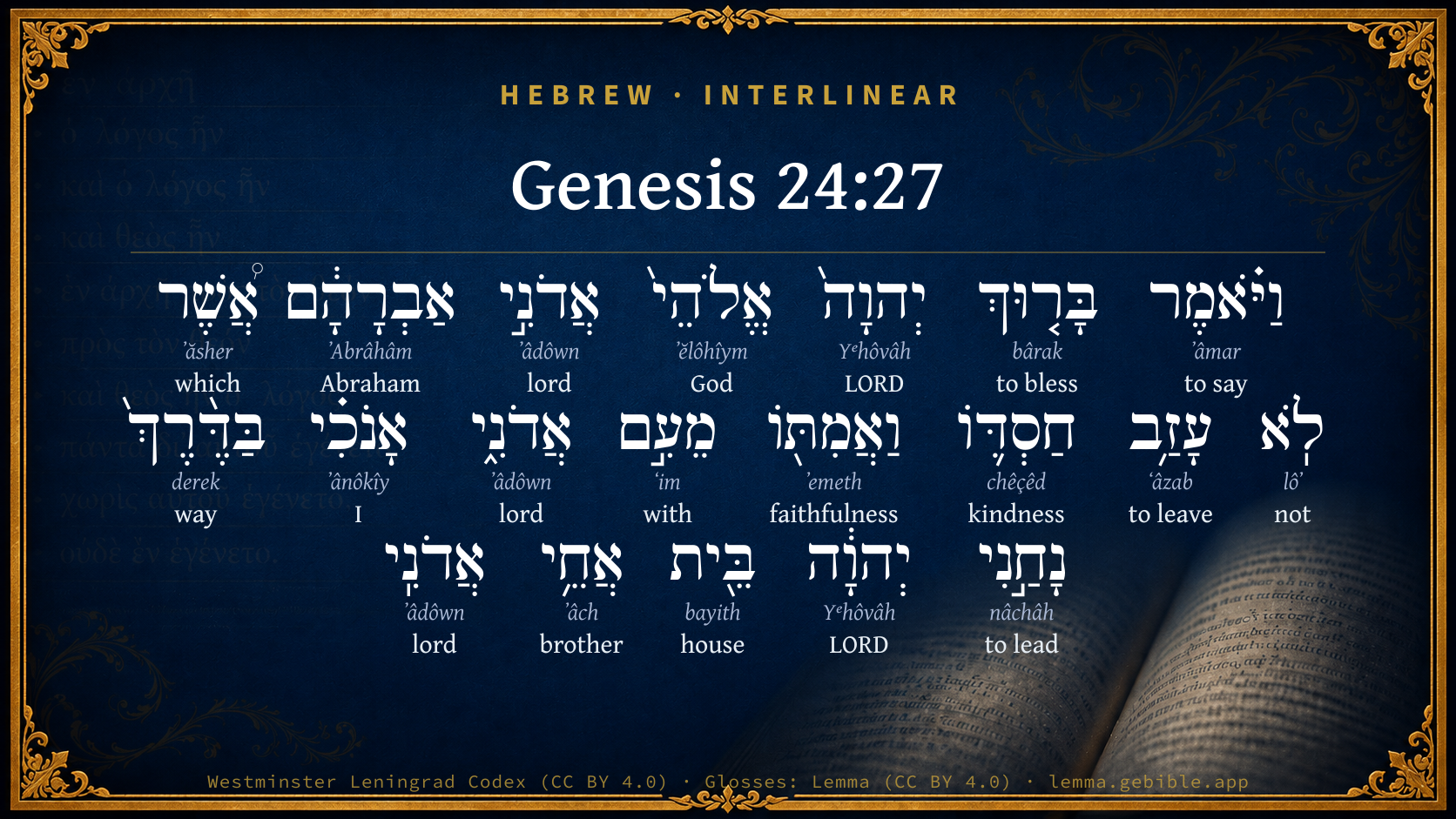
Hebrew (Westminster Leningrad Codex) Genesis 24:27 appears in the Hebrew Old Testament. The text above is from the Westminster Leningrad Codex. Each word links to its Strong’s number, a concise gloss, and parsing drawn from the Open Scriptures Hebrew Bible morphology. Click any word for its full Brown-Driver-Briggs (BDB) entry.
Download image
Cite this verse

Genesis 24:27 (World English Bible). Public Domain. Lemma interlinear Bible study tool, https://lemma.gebible.app/v/genesis/24/27.

Show BibTeX & RIS
BibTeX
RIS
English Translation
He said, "Blessed be Yahweh, the God of my master Abraham, who has not forsaken his loving kindness and his truth toward my master. As for me, Yahweh has led me in the way to the house of my master's relatives."
World English Bible · Public Domain
Highlights
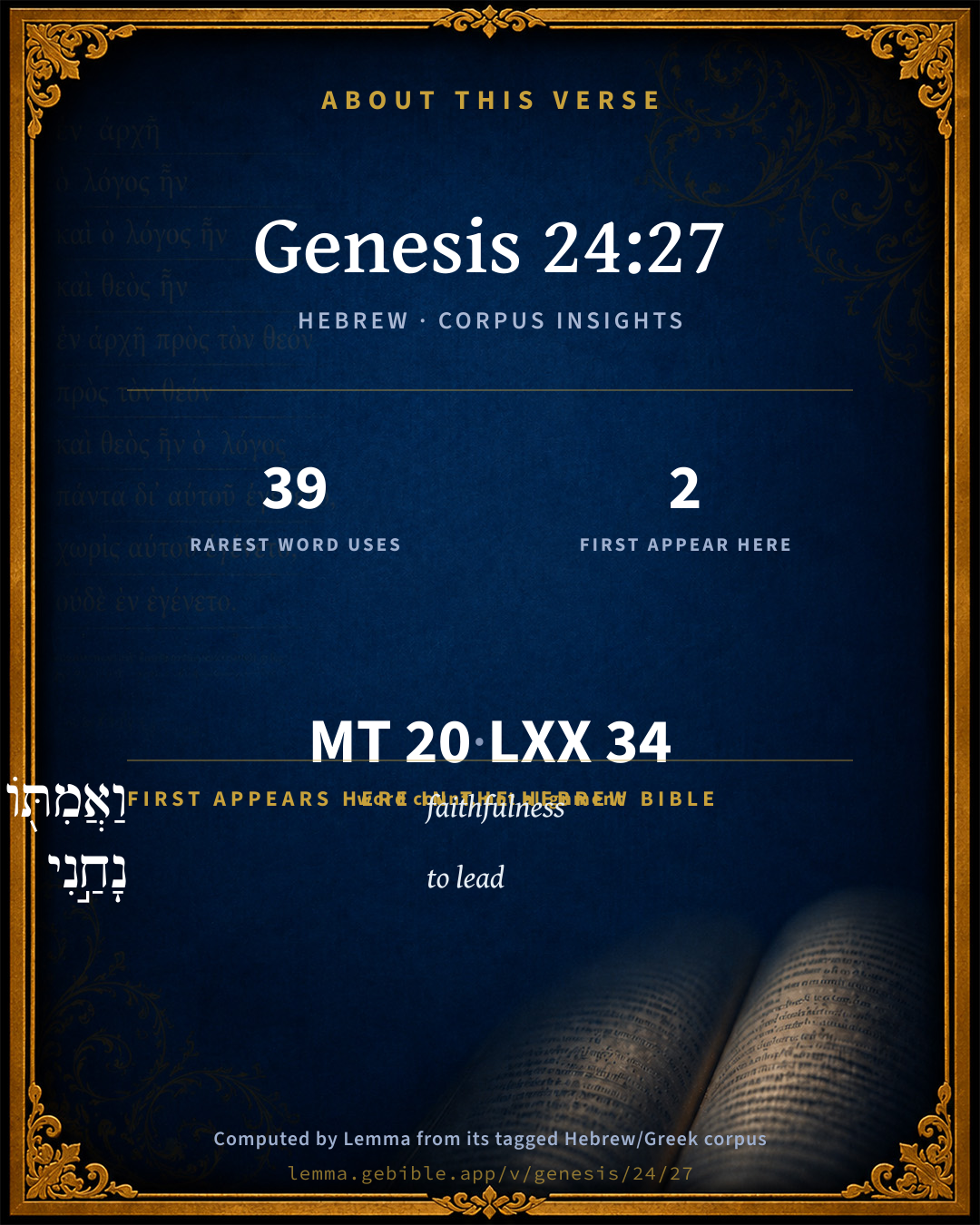
  • 2 first appearances in the Hebrew Bible
Full analysis ↓
Download a study sheet

One document with this verse’s original text, its word-by-word gloss line, the meaning frame, cross-references with their text, attributed commentary, and full source and license credits — printable, and it pastes into notes with its structure intact.

This verse Autodidact and up

Study sheet (.html) Plain text (.txt)

A passage Seminary Student

Up to 50 verses in one chapter. A passage sheet keeps up to 6 commentary sources and 12 cross-references per verse, in the order this page ranks them, and says so on the sheet whenever that leaves anything out. Ask for a single verse and you get the Autodidact verse sheet above.

Everything on this page stays free to read, with no account — the sheet is a download of what is already on screen, not access to it.

Want to remove ads? Support Godless Engineer
Compare translations 3

The same verse in 3 English versions, stacked beneath the original-language interlinear above. Click any original word for its lexicon entry.

Each is an independent rendering of the whole verse — the interlinear is not word-aligned to these translations.

Highlighted words mark where these versions differ — a whole-verse word diff, not a word-by-word alignment.

  • World English Bible Public Domain
    He said, "Blessed be Yahweh, the God of my master Abraham, who has not forsaken his loving kindness and his truth toward my master. As for me, Yahweh has led me in the way to the house of my master's relatives."
  • King James Version Public Domain
    And he said, Blessed be the LORD God of my master Abraham, who hath not left destitute my master of his mercy and his truth: I being in the way, the LORD led me to the house of my master's brethren.
  • unfoldingWord Literal Text CC BY-SA 4.0
    and said, “Praised be Yahweh, the God of my master Abraham, who has not abandoned his kindness and his faithfulness toward my master. me, Yahweh has led me on the road the home of the relatives of my master!”

unfoldingWord Literal Text — © unfoldingWord, licensed CC BY-SA 4.0. Word-aligned USFM3 via Door43 (git.door43.org/unfoldingWord/en_ult).

Versions to compare (up to 4)

3 of 4 selected

Show all 18 translations

Every available English version of this verse, each an independent rendering of the whole verse.

  • World English Bible Public Domain
    He said, "Blessed be Yahweh, the God of my master Abraham, who has not forsaken his loving kindness and his truth toward my master. As for me, Yahweh has led me in the way to the house of my master's relatives."
  • Berean Standard Bible Public Domain
    saying, “Blessed be the LORD, the God of my master Abraham, who has not withheld His kindness and faithfulness from my master. As for me, the LORD has led me on the journey to the house of my master’s relatives.”
  • Majority Standard Bible Public Domain
    saying, “Blessed be the LORD, the God of my master Abraham, who has not withheld His kindness and faithfulness from my master. As for me, the LORD has led me on the journey to the house of my master’s relatives.”
  • King James Version Public Domain
    And he said, Blessed be the LORD God of my master Abraham, who hath not left destitute my master of his mercy and his truth: I being in the way, the LORD led me to the house of my master's brethren.
  • American Standard Version (1901) Public Domain
    And he said, Blessed be Jehovah, the God of my master Abraham, who hath not forsaken his lovingkindness and his truth toward my master. As for me, Jehovah hath led me in the way to the house of my master's brethren.
  • Revised Version (1885) Public Domain
    And he said, Blessed be the LORD, the God of my master Abraham, who hath not forsaken his mercy and his truth toward my master: as for me, the LORD hath led me in the way to the house of my master’s brethren.
  • Geneva Bible (1599) Public Domain
    And said, Blessed be the Lord God of my master Abraham, which hath not withdrawen his mercie and his trueth from my master: for when I was in the way, the Lord brought me to my masters brethrens house.
  • Douay-Rheims (1899) Public Domain
    Saying: Blessed be the Lord God of my master Abraham, who hath not taken away his mercy and truth from my master, and hath brought me the straight way into the house of my master's brother.
  • Young's Literal Translation Public Domain
    and saith, `Blessed `is' Jehovah, God of my lord Abraham, who hath not left off His kindness and His truth with my lord; -- I `being' in the way, Jehovah hath led me to the house of my lord's brethren.'
  • Literal Standard Version CC BY-SA 4.0
    and says, “Blessed [is] YHWH, God of my lord Abraham, who has not left off His kindness and His truth with my lord—I [being] in the way, YHWH has led me to the house of my lord’s brothers.”
  • Unlocked Literal Bible CC BY-SA 4.0
    He said, “Blessed be Yahweh, the God of my master Abraham, who has not forsaken his covenant faithfulness and his trustworthiness toward my master. As for me, Yahweh has led me directly to the house of my master's relatives.”
  • unfoldingWord Literal Text CC BY-SA 4.0
    and said, “Praised be Yahweh, the God of my master Abraham, who has not abandoned his kindness and his faithfulness toward my master. me, Yahweh has led me on the road the home of the relatives of my master!”
  • Darby Bible Public Domain
    and said, Blessed be Jehovah, God of my master Abraham, who has not withdrawn his loving-kindness and his faithfulness from my master; I being in the way, Jehovah has led me to the house of my master's brethren.
  • World Messianic Bible Public Domain
    He said, “Blessed be the LORD, the God of my master Abraham, who has not forsaken his loving kindness and his truth toward my master. As for me, the LORD has led me on the way to the house of my master’s relatives.”
  • Webster's Bible Public Domain
    And he said, Blessed be the LORD God of my master Abraham, who hath not left my master destitute of his mercy and his truth: I being in the way, the LORD led me to the house of my master's brethren.
  • Free Bible Version CC BY-SA 4.0
    “Thank you Lord, the God of my master Abraham,” he prayed. “You have not forgotten your commitment and faithfulness to my master. And Lord, you have led me directly to the home of my master's relatives!”
  • Bible in Basic English Public Domain
    And said, Praise be to the Lord, the God of my master Abraham, who has given a sign that he is good and true to my master, by guiding me straight to the house of my master's family.
  • JPS Tanakh (1917) Public Domain
    And he said: 'Blessed be the LORD, the God of my master Abraham, who hath not forsaken His mercy and His truth toward my master; as for me, the LORD hath led me in the way to the house of my master's brethren.'

Literal Standard Version (2020), Covenant Press — licensed CC BY-SA 4.0. Text via the HelloAO Bible API (eBible.org). Unlocked Literal Bible (unfoldingWord) — licensed CC BY-SA 4.0. Text via the HelloAO Bible API (eBible.org). unfoldingWord Literal Text — © unfoldingWord, licensed CC BY-SA 4.0. Word-aligned USFM3 via Door43 (git.door43.org/unfoldingWord/en_ult). Free Bible Version, Dr. Jonathan Gallagher — licensed CC BY-SA 4.0. Text via the HelloAO Bible API (eBible.org).

Word by word

More ways to search: Search by grammar → Find every occurrence → Compare this word →

Practice this passage: Drill this verse → Learn its vocabulary →

נָחַ֣נִי
nâchâh
H5148
“to lead · me”
Verb, Qal, Perfect, 3rd Person, Masculine, Singular + Suffix, Personal, 1st Person, Common, Singular
Part of Speech
Verb
Stem
Qal
Form
Perfect
Person
3rd Person
Gender
Masculine
Number
Singular
Full BDB Definition

Origin: a primitive root

TWOT: 1341

to lead, guide - (Qal) to lead, bring - (Hiphil) to lead, guide
  1. וַיֹּ֗אמֶר ʼâmar H559 “and · to say” Conjunction + Verb, Qal, Sequential Imperfect, 3rd Person, Masculine, Singular
  2. בָּר֤וּךְ bârak H1288 “blessed” Verb, Qal, Participle Passive, Masculine, Singular, Absolute
  3. יְהוָה֙ Yᵉhôvâh H3068 “LORD” Noun, Proper
  4. אֱלֹהֵי֙ ʼĕlôhîym H430 “God(s) of” Noun, Common, Masculine, Plural, Construct
  5. אֲדֹנִ֣י ʼâdôwn H113 “lord · my” Noun, Common, Masculine, Singular, Construct + Suffix, Personal, 1st Person, Common, Singular
  6. אַבְרָהָ֔ם ʼAbrâhâm H85 “Abraham” Noun, Proper
  7. אֲ֠שֶׁר ʼăsher H834 “which” Particle, Relative
  8. לֹֽא lôʼ H3808 “not” Particle, Negative
  9. עָזַ֥ב ʻâzab H5800 “to leave” Verb, Qal, Perfect, 3rd Person, Masculine, Singular
  10. חַסְדּ֛וֹ chêçêd H2617 “kindness · his” Noun, Common, Masculine, Singular, Construct + Suffix, Personal, 3rd Person, Masculine, Singular
  11. וַאֲמִתּ֖וֹ ʼemeth H571 “and · faithfulness · his” Conjunction + Noun, Common, Feminine, Singular, Construct + Suffix, Personal, 3rd Person, Masculine, Singular
  12. מֵעִ֣ם ʻim H5973 “from · with” Preposition + Preposition
  13. אֲדֹנִ֑י ʼâdôwn H113 “lord · my” Noun, Common, Masculine, Singular, Construct + Suffix, Personal, 1st Person, Common, Singular
  14. אָנֹכִ֗י ʼânôkîy H595 “I” Pronoun, Personal, 1st Person, Common, Singular
  15. בַּדֶּ֨רֶךְ֙ derek H1870 “in/at the · way” Preposition, Determined + Noun, Common, Both, Singular, Absolute
  16. יְהוָ֔ה Yᵉhôvâh H3068 “LORD” Noun, Proper
  17. בֵּ֖ית bayith H1004 “house of” Noun, Common, Masculine, Singular, Construct
  18. אֲחֵ֥י ʼâch H251 “brothers of” Noun, Common, Masculine, Plural, Construct
  19. אֲדֹנִֽי ʼâdôwn H113 “lord · my” Noun, Common, Masculine, Singular, Construct + Suffix, Personal, 1st Person, Common, Singular

About this verse

These counts appear in no published source. They are computed here, from the morphology-tagged text and Lemma’s own curated glosses. What Lemma adds →

20
words
17
distinct lemmas
Pentateuch
section

First appearance in Scripture

These words make their first canonical appearance in the Hebrew Bible here:

  • וַאֲמִתּ֖וֹ faithfulness H571
  • נָחַ֣נִי to lead H5148

Shared distinctive vocabulary

נָחַ֣נִי to lead H5148 occurs in 39 verses of the Hebrew Bible. Also found in:

Grammatical profile

  • 4 verbs
  • 12 nouns
  • 1 pronoun
  • 1 preposition
  • 2 particles

Verb forms

  • וַיֹּ֗אמֶר Qal · Sequential Imperfect
  • בָּר֤וּךְ Qal · Participle Passive
  • עָזַ֥ב Qal · Perfect
  • נָחַ֣נִי Qal · Perfect

Repetition

Words recur within this verse — often emphatic in Hebrew:

  • אֲדֹנִ֣י lord H113 ×3
  • יְהוָה֙ LORD H3068 ×2

Hebrew & Septuagint length

In English translation the verse runs 41 words from the Hebrew and 42 from the Septuagint (LXX English) — closely comparable.

A rough comparison of the two English renderings, which tokenize alike — not a word-level alignment.

Word counts can differ between the Hebrew and the Greek without any difference in meaning — e.g. the Hebrew direct-object marker אֵת has no separate Greek word, and Greek often adds the article ὁ.

In the original languages it is 20 Hebrew tokens and 34 Greek tokens — but the two are counted differently (Hebrew bundles its prefixes and suffixes into one token; the Greek is in lemma form), so that isn’t a like-for-like length.

Cross-references

29

Topical passages linked to Genesis 24:27 in the Treasury of Scripture Knowledge — connected by theme and wording, ordered by reader-vote popularity; previews shown in the World English Bible.

  • Genesis 24:48 I bowed my head, and worshiped Yahweh, and blessed Yahweh, the God of my master Abraham, who had led me in the right way to take my master's brother's daughter for his son.
  • Genesis 24:12 He said, "Yahweh, the God of my master Abraham, please give me success this day, and show kindness to my master Abraham.
  • Genesis 32:10 I am not worthy of the least of all the loving kindnesses, and of all the truth, which you have shown to your servant; for with just my staff I passed over this Jordan; and now I have become two companies.
  • Ruth 4:14 The women said to Naomi, Blessed be Yahweh, who has not left you this day without a near kinsman; and let his name be famous in Israel.
  • Psalms 98:3 He has remembered his loving kindness and his faithfulness toward the house of Israel. All the ends of the earth have seen the salvation of our God.
  • Exodus 18:10 Jethro said, "Blessed be Yahweh, who has delivered you out of the hand of the Egyptians, and out of the hand of Pharaoh; who has delivered the people from under the hand of the Egyptians.
  • 1 Samuel 25:32 David said to Abigail, Blessed be Yahweh, the God of Israel, who sent you this day to meet me:
  • 2 Samuel 18:28 Ahimaaz called, and said to the king, All is well. He bowed himself before the king with his face to the earth, and said, Blessed be Yahweh your God, who has delivered up the men who lifted up their hand against my lord the king.
  • Psalms 100:5 For Yahweh is good. His loving kindness endures forever, His faithfulness to all generations.
  • Proverbs 3:6 In all your ways acknowledge him, And he will direct your paths.
  • Luke 1:68 "Blessed be the Lord, the God of Israel, For he has visited and worked redemption for his people;
  • Genesis 9:26 He said, "Blessed be Yahweh, the God of Shem; Let Canaan be his servant.
  • Genesis 13:8 Abram said to Lot, "Please, let there be no strife between me and you, and between my herdsmen and your herdsmen; for we are relatives.
  • Genesis 14:20 and blessed be God Most High, who has delivered your enemies into your hand." Abram gave him a tenth of all.
  • Genesis 24:4 But you shall go to my country, and to my relatives, and take a wife for my son Isaac."
  • Genesis 24:21 The man looked steadfastly at her, holding his peace, to know whether Yahweh had made his journey prosperous or not.
  • Genesis 24:42 I came this day to the spring, and said, 'Yahweh, the God of my master Abraham, if now you do prosper my way which I go.
  • Exodus 2:11 It happened in those days, when Moses had grown up, that he went out to his brothers, and looked at their burdens. He saw an Egyptian striking a Hebrew, one of his brothers.
  • Exodus 2:13 He went out the second day, and, behold, two men of the Hebrews were fighting with each other. He said to him who did the wrong, "Why do you strike your fellow?"
  • 1 Samuel 25:39 When David heard that Nabal was dead, he said, Blessed be Yahweh, who has pleaded the cause of my reproach from the hand of Nabal, and has kept back his servant from evil: and the evil-doing of Nabal has Yahweh returned on his own head. David sent and spoke concerning Abigail, to take her to him as wife.
  • 1 Chronicles 29:10–13 Therefore David blessed Yahweh before all the assembly; and David said, You are blessed, Yahweh, the God of Israel our father, forever and ever.
  • Psalms 68:19 Blessed be the Lord, who daily bears our burdens, Even the God who is our salvation. Selah.
  • Psalms 72:18–19 Praise be to Yahweh God, the God of Israel, Who alone does marvelous deeds.
  • Proverbs 4:11–13 I have taught you in the way of wisdom. I have led you in straight paths.
  • Proverbs 8:20 I walk in the way of righteousness, In the midst of the paths of justice;
  • Micah 7:20 You will give truth to Jacob, and mercy to Abraham, As you have sworn to our fathers from the days of old.
  • John 1:17 For the law was given through Moses. Grace and truth came through Jesus Christ.
  • Ephesians 1:3 Blessed be the God and Father of our Lord Jesus Christ, who has blessed us with every spiritual blessing in the heavenly places in Christ;
  • 1 Timothy 1:17 Now to the King eternal, immortal, invisible, to God who alone is wise, be honor and glory forever and ever. Amen.

Cross-references courtesy of OpenBible.info (CC BY 4.0).

Hebrew and Greek witnesses Masoretic Hebrew ↔ Greek Septuagint

The same verse in the two great witnesses to the Old Testament, shown verse-for-verse.

These are two independent witnesses, not word-aligned to each other, and the Septuagint is shown in lemma (dictionary) form.

Hebrew Genesis 24:27 Masoretic · Westminster Leningrad Codex

וַיֹּ֗אמֶר בָּר֤וּךְ יְהוָה֙ אֱלֹהֵי֙ אֲדֹנִ֣י אַבְרָהָ֔ם אֲ֠שֶׁר לֹֽא עָזַ֥ב חַסְדּ֛וֹ וַאֲמִתּ֖וֹ מֵעִ֣ם אֲדֹנִ֑י אָנֹכִ֗י בַּדֶּ֨רֶךְ֙ נָחַ֣נִי יְהוָ֔ה בֵּ֖ית אֲחֵ֥י אֲדֹנִֽי

He said, "Blessed be Yahweh, the God of my master Abraham, who has not forsaken his loving kindness and his truth toward my master. As for me, Yahweh has led me in the way to the house of my master's relatives."

World English Bible · Public Domain

Greek LXX Genesis 24:27 Septuagint · lemma form

καί εἶπον εὐλογητός κύριος ὁ θεός ὁ κύριος ἐγώ αβρααμ ὅς οὐ ἐν καταλείπω ὁ δικαιοσύνη αὐτός καί ὁ ἀλήθεια ἀπό ὁ κύριος ἐγώ ἐγώ εὐοδόω κύριος εἰς οἶκος ὁ ἀδελφός ὁ κύριος ἐγώ

and said, Blessed be the Lord the God of my master Abraam, who has not suffered his righteousness to fail, nor his truth from my master, and the Lord has brought me prosperously to the house of the brother of my lord.

LXX2012 (modern English Septuagint) · Public Domain

Hebrew: Westminster Leningrad Codex (CC BY 4.0). Greek: Septuagint (public domain); English from LXX2012 (modern English Septuagint) (Public Domain). How the Septuagint differs from the Hebrew →

Targum (Aramaic paraphrase)

2

The Targum is the ancient Jewish Aramaic paraphrase of the Hebrew Scriptures — an interpretive translation, not the Hebrew text itself. Onkelos (literal) and Pseudo-Jonathan (expansive) render the Torah, and Jonathan the Prophets. Coverage is partial: where no permissively-licensed English translation exists for a verse, only the Aramaic is shown. This is verse-level text, not a word-by-word alignment to the Hebrew.

  1. Targum Onkelos Torah (Genesis–Deuteronomy)
    וַאֲמַר בְּרִיךְ יְיָ אֱלָהָא דְרִבּוֹנִי אַבְרָהָם דִּי לָא מְנַע טִיבוּתֵהּ וְקוּשְׁטֵהּ מִן רִבּוֹנִי אֲנָא בְּאוֹרַח תַּקְנָא דַּבְּרַנִּי יְיָ בֵּית אֲחוֹהִי דְרִבּוֹנִי

    (no public-domain English translation for this verse)

    Targum Onkelos — Aramaic: “Onkelos Genesis” (public domain); “Onkelos Exodus” (public domain); “Onkelos Leviticus” (public domain); “Onkelos Numbers” (public domain); “Onkelos Deuteronomy” (public domain). English: “Sefaria Community Translation” (CC0 1.0 (public-domain dedication)); “J.W. Etheridge. The Targums of Onkelos and Jonathan Ben Uzziel on the Pentateuch. London: Longmans, Green, 1862” (public domain). Text via Sefaria.

  2. Targum Pseudo-Jonathan Torah (Genesis–Deuteronomy)
    וַאֲמַר בְּרִיךְ שְׁמָא דַיְיָ אֱלָהֵיהּ דְרִיבּוֹנִי אַבְרָהָם דִי לָא מְנַע טֵיבוּתֵיהּ וְקוּשְׁטֵיהּ מִן רִבּוֹנִי אֲנָא בִּזְכוּתֵיהּ בְּאוֹרַח תַּקְנָא דַבְּרַנִי יְיָ בֵּית אָחוֹי דְרִבּוֹנִי

    And he said, Blessed be the Name of the Lord, the God of my master Abraham, who hath not restrained His mercy and His truth from my master; for the sake of his righteousness in the right way hath the Lord led me to the house of my master's brother.

    Targum Pseudo-Jonathan — Aramaic: “Targum Jonathan on Genesis” (public domain); “Targum Jonathan on Exodus” (public domain); “Targum Jonathan on Leviticus” (public domain); “Targum Jonathan on Numbers” (public domain); “Targum Jonathan on Deuteronomy” (public domain). English: “The Targum of Jonathan ben Uzziel, trans. J. W. Etheridge, London, 1862” (public domain). Text via Sefaria.

Commentary

Notes on Genesis 24:27 from classic Christian and Jewish commentators (each source and its license shown beneath its notes). The classic Christian expositions comment on the surrounding passage and are grouped to its opening verse, so a note may address several verses; the Jewish commentaries on the Tanakh (Rashi and others) are per-verse, so they appear only where the commentator wrote on this verse.

Lemma curates 59 commentaries, every one of them public domain or Creative Commons licensed, each selected and text-cleaned for this edition rather than reprinted as found. About our sources →

Trapp's Complete Commentary

John Trapp

Gen 24:27 And he said, Blessed [be] the LORD God of my master Abraham, who hath not left destitute my master of his mercy and his truth: I [being] in the way, the LORD led me to the house of my master’s brethren.

Ver. 27. Who hath not left destitute my master.] He ascribeth all to God’s good providence, nothing to his good luck or service. Men play the atheists in speaking of fortune, like those {Isa 65:11} "that prepared a table for fortune": and those Philistines, that said, "It is a chance". {1Sa 6:9} Augustine repented that ever he spoke such language of Ashdod.

John Trapp, A Commentary or Exposition upon All the Books of the Old and New Testament (1647–1656) — public domain. Text from a community e-Sword module.

The Biblical Illustrator

Joseph S. Exell

Gen_24:27

I being in the way, the Lord led me to the house of my masters brethren

Home coming

Where did this man want to go?

To the house of his masters brethren. Then he had a master! We all have. No one is his own master. There are two great masters--Jesus and Satan. Can we serve both? No; for they work against one another. The one pulls up what the other plants, and plants what the other pulls up; and no one can serve two masters whose ways are so contrary. Which is your master? If it is not Jesus, it must be Satan. A master you must have; oh, let it be Jesus I This master has many brothers. I being in the way, the Lord led me to the house of my masters brethren. A rich little boy was boasting one day to a poor little boy about his, great relatives, and said at last, My uncle is a lord. So is my brother, said the poor boy. Your brother a lord! said the other, scornfully; pray, what is he called? He is called the Lord Jesus, was the answer. Yes; Jesus is the Brother of every one who has the same spirit, the same heart, that He has. You can be His brother, or His sister; and oh! is it not grand to think that our elder Brother is the King of earth and heaven! These brothers of Jesus have a house. The Lord led me to the house of my masters brethren. Where is that house? It is the church. Every church is a house of the Masters brethren; and if you are in the Lords way, you will most surely be led there very often. Yes, but they do not stay there always. There is another, a greater house and a finer one, into which they are led by and by. It is like this: When people are invited to go to the palace and be presented to the queen, they come up from all parts of the country and from beyond the seas; but they do not go straight to the palace. No; they first take up their abode in some house in the city, and there they wait till the day comes when they are to be presented to the queen, and then they leave the house they stayed in for the time, and go into the palace and see the queen. It is the same with the Masters brethren--with the Lords brothers; they wait first in the earthly house of God, andthen, when the time comes, one after another is called to go and see the King--and the King is Jesus! They find, as Josephs brothers found, that He is their very own Brother who has all the power! How did this man the text speaks of get to the house of his masters brethren? It was by putting himself in the way. I being in the way. That is the great thing, to get into the way. If I want to find out the road that leads to a distant place, I look up the map, and make inquiries as to whether there is a ferry at this river or a bridge at that, and so try to find out all I can about the road. But does that bring me any nearer to the place I want to go to? No; I am just as far from it as ever. There is but one way I ever can get there, and that is by putting myself on the road and going forward! It is the same with the way to the Masters house on high. The Bible is the map, and it shows us all we need to learn about the way. But we must do something more than study the map; we must go on the way ourselves. What is the way? It is doing what the Bible tells us; it is loving Jesus, and trusting Jesus, and doing things for His sake. It is trying to look on things as Jesus would look on them, and trying to do things as Jesus would do them. That is getting on the way. The way to Jesus is trying to be like Jesus. But how did this man keep the way? You know, many get on the right road at the first, but afterwards, when they come to cross-roads, and roads that lead out of roads, they often go astray. How did this man keep the right way? Because the Lord led him! I being in the way, the Lord feel me. Yes; and when we are on the way to the house of the Masters brethren, the Lord Himself goes with us, and leads us. We may not see Him, but He sees us. How does He lead us? Oh, in a thousand different fashions! When you do wrong, is not there something inside you that tells you you have done wrong? That is the Lord trying to lead you right. It is the Lord who whispers in your heart sometimes, saying, Do not do that! or, Do not go there, it is wrong! or, Do this! or, Go there, that is right! He is then leading you. And so this man got to the house of his masters brethren; and so will you, by putting yourself in the way--the way of love to Jesus, the way of trusting Him and praying to Him. Do this, and the Lord will lead you, step by step, till He brings you to the house of many mansions. (J. Reid Howatt.)

The Biblical Illustrator, edited by Joseph S. Exell (c. 1880s–1900s) — public domain. Text from a community e-Sword module.

Joseph Benson's Commentary

Gen 24:27. Blessed be the Lord God of my master — Here again this servant shows a noble example in returning thanks to God, as soon as he finds that his errand is likely to succeed. He had prayed for good speed, and, having sped well so far, he blesses God, although, as yet, he is not certain what the issue may be. Thus ought we to do: when God’s favours are coming toward us, we ought to meet them with our praises; giving thanks for all our successes in business, for all our prosperous and safe journeys, for our being comfortably situated in life, our being happily married, our having obedient children, our being placed among, and in favour with good men. For all these things we ought to give God the glory, and return him continual thanks and praise from grateful hearts, truly sensible that it is he that giveth us all good things. The Lord hath led me to the house of my master’s brethren — Those that were come out of Ur of the Chaldees, though they were not come to Canaan, but stayed in Haran. They were not idolaters, but worshippers of the true God, and inclinable to the religion of Abraham’s family.

Joseph Benson's Commentary on the Old and New Testaments (1811–1818) — public domain. Text from a community e-Sword module.

MacLaren's Expositions of Holy Scripture

Alexander MacLaren

Genesis

GUIDANCE IN THE WAY

Gen 24:27.

So said Abraham’s anonymous servant when telling how he had found Rebekah at the well, and known her to be the destined bride of his master’s servant. There is no more beautiful page, even amongst the many lovely ones in these ancient stories, than this domestic idyll of the mission of the faithful servant from far Canaan across the desert. The homely test by which he would determine that the maiden should be pointed out to him, the glimpse of old-world ways at the well, the gracious courtesy of the fair damsel, and the simple devoutness of the speaker, who recognises in what to others were trivial commonplaces God’s guidance to the end which He had appointed, his recognition of the divine hand moving beneath all the nothings and littlenesses of daily life-may teach us much.

1. The first thing that these words seem to me to suggest is the conditions under which we may be sure that God leads-’I being in the way.’

Now, of course, some of you may know that the words of our text are, by the Revised Version and others, rendered so as to obliterate the clause telling where the speaker was when the Lord led him, and to make the whole a continuous expression of the one fact-’As for me, the Lord hath led me in the way to the house of my master’s brethren.’ The literal rendering is, ‘I in the way, Jehovah led me.’ No doubt the Hebrew idiom admits of the ‘I’ being thus emphatically premised, and then repeated as ‘me’ after the verb, and possibly no more is to be made of the words than that. But the fuller and more impressive meaning is possible, and I venture to retain it, and to see in it the expression of the truth that it is when we are ‘in the way’ that God will certainly lead us.

So that suggests, first, how the people that have any right to expect any kind of guidance from God are those who have their feet upon a path which conscience approves. Many men run into all manner of perplexities by their own folly and self-will, and never ask whether their acts are right or wrong, wise or foolish, until they begin to taste the bitter consequences. Then they cry to God to help them, and think themselves very religious because they do. That is not the way to get God’s help. Such folk are like Italian brigands who had an image of the Virgin in their hats, and sometimes had the Pope’s commission in their pockets, and therefore went out to murder and ravish, in sure and certain hope of God’s favour and protection.

But when we are ‘in the way,’ and know that we are doing what we ought to do, and conscience says, ‘Go on; never mind what stands against you,’ it is then, and only then, that we have a right to be sure that the Lord will lead us. Otherwise, the best thing that can happen to us is that the Lord should thwart us when we are on the wrong road. Resistance, indeed, may be guidance; and it is often God’s manner of setting our feet in the way of His steps. We have no claim on Him for guidance, indeed, unless we have submitted ourselves to His commandments; yet His mercies go beyond our claims. Just as the obedient child gets guidance, so the petulant and disobedient child gets resistance, which is guidance too. The angel of the Lord stands in front of Balaam, amongst the vines, though the seer sometimes does not see, and blocks the path for him, and hedges up the way with his flaming sword. Only, if we would have the sweet, gracious, companionable guidance of our Lord, let us be sure, to begin with, that we are ‘in the way,’ and not in any of the bypaths into which arrogance and self-will and fleshly desires and the like are only too apt to divert our feet.

Another consideration suggested by these words, ‘I being in the way,’ is that if we expect guidance we must diligently do present duty. We are led, thank God, by one step at a time. He does with His child, whom He is teaching to read His will, as we sometimes do with our children, when we are occupied in teaching them their first book-learning: we cover the page up, all but the line that we want them to concentrate their eyes upon; and then, when they have got to the end of that, slip the hand down, low enough to allow the next line to come into view. So often God does with us. One thing at a time is enough for the little brains. And this is the condition of mortal life, for the most part-though there do come rare exceptions. Not that we have to look a long way ahead, and forecast what we shall do this time ten years off, or to make decisions that involve a distant future-except once or twice in a lifetime-but that we have to settle what is to be done in this flying minute, and in the one adjacent to it. ‘Do the duty that lies nearest thee,’ and the remoter duty will become clearer. There is nothing that has more power to make a man’s path plain before his feet than that he should concentrate his better self on the manful and complete discharge of the present moment’s service. And, on the other hand, there is nothing that will so fill our sky with mists, and blur the marks of the faint track through the moor, as present negligence, or still more, present sin. Iron in a ship’s hull makes the magnet tremble, and point away from its true source. He that has complied with evil to-day is the less capable of discerning duty to-morrow; and he that does all the duty that he knows will thereby increase the probability that he will know all that he needs. ‘If any man wills to do His will, he shall know of the teaching’-enough, at any rate, to direct his steps.

But there is another lesson still in the words; and that is that, if we are to be guided, we must see to it that we expect and obey the guidance.

This servant of Abraham’s, with a very imperfect knowledge of the divine will, had, when he set out on his road, prayed very earnestly that God would lead him. He had ventured to prescribe a certain token, naïve in its simplicity: ‘If the girl drops her pitcher, and gives us drink gladly, and does not grudge to fill the troughs for the cattle, that will show that she is of a good sort, and will make the right wife for Isaac.’ He had prayed thus, and he was ready to accept whomsoever God so designated. He had not made up his mind, ‘Bethuel’s daughter is a relation of my master’s, and so she will be a suitable wife for his son.’ He left it all with God, and then he went straight on his road, and was perfectly sure that he would get the guidance that he had sought. And when it came the good man bowed and obeyed.

Now there is a picture for us all. There are many people that say, ‘O Lord! guide me.’ when all the while they mean, ‘Let me guide Thee.’ They are perfectly willing to accept the faintest and moat questionable indications that may seem to point down the road where their inclination drives them, and like Lord Nelson at Copenhagen, will put the telescope to the blind eye when the flag is flying at the admiral’s peak, signalling ‘Come out of action,’ because they are determined to stay where they are.

Do not let us forget that the first condition of securing real guidance in our daily life is to ask it, and that the next is to look for it, and that a third is to be quite willing to accept it, whether the finger points down the broad road that we would like to go upon, or through some tangled path amongst the brushwood that we would fain avoid. And if you and I, dear brethren, in the littlenesses of our daily life, do fulfil these conditions, the heavens will crumble, and earth will melt, before God will leave His child untaught in the way in which he should go.

Only, let us be patient. Do you remember what Joshua said to the Israelites? ‘Let there be a good space of vacant ground between you and the guiding ark, that you may know by which way you ought to go.’ When men precipitately press on the heels of half-disclosed providences, they are uncommonly apt to mistake the road. We must wait till we are sure of God’s will before we try to do it. If we are not sure of what He would have us do, then, for the present, He would have us do nothing until He speaks. ‘I being in the way, the Lord led me.’

2. Now a word about the manner of the guidance.

There was no miracle, no supernatural voice, no pillar of cloud or fire, no hovering glory round the head of the village maiden. All the indications were perfectly natural and trivial. A thousand girls had gone to the wells that day all about Haran and done the very same things that Rebekah did. But the devout man who had prayed for guidance, and was sure that he was getting it, was guided by her most simple, commonplace act; and that is how we are usually to be guided. God leaves a great deal to our common sense. His way of speaking to common sense is by very common things. If any of us fancy that some glow at the heart, some sudden flash as of inspiration, is the test of a divine commandment, we have yet to learn the full meaning of the Incarnation of Jesus Christ. For that Incarnation, amongst all its other mighty influences, hallowed the commonest things of life and turned them into ministers of God’s purposes. So remember, God’s guidance may come to you through so insignificant a girl as Rebekah. It may come to you through as commonplace an incident as tipping the water of a spring out of an earthen pot into a stone trough. None the less is it God’s guidance; and what we want is the eye to see it. He will guide us by very common indications of His providence.

3. And now, the last thing that I would say a word about is the realisation in daily life of this guidance as a plain actual fact.

This anonymous trusted servant of Abraham’s, whose name we should like to have known, had a mere segment of the full orb of the knowledge of God that shines upon our path. With true Oriental freedom to speak about the deepest matters, he was not afraid nor ashamed to stand before Bethuel and Laban, and all these other strangers that crowded round the doorway, and say, ‘The Lord led me.’ There is a pattern for some of us tongue-tied, shamefaced Christians. Whatever may be the truth about the degradations of which heathen religion is full, there is a great deal in heathen religion that ought to teach, and does teach, Christendom a lesson, as to willingness to recognise and to confess God’s working in daily life. It may be very superficial; it may be very little connected with high morality; but so far as it goes it is a thousand-fold better than the dumb religion that characterises such hosts of Christian people.

A realisation of the divine guidance is the talisman that makes crooked things straight and rough places plain; that brings peace and calmness into our hearts, amid all changes, losses, and sorrows. If we hold fast by that faith, it will interpret for us the mysterious in the providences concerning our own lives, and will help us to feel that, as I said, resistance to our progress may be true guidance, and thwarting our wills may be our highest good. For the road which we travel should, in all its turnings, lead us to God; and whatsoever guides us to Him is only and always blessed.

May I, for one moment, turn these words in another direction, and remind you, dear friends, of how the sublimest application of them is still to be realised? As a climber on a mountain-peak may look down the vale up which he had painfully toiled for many days and see the dusty path lying, like a sinuous snake, down all along it, so, when we get up yonder, ‘Thou shalt remember all the way by which the Lord thy God hath led thee these many years in the wilderness,’ and shalt see the green pastures and the still waters, valleys of the shadow of death, and burning roads with sharp flints, which have all brought thee hither at last. We shall know then what we believe now, that the Lord does indeed go before them who desire to follow Him, and that the God of Israel is their reward. Then we shall say with deepened thankfulness, deepened by complete understanding of life here, seen in the light of its attained end, ‘I being in the way, the Lord led me,’ and ‘I shall dwell in the house of the Lord for ever.’

Alexander MacLaren, Expositions of Holy Scripture (1904–1910) — public domain. Text from a community e-Sword module.

Tyndale Open Study Notes

Tyndale Open Resources

24:27 The Lord has shown unfailing love and faithfulness to my master: These words express this chapter’s message (cp. 24:48). Believers can trust the Lord’s leading because he is sovereign in all things. He never leaves his people to their own resources in carrying out his covenant work.

Tyndale Open Study Notes — © Tyndale Open Resources, licensed CC BY-SA 4.0. Text via the HelloAO Bible API.

Geneva Bible (1599)

Geneva Bible translators

He boasteth not his good fortune (as do the wicked) but acknowledgeth that God hath dealt mercifully with his master in keeping promise.

Geneva Bible (1599) marginal notes — public domain. Text via Bolls.life.

Adam Clarke's Commentary

Verse 27. The Lord led me] By desire of his master he went out on this journey; and as he acknowledged God in all his ways, the Lord directed all his steps.

Adam Clarke's Commentary on the Bible (1810–1826) — public domain. Text from a community e-Sword/MySword module.

The Cambridge Bible for Schools and Colleges

gen. ed. J. J. S. Perowne

27. who hath not forsaken his mercy and his truth] For a very similar sentence, cf. Rth_2:20, “Blessed be he of the Lord who hath not left off his kindness.” The word used here for “mercy” is the same as that rendered “kindness,” Gen_24:12; Gen_24:14, and “kindly” in Gen_24:49. The combination of the Heb. words for “mercy” and “truth” was almost proverbial; cf. Gen_32:10, Gen_47:29, “kindly and truly” (J), Psa_98:3. “Mercy” denotes the goodness, “truth” the fidelity of God, in the fulfilment of His promises.

brethren] i.e. “kindred,” as in Gen_24:48. See note on Gen_13:8.

The Cambridge Bible for Schools and Colleges (gen. ed. J. J. S. Perowne; Cambridge University Press, 1878–1918) — public domain. Text from a community e-Sword module.

John Gill's Exposition

And he said, blessed be the Lord God of my master Abraham,.... See Gill on Gen 24:12,

who hath not left destitute my master of his mercy and truth; or hath not withdrawn his mercy, grace and goodness, truth and faithfulness; for his loving kindness he does not take away from his people, nor suffer his faithfulness to fail; his mercy and grace in making kind and gracious promises continue, and his truth in performing them sooner or later appear, and both in this case; as Abraham believed in the grace and goodness of God, that he would send his angel and direct his servant, and make his way prosperous, here was now an appearance of his truth and faithfulness, in making good the promise or prophecy on which Abraham's faith was built, see Gen 24:7,

I being in the way; by the way of the well; in the right way, as Jarchi, in which he was directed; in the way of his duty, following the steps of divine Providence, and observing them. It is good to be in the way which God directs to and prescribes, especially in religious things, where the blessing and presence of God may be expected:

the Lord led me to the house of my master's brethren: Nahor, whose granddaughter Rebekah was, was Abraham's brother, and Bethuel her father might be called so, as Lot was, who stood in the same relation to Abraham as he did, Gen 14:16; and, though the servant was not as yet come to the house where they lived, he had met with one of the family, and had got an invitation to it, and was on his way thither and near it.

John Gill's Exposition of the Whole Bible (1746–1763) — public domain (CC PDM 1.0). Text via the HelloAO Bible API.

Haydock's Catholic Bible Commentary

Mercy and truth: or a real kindness, so often mentioned in the Psalms. (Calmet)

George Leo Haydock (1774–1849), Haydock's Catholic Family Bible and Commentary, 1859 edition — public domain. Excludes Psalms (Douay-Rheims chapter numbering differs from Protestant) and Deuterocanonical books (Catholic canon only).

Matthew Poole's English Annotations

His mercy and his truth, i.e. who hath showed his mercy in promising all manner of blessings, and his truth in performing his promises at this day. Or, it is a figure called hendyadis, for true mercy: q. d. he hath not only been kind to him in show, and in words, but in real and considerable effects.

My master’s brethren, i.e. near kinsmen, as that word is commonly used, as Gen 24:48; 13:8; Mar 3:31,32.

Matthew Poole's English Annotations on the Holy Bible (1683–1685) — public domain. Text from a community e-Sword/MySword module.

Whedon's Commentary on the Bible

Daniel D. Whedon

27. Blessed be the Lord — The aged servant is now convinced that Jehovah has heard his prayer, and directed his steps, and he breaks out in thanksgiving.

Daniel D. Whedon (gen. ed.), Commentary on the Old and New Testaments (1874–1909) — public domain. Text from a community e-Sword module.

John Wesley's Explanatory Notes

Blessed be the Lord God of my master Abraham - Observe here,

1. He had prayed for good speed, and now he had sped well, he gives thanks.

2. As yet, he was not certain what the issue might prove, yet he gives thanks. When God's favours are coming towards us; we must meet them with our praises. The Lord led me to the house of my master's brethren -- those of them that were come out of Ur of the Chaldees, though they were not come to Canaan, but staid in Haran. They were not idolaters, but worshippers of the true God, and inclinable to the religion of Abraham's family.

John Wesley, Explanatory Notes Upon the Whole Bible (1754–1765) — public domain. Text via the GEBible commentary corpus.

Rashi

Rabbi Shlomo Yitzchaki (Rashi)

בדרך [I BEING] IN THE WAY — The way i.e. the designated way — the right way — that way which I really required. In the same manner wherever ב or ל or ה are prefixed to a word and are punctuated with a Patach, they speak of some object that is quite definite in sense, having been already mentioned in another passage, or of some object where it is quite clear and evident about what one is speaking.

Rashi on the Tanakh — English translations: “The Judaica Press complete Tanach with Rashi, translated by A. J. Rosenberg” (CC BY 4.0); “Pentateuch with Rashi's commentary by M. Rosenbaum and A.M. Silbermann, 1929-1934” (public domain); “The Metsudah Tanach series, Lakewood, N.J” (CC BY 4.0); and “The Book of Joshua, Metsudah Publications, 1997” (CC BY 4.0). Text via Sefaria.

Radak

Rabbi David Kimhi (Radak)

חסדו ואמתו, if someone constantly endeavours to do what is good and pleasing in the eyes of the Lord, and he succeeds in his personal endeavours, this is no more than just, he deserves to do so. We describe this as G’d’s אמת, “truth.” חסד on the other hand, is the recognition that G’d has granted one loving kindness over and beyond what one could have expected based on one’s general conduct. In this instance G’d’s חסד was that not only did He make Eliezer meet a girl who was suitable for marriage to Yitzchok on the basis of her personal virtues, but beyond that she was also qualified through being a member of Avraham’s family. Eliezer attributed these favourable developments to the merits of his master, not to his own.

אנכי בדרך, and I had no idea where to spend the night and G’d guided me to בית אחי אדוני, for Nachor was Avraham’s brother and Milkah was his brother’s daughter. This is why he used the plural formulation saying: achey adoni instead of the singular mode as he did when he recounted these events in verse 48 when he said bat achi adoni. Both formulations were accurate with a slight shift of emphasis. The author quotes Genesis 46,21 echi varosh (names of Binyamin’s sons) as a tool to help one remember these two constructions of the words achi and achey. After Eliezer had thanked the Lord for making his mission successful, he produced the jewelry and gave them to Rivkah.

Radak on the Tanakh — English translations: “Sefaria Community Translation” (CC0 1.0 (public-domain dedication)); “Eliyahu Munk, HaChut Hameshulash” (CC BY 4.0); “Rabbi Mike Feuer, Jerusalem Anthology” (CC BY 4.0); and “R. David Kimhi on the first book of Psalms, Translated by R.G. Finch, London, 1919” (public domain). Text via Sefaria.

Lesson kit

Teaching starters — assembled from the data on this page, not authored interpretation. Every prompt links to the verse data it draws on. Edit before teaching.

Genesis, in the Pentateuch, opens this verse with 20 words (17 distinct Hebrew lemmas). Its most distinctive word is nâchâh (“to lead”). A historical commentator’s framing appears above. Read the whole chapter for the surrounding context.

Discussion questions

  1. The word nâchâh carries the sense “to lead.” How does it shape the verse?
  2. 2 words make their first appearance in Scripture here. What does this debut establish?
  3. How does Genesis 24:48, which shares the word «to lead», read alongside this verse?
  4. What does the repetition of “lord” (3× in this one verse) do in this verse?
  5. These translations render this verse differently. What is at stake in choosing one wording over another?
  6. «וַיֹּ֗אמֶר» is a Qal Sequential Imperfect verb. How does that grammatical form shape the action described?
  7. Compare how Trapp's Complete Commentary and The Biblical Illustrator read this verse. Where do they agree or differ?

Things to notice

Reading settings

Reading text

Shown beneath each verse's original-language words.

Old Testament
Old Testament edition

Read the OT as the Masoretic Hebrew (MT) or the Greek Septuagint (LXX).

English shown for the Greek Septuagint (in the Hebrew ↔ Greek comparison).

Comparing translations? Open the Compare panel on any verse page to stack up to four side by side.