
Genesis 47:10

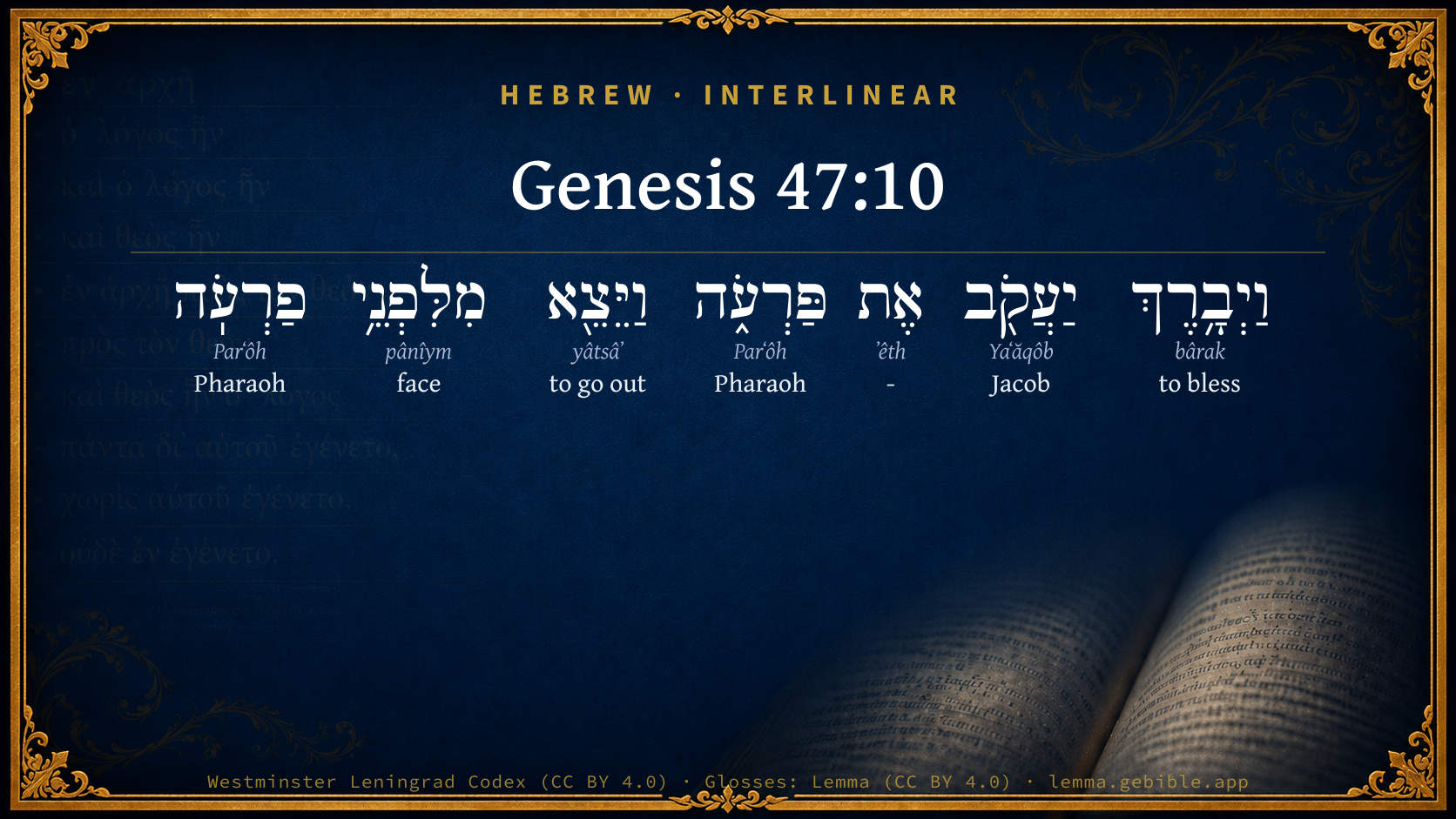
Hebrew (Westminster Leningrad Codex) Genesis 47:10 appears in the Hebrew Old Testament. The text above is from the Westminster Leningrad Codex. Each word links to its Strong’s number, a concise gloss, and parsing drawn from the Open Scriptures Hebrew Bible morphology. Click any word for its full Brown-Driver-Briggs (BDB) entry.
Download image
Cite this verse

Genesis 47:10 (World English Bible). Public Domain. Lemma interlinear Bible study tool, https://lemma.gebible.app/v/genesis/47/10.

Show BibTeX & RIS
BibTeX
RIS
English Translation
Jacob blessed Pharaoh, and went out from the presence of Pharaoh.
World English Bible · Public Domain
Download a study sheet

One document with this verse’s original text, its word-by-word gloss line, the meaning frame, cross-references with their text, attributed commentary, and full source and license credits — printable, and it pastes into notes with its structure intact.

This verse Autodidact and up

Study sheet (.html) Plain text (.txt)

A passage Seminary Student

Up to 50 verses in one chapter. A passage sheet keeps up to 6 commentary sources and 12 cross-references per verse, in the order this page ranks them, and says so on the sheet whenever that leaves anything out. Ask for a single verse and you get the Autodidact verse sheet above.

Everything on this page stays free to read, with no account — the sheet is a download of what is already on screen, not access to it.

Want to remove ads? Support Godless Engineer
Compare translations 3

The same verse in 3 English versions, stacked beneath the original-language interlinear above. Click any original word for its lexicon entry.

Each is an independent rendering of the whole verse — the interlinear is not word-aligned to these translations.

Highlighted words mark where these versions differ — a whole-verse word diff, not a word-by-word alignment.

  • World English Bible Public Domain
    Jacob blessed Pharaoh, and went out from the presence of Pharaoh.
  • King James Version Public Domain
    And Jacob blessed Pharaoh, and went out from before Pharaoh.
  • unfoldingWord Literal Text CC BY-SA 4.0
    Then Jacob blessed Pharaoh and left from the presence of Pharaoh.

unfoldingWord Literal Text — © unfoldingWord, licensed CC BY-SA 4.0. Word-aligned USFM3 via Door43 (git.door43.org/unfoldingWord/en_ult).

Versions to compare (up to 4)

3 of 4 selected

Show all 18 translations

Every available English version of this verse, each an independent rendering of the whole verse.

  • World English Bible Public Domain
    Jacob blessed Pharaoh, and went out from the presence of Pharaoh.
  • Berean Standard Bible Public Domain
    Then Jacob blessed Pharaoh and departed from his presence.
  • Majority Standard Bible Public Domain
    Then Jacob blessed Pharaoh and departed from his presence.
  • King James Version Public Domain
    And Jacob blessed Pharaoh, and went out from before Pharaoh.
  • American Standard Version (1901) Public Domain
    And Jacob blessed Pharaoh, and went out from the presence of Pharaoh.
  • Revised Version (1885) Public Domain
    And Jacob blessed Pharaoh, and went out from the presence of Pharaoh.
  • Geneva Bible (1599) Public Domain
    And Iaakob tooke leaue of Pharaoh, and departed from the presence of Pharaoh.
  • Douay-Rheims (1899) Public Domain
    And blessing the king, he went out.
  • Young's Literal Translation Public Domain
    And Jacob blesseth Pharaoh, and goeth out from before Pharaoh.
  • Literal Standard Version CC BY-SA 4.0
    And Jacob blesses Pharaoh, and goes out from before Pharaoh.
  • Unlocked Literal Bible CC BY-SA 4.0
    Then Jacob blessed Pharaoh and went out from his presence.
  • unfoldingWord Literal Text CC BY-SA 4.0
    Then Jacob blessed Pharaoh and left from the presence of Pharaoh.
  • Darby Bible Public Domain
    And Jacob blessed Pharaoh, and went out from Pharaoh.
  • World Messianic Bible Public Domain
    Jacob blessed Pharaoh, and went out from the presence of Pharaoh.
  • Webster's Bible Public Domain
    And Jacob blessed Pharaoh, and went out from before Pharaoh.
  • Free Bible Version CC BY-SA 4.0
    Then Jacob blessed Pharaoh again before leaving him.
  • Bible in Basic English Public Domain
    And Jacob gave Pharaoh his blessing, and went out from before him.
  • JPS Tanakh (1917) Public Domain
    And Jacob blessed Pharaoh, and went out from the presence of Pharaoh.

Literal Standard Version (2020), Covenant Press — licensed CC BY-SA 4.0. Text via the HelloAO Bible API (eBible.org). Unlocked Literal Bible (unfoldingWord) — licensed CC BY-SA 4.0. Text via the HelloAO Bible API (eBible.org). unfoldingWord Literal Text — © unfoldingWord, licensed CC BY-SA 4.0. Word-aligned USFM3 via Door43 (git.door43.org/unfoldingWord/en_ult). Free Bible Version, Dr. Jonathan Gallagher — licensed CC BY-SA 4.0. Text via the HelloAO Bible API (eBible.org).

Word by word

More ways to search: Search by grammar → Find every occurrence → Compare this word →

Practice this passage: Drill this verse → Learn its vocabulary →

About this verse

These counts appear in no published source. They are computed here, from the morphology-tagged text and Lemma’s own curated glosses. What Lemma adds →

7
words
6
distinct lemmas
Pentateuch
section

Grammatical profile

  • 2 verbs
  • 4 nouns
  • 1 particle

Verb forms

  • וַיְבָ֥רֶךְ Piel · Sequential Imperfect
  • וַיֵּצֵ֖א Qal · Sequential Imperfect

Repetition

A word recurs within this verse — often emphatic in Hebrew:

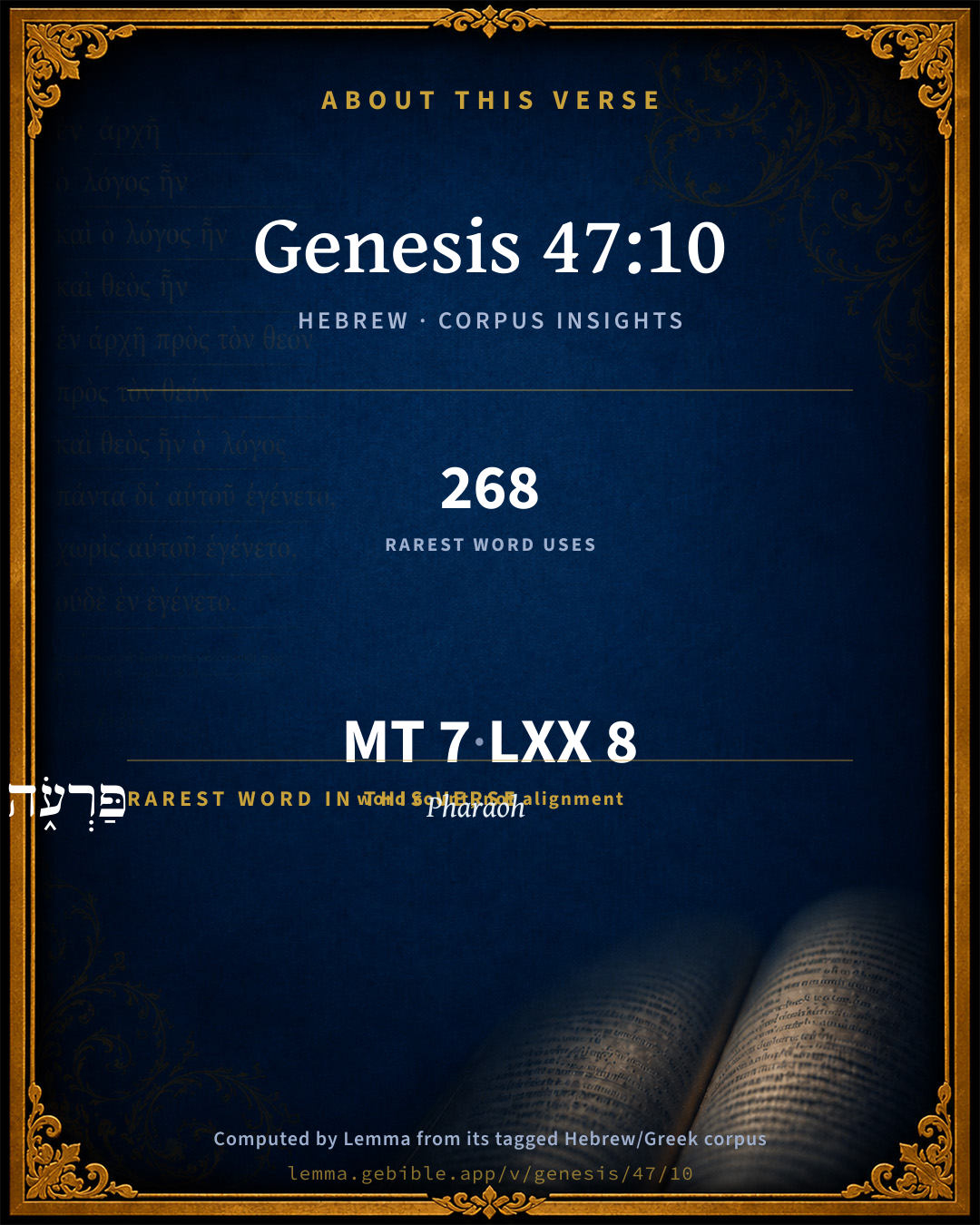
  • פַּרְעֹ֑ה Pharaoh H6547 ×2

Hebrew & Septuagint length

In English translation the verse runs 11 words from the Hebrew and 8 from the Septuagint (LXX English) — closely comparable.

A rough comparison of the two English renderings, which tokenize alike — not a word-level alignment.

Word counts can differ between the Hebrew and the Greek without any difference in meaning — e.g. the Hebrew direct-object marker אֵת has no separate Greek word, and Greek often adds the article ὁ.

In the original languages it is 7 Hebrew tokens and 8 Greek tokens — but the two are counted differently (Hebrew bundles its prefixes and suffixes into one token; the Greek is in lemma form), so that isn’t a like-for-like length.

Cross-references

10

Topical passages linked to Genesis 47:10 in the Treasury of Scripture Knowledge — connected by theme and wording, ordered by reader-vote popularity; previews shown in the World English Bible.

  • Genesis 47:7 Joseph brought in Jacob, his father, and set him before Pharaoh, and Jacob blessed Pharaoh.
  • Genesis 14:19 He blessed him, and said, "Blessed be Abram of God Most High, possessor of heaven and earth:
  • Deuteronomy 33:1 This is the blessing, with which Moses the man of God blessed the children of Israel before his death.
  • 2 Samuel 8:10 then Toi sent Joram his son to king David, to Greet him, and to bless him, because he had fought against Hadadezer and struck him: for Hadadezer had wars with Toi. [Joram] brought with him vessels of silver, and vessels of gold, and vessels of brass:
  • 2 Samuel 19:39 All the people went over the Jordan, and the king went over: and the king kissed Barzillai, and blessed him; and he returned to his own place.
  • Psalms 129:8 Neither do those who go by say, "The blessing of Yahweh be on you. We bless you in the name of Yahweh."
  • Hebrews 7:7 But without any dispute the less is blessed by the better.
  • Numbers 6:23–27 "Speak to Aaron and to his sons, saying, 'This is how you shall bless the children of Israel.' You shall tell them,
  • Psalms 119:46 I will also speak of your statutes before kings, And will not be disappointed.
  • Ruth 2:4 Behold, Boaz came from Bethlehem, and said to the reapers, Yahweh be with you. They answered him, Yahweh bless you.

Cross-references courtesy of OpenBible.info (CC BY 4.0).

Hebrew and Greek witnesses Masoretic Hebrew ↔ Greek Septuagint

The same verse in the two great witnesses to the Old Testament, shown verse-for-verse.

These are two independent witnesses, not word-aligned to each other, and the Septuagint is shown in lemma (dictionary) form.

Hebrew Genesis 47:10 Masoretic · Westminster Leningrad Codex

וַיְבָ֥רֶךְ יַעֲקֹ֖ב אֶת פַּרְעֹ֑ה וַיֵּצֵ֖א מִלִּפְנֵ֥י פַרְעֹֽה

Jacob blessed Pharaoh, and went out from the presence of Pharaoh.

World English Bible · Public Domain

Greek LXX Genesis 47:10 Septuagint · lemma form

καί εὐλογέω ἰακώβ ὁ φαραώ ἐκἔρχομαι ἀπό αὐτός

And Jacob blessed Pharao, and departed from him.

LXX2012 (modern English Septuagint) · Public Domain

Hebrew: Westminster Leningrad Codex (CC BY 4.0). Greek: Septuagint (public domain); English from LXX2012 (modern English Septuagint) (Public Domain). How the Septuagint differs from the Hebrew →

Targum (Aramaic paraphrase)

2

The Targum is the ancient Jewish Aramaic paraphrase of the Hebrew Scriptures — an interpretive translation, not the Hebrew text itself. Onkelos (literal) and Pseudo-Jonathan (expansive) render the Torah, and Jonathan the Prophets. Coverage is partial: where no permissively-licensed English translation exists for a verse, only the Aramaic is shown. This is verse-level text, not a word-by-word alignment to the Hebrew.

  1. Targum Onkelos Torah (Genesis–Deuteronomy)
    וּבָרִיךְ יַעֲקֹב יָת פַּרְעֹה וּנְפַק מִן קֳדָם פַּרְעֹה

    (no public-domain English translation for this verse)

    Targum Onkelos — Aramaic: “Onkelos Genesis” (public domain); “Onkelos Exodus” (public domain); “Onkelos Leviticus” (public domain); “Onkelos Numbers” (public domain); “Onkelos Deuteronomy” (public domain). English: “Sefaria Community Translation” (CC0 1.0 (public-domain dedication)); “J.W. Etheridge. The Targums of Onkelos and Jonathan Ben Uzziel on the Pentateuch. London: Longmans, Green, 1862” (public domain). Text via Sefaria.

  2. Targum Pseudo-Jonathan Torah (Genesis–Deuteronomy)
    וּבְרִיךְ יַעֲקב יַת פַּרְעה וּנְפַק מִן קֳדָם פַּרְעה

    And Jakob blessed Pharoh, and went out from before Pharoh.

    Targum Pseudo-Jonathan — Aramaic: “Targum Jonathan on Genesis” (public domain); “Targum Jonathan on Exodus” (public domain); “Targum Jonathan on Leviticus” (public domain); “Targum Jonathan on Numbers” (public domain); “Targum Jonathan on Deuteronomy” (public domain). English: “The Targum of Jonathan ben Uzziel, trans. J. W. Etheridge, London, 1862” (public domain). Text via Sefaria.

Commentary

Notes on Genesis 47:10 from classic Christian and Jewish commentators (each source and its license shown beneath its notes). The classic Christian expositions comment on the surrounding passage and are grouped to its opening verse, so a note may address several verses; the Jewish commentaries on the Tanakh (Rashi and others) are per-verse, so they appear only where the commentator wrote on this verse.

Lemma curates 59 commentaries, every one of them public domain or Creative Commons licensed, each selected and text-cleaned for this edition rather than reprinted as found. About our sources →

Trapp's Complete Commentary

John Trapp

Gen 47:10 And Jacob blessed Pharaoh, and went out from before Pharaoh.

Ver. 10. {See Trapp on "Gen 47:7"}

John Trapp, A Commentary or Exposition upon All the Books of the Old and New Testament (1647–1656) — public domain. Text from a community e-Sword module.

Geneva Bible (1599)

Geneva Bible translators

Hebrew, blessed.

Geneva Bible (1599) marginal notes — public domain. Text via Bolls.life.

John Gill's Exposition

And Jacob blessed Pharaoh, and went out from before Pharaoh. When he took his leave of him, he blessed him, in like manner as when he came into his presence, by wishing all happiness to him, and giving him thanks for the honour he had done him, and the favours he had conferred on him and his.

And Jacob blessed Pharaoh, and went out from before Pharaoh. When he took his leave of him, he blessed him, in like manner as when he came into his presence, by wishing all happiness to him, and giving him thanks for the honour he had done him, and the favours he had conferred on him and his.

Genesis 47:11

gen 47:11

gen 47:11

gen 47:11And Joseph placed his father and his brethren, and gave them a possession in the land of Egypt,.... Houses to dwell in, lands to till, and pastures to feed their flocks and herds in:

in the best of the land, in the land of Rameses, as Pharaoh commanded; according to Jarchi and Aben Ezra, the land of Rameses was a part of the land of Goshen: Jerom (o) says, that Rameses was a city the children of Israel built in Egypt, and that the province was formerly so called in which Jacob and his sons dwelt; but if it is the same with the city which was built by them, it is here called so by anticipation: but Aben Ezra is of opinion that it is not the same, and indeed the names are differently pointed and pronounced; that built by the Israelites is Raamses, and was one of the treasure cities of Pharaoh, and never inhabited by the Israelites; the Targums of Jonathan and Jerusalem call this land the land of Pelusium; but this part of the country lay not in the Pelusiac, but rather in the Heliopolitan home: Sir John Marsham is of opinion (p) that Rameses is the name of Pharaoh, the then present king of Egypt, as there were several of the kings of Egypt of that name; and therefore he thinks this land was the king's land, the land of King Rameses, which Joseph placed his father and brethren in by the order of Pharaoh: but it seems rather to be the name of a place, and is thought by Dr. Shaw (q) to be the same with Cairo: a very learned man (r) takes this to be the name of the land of Goshen, after the coming of the Israelites into it, and observes, that, in the Egyptian language, "Remsosch" signifies men that live a pastoral life, and so this country was called Ramses or Remsosch, as being the country of the shepherds; and the same learned writer (s) is of opinion, that the land of Goshen is the same with the Heracleotic nome, or district, which lies in the great island the Nile makes above Memphis, and which is now called by the Arabs Fioum, it being the best and most fruitful part of all Egypt; which is confirmed by the testimony of Strabo, who says (t) it excels all the rest of the nomes, or districts; that it is the only one that produces olives, large and perfect, with fine fruit, which, if well gathered, make good oil, but all the rest of Egypt is without oil; moreover it produces wine not a little (whereas Herodotus says (u) vines were wanting in Egypt, i.e. in other parts of it), also corn and pulse, and other seeds: and that Fioum, as it is now called, is the most fruitful, and is the most pleasant part of all Egypt, having vines, olives, figs, and fruits of all sorts, the most excellent, and some of which are not to be found in other parts of the country, the same, writer proves from various travellers and historians (w); particularly Leo Africanus says (x), that the Sahidic nome, in which he places Fium, excels all the other parts of Egypt in plenty of pulse, as peas, beans, &c. and of animals and linen, though all Egypt is very fruitful: and Vansleb (y) says, the province of Fium has been always esteemed one of the most excellent in all Egypt, because of its fruitful fields, its great riches, and pleasant gardens,--all that grows here is of a better taste than in other provinces: here are fields full of rose trees, and woods of fig trees, which are not in other parts of Egypt; the gardens are full of all manner of trees, pears, oranges, lemons, peaches, plums, and apricots:--in Fium only, says he, of all the provinces of Egypt, are vineyards--nor is any province so much cut into channels as this: they all proceed from Joseph's river, and have bridges over them, made with burnt bricks very strong; and tradition says they were built in the days of the Pharaohs; and it is the opinion of the Coptics, that these kings employed the Israelites in making: bricks for those bridges, which is very probable, from the infinite number of men needful to make such a prodigious quantity: this part of Egypt where Israel dwelt, by all relations, being so excellent, the impudence of Celsus (z) the Heathen is very surprising, when he affirms that the nation of the Jews, becoming numerous in Egypt, were ordered to dwell apart as sojourners, and to feed their flocks in places vile and despicable.

(o) De locis Heb. fol. 94. A. (p) Canon. Chron. Aegypt, &c. p. 90. (q) Travels, p. 307. Ed. 2. (r) Jablonski de Terra Goshen, Dissert. 4. sect. 7. (s) Ib. Dissert. 3. sect. 2. (t) Geograph. l. 17. p. 556. (u) Euterpe, sive, l. 2. c. 77. (w) Paulus Lucas, Wilhelm. Tyrius, &c. apud Jablonski, ibid. sect. 7. (x) Descriptio Africae, l. 8. p. 666, 669. (y) Relation of a Voyage to Egypt, p. 148, 154, 155. (z) Apud Origen. contr. Cels. l. 4. p. 195.

John Gill's Exposition of the Whole Bible (1746–1763) — public domain (CC PDM 1.0). Text via the HelloAO Bible API.

The Pulpit Commentary

And Jacob blessed Pharaoh (as he had done on entering the royal presence),

The Pulpit Commentary (1880–1919), ed. H.D.M. Spence-Jones & Joseph S. Exell — public domain. Text from a community e-Sword module.

John Wesley's Explanatory Notes

And Jacob blessed Pharaoh - Which was not only an act of civility but an act of piety; he prayed for him, as one having the authority of a prophet and a patriarch: and a patriarch's blessing was not a thing to be despised, no not by a potent prince.

John Wesley, Explanatory Notes Upon the Whole Bible (1754–1765) — public domain. Text via the GEBible commentary corpus.

Keil & Delitzsch

C. F. Keil & F. Delitzsch

After this probably short interview, of which, however, only the leading incidents are given, Jacob left the king with a blessing.

Keil & Delitzsch — Biblical Commentary on the Old Testament (1861–1891) — public domain (CC PDM 1.0). Text via the HelloAO Bible API. (Old Testament only.)

MacLaren's Expositions of Holy Scripture

Alexander MacLaren

Genesis

GROWTH BY TRANSPLANTING

Gen 47:1 - Gen 47:12.

1. The conduct of Joseph in reference to the settlement in Goshen is an example of the possibility of uniting worldly prudence with high religious principle and great generosity of nature. He had promised his brothers a home in that fertile eastern district, which afforded many advantages in its proximity to Canaan, its adaptation to pastoral life, and its vicinity to Joseph when in Zoan, the capital. But he had not consulted Pharaoh, and, however absolute his authority, it scarcely stretched to giving away Egyptian territory without leave. So his first care, when the wanderers arrive, is to manage the confirmation of the grant. He goes about it with considerable astuteness-a hereditary quality, which is redeemed from blame because used for unselfish purposes and unstained by deceit. He does not tell Pharaoh how far he had gone, but simply announces that his family are in Goshen, as if awaiting the monarch’s further pleasure. Then he introduces a deputation, no doubt carefully chosen, of five of his brothers {as if the whole number would have been too formidable}, previously instructed how to answer. He knows what Pharaoh is in the habit of asking, or he knows that he can lead him to ask the required question, which will bring out the fact of their being shepherds, and utilise the prejudice against that occupation, to ensure separation in Goshen. All goes as he had arranged. Thanks partly to the indifference of the king, who seems to have been rather a roi fainéant in the hands of his energetic maire du palais, and to have been contented to give, with a flourish of formality, as a command to Joseph, what Joseph had previously carefully suggested to him {vers. 6, 7}. There is nothing unfair in all this. It is good, shrewd management, and no fault can be found with it; but it is a new trait in the ideal character of a servant of God, and contrasts strongly with the type shown in Abraham. None the less, it is a legitimate element in the character and conduct of a good man, set down to do God’s work in such a world. Joseph is a saint and a politician. His shrewdness is never craft; sagacity is not alien to consecration. No doubt it has to be carefully watched lest it degenerate; but prudence is as needful as enthusiasm, and he is the complete man who has a burning fire down in his heart to generate the force that drives him, and a steady hand on the helm, and a keen eye on the chart, to guide him. Be ye ‘wise as serpents’ but also ‘harmless as doves.’

2. We may note in Joseph’s conduct also an instance of a man in high office and not ashamed of his humble relations. One of the great lessons meant to be taught by the whole patriarchal period was the sacredness of the family. That is, in some sense, the keynote of Joseph’s history. Here we see family love, which had survived the trial of ill-usage and long absence, victorious over the temptation of position and high associates. It took some nerve and a great deal of affection, for the viceroy, whom envious and sarcastic courtiers watched, to own his kin. What a sweet morsel for malicious tongues it would be, ‘Have you heard? He is only the son of an old shepherd, who is down in Goshen, come to pick up some crumbs there!’ One can fancy the curled lips and the light laugh, as the five brothers, led by the great man himself, made their rustic reverences to Pharaoh. It is as if some high official in Paris were to walk in half a dozen peasants in blouse and sabots, and present them to the president as ‘my brothers.’ It was a brave thing to do; and it teaches a lesson which many people, who have made their way in the world, would be nobler and more esteemed if they learned.

3. The brother’s words to Pharaoh are another instance of that ignorant carrying out of the divine purposes which we have already had to notice. They evidently contemplate only a temporary stay in the country. They say that they are come ‘to sojourn’-the verb from which are formed the noun often rendered ‘strangers,’ and that which Jacob uses in Gen 47:9, ‘my pilgrimage.’ The reason for their coming is given as the transient scarcity of pasturage in Canaan, which implies the intention of return as soon as that was altered. Joseph had the same idea of the short duration of their stay; and though Jacob had been taught by vision that the removal was in order to their being made a great nation, it does not seem that his sons’ intentions were affected by that-if they knew it. So mistaken are our estimates. We go to a place for a month, and we stay in it for twenty years. We go to a place to settle for life, and our tent-pegs are pulled up in a week. They thought of five years, and it was to be nearly as many centuries. They thought of temporary shelter and food; God meant an education of them and their descendants. Over all this story the unseen Hand hovers, chastising, guiding, impelling; and the human agents are free and yet fulfilling an eternal purpose, blind and yet accountable, responsible for motives, and mercifully ignorant of consequences. So we all play our little parts. We have no call to be curious as to what will come of our deeds. This end of the action, the motive of it, is our care; the other end, the outcome of it, is God’s business to see to.

4. We may also observe how trivial incidents are wrought into God’s scheme. The Egyptian hatred of the shepherd class secured one of the prime reasons for the removal from Canaan-the unimpeded growth of a tribe into a nation. There was no room for further peaceful and separate expansion in that thickly populated country. Nor would there have been in Egypt, unless under the condition of comparative isolation, which could not have been obtained in any other way. Thus an unreasonable prejudice, possibly connected with religious ideas, became an important factor in the development of Israel; and, once again, we have to note the wisdom of the great Builder who uses not only gold, silver, and precious stones, but even wood, hay, stubble-follies and sins-for His edifice.

5. The interview of Jacob with Pharaoh is pathetic and beautiful. The old man comports himself, in all the later history of Joseph, as if done with the world, and waiting to go. ‘Let me die, since I have seen thy face,’ was his farewell to life. He takes no part in the negotiation about Goshen, but has evidently handed over all temporal cares to younger hands. A halo of removedness lies round his grey hairs, and to Pharaoh he behaves as one withdrawn from fleeting things, and, by age and nearness to the end, superior even to a king’s dignity. As he enters the royal presence he does not do reverence, but invokes a blessing upon him. ‘The less is blessed of the better.’ He has nothing to do with court ceremonials or conventionalities. The hoary head is a crown of honour, Pharaoh recognises his right to address him thus by the kindly question as to his age, which implied respect for his years. The answer of the ‘Hebrew Ulysses,’ as Stanley calls him, breathes a spirit of melancholy not unnatural in one who had once more been uprooted, and found himself again a wanderer in his old age. The tremulous voice has borne the words across all the centuries, and has everywhere evoked a response in the hearts of weary and saddened men. Look at the component parts of this pensive retrospect.

Life has been to him a ‘pilgrimage’. He thinks of all his wanderings from that far-off day when at Bethel he received the promise of God’s presence ‘in all places whither thou goest,’ till this last happy and yet disturbing change. But he is thinking not only, perhaps not chiefly, of the circumstances, but of the spirit, of his life. This is, no doubt, the confession ‘that they were strangers and pilgrims’ referred to in the Epistle to the Hebrews. He was a pilgrim, not because he had often changed his place of abode, but because he sought the ‘city which hath foundations,’ and therefore could not be at home here. The goal of his life lay in the far future; and whether he looked for the promises to be fulfilled on earth, or had the unformulated consciousness of immortality, and saluted the dimly descried coast from afar while tossing on life’s restless ocean, he was effectually detached from the present, and felt himself an alien in the existing order. We have to live by the same hope, and to let it work the same estrangement, if we would live noble lives. Not because all life is change, nor because it all marches steadily on to the grave, but because our true home-the community to which we really belong, the metropolis, the mother city of our souls-is above, are we to feel ourselves strangers upon earth. They who only take into account the transiency of life are made sad, or sometimes desperate, by the unwelcome thought. But they whose pilgrimage is a journey home may look that transiency full in the face, and be as glad because of it as colonists on their voyage to the old country which they call ‘home,’ though they were born on the other side of the world and have never seen its green fields.

To Jacob’s eyes his days seem ‘few.’ Abraham’s one hundred and seventy-five years, Isaac’s one hundred and eighty, were in his mind. But more than these was in his mind. The law of the moral perspective is other than that of the physical. The days in front, seen through the glass of anticipation, are drawn out; the days behind, viewed through the telescope of memory, are crowded together. What a moment looked all the long years of his struggling life-shorter now than even had once seemed the seven years of service for his Rachel, that love had made to fly past on such swift wings! That happy wedded life, how short it looked! A bright light for a moment, and

‘Ere a man could say “Behold!”

The jaws of darkness did devour it up.’

It is well to lay the coolness of this thought on our fevered hearts, and, whether they be torn by sorrows or gladdened with bliss, to remember ‘this also will pass’ and the longest stretch of dreary days be seen in retrospect, in their due relation to eternity, as but a moment. That will not paralyse effort nor abate sweetness, but it will teach proportion, and deliver from the illusions of this solid-seeming shadow which we call life.

The pensive retrospect darkens as the old man’s memory dwells upon the past. His days have not only been few-that could be borne-but they have been ‘evil’ by which I understand not unfortunate so much as faulty. We have seen in preceding pages the slow process by which the crafty Jacob had his sins purged out of him, and became ‘God’s wrestler.’ Here we learn that old wrong-doing, even when forgiven-or, rather, when and because forgiven-leaves regretful memories lifelong. The early treachery had been long ago repented of and pardoned by God and man. The nature which hatched it had been renewed. But here it starts up again, a ghost from the grave, and the memory of it is full of bitterness. No lapse of time deprives a sin of its power to sting. As in the old story of the man who was killed by a rattlesnake’s poison fang embedded in a boot which had lain forgotten for years, we may be wounded by suddenly coming against it, long after it is forgiven by God and almost forgotten by ourselves. Many a good man, although he knows that Christ’s blood has washed away his guilt, is made to possess the iniquities of his youth. ‘Thou shalt be ashamed and confounded, and never open thy mouth any more, when I am pacified toward thee for all that thou hast done.’

But this shaded retrospect is one-sided. It is true, and in some moods seems all the truth; but Jacob saw more distinctly, and his name was rightly Israel, when, laying his trembling hands on the heads of Joseph’s sons, he laid there the blessing of ‘the God which fed me all my life long, . . .’the Angel which redeemed me from all evil.’ That was his last thought about his life, as it began to be seen in the breaking light of eternal day. Pensive and penitent memory may call the years few and evil, but grateful faith even here, and still more the cleared vision of heaven, will discern more truly that they have been a long miracle of loving care, and that all their seeming evil has been transmuted into good.

Alexander MacLaren, Expositions of Holy Scripture (1904–1910) — public domain. Text from a community e-Sword module.

Rashi

Rabbi Shlomo Yitzchaki (Rashi)

ויברך יעקב AND JACOB BLESSED [PHARAOH] — i.e. he gave him the salutation of peace as is usual for all who take their leave of princes — they salute them and depart. A Midrash however understands this more literally and asks, “What was the blessing with which he blessed him? That the waters of the Nile might rise at his approach Because Egypt does not drink (is not irrigated by) rain-water, but the waters of the Nile rise and irrigate it. And from the time when Jacob blessed him and henceforth, whenever Pharaoh came to the Nile it rose at his coming, overflowed its banks and watered the land. Thus it is stated in Tanchuma Yashan 4:2:26 to נשא.

Rashi on the Tanakh — English translations: “The Judaica Press complete Tanach with Rashi, translated by A. J. Rosenberg” (CC BY 4.0); “Pentateuch with Rashi's commentary by M. Rosenbaum and A.M. Silbermann, 1929-1934” (public domain); “The Metsudah Tanach series, Lakewood, N.J” (CC BY 4.0); and “The Book of Joshua, Metsudah Publications, 1997” (CC BY 4.0). Text via Sefaria.

Lesson kit

Teaching starters — assembled from the data on this page, not authored interpretation. Every prompt links to the verse data it draws on. Edit before teaching.

Genesis, in the Pentateuch, opens this verse with 7 words (6 distinct Hebrew lemmas). Its most distinctive word is Parʻôh (“Pharaoh”). A historical commentator’s framing appears above. Read the whole chapter for the surrounding context.

Discussion questions

  1. What does “Pharaoh” (Parʻôh) contribute to the verse as a whole?
  2. Genesis 47:7 shares this passage’s theme. How do the two illuminate each other?
  3. “Pharaoh” occurs 2× in this one verse. What is the effect of the repetition?
  4. These translations render this verse differently; the difference is in the English rendering, not the original. What questions does that raise?
  5. The verb «וַיְבָ֥רֶךְ» is Piel Sequential Imperfect. How does its form color the action?
  6. Reading how Trapp's Complete Commentary and Geneva Bible (1599) read this verse, where do the two commentators agree and where do they part?

Things to notice

Reading settings

Reading text

Shown beneath each verse's original-language words.

Old Testament
Old Testament edition

Read the OT as the Masoretic Hebrew (MT) or the Greek Septuagint (LXX).

English shown for the Greek Septuagint (in the Hebrew ↔ Greek comparison).

Comparing translations? Open the Compare panel on any verse page to stack up to four side by side.