
2 Samuel 8:10

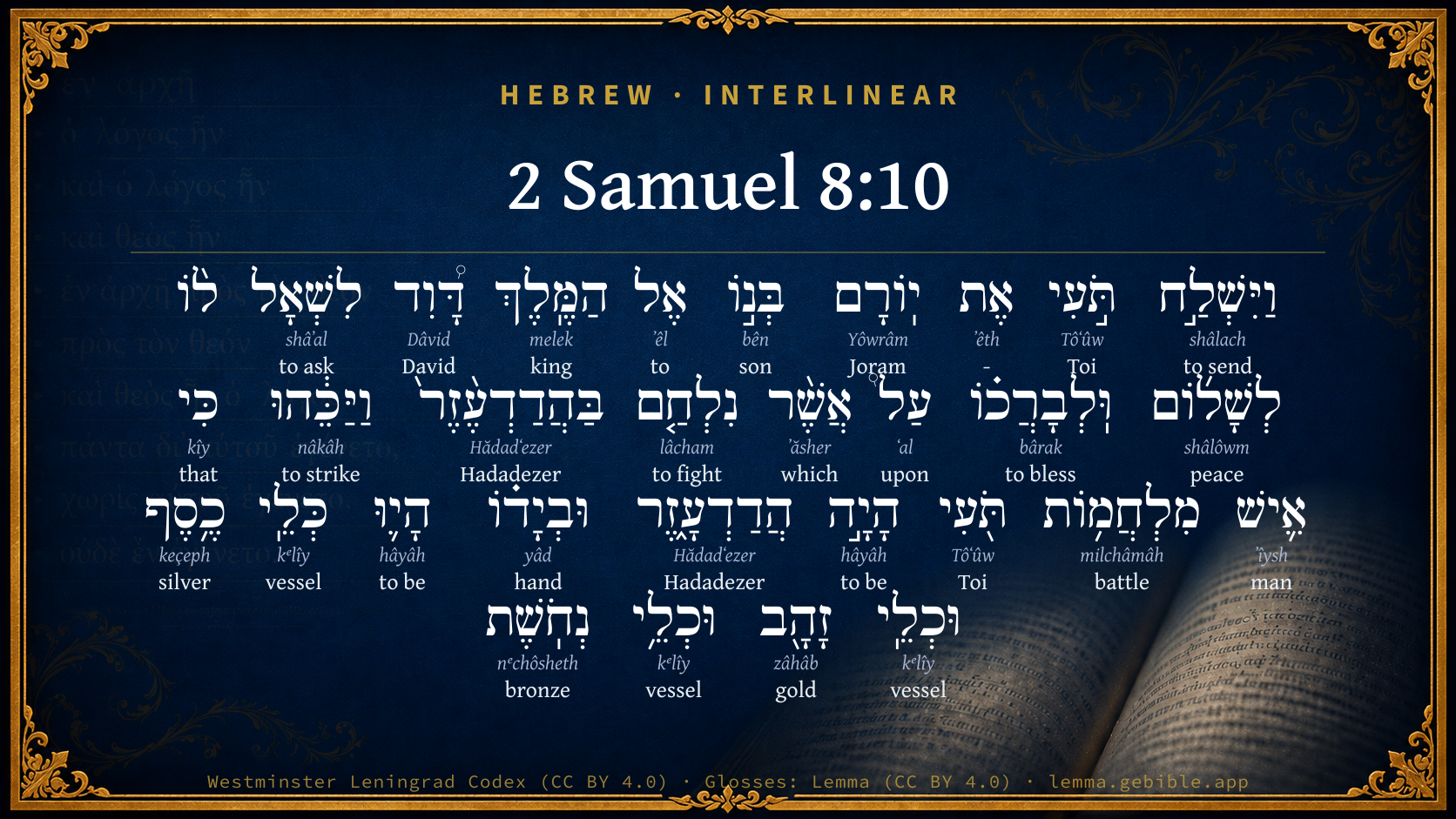
Hebrew (Westminster Leningrad Codex) 2 Samuel 8:10 appears in the Hebrew Old Testament. The text above is from the Westminster Leningrad Codex. Each word links to its Strong’s number, a concise gloss, and parsing drawn from the Open Scriptures Hebrew Bible morphology. Click any word for its full Brown-Driver-Briggs (BDB) entry.
Download image
Cite this verse

2 Samuel 8:10 (World English Bible). Public Domain. Lemma interlinear Bible study tool, https://lemma.gebible.app/v/2-samuel/8/10.

Show BibTeX & RIS
BibTeX
RIS
English Translation
then Toi sent Joram his son to king David, to Greet him, and to bless him, because he had fought against Hadadezer and struck him: for Hadadezer had wars with Toi. [Joram] brought with him vessels of silver, and vessels of gold, and vessels of brass:
World English Bible · Public Domain
Highlights
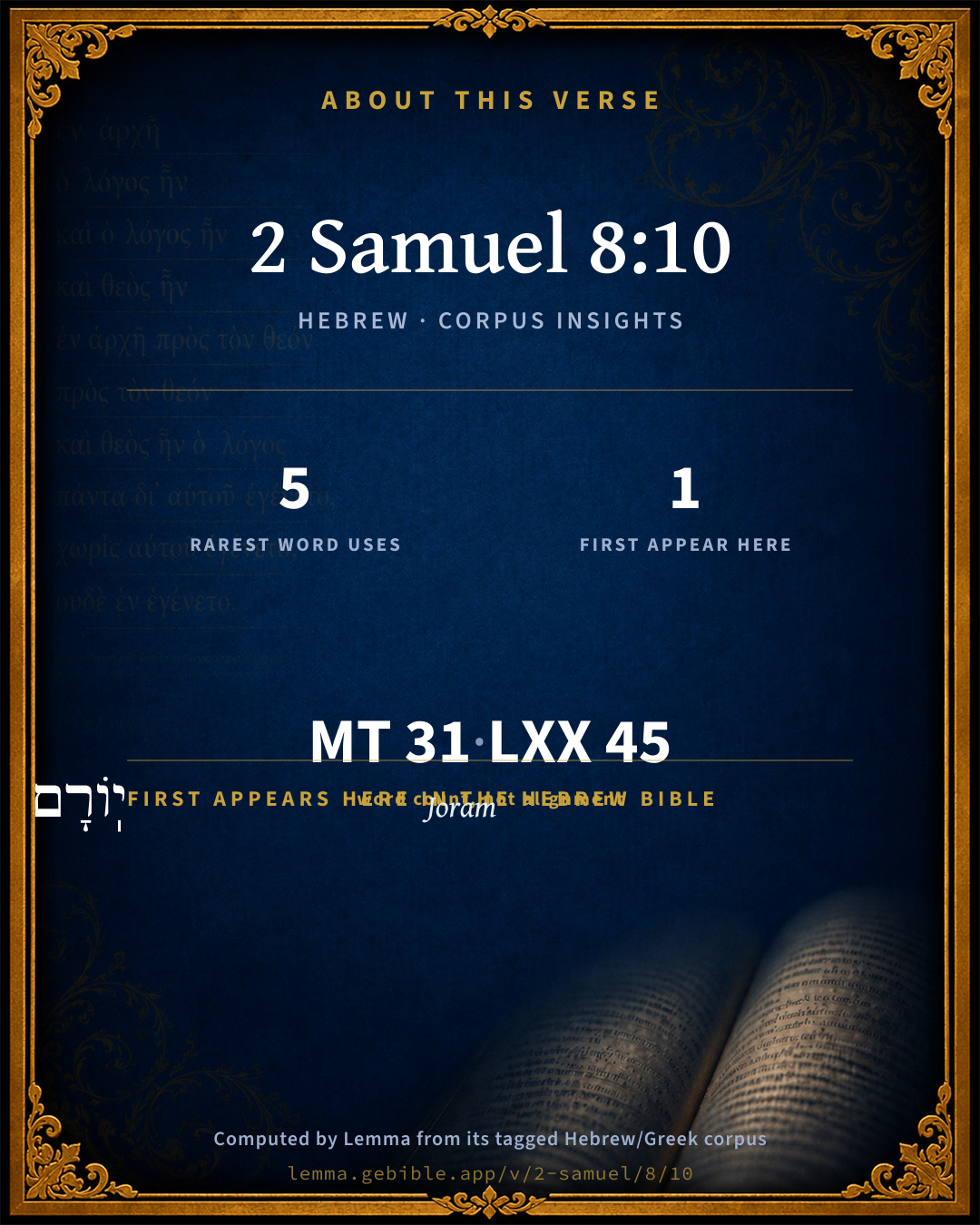
  • 1 first appearance in the Hebrew Bible
Full analysis ↓
Download a study sheet

One document with this verse’s original text, its word-by-word gloss line, the meaning frame, cross-references with their text, attributed commentary, and full source and license credits — printable, and it pastes into notes with its structure intact.

This verse Autodidact and up

Study sheet (.html) Plain text (.txt)

A passage Seminary Student

Up to 50 verses in one chapter. A passage sheet keeps up to 6 commentary sources and 12 cross-references per verse, in the order this page ranks them, and says so on the sheet whenever that leaves anything out. Ask for a single verse and you get the Autodidact verse sheet above.

Everything on this page stays free to read, with no account — the sheet is a download of what is already on screen, not access to it.

Want to remove ads? Support Godless Engineer
Compare translations 3

The same verse in 3 English versions, stacked beneath the original-language interlinear above. Click any original word for its lexicon entry.

Each is an independent rendering of the whole verse — the interlinear is not word-aligned to these translations.

Highlighted words mark where these versions differ — a whole-verse word diff, not a word-by-word alignment.

  • World English Bible Public Domain
    then Toi sent Joram his son to king David, to Greet him, and to bless him, because he had fought against Hadadezer and struck him: for Hadadezer had wars with Toi. [Joram] brought with him vessels of silver, and vessels of gold, and vessels of brass:
  • King James Version Public Domain
    Then Toi sent Joram his son unto king David, to salute him, and to bless him, because he had fought against Hadadezer, and smitten him: for Hadadezer had wars with Toi. And Joram brought with him vessels of silver, and vessels of gold, and vessels of brass:
  • unfoldingWord Literal Text CC BY-SA 4.0
    And Toi sent Joram his son to King David to ask about him regarding peace and to bless him because he had fought with Hadadezer and had struck him. For Hadadezer had been a man of war of Toi. And in his hand were vessels of silver and vessels of gold and vessels of bronze.

unfoldingWord Literal Text — © unfoldingWord, licensed CC BY-SA 4.0. Word-aligned USFM3 via Door43 (git.door43.org/unfoldingWord/en_ult).

Versions to compare (up to 4)

3 of 4 selected

Show all 18 translations

Every available English version of this verse, each an independent rendering of the whole verse.

  • World English Bible Public Domain
    then Toi sent Joram his son to king David, to Greet him, and to bless him, because he had fought against Hadadezer and struck him: for Hadadezer had wars with Toi. [Joram] brought with him vessels of silver, and vessels of gold, and vessels of brass:
  • Berean Standard Bible Public Domain
    he sent his son Joram to greet King David and bless him for fighting and defeating Hadadezer, who had been at war with Toi. Joram brought with him articles of silver and gold and bronze,
  • Majority Standard Bible Public Domain
    he sent his son Joram to greet King David and bless him for fighting and defeating Hadadezer, who had been at war with Toi. Joram brought with him articles of silver and gold and bronze,
  • King James Version Public Domain
    Then Toi sent Joram his son unto king David, to salute him, and to bless him, because he had fought against Hadadezer, and smitten him: for Hadadezer had wars with Toi. And Joram brought with him vessels of silver, and vessels of gold, and vessels of brass:
  • American Standard Version (1901) Public Domain
    then Toi sent Joram his son unto king David, to salute him, and to bless him, because he had fought against Hadadezer and smitten him: for Hadadezer had wars with Toi. And `Joram' brought with him vessels of silver, and vessels of gold, and vessels of brass:
  • Revised Version (1885) Public Domain
    then Toi sent Joram his son unto king David, to salute him, and to bless him, because he had fought against Hadadezer and smitten him: for Hadadezer had wars with Toi. And Joram brought with him vessels of silver, and vessels of gold, and vessels of brass:
  • Geneva Bible (1599) Public Domain
    Therefore Toi sent Ioram his sonne vnto King Dauid, to salute him, and to reioyce with him because he had fought against Hadadezer, and beaten him (for Hadadezer had warre with Toi) who brought with him vessels of siluer, and vessels of golde, and vessels of brasse.
  • Douay-Rheims (1899) Public Domain
    And Thou sent Joram his son to king David, to salute him, and to congratulate with him, and to return him thanks: because he had fought against Adarezer, and had defeated him. For Thou was an enemy to Adarezer, and in his hand were vessels of gold, and vessels of silver, and vessels of brass:
  • Young's Literal Translation Public Domain
    and Toi sendeth Joram his son unto king David to ask of him of welfare, and to bless him, (because that he hath fought against Hadadezer, and smiteth him, for a man of wars `with' Toi had Hadadezer been), and in his hand have been vessels of silver, and vessels of gold, and vessels of brass,
  • Literal Standard Version CC BY-SA 4.0
    and Toi sends his son Joram to King David to ask of him of welfare, and to bless him (because that he has fought against Hadadezer, and strikes him, for Hadadezer had been a man of wars [with] Toi), and in his hand have been vessels of silver, and vessels of gold, and vessels of bronze,
  • Unlocked Literal Bible CC BY-SA 4.0
    Tou sent Hadoram his son to King David to greet him and to bless him, because David had fought against Hadadezer and defeated him, and because Hadadezer had waged war against Tou. Hadoram brought with himself objects of silver, gold, and bronze.
  • unfoldingWord Literal Text CC BY-SA 4.0
    And Toi sent Joram his son to King David to ask about him regarding peace and to bless him because he had fought with Hadadezer and had struck him. For Hadadezer had been a man of war of Toi. And in his hand were vessels of silver and vessels of gold and vessels of bronze.
  • Darby Bible Public Domain
    and Toi sent Joram his son to king David, to inquire of his welfare, and to congratulate him, because he had fought against Hadadezer and smitten him; for Hadadezer was continually at war with Toi. And he brought with him vessels of silver, and vessels of gold, and vessels of bronze.
  • World Messianic Bible Public Domain
    then Toi sent Joram his son to King David to greet him and to bless him, because he had fought against Hadadezer and struck him; for Hadadezer had wars with Toi. Joram brought with him vessels of silver, vessels of gold, and vessels of bronze.
  • Webster's Bible Public Domain
    Then Toi sent Joram his son to king David, to salute him, and to bless him, because he had fought against Hadadezer, and smitten him: (for Hadadezer had wars with Toi) and Joram brought with him vessels of silver, and vessels of gold, and vessels of brass:
  • Free Bible Version CC BY-SA 4.0
    he sent his son Joram to David to make friends with him and to congratulate him on his victory in battle over Hadadezer. Tou and Hadadezer had often been at war. Joram brought all kinds of gifts of gold, silver, and bronze.
  • Bible in Basic English Public Domain
    He sent his son Hadoram to David, with words of peace and blessing, because he had overcome Hadadezer in the fight, for Hadadezer had wars with Tou; and Hadoram took with him vessels of silver and gold and brass:
  • JPS Tanakh (1917) Public Domain
    then Toi sent Joram his son unto king David, to salute him, and to bless him — because he had fought against Hadadezer and smitten him; for Hadadezer had wars with Toi — and he brought with him vessels of silver, and vessels of gold, and vessels of brass.

Literal Standard Version (2020), Covenant Press — licensed CC BY-SA 4.0. Text via the HelloAO Bible API (eBible.org). Unlocked Literal Bible (unfoldingWord) — licensed CC BY-SA 4.0. Text via the HelloAO Bible API (eBible.org). unfoldingWord Literal Text — © unfoldingWord, licensed CC BY-SA 4.0. Word-aligned USFM3 via Door43 (git.door43.org/unfoldingWord/en_ult). Free Bible Version, Dr. Jonathan Gallagher — licensed CC BY-SA 4.0. Text via the HelloAO Bible API (eBible.org).

Word by word

More ways to search: Search by grammar → Find every occurrence → Compare this word →

Practice this passage: Drill this verse → Learn its vocabulary →

תֹּ֣עִי
Tôʻûw
H8583
“Toi”
Noun, Proper
Part of Speech
Noun
Type
Proper
Full BDB Definition

Origin: from H8582

TWOT: None

Toi or Tou = "wander" - king of Hamath in the time of David
  1. וַיִּשְׁלַ֣ח shâlach H7971 “and · to send” Conjunction + Verb, Qal, Sequential Imperfect, 3rd Person, Masculine, Singular
  2. אֶת ʼêth H853 “-” Particle, Direct Object
  3. יֽוֹרָם Yôwrâm H3141 “Joram” Noun, Proper
  4. בְּנ֣וֹ bên H1121 “son · his” Noun, Common, Masculine, Singular, Construct + Suffix, Personal, 3rd Person, Masculine, Singular
  5. אֶל ʼêl H413 “to” Preposition
  6. הַמֶּֽלֶךְ melek H4428 “the · king” Particle, Definite Article + Noun, Common, Masculine, Singular, Absolute
  7. דָּ֠וִד Dâvid H1732 “David” Noun, Proper
  8. לִשְׁאָל shâʼal H7592 “to ask” Preposition + Verb, Qal, Infinitive Construct
  9. לְשָׁל֜וֹם shâlôwm H7965 “to/for · peace” Preposition + Noun, Common, Masculine, Singular, Absolute
  10. וּֽלְבָרֲכ֗וֹ bârak H1288 “and · to bless · him” Conjunction + Preposition + Verb, Piel, Infinitive Construct + Suffix, Personal, 3rd Person, Masculine, Singular
  11. עַל֩ ʻal H5921 “upon” Preposition
  12. אֲשֶׁ֨ר ʼăsher H834 “which” Particle, Relative
  13. נִלְחַ֤ם lâcham H3898 “to fight” Verb, Niphal, Perfect, 3rd Person, Masculine, Singular
  14. בַּהֲדַדְעֶ֨זֶר֙ Hădadʻezer H1909 “in/at · Hadadezer” Preposition + Noun, Proper
  15. וַיַּכֵּ֔הוּ nâkâh H5221 “and · to strike · him” Conjunction + Verb, Hiphil, Sequential Imperfect, 3rd Person, Masculine, Singular + Suffix, Personal, 3rd Person, Masculine, Singular
  16. כִּי kîy H3588 “that” Conjunction
  17. אִ֛ישׁ ʼîysh H376 “man of” Noun, Common, Masculine, Singular, Construct
  18. מִלְחֲמ֥וֹת milchâmâh H4421 “battles of” Noun, Common, Feminine, Plural, Construct
  19. תֹּ֖עִי Tôʻûw H8583 “Toi” Noun, Proper
  20. הָיָ֣ה hâyâh H1961 “to be” Verb, Qal, Perfect, 3rd Person, Masculine, Singular
  21. הֲדַדְעָ֑זֶר Hădadʻezer H1909 “Hadadezer” Noun, Proper
  22. וּבְיָד֗וֹ yâd H3027 “and · in/at · hand · his” Conjunction + Preposition + Noun, Common, Both, Singular, Construct + Suffix, Personal, 3rd Person, Masculine, Singular
  23. הָי֛וּ hâyâh H1961 “to be” Verb, Qal, Perfect, 3rd Person, Common, Plural
  24. כְּלֵֽי kᵉlîy H3627 “vessels of” Noun, Common, Masculine, Plural, Construct
  25. כֶ֥סֶף keçeph H3701 “silver” Noun, Common, Masculine, Singular, Absolute
  26. וּכְלֵֽי kᵉlîy H3627 “and · vessels of” Conjunction + Noun, Common, Masculine, Plural, Construct
  27. זָהָ֖ב zâhâb H2091 “gold” Noun, Common, Masculine, Singular, Absolute
  28. וּכְלֵ֥י kᵉlîy H3627 “and · vessels of” Conjunction + Noun, Common, Masculine, Plural, Construct
  29. נְחֹֽשֶׁת nᵉchôsheth H5178 “bronze” Noun, Common, Feminine, Singular, Absolute

About this verse

These counts appear in no published source. They are computed here, from the morphology-tagged text and Lemma’s own curated glosses. What Lemma adds →

31
words
25
distinct lemmas
Historical
section

Notable vocabulary

The rarest word here is תֹּ֣עִי Toi H8583 — appearing just 5 times in the whole Hebrew Bible.

First appearance in Scripture

This word makes its first canonical appearance in the Hebrew Bible here:

  • יֽוֹרָם Joram H3141

Shared distinctive vocabulary

תֹּ֣עִי Toi H8583 occurs in 4 verses of the Hebrew Bible. Also found in:

Grammatical profile

  • 7 verbs
  • 18 nouns
  • 3 prepositions
  • 1 conjunction
  • 2 particles

Verb forms

  • וַיִּשְׁלַ֣ח Qal · Sequential Imperfect
  • לִשְׁאָל Qal · Infinitive Construct
  • וּֽלְבָרֲכ֗וֹ Piel · Infinitive Construct
  • נִלְחַ֤ם Niphal · Perfect
  • וַיַּכֵּ֔הוּ Hiphil · Sequential Imperfect
  • הָיָ֣ה Qal · Perfect
  • הָי֛וּ Qal · Perfect

Repetition

Words recur within this verse — often emphatic in Hebrew:

  • כְּלֵֽי vessel H3627 ×3
  • תֹּ֣עִי Toi H8583 ×2
  • בַּהֲדַדְעֶ֨זֶר֙ Hadadezer H1909 ×2
  • הָיָ֣ה to be H1961 ×2

Hebrew & Septuagint length

In English translation the verse runs 46 words from the Hebrew and 50 from the Septuagint (LXX English) — closely comparable.

A rough comparison of the two English renderings, which tokenize alike — not a word-level alignment.

Word counts can differ between the Hebrew and the Greek without any difference in meaning — e.g. the Hebrew direct-object marker אֵת has no separate Greek word, and Greek often adds the article ὁ.

In the original languages it is 31 Hebrew tokens and 45 Greek tokens — but the two are counted differently (Hebrew bundles its prefixes and suffixes into one token; the Greek is in lemma form), so that isn’t a like-for-like length.

Cross-references

6

Topical passages linked to 2 Samuel 8:10 in the Treasury of Scripture Knowledge — connected by theme and wording, ordered by reader-vote popularity; previews shown in the World English Bible.

  • 1 Samuel 13:10 It came to pass that as soon as he had made an end of offering the burnt offering, behold, Samuel came; and Saul went out to meet him, that he might greet him.
  • 1 Chronicles 18:10 he sent Hadoram his son to king David, to Greet him, and to bless him, because he had fought against Hadarezer and struck him; (for Hadarezer had wars with Tou;) and [he had with him] all manner of vessels of gold and silver and brass.
  • Psalms 129:8 Neither do those who go by say, "The blessing of Yahweh be on you. We bless you in the name of Yahweh."
  • Genesis 43:27 He asked them of their welfare, and said, "Is your father well, the old man of whom you spoke? Is he yet alive?"
  • 1 Kings 1:47 Moreover the king's servants came to bless our lord king David, saying, Your God make the name of Solomon better than your name, and make his throne greater than your throne: and the king bowed himself on the bed.
  • Isaiah 39:1 At that time Merodach Baladan the son of Baladan, king of Babylon, sent letters and a present to Hezekiah; for he heard that he had been sick, and was recovered.

Cross-references courtesy of OpenBible.info (CC BY 4.0).

Hebrew and Greek witnesses Masoretic Hebrew ↔ Greek Septuagint

The same verse in the two great witnesses to the Old Testament, shown verse-for-verse.

These are two independent witnesses, not word-aligned to each other, and the Septuagint is shown in lemma (dictionary) form.

Hebrew 2 Samuel 8:10 Masoretic · Westminster Leningrad Codex

וַיִּשְׁלַ֣ח תֹּ֣עִי אֶת יֽוֹרָם בְּנ֣וֹ אֶל הַמֶּֽלֶךְ דָּ֠וִד לִשְׁאָל ל֨וֹ לְשָׁל֜וֹם וּֽלְבָרֲכ֗וֹ עַל֩ אֲשֶׁ֨ר נִלְחַ֤ם בַּהֲדַדְעֶ֨זֶר֙ וַיַּכֵּ֔הוּ כִּי אִ֛ישׁ מִלְחֲמ֥וֹת תֹּ֖עִי הָיָ֣ה הֲדַדְעָ֑זֶר וּבְיָד֗וֹ הָי֛וּ כְּלֵֽי כֶ֥סֶף וּכְלֵֽי זָהָ֖ב וּכְלֵ֥י נְחֹֽשֶׁת

then Toi sent Joram his son to king David, to Greet him, and to bless him, because he had fought against Hadadezer and struck him: for Hadadezer had wars with Toi. [Joram] brought with him vessels of silver, and vessels of gold, and vessels of brass:

World English Bible · Public Domain

Greek LXX 2 Samuel 8:10 Septuagint · lemma form

καί ἀποστέλλω θοου ιεδδουραν ὁ υἱός αὐτός πρός βασιλεύς δαυίδ ἐρωτάω αὐτός ὁ εἰς εἰρήνη καί εὐλογέω αὐτός ὑπέρ ὅς πολεμέω ὁ αδρααζαρ καί πατάσσω αὐτός ὅτι ἀντικεῖμαι εἰμί ὁ αδρααζαρ καί ἐν ὁ χείρ αὐτός εἰμί σκεῦος ἀργυροῦς καί σκεῦος χρυσοῦς καί σκεῦος χαλκοῦς

And You sent Jedduram his son to king David, to ask him of his welfare, and to congratulate him on his fighting against Adraazar and striking him, for he was an enemy to Adraazar: and in his hands were vessels of silver, and vessels of gold, and vessels of brass.

LXX2012 (modern English Septuagint) · Public Domain

Hebrew: Westminster Leningrad Codex (CC BY 4.0). Greek: Septuagint (public domain); English from LXX2012 (modern English Septuagint) (Public Domain). How the Septuagint differs from the Hebrew →

Targum (Aramaic paraphrase)

1

The Targum is the ancient Jewish Aramaic paraphrase of the Hebrew Scriptures — an interpretive translation, not the Hebrew text itself. Onkelos (literal) and Pseudo-Jonathan (expansive) render the Torah, and Jonathan the Prophets. Coverage is partial: where no permissively-licensed English translation exists for a verse, only the Aramaic is shown. This is verse-level text, not a word-by-word alignment to the Hebrew.

  1. Targum Jonathan Prophets (Joshua–Malachi)
    וּשְׁלַח תּוֹעִי יַת יוֹרָם בְּרֵיהּ לְוַת מַלְכָּא דָוִד לְמִשְׁאַל לֵיהּ לִשְׁלָם וּלְבָרְכוּתֵיהּ עַל דְאַגִיחַ קְרָבָא בַּהֲדַדְעֶזֶר וְקַטְלֵיהּ אֲרֵי גְבַר עָבֵיד קְרָבִין עִם תּוֹעִי הֲוָה הֲדַדְעֶזֶר וְעִמֵיהּ הֲווֹ מָנֵי כַסְפָּא וּמָנֵי דַהֲבָא וּמָנֵי נְחָשָׁא:

    (no public-domain English translation for this verse)

    Targum Jonathan — Aramaic: “Mikraot Gedolot” (public domain). English: “Sefaria Community Translation” (CC0 1.0 (public-domain dedication)); “London "Chaldee Paraphrase," 1871” (public domain). Text via Sefaria.

Commentary

Notes on 2 Samuel 8:10 from classic Christian and Jewish commentators (each source and its license shown beneath its notes). The classic Christian expositions comment on the surrounding passage and are grouped to its opening verse, so a note may address several verses; the Jewish commentaries on the Tanakh (Rashi and others) are per-verse, so they appear only where the commentator wrote on this verse.

Lemma curates 59 commentaries, every one of them public domain or Creative Commons licensed, each selected and text-cleaned for this edition rather than reprinted as found. About our sources →

Trapp's Complete Commentary

John Trapp

2Sa 8:10 Then Toi sent Joram his son unto king David, to salute him, and to bless him, because he had fought against Hadadezer, and smitten him: for Hadadezer had wars with Toi. And [Joram] brought with him vessels of silver, and vessels of gold, and vessels of brass:

Ver. 10. Then Toi sent Joram his son:] So true is that of Solomon, "Many are the lovers of the rich and prosperous: whenas the poor is hated even of his own neighbour," {Pro 14:20} as David had been whilst in a low condition.

Had wars with Toi.] Heb., Was a man of wars with him. {a} A quarrelsome man is like a cock of the game, that is still bloody with the blood of others, and himself.

{a} Perpetuis bellis cum infestabat neque sinebat ab eis quiescere. - Jun.

John Trapp, A Commentary or Exposition upon All the Books of the Old and New Testament (1647–1656) — public domain. Text from a community e-Sword module.

Tyndale Open Study Notes

Tyndale Open Resources

8:10 his son: King Toi dispatched the crown prince rather than another entourage on this mission because he considered it vital to stay properly connected with David. • Joram: The prefix Jo- is an abbreviated form of Yahweh; Joram means “Yahweh is exalted.” In 1 Chr 18:10 the prince’s name is Hadoram, which means “Hadad [a Canaanite god] is exalted.” It is possible that Toi changed the prince’s name for diplomatic reasons, to make it more agreeable to David.

Tyndale Open Study Notes — © Tyndale Open Resources, licensed CC BY-SA 4.0. Text via the HelloAO Bible API.

Geneva Bible (1599)

Geneva Bible translators

For seeing David victorious, he was glad to entreat of peace.

Hebrew, to ask peace.

Hebrew, bless him.

Hebrew, in his hand.

Geneva Bible (1599) marginal notes — public domain. Text via Bolls.life.

Jamieson, Fausset & Brown

Robert Jamieson, A. R. Fausset & David Brown

Joram--or Hadoram (Ch1 18:10).

Jamieson, Fausset & Brown — Commentary Critical and Explanatory on the Whole Bible (1871) — public domain (CC PDM 1.0). Text via the HelloAO Bible API.

Ellicott's Commentary for English Readers

(10) Joram=Hadoram, 1Ch_18:10. Joram is probably the Jewish form of the same name. An embassy headed by the king’s son was an especially honourable one. The occasion was David’s conquest of Toi’s neighbour and constant enemy, and the large presents sent by him have something of the character of tribute. The phrase “to bless him,” is simply equivalent to “congratulate him,” by which the same word is translated in 1Ch_18:10.

A Bible Commentary for English Readers, edited by Charles John Ellicott (1878–1897) — public domain. Text from a community e-Sword module.

The Cambridge Bible for Schools and Colleges

gen. ed. J. J. S. Perowne

10. Joram] Hadoram, the name given in Chr., is probably the true reading, for which the Hebrew name Joram has been substituted by a scribe’s error.

to bless him] To congratulate him, as in Chr. The phrase there translated “to inquire of his welfare” is identical with that rendered “to salute” here.

Hadadezer had wars with Toi] Lit. “a man of wars of Toi was Hadadezer.” A man of wars = one who wages wars. Cp. 1Ch_28:3.

Joram brought, &c.] A valuable present, intended to secure the goodwill of his powerful neighbour. Cp. 1Ki_15:18.

The Cambridge Bible for Schools and Colleges (gen. ed. J. J. S. Perowne; Cambridge University Press, 1878–1918) — public domain. Text from a community e-Sword module.

John Gill's Exposition

Then Toi sent Joram his son unto King David,.... Who is called Hadoram in Ch1 18:10; though the Syriac and Arabic versions read Joram there:

to salute him: to inquire of his welfare after his fatigue in the battles he had had with the Moabites and Syrians, and to wish him all happiness and prosperity for the future:

and to bless him; to congratulate him on his victory, and to wish him success in all after wars he might be engaged in; and particularly to give him thanks for delivering him from so great an enemy as Hadadezer had been to him, as also to bring a present to him, which is sometimes called a blessing; see Gen 33:11,

because he had fought against Hadadezer, and smitten him; that is, David had, which had endeared him to Toi:

for Hadadezer had wars with Toi; was an enemy of his, sought to take his kingdom from him, and had had many battles with him: and though he could not conquer him, he sadly harassed him, being too mighty for him:

and Joram brought with him vessels of silver, and vessels of gold,

and vessels of brass; as a present to David, in gratitude for his deliverance from his enemy by him, and as a token of his homage and subjection to him; at least as a sign that he put himself under his protection, and desired to be his friend and ally. The word "Joram", though not in the Hebrew text, is rightly supplied; for none else can be supposed to bring the present.

John Gill's Exposition of the Whole Bible (1746–1763) — public domain (CC PDM 1.0). Text via the HelloAO Bible API.

Albert Barnes' Notes on the Bible

Joram - Or, more probably, Hadoram. See the margin.

Albert Barnes' Notes on the Bible (1834–1885) — public domain. Text from a community e-Sword/MySword module.

Haydock's Catholic Bible Commentary

Joram, called Adoram in Chronicles. (Calmet) --- His, Joram’s hand. (Menochius)

George Leo Haydock (1774–1849), Haydock's Catholic Family Bible and Commentary, 1859 edition — public domain. Excludes Psalms (Douay-Rheims chapter numbering differs from Protestant) and Deuterocanonical books (Catholic canon only).

Matthew Poole's English Annotations

Toi sent Joram: here also the names differ from 1Ch 18:9,10, where it is Tou and Hadoram.

Had wars, Heb. was a man of wars, i.e. was exercised with continual wars. Compare Gen 9:20, &c.

Matthew Poole's English Annotations on the Holy Bible (1683–1685) — public domain. Text from a community e-Sword/MySword module.

The Pulpit Commentary

Joram. In 1Ch_18:10 he is called Hadoram, and this was apparently his real name, Joram being merely the substitution of the nearest Hebrew word for something foreign and therefore unintelligible. So among the descendants of the French refugees settled in England similar changes are common. Thus Pillons becomes Pillow; Chevallier, Shoveller; St. Amour, Stammers. As Hamath bordered upon Zobah, and apparently had waged unsuccessful war with the vigorous Hadarezer, Tel was grateful to David for smiting his rival, and sent this embassy of congratulation for the purpose of ensuring the conqueror"s friendship. For this end he also sent rich presents; and as a present is called in the Hebrew a blessing, (1Sa_25:27 1Sa_30:26, margin) the phrase used here, to bless him, contains the idea, not only of congratulation, but of offerings. There is something admirable in this high Oriental courtesy. The material value of the gifts is left in the background. Their worth lies in their being the acknowledgment of the Divine favour resting upon David, and in the prayer that that favour may continue. In Psa_18:43, 44 we have proof of the great pleasure which this embassy from so great a nation gave to David.

The Pulpit Commentary (1880–1919), ed. H.D.M. Spence-Jones & Joseph S. Exell — public domain. Text from a community e-Sword module.

Lesson kit

Teaching starters — assembled from the data on this page, not authored interpretation. Every prompt links to the verse data it draws on. Edit before teaching.

2 Samuel, in the Historical, opens this verse with 31 words (25 distinct Hebrew lemmas). Its most distinctive word is Tôʻûw (“Toi”). A historical commentator’s framing appears above. Read the whole chapter for the surrounding context.

Discussion questions

  1. The word Tôʻûw carries the sense “Toi.” How does it shape the verse?
  2. The word “Joram” first appears here in Scripture. What is being introduced at this debut?
  3. 2 Samuel 8:9 shares the word «Toi» with this verse. How do the two illuminate each other?
  4. “vessel” occurs 3× in this one verse. What is the effect of the repetition?
  5. These translations render this verse differently; the difference is in the English rendering, not the original. What questions does that raise?
  6. The verb «וַיִּשְׁלַ֣ח» is Qal Sequential Imperfect. How does its form color the action?
  7. Reading how Trapp's Complete Commentary and Tyndale Open Study Notes read this verse, where do the two commentators agree and where do they part?

Things to notice

Reading settings

Reading text

Shown beneath each verse's original-language words.

Old Testament
Old Testament edition

Read the OT as the Masoretic Hebrew (MT) or the Greek Septuagint (LXX).

English shown for the Greek Septuagint (in the Hebrew ↔ Greek comparison).

Comparing translations? Open the Compare panel on any verse page to stack up to four side by side.