
Deuteronomy 16:10

Hebrew (Westminster Leningrad Codex) Deuteronomy 16:10 appears in the Hebrew Old Testament. The text above is from the Westminster Leningrad Codex. Each word links to its Strong’s number, a concise gloss, and parsing drawn from the Open Scriptures Hebrew Bible morphology. Click any word for its full Brown-Driver-Briggs (BDB) entry.
Download image
Cite this verse

Deuteronomy 16:10 (World English Bible). Public Domain. Lemma interlinear Bible study tool, https://lemma.gebible.app/v/deuteronomy/16/10.

Show BibTeX & RIS
BibTeX
RIS
English Translation
You shall keep the feast of weeks to Yahweh your God with a tribute of a freewill-offering of your hand, which you shall give, according as Yahweh your God blesses you:
World English Bible · Public Domain
Highlights
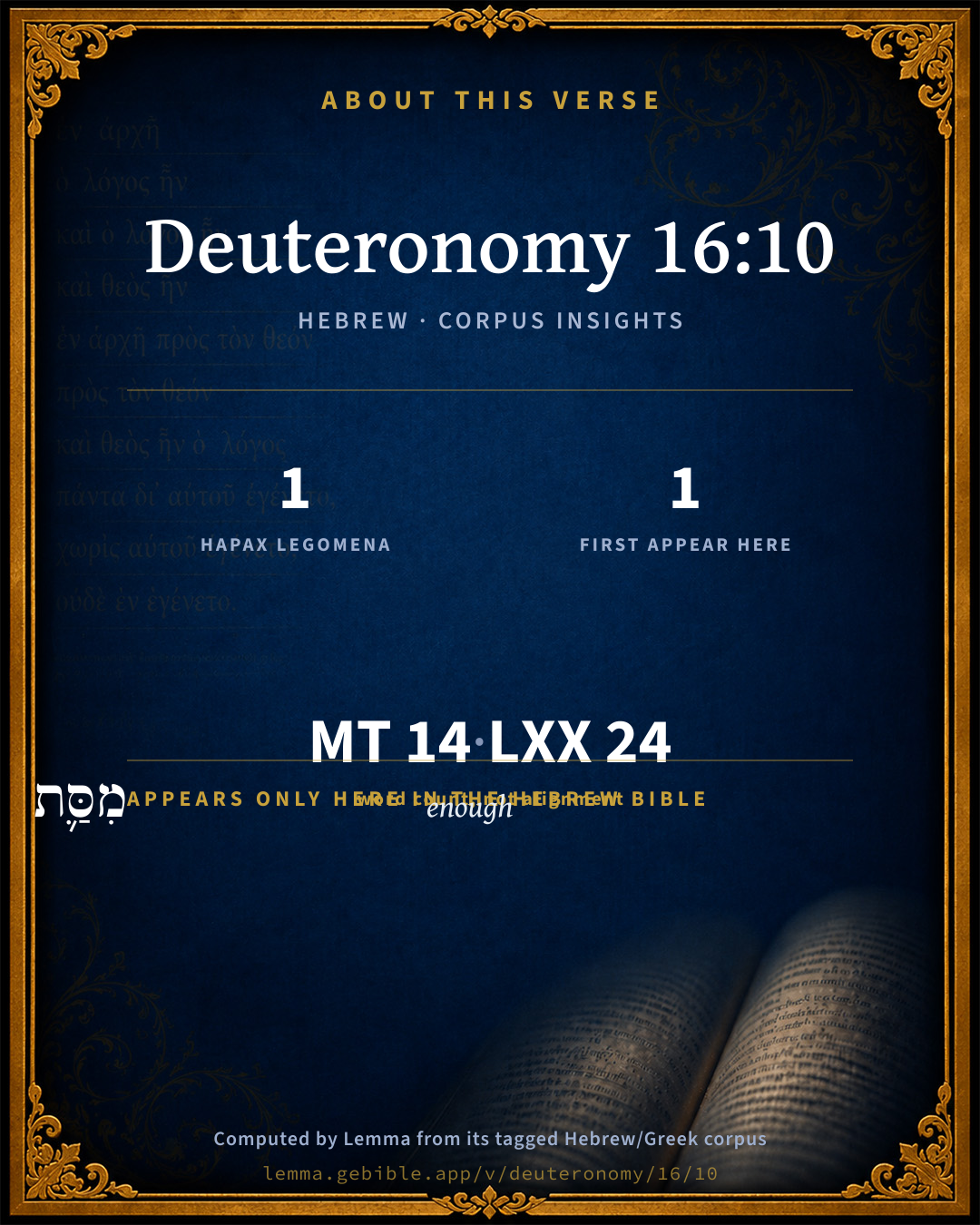
  • 1 hapax legomenon — only here in the Hebrew Bible
  • 1 first appearance in the Hebrew Bible
Full analysis ↓
Download a study sheet

One document with this verse’s original text, its word-by-word gloss line, the meaning frame, cross-references with their text, attributed commentary, and full source and license credits — printable, and it pastes into notes with its structure intact.

This verse Autodidact and up

Study sheet (.html) Plain text (.txt)

A passage Seminary Student

Up to 50 verses in one chapter. A passage sheet keeps up to 6 commentary sources and 12 cross-references per verse, in the order this page ranks them, and says so on the sheet whenever that leaves anything out. Ask for a single verse and you get the Autodidact verse sheet above.

Everything on this page stays free to read, with no account — the sheet is a download of what is already on screen, not access to it.

Want to remove ads? Support Godless Engineer
Compare translations 3

The same verse in 3 English versions, stacked beneath the original-language interlinear above. Click any original word for its lexicon entry.

Each is an independent rendering of the whole verse — the interlinear is not word-aligned to these translations.

Highlighted words mark where these versions differ — a whole-verse word diff, not a word-by-word alignment.

  • World English Bible Public Domain
    You shall keep the feast of weeks to Yahweh your God with a tribute of a freewill-offering of your hand, which you shall give, according as Yahweh your God blesses you:
  • King James Version Public Domain
    And thou shalt keep the feast of weeks unto the LORD thy God with a tribute of a freewill offering of thine hand, which thou shalt give unto the LORD thy God, according as the LORD thy God hath blessed thee:
  • unfoldingWord Literal Text CC BY-SA 4.0
    And you shall make the Festival of Weeks for Yahweh your God the contribution of a freewill offering of your hand that you shall give, as Yahweh your God has blessed you.

unfoldingWord Literal Text — © unfoldingWord, licensed CC BY-SA 4.0. Word-aligned USFM3 via Door43 (git.door43.org/unfoldingWord/en_ult).

Versions to compare (up to 4)

3 of 4 selected

Show all 18 translations

Every available English version of this verse, each an independent rendering of the whole verse.

  • World English Bible Public Domain
    You shall keep the feast of weeks to Yahweh your God with a tribute of a freewill-offering of your hand, which you shall give, according as Yahweh your God blesses you:
  • Berean Standard Bible Public Domain
    And you shall celebrate the Feast of Weeks to the LORD your God with a freewill offering that you give in proportion to how the LORD your God has blessed you,
  • Majority Standard Bible Public Domain
    And you shall celebrate the Feast of Weeks to the LORD your God with a freewill offering that you give in proportion to how the LORD your God has blessed you,
  • King James Version Public Domain
    And thou shalt keep the feast of weeks unto the LORD thy God with a tribute of a freewill offering of thine hand, which thou shalt give unto the LORD thy God, according as the LORD thy God hath blessed thee:
  • American Standard Version (1901) Public Domain
    And thou shalt keep the feast of weeks unto Jehovah thy God with a tribute of a freewill-offering of thy hand, which thou shalt give, according as Jehovah thy God blesseth thee:
  • Revised Version (1885) Public Domain
    And thou shalt keep the feast of weeks unto the LORD thy God with a tribute of a freewill offering of thine hand, which thou shalt give, according as the LORD thy God blesseth thee:
  • Geneva Bible (1599) Public Domain
    And thou shalt keepe the feast of weekes vnto the Lord thy God, euen a free gift of thine hand, which thou shalt giue vnto the Lord thy God, as the Lord thy God hath blessed thee.
  • Douay-Rheims (1899) Public Domain
    And thou shalt celebrate the festival of weeks to the Lord thy God, a voluntary oblation of thy hand, which thou shalt offer according to the blessing of the Lord thy God.
  • Young's Literal Translation Public Domain
    and thou hast made the feast of weeks to Jehovah thy God, a tribute of a free-will offering of thy hand, which thou dost give, as Jehovah thy God doth bless thee.
  • Literal Standard Version CC BY-SA 4.0
    and you have observed the Celebration of Weeks to your God YHWH, a tribute of a free-will offering of your hand, which you give as your God YHWH blesses you.
  • Unlocked Literal Bible CC BY-SA 4.0
    You must keep the Festival of Weeks for Yahweh your God with the contribution of a freewill offering from your hand that you will give, according as Yahweh your God has blessed you.
  • unfoldingWord Literal Text CC BY-SA 4.0
    And you shall make the Festival of Weeks for Yahweh your God the contribution of a freewill offering of your hand that you shall give, as Yahweh your God has blessed you.
  • Darby Bible Public Domain
    And thou shalt hold the feast of weeks to Jehovah thy God with a tribute of a voluntary-offering of thy hand, which thou shalt give, according as Jehovah thy God hath blessed thee;
  • World Messianic Bible Public Domain
    You shall keep the feast of weeks to the LORD your God with a tribute of a free will offering of your hand, which you shall give according to how the LORD your God blesses you.
  • Webster's Bible Public Domain
    And thou shalt keep the feast of weeks to the LORD thy God with a tribute of a free-will-offering of thy hand, which thou shalt give to the LORD thy God, according as the LORD thy God hath blessed thee:
  • Free Bible Version CC BY-SA 4.0
    Then celebrate the Festival of Weeks to honor the Lord your God by giving him a freewill offering, depending on just how much the Lord your God has blessed you.
  • Bible in Basic English Public Domain
    Then keep the feast of weeks to the Lord your God, with an offering freely given to him from the wealth he has given you:
  • JPS Tanakh (1917) Public Domain
    And thou shalt keep the feast of weeks unto the LORD thy God after the measure of the freewill-offering of thy hand, which thou shalt give, according as the LORD thy God blesseth thee.

Literal Standard Version (2020), Covenant Press — licensed CC BY-SA 4.0. Text via the HelloAO Bible API (eBible.org). Unlocked Literal Bible (unfoldingWord) — licensed CC BY-SA 4.0. Text via the HelloAO Bible API (eBible.org). unfoldingWord Literal Text — © unfoldingWord, licensed CC BY-SA 4.0. Word-aligned USFM3 via Door43 (git.door43.org/unfoldingWord/en_ult). Free Bible Version, Dr. Jonathan Gallagher — licensed CC BY-SA 4.0. Text via the HelloAO Bible API (eBible.org).

Word by word

More ways to search: Search by grammar → Find every occurrence → Compare this word →

Practice this passage: Drill this verse → Learn its vocabulary →

מִסַּ֛ת
miççâh
H4530
“enough of”
Noun, Common, Feminine, Singular, Construct
Part of Speech
Noun
Type
Common
Gender
Feminine
Number
Singular
State
Construct
Full BDB Definition

Origin: from H4549 (in the sense of flowing)

TWOT: 1225

sufficient, sufficiency - sufficiency, enough - full amount or proportion (affordable)
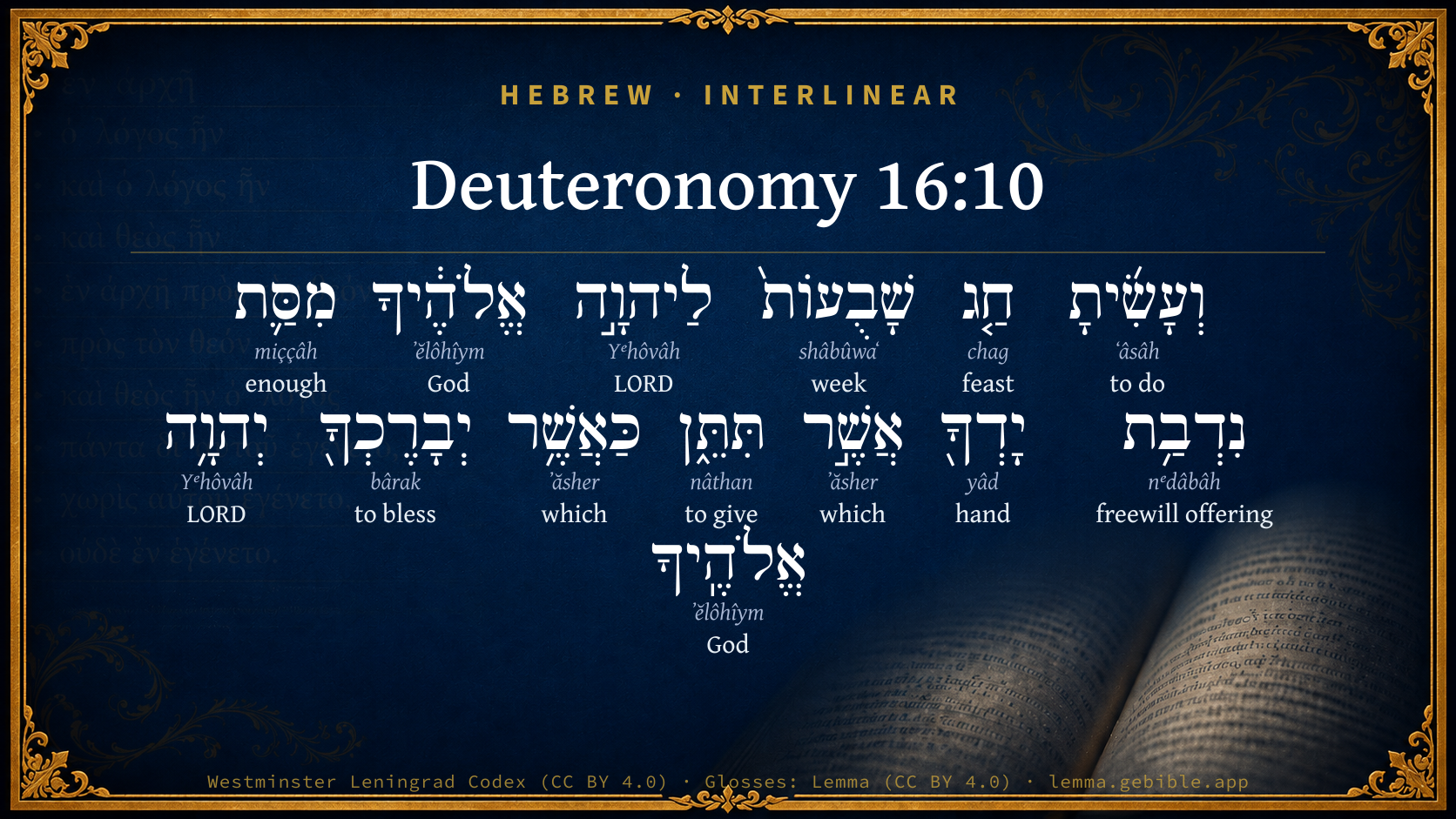
  1. וְעָשִׂ֜יתָ ʻâsâh H6213 “and · to do” Conjunction + Verb, Qal, Sequential Perfect, 2nd Person, Masculine, Singular
  2. חַ֤ג chag H2282 “feast of” Noun, Common, Masculine, Singular, Construct
  3. שָׁבֻעוֹת֙ shâbûwaʻ H7620 “weeks” Noun, Common, Masculine, Plural, Absolute
  4. לַיהוָ֣ה Yᵉhôvâh H3068 “to/for · LORD” Preposition + Noun, Proper
  5. אֱלֹהֶ֔יךָ ʼĕlôhîym H430 “God(s) · your” Noun, Common, Masculine, Plural, Construct + Suffix, Personal, 2nd Person, Masculine, Singular
  6. נִדְבַ֥ת nᵉdâbâh H5071 “freewill offering of” Noun, Common, Feminine, Singular, Construct
  7. יָדְךָ֖ yâd H3027 “hand · your” Noun, Common, Both, Singular, Construct + Suffix, Personal, 2nd Person, Masculine, Singular
  8. אֲשֶׁ֣ר ʼăsher H834 “which” Particle, Relative
  9. תִּתֵּ֑ן nâthan H5414 “to give” Verb, Qal, Imperfect, 2nd Person, Masculine, Singular
  10. כַּאֲשֶׁ֥ר ʼăsher H834 “like/as · which” Preposition + Particle, Relative
  11. יְבָרֶכְךָ֖ bârak H1288 “to bless · you” Verb, Piel, Imperfect, 3rd Person, Masculine, Singular + Suffix, Personal, 2nd Person, Masculine, Singular
  12. יְהוָ֥ה Yᵉhôvâh H3068 “LORD” Noun, Proper
  13. אֱלֹהֶֽיךָ ʼĕlôhîym H430 “God(s) · your” Noun, Common, Masculine, Plural, Construct + Suffix, Personal, 2nd Person, Masculine, Singular

About this verse

These counts appear in no published source. They are computed here, from the morphology-tagged text and Lemma’s own curated glosses. What Lemma adds →

14
words
11
distinct lemmas
Pentateuch
section

Notable vocabulary

1 hapax legomenon — a word that appears only here in the entire Hebrew Bible:

  • מִסַּ֛ת enough H4530

First appearance in Scripture

This word makes its first canonical appearance in the Hebrew Bible here:

  • מִסַּ֛ת enough H4530

Shared distinctive vocabulary

שָׁבֻעוֹת֙ week H7620 occurs in 17 verses of the Hebrew Bible. Also found in:

Grammatical profile

  • 3 verbs
  • 9 nouns
  • 2 particles

Verb forms

  • וְעָשִׂ֜יתָ Qal · Sequential Perfect
  • תִּתֵּ֑ן Qal · Imperfect
  • יְבָרֶכְךָ֖ Piel · Imperfect

Repetition

Words recur within this verse — often emphatic in Hebrew:

  • לַיהוָ֣ה LORD H3068 ×2
  • אֱלֹהֶ֔יךָ God H430 ×2
  • אֲשֶׁ֣ר which H834 ×2

Hebrew & Septuagint length

In English translation the verse runs 31 words from the Hebrew and 31 from the Septuagint (LXX English) — the same length.

A rough comparison of the two English renderings, which tokenize alike — not a word-level alignment.

Word counts can differ between the Hebrew and the Greek without any difference in meaning — e.g. the Hebrew direct-object marker אֵת has no separate Greek word, and Greek often adds the article ὁ.

In the original languages it is 14 Hebrew tokens and 24 Greek tokens — but the two are counted differently (Hebrew bundles its prefixes and suffixes into one token; the Greek is in lemma form), so that isn’t a like-for-like length.

Cross-references

15

Topical passages linked to Deuteronomy 16:10 in the Treasury of Scripture Knowledge — connected by theme and wording, ordered by reader-vote popularity; previews shown in the World English Bible.

  • 1 Corinthians 16:2 On the first day of the week, let each one of you save, as he may prosper, that no collections be made when I come.
  • 2 Corinthians 8:10 I give a judgment in this: for this is expedient for you, who were the first to start a year ago, not only to do, but also to be willing.
  • 2 Corinthians 9:5–11 I thought it necessary therefore to entreat the brothers that they would go before to you, and arrange ahead of time the generous gift that you promised before, that the same might be ready as a matter of generosity, and not of greediness.
  • Leviticus 5:7 "'If he can't afford a lamb, then he shall bring his trespass offering for that in which he has sinned, two turtledoves, or two young pigeons, to Yahweh; one for a sin offering, and the other for a burnt offering.
  • Leviticus 12:8 If she cannot afford a lamb, then she shall take two turtledoves, or two young pigeons; the one for a burnt offering, and the other for a sin offering: and the priest shall make atonement for her, and she shall be clean.'"
  • Leviticus 25:26 If a man has no one to redeem it, and he becomes prosperous and finds sufficient means to redeem it;
  • Numbers 31:28 Levy a tribute to Yahweh of the men of war who went out to battle: one soul of five hundred, [both] of the persons, and of the oxen, and of the donkeys, and of the flocks:
  • Numbers 31:37 and Yahweh's tribute of the sheep was six hundred seventy-five.
  • Deuteronomy 16:16–17 Three times in a year shall all your males appear before Yahweh your God in the place which he shall choose: in the feast of unleavened bread, and in the feast of weeks, and in the feast of tents; and they shall not appear before Yahweh empty:
  • Proverbs 3:9–10 Honor Yahweh with your substance, With the first fruits of all your increase:
  • Proverbs 10:22 Yahweh's blessing brings wealth, And he adds no trouble to it.
  • Joel 2:14 Who knows? He may turn and relent, And leave a blessing behind him, Even a meal offering and a drink offering to Yahweh, your God.
  • Haggai 2:15–19 Now, please consider from this day and backward, before a stone was laid on a stone in the temple of Yahweh.
  • Malachi 3:10–11 Bring the whole tithe into the store-house, that there may be food in my house, and test me now in this," says Yahweh of hosts, "if I will not open you the windows of heaven, and pour you out a blessing, that there shall not be room enough for.
  • 2 Corinthians 8:12 For if the readiness is there, it is acceptable according to what you have, not according to what you don't have.

Cross-references courtesy of OpenBible.info (CC BY 4.0).

Hebrew and Greek witnesses Masoretic Hebrew ↔ Greek Septuagint

The same verse in the two great witnesses to the Old Testament, shown verse-for-verse.

These are two independent witnesses, not word-aligned to each other, and the Septuagint is shown in lemma (dictionary) form.

Hebrew Deuteronomy 16:10 Masoretic · Westminster Leningrad Codex

וְעָשִׂ֜יתָ חַ֤ג שָׁבֻעוֹת֙ לַיהוָ֣ה אֱלֹהֶ֔יךָ מִסַּ֛ת נִדְבַ֥ת יָדְךָ֖ אֲשֶׁ֣ר תִּתֵּ֑ן כַּאֲשֶׁ֥ר יְבָרֶכְךָ֖ יְהוָ֥ה אֱלֹהֶֽיךָ

You shall keep the feast of weeks to Yahweh your God with a tribute of a freewill-offering of your hand, which you shall give, according as Yahweh your God blesses you:

World English Bible · Public Domain

Greek LXX Deuteronomy 16:10 Septuagint · lemma form

καί ποιέω ἑορτή ἑβδομάς κύριος ὁ θεός σύ καθότι ὁ χείρ σύ ἰσχύω ὅσος ἄν δίδωμι σύ καθότι εὐλογέω σύ κύριος ὁ θεός σύ

And you shall keep the feast of weeks to the Lord your God, accordingly as your hand has power in as many things as the Lord your God shall give you.

LXX2012 (modern English Septuagint) · Public Domain

On this verse, Haydock's Catholic Bible Commentary discusses the Septuagint’s reading. Read the note in Commentary ↓

Hebrew: Westminster Leningrad Codex (CC BY 4.0). Greek: Septuagint (public domain); English from LXX2012 (modern English Septuagint) (Public Domain). How the Septuagint differs from the Hebrew →

Targum (Aramaic paraphrase)

2

The Targum is the ancient Jewish Aramaic paraphrase of the Hebrew Scriptures — an interpretive translation, not the Hebrew text itself. Onkelos (literal) and Pseudo-Jonathan (expansive) render the Torah, and Jonathan the Prophets. Coverage is partial: where no permissively-licensed English translation exists for a verse, only the Aramaic is shown. This is verse-level text, not a word-by-word alignment to the Hebrew.

  1. Targum Onkelos Torah (Genesis–Deuteronomy)
    וְתַעְבֵּד חַגָא דְשָׁבוּעַיָא קֳדָם יְיָ אֱלָהָךְ מִסַת נִדְבַת יְדָךְ דִי תִתֵּן כְּמָא דִי יְבָרֵכִנָךְ יְיָ אֱלָהָךְ

    (no public-domain English translation for this verse)

    Targum Onkelos — Aramaic: “Onkelos Genesis” (public domain); “Onkelos Exodus” (public domain); “Onkelos Leviticus” (public domain); “Onkelos Numbers” (public domain); “Onkelos Deuteronomy” (public domain). English: “Sefaria Community Translation” (CC0 1.0 (public-domain dedication)); “J.W. Etheridge. The Targums of Onkelos and Jonathan Ben Uzziel on the Pentateuch. London: Longmans, Green, 1862” (public domain). Text via Sefaria.

  2. Targum Pseudo-Jonathan Torah (Genesis–Deuteronomy)
    וְתַעַבְדוּן חֶדְוַת חַגָּא דְשָׁבוּעַיָיא קֳדָם יְיָ אֱלָהָכוֹן הֵי כְּמֵסַת נִדְבַת יְדֵיכוֹן הֵיכְמָא דְבָרְכֵיכוֹן יְיָ אֱלָהָכוֹן

    And you shall keep with joy the Festival of Weeks before the Lord your God, after the measure of the freewill offerings of your hands, according as the Lord your God shall have blessed you.

    Targum Pseudo-Jonathan — Aramaic: “Targum Jonathan on Genesis” (public domain); “Targum Jonathan on Exodus” (public domain); “Targum Jonathan on Leviticus” (public domain); “Targum Jonathan on Numbers” (public domain); “Targum Jonathan on Deuteronomy” (public domain). English: “The Targum of Jonathan ben Uzziel, trans. J. W. Etheridge, London, 1862” (public domain). Text via Sefaria.

Commentary

Notes on Deuteronomy 16:10 from classic Christian and Jewish commentators (each source and its license shown beneath its notes). The classic Christian expositions comment on the surrounding passage and are grouped to its opening verse, so a note may address several verses; the Jewish commentaries on the Tanakh (Rashi and others) are per-verse, so they appear only where the commentator wrote on this verse.

Lemma curates 59 commentaries, every one of them public domain or Creative Commons licensed, each selected and text-cleaned for this edition rather than reprinted as found. About our sources →

Trapp's Complete Commentary

John Trapp

Deu 16:10 And thou shalt keep the feast of weeks unto the LORD thy God with a tribute of a freewill offering of thine hand, which thou shalt give [unto the LORD thy God], according as the LORD thy God hath blessed thee:

Ver. 10. With a tribute of a free will offering.] Over and besides the sacrifice appointed for the feast day, {Num 18:27; Num 18:31} and the two loaves with their sacrifices commanded. {Lev 23:17; Lev 23:20} So good cheap is God’s service to us, over what it was to them.

John Trapp, A Commentary or Exposition upon All the Books of the Old and New Testament (1647–1656) — public domain. Text from a community e-Sword module.

Tyndale Open Study Notes

Tyndale Open Resources

16:10 The Festival of Harvest took place seven weeks after Passover to celebrate the wheat harvest (Exod 34:22; Lev 23:15-22).

Tyndale Open Study Notes — © Tyndale Open Resources, licensed CC BY-SA 4.0. Text via the HelloAO Bible API.

Geneva Bible (1599)

Geneva Bible translators

Or, as thou art able, willingly.

Geneva Bible (1599) marginal notes — public domain. Text via Bolls.life.

The Cambridge Bible for Schools and Colleges

gen. ed. J. J. S. Perowne

10. feast] Heb. ḥag, as in Rabbinic Hebrew a pilgrim-feast, and in Ar. pilgrimage (perhaps originally a sacred dance, Wellh. Reste d. Arab. Heiden. iii. 106, 165, and Exo_32:5 f.; cp. the vb ḥagag, Psa_42:5; Psa_107:27). So E, Exo_23:14, and frequently in O.T. of the three pilgrim feasts. See Driver’s Exod. 242.

with a tribute of a free-will offering, etc.] Heb. (according to) the sufficiency of the free-will offering, etc.; i.e. with a gift (see on Deu_12:6) adequate to the competence of the offerer, as he has been blessed by God.

The Cambridge Bible for Schools and Colleges (gen. ed. J. J. S. Perowne; Cambridge University Press, 1878–1918) — public domain. Text from a community e-Sword module.

John Gill's Exposition

And thou shall keep the feast of weeks unto the Lord thy God,.... The feast of Pentecost, at which time the Spirit was poured down upon the apostles, Act 2:1.

with a tribute of a freewill offering of thine hand; there were two wave loaves which were ordered to be brought and seven lambs, one young bullock and two rams for a burnt offering, together with the meat and drink offerings belonging thereunto, and a kid of the goats for a sin offering, and two lambs for a peace offering, Lev 23:17, and besides all this, there was to be a voluntary contribution brought in their hands; for this was one of those feasts at which all the males were to appear before the Lord, and none of them empty:

which thou shalt give unto the Lord thy God,

according as the Lord thy God hath blessed thee; no certain rate was fixed, it was to be a free gift, and in proportion to a man's abilities, or what the Lord had blessed him with.

John Gill's Exposition of the Whole Bible (1746–1763) — public domain (CC PDM 1.0). Text via the HelloAO Bible API.

Haydock's Catholic Bible Commentary

Hand. Hebrew and Septuagint, "as much as thy hand is able;" an offering, bearing a due proportion with what God has bestowed upon thee. (Haydock) --- Each one was exhorted to make peace-offerings and feasts, at Jerusalem, in honour of God, ver. 11. On these festival days the first-born, fattened animals, were brought to be slain, chap. xii. 17., and xiv. 23. The Jews think that by these feasts their solemnities are very much honoured. But the intention of the lawgiver, was only to keep them at a distance from the profane rejoicings of the pagans, and to raise their thoughts and their hearts, by degrees, to the more solid spiritual delights. There were, however, too much inclined to stop at the gratification of the senses, and understood in that sense the sabbath, which Isaias (lviii. 13,) calls delightful, or delicate. (Buxtorf, Syn. x.)

George Leo Haydock (1774–1849), Haydock's Catholic Family Bible and Commentary, 1859 edition — public domain. Excludes Psalms (Douay-Rheims chapter numbering differs from Protestant) and Deuterocanonical books (Catholic canon only).

Matthew Poole's English Annotations

The feast of weeks, i.e. of pentecost, Act 2:1.

Which thou shalt give, over and besides what was appointed, Lev 23:17-20; Num 28:27-31.

Matthew Poole's English Annotations on the Holy Bible (1683–1685) — public domain. Text from a community e-Sword/MySword module.

Whedon's Commentary on the Bible

Daniel D. Whedon

10. With a tribute of a free will offering — Rather, with a measure. A spontaneous tribute in proportion to their ability. THE FEAST OF TABERNACLES.

In Exo_23:16, this is spoken of as “the feast of ingathering at the end of the year, when thou hast gathered in thy labours out of the field.” At this feast the people dwelt in booths made of the “boughs of goodly trees, branches of palm trees, and the boughs of thick trees and willows of the brook.” Lev_23:40. This was the great harvest feast of the year. The fruit of the olive orchards and the vineyards had been at this time gathered. It was at this feast, “in the last day, that great day of the feast, Jesus stood and cried, saying, If any man thirst, let him come unto me, and drink.” Amid the joyous festivities of this great national thanksgiving how these words of Jesus must have impressed the assembled multitudes! No wonder many of the listeners said, “Of a truth this is the Prophet. Others said, This is the Christ.” Joh_7:37, seq. Comp. Lev_23:34-43; Num_29:12-40; Neh_8:14-18.

Daniel D. Whedon (gen. ed.), Commentary on the Old and New Testaments (1874–1909) — public domain. Text from a community e-Sword module.

The Pulpit Commentary

This feast was to be kept with sacrificial gifts according to the measure of the free-will offerings of their hand, i.e. voluntary offerings which they gave as the Lord had blessed them; nothing was specially prescribed, each was to give of his own free-will as the Lord had prospered him. The word translated "tribute" in the Authorized Version (tSmi) occurs only here, and is of doubtful signification. The LXX render it by kaqwv, as, according to; it is identical with the Aramaic tsm sufficiency, enough, and may be understood here of the full measure according to which their offerings were to be presented. The freewill offering of thine hand, here referred to, belonged to the gifts of burnt offerings, meat offerings, drink offerings, and thank offerings which might be offered at every feast along with the sacrifices prescribed. (of Lev_23:38; Num_29:39) Of the latter no mention is made here, as the law regarding them was already sufficiently proclaimed (Numbers 28, and 29); and in a popular address it was rather to what depended on the will of the people than to what was imperative by law, that attention had to be directed.

The Pulpit Commentary (1880–1919), ed. H.D.M. Spence-Jones & Joseph S. Exell — public domain. Text from a community e-Sword module.

John Wesley's Explanatory Notes

Of weeks - Of pentecost. Thou shalt give - Over and besides what was appointed.

John Wesley, Explanatory Notes Upon the Whole Bible (1754–1765) — public domain. Text via the GEBible commentary corpus.

Rashi

Rabbi Shlomo Yitzchaki (Rashi)

מסת נדבת ידך means sufficient (די) free-will offerings of thy hand (i.e. of thy possession) (cf. Targum on Deuteronomy 15:8, which renders די מחסרו by כמסת חסרונה); everything must be in accordance with the blessing which God has bestowed upon you (אשר יברכך): offer peace-offerings of rejoicing and invite guests for the meal.

Rashi on the Tanakh — English translations: “The Judaica Press complete Tanach with Rashi, translated by A. J. Rosenberg” (CC BY 4.0); “Pentateuch with Rashi's commentary by M. Rosenbaum and A.M. Silbermann, 1929-1934” (public domain); “The Metsudah Tanach series, Lakewood, N.J” (CC BY 4.0); and “The Book of Joshua, Metsudah Publications, 1997” (CC BY 4.0). Text via Sefaria.

Lesson kit

Teaching starters — assembled from the data on this page, not authored interpretation. Every prompt links to the verse data it draws on. Edit before teaching.

Deuteronomy, in the Pentateuch, opens this verse with 14 words (11 distinct Hebrew lemmas). Its most distinctive word is miççâh (“enough”). A historical commentator’s framing appears above. Read the whole chapter for the surrounding context.

Discussion questions

  1. What does “enough” (miççâh) contribute to the verse as a whole?
  2. 1 word here appears nowhere else in the Hebrew Bible. Why might the author reach for such rare wording?
  3. This is the first place “enough” appears in Scripture (first appears here). What does its debut here establish?
  4. How does Genesis 29:27, which shares the word «week», read alongside this verse?
  5. What does the repetition of “LORD” (2× in this one verse) do in this verse?
  6. These translations render this verse differently. What is at stake in choosing one wording over another?
  7. «וְעָשִׂ֜יתָ» is a Qal Sequential Perfect verb. How does that grammatical form shape the action described?
  8. Compare how Trapp's Complete Commentary and Tyndale Open Study Notes read this verse. Where do they agree or differ?

Things to notice

  • 1 word in this verse appears nowhere else in the Hebrew Bible.
  • 1 word makes its first canonical appearance in Scripture here.
  • This verse counts 14 Hebrew ↔ 24 Greek words.
  • These translations choose different wording for 18 words in this verse.
  • “LORD” occurs 2× in this single verse.

Reading settings

Reading text

Shown beneath each verse's original-language words.

Old Testament
Old Testament edition

Read the OT as the Masoretic Hebrew (MT) or the Greek Septuagint (LXX).

English shown for the Greek Septuagint (in the Hebrew ↔ Greek comparison).

Comparing translations? Open the Compare panel on any verse page to stack up to four side by side.