
Deuteronomy 2:7

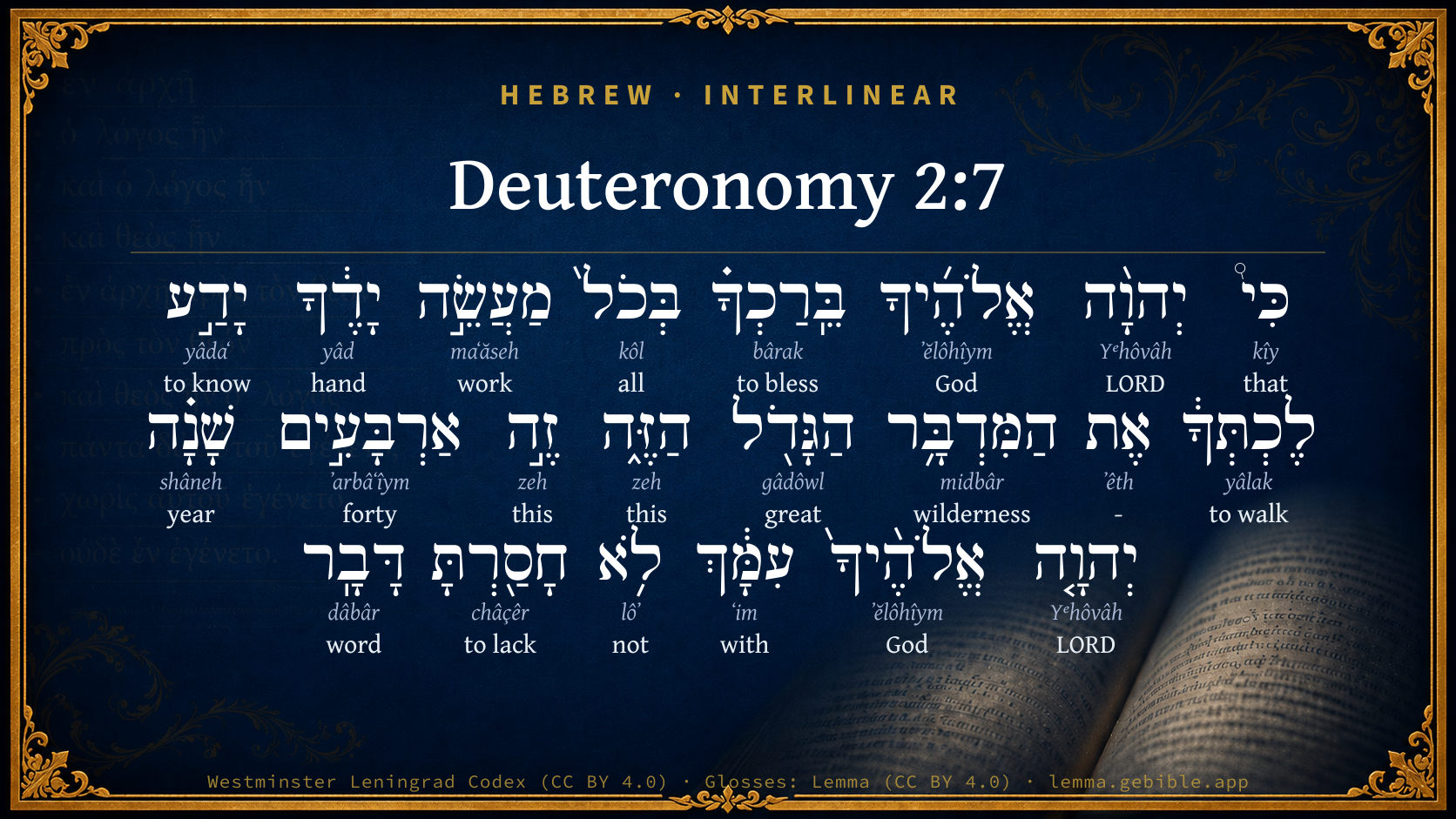
Hebrew (Westminster Leningrad Codex) Deuteronomy 2:7 appears in the Hebrew Old Testament. The text above is from the Westminster Leningrad Codex. Each word links to its Strong’s number, a concise gloss, and parsing drawn from the Open Scriptures Hebrew Bible morphology. Click any word for its full Brown-Driver-Briggs (BDB) entry.
Download image
Cite this verse

Deuteronomy 2:7 (World English Bible). Public Domain. Lemma interlinear Bible study tool, https://lemma.gebible.app/v/deuteronomy/2/7.

Show BibTeX & RIS
BibTeX
RIS
English Translation
For Yahweh your God has blessed you in all the work of your hand; he has known your walking through this great wilderness: these forty years Yahweh your God has been with you; you have lacked nothing.
World English Bible · Public Domain
Download a study sheet

One document with this verse’s original text, its word-by-word gloss line, the meaning frame, cross-references with their text, attributed commentary, and full source and license credits — printable, and it pastes into notes with its structure intact.

This verse Autodidact and up

Study sheet (.html) Plain text (.txt)

A passage Seminary Student

Up to 50 verses in one chapter. A passage sheet keeps up to 6 commentary sources and 12 cross-references per verse, in the order this page ranks them, and says so on the sheet whenever that leaves anything out. Ask for a single verse and you get the Autodidact verse sheet above.

Everything on this page stays free to read, with no account — the sheet is a download of what is already on screen, not access to it.

Want to remove ads? Support Godless Engineer
Compare translations 3

The same verse in 3 English versions, stacked beneath the original-language interlinear above. Click any original word for its lexicon entry.

Each is an independent rendering of the whole verse — the interlinear is not word-aligned to these translations.

Highlighted words mark where these versions differ — a whole-verse word diff, not a word-by-word alignment.

  • World English Bible Public Domain
    For Yahweh your God has blessed you in all the work of your hand; he has known your walking through this great wilderness: these forty years Yahweh your God has been with you; you have lacked nothing.
  • King James Version Public Domain
    For the LORD thy God hath blessed thee in all the works of thy hand: he knoweth thy walking through this great wilderness: these forty years the LORD thy God hath been with thee; thou hast lacked nothing.
  • unfoldingWord Literal Text CC BY-SA 4.0
    For Yahweh your God has blessed you in all the work of your hand. He has known your walking through this great wilderness. These 40 years Yahweh your God with you. You have not lacked a thing.

unfoldingWord Literal Text — © unfoldingWord, licensed CC BY-SA 4.0. Word-aligned USFM3 via Door43 (git.door43.org/unfoldingWord/en_ult).

Versions to compare (up to 4)

3 of 4 selected

Show all 18 translations

Every available English version of this verse, each an independent rendering of the whole verse.

  • World English Bible Public Domain
    For Yahweh your God has blessed you in all the work of your hand; he has known your walking through this great wilderness: these forty years Yahweh your God has been with you; you have lacked nothing.
  • Berean Standard Bible Public Domain
    Indeed, the LORD your God has blessed you in all the work of your hands. He has watched over your journey through this vast wilderness. The LORD your God has been with you these forty years, and you have lacked nothing.
  • Majority Standard Bible Public Domain
    Indeed, the LORD your God has blessed you in all the work of your hands. He has watched over your journey through this vast wilderness. The LORD your God has been with you these forty years, and you have lacked nothing.
  • King James Version Public Domain
    For the LORD thy God hath blessed thee in all the works of thy hand: he knoweth thy walking through this great wilderness: these forty years the LORD thy God hath been with thee; thou hast lacked nothing.
  • American Standard Version (1901) Public Domain
    For Jehovah thy God hath blessed thee in all the work of thy hand; he hath known thy walking through this great wilderness: these forty years Jehovah thy God hath been with thee; thou hast lacked nothing.
  • Revised Version (1885) Public Domain
    For the LORD thy God hath blessed thee in all the work of thy hand: he hath known thy walking through this great wilderness: these forty years the LORD thy God hath been with thee; thou hast lacked nothing.
  • Geneva Bible (1599) Public Domain
    For the Lord thy God hath blessed thee in all the workes of thine hand: he knoweth thy walking through this great wildernes, and the Lord thy God hath bene with thee this fourtie yeere, and thou hast lacked nothing.
  • Douay-Rheims (1899) Public Domain
    The Lord thy God hath blessed thee in every work of thy hands: the Lord thy God dwelling with thee, knoweth thy journey, how thou hast passed through this great wilderness, for forty years, and thou hast wanted nothing.
  • Young's Literal Translation Public Domain
    for Jehovah thy God hath blessed thee in all the work of thy hands; He hath known thy walking in this great wilderness these forty years; Jehovah thy God `is' with thee; thou hast not lacked anything.
  • Literal Standard Version CC BY-SA 4.0
    For your God YHWH has blessed you in all the work of your hands; He has known your walking in this great wilderness these forty years; your God YHWH [is] with you; you have not lacked anything.
  • Unlocked Literal Bible CC BY-SA 4.0
    For Yahweh your God has blessed you in all the work of your hand; he has known your walking through this great wilderness. For these forty years Yahweh your God has been with you, and you have lacked nothing.”'
  • unfoldingWord Literal Text CC BY-SA 4.0
    For Yahweh your God has blessed you in all the work of your hand. He has known your walking through this great wilderness. These 40 years Yahweh your God with you. You have not lacked a thing.
  • Darby Bible Public Domain
    for Jehovah thy God hath blessed thee in all the work of thy hand. He hath known thy walking through this great wilderness: these forty years hath Jehovah thy God been with thee; thou hast lacked nothing.
  • World Messianic Bible Public Domain
    For the LORD your God has blessed you in all the work of your hands. He has known your walking through this great wilderness. These forty years, the LORD your God has been with you. You have lacked nothing.
  • Webster's Bible Public Domain
    For the LORD thy God hath blessed thee in all the works of thy hand: he knoweth thy walking through this great wilderness: these forty years the LORD thy God hath been with thee: thou hast lacked nothing.
  • Free Bible Version CC BY-SA 4.0
    Remember that the Lord your God has blessed you in everything you've done. He has looked after you during your journey through this large desert. The Lord your God has been with you for these forty years, and you haven't lacked anything.
  • Bible in Basic English Public Domain
    For the blessing of the Lord your God has been on you in all the work of your hands: he has knowledge of your wanderings through this great waste: these forty years the Lord your God has been with you, and you have been short of nothing.
  • JPS Tanakh (1917) Public Domain
    For the LORD thy God hath blessed thee in all the work of thy hand; He hath known thy walking through this great wilderness; these forty years the LORD thy God hath been with thee; thou hast lacked nothing.'

Literal Standard Version (2020), Covenant Press — licensed CC BY-SA 4.0. Text via the HelloAO Bible API (eBible.org). Unlocked Literal Bible (unfoldingWord) — licensed CC BY-SA 4.0. Text via the HelloAO Bible API (eBible.org). unfoldingWord Literal Text — © unfoldingWord, licensed CC BY-SA 4.0. Word-aligned USFM3 via Door43 (git.door43.org/unfoldingWord/en_ult). Free Bible Version, Dr. Jonathan Gallagher — licensed CC BY-SA 4.0. Text via the HelloAO Bible API (eBible.org).

Word by word

More ways to search: Search by grammar → Find every occurrence → Compare this word →

Practice this passage: Drill this verse → Learn its vocabulary →

חָסַ֖רְתָּ
châçêr
H2637
“to lack”
Verb, Qal, Perfect, 2nd Person, Masculine, Singular
Part of Speech
Verb
Stem
Qal
Form
Perfect
Person
2nd Person
Gender
Masculine
Number
Singular
Full BDB Definition

Origin: a primitive root

TWOT: 705

to lack, be without, decrease, be lacking, have a need - (Qal) - to lack - to be lacking - to diminish, decrease - (Piel) to cause to lack - (Hiphil) to cause to be lacking
  1. כִּי֩ kîy H3588 “that” Conjunction
  2. יְהוָ֨ה Yᵉhôvâh H3068 “LORD” Noun, Proper
  3. אֱלֹהֶ֜יךָ ʼĕlôhîym H430 “God(s) · your” Noun, Common, Masculine, Plural, Construct + Suffix, Personal, 2nd Person, Masculine, Singular
  4. בֵּֽרַכְךָ֗ bârak H1288 “to bless · you” Verb, Piel, Perfect, 3rd Person, Masculine, Singular + Suffix, Personal, 2nd Person, Masculine, Singular
  5. בְּכֹל֙ kôl H3605 “in/at · all of” Preposition + Noun, Common, Masculine, Singular, Construct
  6. מַעֲשֵׂ֣ה maʻăseh H4639 “work of” Noun, Common, Masculine, Singular, Construct
  7. יָדֶ֔ךָ yâd H3027 “hand · your” Noun, Common, Both, Singular, Construct + Suffix, Personal, 2nd Person, Masculine, Singular
  8. יָדַ֣ע yâdaʻ H3045 “to know” Verb, Qal, Perfect, 3rd Person, Masculine, Singular
  9. לֶכְתְּךָ֔ yâlak H3212 “to walk · you” Verb, Qal, Infinitive Construct + Suffix, Personal, 2nd Person, Masculine, Singular
  10. אֶת ʼêth H853 “-” Particle, Direct Object
  11. הַמִּדְבָּ֥ר midbâr H4057 “the · wilderness” Particle, Definite Article + Noun, Common, Masculine, Singular, Absolute
  12. הַגָּדֹ֖ל gâdôwl H1419 “the · great” Particle, Definite Article + Adjective, Adjective, Masculine, Singular, Absolute
  13. הַזֶּ֑ה zeh H2088 “the · this” Particle, Definite Article + Pronoun, Demonstrative, Masculine, Singular
  14. זֶ֣ה zeh H2088 “this” Pronoun, Demonstrative, Masculine, Singular
  15. אַרְבָּעִ֣ים ʼarbâʻîym H705 “forty” Adjective, Cardinal number, Both, Plural, Absolute
  16. שָׁנָ֗ה shâneh H8141 “year” Noun, Common, Feminine, Singular, Absolute
  17. יְהוָ֤ה Yᵉhôvâh H3068 “LORD” Noun, Proper
  18. אֱלֹהֶ֨יךָ֙ ʼĕlôhîym H430 “God(s) · your” Noun, Common, Masculine, Plural, Construct + Suffix, Personal, 2nd Person, Masculine, Singular
  19. עִמָּ֔ךְ ʻim H5973 “with · you” Preposition + Suffix, Personal, 2nd Person, Feminine, Singular
  20. לֹ֥א lôʼ H3808 “not” Particle, Negative
  21. דָּבָֽר dâbâr H1697 “word” Noun, Common, Masculine, Singular, Absolute

About this verse

These counts appear in no published source. They are computed here, from the morphology-tagged text and Lemma’s own curated glosses. What Lemma adds →

22
words
19
distinct lemmas
Pentateuch
section

Notable vocabulary

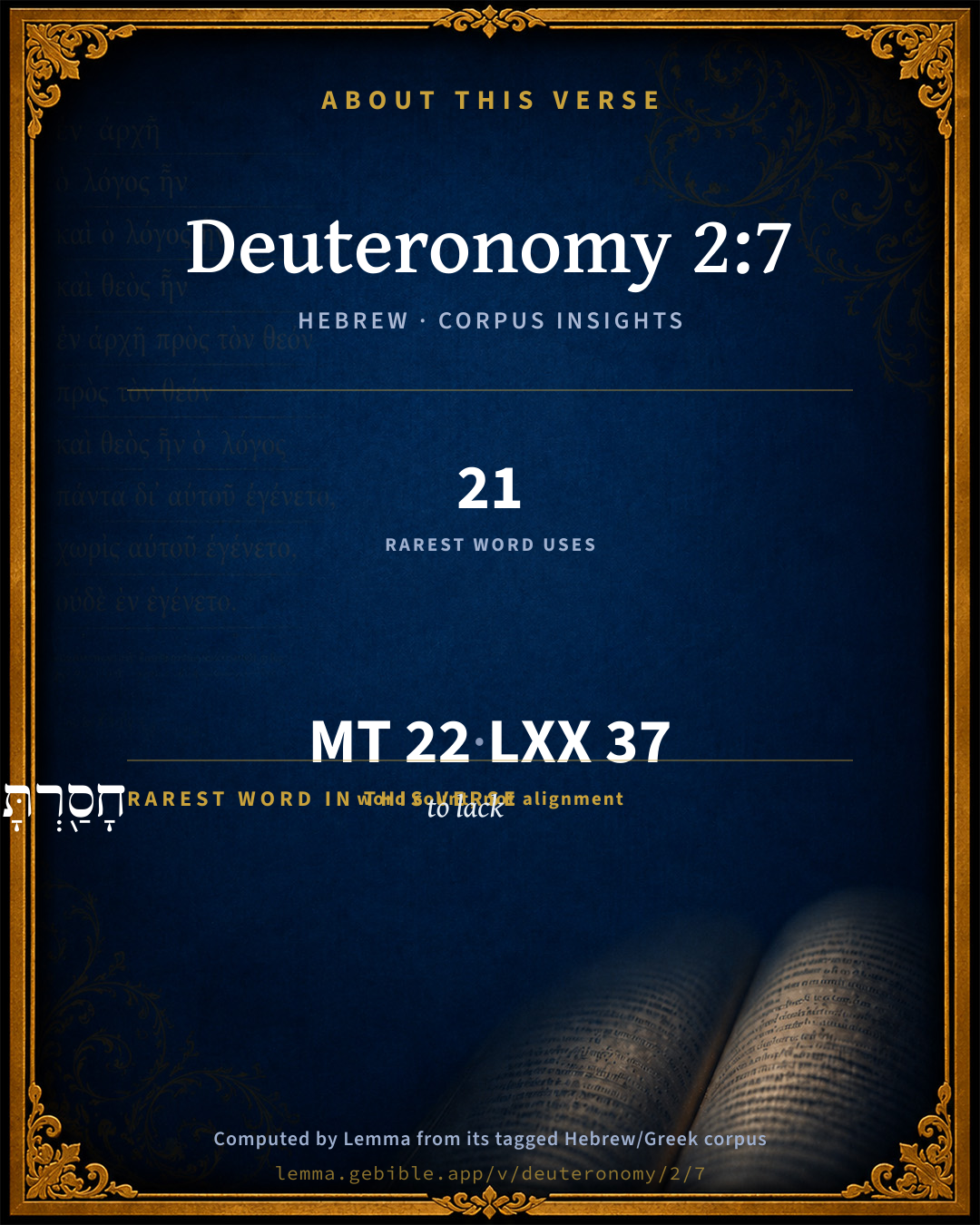
The rarest word here is חָסַ֖רְתָּ to lack H2637 — appearing just 21 times in the whole Hebrew Bible.

Shared distinctive vocabulary

חָסַ֖רְתָּ to lack H2637 occurs in 21 verses of the Hebrew Bible. Also found in:

Grammatical profile

  • 4 verbs
  • 10 nouns
  • 2 adjectives
  • 2 pronouns
  • 1 preposition
  • 1 conjunction
  • 2 particles

Verb forms

  • בֵּֽרַכְךָ֗ Piel · Perfect
  • יָדַ֣ע Qal · Perfect
  • לֶכְתְּךָ֔ Qal · Infinitive Construct
  • חָסַ֖רְתָּ Qal · Perfect

Repetition

Words recur within this verse — often emphatic in Hebrew:

  • יְהוָ֨ה LORD H3068 ×2
  • אֱלֹהֶ֜יךָ God H430 ×2
  • הַזֶּ֑ה this H2088 ×2

Hebrew & Septuagint length

In English translation the verse runs 37 words from the Hebrew and 41 from the Septuagint (LXX English) — closely comparable.

A rough comparison of the two English renderings, which tokenize alike — not a word-level alignment.

Word counts can differ between the Hebrew and the Greek without any difference in meaning — e.g. the Hebrew direct-object marker אֵת has no separate Greek word, and Greek often adds the article ὁ.

In the original languages it is 22 Hebrew tokens and 37 Greek tokens — but the two are counted differently (Hebrew bundles its prefixes and suffixes into one token; the Greek is in lemma form), so that isn’t a like-for-like length.

Cross-references

14

Topical passages linked to Deuteronomy 2:7 in the Treasury of Scripture Knowledge — connected by theme and wording, ordered by reader-vote popularity; previews shown in the World English Bible.

  • Nehemiah 9:21 Yes, forty years did you sustain them in the wilderness, [and] they lacked nothing; their clothes didn't grow old, and their feet didn't swell.
  • Luke 22:35 He said to them, "When I sent you out without purse, and wallet, and shoes, did you lack anything?" They said, "Nothing."
  • Deuteronomy 8:2–4 You shall remember all the way which Yahweh your God has led you these forty years in the wilderness, that he might humble you, to prove you, to know what was in your heart, whether you would keep his commandments, or not.
  • Deuteronomy 29:5 I have led you forty years in the wilderness: your clothes have not grown old on you, and your shoe has not grown old on your foot.
  • Psalms 90:17 Let the favor of the Lord our God be on us; Establish the work of our hands for us; Yes, establish the work of our hands.
  • Genesis 12:2 I will make of you a great nation. I will bless you, and make your name great. You will be a blessing.
  • Genesis 24:35 Yahweh has blessed my master greatly. He has become great. He has given him flocks and herds, silver and gold, men-servants and maid-servants, and camels and donkeys.
  • Job 23:10 But he knows the way that I take. When he has tried me, I shall come forth like gold.
  • Psalms 31:7 I will be glad and rejoice in your loving kindness, For you have seen my affliction. You have known my soul in adversities.
  • Genesis 26:12 Isaac sowed in that land, and reaped in the same year one hundred times what he planted. Yahweh blessed him.
  • Genesis 30:27 Laban said to him, "If now I have found favor in your eyes, stay here, for I have divined that Yahweh has blessed me for your sake."
  • Genesis 39:5 It happened from the time that he made him overseer in his house, and over all that he had, that Yahweh blessed the Egyptian's house for Joseph's sake; and the blessing of Yahweh was on all that he had, in the house and in the field.
  • Psalms 1:6 For Yahweh knows the way of the righteous, But the way of the wicked shall perish.
  • John 10:27 My sheep hear my voice, and I know them, and they follow me.

Cross-references courtesy of OpenBible.info (CC BY 4.0).

Hebrew and Greek witnesses Masoretic Hebrew ↔ Greek Septuagint

The same verse in the two great witnesses to the Old Testament, shown verse-for-verse.

These are two independent witnesses, not word-aligned to each other, and the Septuagint is shown in lemma (dictionary) form.

Hebrew Deuteronomy 2:7 Masoretic · Westminster Leningrad Codex

כִּי֩ יְהוָ֨ה אֱלֹהֶ֜יךָ בֵּֽרַכְךָ֗ בְּכֹל֙ מַעֲשֵׂ֣ה יָדֶ֔ךָ יָדַ֣ע לֶכְתְּךָ֔ אֶת הַמִּדְבָּ֥ר הַגָּדֹ֖ל הַזֶּ֑ה זֶ֣ה אַרְבָּעִ֣ים שָׁנָ֗ה יְהוָ֤ה אֱלֹהֶ֨יךָ֙ עִמָּ֔ךְ לֹ֥א חָסַ֖רְתָּ דָּבָֽר

For Yahweh your God has blessed you in all the work of your hand; he has known your walking through this great wilderness: these forty years Yahweh your God has been with you; you have lacked nothing.

World English Bible · Public Domain

Greek LXX Deuteronomy 2:7 Septuagint · lemma form

ὁ γάρ κύριος ὁ θεός ἐγώ εὐλογέω σύ ἐν πᾶς ἔργον ὁ χείρ σύ διαγινώσκω πῶς διαἔρχομαι ὁ ἔρημος ὁ μέγας καί ὁ φοβερός ἐκεῖνος ἰδού τεσσαράκοντα ἔτος κύριος ὁ θεός σύ μετά σύ οὐ ἐπιδέω ῥῆμα

For the Lord our God has blessed you in every work of your hands. Consider how you went through that great and terrible wilderness: behold, the Lord your God has been with you forty years; you did not lack any thing.

LXX2012 (modern English Septuagint) · Public Domain

On this verse, The Cambridge Bible for Schools and Colleges discusses the Septuagint’s reading. Read the note in Commentary ↓

Hebrew: Westminster Leningrad Codex (CC BY 4.0). Greek: Septuagint (public domain); English from LXX2012 (modern English Septuagint) (Public Domain). How the Septuagint differs from the Hebrew →

Targum (Aramaic paraphrase)

2

The Targum is the ancient Jewish Aramaic paraphrase of the Hebrew Scriptures — an interpretive translation, not the Hebrew text itself. Onkelos (literal) and Pseudo-Jonathan (expansive) render the Torah, and Jonathan the Prophets. Coverage is partial: where no permissively-licensed English translation exists for a verse, only the Aramaic is shown. This is verse-level text, not a word-by-word alignment to the Hebrew.

  1. Targum Onkelos Torah (Genesis–Deuteronomy)
    אֲרֵי יְיָ אֱלָהָךְ בֵּרְכָךְ בְּכָל עֹבַד יְדָךְ סַפֶּק לָךְ צָרְכָּךְ בְּמֶהָכָךְ יָת מַדְבְּרָא רַבָּא הָדֵין דְנַן אַרְבְּעִין שְׁנִין מֵימְרָא דַיְיָ אֱלָהָךְ בְּסַעֲדָךְ לָא מְנַעְתָּא מִדָעַם

    (no public-domain English translation for this verse)

    Targum Onkelos — Aramaic: “Onkelos Genesis” (public domain); “Onkelos Exodus” (public domain); “Onkelos Leviticus” (public domain); “Onkelos Numbers” (public domain); “Onkelos Deuteronomy” (public domain). English: “Sefaria Community Translation” (CC0 1.0 (public-domain dedication)); “J.W. Etheridge. The Targums of Onkelos and Jonathan Ben Uzziel on the Pentateuch. London: Longmans, Green, 1862” (public domain). Text via Sefaria.

  2. Targum Pseudo-Jonathan Torah (Genesis–Deuteronomy)
    אִזְדַּהֲרוּן דְּלָא תְעִיקוּן לְהוֹן אֲרוּם יְיָ אֱלָהָכוֹן בְּרִיךְ יַתְכוֹן בְּכָל עוֹבְדֵי יְדֵיכוֹן סוּפֵּיק צָרְכֵיכוֹן בְּמֵיהֲכָךְ בְּמַדְבְּרָא רַבָּא הָדֵין דְּנַן אַרְבְּעִין שְׁנִין מֵימְרָא דַיְיָ אֱלָהָכוֹן בְּסַעַדְכוֹן לָא חֲסַרְתּוּן מִדָּעַם

    Be careful that you vex them not: for the Lord your God hath blessed you in all the works of your hands, he hath supplied your wants in thy journeying in the great wilderness; these forty years hath the Word of the Lord your God been your helper; you have not wanted anything.

    Targum Pseudo-Jonathan — Aramaic: “Targum Jonathan on Genesis” (public domain); “Targum Jonathan on Exodus” (public domain); “Targum Jonathan on Leviticus” (public domain); “Targum Jonathan on Numbers” (public domain); “Targum Jonathan on Deuteronomy” (public domain). English: “The Targum of Jonathan ben Uzziel, trans. J. W. Etheridge, London, 1862” (public domain). Text via Sefaria.

Commentary

Notes on Deuteronomy 2:7 from classic Christian and Jewish commentators (each source and its license shown beneath its notes). The classic Christian expositions comment on the surrounding passage and are grouped to its opening verse, so a note may address several verses; the Jewish commentaries on the Tanakh (Rashi and others) are per-verse, so they appear only where the commentator wrote on this verse.

Lemma curates 59 commentaries, every one of them public domain or Creative Commons licensed, each selected and text-cleaned for this edition rather than reprinted as found. About our sources →

Trapp's Complete Commentary

John Trapp

Deu 2:7 For the LORD thy God hath blessed thee in all the works of thy hand: he knoweth thy walking through this great wilderness: these forty years the LORD thy God [hath been] with thee; thou hast lacked nothing.

Ver. 7. For the Lord thy God hath blessed thee,] viz., With money, to fetch thee in other commodities. It is the blessing of God, when all is done, that maketh rich; without this men do but labour in the fire, labour all night and take nothing, trouble themselves to no purpose; all their endeavours are but Arena sine calce, sand without lime, they will not hold together, but, like untempered mortar, fall asunder; there being a curse upon unlawful practices, though men be never so industrious: as you may see in Jehoiachim. {Jer 22:18-19}

John Trapp, A Commentary or Exposition upon All the Books of the Old and New Testament (1647–1656) — public domain. Text from a community e-Sword module.

Joseph Benson's Commentary

Deu 2:7. The Lord hath blessed thee — By God’s blessing thou art able to buy thy conveniences, and therefore thy theft and rapine will be inexcusable, because without any pretence of necessity. He knoweth — Hebrew, He hath known; that is, observed, or regarded with care and kindness, which that word often denotes. Which experience of God’s singular goodness to thee should make thee rely on him still, and not use any unjust practice to procure what thou wantest or desirest.

Joseph Benson's Commentary on the Old and New Testaments (1811–1818) — public domain. Text from a community e-Sword module.

Geneva Bible (1599)

Geneva Bible translators

And given thee means, wherewith thou mayest make recompense: also God will direct thee by his providence, as he hath done.

Geneva Bible (1599) marginal notes — public domain. Text via Bolls.life.

Adam Clarke's Commentary

Verse 7. The Lord - hath blessed thee, c.] God had given them much property, and therefore they had no need of plunder they had gold and silver to buy the provender they needed, and therefore God would not permit them to take any thing by violence.

Adam Clarke's Commentary on the Bible (1810–1826) — public domain. Text from a community e-Sword/MySword module.

Ellicott's Commentary for English Readers

(7) The Lord thy God hath blessed thee.—There is nothing unreasonable in the view suggested by these words, that the Israelites acquired wealth by trade or by ordinary occupations during their wilderness journey. They had skilled workmen among them.

A Bible Commentary for English Readers, edited by Charles John Ellicott (1878–1897) — public domain. Text from a community e-Sword module.

The Cambridge Bible for Schools and Colleges

gen. ed. J. J. S. Perowne

7. For the Lord thy God hath blessed thee] Another formula recurrent in D.

in all the work of thy hand] Some Heb. MSS, LXX, Sam., hands: another recurrent phrase.

he hath known thy walking] Rather hath cared for. The Heb. verb to know means frequently, especially in a religious connection, to put the mind to, attend to, regard; cp. Gen_39:6 : Potiphar had no thought or care, about anything in Joseph’s charge, 1Sa_2:12; Pro_9:13; Pro_27:23; Job_35:15. See Book of the Twelve Pr., i. 321 f. But LXX read the verb here as imperative, consider thy walking.

these forty years] So exactly Deu_8:2; Deu_8:4, also in the Sg. address. The tradition that the time of the wandering was 40 years, stated by Amo_2:10; Amo_5:25, is common to D and P (Deu_1:3; Num_14:33; Num_32:13; cp. Num_33:38), also in editorial passages in JE, Jos_5:6; Jos_16:10. The Semites frequently reckoned by multiples of 4 and 40: the latter express many round numbers in O.T. chronology. Forty years seems to have been equivalent to a generation. That Israel was 40 years in the wilderness agrees with the tradition that a generation died out there. For the same equation in Babylonian chronology see Modern Criticism and the Preaching of the O.T., 90 f., n. 1.

This verse is the third in the Sg. address. Note that in harmony with other Sg. passages it affirms the well-being of Israel during the 40 years, while the Pl. passages emphasise their dangers and losses. It is not necessary to the context, and therefore regarded as a later insertion. Yet it would not be unnatural for the same writer to change from Pl. to Sg. when taking a conjunct view of Israel’s experience.

The Cambridge Bible for Schools and Colleges (gen. ed. J. J. S. Perowne; Cambridge University Press, 1878–1918) — public domain. Text from a community e-Sword module.

John Gill's Exposition

For the Lord thy God hath blessed thee in all the works of thine hands,.... Had increased their cattle and substance, even though in a wilderness:

he knoweth thy walking through this great wilderness; every step they took, and he owned them and prospered them in all things in which they were concerned:

these forty years the Lord thy God hath been with thee: not only to protect and defend them, but to provide all things necessary for them. This number of years was not fully completed, but the round number is given instead of the broken one:

thou hast lacked nothing: and since they had wherewith to pay for their food and drink, they are directed to do it, and not take anything from the Edomites in an unjust way; nor make themselves look poor when they were rich, as Jarchi says.

John Gill's Exposition of the Whole Bible (1746–1763) — public domain (CC PDM 1.0). Text via the HelloAO Bible API.

Haydock's Catholic Bible Commentary

Knoweth, or approveth, directing by his loving providence, Psalm i. 6., and xxxvi. 18.

George Leo Haydock (1774–1849), Haydock's Catholic Family Bible and Commentary, 1859 edition — public domain. Excludes Psalms (Douay-Rheims chapter numbering differs from Protestant) and Deuterocanonical books (Catholic canon only).

Matthew Poole's English Annotations

By God’s blessing thou art able to buy thy conveniences, and therefore thy theft and rapine will be inexcusable, because without any pretence of necessity.

He knoweth, Heb. he hath known, i.e. observed, or regarded with care and kindness, which that word oft notes, as Psa 1:6; 31:7; which experience of God’s singular goodness to thee, should make thee trust him still, and not use any indirect and unjust practices to procure. what thou wantest or desirest.

Matthew Poole's English Annotations on the Holy Bible (1683–1685) — public domain. Text from a community e-Sword/MySword module.

The Pulpit Commentary

They were enabled to buy what they requiredFor the Lord thy God hath blessed thee in all the works of thy hand; their flocks and herds had increased during their wanderings; (Num_32:1) and they may have gained wealth by cultivating the soil at places where they had made a lengthened sojourn, or by traffic with the tribes of the desert with whom they came in contact. Jehovah their God had known had noted, observed, had regard to, had cared for. (Gen_39:6; Pro_27:23) their walking their peregrinationsthrough this great wilderness; he had been their Leader, had chosen for them places to rest in, had provided food for them, and had been their Protector and Guardian all through the forty years of their pilgrimage, so that they had wanted for nothing (Deu_1:33 Deu_8:2, Deu_8:3, Deu_8:15, Deu_8:16; Psa_23:1-6) "He sufficiently supplied what was needful for thee when thou walkedst through this great wilderness; for these forty years the Word of Jah thy God hath sustained thee; nor hath anything been wanting to thee" (Chaldee Paraphrase). Forty years. (Num_14:33) "From the fifteenth day of the first month in which their fathers came out of Egypt, (Num_33:3) to the tenth day of the same month in which they went over Jordan into Canaan, (Jos_4:19) there were but five days wanting of complete forty years" (Patrick).

The Pulpit Commentary (1880–1919), ed. H.D.M. Spence-Jones & Joseph S. Exell — public domain. Text from a community e-Sword module.

John Wesley's Explanatory Notes

The Lord hath blessed thee - By God's blessing thou art able to buy thy conveniences, and therefore thy theft and rapine will be inexcusable, because without any pretense of necessity. He knoweth - Hebrew. He hath known, that is, observed, or regarded with care and kindness, which that word often notes. Which experience of God's singular goodness to thee, should make thee rely on him still, and not use any unjust practice to procure what thou wantest or desirest.

John Wesley, Explanatory Notes Upon the Whole Bible (1754–1765) — public domain. Text via the GEBible commentary corpus.

Rashi

Rabbi Shlomo Yitzchaki (Rashi)

כי ה' אלהיך ברכך FOR THE LORD THY GOD HATH BLESSED THEE — therefore you should not show yourselves ungrateful to Him by behaving as though you were poor, but act as rich people.

Rashi on the Tanakh — English translations: “The Judaica Press complete Tanach with Rashi, translated by A. J. Rosenberg” (CC BY 4.0); “Pentateuch with Rashi's commentary by M. Rosenbaum and A.M. Silbermann, 1929-1934” (public domain); “The Metsudah Tanach series, Lakewood, N.J” (CC BY 4.0); and “The Book of Joshua, Metsudah Publications, 1997” (CC BY 4.0). Text via Sefaria.

Ramban (Nachmanides)

Rabbi Moshe ben Nachman (Ramban / Nachmanides)

FOR THE ETERNAL THY G-D HATH BLESSED THEE. “Therefore, you should not deny His goodness by behaving as though you were poor; instead deport yourselves like rich people.” This is Rashi’s language. Now, I have not understood what he meant [by the next phrase in the verse, For the Eternal thy G-d hath blessed thee] in all the work of thy hand, since their blessings were heavenly blessings and they did nothing with their hands that it be blessed! Perhaps the expression in all the work of thy hand alludes to the sheep and herds which they brought out from Egypt. They also had riches, herds, and acquisitions from the spoils of the Egyptians and the spoils of Amalek. Everything they possessed was blessed, similar to what is stated, Thou hast blessed the work of his hands, and his possessions are increased in the land. Moreover, the Eternal hath known thy walking through this vast wilderness and He supplied you there with all your needs — the manna, the quails, and the waters of the well — so that thou hast lacked nothing that is needed by wayfarers. And so it was — they bought food and nourishment from the children of Esau as Moses said [to Sihon], Thou shalt sell me food for money that I may eat, and give me water for money, that I may drink etc.; as the children of Esau did unto me etc.

Ramban (Nachmanides) on the Tanakh — English translation: “Commentary on the Torah by Ramban (Nachmanides). Translated and annotated by Charles B. Chavel. New York, Shilo Pub. House, 1971-1976” (CC BY 4.0). Text via Sefaria.

Lesson kit

Teaching starters — assembled from the data on this page, not authored interpretation. Every prompt links to the verse data it draws on. Edit before teaching.

Deuteronomy, in the Pentateuch, opens this verse with 22 words (19 distinct Hebrew lemmas). Its most distinctive word is châçêr (“to lack”). A historical commentator’s framing appears above. Read the whole chapter for the surrounding context.

Discussion questions

  1. What does “to lack” (châçêr) contribute to the verse as a whole?
  2. Genesis 8:3 shares the word «to lack» with this verse. How do the two illuminate each other?
  3. “LORD” occurs 2× in this one verse. What is the effect of the repetition?
  4. The translations on this page render this verse differently — a whole-verse word diff, not a word-by-word alignment. What might account for the different wordings?
  5. The verb «בֵּֽרַכְךָ֗» is Piel Perfect. How does its form color the action?
  6. Reading how Trapp's Complete Commentary and Joseph Benson's Commentary read this verse, where do the two commentators agree and where do they part?

Things to notice

Reading settings

Reading text

Shown beneath each verse's original-language words.

Old Testament
Old Testament edition

Read the OT as the Masoretic Hebrew (MT) or the Greek Septuagint (LXX).

English shown for the Greek Septuagint (in the Hebrew ↔ Greek comparison).

Comparing translations? Open the Compare panel on any verse page to stack up to four side by side.