
1 Chronicles 23:13

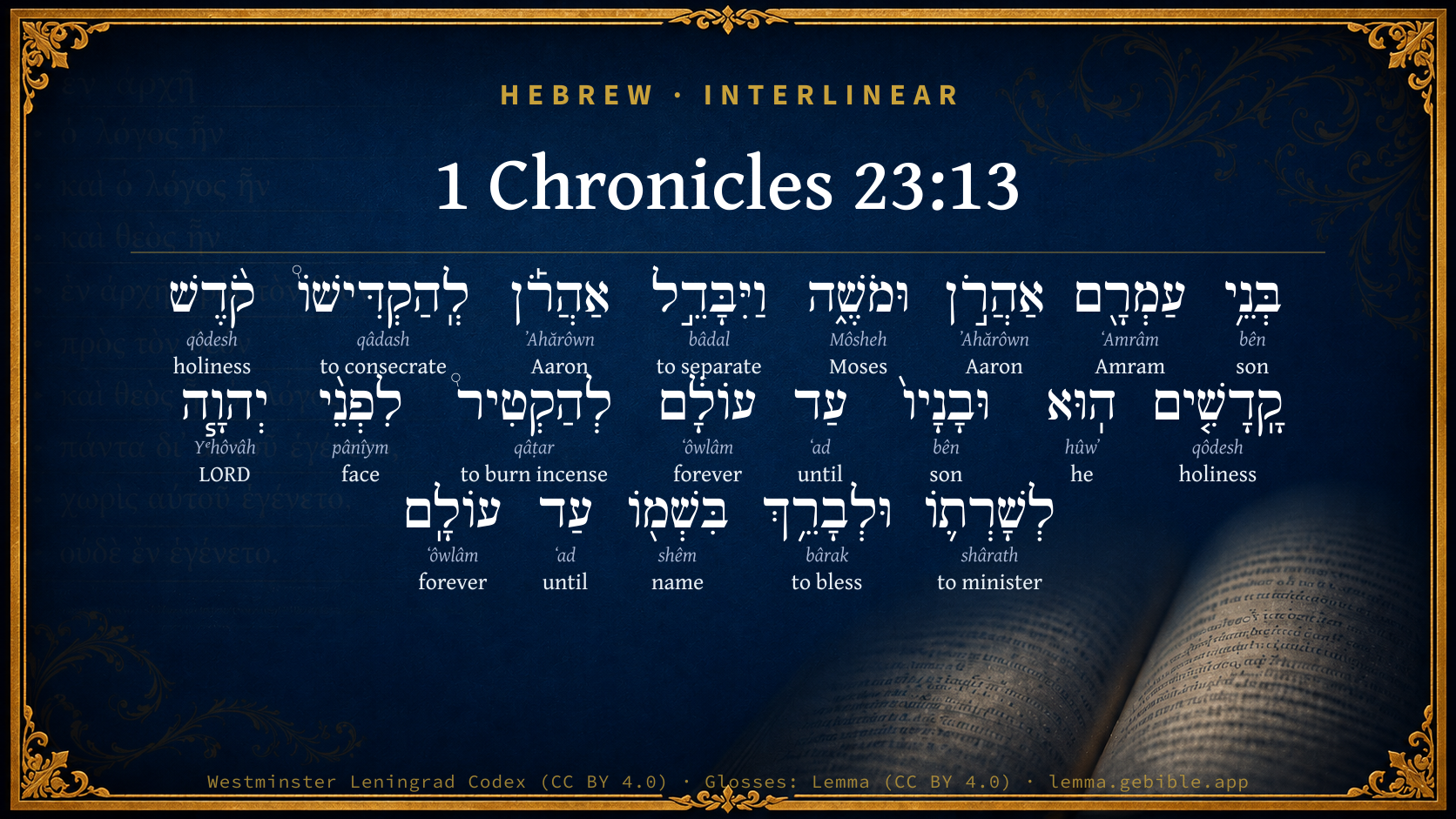
Hebrew (Westminster Leningrad Codex) 1 Chronicles 23:13 appears in the Hebrew Old Testament. The text above is from the Westminster Leningrad Codex. Each word links to its Strong’s number, a concise gloss, and parsing drawn from the Open Scriptures Hebrew Bible morphology. Click any word for its full Brown-Driver-Briggs (BDB) entry.
Download image
Cite this verse

1 Chronicles 23:13 (World English Bible). Public Domain. Lemma interlinear Bible study tool, https://lemma.gebible.app/v/1-chronicles/23/13.

Show BibTeX & RIS
BibTeX
RIS
English Translation
The sons of Amram: Aaron and Moses; and Aaron was separated, that he should sanctify the most holy things, he and his sons, forever, to burn incense before Yahweh, to minister to him, and to bless in his name, forever.
World English Bible · Public Domain
Download a study sheet

One document with this verse’s original text, its word-by-word gloss line, the meaning frame, cross-references with their text, attributed commentary, and full source and license credits — printable, and it pastes into notes with its structure intact.

This verse Autodidact and up

Study sheet (.html) Plain text (.txt)

A passage Seminary Student

Up to 50 verses in one chapter. A passage sheet keeps up to 6 commentary sources and 12 cross-references per verse, in the order this page ranks them, and says so on the sheet whenever that leaves anything out. Ask for a single verse and you get the Autodidact verse sheet above.

Everything on this page stays free to read, with no account — the sheet is a download of what is already on screen, not access to it.

Want to remove ads? Support Godless Engineer
Compare translations 3

The same verse in 3 English versions, stacked beneath the original-language interlinear above. Click any original word for its lexicon entry.

Each is an independent rendering of the whole verse — the interlinear is not word-aligned to these translations.

Highlighted words mark where these versions differ — a whole-verse word diff, not a word-by-word alignment.

  • World English Bible Public Domain
    The sons of Amram: Aaron and Moses; and Aaron was separated, that he should sanctify the most holy things, he and his sons, forever, to burn incense before Yahweh, to minister to him, and to bless in his name, forever.
  • King James Version Public Domain
    The sons of Amram; Aaron and Moses: and Aaron was separated, that he should sanctify the most holy things, he and his sons for ever, to burn incense before the LORD, to minister unto him, and to bless in his name for ever.
  • unfoldingWord Literal Text CC BY-SA 4.0
    The sons of Amram: Aaron and Moses. And Aaron was separated for him to consecrate the holy of holies, he and his sons to forever, to sacrifice to the face of Yahweh, to minister to him, and to bless his name to forever.

unfoldingWord Literal Text — © unfoldingWord, licensed CC BY-SA 4.0. Word-aligned USFM3 via Door43 (git.door43.org/unfoldingWord/en_ult).

Versions to compare (up to 4)

3 of 4 selected

Show all 18 translations

Every available English version of this verse, each an independent rendering of the whole verse.

  • World English Bible Public Domain
    The sons of Amram: Aaron and Moses; and Aaron was separated, that he should sanctify the most holy things, he and his sons, forever, to burn incense before Yahweh, to minister to him, and to bless in his name, forever.
  • Berean Standard Bible Public Domain
    The sons of Amram: Aaron and Moses. Aaron and his descendants were set apart forever to consecrate the most holy things, to burn incense before the LORD, to minister before Him, and to pronounce blessings in His name forever.
  • Majority Standard Bible Public Domain
    The sons of Amram: Aaron and Moses. Aaron and his descendants were set apart forever to consecrate the most holy things, to burn incense before the LORD, to minister before Him, and to pronounce blessings in His name forever.
  • King James Version Public Domain
    The sons of Amram; Aaron and Moses: and Aaron was separated, that he should sanctify the most holy things, he and his sons for ever, to burn incense before the LORD, to minister unto him, and to bless in his name for ever.
  • American Standard Version (1901) Public Domain
    The sons of Amram: Aaron and Moses; and Aaron was separated, that he should sanctify the most holy things, he and his sons, for ever, to burn incense before Jehovah, to minister unto him, and to bless in his name, for ever.
  • Revised Version (1885) Public Domain
    The sons of Amram; Aaron and Moses: and Aaron was separated, that he should sanctify the most holy things, he and his sons, for ever, to burn incense before the LORD, to minister unto him, and to bless in his name, for ever.
  • Geneva Bible (1599) Public Domain
    The sonnes of Amram, Aaron and Moses: and Aaron was separated to sanctifie the most holy place, hee and his sonnes for euer to burne incense before the Lord, to minister to him, and to blesse in his Name for euer.
  • Douay-Rheims (1899) Public Domain
    The sons of Amram, Aaron, and Moses. And Aaron was separated to minister in the holy of holies, he and his sons for ever, and to burn incense before the Lord, according to his ceremonies, and to bless his name for ever.
  • Young's Literal Translation Public Domain
    Sons of Amram: Aaron and Moses; and Aaron is separated for his sanctifying the holy of holies, he and his sons -- unto the age, to make perfume before Jehovah, to serve Him, and to bless in His name -- unto the age.
  • Literal Standard Version CC BY-SA 4.0
    Sons of Amram: Aaron and Moses; and Aaron is separated for his sanctifying the Holy of Holies, he and his sons, for all time, to make incense before YHWH, to serve Him, and to bless in His Name for all time.
  • Unlocked Literal Bible CC BY-SA 4.0
    These were Amram's sons: Aaron and Moses. Aaron was chosen to set apart the most holy things, that he and his descendants would offer incense before Yahweh, to serve him and to give blessings in his name forever.
  • unfoldingWord Literal Text CC BY-SA 4.0
    The sons of Amram: Aaron and Moses. And Aaron was separated for him to consecrate the holy of holies, he and his sons to forever, to sacrifice to the face of Yahweh, to minister to him, and to bless his name to forever.
  • Darby Bible Public Domain
    The sons of Amram: Aaron and Moses. And Aaron was separated, that he should be hallowed as most holy, he and his sons for ever, to offer before Jehovah, to do service to him, and to bless in his name for ever.
  • World Messianic Bible Public Domain
    The sons of Amram: Aaron and Moses; and Aaron was separated that he should sanctify the most holy things, he and his sons forever, to burn incense before the LORD, to minister to him, and to bless in his name forever.
  • Webster's Bible Public Domain
    The sons of Amram; Aaron and Moses: and Aaron was separated, that he should sanctify the most holy things, he and his sons for ever, to burn incense before the LORD, to minister to him, and to bless in his name for ever.
  • Free Bible Version CC BY-SA 4.0
    The sons of Amram: Aaron and Moses. Aaron was dedicated to service with the most holy things, that he and his sons should always present offerings to the Lord, and minister before him, and give blessings in his name forever.
  • Bible in Basic English Public Domain
    The sons of Amram: Aaron and Moses; and Aaron was made separate and holy, he and his sons for ever, for the care of the most holy things and the burning of offerings before the Lord, to do his work and give blessings in his name for ever.
  • JPS Tanakh (1917) Public Domain
    The sons of Amram: Aaron and Moses; and Aaron was separated, that he should be sanctified as most holy, he and his sons for ever, to offer before the LORD, to minister unto Him, and to bless in His name for ever.

Literal Standard Version (2020), Covenant Press — licensed CC BY-SA 4.0. Text via the HelloAO Bible API (eBible.org). Unlocked Literal Bible (unfoldingWord) — licensed CC BY-SA 4.0. Text via the HelloAO Bible API (eBible.org). unfoldingWord Literal Text — © unfoldingWord, licensed CC BY-SA 4.0. Word-aligned USFM3 via Door43 (git.door43.org/unfoldingWord/en_ult). Free Bible Version, Dr. Jonathan Gallagher — licensed CC BY-SA 4.0. Text via the HelloAO Bible API (eBible.org).

Word by word

More ways to search: Search by grammar → Find every occurrence → Compare this word →

Practice this passage: Drill this verse → Learn its vocabulary →

עַמְרָ֖ם
ʻAmrâm
H6019
“Amram”
Noun, Proper
Part of Speech
Noun
Type
Proper
Full BDB Definition

Origin: probably from H5971 and H7311

TWOT: None

Amram = "exalted people" - a descendant of Kohath and Levi and father of Moses - one of the sons of Bani who had a foreign wife in the time of Ezra
  1. בְּנֵ֥י bên H1121 “sons of” Noun, Common, Masculine, Plural, Construct
  2. אַהֲרֹ֣ן ʼAhărôwn H175 “Aaron” Noun, Proper
  3. וּמֹשֶׁ֑ה Môsheh H4872 “and · Moses” Conjunction + Noun, Proper
  4. וַיִּבָּדֵ֣ל bâdal H914 “and · to separate” Conjunction + Verb, Niphal, Sequential Imperfect, 3rd Person, Masculine, Singular
  5. אַהֲרֹ֡ן ʼAhărôwn H175 “Aaron” Noun, Proper
  6. לְֽהַקְדִּישׁוֹ֩ qâdash H6942 “to consecrate · him” Preposition + Verb, Hiphil, Infinitive Construct + Suffix, Personal, 3rd Person, Masculine, Singular
  7. קֹ֨דֶשׁ qôdesh H6944 “holiness of” Noun, Common, Masculine, Singular, Construct
  8. קָֽדָשִׁ֤ים qôdesh H6944 “holy things” Noun, Common, Masculine, Plural, Absolute
  9. הֽוּא hûwʼ H1931 “he” Pronoun, Personal, 3rd Person, Masculine, Singular
  10. וּבָנָיו֙ bên H1121 “and · sons · his” Conjunction + Noun, Common, Masculine, Plural, Construct + Suffix, Personal, 3rd Person, Masculine, Singular
  11. עַד ʻad H5704 “until” Preposition
  12. עוֹלָ֔ם ʻôwlâm H5769 “forever” Noun, Common, Masculine, Singular, Absolute
  13. לְהַקְטִיר֩ qâṭar H6999 “to burn incense” Preposition + Verb, Hiphil, Infinitive Construct
  14. לִפְנֵ֨י pânîym H6440 “to/for · face(s) of” Preposition + Noun, Common, Both, Plural, Construct
  15. יְהוָ֧ה Yᵉhôvâh H3068 “LORD” Noun, Proper
  16. לְשָׁרְת֛וֹ shârath H8334 “to minister · him” Preposition + Verb, Piel, Infinitive Construct + Suffix, Personal, 3rd Person, Masculine, Singular
  17. וּלְבָרֵ֥ךְ bârak H1288 “and · to bless” Conjunction + Preposition + Verb, Piel, Infinitive Construct
  18. בִּשְׁמ֖וֹ shêm H8034 “in/at · name · his” Preposition + Noun, Common, Masculine, Singular, Construct + Suffix, Personal, 3rd Person, Masculine, Singular
  19. עַד ʻad H5704 “until” Preposition
  20. עוֹלָֽם ʻôwlâm H5769 “forever” Noun, Common, Masculine, Singular, Absolute

About this verse

These counts appear in no published source. They are computed here, from the morphology-tagged text and Lemma’s own curated glosses. What Lemma adds →

21
words
16
distinct lemmas
Historical
section

Notable vocabulary

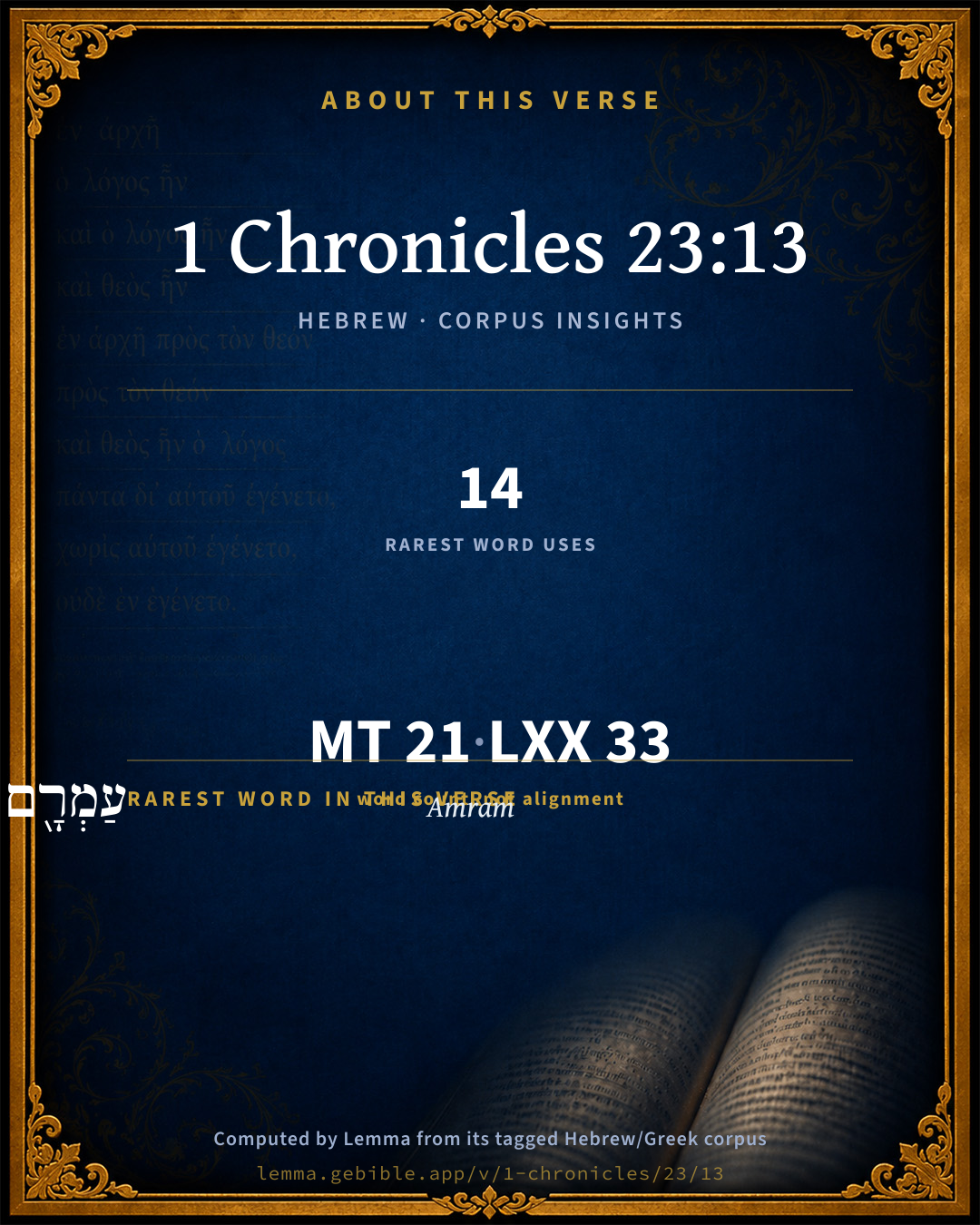
The rarest word here is עַמְרָ֖ם Amram H6019 — appearing just 14 times in the whole Hebrew Bible.

Shared distinctive vocabulary

עַמְרָ֖ם Amram H6019 occurs in 12 verses of the Hebrew Bible. Also found in:

Grammatical profile

  • 5 verbs
  • 13 nouns
  • 1 pronoun
  • 2 prepositions

Verb forms

  • וַיִּבָּדֵ֣ל Niphal · Sequential Imperfect
  • לְֽהַקְדִּישׁוֹ֩ Hiphil · Infinitive Construct
  • לְהַקְטִיר֩ Hiphil · Infinitive Construct
  • לְשָׁרְת֛וֹ Piel · Infinitive Construct
  • וּלְבָרֵ֥ךְ Piel · Infinitive Construct

Repetition

Words recur within this verse — often emphatic in Hebrew:

  • בְּנֵ֥י son H1121 ×2
  • אַהֲרֹ֣ן Aaron H175 ×2
  • קֹ֨דֶשׁ holiness H6944 ×2
  • עַד until H5704 ×2
  • עוֹלָ֔ם forever H5769 ×2

Hebrew & Septuagint length

In English translation the verse runs 40 words from the Hebrew and 40 from the Septuagint (LXX English) — the same length.

A rough comparison of the two English renderings, which tokenize alike — not a word-level alignment.

Word counts can differ between the Hebrew and the Greek without any difference in meaning — e.g. the Hebrew direct-object marker אֵת has no separate Greek word, and Greek often adds the article ὁ.

In the original languages it is 21 Hebrew tokens and 33 Greek tokens — but the two are counted differently (Hebrew bundles its prefixes and suffixes into one token; the Greek is in lemma form), so that isn’t a like-for-like length.

Cross-references

34

Topical passages linked to 1 Chronicles 23:13 in the Treasury of Scripture Knowledge — connected by theme and wording, ordered by reader-vote popularity; previews shown in the World English Bible.

  • Exodus 6:20 Amram took Jochebed his father's sister to himself as wife; and she bore him Aaron and Moses: and the years of the life of Amram were a hundred and thirty-seven years.
  • Deuteronomy 21:5 The priests the sons of Levi shall come near; for them Yahweh your God has chosen to minister to him, and to bless in the name of Yahweh; and according to their word shall every controversy and every stroke be.
  • Exodus 30:6–10 You shall put it before the veil that is by the ark of the testimony, before the mercy seat that is over the testimony, where I will meet with you.
  • 1 Samuel 2:28 and did I choose him out of all the tribes of Israel to be my priest, to go up to my altar, to burn incense, to wear an ephod before me? and did I give to the house of your father all the offerings of the children of Israel made by fire?
  • Exodus 28:1–14 "Bring Aaron your brother, and his sons with him, near to you from among the children of Israel, that he may minister to me in the priest's office, even Aaron, Nadab and Abihu, Eleazar and Ithamar, Aaron's sons.
  • Exodus 29:33–37 They shall eat those things with which atonement was made, to consecrate and sanctify them: but a stranger shall not eat of it, because they are holy.
  • Exodus 29:44 I will sanctify the tent of meeting and the altar: Aaron also and his sons I will sanctify, to minister to me in the priest's office.
  • Exodus 30:34–38 Yahweh said to Moses, "Take to yourself sweet spices, gum resin, and onycha, and galbanum; sweet spices with pure frankincense: of each shall there be an equal weight;
  • Exodus 40:9–15 You shall take the anointing oil, and anoint the tent, and all that is in it, and shall make it holy, and all its furniture: and it will be holy.
  • Leviticus 9:22–23 Aaron lifted up his hands toward the people, and blessed them; and he came down from offering the sin offering, and the burnt offering, and the peace offerings.
  • Leviticus 10:1–2 Nadab and Abihu, the sons of Aaron, each took his censer, and put fire in it, and laid incense on it, and offered strange fire before Yahweh, which he had not commanded them.
  • Leviticus 10:10 and that you are to make a distinction between the holy and the common, and between the unclean and the clean;
  • Leviticus 10:17–18 "Why haven't you eaten the sin offering in the place of the sanctuary, seeing it is most holy, and he has given it you to bear the iniquity of the congregation, to make atonement for them before Yahweh?
  • Leviticus 16:11–19 "Aaron shall present the bull of the sin offering, which is for himself, and shall make atonement for himself and for his house, and shall kill the bull of the sin offering which is for himself.
  • Leviticus 16:32–33 The priest, who is anointed and who is consecrated to be priest in his father's place, shall make the atonement, and shall put on the linen garments, even the holy garments.
  • Leviticus 17:2–6 "Speak to Aaron, and to his sons, and to all the children of Israel, and say to them: 'This is the thing which Yahweh has commanded,
  • Numbers 3:27 Of Kohath was the family of the Amramites, and the family of the Izharites, and the family of the Hebronites, and the family of the Uzzielites: these are the families of the Kohathites.
  • Numbers 6:23–27 "Speak to Aaron and to his sons, saying, 'This is how you shall bless the children of Israel.' You shall tell them,
  • Numbers 16:16–18 Moses said to Korah, You and all your company go before Yahweh, you, and they, and Aaron, tomorrow:
  • Numbers 16:35–40 Fire came forth from Yahweh, and devoured the two hundred fifty men who offered the incense.
  • Numbers 16:46–47 Moses said to Aaron, Take your censer, and put fire therein from off the altar, and lay incense thereon, and carry it quickly to the congregation, and make atonement for them: for there is wrath gone out from Yahweh; the plague is begun.
  • Numbers 18:1 Yahweh said to Aaron, You and your sons and your fathers' house with you shall bear the iniquity of the sanctuary; and you and your sons with you shall bear the iniquity of your priesthood.
  • Numbers 18:3–8 They shall keep your charge, and the charge of all the Tent: only they shall not come near to the vessels of the sanctuary and to the altar, that they not die, neither they, nor you.
  • Numbers 26:59 The name of Amram's wife was Jochebed, the daughter of Levi, who was born to Levi in Egypt: and she bore to Amram Aaron and Moses, and Miriam their sister.
  • 1 Chronicles 6:3 The children of Amram: Aaron, and Moses, and Miriam. The sons of Aaron: Nadab, and Abihu, Eleazar, and Ithamar.
  • 2 Chronicles 26:18–21 and they withstood Uzziah the king, and said to him, It pertains not to you, Uzziah, to burn incense to Yahweh, but to the priests the sons of Aaron, who are consecrated to burn incense: go out of the sanctuary; for you have trespassed; neither shall it be for your honor from Yahweh God.
  • Psalms 99:6 Moses and Aaron were among his priests, Samuel among those who call on his name; They called on Yahweh, and he answered them.
  • Psalms 106:16 They envied Moses also in the camp, And Aaron, Yahweh's saint.
  • Luke 1:9 according to the custom of the priest's office, his lot was to enter into the temple of the Lord and burn incense.
  • Acts 13:2 As they served the Lord and fasted, the Holy Spirit said, "Separate Barnabas and Saul for me, for the work to which I have called them."
  • Romans 1:1 Paul, a servant of Jesus Christ, called to be an apostle, set apart for the Gospel of God,
  • Galatians 1:15 But when it was the good pleasure of God, who separated me from my mother's womb, and called me through his grace,
  • Hebrews 5:4 Nobody takes this honor on himself, but he is called by God, just like Aaron was.
  • Revelation 8:3 Another angel came and stood over the altar, having a golden censer. Much incense was given to him, that he should add it to the prayers of all the saints on the golden altar which was before the throne.

Cross-references courtesy of OpenBible.info (CC BY 4.0).

Hebrew and Greek witnesses Masoretic Hebrew ↔ Greek Septuagint

The same verse in the two great witnesses to the Old Testament, shown verse-for-verse.

These are two independent witnesses, not word-aligned to each other, and the Septuagint is shown in lemma (dictionary) form.

Hebrew 1 Chronicles 23:13 Masoretic · Westminster Leningrad Codex

בְּנֵ֥י עַמְרָ֖ם אַהֲרֹ֣ן וּמֹשֶׁ֑ה וַיִּבָּדֵ֣ל אַהֲרֹ֡ן לְֽהַקְדִּישׁוֹ֩ קֹ֨דֶשׁ קָֽדָשִׁ֤ים הֽוּא וּבָנָיו֙ עַד עוֹלָ֔ם לְהַקְטִיר֩ לִפְנֵ֨י יְהוָ֧ה לְשָׁרְת֛וֹ וּלְבָרֵ֥ךְ בִּשְׁמ֖וֹ עַד עוֹלָֽם

The sons of Amram: Aaron and Moses; and Aaron was separated, that he should sanctify the most holy things, he and his sons, forever, to burn incense before Yahweh, to minister to him, and to bless in his name, forever.

World English Bible · Public Domain

Greek LXX 1 Chronicles 23:13 Septuagint · lemma form

υἱός αμβραμ ἀαρών καί μωυσῆς καί διαστέλλω ἀαρών ὁ ἁγιάζω ἅγιος ἅγιος αὐτός καί ὁ υἱός αὐτός ἕως αἰών ὁ θυμιάζω ἐναντίον ὁ κύριος λειτουργέω καί ἐπιεὔχομαι ἐπί ὁ ὄνομα αὐτός ἕως αἰών

The sons of Ambram; Aaron and Moses: and Aaron was appointed for the consecration of the most holy things, he and his sons for ever, to burn incense before the Lord, to minister and bless in his name for ever.

LXX2012 (modern English Septuagint) · Public Domain

Hebrew: Westminster Leningrad Codex (CC BY 4.0). Greek: Septuagint (public domain); English from LXX2012 (modern English Septuagint) (Public Domain). How the Septuagint differs from the Hebrew →

Commentary

Notes on 1 Chronicles 23:13 from classic Christian and Jewish commentators (each source and its license shown beneath its notes). The classic Christian expositions comment on the surrounding passage and are grouped to its opening verse, so a note may address several verses; the Jewish commentaries on the Tanakh (Rashi and others) are per-verse, so they appear only where the commentator wrote on this verse.

Lemma curates 59 commentaries, every one of them public domain or Creative Commons licensed, each selected and text-cleaned for this edition rather than reprinted as found. About our sources →

Trapp's Complete Commentary

John Trapp

1Ch 23:13 The sons of Amram; Aaron and Moses: and Aaron was separated, that he should sanctify the most holy things, he and his sons for ever, to burn incense before the LORD, to minister unto him, and to bless in his name for ever.

Ver. 13. And Aaron was separated.] (Exo 28:1-43 Heb 5:4). So was Paul, {Rom 1:1} and so is every faithful minister "separated unto the gospel of God" (ib.). See Gal 1:15.

And to bless in his name.] See Num 6:23. To pronounce God’s blessing upon his people, is no small part of a minister’s duty: to blame, surely, are they that slight it.

John Trapp, A Commentary or Exposition upon All the Books of the Old and New Testament (1647–1656) — public domain. Text from a community e-Sword module.

Joseph Benson's Commentary

1Ch 23:13. That he should sanctify the most holy things — That he might keep them from pollution: for these most holy things were polluted when they were touched by any other person. He and his sons for ever — Not only his eldest sons the high-priests successively, but all his posterity, or all the priests: for the works here following were not peculiar to the high- priest, but common to all the priests.

Joseph Benson's Commentary on the Old and New Testaments (1811–1818) — public domain. Text from a community e-Sword module.

Geneva Bible (1599)

Geneva Bible translators

That is, to serve in the most holy place, and to consecrate the holy things.

Geneva Bible (1599) marginal notes — public domain. Text via Bolls.life.

Jamieson, Fausset & Brown

Robert Jamieson, A. R. Fausset & David Brown

Aaron was separated--as high priest (see on 1Ch. 25:1-19).

Jamieson, Fausset & Brown — Commentary Critical and Explanatory on the Whole Bible (1871) — public domain (CC PDM 1.0). Text via the HelloAO Bible API.

Adam Clarke's Commentary

Verse 13. To bless in his name] To bless the people by invoking the name of the Lord.

Adam Clarke's Commentary on the Bible (1810–1826) — public domain. Text from a community e-Sword/MySword module.

Ellicott's Commentary for English Readers

(13) And Aaron was separated.—Aaron and his sons, as priests, are thus excluded from present consideration. They form the proper subject of 1Ch_25:1-19, and are only mentioned here for the sake of completeness in the reckoning.

That he should sanctify the most holy-things.—Rather, to hallow (or consecrate) him as most holy; literally, holy of holies (qôdesh qŏdâshîm), an expression not applied to Aaron in any other passage of Scripture. The meaning is that the priests represented a higher grade of holiness, a more thorough consecration, than the mere Levites, because they were called to the discharge of a higher and holier ministry.

He and his sons.—All the priests are included with Aaron.

To burn incense.—The Hebrew term means to burn victims as well as incense.

To minister unto him, and to bless in his name—The same words occur (Deu_10:8) with reference to the purpose for which the tribe of Levi was “separated.” The tribe obviously includes the Aaronite clan. (Comp. also Deu_21:5.)

And to bless in his name.—This appears right from Num_6:23. Others render, and to bless His name.

A Bible Commentary for English Readers, edited by Charles John Ellicott (1878–1897) — public domain. Text from a community e-Sword module.

John Gill's Exposition

Now concerning Moses the man of God,.... Raised up by him as a prophet, admitted to great familiarity with him, a lawgiver from him, and the ruler and guide of Israel under him through the wilderness:

his sons were named of the tribe of Levi; were only common Levites; Moses had no ambition to gratify; he sought no honour for his posterity; the civil government was left to Joshua, and the priesthood to Aaron.

John Gill's Exposition of the Whole Bible (1746–1763) — public domain (CC PDM 1.0). Text via the HelloAO Bible API.

Haydock's Catholic Bible Commentary

Minister. Hebrew, "to sanctify the holy of holies." --- His. Hebrew, "in his name," with solemnity, Numbers vi. 23. The Levites might bless the name of the Lord.

George Leo Haydock (1774–1849), Haydock's Catholic Family Bible and Commentary, 1859 edition — public domain. Excludes Psalms (Douay-Rheims chapter numbering differs from Protestant) and Deuterocanonical books (Catholic canon only).

Matthew Poole's English Annotations

That he should sanctify the most holy things; not positively, for so he could not sanctify them, they being already sanctified by God in the highest degree; but negatively, i.e. that he might keep them from pollution; for these most holy things were polluted when they were touched by any other persons.

He and his sons; not only his eldest sons, the high priests successively, but all his posterity, or all the priests; for the works here following were not peculiar to the high priest, but common to all the priests, who might all

burn incense, 2Ch 29:11; Luk 1:9, and to

minister in the temple, and to bless the people in God’s name, Num 6:23; Deu 10:8.

Matthew Poole's English Annotations on the Holy Bible (1683–1685) — public domain. Text from a community e-Sword/MySword module.

Whedon's Commentary on the Bible

Daniel D. Whedon

13. Aaron was separated — The divisions and courses of his sons, the priests, are given in the next chapter, and so not numbered with the ordinary Levites.

Daniel D. Whedon (gen. ed.), Commentary on the Old and New Testaments (1874–1909) — public domain. Text from a community e-Sword module.

The Pulpit Commentary

The sons of Amram. From Amram, the first-mentioned son of Kohath, come the two great names of Aaron and Moses. (Exo_6:20) Aaron was separated, and his sons for ever. This statement must be read, both with ver. 3 into the number of Levites mentioned in which Aaron and his sons do not count and with ver. 14, which implies that Moses and his sons did count into that number. The sons of Aaron are dealt with in, 1Ch_24:1-19, infra. That he should sanctify the most holy things. The Hebrew text renders it doubtful whether the rendering here should not rather be, "Aaron was separated to sanctify him as most holy," etc. If it be so, this is the only place where the forcible term, "holy of holies" (most holy) is used of Aaron. The duties of the priest are described as threefold, in this place, viz.: "to burn incense before the Lord, this will carry the idea of making atonement; "to minister to God," on behalf of man, this will be one part of the work of a mediator; and "to bless in the Name of God, this will fulfil the remaining part. For ever. The proviso may, no doubt, include reference to the "ever-living High Priest." The threefold summary of solemn and beneficent duties receives ample illustration from many passages, and in special connection with the names of Aaron and his sons (Exo_28:1, Exo_28:38, 43 29:1, 35, 45, 30:7-10; Num_6:22-27)

Ver. 13.

The threefold functions of the priest.

In the words of this verse the compiler of the Chronicles sums the characteristic functions of the priest. It was now nearly five centuries since these had been distinctly prescribed by heavenly legislation for the religious observance of a nation, and for the religious education of far more than a nation, when David reviews the solemn institution of the priesthood. He wishes to see holy men in their places, and holy duties efficiently discharged. Time has helped to show their importance, and to illustrate the deeper significance which inhered in them. Perhaps it has in some degree availed also to disconnect men"s minds from their pure original. A journeying people, a warring nation, a wandering ark and sometimes dishonoured an irregular celebration of religious service, have all tended in some degree to harm the freshness of impression and of stamp which a Heaven-derived "pattern" should make on men"s hearts though ages and centuries have passed. Now that the nation was settling in its new territory long promised, the crisis was opportune for David to reconnect the great religious authorities of his kingdom with their original beginning. And our chronicler, though added centuries have passed, when he writes, knows their importance too well to omit the record of the fact, even though it be repetition and copy only. The threefold work of the priest is the matter of description here, and consists of

I The duty TO BURN INCENSE BEFORE THE LORD. The burning of the incense on that golden altar in the holy place, which was constantly fed with the costliest of material, was the act distinctively of the priest. For the "stranger to come near" with any view of usurping this function was to incur prompt punishment (Num_16:40; 2Ch_26:16, 2Ch_26:18) Do sudden danger and the threat of wrath impend? the ruler, legislator, prophet, conjures the priest to "take a censer, and put fire therein from off the altar, and put on incense, and go quickly unto the congregation, and make an atonement for them". (Num_16:46, Num_16:47) The burning of the incense was the immediate preliminary of the morning sacrifice, or immediate accompaniment of the evening sacrifice (Exo_30:7, Exo_30:9; Luk_1:9, Luk_1:10; Lev_16:13) and was a very special part of the arrangements of the ceremonial on the great Day of Atonement, and of its sacrifice. (Lev_16:11-13) It is difficult, amid a choice of many theories, to identify with any comfortable assurance the real symbolical significance of incense and its burning, yet the fact remains patent of its close relationship with the act of sacrifice in all the formal services of the Israelites. As it is said, "And without shedding of blood is no remission", (Heb_9:22) so it might almost without qualification be said that without incense there was no shedding of blood for any of the stated sacrificial objects. This would sufficiently defend the use of this part of the high priest"s (and later of the ordinary priest"s) duty, as speaking the very first and chiefest of all that makes up his raison d"etre. But beyond this, it is impossible to doubt that the burning of the incense, in the golden censer and with the special fire, had its own significance, worthy of the priest"s own performing. Whether it were expressive of the fragrant acceptableness of human service and sacrifice to him in heaven, as it ascended; or whether rather its diffusive and pervading influences amid the congregation or the groups of humanity below were regarded; whether it symbolized the rising prayers and aspirations and glowing devotion of those who sought their Father and God, or, as has been suggested, something more specific, as e.g. prayer alone, or that form of prayer called intercession, and so understood, to be regarded as typical of the intercession of the great Intercessor; it spoke some proffered approach of the sinful creature to the condescending Creator, fit to be set forth by the priest himself, and by none inferior to him. For the modern apostle of Christ, for the modern minister and preacher of the truth of Christ, for the modern pastor and under-shepherd of "the flock of God," there is no duty that consists in the offering of sacrifice on their behalf or the burning of incense; but upon such lies perpetual and most solemn the responsibility of pointing to the Sacrifice for sin, and of insisting on all that helps to denote the acceptableness and the fragrance of that Sacrifice so illustrious. There is nothing more incumbent on the man who professes to seek to lead his fellow-creature to God than this. And it should have a prominence given to it, not less decided than that indicated by the place here given in this threefold description of the priest"s duties to the burning of incense.

II The duty TO MINISTER UNTO THE LORD. This simple and expressive description occurs above eighty times in the Pentateuchal, historical, and prophetical books of Scripture. It covers the whole range of those religious services, whether of the congregational or of the individual kind, allowed or appointed as the acceptable methods of the approach to God of his people Israel. He was not accessible to every person directly nor by every directest conceivable method. Long and plain as were the typical teachings of the sacrifices as such, so long and plain was the typical teaching under the ancient system of priests, of this fact, that the high and holy One was to be approached not without introduction, intervention, interposition. The various conditions of the intermediate approach were committed to the faithful priest. He was to become instructed and versed in them. He was to see that the people in no way suffered loss or unnecessary delay or difficulty in complying with them. And he was answerable directly to the Lord, whose servant he was for the people"s sake. Hence he is said to "minister unto the Lord," although it was on behalf of the congregation or the individual Israelite. While, again, the modern preacher and pastor has no duty that can be described as the facsimile of this, yet in the first place, for all congregational prayer at least, his voice performs a service not dissimilar, as for some pastoral helps as well. But much rather would we again trace the deeper analogy. The Minister, the Intercessor, is to be pointed to, of whom it is said, "He is Minister of the sanctuary, and true tabernacle, which the Lord pitched, and not man;" and that "he hath obtained a more excellent ministry, by how much also he is the Mediator of a better covenant". (Heb_8:2, Heb_8:6)

III The duty To BLESS IN THE NAME OF THE LORD. This completes the sketch of the priest"s work. He not only presents sacrifice and burns incense; he not only ushers the worshipper and his worship into the presence of the high and holy God; he also is privileged to speak the great God"s blessings, to pronounce his favour, to assure of his pardon and mercy, and to wake to melody the hearts and voices of the vast congregation sometimes, in response to an announcement of Divine goodness and love. We know now no priests who have power to pronounce in their own right the absolution or remission of sins, or to volunteer the assurance of Divine benediction. The priests of Israel had not themselves such a right. But neither now does God authorize or inspire any class of men, or any individual man, to speak in these tones to their fellowmen, except on the real humble, hearty compliance of these latter with the conditions laid down in Scripture. To these men must apply, not to the voice or even the wisest, holiest judgment of a living man, who cannot tell the inmost heart nor gauge the absolute sincerity of the applicant. Still, indeed, may we speak hope to the repentant, peace to the humble of heart, mercy and love to the trustful and true, but as it were in the quotations of Scripture, and well safe-guarded by the Scripture conditions. All beyond this, all beside this, will be beyond our power and beside our rights. And instead of being the better part of a true priest, we are turned into false prophets even.

Separation and consecration.

Aaron was separated in order that he might be consecrated to the "sanctifying of the most holy things". (see Ex 28) All of us should be consecrated, but some of us may be also called and separated unto some special service. Expressing the consecrated separateness of Christian believers, St. Peter says, "Ye also, as lively stones, are built up a spiritual house, a holy priesthood, to offer up spiritual sacrifices, acceptable to God by Jesus Christ". (1Pe_2:5)

I THE DIVINE REQUIREMENT OF CHARACTER. Personal holiness and the refined culture of all faculty and virtue are necessary if we would serve God in any sphere. It should be distinctly apprehended that God calls to his service not mens powers, but men with their powers, and so a man"s character God wants consecrated for him and to him.

II THE DIVINE ELECTION TO SERVICE. Much of the difficulty felt concerning God"s election has arisen from our fixing attention on election to privilege, and setting in quite the background election to service. But God puts first "election to service," and bases such election on the known fitness of particular men for particular work. The attendant "privilege" is little more than the accident attending on, or the reward given to, faithful service. Aaron was honoured by his place and sphere of work.

III THE DIVINE SEPARATION TO PARTICULAR SERVICE. God condescends to the minutest things, and fits his people for the smallest places. We easily recognize the Divine call of men upon emergencies, and the special call of the men of genius in every age; but we should feel that every one of us, in the family, the Church, and the world, is called of God, and separated unto his particular work; and "every man, wherein he is called, should therein abide with God.

IV THE RELATION OF ALL SEPARATED ONES TO THE WHOLE. Each, in his separated sphere, is to become an example, and so a sanctifying power, upon the rest. There is a tendency in us all to feel the force of an example shown in some other sphere than our own, and in this way each one of us exerts a real influence on the whole. Aaron pleaded by his example for the sanctified life of every Israelite. Common consecration to God, and openness to yield to all Divine calls and separations, are the secrets of deliverance from all jealousies and envies. R.T.

The Pulpit Commentary (1880–1919), ed. H.D.M. Spence-Jones & Joseph S. Exell — public domain. Text from a community e-Sword module.

John Wesley's Explanatory Notes

Sanctify - That he might keep them from pollution: for these most holy things were polluted when they were touched by any other person. He and his - Not only his eldest sons the high-priests successively, but all his posterity or all the priests; for the works here following were not peculiar to the high-priest, but common to all the priests.

John Wesley, Explanatory Notes Upon the Whole Bible (1754–1765) — public domain. Text via the GEBible commentary corpus.

Keil & Delitzsch

C. F. Keil & F. Delitzsch

Now concerning Moses the man of God,.... Raised up by him as a prophet, admitted to great familiarity with him, a lawgiver from him, and the ruler and guide of Israel under him through the wilderness:

his sons were named of the tribe of Levi; were only common Levites; Moses had no ambition to gratify; he sought no honour for his posterity; the civil government was left to Joshua, and the priesthood to Aaron.

Keil & Delitzsch — Biblical Commentary on the Old Testament (1861–1891) — public domain (CC PDM 1.0). Text via the HelloAO Bible API. (Old Testament only.)

Lesson kit

Teaching starters — assembled from the data on this page, not authored interpretation. Every prompt links to the verse data it draws on. Edit before teaching.

1 Chronicles, in the Historical, opens this verse with 21 words (16 distinct Hebrew lemmas). Its most distinctive word is ʻAmrâm (“Amram”). A historical commentator’s framing appears above. Read the whole chapter for the surrounding context.

Discussion questions

  1. How does “Amram” (ʻAmrâm) shape what this verse is saying?
  2. Exodus 6:18 shares the word «Amram» with this verse. How do the two illuminate each other?
  3. “son” occurs 2× in this one verse. What is the effect of the repetition?
  4. The translations on this page render this verse differently — a whole-verse word diff, not a word-by-word alignment. What might account for the different wordings?
  5. The verb «וַיִּבָּדֵ֣ל» is Niphal Sequential Imperfect. How does its form color the action?
  6. Reading how Trapp's Complete Commentary and Joseph Benson's Commentary read this verse, where do the two commentators agree and where do they part?

Things to notice

Reading settings

Reading text

Shown beneath each verse's original-language words.

Old Testament
Old Testament edition

Read the OT as the Masoretic Hebrew (MT) or the Greek Septuagint (LXX).

English shown for the Greek Septuagint (in the Hebrew ↔ Greek comparison).

Comparing translations? Open the Compare panel on any verse page to stack up to four side by side.