
2 Chronicles 31:10

Hebrew (Westminster Leningrad Codex) 2 Chronicles 31:10 appears in the Hebrew Old Testament. The text above is from the Westminster Leningrad Codex. Each word links to its Strong’s number, a concise gloss, and parsing drawn from the Open Scriptures Hebrew Bible morphology. Click any word for its full Brown-Driver-Briggs (BDB) entry.
Download image
Cite this verse

2 Chronicles 31:10 (World English Bible). Public Domain. Lemma interlinear Bible study tool, https://lemma.gebible.app/v/2-chronicles/31/10.

Show BibTeX & RIS
BibTeX
RIS
English Translation
Azariah the chief priest, of the house of Zadok, answered him and said, Since [the people] began to bring the offerings into the house of Yahweh, we have eaten and had enough, and have left plenty: for Yahweh has blessed his people; and that which is left is this great store.
World English Bible · Public Domain
Download a study sheet

One document with this verse’s original text, its word-by-word gloss line, the meaning frame, cross-references with their text, attributed commentary, and full source and license credits — printable, and it pastes into notes with its structure intact.

This verse Autodidact and up

Study sheet (.html) Plain text (.txt)

A passage Seminary Student

Up to 50 verses in one chapter. A passage sheet keeps up to 6 commentary sources and 12 cross-references per verse, in the order this page ranks them, and says so on the sheet whenever that leaves anything out. Ask for a single verse and you get the Autodidact verse sheet above.

Everything on this page stays free to read, with no account — the sheet is a download of what is already on screen, not access to it.

Want to remove ads? Support Godless Engineer
Compare translations 3

The same verse in 3 English versions, stacked beneath the original-language interlinear above. Click any original word for its lexicon entry.

Each is an independent rendering of the whole verse — the interlinear is not word-aligned to these translations.

Highlighted words mark where these versions differ — a whole-verse word diff, not a word-by-word alignment.

  • World English Bible Public Domain
    Azariah the chief priest, of the house of Zadok, answered him and said, Since [the people] began to bring the offerings into the house of Yahweh, we have eaten and had enough, and have left plenty: for Yahweh has blessed his people; and that which is left is this great store.
  • King James Version Public Domain
    And Azariah the chief priest of the house of Zadok answered him, and said, Since the people began to bring the offerings into the house of the LORD, we have had enough to eat, and have left plenty: for the LORD hath blessed his people; and that which is left is this great store.
  • unfoldingWord Literal Text CC BY-SA 4.0
    And Azariah, the head priest, of the house of Zadok, said to him, and he said, “From the beginning of the bringing of the contribution to the house of Yahweh we ate, and were full and had left over in abundance, for Yahweh has blessed his people, and this abundance is left.”

unfoldingWord Literal Text — © unfoldingWord, licensed CC BY-SA 4.0. Word-aligned USFM3 via Door43 (git.door43.org/unfoldingWord/en_ult).

Versions to compare (up to 4)

3 of 4 selected

Show all 18 translations

Every available English version of this verse, each an independent rendering of the whole verse.

  • World English Bible Public Domain
    Azariah the chief priest, of the house of Zadok, answered him and said, Since [the people] began to bring the offerings into the house of Yahweh, we have eaten and had enough, and have left plenty: for Yahweh has blessed his people; and that which is left is this great store.
  • Berean Standard Bible Public Domain
    and Azariah, the chief priest of the household of Zadok, answered him, “Since the people began to bring their contributions into the house of the LORD, we have had enough to eat and there is plenty left over, because the LORD has blessed His people; this great abundance is what is left over.”
  • Majority Standard Bible Public Domain
    and Azariah, the chief priest of the household of Zadok, answered him, “Since the people began to bring their contributions into the house of the LORD, we have had enough to eat, and there is plenty left over, because the LORD has blessed His people; this great abundance is what is left over.”
  • King James Version Public Domain
    And Azariah the chief priest of the house of Zadok answered him, and said, Since the people began to bring the offerings into the house of the LORD, we have had enough to eat, and have left plenty: for the LORD hath blessed his people; and that which is left is this great store.
  • American Standard Version (1901) Public Domain
    And Azariah the chief priest, of the house of Zadok, answered him and said, Since `the people' began to bring the oblations into the house of Jehovah, we have eaten and had enough, and have left plenty: for Jehovah hath blessed his people; and that which is left is this great store.
  • Revised Version (1885) Public Domain
    And Azariah the chief priest, of the house of Zadok, answered him and said, Since the people began to bring the oblations into the house of the LORD, we have eaten and had enough, and have left plenty: for the LORD hath blessed his people; and that which is left is this great store.
  • Geneva Bible (1599) Public Domain
    And Azariah the chiefe Priest of the house of Zadok answered him, and sayde, Since the people beganne to bring the offrings into the house of the Lord, we haue eaten and haue bene satisfied, and there is left in abundance: for the Lord hath blessed his people, and this abundance that is left.
  • Douay-Rheims (1899) Public Domain
    Azarias the chief priest of the race of Sadoc answered him, saying: Since the firstfruits began to be offered in the house of the Lord, we have eaten, and have been filled, and abundance is left, because the Lord hath blessed his people: and of that which is left is this great store which thou seest.
  • Young's Literal Translation Public Domain
    and Azariah the head priest, of the house of Zadok, speaketh unto him, and saith, `From the beginning of the bringing of the heave-offering to the house of Jehovah, `there is' to eat, and to be satisfied, and to leave abundantly, for Jehovah hath blessed His people, and that left `is' this store.'
  • Literal Standard Version CC BY-SA 4.0
    and Azariah the head priest, of the house of Zadok, speaks to him and says, “From the beginning of the bringing of the raised-offering to the house of YHWH, [there is enough] to eat, and to be satisfied, and to leave abundantly, for YHWH has blessed His people, and that left [is] this store.”
  • Unlocked Literal Bible CC BY-SA 4.0
    Azariah, the chief priest, of the house of Zadok, answered him and said, “Since the people began to bring the offerings into the house of Yahweh, we have eaten and had enough, and have plenty left over, for Yahweh has blessed his people. What was left over is this large amount here.”
  • unfoldingWord Literal Text CC BY-SA 4.0
    And Azariah, the head priest, of the house of Zadok, said to him, and he said, “From the beginning of the bringing of the contribution to the house of Yahweh we ate, and were full and had left over in abundance, for Yahweh has blessed his people, and this abundance is left.”
  • Darby Bible Public Domain
    And Azariah the chief priest of the house of Zadok spoke to him and said, Since they began to bring the heave-offerings into the house of Jehovah, we have eaten and been satisfied and have left plenty; for Jehovah has blessed his people; and what is left is this great store.
  • World Messianic Bible Public Domain
    Azariah the chief priest, of the house of Zadok, answered him and said, “Since people began to bring the offerings into the LORD’s house, we have eaten and had enough, and have plenty left over, for the LORD has blessed his people; and that which is left is this great store.”
  • Webster's Bible Public Domain
    And Azariah the chief priest of the house of Zadok answered him, and said, Since the people began to bring the offerings into the house of the LORD, we have had enough to eat, and have left plenty: for the LORD hath blessed his people; and that which is left is this great abundance.
  • Free Bible Version CC BY-SA 4.0
    Azariah, the chief priest of the family of Zadok, answered, “Ever since the people began to bring their contributions into the Lord's Temple, we have had enough to eat and plenty to spare. Because the Lord has blessed his people there is so much left over.”
  • Bible in Basic English Public Domain
    And Azariah, the chief priest, of the family of Zadok, said in answer, From the time when the people first came with their offerings into the house of the Lord, we have had food enough, and more than enough: for the blessing of the Lord is on his people; and there is this great store which has not been used.
  • JPS Tanakh (1917) Public Domain
    And Azariah the chief priest, of the house of Zadok, answered him and said: 'Since the people began to bring the offerings into the house of the LORD, we have eaten and had enough, and have left plenty; for the LORD hath blessed His people; and that which is left is this great store.'

Literal Standard Version (2020), Covenant Press — licensed CC BY-SA 4.0. Text via the HelloAO Bible API (eBible.org). Unlocked Literal Bible (unfoldingWord) — licensed CC BY-SA 4.0. Text via the HelloAO Bible API (eBible.org). unfoldingWord Literal Text — © unfoldingWord, licensed CC BY-SA 4.0. Word-aligned USFM3 via Door43 (git.door43.org/unfoldingWord/en_ult). Free Bible Version, Dr. Jonathan Gallagher — licensed CC BY-SA 4.0. Text via the HelloAO Bible API (eBible.org).

Word by word

More ways to search: Search by grammar → Find every occurrence → Compare this word →

Practice this passage: Drill this verse → Learn its vocabulary →

עֲזַרְיָ֧הוּ
ʻĂzaryâh
H5838
“Azariah”
Noun, Proper
Part of Speech
Noun
Type
Proper
Full BDB Definition

Origin: from H5826 and H3050

TWOT: None

Azariah = "Jehovah has helped" - son of king Amaziah of Judah and king of Judah himself for 52 years; also 'Uzziah' - the godly friend of Daniel who Nebuchadnezzar renamed Abednego; one of the three friends who with Daniel refused to make themselves unclean by eating food from the king's table which went against the dietary laws which God had given the Jews; also one of the three who were thrown into the fiery furnace for refusing to bow down to a graven image of Nebuchadnezzar and who were saved by the angel of the Lord - son of Nathan and an officer of Solomon; perhaps David's grandson and Solomon's nephew - a prophet in the days of king Asa of Judah - son of king Jehoshaphat of Judah and brother to 5 - another son of king Jehoshaphat of Judah and brother to 4 - a priest, son of Ahimaaz, grandson of Zadok and high priest in the reign of king Solomon - the high priest in the reign of king Uzziah of Judah - a priest who sealed the covenant with Nehemiah; probably same as 18 - a Kohathite Levite, father of Joel in the reign of king Hezekiah of Judah - a Merarite Levite, son of Jehalelel in the reign of king Hezekiah of Judah - a Kohathite Levite, son of Zephaniah and ancestor of Samuel the prophet - a Levite who helped Ezra in instructing the people in the law - son of Jeroham and one of the temple captains of Judah in the time of queen Athaliah; probably the same as 21 - son of Maaseiah who repaired part of the wall of Jerusalem in the time of Nehemiah - one of the leaders who returned from Babylon with Zerubbabel - a man who assisted in the dedication of the wall of Jerusalem in the time of Nehemiah; probably the same as 10 - son of Johanan, one of the captains of Ephraim in the reign of king Ahaz of Judah - a Judaite, son of Ethan of the sons of Zerah - a Judaite, son of Jehu of the family of the Jerahmeelites and descended from Jarha the Egyptian slave of Sheshan; probably one of the captains of the time of queen Athaliah and the same as 15 - a priest, son of Hilkiah - a priest, son of Johanan - son of king Jehoram of Judah; probably clerical error for 'Ahaziah' - son of Meraioth - son of Hoshaiah and one of the proud men who confronted Jeremiah
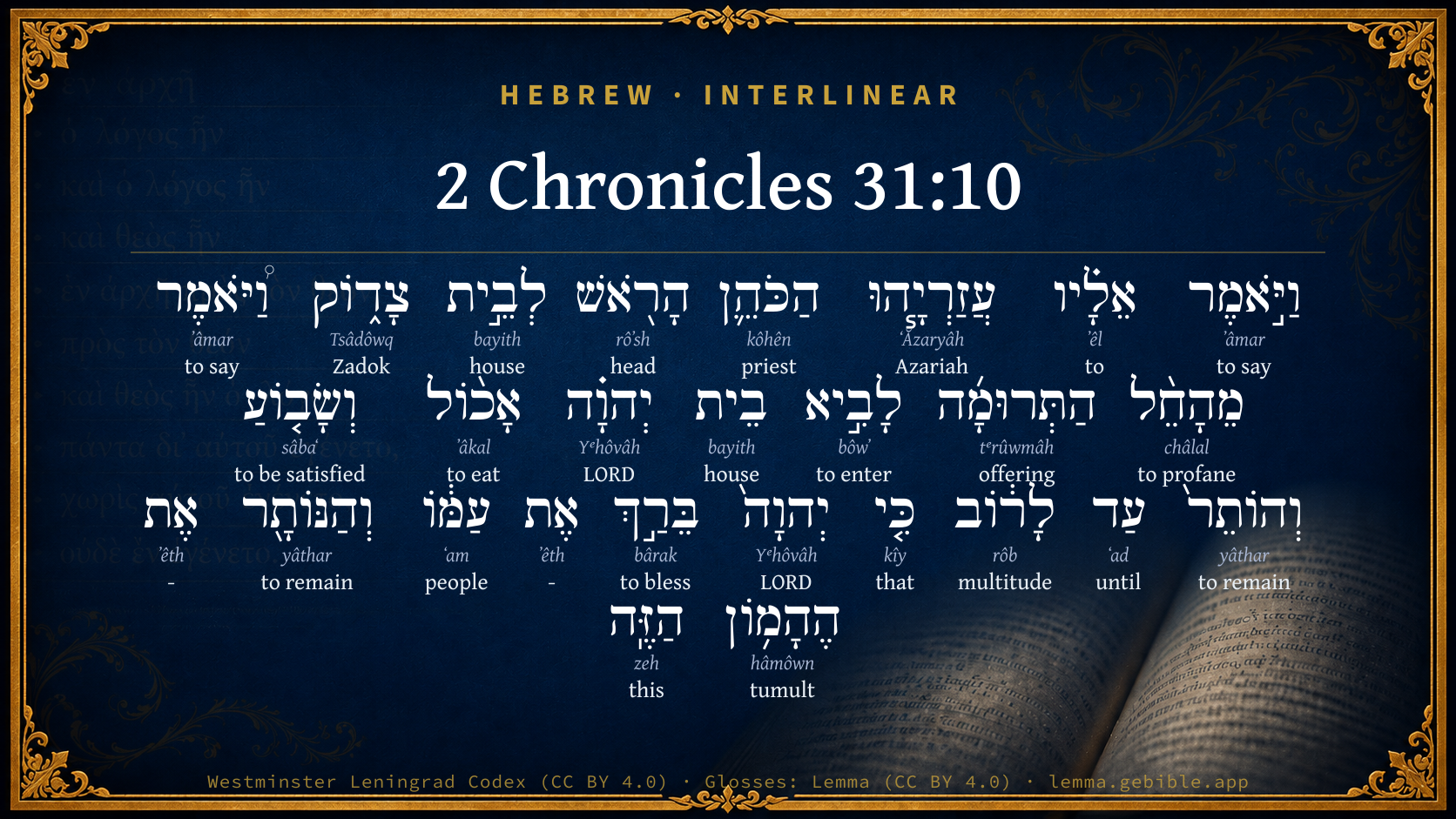
  1. וַיֹּ֣אמֶר ʼâmar H559 “and · to say” Conjunction + Verb, Qal, Sequential Imperfect, 3rd Person, Masculine, Singular
  2. אֵלָ֗יו ʼêl H413 “to · him” Preposition + Suffix, Personal, 3rd Person, Masculine, Singular
  3. הַכֹּהֵ֛ן kôhên H3548 “the · priest” Particle, Definite Article + Noun, Common, Masculine, Singular, Absolute
  4. הָרֹ֖אשׁ rôʼsh H7218 “the · head” Particle, Definite Article + Noun, Common, Masculine, Singular, Absolute
  5. לְבֵ֣ית bayith H1004 “to/for · house of” Preposition + Noun, Common, Masculine, Singular, Construct
  6. צָד֑וֹק Tsâdôwq H6659 “Zadok” Noun, Proper
  7. וַ֠יֹּאמֶר ʼâmar H559 “and · to say” Conjunction + Verb, Qal, Sequential Imperfect, 3rd Person, Masculine, Singular
  8. מֵהָחֵ֨ל châlal H2490 “from · to profane” Preposition + Verb, Hiphil, Infinitive Construct
  9. הַתְּרוּמָ֜ה tᵉrûwmâh H8641 “the · offering” Particle, Definite Article + Noun, Common, Feminine, Singular, Absolute
  10. לָבִ֣יא bôwʼ H935 “to enter” Preposition + Verb, Hiphil, Infinitive Construct
  11. בֵית bayith H1004 “house of” Noun, Common, Masculine, Singular, Construct
  12. יְהוָ֗ה Yᵉhôvâh H3068 “LORD” Noun, Proper
  13. אָכ֨וֹל ʼâkal H398 “to eat” Verb, Qal, Infinitive Absolute
  14. וְשָׂב֤וֹעַ sâbaʻ H7646 “and · to be satisfied” Conjunction + Verb, Qal, Infinitive Absolute
  15. וְהוֹתֵר֙ yâthar H3498 “and · to remain” Conjunction + Verb, Hiphil, Infinitive Absolute
  16. עַד ʻad H5704 “until” Preposition
  17. לָר֔וֹב rôb H7230 “to/for · multitude” Preposition + Noun, Common, Both, Singular, Absolute
  18. כִּ֤י kîy H3588 “that” Conjunction
  19. יְהוָה֙ Yᵉhôvâh H3068 “LORD” Noun, Proper
  20. בֵּרַ֣ךְ bârak H1288 “to bless” Verb, Piel, Perfect, 3rd Person, Masculine, Singular
  21. אֶת ʼêth H853 “-” Particle, Direct Object
  22. עַמּ֔וֹ ʻam H5971 “people · his” Noun, Common, Masculine, Singular, Construct + Suffix, Personal, 3rd Person, Masculine, Singular
  23. וְהַנּוֹתָ֖ר yâthar H3498 “and · the · remaining” Conjunction + Particle, Definite Article + Verb, Niphal, Participle Active, Masculine, Singular, Absolute
  24. אֶת ʼêth H853 “-” Particle, Direct Object
  25. הֶהָמ֥וֹן hâmôwn H1995 “the · tumult” Particle, Definite Article + Noun, Common, Masculine, Singular, Absolute
  26. הַזֶּֽה zeh H2088 “the · this” Particle, Definite Article + Pronoun, Demonstrative, Masculine, Singular

About this verse

These counts appear in no published source. They are computed here, from the morphology-tagged text and Lemma’s own curated glosses. What Lemma adds →

27
words
22
distinct lemmas
Historical
section

Shared distinctive vocabulary

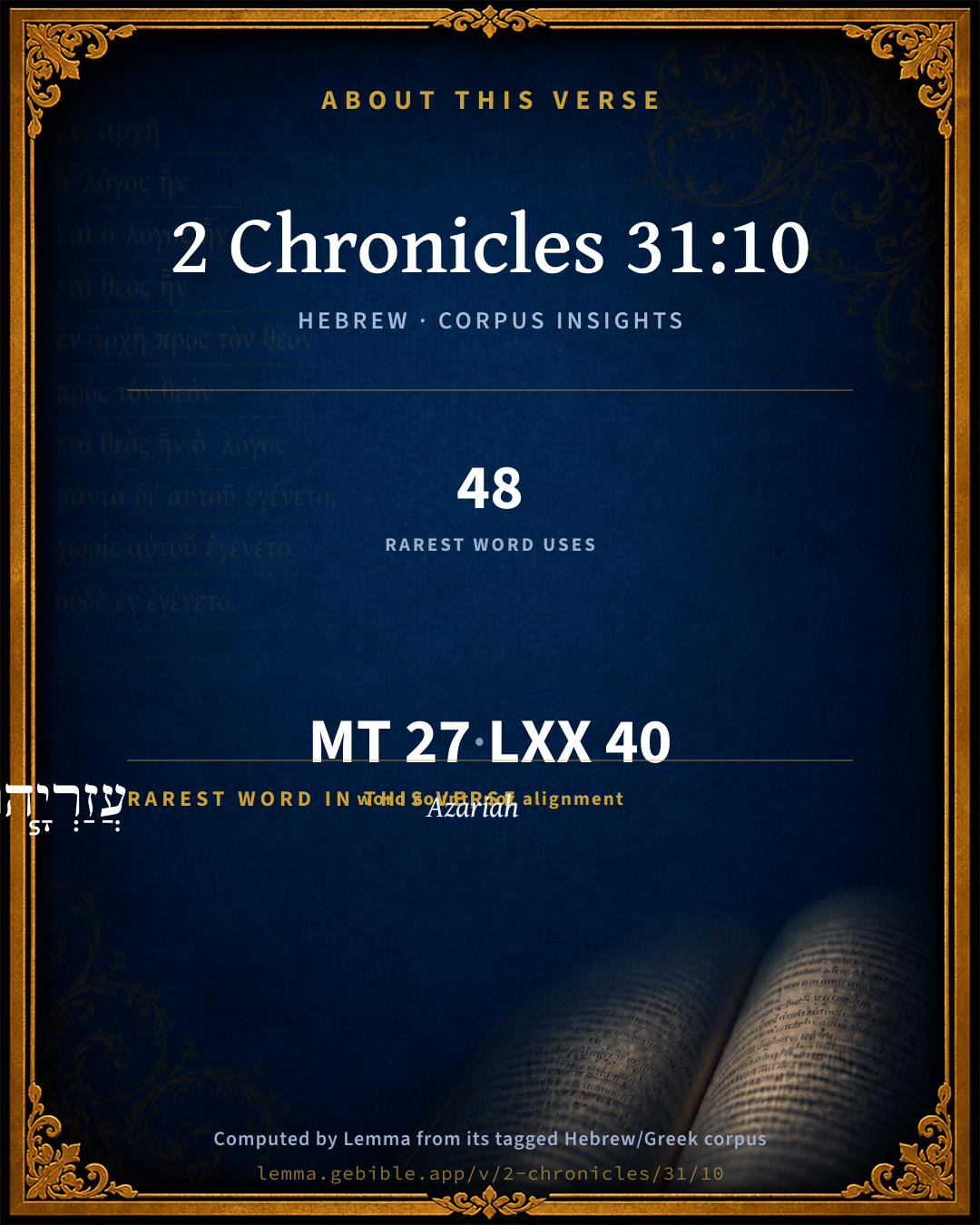
עֲזַרְיָ֧הוּ Azariah H5838 occurs in 44 verses of the Hebrew Bible. Also found in:

Grammatical profile

  • 9 verbs
  • 12 nouns
  • 1 pronoun
  • 2 prepositions
  • 1 conjunction
  • 2 particles

Verb forms

  • וַיֹּ֣אמֶר Qal · Sequential Imperfect
  • וַ֠יֹּאמֶר Qal · Sequential Imperfect
  • מֵהָחֵ֨ל Hiphil · Infinitive Construct
  • לָבִ֣יא Hiphil · Infinitive Construct
  • אָכ֨וֹל Qal · Infinitive Absolute
  • וְשָׂב֤וֹעַ Qal · Infinitive Absolute
  • וְהוֹתֵר֙ Hiphil · Infinitive Absolute
  • בֵּרַ֣ךְ Piel · Perfect
  • וְהַנּוֹתָ֖ר Niphal · Participle Active

Repetition

Words recur within this verse — often emphatic in Hebrew:

  • וַיֹּ֣אמֶר to say H559 ×2
  • לְבֵ֣ית house H1004 ×2
  • יְהוָ֗ה LORD H3068 ×2
  • וְהוֹתֵר֙ to remain H3498 ×2

Hebrew & Septuagint length

In English translation the verse runs 51 words from the Hebrew and 56 from the Septuagint (LXX English) — closely comparable.

A rough comparison of the two English renderings, which tokenize alike — not a word-level alignment.

Word counts can differ between the Hebrew and the Greek without any difference in meaning — e.g. the Hebrew direct-object marker אֵת has no separate Greek word, and Greek often adds the article ὁ.

In the original languages it is 27 Hebrew tokens and 40 Greek tokens — but the two are counted differently (Hebrew bundles its prefixes and suffixes into one token; the Greek is in lemma form), so that isn’t a like-for-like length.

Cross-references

21

Topical passages linked to 2 Chronicles 31:10 in the Treasury of Scripture Knowledge — connected by theme and wording, ordered by reader-vote popularity; previews shown in the World English Bible.

  • Malachi 3:10 Bring the whole tithe into the store-house, that there may be food in my house, and test me now in this," says Yahweh of hosts, "if I will not open you the windows of heaven, and pour you out a blessing, that there shall not be room enough for.
  • 1 Chronicles 6:8 and Ahitub became the father of Zadok, and Zadok became the father of Ahimaaz,
  • Genesis 26:12 Isaac sowed in that land, and reaped in the same year one hundred times what he planted. Yahweh blessed him.
  • Genesis 30:27–30 Laban said to him, "If now I have found favor in your eyes, stay here, for I have divined that Yahweh has blessed me for your sake."
  • Genesis 39:5 It happened from the time that he made him overseer in his house, and over all that he had, that Yahweh blessed the Egyptian's house for Joseph's sake; and the blessing of Yahweh was on all that he had, in the house and in the field.
  • Genesis 39:23 The keeper of the prison didn't look after anything that was under his hand, because Yahweh was with him; and that which he did, Yahweh made it prosper.
  • Leviticus 25:21 then I will command my blessing on you in the sixth year, and it shall bring forth fruit for the three years.
  • Leviticus 26:4–5 then I will give you your rains in their season, and the land shall yield its increase, and the trees of the field shall yield their fruit.
  • 1 Kings 2:35 The king put Benaiah the son of Jehoiada in his room over the host; and Zadok the priest did the king put in the room of Abiathar.
  • 2 Kings 4:43–44 His servant said, What, should I set this before a hundred men? But he said, Give the people, that they may eat; for thus says Yahweh, They shall eat, and shall leave of it.
  • 2 Chronicles 26:17 Azariah the priest went in after him, and with him eighty priests of Yahweh, who were valiant men:
  • Proverbs 3:9 Honor Yahweh with your substance, With the first fruits of all your increase:
  • Proverbs 10:22 Yahweh's blessing brings wealth, And he adds no trouble to it.
  • Ezekiel 44:15 But the priests the Levites, the sons of Zadok, who kept the charge of my sanctuary when the children of Israel went astray from me, they shall come near to me to minister to me; and they shall stand before me to offer to me the fat and the blood, says the Lord Yahweh:
  • Haggai 2:18 'Consider, please, from this day and backward, from the twenty-fourth day of the ninth month, since the day that the foundation of Yahweh's temple was laid, consider it.
  • Matthew 15:37 They all ate, and were filled. They took up seven baskets full of the broken pieces that were left over.
  • 2 Corinthians 9:8–11 And God is able to make all grace abound to you, that you, always having all sufficiency in everything, may abound to every good work.
  • Philippians 4:18 But I have all things, and abound. I am filled, having received from Epaphroditus the things that came from you, a sweet-smelling fragrance, an acceptable and well-pleasing sacrifice to God.
  • Deuteronomy 28:8 Yahweh will command the blessing on you in your barns, and in all that you put your hand to; and he will bless you in the land which Yahweh your God gives you.
  • 1 Chronicles 6:14 and Azariah became the father of Seraiah, and Seraiah became the father of Jehozadak;
  • 1 Timothy 4:8 For bodily exercise has some value, but godliness has value for all things, having the promise of the life which is now, and of that which is to come.

Cross-references courtesy of OpenBible.info (CC BY 4.0).

Hebrew and Greek witnesses Masoretic Hebrew ↔ Greek Septuagint

The same verse in the two great witnesses to the Old Testament, shown verse-for-verse.

These are two independent witnesses, not word-aligned to each other, and the Septuagint is shown in lemma (dictionary) form.

Hebrew 2 Chronicles 31:10 Masoretic · Westminster Leningrad Codex

וַיֹּ֣אמֶר אֵלָ֗יו עֲזַרְיָ֧הוּ הַכֹּהֵ֛ן הָרֹ֖אשׁ לְבֵ֣ית צָד֑וֹק וַ֠יֹּאמֶר מֵהָחֵ֨ל הַתְּרוּמָ֜ה לָבִ֣יא בֵית יְהוָ֗ה אָכ֨וֹל וְשָׂב֤וֹעַ וְהוֹתֵר֙ עַד לָר֔וֹב כִּ֤י יְהוָה֙ בֵּרַ֣ךְ אֶת עַמּ֔וֹ וְהַנּוֹתָ֖ר אֶת הֶהָמ֥וֹן הַזֶּֽה

Azariah the chief priest, of the house of Zadok, answered him and said, Since [the people] began to bring the offerings into the house of Yahweh, we have eaten and had enough, and have left plenty: for Yahweh has blessed his people; and that which is left is this great store.

World English Bible · Public Domain

Greek LXX 2 Chronicles 31:10 Septuagint · lemma form

καί εἶπον πρός αὐτός αζαριας ὁ ἱερεύς ὁ ἄρχων εἰς οἶκος σαδωκ καί εἶπον ἐκ ὅς ἄρχω ὁ ἀπαρχή φέρω εἰς οἶκος κύριος ἐσθίω καί πίνω καί καταλείπω ὅτι κύριος εὐλογέω ὁ λαός αὐτός καί καταλείπω ἔτι ὁ πλῆθος οὗτος

And Azarias the priest, the chief over the house of Sadoc, spoke to him, and said, From the time that the first fruits began to be brought into the house of the Lord, we have eaten and drunk, and left even abundantly; for the Lord has blessed his people, and we have left to this amount.

LXX2012 (modern English Septuagint) · Public Domain

On this verse, The Cambridge Bible for Schools and Colleges discusses the Septuagint’s reading. Read the note in Commentary ↓

Hebrew: Westminster Leningrad Codex (CC BY 4.0). Greek: Septuagint (public domain); English from LXX2012 (modern English Septuagint) (Public Domain). How the Septuagint differs from the Hebrew →

Commentary

Notes on 2 Chronicles 31:10 from classic Christian and Jewish commentators (each source and its license shown beneath its notes). The classic Christian expositions comment on the surrounding passage and are grouped to its opening verse, so a note may address several verses; the Jewish commentaries on the Tanakh (Rashi and others) are per-verse, so they appear only where the commentator wrote on this verse.

Lemma curates 59 commentaries, every one of them public domain or Creative Commons licensed, each selected and text-cleaned for this edition rather than reprinted as found. About our sources →

Trapp's Complete Commentary

John Trapp

2Ch 31:10 And Azariah the chief priest of the house of Zadok answered him, and said, Since [the people] began to bring the offerings into the house of the LORD, we have had enough to eat, and have left plenty: for the LORD hath blessed his people; and that which is left [is] this great store.

Ver. 10. And Azariah the chief priest.] The same, saith Lyra, that withstood Uzziah, with so much zeal and courage.

For the Lord hath blessed his people.] That is, His priests and people, saith Lavater, who have rightly used and not wasted God’s plenty.

John Trapp, A Commentary or Exposition upon All the Books of the Old and New Testament (1647–1656) — public domain. Text from a community e-Sword module.

Tyndale Open Study Notes

Tyndale Open Resources

31:10 The people’s great generosity is reminiscent of when the Tabernacle was first constructed (Exod 36:3-5).

Tyndale Open Study Notes — © Tyndale Open Resources, licensed CC BY-SA 4.0. Text via the HelloAO Bible API.

Geneva Bible (1599)

Geneva Bible translators

He showeth that this plenteous liberality is expedient for the maintenance of the ministers, and that God therefore prospereth his people, and increaseth by his blessing that which is given.

Geneva Bible (1599) marginal notes — public domain. Text via Bolls.life.

Jamieson, Fausset & Brown

Robert Jamieson, A. R. Fausset & David Brown

Azariah . . . answered . . . we have had enough--This is probably the person mentioned (Ch2 26:17), and his reply was to the following purport: There has been an abundant harvest, and a corresponding plenty in the incoming of first-fruits and tithes; the people have testified their gratitude to Him who has crowned the year with His goodness by their liberality towards His servants.

Jamieson, Fausset & Brown — Commentary Critical and Explanatory on the Whole Bible (1871) — public domain (CC PDM 1.0). Text via the HelloAO Bible API.

Ellicott's Commentary for English Readers

(10) Azariah.—Possibly the Azariah of 2Ch_26:17. If not, he is otherwise unknown.

Since the people began to bring the offerings.—Since they began to bring the Tĕrûmâh: a word which the Authorised Version usually renders “heave offering.” (See Note on 2Ch_31:6.)

To bring.—In the Hebrew a contracted form, recurring in Jer_39:7.

We have had enough to eat, and have left plenty.—Literally, Eating and being satisfied, and leaving over, even unto abundance (exclamatory infinitives). (Comp. Hos_4:2 for this construction.)

The Lord hath blessed his people.—So that they were able to give liberally.

That which is left.—After the maintenance o the priests has been subtracted.

This great store.—In the Hebrew these words are in the accusative case. Probably, therefore, the right reading is, “and there is left this great store” (omitting the article, and reading wĕ-nôthâr, with Kamp-hausen).

Chambers.—Cells; lĕshâkôth. (See Notes on 1Ch_9:26; 1Ch_23:28.) The preparation intended is probably nothing but the clearance and cleansing of some of these cells for the reception of the stores.

A Bible Commentary for English Readers, edited by Charles John Ellicott (1878–1897) — public domain. Text from a community e-Sword module.

The Cambridge Bible for Schools and Colleges

gen. ed. J. J. S. Perowne

10. Azariah the chief priest] Not mentioned in connexion with Hezekiah’s previous arrangements: he may have been only just appointed.

of the house of Zadok] Cp. 1Ch_24:1-4. There were two main families of priests, (1) the descendants of Eleazar the third son of Aaron, whose chief representative in David’s day was Zadok (hence they are here called “the house of Zadok”), (2) the descendants of Ithamar the fourth son of Aaron, represented in David’s time by Ahimelech (Saul’s victim) or by Abiathar (David’s protégé). The Chronicler prefers to name the descendants of Ithamar after Ahimelech (1Ch_24:3).

the offerings] R.V. the oblations (so also 2Ch_31:12). The Heb. word tìrûmâh denotes the heave offering (Lev_7:32), which the priest heaved (“lifted on high”) and was allowed to keep for himself.

we have had enough to eat) R.V. we have eaten and had enough.

hath blessed his people] Cp. Mal_3:10.

and that which is left is this great store] LXX., καὶ κατελίπομεν ἐπὶ τὸ πλῆθος τοῦτο, “we leave (‘have left’) this great store and more.” An apparently superfluous particle (eth) in the Heb. has troubled the translators and commentators.

The Cambridge Bible for Schools and Colleges (gen. ed. J. J. S. Perowne; Cambridge University Press, 1878–1918) — public domain. Text from a community e-Sword module.

John Gill's Exposition

Then Hezekiah commanded to prepare chambers in the house of the Lord,.... Either to build new ones, or fit up those that were built:

and they prepared them; got them ready to lay up the stores in.

John Gill's Exposition of the Whole Bible (1746–1763) — public domain (CC PDM 1.0). Text via the HelloAO Bible API.

Albert Barnes' Notes on the Bible

If this Azariah was the same as he who resisted Uzziah 2Ch 26:17-20, he must have held his office at least 33 years. Compare 2Ch 27:1; 2Ch 28:1.

The Lord hath blessed his people - i. e. God has made the harvest unusually abundant, and hence the great amount of tithes and first-fruits.

Albert Barnes' Notes on the Bible (1834–1885) — public domain. Text from a community e-Sword/MySword module.

Haydock's Catholic Bible Commentary

Sadoc, being his grandson, (1 Paralipomenon vi. 12.; C.) or the father of Sellum. Junius --- People, with abundance; so that more would belong to the priests. C.

George Leo Haydock (1774–1849), Haydock's Catholic Family Bible and Commentary, 1859 edition — public domain. Excludes Psalms (Douay-Rheims chapter numbering differs from Protestant) and Deuterocanonical books (Catholic canon only).

Matthew Poole's English Annotations

The chief priest of the house of Zadok; either,

1. The high priest, called also Zadok, 1Ch 6:12, because he was of his line and family. Or,

2. The chief priest, or the head of that family of Zadok, or of Eleazar; as there was another chief priest of the family of Abiathar, or of Ithamar; see 2Sa 8:17; 1Ch 24:3; but both subject to the high priest.

Since the people began to bring the offerings; which they did from the beginning of the harvest, according to the manner.

The Lord hath blessed his people in an extraordinary degree.

Matthew Poole's English Annotations on the Holy Bible (1683–1685) — public domain. Text from a community e-Sword/MySword module.

The Pulpit Commentary

Azariah chief priest of the house of Zadok. Though this Azariah be of the house of Zadok, he is not of the line of Jozadak; and we cannot be certain that he is one with him of 2Ch_26:17, 2Ch_26:20; in which case his grandson Jotham (2Ch_27:1) would be grandfather of Hezekiah, inferring a long term both for his office and his life.

The Pulpit Commentary (1880–1919), ed. H.D.M. Spence-Jones & Joseph S. Exell — public domain. Text from a community e-Sword module.

Rashi

Rabbi Shlomo Yitzchaki (Rashi)

And Azariah...said to him He lived in the days of Uzziah.

“From the beginning of bringing the heave-offering We have surely eaten, and not an incidental meal but we ate, were satisfied, and left over. Now what you are surprised about, that we ate four months, and nevertheless, their stacks are so large - this is because the Lord blessed His people and gave them abundant grains; therefore, they increased our heave-offerings and tithes.

and what is left over from this eating of ours.

is this abundance that you see: many stacks.

Rashi on the Tanakh — English translations: “The Judaica Press complete Tanach with Rashi, translated by A. J. Rosenberg” (CC BY 4.0); “Pentateuch with Rashi's commentary by M. Rosenbaum and A.M. Silbermann, 1929-1934” (public domain); “The Metsudah Tanach series, Lakewood, N.J” (CC BY 4.0); and “The Book of Joshua, Metsudah Publications, 1997” (CC BY 4.0). Text via Sefaria.

Lesson kit

Teaching starters — assembled from the data on this page, not authored interpretation. Every prompt links to the verse data it draws on. Edit before teaching.

2 Chronicles, in the Historical, opens this verse with 27 words (22 distinct Hebrew lemmas). Its most distinctive word is ʻĂzaryâh (“Azariah”). A historical commentator’s framing appears above. Read the whole chapter for the surrounding context.

Discussion questions

  1. The word ʻĂzaryâh carries the sense “Azariah.” How does it shape the verse?
  2. How does 1 Kings 4:2, which shares the word «Azariah», read alongside this verse?
  3. What does the repetition of “to say” (2× in this one verse) do in this verse?
  4. These translations render this verse differently; the difference is in the English rendering, not the original. What questions does that raise?
  5. «וַיֹּ֣אמֶר» is a Qal Sequential Imperfect verb. How does that grammatical form shape the action described?
  6. Compare how Trapp's Complete Commentary and Tyndale Open Study Notes read this verse. Where do they agree or differ?

Things to notice

Reading settings

Reading text

Shown beneath each verse's original-language words.

Old Testament
Old Testament edition

Read the OT as the Masoretic Hebrew (MT) or the Greek Septuagint (LXX).

English shown for the Greek Septuagint (in the Hebrew ↔ Greek comparison).

Comparing translations? Open the Compare panel on any verse page to stack up to four side by side.