Deuteronomy 28:4

Hebrew (Westminster Leningrad Codex) Deuteronomy 28:4 appears in the Hebrew Old Testament. The text above is from the Westminster Leningrad Codex. Each word links to its Strong’s number, a concise gloss, and parsing drawn from the Open Scriptures Hebrew Bible morphology. Click any word for its full Brown-Driver-Briggs (BDB) entry.
Download image
Cite this verse

Deuteronomy 28:4 (World English Bible). Public Domain. Lemma interlinear Bible study tool, https://lemma.gebible.app/v/deuteronomy/28/4.

Show BibTeX & RIS
BibTeX
RIS
English Translation
Blessed shall be the fruit of your body, and the fruit of your ground, and the fruit of your animals, the increase of your cattle, and the young of your flock.
World English Bible · Public Domain
Download a study sheet

One document with this verse’s original text, its word-by-word gloss line, the meaning frame, cross-references with their text, attributed commentary, and full source and license credits — printable, and it pastes into notes with its structure intact.

This verse Autodidact and up

Study sheet (.html) Plain text (.txt)

A passage Seminary Student

Up to 50 verses in one chapter. A passage sheet keeps up to 6 commentary sources and 12 cross-references per verse, in the order this page ranks them, and says so on the sheet whenever that leaves anything out. Ask for a single verse and you get the Autodidact verse sheet above.

Everything on this page stays free to read, with no account — the sheet is a download of what is already on screen, not access to it.

Want to remove ads? Support Godless Engineer
Compare translations 3

The same verse in 3 English versions, stacked beneath the original-language interlinear above. Click any original word for its lexicon entry.

Each is an independent rendering of the whole verse — the interlinear is not word-aligned to these translations.

Highlighted words mark where these versions differ — a whole-verse word diff, not a word-by-word alignment.

  • World English Bible Public Domain
    Blessed shall be the fruit of your body, and the fruit of your ground, and the fruit of your animals, the increase of your cattle, and the young of your flock.
  • King James Version Public Domain
    Blessed shall be the fruit of thy body, and the fruit of thy ground, and the fruit of thy cattle, the increase of thy kine, and the flocks of thy sheep.
  • unfoldingWord Literal Text CC BY-SA 4.0
    Blessed the fruit of your womb and the fruit of your land and the fruit of your cattle, the increase of your cattle and the young of your flock.

unfoldingWord Literal Text — © unfoldingWord, licensed CC BY-SA 4.0. Word-aligned USFM3 via Door43 (git.door43.org/unfoldingWord/en_ult).

Versions to compare (up to 4)

3 of 4 selected

Show all 18 translations

Every available English version of this verse, each an independent rendering of the whole verse.

  • World English Bible Public Domain
    Blessed shall be the fruit of your body, and the fruit of your ground, and the fruit of your animals, the increase of your cattle, and the young of your flock.
  • Berean Standard Bible Public Domain
    The fruit of your womb will be blessed, as well as the produce of your land and the offspring of your livestock—the calves of your herds and the lambs of your flocks.
  • Majority Standard Bible Public Domain
    The fruit of your womb will be blessed, as well as the produce of your land and the offspring of your livestock—the calves of your herds and the lambs of your flocks.
  • King James Version Public Domain
    Blessed shall be the fruit of thy body, and the fruit of thy ground, and the fruit of thy cattle, the increase of thy kine, and the flocks of thy sheep.
  • American Standard Version (1901) Public Domain
    Blessed shall be the fruit of thy body, and the fruit of thy ground, and the fruit of thy beasts, the increase of thy cattle, and the young of thy flock.
  • Revised Version (1885) Public Domain
    Blessed shall be the fruit of thy body, and the fruit of thy ground, and the fruit of thy cattle, the increase of thy kine, and the young of thy flock.
  • Geneva Bible (1599) Public Domain
    Blessed shalbe the fruite of thy body, and ye fruite of thy ground, and the fruite of thy cattel, the increase of thy kine, and ye flocks of thy sheepe.
  • Douay-Rheims (1899) Public Domain
    Blessed shall be the fruit of thy womb, and the fruit of thy ground, and the fruit of thy cattle, the droves of thy herds, and the folds of thy sheep.
  • Young's Literal Translation Public Domain
    `Blessed `is' the fruit of thy womb, and the fruit of thy ground, and the fruit of thy cattle, increase of thine oxen, and wealth of thy flock.
  • Literal Standard Version CC BY-SA 4.0
    Blessed [is] the fruit of your womb, and the fruit of your ground, and the fruit of your livestock, the increase of your oxen, and the wealth of your flock.
  • Unlocked Literal Bible CC BY-SA 4.0
    Blessed will be the fruit of your body, and the fruit of your ground, and the fruit of your beasts, the increase of your cattle, and the young of your flock.
  • unfoldingWord Literal Text CC BY-SA 4.0
    Blessed the fruit of your womb and the fruit of your land and the fruit of your cattle, the increase of your cattle and the young of your flock.
  • Darby Bible Public Domain
    Blessed shall be the fruit of thy womb, and the fruit of thy ground, and the fruit of thy cattle, the offspring of thy kine, and the increase of thy sheep.
  • World Messianic Bible Public Domain
    You shall be blessed in the fruit of your body, the fruit of your ground, the fruit of your animals, the increase of your livestock, and the young of your flock.
  • Webster's Bible Public Domain
    Blessed shall be the fruit of thy body, and the fruit of thy ground, and the fruit of thy cattle, the increase of thy cattle, and the flocks of thy sheep.
  • Free Bible Version CC BY-SA 4.0
    You will be blessed with many children. You will be blessed with good harvests. You will be blessed with livestock—your cattle will have many calves, and your sheep will have many lambs.
  • Bible in Basic English Public Domain
    A blessing will be on the fruit of your body, and on the fruit of your land, on the fruit of your cattle, the increase of your herd, and the young of your flock.
  • JPS Tanakh (1917) Public Domain
    Blessed shall be the fruit of thy body, and the fruit of thy land, and the fruit of thy cattle, the increase of thy kine, and the young of thy flock.

Literal Standard Version (2020), Covenant Press — licensed CC BY-SA 4.0. Text via the HelloAO Bible API (eBible.org). Unlocked Literal Bible (unfoldingWord) — licensed CC BY-SA 4.0. Text via the HelloAO Bible API (eBible.org). unfoldingWord Literal Text — © unfoldingWord, licensed CC BY-SA 4.0. Word-aligned USFM3 via Door43 (git.door43.org/unfoldingWord/en_ult). Free Bible Version, Dr. Jonathan Gallagher — licensed CC BY-SA 4.0. Text via the HelloAO Bible API (eBible.org).

Word by word

More ways to search: Search by grammar → Find every occurrence → Compare this word →

Practice this passage: Drill this verse → Learn its vocabulary →

וְעַשְׁתְּר֥וֹת
ʻashtᵉrâh
H6251
“and · ewe”
Conjunction + Noun, Proper
Part of Speech
Conjunction + Noun
Type
Proper
Full BDB Definition

Origin: probably from H6238

TWOT: 1718a

ewe, flock, increase, young
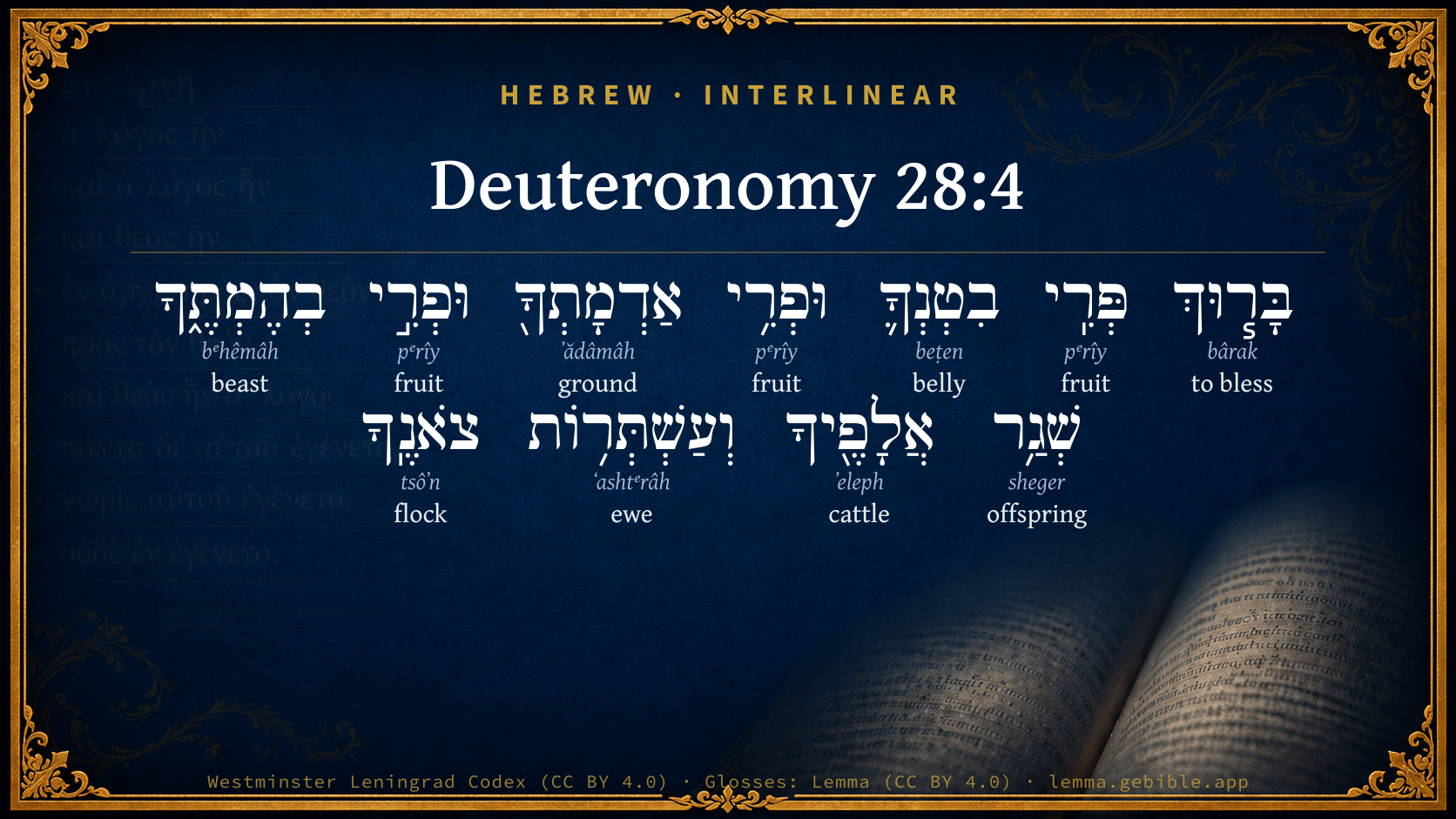
  1. בָּר֧וּךְ bârak H1288 “blessed” Verb, Qal, Participle Passive, Masculine, Singular, Absolute
  2. פְּרִֽי pᵉrîy H6529 “fruit of” Noun, Common, Masculine, Singular, Construct
  3. בִטְנְךָ֛ beṭen H990 “belly · your” Noun, Common, Feminine, Singular, Construct + Suffix, Personal, 2nd Person, Masculine, Singular
  4. וּפְרִ֥י pᵉrîy H6529 “and · fruit of” Conjunction + Noun, Common, Masculine, Singular, Construct
  5. אַדְמָתְךָ֖ ʼădâmâh H127 “ground · your” Noun, Common, Feminine, Singular, Construct + Suffix, Personal, 2nd Person, Masculine, Singular
  6. וּפְרִ֣י pᵉrîy H6529 “and · fruit of” Conjunction + Noun, Common, Masculine, Singular, Construct
  7. בְהֶמְתֶּ֑ךָ bᵉhêmâh H929 “beast · your” Noun, Common, Feminine, Singular, Construct + Suffix, Personal, 2nd Person, Masculine, Singular
  8. שְׁגַ֥ר sheger H7698 “offspring of” Noun, Common, Masculine, Singular, Construct
  9. אֲלָפֶ֖יךָ ʼeleph H504 “cattle · your” Noun, Common, Masculine, Plural, Construct + Suffix, Personal, 2nd Person, Masculine, Singular
  10. צֹאנֶֽךָ tsôʼn H6629 “flock · your” Noun, Common, Both, Singular, Construct + Suffix, Personal, 2nd Person, Masculine, Singular

About this verse

These counts appear in no published source. They are computed here, from the morphology-tagged text and Lemma’s own curated glosses. What Lemma adds →

11
words
9
distinct lemmas
Pentateuch
section

Notable vocabulary

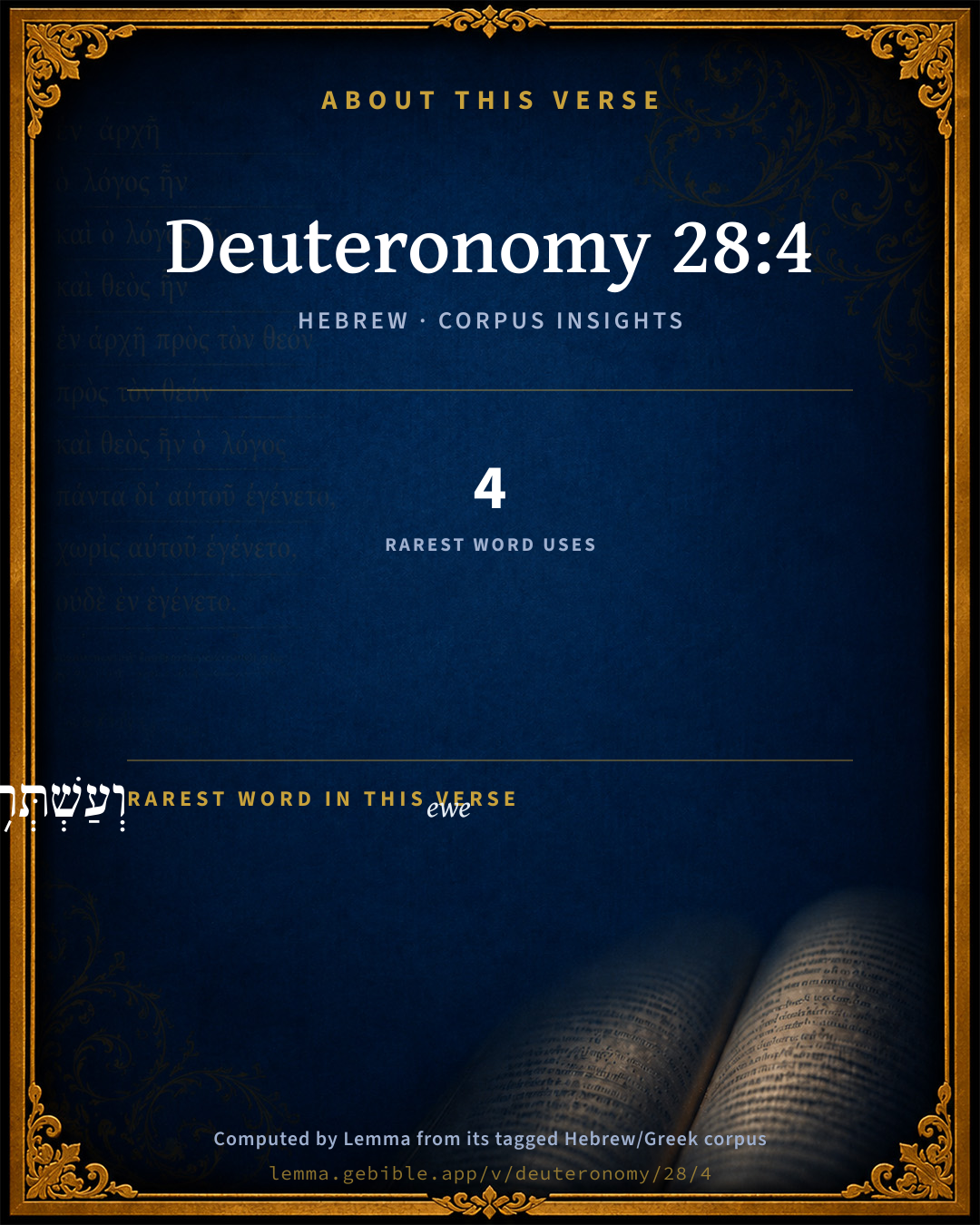
The rarest word here is וְעַשְׁתְּר֥וֹת ewe H6251 — appearing just 4 times in the whole Hebrew Bible.

Shared distinctive vocabulary

וְעַשְׁתְּר֥וֹת ewe H6251 occurs in 4 verses of the Hebrew Bible. Also found in:

Grammatical profile

  • 1 verb
  • 10 nouns

Verb forms

  • בָּר֧וּךְ Qal · Participle Passive

Repetition

A word recurs within this verse — often emphatic in Hebrew:

  • פְּרִֽי fruit H6529 ×3

Hebrew & Septuagint length

In English translation the verse runs 31 words from the Hebrew and 26 from the Septuagint (LXX English) — closely comparable.

A rough comparison of the two English renderings, which tokenize alike — not a word-level alignment.

Word counts can differ between the Hebrew and the Greek without any difference in meaning — e.g. the Hebrew direct-object marker אֵת has no separate Greek word, and Greek often adds the article ὁ.

Cross-references

12

Topical passages linked to Deuteronomy 28:4 in the Treasury of Scripture Knowledge — connected by theme and wording, ordered by reader-vote popularity; previews shown in the World English Bible.

  • Proverbs 10:22 Yahweh's blessing brings wealth, And he adds no trouble to it.
  • Genesis 49:25 Even by the God of your father, who will help you, By the Almighty, who will bless you, With blessings of heaven above, Blessings of the deep that lies below, Blessings of the breasts, and of the womb.
  • Deuteronomy 7:13 and he will love you, and bless you, and multiply you; he will also bless the fruit of your body and the fruit of your ground, your grain and your new wine and your oil, the increase of your cattle and the young of your flock, in the land which he swore to your fathers to give you.
  • Psalms 128:3 Your wife will be as a fruitful vine, In the innermost parts of your house; Your children like olive plants, Around your table.
  • Leviticus 26:9 "'I will have respect for you, and make you fruitful, and multiply you, and will establish my covenant with you.
  • Deuteronomy 28:11 Yahweh will make you plenteous for good, in the fruit of your body, and in the fruit of your cattle, and in the fruit of your ground, in the land which Yahweh swore to your fathers to give you.
  • Psalms 107:38 He blesses them also, so that they are multiplied greatly. He doesn't allow their cattle to decrease.
  • Genesis 22:17 that in blessing I will bless you, and in multiplying I will multiply your seed as the stars of the heavens, and as the sand which is on the seashore. Your seed will possess the gate of his enemies.
  • Psalms 127:3 Behold, children are a heritage of Yahweh. The fruit of the womb is his reward.
  • Proverbs 13:22 A good man leaves an inheritance to his children's children, But the wealth of the sinner is stored for the righteous.
  • Proverbs 20:7 A righteous man walks in integrity. Blessed are his children after him.
  • 1 Timothy 4:8 For bodily exercise has some value, but godliness has value for all things, having the promise of the life which is now, and of that which is to come.

Cross-references courtesy of OpenBible.info (CC BY 4.0).

Hebrew and Greek witnesses Masoretic Hebrew ↔ Greek Septuagint

The same verse in the two great witnesses to the Old Testament, shown verse-for-verse.

These are two independent witnesses, not word-aligned to each other, and the Septuagint is shown in lemma (dictionary) form.

Hebrew Deuteronomy 28:4 Masoretic · Westminster Leningrad Codex

בָּר֧וּךְ פְּרִֽי בִטְנְךָ֛ וּפְרִ֥י אַדְמָתְךָ֖ וּפְרִ֣י בְהֶמְתֶּ֑ךָ שְׁגַ֥ר אֲלָפֶ֖יךָ וְעַשְׁתְּר֥וֹת צֹאנֶֽךָ

Blessed shall be the fruit of your body, and the fruit of your ground, and the fruit of your animals, the increase of your cattle, and the young of your flock.

World English Bible · Public Domain

Greek LXX Deuteronomy 28:4 Septuagint · lemma form

εὐλογέω ὁ ἔκγονος ὁ κοιλία σύ καί ὁ γένημα ὁ γῆ σύ ὁ βουκόλιον ὁ βοῦς σύ καί ὁ ποίμνιον ὁ πρόβατον σύ

Blessed shall be the offspring of your body, and the fruits of your land, and the herds of your oxen, and the flocks of your sheep.

LXX2012 (modern English Septuagint) · Public Domain

Hebrew: Westminster Leningrad Codex (CC BY 4.0). Greek: Septuagint (public domain); English from LXX2012 (modern English Septuagint) (Public Domain). How the Septuagint differs from the Hebrew →

Targum (Aramaic paraphrase)

2

The Targum is the ancient Jewish Aramaic paraphrase of the Hebrew Scriptures — an interpretive translation, not the Hebrew text itself. Onkelos (literal) and Pseudo-Jonathan (expansive) render the Torah, and Jonathan the Prophets. Coverage is partial: where no permissively-licensed English translation exists for a verse, only the Aramaic is shown. This is verse-level text, not a word-by-word alignment to the Hebrew.

  1. Targum Onkelos Torah (Genesis–Deuteronomy)
    בְּרִיךְ וַלְדָא דִמְעָךְ וְאִבָּא דְאַרְעָךְ וּוַלְדָא דִבְעִירָךְ בַּקְרֵי תוֹרָיךְ וְעֶדְרֵי עָנָךְ

    (no public-domain English translation for this verse)

    Targum Onkelos — Aramaic: “Onkelos Genesis” (public domain); “Onkelos Exodus” (public domain); “Onkelos Leviticus” (public domain); “Onkelos Numbers” (public domain); “Onkelos Deuteronomy” (public domain). English: “Sefaria Community Translation” (CC0 1.0 (public-domain dedication)); “J.W. Etheridge. The Targums of Onkelos and Jonathan Ben Uzziel on the Pentateuch. London: Longmans, Green, 1862” (public domain). Text via Sefaria.

  2. Targum Pseudo-Jonathan Torah (Genesis–Deuteronomy)
    בְּרִיכִין וַלְדֵי מֵעֵיכוֹן וּפֵירֵי אַרְעֲכוֹן בַּקְרֵי תוֹרֵיכוֹן וְעֶדְרֵי עָנֵיכוֹן

    Blessed shall be the offspring of your womb, the fruits of your ground, the oxen of your herd, and the flocks of your sheep.

    Targum Pseudo-Jonathan — Aramaic: “Targum Jonathan on Genesis” (public domain); “Targum Jonathan on Exodus” (public domain); “Targum Jonathan on Leviticus” (public domain); “Targum Jonathan on Numbers” (public domain); “Targum Jonathan on Deuteronomy” (public domain). English: “The Targum of Jonathan ben Uzziel, trans. J. W. Etheridge, London, 1862” (public domain). Text via Sefaria.

Commentary

Notes on Deuteronomy 28:4 from classic Christian and Jewish commentators (each source and its license shown beneath its notes). The classic Christian expositions comment on the surrounding passage and are grouped to its opening verse, so a note may address several verses; the Jewish commentaries on the Tanakh (Rashi and others) are per-verse, so they appear only where the commentator wrote on this verse.

Lemma curates 59 commentaries, every one of them public domain or Creative Commons licensed, each selected and text-cleaned for this edition rather than reprinted as found. About our sources →

Trapp's Complete Commentary

John Trapp

Deu 28:4 Blessed [shall be] the fruit of thy body, and the fruit of thy ground, and the fruit of thy cattle, the increase of thy kine, and the flocks of thy sheep.

Ver. 4. The fruit of thy body.] Which is thy chief possession; but without my blessing will be bitter sweets, {a} "Blessed is the man that hath his quiver full of such as are the arrows of a strong man," {Psa 128:3-4} the knottiness of whose nature is refined and reformed, and made smooth by grace. Arrows be not arrows by growth, but by art: what can better preserve Jacob from confusion, or his face from waxing pale, than when he shall see his children, the work of God’s hands, framed and fitted by the word in regeneration, and the duties of new obedience? This will make him to sanctify God, even to sanctify the Holy One, and with singular encouragement from the God of Israel. {Isa 29:22-23}

{a} Dulcis acerbitas, amarissima voluptas. - Tertul.

John Trapp, A Commentary or Exposition upon All the Books of the Old and New Testament (1647–1656) — public domain. Text from a community e-Sword module.

Geneva Bible (1599)

Geneva Bible translators

Thy children and succession.

Geneva Bible (1599) marginal notes — public domain. Text via Bolls.life.

Adam Clarke's Commentary

Verse 4. Fruit of thy body] All thy children. Increase of thy kine, c. every animal employed in domestic and agricultural purposes shall be under the especial protection of Divine Providence.

Adam Clarke's Commentary on the Bible (1810–1826) — public domain. Text from a community e-Sword/MySword module.

The Cambridge Bible for Schools and Colleges

gen. ed. J. J. S. Perowne

4. Cp. Deu_7:13, and notes there on increase and young.

The Cambridge Bible for Schools and Colleges (gen. ed. J. J. S. Perowne; Cambridge University Press, 1878–1918) — public domain. Text from a community e-Sword module.

John Gill's Exposition

Blessed shall be the fruit of thy body,.... Their children, of which they should have many, and these live; be healthful, thrive, and arrive to manhood, and increase and perpetuate their families. Grotius thinks this was eminently fulfilled in Mary, the mother of our Lord; see Luk 1:42,

and the fruit of thy ground; of their gardens, orchards, and fields; grass for the cattle, and the wheat, barley, vines, figs, pomegranates, olives, and dates for the use of men:

and the fruit of thy cattle; which being distinguished from oxen and sheep in the following clause, must be understood of camels and asses, which were used for the carriage both of persons and burdens, and were very serviceable, and were a considerable part of their substance in those countries; see Job 1:3,

the increase of thy kine, and the flocks of thy sheep; of their cows and oxen, and of their sheep and goats, which were very increasing creatures, and in the increase of which much of their outward happiness lay; see Psa 144:13.

John Gill's Exposition of the Whole Bible (1746–1763) — public domain (CC PDM 1.0). Text via the HelloAO Bible API.

Haydock's Catholic Bible Commentary

Womb. This was most fully verified in the birth of the Messias, as the Holy Ghost insinuated, by causing St. Elizabeth to address these words to the mother of Jesus Christ, Luke i. 42. (Calmet)

George Leo Haydock (1774–1849), Haydock's Catholic Family Bible and Commentary, 1859 edition — public domain. Excludes Psalms (Douay-Rheims chapter numbering differs from Protestant) and Deuterocanonical books (Catholic canon only).

Rashi

Rabbi Shlomo Yitzchaki (Rashi)

שגר אלפיך means the young of thy cattle which the animal casts out (שגר) of its womb.

ועשתרות צאנך — Understand this as the Targum does: the flocks of thy herd. Our Rabbis asked, “Why are they (the flocks of sheep) called עשתרות? Because, replied they, they enrich (מעשירות) their owners (through the sale of their wool, etc.) and make them strong as עשתרות — which are strong rocks (Chullin 84b; cf. Rashi on Deuteronomy 7:13).

Rashi on the Tanakh — English translations: “The Judaica Press complete Tanach with Rashi, translated by A. J. Rosenberg” (CC BY 4.0); “Pentateuch with Rashi's commentary by M. Rosenbaum and A.M. Silbermann, 1929-1934” (public domain); “The Metsudah Tanach series, Lakewood, N.J” (CC BY 4.0); and “The Book of Joshua, Metsudah Publications, 1997” (CC BY 4.0). Text via Sefaria.

Lesson kit

Teaching starters — assembled from the data on this page, not authored interpretation. Every prompt links to the verse data it draws on. Edit before teaching.

Deuteronomy, in the Pentateuch, opens this verse with 11 words (9 distinct Hebrew lemmas). Its most distinctive word is ʻashtᵉrâh (“ewe”). A historical commentator’s framing appears above. Read the whole chapter for the surrounding context.

Discussion questions

  1. What does “ewe” (ʻashtᵉrâh) contribute to the verse as a whole?
  2. How does Deuteronomy 7:13, which shares the word «ewe», read alongside this verse?
  3. What does the repetition of “fruit” (3× in this one verse) do in this verse?
  4. The translations on this page render this verse differently — a whole-verse word diff, not a word-by-word alignment. What might account for the different wordings?
  5. «בָּר֧וּךְ» is a Qal Participle Passive verb. How does that grammatical form shape the action described?
  6. Compare how Trapp's Complete Commentary and Geneva Bible (1599) read this verse. Where do they agree or differ?

Things to notice

Reading settings

Reading text

Shown beneath each verse's original-language words.

Old Testament
Old Testament edition

Read the OT as the Masoretic Hebrew (MT) or the Greek Septuagint (LXX).

English shown for the Greek Septuagint (in the Hebrew ↔ Greek comparison).

Comparing translations? Open the Compare panel on any verse page to stack up to four side by side.