
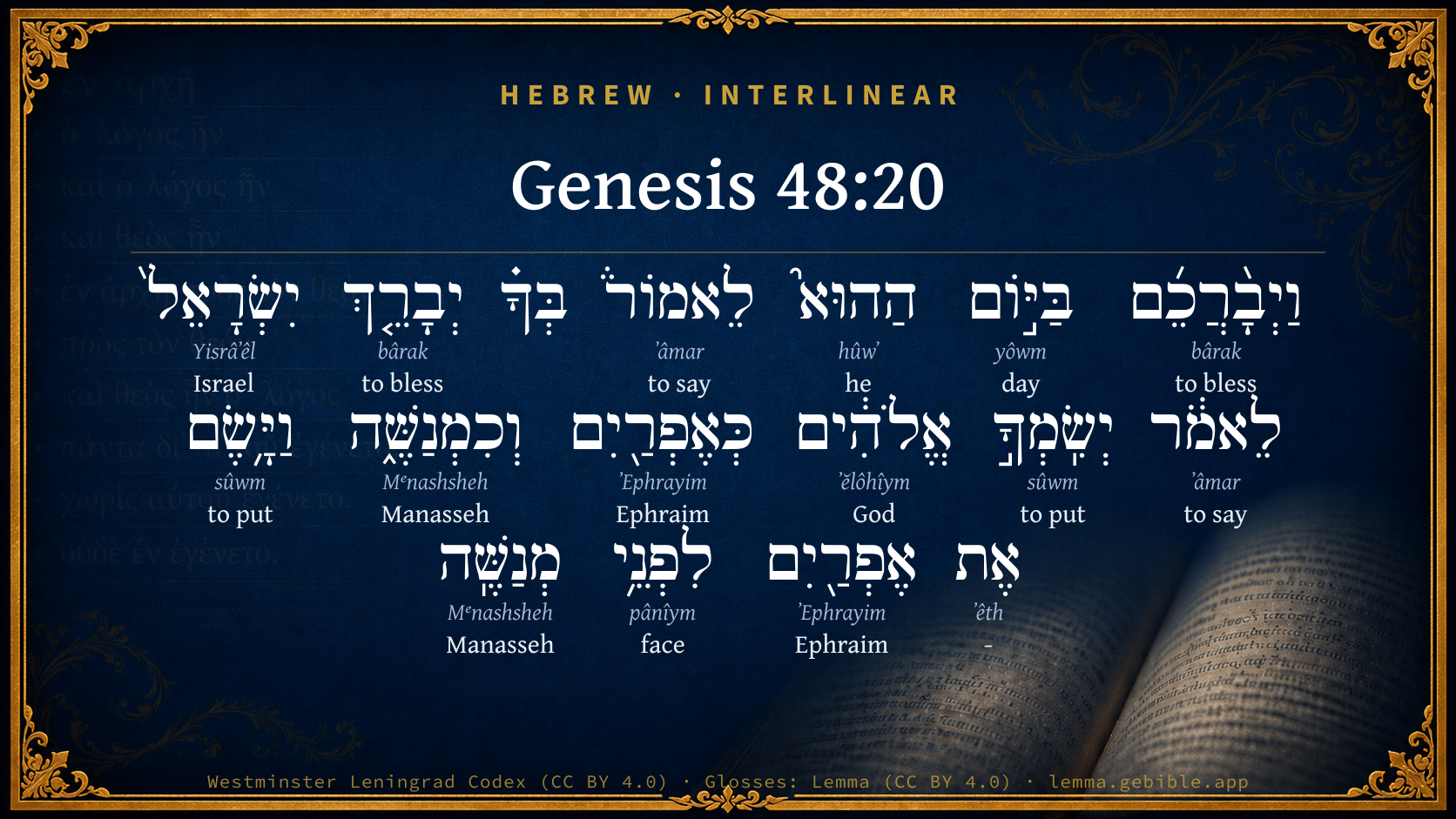
Genesis 48:20

Hebrew (Westminster Leningrad Codex) Genesis 48:20 appears in the Hebrew Old Testament. The text above is from the Westminster Leningrad Codex. Each word links to its Strong’s number, a concise gloss, and parsing drawn from the Open Scriptures Hebrew Bible morphology. Click any word for its full Brown-Driver-Briggs (BDB) entry.
Download image
Cite this verse

Genesis 48:20 (World English Bible). Public Domain. Lemma interlinear Bible study tool, https://lemma.gebible.app/v/genesis/48/20.

Show BibTeX & RIS
BibTeX
RIS
English Translation
He blessed them that day, saying, "In you will Israel bless, saying, 'God make you as Ephraim and as Manasseh'" He set Ephraim before Manasseh.
World English Bible · Public Domain
Download a study sheet

One document with this verse’s original text, its word-by-word gloss line, the meaning frame, cross-references with their text, attributed commentary, and full source and license credits — printable, and it pastes into notes with its structure intact.

This verse Autodidact and up

Study sheet (.html) Plain text (.txt)

A passage Seminary Student

Up to 50 verses in one chapter. A passage sheet keeps up to 6 commentary sources and 12 cross-references per verse, in the order this page ranks them, and says so on the sheet whenever that leaves anything out. Ask for a single verse and you get the Autodidact verse sheet above.

Everything on this page stays free to read, with no account — the sheet is a download of what is already on screen, not access to it.

Want to remove ads? Support Godless Engineer
Compare translations 3

The same verse in 3 English versions, stacked beneath the original-language interlinear above. Click any original word for its lexicon entry.

Each is an independent rendering of the whole verse — the interlinear is not word-aligned to these translations.

Highlighted words mark where these versions differ — a whole-verse word diff, not a word-by-word alignment.

  • World English Bible Public Domain
    He blessed them that day, saying, "In you will Israel bless, saying, 'God make you as Ephraim and as Manasseh'" He set Ephraim before Manasseh.
  • King James Version Public Domain
    And he blessed them that day, saying, In thee shall Israel bless, saying, God make thee as Ephraim and as Manasseh: and he set Ephraim before Manasseh.
  • unfoldingWord Literal Text CC BY-SA 4.0
    And he blessed them on that day, saying, “By you Israel will bless, saying, ‘May God make you like Ephraim and like Manasseh.’” So he put Ephraim before Manasseh.

unfoldingWord Literal Text — © unfoldingWord, licensed CC BY-SA 4.0. Word-aligned USFM3 via Door43 (git.door43.org/unfoldingWord/en_ult).

Versions to compare (up to 4)

3 of 4 selected

Show all 18 translations

Every available English version of this verse, each an independent rendering of the whole verse.

  • World English Bible Public Domain
    He blessed them that day, saying, "In you will Israel bless, saying, 'God make you as Ephraim and as Manasseh'" He set Ephraim before Manasseh.
  • Berean Standard Bible Public Domain
    So that day Jacob blessed them and said: “By you shall Israel pronounce this blessing: ‘May God make you like Ephraim and Manasseh.’” So he put Ephraim before Manasseh.
  • Majority Standard Bible Public Domain
    So that day Jacob blessed them and said: “By you shall Israel pronounce this blessing: ‘May God make you like Ephraim and Manasseh.’” So he put Ephraim before Manasseh.
  • King James Version Public Domain
    And he blessed them that day, saying, In thee shall Israel bless, saying, God make thee as Ephraim and as Manasseh: and he set Ephraim before Manasseh.
  • American Standard Version (1901) Public Domain
    And he blessed them that day, saying, In thee will Israel bless, saying, God make thee as Ephraim and as Manasseh: and he set Ephraim before Manasseh.
  • Revised Version (1885) Public Domain
    And he blessed them that day, saying, In thee shall Israel bless, saying, God make thee as Ephraim and as Manasseh: and he set Ephraim before Manasseh.
  • Geneva Bible (1599) Public Domain
    So he blessed them that day, and sayde, In thee Israel shall blesse, and say, God make thee as Ephraim and as Manasseh. and he set Ephraim before Manasseh.
  • Douay-Rheims (1899) Public Domain
    And he blessed them at that time, saying: In thee shall Israel be blessed, and it shall be said: God do to thee as to Ephraim, and as to Manasses. And he set Ephraim before Manasses.
  • Young's Literal Translation Public Domain
    and he blesseth them in that day, saying, `By thee doth Israel bless, saying, God set thee as Ephraim and as Manasseh;' and he setteth Ephraim before Manasseh.
  • Literal Standard Version CC BY-SA 4.0
    and he blesses them in that day, saying, “By you does Israel bless, saying, God set you as Ephraim and as Manasseh”; and he sets Ephraim before Manasseh.
  • Unlocked Literal Bible CC BY-SA 4.0
    Israel blessed them that day with these words, “The people of Israel will pronounce blessings by your names saying, 'May God make you like Ephraim and like Manasseh'.” In this way, Israel put Ephraim before Manasseh.
  • unfoldingWord Literal Text CC BY-SA 4.0
    And he blessed them on that day, saying, “By you Israel will bless, saying, ‘May God make you like Ephraim and like Manasseh.’” So he put Ephraim before Manasseh.
  • Darby Bible Public Domain
    And he blessed them that day, saying, In thee will Israel bless, saying, God make thee as Ephraim and Manasseh! And he set Ephraim before Manasseh.
  • World Messianic Bible Public Domain
    He blessed them that day, saying, “Israel will bless in your name, saying, ‘God make you as Ephraim and as Manasseh’” He set Ephraim before Manasseh.
  • Webster's Bible Public Domain
    And he blessed them that day, saying, In thee shall Israel bless, saying, God make thee as Ephraim and as Manasseh: and he set Ephraim before Manasseh.
  • Free Bible Version CC BY-SA 4.0
    So Israel blessed them that day and said: “In the future the people of Israel will use your names to give a blessing, saying, ‘May God bless you like he did Ephraim and Manasseh.’” In saying this he placed Ephraim before Manasseh.
  • Bible in Basic English Public Domain
    So he gave them his blessing that day, saying, You will be the sign of blessing in Israel, for they will say, May God make you like Ephraim and Manasseh; and he put Ephraim before Manasseh.
  • JPS Tanakh (1917) Public Domain
    And he blessed them that day, saying: 'By thee shall Israel bless, saying: God make thee as Ephraim and as Manasseh.' And he set Ephraim before Manasseh.

Literal Standard Version (2020), Covenant Press — licensed CC BY-SA 4.0. Text via the HelloAO Bible API (eBible.org). Unlocked Literal Bible (unfoldingWord) — licensed CC BY-SA 4.0. Text via the HelloAO Bible API (eBible.org). unfoldingWord Literal Text — © unfoldingWord, licensed CC BY-SA 4.0. Word-aligned USFM3 via Door43 (git.door43.org/unfoldingWord/en_ult). Free Bible Version, Dr. Jonathan Gallagher — licensed CC BY-SA 4.0. Text via the HelloAO Bible API (eBible.org).

Word by word

More ways to search: Search by grammar → Find every occurrence → Compare this word →

Practice this passage: Drill this verse → Learn its vocabulary →

וְכִמְנַשֶּׁ֑ה
Mᵉnashsheh
H4519
“and · like/as · Manasseh”
Conjunction + Preposition + Noun, Proper
Part of Speech
Conjunction + Preposition + Noun
Type
Proper
Full BDB Definition

Origin: from H5382

TWOT: 1217

Manasseh = "causing to forget" - the eldest son of Joseph and progenitor of the tribe of Manasseh - the tribe descended from Manasseh - the territory occupied by the tribe of Manasseh - son of king Hezekiah of Judah and himself king of Judah; he was the immediate and direct cause for the exile - a descendant of Pahath-moab who put away a foreign wife in the time of Ezra - a descendant of Hashum who put away a foreign wife in the time of Ezra
  1. וַיְבָ֨רֲכֵ֜ם bârak H1288 “and · to bless · them” Conjunction + Verb, Piel, Sequential Imperfect, 3rd Person, Masculine, Singular + Suffix, Personal, 3rd Person, Masculine, Plural
  2. בַּיּ֣וֹם yôwm H3117 “in/at the · day” Preposition, Determined + Noun, Common, Masculine, Singular, Absolute
  3. הַהוּא֮ hûwʼ H1931 “the · he” Particle, Definite Article + Pronoun, Personal, 3rd Person, Masculine, Singular
  4. לֵאמוֹר֒ ʼâmar H559 “to say” Preposition + Verb, Qal, Infinitive Construct
  5. יְבָרֵ֤ךְ bârak H1288 “to bless” Verb, Piel, Imperfect, 3rd Person, Masculine, Singular
  6. יִשְׂרָאֵל֙ Yisrâʼêl H3478 “Israel” Noun, Proper
  7. לֵאמֹ֔ר ʼâmar H559 “to say” Preposition + Verb, Qal, Infinitive Construct
  8. יְשִֽׂמְךָ֣ sûwm H7760 “to put · you” Verb, Qal, Imperfect, 3rd Person, Masculine, Singular + Suffix, Personal, 2nd Person, Masculine, Singular
  9. אֱלֹהִ֔ים ʼĕlôhîym H430 “God(s)” Noun, Common, Masculine, Plural, Absolute
  10. כְּאֶפְרַ֖יִם ʼEphrayim H669 “like/as · Ephraim” Preposition + Noun, Proper
  11. וַיָּ֥שֶׂם sûwm H7760 “and · to put” Conjunction + Verb, Qal, Sequential Imperfect, 3rd Person, Masculine, Singular
  12. אֶת ʼêth H853 “-” Particle, Direct Object
  13. אֶפְרַ֖יִם ʼEphrayim H669 “Ephraim” Noun, Proper
  14. לִפְנֵ֥י pânîym H6440 “to/for · face(s) of” Preposition + Noun, Common, Both, Plural, Construct
  15. מְנַשֶּֽׁה Mᵉnashsheh H4519 “Manasseh” Noun, Proper

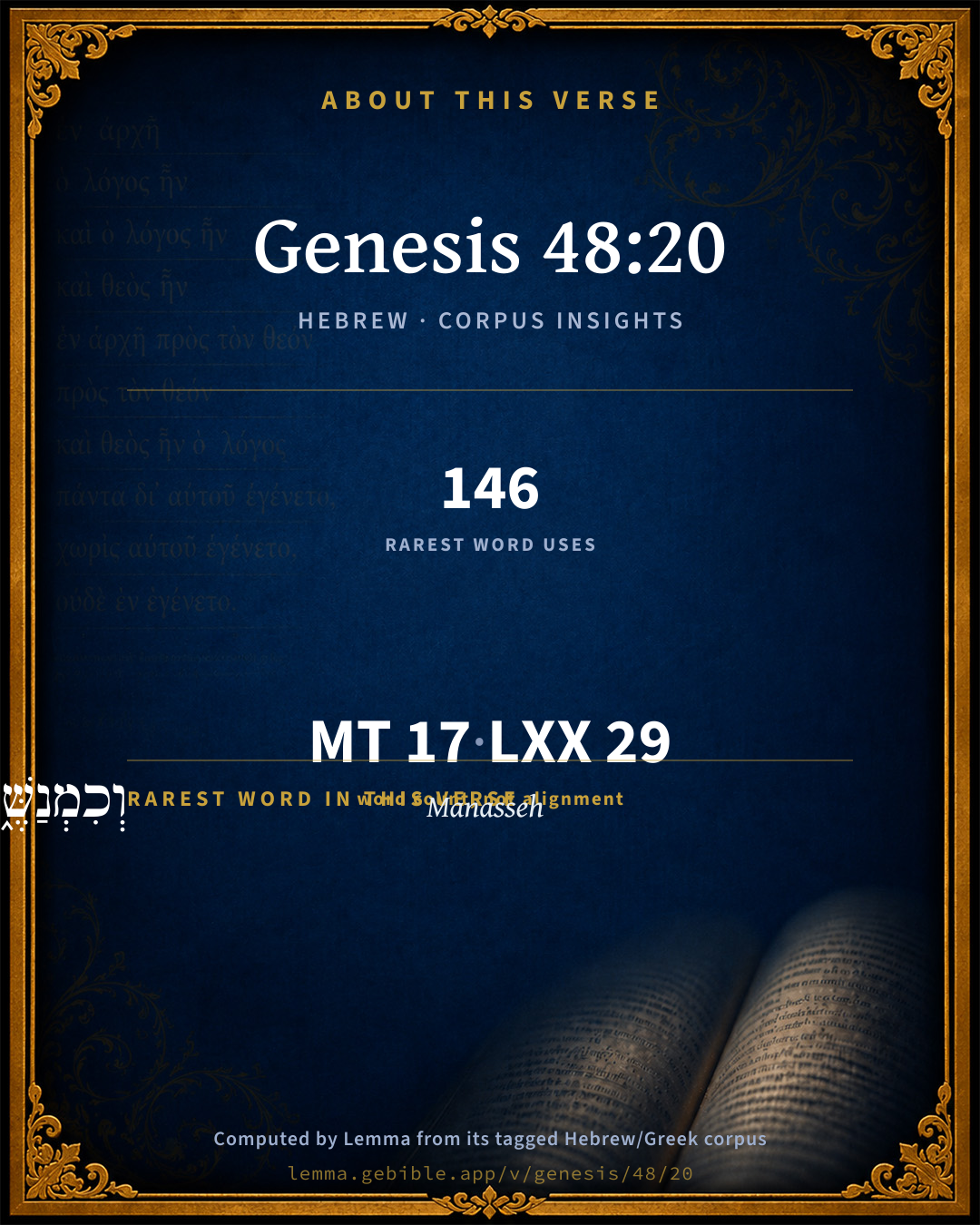
About this verse

These counts appear in no published source. They are computed here, from the morphology-tagged text and Lemma’s own curated glosses. What Lemma adds →

17
words
11
distinct lemmas
Pentateuch
section

Grammatical profile

  • 6 verbs
  • 8 nouns
  • 1 pronoun
  • 1 preposition
  • 1 particle

Verb forms

  • וַיְבָ֨רֲכֵ֜ם Piel · Sequential Imperfect
  • לֵאמוֹר֒ Qal · Infinitive Construct
  • יְבָרֵ֤ךְ Piel · Imperfect
  • לֵאמֹ֔ר Qal · Infinitive Construct
  • יְשִֽׂמְךָ֣ Qal · Imperfect
  • וַיָּ֥שֶׂם Qal · Sequential Imperfect

Repetition

Words recur within this verse — often emphatic in Hebrew:

  • וַיְבָ֨רֲכֵ֜ם to bless H1288 ×2
  • לֵאמוֹר֒ to say H559 ×2
  • יְשִֽׂמְךָ֣ to put H7760 ×2
  • כְּאֶפְרַ֖יִם Ephraim H669 ×2
  • וְכִמְנַשֶּׁ֑ה Manasseh H4519 ×2

Hebrew & Septuagint length

In English translation the verse runs 25 words from the Hebrew and 28 from the Septuagint (LXX English) — closely comparable.

A rough comparison of the two English renderings, which tokenize alike — not a word-level alignment.

Word counts can differ between the Hebrew and the Greek without any difference in meaning — e.g. the Hebrew direct-object marker אֵת has no separate Greek word, and Greek often adds the article ὁ.

In the original languages it is 17 Hebrew tokens and 29 Greek tokens — but the two are counted differently (Hebrew bundles its prefixes and suffixes into one token; the Greek is in lemma form), so that isn’t a like-for-like length.

Cross-references

9

Topical passages linked to Genesis 48:20 in the Treasury of Scripture Knowledge — connected by theme and wording, ordered by reader-vote popularity; previews shown in the World English Bible.

  • Ruth 4:11–12 All the people who were in the gate, and the elders, said, We are witnesses. Yahweh make the woman who has come into your house like Rachel and like Leah, which two built the house of Israel: and do you worthily in Ephrathah, and be famous in Bethlehem:
  • Genesis 24:60 They blessed Rebekah, and said to her, "Our sister, may you be the mother of thousands of ten thousands, and let your seed possess the gate of those who hate them."
  • Genesis 28:3 May God Almighty bless you, and make you fruitful, and multiply you, that you may be a company of peoples,
  • Numbers 2:18–21 "On the west side shall be the standard of the camp of Ephraim according to their divisions: and the prince of the children of Ephraim shall be Elishama the son of Ammihud.
  • Numbers 7:48 On the seventh day Elishama the son of Ammihud, prince of the children of Ephraim
  • Numbers 7:54 On the eighth day Gamaliel the son of Pedahzur, prince of the children of Manasseh
  • Numbers 10:22–23 The standard of the camp of the children of Ephraim set forward according to their hosts: and over his host was Elishama the son of Ammihud.
  • Numbers 13:11 Of the tribe of Joseph, [namely], of the tribe of Manasseh, Gaddi the son of Susi.
  • Numbers 13:16 These are the names of the men who Moses sent to spy out the land. Moses called Hoshea the son of Nun Joshua.

Cross-references courtesy of OpenBible.info (CC BY 4.0).

Hebrew and Greek witnesses Masoretic Hebrew ↔ Greek Septuagint

The same verse in the two great witnesses to the Old Testament, shown verse-for-verse.

These are two independent witnesses, not word-aligned to each other, and the Septuagint is shown in lemma (dictionary) form.

Hebrew Genesis 48:20 Masoretic · Westminster Leningrad Codex

וַיְבָ֨רֲכֵ֜ם בַּיּ֣וֹם הַהוּא֮ לֵאמוֹר֒ בְּךָ֗ יְבָרֵ֤ךְ יִשְׂרָאֵל֙ לֵאמֹ֔ר יְשִֽׂמְךָ֣ אֱלֹהִ֔ים כְּאֶפְרַ֖יִם וְכִמְנַשֶּׁ֑ה וַיָּ֥שֶׂם אֶת אֶפְרַ֖יִם לִפְנֵ֥י מְנַשֶּֽׁה

He blessed them that day, saying, "In you will Israel bless, saying, 'God make you as Ephraim and as Manasseh'" He set Ephraim before Manasseh.

World English Bible · Public Domain

Greek LXX Genesis 48:20 Septuagint · lemma form

καί εὐλογέω αὐτός ἐν ὁ ἡμέρα ἐκεῖνος λέγω ἐν σύ εὐλογέω ἰσραήλ λέγω ποιέω σύ ὁ θεός ὡς ἐφράιμ καί ὡς μανασσή καί τίθημι ὁ ἐφράιμ ἔμπροσθεν ὁ μανασσή

And he blessed them in that day, saying, In you shall Israel be blessed, saying, God make you as Ephraim and Manasse; and he set Ephraim before Manasse.

LXX2012 (modern English Septuagint) · Public Domain

On this verse, The Cambridge Bible for Schools and Colleges discusses the Septuagint’s reading. Read the note in Commentary ↓

Hebrew: Westminster Leningrad Codex (CC BY 4.0). Greek: Septuagint (public domain); English from LXX2012 (modern English Septuagint) (Public Domain). How the Septuagint differs from the Hebrew →

Targum (Aramaic paraphrase)

2

The Targum is the ancient Jewish Aramaic paraphrase of the Hebrew Scriptures — an interpretive translation, not the Hebrew text itself. Onkelos (literal) and Pseudo-Jonathan (expansive) render the Torah, and Jonathan the Prophets. Coverage is partial: where no permissively-licensed English translation exists for a verse, only the Aramaic is shown. This is verse-level text, not a word-by-word alignment to the Hebrew.

  1. Targum Onkelos Torah (Genesis–Deuteronomy)
    וּבְרֵיכִנּוּן בְּיוֹמָא הַהוּא לְמֵימַר בָּךְ יְבָרֵךְ יִשְׂרָאֵל לְמֵימַר יְשַׁוִּינָךְ יְיָ כְּאֶפְרַיִם וְכִמְנַשֶּׁה וְשַׁוִּי יָת אֶפְרַיִם קֳדָם מְנַשֶּׁה

    (no public-domain English translation for this verse)

    Targum Onkelos — Aramaic: “Onkelos Genesis” (public domain); “Onkelos Exodus” (public domain); “Onkelos Leviticus” (public domain); “Onkelos Numbers” (public domain); “Onkelos Deuteronomy” (public domain). English: “Sefaria Community Translation” (CC0 1.0 (public-domain dedication)); “J.W. Etheridge. The Targums of Onkelos and Jonathan Ben Uzziel on the Pentateuch. London: Longmans, Green, 1862” (public domain). Text via Sefaria.

  2. Targum Pseudo-Jonathan Torah (Genesis–Deuteronomy)
    וּבָרֵיכִינוּן בְּיוֹמָא הַהוּא לְמֵימַר בָּךְ יוֹסֵף בְּרִי יְבָרְכוּן בֵּית יִשְרָאֵל יַת יְנוּקָא בְּיוֹמָא דִמְהוּלְתָּא לְמֵימָר יְשַׁוִינָךְ יְיָ כְּאֶפְרַיִם וְכִמְנַשֶׁה וּבְמִנְיַן שִׁבְטַיָא יִתְמַנֵי רַבָּא דְאֶפְרַיִם קֳדָם רַבָּא דִמְנַשֶׁה וּמַנֵי יַת אֶפְרַיִם דִיהֵי קֳדָם מְנַשֶׁה

    And he blessed them in that day, saying, In thee, Joseph my son, shall the house of Israel bless their infants in the day of their circumcision, saying, The Lord set thee as Ephraim and as Menasheh. And in the numbering of the tribes the prince of Ephraim shall be numbered before the prince of Menasheh. And he appointed that Ephraim should be before Menasheh.

    Targum Pseudo-Jonathan — Aramaic: “Targum Jonathan on Genesis” (public domain); “Targum Jonathan on Exodus” (public domain); “Targum Jonathan on Leviticus” (public domain); “Targum Jonathan on Numbers” (public domain); “Targum Jonathan on Deuteronomy” (public domain). English: “The Targum of Jonathan ben Uzziel, trans. J. W. Etheridge, London, 1862” (public domain). Text via Sefaria.

Commentary

Notes on Genesis 48:20 from classic Christian and Jewish commentators (each source and its license shown beneath its notes). The classic Christian expositions comment on the surrounding passage and are grouped to its opening verse, so a note may address several verses; the Jewish commentaries on the Tanakh (Rashi and others) are per-verse, so they appear only where the commentator wrote on this verse.

Lemma curates 59 commentaries, every one of them public domain or Creative Commons licensed, each selected and text-cleaned for this edition rather than reprinted as found. About our sources →

Trapp's Complete Commentary

John Trapp

Gen 48:20 And he blessed them that day, saying, In thee shall Israel bless, saying, God make thee as Ephraim and as Manasseh: and he set Ephraim before Manasseh.

Ver. 20. And he set Ephraim before.] God many times sets the younger before the elder; makes the last to be first, and the first last; to show the freedom of his grace, and that "he seeth not as man seeth." {1Sa 16:7} The maids were first purified and perfmned, before Ahasuerus chose one. But Christ first loves, and then purifies his Church, {Eph 5:25-26} and loves, because he loves. {Deu 7:7-8} "And hath mercy on whom he will have mercy." {Rom 9:18}

John Trapp, A Commentary or Exposition upon All the Books of the Old and New Testament (1647–1656) — public domain. Text from a community e-Sword module.

Geneva Bible (1599)

Geneva Bible translators

In whom God’s graces should manifestly appear.

Geneva Bible (1599) marginal notes — public domain. Text via Bolls.life.

Adam Clarke's Commentary

Verse 20. In thee shall Israel bless] That is, in future generations the Israelites shall take their form of wishing prosperity to any nation or family from the circumstance of the good which it shall be known that God has done to Ephraim and Manasseh: May God make thee as fruitful as Ephraim, and multiply thee as Manasseh! So, to their daughters when married, the Jewish women are accustomed to say, God make thee as Sarah and Rebekah! The forms are still in use.

Adam Clarke's Commentary on the Bible (1810–1826) — public domain. Text from a community e-Sword/MySword module.

Ellicott's Commentary for English Readers

(20) In thee shall Israel bless.—In conformity with these words, the Israelites to this day use Jacob’s formula in blessing their children.

A Bible Commentary for English Readers, edited by Charles John Ellicott (1878–1897) — public domain. Text from a community e-Sword module.

The Cambridge Bible for Schools and Colleges

gen. ed. J. J. S. Perowne

20. In] Better, as marg., By. The meaning is that the blessing upon Ephraim and Manasseh shall be quoted as a formula for the invocation of Divine favour. Compare the blessing in Rth_4:11-12.

bless] The versions, LXX, Vulg., and Syriac, give the passive “shall be blessed.”

The Cambridge Bible for Schools and Colleges (gen. ed. J. J. S. Perowne; Cambridge University Press, 1878–1918) — public domain. Text from a community e-Sword module.

John Gill's Exposition

And he blessed them that day,.... That Joseph visited him, and this be did "by faith"; believing that what he had said concerning them would be accomplished, as the apostle observes, Heb 11:21,

saying, in thee shall Israel bless; in Joseph, as the Targum of Jonathan, that is, in his seed, in his sons Ephraim and Manasseh, when the Israelites blessed any, they should make use of their names:

saying, God make thee as Ephraim and Manasseh: as great and honourable, as rich and wealthy, as fruitful and prosperous as they; and the Targum says, this custom continues with the Jews to this day, to put their hands on persons to bless them; if a son, they say,"God make thee as Ephraim and Manasseh;''if a daughter,"God make thee as Sarah and Rebekah:"

and he set Ephraim before Manasseh; not only in this form of benediction, but in all that he had said and done before; he preferred him to Manasseh by putting his right hand upon him, and giving him the superior blessing: and it is no unusual thing for the younger to be set before the elder, both by God and man, but especially by the Lord, who seeth not as man seeth, and proceeds not according to carnal descent, or those rules men go by: there had been many instances before this, as Abel was preferred to Cain, Shem to Japheth, Abraham to Nahor, Isaac to Ishmael, and Jacob to Esau; as there were after it, as Moses to Aaron, and David to his brethren.

John Gill's Exposition of the Whole Bible (1746–1763) — public domain (CC PDM 1.0). Text via the HelloAO Bible API.

Haydock's Catholic Bible Commentary

In thee, Joseph. Septuagint, "in you," Ephraim and Manasses. The Israelites shall wish the same happiness to their greatest friends, as that which you have enjoyed. (Menochius)

George Leo Haydock (1774–1849), Haydock's Catholic Family Bible and Commentary, 1859 edition — public domain. Excludes Psalms (Douay-Rheims chapter numbering differs from Protestant) and Deuterocanonical books (Catholic canon only).

Matthew Poole's English Annotations

In thee, i.e. in thy seed, as appears both from the relative

them here, and from Gen 48:15, where his blessing of them is called the blessing of Joseph; and from the following words, where this is interpreted of

Ephraim and

Manasseh. And

in thee, or in thy seed, i.e. using their names in the form or words of blessing, as eminent examples of blessedness.

Matthew Poole's English Annotations on the Holy Bible (1683–1685) — public domain. Text from a community e-Sword/MySword module.

Whedon's Commentary on the Bible

Daniel D. Whedon

20. He set Ephraim before Manasseh — “Manasseh outnumbered Ephraim at the Exodus, (Num_26:34; Num_26:37,) yet the Ephraimite Joshua led Israel into Canaan, and after the conquest Ephraim was the leading tribe of the northern nation, as Judah was of the southern.” — Newhall.

Daniel D. Whedon (gen. ed.), Commentary on the Old and New Testaments (1874–1909) — public domain. Text from a community e-Sword module.

The Pulpit Commentary

And he (i.e. Jacob) blessed them that day, saying, In thee (i.e. in Joseph, who is still identified with his sons) shall Israel (the nation) bless, saying, God (Elohim, the supreme source of all blessing) make thee as Ephraim and as Manasseh: and he set Ephraim Before Manasseh the position of his hands, and the terms of the blessing" (Keil).

The Pulpit Commentary (1880–1919), ed. H.D.M. Spence-Jones & Joseph S. Exell — public domain. Text from a community e-Sword module.

Rashi

Rabbi Shlomo Yitzchaki (Rashi)

בך יברך ישראל IN THEE SHALL ISRAEL BLESS — When one wishes to bless his sons he will bless them by reciting the formula with which they were blessed — a man will say to his son, “God make thee as Ephraim and as Manasseh.”

וישם את אפרים AND HE PUT EPHRAIM etc. — i.e. in the blessing he bestowed upon them he put Ephraim’s name before that of Manasseh, so giving him precedence over his brother when the Israelites encamped and marched beneath their banners in the wilderness (cf. Numbers 2:18 and Numbers 10:22), and when at the dedication of the altar by the princes of the tribes each brought his gifts (cf. Numbers 7:48 Numbers 7:54). (see Genesis Rabbah 97:5).

Rashi on the Tanakh — English translations: “The Judaica Press complete Tanach with Rashi, translated by A. J. Rosenberg” (CC BY 4.0); “Pentateuch with Rashi's commentary by M. Rosenbaum and A.M. Silbermann, 1929-1934” (public domain); “The Metsudah Tanach series, Lakewood, N.J” (CC BY 4.0); and “The Book of Joshua, Metsudah Publications, 1997” (CC BY 4.0). Text via Sefaria.

Ramban (Nachmanides)

Rabbi Moshe ben Nachman (Ramban / Nachmanides)

AND HE BLESSED THEM THAT DAY. The meaning of that day is that since Joseph had urged him to give Menasheh precedence, the verse declares that Jacob did not wish to remove his right hand from Ephraim’s head to that of Menasheh. Moreover, he expressly reiterated on that occasion, in Joseph’s presence, when he blessed them by saying, As Ephraim and Menasheh. And he put Ephraim before Menasheh in all his blessings.

BY THEE SHALL ISRAEL BLESS. Jacob addressed this to Joseph. It means that the nation of Israel will bless with your children and say to those being blessed, God make thee as Ephraim and Menasheh.

Ramban (Nachmanides) on the Tanakh — English translation: “Commentary on the Torah by Ramban (Nachmanides). Translated and annotated by Charles B. Chavel. New York, Shilo Pub. House, 1971-1976” (CC BY 4.0). Text via Sefaria.

Radak

Rabbi David Kimhi (Radak)

ויברכם. He bestowed an additional blessing on them on the same day, saying: בך יברך ישראל, whenever an Israelite wants to bestow a blessing on his son, he will preface it with the words: ישימך אלוקים כאפרים ומנשה. “May the Lord make you to be like Ephrayim and Menashe.”

וישם את אפרים לפני מנשה, in this blessing too, Yaakov placed more emphasis on the recipient of the blessing being compared to Ephrayim, the younger of Joseph’s sons, by mentioning his name first. Even the choice of words כאפרים וכמנשה instead of כאפרים ומנשה, indicated clearly that Menashe was considered secondary in Yaakov’s blessing. He was considered the adjunct.

Radak on the Tanakh — English translations: “Sefaria Community Translation” (CC0 1.0 (public-domain dedication)); “Eliyahu Munk, HaChut Hameshulash” (CC BY 4.0); “Rabbi Mike Feuer, Jerusalem Anthology” (CC BY 4.0); and “R. David Kimhi on the first book of Psalms, Translated by R.G. Finch, London, 1919” (public domain). Text via Sefaria.

Lesson kit

Teaching starters — assembled from the data on this page, not authored interpretation. Every prompt links to the verse data it draws on. Edit before teaching.

Genesis, in the Pentateuch, opens this verse with 17 words (11 distinct Hebrew lemmas). Its most distinctive word is Mᵉnashsheh (“Manasseh”). A historical commentator’s framing appears above. Read the whole chapter for the surrounding context.

Discussion questions

  1. The word Mᵉnashsheh carries the sense “Manasseh.” How does it shape the verse?
  2. Ruth 4:11–12 shares this passage’s theme. How do the two illuminate each other?
  3. “to bless” occurs 2× in this one verse. What is the effect of the repetition?
  4. These translations render this verse differently. What is at stake in choosing one wording over another?
  5. The verb «וַיְבָ֨רֲכֵ֜ם» is Piel Sequential Imperfect. How does its form color the action?
  6. Reading how Trapp's Complete Commentary and Geneva Bible (1599) read this verse, where do the two commentators agree and where do they part?

Things to notice

Reading settings

Reading text

Shown beneath each verse's original-language words.

Old Testament
Old Testament edition

Read the OT as the Masoretic Hebrew (MT) or the Greek Septuagint (LXX).

English shown for the Greek Septuagint (in the Hebrew ↔ Greek comparison).

Comparing translations? Open the Compare panel on any verse page to stack up to four side by side.