
2 Samuel 6:12

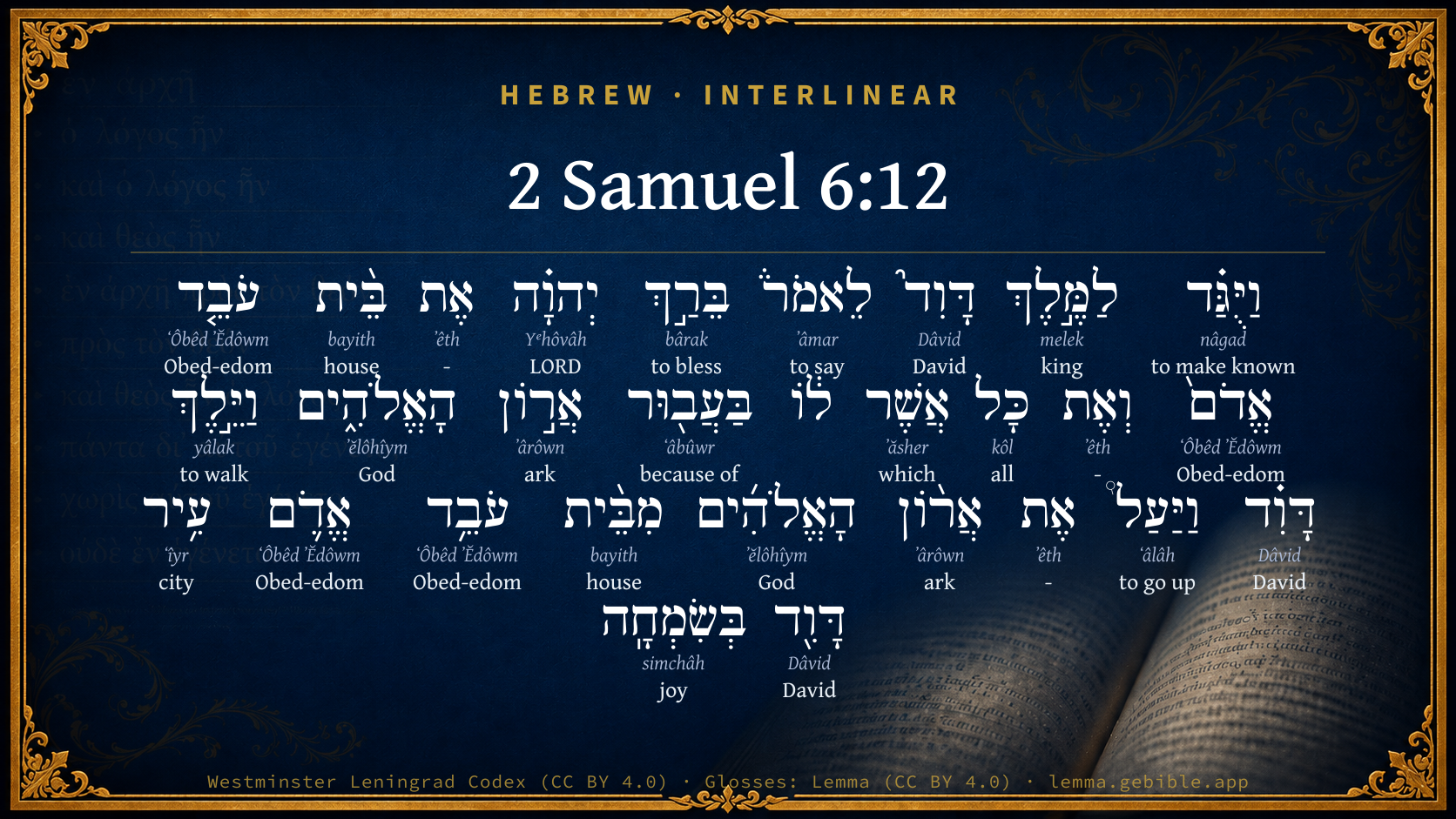
Hebrew (Westminster Leningrad Codex) 2 Samuel 6:12 appears in the Hebrew Old Testament. The text above is from the Westminster Leningrad Codex. Each word links to its Strong’s number, a concise gloss, and parsing drawn from the Open Scriptures Hebrew Bible morphology. Click any word for its full Brown-Driver-Briggs (BDB) entry.
Download image
Cite this verse

2 Samuel 6:12 (World English Bible). Public Domain. Lemma interlinear Bible study tool, https://lemma.gebible.app/v/2-samuel/6/12.

Show BibTeX & RIS
BibTeX
RIS
English Translation
It was told king David, saying, Yahweh has blessed the house of Obed-edom, and all that pertains to him, because of the ark of God. David went and brought up the ark of God from the house of Obed-edom into the city of David with joy.
World English Bible · Public Domain
Download a study sheet

One document with this verse’s original text, its word-by-word gloss line, the meaning frame, cross-references with their text, attributed commentary, and full source and license credits — printable, and it pastes into notes with its structure intact.

This verse Autodidact and up

Study sheet (.html) Plain text (.txt)

A passage Seminary Student

Up to 50 verses in one chapter. A passage sheet keeps up to 6 commentary sources and 12 cross-references per verse, in the order this page ranks them, and says so on the sheet whenever that leaves anything out. Ask for a single verse and you get the Autodidact verse sheet above.

Everything on this page stays free to read, with no account — the sheet is a download of what is already on screen, not access to it.

Want to remove ads? Support Godless Engineer
Compare translations 3

The same verse in 3 English versions, stacked beneath the original-language interlinear above. Click any original word for its lexicon entry.

Each is an independent rendering of the whole verse — the interlinear is not word-aligned to these translations.

Highlighted words mark where these versions differ — a whole-verse word diff, not a word-by-word alignment.

  • World English Bible Public Domain
    It was told king David, saying, Yahweh has blessed the house of Obed-edom, and all that pertains to him, because of the ark of God. David went and brought up the ark of God from the house of Obed-edom into the city of David with joy.
  • King James Version Public Domain
    And it was told king David, saying, The LORD hath blessed the house of Obededom, and all that pertaineth unto him, because of the ark of God. So David went and brought up the ark of God from the house of Obededom into the city of David with gladness.
  • unfoldingWord Literal Text CC BY-SA 4.0
    And it was declared to King David, saying, “Yahweh has blessed the house of Obed Edom and all who to him for the sake of the Box of God.” So David went, and he brought up the Box of God from the house of Obed Edom the City of David with joy.

unfoldingWord Literal Text — © unfoldingWord, licensed CC BY-SA 4.0. Word-aligned USFM3 via Door43 (git.door43.org/unfoldingWord/en_ult).

Versions to compare (up to 4)

3 of 4 selected

Show all 18 translations

Every available English version of this verse, each an independent rendering of the whole verse.

  • World English Bible Public Domain
    It was told king David, saying, Yahweh has blessed the house of Obed-edom, and all that pertains to him, because of the ark of God. David went and brought up the ark of God from the house of Obed-edom into the city of David with joy.
  • Berean Standard Bible Public Domain
    Now it was reported to King David, “The LORD has blessed the house of Obed-edom and all that belongs to him, because of the ark of God.” So David went and had the ark of God brought up from the house of Obed-edom into the City of David with rejoicing.
  • Majority Standard Bible Public Domain
    Now it was reported to King David, “The LORD has blessed the house of Obed-edom and all that belongs to him, because of the ark of God.” So David went and had the ark of God brought up from the house of Obed-edom into the City of David with rejoicing.
  • King James Version Public Domain
    And it was told king David, saying, The LORD hath blessed the house of Obededom, and all that pertaineth unto him, because of the ark of God. So David went and brought up the ark of God from the house of Obededom into the city of David with gladness.
  • American Standard Version (1901) Public Domain
    And it was told king David, saying, Jehovah hath blessed the house of Obed-edom, and all that pertaineth unto him, because of the ark of God. And David went and brought up the ark of God from the house of Obed-edom into the city of David with joy.
  • Revised Version (1885) Public Domain
    And it was told king David, saying, The LORD hath blessed the house of Obed-edom, and all that pertaineth to him, because of the ark of God. And David went and brought up the ark of God from the house of Obed-edom into the city of David with joy.
  • Geneva Bible (1599) Public Domain
    And one told King Dauid, saying, The Lord hath blessed the house of Obed-edom, and all that hee hath, because of the Arke of God: therefore Dauid went and brought the Arke of God from the house of Obed-edom, into the citie of Dauid with gladnesse.
  • Douay-Rheims (1899) Public Domain
    And it was told king David, that the Lord had blessed Obededom, and all that he had, because of the ark of God. So David went, and brought away the ark of God out of the house of Obededom into the city of David with joy. And there were with David seven choirs, and calves for victims.
  • Young's Literal Translation Public Domain
    And it is declared to king David, saying, `Jehovah hath blessed the house of Obed-Edom, and all that he hath, because of the ark of God;' and David goeth and bringeth up the ark of God from the house of Obed-Edom to the city of David with joy.
  • Literal Standard Version CC BY-SA 4.0
    And it is declared to King David, saying, “YHWH has blessed the house of Obed-Edom, and all that he has, because of the Ark of God”; and David goes and brings up the Ark of God from the house of Obed-Edom to the City of David with joy.
  • Unlocked Literal Bible CC BY-SA 4.0
    Now King David was told, “Yahweh has blessed Obed Edom's house and everything that belongs to him because of the ark of God.” So David went and brought up the ark of God from Obed Edom's house to the city of David with joy.
  • unfoldingWord Literal Text CC BY-SA 4.0
    And it was declared to King David, saying, “Yahweh has blessed the house of Obed Edom and all who to him for the sake of the Box of God.” So David went, and he brought up the Box of God from the house of Obed Edom the City of David with joy.
  • Darby Bible Public Domain
    And it was told king David, saying, Jehovah has blessed the house of Obed-Edom, and all that is his, because of the ark of God. And David went and brought up the ark of God from the house of Obed-Edom into the city of David with joy.
  • World Messianic Bible Public Domain
    King David was told, “The LORD has blessed the house of Obed-Edom, and all that belongs to him, because of God’s ark.” So David went and brought up God’s ark from the house of Obed-Edom into David’s city with joy.
  • Webster's Bible Public Domain
    And it was told king David, saying, The LORD hath blessed the house of Obed-edom, and all that pertaineth to him, because of the ark of God. So David went and brought up the ark of God from the house of Obed-edom into the city of David with gladness.
  • Free Bible Version CC BY-SA 4.0
    King David was told, “The Lord has blessed Obed-edom's household and all that he has because of the Ark of God.” So David went and had the Ark of God brought from Obed-edom's house to the City of David. There was a lot of celebration!
  • Bible in Basic English Public Domain
    And they said to King David, The blessing of the Lord is on the family of Obed-edom and on all he has, because of the ark of God. And David went and took the ark of God from the house of Obed-edom into the town of David with joy.
  • JPS Tanakh (1917) Public Domain
    And it was told king David, saying: 'The LORD hath blessed the house of Obed-edom, and all that pertaineth unto him, because of the ark of God.' And David went and brought up the ark of God from the house of Obed-edom into the city of David with joy.

Literal Standard Version (2020), Covenant Press — licensed CC BY-SA 4.0. Text via the HelloAO Bible API (eBible.org). Unlocked Literal Bible (unfoldingWord) — licensed CC BY-SA 4.0. Text via the HelloAO Bible API (eBible.org). unfoldingWord Literal Text — © unfoldingWord, licensed CC BY-SA 4.0. Word-aligned USFM3 via Door43 (git.door43.org/unfoldingWord/en_ult). Free Bible Version, Dr. Jonathan Gallagher — licensed CC BY-SA 4.0. Text via the HelloAO Bible API (eBible.org).

Word by word

More ways to search: Search by grammar → Find every occurrence → Compare this word →

Practice this passage: Drill this verse → Learn its vocabulary →

עֹבֵ֤ד
ʻÔbêd ʼĔdôwm
H5654
“Obed-edom”
Noun, Proper
Part of Speech
Noun
Type
Proper
Full BDB Definition

Origin: from the act part of H5647 and H123

TWOT: None

Obed-edom = "servant of Edom" - a Levite and a Gittite who kept the ark after Uzzah was slain by God for touching the ark while it was being taken to Jerusalem - a Merarite Levite and a singer and gatekeeper - the family descended from him
  1. וַיֻּגַּ֗ד nâgad H5046 “and · to make known” Conjunction + Verb, Hophal, Sequential Imperfect, 3rd Person, Masculine, Singular
  2. לַמֶּ֣לֶךְ melek H4428 “to/for the · king” Preposition, Determined + Noun, Common, Masculine, Singular, Absolute
  3. דָּוִד֮ Dâvid H1732 “David” Noun, Proper
  4. לֵאמֹר֒ ʼâmar H559 “to say” Preposition + Verb, Qal, Infinitive Construct
  5. בֵּרַ֣ךְ bârak H1288 “to bless” Verb, Piel, Perfect, 3rd Person, Masculine, Singular
  6. יְהוָ֗ה Yᵉhôvâh H3068 “LORD” Noun, Proper
  7. אֶת ʼêth H853 “-” Particle, Direct Object
  8. בֵּ֨ית bayith H1004 “house of” Noun, Common, Masculine, Singular, Construct
  9. אֱדֹם֙ ʻÔbêd ʼĔdôwm H5654 “Obed-edom” Noun, Proper
  10. וְאֶת ʼêth H853 “and · -” Conjunction + Particle, Direct Object
  11. כָּל kôl H3605 “all of” Noun, Common, Masculine, Singular, Construct
  12. אֲשֶׁר ʼăsher H834 “which” Particle, Relative
  13. בַּעֲב֖וּר ʻâbûwr H5668 “in/at · because of of” Preposition + Noun, Common, Masculine, Singular, Construct
  14. אֲר֣וֹן ʼârôwn H727 “ark of” Noun, Common, Both, Singular, Construct
  15. הָאֱלֹהִ֑ים ʼĕlôhîym H430 “the · God(s)” Particle, Definite Article + Noun, Common, Masculine, Plural, Absolute
  16. וַיֵּ֣לֶךְ yâlak H3212 “and · to walk” Conjunction + Verb, Qal, Sequential Imperfect, 3rd Person, Masculine, Singular
  17. דָּוִ֗ד Dâvid H1732 “David” Noun, Proper
  18. וַיַּעַל֩ ʻâlâh H5927 “and · to go up” Conjunction + Verb, Hiphil, Sequential Imperfect, 3rd Person, Masculine, Singular
  19. אֶת ʼêth H853 “-” Particle, Direct Object
  20. אֲר֨וֹן ʼârôwn H727 “ark of” Noun, Common, Both, Singular, Construct
  21. הָאֱלֹהִ֜ים ʼĕlôhîym H430 “the · God(s)” Particle, Definite Article + Noun, Common, Masculine, Plural, Absolute
  22. מִבֵּ֨ית bayith H1004 “from · house of” Preposition + Noun, Common, Masculine, Singular, Construct
  23. עֹבֵ֥ד ʻÔbêd ʼĔdôwm H5654 “Obed-edom” Noun, Proper
  24. אֱדֹ֛ם ʻÔbêd ʼĔdôwm H5654 “Obed-edom” Noun, Proper
  25. עִ֥יר ʻîyr H5892 “city of” Noun, Common, Feminine, Singular, Construct
  26. דָּוִ֖ד Dâvid H1732 “David” Noun, Proper
  27. בְּשִׂמְחָֽה simchâh H8057 “in/at · joy” Preposition + Noun, Common, Feminine, Singular, Absolute

About this verse

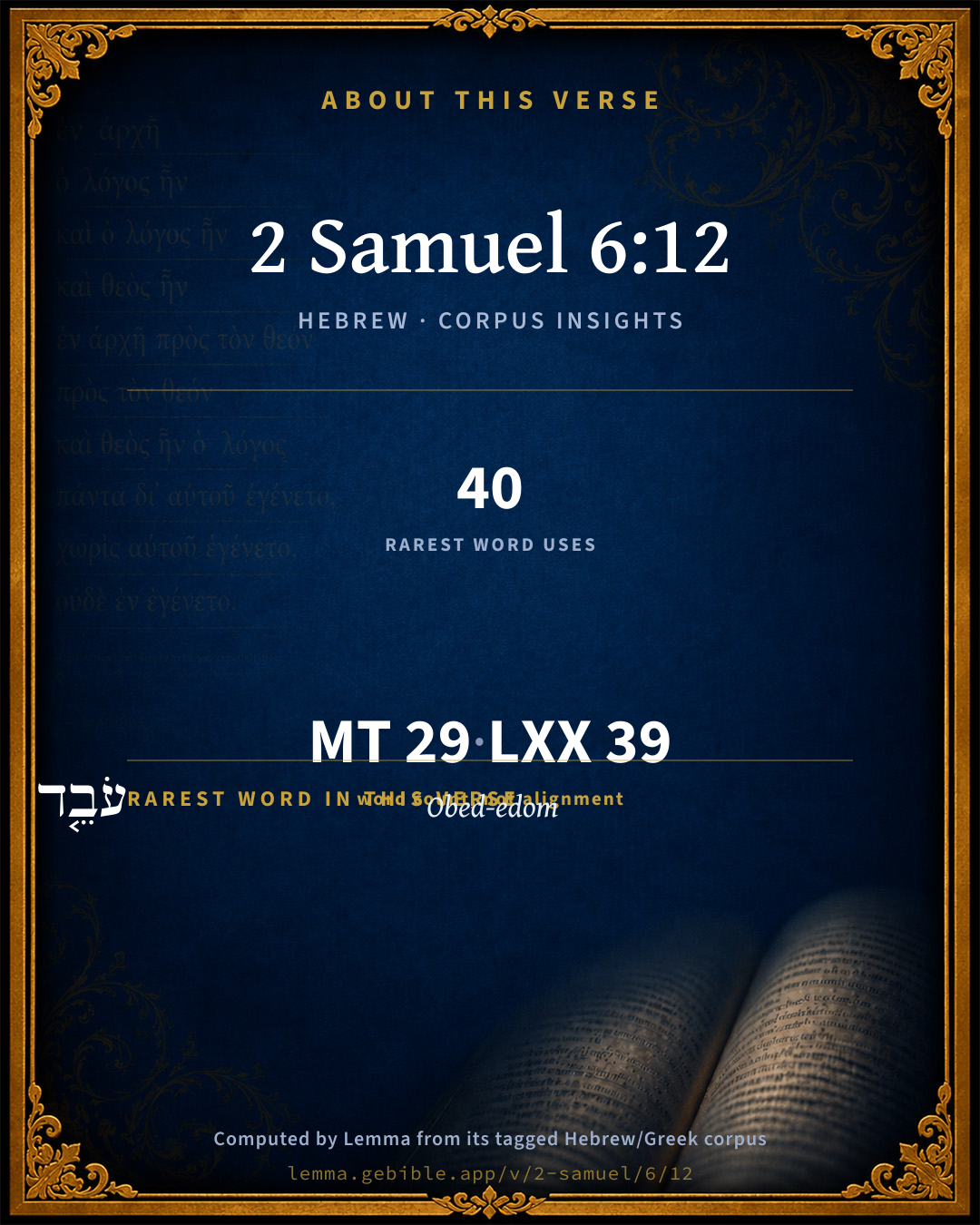
These counts appear in no published source. They are computed here, from the morphology-tagged text and Lemma’s own curated glosses. What Lemma adds →

29
words
18
distinct lemmas
Historical
section

Shared distinctive vocabulary

עֹבֵ֤ד Obed-edom H5654 occurs in 15 verses of the Hebrew Bible. Also found in:

Grammatical profile

  • 5 verbs
  • 19 nouns
  • 1 preposition
  • 4 particles

Verb forms

  • וַיֻּגַּ֗ד Hophal · Sequential Imperfect
  • לֵאמֹר֒ Qal · Infinitive Construct
  • בֵּרַ֣ךְ Piel · Perfect
  • וַיֵּ֣לֶךְ Qal · Sequential Imperfect
  • וַיַּעַל֩ Hiphil · Sequential Imperfect

Repetition

Words recur within this verse — often emphatic in Hebrew:

  • עֹבֵ֤ד Obed-edom H5654 ×4
  • דָּוִד֮ David H1732 ×3
  • בֵּ֨ית house H1004 ×2
  • אֲר֣וֹן ark H727 ×2
  • הָאֱלֹהִ֑ים God H430 ×2

Hebrew & Septuagint length

In English translation the verse runs 46 words from the Hebrew and 51 from the Septuagint (LXX English) — closely comparable.

A rough comparison of the two English renderings, which tokenize alike — not a word-level alignment.

Word counts can differ between the Hebrew and the Greek without any difference in meaning — e.g. the Hebrew direct-object marker אֵת has no separate Greek word, and Greek often adds the article ὁ.

In the original languages it is 29 Hebrew tokens and 39 Greek tokens — but the two are counted differently (Hebrew bundles its prefixes and suffixes into one token; the Greek is in lemma form), so that isn’t a like-for-like length.

Cross-references

7

Topical passages linked to 2 Samuel 6:12 in the Treasury of Scripture Knowledge — connected by theme and wording, ordered by reader-vote popularity; previews shown in the World English Bible.

  • 1 Chronicles 15:25–16:3 So David, and the elders of Israel, and the captains over thousands, went to bring up the ark of the covenant of Yahweh out of the house of Obed-edom with joy.
  • 1 Kings 8:1 Then Solomon assembled the elders of Israel, and all the heads of the tribes, the princes of the fathers' [houses] of the children of Israel, to king Solomon in Jerusalem, to bring up the ark of the covenant of Yahweh out of the city of David, which is Zion.
  • Matthew 10:42 Whoever gives one of these little ones just a cup of cold water to drink in the name of a disciple, most assuredly I tell you he will in no way lose his reward."
  • Psalms 24:7–10 Lift up your heads, you gates; Be lifted up, you everlasting doors: The King of glory will come in.
  • Psalms 68:24–27 They have seen your processions, God, Even the processions of my God, my King, into the sanctuary.
  • 1 Chronicles 15:1–3 [David] made him houses in the city of David; and he prepared a place for the ark of God, and pitched for it a tent.
  • Psalms 132:6–8 Behold, we heard of it in Ephrathah. We found it in the field of Jaar:

Cross-references courtesy of OpenBible.info (CC BY 4.0).

Hebrew and Greek witnesses Masoretic Hebrew ↔ Greek Septuagint

The same verse in the two great witnesses to the Old Testament, shown verse-for-verse.

These are two independent witnesses, not word-aligned to each other, and the Septuagint is shown in lemma (dictionary) form.

Hebrew 2 Samuel 6:12 Masoretic · Westminster Leningrad Codex

וַיֻּגַּ֗ד לַמֶּ֣לֶךְ דָּוִד֮ לֵאמֹר֒ בֵּרַ֣ךְ יְהוָ֗ה אֶת בֵּ֨ית עֹבֵ֤ד אֱדֹם֙ וְאֶת כָּל אֲשֶׁר ל֔וֹ בַּעֲב֖וּר אֲר֣וֹן הָאֱלֹהִ֑ים וַיֵּ֣לֶךְ דָּוִ֗ד וַיַּעַל֩ אֶת אֲר֨וֹן הָאֱלֹהִ֜ים מִבֵּ֨ית עֹבֵ֥ד אֱדֹ֛ם עִ֥יר דָּוִ֖ד בְּשִׂמְחָֽה

It was told king David, saying, Yahweh has blessed the house of Obed-edom, and all that pertains to him, because of the ark of God. David went and brought up the ark of God from the house of Obed-edom into the city of David with joy.

World English Bible · Public Domain

Greek LXX 2 Samuel 6:12 Septuagint · lemma form

καί ἀποἀγγέλλω ὁ βασιλεύς δαυίδ λέγω εὐλογέω κύριος ὁ οἶκος αβεδδαρα καί πᾶς ὁ αὐτός ἕνεκεν ὁ κιβωτός ὁ θεός καί πορεύομαι δαυίδ καί ἀναἄγω ὁ κιβωτός ὁ κύριος ἐκ ὁ οἶκος αβεδδαρα εἰς ὁ πόλις δαυίδ ἐν εὐφροσύνη

And it was reported to king David, saying, The Lord has blessed the house of Abeddara, and all that he has, because of the ark of the Lord. And David went, and brought up the Ark of the Lord from the house of Abeddara to the city of David with gladness.

LXX2012 (modern English Septuagint) · Public Domain

On this verse, Adam Clarke's Commentary discusses the Septuagint’s reading. Read the note in Commentary ↓

Hebrew: Westminster Leningrad Codex (CC BY 4.0). Greek: Septuagint (public domain); English from LXX2012 (modern English Septuagint) (Public Domain). How the Septuagint differs from the Hebrew →

Targum (Aramaic paraphrase)

1

The Targum is the ancient Jewish Aramaic paraphrase of the Hebrew Scriptures — an interpretive translation, not the Hebrew text itself. Onkelos (literal) and Pseudo-Jonathan (expansive) render the Torah, and Jonathan the Prophets. Coverage is partial: where no permissively-licensed English translation exists for a verse, only the Aramaic is shown. This is verse-level text, not a word-by-word alignment to the Hebrew.

  1. Targum Jonathan Prophets (Joshua–Malachi)
    וְאִתְחַוָא לְמַלְכָּא דָוִד לְמֵימַר בָּרִיךְ יְיָ יַת בֵּית עוֹבֵד אֱדוֹם וְיַת כָּל דִילֵיהּ בְּדִיל אֲרוֹנָא דַייָ וַאֲזַל דָוִד וְאַסֵּיק יַת אֲרוֹנָא דַייָ מִבֵּית עוֹבֵד אֱדוֹם לְקַרְתָּא דְדָוִד בְּחֶדְוָא:

    (no public-domain English translation for this verse)

    Targum Jonathan — Aramaic: “Mikraot Gedolot” (public domain). English: “Sefaria Community Translation” (CC0 1.0 (public-domain dedication)); “London "Chaldee Paraphrase," 1871” (public domain). Text via Sefaria.

Commentary

Notes on 2 Samuel 6:12 from classic Christian and Jewish commentators (each source and its license shown beneath its notes). The classic Christian expositions comment on the surrounding passage and are grouped to its opening verse, so a note may address several verses; the Jewish commentaries on the Tanakh (Rashi and others) are per-verse, so they appear only where the commentator wrote on this verse.

Lemma curates 59 commentaries, every one of them public domain or Creative Commons licensed, each selected and text-cleaned for this edition rather than reprinted as found. About our sources →

Matthew Henry's Commentary

We have here the second attempt to bring the ark home to the city of David; and this succeeded, though the former miscarried.

I. It should seem the blessing with which the house of Obed-edom was blessed for the ark's sake was a great inducement to David to bring it forward; for when that was told him (Sa2 6:12) he hastened to fetch it to him. For, 1. It was an evidence that God was reconciled to them, and his anger was turned away. As David could read God's frowns upon them all in Uzzah's stroke, so he could read God's favour to them all in Obed-edom's prosperity; and, if God be at peace with them, they can cheerfully go on with their design. 2. It was an evidence that the ark was not such a burdensome stone as it was taken to be, but, on the contrary, happy was the man that had it near him. Christ is indeed a stone of stumbling, and a rock of offence, to those that are disobedient; but to those who believe he is a corner-stone, elect, precious, Pe1 2:6-8. When David heard that Obed-edom had such joy of the ark, then he would have it in his own city. Note, The experience others have had of the gains of godliness should encourage us to be religious. Is the ark a blessing to others' houses? let us bid it welcome to ours; we may have it, and the blessing of it, without fetching it from our neighbours.

II. Let us see how David managed the matter now. 1. He rectified the former error. He did not put the ark in a cart now, but ordered those whose business it was to carry it on their shoulders. This is implied here (Sa2 6:13) and expressed Ch1 15:15. Then we make a good use of the judgments of God on ourselves and others when we are awakened by them to reform and amend whatever has been amiss. 2. At their first setting out he offered sacrifices to God (Sa2 6:13) by way of atonement for their former errors and in a thankful acknowledgment of the blessings bestowed on the house of Obed-edom. Then we are likely to speed in our enterprises when we begin with God and give diligence to make our peace with him, When we attend upon God in holy ordinances our eye must be to the great sacrifice, to which we owe it that we are taken into covenant and communion with God, Psa 50:5. 3. He himself attended the solemnity with the highest expressions of joy that could be (Sa2 6:14): He danced before the Lord with all his might; he leaped for joy, as one transported with the occasion, and the more because of the disappointment he met with the last time. It is a pleasure to a good man to see his errors rectified and himself in the way of his duty. His dancing, I suppose, was not artificial, by any certain rule or measure, nor do we find that any danced with him; but it was a natural expression of his great joy and exultation of mind. He did it with all his might; so we should perform all our religious services, as those that are intent upon them and desire to do them in the best manner. All our might is little enough to be employed in holy duties: the work deserves it all. On this occasion David laid aside his imperial purple, and put on a plain linen ephod, which was light and convenient for dancing, and was used in religious exercises by those who were no priests, for Samuel wore one, Sa1 2:18. That great prince thought it no disparagement to him to appear in the habit of a minister to the ark. 4. All the people triumphed in this advancement of the ark (Sa2 6:15): They brought it up into the royal city with shouting, and with sound of trumpet, so expressing their own joy in loud acclamations, and giving notice to all about them to rejoice with them. The public and free administration of ordinances, not only under the protection, but under the smiles, of the civil powers, is just matter of rejoicing to any people. 5. the ark was safely brought to, and honourably deposited in, the place prepared for it, Sa2 6:17. They set it in the midst of the tabernacle, or tent, which David had pitched for it; not the tabernacle which Moses reared, for that was at Gibeon (Ch2 1:13), and, we may suppose, being made of cloth, in so many hundred years it had gone to decay and was not fit to be removed; but this was a tent set up on purpose to receive the ark. He would not bring it into a private house, no, not his own, lest it should seem to be too much engrossed, and people's resort to it, to pray before it, should be less free; yet he would not build a house for it, lest that should supersede the building of a more stately temple in due time, and therefore, for the present, he placed it within curtains, under a canopy, in imitation of Moses's tabernacle. As soon as ever it was lodged, he offered burnt-offerings and peace-offerings, in thankfulness to God that the business was now done without any more errors or breaches, and in supplication to God for the continuance of his favour. Note, All our joys must be sanctified both with praises and prayers; for with such sacrifices God is well pleased. New, it should seem, he penned the 132nd Psa 6:1-10. The people were then dismissed with great satisfaction. He sent them away, (1.) With a gracious prayer: He blessed them in the name of the Lord of hosts (v. 18), having not only a particular interest in heaven as a prophet, but an authority over them as a prince; for the less is blessed of the better, Heb 7:7. He prayed to God to bless them, and particularly to reward them for the honour and respect they had now shown to his ark, assuring them they should be no losers by their journey, but the blessing of God upon their affairs at home would more than bear their charges. He testified his desire for their welfare by this prayer for them, and let them know they had a king that loved them. (2.) With a generous treat; for so it was, rather than a distribution of alms. The great men, it is probable, he entertained at his own house, but to the multitude of Israel, men and women (and children, says Josephus), he dealt to every one a cake of bread (a spice-cake, so some), a good piece of flesh - a handsome decent piece (so some) - a part of the peace-offerings (so Josephus), that they might feast with him upon the sacrifice, and a flagon, or bottle, of wine, Sa2 6:19. Probably he ordered this provision to be made for them at their respective quarters, and this he did, [1.] In token of his joy and gratitude to God. When the heart is enlarged in cheerfulness the hand should be opened in liberality. The feast of Purim was observed with sending portions one to another, Est 9:22. As those to whom God is merciful ought to show mercy in forgiving, so those to whom God is bountiful ought to exercise bounty in giving. [2.] To recommend himself to the people, and confirm his interest in them; for every one is a friend to him that giveth gifts. Those that cared not for his prayers would love him for his generosity; and this would encourage them to attend him another time if he saw cause to call them together.

Matthew Henry's Commentary on the Whole Bible (1708–1710) — public domain (CC PDM 1.0). Text via the HelloAO Bible API.

Jamieson, Fausset & Brown

Robert Jamieson, A. R. Fausset & David Brown

DAVID AFTERWARDS BRINGS THE ARK TO ZION. (Sa2 6:12-19)

it was told king David, saying, The Lord hath blessed the house of Obed-edom, and all that pertaineth unto him, because of the ark of God--The lapse of three months not only restored the agitated mind of the monarch to a tranquil and settled tone, but led him to a discovery of his former error. Having learned that the ark was kept in its temporary resting-place not only without inconvenience or danger, but with great advantage, he resolved forthwith to remove it to the capital, with the observance of all due form and solemnity (Ch1 15:1-13). It was transported now on the shoulders of the priests, who had been carefully prepared for the work, and the procession was distinguished by extraordinary solemnities and demonstrations of joy.

Jamieson, Fausset & Brown — Commentary Critical and Explanatory on the Whole Bible (1871) — public domain (CC PDM 1.0). Text via the HelloAO Bible API.

Trapp's Complete Commentary

John Trapp

2Sa 6:12 And it was told king David, saying, The LORD hath blessed the house of Obededom, and all that [pertaineth] unto him, because of the ark of God. So David went and brought up the ark of God from the house of Obededom into the city of David with gladness.

Ver. 12. And it was told king David, saying.] So that now he feared no danger, as Josephus noteth, but resolved upon a better carriage of the matter. It is well observed by a grave divine, {a} that while the ark brought the plague, everyone was glad to be rid of it: but when it brought a blessing to Obededom, they looked upon it as worthy of entertainment. Many will own a blessing ark, a prospering truth: but he is an Obededom indeed that will own a persecuted, tossed, banished ark.

{a} Dr Bolton.

John Trapp, A Commentary or Exposition upon All the Books of the Old and New Testament (1647–1656) — public domain. Text from a community e-Sword module.

Joseph Benson's Commentary

2Sa 6:12. That God had blessed the house of Obed-edom because of the ark — They could not tell to what to impute the extraordinary prosperity and happiness that attended him, but to his willing reception and care of the ark. And it is certain it was, under God, owing to this. David went and brought up the ark to the city of David — Hoping God would bless him and his city, as he had done Obed-edom and his house.

Joseph Benson's Commentary on the Old and New Testaments (1811–1818) — public domain. Text from a community e-Sword module.

MacLaren's Expositions of Holy Scripture

Alexander MacLaren

2 Samuel

DEATH AND LIFE FROM THE ARK

2Sa 6:1 - 2Sa 6:12.

I. The first section {2Sa 6:1 - 2Sa 6:5} describes the joyful reception and procession. The parallel account in 1 Chronicles states that Baalah, or Baale, was Kirjath-jearim. Probably the former was the more ancient Canaanitish name, and indicates that it had been a Baal sanctuary. If so, the presence of the ark there was at once a symbol and an omen, showing Jehovah’s conquest over the obscene and bloody gods of the land, and forecasting His triumph over all the gods of the nations. Every Baale shall one day be a resting-place of the ark of God. The solemn designation of the ark, as ‘called by the Name, the name of the Lord of Hosts, that dwelleth between the cherubim,’ is significant on this, its reappearance after so long eclipse, and, by emphasising its awful sanctity, prepares for the incidents which are to follow. The manner of the ark’s transport was irregular; for the law strictly enjoined its being carried by the Levites by means of bearing-poles resting on their shoulders; and the copying of the Philistines’ cart, though a new one was made for the purpose, indicates the desuetude into which the decencies of worship had fallen in seventy years. In 1 Chronicles, the singular words in 2Sa 6:5, which describe David as playing before the Lord on the very unlikely things for such a purpose,’ all manner of instruments of fir wood,’ become ‘with all their might: even with songs’ which seems much more reasonable. A slight alteration in three letters and the transposition of two would bring our text into conformity with I Chronicles, and the conjectural emendation is tempting. Who ever heard of fir-wood musical instruments? The specified ones which follow were certainly not made of it, and songs could scarcely fail to be mentioned.

At all events, we see the glad procession streaming out of the little city buried among its woods; the cart drawn by meek oxen, and loaded with the unadorned wooden chest, in the midst; the two sons or descendants of its faithful custodian honoured to be the teamsters; the king with the harp which had cheered him in many a sad hour of exile; and the crowd ‘making a joyful noise before the Lord,’ which might sound discord in our ears, as some lifted up shrill songs, some touched stringed instruments, some beat on timbrels, some rattled metal rods with movable rings, and some clashed cymbals together. It was a wild scene, in which there was a dangerous resemblance to the frantic jubilations of idolatrous worship. No doubt there were true hearts in that crowd, and none truer than David’s. No doubt we have to beware of applying our Christian standards to these early times, and must let a good deal that is sensuous and turbid pass, as, no doubt, God let it pass. But confession of sin in leaving the ark so long forgotten would have been better than this tumultuous joy; and if there had been more trembling in it, it would not have passed so soon into wild terror. Still, on the other hand, that rejoicing crowd does represent, though in crude form, the effect which the consciousness of God’s presence should ever have. His felt nearness should be, as the Psalmist says, ‘the gladness of my joy.’ Much of our modern religion is far too gloomy, and it is thought to be a sign of devotion and spiritual-mindedness to be sad and of a mortified countenance. Unquestionably, Christianity brings men into the continual presence of very solemn truths about themselves and the world which may well sober them, and make what the world calls mirth incongruous.

‘There is no music in the life

That rings with idiot laughter solely.’

But the Man of Sorrows said that His purpose for us was that ‘His joy might remain in us, and that our joy might be full’; and we but imperfectly apprehend the gospel if we do not feel that its joys ‘much more abound’ than its sorrows, and that they even burn brightest, like the lights on safety-buoys, when drenched by stormy seas.

II. The second section contains the dread vindication of the sanctity of the ark, which changed joy into terror, and silenced the songs. At some bad place in the rocky and steep track, the oxen stumbled or were restive. The spot is called in Samuel ‘the threshing-floor of Nachon,’ but in Chronicles the owner is named ‘Chidon.’ As the former word means ‘a stroke’ and the latter ‘destruction,’ they are probably not to be taken as proper names, but as applied to the place after this event. The name given by David, however-Perez-uzzah-proved the more permanent ‘to this day.’ Uzzah, who was driving while his brother went in front to pilot the way, naturally stretched out his hand to steady his freight, just as if it had been a sack of corn; and, as if he had touched an electric wire, fell dead, as the story graphically says, ‘by the ark of God.’ What confusion and panic would agitate the joyous singers, and how their songs would die on their lips!

What harm was there in Uzzah’s action? It was most natural, and, in one point of view, commendable. Any careful waggoner would have done the same with any valuable article he had in charge. Yes; that was just the point of his error and sin, that he saw no difference between the ark and any other valuable article. His intention to help was right enough; but there was profound insensibility to the awful sacredness of the ark, on which even its Levitical bearers were forbidden to lay hands. All his life Uzzah had been accustomed to its presence. It had been one of the familiar pieces of furniture in Abinadab’s house, and, no doubt, familiarity had had its usual effect. Do none of us ministers, teachers, and others, to whom the gospel and the worship and ordinances of the Church have been familiar from infancy, treat them in the same fashion? Many a hand is laid on the ark, sometimes to keep it from falling, with more criminal carelessness of its sacredness than Uzzah showed. Note, too, how swiftly an irreverent habit of treating holy things grows. The first error was in breaking the commanded order for removal of the ark by the Levites. Once in the cart, the rest follows. The smallest breach in the feeling of awe and reverence will soon lead to more complete profanation. There is nothing more delicate than the sense of awe. Trifled with ever so little, it speedily disappears. There is far too little of it in our modern religion. Perfect love casts out fear and deepens awe which hath not torment.

Was not the punishment in excess of the sin? We must remember the times, the long neglect of the ark, the decay of religion in Saul’s reign, the critical character of the moment as the beginning of a new era, when it was all-important to print deep the impression of sanctity, and the rude material which had to be dealt with; and we must not forget that God, in His punishments, does not adopt men’s ideas of death as such a very dreadful thing. Many since have followed in David’s wake, and been ‘displeased, because the Lord broke forth upon Uzzah’; but he and they have been wrong. He ought to have known better, and to have understood the lesson of the solemn corpse that lay there by the ark; instead of which he gives way to mere terror, and was ‘afraid of the Lord.’ David afraid of the Lord! What had become of the rapturous love and strong trust which ring clear through his psalms? Is this the man who called God his rock and fortress and deliverer, his buckler and the horn of his salvation and his high tower, and poured out his soul in burning words, which glow yet through all the centuries and the darkness of earth? It was ill for David to fall thus below himself, but well for us that the eclipse of his faith and love should be recorded, to hearten us, when the like emotions fall asleep in our souls. His consciousness of impurity was wholesome and sound, but his cowering before the ark, as if it were the seat of arbitrary anger, which might flame out destruction for no discernible reason, was a woful darkening of his loving insight into the heart of God.

III. The last section {2Sa 6:10 - 2Sa 6:12} gives us the blessings on the house of Obed-edom and the glad removal of the ark to Jerusalem. Obed-edom is called a ‘Gittite,’ or man of Gath; but he does not appear to have been a Philistine immigrant, but a native of another Gath, a Levitical city, and himself a Levite. There is an Obededom in the lists of David’s Levites in Chronicles who is probably the same man. He did not fear to receive the ark, and, worthily received, the presence which had been a source of disaster and death to idolaters, to profanely curious pryers into its secret, and to presumptuous irreverence, became a fountain of unbroken blessing. This twofold effect of the same presence is but a symbol of a solemn law which runs through all life, and is especially manifest in the effects of Christ’s work upon men. Everything has two handles, and it depends on ourselves by which of them we lay hold of it, and whether we shall receive a shock that kills, or blessings. The same circumstances of poverty, or wealth, or sorrow, or temptation, make one man better and another worse. The same presence of God will be to one man a joy; to another, a terror. ‘What maketh heaven, that maketh hell.’ The same gospel received is the fountain of life, purity, peace; and, rejected or neglected, is the source of harm and death. Jesus Christ is ‘set for the fall and rising again of many.’ Either He is the savour of life unto life, the rock on which we build, or He is the savour of death unto death, the stone on which we stumble and break our limbs.

Alexander MacLaren, Expositions of Holy Scripture (1904–1910) — public domain. Text from a community e-Sword module.

Tyndale Open Study Notes

Tyndale Open Resources

6:12 David reasoned that if God blessed Obed-edom simply for storing the Ark, God would surely bless David for placing the Ark in a dwelling specifically built for it in the capital city.

Tyndale Open Study Notes — © Tyndale Open Resources, licensed CC BY-SA 4.0. Text via the HelloAO Bible API.

Geneva Bible (1599)

Geneva Bible translators

Meaning, he caused the Levites to bear it, according to the Law.

Geneva Bible (1599) marginal notes — public domain. Text via Bolls.life.

Adam Clarke's Commentary

Verse 12. So David - brought up the ark] The Vulgate adds to this verse: And David had seven choirs, and a calf for a sacrifice. The Septuagint make a greater addition: "And he had seven choirs carrying the ark, a sacrifice, a calf, and lambs. And David played on harmonious organs before the Lord; and David was clothed with a costly tunic; and David and all the house of Israel, brought the ark of the Lord with rejoicing, and the sound of a trumpet." Nothing of this is found in any MS., nor in the Chaldee, the Syriac, nor the Arabic, nor in the parallel place, 1Ch 15:25.

Adam Clarke's Commentary on the Bible (1810–1826) — public domain. Text from a community e-Sword/MySword module.

Ellicott's Commentary for English Readers

(12) Went and brought up.—The immediate reason for David’s action was the knowledge of the blessings which had come to Obed-edom through the presence of the ark, in contrast to the punishment of Uzzah; yet this implies neither jealousy nor a wish to deprive his subject of a blessing. It had been his original purpose to carry the ark to Jerusalem, and he had only desisted in a fit of vexation and then of fear. He now saw that such fear was groundless, and went on to the completion of his unfinished action. The word “with gladness” means with festal shouts and rejoicings.

A Bible Commentary for English Readers, edited by Charles John Ellicott (1878–1897) — public domain. Text from a community e-Sword module.

The Cambridge Bible for Schools and Colleges

gen. ed. J. J. S. Perowne

12–19. Removal of the Ark from the house of Obed-edom to Jerusalem

12. So David went] Some Latin and a few Greek MSS. soften the abruptness of the text by inserting before this sentence the words, “And David said, I will go and bring back the Ark with blessing unto my house;” but they are in all probability only a gloss.

with gladness] i.e. festal rejoicings; jubilant shouts and songs.

The Cambridge Bible for Schools and Colleges (gen. ed. J. J. S. Perowne; Cambridge University Press, 1878–1918) — public domain. Text from a community e-Sword module.

John Gill's Exposition

And it was so, that when they that bare the ark of the Lord,.... The Levites; for now David had seen the former mistake, and rectified it, and ordered the Levites to "carry" it, as they did upon their shoulders, with the staves therein, see Ch1 15:2; when these

had gone six paces, he sacrificed oxen and fatlings; upon an altar, which was at once erected for that purpose; the number and kind of sacrifices offered were seven bullocks and seven rams, Ch1 15:26; and these David offered, not by himself, but by the priests that were with him, and that as soon as they had gone six paces from the house of Obededom; whereby they perceived the Levites, were able to carry the ark, with what was in it, the Lord helping them, as in Ch1 15:2, and without stumbling and falling, or any evil attending them; and Kimchi thinks these six paces were just the measure of the ground Uzzah went before what befell him; but it is highly probable that he had gone further; however, no doubt by the order of David, the Levites set down the ark, and sacrifices were offered by way of thanksgiving to God, and for the continuance of his goodness, and for atonement for former errors. Some think these seven oxen and rams were offered, at seven different times and places, at every six paces an ox and a ram; but this is not very likely.

John Gill's Exposition of the Whole Bible (1746–1763) — public domain (CC PDM 1.0). Text via the HelloAO Bible API.

Albert Barnes' Notes on the Bible

With gladness - Especially with joyful music and song (1Ch 15:16, etc.).

Albert Barnes' Notes on the Bible (1834–1885) — public domain. Text from a community e-Sword/MySword module.

Haydock's Catholic Bible Commentary

Choirs. Or companies of musicians. (Challoner) --- This sentence is not found in Hebrew nor in St. Jerome’s version. (Calmet) --- The Vatican and Alexandrian Septuagint have, "David brought the ark of the Lord from the house of Obeddara, into the city of David, with joy; (13) and there were seven choirs with him, taking up the ark, and the sacrifice, a calf and lamb; (14) and David played on tuneful organs before the Lord; and David had on a beautiful stole." (Haydock)

George Leo Haydock (1774–1849), Haydock's Catholic Family Bible and Commentary, 1859 edition — public domain. Excludes Psalms (Douay-Rheims chapter numbering differs from Protestant) and Deuterocanonical books (Catholic canon only).

Matthew Poole's English Annotations

David brought up the ark of God; understanding that the ark was entertained without danger or inconvenience, and with great advantage, he apprehended his former mistake, and brought it to himself.

From the house of Obed-edom, which is thought to have been either in Jerusalem, or very near it.

Matthew Poole's English Annotations on the Holy Bible (1683–1685) — public domain. Text from a community e-Sword/MySword module.

Whedon's Commentary on the Bible

Daniel D. Whedon

12. David went and brought up the ark — This time having all things done according to the instructions of the law, as the account in 1 Chronicles 15 more fully shows.

Daniel D. Whedon (gen. ed.), Commentary on the Old and New Testaments (1874–1909) — public domain. Text from a community e-Sword module.

The Pulpit Commentary

With gladness. The words mean, "in a joyful procession with music and dancing.

Vers. 12-23. The facts are:

1. David, learning the blessing that had come upon the house of Obed-Edom, resolves to bring up the ark to Jerusalem.

2. Having made arrangements in accordance with the Law for the properbearing of the ark, he inaugurates the procession by a sacrifice.

3. Girded with a linen ephod, he dances before the ark, and with music andshouting it enters Jerusalem.

4. Placing the ark in the tabernacle he had provided for it, he offers burntofferings and peace offerings before the Lord, pronounces a blessing on the people, and distributes to them meat and drink.

5. Returning to his house, he is met by his wife Michal, who, having witnessed his dancing before the ark, now reproaches him with having demeaned himself in the eyes of the people.

6. With mildness of temper, but great firmness, he not only admits the fact,but glories in it as due unto God, and affirms his readiness to again debase himself in the same manner, being sure of winning the esteem of others less prejudiced.

7. Michal his wife remains childless. We have here a great change in David"s religious condition; an event of supreme national interest; and the domestic sorrows of a devout man. The topics suggested may be taken in succession.

Joy restored.

There is a marked change in the David mentioned in vers. 13-15 as compared with the David of vers. 8-10, and in general terms it may be expressed as a restoration to the joy of his life. But it is well to notice the process implied.

I THE SINS AND.ERRORS OF A REALLY GOOD MAN CAUSE HIM GREAT SUFFERING. In general terms, all sin entails suffering; but facts prove that the degree of personal suffering consequent on particular sins depends on the actual goodness of the man who sins. David was truly a "man after God"s own heart," a man of pure sensitive nature, of enlightened conscience and intense sincerity. In some respect his very sin (ver. 8) was consequent on his noble ambition to see God glorified in a great national demonstration. We may be sure, although the historian says nothing of it, that the days immediately after his return to Jerusalem were full of bitterness. The fact that a great project, in which the nation was concerned, had come to a sudden collapse, that elders and common people throughout the land would be talking of his chagrin, that strange impressions would be conveyed as to the stability of his purposes, and the consciousness that his God was not to him now as he had been in days past, must have robbed him of former peace and embittered all the relationships of life. Peter"s life was anguish after his fall, because he was so good a man. Dark days and painful sense of solitariness are the lot of many of the faithful after having turned their heart in distrust from their God.

II REFLECTION ARISES AND GRADUALLY TONES DOWN THE TUMULT OF FEELING. For a time the passion of discontent and distrust, like a storm, would rage, and, while making David wretched by virtue of their own nature, would throw the reflective powers into confusion. No sinner is perfectly sane when under the stormy influence of his sin. In the case of a really bad man the confusion becomes worse by deliberate indulgence in fresh sins in order to get rid of what slight uneasiness is experienced; but with David the disturbing force of sin would gradually expend itself, and the reflective powers would begin to review the situation and gradually allow the influence of truth and fact to reveal the folly and shame of what had been done. The monarch retired from the cares and toils of the day, and, though fretted and vexed by the bad impression his people might entertain as to his persistency of purpose, he could not but ponder the recent path of his feet, and the great truths on which he had formerly been wont to "meditate day and night". (Psa_1:2) In good men, though fallen and wretched, the intellectual faculties, as under the action of a magnet, will be sure to concentrate on the truths that help to recovery.

III THE MIND COMES IN DUE COURSE INTO DIRECT CONTACT WITH ACTUAL FACTS AND THE WORD OF GOD. Reflection would clear away the mists of passion, and David would see in the light of the written Word the error of setting out with the ark on a cart; the exposure, therefore, by his own arrangement or connivance, of the man to the temptation to violate the Law, and the justice of the blow which fell, as also its use in checking a spirit of indifference and inculcating reverence for sacred things. The piety of his nature, thus brought into direct contact with truth, would at once recognize its force, the shamefulness and folly of the discontent and distrust, and the desirability of placing the life once more in its proper relation to the general interests of religion. Penitents and backsliders are not far from restoration when once they gaze with calm and steadfast eye on the actual facts as illumined by the light of God"s Word. The revealed truth of God is the material on which the reflective powers act, and so the truly sorrowful spirit does not become the victim of false imaginings.

IV THERE IS BROUGHT ABOUT A VIVID RECOGNITION OF THE MERCY OF GOD IN CHRIST. AS long as the passions engendered by indulgence in sin darken the soul, there is a loss of that clear and restful view of God which is the peculiar privilege of the pure in heart. David"s sin (ver. 8) had transformed the all-merciful, covenanted God into an object of dread (ver. 9). But now that passion was subsiding, and the Word was allowed once more to shed its light on the facts of the case, the true character of God, as set forth in the sacred symbol, reappeared; and love, and mercy, and faithfulness, and care were seen to be concentrated in the glory over the mercy seat. The memory of all that the ark had been to Israel, in the passage of the Jordan and elsewhere, also confirmed the returning conviction of the most precious of all truths. Once more the ark of the covenant of the Lord was, as of old, the revelation of Divine love and mercy. The same spiritual change occurs in men now when, on the subsidence of the passions, the full light of Scripture falls on the soul. God ceases to be full of terrors an object of dread and avoidance. Christ is seen to be the express Image of the Father"s Person, full of grace and truth. The old relation to him as God manifest in the flesh is restored; and the vastness and freeness of the mercy in him outshine all other truth, and shed a radiance on every thought and feeling. There is another transfiguration. (Mat_17:2)

V THE FACTS OF HISTORY ARE SEEN TO ILLUSTRATE THE TRUTH RECOGNIZED. It was told David how the Lord was blessing the house of Obed-Edom. The experience of the godly who loved and trusted the ark as a symbol of the true character of God was thus in accord with the conviction arising from the exercise of reflection and the subsidence of sinful passion. History was in accord with the best thought concerning God, and furnished striking instances of the reality of a love and mercy by no means to be dreaded. Thus wonderfully does God interweave the experiences of his people for the common good of the Church and for the special help and cheer of those who have fallen into the snare of the evil one. Many a lowly Obed-Edom, by means of a love and trust simple and strong, and the blessedness resulting therefrom, has been the instrument of restoring to right views and feelings others whose position and powers were far more distinguished. Nothing is lost in the kingdom of God; small and obscure persons and things are employed for great ends. The bearing of the actual experiences of sincere and humble Christians in the common walks of life upon the formation, by the more gifted and influential, of just conceptions of the revelation of God in Christ, is a subject worthy of much consideration.

VI THE TRUTH BEING FULLY RECOGNIZED, THE OLD JOY RETURNS. The narrative sets forth the strong abounding joy of David exhibiting itself in forms which, judged by the cool feelings and conventional standards of Western life, seem almost fanatical. The question of form and degree is here really one of naturalness, and of this there can be no doubt. The king gave himself up to the full dominion of the present joy. The spring of that joy lay in his restored perception of what the ark of the covenant really was to himself and his people. It was not now the seat of flaming fire and source of destruction, but was the visible sign of the presence and favour of the God merciful and gracious, slow to anger, and plenteous in redemption. It told of protection, and guidance, and pardon, and holy communion. It was the reconciling meeting place, where the trembling sinner became the loving, trustful child once more. The Jordan, the walls of Jericho, the restfulness of pious souls on the great Day of Atonement, all told of what a blessed heritage is theirs whose God is the Lord; and could he as a man and a king feel other than boundless joy now that the Refuge and Dwelling place of all generations was coming to make a permanent abode in the very midst of his people? So it is with us all when, having known the oppression and darkness of sin, we come to see in Christ the Manifestation of the reconciling God, who forgiveth our iniquities, shelters us from condemnation, comes into close sympathetic fellowship with our spirits, and abides with us as Guardian and Friend. There are seasons when this restored joy is so pure and strong that all song and music seem too meagre for its due expression when the spirit exults inexpressibly in the God of salvation. If dancing, when natural, is the gesticulated expression of what cannot be put into word or tone, then it might be an outlet for a joy unspeakable and full of glory.

Wise religious leadership.

The narrative from vers. 13-19 describes David"s conduct throughout the great processional march to Jerusalem. He was here acting the part of leader of a great religious movement, and in his spirit and deeds we see the conditions of a wise religious leadership.

I ABSOLUTE DEFERENCE TO THE AUTHORITY OF GOD. By comparing this account with the fuller record in 1Ch 15., it will be seen that David was most anxious that every step taken should be in accordance with the will of God. On the former occasion he seems to have left the people to follow the precedent set by the Philistines, (1Sa_6:7-9; cf. ver. 3) and we have seen with what sad consequences. The bitter experience of the past few months had, at all events, issued in the desire to pay deference to the revealed will of God in everything, and no longer adopt the questionable methods of men. This feeling is the first prerequisite to all spiritual success. Leaders whose minds are charged with the feeling that God is supreme, and that his will enters into all things and is first of all to be considered, carry with their own actions and words a force of the highest character. Their work is Divine, and God should fill the whole area of their vision. In so far as the thought of God as supreme dominates our mental life do we ensure action on sound principles, and put force and determination into our words and deeds.

II MANIFESTATION OF A SPIRIT SUITABLE TO THE OCCASION. Whether the wearing of the linen ephod meant the assumption, by inspiration of God, of priestly functions in combination with the kingly and prophetic typical of him who is our Prophet, Priest, and King or whether it was but a garment of royalty used on special sacred occasions, this is clear: that by it David manifested a spirit appropriate to a very holy and blessed occasion. He would have people see that this was a time of consecration to the Lord, a time for purity to be the clothing of all, a time of exceptional sacredness. The impression on the people could not but be serious and elevating. Men who lead others have much in their power by virtue of the general spirit they manifest. It should always be in harmony with the occasion, indicating its special character, and bringing other minds into holy sympathy with the end in view.

III ACKNOWLEDGMENTS OF GRATITUDE AND DEPENDENCE. There must have been among the people some trepidation on the first movement of the ark, and it was a wise arrangement that, on clearing the house of Obed-Edom, sacrifice should be offered expressing gratitude for mercies vouchsafed, and a sense of dependence on God for.pardon and all needful good. The same is true of the offerings at the end of the journey. It was characteristic of the leadership of Moses that he sought to cultivate these sentiments in the minds of Israel all through the desert. We do wrong to ourselves and to God when we fail to recognize our obligations to him on every stage of our life"s course. Thankfulness of heart for the past, and trustful submission for all things needed, are the two elements of a cheery, earnest, and lowly service. The preacher, the missionary leader, the teacher, and parent, who knows how to foster these sentiments in others, is in a fair way of carrying through any spiritual work that may be in hand. (Php_4:6, 7)

IV PREVISION FOR COMPLETENESS OF WORK. David not only sought to bring up the ark in a manner agreeable to the will of God, and by such personal bearing and special arrangements as should impress and elevate the people, but he looked on, and, by preparing a tabernacle beforehand, secured a completion of the work befitting its nature. Many a good undertaking is left incomplete for want of this prevision. It is true each man should be intent on the work of the hour, but the work of each hour is to be regarded as having relations to all future time; and so far as lies in our power we may anticipate the success of the succeeding hours and prepare the crowning work. The architect provides for the cupola while careful of the foundations. The statesman arranges for participation in wider privileges while educating the people up to them. The religious reformer looks on to the need of positive instruction and formation of new institutions on newly recognized principles even before releasing the people from the supposed errors of the past. The evangelist who seeks to arouse the people and bring them up to a better life, if wise, will anticipate the result of his efforts by providing solid instruction. Church leaders who seek to conduct the Church through phases of faith and practice, will forecast what is necessary when the present discipline has done its work.

V HELPFUL WORDS AND BROAD SYMPATHIES. The people must have felt, when David stood up and blessed them in the name of the Lord, and then sent them home with substantial tokens of his sympathy, that he was indeed a leader of whom they might well be proud. The right choice of words, and the deeds which express a personal interest, are things which give a just and beneficial power over men. Human life is very dependent for its highest welfare on words fitly spoken and on deeds which symbolize affection and interest. A master of words that really convey blessing to human hearts is indeed a great man, a worthy leader. It is not by mere assertion of official authority, or performance of deeds strictly in accord with propriety and law, that hearts are won and characters moulded to a nobler type. The leader who can send his people home thankful for his existence and satisfied with the largeness of his heart, is wise -in that he not only blesses men, but also renders them accessible in future to his influence.

Domestic hindrances to piety.

A day of high festivities and holy gladness was closed by an event which must have made David feel how imperfect is the best estate at which man can arrive in this world. The reviling of his wife Michal was indeed a bitter element in the cup, and suggests to us a sad subject, too frequently illustrated in the lives of good men, namely, the hindrances to piety in domestic life.

I THE MOST PERFECT HUMAN CONDITION IS MARRED BY SOME BLEMISH. To an ordinary observer David would seem to have been on that day the happiest and most honoured of men monarch of the chosen race, in the flush of health and fulness of power and intellect, beloved by his people, and filled with joy in having brought to pass an event of great religious significance. But even for him there was a bitterness most bitter. In his home, where love and joy and full sympathy with all his noble aspirations ought to abound, there awaited him scorn, distrust, and the venom of spite. Truly, royal personages are not free from common woes. The fairest, most beautiful life is shaded by some sorrow. Every heart knoweth its own bitterness. In this we have, doubtless, an illustration of what has been true in all ages of all men. Behind all grandeur there is some destroying moth. The most charming prosperity is attended with some defect. There is "a crook in every lot." Even the great apostle knew the "thorn in the flesh.

II DOMESTIC OPPOSITION TO PERSONAL PIETY IS AMONG THE MOST BITTER OF TRIALS. Though, as king amongst men of stubborn will and perverse disposition, David carried on his heart many a care, there was, doubtless, no trouble of his life comparable to that of the opposition of his favourite wife to the conduct which he, as a pious man, felt bound to adopt. Such sorrow presses heavily in the home where only joy ought to be found, and attends, as a dark, unwelcome shadow, the pathway of daily duty out of the home. In so far as we believe godliness to be the best of all things, and the particular expression of it we may adopt as the tribute due to God, so must the antagonism of those we love most of all embitter the spirit. This wearies and worries when, after the toil of day, the domestic circle is sought for repose and refreshment of heart. Apart from the pain of being opposed in what is most sacred and binding and precious, there is the oppressive feeling that two human beings abiding under the same roof, and pledged to mutual love and confidence, are pressing towards eternity with no assurance of being one there. This is a tender subject, the very mention of which may open the floodgates of weeping.

III THE FORMS OF ANTAGONISM MAY VARY, BUT THE AIM IS ONE TO WIN OR DRIVE FROM HIGH-TONED SERVICE. The sharp tongue of Michal was employed to reproach David for a form of service in which he rejoiced, and which he believed to be due to God and for the good of the people; and the ulterior aim was to hinder his adopting such courses in future. Others may meet with smiles and persuasions and all the engaging arts of the charmer, which in themselves do not assume the form of antagonism; but are designed for the same end. The manifestation of earnest piety is too earnest, too spiritual, too elevated, for the carnal mind; and hence must be brought down to a lower level. There are unspiritual wives who thus strive to despiritualize their husbands, and sometimes, but not so often, husbands strive to despiritualize their wives. Through unfortunate alliances many a godly soul has to experience this dreadful evil.

IV THE TRUE WAY OF MEETING THIS TRIAL IS BY COMBINED MEEKNESS AND FIRMNESS. The rasping tongue of Michal and her base insinuations only provoked a gentle reply in a firm spirit. David would not increase the trouble by bitter, cutting words. Referring to God"s choice of him and the consequent obligations to do all he could to raise the tone of religion, he calmly informed his wife that his purpose was unchangeable, and expressed.the belief that some at least would see honour and not disgrace in his conduct. It is a hard fight to hold one"s own in such a contest, and many, it is to be feared, gradually yield for the sake of what is called "peace," only to sink down to a formality in religion congenial to the unspiritual companion of the domestic hearth. Those thus tried have need to lift up their hearts to God for the wisdom and grace by which they shall know how to be true to their God and disarm the opposition or else neutralize its power. They have this encouragement, that, while.the favour of the world can only tend to spiritual death, fidelity to God is sure to win the respect of all the good, command the silent reverence of even the hostile mind, and gather up daily strength wherewith to bear the burden of sorrow, and at.last end. one"s course as a "good and faithful servant.

Vers. 12-15. (JERUSALEM) (1Ch 15)

The ark led forth with devout enthusiasm.

A man"s ruling passion, although repressed for a season, surely reappears. It was thus with David"s affection for the ark of God, and his desire to bring it up to Zion, where he had prepared a new tent, tabernacle, or pavilion, (Psa_27:5) for its reception (ver. 17), in or adjoining his own palace. (1Ch_14:1 1Ch_15:1) His zeal, which had been checked by fear, now revived

As florets, by the frosty air of night Bent down and closed, when day has blanched their leaves, Rise all unfolded on their spiry stems. (Dante.)

I A RENEWED PURPOSE IS ofttimes:

1. Incited by the example of another, and the manifest success attending his conduct. "And it was told King David," etc. (ver. 12); "And David said, I will go and bring back the ark with blessing to my house" (Vulgate). To this also his study of the Law, meditation and prayer, during the preceding three months contributed.

1. Accompanied with the conviction and confession of the cause of previous failure (ver. 13; 1Ch_15:2, 1Ch_15:13, 1Ch_15:15) "Pious men will

2. profit by their own errors, stand the stronger for their falls, and not abate in their zeal and affections, but learn to connect them with humility, and to regulate them according to the precepts of the sacred Scripture" (Scott).

3. Carried out with more careful and diligent preparation than before. "David gathered all Israel together the priests (Abiathar, (1Sa_30:7 Zadok, 1Ch_12:28) and the Levites (mentioned only once in 2 Samuel, viz. ch. 15:24); charged them to sanctify themselves to bring up the ark, and directed the chiefs of the latter to appoint singers with musical instruments for the procession, (1Ch_15:12-16) among whom he seems to have "found a faculty of song and music already in existence" (Hengstenberg).

II AN AUSPICIOUS COMMENCEMENT. "When they had. gone six paces, he sacrificed oxen and fatlings" ("seven bullocks and seven rams," (1Ch_15:26) thank offering for the happy beginning, and a petition for the prosperous continuation of the undertaking" (Bottcher).

1. The first steps of an enterprise are of high importance, and, until they are actually taken, even the best prepared are seldom without misgiving.

2. When taken with the manifest approval of Heaven, they afford strong confidence and hope of a successful issue.

3. The gladness (ver. 12) of successful effort is all the greater because of previous anxiety and grief. (Psa_126:6) The procession was led by eight hundred and sixty-two Levites clad in white, in three choirs, playing respectively on cymbals, psalteries, and harps; over the first of which were Heman (grandson of Samuel), Asaph, and Ethan, or Jeduthun. Then followed Chenaiah, "chief" or marshal "of the Levites for bearing;" two doorkeepers; the ark, attended by seven priests blowing silver trumpets; (Num_10:1-10) and two other doorkeepers (of whom Obed-Edom was one). Last of all came the king, with the elders and captains of thousands, and the whole body of the people.

Before went the singers, behind the players on stringed instruments; In the midst of damsels striking timbrels. There is Benjamin the youngest, their ruler; The princes of Judah their motley band, The princes of Zebulun, the princes of Naphtali. (Psa_68:26, Psa_68:28)

III A FESTAL AND TRIUMPHAL PROGRESS. "With shouting and sound of trumpet" (ver. 15). Again arose the well-known shout, "Let God arise," etc.! (Ps 68 Psa_132:8) The king may have composed the hymns sung by the Levites, and himself carried a harp in his hand. His clothing "had a priestly character, and not only the ephod of white, but also the meil of white byssos, distinguished him as the head of a priestly people" (Keil,. (1Ch_15:27) And David, having laid aside his royal garment, which would impede his movements, "danced before Jehovah with all his might" (ver. 14).

The same who sang The Holy Spirit"s song, and bare about The ark from town to town; now doth he know The merit of his soul-impassioned strains By their well-fitted guerdon. (Dante, "Par.," 20.)

"Simonides used to say of dancing that it was silent poetry, and of poetry that it was eloquent dancing" (Delany, from Plutarch). There is "a time to dance". (Ecc_3:4) David"s dancing was a religious act (ver. 21); customary among a people of simple and demonstrative habits, on a return from victory and in public worship (Exo_15:20; Judges; 1Sa_18:6) rendered familiar to him in the school of the prophets; (1Sa_19:24) practised only on an extraordinary occasion; a natural expression of personal gratitude and joy (Psa_30:11) in a man of ardent temperament; a sign of humble, avowed, and unreserved devotion to Jehovah; (Psa_150:4) a means of identifying himself with the people, and of infusing his own spirit into them. Those persons who condemn him as deficient in modesty and dignity should remember these things: those who commend dancing as a social amusement or recreation by his example must find other grounds for their commendation; and these who justify the unseasonable, vain, and indelicate manner in which it is ordinarily performed, by his conduct, either misunderstand or shamelessly pervert it. (Job_21:7-15)

Of religious excitement it may be said that:

1. It does not prevail to such an extent as might have been expected from the glorious truths set forth in the Word of God.

1. It is of great value in inducing the performance of duty, overcoming obstacles, and leading to a decisive course of action. Reason and

2. conscience are often insufficient of themselves to influence the will effectually.

0. It is fraught with serious danger of not being properly regulated by intelligence, of running into imprudence and excess, of being superficial and transient, and perverted to an unworthy and sinful end.

1. It requires to be controlled by an enlightened conscience, transformed into fixed principles, and translated into holy and useful deeds. Unless it be immediately acted upon it is injurious rather than beneficial. D.

Vers. 12-19.

The ark brought to Zion.

A grand day for Israel, and indeed for the world; the beginning of the religious significance of "Zion" and "Jerusalem," and the mighty spiritual influence which has gone forth far and wide from that centre. With respect to the bringing of the ark "into the city of David," we remark

I IT WAS THE ACCOMPLISHMENT OF A DELAYED PURPOSE. Although David was shocked and alarmed by the event which compelled him to desist from his first endeavour, he did not give up his purpose, but evidently set himself to prepare for a more imposing and appropriate introduction of the sacred symbol into his metropolis than he at first contemplated. The narrative in 1Ch 15. and 16. shows this; for. such elaborate arrangements could not have been made in a short time. Delay tests the resolutions and purposes of men, reveals their quality, intensifies those which spring from true and reasonable zeal, and issues in their fuller execution.

II IT WAS MARKED BY STRICT OBEDIENCE TO THE LAW OF GOD. The death of Uzzah had led to careful study of the Divine directions, which were now rigidly obeyed. (1Ch_15:12-15, with which corresponds ver. 13 of our text, "they that bare the ark of the Lord It is well when painful experience of the penalties of disregard to God"s laws leads to inquiry and improvement. Unhappily, multitudes who suffer the penalties fail to profit by them.

III IT WAS ACCOMPANIED WITH MUCH WORSHIP. Sacrifices were offered when a successful start had been made. Others, in greater number, when the ark had been placed in the tent prepared for it. The praises of God were sung as the procession moved on; and at the close of the ceremonies David "blessed the people in the name of the Lord of hosts." The suitableness of all this to the occasion is obvious.

IV IT WAS A SEASON OF GREAT GLADNESS. Indicated by David"s dance "before the Lord with all his might." Also by the shouting and the noise of musical instruments; and the royal gifts to the people at large, that all might feast.

V IT WAS A NATIONAL TRANSACTION. All the tribes, by their representatives in great numbers, and all classes of the people the king, the priests and Levites, the nobles, the officers of the army and their forces, the rich and the poor united in the celebration. It was an act of national homage to the supreme Sovereign of the people a kind of enthronement of him in his metropolis. It was intended and well adapted to make the people realize afresh that they were one nation, and to bind them in a closer unity hereafter, religious as well as civil.

VI IT WAS THE INAUGURATION OF A NEW AND BETTER ERA IN RELIGION. The ark was not thus brought to Jerusalem to remain solitary and neglected, as it had so long been, but that before it Divine worship might be conducted daily in a manner becoming the new circumstances of the people. For this David had made careful preparation, organizing part of the priests and Levites for the purpose, while others were appointed to minister at Gibeon, where the tabernacle proper and the altars were. (1Ch_16:4-42) For the national worship was not even now conducted in strict accordance with the Mosaic Law, since that required the ark and the altars, and the priestly and Levitical ministrations, to be all in one place. On account of Circumstances which are not explained, though they may be surmised, the king could not do all that he would, but he did what he could; and this prepared the way for the more exact obedience to the Law which was rendered when the temple was built.

VII IT MADE MANIFEST THE CHARACTER OF THE KING. His convictions as to the claims of God over him and his people; his zeal for the worship of God, and desire to infuse a similar spirit into the nation; his humility in descending from his elevation and fraternizing with, whilst he led, the people.

By the whole narrative we are reminded of:

1. The necessity and worth to a nation of true religion. To elevate its life,unite its various parts and classes, promote mutual justice and a spirit of brotherhood, regulate its conduct towards other peoples, and withal secure the blessing of God.

2. The worth of godly rulers. From their position, rulers necessarilyexercise a wide influence, and it is a happy circumstance when their example is in favour of religion and virtue.

3. The difference between national religious pageants and ceremonies, andtrue national religion. Many will unite in the former who have no part in the latter. The former are often more brilliant and imposing as the latter decays. National Christianity can exist only as the individuals who compose the nation are sincere Christians.

4. The lessons which the proceedings here recorded suggest to thoseengaged in opening a new Christian sanctuary. Concern to secure the abiding presence and blessing of God. Much praise and prayer: praise for all the mercies which have led up to the day, and all the revelations and promises that give hope to its proceedings; prayer for the help of God in all, his acceptance of the work done in his Name, his use of it for the promotion of his kingdom, the good of his Church, and the salvation of those without. Much gladness and mutual congratulation on account of the work accomplished, and the good that may be hoped for from it to individuals, families, the neighbourhood, etc. A hearty union of all classes in the services, introductory to permanent union in mutual love and combined effort. G.W.

The Pulpit Commentary (1880–1919), ed. H.D.M. Spence-Jones & Joseph S. Exell — public domain. Text from a community e-Sword module.

Kretzmann's Popular Commentary

Paul E. Kretzmann

The Second Attempt Successful

v. 12. And it was told King David, saying, the Lord hath blessed the house of Obed-edom, and all that pertaineth unto him, because of the ark of God. So the mere presence of the ark did not bring misfortune, as David had feared. All depended, rather, upon one’s attitude toward the Lord, whether that was one of rash presumption or of humble faith. So David went and brought up the ark of God from the house of Obed-edom in to the city of David, where he had prepared a place and pitched a tent for it, 1Ch 15:1, with gladness, with festival joy, in solemn procession.

v. 13. And it was so that, when they that bare the ark of the Lord, for David did not repeat his first mistake of transporting it on a cart, had gone six paces, he sacrificed oxen and fatlings, literally, "he caused to be sacrificed an ox and a fat calf," in order to consecrate the procession, which had started so auspiciously.

v. 14. And David, when the procession moved on, danced before the Lord with all his might, in an ecstasy of holy joy; and David was girded with a linen ephod, a copy of those worn by the priests, for David, as the head of a nation of priests, wore this garment in honor of Jehovah.

v. 15. So David and all the house of Israel brought up the ark of the Lord with shouting, amid the joyful acclamation of the people, and with the sound of the trumpet, used on all festive occasions.

v. 16. And as the ark of the Lord came in to the City of David, Michal, Saul’s daughter, showing the characteristics of her father rather than those of her husband, looked through a window, for she had probably disdained to mingle with the common people, and saw King David leaping and dancing before the Lord, placing himself on a level with the multitude; and she despised him in her heart, considering his behavior unseemly and unbecoming his royal dignity.

v. 17. And they brought in the ark of the Lord, and set it in his place, in a space marked off as particularly holy, in the midst of the tabernacle that David had pitched for it, a large tent with costly curtains. And David offered burnt offerings and peace-offerings before the Lord, preparing for the sacrificial meal which was then celebrated.

v. 18. And as soon as David had made an end of offering burnt offerings and peace-offerings, he blessed the people in the name of the Lord of hosts, not with the blessing of Aaron, which pertained to the priests only, but in an address in which he called down upon them the blessings of Jehovah.

v. 19. And, after the ceremony of dedication, he dealt among all the people, even among the whole multitude of Israel, as well to the women as men, to every one a cake of bread, like those baked for sacrificial meals, Exo 29:23; Lev 8:24-25, and a good piece of flesh, either a slab of bread or a measure of wine, the word in the original meaning "measure," and a flagon of wine, a cake of pressed raisins. So all the people departed every one to his house, at the completion of the festival meal.

v. 20. Then David, still filled with elation over the success of his undertaking, returned to bless his household, as he had blessed the entire assembly And Michal, the daughter of Saul, still under the influence of her feeling of disgust, came out to meet David and said, How glorious was the king of Israel today, emphasizing his title in bitter irony, who uncovered himself today in the eyes of the handmaids of his servants, degrading himself by exchanging his long royal garments for the light and comparatively short priestly dress, as one of the vain fellows shamelessly uncovereth himself! She accused him of forgetting his royal dignity and acting the buffoon, the common street-dancer.

v. 21. And David said unto Michal, in a gentle, but very effective reproof of her pride, It was before the Lord, which chose me before thy father and before all his house, the sons who might have been his successors, to appoint me ruler over the people of the Lord, over Israel. Saul had been rejected by God on account of his pride, and here the same ugly trait showed in his daughter. But David had been placed ahead of Saul and his own family, hence he adds: Therefore will I play before the Lord, willing to abase himself in the presence of Jehovah.

v. 22. And I will yet be more vile than thus, ready to bear still greater contempt on the part of men, and will be base in mine own sight; and of the maid-servants which thou hast spoken of, of them shall I be had in honor, fully satisfied with the homage given him by the lowest in the nation. He that humbleth himself shall be exalted.

v. 23. Therefore, because she had exhibited such unwarranted pride, Michal, the daughter of Saul, had no child unto the day of her death, one of the severest punishments known in the Old Testament. Like David and the children of Israel, the believers rejoice in the Lord and in His Word and gladly sing praises to Him, nor will they be deterred by the contempt of the world.

Paul E. Kretzmann, Popular Commentary of the Bible (1921–1924) — public domain. Text from a community e-Sword module.

unfoldingWord translationNotes

Door43 World Missions Community

Now

This word starts a new part of the story.

King David was told

This can be stated in active form. AT: "people told King David" (See: Active or Passive)

Obed Edom's house

Here "house" represents a family. AT: "Obed Edom and his family" (See: Metonymy)

brought up the ark of God

Jerusalem was higher than almost any other place in Israel, so it was normal for Israelites to speak of going up to Jerusalem and going down from it. AT: "moved the ark of God" or "took the ark of God"

brought up

The word "brought" can be translated as "took." (See: Go and Come)

translationWords

king

joy

sacrifice

cow

cow

unfoldingWord translationNotes — © Distant Shores Media and the Door43 World Missions Community, licensed CC BY-SA 4.0. Source: git.door43.org/Door43/en_tn.

Lesson kit

Teaching starters — assembled from the data on this page, not authored interpretation. Every prompt links to the verse data it draws on. Edit before teaching.

2 Samuel, in the Historical, opens this verse with 29 words (18 distinct Hebrew lemmas). Its most distinctive word is ʻÔbêd ʼĔdôwm (“Obed-edom”). A historical commentator’s framing appears above. Read the whole chapter for the surrounding context.

Discussion questions

  1. How does “Obed-edom” (ʻÔbêd ʼĔdôwm) shape what this verse is saying?
  2. 2 Samuel 6:10 shares the word «Obed-edom» with this verse. How do the two illuminate each other?
  3. “Obed-edom” occurs 4× in this one verse. What is the effect of the repetition?
  4. The translations on this page render this verse differently — a whole-verse word diff, not a word-by-word alignment. What might account for the different wordings?
  5. The verb «וַיֻּגַּ֗ד» is Hophal Sequential Imperfect. How does its form color the action?
  6. Reading how Matthew Henry's Commentary and Jamieson, Fausset & Brown read this verse, where do the two commentators agree and where do they part?

Things to notice

Reading settings

Reading text

Shown beneath each verse's original-language words.

Old Testament
Old Testament edition

Read the OT as the Masoretic Hebrew (MT) or the Greek Septuagint (LXX).

English shown for the Greek Septuagint (in the Hebrew ↔ Greek comparison).

Comparing translations? Open the Compare panel on any verse page to stack up to four side by side.