Zechariah 11:5

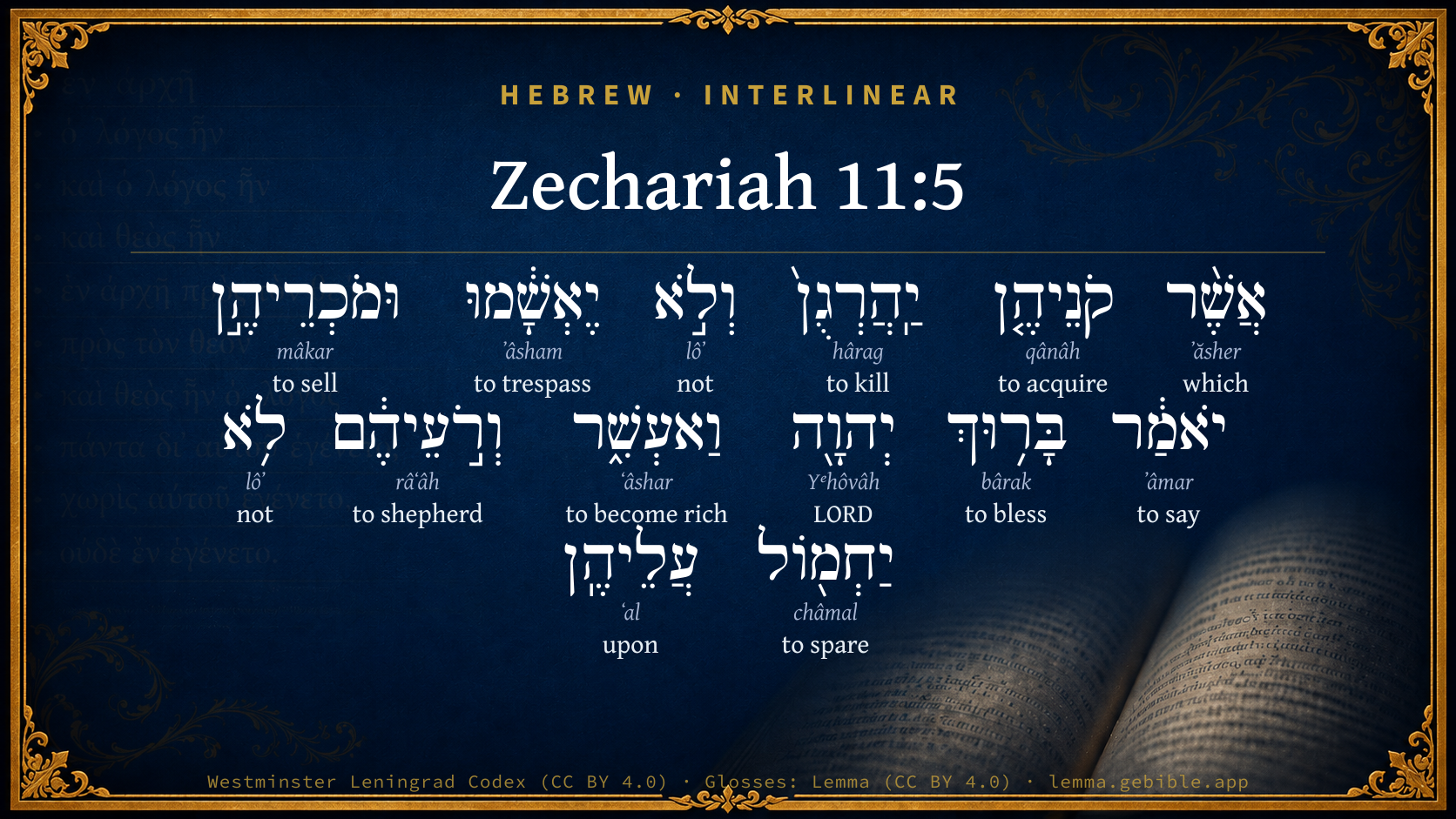
Hebrew (Westminster Leningrad Codex) Zechariah 11:5 appears in the Hebrew Old Testament. The text above is from the Westminster Leningrad Codex. Each word links to its Strong’s number, a concise gloss, and parsing drawn from the Open Scriptures Hebrew Bible morphology. Click any word for its full Brown-Driver-Briggs (BDB) entry.
Download image
Cite this verse

Zechariah 11:5 (World English Bible). Public Domain. Lemma interlinear Bible study tool, https://lemma.gebible.app/v/zechariah/11/5.

Show BibTeX & RIS
BibTeX
RIS
English Translation
Their buyers slaughter them, and go unpunished. Those who sell them say, 'Blessed be Yahweh, for I am rich;' and their own shepherds don't pity them.
World English Bible · Public Domain
Download a study sheet

One document with this verse’s original text, its word-by-word gloss line, the meaning frame, cross-references with their text, attributed commentary, and full source and license credits — printable, and it pastes into notes with its structure intact.

This verse Autodidact and up

Study sheet (.html) Plain text (.txt)

A passage Seminary Student

Up to 50 verses in one chapter. A passage sheet keeps up to 6 commentary sources and 12 cross-references per verse, in the order this page ranks them, and says so on the sheet whenever that leaves anything out. Ask for a single verse and you get the Autodidact verse sheet above.

Everything on this page stays free to read, with no account — the sheet is a download of what is already on screen, not access to it.

Want to remove ads? Support Godless Engineer
Compare translations 3

The same verse in 3 English versions, stacked beneath the original-language interlinear above. Click any original word for its lexicon entry.

Each is an independent rendering of the whole verse — the interlinear is not word-aligned to these translations.

Highlighted words mark where these versions differ — a whole-verse word diff, not a word-by-word alignment.

  • World English Bible Public Domain
    Their buyers slaughter them, and go unpunished. Those who sell them say, 'Blessed be Yahweh, for I am rich;' and their own shepherds don't pity them.
  • King James Version Public Domain
    Whose possessors slay them, and hold themselves not guilty: and they that sell them say, Blessed be the LORD; for I am rich: and their own shepherds pity them not.
  • unfoldingWord Literal Text CC BY-SA 4.0
    (The ones who buy them slaughter them and are not punished, and the ones who sell them say, ‘Blessed be Yahweh! I have become rich!’ for the shepherds working for the flocks’ owners have no pity on them.)

unfoldingWord Literal Text — © unfoldingWord, licensed CC BY-SA 4.0. Word-aligned USFM3 via Door43 (git.door43.org/unfoldingWord/en_ult).

Versions to compare (up to 4)

3 of 4 selected

Show all 18 translations

Every available English version of this verse, each an independent rendering of the whole verse.

  • World English Bible Public Domain
    Their buyers slaughter them, and go unpunished. Those who sell them say, 'Blessed be Yahweh, for I am rich;' and their own shepherds don't pity them.
  • Berean Standard Bible Public Domain
    whose buyers slaughter them without remorse. Those who sell them say, ‘Blessed be the LORD, for I am rich!’ Even their own shepherds have no compassion on them.
  • Majority Standard Bible Public Domain
    whose buyers slaughter them without remorse. Those who sell them say, ‘Blessed be the LORD, for I am rich!’ Even their own shepherds have no compassion on them.
  • King James Version Public Domain
    Whose possessors slay them, and hold themselves not guilty: and they that sell them say, Blessed be the LORD; for I am rich: and their own shepherds pity them not.
  • American Standard Version (1901) Public Domain
    whose possessors slay them, and hold themselves not guilty; and they that sell them say, Blessed be Jehovah, for I am rich; and their own shepherds pity them not.
  • Revised Version (1885) Public Domain
    whose possessors slay them, and hold themselves not guilty; and they that sell them say, Blessed be the LORD, for I am rich: and their own shepherds pity them not.
  • Geneva Bible (1599) Public Domain
    They that possesse them, slay them and sinne not: and they that sell them, say, Blessed be the Lord: for I am riche, and their owne shepherds spare them not.
  • Douay-Rheims (1899) Public Domain
    Which they that possessed, slew, and repented not, and they sold them, saying: Blessed be the Lord, we are become rich: and their shepherds spared them not.
  • Young's Literal Translation Public Domain
    Whose buyers slay them, and are not guilty, And their sellers say, Blessed `is' Jehovah, And I am rich, And their shepherds have no pity on them.
  • Literal Standard Version CC BY-SA 4.0
    Whose buyers slay them, and are not guilty, || And their sellers say, Blessed [is] YHWH, || And I am rich, || And their shepherds have no pity on them.
  • Unlocked Literal Bible CC BY-SA 4.0
    (The ones who buy them slaughter them and are not punished, and the ones who sell them say, 'Blessed be Yahweh! I have become rich!' for the shepherds working for the flocks' owners have no pity on them.)
  • unfoldingWord Literal Text CC BY-SA 4.0
    (The ones who buy them slaughter them and are not punished, and the ones who sell them say, ‘Blessed be Yahweh! I have become rich!’ for the shepherds working for the flocks’ owners have no pity on them.)
  • Darby Bible Public Domain
    whose possessors slay them without being held guilty; and they that sell them say, Blessed be Jehovah! for I am become rich; and their own shepherds pity them not.
  • World Messianic Bible Public Domain
    Their buyers slaughter them and go unpunished. Those who sell them say, ‘Blessed be the LORD, for I am rich;’ and their own shepherds don’t pity them.
  • Webster's Bible Public Domain
    Whose possessors slay them, and hold themselves not guilty: and they that sell them say, Blessed be the LORD; for I am rich: and their own shepherds pity them not.
  • Free Bible Version CC BY-SA 4.0
    Those who buy them kill them and don't feel guilty; those who sell them say, “Praise the Lord! Now I'm rich!” Even their shepherds don't care about them.
  • Bible in Basic English Public Domain
    Whose owners put them to death and have no sense of sin; and those who get a price for them say, May the Lord be praised for I have much wealth: and the keepers of the flock have no pity for them.
  • JPS Tanakh (1917) Public Domain
    whose buyers slay them, and hold themselves not guilty; and they that sell them say: Blessed be the LORD, for I am rich; and their own shepherds pity them not.

Literal Standard Version (2020), Covenant Press — licensed CC BY-SA 4.0. Text via the HelloAO Bible API (eBible.org). Unlocked Literal Bible (unfoldingWord) — licensed CC BY-SA 4.0. Text via the HelloAO Bible API (eBible.org). unfoldingWord Literal Text — © unfoldingWord, licensed CC BY-SA 4.0. Word-aligned USFM3 via Door43 (git.door43.org/unfoldingWord/en_ult). Free Bible Version, Dr. Jonathan Gallagher — licensed CC BY-SA 4.0. Text via the HelloAO Bible API (eBible.org).

Word by word

More ways to search: Search by grammar → Find every occurrence → Compare this word →

Practice this passage: Drill this verse → Learn its vocabulary →

וַאעְשִׁ֑ר
ʻâshar
H6238
“and · to become rich”
Conjunction + Verb, Hiphil, Imperfect, 1st Person, Common, Singular
Part of Speech
Conjunction + Verb
Stem
Hiphil
Form
Imperfect
Person
1st Person
Gender
Common
Number
Singular
Full BDB Definition

Origin: a primitive root

TWOT: 1714

to be or become rich or wealthy, enrich, pretend to be rich - (Qal) to be or become rich - (Hiphil) - to make rich - to gain riches - (Hithpael) to enrich oneself, pretend to be rich
  1. אֲשֶׁ֨ר ʼăsher H834 “which” Particle, Relative
  2. קֹנֵיהֶ֤ן qânâh H7069 “acquiring · them” Verb, Qal, Participle Active, Masculine, Plural, Construct + Suffix, Personal, 3rd Person, Feminine, Plural
  3. יַֽהֲרְגֻן֙ hârag H2026 “to kill · them” Verb, Qal, Imperfect, 3rd Person, Masculine, Plural + Suffix, Personal, 3rd Person, Feminine, Plural
  4. וְלֹ֣א lôʼ H3808 “and · not” Conjunction + Particle, Negative
  5. יֶאְשָׁ֔מוּ ʼâsham H816 “to trespass” Verb, Qal, Imperfect, 3rd Person, Masculine, Plural
  6. וּמֹכְרֵיהֶ֣ן mâkar H4376 “and · selling · them” Conjunction + Verb, Qal, Participle Active, Masculine, Plural, Construct + Suffix, Personal, 3rd Person, Feminine, Plural
  7. יֹאמַ֔ר ʼâmar H559 “to say” Verb, Qal, Imperfect, 3rd Person, Masculine, Singular
  8. בָּר֥וּךְ bârak H1288 “blessed” Verb, Qal, Participle Passive, Masculine, Singular, Absolute
  9. יְהוָ֖ה Yᵉhôvâh H3068 “LORD” Noun, Proper
  10. וְרֹ֣עֵיהֶ֔ם râʻâh H7462 “and · shepherding · them” Conjunction + Verb, Qal, Participle Active, Masculine, Plural, Construct + Suffix, Personal, 3rd Person, Masculine, Plural
  11. לֹ֥א lôʼ H3808 “not” Particle, Negative
  12. יַחְמ֖וֹל châmal H2550 “to spare” Verb, Qal, Imperfect, 3rd Person, Masculine, Singular
  13. עֲלֵיהֶֽן ʻal H5921 “upon · them” Preposition + Suffix, Personal, 3rd Person, Feminine, Plural

About this verse

These counts appear in no published source. They are computed here, from the morphology-tagged text and Lemma’s own curated glosses. What Lemma adds →

14
words
13
distinct lemmas
Prophets
section

Notable vocabulary

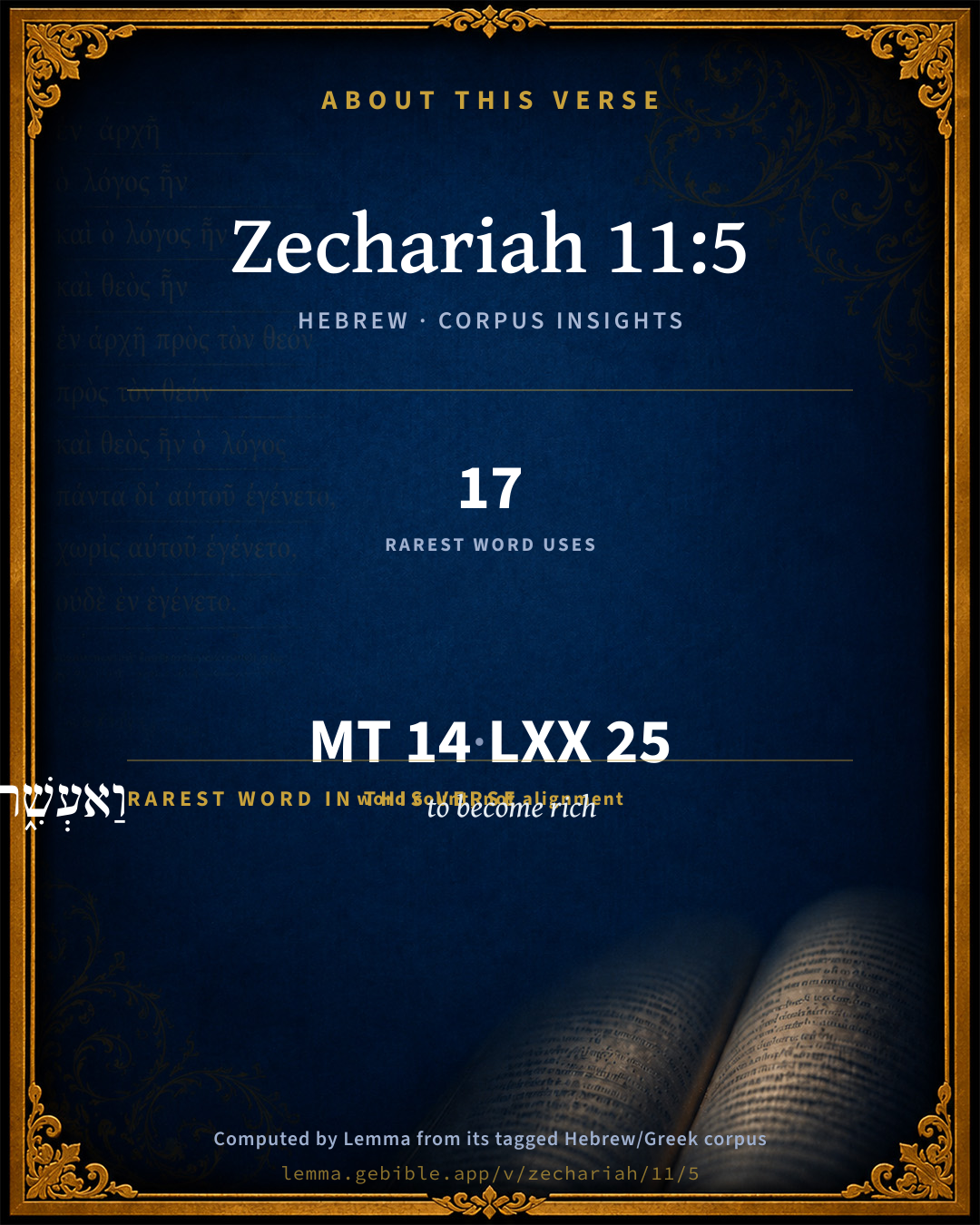
The rarest word here is וַאעְשִׁ֑ר to become rich H6238 — appearing just 17 times in the whole Hebrew Bible.

Shared distinctive vocabulary

וַאעְשִׁ֑ר to become rich H6238 occurs in 17 verses of the Hebrew Bible. Also found in:

Grammatical profile

  • 9 verbs
  • 1 noun
  • 1 preposition
  • 3 particles

Verb forms

  • קֹנֵיהֶ֤ן Qal · Participle Active
  • יַֽהֲרְגֻן֙ Qal · Imperfect
  • יֶאְשָׁ֔מוּ Qal · Imperfect
  • וּמֹכְרֵיהֶ֣ן Qal · Participle Active
  • יֹאמַ֔ר Qal · Imperfect
  • בָּר֥וּךְ Qal · Participle Passive
  • וַאעְשִׁ֑ר Hiphil · Imperfect
  • וְרֹ֣עֵיהֶ֔ם Qal · Participle Active
  • יַחְמ֖וֹל Qal · Imperfect

Repetition

A word recurs within this verse — often emphatic in Hebrew:

  • וְלֹ֣א not H3808 ×2

Hebrew & Septuagint length

In English translation the verse runs 26 words from the Hebrew and 33 from the Septuagint (LXX English) — closely comparable.

A rough comparison of the two English renderings, which tokenize alike — not a word-level alignment.

Word counts can differ between the Hebrew and the Greek without any difference in meaning — e.g. the Hebrew direct-object marker אֵת has no separate Greek word, and Greek often adds the article ὁ.

In the original languages it is 14 Hebrew tokens and 25 Greek tokens — but the two are counted differently (Hebrew bundles its prefixes and suffixes into one token; the Greek is in lemma form), so that isn’t a like-for-like length.

Cross-references

24

Topical passages linked to Zechariah 11:5 in the Treasury of Scripture Knowledge — connected by theme and wording, ordered by reader-vote popularity; previews shown in the World English Bible.

  • Jeremiah 50:7 All who found them have devoured them; and their adversaries said, We are not guilty, because they have sinned against Yahweh, the habitation of righteousness, even Yahweh, the hope of their fathers.
  • 1 Timothy 6:5–10 constant friction of people of corrupt minds and destitute of the truth, who suppose that godliness is a means of gain. Withdraw yourself from such.
  • Hosea 12:8 Ephraim said, "Surely I have become rich, I have found myself wealth. In all my wealth they won't find in me any iniquity that is sin."
  • Genesis 37:26–28 Judah said to his brothers, "What profit is it if we kill our brother and conceal his blood?
  • Deuteronomy 29:19–21 and it happen, when he hears the words of this curse, that he bless himself in his heart, saying, I shall have peace, though I walk in the stubbornness of my heart, to destroy the moist with the dry.
  • 2 Kings 4:1 Now there cried a certain woman of the wives of the sons of the prophets to Elisha, saying, Your servant my husband is dead; and you know that your servant did fear Yahweh: and the creditor is come to take to him my two children to be bondservants.
  • Nehemiah 5:8 I said to them, We after our ability have redeemed our brothers the Jews, that were sold to the nations; and would you even sell your brothers, and should they be sold to us? Then held they their peace, and found never a word.
  • Jeremiah 2:3 Israel [was] holiness to Yahweh, the first fruits of his increase: all who devour him shall be held guilty; evil shall come on them, says Yahweh.
  • Jeremiah 23:1–2 Woe to the shepherds who destroy and scatter the sheep of my pasture! says Yahweh.
  • Ezekiel 22:25–27 There is a conspiracy of her prophets in the midst of it, like a roaring lion ravening the prey: they have devoured souls; they take treasure and precious things; they have made her widows many in the midst of it.
  • Ezekiel 34:2–4 Son of man, prophesy against the shepherds of Israel, prophesy, and tell them, even to the shepherds, Thus says the Lord Yahweh: Woe to the shepherds of Israel who feed themselves! Shouldn't the shepherds feed the sheep?
  • Ezekiel 34:6 My sheep wandered through all the mountains, and on every high hill: yes, my sheep were scattered on all the surface of the earth; and there was none who searched or sought.
  • Ezekiel 34:10 Thus says the Lord Yahweh: Behold, I am against the shepherds; and I will require my sheep at their hand, and cause them to cease from feeding the sheep; neither shall the shepherds feed themselves any more; and I will deliver my sheep from their mouth, that they may not be food for them.
  • Ezekiel 34:18–19 Seems it a small thing to you to have fed on the good pasture, but you must tread down with your feet the residue of your pasture? and to have drunk of the clear waters, but you must foul the residue with your feet?
  • Ezekiel 34:21 Because you thrust with side and with shoulder, and push all the diseased with your horns, until you have scattered them abroad;
  • Micah 3:1–3 I said, "Please listen, you heads of Jacob, And rulers of the house of Israel: Isn't it for you to know justice?
  • Micah 3:9–12 Please listen to this, you heads of the house of Jacob, And rulers of the house of Israel, Who abhor justice, And pervert all equity.
  • Matthew 21:12–13 Jesus entered into the temple of God, and drove out all of those who sold and bought in the temple, and overthrew the money-changers' tables and the seats of those who sold the doves.
  • Matthew 23:13 "Woe to you, scribes and Pharisees, hypocrites! For you devour widows' houses, and as a pretense you make long prayers. Therefore you will receive greater condemnation.
  • John 10:12–13 He who is a hired hand, and not a shepherd, who doesn't own the sheep, sees the wolf coming, leaves the sheep, and flees. The wolf snatches the sheep, and scatters them.
  • John 16:2 They will put you out of the synagogues. Yes, the time comes that whoever kills you will think that he offers service to God.
  • 2 Peter 2:3 In covetousness they will exploit you with deceptive words: whose sentence now from of old doesn't linger, and their destruction will not slumber.
  • John 10:1 "Most assuredly, I tell you, one who doesn't enter by the door into the sheep fold, but climbs up some other way, the same is a thief and a robber.
  • Revelation 18:13 and cinnamon, incense, perfume, frankincense, wine, olive oil, fine flour, wheat, sheep, horses, chariots, bodies, and people's souls.

Cross-references courtesy of OpenBible.info (CC BY 4.0).

Hebrew and Greek witnesses Masoretic Hebrew ↔ Greek Septuagint

The same verse in the two great witnesses to the Old Testament, shown verse-for-verse.

These are two independent witnesses, not word-aligned to each other, and the Septuagint is shown in lemma (dictionary) form.

Hebrew Zechariah 11:5 Masoretic · Westminster Leningrad Codex

אֲשֶׁ֨ר קֹנֵיהֶ֤ן יַֽהֲרְגֻן֙ וְלֹ֣א יֶאְשָׁ֔מוּ וּמֹכְרֵיהֶ֣ן יֹאמַ֔ר בָּר֥וּךְ יְהוָ֖ה וַאעְשִׁ֑ר וְרֹ֣עֵיהֶ֔ם לֹ֥א יַחְמ֖וֹל עֲלֵיהֶֽן

Their buyers slaughter them, and go unpunished. Those who sell them say, 'Blessed be Yahweh, for I am rich;' and their own shepherds don't pity them.

World English Bible · Public Domain

Greek LXX Zechariah 11:5 Septuagint · lemma form

ὅς ὁ κτάομαι κατασφάζω καί οὐ μεταμελέω καί ὁ πωλέω αὐτός λέγω εὐλογητός κύριος καί πλουτέω καί ὁ ποιμήν αὐτός οὐ πάσχω οὐδείς ἐπί αὐτός

which their possessors have slain, and have not repented: and they that sold them said, Blessed be the Lord; for we have become rich: and their shepherds have suffered no sorrow for them.

LXX2012 (modern English Septuagint) · Public Domain

On this verse, The Pulpit Commentary discusses the Septuagint’s reading. Read the note in Commentary ↓

Hebrew: Westminster Leningrad Codex (CC BY 4.0). Greek: Septuagint (public domain); English from LXX2012 (modern English Septuagint) (Public Domain). How the Septuagint differs from the Hebrew →

Targum (Aramaic paraphrase)

1

The Targum is the ancient Jewish Aramaic paraphrase of the Hebrew Scriptures — an interpretive translation, not the Hebrew text itself. Onkelos (literal) and Pseudo-Jonathan (expansive) render the Torah, and Jonathan the Prophets. Coverage is partial: where no permissively-licensed English translation exists for a verse, only the Aramaic is shown. This is verse-level text, not a word-by-word alignment to the Hebrew.

  1. Targum Jonathan Prophets (Joshua–Malachi)
    דִי קָנֵיהוֹן קָטְלִין לְהֵין אָמְרִין לָא עֲלָנָא חוֹבָא וּמְזַבְּנֵיהֶן אָמְרִין בְּרִיךְ יְיָ דִי אַעְתַּרִנָא וְרָעֵיהֶן לָא חַיְסִין עֲלֵיהֶן:

    (no public-domain English translation for this verse)

    Targum Jonathan — Aramaic: “Mikraot Gedolot” (public domain). English: “Sefaria Community Translation” (CC0 1.0 (public-domain dedication)); “London "Chaldee Paraphrase," 1871” (public domain). Text via Sefaria.

Commentary

Notes on Zechariah 11:5 from classic Christian and Jewish commentators (each source and its license shown beneath its notes). The classic Christian expositions comment on the surrounding passage and are grouped to its opening verse, so a note may address several verses; the Jewish commentaries on the Tanakh (Rashi and others) are per-verse, so they appear only where the commentator wrote on this verse.

Lemma curates 59 commentaries, every one of them public domain or Creative Commons licensed, each selected and text-cleaned for this edition rather than reprinted as found. About our sources →

Trapp's Complete Commentary

John Trapp

Zec 11:5 Whose possessors slay them, and hold themselves not guilty: and they that sell them say, Blessed [be] the LORD; for I am rich: and their own shepherds pity them not.

Ver. 5. Whose possessors slay them] Flaying their skin from off them, eating their flesh, breaking their bones, &c., Mic 3:3; feeding themselves, and not the flock of God, Eze 34:2, as if they had been "lords over God’s heritage," 1Pe 5:3. Owners and possessors, as here, vel pretio vel paemio; and as the Pope and his, Curia Romana quae non vult ovem sine lana, The papal court which did not want the as the sheep without the fleece, old proverb was.

And hold themselves not guilty] Non peccant. They fault not themselves; they are not found guilty by others. Such an unlimited power over God’s people they have usurped, as if they might use them at their pleasure, and never be once questioned or punished for the same; but escape scot free. This was the extremity of tyranny; such as the cruel Spaniards exercise over the poor Indians: they suppose they show the wretches great favour, when they do not, for their pleasures, whip them with cords, and day by day drop their naked bodies with burning bacon; which is one of the least cruelties they inflict upon them.

And they that sell them] Sell them for slaves (whom they ought to redeem rather with their own blood), and grow rich by them; being greedy of filthy lucre, not without foul blasphemy against God, whom they entitle to their riches sacrilegiously and most thievishly gotten; while they say,

Blessed be the Lord, for I am rich] Deo gratius, blessed be God is a very good saying, and was much in Austin’s mouth. But as the fountain of goodness will not be laden at with unwashed hands; so fair words from a foul mouth are infinitely displeasing to him that "inhabiteth the praises of Israel," Psa 22:3. Hypocrites are not unfitly compared to monkeys, that have the gravest countenances of all creatures, but are incessantly doing mischief; or to the harpies, {a} that are said to have virgins’ faces, vultures’ talons. Mel in ore, verba lactis; Fel in corde, fraus in factis. Words of milk are honey in the mouth; gall in the heart is fraud in the making. Pharisees, under pretence of long prayers, devoured widows’ houses, Mat 23:14; while their lips seemed to pray or praise God, they were but chewing and champing some sweet morsel snatched from the flock, but sauced with the wrath of God, Job 20:15. See how our Saviour sets them out in their colours, Mat 23:15-16; Mat 23:23. Such fair professors but foul sinners were their predecessors, Isa 66:5, who, when they had done evil as they could, thought to salve all by saying, Let the Lord be glorified. And such also are their successors, the Pope and his followers. Verba tua Dei plane sunt, facta vero diaboli (said one once to Pope Innocent III, preaching peace but sowing discord), you speak like a God, but do like a devil; wherefore you shall receive the greater damnation. When one of our persecuting bishops read the sentence of excommunication against a certain martyr, and began, as the usual form was, In the name of God, Amen, the martyr cried out, You begin in a wrong name. And it grew to a common proverb, In nomine Dei incipit omne malum. All mischief begins on that manner. Gentilis, that impious anti-trinitarian, gave out that he suffered for the glory of the most high God. Becket, the arch-traitor, pretended to submit to his sovereign, but with this false reserve, Salvo honore Dei. Iam am saved by the honour of God. The Swenckfeldians entitled themselves the confessors of the glory of Christ. And Conradus Vorstius’s late monster hath De Deo concerning God in the front, and atheism and blasphemy in the text.

And their own shepherds pity them not] Which yet they ought to have done, had they had never so much right and reason to destroy them. A shepherd hath his name from friendly feeding; in Greek, from earnest desire and love to the sheep. David, when he was hunted from Samuel the prophet, he fleeth to Ahimelech the priest; as one that knew justice and compassion should dwell in those breasts that are consecrated to God and his people. But these shepherds, through want of God’s holy fear, Job 6:14, had brawny breasts, horny heart strings; their hearts, first turned into earth and mud, did afterwards freeze into steel and adamant; cursed children they were, having their hearts exercised with covetousness and cruelty, 2Pe 2:14.

{a} A fabulous monster, rapacious and filthy, having a woman’s face and body and a bird’s wings and claws, and supposed to act as a minister of divine vengeance. ŒD

John Trapp, A Commentary or Exposition upon All the Books of the Old and New Testament (1647–1656) — public domain. Text from a community e-Sword module.

Tyndale Open Study Notes

Tyndale Open Resources

11:5 The sheep (the Hebrew people) were being sold as slaves to buyers—occupying foreign powers, foreign allies, or domestic slave-traders (see Amos 2:6). • The sellers were the shepherds, leaders of the people who were more concerned with getting rich than with the well-being of the sheep.

Tyndale Open Study Notes — © Tyndale Open Resources, licensed CC BY-SA 4.0. Text via the HelloAO Bible API.

Geneva Bible (1599)

Geneva Bible translators

He noteth the hypocrites, which ever have the Name of God in their mouths, though in their life and doings they deny God, attributing their gain to God’s blessings, which cometh of the spoil of their brethren.

Their governors destroy them without any remorse of conscience, or yet thinking that they do evil.

Geneva Bible (1599) marginal notes — public domain. Text via Bolls.life.

Jamieson, Fausset & Brown

Robert Jamieson, A. R. Fausset & David Brown

possessors--The buyers [MAURER], their Roman oppressors, contrasted with "they that sell men." The instruments of God's righteous judgment, and therefore "not holding themselves guilty" (Jer 50:7). It is meant that they might use this plea, not that they actually used it. Judah's adversaries felt no compunction in destroying them; and God in righteous wrath against Judah allowed it.

they that sell them--(Compare Zac 11:12). The rulers of Judah, who by their avaricious rapacity and selfishness (Joh 11:48, Joh 11:50) virtually sold their country to Rome. Their covetousness brought on Judea God's visitation by Rome. The climax of this was the sale of the innocent Messiah for thirty pieces of silver. They thought that Jesus was thus sold and their selfish interest secured by the delivery of Him to the Romans for crucifixion; but it was themselves and their country that they thus sold to the Roman possessors."

I am rich--by selling the sheep (Deu 29:19; Hos 12:8). In short-sighted selfishness they thought they had gained their object, covetous self-aggrandizement (Luk 16:14), and hypocritically "thanked" God for their wicked gain (compare Luk 18:11).

say . . . pity--In Hebrew it is singular: that is, each of those that sell them saith: Not one of their own shepherds pitieth them. An emphatical mode of expression by which each individual is represented as doing, or not doing, the action of the verb [HENDERSON]. HENGSTENBERG refers the singular verbs to JEHOVAH, the true actor; the wicked shepherds being His unconscious instruments. Compare Zac 11:6, For I will no more pity, with the Hebrew "pitieth not" here.

Jamieson, Fausset & Brown — Commentary Critical and Explanatory on the Whole Bible (1871) — public domain (CC PDM 1.0). Text via the HelloAO Bible API.

Adam Clarke's Commentary

Verse 5. Whose possessors] Governors and false prophets, slay them, by leading them to those things that will bring them to destruction.

And they that sell them] Give them up to idolatry; and bless God, strange to tell, that they get secular advantage by the establishment of this false religion.

Adam Clarke's Commentary on the Bible (1810–1826) — public domain. Text from a community e-Sword/MySword module.

John Calvin's Commentaries

He afterwards adds another circumstance, which shows still further the wonderful and ineffable goodness of God, — that he had been a shepherd of a flock, which had not only been harassed by wolves and robbers, but also by its own shepherds. In short, the import of the whole is, — that though wolves and robbers had ranged with great barbarity among the people, yet God had always been their shepherd.

He then enlarges on the subject and says, that they who possessed them had killed them, so that they spared not. By these words the Prophet shows that the safety of the people had been deemed as nothing by their very leaders: they could not then by any excellence of their own have induced God to show so much kindness to them. But these words ought to be attentively noticed, — that when the flock was slain, the executioners or butchers themselves had no mercy, for they thought it was a spoil justly due to them. We see how God extols here his own goodness; for he had condescended to defend and rule and feed that people, who were not only despised in the world, but counted as nothing, and the slaughtering of them deemed a lawful prey: they sin not, he says, that is, they are not conscious of exercising any cruelty, — Why? because they thought that they justly enriched themselves, while they were plundering so wretched a flock. The more base, then, and inexcusable was the ingratitude of the people, when after having been so kindly received and so gently nourished by God, they yet rejected all his favors and suffered not themselves to be governed by his hand. And it is material to observe here, that these contrasts tend greatly to exaggerate the sins of men, and ought to be considered, that God’s severity may not be blamed; for we know that many complain when God executes his judgments: they would measure all punishments by their own ideas, and subject God to their own will. In order therefore to check such complaints, the Prophet says, that though the flock was most contemptible, it had not yet been despised by God, but that he undertook the care of it.

The shepherds and masters said, Blessed be Jehovah. We are wont to give thanks to God when we really believe that the blessings we have come from him. The robber who kills an innocent man will not say, “Blessed be God;” for he on the contrary tries to extinguish every remembrance of God, because he has wounded his own conscience. The same may be also said of thieves. Hypocrites often profess the name of God; and they whose trade is cheating ever make a speech of this kind, “By God’s grace I have gained so much this year;” that is, after having acquired the property of others by deceit, cheating, and plunder, they give thanks to God! and at the same time they flatter themselves by self-deception, as though all were a lawful prey; for, forsooth! they are not proved guilty before a human tribunal. Now the Prophet here adopts this common mode of speaking, by which men, not conscious of doing wrong, usually testify that their gain is just and lawful.

John Calvin's Commentaries (1540-1563) — public domain. Text from the Calvin Translation Society English edition (1840s-50s) via the Christian Classics Ethereal Library (ccel.org). Calvin's coverage is partial (roughly two-thirds of the Bible); uncommented books and verses are honest gaps, never fabricated. The 19th-century editor's footnotes and remarks are omitted so the notes are faithfully Calvin's own voice.

Ellicott's Commentary for English Readers

(5) And hold . . . not guilty.—Comp. Jer_1:7. Own is a gloss of the English version.

A Bible Commentary for English Readers, edited by Charles John Ellicott (1878–1897) — public domain. Text from a community e-Sword module.

The Cambridge Bible for Schools and Colleges

gen. ed. J. J. S. Perowne

5. possessors] Rather, buyers. The flock of which the prophet was commanded to take charge had been bought and slain without compunction, and sold for gain, with a complacent “bless the Lord” at the good price they fetched.

The Cambridge Bible for Schools and Colleges (gen. ed. J. J. S. Perowne; Cambridge University Press, 1878–1918) — public domain. Text from a community e-Sword module.

John Gill's Exposition

Whose possessors slay them, and hold themselves not guilty,.... Not the Romans after Christ came, into whose hands they were delivered, and by whom they were slain in great numbers, not accounting it any sin to put them to death; but the priests, Scribes, Pharisees, and doctors, among the Jews, who ruined and destroyed their souls, by feeding them with poisonous doctrines; teaching them the commandments of men, and to observe the traditions of the elders; and to seek for life and salvation by the works of the law, which was a ministration of condemnation and death to them; and yet thought they did God and the souls of men good service:

and they that sell them; as false teachers make merchandise of the souls of men:

say, Blessed be the Lord, for I am rich; having devoured widows' houses and substances, under a pretence of long prayers; and enriched themselves through tithes of everything, and by other methods; as the Scribes and Pharisees did:

and their own shepherds pity them not; those who should have been concerned for the welfare of their souls had no compassion on them. Aben Ezra, Kimchi, and Ben Melech, interpret this of God, the Shepherd of Israel; the verb being singular, though the noun is plural: so God is called Makers, Creators, Psa 149:2 and this sense agrees with the following words.

John Gill's Exposition of the Whole Bible (1746–1763) — public domain (CC PDM 1.0). Text via the HelloAO Bible API.

Albert Barnes' Notes on the Bible

Whose possessors - (buyers) slay them and hold themselves not guilty, rather, are not guilty either in their own eyes, or in the sight of God, since He gave them up and would no more avenge them. They contract no guilt. Aforetime God said; “Israel was holiness to the Lord, the first-fruits of His increase; all that devour him shall be guilty: evil shall come upon them, saith the Lord” Jer 2:3. Now God reversed this, as He said by the same prophet, “My people hath been lost sheep; their shepherds have caused them to go astray; they have turned them away on the mountains; all that found them have devoured them; and their adversaries say, We are not guilty, because they have sinned against the Lord, the habitation of justice, yea, the hope of their fathers, the Lord” Jer 50:6-7. The offence of injuring Israel was that they were God’s people: when He cast them forth, they who chastened them were His servants Jer 25:9; Jer 27:6; Jer 43:10, His instruments, and offended only when through pride they knew not in whose hands they themselves were Isa 10:7; Hab 1:11, or through cruelty exceeded their office Isa 47:6; Zec 1:18, and so they became guilty.

And they that sell them say, Blessed be the Lord, for I am rich - Even Sennacherib felt himself in part, or thought best to own himself, to be an instrument in God’s hand Isa 36:10. But Titus when he “entered Jerusalem, marveled at the strength of the city and its towers, which ‘he tyrants’ in phrensy abandoned. When then he had beheld their solid strength and the greatness of each rock, and how accurately they were fitted in, and how great their length and breadth, he said ‘By the help of God we have warred: and God it was who brought down the Jews from those bulwarks: for what avail the hands of man or his engines against such towers?’ Much of this sort he said to his friends.” The Jews also were “sold” in this war, as they had not been in former captures; and that, not by chance, but because the Roman policy was different from all, known by “experience” in the time of Zechariah. Into Babylon they had been carried captive, as a whole, because it was the will of God, after the “seventy years” to restore them. In this war, it was His will to destroy or disperse them; and so those above 17 were sent to Egypt to the works; those below 17 were sold. : “The whole number taken prisoners during the wars were 1,100,000,” beside those who perished elsewhere. Jerome: “Read we the ancient histories and the traditions of the mourning Jews, that at the Tabernaculum Abrahae (where now is a very thronged mart every year) after the last destruction, which they endured from Adrian, many thousands were sold, and what could not be sold were removed into Egypt, and destroyed by shipwreck or famine and slaughter by the people. No displeasure came upon the Romans for the utter destruction, as there had upon the Assyrians and Chaldaeans.”

And their own shepherds - (In contrast to those who “bought” and “sold” them, who accordingly were not their own, temporal or spiritual) they to whom God had assigned them, who should have fed them with the word of God, strengthened the diseased, healed the sick, bound up the broken, and sought the lost, “pity them not” Eze 34:4. He says what they should have done, in blaming them for what they did not do. They owed them a tender compassionate love; they laid aside all mercy, and became wolves, as Paul says; “After my departure shall grievous wolves enter in among you, not sparing the flock. Also of your own selves shall men arise, speaking perverse things, to draw away disciples after them” Act 20:29-30. They who owed them all love, shall have none. Jerome: “No marvel then, he says, if enemies shall use the right of conquest, when their very shepherds and teachers spared them not, and, through their fault, the flock was given over to the wolves.” All were corrupted, high priest, priests, scribes, lawyers, Pharisees, Sadducees. No one had pity on them.

Albert Barnes' Notes on the Bible (1834–1885) — public domain. Text from a community e-Sword/MySword module.

Matthew Poole's English Annotations

Whose possessors slay them; either their own governors, or the Romans who in right of conquerors are their possessors; which way soever they got them into their hands, they ruined them, destroyed them both in body and estate.

And hold themselves not guilty; think they do not sin in doing this; so low thoughts they had of this people, such extravagant thoughts they had of their own power and authority.

They that sell them; betray their persons, or liberty, or estate for profit, or sell them for slaves to foreigners; say,

Blessed be the Lord, for I am rich; with profane, ungodly hearts do give God thanks that they thrive by the most barbarous methods of cruelty and oppression, by bloody murders, as if these were ways of his appointing to gain wealth as if he blessed them.

Their own shepherds pity them not; who by birth, call, and office were their proper shepherds, the governors of this poor people, the princes, the priests, had no pity on them in their slavery or blood; looked on as unconcerned, it may be glad, that either they got a booty, or were rid of a disaffected subject.

Matthew Poole's English Annotations on the Holy Bible (1683–1685) — public domain. Text from a community e-Sword/MySword module.

The Pulpit Commentary

Possessors; or, buyers. Those who claimed to be owners by right of purchase. Hold themselves not guilty. They are so blinded by self-interest that they see no sin in thus treating the flock. But the expression is better rendered, bear no blame, i.e. suffer no penalty, commit this wickedness with impunity. Septuagint, "repent not;" Vulgate, non dolebant, which Jerome explains, "did not suffer for it." Blessed be the Lord. So little compunction do they feel that they actually thank God for their ill-gotten gains. The prophet is speaking of chiefs and rulers, civil and ecclesiastical, who played into the enemies" hands, and thought of nothing but how to make a gain of the subject people. Our Lord denounces such untrustworthy shepherds. (Joh_10:11-13) Doubtless, too, the expressions in the text refer to the foreign powers which had oppressed the Jews at various times, Egypt, Assyria, etc. Amid all such distresses, from whatever cause, God still had tender care for his people, and punished and will punish their enemies. In this verse the offenders against Israel are of three classes buyers, sellers, shepherds (see ver. 8). "Shepherd" appears sometimes in the Assyrian inscriptions as a synonym for "prince" (see Schrader, "Keilinschr.," p. 453):

Vers. 5, 6. Oppressors and oppressed.

I GOD"S JUDGMENT ON OPPRESSORS. Power great thing. Test of character. Few able to use it rightly. Even the "wise man" (Ecc_7:7) may have his head turned, and act as if "mad." The "shepherds" false to their awful trust. Hence the people became the prey of oppressors. Merciless, avaricious, godless, neither fearing God nor regarding man. Such oppressors are found in various forms. Landlords and other "possessors" have need to take warning. The people were not made for the land, but the land for the people. Property has its duties as well as its rights. "Unto whom much is given, of them shall much be required." "Shall not the Judge of all the earth do right?

II GOD"S MERCY FOR THE OPPRESSED. The Bible is on the side of the weak, and not the strong; of the wronged, and not the wrong doer. Prophet after prophet has spoken on behalf of the poor and the needy, and carried their cause to the throne of the Most High. God acts by means. "Feed:

1. With the gospel of love.

2. With the law of righteousness. Binding on all.

3. With the hope of immortality.

"We were weary and we Fearful, and we in our march Fain to drop down and to die; Still thou turnedst and still Beckonedst the trembler and still Gavest the weary thy hand. If, in the paths of the world, Stones might have wounded thy feet, Toil or dejection have tried Thy spirit, of that we saw Nothing; to us thou wast still Cheerful and helpful and firm. Therefore to thee it was given Many to save with thyself. And at the end of thy day, O faithful Shepherd, to come, Bringing thy sheep in thy hand. (Matthew Arnold) F.

The Pulpit Commentary (1880–1919), ed. H.D.M. Spence-Jones & Joseph S. Exell — public domain. Text from a community e-Sword module.

John Wesley's Explanatory Notes

Whose possessors - Governors. Not guilty - Think they do no ill. That sell them - For slaves. For l am rich - Profanely give God thanks, that they thrive by cruelty and oppression.

John Wesley, Explanatory Notes Upon the Whole Bible (1754–1765) — public domain. Text via the GEBible commentary corpus.

Rashi

Rabbi Shlomo Yitzchaki (Rashi)

and not be guilty The kings of the nations among whom I will exile them; this one sells them, and the buyer slays them, without feeling (lit., “and he does not put to his heart”) that there should be guilt in the matter. The seller boasts: Blessed be the Lord Who delivered them into my hand, and behold! I am wealthy.

for I have become wealthy And behold! I am wealthy.

Rashi on the Tanakh — English translations: “The Judaica Press complete Tanach with Rashi, translated by A. J. Rosenberg” (CC BY 4.0); “Pentateuch with Rashi's commentary by M. Rosenbaum and A.M. Silbermann, 1929-1934” (public domain); “The Metsudah Tanach series, Lakewood, N.J” (CC BY 4.0); and “The Book of Joshua, Metsudah Publications, 1997” (CC BY 4.0). Text via Sefaria.

Lesson kit

Teaching starters — assembled from the data on this page, not authored interpretation. Every prompt links to the verse data it draws on. Edit before teaching.

Zechariah, in the Prophets, opens this verse with 14 words (13 distinct Hebrew lemmas). Its most distinctive word is ʻâshar (“to become rich”). A historical commentator’s framing appears above. Read the whole chapter for the surrounding context.

Discussion questions

  1. How does “to become rich” (ʻâshar) shape what this verse is saying?
  2. Genesis 14:23 shares the word «to become rich» with this verse. How do the two illuminate each other?
  3. “not” occurs 2× in this one verse. What is the effect of the repetition?
  4. These translations render this verse differently; the difference is in the English rendering, not the original. What questions does that raise?
  5. The verb «קֹנֵיהֶ֤ן» is Qal Participle Active. How does its form color the action?
  6. Reading how Trapp's Complete Commentary and Tyndale Open Study Notes read this verse, where do the two commentators agree and where do they part?

Things to notice

Reading settings

Reading text

Shown beneath each verse's original-language words.

Old Testament
Old Testament edition

Read the OT as the Masoretic Hebrew (MT) or the Greek Septuagint (LXX).

English shown for the Greek Septuagint (in the Hebrew ↔ Greek comparison).

Comparing translations? Open the Compare panel on any verse page to stack up to four side by side.