
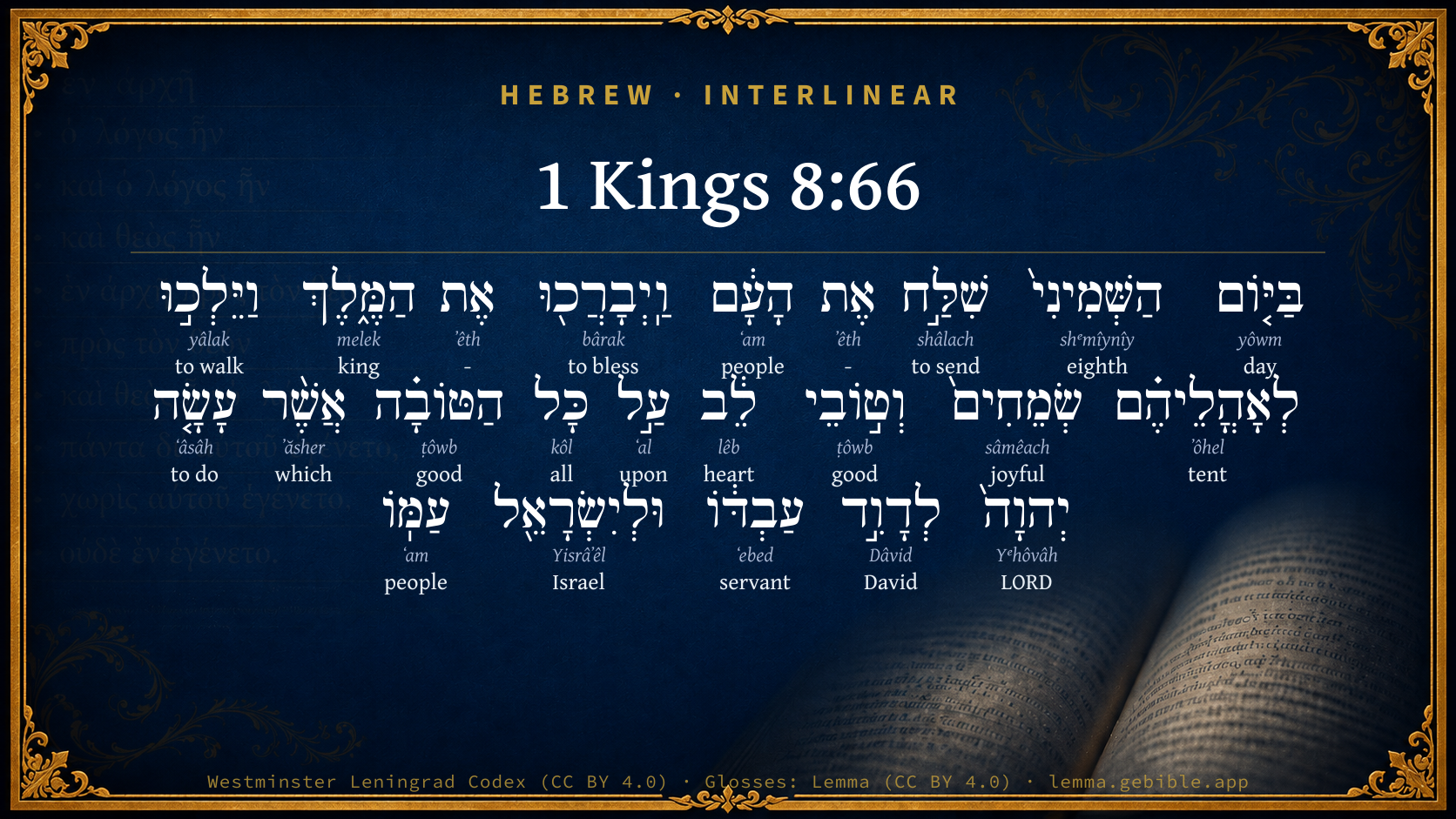
1 Kings 8:66

Hebrew (Westminster Leningrad Codex) 1 Kings 8:66 appears in the Hebrew Old Testament. The text above is from the Westminster Leningrad Codex. Each word links to its Strong’s number, a concise gloss, and parsing drawn from the Open Scriptures Hebrew Bible morphology. Click any word for its full Brown-Driver-Briggs (BDB) entry.
Download image
Cite this verse

1 Kings 8:66 (World English Bible). Public Domain. Lemma interlinear Bible study tool, https://lemma.gebible.app/v/1-kings/8/66.

Show BibTeX & RIS
BibTeX
RIS
English Translation
On the eighth day he sent the people away; and they blessed the king, and went to their tents joyful and glad of heart for all the goodness that Yahweh had shown to David his servant, and to Israel his people.
World English Bible · Public Domain
Download a study sheet

One document with this verse’s original text, its word-by-word gloss line, the meaning frame, cross-references with their text, attributed commentary, and full source and license credits — printable, and it pastes into notes with its structure intact.

This verse Autodidact and up

Study sheet (.html) Plain text (.txt)

A passage Seminary Student

Up to 50 verses in one chapter. A passage sheet keeps up to 6 commentary sources and 12 cross-references per verse, in the order this page ranks them, and says so on the sheet whenever that leaves anything out. Ask for a single verse and you get the Autodidact verse sheet above.

Everything on this page stays free to read, with no account — the sheet is a download of what is already on screen, not access to it.

Want to remove ads? Support Godless Engineer
Compare translations 3

The same verse in 3 English versions, stacked beneath the original-language interlinear above. Click any original word for its lexicon entry.

Each is an independent rendering of the whole verse — the interlinear is not word-aligned to these translations.

Highlighted words mark where these versions differ — a whole-verse word diff, not a word-by-word alignment.

  • World English Bible Public Domain
    On the eighth day he sent the people away; and they blessed the king, and went to their tents joyful and glad of heart for all the goodness that Yahweh had shown to David his servant, and to Israel his people.
  • King James Version Public Domain
    On the eighth day he sent the people away: and they blessed the king, and went unto their tents joyful and glad of heart for all the goodness that the LORD had done for David his servant, and for Israel his people.
  • unfoldingWord Literal Text CC BY-SA 4.0
    On the eighth day he sent the people away, and they blessed the king, and they went to their tents rejoicing and good of heart over all of the good that Yahweh had done for David his servant and for Israel his people.

unfoldingWord Literal Text — © unfoldingWord, licensed CC BY-SA 4.0. Word-aligned USFM3 via Door43 (git.door43.org/unfoldingWord/en_ult).

Versions to compare (up to 4)

3 of 4 selected

Show all 18 translations

Every available English version of this verse, each an independent rendering of the whole verse.

  • World English Bible Public Domain
    On the eighth day he sent the people away; and they blessed the king, and went to their tents joyful and glad of heart for all the goodness that Yahweh had shown to David his servant, and to Israel his people.
  • Berean Standard Bible Public Domain
    On the fifteenth day Solomon sent the people away. So they blessed the king and went home, joyful and glad in heart for all the good things that the LORD had done for His servant David and for His people Israel.
  • Majority Standard Bible Public Domain
    On the fifteenth day Solomon sent the people away. So they blessed the king and went home, joyful and glad in heart for all the good things that the LORD had done for His servant David and for His people Israel.
  • King James Version Public Domain
    On the eighth day he sent the people away: and they blessed the king, and went unto their tents joyful and glad of heart for all the goodness that the LORD had done for David his servant, and for Israel his people.
  • American Standard Version (1901) Public Domain
    On the eighth day he sent the people away; and they blessed the king, and went unto their tents joyful and glad of heart for all the goodness that Jehovah had showed unto David his servant, and to Israel his people.
  • Revised Version (1885) Public Domain
    On the eighth day he sent the people away, and they blessed the king, and went unto their tents joyful and glad of heart for all the goodness that the LORD had shewed unto David his servant, and to Israel his people.
  • Geneva Bible (1599) Public Domain
    And the eight day he sent the people away: and they thanked the King and went vnto their tentes ioyous and with glad heart, because of al the goodnesse that the Lord had done for Dauid his seruant, and for Israel his people.
  • Douay-Rheims (1899) Public Domain
    And on the eighth day he sent away the people: and they blessed the king, and went to their dwellings rejoicing, and glad in heart for all the good things that the Lord had done for David his servant, and for Israel his people.
  • Young's Literal Translation Public Domain
    On the eighth day he hath sent the people away, and they bless the king, and go to their tents, rejoicing and glad of heart for all the good that Jehovah hath done to David His servant, and to Israel His people.
  • Literal Standard Version CC BY-SA 4.0
    On the eighth day he has sent the people away, and they bless the king, and go to their tents, rejoicing and glad of heart for all the good that YHWH has done to His servant David, and to His people Israel.
  • Unlocked Literal Bible CC BY-SA 4.0
    On the eighth day he sent the people away, and they blessed the king and went to their homes with joyful and glad hearts for all the goodness that Yahweh had shown to David, his servant, and to Israel, his people.
  • unfoldingWord Literal Text CC BY-SA 4.0
    On the eighth day he sent the people away, and they blessed the king, and they went to their tents rejoicing and good of heart over all of the good that Yahweh had done for David his servant and for Israel his people.
  • Darby Bible Public Domain
    On the eighth day he sent the people away; and they blessed the king, and went to their tents, joyful and glad of heart for all the goodness that Jehovah had done to David his servant, and to Israel his people.
  • World Messianic Bible Public Domain
    On the eighth day he sent the people away; and they blessed the king, and went to their tents joyful and glad in their hearts for all the goodness that the LORD had shown to David his servant, and to Israel his people.
  • Webster's Bible Public Domain
    On the eighth day he sent the people away: and they blessed the king, and went to their tents joyful and glad of heart for all the goodness that the LORD had done for David his servant, and for Israel his people.
  • Free Bible Version CC BY-SA 4.0
    One day later Solomon sent the people home. They blessed the king and went home, full of joy and happy for all the good things that the Lord had done for his servant David and for his people Israel.
  • Bible in Basic English Public Domain
    And on the eighth day he sent the people away, and, blessing the king, they went to their tents full of joy and glad in their hearts, because of all the good which the Lord had done to David his servant and to Israel his people.
  • JPS Tanakh (1917) Public Domain
    On the eighth day he sent the people away, and they blessed the king, and went unto their tents joyful and glad of heart for all the goodness that the LORD had shown unto David His servant, and to Israel His people.

Literal Standard Version (2020), Covenant Press — licensed CC BY-SA 4.0. Text via the HelloAO Bible API (eBible.org). Unlocked Literal Bible (unfoldingWord) — licensed CC BY-SA 4.0. Text via the HelloAO Bible API (eBible.org). unfoldingWord Literal Text — © unfoldingWord, licensed CC BY-SA 4.0. Word-aligned USFM3 via Door43 (git.door43.org/unfoldingWord/en_ult). Free Bible Version, Dr. Jonathan Gallagher — licensed CC BY-SA 4.0. Text via the HelloAO Bible API (eBible.org).

Word by word

More ways to search: Search by grammar → Find every occurrence → Compare this word →

Practice this passage: Drill this verse → Learn its vocabulary →

שְׂמֵחִים֙
sâmêach
H8056
“joyful”
Adjective, Adjective, Masculine, Plural, Absolute
Part of Speech
Adjective
Type
Adjective
Gender
Masculine
Number
Plural
State
Absolute
Full BDB Definition

Origin: from H8055

TWOT: 2268a

joyful, merry, glad - joyful, showing joy - you who rejoice (substantive)
  1. בַּיּ֤וֹם yôwm H3117 “in/at the · day” Preposition, Determined + Noun, Common, Masculine, Singular, Absolute
  2. הַשְּׁמִינִי֙ shᵉmîynîy H8066 “the · eighth” Particle, Definite Article + Adjective, Ordinal number, Masculine, Singular, Absolute
  3. שִׁלַּ֣ח shâlach H7971 “to send” Verb, Piel, Perfect, 3rd Person, Masculine, Singular
  4. אֶת ʼêth H853 “-” Particle, Direct Object
  5. הָעָ֔ם ʻam H5971 “the · people” Particle, Definite Article + Noun, Common, Masculine, Singular, Absolute
  6. וַֽיְבָרֲכ֖וּ bârak H1288 “and · to bless” Conjunction + Verb, Piel, Sequential Imperfect, 3rd Person, Masculine, Plural
  7. אֶת ʼêth H853 “-” Particle, Direct Object
  8. הַמֶּ֑לֶךְ melek H4428 “the · king” Particle, Definite Article + Noun, Common, Masculine, Singular, Absolute
  9. וַיֵּלְכ֣וּ yâlak H3212 “and · to walk” Conjunction + Verb, Qal, Sequential Imperfect, 3rd Person, Masculine, Plural
  10. לְאָהֳלֵיהֶ֗ם ʼôhel H168 “to/for · tents · their” Preposition + Noun, Common, Masculine, Plural, Construct + Suffix, Personal, 3rd Person, Masculine, Plural
  11. וְט֣וֹבֵי ṭôwb H2896 “and · good of” Conjunction + Adjective, Adjective, Masculine, Plural, Construct
  12. לֵ֔ב lêb H3820 “heart” Noun, Common, Masculine, Singular, Absolute
  13. עַ֣ל ʻal H5921 “upon” Preposition
  14. כָּל kôl H3605 “all of” Noun, Common, Masculine, Singular, Construct
  15. הַטּוֹבָ֗ה ṭôwb H2896 “the · good” Particle, Definite Article + Adjective, Adjective, Feminine, Singular, Absolute
  16. אֲשֶׁ֨ר ʼăsher H834 “which” Particle, Relative
  17. עָשָׂ֤ה ʻâsâh H6213 “to do” Verb, Qal, Perfect, 3rd Person, Masculine, Singular
  18. יְהוָה֙ Yᵉhôvâh H3068 “LORD” Noun, Proper
  19. לְדָוִ֣ד Dâvid H1732 “to/for · David” Preposition + Noun, Proper
  20. עַבְדּ֔וֹ ʻebed H5650 “servant · his” Noun, Common, Masculine, Singular, Construct + Suffix, Personal, 3rd Person, Masculine, Singular
  21. וּלְיִשְׂרָאֵ֖ל Yisrâʼêl H3478 “and · to/for · Israel” Conjunction + Preposition + Noun, Proper
  22. עַמּֽוֹ ʻam H5971 “people · his” Noun, Common, Masculine, Singular, Construct + Suffix, Personal, 3rd Person, Masculine, Singular

About this verse

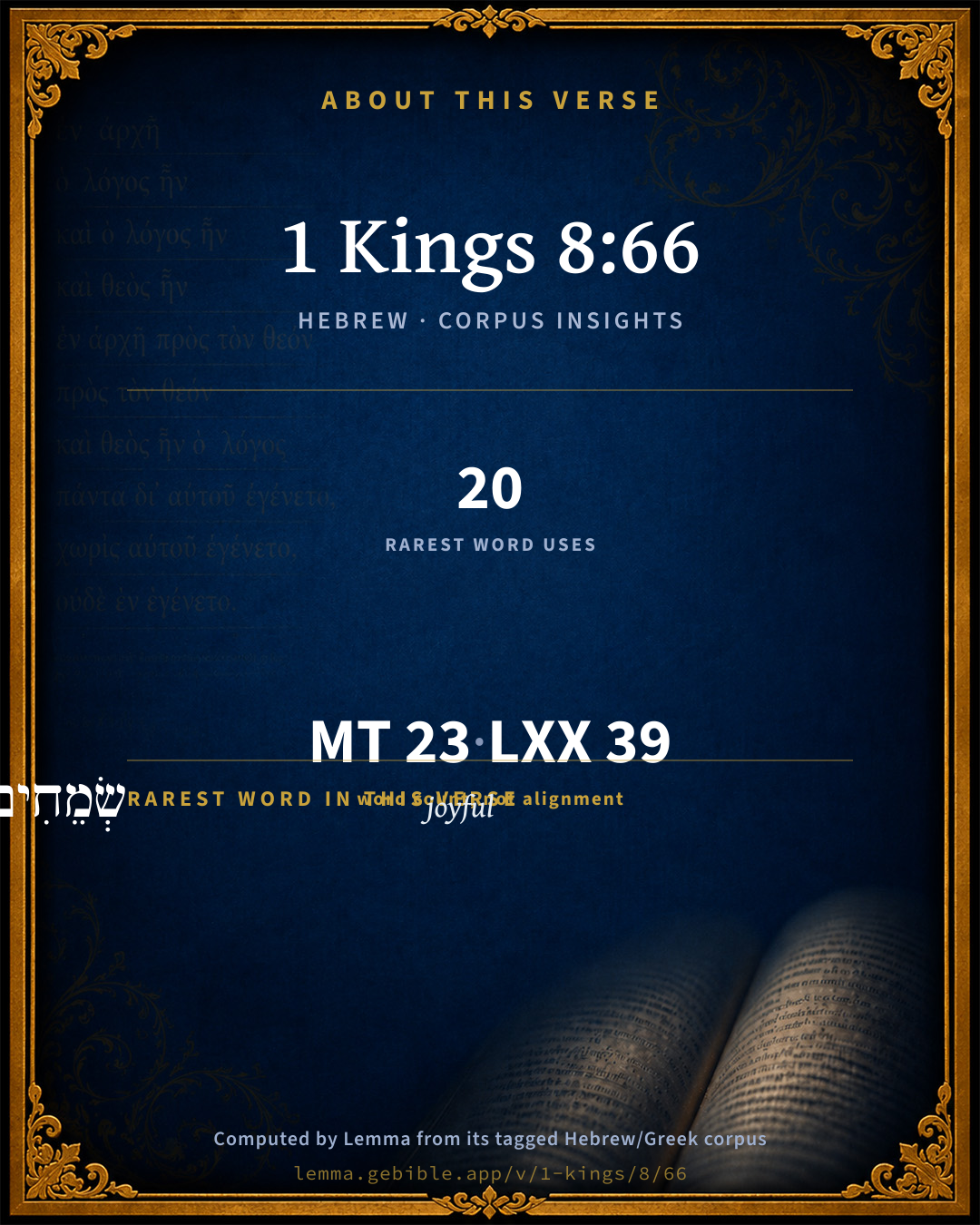
These counts appear in no published source. They are computed here, from the morphology-tagged text and Lemma’s own curated glosses. What Lemma adds →

23
words
20
distinct lemmas
Historical
section

Notable vocabulary

The rarest word here is שְׂמֵחִים֙ joyful H8056 — appearing just 20 times in the whole Hebrew Bible.

Shared distinctive vocabulary

שְׂמֵחִים֙ joyful H8056 occurs in 20 verses of the Hebrew Bible. Also found in:

Grammatical profile

  • 4 verbs
  • 11 nouns
  • 4 adjectives
  • 1 preposition
  • 3 particles

Verb forms

  • שִׁלַּ֣ח Piel · Perfect
  • וַֽיְבָרֲכ֖וּ Piel · Sequential Imperfect
  • וַיֵּלְכ֣וּ Qal · Sequential Imperfect
  • עָשָׂ֤ה Qal · Perfect

Repetition

Words recur within this verse — often emphatic in Hebrew:

  • הָעָ֔ם people H5971 ×2
  • וְט֣וֹבֵי good H2896 ×2

Hebrew & Septuagint length

In English translation the verse runs 41 words from the Hebrew and 46 from the Septuagint (LXX English) — closely comparable.

A rough comparison of the two English renderings, which tokenize alike — not a word-level alignment.

Word counts can differ between the Hebrew and the Greek without any difference in meaning — e.g. the Hebrew direct-object marker אֵת has no separate Greek word, and Greek often adds the article ὁ.

In the original languages it is 23 Hebrew tokens and 39 Greek tokens — but the two are counted differently (Hebrew bundles its prefixes and suffixes into one token; the Greek is in lemma form), so that isn’t a like-for-like length.

Cross-references

24

Topical passages linked to 1 Kings 8:66 in the Treasury of Scripture Knowledge — connected by theme and wording, ordered by reader-vote popularity; previews shown in the World English Bible.

  • Deuteronomy 12:7 and there you shall eat before Yahweh your God, and you shall rejoice in all that you put your hand to, you and your households, in which Yahweh your God has blessed you.
  • Deuteronomy 12:12 You shall rejoice before Yahweh your God, you, and your sons, and your daughters, and your men-servants, and your maid-servants, and the Levite who is within your gates, because he has no portion nor inheritance with you.
  • Zechariah 9:17 For how great is his goodness, And how great is his beauty! Grain will make the young men flourish, And new wine the virgins.
  • Acts 2:46 Day by day, continuing steadfastly with one accord in the temple, and breaking bread at home, they took their food with gladness and singleness of heart,
  • Galatians 5:22 But the fruit of the Spirit is love, joy, peace, patience, kindness, goodness, faithfulness,
  • Philippians 4:4 Rejoice in the Lord always! Again I will say, Rejoice!
  • Deuteronomy 12:18 but you shall eat them before Yahweh your God in the place which Yahweh your God shall choose, you, and your son, and your daughter, and your man-servant, and your maid-servant, and the Levite who is within your gates: and you shall rejoice before Yahweh your God in all that you put your hand to.
  • Deuteronomy 16:11 and you shall rejoice before Yahweh your God, you, and your son, and your daughter, and your man-servant, and your maid-servant, and the Levite who is within your gates, and the foreigner, and the fatherless, and the widow, who are in the midst of you, in the place which Yahweh your God shall choose, to cause his name to dwell there.
  • 1 Kings 8:1 Then Solomon assembled the elders of Israel, and all the heads of the tribes, the princes of the fathers' [houses] of the children of Israel, to king Solomon in Jerusalem, to bring up the ark of the covenant of Yahweh out of the city of David, which is Zion.
  • 1 Kings 8:47 yet if they shall repent themselves in the land where they are carried captive, and turn again, and make supplication to you in the land of those who carried them captive, saying, We have sinned, and have done perversely, we have dealt wickedly;
  • 2 Chronicles 7:10 On the three and twentieth day of the seventh month he sent the people away to their tents, joyful and glad of heart for the goodness that Yahweh had shown to David, and to Solomon, and to Israel his people.
  • 2 Chronicles 29:36 Hezekiah rejoiced, and all the people, because of that which God had prepared for the people: for the thing was done suddenly.
  • 2 Chronicles 30:26–31:1 So there was great joy in Jerusalem; for since the time of Solomon the son of David king of Israel there was not the like in Jerusalem.
  • Nehemiah 8:10 Then he said to them, Go your way, eat the fat, and drink the sweet, and send portions to him for whom nothing is prepared; for this day is holy to our Lord: neither be you grieved; for the joy of Yahweh is your strength.
  • Psalms 95:1–2 Oh come, let's sing to Yahweh. Let's shout aloud to the rock of our salvation!
  • Psalms 100:1–2 Shout for joy to Yahweh, all you lands!
  • Psalms 106:4–5 Remember me, Yahweh, with the favor that you show to your people. Visit me with your salvation,
  • Psalms 122:6 Pray for the peace of Jerusalem. Those who love you will prosper.
  • Psalms 122:9 For the sake of the house of Yahweh our God, I will seek your good.
  • Isaiah 61:9–10 Their seed shall be known among the nations, and their offspring among the peoples; all who see them shall acknowledge them, that they are the seed which Yahweh has blessed.
  • Isaiah 66:13–14 As one whom his mother comforts, so will I comfort you; and you shall be comforted in Jerusalem.
  • Jeremiah 31:12–14 They shall come and sing in the height of Zion, and shall flow to the goodness of Yahweh, to the grain, and to the new wine, and to the oil, and to the young of the flock and of the herd: and their soul shall be as a watered garden; and they shall not sorrow any more at all.
  • Zephaniah 3:14 Sing, daughter of Zion! Shout, Israel! Be glad and rejoice with all your heart, daughter of Jerusalem.
  • Zechariah 9:9 Rejoice greatly, daughter of Zion! Shout, daughter of Jerusalem! Behold, your king comes to you! He is righteous, and having salvation; Lowly, and riding on a donkey, Even on a colt, the foal of a donkey.

Cross-references courtesy of OpenBible.info (CC BY 4.0).

Hebrew and Greek witnesses Masoretic Hebrew ↔ Greek Septuagint

The same verse in the two great witnesses to the Old Testament, shown verse-for-verse.

These are two independent witnesses, not word-aligned to each other, and the Septuagint is shown in lemma (dictionary) form.

Hebrew 1 Kings 8:66 Masoretic · Westminster Leningrad Codex

בַּיּ֤וֹם הַשְּׁמִינִי֙ שִׁלַּ֣ח אֶת הָעָ֔ם וַֽיְבָרֲכ֖וּ אֶת הַמֶּ֑לֶךְ וַיֵּלְכ֣וּ לְאָהֳלֵיהֶ֗ם שְׂמֵחִים֙ וְט֣וֹבֵי לֵ֔ב עַ֣ל כָּל הַטּוֹבָ֗ה אֲשֶׁ֨ר עָשָׂ֤ה יְהוָה֙ לְדָוִ֣ד עַבְדּ֔וֹ וּלְיִשְׂרָאֵ֖ל עַמּֽוֹ

On the eighth day he sent the people away; and they blessed the king, and went to their tents joyful and glad of heart for all the goodness that Yahweh had shown to David his servant, and to Israel his people.

World English Bible · Public Domain

Greek LXX 1 Kings 8:66 Septuagint · lemma form

καί ἐν ὁ ἡμέρα ὁ ὄγδοος ἐκ ἀποστέλλω ὁ λαός καί εὐλογέω αὐτός καί ἀποἔρχομαι ἕκαστος εἰς ὁ σκήνωμα αὐτός χαίρω καί ἀγαθός καρδία ἐπί ὁ ἀγαθός ὅς ποιέω κύριος ὁ δαυίδ δοῦλος αὐτός καί ὁ ἰσραήλ λαός αὐτός

And on the eighth day he sent away the people: and they blessed the king, and each departed to his tabernacle rejoicing, and their heart was glad because of the good things which the Lord had done to his servant David, and to Israel his people.

LXX2012 (modern English Septuagint) · Public Domain

Hebrew: Westminster Leningrad Codex (CC BY 4.0). Greek: Septuagint (public domain); English from LXX2012 (modern English Septuagint) (Public Domain). How the Septuagint differs from the Hebrew →

Targum (Aramaic paraphrase)

1

The Targum is the ancient Jewish Aramaic paraphrase of the Hebrew Scriptures — an interpretive translation, not the Hebrew text itself. Onkelos (literal) and Pseudo-Jonathan (expansive) render the Torah, and Jonathan the Prophets. Coverage is partial: where no permissively-licensed English translation exists for a verse, only the Aramaic is shown. This is verse-level text, not a word-by-word alignment to the Hebrew.

  1. Targum Jonathan Prophets (Joshua–Malachi)
    בְּיוֹמָא תְמִינָאָה שַׁלַח יַת עַמָא וּבָרִיכוּ יַת מַלְכָּא וַאֲזַל לְקִרְוֵיהוֹן כַּד חָדָן וְשַׁפִּירָא לִבְּהוֹן עַל כָּל טַבְתָא דַעֲבַד יְיָ לְדָוִד עַבְדֵיהּ וּלְיִשְׂרָאֵל עַמֵיהּ:

    (no public-domain English translation for this verse)

    Targum Jonathan — Aramaic: “Mikraot Gedolot” (public domain). English: “Sefaria Community Translation” (CC0 1.0 (public-domain dedication)); “London "Chaldee Paraphrase," 1871” (public domain). Text via Sefaria.

Commentary

Notes on 1 Kings 8:66 from classic Christian and Jewish commentators (each source and its license shown beneath its notes). The classic Christian expositions comment on the surrounding passage and are grouped to its opening verse, so a note may address several verses; the Jewish commentaries on the Tanakh (Rashi and others) are per-verse, so they appear only where the commentator wrote on this verse.

Lemma curates 59 commentaries, every one of them public domain or Creative Commons licensed, each selected and text-cleaned for this edition rather than reprinted as found. About our sources →

Trapp's Complete Commentary

John Trapp

1Ki 8:66 On the eighth day he sent the people away: and they blessed the king, and went unto their tents joyful and glad of heart for all the goodness that the LORD had done for David his servant, and for Israel his people.

Ver. 66. He sent the people away.] Blessing their good king, and congratulating their own great happiness.

John Trapp, A Commentary or Exposition upon All the Books of the Old and New Testament (1647–1656) — public domain. Text from a community e-Sword module.

The Biblical Illustrator

Joseph S. Exell

1Ki_8:66

On the eighth day he sent the people away; and they blessed the king.

The earthly fellowship of the good

I. The fellowship of the good on earth is imperfect. Secular concerns, physical infirmities, incongruities of mind, temper, education, worldly condition, and other circumstances, expose it to interruption. On the eighth day he sent the people away. Follow them in imagination. Some go south to Bethlehem, and Hebron, and Libah; some to the east, to the pleasant vales of the Jordan, etc.

II. The fellowship of the good on earth tends to the promotion of all good feeling.

1. Increased attachment to those who are over them in the Lord. And they blessed the king (1Pe_2:13-17).

2. Increased sympathy with, and delight in the work of God. Joyful and glad of heart, for, etc. No petty jealousies, no sectarian strifes, no proud boasting. The tribes are lost in Israel. Solomon and David are one. The Lord is all in all. What a lesson to Christians.

3. Increased aptitude for the service of God in their several houses. They seem to have had a deep sense of the transitoriness of earthly things. Went unto their tents. The word stands for houses. It had come down from the time of the patriarchs. Would suggest the thought, we are pilgrims. What are our houses, and the fabric of our families, the organisations of our churches, but tents? (Heb_12:27-28).

III. The fellowship of the good on earth prophesies of a more perfect and enduring fellowship hereafter.

1. More perfect. No distractions, no weariness, no incongruities, nothing to mar or interrupt the universal harmony.

2. More enduring. All things earthly are transitory. The sweetest song must come to an end, the pleasantest book must be laid aside, the most endearing fellowship, etc. Not so hereafter. In heaven there is no sending away. (William Forsyth.)

The afterwards of Divine worship

After the worship of the Lords Day, and especially after the Lords Supper, we should continue in devotion, and make the whole day a post-communion. As civet boxes retain their scent when the civet is taken out, so, when the act of visible communion is over, our thoughts and discourse and actions should still savour of the solemnity. Certainly it is an argument of much weakness to be all for flashes and sudden starts. This retaining of their perfume by boxes and drawers in which sweet scents have been placed is a fragrant figure of the abiding nature of grace in a heart wherein it has once been stored up. II ordinances yield the influence designed by them, their savour will remain in our lives. (C. H. Spurgeon.)

.

The Biblical Illustrator, edited by Joseph S. Exell (c. 1880s–1900s) — public domain. Text from a community e-Sword module.

Geneva Bible (1599)

Geneva Bible translators

Hebrew, blessed.

Geneva Bible (1599) marginal notes — public domain. Text via Bolls.life.

Adam Clarke's Commentary

Verse 66. They blessed the king] Wished him all spiritual and temporal happiness. They were contented with their king, at peace among themselves, and happy in their God; so that they returned to their houses magnifying their God for all his bounty to them, their country, and their king. How happy must these people have been, and how prosperous, had their king continued to walk uprightly before God! But alas! the king fell, and the nation followed his example.

Adam Clarke's Commentary on the Bible (1810–1826) — public domain. Text from a community e-Sword/MySword module.

The Cambridge Bible for Schools and Colleges

gen. ed. J. J. S. Perowne

66. On the eighth day] i.e. Of the feast of Tabernacles, which had been preceded on this occasion by the feast of Dedication. Therefore this was the fifteenth day of the whole ceremony. It is defined in 2Ch_7:10 as ‘the three and twentieth day of the seventh month.’

and they blessed the king] Josephus explains thus: ‘they went away thanking the king for his forethought about them, and for the conduct which he had exhibited towards them, and praying God to give them Solomon as their king for a long time to come.’

and went unto their tents] The expression is a survival from those times when the home was a tent. Cf. 2Sa_18:17; 2Sa_19:8.

The Cambridge Bible for Schools and Colleges (gen. ed. J. J. S. Perowne; Cambridge University Press, 1878–1918) — public domain. Text from a community e-Sword module.

Albert Barnes' Notes on the Bible

Their tents - i. e. “their homes.” The word “tents” was used for “houses” from an old habit of speech, which had come down from the time when the Israelites were a nomadic nation.

Albert Barnes' Notes on the Bible (1834–1885) — public domain. Text from a community e-Sword/MySword module.

Haydock's Catholic Bible Commentary

Eighth day, at the conclusion of the second octave. (Haydock) --- Blessed the king, as he had done them before. The most honourable performs this office, Hebrew vii. 7. (Calmet) --- The king and people wished all sorts of happiness to each other. --- David. The glory of his son reflected honour on him. (Haydock)

George Leo Haydock (1774–1849), Haydock's Catholic Family Bible and Commentary, 1859 edition — public domain. Excludes Psalms (Douay-Rheims chapter numbering differs from Protestant) and Deuterocanonical books (Catholic canon only).

Matthew Poole's English Annotations

Solomon having joined with the people in the solemn assembly, which was kept on the eighth day, in the close of that day and service he took his solemn farewell, and dismissed them with his blessing; and the next morning when the heads and elders who came to Solomon upon this special summons, above, 1Ki 8:3, and with them divers of the people came to take their leave of the king, he sent them away. And so this place agrees very well with 2Ch 7:9,10.

They blessed the king, i.e. they prayed to God to bless him, according to their duty and custom. Or,

they praised him, for his great care and pains in building of the temple, and setting up God’s worship among them.

The goodness that the Lord had done for David, in giving him a sure house, and a wise and religious son, by whom he had now fulfilled the promise made to David about the building of the temple.

Matthew Poole's English Annotations on the Holy Bible (1683–1685) — public domain. Text from a community e-Sword/MySword module.

Whedon's Commentary on the Bible

Daniel D. Whedon

66. On the eighth day — The day following the last seven days’ feast, which was the twenty-third day of the seventh month. 2Ch_7:10.

Went unto their tents — That is, went home. Compare note on 1Sa_17:54.

Daniel D. Whedon (gen. ed.), Commentary on the Old and New Testaments (1874–1909) — public domain. Text from a community e-Sword module.

The Pulpit Commentary

On the eighth day he sent the people away i.e., on the eighth day of the second feast, the "three and twentieth day of the month" (ib., ver. 10). The first impression is that the eighth day of the period of fourteen days is meant, but the context, to say nothing of the Chronicles, contradicts this. The feast of dedication began on the eighth day of the month Ethanim (ver. 2), and lasted until the fourteenth. The feast of tabernacles began on the fifteenth and lasted till the twenty-first. On the evening of the twenty-second, the "day of restraint", Lev_23:36 marg. he dismissed the people, who would depart to their homes next morning: and they blessed i.e., felicitated, saluted (on taking leave). Cf. Pro_27:14 2Ki_4:29 1Sa_25:6, 1Sa_25:14. Marg. thanked. (See note on ver. 14) the king, and went unto their tents i.e., homes an archaic expression, dating from the times of the desert wanderings. (Jos_22:4 Jud_1:7:8 2Sa_20:1 1Ki_12:16) joyful and glad of heart for the goodness that the Lord had done for David his servant the real founder of the temple. Solomon had but carried out his ideas and had entered into his labours, and for Israel his people.

The Pulpit Commentary (1880–1919), ed. H.D.M. Spence-Jones & Joseph S. Exell — public domain. Text from a community e-Sword module.

John Wesley's Explanatory Notes

He sent - Solomon having joined with the people in the solemn assembly, which was kept on the eighth day; in the close of that day took his solemn farewell, and dismissed them with his blessing; and the next morning when the heads and elders with divers of the people came to take their leave of the king, he sent them away.

John Wesley, Explanatory Notes Upon the Whole Bible (1754–1765) — public domain. Text via the GEBible commentary corpus.

Rashi

Rabbi Shlomo Yitzchaki (Rashi)

For Dovid His servant. To make known that He forgave them their sins, as we find in [Maseches] Mo’ed Katan. When Shlomo wished to bring the Ark into the Holy of Holies, the gates clung to one another.

And for Yisroel His people. That He forgave them the sin of Yom Kippur, and a Bas Kol emanated and declared, “All of you are prepared for the life of the World to Come.”

Rashi on the Tanakh — English translations: “The Judaica Press complete Tanach with Rashi, translated by A. J. Rosenberg” (CC BY 4.0); “Pentateuch with Rashi's commentary by M. Rosenbaum and A.M. Silbermann, 1929-1934” (public domain); “The Metsudah Tanach series, Lakewood, N.J” (CC BY 4.0); and “The Book of Joshua, Metsudah Publications, 1997” (CC BY 4.0). Text via Sefaria.

Lesson kit

Teaching starters — assembled from the data on this page, not authored interpretation. Every prompt links to the verse data it draws on. Edit before teaching.

1 Kings, in the Historical, opens this verse with 23 words (20 distinct Hebrew lemmas). Its most distinctive word is sâmêach (“joyful”). A historical commentator’s framing appears above. Read the whole chapter for the surrounding context.

Discussion questions

  1. The word sâmêach carries the sense “joyful.” How does it shape the verse?
  2. How does Deuteronomy 16:15, which shares the word «joyful», read alongside this verse?
  3. What does the repetition of “people” (2× in this one verse) do in this verse?
  4. These translations render this verse differently; the difference is in the English rendering, not the original. What questions does that raise?
  5. «שִׁלַּ֣ח» is a Piel Perfect verb. How does that grammatical form shape the action described?
  6. Compare how Trapp's Complete Commentary and The Biblical Illustrator read this verse. Where do they agree or differ?

Things to notice

Reading settings

Reading text

Shown beneath each verse's original-language words.

Old Testament
Old Testament edition

Read the OT as the Masoretic Hebrew (MT) or the Greek Septuagint (LXX).

English shown for the Greek Septuagint (in the Hebrew ↔ Greek comparison).

Comparing translations? Open the Compare panel on any verse page to stack up to four side by side.