
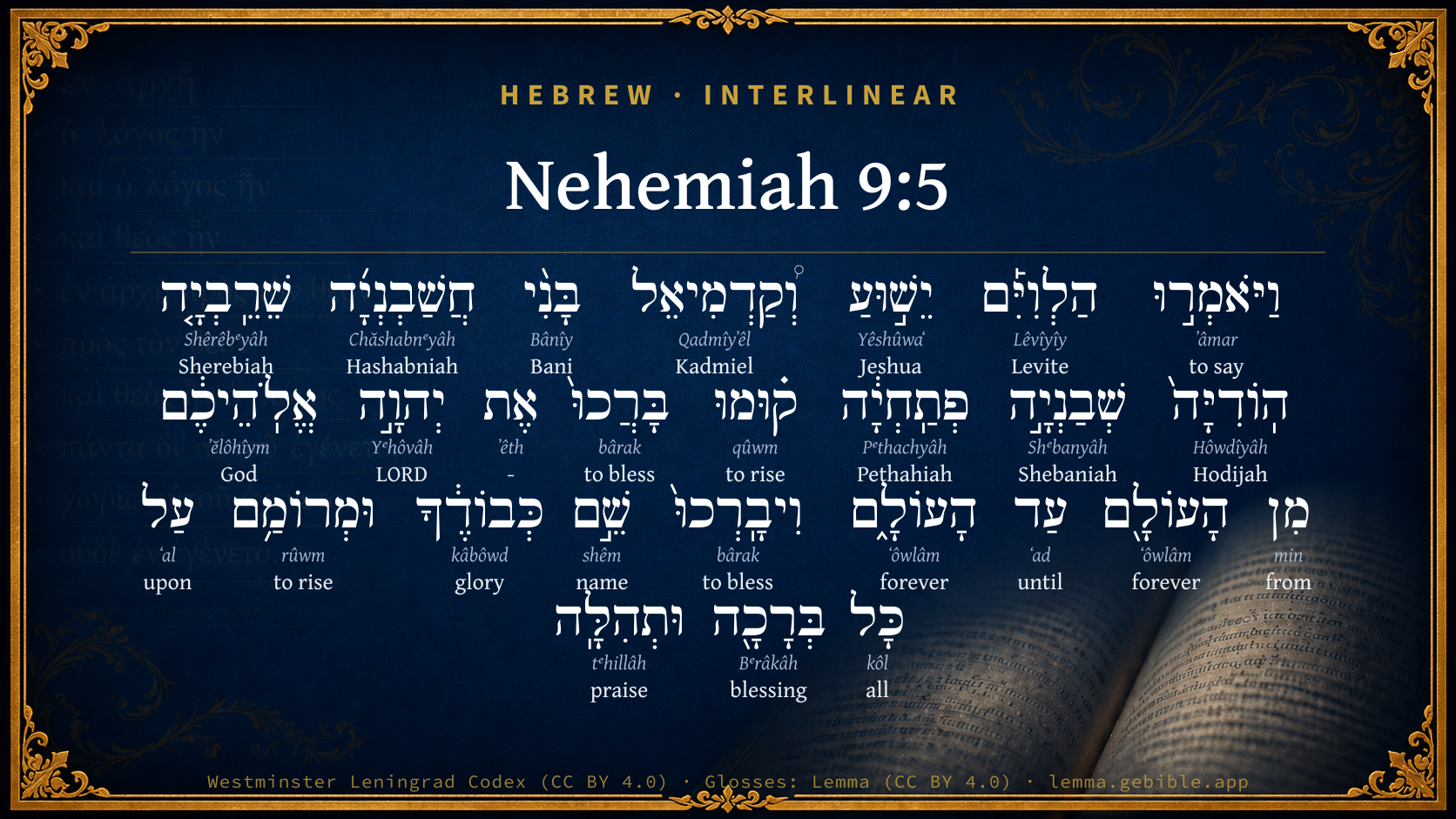
Nehemiah 9:5

Hebrew (Westminster Leningrad Codex) Nehemiah 9:5 appears in the Hebrew Old Testament. The text above is from the Westminster Leningrad Codex. Each word links to its Strong’s number, a concise gloss, and parsing drawn from the Open Scriptures Hebrew Bible morphology. Click any word for its full Brown-Driver-Briggs (BDB) entry.
Download image
Cite this verse

Nehemiah 9:5 (World English Bible). Public Domain. Lemma interlinear Bible study tool, https://lemma.gebible.app/v/nehemiah/9/5.

Show BibTeX & RIS
BibTeX
RIS
English Translation
Then the Levites, Jeshua, and Kadmiel, Bani, Hashabneiah, Sherebiah, Hodiah, Shebaniah, [and] Pethahiah, said, Stand up and bless Yahweh your God from everlasting to everlasting; and blessed be your glorious name, which is exalted above all blessing and praise.
World English Bible · Public Domain
Download a study sheet

One document with this verse’s original text, its word-by-word gloss line, the meaning frame, cross-references with their text, attributed commentary, and full source and license credits — printable, and it pastes into notes with its structure intact.

This verse Autodidact and up

Study sheet (.html) Plain text (.txt)

A passage Seminary Student

Up to 50 verses in one chapter. A passage sheet keeps up to 6 commentary sources and 12 cross-references per verse, in the order this page ranks them, and says so on the sheet whenever that leaves anything out. Ask for a single verse and you get the Autodidact verse sheet above.

Everything on this page stays free to read, with no account — the sheet is a download of what is already on screen, not access to it.

Want to remove ads? Support Godless Engineer
Compare translations 3

The same verse in 3 English versions, stacked beneath the original-language interlinear above. Click any original word for its lexicon entry.

Each is an independent rendering of the whole verse — the interlinear is not word-aligned to these translations.

Highlighted words mark where these versions differ — a whole-verse word diff, not a word-by-word alignment.

  • World English Bible Public Domain
    Then the Levites, Jeshua, and Kadmiel, Bani, Hashabneiah, Sherebiah, Hodiah, Shebaniah, [and] Pethahiah, said, Stand up and bless Yahweh your God from everlasting to everlasting; and blessed be your glorious name, which is exalted above all blessing and praise.
  • King James Version Public Domain
    Then the Levites, Jeshua, and Kadmiel, Bani, Hashabniah, Sherebiah, Hodijah, Shebaniah, and Pethahiah, said, Stand up and bless the LORD your God for ever and ever: and blessed be thy glorious name, which is exalted above all blessing and praise.
  • unfoldingWord Literal Text CC BY-SA 4.0
    And the Levites, Jeshua, and Kadmiel, Bani, Hashabneiah, Sherebiah, Hodiah, Shebaniah, Pethahiah, said: “Rise up! Bless Yahweh your God from eternity to eternity! And may they bless your glorious name, which is exalted above all blessing and praise.

unfoldingWord Literal Text — © unfoldingWord, licensed CC BY-SA 4.0. Word-aligned USFM3 via Door43 (git.door43.org/unfoldingWord/en_ult).

Versions to compare (up to 4)

3 of 4 selected

Show all 18 translations

Every available English version of this verse, each an independent rendering of the whole verse.

  • World English Bible Public Domain
    Then the Levites, Jeshua, and Kadmiel, Bani, Hashabneiah, Sherebiah, Hodiah, Shebaniah, [and] Pethahiah, said, Stand up and bless Yahweh your God from everlasting to everlasting; and blessed be your glorious name, which is exalted above all blessing and praise.
  • Berean Standard Bible Public Domain
    Then the Levites—Jeshua, Kadmiel, Bani, Hashabneiah, Sherebiah, Hodiah, Shebaniah, and Pethahiah—said, “Stand up and bless the LORD your God from everlasting to everlasting: Blessed be Your glorious name, and may it be exalted above all blessing and praise.
  • Majority Standard Bible Public Domain
    Then the Levites—Jeshua, Kadmiel, Bani, Hashabneiah, Sherebiah, Hodiah, Shebaniah, and Pethahiah—said, “Stand up and bless the LORD your God from everlasting to everlasting: Blessed be Your glorious name, and may it be exalted above all blessing and praise.
  • King James Version Public Domain
    Then the Levites, Jeshua, and Kadmiel, Bani, Hashabniah, Sherebiah, Hodijah, Shebaniah, and Pethahiah, said, Stand up and bless the LORD your God for ever and ever: and blessed be thy glorious name, which is exalted above all blessing and praise.
  • American Standard Version (1901) Public Domain
    Then the Levites, Jeshua, and Kadmiel, Bani, Hashabneiah, Sherebiah, Hodiah, Shebaniah, `and' Pethahiah, said, Stand up and bless Jehovah your God from everlasting to everlasting; and blessed be thy glorious name, which is exalted above all blessing and praise.
  • Revised Version (1885) Public Domain
    Then the Levites, Jeshua, and Kadmiel, Bani, Hashabneiah, Sherebiah, Hodiah, Shebaniah, and Pethahiah, said, Stand up and bless the LORD your God from everlasting to everlasting: and blessed be thy glorious name, which is exalted above all blessing and praise.
  • Geneva Bible (1599) Public Domain
    And the Leuites said, euen Ieshua and Kadmiel, Bani, Hashabniah, Sherebiah, Hodiiah, Shebaniah and Pethahiah, Stande vp, and praise the Lord your God for euer, and euer, and let them praise thy glorious Name, O God, which excelleth aboue all thankesgiuing and praise.
  • Douay-Rheims (1899) Public Domain
    And the Levites Josue and Cedmihel, Bonni, Hasebnia, Serebia, Oduia, Sebnia, and Phathahia, said: Arise, bless the Lord your God from eternity to eternity: and blessed be the high name of thy glory with all blessing and praise.
  • Young's Literal Translation Public Domain
    And the Levites say, `even' Jeshua, and Kadmiel, Bani, Hashabniah, Sherebiah, Hodijah, Shebaniah, Pethahiah, `Rise, bless Jehovah your God, from the age unto the age, and they bless the name of Thine honour that `is' exalted above all blessing and praise.
  • Literal Standard Version CC BY-SA 4.0
    And the Levites say, [even] Jeshua, and Kadmiel, Bani, Hashabniah, Sherebiah, Hodijah, Shebaniah, Pethahiah, “Rise, bless your God YHWH, || From age to age, || And they bless the Name of Your glory || That [is] exalted above all blessing and praise.
  • Unlocked Literal Bible CC BY-SA 4.0
    Then the Levites, Jeshua, and Kadmiel, Bani, Hashabneiah, Sherebiah, Hodiah, Shebaniah, and Pethahiah said, “Stand up and give praise to Yahweh your God forever and ever.” “May they bless your glorious name, and may it be exalted above every blessing and praise.
  • unfoldingWord Literal Text CC BY-SA 4.0
    And the Levites, Jeshua, and Kadmiel, Bani, Hashabneiah, Sherebiah, Hodiah, Shebaniah, Pethahiah, said: “Rise up! Bless Yahweh your God from eternity to eternity! And may they bless your glorious name, which is exalted above all blessing and praise.
  • Darby Bible Public Domain
    And the Levites, Jeshua, and Kadmiel, Bani, Hashabniah, Sherebiah, Hodijah, Shebaniah, Pethahiah, said, Stand up, bless Jehovah your God from eternity to eternity. And let [men] bless the name of thy glory, which is exalted above all blessing and praise.
  • World Messianic Bible Public Domain
    Then the Levites, Yeshua, and Kadmiel, Bani, Hashabneiah, Sherebiah, Hodiah, Shebaniah, and Pethahiah, said, “Stand up and bless the LORD your God from everlasting to everlasting! Blessed be your glorious name, which is exalted above all blessing and praise!
  • Webster's Bible Public Domain
    Then the Levites, Jeshua, and Kadmiel, Bani, Hashabniah, Sherebiah, Hodijah, Shebaniah, and Pethahiah, said, Stand up and bless the LORD your God for ever and ever: and blessed be thy glorious name, which is exalted above all blessing and praise.
  • Free Bible Version CC BY-SA 4.0
    Then the Levites announced: “Stand up and praise the Lord your God who lives eternally: ‘May who you are and your glory be blessed, and may you be lifted up above all blessing and praise.’” (The names of the Levites were Jeshua, Kadmiel, Bani, Hashabneiah, Sherebiah, Hodiah, Shebaniah, and Pethahiah.)
  • Bible in Basic English Public Domain
    Then the Levites, Jeshua, and Kadmiel, Bani, Hashabneiah, Sherebiah, Hodiah, Shebaniah, and Pethahiah said, Get up and give praise to the Lord your God for ever and ever. Praise be to your great name which is lifted up high over all blessing and praise.
  • JPS Tanakh (1917) Public Domain
    Then the Levites, Jeshua, and Kadmiel, Bani, Hashabneiah, Sherebiah, Hodiah, Shebaniah, and Pethahiah, said: 'Stand up and bless the LORD your God from everlasting to everlasting; and let them say: Blessed be Thy glorious Name, that is exalted above all blessing and praise.

Literal Standard Version (2020), Covenant Press — licensed CC BY-SA 4.0. Text via the HelloAO Bible API (eBible.org). Unlocked Literal Bible (unfoldingWord) — licensed CC BY-SA 4.0. Text via the HelloAO Bible API (eBible.org). unfoldingWord Literal Text — © unfoldingWord, licensed CC BY-SA 4.0. Word-aligned USFM3 via Door43 (git.door43.org/unfoldingWord/en_ult). Free Bible Version, Dr. Jonathan Gallagher — licensed CC BY-SA 4.0. Text via the HelloAO Bible API (eBible.org).

Word by word

More ways to search: Search by grammar → Find every occurrence → Compare this word →

Practice this passage: Drill this verse → Learn its vocabulary →

חֲשַׁבְנְיָ֜ה
Chăshabnᵉyâh
H2813
“Hashabniah”
Noun, Proper
Part of Speech
Noun
Type
Proper
Full BDB Definition

Origin: from H2808 and H3050

TWOT: None

Hashabniah = "whom Jehovah regards" - the father of Hattush, repairer of the wall - a Levite who was among those who officiated at the great fast under Ezra and Nehemiah when the covenant was sealed
  1. וַיֹּאמְר֣וּ ʼâmar H559 “and · to say” Conjunction + Verb, Qal, Sequential Imperfect, 3rd Person, Masculine, Plural
  2. הַלְוִיִּ֡ם Lêvîyîy H3881 “the · Levites” Particle, Definite Article + Noun, Gentilic, Masculine, Plural, Absolute
  3. יֵשׁ֣וּעַ Yêshûwaʻ H3442 “Jeshua” Noun, Proper
  4. וְ֠קַדְמִיאֵל Qadmîyʼêl H6934 “and · Kadmiel” Conjunction + Noun, Proper
  5. בָּנִ֨י Bânîy H1137 “Bani” Noun, Proper
  6. שֵׁרֵֽבְיָ֤ה Shêrêbᵉyâh H8274 “Sherebiah” Noun, Proper
  7. הֽוֹדִיָּה֙ Hôwdîyâh H1941 “Hodijah” Noun, Proper
  8. שְׁבַנְיָ֣ה Shᵉbanyâh H7645 “Shebaniah” Noun, Proper
  9. פְתַֽחְיָ֔ה Pᵉthachyâh H6611 “Pethahiah” Noun, Proper
  10. ק֗וּמוּ qûwm H6965 “rise” Verb, Qal, Imperative, 2nd Person, Masculine, Plural
  11. בָּרֲכוּ֙ bârak H1288 “bless” Verb, Piel, Imperative, 2nd Person, Masculine, Plural
  12. אֶת ʼêth H853 “-” Particle, Direct Object
  13. יְהוָ֣ה Yᵉhôvâh H3068 “LORD” Noun, Proper
  14. אֱלֹֽהֵיכֶ֔ם ʼĕlôhîym H430 “God(s) · your” Noun, Common, Masculine, Plural, Construct + Suffix, Personal, 2nd Person, Masculine, Plural
  15. מִן min H4480 “from” Preposition
  16. הָעוֹלָ֖ם ʻôwlâm H5769 “the · forever” Particle, Definite Article + Noun, Common, Masculine, Singular, Absolute
  17. עַד ʻad H5704 “until” Preposition
  18. הָעוֹלָ֑ם ʻôwlâm H5769 “the · forever” Particle, Definite Article + Noun, Common, Masculine, Singular, Absolute
  19. וִיבָֽרְכוּ֙ bârak H1288 “and · to bless” Conjunction + Verb, Piel, Jussive, 3rd Person, Masculine, Plural
  20. שֵׁ֣ם shêm H8034 “name of” Noun, Common, Masculine, Singular, Construct
  21. כְּבוֹדֶ֔ךָ kâbôwd H3519 “glory · your” Noun, Common, Both, Singular, Construct + Suffix, Personal, 2nd Person, Masculine, Singular
  22. וּמְרוֹמַ֥ם rûwm H7311 “and · risen” Conjunction + Verb, Polal, Participle Passive, Masculine, Singular, Absolute
  23. עַל ʻal H5921 “upon” Preposition
  24. כָּל kôl H3605 “all of” Noun, Common, Masculine, Singular, Construct
  25. בְּרָכָ֖ה Bᵉrâkâh H1293 “blessing” Noun, Common, Feminine, Singular, Absolute
  26. וּתְהִלָּֽה tᵉhillâh H8416 “and · praise” Conjunction + Noun, Common, Feminine, Singular, Absolute

About this verse

These counts appear in no published source. They are computed here, from the morphology-tagged text and Lemma’s own curated glosses. What Lemma adds →

27
words
25
distinct lemmas
Historical
section

Notable vocabulary

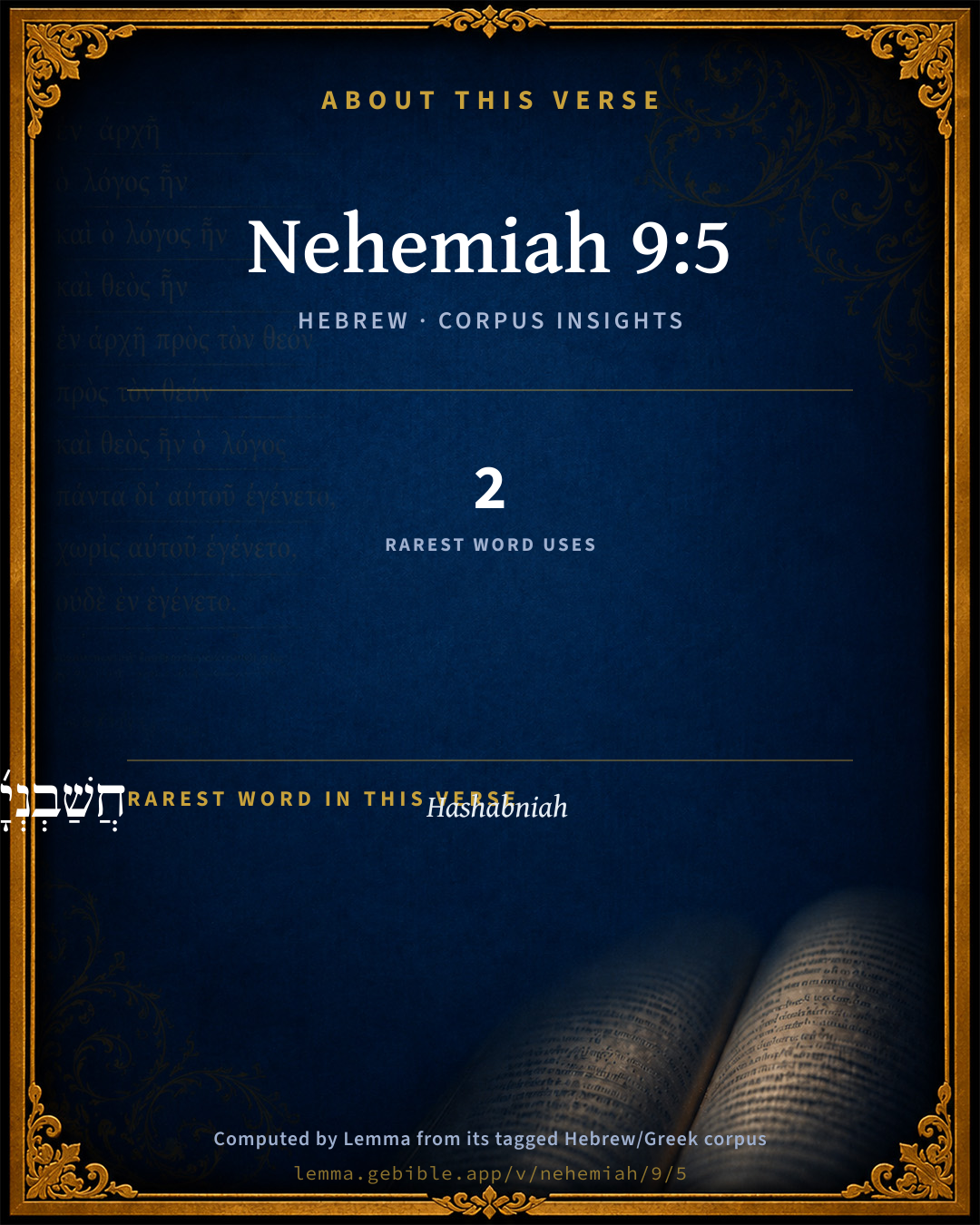
The rarest word here is חֲשַׁבְנְיָ֜ה Hashabniah H2813 — appearing just 2 times in the whole Hebrew Bible.

Shared distinctive vocabulary

חֲשַׁבְנְיָ֜ה Hashabniah H2813 occurs in 2 verses of the Hebrew Bible. Also found in:

Grammatical profile

  • 5 verbs
  • 18 nouns
  • 3 prepositions
  • 1 particle

Verb forms

  • וַיֹּאמְר֣וּ Qal · Sequential Imperfect
  • ק֗וּמוּ Qal · Imperative
  • בָּרֲכוּ֙ Piel · Imperative
  • וִיבָֽרְכוּ֙ Piel · Jussive
  • וּמְרוֹמַ֥ם Polal · Participle Passive

Repetition

Words recur within this verse — often emphatic in Hebrew:

  • בָּרֲכוּ֙ to bless H1288 ×2
  • הָעוֹלָ֖ם forever H5769 ×2

Cross-references

27

Topical passages linked to Nehemiah 9:5 in the Treasury of Scripture Knowledge — connected by theme and wording, ordered by reader-vote popularity; previews shown in the World English Bible.

  • Psalms 103:1–2 Praise Yahweh, my soul! All that is within me, praise his holy name!
  • 2 Corinthians 4:6 seeing it is God who said, "Light will shine out of darkness," who has shone in our hearts, to give the light of the knowledge of the glory of God in the face of Jesus Christ.
  • 1 Peter 1:3 Blessed be the God and Father of our Lord Jesus Christ, who according to his great mercy became our father again to a living hope through the resurrection of Jesus Christ from the dead,
  • 1 Chronicles 29:13 Now therefore, our God, we thank you, and praise your glorious name.
  • Ezra 3:11 They sang one to another in praising and giving thanks to Yahweh, [saying], For he is good, for his loving kindness endures forever toward Israel. All the people shouted with a great shout, when they praised Yahweh, because the foundation of the house of Yahweh was laid.
  • Psalms 72:18–19 Praise be to Yahweh God, the God of Israel, Who alone does marvelous deeds.
  • Psalms 106:2 Who can utter the mighty acts of Yahweh, Or fully declare all his praise?
  • Psalms 117:1–2 Praise Yahweh, all you nations! Extol him, all you peoples!
  • Jeremiah 33:10–11 Thus says Yahweh: Yet again there shall be heard in this place, about which you say, It is waste, without man and without animal, even in the cities of Judah, and in the streets of Jerusalem, that are desolate, without man and without inhabitant and without animal,
  • Matthew 11:25 At that time, Jesus answered, "I thank you, Father, Lord of heaven and earth, that you hid these things from the wise and understanding, and revealed them to infants.
  • Exodus 15:6 Your right hand, Yahweh, is glorious in power, Your right hand, Yahweh, dashes the enemy in pieces.
  • Exodus 15:11 Who is like you, Yahweh, among the gods? Who is like you, glorious in holiness, Fearful in praises, doing wonders?
  • Deuteronomy 28:58 If you will not observe to do all the words of this law that are written in this book, that you may fear this glorious and fearful name, YAHWEH YOUR GOD;
  • 1 Kings 8:14 The king turned his face about, and blessed all the assembly of Israel: and all the assembly of Israel stood.
  • 1 Kings 8:22 Solomon stood before the altar of Yahweh in the presence of all the assembly of Israel, and spread forth his hands toward heaven;
  • 1 Kings 8:27 But will God in very deed dwell on the earth? behold, heaven and the heaven of heavens can't contain you; how much less this house that I have built!
  • 1 Chronicles 29:11 Yours, Yahweh, is the greatness, the power, the glory, the victory, and the majesty: for all that is in the heavens and in the earth is yours. Yours is the kingdom, Yahweh, and you are exalted as head above all.
  • 1 Chronicles 29:20 David said to all the assembly, Now bless Yahweh your God. All the assembly blessed Yahweh, the God of their fathers, and bowed down their heads, and worshiped Yahweh, and the king.
  • 2 Chronicles 20:13 All Judah stood before Yahweh, with their little ones, their wives, and their children.
  • 2 Chronicles 20:19 The Levites, of the children of the Kohathites and of the children of the Korahites, stood up to praise Yahweh, the God of Israel, with an exceeding loud voice.
  • Psalms 16:2 My soul, you have said to Yahweh, "You are my Lord. Apart from you I have no good thing."
  • Psalms 134:1–135:3 Look! Praise Yahweh, all you servants of Yahweh, Who stand by night in Yahweh's house!
  • Psalms 145:2 Every day I will praise you. I will extol your name forever and ever.
  • Psalms 145:5 Of the glorious majesty of your honor, Of your wondrous works, I will meditate.
  • Psalms 145:11–12 They will speak of the glory of your kingdom, And talk about your power;
  • Psalms 146:2 While I live, I will praise Yahweh. I will sing praises to my God as long as I exist.
  • Ephesians 3:20–21 Now to him who is able to do exceedingly abundantly above all that we ask or think, according to the power that works in us,

Cross-references courtesy of OpenBible.info (CC BY 4.0).

Hebrew and Greek witnesses Masoretic Hebrew ↔ Greek Septuagint

The same verse in the two great witnesses to the Old Testament, shown verse-for-verse.

These are two independent witnesses, not word-aligned to each other, and the Septuagint is shown in lemma (dictionary) form.

Hebrew Nehemiah 9:5 Masoretic · Westminster Leningrad Codex

וַיֹּאמְר֣וּ הַלְוִיִּ֡ם יֵשׁ֣וּעַ וְ֠קַדְמִיאֵל בָּנִ֨י חֲשַׁבְנְיָ֜ה שֵׁרֵֽבְיָ֤ה הֽוֹדִיָּה֙ שְׁבַנְיָ֣ה פְתַֽחְיָ֔ה ק֗וּמוּ בָּרֲכוּ֙ אֶת יְהוָ֣ה אֱלֹֽהֵיכֶ֔ם מִן הָעוֹלָ֖ם עַד הָעוֹלָ֑ם וִיבָֽרְכוּ֙ שֵׁ֣ם כְּבוֹדֶ֔ךָ וּמְרוֹמַ֥ם עַל כָּל בְּרָכָ֖ה וּתְהִלָּֽה

Then the Levites, Jeshua, and Kadmiel, Bani, Hashabneiah, Sherebiah, Hodiah, Shebaniah, [and] Pethahiah, said, Stand up and bless Yahweh your God from everlasting to everlasting; and blessed be your glorious name, which is exalted above all blessing and praise.

World English Bible · Public Domain

Greek LXX Structure differs

The Septuagint has no separate book of Nehemiah. Its Greek text is the second half of Esdras B (2 Esdras), chapters 11–23; Ezra is the first half (1–10).

A verse-for-verse comparison isn’t shown here because the chapters and verses don’t line up. Switch to the LXX edition with the MT / LXX toggle above to read the Greek directly.

On this verse, Ellicott's Commentary for English Readers discusses the Septuagint’s reading. Read the note in Commentary ↓

Hebrew: Westminster Leningrad Codex (CC BY 4.0). Greek: Septuagint (public domain); English from a public-domain English Septuagint. How the Septuagint differs from the Hebrew →

Commentary

Notes on Nehemiah 9:5 from classic Christian and Jewish commentators (each source and its license shown beneath its notes). The classic Christian expositions comment on the surrounding passage and are grouped to its opening verse, so a note may address several verses; the Jewish commentaries on the Tanakh (Rashi and others) are per-verse, so they appear only where the commentator wrote on this verse.

Lemma curates 59 commentaries, every one of them public domain or Creative Commons licensed, each selected and text-cleaned for this edition rather than reprinted as found. About our sources →

Trapp's Complete Commentary

John Trapp

Neh 9:5 Then the Levites, Jeshua, and Kadmiel, Bani, Hashabniah, Sherebiah, Hodijah, Shebaniah, [and] Pethahiah, said, Stand up [and] bless the LORD your God for ever and ever: and blessed be thy glorious name, which is exalted above all blessing and praise.

Ver. 5. Then the Levites, Jeshua, &c., said, Stand up] Gird yourselves, and serve the Lord, as Luk 17:8. Be instant, or stand close to the work, επιστηθι, 2Ti 4:2; set sides and shoulders to it; rouse up yourselves, and wrestle with God. Hoc agite, Do this, said the Roman priest to the people at their sacrifices. And Sacerdos parat fratrum mentes dicendo, Sursum corda, saith Cyprian, In the primitive times the ministers prepared the people to serve God, by saying, Lift up your hearts ( De Oratione).

And bless the Lord your God for ever] Give him immortal thanks, all possible praise, amore more, ore, glorify him doingly, 1Co 10:30-31 Eph 1:11-12. Think of the multitude, seasonableness, suitableness, constancy, &c., of God’s favours; and then give him the glory due unto his name; which yet we can never do, because his name is exalted above all blessing and praise (as it followeth here), so that if we should do nothing else all our days, yea, as long as the days of heaven shall last (said that martyr), but kneel upon our knees and sing over David’s Psalms to God’s praise, yet should we fall far short of what we owe to the Lord, who is most worthy to be praised.

And blessed be thy glorious name] These holy Levites, having called upon the people to bless God, break forth into the performance of this divine duty themselves. So St Paul often, exhorting the saints to pray, falls a praying for them.

Which is exalted above all blessing and praise] So that when we have done our utmost herein, we can never out do. David is oft so transported, that he seems to forget himself, as a bird that hath got a note, records it over and over, as Psa 136:1-26, "for his mercy endureth for ever." And Psa 150:1-6, in six verses are twelve Hallelujahs. "Praise him," saith he, Neh 9:2, "according to his excellent greatness," "for great is the Lord, and greatly to be praised," Psa 145:3; and Neh 9:5, "Let everything that hath breath praise the Lord," or, Let every breath praise the Lord. As oft as we breathe we are to breathe out the praises of God, and to make our breath like the perfumed smoke of the Tabernacle.

John Trapp, A Commentary or Exposition upon All the Books of the Old and New Testament (1647–1656) — public domain. Text from a community e-Sword module.

Joseph Benson's Commentary

Neh 9:5. Then the Levites, Jeshua, &c., said, Stand up, and bless the Lord for ever and ever — Praise him and give him thanks, as long as you have any being; and blessed be thy glorious name, which is exalted above all blessing and praise — The super-excellent perfections of which, the noblest creatures cannot worthily magnify. The Levites, it is likely, praised him in these or such like words, in which all the people joined, either with their lips, or in their hearts.

Joseph Benson's Commentary on the Old and New Testaments (1811–1818) — public domain. Text from a community e-Sword module.

Tyndale Open Study Notes

Tyndale Open Resources

9:5-37 This long prayer confesses the nation’s sins and praises God for his compassion throughout history (cp. Pss 105–106; 135–136). It prompted listeners to confess their own unfaithfulness and to call on God to be compassionate and forgive their sins.

9:5-6 The Levites’ prayer praised God for his glorious reputation, his sole divinity, his creation of the universe, his providential care for life on earth, and his worship by angels. Putting the focus on God brought Israel’s present circumstances into proper perspective.

Tyndale Open Study Notes — © Tyndale Open Resources, licensed CC BY-SA 4.0. Text via the HelloAO Bible API.

Jamieson, Fausset & Brown

Robert Jamieson, A. R. Fausset & David Brown

Then the Levites . . . said, Stand up and bless the Lord your God--If this prayer was uttered by all these Levites in common, it must have been prepared and adopted beforehand, perhaps, by Ezra; but it may only embody the substance of the confession and thanksgiving.

Jamieson, Fausset & Brown — Commentary Critical and Explanatory on the Whole Bible (1871) — public domain (CC PDM 1.0). Text via the HelloAO Bible API.

Adam Clarke's Commentary

Verse 5. Stand up and bless the Lord your God] It is the shameless custom of many congregations of people to sit still while they profess to bless and praise God, by singing the Psalms of David or hymns made on the plan of the Gospel! I ask such persons, Did they ever feel the spirit of devotion while thus employed? If they do, it must be owned that, by the prevalence of habit, they have counteracted the influence of an attitude most friendly to such acts of devotion.

Adam Clarke's Commentary on the Bible (1810–1826) — public domain. Text from a community e-Sword/MySword module.

Ellicott's Commentary for English Readers

(5) Hashabniah.—Not found elsewhere. No reason is given why this company is somewhat different from the former; the LXX. arbitrarily omit all names after Kadmiel. Similarly, they insert “and Ezra said” before Neh_9:6. The psalm was perhaps composed by Ezra, but uttered by the Levites in the name of the congregation.

Stand up and bless . . . Blessed be.—Or, let them bless.

Thou, even thou, art Lord alone.—The three phrases mark how the address to the people glides into direct adoration of God.

Thy glorious name.—Literally found again in Psa_72:19 alone.

A Bible Commentary for English Readers, edited by Charles John Ellicott (1878–1897) — public domain. Text from a community e-Sword module.

The Cambridge Bible for Schools and Colleges

gen. ed. J. J. S. Perowne

5. Then] As in Neh_9:4, the ‘copula’; no very exact sequence of time is implied.

Hashabniah … Hodijah] R.V. Hashabneiah … Hodiah. The Levitical names of the previous verse appear here with some variations. Bunni, the second Bani, Chenani disappear; and the names of Hashabneiah, Hodiah, Pethahiah are introduced afresh. The remaining five names are the same in both lists; and this adds to the difficulty in accounting for the variation, for there seems to be no reason for a partial change of personnel at this juncture. Very possibly the Hebrew text is in fault.

The LXX. gives only two names, Jeshua and Kadmiel, but its tendency to shorten lists of names (cf. Neh_8:7) diminishes the value of its testimony in the present instance.

The best way of accounting for the variation is to suppose that the compiler turns at this point to a different source of information, in which there was a slight disagreement in the list of names. The compiler transcribes: he neither corrects nor explains; and the variation is evidence both of his candour and of the general honesty of subsequent copyists.

Stand up] It may be questioned whether these words should be understood literally. Some commentators suppose that the Levites enjoin the people to exchange the kneeling position of prayer for the standing posture of praise. In Neh_9:2 we are told the people ‘stood and confessed their sins,’ and in Neh_9:3 they ‘confessed and worshipped the Lord.’ Now ‘worshipping’ is not necessarily ‘kneeling.’ Prayer and confession are quite consistent with a ‘standing position,’ cf. Neh_8:5 and note.

If not taken literally, it must be understood in its common metaphorical sense ‘arise,’ ‘up!’ prefacing an appeal to the laity to join in praise with the Levites.

for ever and ever] R.V. from everlasting to everlasting. Cf. Psa_41:13, ‘Blessed be the Lord, the God of Israel, from everlasting and to everlasting,’ Psa_90:2, ‘even from everlasting to everlasting, thou art God,’ Psa_103:17. The words are connected more appropriately with ‘the Lord your God’ than with the verb ‘bless.’ This ascription to the Eternal Jehovah is possibly taken from a familiar doxology in Jewish worship (cf. Psa_41:13).

blessed be] R.V. marg. ‘Or, let them bless’. The rendering ‘let them bless’ is more literal. The third Pers. Plur. will refer either to the Israelites or, by a more comprehensive thought, to the dwellers of the earth. But the change of person is abrupt and not without awkwardness. It is perhaps due to a quotation from a Doxology; compare a somewhat similar clause introduced in Psa_106:48.

The LXX. rendering introduces the words ‘and Ezra said’ as a prefix to this clause, as if the whole of the ensuing address were his utterance. No other evidence, however, supports this reading; but it seems to preserve a very probable tradition based on the similarity of this confession to that of Ezra in Ezra 9.

thy glorious name] Literally, ‘the name of thy glory’ (kâbôd) as in Psa_72:19, ‘blessed be his glorious name for ever.’ The expression differs very slightly from that in 1Ch_29:13, ‘Now therefore, our God, we thank thee, and praise thy glorious name’ (lit. the name of thy glory ‘tiphereth’). The Name is the Being of God made known to man; the glory (kâbôd) of it is its manifestation (Exo_33:18; Exo_33:22), of which splendour (tiphereth) is an accompaniment.

exalted above all blessing and praise] i.e. man can add nothing thereto by the highest blessings or by the noblest praises. He dwelleth in the ‘light unapproachable,’ cf. 1Ti_6:16. The Hebrew has ‘and (or, even) exalted:’ the LXX. καὶ ὑψώσουσιν ἐπὶ: Vulg. ‘excelso in.’

The Cambridge Bible for Schools and Colleges (gen. ed. J. J. S. Perowne; Cambridge University Press, 1878–1918) — public domain. Text from a community e-Sword module.

John Gill's Exposition

Then the Levites, Jeshua,.... Or, then the Levites, even Jeshua:

and Kadmiel, Bani, Hashabniah, Sherebiah, Hodijah, Shebaniah, and Pethahiah; the same as before, with a little variation of their names, and perhaps some of them might have two names:

and said; to the men that stood and confessed their sins, Neh 9:2

stand up; for though they are before said to stand, yet, through shame and confusion of face, and awe of the Divine Majesty, might be fallen on their faces to the ground:

and bless the Lord your God for ever and ever; for all the great and good things he had done for them, notwithstanding their sins; and particularly for his pardoning grace and mercy they had reason to hope for:

and blessed be thy glorious name, which is exalted above all blessing and praise: the glory of which name, nature, and perfections of his, cannot be set forth by the highest praises of men, and the largest ascriptions of blessing and honour to him.

John Gill's Exposition of the Whole Bible (1746–1763) — public domain (CC PDM 1.0). Text via the HelloAO Bible API.

Albert Barnes' Notes on the Bible

Stand up - The people had knelt to confess and to worship God Neh 9:3. They were now to take the proper attitude for praise. Compare throughout the margin reference.

Albert Barnes' Notes on the Bible (1834–1885) — public domain. Text from a community e-Sword/MySword module.

Haydock's Catholic Bible Commentary

To eternity. Existing. (Sa) --- Bless him continually. (Menochius) --- Let one generation after another praise his holy name. (Haydock)

George Leo Haydock (1774–1849), Haydock's Catholic Family Bible and Commentary, 1859 edition — public domain. Excludes Psalms (Douay-Rheims chapter numbering differs from Protestant) and Deuterocanonical books (Catholic canon only).

Matthew Poole's English Annotations

Then the Levites said all the following words. Either therefore they all used the same words, being composed and agreed upon by Ezra and themselves; or they all prayed in the same manner, and to the same purpose, having agreed among themselves concerning the matter of their confessions and prayers. And these are the words which one of them used; and it is implied that the rest of their prayers were of the same nature.

For ever and ever; from day to day, as long as you live, and to all eternity.

Matthew Poole's English Annotations on the Holy Bible (1683–1685) — public domain. Text from a community e-Sword/MySword module.

Whedon's Commentary on the Bible

Daniel D. Whedon

5. Stand up — The Levites thus call upon the congregation to join in offering the prayer, and probably the people, rising, responded, and blessed be thy glorious name, etc. And thus they continued, reciting and responding, through all this confession prepared for them by Ezra.

For ever and ever — Hebrew, from everlasting to everlasting. Always and unceasingly is Jehovah to be praised.

Exalted above all blessing — All worship and praise must fail fully to recognise and appreciate the worth and power of that GLORIOUS NAME.

Daniel D. Whedon (gen. ed.), Commentary on the Old and New Testaments (1874–1909) — public domain. Text from a community e-Sword module.

The Pulpit Commentary

Stand up. The people had prostrated themselves (see the comment on ver. 3) for confession and prayer; they are now bidden to "stand up" for praise. Compare the practice of the Christian Church. Blessed be. Literally, "let them bless." The Levites turn their address, after its opening clause, from the people to Jehovah himself, who henceforth becomes the subject of it. Thy glorious name. The high honour due to the "name" of God is taught by the sacred writers with one uniform voice from Moses (Exo_20:7) to the last "surviving apostle. (Rev_15:4) The "glorious name" of God is an expression which occurs four times in our version of the Old Testament; but the exact phrase here used is found only in Psa_72:19.

The Pulpit Commentary (1880–1919), ed. H.D.M. Spence-Jones & Joseph S. Exell — public domain. Text from a community e-Sword module.

unfoldingWord translationNotes

Door43 World Missions Community

Then the Levites ... said, "Stand up ... ever."

Here the Levites are speaking to the people of Israel.

give praise to Yahweh

"bless Yahweh"

Jeshua ... Kadmiel ... Bani ... Sherebiah ... Shebaniah

men's names. See how you translated this in Nehemiah 9:3-4. (See: How to Translate Names)

Hashabneiah ... Hodiah ... Pethahiah

men's names (See: How to Translate Names)

May they bless your glorious name

the Levites are speaking to Yahweh. "May the people of Judah bless your glorious name, Yahweh"

the highest heavens, with all their host ... the host of heaven worship you

A host is an army. The "host of heaven" speaks in a metaphor of the many stars as if they were an army. The stars in turn are a metaphor for the many angels. The stars worshiping Yahweh is a metaphor for the angels worshiping Yahweh. (See: Metaphor)

translationWords

Levi

praise

Yahweh

God

bless

glory

name

exalt

heaven

angel

earth

life

worship

unfoldingWord translationNotes — © Distant Shores Media and the Door43 World Missions Community, licensed CC BY-SA 4.0. Source: git.door43.org/Door43/en_tn.

Rashi

Rabbi Shlomo Yitzchaki (Rashi)

from everlasting to ever lasting From the beginning of the world until its end, He shall be blessed.

and they shall bless Your glorious Name Now the Levites spoke toward the Shechinah in prayer, for He is great and exalted over every blessing and praise, for all the blessings and praises are His. Another explanation is that He is exalted above every blessing and praise; that no creature can bless Him or praise Him according to His greatness and His exaltedness, for He is exalted and raised higher than the mouth can express.

Rashi on the Tanakh — English translations: “The Judaica Press complete Tanach with Rashi, translated by A. J. Rosenberg” (CC BY 4.0); “Pentateuch with Rashi's commentary by M. Rosenbaum and A.M. Silbermann, 1929-1934” (public domain); “The Metsudah Tanach series, Lakewood, N.J” (CC BY 4.0); and “The Book of Joshua, Metsudah Publications, 1997” (CC BY 4.0). Text via Sefaria.

Lesson kit

Teaching starters — assembled from the data on this page, not authored interpretation. Every prompt links to the verse data it draws on. Edit before teaching.

Nehemiah, in the Historical, opens this verse with 27 words (25 distinct Hebrew lemmas). Its most distinctive word is Chăshabnᵉyâh (“Hashabniah”). A historical commentator’s framing appears above. Read the whole chapter for the surrounding context.

Discussion questions

  1. The word Chăshabnᵉyâh carries the sense “Hashabniah.” How does it shape the verse?
  2. How does Nehemiah 3:10, which shares the word «Hashabniah», read alongside this verse?
  3. What does the repetition of “to bless” (2× in this one verse) do in this verse?
  4. These translations render this verse differently; the difference is in the English rendering, not the original. What questions does that raise?
  5. «וַיֹּאמְר֣וּ» is a Qal Sequential Imperfect verb. How does that grammatical form shape the action described?
  6. Compare how Trapp's Complete Commentary and Joseph Benson's Commentary read this verse. Where do they agree or differ?

Things to notice

Reading settings

Reading text

Shown beneath each verse's original-language words.

Old Testament
Old Testament edition

Read the OT as the Masoretic Hebrew (MT) or the Greek Septuagint (LXX).

English shown for the Greek Septuagint (in the Hebrew ↔ Greek comparison).

Comparing translations? Open the Compare panel on any verse page to stack up to four side by side.