
Joshua 8:33

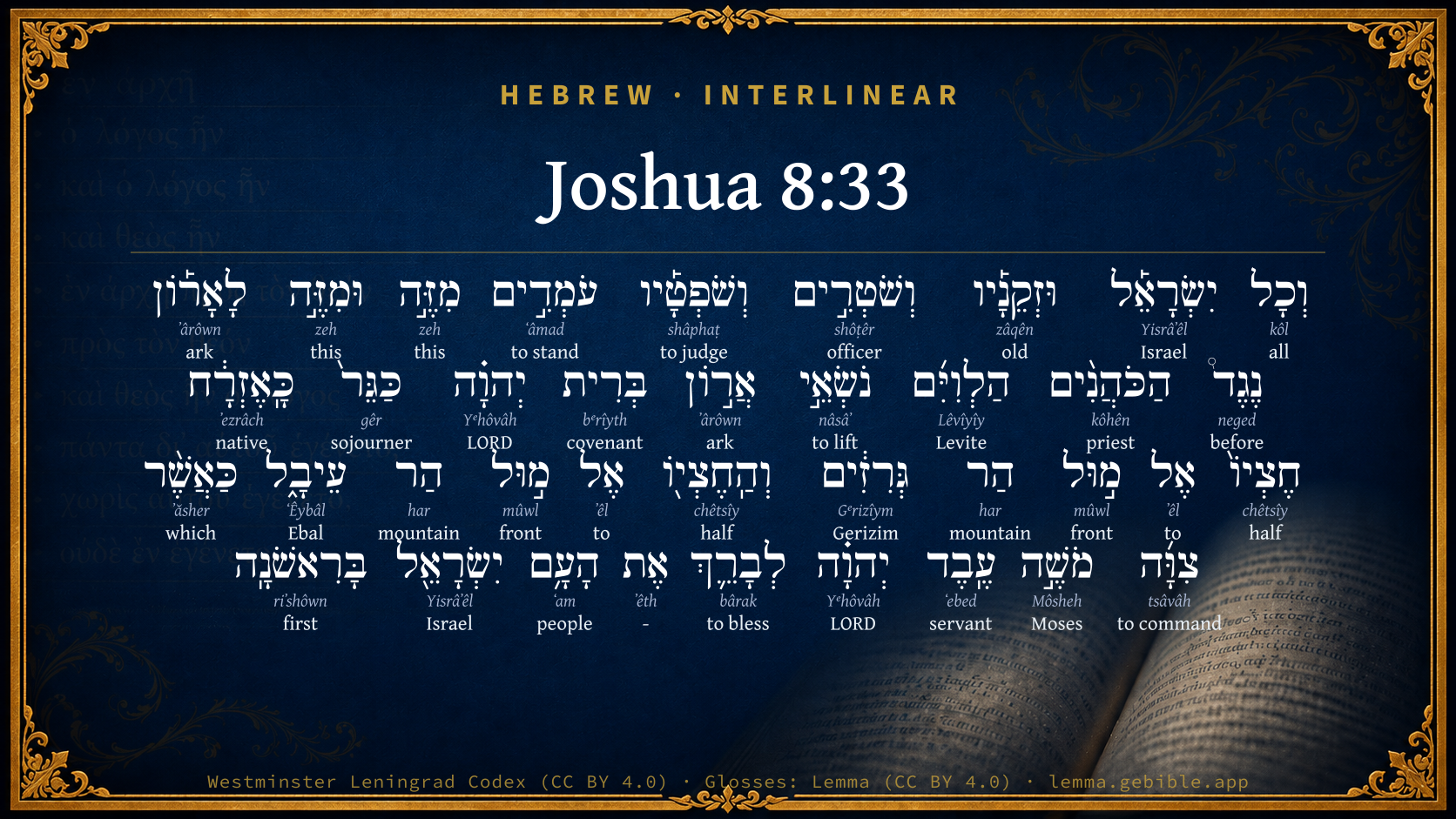
Hebrew (Westminster Leningrad Codex) Joshua 8:33 appears in the Hebrew Old Testament. The text above is from the Westminster Leningrad Codex. Each word links to its Strong’s number, a concise gloss, and parsing drawn from the Open Scriptures Hebrew Bible morphology. Click any word for its full Brown-Driver-Briggs (BDB) entry.
Download image
Cite this verse

Joshua 8:33 (World English Bible). Public Domain. Lemma interlinear Bible study tool, https://lemma.gebible.app/v/joshua/8/33.

Show BibTeX & RIS
BibTeX
RIS
English Translation
All Israel, and their elders and officers, and their judges, stood on this side of the ark and on that side before the priests the Levites, who bore the ark of the covenant of Yahweh, as well the foreigner as the native; half of them in front of Mount Gerizim, and half of them in front of Mount Ebal; as Moses the servant of Yahweh had commanded at the first, that they should bless the people of Israel.
World English Bible · Public Domain
Download a study sheet

One document with this verse’s original text, its word-by-word gloss line, the meaning frame, cross-references with their text, attributed commentary, and full source and license credits — printable, and it pastes into notes with its structure intact.

This verse Autodidact and up

Study sheet (.html) Plain text (.txt)

A passage Seminary Student

Up to 50 verses in one chapter. A passage sheet keeps up to 6 commentary sources and 12 cross-references per verse, in the order this page ranks them, and says so on the sheet whenever that leaves anything out. Ask for a single verse and you get the Autodidact verse sheet above.

Everything on this page stays free to read, with no account — the sheet is a download of what is already on screen, not access to it.

Want to remove ads? Support Godless Engineer
Compare translations 3

The same verse in 3 English versions, stacked beneath the original-language interlinear above. Click any original word for its lexicon entry.

Each is an independent rendering of the whole verse — the interlinear is not word-aligned to these translations.

Highlighted words mark where these versions differ — a whole-verse word diff, not a word-by-word alignment.

  • World English Bible Public Domain
    All Israel, and their elders and officers, and their judges, stood on this side of the ark and on that side before the priests the Levites, who bore the ark of the covenant of Yahweh, as well the foreigner as the native; half of them in front of Mount Gerizim, and half of them in front of Mount Ebal; as Moses the servant of Yahweh had commanded at the first, that they should bless the people of Israel.
  • King James Version Public Domain
    And all Israel, and their elders, and officers, and their judges, stood on this side the ark and on that side before the priests the Levites, which bare the ark of the covenant of the LORD, as well the stranger, as he that was born among them; half of them over against mount Gerizim, and half of them over against mount Ebal; as Moses the servant of the LORD had commanded before, that they should bless the people of Israel.
  • unfoldingWord Literal Text CC BY-SA 4.0
    And all of Israel and its elders and officers and its judges standing from here and from there at the Box, in front of the priests, the Levites, the carriers of the Box of the Covenant of Yahweh, as the sojourner, so the native, half of him toward the front of Mount Gerizim and half of him toward the front of Mount Ebal, just as Moses, the servant of Yahweh, had commanded to bless the people of Israel at the first.

unfoldingWord Literal Text — © unfoldingWord, licensed CC BY-SA 4.0. Word-aligned USFM3 via Door43 (git.door43.org/unfoldingWord/en_ult).

Versions to compare (up to 4)

3 of 4 selected

Show all 18 translations

Every available English version of this verse, each an independent rendering of the whole verse.

  • World English Bible Public Domain
    All Israel, and their elders and officers, and their judges, stood on this side of the ark and on that side before the priests the Levites, who bore the ark of the covenant of Yahweh, as well the foreigner as the native; half of them in front of Mount Gerizim, and half of them in front of Mount Ebal; as Moses the servant of Yahweh had commanded at the first, that they should bless the people of Israel.
  • Berean Standard Bible Public Domain
    All Israel, foreigners and citizens alike, with their elders, officers, and judges, stood on both sides of the ark of the covenant of the LORD facing the Levitical priests who carried it. Half of the people stood in front of Mount Gerizim and half of them in front of Mount Ebal, as Moses the servant of the LORD had commanded earlier, to bless the people of Israel.
  • Majority Standard Bible Public Domain
    All Israel, foreigners and citizens alike, with their elders, officers, and judges, stood on both sides of the ark of the covenant of the LORD facing the Levitical priests who carried it. Half of the people stood in front of Mount Gerizim and half of them in front of Mount Ebal, as Moses the servant of the LORD had commanded earlier, to bless the people of Israel.
  • King James Version Public Domain
    And all Israel, and their elders, and officers, and their judges, stood on this side the ark and on that side before the priests the Levites, which bare the ark of the covenant of the LORD, as well the stranger, as he that was born among them; half of them over against mount Gerizim, and half of them over against mount Ebal; as Moses the servant of the LORD had commanded before, that they should bless the people of Israel.
  • American Standard Version (1901) Public Domain
    And all Israel, and their elders and officers, and their judges, stood on this side of the ark and on that side before the priests the Levites, that bare the ark of the covenant of Jehovah, as well the sojourner as the homeborn; half of them in front of mount Gerizim, and half of them in front of mount Ebal; as Moses the servant of Jehovah had commanded at the first, that they should bless the people of Israel.
  • Revised Version (1885) Public Domain
    And all Israel, and their elders and officers, and their judges, stood on this side the ark and on that side before the priests the Levites, which bare the ark of the covenant of the LORD, as well the stranger as the homeborn; half of them in front of mount Gerizim, and half of them in front of mount Ebal; as Moses the servant of the LORD had commanded, that they should bless the people of Israel first of all.
  • Geneva Bible (1599) Public Domain
    And all Israel (and their Elders, and officers and their iudges stoode on this side of the Arke, and on that side, before the Priestes of the Leuites, which bare the Arke of the couenant of the Lord) as well the stranger, as he that is borne in the countrey: halfe of them were ouer against mount Gerizim, and halfe of them ouer against mount Ebal, as Moses the seruant of the Lord had commanded before, that they should blesse the people of Israel.
  • Douay-Rheims (1899) Public Domain
    And all the people, and the ancients, and the princes and judges stood on both sides of the ark, before the priests that carried the ark of the covenant of the Lord, both the stranger and he that was born among them, half of them by mount Garizim, and half by mount Hebal, as Moses the servant of the Lord had commanded. And first he blessed the people of Israel.
  • Young's Literal Translation Public Domain
    And all Israel, and its elders, and authorities, and its judges, are standing on this side and on that of the ark, over-against the priests, the Levites, bearing the ark of the covenant of Jehovah, as well the sojourner as the native, half of them over-against mount Gerizim, and the half of them over-against mount Ebal, as Moses servant of Jehovah commanded to bless the people of Israel at the first.
  • Literal Standard Version CC BY-SA 4.0
    And all Israel, and its elderly, and authorities, and his judges, are standing on this [side] and on that [side] of the Ark, before the priests, the Levites, carrying the Ark of the Covenant of YHWH, the sojourner as well as the native, half of them in front of Mount Gerizim, and the half of them in front of Mount Ebal, as Moses servant of YHWH had commanded to bless the people of Israel at the first.
  • Unlocked Literal Bible CC BY-SA 4.0
    All Israel, their elders, officers, and their judges stood on both sides of the ark before the priests and Levites who carried the ark of the covenant of Yahweh—the foreigner as well as the native born—half of them stood in front of Mount Gerizim and the other half stood in front of Mount Ebal. They blessed the people of Israel, just as Moses the servant of Yahweh had commanded them at first.
  • unfoldingWord Literal Text CC BY-SA 4.0
    And all of Israel and its elders and officers and its judges standing from here and from there at the Box, in front of the priests, the Levites, the carriers of the Box of the Covenant of Yahweh, as the sojourner, so the native, half of him toward the front of Mount Gerizim and half of him toward the front of Mount Ebal, just as Moses, the servant of Yahweh, had commanded to bless the people of Israel at the first.
  • Darby Bible Public Domain
    And all Israel, and their elders, and their officers and judges, stood on this side and on that side of the ark before the priests the Levites, who bore the ark of the covenant of Jehovah, as well the stranger as the home-born [Israelite]; half of them toward mount Gerizim, and the other half of them toward mount Ebal; as Moses the servant of Jehovah had commanded, that they should bless the people of Israel, in the beginning.
  • World Messianic Bible Public Domain
    All Israel, with their elders, officers, and judges, stood on both sides of the ark before the Levitical priests, who carried the ark of the LORD’s covenant, the foreigner as well as the native; half of them in front of Mount Gerizim, and half of them in front of Mount Ebal, as Moses the servant of the LORD had commanded at the first, that they should bless the people of Israel.
  • Webster's Bible Public Domain
    And all Israel, and their elders, and officers, and their judges, stood on this side of the ark, and on that side, before the priests the Levites, who bore the ark of the covenant of the LORD, as well the stranger, as he that was born among them; half of them over against mount Gerizim, and half of them over against mount Ebal; as Moses the servant of the LORD had commanded before, that they should bless the people of Israel.
  • Free Bible Version CC BY-SA 4.0
    All the Israelites, the elders, the officers, and the judges stood in two groups facing each other with the priests, the Levites, and the Ark of the Lord's Agreement between them. (Included were the foreigners as well as the native born.) Half of them stood in front of Mount Gerizim, and half in front of Mount Ebal, just as Moses had ordered, for the blessing of the people this first time.
  • Bible in Basic English Public Domain
    And all Israel, those who were Israelites by birth, as well as the men from other lands living with them, and their responsible men and their overseers and judges, took their places round the ark, in front of the priests, the Levites, whose work it was to take up the ark of the Lord's agreement; half of them were stationed in front of Mount Gerizim and half in front of Mount Ebal, in agreement with the orders for the blessing of the children of Israel which Moses, the servant of the Lord, had given.
  • JPS Tanakh (1917) Public Domain
    And all Israel, and their elders and officers, and their judges, stood on this side the ark and on that side before the priests the Levites, that bore the ark of the covenant of the LORD, as well the stranger as the home-born; half of them in front of mount Gerizim and half of them in front of mount Ebal; as Moses the servant of the LORD had commanded at the first, that they should bless the people of Israel.

Literal Standard Version (2020), Covenant Press — licensed CC BY-SA 4.0. Text via the HelloAO Bible API (eBible.org). Unlocked Literal Bible (unfoldingWord) — licensed CC BY-SA 4.0. Text via the HelloAO Bible API (eBible.org). unfoldingWord Literal Text — © unfoldingWord, licensed CC BY-SA 4.0. Word-aligned USFM3 via Door43 (git.door43.org/unfoldingWord/en_ult). Free Bible Version, Dr. Jonathan Gallagher — licensed CC BY-SA 4.0. Text via the HelloAO Bible API (eBible.org).

Word by word

More ways to search: Search by grammar → Find every occurrence → Compare this word →

Practice this passage: Drill this verse → Learn its vocabulary →

גְּרִזִ֔ים
Gᵉrizîym
H1630
“Gerizim”
Noun, Proper
Part of Speech
Noun
Type
Proper
Full BDB Definition

Origin: plural of an unused noun from H1629

TWOT: None

Gerizim = "cuttings off" - a mountain in northern Israel in Ephraim near Shechem from which the blessings were read to the Israelites on entering Canaan; site of the Samaritan temple built after the captivity
  1. וְכָל kôl H3605 “and · all of” Conjunction + Noun, Common, Masculine, Singular, Construct
  2. יִשְׂרָאֵ֡ל Yisrâʼêl H3478 “Israel” Noun, Proper
  3. וּזְקֵנָ֡יו zâqên H2205 “and · old · his” Conjunction + Adjective, Adjective, Masculine, Plural, Construct + Suffix, Personal, 3rd Person, Masculine, Singular
  4. וְשֹׁטְרִ֣ים shôṭêr H7860 “and · officer” Conjunction + Verb, Qal, Participle Active, Masculine, Plural, Absolute
  5. וְשֹׁפְטָ֡יו shâphaṭ H8199 “and · judging · him” Conjunction + Verb, Qal, Participle Active, Masculine, Plural, Construct + Suffix, Personal, 3rd Person, Masculine, Singular
  6. עֹמְדִ֣ים ʻâmad H5975 “standing” Verb, Qal, Participle Active, Masculine, Plural, Absolute
  7. מִזֶּ֣ה zeh H2088 “from · this” Preposition + Pronoun, Demonstrative, Masculine, Singular
  8. וּמִזֶּ֣ה zeh H2088 “and · from · this” Conjunction + Preposition + Pronoun, Demonstrative, Masculine, Singular
  9. לָאָר֡וֹן ʼârôwn H727 “to/for the · ark” Preposition, Determined + Noun, Common, Both, Singular, Absolute
  10. נֶגֶד֩ neged H5048 “before” Preposition
  11. הַכֹּהֲנִ֨ים kôhên H3548 “the · priests” Particle, Definite Article + Noun, Common, Masculine, Plural, Absolute
  12. הַלְוִיִּ֜ם Lêvîyîy H3881 “the · Levites” Particle, Definite Article + Noun, Gentilic, Masculine, Plural, Absolute
  13. נֹשְׂאֵ֣י nâsâʼ H5375 “lifting” Verb, Qal, Participle Active, Masculine, Plural, Construct
  14. אֲר֣וֹן ʼârôwn H727 “ark of” Noun, Common, Both, Singular, Construct
  15. בְּרִית bᵉrîyth H1285 “covenant of” Noun, Common, Feminine, Singular, Construct
  16. יְהוָ֗ה Yᵉhôvâh H3068 “LORD” Noun, Proper
  17. כַּגֵּר֙ gêr H1616 “like/as the · sojourner” Preposition, Determined + Noun, Common, Masculine, Singular, Absolute
  18. כָּֽאֶזְרָ֔ח ʼezrâch H249 “like/as the · native” Preposition, Determined + Noun, Common, Masculine, Singular, Absolute
  19. חֶצְיוֹ֙ chêtsîy H2677 “half · his” Noun, Common, Masculine, Singular, Construct + Suffix, Personal, 3rd Person, Masculine, Singular
  20. אֶל ʼêl H413 “to” Preposition
  21. מ֣וּל mûwl H4136 “front” Preposition
  22. הַר har H2022 “mountain of” Noun, Common, Masculine, Singular, Construct
  23. וְהַֽחֶצְי֖וֹ chêtsîy H2677 “and · the · half · his” Conjunction + Particle, Definite Article + Noun, Common, Masculine, Singular, Construct + Suffix, Personal, 3rd Person, Masculine, Singular
  24. אֶל ʼêl H413 “to” Preposition
  25. מ֣וּל mûwl H4136 “front” Preposition
  26. הַר har H2022 “mountain of” Noun, Common, Masculine, Singular, Construct
  27. עֵיבָ֑ל ʻÊybâl H5858 “Ebal” Noun, Proper
  28. כַּאֲשֶׁ֨ר ʼăsher H834 “like/as · which” Preposition + Particle, Relative
  29. צִוָּ֜ה tsâvâh H6680 “to command” Verb, Piel, Perfect, 3rd Person, Masculine, Singular
  30. מֹשֶׁ֣ה Môsheh H4872 “Moses” Noun, Proper
  31. עֶֽבֶד ʻebed H5650 “servant of” Noun, Common, Masculine, Singular, Construct
  32. יְהוָ֗ה Yᵉhôvâh H3068 “LORD” Noun, Proper
  33. לְבָרֵ֛ךְ bârak H1288 “to bless” Preposition + Verb, Piel, Infinitive Construct
  34. אֶת ʼêth H853 “-” Particle, Direct Object
  35. הָעָ֥ם ʻam H5971 “the · people” Particle, Definite Article + Noun, Common, Masculine, Singular, Absolute
  36. יִשְׂרָאֵ֖ל Yisrâʼêl H3478 “Israel” Noun, Proper
  37. בָּרִאשֹׁנָֽה riʼshôwn H7223 “in/at the · first” Preposition, Determined + Adjective, Adjective, Feminine, Singular, Absolute

About this verse

These counts appear in no published source. They are computed here, from the morphology-tagged text and Lemma’s own curated glosses. What Lemma adds →

38
words
30
distinct lemmas
Historical
section

Notable vocabulary

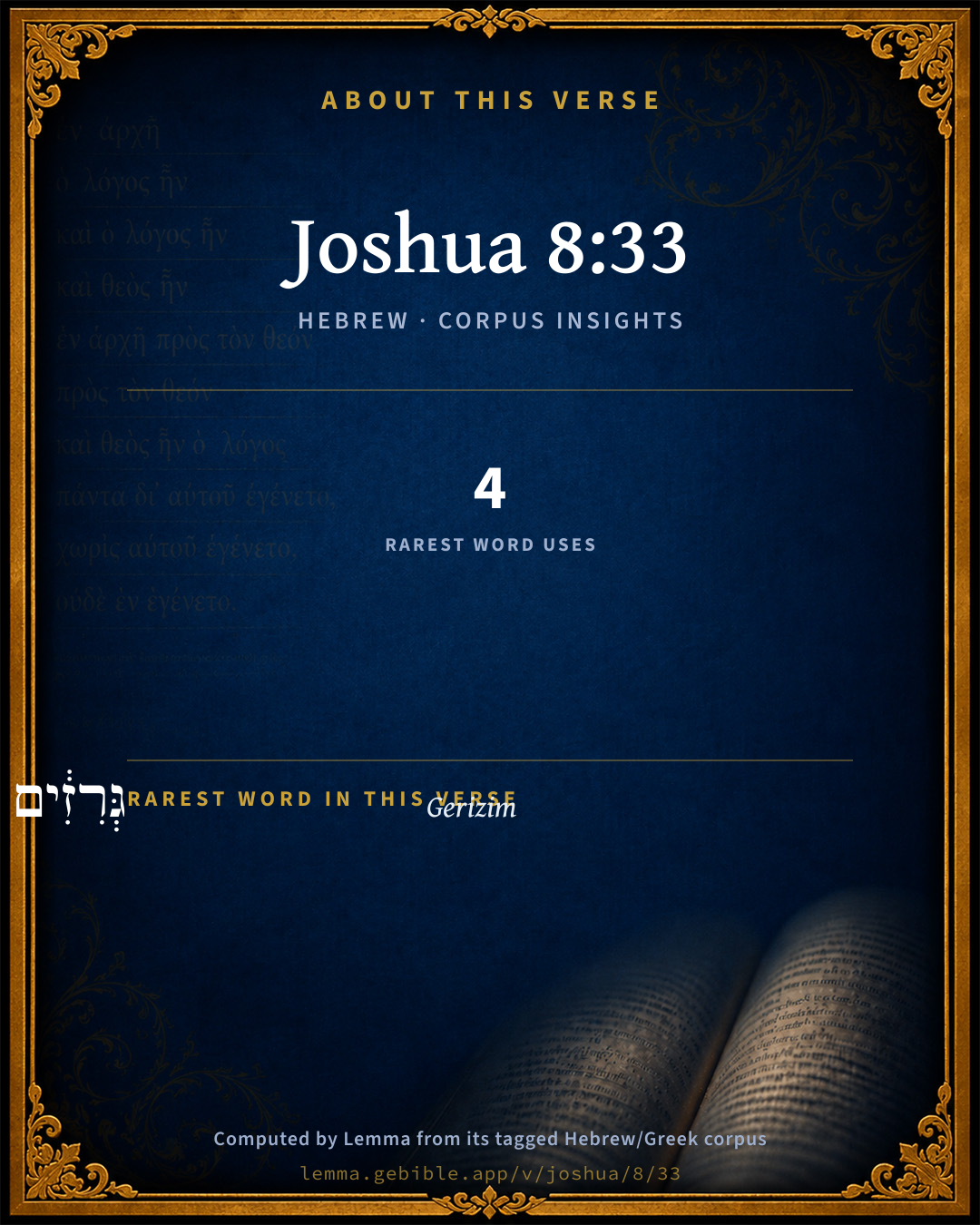
The rarest word here is גְּרִזִ֔ים Gerizim H1630 — appearing just 4 times in the whole Hebrew Bible.

Shared distinctive vocabulary

גְּרִזִ֔ים Gerizim H1630 occurs in 4 verses of the Hebrew Bible. Also found in:

Grammatical profile

  • 6 verbs
  • 21 nouns
  • 2 adjectives
  • 2 pronouns
  • 5 prepositions
  • 2 particles

Verb forms

  • וְשֹׁטְרִ֣ים Qal · Participle Active
  • וְשֹׁפְטָ֡יו Qal · Participle Active
  • עֹמְדִ֣ים Qal · Participle Active
  • נֹשְׂאֵ֣י Qal · Participle Active
  • צִוָּ֜ה Piel · Perfect
  • לְבָרֵ֛ךְ Piel · Infinitive Construct

Repetition

Words recur within this verse — often emphatic in Hebrew:

  • יִשְׂרָאֵ֡ל Israel H3478 ×2
  • לָאָר֡וֹן ark H727 ×2
  • יְהוָ֗ה LORD H3068 ×2
  • חֶצְיוֹ֙ half H2677 ×2
  • מ֣וּל front H4136 ×2
  • הַר mountain H2022 ×2
  • מִזֶּ֣ה this H2088 ×2
  • אֶל to H413 ×2

Hebrew & Septuagint length

In English translation the verse runs 78 words from the Hebrew and 74 from the Septuagint (LXX English) — closely comparable.

A rough comparison of the two English renderings, which tokenize alike — not a word-level alignment.

Word counts can differ between the Hebrew and the Greek without any difference in meaning — e.g. the Hebrew direct-object marker אֵת has no separate Greek word, and Greek often adds the article ὁ.

Cross-references

20

Topical passages linked to Joshua 8:33 in the Treasury of Scripture Knowledge — connected by theme and wording, ordered by reader-vote popularity; previews shown in the World English Bible.

  • Deuteronomy 11:29 It shall happen, when Yahweh your God shall bring you into the land where you go to possess it, that you shall set the blessing on Mount Gerizim, and the curse on Mount Ebal.
  • Deuteronomy 31:12 Assemble the people, the men and the women and the little ones, and your foreigner who is within your gates, that they may hear, and that they may learn, and fear Yahweh your God, and observe to do all the words of this law;
  • Deuteronomy 27:11–14 Moses charged the people the same day, saying,
  • Deuteronomy 31:9 Moses wrote this law, and delivered it to the priests the sons of Levi, who bore the ark of the covenant of Yahweh, and to all the elders of Israel.
  • Exodus 12:49 One law shall be to him who is born at home, and to the stranger who lives as a foreigner among you."
  • Numbers 15:16 One law and one ordinance shall be for you, and for the stranger who lives as a foreigner with you.
  • Numbers 15:29 You shall have one law for him who does anything unwittingly, for him who is home-born among the children of Israel, and for the stranger who lives as a foreigner among them.
  • Deuteronomy 31:25 that Moses commanded the Levites, who bore the ark of the covenant of Yahweh, saying,
  • Joshua 3:3 and they commanded the people, saying, When you see the ark of the covenant of Yahweh your God, and the priests the Levites bearing it, then you shall remove from your place, and go after it.
  • Joshua 4:18 It happened, when the priests who bore the ark of the covenant of Yahweh were come up out of the midst of the Jordan, and the soles of the priests' feet were lifted up to the dry ground, that the waters of the Jordan returned to their place, and went over all its banks, as before.
  • Joshua 8:30–32 Then Joshua built an altar to Yahweh, the God of Israel, in Mount Ebal,
  • Joshua 24:1 Joshua gathered all the tribes of Israel to Shechem, and called for the elders of Israel, and for their heads, and for their judges, and for their officers; and they presented themselves before God.
  • Leviticus 24:22 You shall have one kind of law, for the foreigner as well as the native-born: for I am Yahweh your God.'"
  • Deuteronomy 29:10–11 You stand this day all of you before Yahweh your God; your heads, your tribes, your elders, and your officers, even all the men of Israel,
  • Joshua 3:14 It happened, when the people removed from their tents, to pass over the Jordan, the priests who bore the ark of the covenant being before the people;
  • Joshua 4:10 For the priests who bore the ark stood in the midst of the Jordan, until everything was finished that Yahweh commanded Joshua to speak to the people, according to all that Moses commanded Joshua: and the people hurried and passed over.
  • Joshua 6:6 Joshua the son of Nun called the priests, and said to them, Take up the ark of the covenant, and let seven priests bear seven trumpets of rams' horns before the ark of Yahweh.
  • Joshua 23:2 that Joshua called for all Israel, for their elders and for their heads, and for their judges and for their officers, and said to them, I am old and well stricken in years:
  • 1 Chronicles 15:11–15 David called for Zadok and Abiathar the priests, and for the Levites, for Uriel, Asaiah, and Joel, Shemaiah, and Eliel, and Amminadab,
  • Joshua 3:6 Joshua spoke to the priests, saying, Take up the ark of the covenant, and pass over before the people. They took up the ark of the covenant, and went before the people.

Cross-references courtesy of OpenBible.info (CC BY 4.0).

Hebrew and Greek witnesses Masoretic Hebrew ↔ Greek Septuagint

The same verse in the two great witnesses to the Old Testament, shown verse-for-verse.

These are two independent witnesses, not word-aligned to each other, and the Septuagint is shown in lemma (dictionary) form.

Hebrew Joshua 8:33 Masoretic · Westminster Leningrad Codex

וְכָל יִשְׂרָאֵ֡ל וּזְקֵנָ֡יו וְשֹׁטְרִ֣ים וְשֹׁפְטָ֡יו עֹמְדִ֣ים מִזֶּ֣ה וּמִזֶּ֣ה לָאָר֡וֹן נֶגֶד֩ הַכֹּהֲנִ֨ים הַלְוִיִּ֜ם נֹשְׂאֵ֣י אֲר֣וֹן בְּרִית יְהוָ֗ה כַּגֵּר֙ כָּֽאֶזְרָ֔ח חֶצְיוֹ֙ אֶל מ֣וּל הַר גְּרִזִ֔ים וְהַֽחֶצְי֖וֹ אֶל מ֣וּל הַר עֵיבָ֑ל כַּאֲשֶׁ֨ר צִוָּ֜ה מֹשֶׁ֣ה עֶֽבֶד יְהוָ֗ה לְבָרֵ֛ךְ אֶת הָעָ֥ם יִשְׂרָאֵ֖ל בָּרִאשֹׁנָֽה

All Israel, and their elders and officers, and their judges, stood on this side of the ark and on that side before the priests the Levites, who bore the ark of the covenant of Yahweh, as well the foreigner as the native; half of them in front of Mount Gerizim, and half of them in front of Mount Ebal; as Moses the servant of Yahweh had commanded at the first, that they should bless the people of Israel.

World English Bible · Public Domain

Greek LXX Joshua 8:33 Septuagint · lemma form
And all Israel, and their elders, and their judges, and their scribes, passed on one side and on the other before the ark; and the priests and the Levites took up the ark of the covenant of the Lord; and the stranger and the native were there, who were half of them near mount Garizin, and half near mount Gaebal, as Moses the servant of the Lord commanded at first, to bless the people.

LXX2012 (modern English Septuagint) · Public Domain

Hebrew: Westminster Leningrad Codex (CC BY 4.0). Greek: Septuagint (public domain); English from LXX2012 (modern English Septuagint) (Public Domain). How the Septuagint differs from the Hebrew →

Targum (Aramaic paraphrase)

1

The Targum is the ancient Jewish Aramaic paraphrase of the Hebrew Scriptures — an interpretive translation, not the Hebrew text itself. Onkelos (literal) and Pseudo-Jonathan (expansive) render the Torah, and Jonathan the Prophets. Coverage is partial: where no permissively-licensed English translation exists for a verse, only the Aramaic is shown. This is verse-level text, not a word-by-word alignment to the Hebrew.

  1. Targum Jonathan Prophets (Joshua–Malachi)
    וְכָל יִשְׂרָאֵל וְסַבוֹהִי וְסַרְכוֹהִי וְדַיָנוֹהִי קַיְמִין מִכָּא וּמִכָּא לַאֲרוֹנָא קֳדָם כַּהֲנַיָא לֵוָאֵי נָטְלֵי אֲרוֹנָא דִקְיָמָא דַייָ כְּגִיוֹרָא כְּיַצִיבָא פַּלְגֵיהוֹן לָקֳבֵל טוּרָא דִגְרִיזִין וּפַלְגֵיהוֹן לָקֳבֵל טוּרָא דְעֵיבָל כְּמָא דְפַקֵיד מֹשֶׁה עַבְדָא דַייָ לְבָרָכָא יַת עַמָא יִשְׂרָאֵל בְּקַדְמֵיתָא:

    (no public-domain English translation for this verse)

    Targum Jonathan — Aramaic: “Mikraot Gedolot” (public domain). English: “Sefaria Community Translation” (CC0 1.0 (public-domain dedication)); “London "Chaldee Paraphrase," 1871” (public domain). Text via Sefaria.

Commentary

Notes on Joshua 8:33 from classic Christian and Jewish commentators (each source and its license shown beneath its notes). The classic Christian expositions comment on the surrounding passage and are grouped to its opening verse, so a note may address several verses; the Jewish commentaries on the Tanakh (Rashi and others) are per-verse, so they appear only where the commentator wrote on this verse.

Lemma curates 59 commentaries, every one of them public domain or Creative Commons licensed, each selected and text-cleaned for this edition rather than reprinted as found. About our sources →

Trapp's Complete Commentary

John Trapp

Jos 8:33 And all Israel, and their elders, and officers, and their judges, stood on this side the ark and on that side before the priests the Levites, which bare the ark of the covenant of the LORD, as well the stranger, as he that was born among them; half of them over against mount Gerizim, and half of them over against mount Ebal; as Moses the servant of the LORD had commanded before, that they should bless the people of Israel.

Ver. 33. Before the priests and the Levites.] Whose office from God was to pronounce not only blessings, {Num 6:23} but curses, that those that would not obey God for love should do it for fear. These curses we may read in Deu 27:15-17, &c. The blessings are not mentioned by Moses, that we might learn to look for them by Messiah only. {Act 3:26}

John Trapp, A Commentary or Exposition upon All the Books of the Old and New Testament (1647–1656) — public domain. Text from a community e-Sword module.

Joseph Benson's Commentary

Jos 8:33. All Israel stood, &c. — That is, the whole congregation, old and young, male and female. On this side the ark and on that side — Some on one side of it, and some on the other. Mount Gerizim and mount Ebal — These two places were in the tribe of Ephraim, not far from Shechem, as appears from Scripture and from other authors. That they should bless — Or curse, which is easily understood out of the following verse.

Joseph Benson's Commentary on the Old and New Testaments (1811–1818) — public domain. Text from a community e-Sword module.

Tyndale Open Study Notes

Tyndale Open Resources

8:33-35 This ceremony marked the formal possession of the land, even though major campaigns against the Canaanites were still to come. The ritual of sacrifice and reading of the law highlighted the promises and obligations of God’s covenant with them and anticipated the eventual possession of all of Canaan.

8:33 The town of Shechem, located between Mount Gerizim to the south and Mount Ebal to the north, guarded the pass between the two mountains. Although the covenant renewal ceremony took place at Shechem, neither Joshua nor Judges records that Israel conquered the town. • With every Israelite involved and the Ark positioned in the valley between the two groups, this ceremony was a promise to keep the covenant God had made with Israel at Sinai.

Tyndale Open Study Notes — © Tyndale Open Resources, licensed CC BY-SA 4.0. Text via the HelloAO Bible API.

Jamieson, Fausset & Brown

Robert Jamieson, A. R. Fausset & David Brown

all Israel, and their elders, and officers, and their judges, stood on this side the ark and on that side--One half of Israel was arranged on Gerizim, and the other half on Ebal--along the sides and base of each.

before the priests the Levites--in full view of them.

Jamieson, Fausset & Brown — Commentary Critical and Explanatory on the Whole Bible (1871) — public domain (CC PDM 1.0). Text via the HelloAO Bible API.

Adam Clarke's Commentary

Verse 33. Half of them over against Mount Gerizim] See the arrangement of the whole of this business in the note and observations on De 27:26. And see also the notes on De 28:1-68.

Adam Clarke's Commentary on the Bible (1810–1826) — public domain. Text from a community e-Sword/MySword module.

John Calvin's Commentaries

33. And all Israel, and their elders, etc The third instance of obedience was the placing all the tribes on Mount Gerizim and Mount Ebal to stand in six rows each over against each other. For they were so arranged that six stood on Mount Ebal, and an equal number on the opposite Mount Gerizim. The intervening space was occupied by the Levites with the ark of the covenant, that the Lord might be surrounded on all sides by his own people. It is said that Joshua stood that he might first bless the people, as it was the purpose of God to allure the people to himself by sweetness and winning condescension. For although Moses, to rebuke the obstinacy of the people, makes mention of curses only, it is certain that these were in a manner accidental, because the genuine method was to employ blessings as a means of gaining over to obedience those who might otherwise have proved refractory. But when humane invitation proved unavailing, curses were added as a new resource and remedy.

God had promised ample rewards to his servants who should obey the Law. On the other hand, curses were denounced in order to deter transgressors. Each is now forced to subscribe his own condemnation, while an amen is responded to every single sentence. For in this way they not only hear themselves condemned by the mouth of God, but as if they had been heralds sent by him, they denounce the punishment which may await themselves. A similar promulgation was made in the plain of Moab beyond the Jordan, but now they are bound more solemnly, and acknowledge on what condition they are to dwell in the land of Canaan. It added no little weight to the whole, that the children also were admitted as witnesses.

John Calvin's Commentaries (1540-1563) — public domain. Text from the Calvin Translation Society English edition (1840s-50s) via the Christian Classics Ethereal Library (ccel.org). Calvin's coverage is partial (roughly two-thirds of the Bible); uncommented books and verses are honest gaps, never fabricated. The 19th-century editor's footnotes and remarks are omitted so the notes are faithfully Calvin's own voice.

The Cambridge Bible for Schools and Colleges

gen. ed. J. J. S. Perowne

33. as well the stranger] See Deu_31:12.

half of them over against mount Gerizim] viz., those which had sprung from the lawful wives of Jacob, Simeon, Levi, Judah, Issachar, Joseph, Benjamin (Deu_27:12).

and half of them over against mount Ebal] viz., Reuben, Gad, Asher, Zebulun, Dan, and Naphtali (Deu_27:13). Five of these had sprung from the handmaids of Leah and Rachel, to whom Reuben is added probably on account of his great sin.

The Cambridge Bible for Schools and Colleges (gen. ed. J. J. S. Perowne; Cambridge University Press, 1878–1918) — public domain. Text from a community e-Sword module.

John Gill's Exposition

And all Israel, and their elders, and officers, and their judges, stood on this side the ark, and on that side,.... Some on Ebal, and some on Gerizim:

before the priests and the Levites, which bare the ark of the covenant of the Lord; it being brought out of the tabernacle on this occasion, and bottle by the priests and Levites:

as well the stranger, as he that was born among them; that is, as well the proselytes as the native Israelites, both appeared and were in the same situation:

half of them over against Mount Gerizim; that is, half of the tribes, and these were Simeon, Levi, Judah, Issachar, Joseph, and Benjamin:

and half of them over against Mount Ebal; which were the tribes of Reuben, Gad, Asher, Zebulun, Dan, and Naphtali; See Gill on Deu 27:12 and See Gill on Deu 27:13,

as Moses the servant of the Lord had commanded before, that they should bless the people of Israel, as in Deu 27:12.

John Gill's Exposition of the Whole Bible (1746–1763) — public domain (CC PDM 1.0). Text via the HelloAO Bible API.

Haydock's Catholic Bible Commentary

Hebal. "Gerizim and Ebal, says Maundrell, p. 59, are separated by a narrow valley, not above a furlong broad; and Naplosa, (the ancient Sychem) consisting chiefly of two streets lying parallel, is built at the foot of, and under Gerizim." The princes, representing the different tribes, were stationed on these mountains, and the crowd at the foot of them, while a select company of Levites attended the ark in the midst, and repeated what the princes proclaimed, that the multitude might answer Amen, as they turned successively to them; (Kennicott) or the princes might answer Amen, from the top of the two hills. (Calmet) --- And first. Protestants, "as Moses....had commanded before, that they should bless the people of Israel." But if Josue blessed them himself, (Haydock) all superiors might do so, as parents bless their children. (Worthington)

George Leo Haydock (1774–1849), Haydock's Catholic Family Bible and Commentary, 1859 edition — public domain. Excludes Psalms (Douay-Rheims chapter numbering differs from Protestant) and Deuterocanonical books (Catholic canon only).

Matthew Poole's English Annotations

All Israel, i.e. the whole congregation, old and young, male and female, as it follows, Jos 8:35.

On this side the ark, and on that side, i.e. some on one side of it, and some on the other. Mount Gerizim and Mount Ebal were in the tribe of Ephraim, not far from Shechem, as appears both from Scripture, Deu 11:29,30; 27:12; Jdg 9:7, and from other authors who lived in those parts, as Josephus and the Jewish doctors. That they should bless, or curse, which is easily understood out of the following verse, and from Deu 27:13, &c.

Matthew Poole's English Annotations on the Holy Bible (1683–1685) — public domain. Text from a community e-Sword/MySword module.

Whedon's Commentary on the Bible

Daniel D. Whedon

33. As well the stranger — The entire body of Israelites, by descent and by adoption, were present. The latter were more commonly called proselytes, but sometimes strangers.

Over against Mount Gerizim — The multitude did not stand on the summits of the mountains, but on their slopes. That they could all hear when thus standing is sufficiently attested by modern travellers. Says Stanley: “The vale of Shechem is far from broad, not exceeding in some places a few hundred feet.” [Says Tristram: “The acoustic properties of this valley are interesting. A single voice might be heard by many thousands, shut in and conveyed up and down by the enclosing hills. In the early morning we could not only see from Gerizim a man driving his ass down a path on Mount Ebal, but could hear every word he uttered as he urged it on; and, in order to test the matter more certainly, on a subsequent occasion two of our party stationed themselves on opposite sides of the valley, and with perfect ease recited the commandments antiphonally.”] Dr. W.M. Thomson writes, respecting this impressive scene: “This was, beyond question or comparison, the most august assembly the sun ever shone upon. I never stand on the narrow plain, with Ebal and Gerizim rising on either hand to the sky, without involuntarily recalling and reproducing the scene. I have shouted to hear the echo, and then fancied how it must have been when the loud-voiced Levites proclaimed from the naked cliffs of Ebal, ‘Cursed be the man that maketh any graven or molten image, an abomination unto Jehovah;’ and then the tremendous AMEN, tenfold louder, from the mighty congregation, rising and swelling, and reaching from Ebal to Gerizim and from Gerizim to Ebal.”

Daniel D. Whedon (gen. ed.), Commentary on the Old and New Testaments (1874–1909) — public domain. Text from a community e-Sword module.

The Pulpit Commentary

And all Israel. (see Jos_23:2 Jos_24:1, Jos_24:2) The word lk is used very loosely in Hebrew. (see Gen_4:14) We need not, therefore, assume as a matter of course that the whole people, men, women, and children, were taken up to Shechem to behold this ceremony. It is quite possible that during all Joshua"s marches and campaigns a large number of the people remained under guard at Gilgal, (see Jos_9:6) which remained the headquarters of the Israelites until the country was subdued. All that is here meant is that a very great number of the people were gathered together, and that every tribe, every age, and each sex were largely represented at this important ceremony. And officers. Shoterim. (see Jos_1:10) Half of them. Origen"s explanation of the spiritual meaning of this passage is noteworthy, even though somewhat farfetched. He regards those of the tribes who stood on Mount Gerizim to bless, as the type of those who are led, not by fear of God"s threatenings, but by a longing for God"s promises and blessings; those who stood on Mount Ebal to curse, as the type of those who are driven by the fear of punishment to obey the will of God, and these finally attain salvation. The former, he adds, are the more noble of the two; but Jesus, who reads the hearts, gives each their proper station, and places some on Mount Ebal to curse, not that they themselves may receive the curse, but, by regarding the curse pronounced on sinners, may learn thereby how to escape it. Over against. lWmAla rather, "in the direction off" The command in Deu_27:12 is that they shall stand upon the two mountains. No doubt certain representatives of the tribes stood on the mountain, and the rest of the people at the foot of the mountain, on either side of the valley, "crowding the slopes," as Canon Tristram says. The valley is narrow here, and the voice in mountainous regions, where the air is rarer, carries far. Under special circumstances, such as frosty weather, the voices of men crying their wares have been distinctly heard across the Humber in our own country. And in mountain passes, as any one who has travelled in them may easily ascertain, conversations may be carried on from opposite sides of a valley or ravine without the slightest difficulty. In this particular place Canon Tristram tell us ("Land of Israel," pp. 149, 150) that when on Mount Gerizim he heard every word uttered by a man who was then driving his ass down Mount Ebal, and that afterwards two of his party recited the commandments antiphonally from the two sides of the valley without the least difficulty.

The Pulpit Commentary (1880–1919), ed. H.D.M. Spence-Jones & Joseph S. Exell — public domain. Text from a community e-Sword module.

John Wesley's Explanatory Notes

All Israel - That is, the whole congregation, old and young, male and female. That side - Some on one side of it, and some on the other. Mount Gerizim - These two places were in the tribe of Ephraim, not far from Shechem, as appears both from scripture, and from other authors. Bless - Or curse, which is easily understood out of the following verse.

John Wesley, Explanatory Notes Upon the Whole Bible (1754–1765) — public domain. Text via the GEBible commentary corpus.

unfoldingWord translationNotes

Door43 World Missions Community

translationWords

Israel

elder

judge, judges

ark of the covenant

priest

Levi

Yahweh

bless

command

unfoldingWord translationNotes — © Distant Shores Media and the Door43 World Missions Community, licensed CC BY-SA 4.0. Source: git.door43.org/Door43/en_tn.

Rashi

Rabbi Shlomo Yitzchaki (Rashi)

To bless the people of Yisroel first. To pronounce the blessings before the curses, began to recite the blessings and the curses. Although the Torah mentions only the curses, each curse was actually preceded by a corresponding blessing. (See Rashi to Devorim 27:12). “Blessed is the man who will not make a statue or a molten image.”

Rashi on the Tanakh — English translations: “The Judaica Press complete Tanach with Rashi, translated by A. J. Rosenberg” (CC BY 4.0); “Pentateuch with Rashi's commentary by M. Rosenbaum and A.M. Silbermann, 1929-1934” (public domain); “The Metsudah Tanach series, Lakewood, N.J” (CC BY 4.0); and “The Book of Joshua, Metsudah Publications, 1997” (CC BY 4.0). Text via Sefaria.

Lesson kit

Teaching starters — assembled from the data on this page, not authored interpretation. Every prompt links to the verse data it draws on. Edit before teaching.

Joshua, in the Historical, opens this verse with 38 words (30 distinct Hebrew lemmas). Its most distinctive word is Gᵉrizîym (“Gerizim”). A historical commentator’s framing appears above. Read the whole chapter for the surrounding context.

Discussion questions

  1. The word Gᵉrizîym carries the sense “Gerizim.” How does it shape the verse?
  2. Deuteronomy 11:29 shares the word «Gerizim» with this verse. How do the two illuminate each other?
  3. “Israel” occurs 2× in this one verse. What is the effect of the repetition?
  4. These translations render this verse differently; the difference is in the English rendering, not the original. What questions does that raise?
  5. The verb «וְשֹׁטְרִ֣ים» is Qal Participle Active. How does its form color the action?
  6. Reading how Trapp's Complete Commentary and Joseph Benson's Commentary read this verse, where do the two commentators agree and where do they part?

Things to notice

Reading settings

Reading text

Shown beneath each verse's original-language words.

Old Testament
Old Testament edition

Read the OT as the Masoretic Hebrew (MT) or the Greek Septuagint (LXX).

English shown for the Greek Septuagint (in the Hebrew ↔ Greek comparison).

Comparing translations? Open the Compare panel on any verse page to stack up to four side by side.