
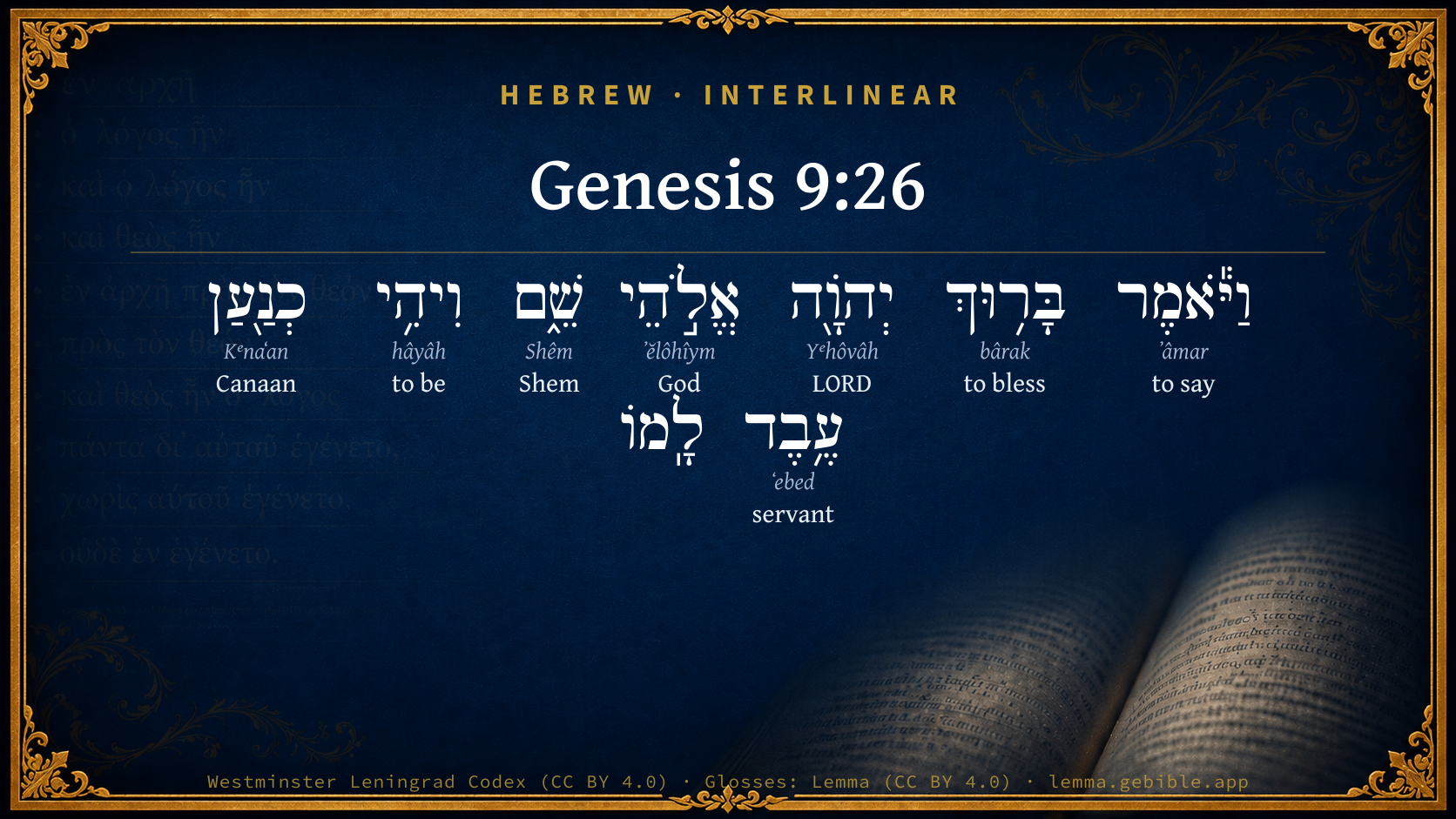
Genesis 9:26

Hebrew (Westminster Leningrad Codex) Genesis 9:26 appears in the Hebrew Old Testament. The text above is from the Westminster Leningrad Codex. Each word links to its Strong’s number, a concise gloss, and parsing drawn from the Open Scriptures Hebrew Bible morphology. Click any word for its full Brown-Driver-Briggs (BDB) entry.
Download image
Cite this verse

Genesis 9:26 (World English Bible). Public Domain. Lemma interlinear Bible study tool, https://lemma.gebible.app/v/genesis/9/26.

Show BibTeX & RIS
BibTeX
RIS
English Translation
He said, "Blessed be Yahweh, the God of Shem; Let Canaan be his servant.
World English Bible · Public Domain
Download a study sheet

One document with this verse’s original text, its word-by-word gloss line, the meaning frame, cross-references with their text, attributed commentary, and full source and license credits — printable, and it pastes into notes with its structure intact.

This verse Autodidact and up

Study sheet (.html) Plain text (.txt)

A passage Seminary Student

Up to 50 verses in one chapter. A passage sheet keeps up to 6 commentary sources and 12 cross-references per verse, in the order this page ranks them, and says so on the sheet whenever that leaves anything out. Ask for a single verse and you get the Autodidact verse sheet above.

Everything on this page stays free to read, with no account — the sheet is a download of what is already on screen, not access to it.

Want to remove ads? Support Godless Engineer
Compare translations 3

The same verse in 3 English versions, stacked beneath the original-language interlinear above. Click any original word for its lexicon entry.

Each is an independent rendering of the whole verse — the interlinear is not word-aligned to these translations.

Highlighted words mark where these versions differ — a whole-verse word diff, not a word-by-word alignment.

  • World English Bible Public Domain
    He said, "Blessed be Yahweh, the God of Shem; Let Canaan be his servant.
  • King James Version Public Domain
    And he said, Blessed be the LORD God of Shem; and Canaan shall be his servant.
  • unfoldingWord Literal Text CC BY-SA 4.0
    Then he said, “Praised be Yahweh, the God of Shem! And may Canaan be a slave for him.

unfoldingWord Literal Text — © unfoldingWord, licensed CC BY-SA 4.0. Word-aligned USFM3 via Door43 (git.door43.org/unfoldingWord/en_ult).

Versions to compare (up to 4)

3 of 4 selected

Show all 18 translations

Every available English version of this verse, each an independent rendering of the whole verse.

  • World English Bible Public Domain
    He said, "Blessed be Yahweh, the God of Shem; Let Canaan be his servant.
  • Berean Standard Bible Public Domain
    He also declared: “Blessed be the LORD, the God of Shem! May Canaan be the servant of Shem.
  • Majority Standard Bible Public Domain
    He also declared: “Blessed be the LORD, the God of Shem! May Canaan be the servant of Shem.
  • King James Version Public Domain
    And he said, Blessed be the LORD God of Shem; and Canaan shall be his servant.
  • American Standard Version (1901) Public Domain
    And he said, Blessed be Jehovah, the God of Shem; And let Canaan be his servant.
  • Revised Version (1885) Public Domain
    And he said, Blessed be the LORD, the God of Shem; And let Canaan be his servant.
  • Geneva Bible (1599) Public Domain
    He said moreouer, blessed be the Lord God of Shem, and let Canaan be his seruant.
  • Douay-Rheims (1899) Public Domain
    And he said: Blessed be the Lord God of Sem, be Chanaan his servant.
  • Young's Literal Translation Public Domain
    And he saith: `Blessed of Jehovah my God `is' Shem, And Canaan is servant to him.
  • Literal Standard Version CC BY-SA 4.0
    And he says: “Blessed of my God YHWH [is] Shem, || And Canaan is servant to him.
  • Unlocked Literal Bible CC BY-SA 4.0
    He also said, “May Yahweh, the God of Shem, be blessed, and may Canaan be his servant.
  • unfoldingWord Literal Text CC BY-SA 4.0
    Then he said, “Praised be Yahweh, the God of Shem! And may Canaan be a slave for him.
  • Darby Bible Public Domain
    And he said, Blessed be Jehovah, the God of Shem, And let Canaan be his bondman.
  • World Messianic Bible Public Domain
    He said, “Blessed be the LORD, the God of Shem. Let Canaan be his servant.
  • Webster's Bible Public Domain
    And he said, Blessed be the LORD God of Shem; and Canaan shall be his servant.
  • Free Bible Version CC BY-SA 4.0
    Then Noah continued, “May the Lord be blessed, the God of Shem, and may Canaan be his slave.
  • Bible in Basic English Public Domain
    And he said, Praise to the Lord, the God of Shem; let Canaan be his servant.
  • JPS Tanakh (1917) Public Domain
    And he said: Blessed be the LORD, the God of Shem; and let Canaan be their servant.

Literal Standard Version (2020), Covenant Press — licensed CC BY-SA 4.0. Text via the HelloAO Bible API (eBible.org). Unlocked Literal Bible (unfoldingWord) — licensed CC BY-SA 4.0. Text via the HelloAO Bible API (eBible.org). unfoldingWord Literal Text — © unfoldingWord, licensed CC BY-SA 4.0. Word-aligned USFM3 via Door43 (git.door43.org/unfoldingWord/en_ult). Free Bible Version, Dr. Jonathan Gallagher — licensed CC BY-SA 4.0. Text via the HelloAO Bible API (eBible.org).

Word by word

More ways to search: Search by grammar → Find every occurrence → Compare this word →

Practice this passage: Drill this verse → Learn its vocabulary →

About this verse

These counts appear in no published source. They are computed here, from the morphology-tagged text and Lemma’s own curated glosses. What Lemma adds →

9
words
8
distinct lemmas
Pentateuch
section

Notable vocabulary

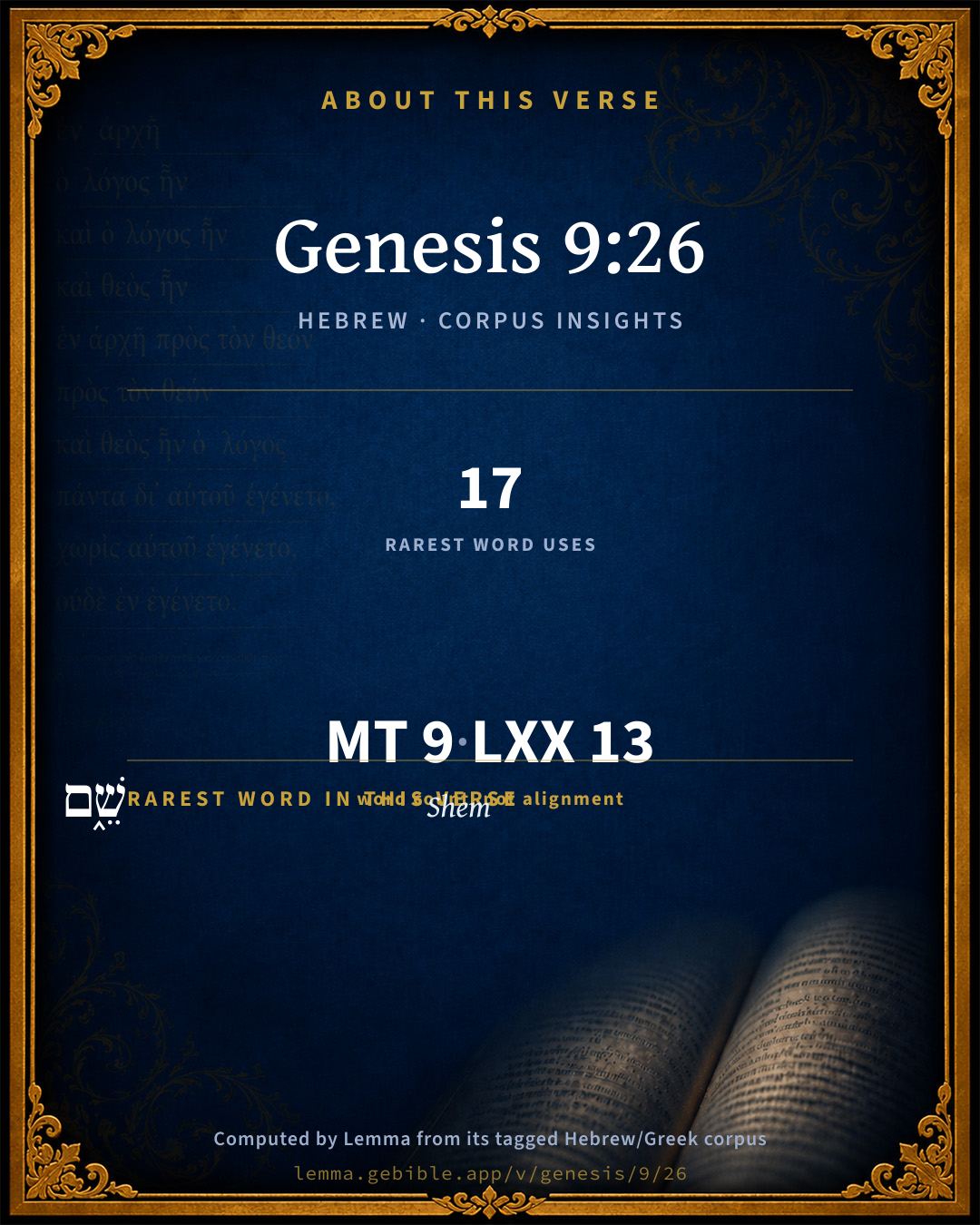
The rarest word here is שֵׁ֑ם Shem H8035 — appearing just 17 times in the whole Hebrew Bible.

Shared distinctive vocabulary

שֵׁ֑ם Shem H8035 occurs in 16 verses of the Hebrew Bible. Also found in:

Grammatical profile

  • 3 verbs
  • 5 nouns
  • 1 preposition

Verb forms

  • וַיֹּ֕אמֶר Qal · Sequential Imperfect
  • בָּר֥וּךְ Qal · Participle Passive
  • וִיהִ֥י Qal · Jussive

Hebrew & Septuagint length

In English translation the verse runs 14 words from the Hebrew and 16 from the Septuagint (LXX English) — closely comparable.

A rough comparison of the two English renderings, which tokenize alike — not a word-level alignment.

Word counts can differ between the Hebrew and the Greek without any difference in meaning — e.g. the Hebrew direct-object marker אֵת has no separate Greek word, and Greek often adds the article ὁ.

In the original languages it is 9 Hebrew tokens and 13 Greek tokens — but the two are counted differently (Hebrew bundles its prefixes and suffixes into one token; the Greek is in lemma form), so that isn’t a like-for-like length.

Cross-references

9

Topical passages linked to Genesis 9:26 in the Treasury of Scripture Knowledge — connected by theme and wording, ordered by reader-vote popularity; previews shown in the World English Bible.

  • Psalms 144:15 Happy are the people who are in such a situation. Happy are the people whose God is Yahweh.
  • Genesis 12:1–3 Now Yahweh said to Abram, "Get out of your country, and from your relatives, and from your father's house, to the land that I will show you.
  • Hebrews 11:16 But now they desire a better country, that is, a heavenly one. Therefore God is not ashamed of them, to be called their God, for he has prepared a city for them.
  • Genesis 10:10–26 The beginning of his kingdom was Babel, Erech, Accad, and Calneh, in the land of Shinar.
  • Genesis 27:37 Isaac answered Esau, "Behold, I have made him your lord, and all his brothers have I given to him for servants. With grain and new wine have I sustained him. What then will I do for you, my son?"
  • Deuteronomy 33:26 There is none like God, Jeshurun, Who rides on the heavens for your help, In his excellency on the skies.
  • Luke 3:23–36 Jesus himself, when he began to teach, was about thirty years old, being the son (as was supposed) of Joseph, the son of Heli,
  • Romans 9:5 of whom are the fathers, and from whom is Christ as concerning the flesh, who is over all, God, blessed forever. Amen.
  • Genesis 27:40 By your sword will you live, and you will serve your brother. It will happen, when you will break loose, That you shall shake his yoke from off your neck."

Cross-references courtesy of OpenBible.info (CC BY 4.0).

Hebrew and Greek witnesses Masoretic Hebrew ↔ Greek Septuagint

The same verse in the two great witnesses to the Old Testament, shown verse-for-verse.

These are two independent witnesses, not word-aligned to each other, and the Septuagint is shown in lemma (dictionary) form.

Hebrew Genesis 9:26 Masoretic · Westminster Leningrad Codex

וַיֹּ֕אמֶר בָּר֥וּךְ יְהֹוָ֖ה אֱלֹ֣הֵי שֵׁ֑ם וִיהִ֥י כְנַ֖עַן עֶ֥בֶד לָֽמוֹ

He said, "Blessed be Yahweh, the God of Shem; Let Canaan be his servant.

World English Bible · Public Domain

Greek LXX Genesis 9:26 Septuagint · lemma form

καί εἶπον εὐλογητός κύριος ὁ θεός ὁ σημ καί εἰμί χανααν παῖς αὐτός

And he said, Blessed be the Lord God of Sem, and Chanaan shall be his bond-servant.

LXX2012 (modern English Septuagint) · Public Domain

On this verse, The Pulpit Commentary discusses the Septuagint’s reading. Read the note in Commentary ↓

Hebrew: Westminster Leningrad Codex (CC BY 4.0). Greek: Septuagint (public domain); English from LXX2012 (modern English Septuagint) (Public Domain). How the Septuagint differs from the Hebrew →

Targum (Aramaic paraphrase)

2

The Targum is the ancient Jewish Aramaic paraphrase of the Hebrew Scriptures — an interpretive translation, not the Hebrew text itself. Onkelos (literal) and Pseudo-Jonathan (expansive) render the Torah, and Jonathan the Prophets. Coverage is partial: where no permissively-licensed English translation exists for a verse, only the Aramaic is shown. This is verse-level text, not a word-by-word alignment to the Hebrew.

  1. Targum Onkelos Torah (Genesis–Deuteronomy)
    וַאֲמַר בְּרִיךְ יְיָ אֱלָהֵהּ דְּשֵׁם וִיהֵי כְנַעַן עַבְדָא לְהוֹן

    And he said:--Blessed be the Lord the God of Shem, and Kenaan shall be servant unto them.

    Targum Onkelos — Aramaic: “Onkelos Genesis” (public domain); “Onkelos Exodus” (public domain); “Onkelos Leviticus” (public domain); “Onkelos Numbers” (public domain); “Onkelos Deuteronomy” (public domain). English: “Sefaria Community Translation” (CC0 1.0 (public-domain dedication)); “J.W. Etheridge. The Targums of Onkelos and Jonathan Ben Uzziel on the Pentateuch. London: Longmans, Green, 1862” (public domain). Text via Sefaria.

  2. Targum Pseudo-Jonathan Torah (Genesis–Deuteronomy)
    וַאֲמַר בְּרִיךְ יְיָ אֱלָהָא דְשֵׁם דַעֲבִידְתֵּיהּ צַדִיקָא וּבְגִין יֶהֱוֵי כְּנָעַן עֲבִיד לֵיהּ

    And he said, Blessed be the Lord, the God of Shem, whose work is righteous; and therefore shall Kenaan be servant unto him.

    Targum Pseudo-Jonathan — Aramaic: “Targum Jonathan on Genesis” (public domain); “Targum Jonathan on Exodus” (public domain); “Targum Jonathan on Leviticus” (public domain); “Targum Jonathan on Numbers” (public domain); “Targum Jonathan on Deuteronomy” (public domain). English: “The Targum of Jonathan ben Uzziel, trans. J. W. Etheridge, London, 1862” (public domain). Text via Sefaria.

Commentary

Notes on Genesis 9:26 from classic Christian and Jewish commentators (each source and its license shown beneath its notes). The classic Christian expositions comment on the surrounding passage and are grouped to its opening verse, so a note may address several verses; the Jewish commentaries on the Tanakh (Rashi and others) are per-verse, so they appear only where the commentator wrote on this verse.

Lemma curates 59 commentaries, every one of them public domain or Creative Commons licensed, each selected and text-cleaned for this edition rather than reprinted as found. About our sources →

Trapp's Complete Commentary

John Trapp

Gen 9:26 And he said, Blessed [be] the LORD God of Shem; and Canaan shall be his servant.

Ver. 26. Blessed be the Lord God of Shem.] Shem seems to have been the chief actor and persuader of that reverent behaviour; and therefore, as he is first named, {Gen 9:23} before his elder brother Japhet; so here he hath the first and chief blessing. It is good to be first in a good matter, yea, prompt and "present to every good work," as Paul hath it. {Tit 3:1}

And Canaan shall be his servant.] This curse was not fulfilled for many hundred years after, till the sins of the Amorites were grown full, and then it was accomplished. God’s forbearance is no acquittance. He can also turn a curse into a blessing, as he did this to Araunah the Jebusite, of the worst and most stubborn of the Canaanites; for they held the Tower of Jebus from the posterity of Shem after all the rest had yielded. {2Sa 5:7} Yet he became a godly proselyte, and gave, as a king, his freehold to King David, to build an altar on, {2Sa 24:18} and this deed of his was long after remembered. {Zec 9:7} The like may be said of the Gibeonites, who are called Nethinims in Ezra and Nehemiah. They were made servants to the Shemites, drawers of water to the temple, as a kind of punishment. God made this cross a mercy. Their employment so near the house of God gave them fit occasion to be partakers of the things of God. And the Lord, we see, did wonderfully honour them; the nearer they were to the church, the nearer to God. It is good getting into his house, though to be but "a doorkeeper" with David, or a water bearer with these Gibeonites. Stand but in God’s way as he passeth, and thou shalt be preferred.

John Trapp, A Commentary or Exposition upon All the Books of the Old and New Testament (1647–1656) — public domain. Text from a community e-Sword module.

Joseph Benson's Commentary

Gen 9:26. Blessed be the Lord God of Shem — Abraham and all his posterity were included in the descendants of Shem, as appears from the next chapter. Our Lord Jesus Christ, therefore, in whom all the nations of the earth are to be blessed, sprang from him. Well, therefore, might Jehovah be called the Lord God of Shem. Most of the worshippers of the true God, before the coming of the Messiah, were of his seed, and afterward the descendants of Shem were the chief instruments of bringing other nations to join in God’s worship, and to partake of the blessings of his salvation. Thus Shem is well recompensed for his respect to his father, and the being thus informed of the blessings that awaited his posterity, must have been a great consolation to him, as it, no doubt, was afterward to the truly pious of his seed.

Joseph Benson's Commentary on the Old and New Testaments (1811–1818) — public domain. Text from a community e-Sword module.

Tyndale Open Study Notes

Tyndale Open Resources

9:26 Noah refers to God as the Lord, who formed the covenant with Israel. Shem was the privileged forefather of the Israelites (see 10:21-32).

Tyndale Open Study Notes — © Tyndale Open Resources, licensed CC BY-SA 4.0. Text via the HelloAO Bible API.

Geneva Bible (1599)

Geneva Bible translators

Or, their.

Geneva Bible (1599) marginal notes — public domain. Text via Bolls.life.

Jamieson, Fausset & Brown

Robert Jamieson, A. R. Fausset & David Brown

Blessed be the Lord God of Shem--rather, "Blessed of Jehovah, my God, be Shem,"--an intimation that the descendants of Shem should be peculiarly honored in the service of the true God, His Church being for ages established among them (the Jews), and of them, concerning the flesh, Christ came. They got possession of Canaan, the people of that land being made their "servants" either by conquest, or, like the Gibeonites, by submission [Jos 9:25].

Jamieson, Fausset & Brown — Commentary Critical and Explanatory on the Whole Bible (1871) — public domain (CC PDM 1.0). Text via the HelloAO Bible API.

John Calvin's Commentaries

26. Blessed be the Lord God of Shem. Noah blesses his other children, but in a different manner. For he places Shem in the highest post of honor. And this is the reason why Noah, in blessing him, breaks forth in the praise of God, without adhering to the person of man. For the Hebrews, when they are speaking of any rare and transcendent excellence, raise their thoughts to God. Therefore the holy man, when he perceived that the most abundant grace of God was destined for his son Shem, rises to thanksgiving. Whence we infer, that he spoke, not from carnal reason, but rather treated of the secret favors of God, the result of which was to be deferred to a remote period. Finally, by these words it is declared, that the benediction of Shem would be divine or heavenly.

John Calvin's Commentaries (1540-1563) — public domain. Text from the Calvin Translation Society English edition (1840s-50s) via the Christian Classics Ethereal Library (ccel.org). Calvin's coverage is partial (roughly two-thirds of the Bible); uncommented books and verses are honest gaps, never fabricated. The 19th-century editor's footnotes and remarks are omitted so the notes are faithfully Calvin's own voice.

Ellicott's Commentary for English Readers

(26) Blessed be Jehovah.—The greatness of Shem’s blessing is shown by its taking the form of a hymn of praise to Jehovah, the personal God; and the patriarch’s fervent outburst of thanksgiving was a presage of the hallelujahs that were to arise unto God from all mankind for the birth of that son of Shem in whom all nations were to be blessed. The following words should be translated, And let Canaan be their servant, the servant both of Shem and Japheth. (See margin.)

A Bible Commentary for English Readers, edited by Charles John Ellicott (1878–1897) — public domain. Text from a community e-Sword module.

The Cambridge Bible for Schools and Colleges

gen. ed. J. J. S. Perowne

26. Blessed be the Lord, the God of Shem] The blessing invoked, not upon Shem himself, but upon Jehovah the God of Shem, is intended to convey the thought that herein will lie the true welfare of the descendants of Shem. The point of this oracle is, of course, dependent on the fact that Shem is to be the ancestor of Israel. The blessing here invoked has reference only to the Hebrews whose God is Jehovah. They are the favoured ones: the God of Redemption will manifest Himself in them. After “Cursed be Canaan,” we should expect to read “Blessed of Jehovah be Shem.” But there hardly seems to be sufficient reason for regarding the text as corrupt. Graetz, who is followed by Gunkel, with a slight alteration of the text, viz. by the transposition of two consonants and by a different reading of the vowels (which of course did not appear in early Hebrew writing), reads, “bless, oh! Jehovah, the tents of Shem” (אהלי שם for אלהי שם), so that “the tents of Shem” should end this line as well as line 2 in the next verse.

his servant] The translation of the margin, their, is to be preferred. The word in the Hebrew is a poetical form of the plural pronoun; and here the reference is to Canaan’s brethren.

The Cambridge Bible for Schools and Colleges (gen. ed. J. J. S. Perowne; Cambridge University Press, 1878–1918) — public domain. Text from a community e-Sword module.

John Gill's Exposition

And he said, blessed be the Lord God of Shem,.... Shem was blessed before Japheth, because he was the first and principal in advising and conducting the affair before ascribed to them, as Jarchi on Gen 9:23 suggests; and though the words are in the form of an ascription of blessedness to God, the fountain of all good, and by whose grace Shem was influenced and enabled to do the good he did, for which the Lord's name was to be praised and blessed; yet it includes the blessing of Shem, and indeed the greatest blessing he could possibly enjoy; for what greater blessing is there, than for a man to have God to be his God? this includes everything, all blessings temporal and spiritual; see Psa 144:15 some interpret the God of Shem of Christ, who, according to the human nature, was a descendant of Shem; and according to the divine nature the God of Shem, God over all, blessed for ever, Rom 9:4.

And Canaan shall be his servant; the posterity of Canaan be servants to the posterity of Shem: this was fulfilled in the times of Joshua, when the Israelites, who sprung from Shem, conquered the land of Canaan, slew thirty of their kings, and took their cities and possessed them, and made the Gibeonites, one of the states of Canaan, hewers of wood and drawers of water to them, or the most mean and abject servants.

John Gill's Exposition of the Whole Bible (1746–1763) — public domain (CC PDM 1.0). Text via the HelloAO Bible API.

Matthew Poole's English Annotations

Blessed be the Lord God of Shem.

Quest. What is this to Shem? For it is not Shem, but God who is here blessed.

Answ.

1. Shem also is here blessed, and that in the highest degree, because the Lord hath here declared himself to be Shem’s God. Now for God to be said to be any man’s God, is every where mentioned as the height of blessedness: see Gen 17:7; Psa 144:15; Jer 31:33; Mat 22:32. But the phrase is here justly varied. The curse is fixed upon Ham, because man alone is the author of his own sin, and the cause of his ruin; but because God is the author and fountain of all the good that man either doth or receiveth, therefore the blessing is emphatically given to God, who only doth the work, and of right is to receive all the glory, yet so as it redounds to Shem also. And Shem is here peculiarly mentioned, not Japheth, both for the comfort of the Israelites, whose progenitor he was, and because this blessing was first seated and long continued in Shem’s posterity alone, Japheth’s posterity being for a long time excluded from it; and because the Lord Christ, who is often called the Lord and God in Scripture, did take flesh from Shem; and so the incarnation of Christ may be here foretold, and Shem highly honoured and blessed in this, that he should be the father of Christ according to the flesh, Rom 9:5.

Answ. 2. This may be a short and abrupt manner of speech, which is frequent in the Hebrew tongue; and it may signify that Shem should be so eminently blessed, that men beholding it should be rapt up into admiration, and break forth into the praises of that God who gave such gifts unto men, and did so great things for Shem.

Answ. 3. The words may be otherwise rendered, either thus, Blessed, O Lord God, let Shem be, i.e. Do thou bless him. So it is only the construct from Elohe, for the absolute Elohim, which is not unusual in Scripture. Or thus, Blessed of the Lord God be Shem, or shall Shem be. So here is only a defect of the Hebrew particle min, which is oft wanting.

Matthew Poole's English Annotations on the Holy Bible (1683–1685) — public domain. Text from a community e-Sword/MySword module.

Whedon's Commentary on the Bible

Daniel D. Whedon

26. Blessed — The blessing of Shem is an ejaculation of praise, as the patriarch sees that Jehovah, the one only God, will be the God of his children, the Hebrew people. This made them a nation, and gave them an historic position grander than was ever occupied by any other people, making the Hebrew character, ritual, and literature the channels of the sublimest moral and religious truths to the world. Thus has the world learned, or rather remembered, the momentous truths of the unity, spirituality, and holiness of God, and the unity, spirituality, and depravity of man.

Daniel D. Whedon (gen. ed.), Commentary on the Old and New Testaments (1874–1909) — public domain. Text from a community e-Sword module.

The Pulpit Commentary

And he said not "Blessed of Jehovah, my God, be Shem" (Jamieson), as might have been anticipated (this, equally with the omission of Ham"s name, lifts the entire patriarchal utterance out of the region of mere personal feeling), butBlessed when applied to God signifies an ascription of praise (cf. Psa_144:15; Eph_1:3) when applied to man, an invocation of good (cf. Gen_14:19, Gen_14:20; Psa_128:1; Heb_7:6) be the Lord God literally, Jehovah, Elohim of Shem; (cf. Gen_24:27) Jehovah being the proper personal name of God, of whom it is predicated that he is the Elohim of Shem; equivalent to a statement not simply that Shem should enjoy a rare and transcendent," "Divine or heavenly," blessing (Calvin), or "a most abundant blessing, reaching its highest point in the promised Seed" (Luther); but that Jehovah, the one living and true God, should be his God, and that the knowledge and practice of the true religion should continue among his descendants, with, perhaps, a hint that the promised Seed should spring from his loins (OEeolampadius, Willet, Murphy, Keil, &c.);of Shem . In the name Shem (name, renown) there may lie an allusion to the spiritual exaltation and advancement of the Semitic nations. (vide Gen_5:32) And Canaan shall be his servant. wOml= shl (Chaldee, Syriac, Arabic), i.e. the two brothers (Delitzsch), their descendants (Knobel, Keil), Shem and Jehovah (Bush); or more probably wOl, as a collective singular (cf. Gesenius, 2), i.e. Shem, including his descendants (LXX, aujtou; Kalisch, Lange, Murphy).

The Pulpit Commentary (1880–1919), ed. H.D.M. Spence-Jones & Joseph S. Exell — public domain. Text from a community e-Sword module.

John Wesley's Explanatory Notes

The God of Shem - All blessings are included in this. This was the blessing conferred on Abraham and his seed, the God of heaven was not ashamed to be called their God, Heb. xi, 16. Shem is sufficiently recompensed for his respect to his father by this, that the Lord himself puts this honour upon him to be his God; which is a sufficient recompense for all our services and all our sufferings for his name.

John Wesley, Explanatory Notes Upon the Whole Bible (1754–1765) — public domain. Text via the GEBible commentary corpus.

Keil & Delitzsch

C. F. Keil & F. Delitzsch

In contrast with the curse, the blessings upon Shem and Japhet are introduced with a fresh "and he said," whilst Canaan's servitude comes in like a refrain and is mentioned in connection with both his brethren: Blessed be Jehovah, the God of Shem, and let Canaan be servant to them." Instead of wishing good to Shem, Noah praises the God of Shem, just as Moses in Deu 33:20, instead of blessing Gad, blesses Him "that enlargeth Gad," and points out the nature of the good which he is to receive, by using the name Jehovah. This is done "propter excellentem benedictionem. Non enim loquitur de corporali benedictione, sed de benedictione futura per semen promissum. Eam tantam videt esse ut explicari verbis non possit, ideo se vertit ad gratiarum actionem" (Luther). Because Jehovah is the God of Shem, Shem will be the recipient and heir of all the blessings of salvation, which God as Jehovah bestows upon mankind. למו = להם neither stands for the singular לו (Ges. 103, 2), nor refers to Shem and Japhet. It serves to show that the announcement does not refer to the person relation of Canaan to Shem, but applies to their descendants.

Keil & Delitzsch — Biblical Commentary on the Old Testament (1861–1891) — public domain (CC PDM 1.0). Text via the HelloAO Bible API. (Old Testament only.)

unfoldingWord translationNotes

Door43 World Missions Community

General Information:

If you can, format these verses as they are formatted here to show your readers that this is poetry.

May Yahweh, the God of Shem, be blessed

"Praised be Yahweh, the God of Shem," or "Yahweh, the God of Shem, is worthy of praise" or "I praise Yahweh, the God of Shem"

May Canaan be his servant

"And let Canaan be Shem's servant." This includes Canaan's and Shem's descendants.

May God extend the territory of Japheth

Possible meanings are 1) "May God make Japheth's territory larger" or 2) "May God cause Japheth to have many descendants."

let him make his home in the tents of Shem

"let him leave peacefully with Shem." This includes Japheth's and Shem's descendants.

May Canaan be his servant

"Let Canaan be Japheth's servant." This includes Canaan's and Japheth's descendants.

translationWords

bless

Yahweh

God

Shem

Canaan

servant

Japheth

unfoldingWord translationNotes — © Distant Shores Media and the Door43 World Missions Community, licensed CC BY-SA 4.0. Source: git.door43.org/Door43/en_tn.

Rashi

Rabbi Shlomo Yitzchaki (Rashi)

ברוך ה' אלהי שם BLESSED BE THE ETERNAL, THE GOD OF SHEM, who will in days to come carry out his promise to his descendants to give them the land of Canaan.

ויהי AND MAY HE BE — Canaan — their servant serving and paying tribute (Cp. Josh. 16:10).

Rashi on the Tanakh — English translations: “The Judaica Press complete Tanach with Rashi, translated by A. J. Rosenberg” (CC BY 4.0); “Pentateuch with Rashi's commentary by M. Rosenbaum and A.M. Silbermann, 1929-1934” (public domain); “The Metsudah Tanach series, Lakewood, N.J” (CC BY 4.0); and “The Book of Joshua, Metsudah Publications, 1997” (CC BY 4.0). Text via Sefaria.

Ramban (Nachmanides)

Rabbi Moshe ben Nachman (Ramban / Nachmanides)

BLESSED BE THE ETERNAL G-D OF SHEM, AND MAY CANAAN BE SERVANT TO THEM. Rabbi Abraham ibn Ezra explained that to them means that Canaan be servant to G-d and to Shem since Shem will compel him to worship G-d. And the second time [this expression is repeated — in Verse 27: May G-d enlarge Japheth, and may He dwell in the tents of Shem, and may Canaan be servant to them — Ibn Ezra] explained that Canaan would be a servant to Japheth and Shem. But if this be so, Noah came to curse his enemies, and behold he blessed Canaan that he be a servant to G-d!But Rashi wrote: “Blessed be the Eternal G-d of Shem, Who will in days to come carry out His promise to the descendants of Shem to give them the land of Canaan, and may Canaan pay them tribute. This is repeated again [in Verse 27, as explained above], in order to state that even when the children of Shem will be in exile, the children of Canaan will be sold to them as slaves.” [Thus Rashi interprets to them as referring to the descendants of Shem.]The correct interpretation appears to me to be that at first he [Noah] cursed him that he be a servant of servants to the entire world, and whosoever will find him will enslave him, for the meaning of unto his brethren is “unto all men,” just as in the verse, For I will set all men every one against his neighbor, and as is the sense of the expression, Every man his fellow. It may that unto his brethren refers to Shem and Japheth for his father’s brothers are called “his brothers,” just as in the expression, that his brother was taken captive, [which refers to Lot who was a son of Abraham’s brother]. And some say — as found in Ibn Ezra — that unto his brethren means his father’s children [namely, Cush, Mitzraim and Phut, who are his father’s children]. Thus, after being made a servant to his father’s children and to Shem and Japheth, he was a servant to the whole world. Now Noah first blessed the G-d of Shem, thereby letting it be known that Shem will be a servant of G-d while Canaan will be subject to him. And to them alludes to the seed of Shem who were many. It is possible that to them reverts also to his brothers already mentioned. Then he blessed Japheth with an enlargement of the boundary, he blessed Shem with the dwelling of G-d in his tents, and finally said that Canaan be a servant to them, meaning to the two of them. He made Canaan subservient to Shem twice, [in Verses 26 and 27, as explained above], thus hinting that the seed of Shem will inherit his land and all that he has, for that which a slave acquires belongs to his master. This section was written in Scripture in order to make known that it was on account of his sin that Canaan became a servant forever and that Abraham was favored with his land. The subject of the wine’s effect on Noah was written because it contains a greater warning against drunkeness than that of the section on the Nazirite: even the perfectly righteous man — whose righteousness saved the whole world — even he sinned on account of wine, and it brought him to disgrace and the cursing of his seed.

Ramban (Nachmanides) on the Tanakh — English translation: “Commentary on the Torah by Ramban (Nachmanides). Translated and annotated by Charles B. Chavel. New York, Shilo Pub. House, 1971-1976” (CC BY 4.0). Text via Sefaria.

Radak

Rabbi David Kimhi (Radak)

ויאמר ברוך ה' אלוקי שם, Noach said this as a prophecy. He used the most holy attribute of G’d in conjunction with the regularly mentioned attribute of G’d when blessing in His name. The reason he did this was that he foresaw in his vision that the descendants of Shem would serve G’d in His capacity as the “Lord, the Eternal,” i.e. as Hashem. When we recite our major prayers we always combine mention of these two attributes of G’d; Noach foresaw this already. We encounter this combination in connection with the Jewish people, the descendants of Shem for the first time in Exodus 3,6. G’d has described Himself as being especially אלוקי ישראל, the G’d of Israel. (Exodus 5,1)

ויהי כנען עבד למו, Canaan is to be a servant to the descendants of Shem.

Radak on the Tanakh — English translations: “Sefaria Community Translation” (CC0 1.0 (public-domain dedication)); “Eliyahu Munk, HaChut Hameshulash” (CC BY 4.0); “Rabbi Mike Feuer, Jerusalem Anthology” (CC BY 4.0); and “R. David Kimhi on the first book of Psalms, Translated by R.G. Finch, London, 1919” (public domain). Text via Sefaria.

Lesson kit

Teaching starters — assembled from the data on this page, not authored interpretation. Every prompt links to the verse data it draws on. Edit before teaching.

Genesis, in the Pentateuch, opens this verse with 9 words (8 distinct Hebrew lemmas). Its most distinctive word is Shêm (“Shem”). A historical commentator’s framing appears above. Read the whole chapter for the surrounding context.

Discussion questions

  1. What does “Shem” (Shêm) contribute to the verse as a whole?
  2. How does Genesis 5:32, which shares the word «Shem», read alongside this verse?
  3. These translations render this verse differently. What is at stake in choosing one wording over another?
  4. «וַיֹּ֕אמֶר» is a Qal Sequential Imperfect verb. How does that grammatical form shape the action described?
  5. Compare how Trapp's Complete Commentary and Joseph Benson's Commentary read this verse. Where do they agree or differ?

Things to notice

Reading settings

Reading text

Shown beneath each verse's original-language words.

Old Testament
Old Testament edition

Read the OT as the Masoretic Hebrew (MT) or the Greek Septuagint (LXX).

English shown for the Greek Septuagint (in the Hebrew ↔ Greek comparison).

Comparing translations? Open the Compare panel on any verse page to stack up to four side by side.