
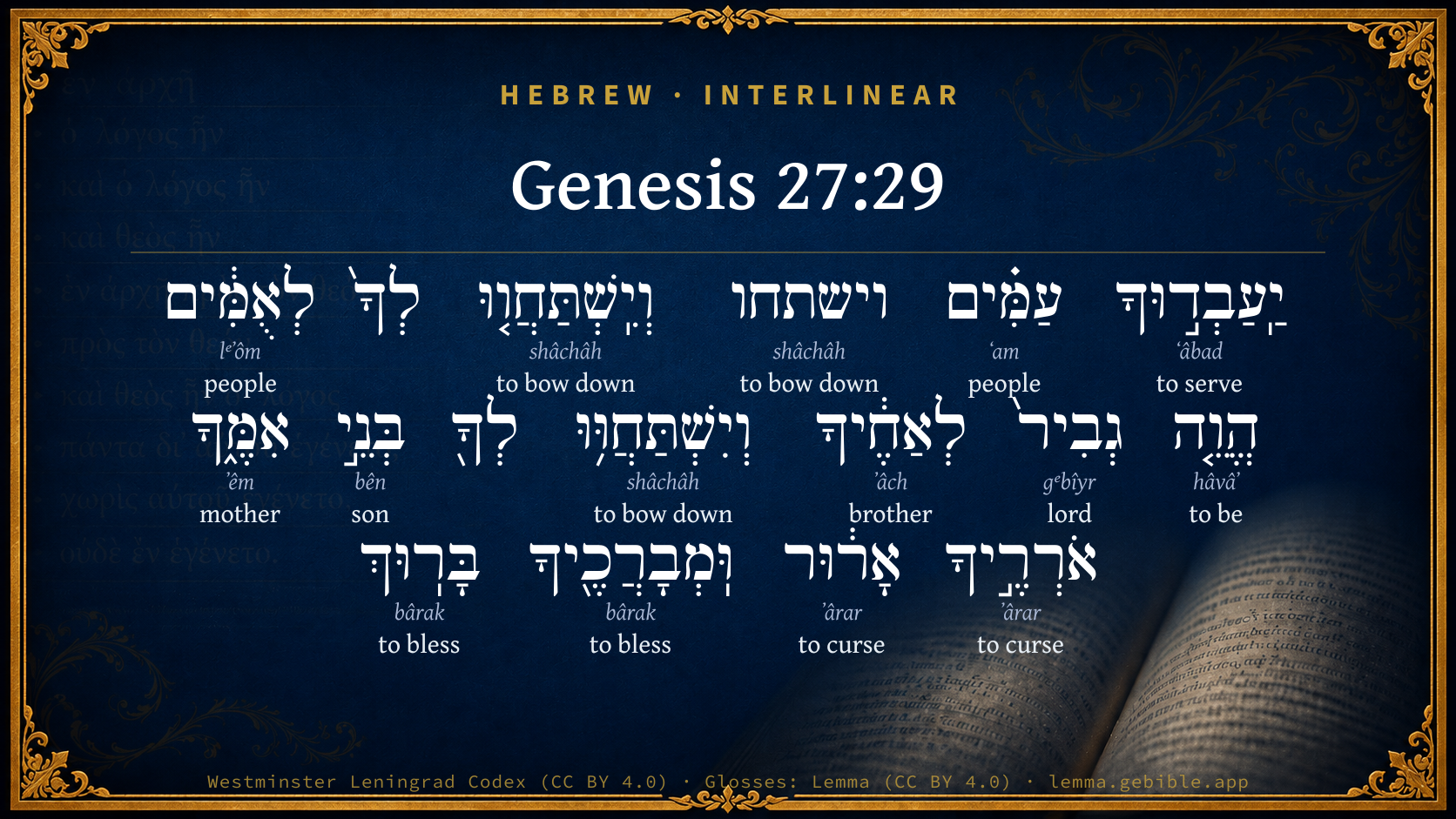
Genesis 27:29

Hebrew (Westminster Leningrad Codex) Genesis 27:29 appears in the Hebrew Old Testament. The text above is from the Westminster Leningrad Codex. Each word links to its Strong’s number, a concise gloss, and parsing drawn from the Open Scriptures Hebrew Bible morphology. Click any word for its full Brown-Driver-Briggs (BDB) entry.
Download image
Cite this verse

Genesis 27:29 (World English Bible). Public Domain. Lemma interlinear Bible study tool, https://lemma.gebible.app/v/genesis/27/29.

Show BibTeX & RIS
BibTeX
RIS
English Translation
Let peoples serve you, Nations bow down to you. Be lord over your brothers, Let your mother's sons bow down to you. Cursed be everyone who curses you, Blessed be everyone who blesses you."
World English Bible · Public Domain
Highlights
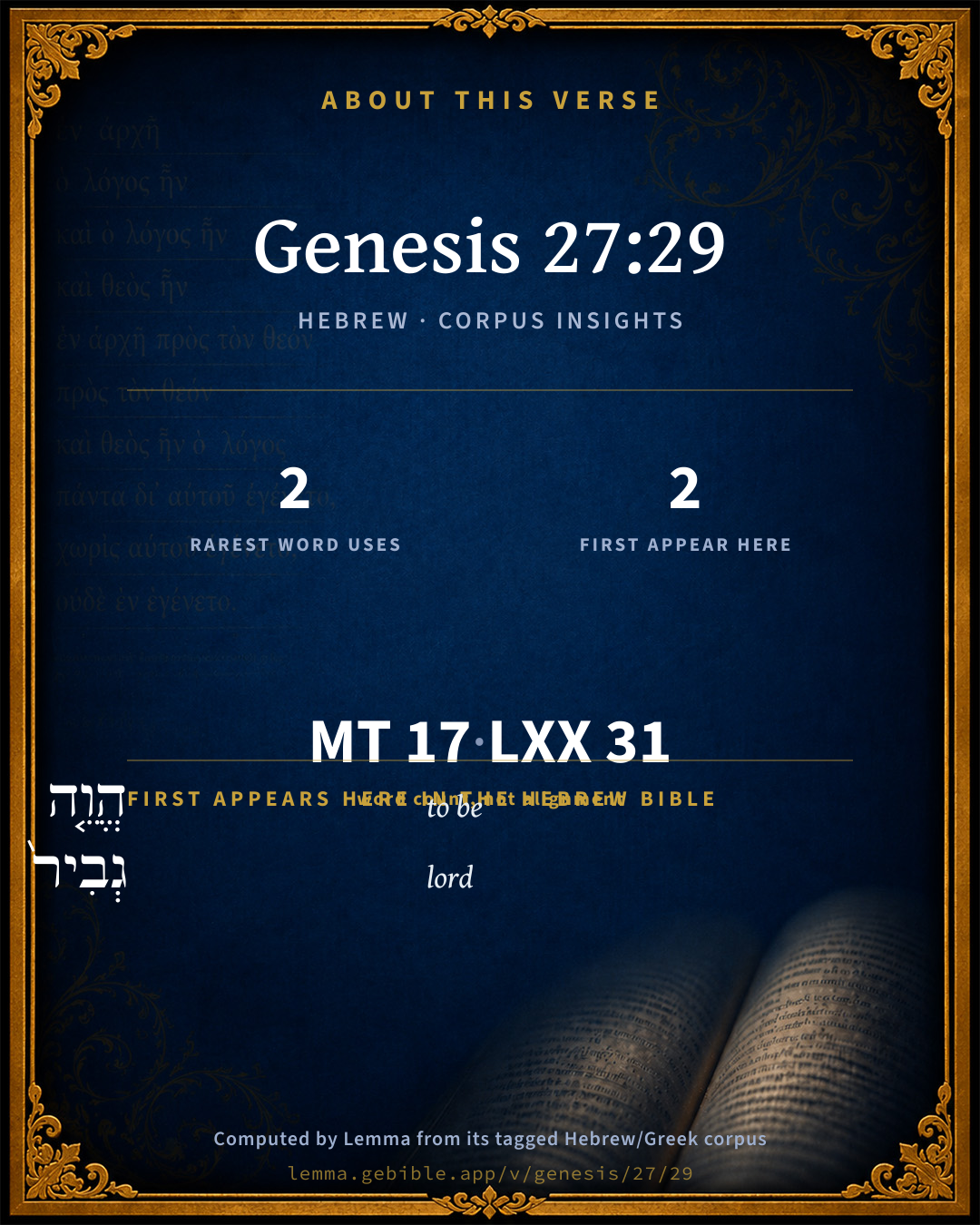
  • 2 first appearances in the Hebrew Bible
Full analysis ↓
Download a study sheet

One document with this verse’s original text, its word-by-word gloss line, the meaning frame, cross-references with their text, attributed commentary, and full source and license credits — printable, and it pastes into notes with its structure intact.

This verse Autodidact and up

Study sheet (.html) Plain text (.txt)

A passage Seminary Student

Up to 50 verses in one chapter. A passage sheet keeps up to 6 commentary sources and 12 cross-references per verse, in the order this page ranks them, and says so on the sheet whenever that leaves anything out. Ask for a single verse and you get the Autodidact verse sheet above.

Everything on this page stays free to read, with no account — the sheet is a download of what is already on screen, not access to it.

Want to remove ads? Support Godless Engineer
Compare translations 3

The same verse in 3 English versions, stacked beneath the original-language interlinear above. Click any original word for its lexicon entry.

Each is an independent rendering of the whole verse — the interlinear is not word-aligned to these translations.

Highlighted words mark where these versions differ — a whole-verse word diff, not a word-by-word alignment.

  • World English Bible Public Domain
    Let peoples serve you, Nations bow down to you. Be lord over your brothers, Let your mother's sons bow down to you. Cursed be everyone who curses you, Blessed be everyone who blesses you."
  • King James Version Public Domain
    Let people serve thee, and nations bow down to thee: be lord over thy brethren, and let thy mother's sons bow down to thee: cursed be every one that curseth thee, and blessed be he that blesseth thee.
  • unfoldingWord Literal Text CC BY-SA 4.0
    May peoples serve you, and may nations bow down to you. Be master over your brothers, and may the sons of your mother bow down to you. those curse you be cursed, and those bless you be blessed.” Esau Gets “Blessed” Too by Isaac 27:30-40

unfoldingWord Literal Text — © unfoldingWord, licensed CC BY-SA 4.0. Word-aligned USFM3 via Door43 (git.door43.org/unfoldingWord/en_ult).

Versions to compare (up to 4)

3 of 4 selected

Show all 18 translations

Every available English version of this verse, each an independent rendering of the whole verse.

  • World English Bible Public Domain
    Let peoples serve you, Nations bow down to you. Be lord over your brothers, Let your mother's sons bow down to you. Cursed be everyone who curses you, Blessed be everyone who blesses you."
  • Berean Standard Bible Public Domain
    May peoples serve you and nations bow down to you. May you be the master of your brothers, and may the sons of your mother bow down to you. May those who curse you be cursed, and those who bless you be blessed.”
  • Majority Standard Bible Public Domain
    May peoples serve you and nations bow down to you. May you be the master of your brothers, and may the sons of your mother bow down to you. May those who curse you be cursed, and those who bless you be blessed.”
  • King James Version Public Domain
    Let people serve thee, and nations bow down to thee: be lord over thy brethren, and let thy mother's sons bow down to thee: cursed be every one that curseth thee, and blessed be he that blesseth thee.
  • American Standard Version (1901) Public Domain
    Let peoples serve thee, And nations bow down to thee. Be lord over thy brethren, And let thy mother's sons bow down to thee. Cursed be every one that curseth thee, And blessed be every one that blesseth thee.
  • Revised Version (1885) Public Domain
    Let peoples serve thee, And nations bow down to thee: Be lord over thy brethren, And let thy mother’s sons bow down to thee: Cursed be every one that curseth thee, And blessed be every one that blesseth thee.
  • Geneva Bible (1599) Public Domain
    Let people bee thy seruantes, and nations bowe vnto thee: be Lord ouer thy brethren, and let thy mothers children honour thee. cursed be he that curseth thee, and blessed be he that blesseth thee.
  • Douay-Rheims (1899) Public Domain
    And let peoples serve thee, and tribes worship thee: be thou lord of thy brethren, and let they mother's children bow down before thee. Cursed be he that curseth thee: and let him that blesseth thee be filled with blessings.
  • Young's Literal Translation Public Domain
    peoples serve thee, and nations bow themselves to thee, be thou mighty over thy brethren, and the sons of thy mother bow themselves to thee; those who curse thee `are' cursed, and those who bless thee `are' blessed.'
  • Literal Standard Version CC BY-SA 4.0
    peoples serve you, and nations bow themselves to you, be mighty over your brothers, and the sons of your mother bow themselves to you; those who curse you [are] cursed, and those who bless you [are] blessed.”
  • Unlocked Literal Bible CC BY-SA 4.0
    May peoples serve you and nations bow down to you. Be master over your brothers, and may your mother's sons bow down to you. May every one who curses you be cursed; may every one who blesses you be blessed.”
  • unfoldingWord Literal Text CC BY-SA 4.0
    May peoples serve you, and may nations bow down to you. Be master over your brothers, and may the sons of your mother bow down to you. those curse you be cursed, and those bless you be blessed.” Esau Gets “Blessed” Too by Isaac 27:30-40
  • Darby Bible Public Domain
    Let peoples serve thee, And races bow down to thee. Be lord over thy brethren, And let thy mother's sons bow down to thee. Cursed be they that curse thee, And blessed be they that bless thee.
  • World Messianic Bible Public Domain
    Let peoples serve you, and nations bow down to you. Be lord over your brothers. Let your mother’s sons bow down to you. Cursed be everyone who curses you. Blessed be everyone who blesses you.”
  • Webster's Bible Public Domain
    Let people serve thee, and nations bow down to thee; be lord over thy brethren, and let thy mother's sons bow down to thee: cursed be every one that curseth thee, and blessed be he that blesseth thee.
  • Free Bible Version CC BY-SA 4.0
    May the people of different nations serve you and bow down to you. May you rule over your relatives, and may they bow down to you. May everyone who curses you be cursed, and may everyone who blesses you be blessed.”
  • Bible in Basic English Public Domain
    Let peoples be your servants, and nations go down before you: be lord over your brothers, and let your mother's sons go down before you: a curse be on everyone by whom you are cursed, and a blessing on those who give you a blessing.
  • JPS Tanakh (1917) Public Domain
    Let peoples serve thee, and nations bow down to thee. Be lord over thy brethren, and let thy mother's sons bow down to thee. Cursed be every one that curseth thee, and blessed be every one that blesseth thee.

Literal Standard Version (2020), Covenant Press — licensed CC BY-SA 4.0. Text via the HelloAO Bible API (eBible.org). Unlocked Literal Bible (unfoldingWord) — licensed CC BY-SA 4.0. Text via the HelloAO Bible API (eBible.org). unfoldingWord Literal Text — © unfoldingWord, licensed CC BY-SA 4.0. Word-aligned USFM3 via Door43 (git.door43.org/unfoldingWord/en_ult). Free Bible Version, Dr. Jonathan Gallagher — licensed CC BY-SA 4.0. Text via the HelloAO Bible API (eBible.org).

Word by word

More ways to search: Search by grammar → Find every occurrence → Compare this word →

Practice this passage: Drill this verse → Learn its vocabulary →

גְבִיר֙
gᵉbîyr
H1376
“lord”
Noun, Common, Masculine, Singular, Absolute
Part of Speech
Noun
Type
Common
Gender
Masculine
Number
Singular
State
Absolute
Full BDB Definition

Origin: from H1396

TWOT: 310d

lord, ruler
  1. יַֽעַבְד֣וּךָ ʻâbad H5647 “to serve · you” Verb, Qal, Jussive, 3rd Person, Masculine, Plural + Suffix, Personal, 2nd Person, Masculine, Singular
  2. עַמִּ֗ים ʻam H5971 “peoples” Noun, Common, Masculine, Plural, Absolute
  3. וישתחו shâchâh H7812 “and · to bow down” Conjunction + Verb, Hishtaphel, Jussive, 3rd Person, Masculine, Singular
  4. וְיִֽשְׁתַּחֲו֤וּ shâchâh H7812 “and · to bow down” Conjunction + Verb, Hishtaphel, Jussive, 3rd Person, Masculine, Plural
  5. לְאֻמִּ֔ים lᵉʼôm H3816 “peoples” Noun, Common, Masculine, Plural, Absolute
  6. הֱוֵ֤ה hâvâʼ H1933 “be” Verb, Qal, Imperative, 2nd Person, Masculine, Singular
  7. לְאַחֶ֔יךָ ʼâch H251 “to/for · brothers · your” Preposition + Noun, Common, Masculine, Plural, Construct + Suffix, Personal, 2nd Person, Masculine, Singular
  8. וְיִשְׁתַּחֲוּ֥וּ shâchâh H7812 “and · to bow down” Conjunction + Verb, Hishtaphel, Jussive, 3rd Person, Masculine, Plural
  9. בְּנֵ֣י bên H1121 “sons of” Noun, Common, Masculine, Plural, Construct
  10. אִמֶּ֑ךָ ʼêm H517 “mother · your” Noun, Common, Feminine, Singular, Construct + Suffix, Personal, 2nd Person, Masculine, Singular
  11. אֹרְרֶ֣יךָ ʼârar H779 “cursing · you” Verb, Qal, Participle Active, Masculine, Plural, Construct + Suffix, Personal, 2nd Person, Masculine, Singular
  12. אָר֔וּר ʼârar H779 “cursed” Verb, Qal, Participle Passive, Masculine, Singular, Absolute
  13. וּֽמְבָרֲכֶ֖יךָ bârak H1288 “and · blessing · you” Conjunction + Verb, Piel, Participle Active, Masculine, Plural, Construct + Suffix, Personal, 2nd Person, Masculine, Singular
  14. בָּרֽוּךְ bârak H1288 “blessed” Verb, Qal, Participle Passive, Masculine, Singular, Absolute

About this verse

These counts appear in no published source. They are computed here, from the morphology-tagged text and Lemma’s own curated glosses. What Lemma adds →

17
words
11
distinct lemmas
Pentateuch
section

Notable vocabulary

The rarest word here is גְבִיר֙ lord H1376 — appearing just 2 times in the whole Hebrew Bible.

First appearance in Scripture

These words make their first canonical appearance in the Hebrew Bible here:

  • הֱוֵ֤ה to be H1933
  • גְבִיר֙ lord H1376

Shared distinctive vocabulary

גְבִיר֙ lord H1376 occurs in 2 verses of the Hebrew Bible. Also found in:

Grammatical profile

  • 9 verbs
  • 6 nouns
  • 2 prepositions

Verb forms

  • יַֽעַבְד֣וּךָ Qal · Jussive
  • וישתחו Hishtaphel · Jussive
  • וְיִֽשְׁתַּחֲו֤וּ Hishtaphel · Jussive
  • הֱוֵ֤ה Qal · Imperative
  • וְיִשְׁתַּחֲוּ֥וּ Hishtaphel · Jussive
  • אֹרְרֶ֣יךָ Qal · Participle Active
  • אָר֔וּר Qal · Participle Passive
  • וּֽמְבָרֲכֶ֖יךָ Piel · Participle Active
  • בָּרֽוּךְ Qal · Participle Passive

Repetition

Words recur within this verse — often emphatic in Hebrew:

  • וישתחו to bow down H7812 ×3
  • אֹרְרֶ֣יךָ to curse H779 ×2
  • וּֽמְבָרֲכֶ֖יךָ to bless H1288 ×2

Hebrew & Septuagint length

In English translation the verse runs 34 words from the Hebrew and 41 from the Septuagint (LXX English) — closely comparable.

A rough comparison of the two English renderings, which tokenize alike — not a word-level alignment.

Word counts can differ between the Hebrew and the Greek without any difference in meaning — e.g. the Hebrew direct-object marker אֵת has no separate Greek word, and Greek often adds the article ὁ.

In the original languages it is 17 Hebrew tokens and 31 Greek tokens — but the two are counted differently (Hebrew bundles its prefixes and suffixes into one token; the Greek is in lemma form), so that isn’t a like-for-like length.

Cross-references

33

Topical passages linked to Genesis 27:29 in the Treasury of Scripture Knowledge — connected by theme and wording, ordered by reader-vote popularity; previews shown in the World English Bible.

  • Genesis 12:3 I will bless those who bless you, and I will curse him who curses you. In you will all of the families of the earth be blessed."
  • Numbers 24:9 He couched, he lay down as a lion, As a lioness; who shall rouse him up? Blessed be everyone who blesses you, Cursed be everyone who curses you.
  • Isaiah 49:23 Kings shall be your nursing fathers, and their queens your nursing mothers: they shall bow down to you with their faces to the earth, and lick the dust of your feet; and you shall know that I am Yahweh; and those who wait for me shall not be disappointed.
  • Genesis 9:25–26 He said, "Cursed be Canaan; A servant of servants will he be to his brothers."
  • Romans 9:12 it was said to her, "The elder will serve the younger."
  • Genesis 22:17–18 that in blessing I will bless you, and in multiplying I will multiply your seed as the stars of the heavens, and as the sand which is on the seashore. Your seed will possess the gate of his enemies.
  • Numbers 22:11–12 Behold, the people that is come out of Egypt, it covers the surface of the earth: now, come curse me them; peradventure I shall be able to fight against them, and shall drive them out.
  • Numbers 23:8 How shall I curse, whom God has not cursed? How shall I defy, whom Yahweh has not defied?
  • 1 Kings 22:47 There was no king in Edom: a deputy was king.
  • Psalms 72:8 He shall have dominion also from sea to sea, From the River to the ends of the earth.
  • Isaiah 9:7 Of the increase of his government and of peace there shall be no end, on the throne of David, and on his kingdom, to establish it, and to uphold it with justice and with righteousness from henceforth even forever. The zeal of Yahweh of Hosts will perform this.
  • Isaiah 45:14 Thus says Yahweh: "The labor of Egypt, and the merchandise of Ethiopia, and the Sabeans, men of stature, shall come over to you, and they shall be yours. They shall go after you. In chains they shall come over; and they shall fall down to you. They shall make supplication to you: 'Surely God is in you; and there is none else, there is no other god.
  • Daniel 2:44–45 In the days of those kings shall the God of heaven set up a kingdom which shall never be destroyed, nor shall the sovereignty of it be left to another people; but it shall break in pieces and consume all these kingdoms, and it shall stand forever.
  • Genesis 27:37 Isaac answered Esau, "Behold, I have made him your lord, and all his brothers have I given to him for servants. With grain and new wine have I sustained him. What then will I do for you, my son?"
  • Genesis 37:7 for, behold, we were binding sheaves in the field, and behold, my sheaf arose and also stood upright; and behold, your sheaves came around, and bowed down to my sheaf."
  • Isaiah 49:7 Thus says Yahweh, the Redeemer of Israel, [and] his Holy One, to him whom man despises, to him whom the nation abhors, to a servant of rulers: Kings shall see and arise; princes, and they shall worship; because of Yahweh who is faithful, [even] the Holy One of Israel, who has chosen you.
  • Genesis 25:22–23 The children struggled together within her. She said, "If it be so, why do I live?" She went to inquire of Yahweh.
  • Genesis 25:33 Jacob said, "Swear to me first." He swore to him. He sold his birthright to Jacob.
  • Genesis 49:8–10 "Judah, your brothers will praise you: Your hand will be on the neck of your enemies; Your father's sons will bow down before you.
  • 2 Samuel 8:1–18 After this it happened that David struck the Philistines, and subdued them: and David took the bridle of the mother city out of the hand of the Philistines.
  • 2 Samuel 10:1–19 It happened after this, that the king of the children of Ammon died, and Hanun his son reigned in his place.
  • 1 Kings 4:21 Solomon ruled over all the kingdoms from the River to the land of the Philistines, and to the border of Egypt: they brought tribute, and served Solomon all the days of his life.
  • 1 Kings 11:15–16 For it happened, when David was in Edom, and Joab the captain of the host was gone up to bury the slain, and had struck every male in Edom
  • 1 Chronicles 5:2 For Judah prevailed above his brothers, and of him came the prince; but the birthright was Joseph's:)
  • 2 Chronicles 25:11–14 Amaziah took courage, and led forth his people, and went to the Valley of Salt, and struck of the children of Seir ten thousand.
  • Psalms 60:1–12 God, you have rejected us. You have broken us down. You have been angry. Restore us, again.
  • Isaiah 63:1–6 Who is this who comes from Edom, with dyed garments from Bozrah? this who is glorious in his clothing, marching in the greatness of his strength? I who speak in righteousness, mighty to save.
  • Zephaniah 2:8–9 I have heard the reproach of Moab, and the insults of the children of Ammon, with which they have reproached my people, and magnified themselves against their border.
  • Malachi 1:2–5 "I have loved you," says Yahweh. Yet you say, "How have you loved us?" "Wasn't Esau Jacob's brother?" says Yahweh, "Yet I loved Jacob;
  • Matthew 25:40 "The King will answer them, 'Most assuredly I tell you, inasmuch as you did it to one of the least of these my brothers, you did it to me.'
  • Matthew 25:45 "Then he will answer them, saying, 'Most assuredly I tell you, inasmuch as you didn't do it to one of the least of these, you didn't do it to me.'
  • Revelation 19:16 He has on his garment and on his thigh a name written, "KING OF KINGS, AND LORD OF LORDS."

Cross-references courtesy of OpenBible.info (CC BY 4.0).

Hebrew and Greek witnesses Masoretic Hebrew ↔ Greek Septuagint

The same verse in the two great witnesses to the Old Testament, shown verse-for-verse.

These are two independent witnesses, not word-aligned to each other, and the Septuagint is shown in lemma (dictionary) form.

Hebrew Genesis 27:29 Masoretic · Westminster Leningrad Codex

יַֽעַבְד֣וּךָ עַמִּ֗ים וישתחו וְיִֽשְׁתַּחֲו֤וּ לְךָ֙ לְאֻמִּ֔ים הֱוֵ֤ה גְבִיר֙ לְאַחֶ֔יךָ וְיִשְׁתַּחֲוּ֥וּ לְךָ֖ בְּנֵ֣י אִמֶּ֑ךָ אֹרְרֶ֣יךָ אָר֔וּר וּֽמְבָרֲכֶ֖יךָ בָּרֽוּךְ

Let peoples serve you, Nations bow down to you. Be lord over your brothers, Let your mother's sons bow down to you. Cursed be everyone who curses you, Blessed be everyone who blesses you."

World English Bible · Public Domain

Greek LXX Genesis 27:29 Septuagint · lemma form

καί δουλεύω σύ ἔθνος καί προςκυνέω σύ ἄρχων καί γίγνομαι κύριος ὁ ἀδελφός σύ καί προςκυνέω σύ ὁ υἱός ὁ πατήρ σύ ὁ καταἀράομαι σύ ἐπικατάρατος ὁ δέ εὐλογέω σύ εὐλογέω

And let nations serve you, and princes bow down to you, and be you lord of your brother, and the sons of your father shall do you reverence; accursed is he that curses you, and blessed is he that blesses you.

LXX2012 (modern English Septuagint) · Public Domain

Hebrew: Westminster Leningrad Codex (CC BY 4.0). Greek: Septuagint (public domain); English from LXX2012 (modern English Septuagint) (Public Domain). How the Septuagint differs from the Hebrew →

Targum (Aramaic paraphrase)

2

The Targum is the ancient Jewish Aramaic paraphrase of the Hebrew Scriptures — an interpretive translation, not the Hebrew text itself. Onkelos (literal) and Pseudo-Jonathan (expansive) render the Torah, and Jonathan the Prophets. Coverage is partial: where no permissively-licensed English translation exists for a verse, only the Aramaic is shown. This is verse-level text, not a word-by-word alignment to the Hebrew.

  1. Targum Onkelos Torah (Genesis–Deuteronomy)
    יִפְלְחֻנָּךְ עַמְמִין וְיִשְׁתַּעְבְּדוּן לָךְ מַלְכְּוָן הֱוֵי רַב לְאַחָיךְ וְיִסְגְּדוּן לָךְ בְּנֵי אִמָּךְ מְלַטְטָיךְ יְהוֹן לִיטִין וּמְבָרֲכָיךְ יְהוֹן בְּרִיכִין

    (no public-domain English translation for this verse)

    Targum Onkelos — Aramaic: “Onkelos Genesis” (public domain); “Onkelos Exodus” (public domain); “Onkelos Leviticus” (public domain); “Onkelos Numbers” (public domain); “Onkelos Deuteronomy” (public domain). English: “Sefaria Community Translation” (CC0 1.0 (public-domain dedication)); “J.W. Etheridge. The Targums of Onkelos and Jonathan Ben Uzziel on the Pentateuch. London: Longmans, Green, 1862” (public domain). Text via Sefaria.

  2. Targum Pseudo-Jonathan Torah (Genesis–Deuteronomy)
    יִשְׁתַּעֲבְּדוּן לָךְ אוּמַיָא כָּל בְּנוֹי דְעֵשָו וִיגַחְנוּן קוּמָךְ מַלְכְּוָותָא כָּל בְּנָהָא דִקְטוּרָה רַב וְשַׁלִיט תְּהִי עַל אָחָךְ וִיהוֹן מְקַדְמִין לְמִשְׁאַל בִּשְׁלָמָךְ בְּנֵי אִמָךְ לָיְטָךְ בְּרִי יְהוֹן לִיטִין כְּבִלְעָם בַּר בְּעוֹר וּמְבָרְכָךְ יְהוֹן בְּרִיכָן כְּמשֶׁה נָבִיא סַפְרֵיהוֹם דְיִשְרָאֵל

    Let peoples be subject to thee, all the sons of Esau, and kingdoms bend before thee, all the sons of Keturah; a chief and a ruler be thou over thy brethren, and let the sons of thy mother salute thee. Let them who curse thee, my son, be accursed as Bileam bar Beor; and them who bless thee be blessed as Mosheh the prophet, the scribe of Israel.

    Targum Pseudo-Jonathan — Aramaic: “Targum Jonathan on Genesis” (public domain); “Targum Jonathan on Exodus” (public domain); “Targum Jonathan on Leviticus” (public domain); “Targum Jonathan on Numbers” (public domain); “Targum Jonathan on Deuteronomy” (public domain). English: “The Targum of Jonathan ben Uzziel, trans. J. W. Etheridge, London, 1862” (public domain). Text via Sefaria.

Commentary

Notes on Genesis 27:29 from classic Christian and Jewish commentators (each source and its license shown beneath its notes). The classic Christian expositions comment on the surrounding passage and are grouped to its opening verse, so a note may address several verses; the Jewish commentaries on the Tanakh (Rashi and others) are per-verse, so they appear only where the commentator wrote on this verse.

Lemma curates 59 commentaries, every one of them public domain or Creative Commons licensed, each selected and text-cleaned for this edition rather than reprinted as found. About our sources →

Trapp's Complete Commentary

John Trapp

Gen 27:29 Let people serve thee, and nations bow down to thee: be lord over thy brethren, and let thy mother’s sons bow down to thee: cursed [be] every one that curseth thee, and blessed [be] he that blesseth thee.

Ver. 29. Let thy mother’s sons bow down to thee.] That is, thy brethren; which are therefore denominated from the mother, quod certior est a matre progenies, quam a patre, saith an interpreter. {a} But this blessing is pronounced in a higher style than ordinary: therefore sentences are doubled, and that kind of speech is here used which, with us, is either poetical, or not far from it.

{a} Castalio in Annotat., ad locum.

John Trapp, A Commentary or Exposition upon All the Books of the Old and New Testament (1647–1656) — public domain. Text from a community e-Sword module.

Joseph Benson's Commentary

Gen 27:29. Let nations bow down to thee — When the Canaanites were subdued in the times of Joshua and the judges, and made tributary to the Israelites; and more especially when the Philistines, Moabites, Ammonites, and Edomites became subject to them, in the time of David, this prophecy was fulfilled; but, like many other prophecies, it shall receive its principal accomplishment in the latter days of the Messiah’s kingdom, when he shall have dominion from sea to sea, and from the river to the ends of the earth; when all kings shall fall down before him, and all nations serve him, Psa 72:8; Psa 72:11.

Joseph Benson's Commentary on the Old and New Testaments (1811–1818) — public domain. Text from a community e-Sword module.

Jamieson, Fausset & Brown

Robert Jamieson, A. R. Fausset & David Brown

Let people serve thee--fulfilled in the discomfiture of the hostile tribes that opposed the Israelites in the wilderness; and in the pre-eminence and power they attained after their national establishment in the promised land. This blessing was not realized to Jacob, but to his descendants; and the temporal blessings promised were but a shadow of those spiritual ones, which formed the grand distinction of Jacob's posterity.

Jamieson, Fausset & Brown — Commentary Critical and Explanatory on the Whole Bible (1871) — public domain (CC PDM 1.0). Text via the HelloAO Bible API.

Adam Clarke's Commentary

Verse 29. Let people serve thee] "However alike their temporal advantages were to each other," says Bp. Newton, "in all spiritual gifts and graces the younger brother was to have the superiority, was to be the happy instrument of conveying the blessing to all nations: In thee and in thy seed shall all the families of the earth be blessed; and to this are to be referred, in their full force, those expressions: Let people serve thee, and nations bow down to thee. Cursed be every one that curseth thee, and blessed be he that blesseth thee. The same promise was made to Abraham in the name of God: I will bless them that bless thee, and curse him that curseth thee, Ge 12:3; and it is here repeated to Jacob, and thus paraphrased in the Jerusalem Targum: 'He who curseth thee shall be cursed as Balaam the son of Beor; and he who blesseth thee shall be blessed as Moses the prophet, the lawgiver of Israel.' It appears that Jacob was, on the whole, a man of more religion, and believed the Divine promises more, than Esau. The posterity of Jacob likewise preserved the true religion, and the worship of one God, while the Edomites were sunk in idolatry; and of the seed of Jacob was born at last the Saviour of the world. This was the peculiar privilege and advantage of Jacob, to be the happy instrument of conveying these blessings to all nations. This was his greatest superiority over Esau; and in this sense St. Paul understood and applied the prophecy: The elder shall serve the younger, Ro 9:12. The Christ, the Saviour of the world, was to be born of some one family; and Jacob's was preferred to Esau's, out of the good pleasure of Almighty God, who is certainly the best judge of fitness and expedience, and has undoubted right to dispense his favours as he shall see proper; for he says to Moses, as the apostle proceeds to argue, Ro 9:15: 'I will have mercy on whom I will have mercy, and I will have compassion on whom I will have compassion.' And when the Gentiles were converted to Christianity, the prophecy was fulfilled literally: Let people serve thee, and let nations bow down to thee; and will be more amply fulfilled when the fulness of the Gentiles shall come in, and all Israel shall be saved."

Adam Clarke's Commentary on the Bible (1810–1826) — public domain. Text from a community e-Sword/MySword module.

John Calvin's Commentaries

29. Cursed be every one that curseth thee. What I have before said must be remembered, namely, that these are not bare wishes, such as fathers are wont to utter on behalf of their children, but that promises of God are included in them; for Isaac is the authorized interpreter of God, and the instrument employed by the Holy Spirit; and therefore, as in the person of God, he efficaciously pronounces those accursed who shall oppose the welfare of his son. This then is the confirmation of the promise, by which God, when he receives the faithful under his protection, declares that he will be an enemy to their enemies. The whole force of the benediction turns to this point, that God will prove himself to be a kind father to his servant Jacob in all things, so that he will constitute him the chief and the head of a holy and elect people, will preserve and defend him by his power, and will secure his salvation in the face of enemies of every kind.

John Calvin's Commentaries (1540-1563) — public domain. Text from the Calvin Translation Society English edition (1840s-50s) via the Christian Classics Ethereal Library (ccel.org). Calvin's coverage is partial (roughly two-thirds of the Bible); uncommented books and verses are honest gaps, never fabricated. The 19th-century editor's footnotes and remarks are omitted so the notes are faithfully Calvin's own voice.

Ellicott's Commentary for English Readers

(29) Let people serve thee.—Heb., peoples. Up to this point the blessing had been general, but now Isaac bestows the birthright, carrying with it widespread dominion, precedence over all other members of the family, and special blessedness. The phrases “thy brethren” and “thy mother’s sons” include all nations sprung from Abraham, and all possible offshoots from Isaac’s own descendants.

Cursed . . . and blessed.—This is a special portion of the blessing given to Abraham (Gen_12:3); but Isaac stops short with this, and does not bestow the greater privilege that “in him should all families of the earth be blessed” (Gen_12:3; Gen_22:18; Gen_26:4). The reason for this may be that it was a blessing which God must grant, and not man; or he may have had misgivings that it was more than Esau was worthy to receive; or, finally, his whole conduct being wrong, he could see and value only the earthly and lower prerogatives of the birthright. Subsequently he bestows the Abrahamic blessing upon Jacob in general terms (Gen_28:4); but this, its highest privilege, is confirmed to Jacob by Jehovah Himself (Gen_28:14).

A Bible Commentary for English Readers, edited by Charles John Ellicott (1878–1897) — public domain. Text from a community e-Sword module.

The Cambridge Bible for Schools and Colleges

gen. ed. J. J. S. Perowne

29. Let peoples, &c.] The first half of this verse seems to refer to conquest over foreign foes; the second half to pre-eminence among the kindred races. The complete fulfilment of this prediction cannot have taken place before the times of David (cf. 2 Samuel 8) and Solomon. The “peoples” and “nations,” who “served” and “bowed down,” were the Canaanites; the “brethren” and the “mother’s sons” were the Edomites, Ammonites, Moabites, and Amalekites.

lord … brethren] These words recall the oracle given to Rebekah in Gen_25:23. The irony of the situation is that Isaac, predicting, as he supposes, Esau’s predominance over Jacob, seems to be reversing the decree, “the elder shall serve the younger.” In reality he ratifies and endorses it.

thy brethren] The word is here poetically used in the sense of “kindred.” The blessing impersonates the nation in the individual. It prefigures kindred races in the individual’s brethren: see note on Gen_27:40. This blessing, as applied to Jacob, was fulfilled in the subjugation of Edom, Moab, and Ammon in the reign of David.

Cursed be every one] For this formula concluding a blessing, cf. Gen_12:3, and Num_24:9. Words of good omen end the utterance.

The Cambridge Bible for Schools and Colleges (gen. ed. J. J. S. Perowne; Cambridge University Press, 1878–1918) — public domain. Text from a community e-Sword module.

John Gill's Exposition

Let people serve thee, and nations bow down to thee,.... Which was literally true in the times of Joshua and the judges, when the Canaanites were conquered and subdued, and those that remained became tributary to the Israelites; and still more so in the times of David, a son of Jacob, in the line of Judah, when the Philistines, Moabites, Syrians, Ammonites, and Edomites, became subject to him, his servants and tributaries; and yet more so in the times of the Messiah that was to spring from Jacob, and did, to whom many nations have been already subject, and all will in the latter day, Psa 72:11. And this passage is applied to the Messiah, and his times, by the Jews, in an ancient book (y) of theirs, at least said to be so. The Targum of Jonathan paraphrases it of the children of Esau or the Edomites, and of the children of Keturah; and that of Jerusalem, of the children of Esau, and of Ishmael:

be lord over thy brethren, and let thy mother's sons bow down to thee; these seem rather to be the children of Esau, Jacob's brother, and his mother's sons; the Targum of Jerusalem interprets the latter of the sons of Laban, his mother's brother, the Arabians and Syrians; which will be more fully accomplished when the kingdoms of this world shall become the kingdoms of our Lord, and of his Christ, Rev 11:15; who will then appear to be King of kings, and Lord of lords, Rev 17:14, even the King of the whole earth:

cursed be everyone that curseth thee; it signifies, that those who were the enemies of Jacob, or would be the enemies of the church and people of God, his spiritual Israel, and of the Messiah, would be reckoned the enemies of God, and treated as such:

and blessed be he that blesseth thee; and that those that were his friends, and the friends of the people of God, and heartily wish well to the interest of Christ, these should be accounted the friends of God, and be used as such. The same blessing is pronounced on Abraham the grandfather of Jacob, Gen 12:3.

(y) Zohar in Gen. fol. 84. 4.

John Gill's Exposition of the Whole Bible (1746–1763) — public domain (CC PDM 1.0). Text via the HelloAO Bible API.

Haydock's Catholic Bible Commentary

Worship thee, with civil respect, (Haydock) as the Idumeans, Philistines and Moabites did, with respect to David, Solomon, and the Machabees, acknowledging their dominion, though reluctantly. --- With blessing. Thus Rebecca had not given her son a vain assurance. Isaac prays that God may ever by his protector, and avenge his cause. (Haydock)

George Leo Haydock (1774–1849), Haydock's Catholic Family Bible and Commentary, 1859 edition — public domain. Excludes Psalms (Douay-Rheims chapter numbering differs from Protestant) and Deuterocanonical books (Catholic canon only).

Matthew Poole's English Annotations

Let thy mother’s son bow down to thee. How and when this was fulfilled, see on Gen 25:23.

Matthew Poole's English Annotations on the Holy Bible (1683–1685) — public domain. Text from a community e-Sword/MySword module.

Whedon's Commentary on the Bible

Daniel D. Whedon

29. People… nations — Peoples and tribes of peoples.

Be lord — This was fulfilled in the days of David, when the Edomites were subjected to Israel. 2Sa_8:14.

Thy mother’s sons — This expression seems to carry with it a sense of putting Jacob, his mother’s favourite son, (Gen_25:28,) in subjection to Esau.

Cursed… blessed — See Gen_12:3. “Isaac does not pronounce on Jacob that emphatic spiritual blessing which God himself had assured to Abraham twice (Gen_12:3; Gen_22:18) and to Isaac once, (Gen_36:4,) ‘In thy seed shall all the nations of the earth be blessed.’ There was something carnal and sinful in the whole conduct of the persons concerned in the history of this chapter, Isaac, Rebekah, Jacob, Esau; and it may have been this which withheld for the time the brightest promise to the family of Abraham; or perhaps it may have been that that promise should come only from the mouth of God himself, as it is given afterwards in Gen_28:14.” — Speaker’s Commentary.

Daniel D. Whedon (gen. ed.), Commentary on the Old and New Testaments (1874–1909) — public domain. Text from a community e-Sword module.

The Pulpit Commentary

Let people serve thee (literally, and will serve thee, peoples; at once a prayer and a prophecy; fulfilled in the political subjection of the Moabites, Ammonites, Syrians, Philistines, and Edomites by David; the thought being repeated in the next clause), and nations bow down to thee (in expression of their homage): be lord over thy brethren, literally, be a lord (from the idea of power; found only here and in ver. 37) to thy brethren . Imminence among his kindred as well as dominion in the world is thus promisedand let thy mother"s sons bow down to thee (a repetition of the preceding thought, with perhaps a hint of his desire to humble Jacob, the favorite of Rebekah): cursed be every one that curseth thee, and blessed be he that blesseth thee framed on the model of the Abrahamic benediction; (Gen_12:3) but not so full as that, either because Isaac felt that after all Esau was not to be the progenitor of the holy seed (Murphy), or because, not being actuated by proper feelings towards Jehovah and his promises, the patriarch could not rise to that height of spiritual benediction to which he afterwards attained , (Gen_28:3, Gen_28:4) (Keil) or because the prerogative of pronouncing the Abrahamic blessing in all its fullness Jehovah may have reserved to himself. (Gen_28:14) ("Speaker"s Commentary")

The Pulpit Commentary (1880–1919), ed. H.D.M. Spence-Jones & Joseph S. Exell — public domain. Text from a community e-Sword module.

Scofield Reference Notes

C. I. Scofield

cursed

See, Gen 12:3; Gen 15:18, See note 3,(5), (See Scofield "Gen 15:18").

The Scofield Reference Bible (1917 edition), notes by C. I. Scofield — public domain. Text from a community e-Sword module.

unfoldingWord translationNotes

Door43 World Missions Community

you ... your

Here these pronouns are singular and refer to Jacob. But the blessing also applies to Jacob's descendants. (See: Forms of You and Synecdoche)

nations bow down

Here "nations" refers to the people. AT: "people from all nations bow down" (See: Metonymy)

bow down

This means to bend over to humbly express respect and honor toward someone. (See: Symbolic Action)

Be master over your brothers

"Become a master over your brothers"

your brothers ... your mother's sons

Isaac is speaking this blessing directly to Jacob. But, it also applies to Jacob's descendants who will rule over the descendants of Esau and the descendants of any other of Jacob's brothers that he may have. (See: Synecdoche)

may your mother's sons bow down to you

"your mother's sons will bow down to you"

May every one who curses you be cursed

This can be stated in active form. AT: "May God curse everyone who curses you" (See: Active or Passive)

may every one who blesses you be blessed

This can be stated in active form. AT: "May God bless everyone who blesses you" (See: Active or Passive)

translationWords

people group

servant

nation

bow

lord

curse

bless

unfoldingWord translationNotes — © Distant Shores Media and the Door43 World Missions Community, licensed CC BY-SA 4.0. Source: git.door43.org/Door43/en_tn.

Rashi

Rabbi Shlomo Yitzchaki (Rashi)

בני אמך THY MOTHER’S SONS — Jacob, however, said to Judah (49:8) “Thy father’s sons (shall bow down to thee]”, because he had sons by several wives, but here, because he (Isaac) had but one wife he said “thy mother’s sons” (Genesis Rabbah 66:4).

ארריך ארור ומברכיך ברוך THEY THAT CURSE THEE SHALL BE CURSED AND THEY THAT BLESS THEE SHALL BE BLESSED — But in the case of Balaam Scripture says (Numbers 24:9) “Blessed be everyone that blesseth thee and cursed be every one that curseth thee”. The explanation is: the righteous have sufferings first and happiness afterwards, so that in point of time those who curse and afflict them (cause them suffering) come before those who bless them (cause them happiness) — therefore Isaac, a righteous man, invokes a curse upon those who themselves curse before he invokes a blessing upon those who bless. The wicked however have happiness first and suffering afterwards; therefore Balaam, a wicked man, invokes the blessing before the curse (Genesis Rabbah 66:4).

Rashi on the Tanakh — English translations: “The Judaica Press complete Tanach with Rashi, translated by A. J. Rosenberg” (CC BY 4.0); “Pentateuch with Rashi's commentary by M. Rosenbaum and A.M. Silbermann, 1929-1934” (public domain); “The Metsudah Tanach series, Lakewood, N.J” (CC BY 4.0); and “The Book of Joshua, Metsudah Publications, 1997” (CC BY 4.0). Text via Sefaria.

Ramban (Nachmanides)

Rabbi Moshe ben Nachman (Ramban / Nachmanides)

CURSED BE EVERY ONE THAT CURSETH THEE, AND BLESSED BE EVERY ONE THAT BLESSETH THEE. But in the case of Balaam it says, Blessed be every one that blesseth thee, and cursed be every one that curseth thee. [The reason for this change in order is that] the righteous begin with affliction and ultimately attain tranquility, so that those who curse them precede those who bless them. But the wicked experience tranquility first and their end is affliction. Hence Balaam mentioned the blessing before the curse. This is Rashi’s language quoting Bereshith Rabbah. But if this be so, why did the Holy One, blessed be He, say to Abraham, And I will bless them that bless thee, and curse him that curseth thee? This however is no difficulty since He concludes there, And in thee shall all families of the earth be blessed. Thus there is a blessing at the beginning and at the end. It may be, as we have explained it there, that He speaks in terms of both an individual and many, — while the curse is expressed in singular form — and curse ‘him’ that curseth thee. suggesting that Abraham will be universally blessed, and the single person who will curse him will be cursed.

Ramban (Nachmanides) on the Tanakh — English translation: “Commentary on the Torah by Ramban (Nachmanides). Translated and annotated by Charles B. Chavel. New York, Shilo Pub. House, 1971-1976” (CC BY 4.0). Text via Sefaria.

Radak

Rabbi David Kimhi (Radak)

יעבדוך....הוה גביר לאחיך, a reference to Esau’s sons (descendants); the same is meant when Yitzchok speaks about בני אמך, “your mother’s sons,” i.e. her descendants. These blessings came true in the time when David defeated the Edomites, and they will come true again in the days of the Messiah.

אררך ארור, in the singular mode, meaning each person cursing you will be cursed individually.

Radak on the Tanakh — English translations: “Sefaria Community Translation” (CC0 1.0 (public-domain dedication)); “Eliyahu Munk, HaChut Hameshulash” (CC BY 4.0); “Rabbi Mike Feuer, Jerusalem Anthology” (CC BY 4.0); and “R. David Kimhi on the first book of Psalms, Translated by R.G. Finch, London, 1919” (public domain). Text via Sefaria.

Lesson kit

Teaching starters — assembled from the data on this page, not authored interpretation. Every prompt links to the verse data it draws on. Edit before teaching.

Genesis, in the Pentateuch, opens this verse with 17 words (11 distinct Hebrew lemmas). Its most distinctive word is gᵉbîyr (“lord”). A historical commentator’s framing appears above. Read the whole chapter for the surrounding context.

Discussion questions

  1. What does “lord” (gᵉbîyr) contribute to the verse as a whole?
  2. 2 words here appear for the first time in Scripture. What is being introduced at this debut?
  3. Genesis 27:37 shares the word «lord» with this verse. How do the two illuminate each other?
  4. “to bow down” occurs 3× in this one verse. What is the effect of the repetition?
  5. The translations on this page render this verse differently — a whole-verse word diff, not a word-by-word alignment. What might account for the different wordings?
  6. The verb «יַֽעַבְד֣וּךָ» is Qal Jussive. How does its form color the action?
  7. Reading how Trapp's Complete Commentary and Joseph Benson's Commentary read this verse, where do the two commentators agree and where do they part?

Things to notice

Reading settings

Reading text

Shown beneath each verse's original-language words.

Old Testament
Old Testament edition

Read the OT as the Masoretic Hebrew (MT) or the Greek Septuagint (LXX).

English shown for the Greek Septuagint (in the Hebrew ↔ Greek comparison).

Comparing translations? Open the Compare panel on any verse page to stack up to four side by side.