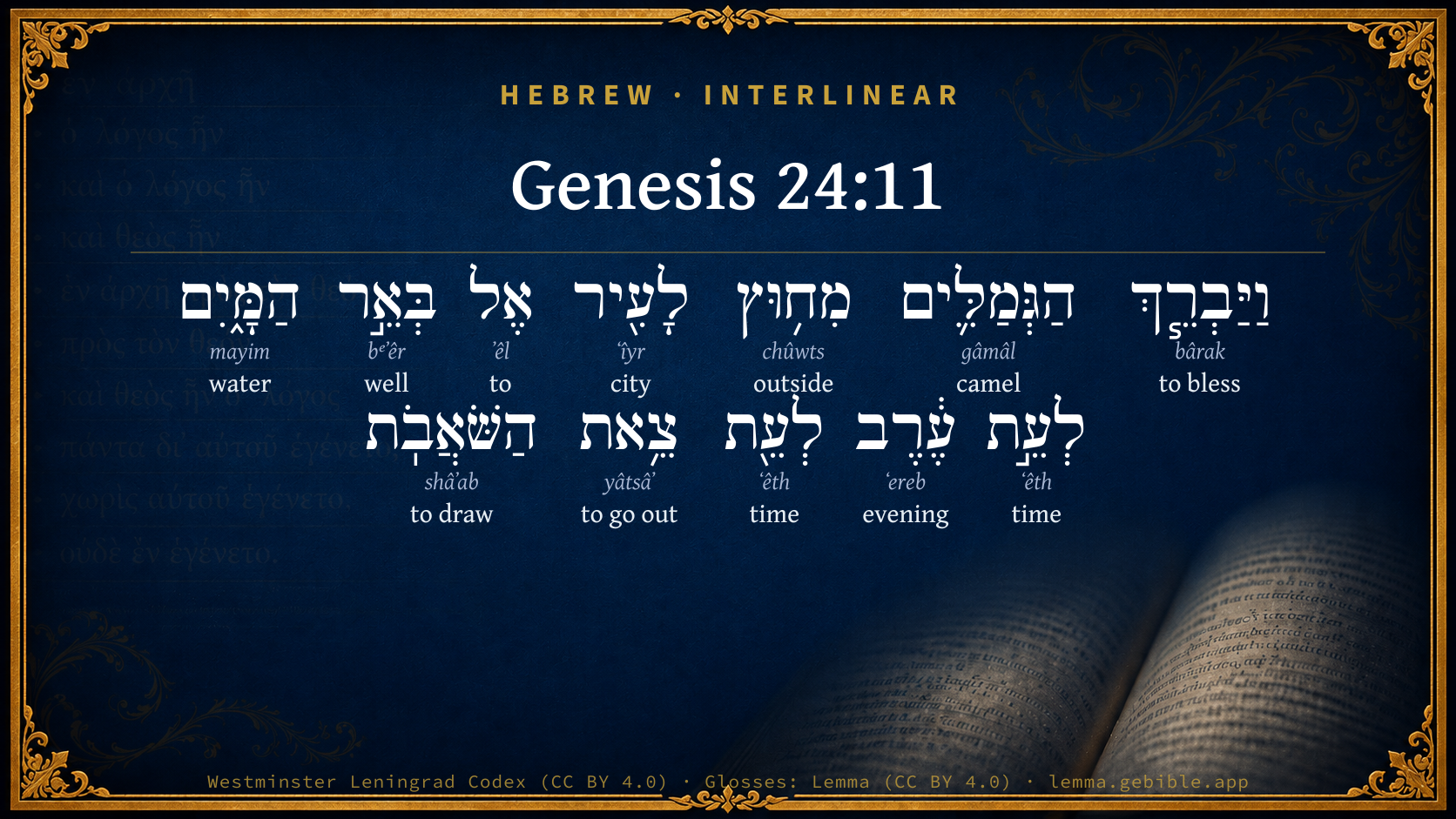
Genesis 24:11

Hebrew (Westminster Leningrad Codex) Genesis 24:11 appears in the Hebrew Old Testament. The text above is from the Westminster Leningrad Codex. Each word links to its Strong’s number, a concise gloss, and parsing drawn from the Open Scriptures Hebrew Bible morphology. Click any word for its full Brown-Driver-Briggs (BDB) entry.
Download image
Cite this verse

Genesis 24:11 (World English Bible). Public Domain. Lemma interlinear Bible study tool, https://lemma.gebible.app/v/genesis/24/11.

Show BibTeX & RIS
BibTeX
RIS
English Translation
He made the camels kneel down outside the city by the well of water at the time of evening, the time that women go out to draw water.
World English Bible · Public Domain
Highlights
  • 1 first appearance in the Hebrew Bible
Full analysis ↓
Download a study sheet

One document with this verse’s original text, its word-by-word gloss line, the meaning frame, cross-references with their text, attributed commentary, and full source and license credits — printable, and it pastes into notes with its structure intact.

This verse Autodidact and up

Study sheet (.html) Plain text (.txt)

A passage Seminary Student

Up to 50 verses in one chapter. A passage sheet keeps up to 6 commentary sources and 12 cross-references per verse, in the order this page ranks them, and says so on the sheet whenever that leaves anything out. Ask for a single verse and you get the Autodidact verse sheet above.

Everything on this page stays free to read, with no account — the sheet is a download of what is already on screen, not access to it.

Want to remove ads? Support Godless Engineer
Compare translations 3

The same verse in 3 English versions, stacked beneath the original-language interlinear above. Click any original word for its lexicon entry.

Each is an independent rendering of the whole verse — the interlinear is not word-aligned to these translations.

Highlighted words mark where these versions differ — a whole-verse word diff, not a word-by-word alignment.

  • World English Bible Public Domain
    He made the camels kneel down outside the city by the well of water at the time of evening, the time that women go out to draw water.
  • King James Version Public Domain
    And he made his camels to kneel down without the city by a well of water at the time of the evening, even the time that women go out to draw water.
  • unfoldingWord Literal Text CC BY-SA 4.0
    Then he made the camels kneel down outside the city by the well of water at evening time, at the time the women who draw water come out.

unfoldingWord Literal Text — © unfoldingWord, licensed CC BY-SA 4.0. Word-aligned USFM3 via Door43 (git.door43.org/unfoldingWord/en_ult).

Versions to compare (up to 4)

3 of 4 selected

Show all 18 translations

Every available English version of this verse, each an independent rendering of the whole verse.

  • World English Bible Public Domain
    He made the camels kneel down outside the city by the well of water at the time of evening, the time that women go out to draw water.
  • Berean Standard Bible Public Domain
    As evening approached, he made the camels kneel down near the well outside the town at the time when the women went out to draw water.
  • Majority Standard Bible Public Domain
    As evening approached, he made the camels kneel down near the well outside the town at the time when the women went out to draw water.
  • King James Version Public Domain
    And he made his camels to kneel down without the city by a well of water at the time of the evening, even the time that women go out to draw water.
  • American Standard Version (1901) Public Domain
    And he made the camels to kneel down without the city by the well of water at the time of evening, the time that women go out to draw water.
  • Revised Version (1885) Public Domain
    And he made the camels to kneel down without the city by the well of water at the time of evening, the time that women go out to draw water.
  • Geneva Bible (1599) Public Domain
    And he made his camels to lye downe without the citie by a well of water, at euentide about the time that the women come out to draw water.
  • Douay-Rheims (1899) Public Domain
    And when he had made the camels lie down without the town near a well of water in Evening, at the time when women were wont to come out to draw water, he said:
  • Young's Literal Translation Public Domain
    and he causeth the camels to kneel at the outside of the city, at the well of water, at even-time, at the time of the coming out of the women who draw water.
  • Literal Standard Version CC BY-SA 4.0
    and he causes the camels to kneel at the outside of the city, at the well of water, at evening, at the time of the coming out of the women who draw water.
  • Unlocked Literal Bible CC BY-SA 4.0
    He made the camels kneel down outside the city by the well of water. It was evening, the time that women go out to draw water.
  • unfoldingWord Literal Text CC BY-SA 4.0
    Then he made the camels kneel down outside the city by the well of water at evening time, at the time the women who draw water come out.
  • Darby Bible Public Domain
    And he made the camels kneel down outside the city by a well of water, at the time of the evening, when the women came out to draw [water].
  • World Messianic Bible Public Domain
    He made the camels kneel down outside the city by the well of water at the time of evening, the time that women go out to draw water.
  • Webster's Bible Public Domain
    And he made his camels to kneel down without the city by a well of water, at the time of the evening, the time when women go out to draw water:
  • Free Bible Version CC BY-SA 4.0
    Arriving in the evening, he had the camels kneel down by the spring that was outside the town. This was the time when women went out to fetch water.
  • Bible in Basic English Public Domain
    And he made the camels take their rest outside the town by the water-spring in the evening, at the time when the women came to get water.
  • JPS Tanakh (1917) Public Domain
    And he made the camels to kneel down without the city by the well of water at the time of evening, the time that women go out to draw water.

Literal Standard Version (2020), Covenant Press — licensed CC BY-SA 4.0. Text via the HelloAO Bible API (eBible.org). Unlocked Literal Bible (unfoldingWord) — licensed CC BY-SA 4.0. Text via the HelloAO Bible API (eBible.org). unfoldingWord Literal Text — © unfoldingWord, licensed CC BY-SA 4.0. Word-aligned USFM3 via Door43 (git.door43.org/unfoldingWord/en_ult). Free Bible Version, Dr. Jonathan Gallagher — licensed CC BY-SA 4.0. Text via the HelloAO Bible API (eBible.org).

Word by word

More ways to search: Search by grammar → Find every occurrence → Compare this word →

Practice this passage: Drill this verse → Learn its vocabulary →

הַשֹּׁאֲבֹֽת
shâʼab
H7579
“the · drawing”
Particle, Definite Article + Verb, Qal, Participle Active, Feminine, Plural, Absolute
Part of Speech
Particle + Verb
Stem
Qal
Form
Participle Active
Gender
Feminine
Number
Plural
State
Absolute
Full BDB Definition

Origin: a primitive root

TWOT: 2299 . 1

to draw (water) - (Qal) - to draw (water) - water-drawing women (participle)
  1. וַיַּבְרֵ֧ךְ bârak H1288 “and · to bless” Conjunction + Verb, Hiphil, Sequential Imperfect, 3rd Person, Masculine, Singular
  2. הַגְּמַלִּ֛ים gâmâl H1581 “the · camels” Particle, Definite Article + Noun, Common, Masculine, Plural, Absolute
  3. מִח֥וּץ chûwts H2351 “from · outside” Preposition + Noun, Common, Masculine, Singular, Absolute
  4. לָעִ֖יר ʻîyr H5892 “to/for the · city” Preposition, Determined + Noun, Common, Feminine, Singular, Absolute
  5. אֶל ʼêl H413 “to” Preposition
  6. בְּאֵ֣ר bᵉʼêr H875 “well of” Noun, Common, Feminine, Singular, Construct
  7. הַמָּ֑יִם mayim H4325 “the · water(s)” Particle, Definite Article + Noun, Common, Masculine, Plural, Absolute
  8. לְעֵ֣ת ʻêth H6256 “to/for · time of” Preposition + Noun, Common, Both, Singular, Construct
  9. עֶ֔רֶב ʻereb H6153 “evening” Noun, Common, Masculine, Singular, Absolute
  10. לְעֵ֖ת ʻêth H6256 “to/for · time of” Preposition + Noun, Common, Both, Singular, Construct
  11. צֵ֥את yâtsâʼ H3318 “to go out” Verb, Qal, Infinitive Construct

About this verse

These counts appear in no published source. They are computed here, from the morphology-tagged text and Lemma’s own curated glosses. What Lemma adds →

12
words
11
distinct lemmas
Pentateuch
section

Notable vocabulary

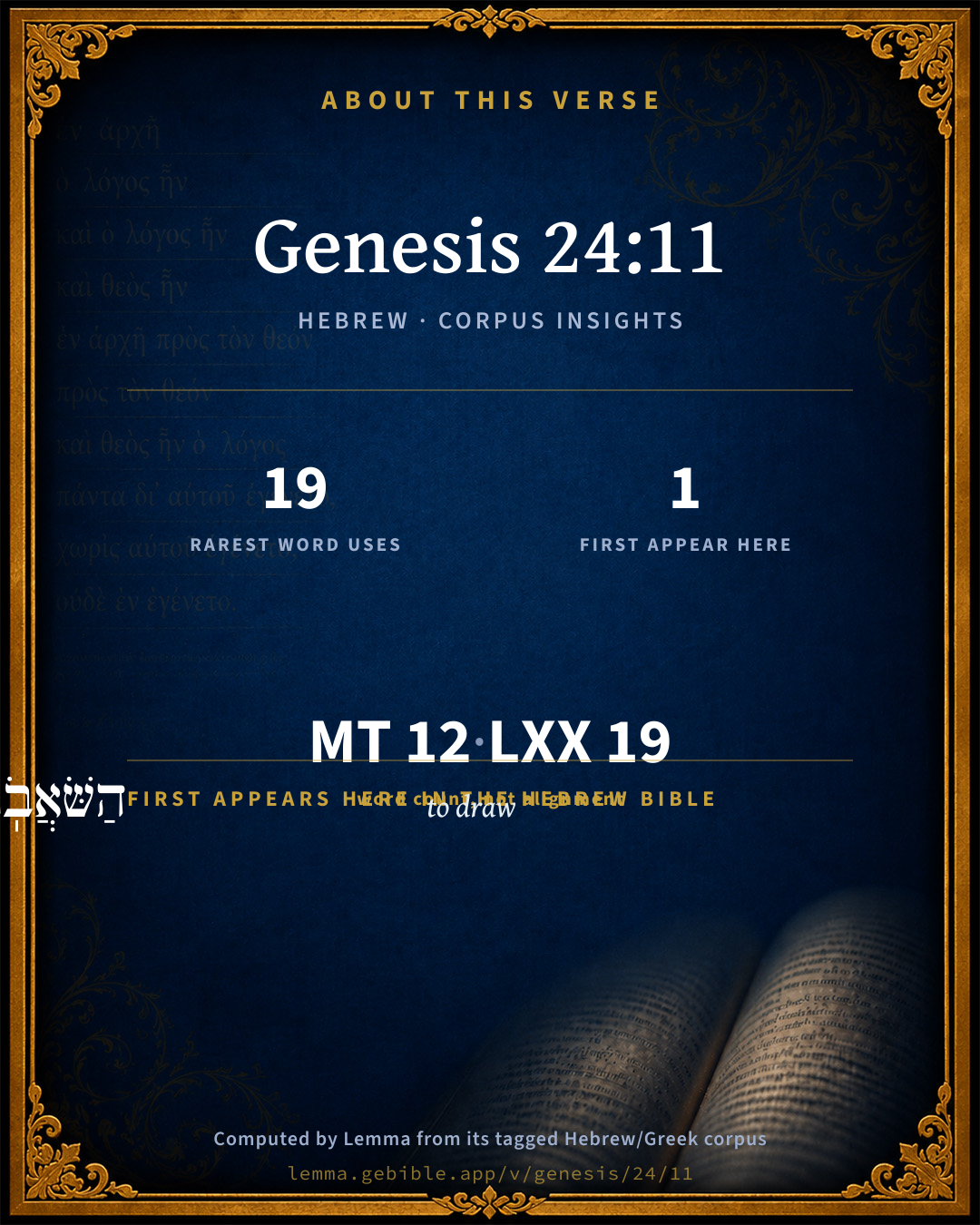
The rarest word here is הַשֹּׁאֲבֹֽת to draw H7579 — appearing just 19 times in the whole Hebrew Bible.

First appearance in Scripture

This word makes its first canonical appearance in the Hebrew Bible here:

  • הַשֹּׁאֲבֹֽת to draw H7579

Shared distinctive vocabulary

הַשֹּׁאֲבֹֽת to draw H7579 occurs in 18 verses of the Hebrew Bible. Also found in:

Grammatical profile

  • 3 verbs
  • 8 nouns
  • 1 preposition

Verb forms

  • וַיַּבְרֵ֧ךְ Hiphil · Sequential Imperfect
  • צֵ֥את Qal · Infinitive Construct
  • הַשֹּׁאֲבֹֽת Qal · Participle Active

Repetition

A word recurs within this verse — often emphatic in Hebrew:

  • לְעֵ֣ת time H6256 ×2

Hebrew & Septuagint length

In English translation the verse runs 28 words from the Hebrew and 22 from the Septuagint (LXX English) — closely comparable.

A rough comparison of the two English renderings, which tokenize alike — not a word-level alignment.

Word counts can differ between the Hebrew and the Greek without any difference in meaning — e.g. the Hebrew direct-object marker אֵת has no separate Greek word, and Greek often adds the article ὁ.

In the original languages it is 12 Hebrew tokens and 19 Greek tokens — but the two are counted differently (Hebrew bundles its prefixes and suffixes into one token; the Greek is in lemma form), so that isn’t a like-for-like length.

Cross-references

6

Topical passages linked to Genesis 24:11 in the Treasury of Scripture Knowledge — connected by theme and wording, ordered by reader-vote popularity; previews shown in the World English Bible.

  • 1 Samuel 9:11 As they went up the ascent to the city, they found young maidens going out to draw water, and said to them, Is the seer here?
  • Exodus 2:16 Now the priest of Midian had seven daughters. They came and drew water, and filled the troughs to water their father's flock.
  • John 4:7 A woman of Samaria came to draw water. Jesus said to her, "Give me a drink."
  • Genesis 24:13–20 Behold, I am standing by the spring of water. The daughters of the men of the city are coming out to draw water.
  • Genesis 33:13–14 Jacob said to him, "My lord knows that the children are tender, and that the flocks and herds with me have their young, and if they overdrive them one day, all the flocks will die.
  • Proverbs 12:10 A righteous man regards the life of his animal, But the tender mercies of the wicked are cruel.

Cross-references courtesy of OpenBible.info (CC BY 4.0).

Hebrew and Greek witnesses Masoretic Hebrew ↔ Greek Septuagint

The same verse in the two great witnesses to the Old Testament, shown verse-for-verse.

These are two independent witnesses, not word-aligned to each other, and the Septuagint is shown in lemma (dictionary) form.

Hebrew Genesis 24:11 Masoretic · Westminster Leningrad Codex

וַיַּבְרֵ֧ךְ הַגְּמַלִּ֛ים מִח֥וּץ לָעִ֖יר אֶל בְּאֵ֣ר הַמָּ֑יִם לְעֵ֣ת עֶ֔רֶב לְעֵ֖ת צֵ֥את הַשֹּׁאֲבֹֽת

He made the camels kneel down outside the city by the well of water at the time of evening, the time that women go out to draw water.

World English Bible · Public Domain

Greek LXX Genesis 24:11 Septuagint · lemma form

καί κοιμίζω ὁ κάμηλος ἔξω ὁ πόλις παρά ὁ φρέαρ ὁ ὕδωρ ὁ πρός ὀψέ ἡνίκα ἐκπορεύομαι ὁ ὑδρεύω

And he rested his camels without the city by the well of water towards evening, when damsels go forth to draw water.

LXX2012 (modern English Septuagint) · Public Domain

On this verse, Adam Clarke's Commentary discusses the Septuagint’s reading. Read the note in Commentary ↓

Hebrew: Westminster Leningrad Codex (CC BY 4.0). Greek: Septuagint (public domain); English from LXX2012 (modern English Septuagint) (Public Domain). How the Septuagint differs from the Hebrew →

Targum (Aramaic paraphrase)

2

The Targum is the ancient Jewish Aramaic paraphrase of the Hebrew Scriptures — an interpretive translation, not the Hebrew text itself. Onkelos (literal) and Pseudo-Jonathan (expansive) render the Torah, and Jonathan the Prophets. Coverage is partial: where no permissively-licensed English translation exists for a verse, only the Aramaic is shown. This is verse-level text, not a word-by-word alignment to the Hebrew.

  1. Targum Onkelos Torah (Genesis–Deuteronomy)
    וְאַשְׁרֵי גַּמְלַיָּא מִבָּרָא לְקַרְתָּא לִבְאֵרָא דְמַיָּא לְעִדַּן רַמְשָׁא לְעִדַּן דְּנַפְקַן מַלְיָתָא

    (no public-domain English translation for this verse)

    Targum Onkelos — Aramaic: “Onkelos Genesis” (public domain); “Onkelos Exodus” (public domain); “Onkelos Leviticus” (public domain); “Onkelos Numbers” (public domain); “Onkelos Deuteronomy” (public domain). English: “Sefaria Community Translation” (CC0 1.0 (public-domain dedication)); “J.W. Etheridge. The Targums of Onkelos and Jonathan Ben Uzziel on the Pentateuch. London: Longmans, Green, 1862” (public domain). Text via Sefaria.

  2. Targum Pseudo-Jonathan Torah (Genesis–Deuteronomy)
    וְאַרְבַּע גַמְלַיָא מִבָּרָא לְקַרְתָּא לְבֵירָא דְמַיָא לְעִידָן רַמְשָׁא לְעִדָן דְנַפְקַן מַלְיָאתָא

    And he made the camels lie down without the city by the fountain of waters, at the time of evening, the time when the fillers (of water) come forth.

    Targum Pseudo-Jonathan — Aramaic: “Targum Jonathan on Genesis” (public domain); “Targum Jonathan on Exodus” (public domain); “Targum Jonathan on Leviticus” (public domain); “Targum Jonathan on Numbers” (public domain); “Targum Jonathan on Deuteronomy” (public domain). English: “The Targum of Jonathan ben Uzziel, trans. J. W. Etheridge, London, 1862” (public domain). Text via Sefaria.

Commentary

Notes on Genesis 24:11 from classic Christian and Jewish commentators (each source and its license shown beneath its notes). The classic Christian expositions comment on the surrounding passage and are grouped to its opening verse, so a note may address several verses; the Jewish commentaries on the Tanakh (Rashi and others) are per-verse, so they appear only where the commentator wrote on this verse.

Lemma curates 59 commentaries, every one of them public domain or Creative Commons licensed, each selected and text-cleaned for this edition rather than reprinted as found. About our sources →

Trapp's Complete Commentary

John Trapp

Gen 24:11 And he made his camels to kneel down without the city by a well of water at the time of the evening, [even] the time that women go out to draw [water].

Ver. 11. And he made his camels to kneel down.] Or, rest themselves, as the Greek interprets it. A good man is merciful to his beast; {Pro 12:10} but the poor "creature groaneth and travaileth in pain" {Rom 8:22} under our abuses.

John Trapp, A Commentary or Exposition upon All the Books of the Old and New Testament (1647–1656) — public domain. Text from a community e-Sword module.

Joseph Benson's Commentary

Gen 24:11. He made his camels to kneel down — Probably to unload them; kneeling, however, is the posture in which they take their rest. Dr. Shaw, giving an account of his journeys between Cairo and mount Sinai, says, “Our camels were made to kneel down in a circle round about us; and in this situation, as they are very watchful, and awake with the least noise, they served us instead of a guard.”

Joseph Benson's Commentary on the Old and New Testaments (1811–1818) — public domain. Text from a community e-Sword module.

Geneva Bible (1599)

Geneva Bible translators

Hebrew, to bow their knees.

Geneva Bible (1599) marginal notes — public domain. Text via Bolls.life.

Adam Clarke's Commentary

Verse 11. He made his camels to kneel down] To rest themselves, or lie down, as the Septuagint has very properly expressed it, και εκοιμισε τας καμηλουσ.

The time that women go out to draw water.] In Bengal it is the universal practice for the women to go to pools and rivers to fetch water. Companies of four, six, ten, or more, may be seen in every town daily going to fetch water, with the pitchers resting upon their sides; and, on their return from bathing, women frequently bring water home. - WARD.

Adam Clarke's Commentary on the Bible (1810–1826) — public domain. Text from a community e-Sword/MySword module.

Ellicott's Commentary for English Readers

(11) He made his camels to kneel down.—Camels rest kneeling, but the servant did not unlade them till he knew that God had heard his prayer. (See Gen_24:32.)

By a well of water.—The well was the property of the whole city, and might be used only at a fixed hour; and the servant therefore waits till the women came to draw. This duty of fetching water is not peculiar to Oriental women, but to this day in most parts of Europe, wherever the supply comes from a public source, women may be seen thus occupied. Rebekah carried her pitcher upon her shoulder; in the south of France the Basque women, like the ancient Egyptians, carry it on their heads, and the habit of thus balancing it gives them a peculiarly erect and graceful carriage.

A Bible Commentary for English Readers, edited by Charles John Ellicott (1878–1897) — public domain. Text from a community e-Sword module.

The Cambridge Bible for Schools and Colleges

gen. ed. J. J. S. Perowne

11. he made the camels to kneel down] Throughout this chapter the camels are made to play a very prominent part. The camels being made to kneel, in order to wait and rest until they are given water, is a common scene in the East.

the time that … to draw water] We have here a familiar scene from Oriental life. The well is outside the gate of the town. It is the women’s duty to draw water: cf. 1Sa_9:11; Joh_4:7. They come when the heat of the day is past.

The Cambridge Bible for Schools and Colleges (gen. ed. J. J. S. Perowne; Cambridge University Press, 1878–1918) — public domain. Text from a community e-Sword module.

John Gill's Exposition

And he made his camels to kneel down,.... Which these creatures are used to do when they are loaded and unloaded, and also when they take rest, and it was for the sake of the latter they were now made to kneel. It seems that this is what is not natural to them, but what they are learned to do: it is said (r),"as soon as a camel is born they tie his four feet under his belly, put a carpet over his back, and stones upon the borders of it, that he may not be able to rise for twenty days together; thus they teach him the habit of bending his knees to rest himself, or when he is to be loaded or unloaded.''This was done

without the city; the city of Nahor, Haran, near to which the servant was now come: and it was

by a well of water: which place was chosen for the refreshment of his camels, as well as of himself and his men. Rauwolff (s) says, that near Haran, now called Orpha,"there is a plentiful well still to this day (1575), called Abraham's well, the water of which hath a more whitish troubledness than others. I have (says he) drank of it several times, out of the conduit that runs from thence into the middle the great camp, and it hath a peculiar pleasantness, and a pleasant sweetness in its taste.''The time of Abraham's servant coming hither was

at the time of the evening, even the time that women go out to draw water; which was the custom for women to do, for the necessary uses of their families; as it was especially in the eastern countries: and the Arabian women to this time, after they have been hard at work all day, weaving, or grinding, or making bread, at evening they set out with a pitcher or a goat's skin, and, tying their sucking children behind them, trudge it in this manner two or three miles to fetch water (t).

(r) Calmet's Dictionary in the word "Camel". (s) Travels, par. 2. ch. 10. p. 177. Ed. Ray. (t) Shaw's Travels, p. 241. Ed. 2.

John Gill's Exposition of the Whole Bible (1746–1763) — public domain (CC PDM 1.0). Text via the HelloAO Bible API.

Whedon's Commentary on the Bible

Daniel D. Whedon

11. He made his camels to kneel — “A mode of expression taken from actual life. The action is literally kneeling, and this the camel is taught to do from its youth. The place is said to have been by a well of water, and this well was outside the city. In the East, where wells are scarce, and water indispensable, the existence of a well or fountain determines the site of a village. The people build near it, but prefer to have it outside of the city, to avoid the noise, dust, and confusion always occurring at it, and especially if the place is on the public highway. It is around the fountain that the thirsty traveller and the weary caravan assemble; and if you have become separated from your own company before arriving at a town, you need only inquire for the fountain, and there you will find them. It was perfectly natural, therefore, for Eliezer to halt at the well.

The time was evening, when women go out to draw water — True to life again. At that hour the peasant returns home from his labour, and the women are busy preparing the evening meal, which is to be ready at sunset. Cool fresh water is then demanded, and, of course, there is a great concourse around the well. About great cities men often carry water, both on donkeys and on their own backs; but in the country, among the unsophisticated natives, women only go to the well or the fountain; and often, when travelling, have I seen long files of them going and returning with their pitchers ‘at the time when women go out to draw water.’” — THOMSON, Land and Book, vol. ii, p. 404.

Daniel D. Whedon (gen. ed.), Commentary on the Old and New Testaments (1874–1909) — public domain. Text from a community e-Sword module.

The Pulpit Commentary

And he made his camels to kneel down mode of expression taken from actual life. The action is literally kneeling; not stooping, sitting, or lying down on the side like a horse, but kneeling on his knees; and this the camel is taught to do from his youth" (Thomson, "Land and Book," p. 592)without the city by a well of water. "In the East, where wells are scarce and water indispensable, the existence of a well or fountain determines the site of the village. The people build near it, but prefer to have it outside the city, to avoid the noise, dust, and confusion always occurring at it, especially if the place is on the highway (Ibid.). At the time of the evening, even the time that women go out to draw water. Literally, that women that draw go forth. "It is the work of females in the East to draw water both morning and evening; and they may be seen going in groups to the wells, with their vessels on the hip or on the, shoulder" (Roberts" Oriental Illustrations, p. 27). "About great cities men often carry, water, both on donkeys and on their own backs; but in the country, among the unsophisticated natives, women only go to the well or the fountain; and often, when traveling, have I seen long files of them going and returning with their pitchers "at the time when women go out to draw water" (Thomson, "Land and Book," p. 592).

The Pulpit Commentary (1880–1919), ed. H.D.M. Spence-Jones & Joseph S. Exell — public domain. Text from a community e-Sword module.

John Wesley's Explanatory Notes

He made his camels kneel down - Perhaps to unload them.

John Wesley, Explanatory Notes Upon the Whole Bible (1754–1765) — public domain. Text via the GEBible commentary corpus.

Rashi

Rabbi Shlomo Yitzchaki (Rashi)

ויברך הגמלים means HE MADE THEM KNEEL (Genesis Rabbah 59:11).

Rashi on the Tanakh — English translations: “The Judaica Press complete Tanach with Rashi, translated by A. J. Rosenberg” (CC BY 4.0); “Pentateuch with Rashi's commentary by M. Rosenbaum and A.M. Silbermann, 1929-1934” (public domain); “The Metsudah Tanach series, Lakewood, N.J” (CC BY 4.0); and “The Book of Joshua, Metsudah Publications, 1997” (CC BY 4.0). Text via Sefaria.

Radak

Rabbi David Kimhi (Radak)

ויברך הגמלים, he made them go down on their knees in order that the jugs of water could be presented to them for them to drink. While all this was happening he prayed to G’d to arrange for the right kind of girl to put in an appearance.

אל באר המים, near the well.

Radak on the Tanakh — English translations: “Sefaria Community Translation” (CC0 1.0 (public-domain dedication)); “Eliyahu Munk, HaChut Hameshulash” (CC BY 4.0); “Rabbi Mike Feuer, Jerusalem Anthology” (CC BY 4.0); and “R. David Kimhi on the first book of Psalms, Translated by R.G. Finch, London, 1919” (public domain). Text via Sefaria.

Lesson kit

Teaching starters — assembled from the data on this page, not authored interpretation. Every prompt links to the verse data it draws on. Edit before teaching.

Genesis, in the Pentateuch, opens this verse with 12 words (11 distinct Hebrew lemmas). Its most distinctive word is shâʼab (“to draw”). A historical commentator’s framing appears above. Read the whole chapter for the surrounding context.

Discussion questions

  1. What does “to draw” (shâʼab) contribute to the verse as a whole?
  2. The word “to draw” first appears here in Scripture. What is being introduced at this debut?
  3. Genesis 24:13 shares the word «to draw» with this verse. How do the two illuminate each other?
  4. “time” occurs 2× in this one verse. What is the effect of the repetition?
  5. These translations render this verse differently. What is at stake in choosing one wording over another?
  6. The verb «וַיַּבְרֵ֧ךְ» is Hiphil Sequential Imperfect. How does its form color the action?
  7. Reading how Trapp's Complete Commentary and Joseph Benson's Commentary read this verse, where do the two commentators agree and where do they part?

Things to notice

Reading settings

Reading text

Shown beneath each verse's original-language words.

Old Testament
Old Testament edition

Read the OT as the Masoretic Hebrew (MT) or the Greek Septuagint (LXX).

English shown for the Greek Septuagint (in the Hebrew ↔ Greek comparison).

Comparing translations? Open the Compare panel on any verse page to stack up to four side by side.