
Ruth 3:10

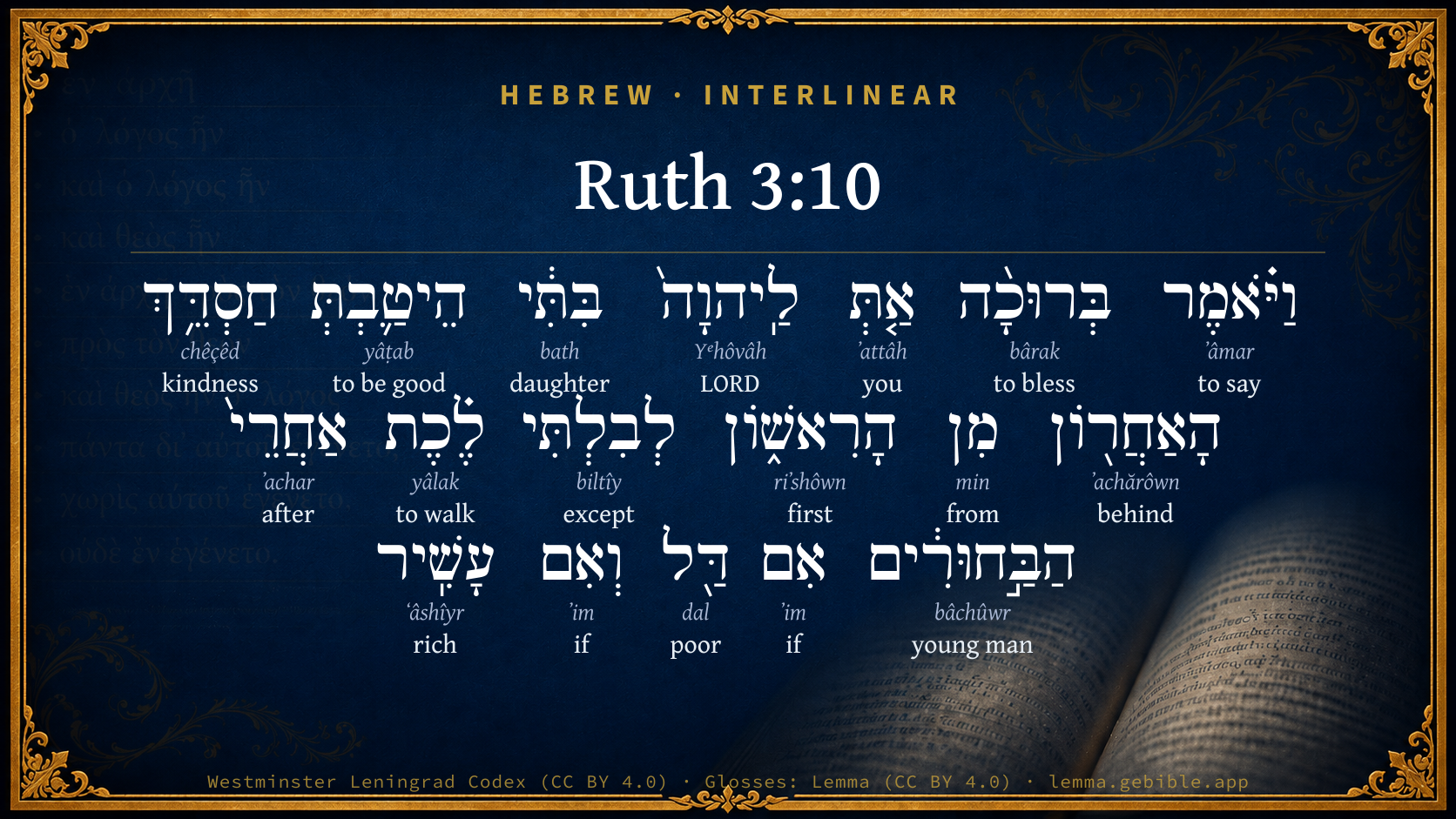
Hebrew (Westminster Leningrad Codex) Ruth 3:10 appears in the Hebrew Old Testament. The text above is from the Westminster Leningrad Codex. Each word links to its Strong’s number, a concise gloss, and parsing drawn from the Open Scriptures Hebrew Bible morphology. Click any word for its full Brown-Driver-Briggs (BDB) entry.
Download image
Cite this verse

Ruth 3:10 (World English Bible). Public Domain. Lemma interlinear Bible study tool, https://lemma.gebible.app/v/ruth/3/10.

Show BibTeX & RIS
BibTeX
RIS
English Translation
He said, Blessed are you by Yahweh, my daughter: you have shown more kindness in the latter end than at the beginning, inasmuch as you didn't follow young men, whether poor or rich.
World English Bible · Public Domain
Download a study sheet

One document with this verse’s original text, its word-by-word gloss line, the meaning frame, cross-references with their text, attributed commentary, and full source and license credits — printable, and it pastes into notes with its structure intact.

This verse Autodidact and up

Study sheet (.html) Plain text (.txt)

A passage Seminary Student

Up to 50 verses in one chapter. A passage sheet keeps up to 6 commentary sources and 12 cross-references per verse, in the order this page ranks them, and says so on the sheet whenever that leaves anything out. Ask for a single verse and you get the Autodidact verse sheet above.

Everything on this page stays free to read, with no account — the sheet is a download of what is already on screen, not access to it.

Want to remove ads? Support Godless Engineer
Compare translations 3

The same verse in 3 English versions, stacked beneath the original-language interlinear above. Click any original word for its lexicon entry.

Each is an independent rendering of the whole verse — the interlinear is not word-aligned to these translations.

Highlighted words mark where these versions differ — a whole-verse word diff, not a word-by-word alignment.

  • World English Bible Public Domain
    He said, Blessed are you by Yahweh, my daughter: you have shown more kindness in the latter end than at the beginning, inasmuch as you didn't follow young men, whether poor or rich.
  • King James Version Public Domain
    And he said, Blessed be thou of the LORD, my daughter: for thou hast showed more kindness in the latter end than at the beginning, inasmuch as thou followedst not young men, whether poor or rich.
  • unfoldingWord Literal Text CC BY-SA 4.0
    Then he said, “Blessed be you by Yahweh, my daughter! You have made your covenant faithfulness better at the end than at the beginning by not going after the young men, either poor or rich.

unfoldingWord Literal Text — © unfoldingWord, licensed CC BY-SA 4.0. Word-aligned USFM3 via Door43 (git.door43.org/unfoldingWord/en_ult).

Versions to compare (up to 4)

3 of 4 selected

Show all 18 translations

Every available English version of this verse, each an independent rendering of the whole verse.

  • World English Bible Public Domain
    He said, Blessed are you by Yahweh, my daughter: you have shown more kindness in the latter end than at the beginning, inasmuch as you didn't follow young men, whether poor or rich.
  • Berean Standard Bible Public Domain
    Then Boaz said, “May the LORD bless you, my daughter. You have shown more kindness now than before, because you have not run after the younger men, whether rich or poor.
  • Majority Standard Bible Public Domain
    Then Boaz said, “May the LORD bless you, my daughter. You have shown more kindness now than before, because you have not run after the younger men, whether rich or poor.
  • King James Version Public Domain
    And he said, Blessed be thou of the LORD, my daughter: for thou hast showed more kindness in the latter end than at the beginning, inasmuch as thou followedst not young men, whether poor or rich.
  • American Standard Version (1901) Public Domain
    And he said, Blessed be thou of Jehovah, my daughter: thou hast showed more kindness in the latter end than at the beginning, inasmuch as thou followedst not young men, whether poor or rich.
  • Revised Version (1885) Public Domain
    And he said, Blessed be thou of the LORD, my daughter: thou hast shewed more kindness in the latter end than at the beginning, inasmuch as thou followedst not young men, whether poor or rich.
  • Geneva Bible (1599) Public Domain
    Then sayd he, Blessed be thou of the Lord, my daughter: thou hast shewed more goodnes in the latter end, then at the beginning, in as much as thou followedst not yong men, were they poore or rich.
  • Douay-Rheims (1899) Public Domain
    And he said: Blessed art thou of the Lord, my daughter, and thy latter kindness has surpassed the former: because thou hast not followed young men either poor or rich.
  • Young's Literal Translation Public Domain
    And he saith, `Blessed `art' thou of Jehovah, my daughter; thou hast dealt more kindly at the latter end than at the beginning -- not to go after the young men, either poor or rich.
  • Literal Standard Version CC BY-SA 4.0
    And he says, “Blessed [are] you of YHWH, my daughter; you have dealt more kindly at the latter end than at the beginning—not to go after the young men, either poor or rich.
  • Unlocked Literal Bible CC BY-SA 4.0
    Boaz said, “My daughter, may you be blessed by Yahweh. You have showed more kindness in the latter end than at the beginning, because you have not gone after any of the young men, whether poor or rich.
  • unfoldingWord Literal Text CC BY-SA 4.0
    Then he said, “Blessed be you by Yahweh, my daughter! You have made your covenant faithfulness better at the end than at the beginning by not going after the young men, either poor or rich.
  • Darby Bible Public Domain
    And he said, Blessed be thou of Jehovah, my daughter! Thou hast shewn more kindness at the end than at the first, inasmuch as thou followedst not young men, whether poor or rich.
  • World Messianic Bible Public Domain
    He said, “You are blessed by the LORD, my daughter. You have shown more kindness in the latter end than at the beginning, because you didn’t follow young men, whether poor or rich.
  • Webster's Bible Public Domain
    And he said, Blessed be thou of the LORD, my daughter: for thou hast shown more kindness in the latter end than at the beginning, inasmuch as thou didst not follow young men, whether poor or rich.
  • Free Bible Version CC BY-SA 4.0
    “May the Lord bless you, my daughter,” he said. “You are showing even more loyalty and love to the family than before. You haven't gone looking for a younger man, of whatever social status.
  • Bible in Basic English Public Domain
    And he said, May the Lord give you his blessing, my daughter: even better than what you did at the first is this last kind act you have done, in not going after young men, with or without wealth.
  • JPS Tanakh (1917) Public Domain
    And he said: 'Blessed be thou of the LORD, my daughter; thou hast shown more kindness in the end than at the beginning, inasmuch as thou didst not follow the young men, whether poor or rich.

Literal Standard Version (2020), Covenant Press — licensed CC BY-SA 4.0. Text via the HelloAO Bible API (eBible.org). Unlocked Literal Bible (unfoldingWord) — licensed CC BY-SA 4.0. Text via the HelloAO Bible API (eBible.org). unfoldingWord Literal Text — © unfoldingWord, licensed CC BY-SA 4.0. Word-aligned USFM3 via Door43 (git.door43.org/unfoldingWord/en_ult). Free Bible Version, Dr. Jonathan Gallagher — licensed CC BY-SA 4.0. Text via the HelloAO Bible API (eBible.org).

Word by word

More ways to search: Search by grammar → Find every occurrence → Compare this word →

Practice this passage: Drill this verse → Learn its vocabulary →

עָשִֽׁיר
ʻâshîyr
H6223
“rich”
Adjective, Adjective, Masculine, Singular, Absolute
Part of Speech
Adjective
Type
Adjective
Gender
Masculine
Number
Singular
State
Absolute
Full BDB Definition

Origin: from H6238

TWOT: 1714b

rich, wealthy (adjective) - the rich, the wealthy, rich man (noun)
  1. וַיֹּ֗אמֶר ʼâmar H559 “and · to say” Conjunction + Verb, Qal, Sequential Imperfect, 3rd Person, Masculine, Singular
  2. בְּרוּכָ֨ה bârak H1288 “blessed” Verb, Qal, Participle Passive, Feminine, Singular, Absolute
  3. אַ֤תְּ ʼattâh H859 “you” Pronoun, Personal, 2nd Person, Feminine, Singular
  4. לַֽיהוָה֙ Yᵉhôvâh H3068 “to/for · LORD” Preposition + Noun, Proper
  5. בִּתִּ֔י bath H1323 “daughter · my” Noun, Common, Feminine, Singular, Construct + Suffix, Personal, 1st Person, Common, Singular
  6. הֵיטַ֛בְתְּ yâṭab H3190 “to be good” Verb, Hiphil, Perfect, 2nd Person, Feminine, Singular
  7. חַסְדֵּ֥ךְ chêçêd H2617 “kindness · your” Noun, Common, Masculine, Singular, Construct + Suffix, Personal, 2nd Person, Feminine, Singular
  8. הָאַחֲר֖וֹן ʼachărôwn H314 “the · behind” Particle, Definite Article + Adjective, Adjective, Masculine, Singular, Absolute
  9. מִן min H4480 “from” Preposition
  10. הָרִאשׁ֑וֹן riʼshôwn H7223 “the · first” Particle, Definite Article + Adjective, Adjective, Masculine, Singular, Absolute
  11. לְבִלְתִּי biltîy H1115 “to/for · except” Preposition + Conjunction
  12. לֶ֗כֶת yâlak H3212 “to walk” Verb, Qal, Infinitive Construct
  13. אַחֲרֵי֙ ʼachar H310 “after” Preposition
  14. הַבַּ֣חוּרִ֔ים bâchûwr H970 “the · young men” Particle, Definite Article + Noun, Common, Masculine, Plural, Absolute
  15. אִם ʼim H518 “if” Conjunction
  16. דַּ֖ל dal H1800 “poor” Adjective, Adjective, Masculine, Singular, Absolute
  17. וְאִם ʼim H518 “and · if” Conjunction + Conjunction

About this verse

These counts appear in no published source. They are computed here, from the morphology-tagged text and Lemma’s own curated glosses. What Lemma adds →

18
words
17
distinct lemmas
Historical
section

Notable vocabulary

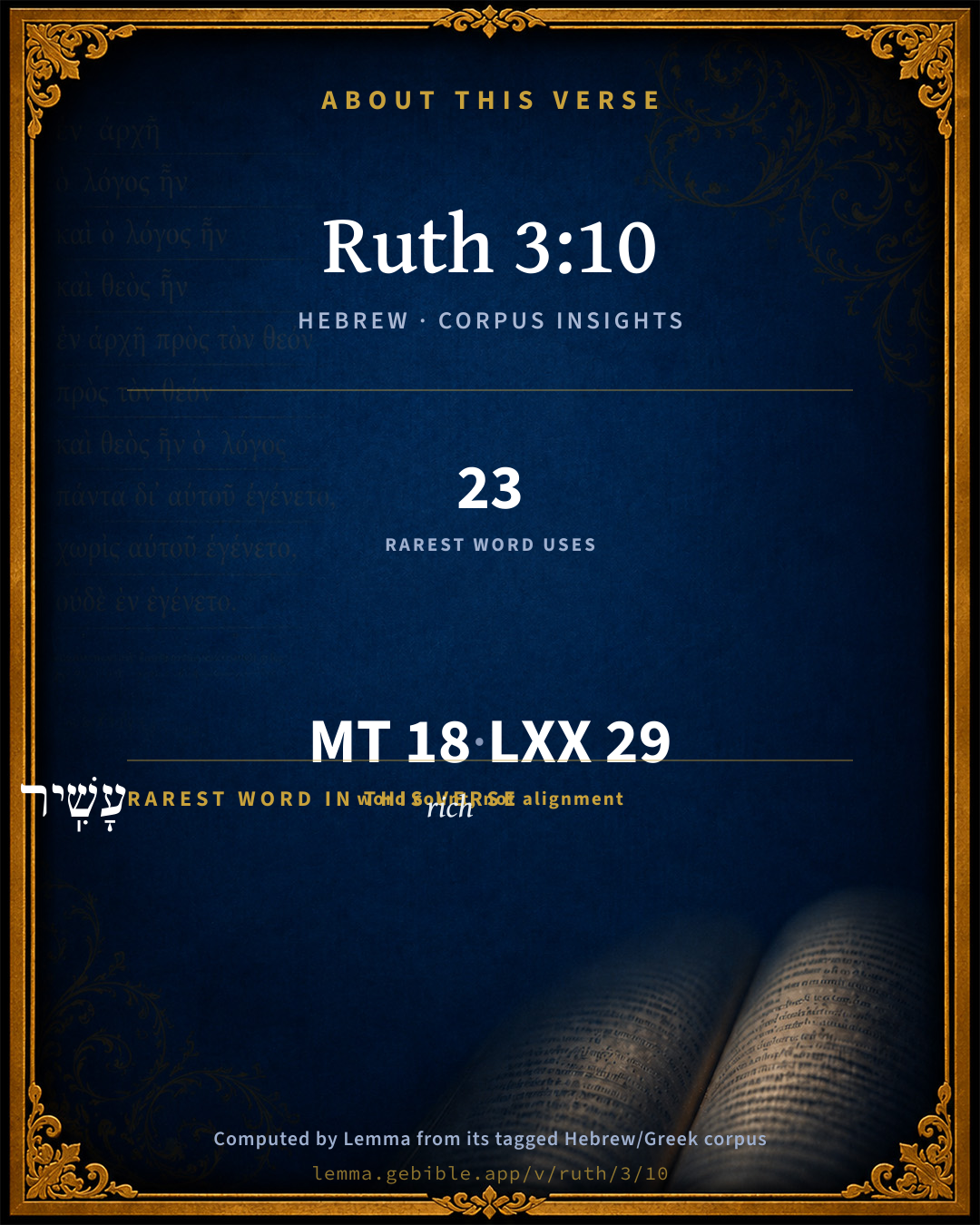
The rarest word here is עָשִֽׁיר rich H6223 — appearing just 23 times in the whole Hebrew Bible.

Shared distinctive vocabulary

עָשִֽׁיר rich H6223 occurs in 23 verses of the Hebrew Bible. Also found in:

Grammatical profile

  • 4 verbs
  • 4 nouns
  • 4 adjectives
  • 1 pronoun
  • 2 prepositions
  • 3 conjunctions

Verb forms

  • וַיֹּ֗אמֶר Qal · Sequential Imperfect
  • בְּרוּכָ֨ה Qal · Participle Passive
  • הֵיטַ֛בְתְּ Hiphil · Perfect
  • לֶ֗כֶת Qal · Infinitive Construct

Repetition

A word recurs within this verse — often emphatic in Hebrew:

  • אִם if H518 ×2

Hebrew & Septuagint length

In English translation the verse runs 33 words from the Hebrew and 37 from the Septuagint (LXX English) — closely comparable.

A rough comparison of the two English renderings, which tokenize alike — not a word-level alignment.

Word counts can differ between the Hebrew and the Greek without any difference in meaning — e.g. the Hebrew direct-object marker אֵת has no separate Greek word, and Greek often adds the article ὁ.

In the original languages it is 18 Hebrew tokens and 29 Greek tokens — but the two are counted differently (Hebrew bundles its prefixes and suffixes into one token; the Greek is in lemma form), so that isn’t a like-for-like length.

Cross-references

4

Topical passages linked to Ruth 3:10 in the Treasury of Scripture Knowledge — connected by theme and wording, ordered by reader-vote popularity; previews shown in the World English Bible.

  • Ruth 2:20 Naomi said to her daughter-in-law, Blessed be he of Yahweh, who has not left off his kindness to the living and to the dead. Naomi said to her, The man is a close relative to us, one of our near kinsmen.
  • 1 Corinthians 13:4–5 Love is patient and is kind; love doesn't envy. Love doesn't brag, is not proud,
  • Ruth 1:8 Naomi said to her two daughters-in-law, Go, return each of you to her mother's house: Yahweh deal kindly with you, as you have dealt with the dead, and with me.
  • Ruth 2:4 Behold, Boaz came from Bethlehem, and said to the reapers, Yahweh be with you. They answered him, Yahweh bless you.

Cross-references courtesy of OpenBible.info (CC BY 4.0).

Hebrew and Greek witnesses Masoretic Hebrew ↔ Greek Septuagint

The same verse in the two great witnesses to the Old Testament, shown verse-for-verse.

These are two independent witnesses, not word-aligned to each other, and the Septuagint is shown in lemma (dictionary) form.

Hebrew Ruth 3:10 Masoretic · Westminster Leningrad Codex

וַיֹּ֗אמֶר בְּרוּכָ֨ה אַ֤תְּ לַֽיהוָה֙ בִּתִּ֔י הֵיטַ֛בְתְּ חַסְדֵּ֥ךְ הָאַחֲר֖וֹן מִן הָרִאשׁ֑וֹן לְבִלְתִּי לֶ֗כֶת אַחֲרֵי֙ הַבַּ֣חוּרִ֔ים אִם דַּ֖ל וְאִם עָשִֽׁיר

He said, Blessed are you by Yahweh, my daughter: you have shown more kindness in the latter end than at the beginning, inasmuch as you didn't follow young men, whether poor or rich.

World English Bible · Public Domain

Greek LXX Ruth 3:10 Septuagint · lemma form

καί εἶπον βοος εὐλογέω σύ ὁ κύριος θεός θυγάτηρ ὅτι ἀγαθύνω ὁ ἔλεος σύ ὁ ἔσχατος ὑπέρ ὁ πρῶτος ὁ μή πορεύομαι σύ ὀπίσω νεανίας εἴτοι πτωχός εἴτοι πλούσιος

And Booz said, Blessed be you of the Lord God, my daughter, for you have made your latter kindness greater than the former, in that you follow not after young men, whether any be poor or rich.

LXX2012 (modern English Septuagint) · Public Domain

Hebrew: Westminster Leningrad Codex (CC BY 4.0). Greek: Septuagint (public domain); English from LXX2012 (modern English Septuagint) (Public Domain). How the Septuagint differs from the Hebrew →

Commentary

Notes on Ruth 3:10 from classic Christian and Jewish commentators (each source and its license shown beneath its notes). The classic Christian expositions comment on the surrounding passage and are grouped to its opening verse, so a note may address several verses; the Jewish commentaries on the Tanakh (Rashi and others) are per-verse, so they appear only where the commentator wrote on this verse.

Lemma curates 59 commentaries, every one of them public domain or Creative Commons licensed, each selected and text-cleaned for this edition rather than reprinted as found. About our sources →

Trapp's Complete Commentary

John Trapp

Rth 3:10 And he said, Blessed [be] thou of the LORD, my daughter: [for] thou hast shewed more kindness in the latter end than at the beginning, inasmuch as thou followedst not young men, whether poor or rich.

Ver. 10. And he said, Blessed be thou, &c.] He did not reproach her, for coming in that manner, and at that time of night, as a light housewife; nor harbour any evil suspicion of her, as unfit to make an honest man’s wife; but considering her former behavior, which was commendable, {Rth 3:11} and her present kindness to the living and to the dead, he candidly interpreteth what she had done, and calling her "daughter," comforteth and commendeth her, as here.

Blessed be thou.] Or, "Blessed art thou of the Lord." {as Luk 1:28}

My daughter.] She calleth herself his "handmaid," he calleth her his "daughter." There is nothing lost by humility. The humble shall have "riches, and honour, and life." {Pro 22:4}

For thou hast showed more kindness in the latter end.] True goodness is of a growing nature. Thyatira’s works were better at last than at first. The righteous are "as the shining light, that shines more and more unto the perfect day"; {Pro 4:18} when blazing stars go out in a snuff and infect the air; so apostates.

Inasmuch as thou followedst not young men.] More suitable to thy age, as being more vigorous and personable. Ruth followed not the law of lust, but the rules of reason and religion: this she is praised for.

John Trapp, A Commentary or Exposition upon All the Books of the Old and New Testament (1647–1656) — public domain. Text from a community e-Sword module.

The Biblical Illustrator

Joseph S. Exell

Rth_3:10-11

Blessed be thou of the Lord, my daughter . . . I will do to thee all that thou requirest

The first-fruits of grace

The passage before us gives a copious illustration of the first-fruits of grace to the accepted soul.

Jesus welcomes, blesses, and abundantly rewards all who thus come unto Him. First we have Divine approval. Boaz does not reject or repel the lowly suitor at his feet. The difference in their outward conditions was great. Yet he neither chides her boldness, nor reproaches her with sorrow, nor refuses her plea. He listens to her prayer in kindness. He invokes the Divine blessing upon her in her need. And how his whole address to her illustrates the Saviours gracious approval of those who seek Him! When the wearied soul comes to the feet of Jesus this is ever the welcome of approbation which it receives. The Saviour takes immediate notice of the prayer which rises up before Him, and answers it with the kindest encouragement. Boaz next illustrates for us the Divine promises. He meets the full requisition of his suppliant. There is not a want which the Christian feels for which there is not a provision promised in the Word of God. And when we come to ask His mercy, and lay ourselves at His feet in humble dedication to Him, the Saviour takes all our concerns into His own hands, and Himself promises to provide for every need. Another of the first-fruits of grace which we find in this illustration is the bounty of Divine gifts. Boaz not only promises for the future, but he bestows in the present. He will not send Ruth away empty. He fills her vail with as much barley as she could carry to her mother. An abundant supply for the wants of both. He is as generous in the amount of his liberality as he is is delicate and free in the manner of its bestowal. Thus the Saviour richly and freely bestows His gifts of grace upon those who love Him. What sweet peace He pours into the conscience in the assurance of our forgiveness! What clear light He gives to the understanding of His whole method of salvation and scheme of truth! What solidity He bestows upon the judgment in its satisfaction with His plans revealed! What joy He awakens in the heart, in the hope and anticipation of His final glory! How He makes our whole path a path of increasing light and abounding peace! In Him we are never straitened. The more diligently and truly we wait upon Him, the more abundantly will our strength be renewed. He will freely say to us, like Boaz to Ruth, Bring the vail that thou hast upon thee, and hold it. Whatever we are ready to receive He is waiting to bestow. But the illustration from the vail of Ruth fails, in the important fact that its measure was fixed, but our capacity to hold increases with our receipts of the Divine bounty. And who shall tell where Gods gracious willingness to bestow shall find its limit? As faith enlarges, and we learn to expect large things, and to attempt large things, so also becomes enlarged the measure of grace which faith receives. The history before us illustrates the Divine fidelity. With what confidence Naomi trusts in the truth and faithfulness of Boaz! The result proved that her confidence was not misplaced. He did complete with entire success the work of protection and mercy which he had undertaken. It is upon such entire fidelity in our gracious Kinsman that we are required to place our trust. Great is His faithfulness. His name is called faithful and true.(S. H. Tyng, D. D.)

Thou art a virtuous woman.

Ruth the virtuous

1. Observe, to begin with one of her humblest virtues, Ruths industry. She accompanies Naomi to the land of Israel; but not to live on public charity or become the humble pensioner of affluent relatives. Reared in the lap of luxury, she has never learned to work; yet in a noble spirit of independence she resolves to earn her bread with her own hands. We have called this a humble virtue, not because we hold it cheap, or do not regret that under the debasing influence of our poor-laws and the self-indulgent spirit of the age, it is dying out of the land. One of the saddest phases of the times is that, for themselves or their parents, thousands now accept and even clamour for public charity who, less than a century ago, would have scorned to touch it. We call it a humble virtue, because, notwithstanding the degeneracy of the age, it still dwells in many a lowly home, stamping those with a true nobility who feel the bread taste sweet their own hands have earned, and, looking forward with a Christians hope to the rest of heaven, are content here to live to work and work to live.

2. Observe next her humility. On losing their fortune some retain in a silly pride what but aggravates the loss, rankling like a thorn in a bleeding wound. An empty sack cannot stand erect; yet they inflict misery on themselves, and not seldom wrong on others, by the mean and even dishonest things they de to keep up appearances. Deeming some honest but humble work beneath their dignity, they buy what they cannot pay for, or borrow what they cannot return. Ashamed to work, they are not ashamed to live on the fruits of others industry rather than their own. There is something inexpressibly mean in this; and worse than mean. It argues a spirit of rebellion against Him and His providence who setteth up one and putteth down another. How different from this un-Christian and rebellious spirit the humility of Ruth! How beautiful it is! Willing to engage in any honest work, however humble, she bends like a reed to the blast, bows her gentle head meekly before the majesty of heaven, and, meeting her trials like a Christian heroine, drinks off the cup mingled and presented by her Fathers hand.

3. Observe her affection to Naomi. It wrings Ruths heart to part with sister, mother, and country; but it would break it to part with Naomi. She cannot do it. The ship may sink; but, mailing her colours to the mast, she will sink or swim with it. Death only shall apart them: nor death--the last favour her lips shall ask, that they lay her in Naomis grave. Nobly did Ruth redeem the pledges of this affecting scene. She teaches us, by what she was to Naomi, what we are to be to Christ; how we should cleave to Him--how we should love Him--with what devotion of heart and body, of soul, strength, mind and spirit we should serve Him, and gladly spend and be spent for Him--saying, as we take up our cross to follow the lover and Redeemer of our souls, Where Thou goest,etc. (T. Guthrie, D. D.)

The Biblical Illustrator, edited by Joseph S. Exell (c. 1880s–1900s) — public domain. Text from a community e-Sword module.

Joseph Benson's Commentary

Rth 3:10. More kindness in the latter end than in the beginning — Both to thy deceased husband, the continuance of whose name and memory thou seekest, and to thy mother-in-law, whose commands thou hast punctually obeyed. The former kindness which Ruth had shown to the family of Boaz was in her love and fidelity to her husband, and her affectionate regard to her mother-in-law. But Boaz here commends her willingness to marry him, who was advanced in years, in order to raise up seed to her departed husband, as the greatest instance of love that she had given; inasmuch as she had not followed young men — Either among the Israelites, or in her own country, as he intimates she would have done if she had not preferred obedience to God’s command, before pleasing herself.

Joseph Benson's Commentary on the Old and New Testaments (1811–1818) — public domain. Text from a community e-Sword module.

Tyndale Open Study Notes

Tyndale Open Resources

3:10 You are showing even more family loyalty: Ruth was not obligated to come to Bethlehem with Naomi, nor did she have to marry within Elimelech’s family or provide them with an heir to the land (see 4:5).

Tyndale Open Study Notes — © Tyndale Open Resources, licensed CC BY-SA 4.0. Text via the HelloAO Bible API.

Geneva Bible (1599)

Geneva Bible translators

Thou showest thyself from time to time more virtuous.

Geneva Bible (1599) marginal notes — public domain. Text via Bolls.life.

Adam Clarke's Commentary

Verse 10. In the latter end than at the beginning] It is not easy to find out what Boaz means. Perhaps חסד chesed, which we translate kindness, means piety; as if he had said: Thou hast given great proof of thy piety in this latter instance, when thou hast avoided the young, and those of thy own age, to associate thyself with an elderly man, merely for the purpose of having the Divine injunction fulfilled, viz., that the brother, or next akin, might take the wife of the deceased, and raise a family to him who had died childless, that his name might not become extinct in Israel: this latter act is a greater proof of thy piety and sincerity than any thing that could be inferred from thy becoming a proselyte.

Whether poor or rich.] So it appears from this that it was not to mend her condition in life that Ruth endeavoured to get Boaz for her husband, for she might have had a rich young man, but she preferred the building up the house of her deceased husband. See above.

Adam Clarke's Commentary on the Bible (1810–1826) — public domain. Text from a community e-Sword/MySword module.

Ellicott's Commentary for English Readers

(10) Blessed be thou of the Lord.—This answer of Boaz’s is in itself a sufficient proof of the view he took of her conduct, and of the integrity of his own. We note, too, that this blessing follows immediately on the avowal of her name. His own feelings had already been attuned to due honour and respect for Ruth; he is prepared not only to discharge the duty of next of kin, but to do it in no perfunctory spirit, but with a sincere loyal affection. The Targum on Rth_3:15 supposes that to Ruth, the distant ancestress of the Saviour, was vouchsafed the knowledge, as in its fulness to the Virgin hereafter, of the birth of the Messiah through her. Origen compares Ruth to the Gentile Church, the engrafted wild olive.

Thou hast shewed . . . .—Literally, thou hast done well thy latter kindness above the former.

A Bible Commentary for English Readers, edited by Charles John Ellicott (1878–1897) — public domain. Text from a community e-Sword module.

The Cambridge Bible for Schools and Colleges

gen. ed. J. J. S. Perowne

10. thou hast shewed more kindness] At the outset Ruth had shewn her piety towards her mother in law (Rth_2:11); now she shews it towards her husband’s family. She has declined to seek a second marriage outside, and by her action the dead will come by his rights.

The Cambridge Bible for Schools and Colleges (gen. ed. J. J. S. Perowne; Cambridge University Press, 1878–1918) — public domain. Text from a community e-Sword module.

John Gill's Exposition

And he said, blessed be thou of the Lord, my daughter,.... Instead of calling her an immodest woman for laying herself down at his feet, and a bold impudent woman, she being poor, to ask marriage of him; and instead of being angry with her, and chiding and reproving her for disturbing and frightening him in the night, he blesses her, and pray's to God to bless her, and prosper her in what she had engaged, and in a kind and loving manner calls her his daughter:

for thou hast showed more kindness in the latter end than at the beginning; that is, to her husband's family; she had shown much love to her husband living and dying, and to her mother-in-law, in leaving her country and kindred to come with her into a strange country, and in labour to support her, as she had done, all which was great kindness; to which the Targum adds, her being proselyted; but the kindness she now showed exceeded all the former, in that she was desirous, according to the law of God, to build up her husband's family, to marry the next near kinsman, even though an old man, to raise up seed to the name and memory of her husband:

inasmuch as thou followedst not the young men, whether poor or rich; the phrase of following young men is not to be understood of committing fornication with them, as the Targum explains it, but of marriage to them: she shunned their company and conversation, and did not put herself in the way of being caressed and addressed by them, and refused everything of that sort; and did not choose to follow any young man, rich or poor, as a bride follows her husband when married to him. Now Boaz mentions this as an instance of her virtue, and of her great respect to her husband's family, that a woman of such amiable qualities, virtuous, young, and beautiful, who doubtless might have been married to a young man in her own country, or in Israel, but chose to marry the nearest of kin in her husband's family, to perpetuate his name and memory; the Jews say (t) Boaz was now eighty years of age, and Ruth forty.

(t) Midrash Ruth, fol. 31. 4. & 34. 2.

John Gill's Exposition of the Whole Bible (1746–1763) — public domain (CC PDM 1.0). Text via the HelloAO Bible API.

Albert Barnes' Notes on the Bible

Thou hast shewed more kindness ... - Literally, “Thou hast made thy last kindness better than the first.” Her last kindness was her willingness to accept Boaz for her husband, advanced in years as he was.

Albert Barnes' Notes on the Bible (1834–1885) — public domain. Text from a community e-Sword/MySword module.

Haydock's Catholic Bible Commentary

Thy latter kindness; viz., to thy husband deceased, in seeking to keep up his name and family, by marrying his relation according to the law, and not following after young men: for Booz, it seems, was then in years. (Challoner) Salien supposes about seventy years old. (Haydock) --- The affection which Ruth had all along displayed towards her husband, deserved applause. (Calmet) --- Much more did her present endeavours to comply with God’s law. (Worthington)

George Leo Haydock (1774–1849), Haydock's Catholic Family Bible and Commentary, 1859 edition — public domain. Excludes Psalms (Douay-Rheims chapter numbering differs from Protestant) and Deuterocanonical books (Catholic canon only).

Matthew Poole's English Annotations

Thou hast showed more kindness; both to thy deceased husband, the continuance of whose name and memory thou preferrest before the satisfaction of thy own lust; and to thy mother-in-law, whose commands thou hast punctually obeyed, even with thy own hazard in so doubtful an enterprise.

Thou followedst not young men, to seek thy marriage either here, or in thy own country, as thou wouldst have done if thou hadst not preferred obedience to God’s command, before the pleasing of thyself.

Matthew Poole's English Annotations on the Holy Bible (1683–1685) — public domain. Text from a community e-Sword/MySword module.

Whedon's Commentary on the Bible

Daniel D. Whedon

10. More kindness in the latter end — חסד, kindness, is often used in the sense of piety, moral and religious goodness. Such is the meaning here, and the passage should be read, Thou hast made thy latter act of piety better than the former. Her former act of piety was her devotion to the memory of her deceased husband and to her mother in law, and her forsaking of father and mother and native land to become a proselyte to the Hebrew faith. Her latter piety was shown, as Boaz proceeds to state, in her not following after young men to seek to win a youthful husband; but, in strict observance of the laws and customs of the Hebrew people, by coming and claiming him as her kinsman.

Daniel D. Whedon (gen. ed.), Commentary on the Old and New Testaments (1874–1909) — public domain. Text from a community e-Sword module.

The Pulpit Commentary

And he said, Blessed be thou of Yahveh, my daughter; thou hast made thy latter kindness better than the former, in not going after any young man, whether poor or rich. This verse is full of satisfactory evidence that Naomi was perfectly right in conjecturing that Boas, deep in love, was restrained only by diffidence from formally declaring himself. It shows us too that the chief ground of his diffidence was his age. He had been an acquaintance, and the equal in years, of Ruth"s father-in-law, Elimelech, and the impression had got hold on him that the handsome young widow might feel repugnance to his suit. Hence, instead of being in the least degree offended by the steps she had taken, he was relieved, and felt full of gratification on the one hand, and of gratitude on the other. Blessed be thou by Yahveh. Literally, to Yahveh," i.e. "in relation to Yahveh". (see Rth_2:20) My daughter. His relative elderliness was in his mind. Thou hast made thy latter kindness better than the former. Michaelis has seized the true meaning of these words: "The kindness which thou art showing to thy husband, now that he is gone, is still greater than what thou didst show to him while he lived." Her employment of the word "kinsman," or goel, was evidence to Boas that she was thinking of the respect which she owed to her husband"s memory. Her concern in discharging that duty of "piety" struck the heart of Boaz; and all the more as, in his opinion, she might easily have found open doors, had she wished for them, in quarters where there was no connection of kinship with her deceased husband. She did not go after any young man, whether poor or rich." She preferred, above all such, her first husband"s elderly kinsman." In the original the construction is peculiar not going after the young men, whether a poor one or a rich one." He does not simply mean that she was free from vagrant courses and desires. Her character lay, to his eye, on a far higher level His meaning is that she deliberately refrained from "thinking of any young man. The plural "young men" is to be accounted for on the principle that when an alternate is assumed or postulated, there is, in actual contemplation, a plurality of individuals.

Vers. 10, 11. now, my daughter, fear not give not thyself any anxious concern in reference to the result. "All the people in the gate of my city know that thou art a virtuous woman." Yes, she was virtuous; and yet she was much more. She was endowed with all the capabilities which fitted her for the position she was willing to occupy (see the Exposition).

Benediction.

A blessing comes appropriately from a senior; a father blesses his son, a venerable patriarch his youthful colleague. Boaz was an elderly man, and it seems appropriate that, addressing Ruth, the young widow of his kinsman, he should use language of benediction: "Blessed be thou of the Lord, my daughter!

I BENEDICTION PROCEEDS FROM A BENEVOLENT DISPOSITION. It is the opposite of cursing. Sometimes language of benediction is used when there is no spiritual reality behind it. In such cases it is a mockery, a counterfeit of benevolence and piety.

II BENEDICTION IMPLIES PIETY. Belief in God, and in God"s willingness to bless. There is a looking up to God on behalf of him who is to be blessed. Without this the language of blessing is meaningless.

III BENEDICTION IS THE ACKNOWLEDGMENT THAT FROM GOD ALL GOOD MUST COME, COMBINED WITH THE DESIRE AND PRAYER THAT HE WILL BE GRACIOUS. It is the hallowing of our best affections; it is the making real and personal of our most solemn religious beliefs.

IV BENEDICTION, IF HARMONIOUS WITH GOD"S WILL, SECURES GOD"S FAVOR. It is a wish, but a wish realized; a prayer, but a prayer heard and answered in heaven. T.

The Pulpit Commentary (1880–1919), ed. H.D.M. Spence-Jones & Joseph S. Exell — public domain. Text from a community e-Sword module.

John Wesley's Explanatory Notes

Shewed kindness - Both to thy deceased husband, the continuance of whose name and memory thou seekest; and to thy mother-in-law, whose commands thou hast punctually obeyed. Followedst not - To seek thy marriage here, or in thy own country, as thou wouldst have done if thou hadst not preferred obedience to God's command, before pleasing thyself.

John Wesley, Explanatory Notes Upon the Whole Bible (1754–1765) — public domain. Text via the GEBible commentary corpus.

Keil & Delitzsch

C. F. Keil & F. Delitzsch

Boaz praised her conduct: "Blessed be thou of the Lord, my daughter (see Rut 2:20); thou hast made thy later love better than the earlier, that thou hast not gone after young men, whether poor or rich. " Ruth's earlier or first love was the love she had shown to her deceased husband and her mother-in-law (comp. Rut 2:11, where Boaz praises this love); the later love she had shown in the fact, that as a young widow she had not sought to win the affections of young men, as young women generally do, that she might have a youthful husband, but had turned trustfully to the older man, that he might find a successor to her deceased husband, through a marriage with him, in accordance with family custom (vid., Rut 4:10). "And now," added Boaz (Rut 3:11), "my daughter, fear not; for all that thou sayest I will do to thee: for the whole gate of my people (i.e., all my city, the whole population of Bethlehem, who go in and out at the gate: see Gen 34:24; Deu 17:2) knoweth that thou art a virtuous woman." Consequently Boaz saw nothing wrong in the fact that Ruth had come to him, but regarded her request that he would marry her as redeemer as perfectly natural and right, and was ready to carry out her wish as soon as the circumstances would legally allow it. He promised her this (vv. 12, 13), saying, "And now truly I am a redeemer; but there is a nearer redeemer than I. Stay here this night (or as it reads at the end of v. 13, 'lie till the morning'), and in the morning, if he will redeem thee, well, let him redeem; but if it does not please him to redeem thee, I will redeem thee, as truly as Jehovah liveth." אם כּי (Kethibh, v. 12), after a strong assurance, as after the formula used in an oath, "God do so to me," etc., Sa2 3:35; Sa2 15:21 (Kethibh), and Kg2 5:20, is to be explained from the use of this particle in the sense of nisi, except that, = only: "only I am redeemer," equivalent to, assuredly I am redeemer (cf. Ewald, 356, b.). Consequently there is no reason whatever for removing the אם from the text, as the Masorites have done (in the Keri).

(Note: What the ל maju sc., in ליני signifies, is uncertain. According to the smaller Masora, it was only found among the eastern (i.e., Palestinian) Jews. Consequently Hiller (in his Arcanum Keri et Ctibh, p. 163) conjectures that they used it to point out a various reading, viz., that לנּי should be the reading here. But this is hardly correct.)

Ruth was to lie till morning, because she could not easily return to the city in the dark at midnight; but, as is shown in Rut 3:14, she did not stay till actual daybreak, but "before one could know another, she rose up, and he said (i.e., as Boaz had said), It must not be known that the woman came to the threshing-floor." For this would have injured the reputation not only of Ruth, but also of Boaz himself.

Keil & Delitzsch — Biblical Commentary on the Old Testament (1861–1891) — public domain (CC PDM 1.0). Text via the HelloAO Bible API. (Old Testament only.)

Kretzmann's Popular Commentary

Paul E. Kretzmann

Boaz Promises Favorable Action

v. 10. And he said, Blessed be thou of the Lord, my daughter; for thou hast showed more kindness in the latter end than at the beginning, inasmuch as thou followedst not young men, whether poor or rich. She had at first, when she might have stayed in her own country and married among her own people, preferred to accompany her mother-in-law into a strange land, with no other prospect than that of sharing poverty, misery, and humiliation with her. And she had now, instead of setting her cap for some attractive young man, as would have been natural for a woman of her age, shown her obedient disposition toward Naomi in proposing marriage to him, as the levir relative, although he was advanced in life.

v. 11. And now, my daughter, fear not, she was to lay aside all anxiety and worry, which probably showed itself in the tremulous tones with which she made her request; I will do to thee all that thou requirest; for all the city of my people, "literally, the whole gate," standing for all the inhabitants of Bethlehem and the surrounding country, doth know that thou art a virtuous woman, she had proved to all that she was a good woman, with no loose morals such as were ascribed to the women of Moab.

v. 12. And now it is true that I am thy near kinsman; howbeit there is a kinsman nearer than I, this restriction being added by Boaz on account of possible legal complications.

v. 13. Tarry this night, he would not think of sending her away in the dense darkness, and it shall be in the morning that, if he will perform unto thee the part of a kinsman, well; let him do the kinsman’s part, in redeeming the land and marrying Ruth; but if he will not do the part of a kinsman to thee, then will I do the part of a kinsman to thee, as the Lord liveth, he would cheerfully perform the duty, as he confirmed with a solemn oath. Lie down until the morning. There is not an unseemly hint in the entire passage, only naturalness and simplicity and virtue.

v. 14. And she lay at his feet until the morning; and she rose up before one could know another, before the light made it possible to recognize people clearly. And he said, Let it not be known that a woman came into the floor. He wanted to protect, not only his own good name, but that of Ruth as well, particularly since there was still a possibility that the nearer relative might claim her as his wife, and scandalous rumors might have resulted most unpleasantly.

v. 15. Also he said, Bring the veil, the cloak or shawl which she had about her, that thou hast upon thee, and hold it. And when she held it, he measured six measures of barley, a large quantity, and laid it on her, as a gift showing his good will. And she went into the city.

v. 16. And when she came to her mother-in-law, she said, Who art thou, my daughter? It was an inquiry concerning the success which she had had, whether her claim had been acknowledged or otherwise. And she told her all that the man had done to her, the gift, of course, being a strong hint to Naomi of the result of Ruth’s application.

v. 17. And she said, These six measures of barley gave he me; for he said to me, Go not empty unto thy mother-in-law, visitors usually being dismissed with gifts for their families.

v. 18. Then said she, Naomi, Sit still, my daughter, she was to remain quietly at home, until thou know how the matter will fall, what the outcome of the business would be; for the man, Boaz, will not be in rest until he have finished the thing this day. He was an energetic man, who always went forward toward the goal with open directness. All the virtues which we here find in him and in Ruth, purity, chastity, openness, generosity, a strict regard for the rights of the neighbor, are fruits of faith.

Paul E. Kretzmann, Popular Commentary of the Bible (1921–1924) — public domain. Text from a community e-Sword module.

unfoldingWord translationNotes

Door43 World Missions Community

my daughter

Boaz used this expression as a sign of respect toward Ruth as a younger woman.

more kindness in the latter end than at the beginning

"even more kindness now than before"

more kindness in the latter end

This refers to Ruth asking Boaz to marry her. By marrying Naomi's relative, Ruth would provide for Naomi and demonstrate great kindness to Naomi.

at the beginning

This refers to the way Ruth had earlier provided for her mother-in-law by staying with her and gleaning grain for food for them.

because you have not gone after

"you have not pursued marriage with." Ruth could have ignored Naomi's need and looked for a husband for herself outside of Naomi's relatives. (See: Idiom)

translationWords

bless

Yahweh

fear

people group

worthy

unfoldingWord translationNotes — © Distant Shores Media and the Door43 World Missions Community, licensed CC BY-SA 4.0. Source: git.door43.org/Door43/en_tn.

Rashi

Rabbi Shlomo Yitzchaki (Rashi)

than the first that you did with your mother-in-law.

Rashi on the Tanakh — English translations: “The Judaica Press complete Tanach with Rashi, translated by A. J. Rosenberg” (CC BY 4.0); “Pentateuch with Rashi's commentary by M. Rosenbaum and A.M. Silbermann, 1929-1934” (public domain); “The Metsudah Tanach series, Lakewood, N.J” (CC BY 4.0); and “The Book of Joshua, Metsudah Publications, 1997” (CC BY 4.0). Text via Sefaria.

Ibn Ezra

Rabbi Abraham ibn Ezra

חסדך האחרון מן הראשון (your latter kindness is greater than the first): This phrase highlights that Ruth's recent act of kindness (presumably her loyalty and willingness to stay with No῾omi and follow her instructions) surpasses the kindness she showed to her deceased husband. No῾omi had acknowledged Ruth's kindness, suggesting that it would be unusual for someone to revert to their old ways after converting to a new faith.

אם דל ואם עשיר (whether poor or rich): This phrase indicates that Ruth's beauty and character make her loved and admired by everyone, regardless of their social or economic status.

Ibn Ezra on the Tanakh — English translations: “Sefaria Community Translation” (CC0 1.0 (public-domain dedication)); “Yalkut, Sifsei Chachomim Chumash, Metsudah Publications, 2009” (CC BY 4.0); and “Commentary of Ibn Ezra on Isaiah - trans. by M. Friedlander, 1873” (public domain). Text via Sefaria.

Lesson kit

Teaching starters — assembled from the data on this page, not authored interpretation. Every prompt links to the verse data it draws on. Edit before teaching.

Ruth, in the Historical, opens this verse with 18 words (17 distinct Hebrew lemmas). Its most distinctive word is ʻâshîyr (“rich”). A historical commentator’s framing appears above. Read the whole chapter for the surrounding context.

Discussion questions

  1. How does “rich” (ʻâshîyr) shape what this verse is saying?
  2. How does Exodus 30:15, which shares the word «rich», read alongside this verse?
  3. What does the repetition of “if” (2× in this one verse) do in this verse?
  4. The translations on this page render this verse differently — a whole-verse word diff, not a word-by-word alignment. What might account for the different wordings?
  5. «וַיֹּ֗אמֶר» is a Qal Sequential Imperfect verb. How does that grammatical form shape the action described?
  6. Compare how Trapp's Complete Commentary and The Biblical Illustrator read this verse. Where do they agree or differ?

Things to notice

Reading settings

Reading text

Shown beneath each verse's original-language words.

Old Testament
Old Testament edition

Read the OT as the Masoretic Hebrew (MT) or the Greek Septuagint (LXX).

English shown for the Greek Septuagint (in the Hebrew ↔ Greek comparison).

Comparing translations? Open the Compare panel on any verse page to stack up to four side by side.