Genesis 5:2

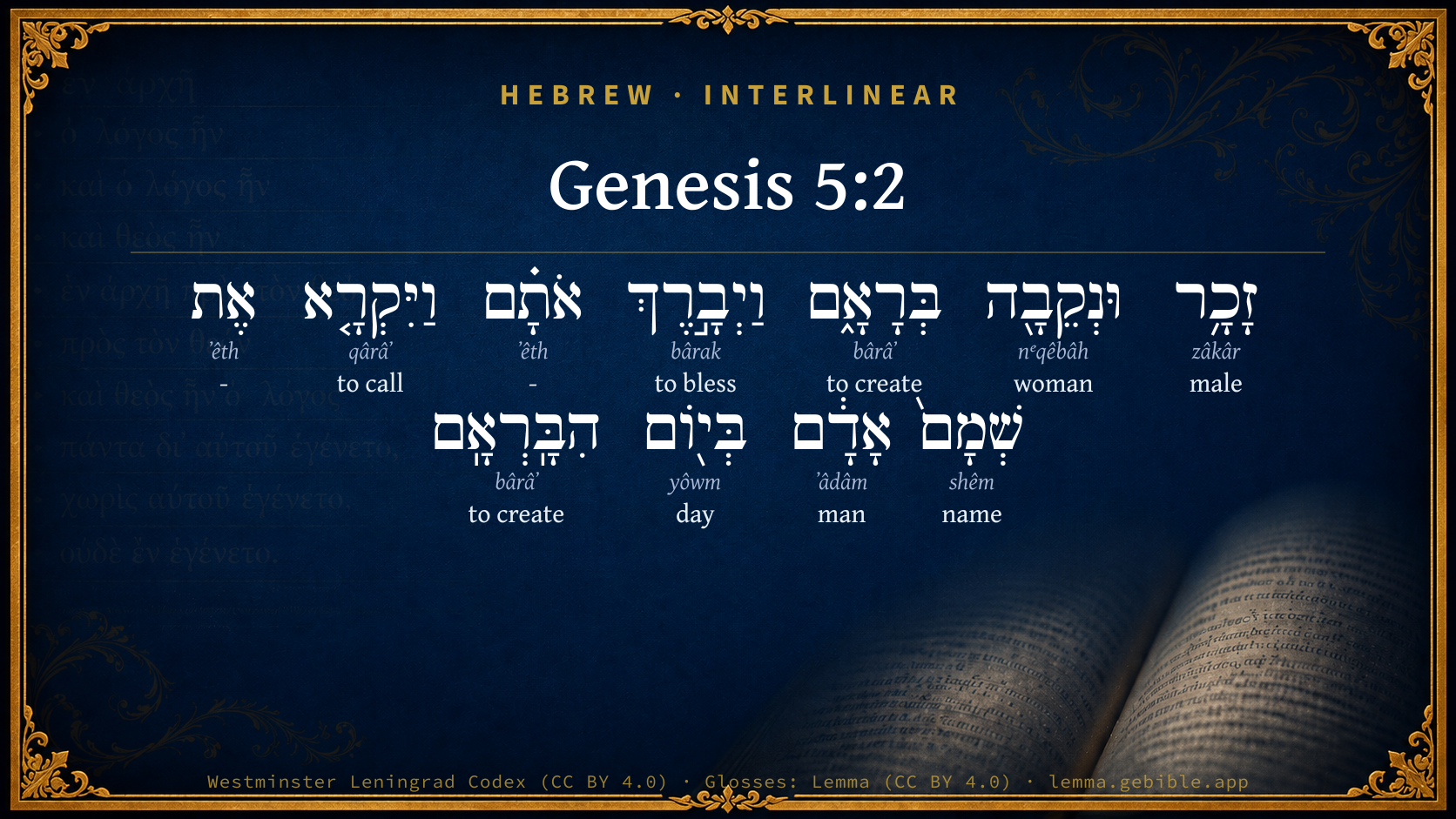
Hebrew (Westminster Leningrad Codex) Genesis 5:2 appears in the Hebrew Old Testament. The text above is from the Westminster Leningrad Codex. Each word links to its Strong’s number, a concise gloss, and parsing drawn from the Open Scriptures Hebrew Bible morphology. Click any word for its full Brown-Driver-Briggs (BDB) entry.
Download image
Cite this verse

Genesis 5:2 (World English Bible). Public Domain. Lemma interlinear Bible study tool, https://lemma.gebible.app/v/genesis/5/2.

Show BibTeX & RIS
BibTeX
RIS
English Translation
He created them male and female, and blessed them, and called their name Adam, in the day when they were created.
World English Bible · Public Domain
Download a study sheet

One document with this verse’s original text, its word-by-word gloss line, the meaning frame, cross-references with their text, attributed commentary, and full source and license credits — printable, and it pastes into notes with its structure intact.

This verse Autodidact and up

Study sheet (.html) Plain text (.txt)

A passage Seminary Student

Up to 50 verses in one chapter. A passage sheet keeps up to 6 commentary sources and 12 cross-references per verse, in the order this page ranks them, and says so on the sheet whenever that leaves anything out. Ask for a single verse and you get the Autodidact verse sheet above.

Everything on this page stays free to read, with no account — the sheet is a download of what is already on screen, not access to it.

Want to remove ads? Support Godless Engineer
Compare translations 3

The same verse in 3 English versions, stacked beneath the original-language interlinear above. Click any original word for its lexicon entry.

Each is an independent rendering of the whole verse — the interlinear is not word-aligned to these translations.

Highlighted words mark where these versions differ — a whole-verse word diff, not a word-by-word alignment.

  • World English Bible Public Domain
    He created them male and female, and blessed them, and called their name Adam, in the day when they were created.
  • King James Version Public Domain
    Male and female created he them; and blessed them, and called their name Adam, in the day when they were created.
  • unfoldingWord Literal Text CC BY-SA 4.0
    He created them male and female, and he blessed them and called their name “man” on the day they were created.

unfoldingWord Literal Text — © unfoldingWord, licensed CC BY-SA 4.0. Word-aligned USFM3 via Door43 (git.door43.org/unfoldingWord/en_ult).

Versions to compare (up to 4)

3 of 4 selected

Show all 18 translations

Every available English version of this verse, each an independent rendering of the whole verse.

  • World English Bible Public Domain
    He created them male and female, and blessed them, and called their name Adam, in the day when they were created.
  • Berean Standard Bible Public Domain
    Male and female He created them, and He blessed them. And in the day they were created, He called them “man.”
  • Majority Standard Bible Public Domain
    Male and female He created them, and He blessed them. And in the day they were created, He called them “man.”
  • King James Version Public Domain
    Male and female created he them; and blessed them, and called their name Adam, in the day when they were created.
  • American Standard Version (1901) Public Domain
    male and female created he them, and blessed them, and called their name Adam, in the day when they were created.
  • Revised Version (1885) Public Domain
    male and female created he them; and blessed them, and called their name Adam, in the day when they were created.
  • Geneva Bible (1599) Public Domain
    Male and female created he them, and blessed them, and called their name Adam in the day that they were created.
  • Douay-Rheims (1899) Public Domain
    He created them male and female; and blessed them: and called their name Adam, in the day when they were created.
  • Young's Literal Translation Public Domain
    a male and a female He hath prepared them, and He blesseth them, and calleth their name Man, in the day of their being prepared.
  • Literal Standard Version CC BY-SA 4.0
    a male and a female He has created them, and He blesses them, and calls their name Man, in the day of their being created.
  • Unlocked Literal Bible CC BY-SA 4.0
    Male and female he created them. He blessed them and named them mankind when they were created.
  • unfoldingWord Literal Text CC BY-SA 4.0
    He created them male and female, and he blessed them and called their name “man” on the day they were created.
  • Darby Bible Public Domain
    Male and female created he them; and blessed them, and called their name Adam, in the day when they were created.
  • World Messianic Bible Public Domain
    He created them male and female, and blessed them. On the day they were created, he named them Adam.
  • Webster's Bible Public Domain
    Male and female created he them; and blessed them, and called their name Adam, in the day when they were created.
  • Free Bible Version CC BY-SA 4.0
    He created them male and female, and blessed them. On the day he created them he called them “human.”
  • Bible in Basic English Public Domain
    Male and female he made them, naming them Man, and giving them his blessing on the day when they were made.
  • JPS Tanakh (1917) Public Domain
    male and female created He them, and blessed them, and called their name Adam, in the day when they were created.

Literal Standard Version (2020), Covenant Press — licensed CC BY-SA 4.0. Text via the HelloAO Bible API (eBible.org). Unlocked Literal Bible (unfoldingWord) — licensed CC BY-SA 4.0. Text via the HelloAO Bible API (eBible.org). unfoldingWord Literal Text — © unfoldingWord, licensed CC BY-SA 4.0. Word-aligned USFM3 via Door43 (git.door43.org/unfoldingWord/en_ult). Free Bible Version, Dr. Jonathan Gallagher — licensed CC BY-SA 4.0. Text via the HelloAO Bible API (eBible.org).

Word by word

More ways to search: Search by grammar → Find every occurrence → Compare this word →

Practice this passage: Drill this verse → Learn its vocabulary →

וּנְקֵבָ֖ה
nᵉqêbâh
H5347
“and · woman”
Conjunction + Noun, Common, Feminine, Singular, Absolute
Part of Speech
Conjunction + Noun
Type
Common
Gender
Feminine
Number
Singular
State
Absolute
Full BDB Definition

Origin: from H5344

TWOT: 1409b

female - woman, female child - female animal
  1. זָכָ֥ר zâkâr H2145 “male” Adjective, Adjective, Masculine, Singular, Absolute
  2. בְּרָאָ֑ם bârâʼ H1254 “to create · them” Verb, Qal, Perfect, 3rd Person, Masculine, Singular + Suffix, Personal, 3rd Person, Masculine, Plural
  3. וַיְבָ֣רֶךְ bârak H1288 “and · to bless” Conjunction + Verb, Piel, Sequential Imperfect, 3rd Person, Masculine, Singular
  4. אֹתָ֗ם ʼêth H853 “- · them” Particle, Direct Object + Suffix, Personal, 3rd Person, Masculine, Plural
  5. וַיִּקְרָ֤א qârâʼ H7121 “and · to call” Conjunction + Verb, Qal, Sequential Imperfect, 3rd Person, Masculine, Singular
  6. אֶת ʼêth H853 “-” Particle, Direct Object
  7. שְׁמָם֙ shêm H8034 “name · their” Noun, Common, Masculine, Singular, Construct + Suffix, Personal, 3rd Person, Masculine, Plural
  8. אָדָ֔ם ʼâdâm H120 “man” Noun, Common, Masculine, Singular, Absolute
  9. בְּי֖וֹם yôwm H3117 “in/at · day of” Preposition + Noun, Common, Masculine, Singular, Construct
  10. הִבָּֽרְאָֽם bârâʼ H1254 “to create · them” Verb, Niphal, Infinitive Construct + Suffix, Personal, 3rd Person, Masculine, Plural

About this verse

These counts appear in no published source. They are computed here, from the morphology-tagged text and Lemma’s own curated glosses. What Lemma adds →

11
words
9
distinct lemmas
Pentateuch
section

Notable vocabulary

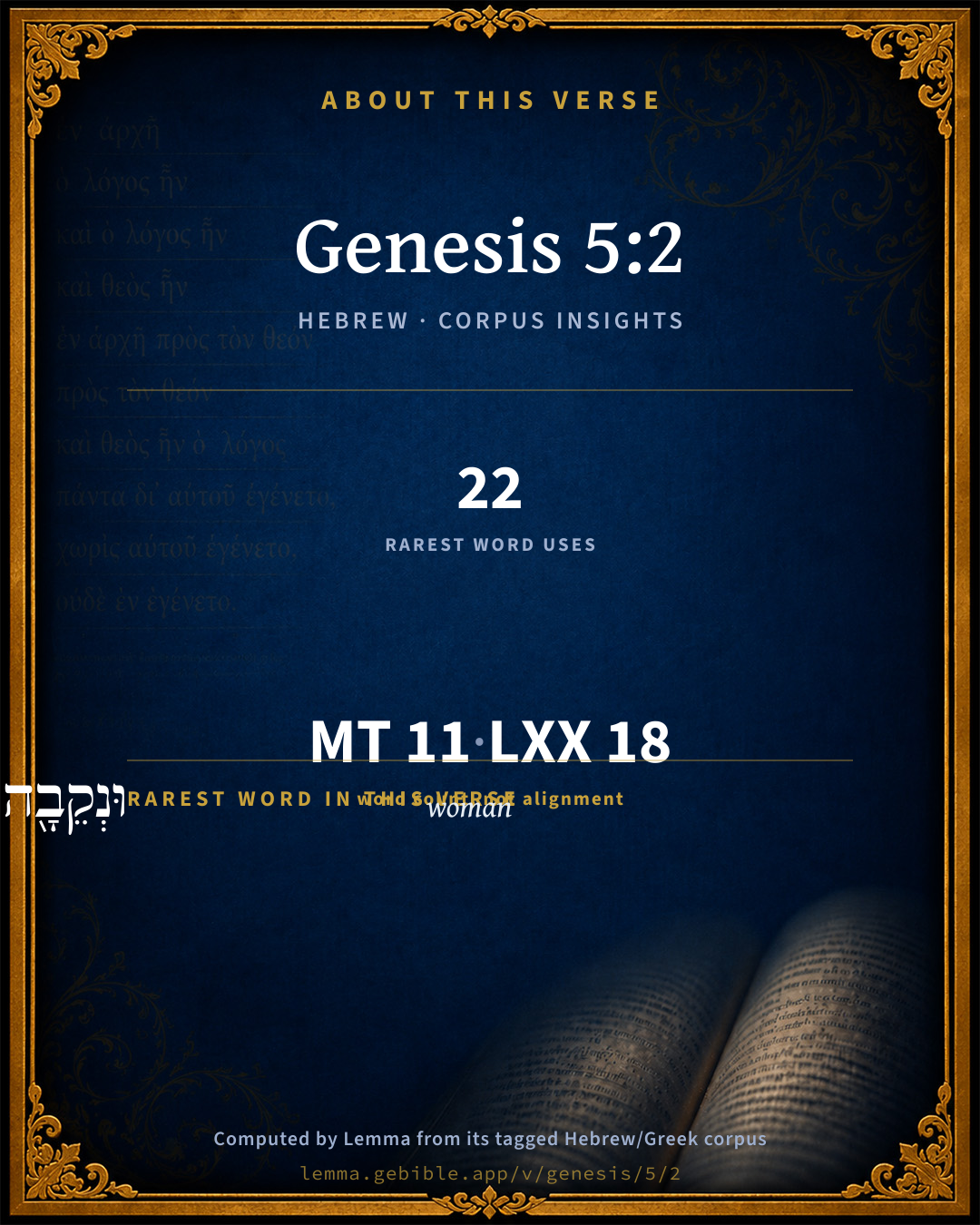
The rarest word here is וּנְקֵבָ֖ה woman H5347 — appearing just 22 times in the whole Hebrew Bible.

Shared distinctive vocabulary

וּנְקֵבָ֖ה woman H5347 occurs in 22 verses of the Hebrew Bible. Also found in:

Grammatical profile

  • 4 verbs
  • 4 nouns
  • 1 adjective
  • 2 particles

Verb forms

  • בְּרָאָ֑ם Qal · Perfect
  • וַיְבָ֣רֶךְ Piel · Sequential Imperfect
  • וַיִּקְרָ֤א Qal · Sequential Imperfect
  • הִבָּֽרְאָֽם Niphal · Infinitive Construct

Repetition

A word recurs within this verse — often emphatic in Hebrew:

  • בְּרָאָ֑ם to create H1254 ×2

Hebrew & Septuagint length

In English translation the verse runs 21 words from the Hebrew and 23 from the Septuagint (LXX English) — closely comparable.

A rough comparison of the two English renderings, which tokenize alike — not a word-level alignment.

Word counts can differ between the Hebrew and the Greek without any difference in meaning — e.g. the Hebrew direct-object marker אֵת has no separate Greek word, and Greek often adds the article ὁ.

In the original languages it is 11 Hebrew tokens and 18 Greek tokens — but the two are counted differently (Hebrew bundles its prefixes and suffixes into one token; the Greek is in lemma form), so that isn’t a like-for-like length.

Cross-references

7

Topical passages linked to Genesis 5:2 in the Treasury of Scripture Knowledge — connected by theme and wording, ordered by reader-vote popularity; previews shown in the World English Bible.

  • Matthew 19:4 He answered, "Haven't you read that he who made them from the beginning made them male and female,
  • Mark 10:6 But from the beginning of the creation, 'God made them male and female.
  • Genesis 2:23 The man said, "This is now bone of my bones, and flesh of my flesh. She will be called Woman, because she was taken out of Man."
  • Genesis 1:27 God created man in his own image. In God's image he created him; male and female he created them.
  • Malachi 2:15 Did he not make one, although he had the residue of the Spirit? Why one? He sought a godly seed. Therefore take heed to your spirit, and let none deal treacherously against the wife of his youth.
  • Genesis 2:15 Yahweh God took the man, and put him into the garden of Eden to dress it and to keep it.
  • Acts 17:26 He made from one blood every nation of men to dwell on all the surface of the earth, having determined appointed seasons, and the boundaries of their dwellings,

Cross-references courtesy of OpenBible.info (CC BY 4.0).

Hebrew and Greek witnesses Masoretic Hebrew ↔ Greek Septuagint

The same verse in the two great witnesses to the Old Testament, shown verse-for-verse.

These are two independent witnesses, not word-aligned to each other, and the Septuagint is shown in lemma (dictionary) form.

Hebrew Genesis 5:2 Masoretic · Westminster Leningrad Codex

זָכָ֥ר וּנְקֵבָ֖ה בְּרָאָ֑ם וַיְבָ֣רֶךְ אֹתָ֗ם וַיִּקְרָ֤א אֶת שְׁמָם֙ אָדָ֔ם בְּי֖וֹם הִבָּֽרְאָֽם

He created them male and female, and blessed them, and called their name Adam, in the day when they were created.

World English Bible · Public Domain

Greek LXX Genesis 5:2 Septuagint · lemma form

ἄρσην καί θῆλυς ποιέω αὐτός καί εὐλογέω αὐτός καί ἐπιὀνομάζω ὁ ὄνομα αὐτός αδαμ ὅς ἡμέρα ποιέω αὐτός

male and female he made them, and blessed them; and he called his name Adam, in the day in which he made them.

LXX2012 (modern English Septuagint) · Public Domain

On this verse, The Cambridge Bible for Schools and Colleges discusses the Septuagint’s reading. Read the note in Commentary ↓

Hebrew: Westminster Leningrad Codex (CC BY 4.0). Greek: Septuagint (public domain); English from LXX2012 (modern English Septuagint) (Public Domain). How the Septuagint differs from the Hebrew →

Targum (Aramaic paraphrase)

2

The Targum is the ancient Jewish Aramaic paraphrase of the Hebrew Scriptures — an interpretive translation, not the Hebrew text itself. Onkelos (literal) and Pseudo-Jonathan (expansive) render the Torah, and Jonathan the Prophets. Coverage is partial: where no permissively-licensed English translation exists for a verse, only the Aramaic is shown. This is verse-level text, not a word-by-word alignment to the Hebrew.

  1. Targum Onkelos Torah (Genesis–Deuteronomy)
    דְּכַר וְנוּקְבָא בְּרָאנוּן וּבָרִיךְ יָתְהוֹן וּקְרָא יָת שְׁמָהוֹן אָדָם בְּיוֹמָא דְאִתְבְּרִיאוּ

    (no public-domain English translation for this verse)

    Targum Onkelos — Aramaic: “Onkelos Genesis” (public domain); “Onkelos Exodus” (public domain); “Onkelos Leviticus” (public domain); “Onkelos Numbers” (public domain); “Onkelos Deuteronomy” (public domain). English: “Sefaria Community Translation” (CC0 1.0 (public-domain dedication)); “J.W. Etheridge. The Targums of Onkelos and Jonathan Ben Uzziel on the Pentateuch. London: Longmans, Green, 1862” (public domain). Text via Sefaria.

  2. Targum Pseudo-Jonathan Torah (Genesis–Deuteronomy)
    דְכַר וְנוּקְבָא בְּרָאנוּן וּבְרִיךְ יַתְהוֹן בְּשׁוּם מֵימְרֵיהּ וּקְרָא יַת שׁוּמְהוֹן אָדָם בְּיוֹמָא דְאִיתְבְּרִיאוּ

    Male and female He created them, and blessed them in the name of His Word; and He called their name Man in the day they were created.

    Targum Pseudo-Jonathan — Aramaic: “Targum Jonathan on Genesis” (public domain); “Targum Jonathan on Exodus” (public domain); “Targum Jonathan on Leviticus” (public domain); “Targum Jonathan on Numbers” (public domain); “Targum Jonathan on Deuteronomy” (public domain). English: “The Targum of Jonathan ben Uzziel, trans. J. W. Etheridge, London, 1862” (public domain). Text via Sefaria.

Commentary

Notes on Genesis 5:2 from classic Christian and Jewish commentators (each source and its license shown beneath its notes). The classic Christian expositions comment on the surrounding passage and are grouped to its opening verse, so a note may address several verses; the Jewish commentaries on the Tanakh (Rashi and others) are per-verse, so they appear only where the commentator wrote on this verse.

Lemma curates 59 commentaries, every one of them public domain or Creative Commons licensed, each selected and text-cleaned for this edition rather than reprinted as found. About our sources →

Trapp's Complete Commentary

John Trapp

Gen 5:2 Male and female created he them; and blessed them, and called their name Adam, in the day when they were created.

Ver. 2. Male and female created he them.] The Jews at this day have base conceits of women: as that they have not so divine a soul as men; that they are of a lower creation, made only for the propagation and pleasure of man, &c. {a} And therefore they suffer them not to enter the synagogue, but appoint them a gallery without. Thus “they err, not knowing the Scriptures.” {Mat 22:29} {See Trapp on "Gen 2:22"}

{a} Blunt’s Voyage, p. 122.

John Trapp, A Commentary or Exposition upon All the Books of the Old and New Testament (1647–1656) — public domain. Text from a community e-Sword module.

Joseph Benson's Commentary

Gen 5:2. He called their name Adam — He gave this name both to the man and the woman. Being at first one by nature, and afterward one by marriage, it was fit they should both have the same name in token of their union.

Joseph Benson's Commentary on the Old and New Testaments (1811–1818) — public domain. Text from a community e-Sword module.

Tyndale Open Study Notes

Tyndale Open Resources

5:2 male and female . . . “human” (Hebrew ’adam): See 1:27 and study note. • blessed them: See 1:28 and study note.

Tyndale Open Study Notes — © Tyndale Open Resources, licensed CC BY-SA 4.0. Text via the HelloAO Bible API.

Geneva Bible (1599)

Geneva Bible translators

By giving them both one name, he noteth the inseparable conjunction of man and wife.

Geneva Bible (1599) marginal notes — public domain. Text via Bolls.life.

John Calvin's Commentaries

2. Male and female created he them. This clause commends the sacred bond of marriage, and the inseparable union of the husband and the wife. For when Moses has mentioned only one, he immediately afterwards includes both under one name. And he assigns a common name indiscriminately to both, in order that posterity might learn more sacredly to cherish this connection between each other, when they saw that their first parents were denominated as one person. The trifling inference of Jewish writers, that married persons only are called Adam, (or man,) is refuted by the history of the creation; nor truly did the Spirit, in this place, mean anything else, than that after the appointment of marriage, the husband and the wife were like one man. Moreover, he records the blessing pronounced upon them, that we may observe in it the wonderful kindness of God in continuing to grant it; yet let us know that by the depravity and wickedness of men it was, in some degree, interrupted.

John Calvin's Commentaries (1540-1563) — public domain. Text from the Calvin Translation Society English edition (1840s-50s) via the Christian Classics Ethereal Library (ccel.org). Calvin's coverage is partial (roughly two-thirds of the Bible); uncommented books and verses are honest gaps, never fabricated. The 19th-century editor's footnotes and remarks are omitted so the notes are faithfully Calvin's own voice.

The Cambridge Bible for Schools and Colleges

gen. ed. J. J. S. Perowne

2. male and female, &c.] This clause is repeated from Gen_1:27.

blessed them] From Gen_1:27. The words of the command, “be fruitful and multiply,” &c., which accompanied the blessing, are not repeated; they are implied in the genealogy that follows.

called their name Adam] Better than marg. “called their name Man.” That God gave the name “man” (Heb. adam) is not recorded in ch. 1. The proper name is probably here intended; but, if so, we should read “his name,” as the LXX, τὸ ὄνομα αὐτοῦ.

The Cambridge Bible for Schools and Colleges (gen. ed. J. J. S. Perowne; Cambridge University Press, 1878–1918) — public domain. Text from a community e-Sword module.

John Gill's Exposition

Male and female created he them,.... Adam and Eve, the one a male, the other a female; and but one male and one female, to show that one man and one woman only were to be joined together in marriage, and live as man and wife for the procreation of posterity; and these were not made together, but first the male, and then the female out of him, though both in one day:

and blessed them; with a power of propagating their species, and multiplying it, and with all other blessings of nature and providence; with an habitation in the garden of Eden; with leave to eat of the fruit of all the trees in it, but one; with subjection of all the creatures to them, and with communion with God in their enjoyments:

and called their name Adam, in the day when they were created; which, as Philo (s) observes, signifies "earth"; and according to Josephus (t) red earth, out of which Adam was made; and as soon as he was made, this name was imposed upon him by God, to put him in mind of his original, that he was of the earth, earthly; and the same name was given to Eve, because made out of him, and because other marriage with him, and union to him; on that account, as ever since, man and wife bear the same name: wherefore I should rather think the name was given them from their junction and union together in love; so the name may be derived from the Arabic word (u) signifying to "join": though some think they had it from their beauty, and the elegance of their form (w), being the most fair and beautiful of the whole creation. The names of Adam and Eve in Sanchoniatho (x), as translated into Greek by Philo Byblius, are Protogonos, the first born, and Aeon, which has some likeness to Eve: the name of the first man with the Chinese is Puoncuus (y).

(s) Leg. Allegor. l. 1. p. 57. (t) Antiqu. l. 1. c. 1. sect. 2. (u) "junxit, addiditque rem rei---amore junxit", Golius, col. 48. (w) "pulcher fuit, nituit", Stockius, p. 13. Vid Ludolph. Hist. Ethiop. l. 1. c. 15. (x) Apud Euseb. Praepar. Evangel. l. 1. p. 34. (y) Martin. Hist. Sinic. l. 1. p. 3.

John Gill's Exposition of the Whole Bible (1746–1763) — public domain (CC PDM 1.0). Text via the HelloAO Bible API.

Haydock's Catholic Bible Commentary

Adam: the common name of mankind, made to the likeness of God. (Haydock)

George Leo Haydock (1774–1849), Haydock's Catholic Family Bible and Commentary, 1859 edition — public domain. Excludes Psalms (Douay-Rheims chapter numbering differs from Protestant) and Deuterocanonical books (Catholic canon only).

Matthew Poole's English Annotations

See Gen 1:26; Mat 19:4; Mar 10:6. He

blessed them with power to propagate their kind, and with other blessings. See Gen 1:28.

Called their name Adam; which name is given both to every man, as Gen 9:6; Psa 49:20, and to the first man, as Gen 2:23, and to the whole kind, both the man and the woman, who are called by one name, to show their intimate union and communion in all things.

Matthew Poole's English Annotations on the Holy Bible (1683–1685) — public domain. Text from a community e-Sword/MySword module.

Whedon's Commentary on the Bible

Daniel D. Whedon

2. Called their name Adam — Adam, אדם, is the Hebrew word for man, and the reference is to Gen_1:26, Let us make אדם. Adam means man of the soil: our word man, (Sanscrit, manuscha, Latin, reeds, Saxon, gemynd,) signifies thinking being. Man and woman were one at creation; their name was Adam.

Daniel D. Whedon (gen. ed.), Commentary on the Old and New Testaments (1874–1909) — public domain. Text from a community e-Sword module.

John Wesley's Explanatory Notes

He called their name Adam - He gave this name both to the man and the woman. Being at first one by nature, and afterwards one by marriage; it was fit they should both have the same name, in token of their union. See note - part two at - "ver. 1"

John Wesley, Explanatory Notes Upon the Whole Bible (1754–1765) — public domain. Text via the GEBible commentary corpus.

Ramban (Nachmanides)

Rabbi Moshe ben Nachman (Ramban / Nachmanides)

AND HE BLESSED THEM. This means that He gave them the power of procreation, to be blessed forever with very many sons and daughters. The intent is to state that begetting offspring comes as a blessing of G-d, for Adam and Eve were not born but were created from nothing and they were blessed to do so [to beget offspring].

AND HE CALLED THEIR NAME ADAM. Since the name Adam (man) is a generic name for the whole human species, Scripture mentions that G-d called the first pair by that name because all generations were potentially in him. It is with reference to them that Scripture says, This is the book of the generations of Adam. Rabbeinu Sherira Gaon wrote that the Sages transmitted to one another [the principles of knowledge concerning] “the recognition of faces” and the arrangements of the lines in the face. Some of these principles are stated in the order of the words of the verse, This is the book of the generations of Adam, and some in the order of the following verse, Male and female He created them. But the secrets and mysteries of the Torah are transmitted only to those in whom we see signs indicating that he is worthy of it. These are the words of the Gaon, but we have not merited to understand them.

Ramban (Nachmanides) on the Tanakh — English translation: “Commentary on the Torah by Ramban (Nachmanides). Translated and annotated by Charles B. Chavel. New York, Shilo Pub. House, 1971-1976” (CC BY 4.0). Text via Sefaria.

Radak

Rabbi David Kimhi (Radak)

זכר ונקבה...ויברך אותם, the blessing, mentioned already in 1,28 consisted of his ability to reproduce, fill the earth and conquer it. If man was equipped to conquer others, he must certainly be able to conquer the evil urge within himself.

ויקרא את שמם ארם ביום הבראם, a reference to 1,26 when G’d had announced His intention to create Adam, saying נעשה אדם בצלמנו, G’d’s purpose in creating him was that he be an אדם, and not another species of בהמה or חיה. Woman too, is included in the description and definition of the word אדם. Proof that woman was included in that term אדם is the plural mode of G’d’s original announcement, uttered before Chavah had been separated from Adam’s body (1,26) וירדו בדגת הים וגו', “they shall rule over the fish of the sea, etc.” This name אדם distinguishes the human species from all other mammals, for, although his body too has been formed from the earth, he possesses a divine soul which originated in heaven. If he allows himself to be drawn by the spiritually negative gravitational pull exerted by the material part his body consists of, he is considered as if no better than אדמה, as if the spiritual soul inside of him had been neutralised. This is exactly what the descendants of Kayin had become guilty of, and this is why the Torah does not bother to enumerate them in this chapter.

Radak on the Tanakh — English translations: “Sefaria Community Translation” (CC0 1.0 (public-domain dedication)); “Eliyahu Munk, HaChut Hameshulash” (CC BY 4.0); “Rabbi Mike Feuer, Jerusalem Anthology” (CC BY 4.0); and “R. David Kimhi on the first book of Psalms, Translated by R.G. Finch, London, 1919” (public domain). Text via Sefaria.

Lesson kit

Teaching starters — assembled from the data on this page, not authored interpretation. Every prompt links to the verse data it draws on. Edit before teaching.

Genesis, in the Pentateuch, opens this verse with 11 words (9 distinct Hebrew lemmas). Its most distinctive word is nᵉqêbâh (“woman”). A historical commentator’s framing appears above. Read the whole chapter for the surrounding context.

Discussion questions

  1. The word nᵉqêbâh carries the sense “woman.” How does it shape the verse?
  2. How does Genesis 1:27, which shares the word «woman», read alongside this verse?
  3. What does the repetition of “to create” (2× in this one verse) do in this verse?
  4. These translations render this verse differently; the difference is in the English rendering, not the original. What questions does that raise?
  5. «בְּרָאָ֑ם» is a Qal Perfect verb. How does that grammatical form shape the action described?
  6. Compare how Trapp's Complete Commentary and Joseph Benson's Commentary read this verse. Where do they agree or differ?

Things to notice

Reading settings

Reading text

Shown beneath each verse's original-language words.

Old Testament
Old Testament edition

Read the OT as the Masoretic Hebrew (MT) or the Greek Septuagint (LXX).

English shown for the Greek Septuagint (in the Hebrew ↔ Greek comparison).

Comparing translations? Open the Compare panel on any verse page to stack up to four side by side.