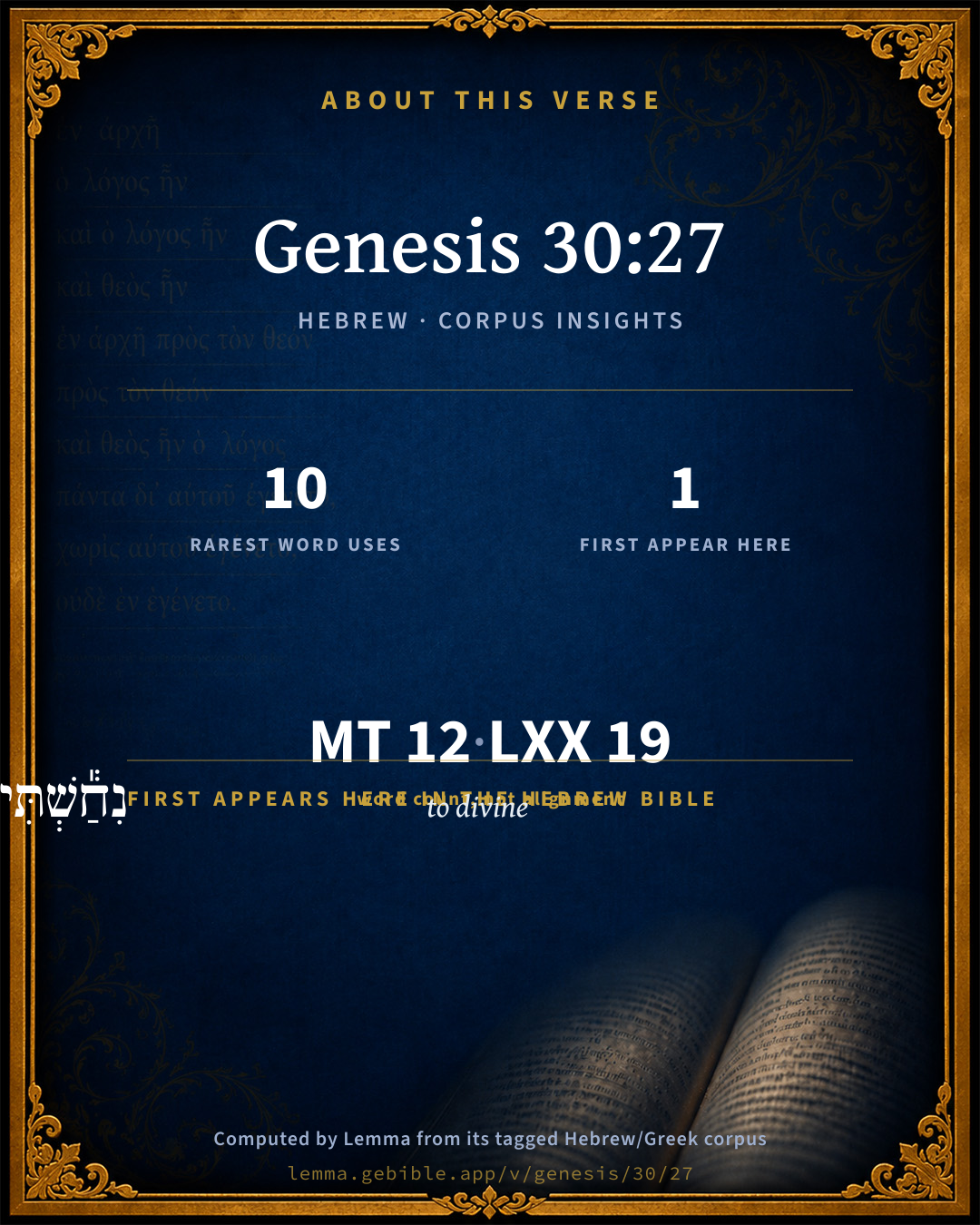
Genesis 30:27

Hebrew (Westminster Leningrad Codex) Genesis 30:27 appears in the Hebrew Old Testament. The text above is from the Westminster Leningrad Codex. Each word links to its Strong’s number, a concise gloss, and parsing drawn from the Open Scriptures Hebrew Bible morphology. Click any word for its full Brown-Driver-Briggs (BDB) entry.
Download image
Cite this verse

Genesis 30:27 (World English Bible). Public Domain. Lemma interlinear Bible study tool, https://lemma.gebible.app/v/genesis/30/27.

Show BibTeX & RIS
BibTeX
RIS
English Translation
Laban said to him, "If now I have found favor in your eyes, stay here, for I have divined that Yahweh has blessed me for your sake."
World English Bible · Public Domain
Highlights
  • 1 first appearance in the Hebrew Bible
Full analysis ↓
Download a study sheet

One document with this verse’s original text, its word-by-word gloss line, the meaning frame, cross-references with their text, attributed commentary, and full source and license credits — printable, and it pastes into notes with its structure intact.

This verse Autodidact and up

Study sheet (.html) Plain text (.txt)

A passage Seminary Student

Up to 50 verses in one chapter. A passage sheet keeps up to 6 commentary sources and 12 cross-references per verse, in the order this page ranks them, and says so on the sheet whenever that leaves anything out. Ask for a single verse and you get the Autodidact verse sheet above.

Everything on this page stays free to read, with no account — the sheet is a download of what is already on screen, not access to it.

Want to remove ads? Support Godless Engineer
Compare translations 3

The same verse in 3 English versions, stacked beneath the original-language interlinear above. Click any original word for its lexicon entry.

Each is an independent rendering of the whole verse — the interlinear is not word-aligned to these translations.

Highlighted words mark where these versions differ — a whole-verse word diff, not a word-by-word alignment.

  • World English Bible Public Domain
    Laban said to him, "If now I have found favor in your eyes, stay here, for I have divined that Yahweh has blessed me for your sake."
  • King James Version Public Domain
    And Laban said unto him, I pray thee, if I have found favor in thine eyes, tarry: for I have learned by experience that the LORD hath blessed me for thy sake.
  • unfoldingWord Literal Text CC BY-SA 4.0
    Then Laban said to him, “Please, if I have found favor in your eyes. I have learned by divination that Yahweh has blessed me because of you.”

unfoldingWord Literal Text — © unfoldingWord, licensed CC BY-SA 4.0. Word-aligned USFM3 via Door43 (git.door43.org/unfoldingWord/en_ult).

Versions to compare (up to 4)

3 of 4 selected

Show all 18 translations

Every available English version of this verse, each an independent rendering of the whole verse.

  • World English Bible Public Domain
    Laban said to him, "If now I have found favor in your eyes, stay here, for I have divined that Yahweh has blessed me for your sake."
  • Berean Standard Bible Public Domain
    But Laban replied, “If I have found favor in your eyes, please stay. I have learned by divination that the LORD has blessed me because of you.”
  • Majority Standard Bible Public Domain
    But Laban replied, “If I have found favor in your eyes, please stay. I have learned by divination that the LORD has blessed me because of you.”
  • King James Version Public Domain
    And Laban said unto him, I pray thee, if I have found favor in thine eyes, tarry: for I have learned by experience that the LORD hath blessed me for thy sake.
  • American Standard Version (1901) Public Domain
    And Laban said unto him, If now I have found favor in thine eyes, `tarry': `for' I have divined that Jehovah hath blessed me for thy sake.
  • Revised Version (1885) Public Domain
    And Laban said unto him, If now I have found favour in thine eyes, tarry: for I have divined that the LORD hath blessed me for thy sake.
  • Geneva Bible (1599) Public Domain
    To whom Laban answered, If I haue nowe found fauour in thy sight tarie: I haue perceiued that the Lord hath blessed me for thy sake.
  • Douay-Rheims (1899) Public Domain
    Laban said to him: Let me find favour in thy sight: I have learned by experience, that God hath blessed me for thy sake.
  • Young's Literal Translation Public Domain
    And Laban saith unto him, `If, I pray thee, I have found grace in thine eyes -- I have observed diligently that Jehovah doth bless me for thy sake.'
  • Literal Standard Version CC BY-SA 4.0
    And Laban says to him, “Now if I have found grace in your eyes—I have observed diligently that YHWH blesses me for your sake.”
  • Unlocked Literal Bible CC BY-SA 4.0
    Laban said to him, “If now I have found favor in your eyes, wait, because I have learned by using divination that Yahweh has blessed me for your sake.”
  • unfoldingWord Literal Text CC BY-SA 4.0
    Then Laban said to him, “Please, if I have found favor in your eyes. I have learned by divination that Yahweh has blessed me because of you.”
  • Darby Bible Public Domain
    And Laban said to him, I pray thee, if I have found favour in thine eyes -- I have discovered that Jehovah has blessed me for thy sake.
  • World Messianic Bible Public Domain
    Laban said to him, “If now I have found favor in your eyes, stay here, for I have divined that the LORD has blessed me for your sake.”
  • Webster's Bible Public Domain
    And Laban said to him, I pray thee, if I have found favor in thine eyes, tarry: for I have learned by experience, that the LORD hath blessed me for thy sake.
  • Free Bible Version CC BY-SA 4.0
    “Please be so kind as to stay,” Laban replied, “because I have discovered that the Lord has blessed me because of you.”
  • Bible in Basic English Public Domain
    And Laban said, If you will let me say so, do not go away; for I have seen by the signs that the Lord has been good to me because of you.
  • JPS Tanakh (1917) Public Domain
    And Laban said unto him: 'If now I have found favour in thine eyes — I have observed the signs, and the LORD hath blessed me for thy sake.'

Literal Standard Version (2020), Covenant Press — licensed CC BY-SA 4.0. Text via the HelloAO Bible API (eBible.org). Unlocked Literal Bible (unfoldingWord) — licensed CC BY-SA 4.0. Text via the HelloAO Bible API (eBible.org). unfoldingWord Literal Text — © unfoldingWord, licensed CC BY-SA 4.0. Word-aligned USFM3 via Door43 (git.door43.org/unfoldingWord/en_ult). Free Bible Version, Dr. Jonathan Gallagher — licensed CC BY-SA 4.0. Text via the HelloAO Bible API (eBible.org).

Word by word

More ways to search: Search by grammar → Find every occurrence → Compare this word →

Practice this passage: Drill this verse → Learn its vocabulary →

בִּגְלָלֶֽךָ
gâlâl
H1558
“in/at · on account of · your”
Preposition + Noun, Common, Masculine, Singular, Construct + Suffix, Personal, 2nd Person, Masculine, Singular
Part of Speech
Preposition + Noun
Type
Common
Gender
Masculine
Number
Singular
State
Construct
Full BDB Definition

Origin: from H1556

TWOT: 352

on account of, for the sake of
  1. וַיֹּ֤אמֶר ʼâmar H559 “and · to say” Conjunction + Verb, Qal, Sequential Imperfect, 3rd Person, Masculine, Singular
  2. אֵלָיו֙ ʼêl H413 “to · him” Preposition + Suffix, Personal, 3rd Person, Masculine, Singular
  3. לָבָ֔ן Lâbân H3837 “Laban” Noun, Proper
  4. אִם ʼim H518 “if” Conjunction
  5. נָ֛א nâʼ H4994 “please” Particle, Exhortation
  6. מָצָ֥אתִי mâtsâʼ H4672 “to find” Verb, Qal, Perfect, 1st Person, Common, Singular
  7. חֵ֖ן chên H2580 “grace” Noun, Common, Masculine, Singular, Absolute
  8. בְּעֵינֶ֑יךָ ʻayin H5869 “in/at · eyes · your” Preposition + Noun, Common, Both, Dual, Construct + Suffix, Personal, 2nd Person, Masculine, Singular
  9. נִחַ֕שְׁתִּי nâchash H5172 “to divine” Verb, Piel, Perfect, 1st Person, Common, Singular
  10. וַיְבָרֲכֵ֥נִי bârak H1288 “and · to bless · me” Conjunction + Verb, Piel, Sequential Imperfect, 3rd Person, Masculine, Singular + Suffix, Personal, 1st Person, Common, Singular
  11. יְהוָ֖ה Yᵉhôvâh H3068 “LORD” Noun, Proper

About this verse

These counts appear in no published source. They are computed here, from the morphology-tagged text and Lemma’s own curated glosses. What Lemma adds →

12
words
12
distinct lemmas
Pentateuch
section

Notable vocabulary

The rarest word here is בִּגְלָלֶֽךָ on account of H1558 — appearing just 10 times in the whole Hebrew Bible.

First appearance in Scripture

This word makes its first canonical appearance in the Hebrew Bible here:

  • נִחַ֕שְׁתִּי to divine H5172

Shared distinctive vocabulary

בִּגְלָלֶֽךָ on account of H1558 occurs in 10 verses of the Hebrew Bible. Also found in:

Grammatical profile

  • 4 verbs
  • 5 nouns
  • 1 preposition
  • 1 conjunction
  • 1 particle

Verb forms

  • וַיֹּ֤אמֶר Qal · Sequential Imperfect
  • מָצָ֥אתִי Qal · Perfect
  • נִחַ֕שְׁתִּי Piel · Perfect
  • וַיְבָרֲכֵ֥נִי Piel · Sequential Imperfect

Hebrew & Septuagint length

In English translation the verse runs 27 words from the Hebrew and 27 from the Septuagint (LXX English) — the same length.

A rough comparison of the two English renderings, which tokenize alike — not a word-level alignment.

Word counts can differ between the Hebrew and the Greek without any difference in meaning — e.g. the Hebrew direct-object marker אֵת has no separate Greek word, and Greek often adds the article ὁ.

In the original languages it is 12 Hebrew tokens and 19 Greek tokens — but the two are counted differently (Hebrew bundles its prefixes and suffixes into one token; the Greek is in lemma form), so that isn’t a like-for-like length.

Cross-references

23

Topical passages linked to Genesis 30:27 in the Treasury of Scripture Knowledge — connected by theme and wording, ordered by reader-vote popularity; previews shown in the World English Bible.

  • Genesis 26:24 Yahweh appeared to him the same night, and said, "I am the God of Abraham your father. Don't be afraid, for I am with you, and will bless you, and multiply your seed for my servant Abraham's sake."
  • Ruth 2:13 Then she said, Let me find favor in your sight, my lord, because you have comforted me, and because you have spoken kindly to your handmaid, though I am not as one of your handmaidens.
  • Isaiah 61:9 Their seed shall be known among the nations, and their offspring among the peoples; all who see them shall acknowledge them, that they are the seed which Yahweh has blessed.
  • Acts 7:10 and delivered him out of all his afflictions, and gave him favor and wisdom before Pharaoh, king of Egypt. He made him governor over Egypt and all his house.
  • Genesis 12:3 I will bless those who bless you, and I will curse him who curses you. In you will all of the families of the earth be blessed."
  • Genesis 39:2–5 Yahweh was with Joseph, and he was a prosperous man. He was in the house of his master the Egyptian.
  • Genesis 39:21–23 But Yahweh was with Joseph, and showed kindness to him, and gave him favor in the sight of the keeper of the prison.
  • Exodus 3:21 I will give this people favor in the sight of the Egyptians, and it will happen that when you go, you shall not go empty-handed.
  • Genesis 18:3 and said, "My lord, if now I have found favor in your sight, please don't go away from your servant.
  • Genesis 30:30 For it was little which you had before I came, and it has increased to a multitude. Yahweh has blessed you wherever I turned. Now when will I provide for my own house also?"
  • Genesis 47:25 They said, "You have saved our lives! Let us find favor in the sight of my lord, and we will be Pharaoh's servants."
  • Genesis 33:15 Esau said, "Let me now leave with you some of the folk who are with me." He said, "Why? Let me find favor in the sight of my lord."
  • 1 Kings 11:19 Hadad found great favor in the sight of Pharaoh, so that he gave him as wife the sister of his own wife, the sister of Tahpenes the queen.
  • Daniel 1:9 Now God made Daniel to find kindness and compassion in the sight of the prince of the eunuchs.
  • Genesis 34:11 Shechem said to her father and to her brothers, "Let me find favor in your eyes, and whatever you will tell me I will give.
  • Numbers 11:15 If you deal thus with me, please kill me out of hand, if I have found favor in your sight; and let me not see my wretchedness.
  • Nehemiah 1:11 Lord, I beg you, let now your ear be attentive to the prayer of your servant, and to the prayer of your servants, who delight to fear your name; and please prosper your servant this day, and grant him mercy in the sight of this man. Now I was cup bearer to the king.
  • 1 Samuel 16:22 Saul sent to Jesse, saying, Please let David stand before me; for he has found favor in my sight.
  • Nehemiah 2:5 I said to the king, If it please the king, and if your servant have found favor in your sight, that you would send me to Judah, to the city of my fathers' tombs, that I may build it.
  • Psalms 1:3 He will be like a tree planted by the streams of water, That brings forth its fruit in its season, Whose leaf also does not wither. Whatever he does shall prosper.
  • Isaiah 6:13 If there are yet a tenth in it, It also shall in turn be eaten up: As a terebinth, and as an oak, whose stock remains, when they are felled; So the holy seed is its stock."
  • Isaiah 65:8 Thus says Yahweh, As the new wine is found in the cluster, and one says, Don't destroy it, for a blessing is in it: so will I do for my servants' sake, that I may not destroy them all.
  • Numbers 11:11 Moses said to Yahweh, Why have you dealt ill with your servant? and why haven't I found favor in your sight, that you lay the burden of all this people on me?

Cross-references courtesy of OpenBible.info (CC BY 4.0).

Hebrew and Greek witnesses Masoretic Hebrew ↔ Greek Septuagint

The same verse in the two great witnesses to the Old Testament, shown verse-for-verse.

These are two independent witnesses, not word-aligned to each other, and the Septuagint is shown in lemma (dictionary) form.

Hebrew Genesis 30:27 Masoretic · Westminster Leningrad Codex

וַיֹּ֤אמֶר אֵלָיו֙ לָבָ֔ן אִם נָ֛א מָצָ֥אתִי חֵ֖ן בְּעֵינֶ֑יךָ נִחַ֕שְׁתִּי וַיְבָרֲכֵ֥נִי יְהוָ֖ה בִּגְלָלֶֽךָ

Laban said to him, "If now I have found favor in your eyes, stay here, for I have divined that Yahweh has blessed me for your sake."

World English Bible · Public Domain

Greek LXX Genesis 30:27 Septuagint · lemma form

εἶπον δέ αὐτός λαβαν εἰ εὑρίσκω χάρις ἐναντίον σύ οἰωνίζομαι ἄν εὐλογέω γάρ ἐγώ ὁ θεός ὁ σός εἴσοδος

And Laban said to him, If I have found grace in your sight, I would augur well, for the Lord has blessed me at your coming in.

LXX2012 (modern English Septuagint) · Public Domain

On this verse, The Cambridge Bible for Schools and Colleges discusses the Septuagint’s reading. Read the note in Commentary ↓

Hebrew: Westminster Leningrad Codex (CC BY 4.0). Greek: Septuagint (public domain); English from LXX2012 (modern English Septuagint) (Public Domain). How the Septuagint differs from the Hebrew →

Targum (Aramaic paraphrase)

2

The Targum is the ancient Jewish Aramaic paraphrase of the Hebrew Scriptures — an interpretive translation, not the Hebrew text itself. Onkelos (literal) and Pseudo-Jonathan (expansive) render the Torah, and Jonathan the Prophets. Coverage is partial: where no permissively-licensed English translation exists for a verse, only the Aramaic is shown. This is verse-level text, not a word-by-word alignment to the Hebrew.

  1. Targum Onkelos Torah (Genesis–Deuteronomy)
    וַאֲמַר לֵהּ לָבָן אִם כְּעַן אַשְׁכָּחִית רַחֲמִין קֳדָמָךְ נַסֵּיתִי וּבָרְכַנִי יְיָ בְּדִילָךְ

    (no public-domain English translation for this verse)

    Targum Onkelos — Aramaic: “Onkelos Genesis” (public domain); “Onkelos Exodus” (public domain); “Onkelos Leviticus” (public domain); “Onkelos Numbers” (public domain); “Onkelos Deuteronomy” (public domain). English: “Sefaria Community Translation” (CC0 1.0 (public-domain dedication)); “J.W. Etheridge. The Targums of Onkelos and Jonathan Ben Uzziel on the Pentateuch. London: Longmans, Green, 1862” (public domain). Text via Sefaria.

  2. Targum Pseudo-Jonathan Torah (Genesis–Deuteronomy)
    וַאֲמַר לֵיהּ לָבָן אִין כְּדוּן אַשְׁכָּחִית רַחֲמִין בְּעֵינָךְ הָא אַטְיָרִית קוּסְמִין וּבָרִכַנִי יְיָ בְּגִינָךְ

    But Laban said to him, If now I have found grace in thy eyes, I have observed by divination that the Lord hath blessed me for thy sake.

    Targum Pseudo-Jonathan — Aramaic: “Targum Jonathan on Genesis” (public domain); “Targum Jonathan on Exodus” (public domain); “Targum Jonathan on Leviticus” (public domain); “Targum Jonathan on Numbers” (public domain); “Targum Jonathan on Deuteronomy” (public domain). English: “The Targum of Jonathan ben Uzziel, trans. J. W. Etheridge, London, 1862” (public domain). Text via Sefaria.

Commentary

Notes on Genesis 30:27 from classic Christian and Jewish commentators (each source and its license shown beneath its notes). The classic Christian expositions comment on the surrounding passage and are grouped to its opening verse, so a note may address several verses; the Jewish commentaries on the Tanakh (Rashi and others) are per-verse, so they appear only where the commentator wrote on this verse.

Lemma curates 59 commentaries, every one of them public domain or Creative Commons licensed, each selected and text-cleaned for this edition rather than reprinted as found. About our sources →

Trapp's Complete Commentary

John Trapp

Gen 30:27 And Laban said unto him, I pray thee, if I have found favour in thine eyes, [tarry: for] I have learned by experience that the LORD hath blessed me for thy sake.

Ver. 27. I pray thee, if I have found favour, &c.] This miserable muckworm, so he may advance his own ends, abased himself to his servants, colloguing or anything, to curry favour, and compass commodity. But he that is swallowed up of the earth (as Korah was), his ears stopped, his heart stuffed, and all passages for God’s Spirit obstructed by it, shall have earth enough when he dies: his mouth shall be filled with a spadeful of mould, and his never-enough quit with fire-enough, in the bottom of hell. Such another courteous caitiff as this in the text was that Plautianus, a rich Roman, of great authority with Severus the Emperor. Omnia enim petebat ab omnibus, et cupiebat omnia , saith the historian {b} Herein only he differed from Laban, when he married his daughter to Antonius the son of Severus, he gave her as much portion as would have sufficed for fifty queens. {a}

{a} Dio in Vita Severi.

{b} Is tantum filiae suae dedit, quantum reginis quinquaginta satis esset . - Dio in Vita Severi.

John Trapp, A Commentary or Exposition upon All the Books of the Old and New Testament (1647–1656) — public domain. Text from a community e-Sword module.

The Biblical Illustrator

Joseph S. Exell

Gen_30:27

I have learned by experience

Moral and religious lessons gained by experience

The words are Labans, and, taken in their connection, they intimate that even an utterly wordly man, such as he was, may be forced to acknowledge the moral providence of God, whereby He takes especial and peculiar care of His servants.

Look at the moral and religious lessons which a thoughtful man may learn by experience.

I. We learn by experience MUCH THAT IS WHOLESOME ABOUT OURSELVES. By the blunders we have made, the falls we have suffered, the injuries we have sustained, the sins we have committed, and the wrongs we have inflicted on others, God has enlightened us in the knowledge of ourselves, and made us feel that it is not in man that walketh to direct his steps.

II. Experience has taught us MUCH REGARDING THE WORLD AND ITS PLEASURES, POSSESSIONS, AND ENJOYMENTS. Even in the case of the Christian, there is much to wean him from the world as the years roll on. As he grows older the world becomes less and less to him, and Christ becomes more and more. He learns to delight in God, and his growth in holiness becomes the ambition of his life.

III. The experience of the lapse of years teaches US MORE AND MORE OF GOD AS THE GOD AND FATHER OF OUR LORD JESUS CHRIST. We have increasing proofs of Gods wisdom and Gods faithfulness. Whoever has been false to us, He has remained true. This testimony of experience thus grows with our growth and strengthens with our strength. It is a fortress which is utterly impregnable. (W. M. Taylor, D. D.)

Experience

Find men where you may, they all agree in owning that they owe much to the same Instructor: they all agree in owning that they have grown wiser for the teaching of that unflattering Preceptor, who knows no royal road to truth, and in whose stern school you must stumble once, that you may learn to avoid falling again. And truly here is the best way to learn--the way that sinks the deepest, and is remembered the best.

And if it be true, as the proverbial saying would have it, that experience teaches the foolish, surely it is true no less that experience makes the wise. And as experience is the teacher that instructs all men and instructs them unthanked and unasked, so there are many things which no other can teach us: many lessons we never learn, and many matters we never rightly understand, till we have learned by experience. We shall never know, for example, what our hearts can feel and bear, by the descriptions of other people; no account can make us understand what great sorrow is, or great anxiety, or buoyant gladness, or hearty gratitude, or fixed determination; we must feel in ourselves the quickened pulse of hopefulness, the laden heart of care, the blankness of disappointment and failure; or we shall never know what they mean. Even Jesus Christ, our Maker, gained that consummate sympathy with us which it became our Saviour to have, through actual experience. But there is one class of subjects one great subject which above all others we must know by experience, or we shall not know at all. My brethren, this is a thing that is hard upon mere human reason; this matter of the real power and efficacy of prayer. If there be any truth in what we believe of the power of prayer, it is the mightiest agent--save God Himself--in all the universe: it is stronger than the hurricane that wrecks a navy: stronger than the great ocean to which mans mightiest works are as a plaything. Christian brethren, let us frankly confess what a weak state, what an insecure position we should be in, if we were taking all this on hearsay. Why, it looks such a truly monstrous deal to believe, that positively for your credit as a reasonable man, you would be half ashamed to say you fancied all this. Never concern yourself to unravel the threads the sceptic has twisted; never set yourself to answer by argument the objections he has raised. It can be done, but there is a far better way. Tell him that your Bible bids you pray, and assures you that prayer shall prevail; but tell him more--and God be thanked if you can say so much--tell him that you have put the matter to the proof!--that you were not content to take the thing on the word of others; that you fairly tried, and that you learned by experience that prayer is heard and answered! Another thing that we may learn by rote, but that we never shall really believe till we learn it by experience, is the insufficiency of this world to satisfy the soul; the great truth, that This is not our rest. For experience alone is enough to bring men to the strong belief, that all worldly things, even when possessed in their intensest degree, leave an aching void within the soul--many a stated man of pleasure, many a successful man of ambition, has told us as much as that--but it needs Gods Holy Spirit to touch the soul, before it can take the next step--before it can draw the final conclusion--that the right things for the soul to love and seek are beyond the grave, and that the hearts true home and abiding treasure are there. But we shall give the remainder of our time to looking at one great fact which is best learned by experience--I mean the preciousness, the all-sufficiency, the love and grace, of our blessed Saviour. You remember it is written, Unto you which believe He is precious. Now that seems to mean, that to those who believe, He is more precious than He is to other people; that, in a peculiarly strong sense, His preciousness is a thing that must be learned by experience. So it is. And it is easy to see how it must be. For the value of a thing is understood fully only by those who know how much they want it. And if a man feels that he does not want a thing--that he can do perfectly well without it--why, he will esteem it as of very little value indeed. Now a perfectly worldly and unconverted man feels he needs food, he cannot do without that; and so of course he sets a value on it. He feels he needs a home to dwell in--he cannot do without that; and so of course he sets a value on it. He feels he needs friends--that life would be a poor, heartless thing without them; and so he sets a value on them. But the quite worldly and unconverted man, who brings everything to a quite worldly estimate, does not feel he needs Christ; he never feels any want of Him; he thinks he can do quite well without Him; and of course he sets no value on Him; of course the Saviour is not precious to that man--how can He be? But, brethren, look to the man who has been convinced of his sin and misery by the Spirit of God; and that only our Redeemer can save us from that dismal estate, and see what he thinks of Christ! Yes, that convicted sinner has found his need of the Saviour. He has learnt that food and raiment, and all things men work hardest for and value most, are not the one thing needful--are worth nothing when compared with a saving interest in the blessed Lamb of God. He has learned by experience I He has felt a want, felt that the Saviour alone could supply that want; and he knows what Christ is worth, by what Christ has done! (A. K. H. Boyd, D. D.)

Experience

1. The true teacher.

2. The universal monitor.

3. The indisputable evidence.

4. Experience of sin, pardon, peace.

5. Character thus becomes argument.

6. Let sin be subjected to this test.

7. The Christian triumphant here.

8. Many can answer by experience who cannot answer by controversy. (J. Parker, D. D.)

Learning by experience

The world is a school, and the period of our remaining here is the school-time of our existence. The school is a severe one, the discipline is hard, and the process is often tedious. God is the teacher, and He has many assistants, which in various ways and manners are used to bring the soul to saving knowledge of the truth. Now, there is no method so potent for impressing facts on the mind as actual practice. Theory is an ideality which amid the whirl of time and business is soon dissipated. It is only when we ourselves apprehend, through actual touching and handling, that we get a positive and practical knowledge of anything. The most learned engineer who ever lived would feel at a terrible loss if put to drive an express locomotive or to superintend the engines of a vast steamship, if he had never seen one before, although he might have read and written on the subjects all his life. The most skilful theoretical architect would shrink from the ordeal of practical building.

I. We learn by experience THE FLIGHT OF TIME. The child is scarcely conscious that time moves at all. It is to him a calm, placid, unruffled lake. But the illusion is gradually dispelled. Youth deepens into maturity, maturity glides into incipient decay, and the soul is startled to find how rapidly life is passing. Then it begins to fly by like a rushing river torrent.

II. We learn by experience THE FRAILTY OF HUMAN NATURE. The curse of decay comes as a revelation. Death of a playmate or relation startles the little soul and awakens an unknown terror. Then with the flight of time comes the realization of weakness within ourselves.

III. We have learned by experience the DISAPPOINTMENTS OF EARTH. How has the sanguine heart grown broken and seared! The rosy vision has minished into darkness. Disappointments!

IV. We have learnt by experience THE VANITY OF TRUSTING TO SELF. Self-sufficiency is mans heritage and Satans mightiest weapon. The best contrived scheme brought to nought, the wisest forethought nullified, the labours of a lifetime lost, have shown us how vain is man.

V. We have learned by experience THE UNENDING LOVE, COMPASSION, AND GOODNESS OF GOD. (Homilist.)

Experience

I. SOME OF THE LESSONS LEARNED BY EXPERIENCE.

1. The unsatisfying nature of all earthly objects.

2. The preciousness of Christ.

3. The efficacy of prayer.

4. The benefit of affliction.

5. The sustaining power of Gods grace.

II. THE REASONS WHY GOD TEACHES US BY EXPERIENCE.

1. Because we will not learn our duty without it.

2. Because the lessons thus acquired are the most valuable and permanent.

3. Because we are then more useful to our fellow-men. (Seeds and Saplings.)

The Biblical Illustrator, edited by Joseph S. Exell (c. 1880s–1900s) — public domain. Text from a community e-Sword module.

Joseph Benson's Commentary

Gen 30:27. I have learned by experience — The best way of learning. And it would be well if we always remembered and adhered to what we have thus learned. But, alas! we are too apt to forget or neglect it.

Joseph Benson's Commentary on the Old and New Testaments (1811–1818) — public domain. Text from a community e-Sword module.

Tyndale Open Study Notes

Tyndale Open Resources

30:27 I have become wealthy: God had prospered Laban through Jacob’s presence (see 22:18). Laban may have looked for omens, or simply have perceived what was happening. Since dark-colored sheep (30:32) were rare, a large number of them was considered an omen of God’s blessing.

Tyndale Open Study Notes — © Tyndale Open Resources, licensed CC BY-SA 4.0. Text via the HelloAO Bible API.

Geneva Bible (1599)

Geneva Bible translators

Or, tried by experience.

Geneva Bible (1599) marginal notes — public domain. Text via Bolls.life.

Jamieson, Fausset & Brown

Robert Jamieson, A. R. Fausset & David Brown

Laban said . . . I have learned--His selfish uncle was averse to a separation, not from warmth of affection either for Jacob or his daughters, but from the damage his own interests would sustain. He had found, from long observation, that the blessing of heaven rested on Jacob, and that his stock had wonderfully increased under Jacob's management. This was a remarkable testimony that good men are blessings to the places where they reside. Men of the world are often blessed with temporal benefits on account of their pious relatives, though they have not always, like Laban, the wisdom to discern, or the grace to acknowledge it.

Jamieson, Fausset & Brown — Commentary Critical and Explanatory on the Whole Bible (1871) — public domain (CC PDM 1.0). Text via the HelloAO Bible API.

Adam Clarke's Commentary

Verse 27. I have learned by experience] נחשתי nichashti, from נחש nachash, to view attentively, to observe, to pry into. I have diligently considered the whole of thy conduct, and marked the increase of my property, and find that the Lord hath blessed me for thy sake. For the meaning of the word נחש nachash, See Clarke on Ge 3:1, &c.

Adam Clarke's Commentary on the Bible (1810–1826) — public domain. Text from a community e-Sword/MySword module.

John Calvin's Commentaries

27. I pray thee, if I have found favor in thine eyes. We perceive hence, that Jacob had not been a burdensome guest, seeing that Laban soothes him with bland address, in order to procure from him a longer continuance in his service. For, sordid and grasping as he was, he would not have suffered Jacob to remain a moment in his house, unless he had found his presence to be a certain source of gain. Inasmuch therefore, as he not only did not thrust him out, but anxiously sought to retain him, we hence infer that the holy man had undergone incredible labors, which had not only sufficed for the sustenance of a large family, but had also brought great profit to his father-in-law. Wherefore, he complains afterwards, not unjustly, that he had endured the heat of the day, and the cold of the night. Nevertheless, there is no doubt, that the blessing of God availed more than any labors whatever, so that Laban perceived Jacob to be a kind of horn of plenty, as he himself confesses. For he not only commends his fidelity and diligence, but expressly declares that he himself had I been blessed by the Lord, for Jacob’s sake. It appears, then, that the wealth of Laban had so increased, from the time of Jacob’s coming, that it was as if his gains had visibly distilled from heaven. Moreover, as the word נחש (nachash,) among the Hebrews, means to know by auguries or by divination, some interpreters imagine that Laban, having been instructed in magic arts, found that the presence of Jacob was useful and profitable to him. Others, however, expound the words more simply, as meaning that he had proved it to be so by experiment. To me the true interpretation seems to be, as if he had said, that the blessing of God was as perceptible to him, as if it had been attested by prophecy, or found out by augury.

John Calvin's Commentaries (1540-1563) — public domain. Text from the Calvin Translation Society English edition (1840s-50s) via the Christian Classics Ethereal Library (ccel.org). Calvin's coverage is partial (roughly two-thirds of the Bible); uncommented books and verses are honest gaps, never fabricated. The 19th-century editor's footnotes and remarks are omitted so the notes are faithfully Calvin's own voice.

Ellicott's Commentary for English Readers

(27) I have learned by experience.—Heb., I have divined. The verb means, to speak between the teeth; to mutter magical formulœ. Others wrongly suppose that it signifies “to divine by omens taken from serpents;” and some imagine that Laban had consulted his teraphim. Words of this sort lose, at a very early date, their special signification, and all that Laban means is—“I fancy,” I conjecture.” His answer is, however, most Oriental. It is courtly and complimentary, but utterly inconclusive. “If now I have found favour in thine eyes, I have a feeling that God hath blessed me for thy sake.” It, of course, suggests that he would be glad if Jacob would remain with him. In Gen_30:28 Laban comes to the point, but probably this was reached by many circuitous windings.

A Bible Commentary for English Readers, edited by Charles John Ellicott (1878–1897) — public domain. Text from a community e-Sword module.

The Cambridge Bible for Schools and Colleges

gen. ed. J. J. S. Perowne

27. If now I have found, &c.] Cf. Gen_18:3, Gen_33:10 (J). Laban’s sentence is unfinished. The words “tarry: for” are inserted to complete the aposeiopesis. Laban wishes to retain Jacob, and to propitiate him with flattering words. The bargain so far has been all in his favour.

I have divined] Lit. “I have observed signs.” The word occurs in Gen_44:5; Gen_44:15, where it is used of obtaining an answer by means of magic. Here Laban means he has “discerned” by clear indications. Perhaps there may be a reference to the custom of consulting the household gods or teraphim. Cf. Gen_31:19. LXX οἰωνισάμην, Lat. experimento didici. See also 1Ki_20:33 marg.

hath blessed me] This is a new feature in the story, and prepares the way for the following section.

for thy sake] LXX τῇ σῇ εἰσόδῳ = “at thy arrival,” reading l’ragl’ka for big’lal ka.

The Cambridge Bible for Schools and Colleges (gen. ed. J. J. S. Perowne; Cambridge University Press, 1878–1918) — public domain. Text from a community e-Sword module.

John Gill's Exposition

And he said, what shall I give thee?.... So said Laban to Jacob, still avoiding making any offer himself, but waiting for Jacob, and pressing upon him to fix his wages:

and Jacob said, thou shalt not give me anything; a speech Laban liked very well: his meaning is, that he should give him no certain settled salary, nor even of anything that Laban was now possessed of, and God had blessed him with for his sake he did not desire any part of it:

but if thou wilt do this thing for me; which he was about to mention, and does in Gen 30:32,

I will again feed and keep thy flock; there is an elegance in the original; "I will return, I will feed, I will keep thy flock": it seems by this that Jacob had relinquished the care of the flock, upon the time of his servitude being out; but, upon the following condition, proposes to return to it, lead it out to the pastures, and feed it on them, and keep it night and day, as he had used to do.

John Gill's Exposition of the Whole Bible (1746–1763) — public domain (CC PDM 1.0). Text via the HelloAO Bible API.

Whedon's Commentary on the Bible

Daniel D. Whedon

27. I have learned by experience — נחשׁתי, I have divined; or, I have learned by divination. The words indicate that Laban had become, to some extent at least, involved in heathen and idolatrous practices. Compare Gen_31:19; Gen_30:32. Some, however, take the word in the wider signification of diligent inquiry and examination, a meaning not sustained by general usage. Laban rather claims to have discovered, by some sort of augury, that Jacob’s God, Jehovah, had favoured him for Jacob’s sake.

Daniel D. Whedon (gen. ed.), Commentary on the Old and New Testaments (1874–1909) — public domain. Text from a community e-Sword module.

The Pulpit Commentary

And Laban said unto him (having learnt by fourteen years" acquaintance with Jacob to know the value of a good shepherd), I pray thee, if I have found favor in thine eyes (the clause is elliptical, the A. V rightly supplying), tarry: for (this word also is not in the original), I have learned by experience literally, I have divined (yTivojni, from vjn; to hiss as a serpent, hence to augur); not necessarily by means of serpents (Gesenius, Wordsworth, "Speaker"s Commentary"), or even by consulting his gods (Delitzsch, Kalisch), but perhaps by close observation and minute inspection (Murphy, Bush). The LXX render oijwnisamhn; the Vulgate by experimento didicithat the Lord Jehovah. Nominally a worshipper of the true God, Laban was in practice addicted to heathen superstitions (cf. Gen_31:19, Gen_31:32) hath blessed me (with material prosperity) for thy sake.

The Pulpit Commentary (1880–1919), ed. H.D.M. Spence-Jones & Joseph S. Exell — public domain. Text from a community e-Sword module.

unfoldingWord translationNotes

Door43 World Missions Community

Laban said to him

"Laban said to Jacob"

If now I have found favor in your eyes

The eyes represent seeing, and seeing represents thoughts or judgment. AT: "If I have found favor with you" or "If you are pleased with me" (See: Metaphor)

found favor

This is an idiom that means that someone is approved of by someone else. (See: Idiom)

wait, because

"please stay, because"

I have learned by using divination

"I have discovered by my own spiritual and magical practices"

for your sake

"because of you"

Name your wages

This can be made more explicit. AT: "Tell me how much I have to pay to keep you here" (See: Assumed Knowledge and Implicit Information)

translationWords

favor

divination

Yahweh

bless

name

unfoldingWord translationNotes — © Distant Shores Media and the Door43 World Missions Community, licensed CC BY-SA 4.0. Source: git.door43.org/Door43/en_tn.

Rashi

Rabbi Shlomo Yitzchaki (Rashi)

נחשתי I HAVE DIVINED — He was a diviner. “I have discovered by my art of divination that through you a blessing has come to me. When you first came here I had no sons” — for it is said (29:6) “And, behold, Rachel his daughter is coming with the flock”: is it possible if he had sons that he would have let his daughter go among the shepherds? — now, however, he had sons, as it is said (31:1) “And he heard the words of Laban’s sons”.

Rashi on the Tanakh — English translations: “The Judaica Press complete Tanach with Rashi, translated by A. J. Rosenberg” (CC BY 4.0); “Pentateuch with Rashi's commentary by M. Rosenbaum and A.M. Silbermann, 1929-1934” (public domain); “The Metsudah Tanach series, Lakewood, N.J” (CC BY 4.0); and “The Book of Joshua, Metsudah Publications, 1997” (CC BY 4.0). Text via Sefaria.

Ramban (Nachmanides)

Rabbi Moshe ben Nachman (Ramban / Nachmanides)

‘NICHASHTI’ I HAVE OBSERVED THE SIGNS AND THE ETERNAL HATH BLESSED ME FOR THY SAKE. That is, “on account of you and your merit for you are a righteous man.” The word nichashti means “I have tested,” and every form of nichesh connotes testing. And some say that Laban was a diviner with teraphim. Jacob, however, said, And the Eternal hath blessed thee ‘leragli’ (since my coming), but, in a humble manner, he did not want to say “for my sake.” Thus, he said leragli, meaning that “from the time I set my foot in your house, you have been blessed.”

Ramban (Nachmanides) on the Tanakh — English translation: “Commentary on the Torah by Ramban (Nachmanides). Translated and annotated by Charles B. Chavel. New York, Shilo Pub. House, 1971-1976” (CC BY 4.0). Text via Sefaria.

Sforno

Rabbi Ovadia Sforno

Ad-noy has blessed you with my coming. Lavan attributed his prosperity to Yaakov’s fortune whereas Yaakov insisted it was due to his effort. But one way or another, it was true that Hashem had blessed Lavan with his coming.

Sforno on the Tanakh — English translation: “Yalkut, Sifsei Chachomim Chumash, Metsudah Publications, 2009” (CC BY 4.0). Text via Sefaria.

Radak

Rabbi David Kimhi (Radak)

נחשתי, I have divined, i.e. I have gone to magicians, mediums, etc., to find confirmation that your stay with me was the cause of my good fortune during the last 14 years. As a result, I want that you stay with me some more time.

Radak on the Tanakh — English translations: “Sefaria Community Translation” (CC0 1.0 (public-domain dedication)); “Eliyahu Munk, HaChut Hameshulash” (CC BY 4.0); “Rabbi Mike Feuer, Jerusalem Anthology” (CC BY 4.0); and “R. David Kimhi on the first book of Psalms, Translated by R.G. Finch, London, 1919” (public domain). Text via Sefaria.

Lesson kit

Teaching starters — assembled from the data on this page, not authored interpretation. Every prompt links to the verse data it draws on. Edit before teaching.

Genesis, in the Pentateuch, opens this verse with 12 words (12 distinct Hebrew lemmas). Its most distinctive word is gâlâl (“on account of”). A historical commentator’s framing appears above. Read the whole chapter for the surrounding context.

Discussion questions

  1. The word gâlâl carries the sense “on account of.” How does it shape the verse?
  2. The word “to divine” first appears here in Scripture. What is being introduced at this debut?
  3. Genesis 12:13 shares the word «on account of» with this verse. How do the two illuminate each other?
  4. These translations render this verse differently. What is at stake in choosing one wording over another?
  5. The verb «וַיֹּ֤אמֶר» is Qal Sequential Imperfect. How does its form color the action?
  6. Reading how Trapp's Complete Commentary and The Biblical Illustrator read this verse, where do the two commentators agree and where do they part?

Things to notice

Reading settings

Reading text

Shown beneath each verse's original-language words.

Old Testament
Old Testament edition

Read the OT as the Masoretic Hebrew (MT) or the Greek Septuagint (LXX).

English shown for the Greek Septuagint (in the Hebrew ↔ Greek comparison).

Comparing translations? Open the Compare panel on any verse page to stack up to four side by side.