
Psalms 103:22

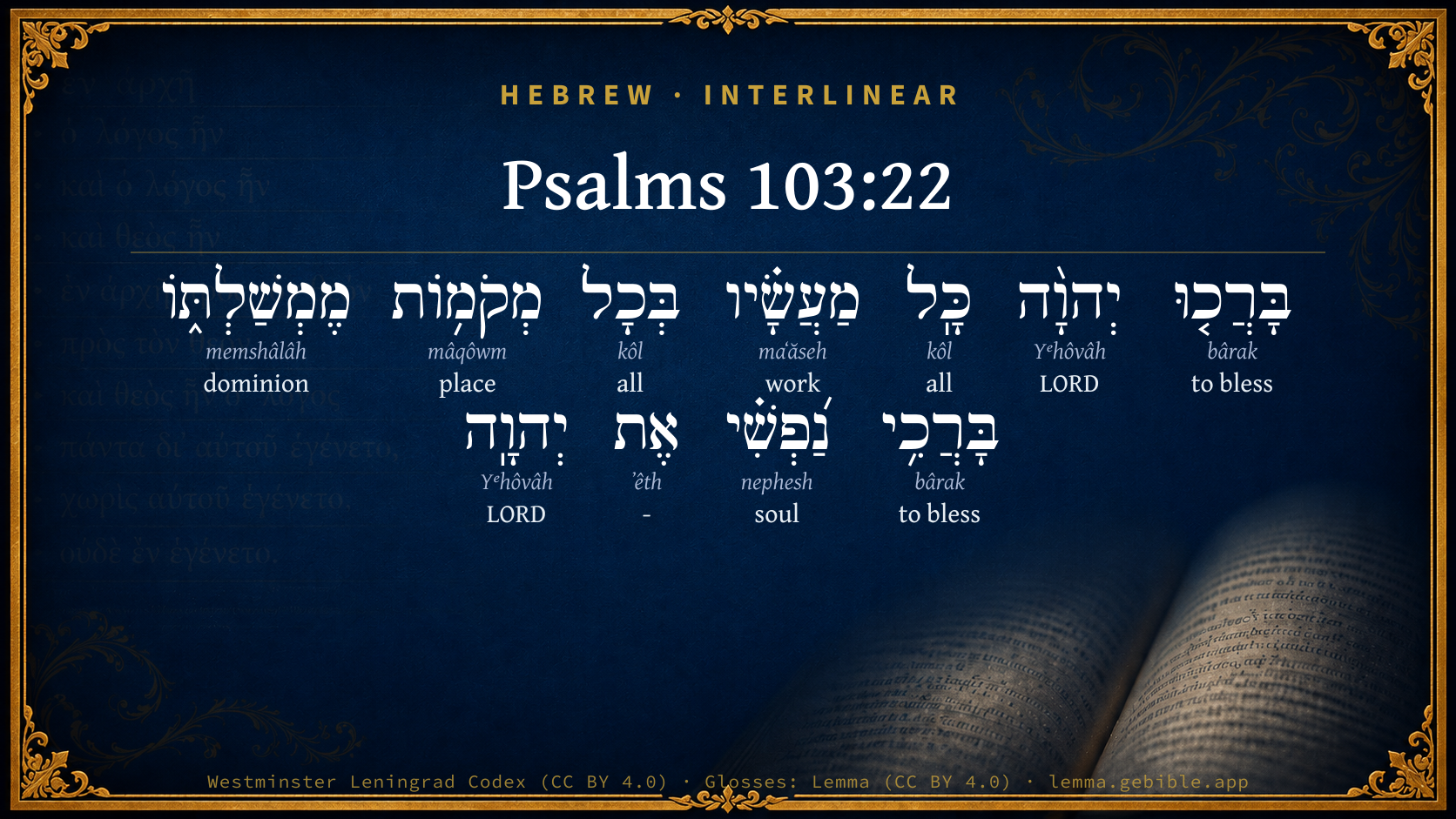
Hebrew (Westminster Leningrad Codex) Psalms 103:22 appears in the Hebrew Old Testament. The text above is from the Westminster Leningrad Codex. Each word links to its Strong’s number, a concise gloss, and parsing drawn from the Open Scriptures Hebrew Bible morphology. Click any word for its full Brown-Driver-Briggs (BDB) entry.
Download image
Cite this verse

Psalms 103:22 (World English Bible). Public Domain. Lemma interlinear Bible study tool, https://lemma.gebible.app/v/psalms/103/22.

Show BibTeX & RIS
BibTeX
RIS
English Translation
Praise Yahweh, all you works of his, In all places of his dominion. Praise Yahweh, my soul.
World English Bible · Public Domain
Download a study sheet

One document with this verse’s original text, its word-by-word gloss line, the meaning frame, cross-references with their text, attributed commentary, and full source and license credits — printable, and it pastes into notes with its structure intact.

This verse Autodidact and up

Study sheet (.html) Plain text (.txt)

A passage Seminary Student

Up to 50 verses in one chapter. A passage sheet keeps up to 6 commentary sources and 12 cross-references per verse, in the order this page ranks them, and says so on the sheet whenever that leaves anything out. Ask for a single verse and you get the Autodidact verse sheet above.

Everything on this page stays free to read, with no account — the sheet is a download of what is already on screen, not access to it.

Want to remove ads? Support Godless Engineer
Compare translations 3

The same verse in 3 English versions, stacked beneath the original-language interlinear above. Click any original word for its lexicon entry.

Each is an independent rendering of the whole verse — the interlinear is not word-aligned to these translations.

Highlighted words mark where these versions differ — a whole-verse word diff, not a word-by-word alignment.

  • World English Bible Public Domain
    Praise Yahweh, all you works of his, In all places of his dominion. Praise Yahweh, my soul.
  • King James Version Public Domain
    Bless the LORD, all his works in all places of his dominion: bless the LORD, O my soul.
  • unfoldingWord Literal Text CC BY-SA 4.0
    Bless Yahweh, all his works, in all the places of his reign! Bless Yahweh, my soul!

unfoldingWord Literal Text — © unfoldingWord, licensed CC BY-SA 4.0. Word-aligned USFM3 via Door43 (git.door43.org/unfoldingWord/en_ult).

Versions to compare (up to 4)

3 of 4 selected

Show all 18 translations

Every available English version of this verse, each an independent rendering of the whole verse.

  • World English Bible Public Domain
    Praise Yahweh, all you works of his, In all places of his dominion. Praise Yahweh, my soul.
  • Berean Standard Bible Public Domain
    Bless the LORD, all His works in all places of His dominion. Bless the LORD, O my soul!
  • Majority Standard Bible Public Domain
    Bless the LORD, all His works in all places of His dominion. Bless the LORD, O my soul!
  • King James Version Public Domain
    Bless the LORD, all his works in all places of his dominion: bless the LORD, O my soul.
  • American Standard Version (1901) Public Domain
    Bless Jehovah, all ye his works, In all places of his dominion: Bless Jehovah, O my soul.
  • Revised Version (1885) Public Domain
    Bless the LORD, all ye his works, in all places of his dominion: bless the LORD, O my soul.
  • Geneva Bible (1599) Public Domain
    Prayse the Lord, all ye his workes, in all places of his dominion: my soule, prayse thou the Lord.
  • Douay-Rheims (1899) Public Domain
    Bless the Lord, all his works: in every place of his dominion, O my soul, bless thou the Lord.
  • Young's Literal Translation Public Domain
    Bless Jehovah, all ye His works, In all places of His dominion. Bless, O my soul, Jehovah!
  • Literal Standard Version CC BY-SA 4.0
    Bless YHWH, all you His works, || In all places of His dominion. Bless, O my soul, YHWH!
  • Unlocked Literal Bible CC BY-SA 4.0
    Give praise to Yahweh, all his creatures, in all the places where he reigns. I will give praise to Yahweh with all my life.
  • unfoldingWord Literal Text CC BY-SA 4.0
    Bless Yahweh, all his works, in all the places of his reign! Bless Yahweh, my soul!
  • Darby Bible Public Domain
    Bless Jehovah, all his works, in all places of his dominion. Bless Jehovah, O my soul!
  • World Messianic Bible Public Domain
    Praise the LORD, all you works of his, in all places of his dominion. Praise the LORD, my soul!
  • Webster's Bible Public Domain
    Bless the LORD, all his works in all places of his dominion: bless the LORD, O my soul.
  • Free Bible Version CC BY-SA 4.0
    Praise the Lord, everything in his creation, everyone under his rule, and let every part of me praise the Lord!
  • Bible in Basic English Public Domain
    Give praise to the Lord, all his works, in all places under his rule: give praise to the Lord, O my soul.
  • JPS Tanakh (1917) Public Domain
    Bless the LORD, all ye His works, in all places of His dominion; bless the LORD, O my soul.

Literal Standard Version (2020), Covenant Press — licensed CC BY-SA 4.0. Text via the HelloAO Bible API (eBible.org). Unlocked Literal Bible (unfoldingWord) — licensed CC BY-SA 4.0. Text via the HelloAO Bible API (eBible.org). unfoldingWord Literal Text — © unfoldingWord, licensed CC BY-SA 4.0. Word-aligned USFM3 via Door43 (git.door43.org/unfoldingWord/en_ult). Free Bible Version, Dr. Jonathan Gallagher — licensed CC BY-SA 4.0. Text via the HelloAO Bible API (eBible.org).

Word by word

More ways to search: Search by grammar → Find every occurrence → Compare this word →

Practice this passage: Drill this verse → Learn its vocabulary →

מֶמְשַׁלְתּ֑וֹ
memshâlâh
H4475
“dominion · his”
Noun, Common, Both, Singular, Construct + Suffix, Personal, 3rd Person, Masculine, Singular
Part of Speech
Noun
Type
Common
Gender
Both
Number
Singular
State
Construct
Full BDB Definition

Origin: from H4474

TWOT: 1259c

rule, dominion, realm - rule, dominion, realm, domain - rule - rule, dominion (of God)
  1. בָּרֲכ֤וּ bârak H1288 “bless” Verb, Piel, Imperative, 2nd Person, Masculine, Plural
  2. יְהוָ֨ה Yᵉhôvâh H3068 “LORD” Noun, Proper
  3. כָּֽל kôl H3605 “all of” Noun, Common, Masculine, Singular, Construct
  4. מַעֲשָׂ֗יו maʻăseh H4639 “works · his” Noun, Common, Masculine, Plural, Construct + Suffix, Personal, 3rd Person, Masculine, Singular
  5. בְּכָל kôl H3605 “in/at · all of” Preposition + Noun, Common, Masculine, Singular, Construct
  6. מְקֹמ֥וֹת mâqôwm H4725 “places of” Noun, Common, Masculine, Plural, Construct
  7. בָּרֲכִ֥י bârak H1288 “bless” Verb, Piel, Imperative, 2nd Person, Feminine, Singular
  8. נַ֝פְשִׁ֗י nephesh H5315 “soul · my” Noun, Common, Both, Singular, Construct + Suffix, Personal, 1st Person, Common, Singular
  9. אֶת ʼêth H853 “-” Particle, Direct Object
  10. יְהוָֽה Yᵉhôvâh H3068 “LORD” Noun, Proper

About this verse

These counts appear in no published source. They are computed here, from the morphology-tagged text and Lemma’s own curated glosses. What Lemma adds →

11
words
8
distinct lemmas
Wisdom
section

Notable vocabulary

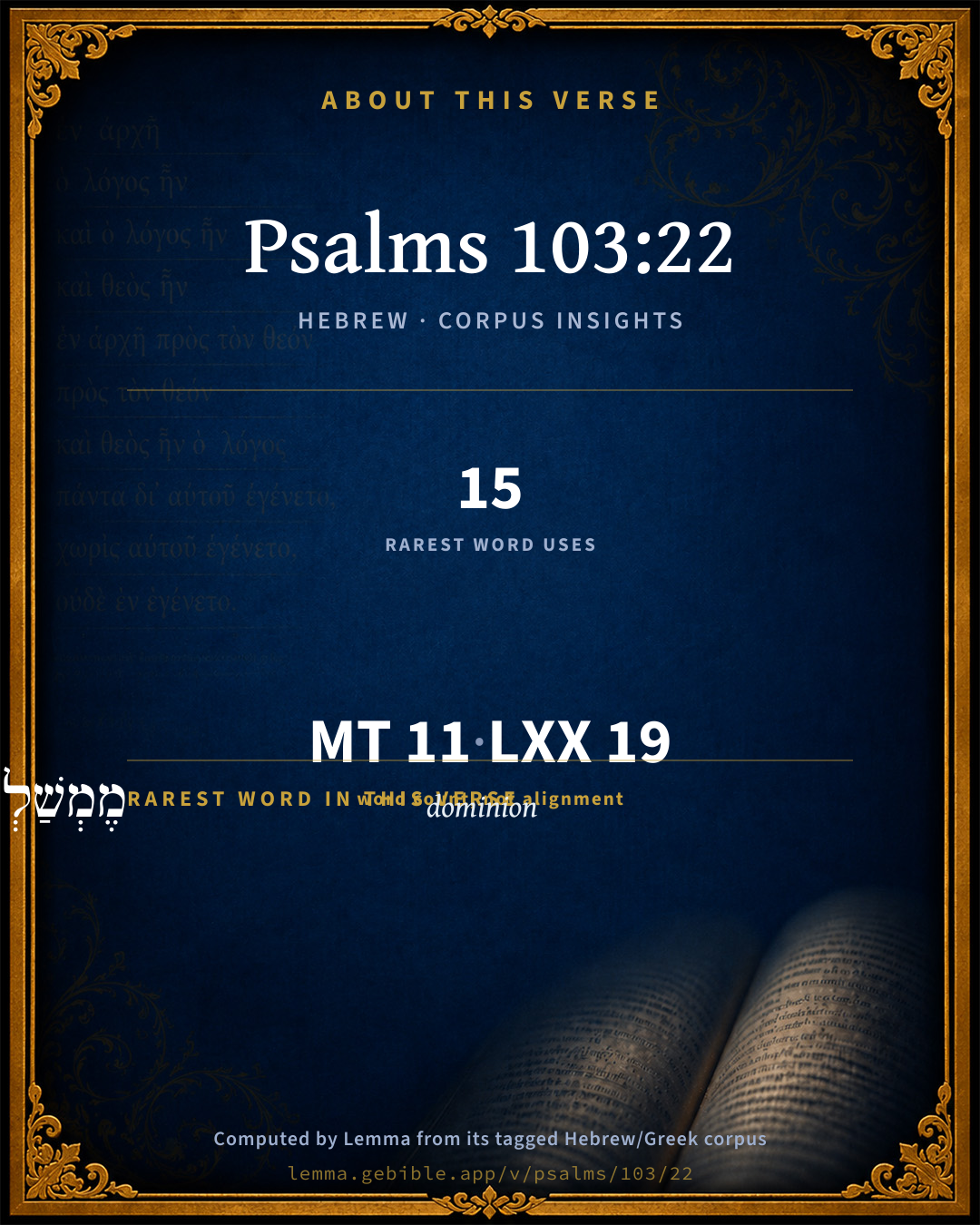
The rarest word here is מֶמְשַׁלְתּ֑וֹ dominion H4475 — appearing just 15 times in the whole Hebrew Bible.

Shared distinctive vocabulary

מֶמְשַׁלְתּ֑וֹ dominion H4475 occurs in 14 verses of the Hebrew Bible. Also found in:

Grammatical profile

  • 2 verbs
  • 8 nouns
  • 1 particle

Verb forms

  • בָּרֲכ֤וּ Piel · Imperative
  • בָּרֲכִ֥י Piel · Imperative

Repetition

Words recur within this verse — often emphatic in Hebrew:

  • בָּרֲכ֤וּ to bless H1288 ×2
  • יְהוָ֨ה LORD H3068 ×2
  • כָּֽל all H3605 ×2

Hebrew & Septuagint length

In English translation the verse runs 17 words from the Hebrew and 18 from the Septuagint (LXX English) — closely comparable.

A rough comparison of the two English renderings, which tokenize alike — not a word-level alignment.

Word counts can differ between the Hebrew and the Greek without any difference in meaning — e.g. the Hebrew direct-object marker אֵת has no separate Greek word, and Greek often adds the article ὁ.

In the original languages it is 11 Hebrew tokens and 19 Greek tokens — but the two are counted differently (Hebrew bundles its prefixes and suffixes into one token; the Greek is in lemma form), so that isn’t a like-for-like length.

Cross-references

12

Topical passages linked to Psalms 103:22 in the Treasury of Scripture Knowledge — connected by theme and wording, ordered by reader-vote popularity; previews shown in the World English Bible.

  • Isaiah 49:13 Sing, heavens; and be joyful, earth; and break forth into singing, mountains: for Yahweh has comforted his people, and will have compassion on his afflicted.
  • Psalms 145:10 All your works will give thanks to you, Yahweh. Your saints will extol you.
  • Isaiah 42:10–12 Sing to Yahweh a new song, and his praise from the end of the earth; you who go down to the sea, and all that is therein, the isles, and the inhabitants of it.
  • Psalms 148:3–12 Praise him, sun and moon! Praise him, all you shining stars!
  • Psalms 150:6 Let everything that has breath praise Yah! Praise Yah!
  • Isaiah 44:23 Sing, you heavens, for Yahweh has done it; shout, you lower parts of the earth; break forth into singing, you mountains, O forest, and every tree therein: for Yahweh has redeemed Jacob, and will glorify himself in Israel.
  • Isaiah 43:20 The animals of the field shall honor me, the jackals and the ostriches; because I give waters in the wilderness, and rivers in the desert, to give drink to my people, my chosen,
  • Revelation 5:12–14 saying with a loud voice, "Worthy is the Lamb who has been killed to receive the power, wealth, wisdom, strength, honor, glory, and blessing!"
  • Psalms 103:1 Praise Yahweh, my soul! All that is within me, praise his holy name!
  • Psalms 104:1 Bless Yahweh, my soul. Yahweh, my God, you are very great. You are clothed with honor and majesty.
  • Psalms 104:35 Let sinners be consumed out of the earth. Let the wicked be no more. Bless Yahweh, my soul. Praise Yah!
  • Psalms 146:1 Praise Yah! Praise Yahweh, my soul.

Cross-references courtesy of OpenBible.info (CC BY 4.0).

Hebrew and Greek witnesses Masoretic Hebrew ↔ Greek Septuagint

The same verse in the two great witnesses to the Old Testament, shown verse-for-verse.

You’re reading Greek Psalm 102 (Hebrew Psalm 103). The Septuagint counts the superscription, so verse numbers can differ from the Hebrew — chapter-level alignment, not verse-by-verse. Numbering follows Rahlfs.

These are two independent witnesses, not word-aligned to each other, and the Septuagint is shown in lemma (dictionary) form.

Hebrew Psalms 103:22 Masoretic · Westminster Leningrad Codex

בָּרֲכ֤וּ יְהוָ֨ה כָּֽל מַעֲשָׂ֗יו בְּכָל מְקֹמ֥וֹת מֶמְשַׁלְתּ֑וֹ בָּרֲכִ֥י נַ֝פְשִׁ֗י אֶת יְהוָֽה

Praise Yahweh, all you works of his, In all places of his dominion. Praise Yahweh, my soul.

World English Bible · Public Domain

Greek LXX Greek Psalm 102:22 Septuagint · lemma form

εὐλογέω ὁ κύριος πᾶς ὁ ἔργον αὐτός ἐν πᾶς τόπος ὁ δεσποτεία αὐτός εὐλογέω ὁ ψυχή ἐγώ ὁ κύριος

Bless the Lord, all his works, in every place of his dominion: bless the Lord, O my soul.

LXX2012 (modern English Septuagint) · Public Domain

Hebrew: Westminster Leningrad Codex (CC BY 4.0). Greek: Septuagint (public domain); English from LXX2012 (modern English Septuagint) (Public Domain). How the Septuagint differs from the Hebrew →

Commentary

Notes on Psalms 103:22 from classic Christian and Jewish commentators (each source and its license shown beneath its notes). The classic Christian expositions comment on the surrounding passage and are grouped to its opening verse, so a note may address several verses; the Jewish commentaries on the Tanakh (Rashi and others) are per-verse, so they appear only where the commentator wrote on this verse.

Lemma curates 59 commentaries, every one of them public domain or Creative Commons licensed, each selected and text-cleaned for this edition rather than reprinted as found. About our sources →

Trapp's Complete Commentary

John Trapp

Psa 103:22 Bless the LORD, all his works in all places of his dominion: bless the LORD, O my soul.

Ver. 22. Bless the Lord, all his works] Whether living or lifeless; for all thy works praise thee, O Lord, and thy saints bless thee, Psa 145:10. Benedicite ter, ad mysterium Triadis, saith an interpreter.

Bless the Lord, O my soul] Whatever others do, let me be doing at it, as Jos 24:14-15.

John Trapp, A Commentary or Exposition upon All the Books of the Old and New Testament (1647–1656) — public domain. Text from a community e-Sword module.

The Biblical Illustrator

Joseph S. Exell

Psa_103:22

Bless the Lord, all His works in all places of His dominion.

The illimitable vastness of the universe

How does our conception of the universe differ from that of David? It differs, among other things, mainly because we know, and he did not know, of infinite time, peopled with innumerable existences, on infinite space, crowded with unnumbered worlds. To David the earth probably seemed comparatively a thing of yesterday. We know of ages when the earth may have been a nebulous mass; of ages more when it was certainly one tangled growth of gigantic vegetation; of ages more when it was trodden by huge and fearful lizards--dragons of the prime, tearing each other with lethal armour of incomparable deadliness. We look at a piece of chalk, and we know that to form it took the spoils of millions of living organisms; and the man sinks powerless before the effort to conceive the years which it must have taken, by ordinary processes, to build up the white ramparts of our coasts. Yes, the knowledge of the deeps which geology reveals, so far from rendering too dim for us, tends only to brighten for us the image of a Fathers love. We know that that Father is caring for us now, and geology has simply proved to us that He was caring for our race, it may be, a billion of years before it appeared upon our globe. But if science has thus widened for us the horizons of time, still more illimitably has it widened for us the horizons of space; still more completely has it annihilated mans self-importance about his race, and about the globe on which he lives. To the ancients, for instance, the world was a very centre of all things, and a very image of immovable stability. To us it is an insignificant speck in the heavens of no material importance, and with no centrality about it; and, so far from being fixed, we know that it is rolling, with incessant revolution, on its own axis, whirling, at immense velocity, round the sun, spinning, as one has said, like an angry midge, in the abyss of its own small system, of which it is but one out of one hundred planets and asteroids, and of which the farthest of these planets rolls three hundred thousand millions of miles round the sun upon its sullen and solitary round. Again, to the ancients, and to David, the moon was but an ornament of the night, a silver cresset hung by Gods hand in heaven, to illumine the darkened earth. To us it is, indeed, this, and we thank God for it, and also for its services, unknown to our forefathers, of attracting the waters, and so causing to roll, from hemisphere to hemisphere, that great tidal wave which purifies the world. But we have also learnt with amazement what the moon is. We know that it is a small world, in structure like our own; but without atmosphere, without clouds, without seas, without rivers, rent with enormous fissures, scathed and scorched with eruptive violences, a burnt-up cinder, a volcanic waste, the wreck, for all we know, of some past home of existence, a corpse in nights highway, naked, fire-scathed, accursed; and if, in the complications of her silent revolutions,

She nightly, to the listening earth,

Repeats the story of her birth,

yet that story presents us with so blank a mystery, that it forces our acknowledgment that it may seem as if its one blank hemisphere was only turned to this earth and its science in mocking irony, as though to convince us, against our will, that what we know is little--what we are ignorant of immense. Then, once more, turn to the sun. The ancients saw its splendour; they felt its warmth; they thanked God for its glory. To David it was, as you know, as a bridegroom cometh forth out of his chamber, and rejoiceth as a giant to run his course. It was thought a monstrous extravagance when one of the Greek philosophers said that it was a fiery mass, and another that it was about the size of Attica. But what is it to us? Look at the bas-relief of the tomb of Newton in Westminster Abbey, and there you will see the little genius weighing the sun, and the earth, and the planets on a steelyard. Yes, we know its weight; we know its distance; we know its revolution. We know even, of late years, by spectrum analysis, of what metals and gases it is composed. No human language can express its awfulness. That great orb, as we have discovered, bursts and boils with a horrible impetuosity, such as no human imagination can conceive; and yet this vast, portentous globe of fire is made to subserve the humblest purposes of man. Once more, for a moment, turn to the stars. Turn to the millions of stars in the Milky Way. Our sun is neither more nor less than just one, and one unimportant, star in that Milky Way. To David, when he said that the heavens declared the glory of God, only were known two or three thousand stars visible to the naked eye. To us are known somewhere about fifty millions. And, yet, I say again that the Christian is not in the least appalled by all this vastness. Space is nothing to that God who extends through all extent, and in the hollow of whose hand all those worlds lie as though they were but a single water-drop. But, by the telescope, better without it--

Man may see

Stretched awful in the hushed midnight,

The ghost of his eternity.

But yet, happily, perhaps, for us, simultaneously with this abyss of non-existence beyond man, God has revealed to us an infinitude of life below Him. Take an animalcula, and Pascal will tell you that, however small its body, it is yet smaller in its limbs, and there are joints in those limbs, veins in those joints, blood in those veins, drops in that blood, humour in those drops, vapour in that humour, and an abyss even below this--an immensity of invisible life; so that man, we say, is suspended between two infinities--an abyss of infinity below, and of nothingness above, him. He is a mean between the nothing and the all--nothing compared to the infinite, infinite compared to the nothing. Is not this, at least, a lesson of humility? Should it not compel man rather to contemplate in silence than to inquire with presumption? Such knowledge is too deep and wonderful for me; I cannot attain to it. What is man that Thou art mindful of him, and the son of man that Thou so regardest him? Here, for the Christian, at any rate, lies the solution of the dark enigma, the removal of the painful perplexity, the removal of the intolerable weight. Man is nothing in himself. He is as small, as mean, as abject as you please. He is but a fragment of the dust to which he shall soon return. Yes, but in himself nothing, in God man is every-thing--sacred, holy, sublime, immortal, a child of God, a joint-heir with Christ. What is vastness, then, to the Christian that it should appal him? It is nothing; it is less than nothing. It does not oppress or crush him. He is greater than those worlds. He is more immortal than all those clustered suns. They are, after all, but gas and flame; but he lives, and he is immortal, and he is created in the image of God. (Dean Farrar.)

Bless the Lord, O my soul--

The perils of the spiritual guide

In the two preceding verses the psalmist had similarly demanded that the Lords works should praise Him--Bless the Lord, ye His angels, etc. In our text, as though he would no longer invoke separately any order of being, or any department of creation, he summons the whole universe to join in the glorious work--Bless the Lord, all His works in all places of His dominion; and after this most comprehensive demand, is there anything else from which he can ask praise? Yes, he subjoins, bless the Lord, O my soul. It seems as if a sudden fear had seized the psalmist, the fear of by any possibility omitting himself; or, if not a fear, yet a consciousness that his very activity in summoning others to praise, might make him forgetful that he was bound to praise God himself. Alas! how possible, how easy, to take pains for others, and to be neglectful of oneself: nay, to make the pains we take for others the reason by which we persuade ourselves that we cannot be neglecting ourselves. Religion of all matters is that which will least bear to be handled professionally: in the mere way of business or occupation. If we once come to handle spiritual things as though they were objects of merchandise or topics for essays, if we come to speak of them with the language of barren speculation, so that the description of the tongue outruns the experience of the heart; alas for the condition of the minister! But it may be well that we consider a little more in detail how that danger may be guarded against, which it has been our endeavour to expose. How shall the guide who feels his mind deadening to the influence of the natural landscape, through the frequency of inspection and the routine of describing it to strangers,--how shall he prevail in keeping his mind alive to the beauties of the scene, the wonders and splendours which crowd the panorama? Let him not be satisfied with showing that panorama to others; let him not look upon it merely in his professional capacity, but let him take frequent opportunities of going by himself to various points of view that he may study it under all possible aspects, now when the shadows of evening rest darkly on the water, now when the sunshine sleeps lovingly on the valley, now when the storm is abroad in its strength, now when the spring mantles hill and plain with its loveliness, and now when winter reigns in coldness and desolateness. Let him not be content with expounding the Bible, or with studying it with a view to his professional duties; let him be careful that he have his season of private meditation, when, like the guide, he may stand on Pisgah by himself, and for himself, not considering the scene with the eye of one who has to delineate the magnificent landscape, but rather with that of one who has to find in it a spot which he may call his own, and where he may fix his everlasting habitation. The more we engage in teaching others, in setting before others the blessings procured by the interference of Christ, the more tenacious should we be of seasons of private meditation and self-examination. For such seasons become then increasingly needful, lest we fancy our acquaintance with truth perfect, or our appreciation of it adequate, and thus shall we not only keep our own lamp well trimmed, but be more than ever fitted, by the blessing of God, to shed light on those who may be walking in darkness and the shadow of death. It is he who is daily schooling himself who is most likely to be instrumental in guiding others to God; the note struck within will produce the greatest vibration around; if I would waken an anthem of praise, I must first attune to thanks the chords of my own soul. (H. Melvill, B.D.)

.

Psa_104:1-35

The Biblical Illustrator, edited by Joseph S. Exell (c. 1880s–1900s) — public domain. Text from a community e-Sword module.

J. A. Alexander on Psalms

Joseph Addison Alexander

22. (Psa 103:22) Bless ye Jehovah, all his works, in all places of his realm; bless thou, 0 my soul, Jehovah! The angels and heavenly bodies, with men and every other creature, are now summed up in the comprehensive phrase, all his works, i.e. all that he has made, all creatures, and invited to bless God, which invitation the Psalmist then addresses once more to himself, and thus, by a beautiful transition, brings us back to the point from which we started.

Joseph Addison Alexander, The Psalms Translated and Explained (1850) — public domain. Text from a community e-Sword module.

Tyndale Open Study Notes

Tyndale Open Resources

103:22 God’s kingdom extends over all things, so all things are called to praise the Lord. • The concluding phrase takes us back to 103:1-2.

Tyndale Open Study Notes — © Tyndale Open Resources, licensed CC BY-SA 4.0. Text via the HelloAO Bible API.

Adam Clarke's Commentary

Verse 22. Bless the Lord, all his works] Let every thing he has done be so considered as to show forth his praise.

Bless the Lord, O my soul.] Let me never forget my obligation to his mercy; for with tender mercies and loving-kindness has he crowned me. I will therefore be thankful unto him, and speak good of his name.

ANALYSIS OF THE ONE HUNDRED AND THIRD PSALM

There are three parts in this Psalm: -

I. The exordium, in which the psalmist invites his own soul to praise the Lord, Ps 103:1-2.

II. The narration, being a declaration of God's benefits conferred on him and others, and the causes of those benefits, Ps 103:3-19.

III. The conclusion, in which he calls on all creatures to assist him in praising the Lord, Ps 103:20-22.

I. The exordium, -

1. Bless God. Think on the benefit, and praise the Benefactor.

2. Let the soul join in this. Let it be done heartily; lip - labour is little worth.

3. "All that is within me." Every faculty, - understanding, will, memory, judgment, affections, desires, c.

4. "Bless Jehovah," who gave thee thy being, and all thy blessings.

5. "Forget not his benefits." Most forget their obligations both to God and man but ingratitude, which is the source of forgetfulness, is abominable.

6. "All his benefits." Thou hast already for gotten many; forget no more. The word gemuley, signifies, literally, retributions or recompenses, as the Vulgate has well expressed it. And of what kind are these recompenses? Invariably good for evil; nor hast thou ever offered him one accent of praise that he has not compensated with a blessing of infinite value.

II. The narration. A declaration of benefits. 1. To himself. 2. To the Church. These were, - 1. Spiritual; 2. Temporal benefits.

First spiritual benefit - justification: "He forgiveth all thine iniquities."

Second spiritual benefit - regeneration or sanctification: "Healeth all thy diseases."

Third spiritual benefit - redemption from the first and second death, in consequence of being thus justified and sanctified.

Fourth spiritual benefit - glorification anticipated: "Who crowneth thee with loving-kindness and tender mercy." The crown comes from the loving-kindness and tender mercy of God; not from any merit in man.

The temporal benefits are, -

1. Abundance of the necessaries of life: "Who satisfieth thy mouth with good things."

2. Health and long life: "Thy youth is renewed like the eagle's." See the note on this passage.

The benefits to the whole Church are, -

1. Defence and deliverance: "The Lord executes judgment."

2. Manifestation of his will: "He made known his ways," c.

All these spring from the four attributes mentioned below, -

1. "He is merciful," רחום rachum, bearing a paternal affection to his intelligent creatures, especially to those who fear him.

2. "Gracious," חנון channun, the Giver of grace and favour for he who has a fatherly heart will give.

3. "Slow to anger," ארך אפים erech appayim, long in nostrils, not hasty; not apt to be angry.

4. "Plenteous in mercy," רב חסד rab chesed, multiplying kindness. Gives abundantly from his own bounty, not according to our merit.

The effects of all these are, -

1. Because he is merciful: "He will not always chide."

2. Because he is gracious: "He deals not with us after our sin."

3. Because he is slow to anger: "He will not keep his anger forever."

4. Because he is plenteous in mercies: His mercies surpass our sins as much as heaven surpasses the earth.

5. Because he is like a father: He "pities his children;" considers their frame, and makes all the allowance that justice mingled with mercy can make.

6. And as he is righteous - true, and faithful in performing his covenant, his mercy is everlasting to those that fear him.

But let it be remembered who they are that have a right to expect such blessings: -

1. "Those who fear him."

2. "Those who keep his covenant."

3. "Those who remember his commandments, and do them."

That he is able to do all that he has promised, the psalmist marks his dominion: -

1. It is not circumscribed: "His throne is in heaven."

2. It takes in all places and all nations. For "his kingdom ruleth over all;" he is King of kings, and Lord of lords.

III. The conclusion. For these benefits he invites all creatures to praise the Lord.

1. The angels, whom he describes, - 1. From their excellence: "Ye that excel in strength." 2. From their obedience: "Ye that do his commandments." 3. From their readiness and cheerfulness in it: "Ye that hearken to the voice of his words," - who are ever ready, at the slightest intimation, to perform his will.

2. All the hosts or armies of God, - archangels, principalities, dominions, powers, thrones, c.

3. He invites all the creatures of God to praise him, whether animate or inanimate: "All creatures, in all places of his dominion." This extends throughout immensity. For this there is the strongest reason - he made all - rules over all - "is in all places" with all - preserves all - moves all.

4. To show that he who calls upon others will not be backward himself to praise God as he began, so he concludes, with "Bless the Lord, O my soul!" Thus he had the high praises of God continually in his mouth.

And thus finishes this most excellent and inimitable Psalm. The old Psalter concludes thus: "Blysses to Lorde al his werks in ilk stede of his Lordschip: blisse my saule to Lorde. When men well lyfes, al thair werks blysses God. Fra blyssyng we cum forth to blyssyngs, gawe agayne, and tharein dwell we."

The more we praise God, the more occasion we shall see to praise him, and the more spiritually minded we shall become. Praise proceeds from gratitude; gratitude from a sense of obligation; and both praise and gratitude will be in proportion to the weight of that obligation; and the weight will be in proportion to the sense we have of God's great goodness and our own unworthiness. As the reader's heart may be in a heavenly frame, I shall help him to express his feelings by the following inimitable verses, which express the substance of the preceding Psalm: -

From all that dwell below the skies

Let the Creator's praise arise!

Let the Redeemer's grace be sung

In every land, by every tongue!

Eternal are thy mercies, Lord!

Eternal truth attends thy word!

Thy praise shall sound from shore to shore,

Till sun shall rise and set no more.

Praise GOD, from whom all blessings flow!

Praise Him, all creatures here below!

Praise Him above, ye heavenly host!

Praise FATHER, SON, and HOLY GHOST!

Amen and Amen.

Adam Clarke's Commentary on the Bible (1810–1826) — public domain. Text from a community e-Sword/MySword module.

John Calvin's Commentaries

22 Bless Jehovah, all ye his works The Psalmist in conclusion addresses all creatures; for although they may be without speech and understanding, yet they ought in a manner to re-echo the praises of their Creator. This he does on our account, that we may learn that there is not a corner in heaven or on earth where God is not praised. We have less excuse, if, when all the works of God by praising their Maker reproach us for our sloth we do not at least follow their example. The express mention of all places of his dominion, seems to be intended to stir up the faithful to greater ardor in this exercise; for if even those countries where his voice is unheard ought not to be mute in his praise, how can we lawfully remain silent to whom he opens his mouth, anticipating us by his own sacred voice? In short, David shows that his design in recounting God’s benefits, and magnifying the extent of his empire, was to animate himself the more to the exercise of praising him.

John Calvin's Commentaries (1540-1563) — public domain. Text from the Calvin Translation Society English edition (1840s-50s) via the Christian Classics Ethereal Library (ccel.org). Calvin's coverage is partial (roughly two-thirds of the Bible); uncommented books and verses are honest gaps, never fabricated. The 19th-century editor's footnotes and remarks are omitted so the notes are faithfully Calvin's own voice.

Ellicott's Commentary for English Readers

(22) All his works.—Not only the heavens and their hosts, but

“Earth with her thousand voices praises God.”

Nor can the psalmist himself remain silent, but must repeat the self-dedication with winch he began his song.

A Bible Commentary for English Readers, edited by Charles John Ellicott (1878–1897) — public domain. Text from a community e-Sword module.

The Cambridge Bible for Schools and Colleges

gen. ed. J. J. S. Perowne

22. Bless Jehovah, all ye his works,

In all places of his dominion:

Bless Jehovah, O my soul.

The ‘Song of the Three Children’ is a noble expansion of this theme. In the last line the Psalmist returns to the point from which he started. In creation’s universal hymn of praise he would fain bear his part, however humble.

The Cambridge Bible for Schools and Colleges (gen. ed. J. J. S. Perowne; Cambridge University Press, 1878–1918) — public domain. Text from a community e-Sword module.

Albert Barnes' Notes on the Bible

Bless the Lord, all his works - All that he has made, animate and inanimate, intelligent and brute. It is not uncommon to call on the inanimate creation to join with intelligent beings in praising God. Compare Psa 148:1-14. The same thing is often found in the “Paradise Lost,” and in fact occurs in all poetry.

In all places of his dominion - Wherever he reigns, on earth, or in heaven; here or in distant worlds.

Bless the Lord, O my soul - Ending the psalm as it began, and with the additional reason derived from the fact that the “universe” is called on to do it. As one of the creatures of God; as a part of that vast universe, the psalmist now calls on his own soul to unite with all others - to be one of them - in praising and blessing the Creator. He “desired” thus to unite with all others. His heart was full; and in a universe thus joyous - thus vocal with praise - he wished to be one among the immense multitudes that lifted their voices in adoration of the great Yahweh.

Albert Barnes' Notes on the Bible (1834–1885) — public domain. Text from a community e-Sword/MySword module.

Matthew Poole's English Annotations

All his works in all places of his dominion; all creatures, both in heaven and earth, according to your several capacities.

Bless the Lord, O my soul; which thou hast special and abundant reason to do. Thus he ends the Psalm with the same words wherewith he began it.

Matthew Poole's English Annotations on the Holy Bible (1683–1685) — public domain. Text from a community e-Sword/MySword module.

The Treasury of David

Charles H. Spurgeon

Ver. 22. Bless the Lord, all his works in all places of his dominion. Here is a trinity of blessing for the thrice blessed God, and each one of the three blessings is an enlargement upon that which went before. This is the most comprehensive of all, for what can be a wider call than to all in all places? See how finite man can awaken unbounded praise! Man is but little, yet, placing his hands upon the keys of the great organ of the universe, he wakes it to thunders of adoration! Redeemed man is the voice of nature, the priest in the temple of creation, the precentor in the worship of the universe. O that all the Lord's works on earth were delivered from the vanity to which they were made subject, and brought into the glorious liberty of the children of God: the time is hastening on and will most surely come; then will all the Lord's works bless him indeed. The immutable promise is ripening, the sure mercy is on its way. Hasten, ye winged hours!

Bless the Lord, O my soul. He closes on his key-note. He cannot be content to call on others without taking his own part; nor because others sing more loudly and perfectly, will he be content to be set aside. O my soul, come home to thyself and to thy God, and let the little world within thee keep time and tune to the spheres which are ringing out Jehovah's praise. O infinitely blessed Lord, favour us with this highest blessing of being for ever and ever wholly engrossed in blessing Thee.

Ver. 22. Bless the LORD, O my soul. That is to say, "Let thy vocation be that of the seraphim, O my soul, and enter on the life of heaven!" Why should I praise him? Can my praise be of any advantage to him? No; nor that of all the heavenly hosts. It is infinite condescension in him to bearken unto the praises of his most exalted creatures.

Let me bless the Lord, because no function will be more rich in blessings to my soul than this. The admiring contemplation of his excellence is in reality the appropriation thereof: the heart cannot delight in God, without becoming like God. Let me do it, because it is the peculiar privilege of man on this earth to bless the Lord. When he would find any to join him in this, he has to ascend the skies. Let me do it, because the earth is fully furnished with the materials of praise. The sands, the seas, the flowers, the insects; animals, birds, fields, mountains, rivers, trees, clouds, sun, moon, stars, all wait for me to translate their attribues and distinctions into praise. But, above all, the new creation.

Let me do it, because of him, through him, and to him, are all the things that pertain to my existence, health, comfort, knowledge, dignity, safety, progress, power, and usefulness. A thousand of his ministers in earth, sea, and sky, are concerned in the production and preparation of every mouthful that I eat. The breath that I am commanded and enabled to modulate in praise, neither comes nor goes without a most surprising exhibition of the condescension, kindness, wisdom, power, and presence of him whom I am to praise. Is it not dastardly to be receiving benefits, without even mentioning the name, or describing the goodness of the giver? Let candidates for heaven bless the Lord. There is no place there for such as have not learned this art. How shall I praise him? Not with fine words. No poetic talent is here necessary: Any language that expresses heart-felt admiration will be accepted. Praise him so far as you know him; and he will make known to you more of his glory. George Bowen, 1873.

Ver. 22. The last specification is completely comprehensive; all his works in all places of his wide dominions all that he has made, whether intelligent or not intelligent; "in all places" above, beneath, around: in heaven, earth, or hell: let them all fall into this universal chorus of praise and blessing, extolling Jehovah, the One supremely great, supremely good! Nor will he exempt himself; for his personal responsibilities as to his own heart, are his highest. Therefore he closes as he began, "Bless the LORD, O my soul." Henry Cowles.

Ver. 22. Bless the LORD, O my soul. Inasmuch as the poet thus comes back to his own soul, his Psalm also turns back into itself and assumes the form of a converging circle. Franz Delitzsch.

Ver. 22. Bless the LORD, all his works in all places of his dominion: bless the LORD, O my soul. We are very much struck by this sudden transition from "all God's works, in all places of his dominion, "to himself, a solitary individual. Of course he had already included himself; himself had been summoned when he summoned all God's works in all places of his dominion; but it seems as if a sudden fear had seized the Psalmist, the fear of by any possibility omitting himself; or, if not a fear, yet a consciousness that his very activity in summoning others to praise, might make him forgetful that he was bound to praise God himself, or sluggish in the duty, or ready to take for granted that he could not himself be neglecting what he was so strenuous in pressing on all orders of being. We have a great subject of discourse here. Solomon has said, "They made me keeper of the vineyards, but mine own vineyard have I not kept." Alas! how possible, how easy, to take pains for others, and to be neglectful of one's self: nay, to make the pains we take for others the reason by which we persuade ourselves that we cannot be neglecting ourselves. How important, then, that, if with the Psalmist we call on all God's works in all places of his dominions to bless the Lord; how important, I say, that we add, like persons bent on self-examination, and fearful of self-deceit, "Bless the LORD, O my soul." Henry Melvill.

Ver. 22.

1. The Chorus.

2. The Echo. W.D.

Meditations and Disquisitions, upon Seven Consolatarie Psalmes of David... by Sir RICHARD BAKER, Knight, 1640. pg 143-172.

Gratitude: an Exposition of the Hundred and Third Psalm. By the Rev. JOHN STEVENSON, Vicar of Patrixbourne-with-Bridge, Canterbury.

1856.

Charles H. Spurgeon's The Treasury of David (1869–1885) — public domain. Psalms only. Text from a community e-Sword/MySword module.

Whedon's Commentary on the Bible

Daniel D. Whedon

22. All his works—All animate and inanimate creatures, the universe, as Psa_103:19. Bless the Lord, O my soul. The thrice “Bless the Lord, O my soul,” (see Psa_103:1-2,) answers to the thrice “Bless ye the Lord;” and, as if to place his own obligation above that of all other beings, he fitly begins and ends the psalm alike, with the same personal call, “Bless the Lord, O my soul.” The psalmist herein furnishes an instructive example to all believers who have sought and found forgiving and accepting grace.

Daniel D. Whedon (gen. ed.), Commentary on the Old and New Testaments (1874–1909) — public domain. Text from a community e-Sword module.

The Pulpit Commentary

Bless the Lord, all his works in all places of his dominion. (comp. Psa_19:1-4 Psa_145:10 Psa_148:7-13) The "works of Godi.e. his material universe cannot, of course, he said to "bless" God in the same sense that men and angels do; but, in a language of their own, they set forth his glory, and to the poetic mind seem truly to sing his praise. The "Song of the Three Children" is a natural outburst from devout hearts. Bless the Lord, O my soul (comp. ver. 1, and the comment ad loc. ).

The peril of the spiritual guide.

Such is the title which a great preacher has given to a sermon on this text. The subject is suggested by its closing words. The psalmist had been summoning angels and all the works of the Lord to bless the Lord, and, as if he remembered that he might be

I CALLING OTHERS TO PRAISE THE LORD, AND YET NEGLECTING IT HIMSELF, he adds, "Bless the Lord, O my soul!

1. And this is a real possibility and a terrible peril. Like as a guide to the loveliest scenes of nature may lead a traveller to different points of view, which will show the glorious landscape at its best, and may expatiate on the beauties that are to be seen, yet may himself be not in the slightest degree stirred or moved by what he calls on the traveller to admire. He has come to be so familiar with it all; he has said the same thing so many times, it is part of his professional talk; he has seen all these glorious things so often, that they have lost their power to affect him. At first it was otherwise; he had become a guide to these scenes because he so delighted in them. But that was a long time ago. He had thought that he could not spend his life more happily than in conducting others to these same beautiful places, and showing them their glories. But all that enthusiasm has long passed, and he is now a mere professional guide.

2. And so, the great preacher to whom I have referred points out, it may be with the spiritual guide the minister of Christ, the teacher of others in holy things. He may have begun with enthusiasm for the blessed truths and the bright prospects to which he was to lead others; he had such joy in them himself, that to show to others these things seemed an employment to which he might, as in fact he did, give his whole life and soul. But alas! he has got so familiar with it all; the work has become such a routine, that all the old zest and glow and enthusiasm are gone, and he too has become a mere professional guide. God help him and all such! This is the peril.

II THE SAFEGUARD is, by continual meditation, prayer, and obedience to the Lord, to maintain the freshness, the force, and the "first love." And this safeguard is sure. S.C.

The Pulpit Commentary (1880–1919), ed. H.D.M. Spence-Jones & Joseph S. Exell — public domain. Text from a community e-Sword module.

Rashi

Rabbi Shlomo Yitzchaki (Rashi)

Bless the Lord, all His works who are in all the places of His dominion.

Rashi on the Tanakh — English translations: “The Judaica Press complete Tanach with Rashi, translated by A. J. Rosenberg” (CC BY 4.0); “Pentateuch with Rashi's commentary by M. Rosenbaum and A.M. Silbermann, 1929-1934” (public domain); “The Metsudah Tanach series, Lakewood, N.J” (CC BY 4.0); and “The Book of Joshua, Metsudah Publications, 1997” (CC BY 4.0). Text via Sefaria.

Lesson kit

Teaching starters — assembled from the data on this page, not authored interpretation. Every prompt links to the verse data it draws on. Edit before teaching.

Psalms, in the Wisdom, opens this verse with 11 words (8 distinct Hebrew lemmas). Its most distinctive word is memshâlâh (“dominion”). A historical commentator’s framing appears above. Read the whole chapter for the surrounding context.

Discussion questions

  1. How does “dominion” (memshâlâh) shape what this verse is saying?
  2. Genesis 1:16 shares the word «dominion» with this verse. How do the two illuminate each other?
  3. “to bless” occurs 2× in this one verse. What is the effect of the repetition?
  4. The translations on this page render this verse differently — a whole-verse word diff, not a word-by-word alignment. What might account for the different wordings?
  5. The verb «בָּרֲכ֤וּ» is Piel Imperative. How does its form color the action?
  6. Reading how Trapp's Complete Commentary and The Biblical Illustrator read this verse, where do the two commentators agree and where do they part?

Things to notice

Reading settings

Reading text

Shown beneath each verse's original-language words.

Old Testament
Old Testament edition

Read the OT as the Masoretic Hebrew (MT) or the Greek Septuagint (LXX).

English shown for the Greek Septuagint (in the Hebrew ↔ Greek comparison).

Comparing translations? Open the Compare panel on any verse page to stack up to four side by side.